patent · US5615742
Noncombustible hydrogen gas containing atmospheres and their production
1 April 1997
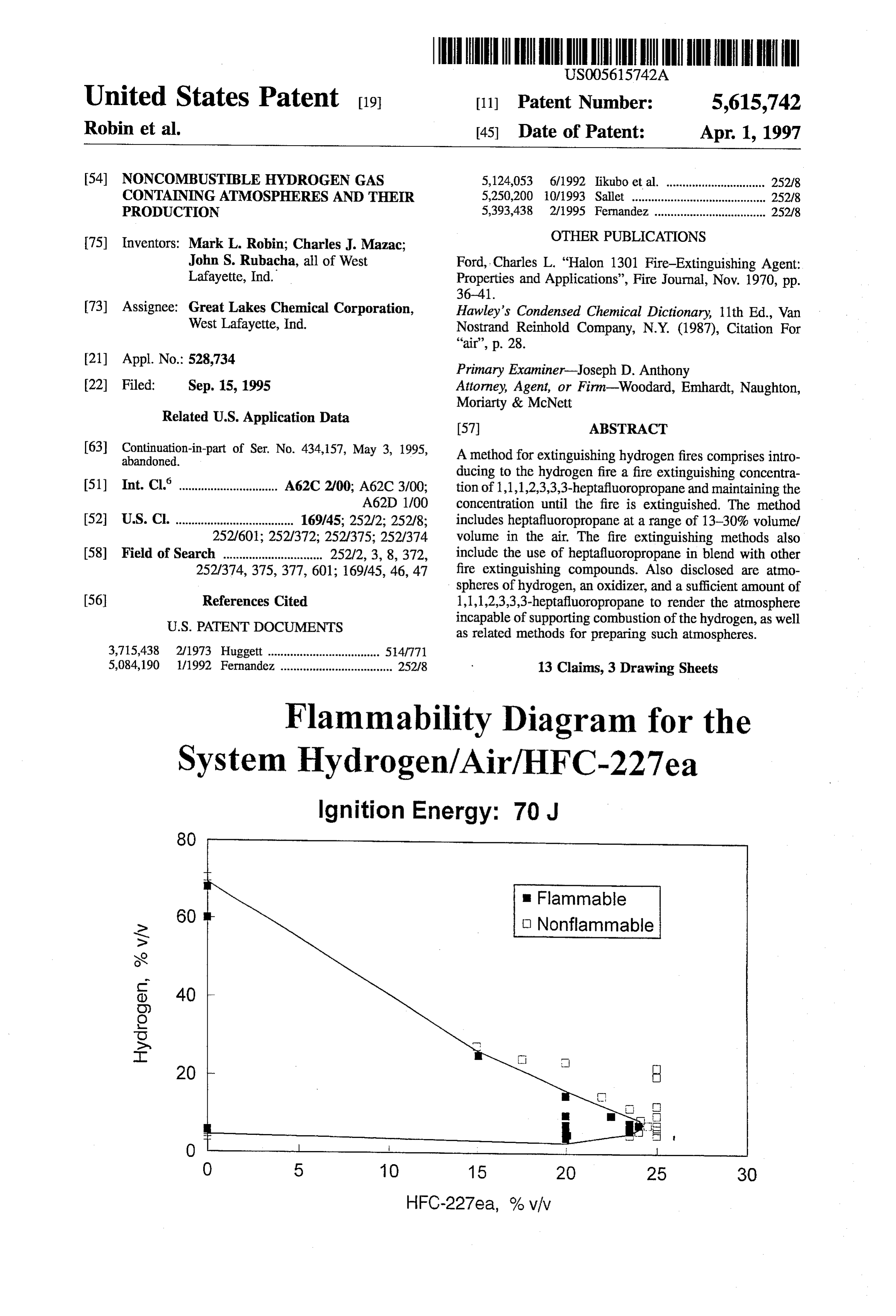
Page 1 — bibliographic record
United States Patent (19) 11) Patent Number: 5,615,742 Robin et al. 45) Date of Patent: Apr. 1, 1997 54) NONCOMBUSTIBLE HYDROGEN GAS 5,124,053 6/1992 likubo et al. ............................... 252/8 CONTAINING ATMOSPHERES AND THEIR 5,250,200 10/1993 Sallet ............. PRODUCTION 5,393,438 2/1995 Fernandez ................................... 252/8 75) Inventors: Mark L. Robin; Charles J. Mazac, OTHER PUBLICATIONS John S. Rubacha, all of West
Lafayette, Ind.
Ford, Charles L. "Halon 1301 Fire-Extinguishing Agent:
Properties and Applications”, Fire Journal, Nov. 1970, pp.
(73) Assignee: Great Lakes Chemical Corporation, Hawley's Condensed Chemical Dictionary, 11th Ed., Van West Lafayette, Ind. Nostrand Reinhold Company, N.Y. (1987), Citation For
Primary Examiner-Joseph D. Anthony 22) Filed: Sep. 15, 1995 Attorney, Agent, or Firm-Woodard, Emhardt, Naughton, Moriarty & McNett
Related U.S. Application Data
(63) Continuation-in-part of Ser. No. 434,157, May 3, 1995, A method for extinguishing hydrogen fires comprises intro abandoned.
ducing to the hydrogen fire a fire extinguishing concentra (51) Int. Cl. ................... A62C 2700; A62C 3700; tion of 1,1,1,2,3,3,3-heptafluoropropane and maintaining the A62D 1100 concentration until the fire is extinguished. The method (52) U.S. C. ..................................... 169/45; 252/2; 252/8; includes heptafluoropropane at a range of 13-30% volumel 252/601; 252/372; 252/375; 252/374 volume in the air. The fire extinguishing methods also 58) Field of Search ............................... 252/2, 3, 8,372, include the use of heptafluoropropane in blend with other 252/374,375, 377, 601; 169/45, 46, 47 fire extinguishing compounds. Also disclosed are atmo spheres of hydrogen, an oxidizer, and a sufficient amount of 56 References Cited 1,1,1,2,3,3,3-heptafluoropropane to render the atmosphere
as related methods for preparing such atmospheres.
3,715,438 2/1973 Huggett ................................... 514/771 5,084,190 l/1992. Fernandez ................................... 252/8 13 Claims, 3 Drawing Sheets
Flammability Diagram for the
System Hydrogen/Air/HFC-227ea
Ignition Energy: 70 J
Flammable 60 ONonflammable
15 2O 25 30
Page 2
Drawing sheet — no readable text.
Page 3
Drawing sheet — no readable text.
Page 4
Drawing sheet — no readable text.
Page 5
NONCOMBUSTIBLE HYDROGEN GAS ed., volume 13). The danger in the use of hydrogen lies in CONTAINING ATMOSPHERES AND THEIR its extreme flammability in oxygen or air. Hydrogen is PRODUCTION odorless, colorless, and burns with an almost invisible flame. As a result, hydrogen is not readily detected, further increas
REFERENCE TO RELATED APPLICATION ing the danger of its use compared to other flammable This application is a continuation-in-part application of substances. Detonation and flammability limits for hydrogen are wider than those of most other flammable gases.
our patent application Ser. No. 08/434,157 filed May 3, The difficulty of suppressing hydrogen combustion and 1995, which is now abandoned. fires is evident from the large quantities of Halons, in
particular Halon 1301, required for suppression. Whereas a
BACKGROUND OF THE INVENTION large selection of Class A and Class B fuels are sufficiently 1. Field of the Invention protected by a concentration of 5 percent by volume Halon The present invention relates to the protection of hydro 1301, suppression of hydrogen fires with Halon 1301 requires gen-containing hazards and the suppression of hydrogen 15 Ford, Halon at least 20 percent by volume Halon 1301 (C. E. combustion and fires. 1301 Fire-Extinguishing Agent: Properties and 2. Description of the Prior Art Applications, in Fire Protection by Halons, NFPA, 1975.). It is a further object of this invention to provide an agent
The use of certain bromine-containing chemical agents for use in a method for the suppression of hydrogen com for the extinguishment of fires is common. These agents are bustion that is efficient, economical and environmentally in general thought to be effective due to their interference safe with regard to ozone depletion. with the normal chain reactions responsible for flame propa The use of certain bromine-containing chemical agents gation. The most widely accepted mechanism for flame such as Halon 1301 to provide an inert atmosphere which is suppression is the radical trap mechanism proposed by incapable of supporting combustion is also known, and such Fryburg in “Review of Literature Pertinent to Fire Extin applications are commonly referred to as inerting applica guishing Agents and to Basic Mechanisms Involved in Their tions, as opposed
to extinguishing applications. In inerting
Action”, NACA-TN 2102 (1950). It is generally accepted applications an enclosure containing a combustible hazard is that compounds containing the halogens chlorine, bromine filled with sufficient quantities of the inerting agent such that and iodine act by interfering with free radical or ionic the resulting atmosphere will not support combustion of the species in the flame; the presence of fluorine had not been otherwise combustible hazard. Hence, even in the case that considered as contributing to the fire extinguishing proper 30 an ignition source is activated, for example an electric arc or ties of a compound, but will impart stability, reduce toxicity electrostatic spark, combustion does not occur. Inerting and boiling point and increase thermal stability. applications include explosion suppression and the protec Various halogenated hydrocarbons have been employed as fire extinguishants. Prior to 1945, three halogenated 35 tion rials.
of areas containing combustible and/or flammable mate extinguishing agents widely used were carbon tetrachloride, The difficulty of suppressing hydrogen combustion is methyl bromide and bromochloromethane. For toxicological evident from the large quantities of Halons required for the reasons, however, the use of these agents has been discon tinued. The three fire extinguishing compounds presently in inertion large of hydrogen/air mixtures. Whereas the inertion of a selection of fuels requires Halon 1211 or Halon 1301 common use are bromine-containing compounds, Halon concentrations in the range of 4 to 10 percent by volume, the 1301 (CFBr), Halon 1211 (CFBrCl) and Halon 2402 inertion of hydrogen/air mixtures requires concentrations in (BrCFCFBr). The effectiveness of these three volatile excess of 20 percent by volume Halon 1211 or Halon 1301 bromine-containing compounds in extinguishing fires has (C. L. Ford, in Halogenated Fire Suppressants, ACS Sym been described in U.S. Pat. No. 4,014,799, issued to Owens. posium Series 16, ACS, 1975.)
The National Fire Protection Association (NFPA) publica 45 tion, The Fire Protection Handbook, Section 18, Chapter 2, It is a further object of this invention to provide an entitled "Halogenated Agents and Systems” (1985) atmosphere which does not support the combustion of describes these agents in more detail. hydrogen that is efficient, economical and environmentally Although the above-named bromine-containing com safe with regard to ozone depletion.
pounds are effective fire fighting agents, those agents con 50 SUMMARY OF THE INVENTION taining bromine or chlorine are asserted to be capable of the destruction of the earth's protective ozone layer. For Briefly describing one aspect of the present invention example, Halon 1301 has an Ozone Depletion Potential there is provided a method of extinguishing hydrogen fires (ODP) rating of 10, and Halon 1211 has an ODP of 3. As a that comprises introducing to the fire a fire extinguishing result of concerns over ozone depletion, the production and 55 concentration of an extinguishant composition including sale of these agents after Jan. 1, 1994 is prohibited under 1,1,1,2,3,3,3-Heptafluoropropane (HFC-227ea, international and United States policy. CFCHFCF), and maintaining the concentration of the It is therefore an object of this invention to provide a composition until the fire is extinguished. 1,1,1,2,3,3,3- method for extinguishing fires as rapidly and effectively as heptafluoropropane may be used alone, or in combination the techniques using presently employed Halons while with other fire extinguishants. Blends of 1,1,1,2,3,3,3-hep avoiding the above-named drawbacks. tafluoropropane with other such extinguishants are also Hydrogen is an important industrial chemical in petro contemplated for use.
leum refining, in the synthesis of methanol and ammonia, It is an object of the present invention to provide an and in the manufacture of various chemicals. Hydrogen also effective method for extinguishing hydrogen fires which finds use in metallurgical processing, vegetable-oil hydro 65 employs compounds that are environmentally safe, and genation, electronics manufacture and fuel cell applications which have low ozone depletion potential and greenhouse (Kirk-Othmer Encyclopedia of Chemical Technology, 5th warming effect. A further object of the present invention is
Page 6
to provide fire extinguishing methods for hydrogen fires bustion. In one aspect, the invention relates to methods for using compositions comprising blends of 1,1,1,2,3,3,3-hep inerting hydrogen/air mixtures which are improved by using tafluoropropane and other extinguishing agents, which 1,1,1,2,3,3,3-heptafluoropropane alone or in a blend, as the blends are effective and safe in use. inerting agent. The invention also relates to the provision of inerting compositions comprising blends of 1,1,1,2,3,3,3-
A further object of the present invention is the protection heptafluoropropane of hydrogen containing hazards with 1,1,1,2,3,3,3-hep with other fire extinguishants. tafluoropropane. Examples of such hazards include, but are 1,1,1,2,3,3,3-Heptafluoropropane (CFCHFCF) is a not limited to, petroleum refineries, ammonia synthesis halogenated hydrocarbon with a molecular weight of 170 plants, methanol production facilities, cyclohexane, ben and a boiling point of-16°C. It has been employed as a fire zene, oxo alcohol and aniline production facilities, metal 10 U.S. suppression agent for various class fuels, as described in
lurgical processing facilities, reduced gas blanketing pro heptafluoropropane cesses, edible fats and oils production facilities, float glass recognized lacks a bromine atom, it is generally
manufacturing, electronics industry applications, fuel cells, compared to Halon 1301, much less efficient fire suppression agent electrolytic cells, hydrogen powered vehicles, and cryogenic on both a volume and weight and corrosion prevention applications. 5 basis. For example, the extinguishment of n-heptane diffu sion flames requires 3 percent by volume Halon 1301, and
In a further aspect of the invention there is provided a 6 percent 1,1,1,2,3,3,3-heptafluoropropane (NFPA 2001 method of rendering hydrogen/oxidizer atmospheres inert, Standard on Clean Agent Fire Extinguishing Systems, i.e., incapable of supporting combustion. It is a further NFPA, 1994 edition). Surprisingly, we have found that object of the present invention to provide an effective 1,1,1,2,3,3,3-heptafluoropropane is uniquely superior to method of producing an atmosphere which does not support 20 Halon 1301 in the suppression of hydrogen fires, on both a the combustion of hydrogen, that is a method of providing volume and weight basis.
inertion of hydrogen/oxidizer mixtures. It is a further object In accordance with one embodiment of the present inven of the present invention to provide an inertion method which tion, there is provided a method for extinguishing hydrogen employs compounds that are environmentally safe, having 25 fires which includes the use of 1,1,1,2,3,3,3-heptafluoropro low ozone depletion potential and greenhouse warming pane as a fire extinguishing agent. In use with hydrogen effect, fires, 1,1,1,2,3,3,3-heptafluoropropane may be applied in the Further objects of the present invention will be apparent variety of methods employed for other halogenated hydro from the description which follows. carbons, including application in a flooding system, portable 30 system or specialized system. 1,1,1,2,3,3,3-Heptafluoropro
BRIEF DESCRIPTION OF THE DRAWING pane is effective in lower concentrations than Halon 1301, and of course at higher concentrations as well. The concen
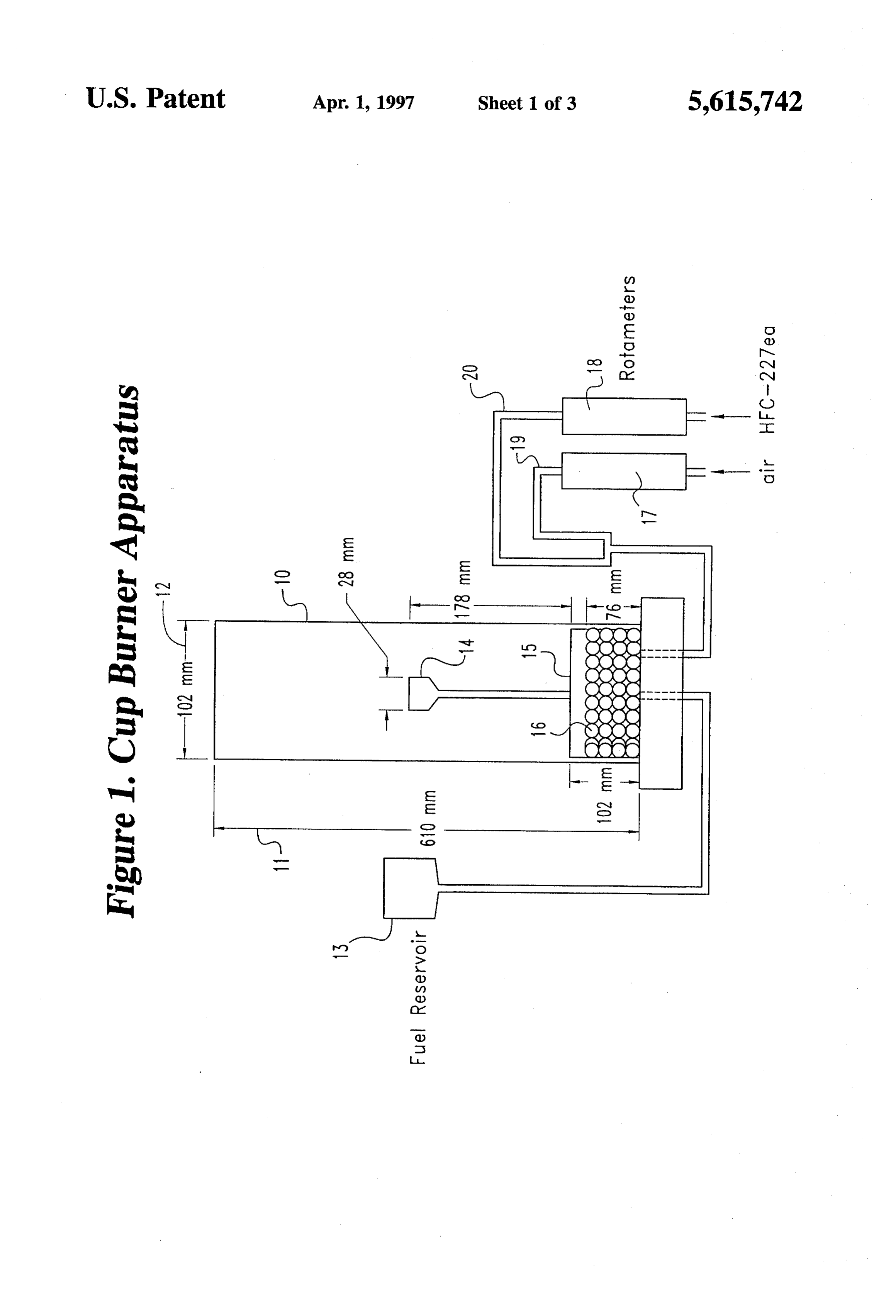
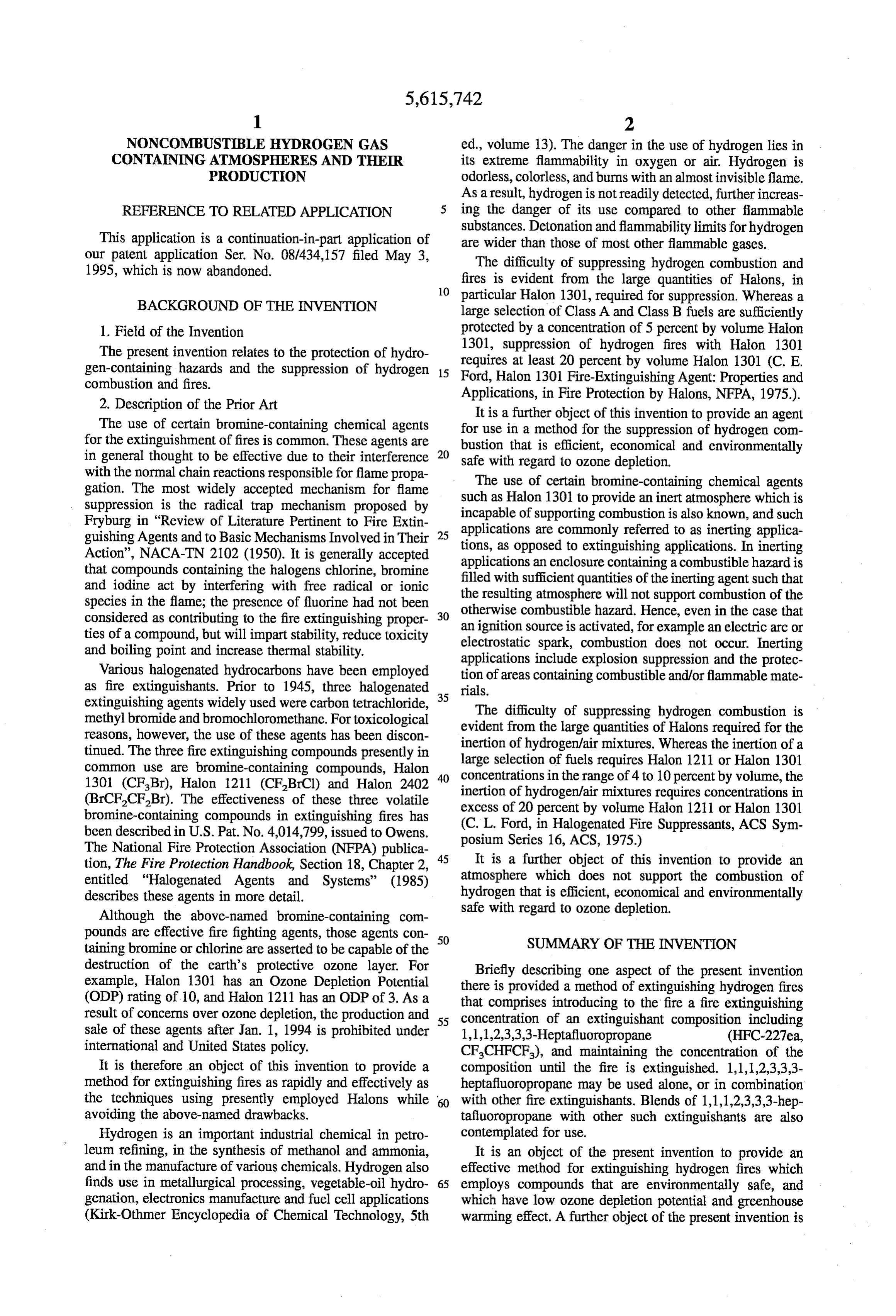
FIG. 1 is a diagrammatic view of a cupburner test system tration used in demonstrating the novel aspects of the present employed may depend to some extent on the circum invention.
stances of application. Generally, application rates of 1,1,1, 35 2,3,3,3-heptafluoropropane alone preferably range from at
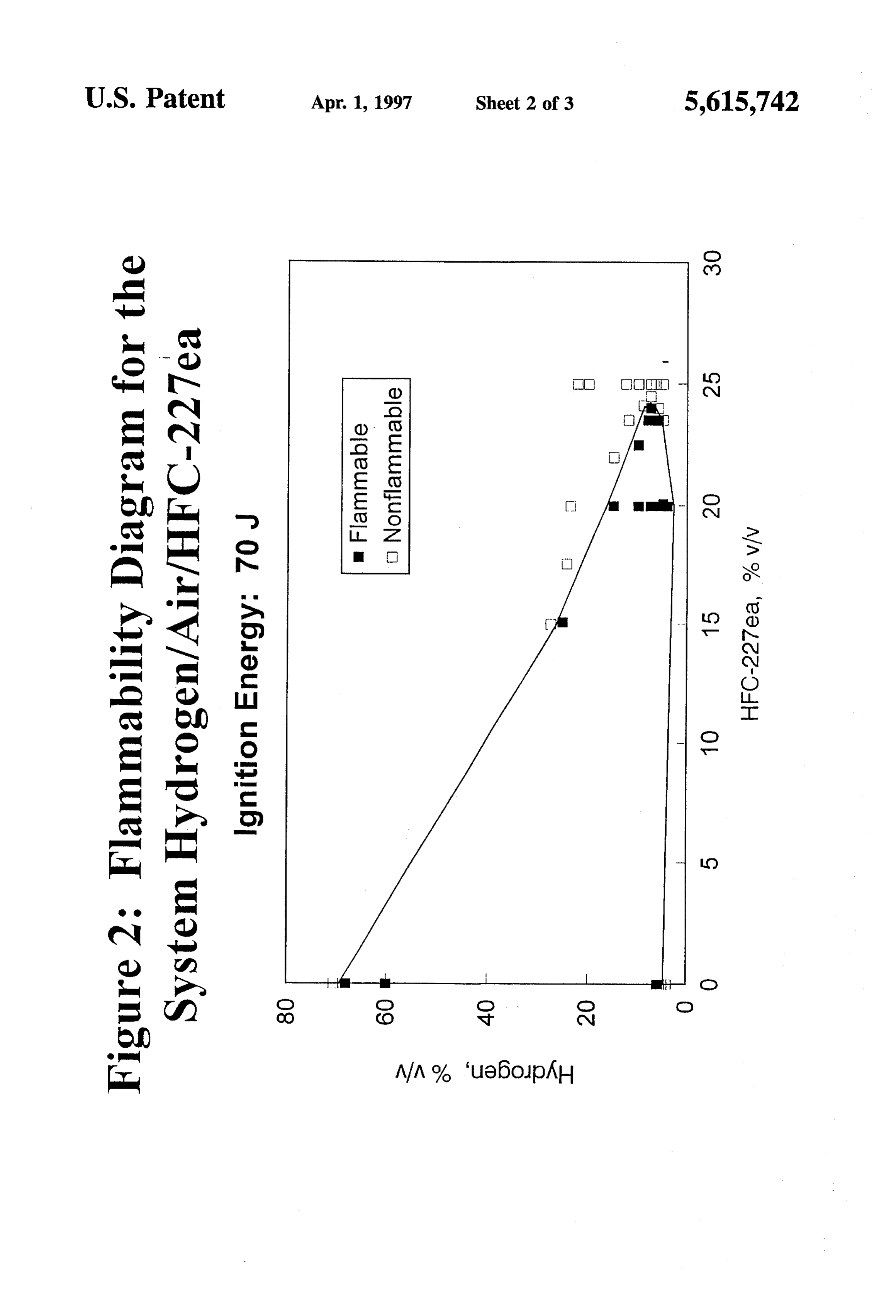
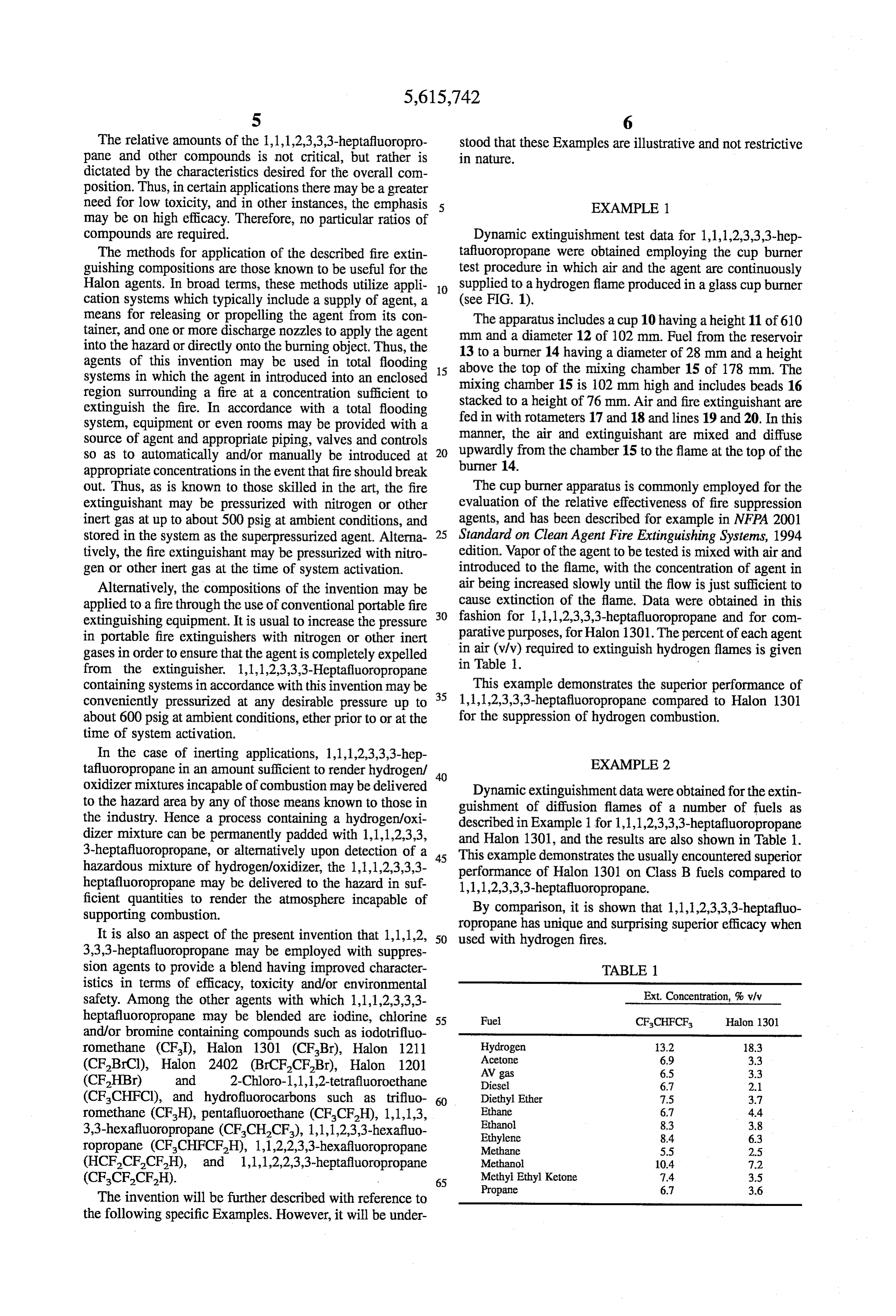
FIG. 2 is a graph showing the flammability of various least about 13%, and more preferably between about 15% combinations of hydrogen/air/HFC-227ea mixtures. and 30% w/v.
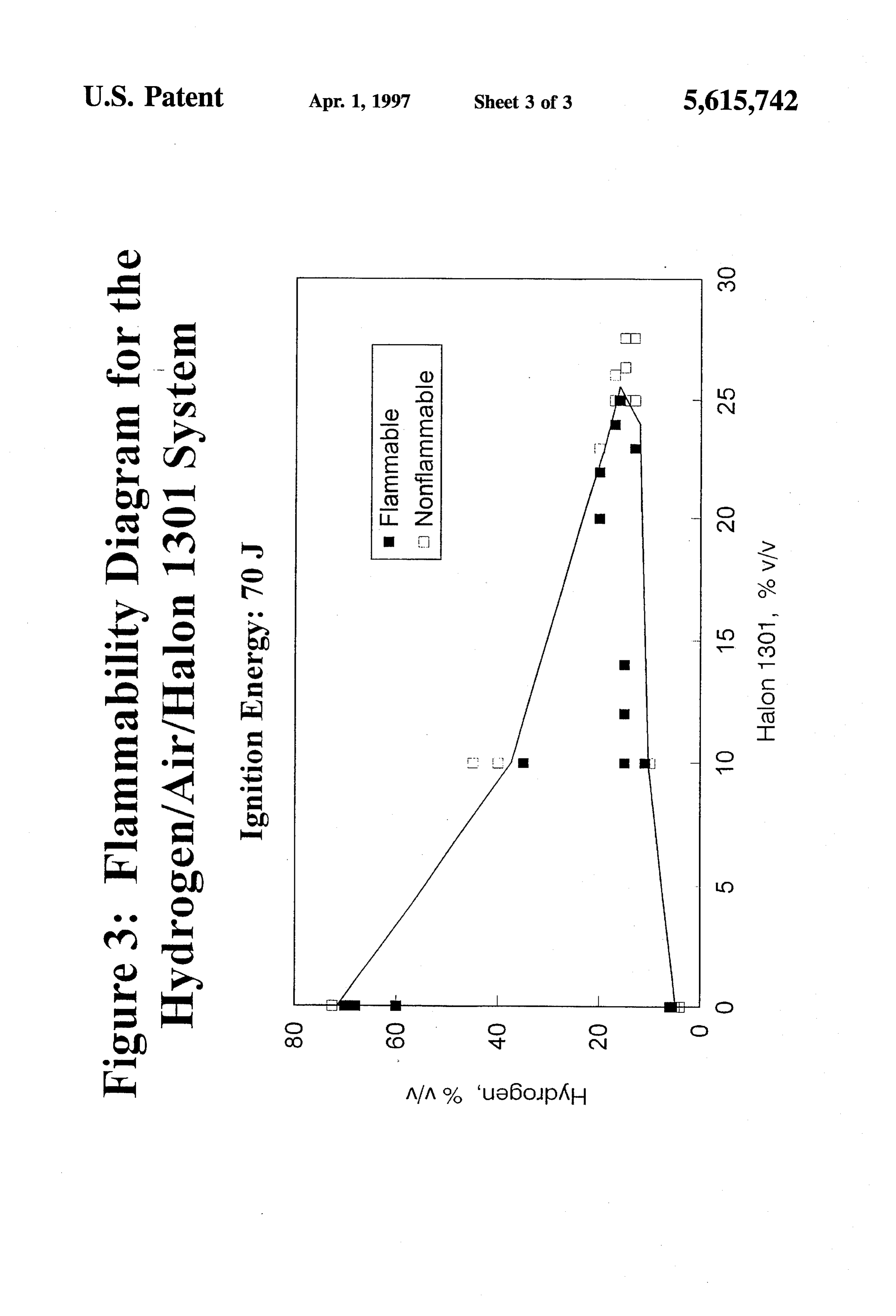
FIG. 3 is a graph showing the flammability of various A further desirable aspect of the present invention is that combinations of hydrogen/air/Halon 1301 mixtures. 1,1,1,2,3,3,3-heptafluoropropane is environmentally safer 40 than many of the prior art halogenated hydrocarbon fire
DESCRIPTION OF THE PREFERRED extinguishing agents. 1,1,1,2,3,3,3-Heptafluoropropane has EMBODIMENTS an ODP of zero, compared to an ODP of 10 for Halon 1301 and of 3 for Halon 1211, two common commercial fire
For the purpose of promoting an understanding of the extinguishants.
principles of the invention, reference will now be made to 45 It is also an aspect of the present invention that 1,1,1,2, preferred embodiments of the invention and specific lan 3,3,3-heptafluoropropane may be employed in use with guage will be used to describe the same. It will nevertheless hydrogen fires with other extinguishants. The resulting be understood that no limitation of the scope of the invention blend will have improved characteristics interms of efficacy, is thereby intended, such alterations, further modifications and applications of the principles of the invention as 50 toxicity and/or environmental safety depending on the blend described herein being contemplated as would normally and the application. Among the other agents with which 1,1,1,2,3,3,3-heptafluoropropane may be blended are iodine, occur to one skilled in the art to which the invention relates.
chlorine and/or bromine containing compounds such as
In accordance with the present invention, 1,1,1,2,3,3,3- iodotrifluoromethane (CFI), Halon 1301 (CFBr), Halon heptafluoropropane (CFCHFCF) has been found to be an 1211 (CFBrCl), Halon 2402 (BrCFCFBr), Halon 1201 effective extinguishant for hydrogen fires. However, because 55 (CFHBr) and 2-chloro-1,1,1,2-tetrafluoroethane 1,1,1,2,3,3,3-heptafluoropropane contains no bromine or (CFCHFC), and hydrofluorocarbons such as trifluo chlorine, it has an ozone depletion potential of zero. In one romethane (CFH), pentafluoroethane (CFCFH), 1,1,1,3, aspect, the invention relates to methods for extinguishing 3.3-hexafluoropropane (CFCHCF), 1,1,1,2,3,3-hexafluo hydrogen fires which are improved by using 1,1,1,2,3,3,3- ropropane (CFCHFCFH), 1,1,2,2,3,3-hexafluoropropane heptafluoropropane alone, or in a blend, as the fire extin (HCFCFCFH), and 1,1,1,2,2,3,3-heptafluoropropane guishing agent. The invention also relates to the provision of (CFCFCFH). Where 1,1,1,2,3,3,3-heptafluoropropane of fire extinguishing compositions comprising blends of 1,1,1, this invention is employed in a blend, 1,1,1,2,3,3,3-hep 2,3,3,3-heptafluoropropane with other fire extinguishants. tafluoropropane may be combined, preferably in an amount In accordance with the present invention, 1,1,1,2,3,3,3- of from about 1% to about 99% by weight of the blend, with heptafluoropropane (CFCHFCF) has also been found to be 65 one or more of these compounds. Mixtures of 1,1,1,2,3,3, an effective agent for the inertion of hydrogen/air mixtures, 3-heptafluoropropane with the hydrofluorocarbons are espe i.e., for rendering hydrogen/air mixtures incapable of com cially preferred because said mixtures have an ODP of zero.
Page 7
The relative amounts of the 1,1,1,2,3,3,3-heptafluoropro stood that these Examples are illustrative and not restrictive pane and other compounds is not critical, but rather is in nature.
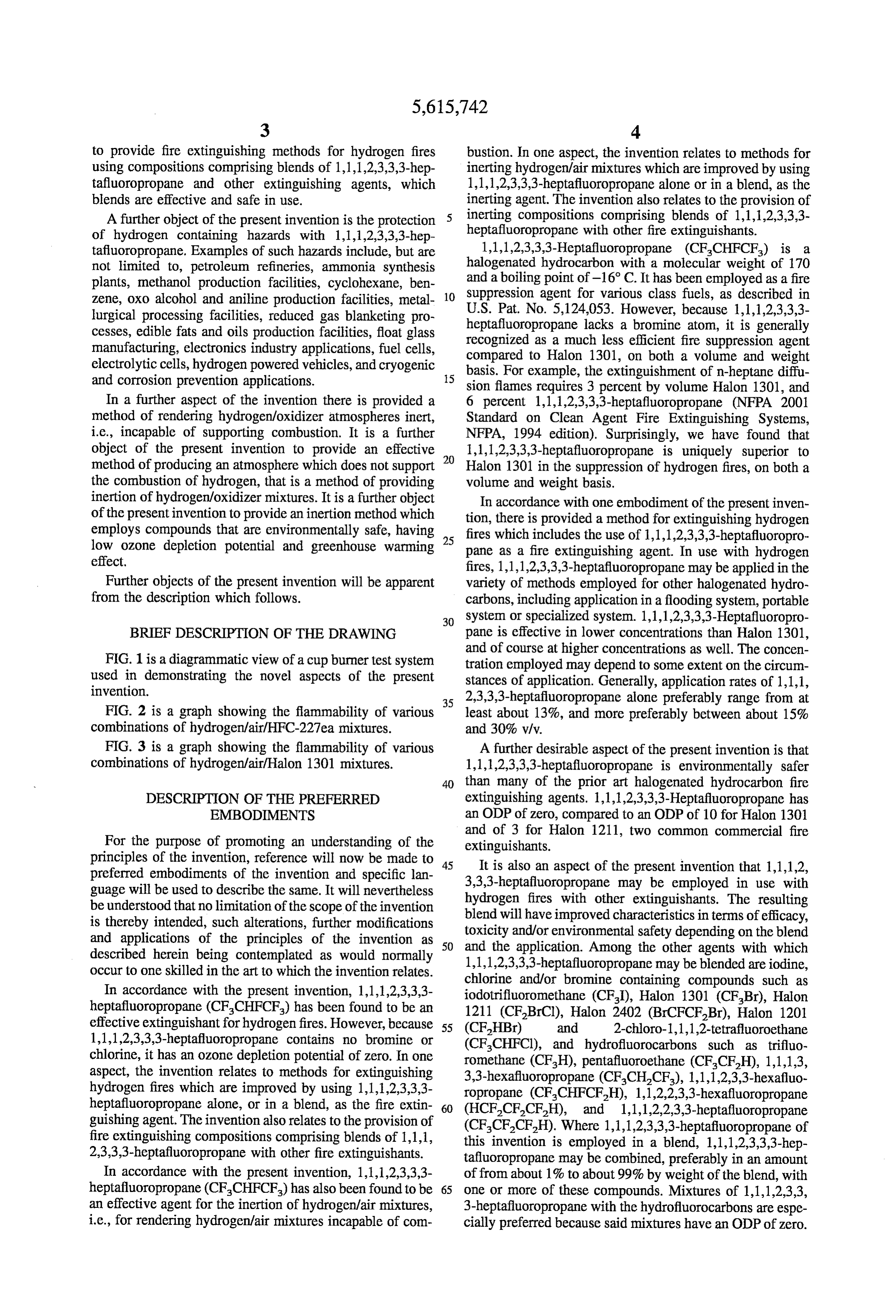
dictated by the characteristics desired for the overall com position. Thus, in certain applications there may be a greater need for low toxicity, and in other instances, the emphasis EXAMPLE 1 may be on high efficacy. Therefore, no particular ratios of compounds are required. Dynamic extinguishment test data for 1,1,1,2,3,3,3-hep The methods for application of the described fire extin tafluoropropane were obtained employing the cup burner guishing compositions are those known to be useful for the test procedure in which air and the agent are continuously Halon agents. In broad terms, these methods utilize appli 10 supplied to a hydrogen flame produced in a glass cup burner cation systems which typically include a supply of agent, a (see FIG. 1).
means for releasing or propelling the agent from its con The apparatus includes a cup 10 having a height 11 of 610 tainer, and one or more discharge nozzles to apply the agent mm and a diameter 12 of 102 mm. Fuel from the reservoir into the hazard or directly onto the burning object. Thus, the 13 to a burner 14 having a diameter of 28 mm and a height agents of this invention may be used in total flooding 15 above the top of the mixing chamber 15 of 178 mm. The systems in which the agent in introduced into an enclosed mixing chamber 15 is 102 mm high and includes beads 16 region surrounding a fire at a concentration sufficient to stacked to a height of 76 mm. Air and fire extinguishant are extinguish the fire. In accordance with a total flooding system, equipment or even rooms may be provided with a fed in with rotameters 17 and 18 and lines 19 and 20. In this source of agent and appropriate piping, valves and controls manner, the air and extinguishant are mixed and diffuse so as to automatically and/or manually be introduced at 20 burnerupwardly from the chamber 15 to the flame at the top of the appropriate concentrations in the event that fire should break 14.
out. Thus, as is known to those skilled in the art, the fire The cup burner apparatus is commonly employed for the extinguishant may be pressurized with nitrogen or other evaluation of the relative effectiveness of fire suppression inert gas at up to about 500 psig at ambient conditions, and agents, and has been described for example in NFPA 2001 stored in the system as the superpressurized agent. Alterna 25 Standard on Clean Agent Fire Extinguishing Systems, 1994 tively, the fire extinguishant may be pressurized with nitro edition. Vapor of the agent to be tested is mixed with air and gen or other inert gas at the time of system activation. introduced to the flame, with the concentration of agent in Alternatively, the compositions of the invention may be air being increased slowly until the flow is just sufficient to applied to a fire through the use of conventional portable fire cause extinction of the flame. Data were obtained in this extinguishing equipment. It is usual to increase the pressure 30 fashion for 1,1,1,2,3,3,3-heptafluoropropane and for com in portable fire extinguishers with nitrogen or other inert parative purposes, for Halon 1301. The percent of each agent gases in order to ensure that the agent is completely expelled inin air (v/v) required to extinguish hydrogen flames is given from the extinguisher. 1,1,1,2,3,3,3-Heptafluoropropane Table 1.
containing systems in accordance with this invention may be 35 This example demonstrates the superior performance of conveniently pressurized at any desirable pressure up to 1,1,1,2,3,3,3-heptafluoropropane compared to Halon 1301 about 600 psig at ambient conditions, ether prior to or at the for the suppression of hydrogen combustion. time of system activation.
In the case of inerting applications, 1,1,1,2,3,3,3-hep tafluoropropane in an amount sufficient to render hydrogen/ EXAMPLE 2 oxidizer mixtures incapable of combustion may be delivered Dynamic extinguishment data were obtained for the extin to the hazard area by any of those means known to those in guishment of diffusion flames of a number of fuels as the industry. Hence a process containing a hydrogen/oxi described in Example 1 for 1,1,1,2,3,3,3-heptafluoropropane dizer mixture can be permanently padded with 1,1,1,2,3,3, and Halon 1301, and the results are also shown in Table 1. 3-heptafluoropropane, or alternatively upon detection of a 45 This example demonstrates the usually encountered superior hazardous mixture of hydrogen/oxidizer, the 1,1,1,2,3,3,3- performance of Halon 1301 on Class B fuels compared to heptafluoropropane may be delivered to the hazard in suf 1,1,1,2,3,3,3-heptafluoropropane. ficient quantities to render the atmosphere incapable of By comparison, it is shown that 1,1,1,2,3,3,3-heptafluo supporting combustion. ropropane has unique and surprising superior efficacy when It is also an aspect of the present invention that 1,1,1,2, 50 3,3,3-heptafluoropropane may be employed with suppres used with hydrogen fires.
sion agents to provide a blend having improved character TABLE 1. istics in terms of efficacy, toxicity and/or environmental safety. Among the other agents with which 1,1,1,2,3,3,3- Ext. Concentration, % w/v heptafluoropropane may be blended are iodine, chlorine 55 Fuel CFCHFCF Hadon 1301 and/or bromine containing compounds such as iodotrifluo romethane (CFI), Halon 1301 (CFBr), Halon 1211 Hydrogen 13.2 18.3
(CFBrCl), Halon 2402 (BrCFCFBr), Halon 1201 AV gas 6.5 3.3 (CFHBr) and 2-Chloro-1,1,1,2-tetrafluoroethane Diesel 6.7 2.1 (CFCHFC), and hydrofluorocarbons such as trifluo Diethyl Ether 7.5 3.7 romethane (CFH), pentafluoroethane (CFCFH), 1,1,1,3, Ethane
Ethanol
3,3-hexafluoropropane (CFCHCF), 1,1,1,2,3,3-hexafluo Ethylene 8.4 6.3 ropropane (CFCHFCFH), 1,1,2,2,3,3-hexafluoropropane Methane 5.5 2.5 (HCFCFCFH), and 1,1,1,2,2,3,3-heptafluoropropane Methanol 10.4 7.2 (CFCFCFH). 65 Methyl Ethyl Ketone 7.4 3.5
The invention will be further described with reference to the following specific Examples. However, it will be under
Page 8
EXAMPLE 3 3. The method of claim 1 in which the concentration of This example demonstrates the inertion of hydrogen by by said heptafluoropropane is in the range from 15 to 75 percent volume of the atmosphere.
HFC-227ea. The concentration of HFC-227ea required to 4. The method of claim 3 in which the concentration of inert hydrogen was measured in an 8.0 L explosion sphere, 5 said heptafluoropropane is at least about 24 percent by consisting of two 304 stainless hemispheres welded on volume of the atmosphere.
stainless steel flanges, and equipped with instrumentation 5. An atmosphere which does not support the combustion allowing the monitoring of pressure and temperature as a of hydrogen comprising:
function of time. A mixture of hydrogen and air and the a. a combination of an amount of hydrogen and an amount desired concentration of HFC-227ea were introduced into 10 the sphere employing partial pressures to determine the of oxidizer sufficient to support combustion of the hydrogen in the absence of another component render volumes of agent, fuel and air. The mixture was then ing the combination non-combustible; and subjected to a DC spark of 70J ignition energy, located in b. 1,1,1,2,3,3,3-heptafluoropropane in a concentration the center of the sphere. Mixtures producing an overpressure of greater than or equal to 1.0 psia following activation of 5 sufficient to render the combination of said heptafluo the spark are considered flammable, and mixtures producing ropropane and said amounts of oxidizer and hydrogen an overpressure of less than 1.0 psia are considered non incapable of supporting the combustion of the hydro gen.
flammable. By examining a series of mixtures of varying ratios of hydrogen/air/HFC-227ea, the concentration of of 6.said The atmosphere of claim 5 in which the concentration heptafluoropropane is in the range from 15 to 75
HFC-227ea required to inert all combinations of hydrogen 20 percent by volume of the atmosphere. and air can be determined. The flammability measurements 7. The atmosphere of claim 5 in which the oxidizer is air. indicated that 24% by volume of HFC-227ea is required to 8. The atmosphere of claim 5 in which the oxidizer is render all combinations of hydrogen and air nonflammable. oxygen.
The flammability diagram determined from the experimen tal data is shown in FIG. 2 for the hydrogen/air/HFC-227ea 25 9. The atmosphere of claim 5 in which the hydrogen is system. present in an amount of at least about 5 percent by volume of the atmosphere.
10. An atmosphere which does not support the combus tion of hydrogen comprising:
EXAMPLE 4
30 a. a combination of hydrogen in air, the hydrogen being
The method of Example 3 was employed to determine the present in the air in an amount sufficient to support amount of Halon 1301 (CFBr) required for the inertion of combustion of the hydrogen by the air in the absence of hydrogen. The flammability measurements indicated that another component rendering the combination non 25% by volume of Halon 1301 was required to render all combustible; and combinations of hydrogen and air nonflammable. The flam 35 b. 1,1,1,2,3,3,3-heptafluoropropane in a concentration mability diagram determined from the experimental data is sufficient to render the combination of said heptafluo shown in FIG. 3 for the hydrogen/air/Halon 1301 system. ropropane and said amounts of air and hydrogen inca What is claimed is: pable of supporting the combustion of the hydrogen. 1. A method for treating an atmosphere containing hydro 11. The atmosphere of claim 10 in which the hydrogen is gen and an oxidizer, the hydrogen and oxidizer being present present in an amount of at least about 5 percent by volume in amounts sufficient to support the combustion of the of the atmosphere.
hydrogen by the oxidizer, the method comprising introduc 12. The atmosphere of claim 10 in which the concentra ing to the atmosphere a concentration of a composition tion of said heptafluoropropane is in the range from 15 to 75 consisting essentially of 1,1,1,2,3,3,3-heptafluoropropane percent by volume of the atmosphere. sufficient to render the atmosphere incapable of supporting 45 13. The atmosphere of claim 12 in which the concentra combustion of the hydrogen. tion of said heptafluoropropane is at least about 24 percent 2. The method of claim 1 in which the hydrogenis present by volume of the atmosphere.
in an amount of at least about 5 percent by volume of the atmosphere. sk xk k k
Provenance
- Collection
- Cited prior art
- Original PDF
- patentimages.storage.googleapis.com →
- Filed
- 1995-09-15
- Pages
- 8
- Method
- pdftotext (the PDF's own text layer) + pdftoppm 300dpi page scans
- Source
- Google Patents bibliographic record
- Granted
- 1997-04-01
- Inventors
- Mark L. Robin; Charles J. Mazac; John S. Rubacha; Great Lakes Chemical Corp
- Transcribed from
- patentimages.storage.googleapis.com →