patent · US5611307
Internal combustion engine ignition device
18 March 1997
Page 1 — bibliographic record
United States Patent 19 11 Patent Number: 5,611,307 Watson 45 Date of Patent: Mar 18, 1997 54 INTERNAL COMBUSTION ENGINE 4,140,090 2/1979 Lindberg ................................. 123,265 IGNITION DEVICE 4,306,526 12/1981 Schaub et al. .. ... 123/259 4,319,552 3/1982 Sauer et al. ..... ... 123,267 75) Inventor: Harry C. Watson, Eltham, Australia 4,343,272 8/1982 Buck ........... ... 123,297 4,448,160 5/1984 Vosper ............ ... 123,297 (73) Assignee: The University of Melbourne, 4,546,740 10/1985 Clements et al. ... 123/304 Parkville, Australia 5,081,969 1/1992 Long, III ................................. 123/274 5,085,176 2/1992 Brinkley, III ................... 23IDIG. 12 (21) Appl. No.: 256,360 FOREIGN PATENT DOCUMENTS (22) PCT Filed: Oct. 14, 1992 198776 9/1977 Australia.
Primary Examiner-Andrew M. Dolinar
S371 Date: Apr. 7, 1995 Attorney, Agent, or Firm-Dennison, Meserole, Pollack & Scheiner
PCT Pub. Date: Apr. 29, 1993 An ignition device for an internal combustion engine com prising a smal pre-chamber 1 having a volume of about 0.7 (30) Foreign Application Priority Data of the volume of an associated combustion chamber, a small outlet orifice 1a in a pre-chamber having a dimensionaless
Oct. 14, 1991 IAU Australia ................................. PK8881 throat parameter of about 0.4 to 0.7, a valve 2 controlling the (51) Int. Cl. ........................................... FO2B 19/18 introduction of hydrogen gas to the pre-chamber 1 via a (52) U.S. Cl. .......................................... 123/254; 123/259 valve driver 3 and a spark plug 4 for igniting the hydrogen 58) Field of Search ............................ 123/259, DIG. 12, rich mixture (about 3 times stoiciometric) in the pre-cham 123/254 ber to cause an ignition jet of burning gas to issue from the orifice la to promote efficient combustion and to reduce (56) References Cited NOx emissions at lean burning mixtures and at higher compression ratios without knock.
3,970,054 7/1976 Henault et al. .................. 23/DEG. 2 12 Claims, 6 Drawing Sheets
Page 2
Drawing sheet — no readable text.
Page 3
Drawing sheet — no readable text.
Page 4
6 -
5 HALF THROTTLE 9.
QRT. THROTTLE
S. ?M
2 B o
2 S. M 9.
O 200 l00 600 800 1000
RATO
X GN TON 100 24 -- -
U 10
NOX with HAJ
O 1 O 200 400 600 800 1000 ENGINE POWER AS WORK/CYCLE (kJ/m3 IIE, 5 A
Page 5
Drawing sheet — no readable text.
Page 6
-- FULL THROTTLE
HALF THROTTLE
O QRT. THROTTLE
2 0.3 0.l. 0.5 0.6 0.7 O8 0.9 1 11 NJECTED H2 (% of CH3OH)
O O8 ck HALF THROTTLE
QRT THROTTLE
NJECTED H2 (% of CH3OH)
Page 7
o STD. G.N. MAX EFFY.
-- STD. IGN. MAX POWER
k HAJ MAX. EFFY.
D HAJ OLD MAX. EFFY.
m LAMBDA - 2.16 SS AMBOA - 1.23
40 LAMBDA - 1.23
s 35 LAMBDA - 0.98
l 5 6 7 8 9 10 11 12
COMPRESSION RATO
NORMAL GN TON
O 100 200 300 00 500 600 700 800 900 ENGINE POWER AS WORK/CYCLE (kJ/m3)
Page 8
INTERNAL COMBUSTION ENGINE though the incentives for lean burn application to automo IGNITION DEVICE tive engines are valid and have good theoretical foundation, its implementation is a complex problem that requires
REFERENCE TO CO-PENDING APPLICATION several conflicting requirements to be satisfied simulta neously. Lean burn operation increases the CBCV and
This is a continuation-in-part Application of International deteriorates vehicle driveability. CBCV increases with PCT/AU92/00552, filed 14 Oct. 1992, for INTERNAL increasing air-fuel ratio.
COMBUSTION ENGINE IGNITION DEVICE, which Many attempts have been made to improve combustion Application designated the United States, and is now aban efficiency. Such attempts include fuel stratification with a doned. 10 rich mixture in the spark plug region, divided or pre chamber engines alone or in combination with stratification,
FIELD OF THE INVENTION and hydrogen enrichment of the whole fuel charge. None of these attempts have been entirely successful and the prob
This invention relates to ignition devices for internal lems referred to above remain in evidence. combustion engines, and more particularly hydrogen 5 In the case of non-fuelled divided chamber engines, assisted jet ignition (HAJI) devices for improving combus including the Bosch spark plug patented around 1978, the tion efficiency. In the present specification, the term "hydro size (volume, connecting passage length and aperture) of the gen' is intended to include hydrogen and other fast-burning pre-chamber can only improve combustion at a particular fuels. power output. Thus, while combustion efficiency can be
improved at a given power output, energy tends to be lost at
BACKGROUND OF THE INVENTION full power to the pre-chamber walls and other parts of the main chamber by the impinging jet so that the peak power
Simultaneous control of exhaust emissions and thermal was reduced by about 10%. Furthermore, since the pre efficiency is an established goal in engine design. Optimi chamber in the prior art arrangements is unfuelled, relying zation of engine design is limited by Cycle by Cycle 25 on the transfer of a fuel mixture from the main chamber, Variability (CBCV), especially for spark ignition engines. starting in cold conditions can be difficult. CBCV is observed as either variations in the pressure In a paper entitled "High Chemical activity of incomplete diagram or as variations in flame propagation between combustion products and a method of pre-chamber torch consecutive engine cycles. In the vehicle the consequent ignition for avalanche activation of combustion in internal unsteadiness in delivered engine power results in uneven 30 combustion engines' by L. A. Gussak of the Institute of vehicle progress which has been termed surge. Combustion Chemical Physics Academy of Sciences of the USSR, Mos variations require compromises in engine design, the setting cow. (Publication No. 750890 of Society of Automotive of mixture composition and spark timing. This reduces Engineers USA) the author discusses the effects of pre engine power and efficiency at full load in order to meet chamber torch ignition on the flame front of a hydrocarbon roughness, noise, and octane requirements and at part load 35 employing aand air mixture concludes that optimization is achieved by pre-chamber volume of two to three percent of and idle reduces fuel economy and increases exhaust emis the compressed combustion chamber volume. While this sions in order to control surge. paper contains some scientific consideration of the combus If CBCV could be eliminated, the engine would run at its tion products resulting from pre-chamber combustion of a best economy settings and still produce a smooth and steady very rich air-hydrogen mixture, the author does not come to output. In addition, the fuel octane requirements could be 40 any conclusion concerning the likelihood of pre-chamber reduced, or the compression ratio raised, with a consequent combustion providing a significant benefit in the improve improvement in efficiency. Further, the lean limit of engine ment of engine thermal efficiency while at the same time operation could be extended, resulting in a reduction in reducing NOx emissions.
exhaust emissions and an improvement in thermal effi The Patent literature also contains some reference to the ciency. It has been shown that the reduction of CBCV in 45 burning of hydrogen in pre-chambers, the most pertinent lean-burn engines, together with control of ignition timing, prior art being U.S. Pat. No. 4,140,090 Lindburg and U.S. can reduce NOx emissions and at the same time improve Pat. No. 4,760,820 Tozzi. The Lindburg reference provides engine thermal efficiency. Another important benefit arising a small pre-chamber for burning hydrogen but specifically from control of cycle variations is the reduction in engine teaches the introduction of an oxidant to be mixed with the surge and improved vehicle driveability while cruising. 50 hydrogen fuel to ensure stoiciometric proportions. The ref Much research has been conducted on lean-burn engines erence is also silent at the nature of the exit passage. The with the intention of improving efficiency and reducing present applicant has found that the mixture in the pre chamber should preferably be hydrogen rich and the outlet emissions. The benefits from the lean combustion approach orifice should be carefully dimensioned to ensure that a can be theoretically explained as follows. The excess air proper ignition jet stream issues from the orifice to ensure improves the engine's thermal efficiency by increasing the 55 complete combustion of a lean fuel mixture in the combus overall specific heats+ ratio, by decreasing the energy losses tion chamber.
from dissociation of the combustion products, and by reduc In the case of the Tozzi reference, the magnetic field ing the thermal losses to the engine cooling system. In generating means introduces undesirable complexity and addition, as the flame temperature drops with decreasing increased power consumption to generate plasma tempera fuel air ratio, the NOx production is exponentially reduced 60 tures of around 4,000 to 6,000° C. Plasma igniters of the and the excess air may promote a more complete reaction of type described by Tozzi have not employed commercial CO and hydrogen fuel emission from crevices and quench success presumably due to the complexity and power con layers. sumption difficulties involved.
It is concluded that at the present state of development, SUMMARY OF THE INVENTION AND OBJECT U.S. emission standards present a considerable challenge to 65 the realization of the fuel economy advantages theoretically It is an object of the present invention to provide an inherent in lean burn engines. On the other hand, even ignition device by means of which combustion efficiency is
Page 9
improved and the problems outlined above are at least expansion. The jet of combustion products, at Sonic or near ameliorated. sonic velocity from the small volume of the prechamber, into The invention provides an ignition device for an internal the main chamber hydrocarbon fuel initiates a distributed combustion engine having combustion chamber(s), com reaction in an ultra lean mixture, which can be much leaner prising a small pre-chamber having a volume substantially than the normal lean flammability limit. The distributed falling within the range of 0.5% to less than 2% of the reaction is triggered by the presence of chemically active combustion chamber volume, said pre-chamber being closed species in the jet and allows nearly spatially homogeneous to the combustion chamber except for one or more small burning with excellent repeatability and hence close to outlet orifices, means for creating a rapidly combustible spatially uniform temperatures. Along with the ability to use mixture in said pre-chamber, means for igniting the com 10 ultra lean mixture this process avoids the higher tempera bustible mixture in the pre-chamber, said pre-chamber and tures found in the region of the first burned gas in the spark said orifice(s) being dimensioned to thereby cause an igni ignition engine in the region of the spark plug or in the richer tion jet of burning gas to issue from said orifice in a manner mixture around the fueljet in the diesel engine which are the which promotes efficient combustion within the combustion source of high NOx emissions.
chamber(s) internal combustion engine. 15 A preferred fast burning fuel is hydrogen which may be The outlet orifice(s) and the pre-chamber are preferably introduced to the pre-chamber from a suitable source or may dimensioned to provide a dimensionless throat parameter be produced in-situ within the pre-chamber by catalysis. The number 3= amount of hydrogen introduced may be varied, and may be as low as 0.2% of the fuel charged to the engine. The area of throat X bore of combustion cylinder 20 hydrogen/air mixture in the pre-chamber is preferably pre-chamber volume greater than stoiciometric and may be from about 1.2 to 7 times stoiciometric or higher, without about 3 times being an substantially falling within the range 0.3 to 0.8, and prefer effective median value.
ably within the range about 0.4 to 0.7, and most preferably The ten times faster flame speed of hydrogen compared about 0.4 to 0.6. 25 with hydro-carbon fuels substantially reduces the variation By the use of the above ignition device, and particularly in the time for ignition kernel growth, thus virtually elimi by selection of the dimensionless throat parameter B within nating CBCV in combustion under idle and light load the above range, idle combustion variability is nearly elimi conditions. This permits the burning of lean mixtures in the nated, even at lean burn operation. At the same time, low main chamber; the mixtures may be so lean that throttling levels of emissions are obtained and unthrottled operation is 30 may be eliminated whereby thermal efficiency increases and possible with some sacrifice in efficiency, but with near zero NOx emissions reduced by as much as three orders of NOx emissions. magnitude.
The volume of the pre-chamber is preferably as small as The pre-chamber may be formed as part of a replacement is practically possible, the lower limit of the chamber spark plug, or may be formed as part of the cylinder head in volume being dictated largely by the ability to physically 35 the region of the spark plug receiving opening. The means form the pre-chamber. Pre-chamber volumes of about 0.5% for igniting the combustible mixture may comprise a min have been achieved with difficulty, while pre-chamber vol iature spark plug, or some other form of spark generating umes of about 0.7% have been readily achieved and offer the means formed integrally with the means for introducing advantage of being capable of location within the diameter hydrogen or other rapidly combustible gas into the pre of a standard spark plug connecting portion. 40 chamber.
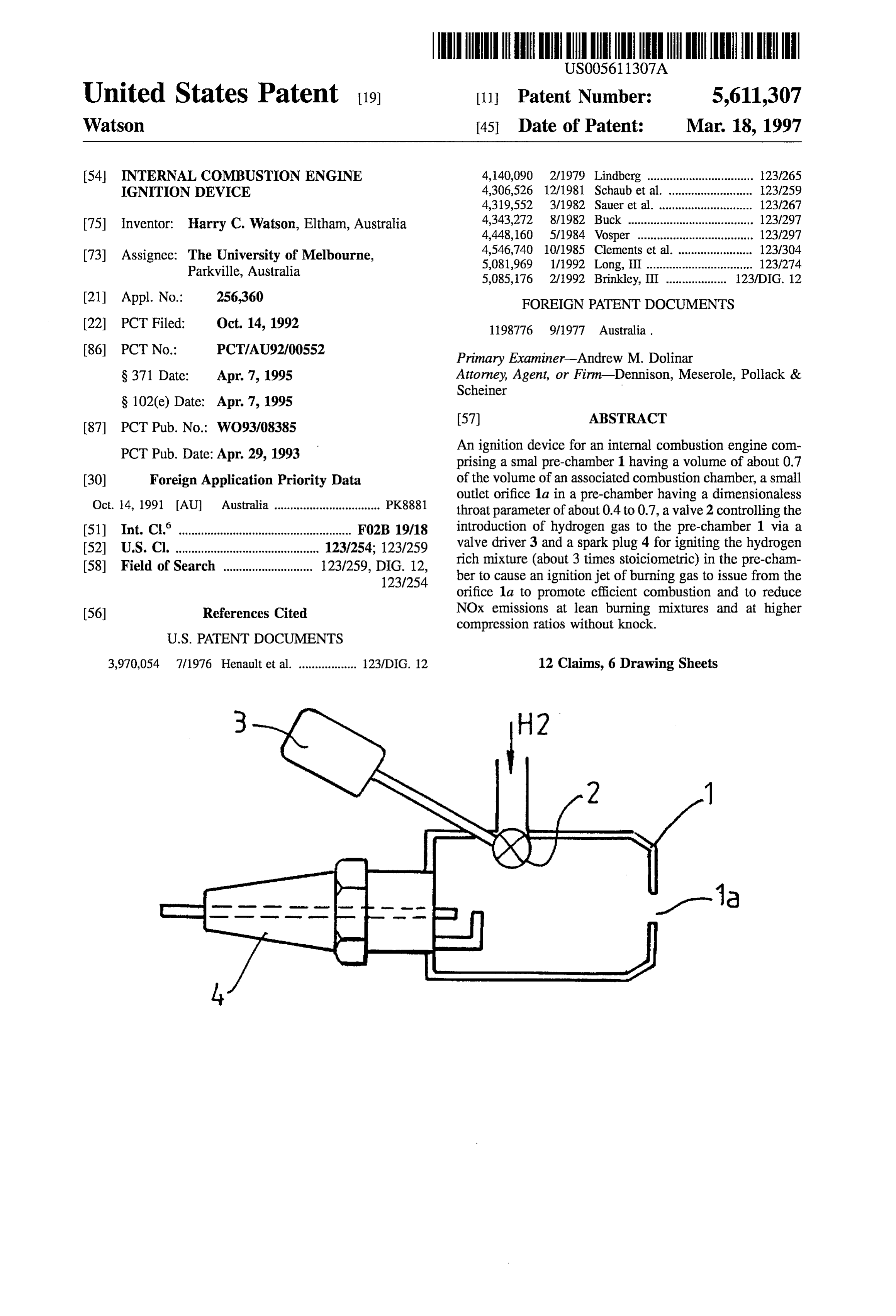
While the availability of hydrogen as a fuel source for The invention also provides a method of operating an combustion within a pre-chamber is known from the Gussak internal combustion engine having combustion chamber(s) paper referred to above and from other sources, the ability comprising the steps of introducing a rapidly combustible to significantly reduce the size of the pre-chamber as defined mixture into a pre-chamber associated with each combustion above has not been recognized before the present invention. 45 chamber of the combustion engine and having a volume Of course, the ability to reduce the size of the pre-chamber substantially falling within the range 0.5% to less than 2% not only enables the pre-chamber to be incorporated into a of the combustion chamber volume, igniting the mixture in modified sparkplug having standard attachment dimensions, the pre-chamber to create a burning fuel ignition jet from but also significantly reduces the total heat losses during the one or more exit orifices of the pre-chamber, said jet being combustion process thereby resulting in surprising improve 50 controlled to promote efficient combustion within the com ments in lean mixture combustion and consequential reduc bustion chamber of the internal combustion engine. tions in NOx emissions. Until the present invention, it was BRIEF DESCRIPTION OF THE DRAWINGS always expected that a pre-chamber volume at least as large as that stated by Gussak to provide optimization of pre In order that the invention may be more readily under chamber combustion would be necessary to form the nec 55 stood several embodiments of the invention will now essary torch ignition to achieve the expected benefit from described with reference to the accompanying drawings in this process. It was surprisingly determined that significantly which:
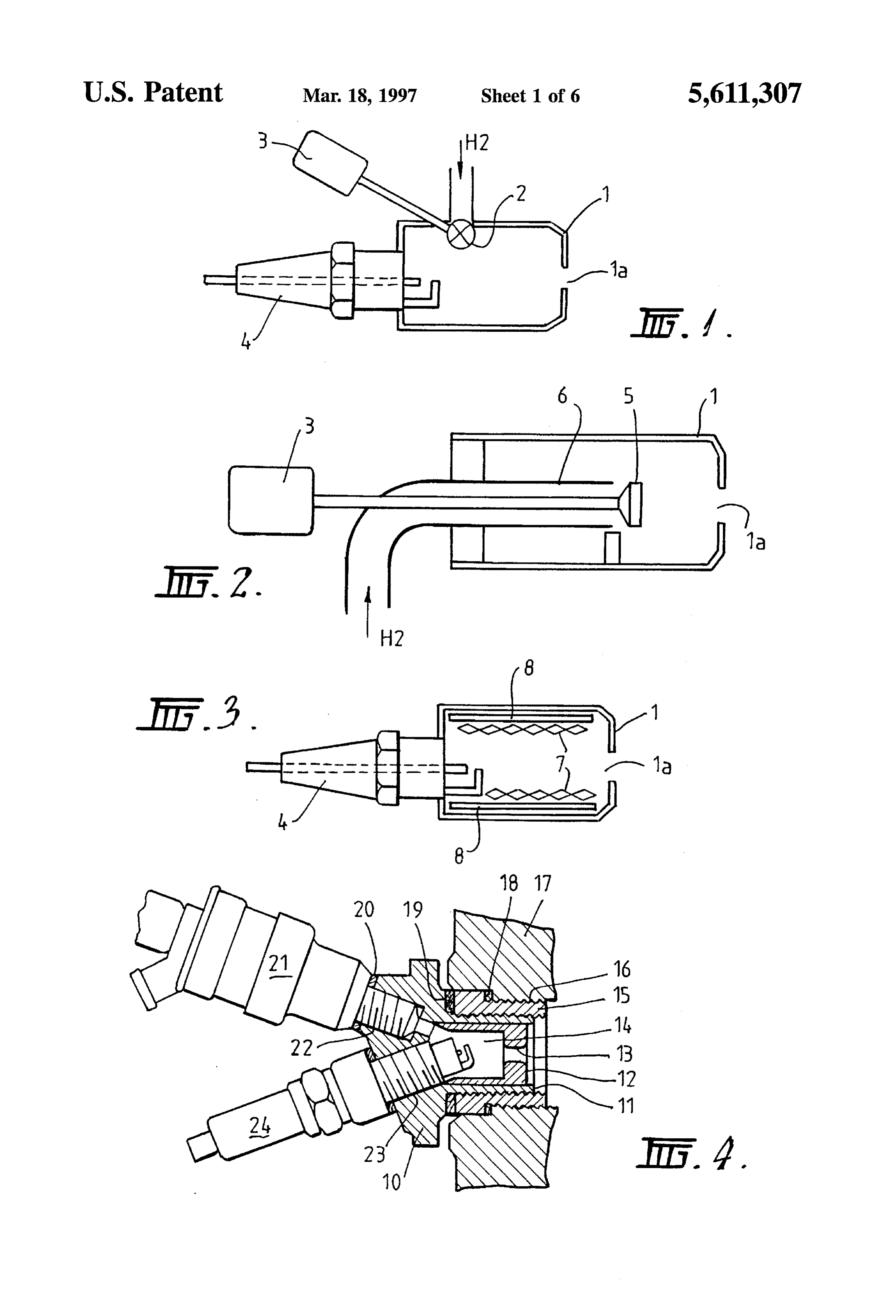
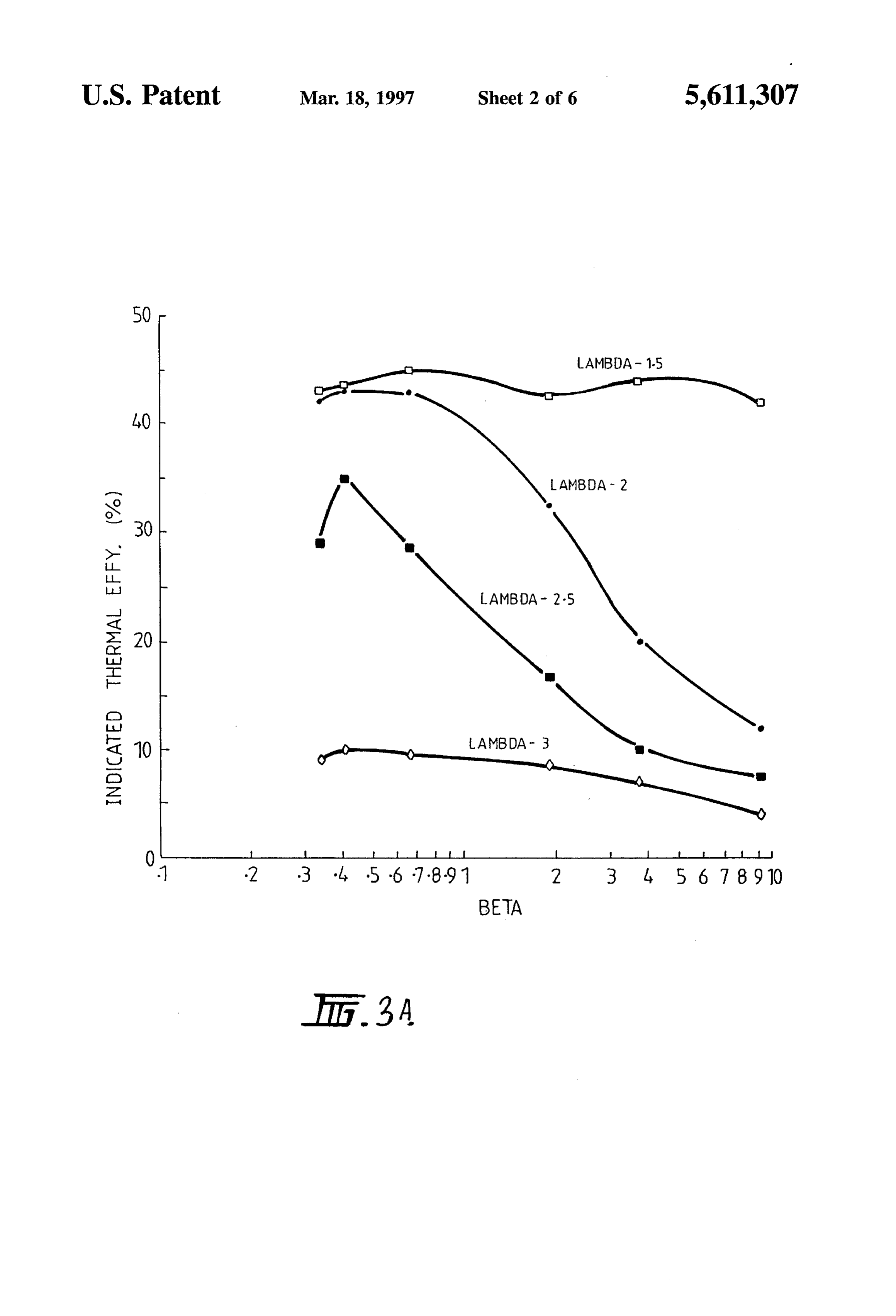
smaller volumes could be used without compromising the FIG. 1 shows schematically an ignition device according effectiveness of the ignition jet of burning gas produced to a first embodiment of the invention; from the pre-chamber combustion process. It has also been 60 surprisingly determined that by selecting an orifice throat FIG. 2 schematically shows an ignition device according size B between about 0.3 and 0.8 engine efficiency is to a second embodiment of the invention;
maximised for lean burning mixtures. FIG. 3 schematically shows a third embodiment of the The large surface area to volume ratio of the pre-chamber invention;
ensures that the residual gas in the pre-chamber is at low 65 FIG. 3a is a graph showing changes in indicated thermal temperature, a requirement for low NOx emission from this efficiency with various values of the dimensionless throat region as the gas expands into the main chamber during parameter f.
Page 10
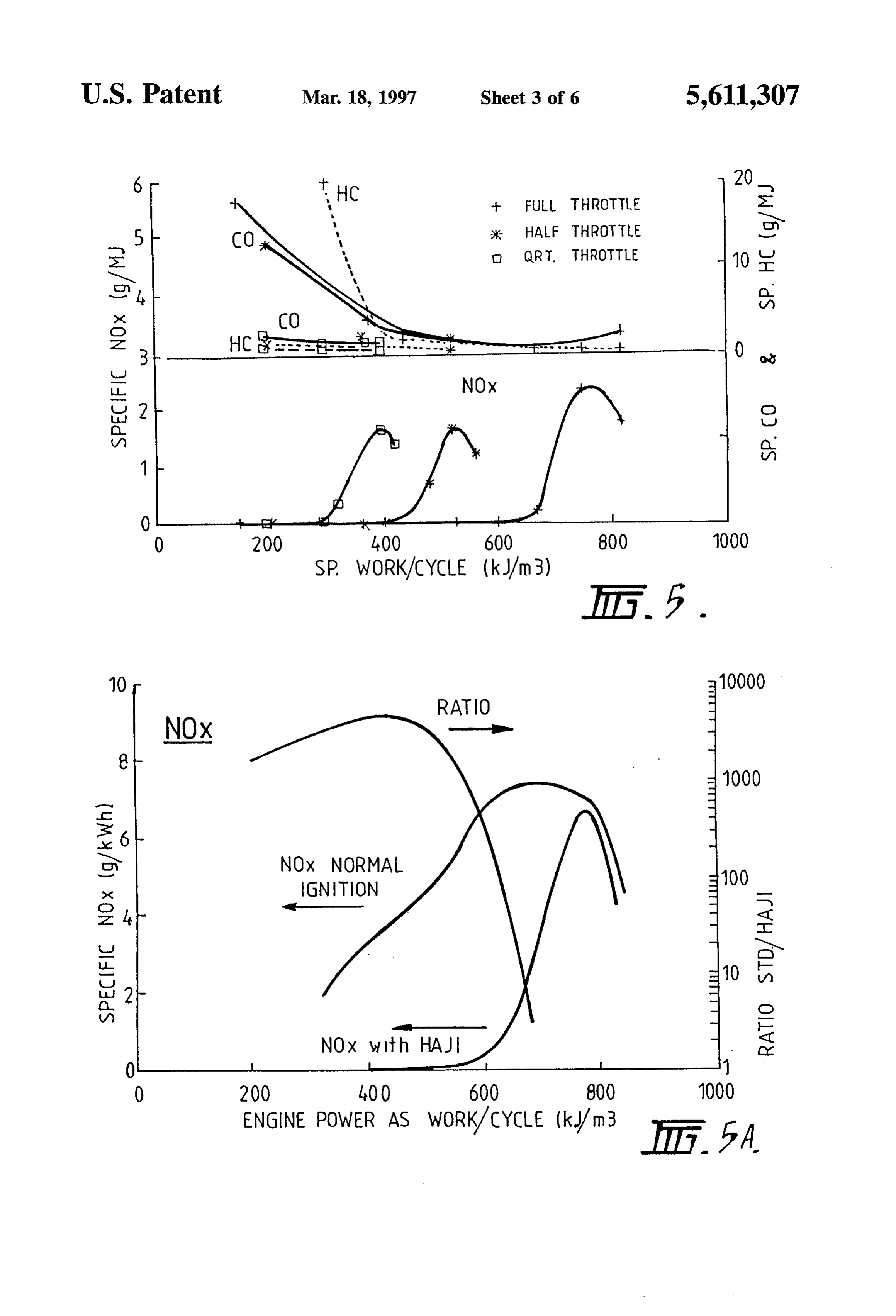
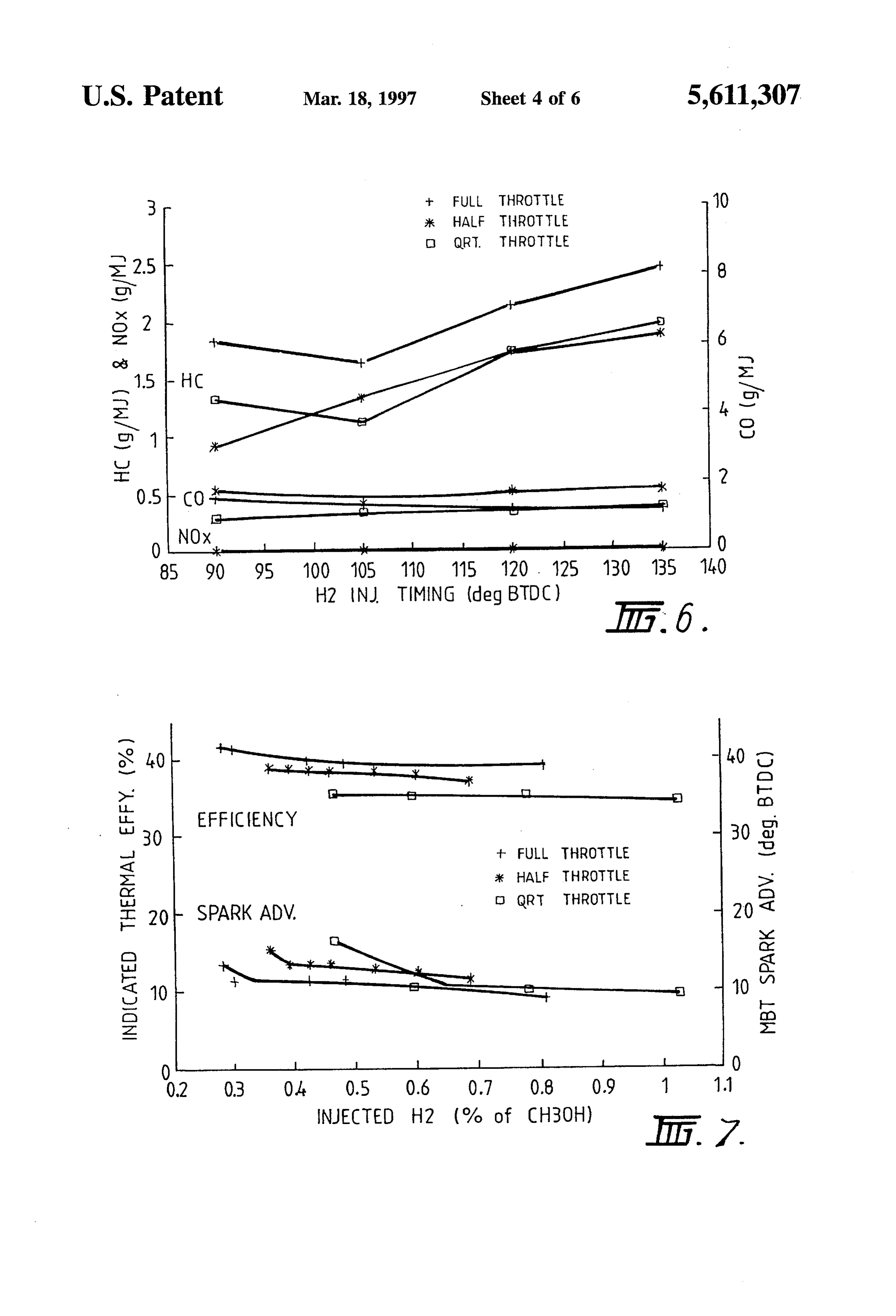
FIG. 4 is a sectional elevation of an ignition device fuel may be introduced into the pre-chamber to form a according to a test prototype, and hydrogen-rich mixture, or small amounts of hydrogen can be FIG. 5 is a graph showing the variation on specific HC, directly injected to supplement the hydrogen produced by CO and NOx emissions with variations of specific work with catalysis.
hydrogen at about 0.8% methanol by mass, injected at 90° The invention is applicable to both four and two-stroke crank angle BTDC at y=9; engines.
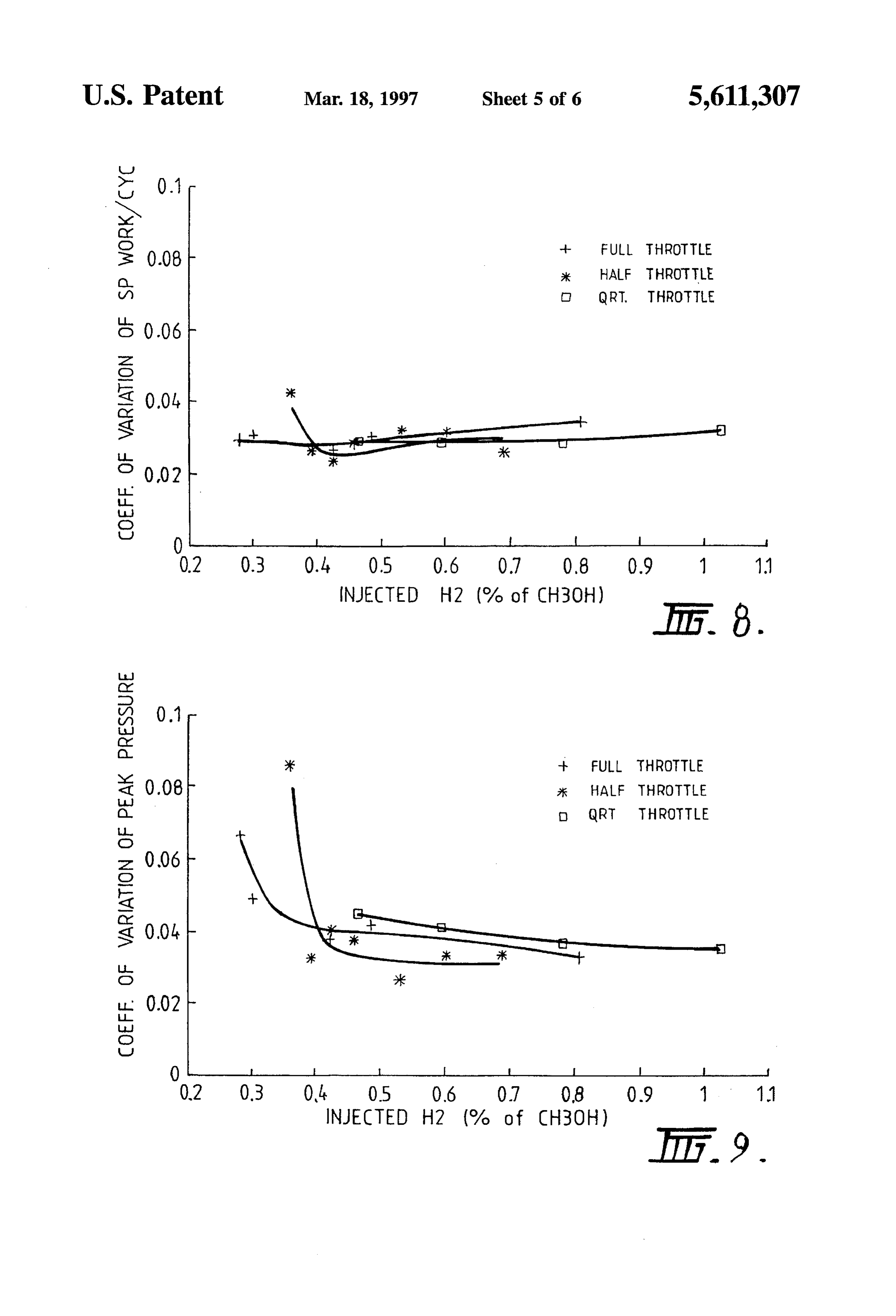
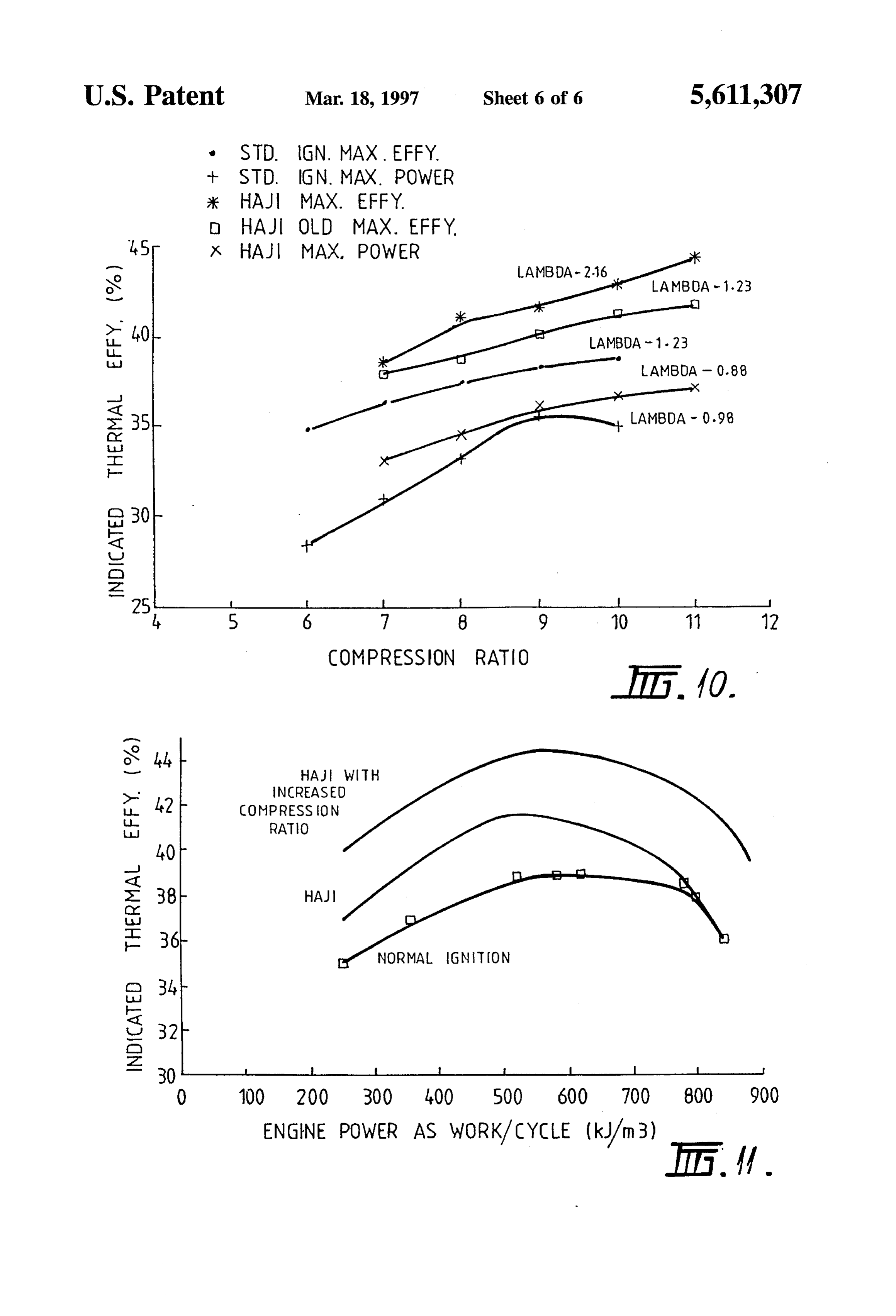
FIG. 5A is a graph showing variations in NOx emissions The amount of hydrogen introduced or reformed fuel with engine power as work/cycle for normal ignition and for produced by catalysis may be varied but small amounts of the order of 0.5 to 2% by mass have been found to produce the case of the invention, 10 acceptable results. The mixture in the pre-chamber should be FIG. 6 is a graph showing the variation of HC, CO and greater than stoichiometric and from 1.2 to 7 times stoicio NOx emissions with pre-chamber H2 injection timing at metric or higher is acceptable, with 3 times constituting a optimum efficiency mixture of A=2.1, 1.98 and 1.6 at full, reasonable median value. The ten times faster flame speed of half and quarter throttle respectively; hydrogen compared with hydrocarbon fuels substantially FIG. 7 is a graph showing the effect of the amount of 15 reduces the variation in the time for ignition kernel grown pre-chamber H2 injection on efficiency and spark advance at and thus virtually eliminates cycle-by-cycle variation in the same optimum efficiency mixtures and throttle settings combustion underidle and light load conditions. The exodus referred to in relation to FIG. 6; of the partially combusted hydrogen and hydrocarbon fuel in FIG. 8 is a graph showing the variation of COV of specific the pre-chamber provides a jet of enthalpy and reacting work per cycle with amount of pre-chamber H2 injection at 20 products which cause the fuel-lean main chamber products the same optimum efficiency mixtures and throttle settings; to burn at much lower temperatures and stoichiometry than FIG. 9 is a graph showing the variation of COV of peak is possible with a localized ignition source. pressure with amount of pre-chamber H2 injection at the The burning of a lean mixture in the main chamber may same optimum efficiency mixtures and throttle settings; be sufficiently lean that throttling may be eliminated and FIG. 10 is a graph showing the effect of increasing 25 thus thermal efficiency increased by eliminating pumping compression ratio on indicated thermal efficiency for stan work and nitrogen oxide emissions reduced by as much as dard ignition and hydrogen assisted jet ignition, and two orders of magnitude by the more uniform low tempera ture combustion.
FIG. 11 is a graph showing indicated changes in indicated thermal efficiency with engine power as work/cycle for 30 Further, because combustion of the mixtures needed for normal ignition, and for the invention with increased com maximum power is so fast the onset of knock is delayed and pression ratio. compression ratios may be increased, thus increasing both power output and efficiency.
DESCRIPTION OF PREFERRED The volume of the pre-chamber will be less than 2% of the
main combustion chamber clearance volume, and may be as low as 0.5%. This is significantly smaller than prior art
Hydrogen or reformed fuel containing a high proportion pre-chambers, e.g. VW, at 17% and Gussak at 2 to 3%. The of hydrogen is made in or introduced into a pre-chamber of number of pre-chamber orifices 1a, orifice throat shape and a volume so small that it may be formed in the spark plug. their direction with respect to the main chamber may be Examples of possible design configurations are shown in 40 varied and optimized for a particular engine configuration. FIGS. 1 to 3. These parameters are chosen to ensure that the ignition jet or FIG. 1 shows the arrangement whereby the hydrogen gas jets issuing from the orifice(s) penetrate the combustion is introduced into a pre-chamber 1 having an outlet orifice 1 a chamber of the engine to such an extent as to maximize by a small value 2 operated by a valve driver 3 and the efficient combustion. Sharp edges should be avoided when mixture ignited by a miniature spark plug 4. Low pressure 45 forming the orifice 1a. By correctly choosing the above delivery (about four atmospheres) of hydrogen is used in parameters, the ignition jet penetrates to a position approxi each of the embodiments of FIGS. 1, 3 and 4, so that the mately coincident with the centre of the cylinder, and pressure of hydrogen delivery is not greater than the fuel ignition is then found to be extremely regular. To ensure a jet supply pressure to the combustion chamber. ignition gas stream is achieved, the orifice should have a FIG. 2 shows an arrangement in which the spark pug 50 dimensionaless throat parameter B= central electrode is constituted by the hydrogen admission area of throat Xbore of combustion cylinder valve 5 which defines a spark gap within the gas inlet 6 when pre-chamber volume the valve is open one unit serving both functions. In this case the hydrogen may be supplied from storage vessels or by the falling within the range about 0.3 to 0.8. reformation of small amounts of fuel outside the pre 55 In this regard reference is made to FIG.3a, which details chamber. The hydrogen may be contaminated by the prod test results of various pre-chamber orifices, described by the ucts of reformation. dimensionless throat parameter B "beta'. The engine on FIG.3 shows a schematic of the pre-chamber in which the which the tests were carried out was the Wakesha Coopera hydrogen is generated by a reforming catalyst 7, the rate of tive Fuel Research Engine (CFR) used for octane rating reformation and thus the amount of hydrogen produced 60 petrols. The engine was operated at 600 rev/min, the speed being controlled by the catalyst bed temperature, which here used for the research octane number determination. Ignition is illustrated by means of electrical heating means 8 under timing was set at the minimum advance for best torque control of an engine management computer (not shown). In (MPT) in all cases, the compression ratio was at 9:1 and the this case, if the amount of fuel within each cylinder is fuel supplied to the main chamber was petrol. All tests were insufficient to produce a greater than stoiciometric hydrogen 65 at wide open throttle (WOT). The relative air/fuel ratio (to mixture, and the effectiveness of the hydrogen assisted jet a base of the stoichiometric air/fuel) "lambada', sometimes ignition system is reduced thereby, additional hydrocarbon known as the excess air fuel ratio, and is the abscissa for the
Page 11
graphs. The indicated thermal efficiency, the ordinate of the range at part throttle was studied. Even at full throttle it was graphs, is absedon the net (lower) heating value of the fuel. possible to reduce the work per cycle w (and the torque) to It is clean from the results that the throat size "beta’ should no load quantities by increasing the relative air/fuel ratio, preferably be in the range of about 0.4 to 0.7 for optimum whereas the lean limit for this engine with normal ignition thermal efficiency, although the range 0.3 to 0.8 provides is shown to occur at =1.64, there exists no lean limit with acceptable efficiency. hydrogen assistedjet ignition, HAJI, within the usable range FIG. 4 shows an experimental ignition device embodying of w. However, it was observed that there is some advan the invention which has been subjected to testing using a tage in throttling the engine as at the smallest values of we high speed, single cylinder CFR engine burning methanol thermal efficiency, m is higher at a quarter throttle. The peak fuel. The ignition device comprises a body 10 having a 10 thermal efficiency m is about two percentage points higher cylindrical portion 11 within which a throat insert 12 having with HAJI over the standard system. an outlet orifice 13 of about 1.5 mm diameter received to define a pre-chamber 14 having a volume of about 0.7 cc. The range of ignition timing needed for operation from This yields a throat parameter B of about 0.4. The cylindrical full to no load (w-820 to 18 kJ/m) was found to be small portion 11 threadably engages an adaptor 15 which in turn and retarded compared with conventional ignition. At full threadably engages the spark plug opening 16 in the cylinder 5 load 0, is after TDC. For all operating conditions as seen head 17 of the engine. Gaskets 18, 19 and 20 are positioned in the COVp was found to be very low and rising only to seal the adaptor 16 to the cylinder head 17 and the body slightly at the lowest values of w at full and half throttles. 10 to the adaptor 16, while the gasket 20 seals a hydrogen Usually under light load, this engine has a COVp of about gas injector 21 in an injector opening 22 formed in the body 0.2 with the standard ignition system. Whilst these exists 10. A spark plug receiving opening 23 in the body 10 20 substantially regular burning to peak pressure, the COVw. receives a sparkplug 24, the electrodes of which project into variations in the laterburning phases of mixtures leaner than the pre-chamber 14. those for maximum mare observable. The failure to burn all If desired, the pre-chamber may be formed within the of the main chamber fuel, at least in some cycles, is cylinder or as an attachment to the cylinder, although these evidenced by an upturn in specific HC and CO emission at options are less attractive than forming the pre-chamber in 25 full and half throttle as observed in FIG. 5. a spark plug body. The benefits from leaner operation, well beyond the The tests conducted using the above described prototype, standard engine's lean limit, is evidenced in FIG. 5 where a referred to in the following description as the hydrogen substantial range of operation at specific NOx values of 0.03 assisted jet ignition (HAJI) system, relate to an engine speed g/MJ or much less than one hundredth of the peak NOx. of 600 r/min for two reasons: first, it is at low speed, low 30 Under these conditions the exhaust NOx concentrations are loads that combustion variability is most noticeable as less than 1 ppm. The variation in NOx emissions with engine engine surge under load or vibration at idle; second, this is power from the invention and for standard combustion is the speed for research octane number (RON) measurement. illustrated in FIG. 5A.
Thus, the effects of the ignition system on the octane At full throttle these low values of NOx are obtained at we requirement, or more specifically, the highest usable com 35 less than 600 kJ/m (i.e. for values of torque less than 70% pression ratio as a surrogate for octane number, may be of the maximum) a point at which the HC and CO are identified. comparatively low and the n for w=530 kJ/m, -2.15 is a A wide range of parameters may be employed to describe maximum of 40%. Maximum efficiency at half and quarter variability in engine combustion. These may be related to throttles also correspond with very low NOx values and the the cylinder pressure, p, the magnitude or the phasing of 40 advantage of throttling lies in avoiding the falling efficiency pressure characteristics such as peak p or maximum value of at full throttle when D3 and the reduced exhaust HC and dp/dt or the cycle integral value of pressure (w). Two CO under light load (w) conditions. measures are used here: the coefficient of variation in peak Very small quantities of hydrogen were injected into the cylinder pressure, COVp (standard deviaton/mean) and the pre-chamber to obtain the very low NOx and high n dem coefficient of variation of the indicated specific work (or 45 onstrated in FIG. 5. The sensitivity to pre-chamber H. i.m.e.p.) per cycle, COVw. Fluctuations in the former injection timing (influencing mixing time) and quantity influence the maximum structural reactive forces and peak (influencing stoichiometry) have been investigated. cycle temperatures and in the latter, variability in the indi The sensitivity of the engine's performance to H2 injec cated thermal efficiency n. The indicated value of w is tion timing for the mixture corresponding to maximum selected rather than the brake value, as the mechanical 50 efficiency at each throttle position was also considered and efficiency of the "high speed CFR engine is unusually low it was found that n is independent of timing at full throttle because of its balancing pistons and belt drive arrangement. but there is a small advantage (an increase of 2% in m) at part Emissions of HC, CO and NOx are also presented on an throttle by using about 100 BTDC injection timing. More indicated specific basis i.e. g/MJ. advanced injection requires slightly more advanced spark The experimental data space has been limited in this 55 timing (but very much less than that of the standard engine presentation to: main chamber mixture composition which is 38° BTDC at a quarter throttle, for example). The expressed as , the relative air/fuel ratio; three manifold air combustion variability as COVw varies slightly with injec pressures, 95, 73 and 0 kPa, described as full, half and a tion timing, but at advanced timing and half throttle, COVw. quarter throttle, respectively; hydrogen injection timing, is nearly twice tat at full throttle. This trend is even more 02, hydrogen injection quantity expressed as a proportion 60 evident in COVp where minima occur close to the timing of the fuel mass supplied, M and compression ratio, r. The of 100BTDC. There is a trend also for both HC and CO spark timing 0, was always adjusted for the minimum emissions (FIG. 6) to minimise with increasing CO and HC. advance of best torque (MBT); and the main chamber The effects of changing the pre-chamber H2 quantity are injection timing was at maximum inlet value lift (98 ATDC) demonstrated in FIGS. 7 to 10. In FIG. 7 there is a tendency for optimum efficiency in the CFR engine. 65 form to increase slightly with reducing quantities of injected The effect of changing the main chamber fuel composi H. The ignition timing (FIG. 7), COVw (FIG. 8) and tion for the range of -1 to 3.5 for full throttle and smaller COVp (FIG. 9) indicate that for each throttle opening a
Page 12
point is reached at which combustion variability increases The above demonstration of the CFR engine, working at and more advance is needed to compensate. This is consis up to 70% maximum torque with NOx emission close to tent with previous findings using conditional sampling of the ambient levels, is most encouraging finding as extrapolation exhaust from fast and slow burn cycles. Corresponding with of these research engine data to automobile application the increases in variability are increases in HC and some would remove the requirement for stoichiometric operation increase in CO emissions. needed for the 3-way' catalyst. The hydrogen assisted jet A further benefit from the changed ignition system is the ignition used to achieve this also confers extremely stable increase in highest usable compression ratio, HUCR. In FIG. combustion with COV's of the peak cylinder pressure and 10 the thermal efficiency n for the standard ignition system specific work per engine cycle reduced by 50 to 80% of that is shown at maximum efficiency (=1.23) and maximum O normally achieved with this engine, allowing increased power (=0.98) mixtures, and the corresponding values thermal efficiency at ultra lean operation, at relative air/fuel (=2.15) and (=0.98) with the HAJI system. In addition the ratios of about 2, and about two numbers increase in the value of n at 'old max effy'=1.23 with the HAJI system is highest useful compression ratio. The result is an improve also included for comparison at equal W. ment in maximum indicated thermal efficiency of about 15% With standard ignition, peak efficiency at maximum 5 simultaneously with the low NOx emissions. The hydrocar power mixture, =0.90 occurs at r=9. At r=10, m falls bon emissions remain high and if realized in automotive because knock is encountered. The HAJI system at r=9, and engines would require after engine clean up. with Wel.23, the optimum for maximum m with standard Near elimination of idle combustion variability by our ignition, shows nearly 2% absolute (or 5% relative) increase novel form of "jet' ignition using a small amount of hydro in n. This increase is considered to be a consequence of the faster burn rate and the improved combustion variability 20 of emissionshas gen addition have been achieved. At the same time low levels also been observed. Idle stability will reducing the overall consequences of the combustion time improve vehicle driveability whilst cruising at low engine loss. Further increase in to increase efficiency (to A=2.16) speeds and high gears when the engine operates near idle is possible and allows an increase of nearly 2% more in n. speed. In addition reduced emissions will be obtained during Moreover, because of the reduced variability and faster burn vehicle deceleration.
times FIG. 10 shows that r can be increased to 11. At r=12, 25
The following conclusions can be drawn from our results:
knock is encountered at maximum power mixture. At r=11 1. In a conventional ignition system, the cycle-by-cycle and -2.16, there is a further increase in n of 3%. The total variability (CBCV) is initiated in the growth of the improvement in maximum efficiency of just over 6% abso ignition kernel, subsequent to spark, during the period lute represents a relative increase of 15% in n. The improve ment in engine power achieved by the invention with 30 when the flame kernel grows to about the scale of the increased compression ratio is illustrated in FIG. 11. largest eddies. Three classifications of flame kernels The indication that the HAJI can support conventionally were made, namely (a) stationary kernels, (b) translat port-injected S. i. engine combustion at mixtures leaner than ing kernels and (c) splitting kernels. Subsequent slow those reported in the literature is exemplified at 1200 rev/ burning with stationary kernels has been seen while min engine speed, where COVp of less than 0.05 can be 35 other types of kernels subsequently have fast burning. sustained at -4.5. The quantity of hydrogen needed to 2. A novel way of controlling combustion variability for sustain such operation is about one tenth that which would a large range of equivalence ratios in the S.I. engine has be needed if added homogeneously mixed with the fuel. been obtained with jet ignition using small amounts of These is some evidence of increased variability which might hydrogen addition. At the same time improvement in be associated with partial burns in the ultra lean mixtures as 40 efficiency and significant reduction in emissions are the COVw increases to values associated with standard obtained. A major outcome is that CBCV is not ignition. However, the increases in IIC and CO emission increased with lean mixtures, which is different from under the full and half throttle conditions are attributed to the that occurring in the conventionally ignited S.I. engine. thickening of the wall quench layers and reduced oxidation 3. Unthrottled operation of the S.I. engine with near of the hydrocarbons in the substantial crevices of the CFR 45 elimination of NOx emission is possible with this novel engine piston. The benefit from throttling in reducing the IIC method at some sacrifice in efficiency. and CO is the result of the increased fraction of hot residuals 4. Idle combustion variations have been nearly eliminated in the charge, increasing the cycle temperatures as evidenced together with low level of emissions. by the twofold increase in NOx from 0.6 to 1.2 ppm as the I claim:
throttle is reduced from full to one quarter. 50 1. An ignition device for association with an internal
The reason for the optimum H injection timing occurring combustion engine having a combustion chamber of prede quite late in the compression process (i.e. at 100 BTDC) is, termined clearance volume, comprising a small pre-chamber with earlier injection, that the lower cylinder pressure allow having a volume of 0.5 or less than 2% of the clearance hydrogen to flow into the main chamber. It is important to volume, said pre-chamber having at least one outlet orifice note that if there is no outflow of hydrogen, the pre-chamber 55 opening into the combustion chamber, means for creating a will be fuel rich for all the reported values of injected H. rapidly combustible hydrogen-rich mixture of about 1.2 to 7 The increase in COVp (FIG.9) at low H values may be the times stoichiometric in said pre-chamber, and means for result of injector variability as it approached its minimum igniting the combustible mixture in the pre-chamber, open time of 2 ms. The extremely wide rich flammability limits of hydrogen appear to render the process moderately 60 saiddimensioned pre-chamber and said at least one orifice being to have a dimensionless throat parameter insensitive to the amount of injected H.
Our test results showed that MBT spark timing was after
TDC for maximum power mixture. This is an unexpected area of throatx bore of combustion cylinder result because, as the burn rate approaches that of the Otto pre-chamber volume cycle's constant volume combustion, equal distribution of 65 the burn process around TDC would be expected to maxi within the range of 0.3 to 0.8, thereby causing an ignition jet mize the cycle work. to issue from said at least one orifice into the combustion
Page 13
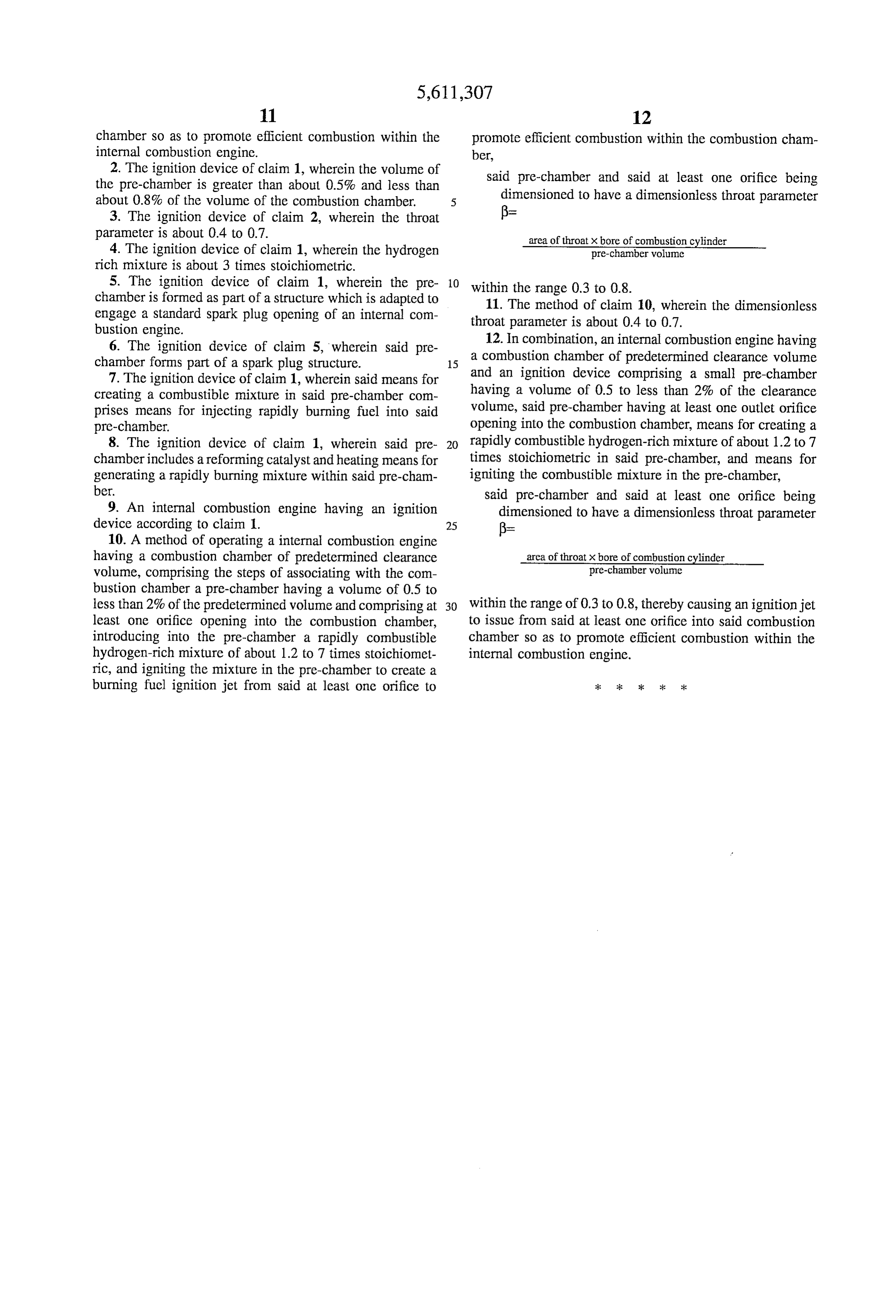
chamber so as to promote efficient combustion within the promote efficient combustion within the combustion cham internal combustion engine. ber, 2. The ignition device of claim 1, wherein the volume of said pre-chamber and said at least one orifice being the pre-chamber is greater than about 0.5% and less than about 0.8% of the volume of the combustion chamber. dimensioned to have a dimensionless throat parameter 3. The ignition device of claim 2, wherein the throat parameter is about 0.4 to 0.7. area of throat Xbore of combustion cylinder 4. The ignition device of claim 1, wherein the hydrogen pre-chamber volume rich mixture is about 3 times stoichiometric.
5. The ignition device of claim 1, wherein the pre 10 within the range 0.3 to 0.8.
chamber is formed as part of a structure which is adapted to 11. The method of claim 10, wherein the dimensionless engage a standard spark plug opening of an internal com throat parameter is about 0.4 to 0.7. bustion engine.
6. The ignition device of claim 5, wherein said pre 12. In combination, an internal combustion engine having chamber forms part of a spark plug structure. 15 a combustion chamber of predetermined clearance volume 7. The ignition device of claim 1, wherein said means for and an ignition device comprising a small pre-chamber creating a combustible mixture in said pre-chamber com having a volume of 0.5 to less than 2% of the clearance prises means for injecting rapidly burning fuel into said volume, said pre-chamber having at least one outlet orifice pre-chamber. opening into the combustion chamber, means for creating a 8. The ignition device of claim 1, wherein said pre 20 rapidly combustible hydrogen-rich mixture of about 1.2 to 7 chamber includes a reforming catalyst and heating means for times stoichiometric in said pre-chamber, and means for generating a rapidly burning mixture within said pre-cham igniting the combustible mixture in the pre-chamber, ber. said pre-chamber and said at least one orifice being 9. An internal combustion engine having an ignition dimensioned to have a dimensionless throat parameter device according to claim 1. 25
10. A method of operating a internal combustion engine having a combustion chamber of predetermined clearance area of throat Xbore of combustion cylinder volume, comprising the steps of associating with the com pre-chamber volume bustion chamber a pre-chamber having a volume of 0.5 to less than 2% of the predetermined volume and comprising at 30 within the range of 0.3 to 0.8, thereby causing an ignition jet least one orifice opening into the combustion chamber, to issue from said at least one orifice into said combustion introducing into the pre-chamber a rapidly combustible chamber so as to promote efficient combustion within the hydrogen-rich mixture of about 1.2 to 7 times stoichiomet internal combustion engine.
ric, and igniting the mixture in the pre-chamber to create a burning fuel ignition jet from said at least one orifice to
Provenance
- Collection
- Cited prior art
- Original PDF
- patentimages.storage.googleapis.com →
- Filed
- 1992-10-14
- Pages
- 13
- Method
- pdftotext (the PDF's own text layer) + pdftoppm 300dpi page scans
- Source
- Google Patents bibliographic record
- Granted
- 1997-03-18
- Inventors
- Harry C. Watson; University of Melbourne
- Transcribed from
- patentimages.storage.googleapis.com →