patent · US5516967
Direct conversion of methane to hythane
14 May 1996
Page 1 — bibliographic record
United States Patent (19) 11 Patent Number: 5,516,967 Pandey et al. (45) Date of Patent: May 14, 1996 (54) DIRECT CONVERSION OF METHANE TO 5,342,702 8/1994 MacGregor ............................... 429/13
HYTHANE
OTHER PUBLICATIONS
(75) Inventors: Raj N. Pandey, Guelph; Kebir F. E. Lynch and G. J. Egan, Proceedings of the 4th Cdn. Ratnani, Boucherville, Shamsuddlin Hydrogen Workshop, No. 1-2, 1989.
Ahmed; Rupesh N. Pandey, both of
Guelph; John R. Williams, Laval, all Primary Examiner-Helane Myers of Canada Attorney, Agent, or Firm-Foley & Lardner (73) Assignees: Chemisar Laboratories Inc., Ontario; 57) ABSTRACT Gas Metropolitain and Company, The direct conversion of methane to hythane, an alternative Limited, Montreal, both of Canada fuel for internal combustion engines, is effected by subject ing methane to a controlled oxidation with water vapor at a 21 Appl. No.: 380,618 temperature of about 400 to about 500° C. and a pressure of about 1 to about 5 atmospheres, in the presence of a 22 Filed: Jan. 30, 1995 catalyst comprising palladium or a binary alloy thereof with (51) Int. Cl. ........................................ CO7C 200 another metal selected from the group consisting of elements U.S. Cl. ..................................... 48/198.1; 48/199 FM; belonging ging to Groupp IB,
LEs, Groupp IIA,
IIA, Groupp VIII and the (52) 98 8/ .f943 lanthanide series of the Periodic Table, the catalyst being
supported on a porous carrier. The direct conversion of methane to hythane under conditions of low temperature and 56 pressure in accordance with the present invention enables References Cited hythane to be produced not only economically and effi
eliminating the storage and transportation of dangerously 25. E. R a 1069 reactive hydrogen for mixing with methane or natural gas. 5,139,002 8/1992 Lynch et al. ... 123,575 5,207,185 5/1993 Greiner et al. .............................. 123/3 20 Claims, 1 Drawing Sheet
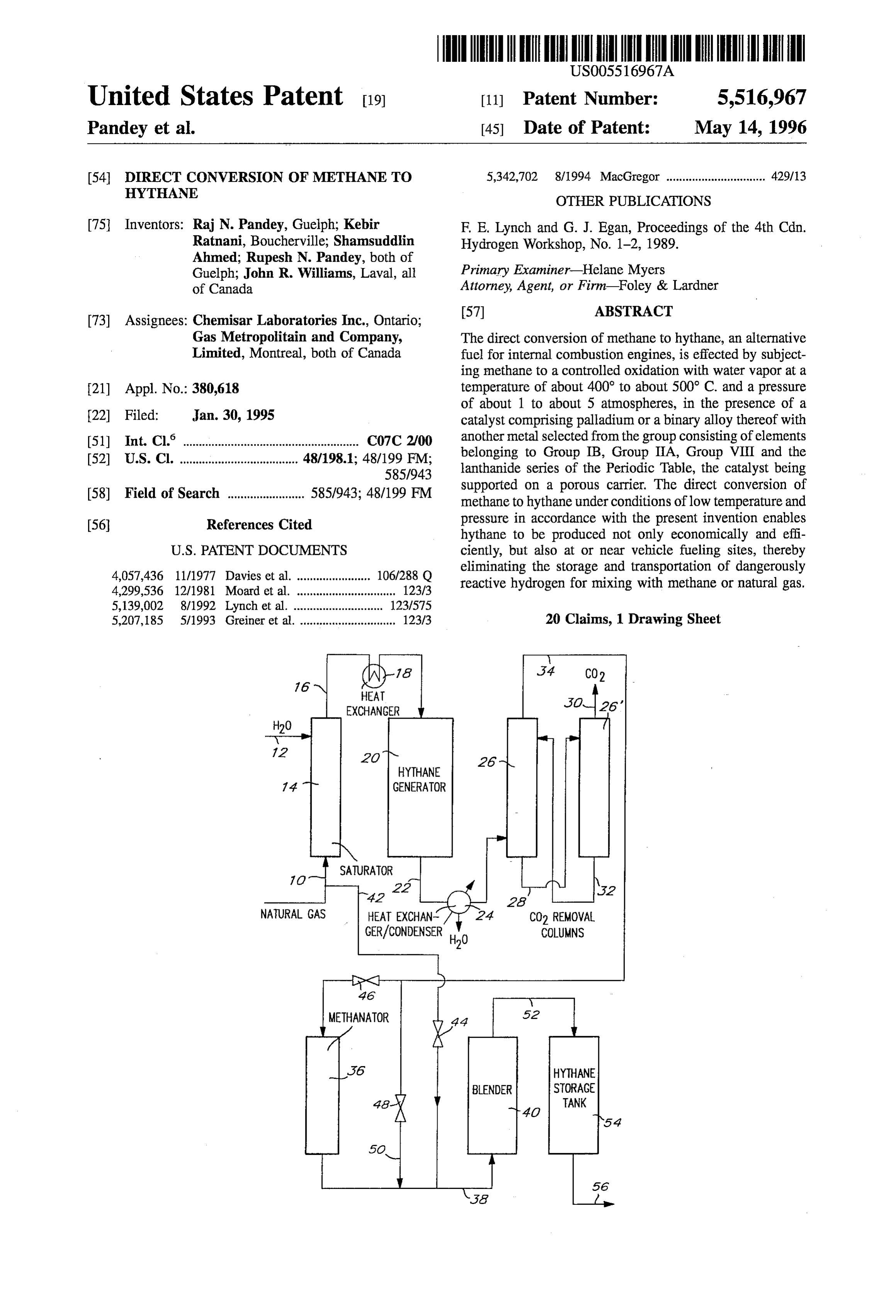
EXCHANGER
HYTHANE
GENERATOR
SATURATOR
NAURAL GAS HEAT EXCHAN C02 REMOVAL
METHANATOR
HYTHANE
BLENDER STORAGE
ANK
Page 2
Drawing sheet — no readable text.
Page 3
DIRECT CONVERSION OF METHANE TO the lanthanide series of the Periodic Table, the catalyst being HYTHANE supported on a porous carrier.
Applicant has found quite unexpectedly that by using the
BACKGROUND OF THE INVENTION above catalyst methane or natural gas can be converted The present invention relates to a novel process for the directly to hythane under controlled conditions of low efficient and economic production of hythane, an alternative temperature and pressure. The absence of severe tempera fuel for internal combustion engines. More particularly, the ture and pressure conditions keeps the capital and operating invention relates to a process for the direct conversion of costs of the process of the invention within reasonable limits.
methane to hythane. 10
The growing regulatory and legislative demands for The expression "controlled oxidation' as used herein refers to an oxidation reaction which is carried out in the gradual introduction of pollution-free vehicles in Canada presence of the above catalyst and under the above con and other industrialized nations of the world have intensified research to find clean burning transportation fuels. Com trolled conditions of low temperature and pressure so that pressed natural gas, methanol and oxygenated fuels are 15 the the reaction proceeds to the desired H2 and CH contents in gaseous product mixture obtained, corresponding to the among the leading candidates. Recently, blends of 5-20 vol. composition of hythane.
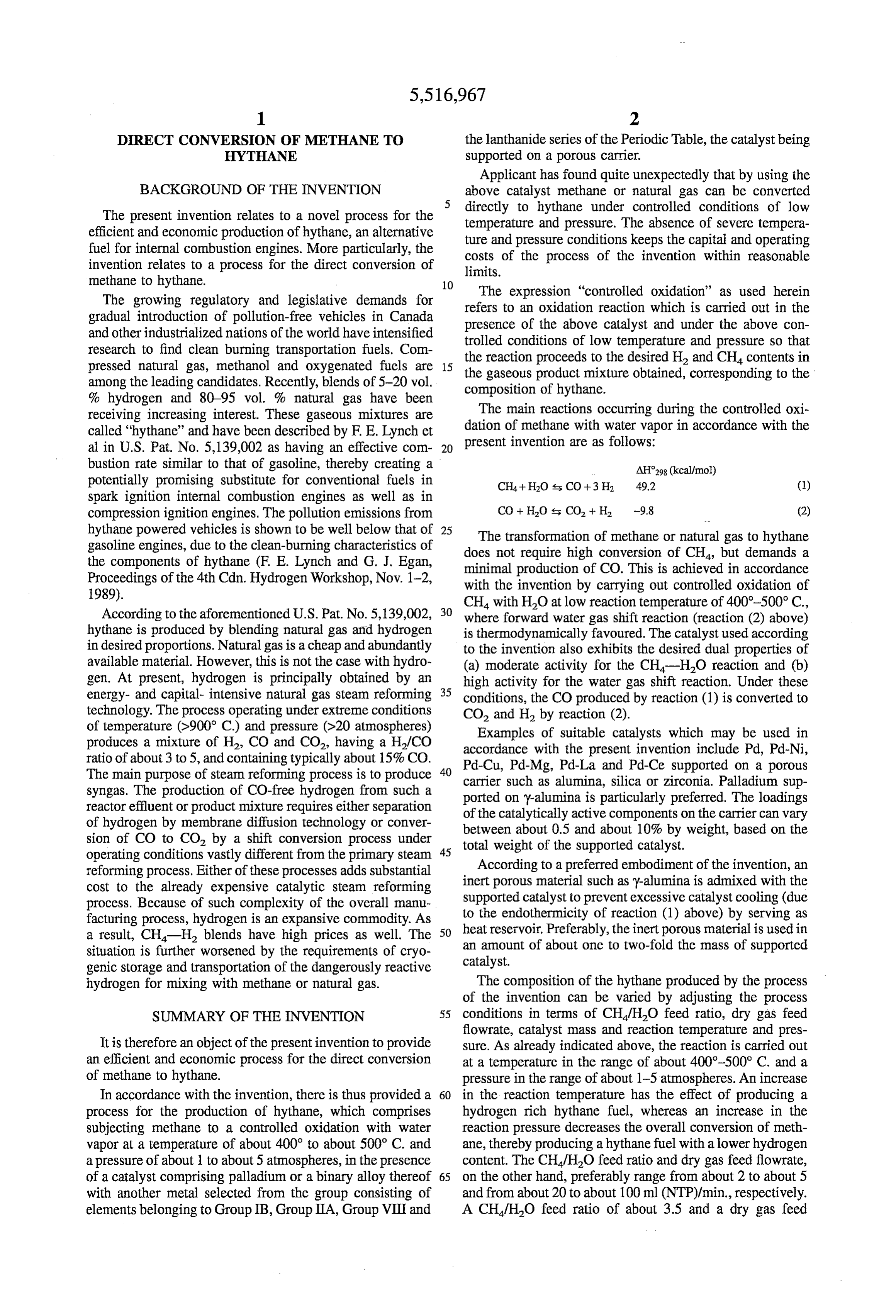
% hydrogen and 80–95 vol. % natural gas have been The main reactions occurring during the controlled oxi receiving increasing interest. These gaseous mixtures are called “hythane' and have been described by F. E. Lynch et dation of methane with water vapor in accordance with the al in U.S. Pat. No. 5,139,002 as having an effective com 20 present invention are as follows:
bustion rate similar to that of gasoline, thereby creating a AH293 (kcal/mol) potentially promising substitute for conventional fuels in CH4+ H2O as CO-3H 49.2 (1) spark ignition internal combustion engines as well as in compression ignition engines. The pollution emissions from CO + H2O es CO + H. -9.8 (2) hythane powered vehicles is shown to be well below that of 25 The transformation of methane or natural gas to hythane gasoline engines, due to the clean-burning characteristics of does not require high conversion of CH, but demands a the components of hythane (F. E. Lynch and G. J. Egan, minimal production of CO. This is achieved in accordance Proceedings of the 4th Cdn. Hydrogen Workshop, Nov. 1-2, with the invention by carrying out controlled oxidation of 1989). CH with HO at low reaction temperature of 400-500° C., According to the aforementioned U.S. Pat. No. 5,139,002, 30 where forward water gas shift reaction (reaction (2) above) hythane is produced by blending natural gas and hydrogen is thermodynamically favoured. The catalyst used according in desired proportions. Natural gas is a cheap and abundantly to the invention also exhibits the desired dual properties of available material. However, this is not the case with hydro (a) moderate activity for the CH-HO reaction and (b) gen. At present, hydrogen is principally obtained by an high activity for the water gas shift reaction. Under these energy- and capital- intensive natural gas steam reforming 35 conditions, the CO produced by reaction (1) is converted to technology. The process operating under extreme conditions CO and H2 by reaction (2).
of temperature (>900° C.) and pressure (>20 atmospheres) Examples of suitable catalysts which may be used in produces a mixture of H., CO and CO2, having a H2/CO accordance with the present invention include Pd, Pd-Ni, ratio of about 3 to 5, and containing typically about 15% CO. Pd-Cu, Pd-Mg, Pd-La and Pd-Ce supported on a porous The main purpose of steam reforming process is to produce 40 carrier such as alumina, silica or zirconia. Palladium sup syngas. The production of CO-free hydrogen from such a ported on Y-alumina is particularly preferred. The loadings reactor effluent or product mixture requires either separation of the catalytically active components on the carrier can vary of hydrogen by membrane diffusion technology or conver between about 0.5 and about 10% by weight, based on the sion of CO to CO by a shift conversion process under total weight of the supported catalyst. operating conditions vastly different from the primary steam 45 According to a preferred embodiment of the invention, an reforming process. Either of these processes adds substantial cost to the already expensive catalytic steam reforming inert porous material such as Y-alumina is admixed with the process. Because of such complexity of the overall manu supported catalyst to prevent excessive catalyst cooling (due facturing process, hydrogen is an expansive commodity. As to the endothermicity of reaction (1) above) by serving as a result, CH-H blends have high prices as well. The 50 heatreservoir. Preferably, the inert porous material is used in an amount of about one to two-fold the mass of supported situation is further worsened by the requirements of cryo catalyst.
genic storage and transportation of the dangerously reactive hydrogen for mixing with methane or natural gas. The composition of the hythane produced by the process of the invention can be varied by adjusting the process
SUMMARY OF THE INVENTION 55 conditions in terms of CH/HO feed ratio, dry gas feed flowrate, catalyst mass and reaction temperature and pres
It is therefore an object of the present invention to provide sure. As already indicated above, the reaction is carried out an efficient and economic process for the direct conversion at a temperature in the range of about 400-500° C. and a of methane to hythane. pressure in the range of about 1-5 atmospheres. An increase In accordance with the invention, there is thus provided a 60 in the reaction temperature has the effect of producing a process for the production of hythane, which comprises hydrogen rich hythane fuel, whereas an increase in the subjecting methane to a controlled oxidation with water reaction pressure decreases the overall conversion of meth vapor at a temperature of about 400 to about 500° C. and ane, thereby producing a hythane fuel with a lower hydrogen a pressure of about 1 to about 5 atmospheres, in the presence content. The CH/HO feed ratio and dry gas feed flowrate, of a catalyst comprising palladium or a binary alloy thereof 65 on the other hand, preferably range from about 2 to about 5 with another metal selected from the group consisting of and from about 20 to about 100 ml (NTP)/min., respectively. elements belonging to Group B, Group IIA, Group VIII and A CH/HO feed ratio of about 3.5 and a dry gas feed
Page 4
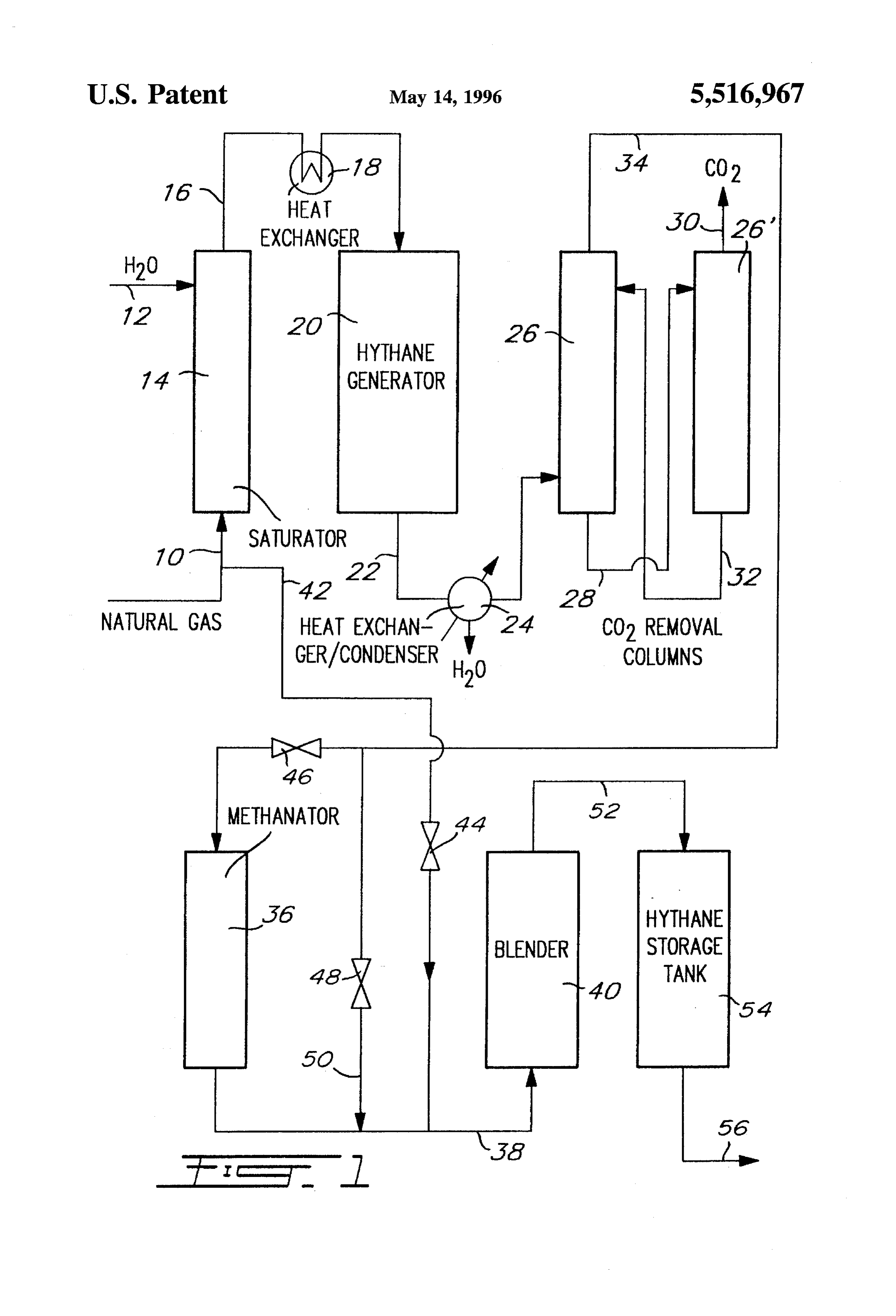
flowrate of about 25 ml/min. are preferred. The mass of The gas stream leaving the CO, absorption tower 26 is supported catalyst may vary within a range of about 0.2 to sent via line 34 to a catalytic methanator 36 for converting about 1 g. An increase in the partial pressure of water vapor residual carbon monoxide to methane. The methanation is in the feed has the effect of producing a hydrogen rich usually carried out over a silica supported nickel catalyst hythane fuel, whereas an increase in the catalyst mass or dry maintained at a temperature of 300-350° C. The methana gas feed flowrate increases the conversion of methane and tor effluent which is discharged via line 38 and contains only thus increases the hydrogen content of the fuel. CH and H is sent to a blender 40. If the CH/H ratio in The process of the invention has the distinct advantage of the hythane fuel thus produced is lower than desired, the offering significant cost savings over conventional processes ratio can be adjusted in the blender by adding make-up for hythane production such as those based on producing 10 natural gas via line 42 and opening valve 44. On the other hydrogen by electrolysis of water or by multistep high hand, if the residual carbon monoxide in the gas stream temperature-high pressure steam reforming of methane, leaving the CO absorption tower 26 is within permissible followed by blending of hydrogen with natural gas. The limits, the methanation step can be bypassed as a cost-saving direct conversion of methane to hythane under conditions of measure by closing valve 46 and opening valve 48 so as to low temperature and pressure in accordance with the present 15 send the gas stream directly to the blender 40 via lines 34, invention enables hythane to be produced not only economi 50 and 38. After blending, the gaseous mixture of CH and cally and efficiently, but also at or near vehicle fueling sites, His sent via line 52 to a storage tank 54 for ultimate fueling thereby eliminating the storage and transportation of dan of automobiles or the like via line 56. gerously reactive hydrogen for mixing with methane or The following non-limiting examples further illustrate the natural gas. 20 invention.
BRIEF DESCRIPTION OF THE DRAWINGS
EXAMPLE 1.
Further features and advantages of the invention will become more readily apparent from the following descrip 25 A Pdfy-AlO catalyst containing 2.0 wt.% Pd was tion of a preferred embodiment as illustrated by way of prepared by incipient wetness impregnation of a Y-alumina example in the accompanying drawing, in which: support (20-40 mesh) with an aqueous solution of palladium FIG. 1 is a flow diagram of a process for producing chloride, followed by drying at 120° C. hythane according to the invention. A microreactor was packed with an admixture of 0.2 gram 30 of the above catalyst with 0.3 gram of inert Y-Al2O and
DESCRIPTION OF PREFERRED placed in a continuous flow system. Prior to the start of the EMBODIMENTS reaction, the mixture of Pdfy-AlO catalyst and inert y-Al-O was calcined at 500° C. under N, flow for 2 hours,
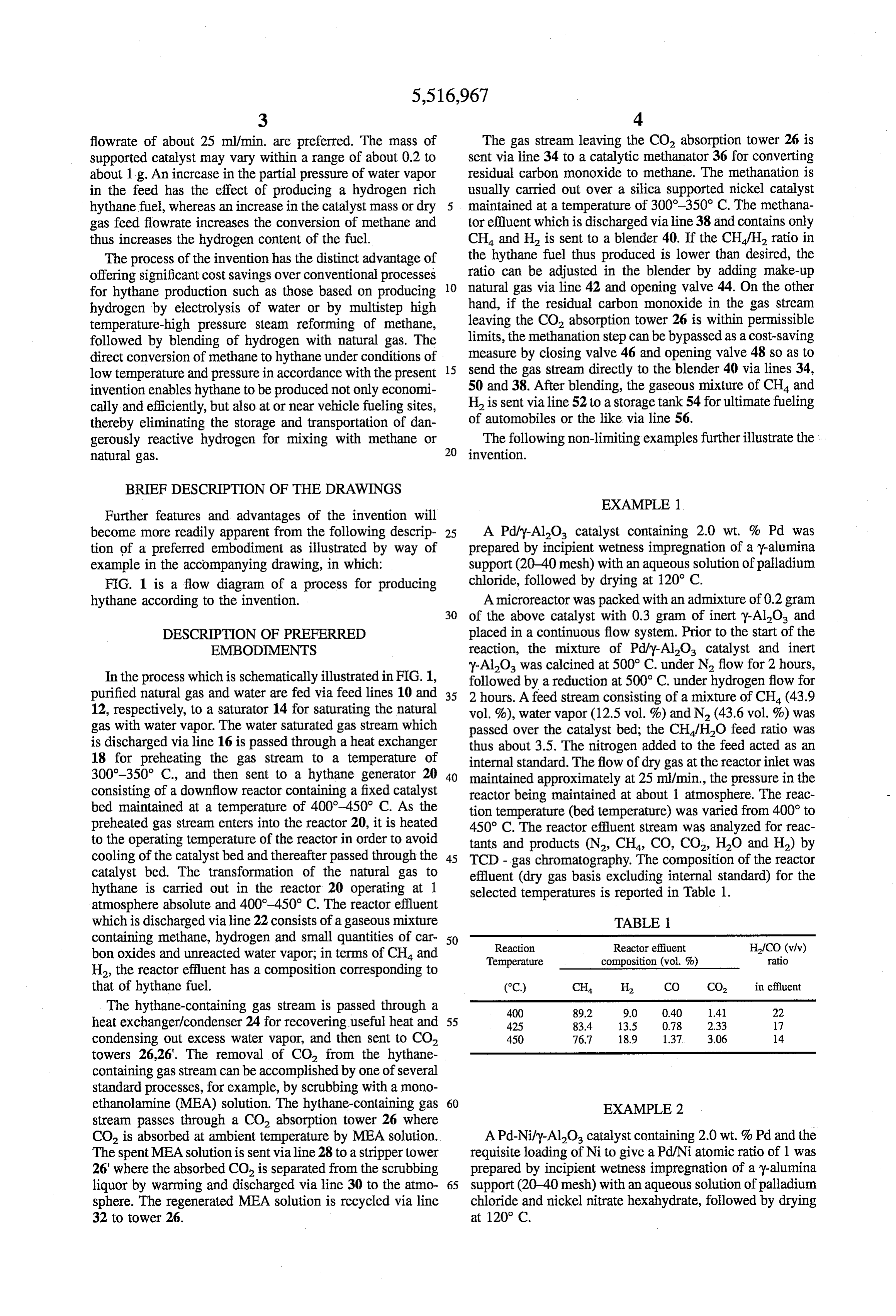
In the process which is schematically illustrated in FIG. 1, followed by a reduction at 500° C. under hydrogen flow for purified natural gas and water are fed via feed lines 10 and 35 2 hours. A feed stream consisting of a mixture of CH (43.9 12, respectively, to a saturator 14 for saturating the natural vol.%), water vapor (12.5 vol.%) and N (43.6 vol.%) was gas with water vapor. The water saturated gas stream which passed over the catalyst bed; the CH/HO feed ratio was is discharged via line 16 is passed through a heat exchanger thus about 3.5. The nitrogen added to the feed acted as an 18 for preheating the gas stream to a temperature of internal standard. The flow of dry gas at the reactor inlet was 300-350° C., and then sent to a hythane generator 20 40 maintained approximately at 25 ml/min., the pressure in the consisting of a downflow reactor containing a fixed catalyst reactor being maintained at about 1 atmosphere. The reac bed maintained at a temperature of 400-450° C. As the tion temperature (bed temperature) was varied from 400 to preheated gas stream enters into the reactor 20, it is heated 450° C. The reactor effluent stream was analyzed for reac to the operating temperature of the reactor in order to avoid tants and products (N, CH, CO, CO2, H2O and H2) by cooling of the catalyst bed and thereafter passed through the 45 TCD-gas chromatography. The composition of the reactor catalyst bed. The transformation of the natural gas to effluent (dry gas basis excluding internal standard) for the hythane is carried out in the reactor 20 operating at 1 selected temperatures is reported in Table 1. atmosphere absolute and 400-450° C. The reactor effluent which is discharged via line 22 consists of a gaseous mixture TABLE 1. containing methane, hydrogen and small quantities of car 50 Reaction Reactor effluent H/CO (v/v) bon oxides and unreacted water vapor; in terms of CH and Temperature composition (vol. %) ratio H2, the reactor effluent has a composition corresponding to that of hythane fuel. (°C) CH, H CO CO in effluent The hythane-containing gas stream is passed through a 400 89.2 9.0 0.40 1.41 22 heat exchanger/condenser 24 for recovering useful heat and 55 425 83.4 3.5 0.78 2.33 17 condensing out excess water vapor, and then sent to CO. 450 76.7 18.9 1.37 3.06 14 towers 26,26'. The removal of CO2 from the hythane containing gas stream can be accomplished by one of several standard processes, for example, by scrubbing with a mono ethanolamine (MEA) solution. The hythane-containing gas 60 EXAMPLE 2 stream passes through a CO2 absorption tower 26 where
CO is absorbed at ambient temperature by MEA solution. APd-Ni?y-Al-O catalyst containing 2.0 wt.% Pd and the The spent MEA solution is sent via line 28to a stripper tower requisite loading of Nito give a Pd/Ni atomic ratio of 1 was 26' where the absorbed CO2 is separated from the scrubbing prepared by incipient wetness impregnation of a Y-alumina liquor by warming and discharged via line 30 to the atmo 65 support (20-40 mesh) with an aqueous solution of palladium sphere. The regenerated MEA solution is recycled via line chloride and nickel nitrate hexahydrate, followed by drying 32 to tower 26. at 120° C.
Page 5
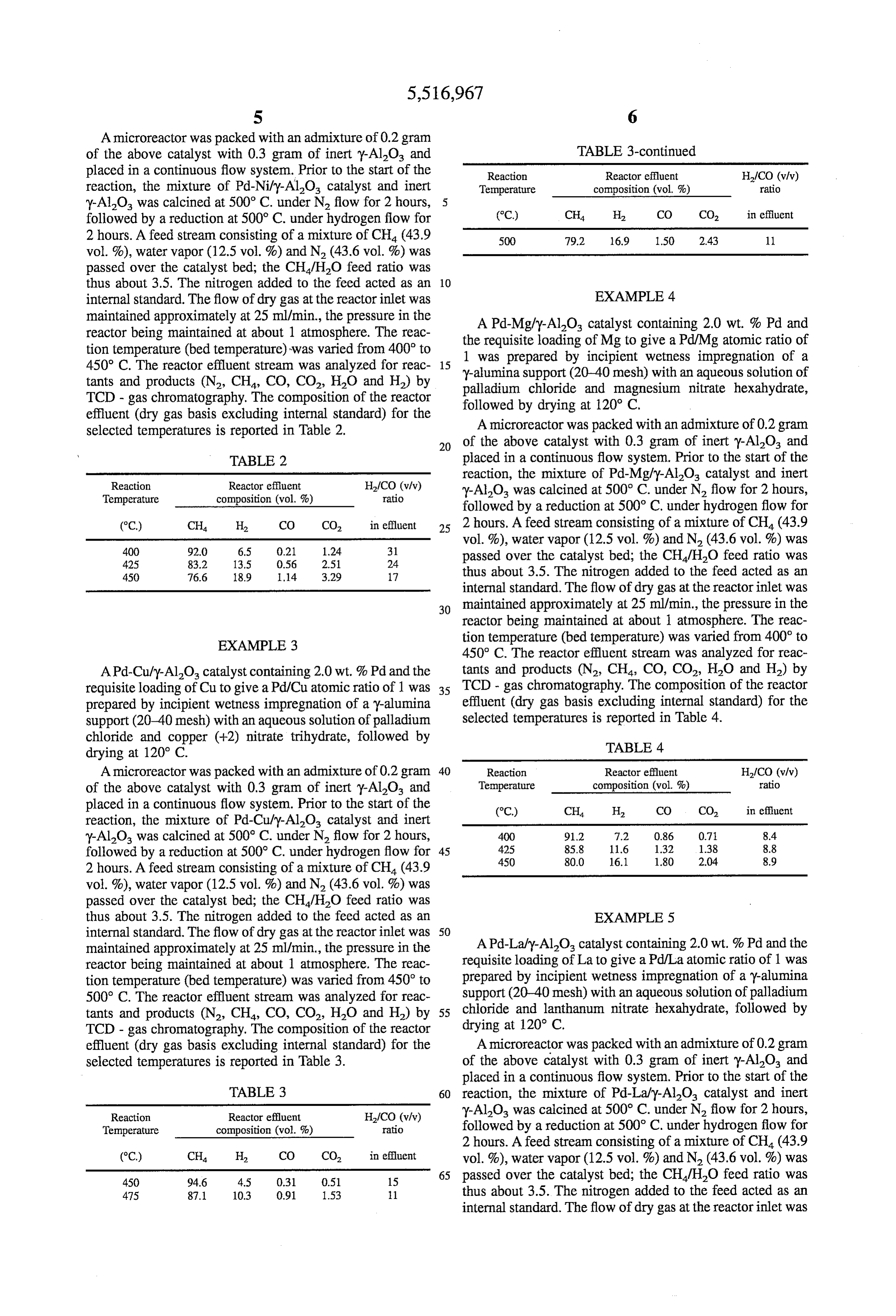
A microreactor was packed with an admixture of 0.2 gram of the above catalyst with 0.3 gram of inert Y-Al2O and TABLE 3-continued placed in a continuous flow system. Prior to the start of the Reaction Reactor effluent H/CO (v/v) reaction, the mixture of Pd-Ni?y-Al-O catalyst and inert Temperature composition (vol.%) ratio Y-Al-O was calcined at 500° C. under N, flow for 2 hours, 5 (°C) CH H2 CO CO in effluent followed by a reduction at 500° C. under hydrogen flow for 2 hours. A feed stream consisting of a mixture of CH (43.9 500 79.2 16.9 150 2.43 11
passed over the catalyst bed; the CH/HO feed ratio was thus about 3.5. The nitrogen added to the feed acted as an 10 internal standard. The flow of dry gas at the reactor inlet was EXAMPLE 4 maintained approximately at 25 ml/min., the pressure in the reactor being maintained at about 1 atmosphere. The reac theArequisite Pd-Mg/Y-Al2O catalyst containing 2.0 wt.% Pd and loading of Mg to give a Pd/Mg atomic ratio of tion temperature (bed temperature) was varied from 400° to 450° C. The reactor effluent stream was analyzed for reac 15 Y-alumina supportby(20-40 1 was prepared incipient wetness impregnation of a tants and products (N, CH, CO, CO, HO and H) by palladium chloride and mesh) with an aqueous solution of magnesium nitrate hexahydrate,
TCD-gas chromatography. The composition of the reactor followed by drying at 120° C.
effluent (dry gas basis excluding internal standard) for the selected temperatures is reported in Table 2. A microreactor was packed with an admixture of 0.2 gram 20 of the above catalyst with 0.3 gram of inert Y-Al2O and
TABLE 2 placed in a continuous flow system. Prior to the start of the Reaction Reactor effluent H/CO (v/v) reaction, the mixture of Pd-Mg/Y-AlO catalyst and inert
Temperature composition (vol. 96) ratio Y-Al-O was calcined at 500° C. under N, flow for 2 hours, followed by a reduction at 500° C. under hydrogen flow for (°C) CH H2 CO CO in effluent 25 2 hours. A feed stream consisting of a mixture of CH (43.9
425 83.2 13.5 0.56 2.51 24 passed over the catalyst bed; the CH/HO feed ratio was 450 76.6 18.9 .14 3.29 17 thus about 3.5. The nitrogen added to the feed acted as an internal standard. The flow of dry gas at the reactor inlet was 30 maintained approximately at 25 ml/min., the pressure in the reactor being maintained at about 1 atmosphere. The reac
EXAMPLE 3 tion temperature (bed temperature) was varied from 400 to 450° C. The reactor effluent stream was analyzed for reac
APd-Cu/y-AlO catalyst containing 2.0 wt.% Pd and the tants and products (N, CH, CO, CO, HO and H2) by requisite loading of Cu to give a Pd/Cu atomic ratio of 1 was 35 TCD - gas chromatography. The composition of the reactor prepared by incipient wetness impregnation of a Y-alumina effluent (dry gas basis excluding internal standard) for the support (20–40 mesh) with an aqueous solution of palladium selected temperatures is reported in Table 4. chloride and copper (+2) nitrate trihydrate, followed by TABLE 4 drying at 120° C.
A microreactor was packed with an admixture of 0.2 gram 40 Reaction Reactor effluent H/CO (v/v) of the above catalyst with 0.3 gram of inert Y-Al-O and Temperature composition (vol. %) ratio placed in a continuous flow system. Prior to the start of the (°C) CH, H CO CO in effluent reaction, the mixture of Pd-Cu/y-Al-O catalyst and inert
Y-Al2O, was calcined at 500° C. under N. flow for 2 hours, 400
followed by a reduction at 500° C. under hydrogen flow for 45 450 80.0 16.1 1.80 2.04 8.9 2 hours. A feed stream consisting of a mixture of CH (43.9
passed over the catalyst bed; the CH/HO feed ratio was thus about 3.5. The nitrogen added to the feed acted as an EXAMPLE 5 internal standard. The flow of dry gas at the reactor inlet was 50 maintained approximately at 25 ml/min., the pressure in the APd-La?y-AlO catalyst containing 2.0 wt.% Pd and the reactor being maintained at about 1 atmosphere. The reac requisite loading of La to give a Pd/La atomic ratio of 1 was tion temperature (bed temperature) was varied from 450° to prepared by incipient wetness impregnation of a Y-alumina 500° C. The reactor effluent stream was analyzed for reac support (20-40 mesh) with an aqueous solution of palladium tants and products (N2, CH, CO, CO., H2O and H) by 55 chloride and lanthanum nitrate hexahydrate, followed by TCD - gas chromatography. The composition of the reactor drying at 120° C.
effluent (dry gas basis excluding internal standard) for the A microreactor was packed with an admixture of 0.2 gram selected temperatures is reported in Table 3. of the above catalyst with 0.3 gram of inert Y-Al-O, and placed in a continuous flow system. Prior to the start of the
TABLE 3 60 reaction, the mixture of Pd-La/Y-Al-O catalyst and inert Reaction Reactor effluent H/CO (v/v) Y-Al2O was calcined at 500° C. under N, flow for 2 hours, Temperature composition (vol.%) ratio followed by a reduction at 500° C. under hydrogen flow for 2 hours. A feed stream consisting of a mixture of CH (43.9 (°C) CH H CO CO in effluent vol.%), water vapor (12.5 vol.%) and N (43.6 vol.%) was
65 passed over the catalyst bed; the CH/HO feed ratio was 475 87.1 10.3 0.91 153 11 thus about 3.5. The nitrogen added to the feed acted as an internal standard. The flow of dry gas at the reactor inlet was
Page 6
maintained approximately at 25 ml/min., the pressure in the presence of a catalyst comprising palladium or a binary alloy reactor being maintained at about 1 atmosphere. The reac thereof with another metal selected from the group consist tion temperature (bed temperature) was varied from 400° to ing of elements belonging to Group IB, Group IIA, Group 450° C. The reactor effluent stream was analyzed for reac VIII and the lanthanide series of the Periodic Table, the tants and products (N, CH, CO, CO, HO and H2) by 5 catalyst being supported on a porous carrier,
TCD - gas chromatography. The composition of the reactor 2. A process as claimed in claim 1, wherein said oxidation effluent (dry gas basis excluding internal standard) for the is carried out at atmospheric pressure. selected temperatures is reported in Table 5. 3. A process as claimed in claim 1, wherein said oxidation is carried out at a temperature ranging from about 400° to
4. A process as claimed in claim 1, wherein said catalyst
Reaction Reactor effluent H/CO (v/v) is selected from the group consisting of palladium, alloys of Temperature composition (vol.%) ratio palladium-nickel, palladium-copper, palladium-magnesium,
palladium-lanthanum and palladium-cerium.
5. A process as claimed in claim 1, wherein said carrier is 15 selected from the group consisting of alumina, silica and
425 82.0 14.8 0.96 2.24 15 Zirconia.
450 76.4 19.0 1.4 3.19 13 6. A process as claimed in claim 1, wherein said catalyst comprises palladium supported on Y-alumina.
7. A process as claimed in claim 1, wherein said catalyst 20 comprises about 0.5 to about 10% by weight of palladium or
EXAMPLE 6 of said binary alloy thereof, based on the total weight of the supported catalyst.
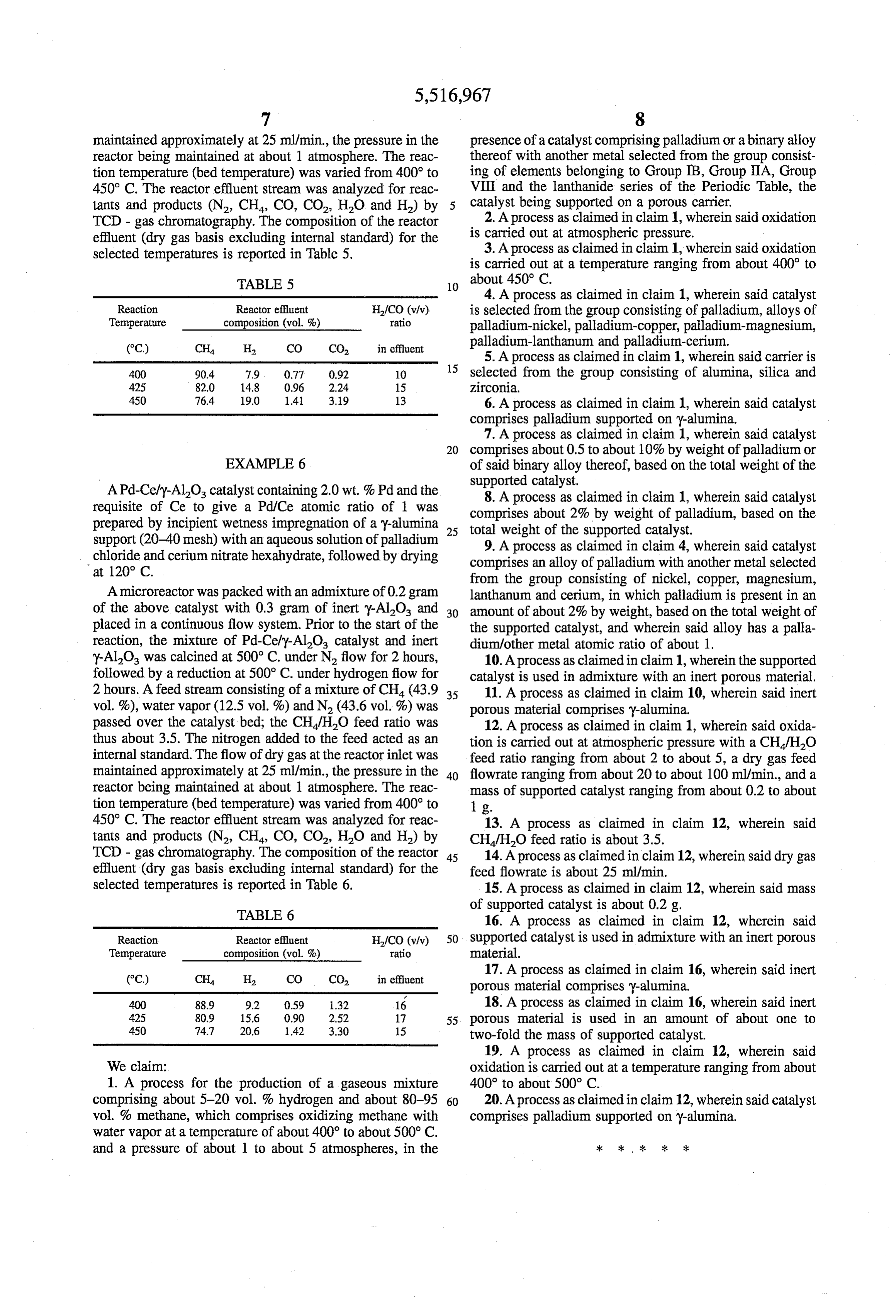
APd-Cefy-AlO catalyst containing 2.0 wt.% Pd and the 8. A process as claimed in claim 1, wherein said catalyst requisite of Ce to give a Pd/Ce atomic ratio of 1 was prepared by incipient wetness impregnation of a Y-alumina 25 total weightabout comprises 2% by weight of palladium, based on the of the supported catalyst.
support (20-40 mesh) with an aqueous solution of palladium 9. A process as claimed in claim 4, wherein said catalyst chloride and cerium nitrate hexahydrate, followed by drying comprises an alloy of palladium with another metal selected at 120° C. from the group consisting of nickel, copper, magnesium, A microreactor was packed with an admixture of 0.2 gram lanthanum and cerium, in which palladium is present in an of the above catalyst with 0.3 gram of inert y-AlO and 30 amount of about 2% by weight, based on the total weight of placed in a continuous flow system. Prior to the start of the the supported catalyst, and wherein said alloy has a palla reaction, the mixture of Pd-Cely-Al-O catalyst and inert dium/other metal atomic ratio of about 1. Y-Al-O was calcined at 500° C. under N, flow for 2 hours, 10. A process as claimed in claim 1, wherein the supported followed by a reduction at 500° C. under hydrogen flow for catalyst is used in admixture with an inert porous material. 2 hours. A feed stream consisting of a mixture of CH (43.9 35 11. A process as claimed in claim 10, wherein said inert vol.%), water vapor (12.5 vol.%) and N (43.6 vol.%) was porous material comprises Y-alumina.
passed over the catalyst bed; the CH/HO feed ratio was 12. A process as claimed in claim 1, wherein said oxida thus about 3.5. The nitrogen added to the feed acted as an tion is carried out at atmospheric pressure with a CH/HO internal standard. The flow of dry gas at the reactor inlet was feed ratio ranging from about 2 to about 5, a dry gas feed maintained approximately at 25 ml/min., the pressure in the 40 flowrate ranging from about 20 to about 100 ml/min., and a reactor being maintained at about 1 atmosphere. The reac mass of supported catalyst ranging from about 0.2 to about tion temperature (bed temperature) was varied from 400 to l g.
450° C. The reactor effluent stream was analyzed for reac 13. A process as claimed in claim 12, wherein said tants and products (N, CH, CO, CO, HO and H2) by CH/HO feed ratio is about 3.5.
TCD - gas chromatography. The composition of the reactor 45 14. A process as claimed in claim 12, wherein said dry gas effluent (dry gas basis excluding internal standard) for the feed flowrate is about 25 ml/min. selected temperatures is reported in Table 6. 15. A process as claimed in claim 12, wherein said mass of supported catalyst is about 0.2g.
TABLE 6 16. A process as claimed in claim 12, wherein said
Reaction Reactor effluent H/CO (v/v) 50 supported catalyst is used in admixture with an inert porous Temperature composition (vol.%) ratio material.
17. A process as claimed in claim 16, wherein said inert porous material comprises Y-alumina.
400 88.9 9.2 0.59 132 16 18. A process as claimed in claim 16, wherein said inert 425 80.9 15.6 0.90 2.52 17 55 porous material is used in an amount of about one to 450 74.7 20.6 1.42 3.30 15 two-fold the mass of supported catalyst. 19. A process as claimed in claim 12, wherein said
We claim: oxidation is carried out at a temperature ranging from about 1. A process for the production of a gaseous mixture 400 to about 500 C.
comprising about 5–20 vol. 96 hydrogen and about 80–95 60 20. A process as claimed in claim 12, wherein said catalyst vol.% methane, which comprises oxidizing methane with comprises palladium supported on Y-alumina.
water vapor at a temperature of about 400° to about 500° C.
and a pressure of about 1 to about 5 atmospheres, in the ck k . * * *k
Page 7
UNITED STATES PATENT AND TRADEMARK OFFICE
CERTIFICATE OF CORRECTION
INVENTOR(S) : Raj N. Pandey
It is certified that error appears in the above-indentified patent and that said Letters Patent is hereby Corrected as shown below:
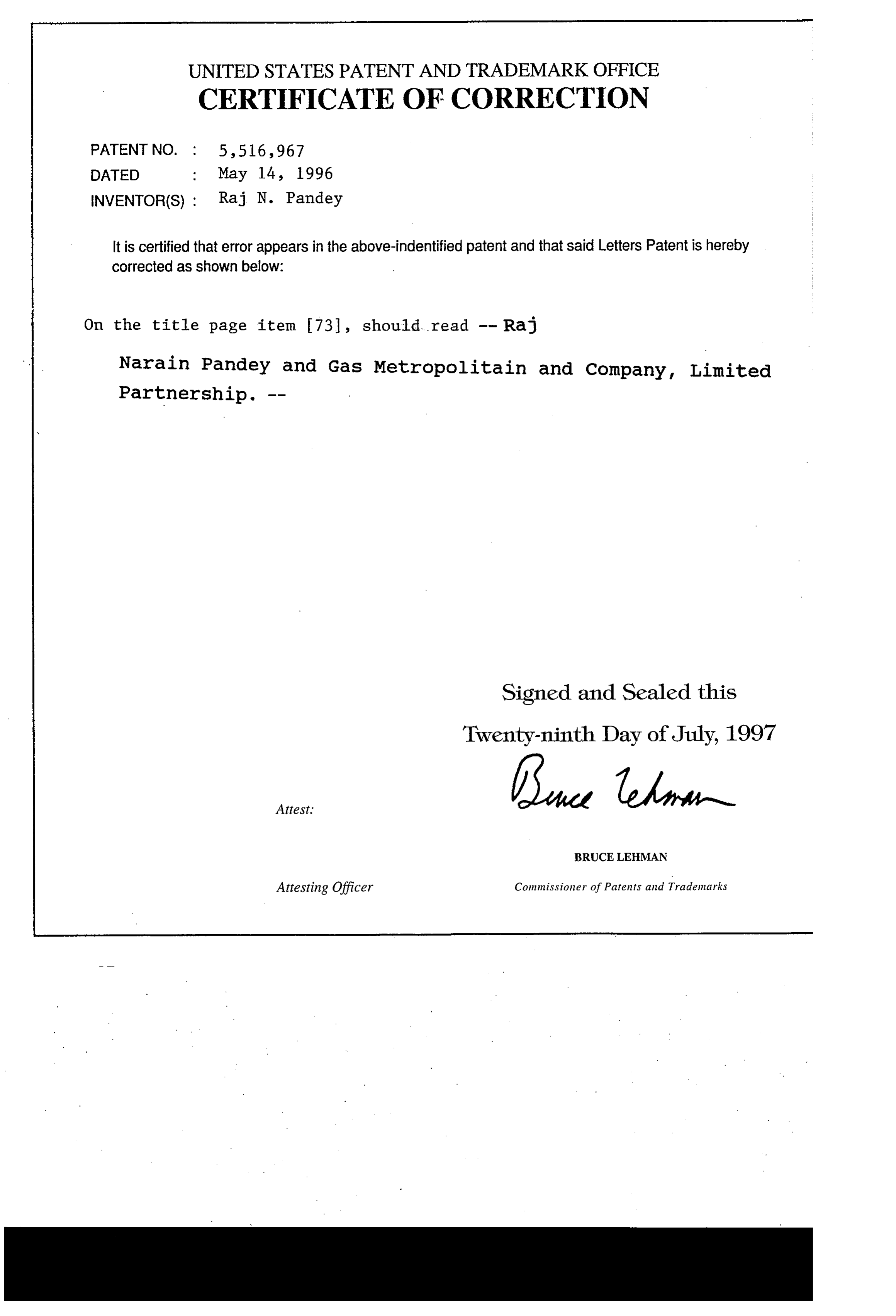
On the title page item 73, should read -- Raj Narain Pandey and Gas Metropolitain and Company, Limited Partnership. --
Signed and Sealed this
Twenty-ninth Day of July, 1997
BRUCE LEHMAN
Attesting Officer Commissioner of Patents and Trademarks
Provenance
- Collection
- Cited prior art
- Original PDF
- patentimages.storage.googleapis.com →
- Filed
- 1995-01-30
- Pages
- 7
- Method
- pdftotext (the PDF's own text layer) + pdftoppm 300dpi page scans
- Source
- Google Patents bibliographic record
- Granted
- 1996-05-14
- Inventors
- Raj N. Pandey; Kebir Ratnani; Shamsuddlin Ahmed; Rupesh N. Pandey; John R. Williams; Gas Metropolitan Inc; Chemisar Laboratories Inc
- Transcribed from
- patentimages.storage.googleapis.com →