patent · US5486983
Lighting module for instruments with a liquid-crystal matrix
23 January 1996
Page 1 — bibliographic record
United States Patent (19) 11) Patent Number: 5,486,983 Cordier et al. 45) Date of Patent: Jan. 23, 1996 (54) LIGHTING MODULE FOR INSTRUMENTS FOREIGN PATENT DOCUMENTS WITH A LIQUID-CRYSTAL MATRIX 0374085 6/1990 European Pat. Off.. (75) Inventors: Maurice Cordier, Paris; Bernard 0420072 4/1991 European Pat. Off.. Veislinger, Parmain, both of France OTHER PUBLICATIONS 73) Assignee: Sextant Avionique, France Patent Abstracts of Japan, vol. 12, No. 102, p. 684, Apr. 5,
21 Appl. No.: 307,370 Oct. 1987, abstract.
22 Filed: Sep. 16, 1994 Primary Examiner Ira S. Lazarus Assistant Examiner-Sara Sachie Raab 30 Foreign Application Priority Data Attorney, Agent, or Firm-Rosenman & Colin Sep. 21, 1993 FR France ................................... 93 11208 57 ABSTRACT (51) Int. Cl. ......................................... G02F1/1335 A lighting module for instruments with a liquid-crystal 52 U.S. Cl. ............................ 362/29; 362/260; 362/247; matrix (1) is disclosed. The module has a casing (5) includ 362/346; 359/50 ing a back (8) and lateral walls (7), the said matrix closing 58) Field of Search .............................. 362/29, 260, 241, off the casing on its face opposite the back, and at least one 362/247, 225, 297, 346, 347, 330; 359/50 fluorescent tube (9). The fluorescent tube is disposed in the 56) References Cited casing near the back. The back is reflective and shaped to form at least one parabolic cylindrical surface. The axis of
focal line of the said surface.
5,143,433 9/1992 Farrell ....................................... 362/29 5,253,151 10/1993 Mepham et al. ........................ 362/347 3 Claims, 1 Drawing Sheet
Page 2
Drawing sheet — no readable text.
Page 3
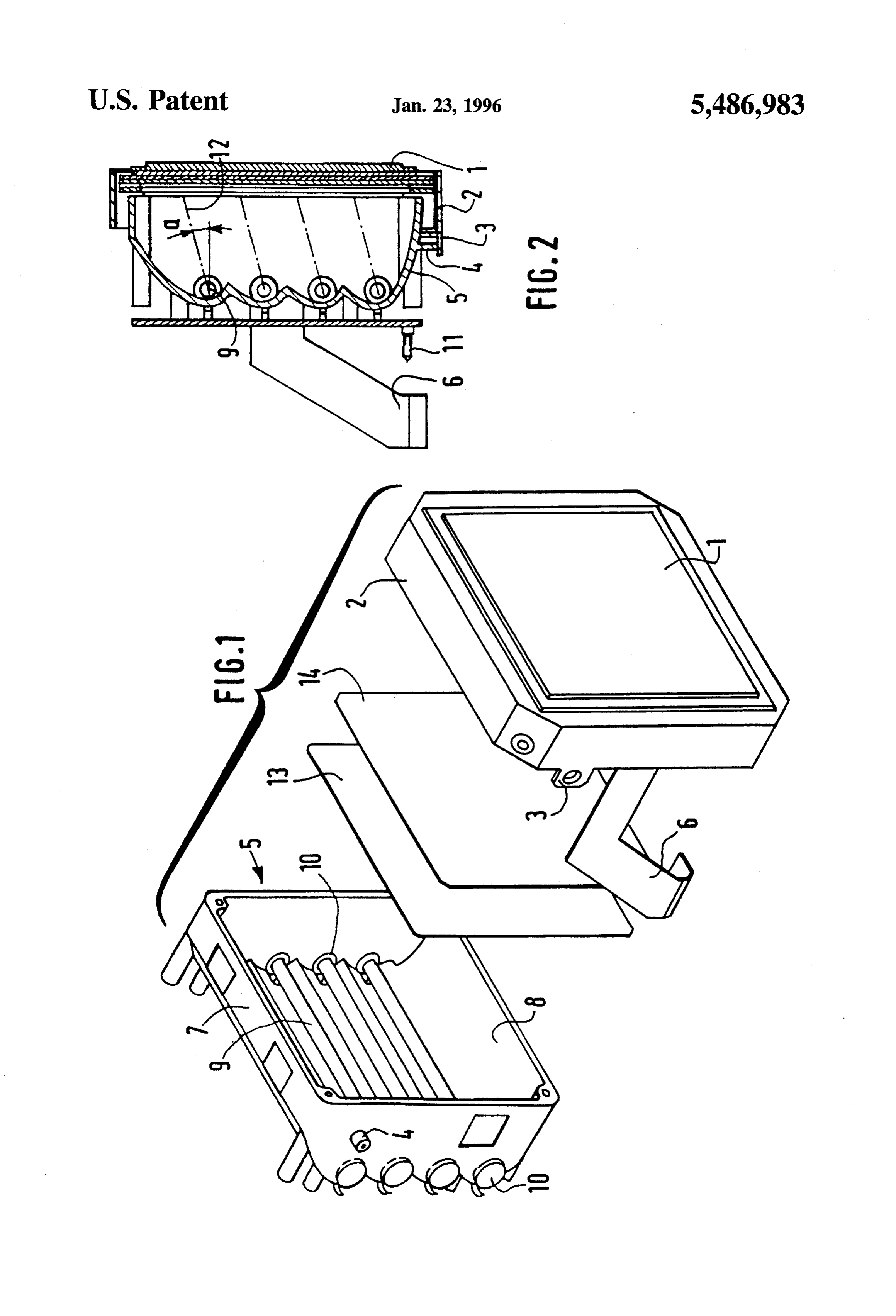
LIGHTING MODULE FOR INSTRUMENTS FIG. 1 is an exploded perspective view of a screen having WITH A LIQUID-CRYSTAL MATRIX a lighting module according to the invention, and BACKGROUND OF THE INVENTION FIG. 2 is a cross section view of this screen. 1. Field of the Invention
DETAILED DESCRIPTION OF A PREFERRED
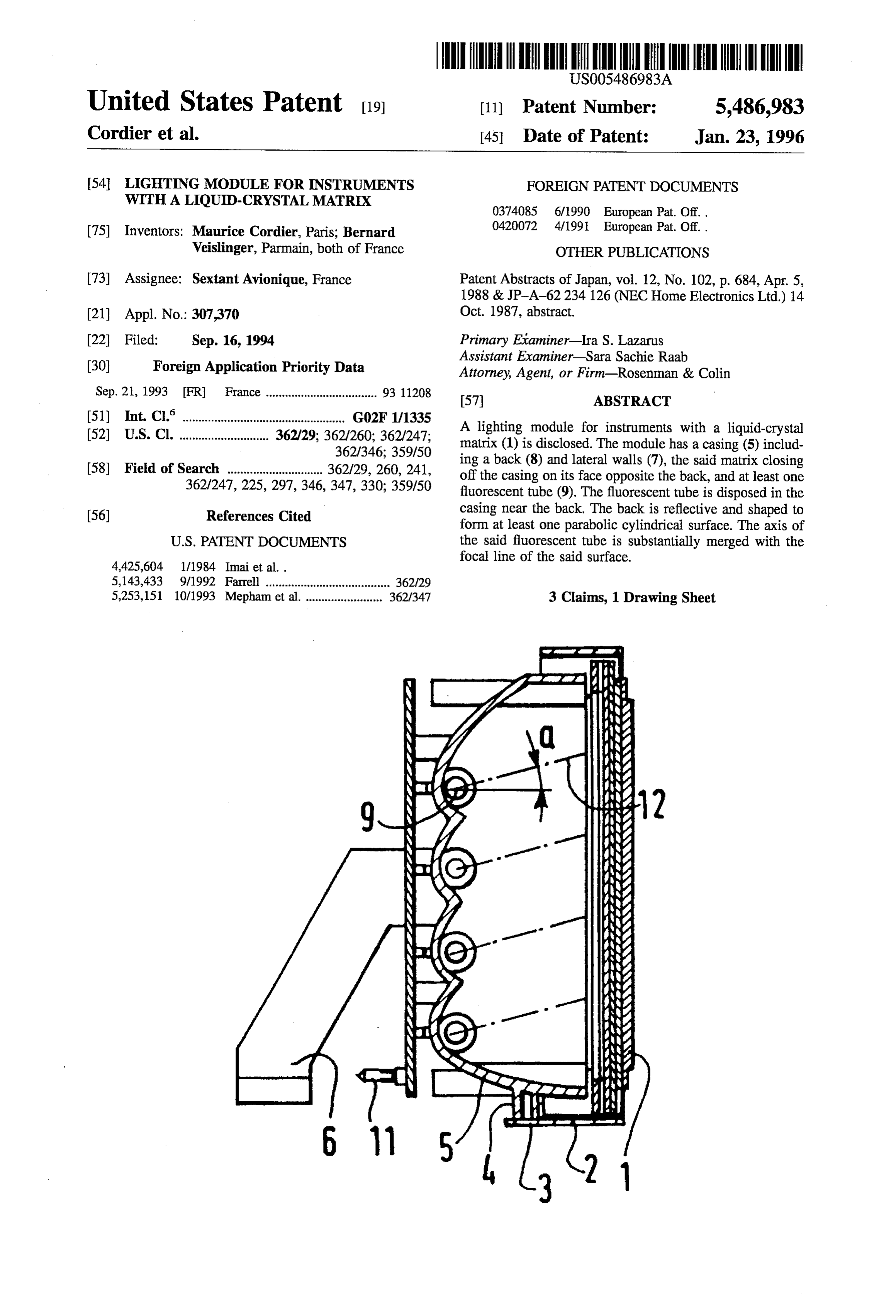
The present invention concerns a lighting module for EMBODIMENT instruments with a liquid-crystal matrix. More particularly, it concerns a module comprising a casing including a back The screen shown in the drawings comprises a liquid and lateral walls, the said matrix closing off the casing on its 10 crystal matrix 1 mounted in a supporting frame 2. The frame face opposite the back, and at least one fluorescent tube 2 has mounting means 3 cooperating with equivalent means being disposed in the casing near the back. 4 on a casing 5 which will be described below, as well as 2. Discussion of Related Art fixing arms 6 to fix the screen to an instrument panel. The illumination of active or inactive liquid crystal matrix The casing 5 has lateral walls 7 and a back wall 8 and is screens is generally provided by one or more fluorescent 15 closed off by the liquid-crystal matrix 1 on the opposite side tubes with cold or hot cathodes according to the applications from the back 8. The casing 5 may consist of a piece of and the levels of luminance required. One of the drawbacks moulded aluminium coated by sublimation on the inside of of these lighting devices lies in the power which they the casing 5.
require, whilst one of the main advantages of active-matrix The back 8 here consists of four parabolic cylindrical screens is precisely their very low consumption. This prob 20 surfaces, the focal lines of which, that is to say the straight lem becomes crucial when these screens are used in instru lines formed from the foci of the cross sections of the back, ments on the instrument panel of an aircraft where the light are parallel to each other and horizontal when the screen is environments may reach very high levels. The power mounted. In other words, seen in section in a vertical plane expended in the instruments to generate the level of light perpendicular to the matrix 1, the back 8 forms a series of ensuring legibility of the screen under these conditions has 25 arcs of a parabola connected together. an adverse effect on the reliability of the equipment. Four fluorescent tubes 9 are disposed so that their axes Until now, the backs of the casings of known lighting coincide with the focal lines of the four parabolic surfaces modules were flat and white. Such an arrangement, however, and are fixed and powered by means of sockets 10 connected has the drawback that a large part of the light is emitted in by suitable wires to a connector 11. directions in which it is of no use, which is particularly the 30 The symmetry planes 12 of the parabolic cylindrical case in applications concerning an instrument panel, where surfaces are inclined upwards with respect to the plane of the the person required to take note of the information displayed matrix 1 and therefore form an angle a, for example one of by the instrument is sitting in a specific, precise position around 15° C., with the horizontal. The parabolic cylindrical with respect to the screen. surfaces are, furthermore, shaped in such a way that the light The present invention aims to mitigate this drawback. 35 is essentially emitted in a dihedron of about 20 on each side
SUMMARY OF THE INVENTION
of the plane 12.
Finally, a filter 13 and a diffuser 14 are provided between
To this effect, the object of the invention is a lighting the casing 5 and the liquid-crystal matrix 1. The diffuser 14 module for instruments with a liquid-crystal matrix com receives, on the one hand, the Lambertian flux coming prising a casing having a back and lateral walls, the said 40 directly from the tubes 9 and, on the other hand, the reflected matrix closing off the casing on its face opposite the back, collimated flux coming from the parabolic cylindrical sur and at least one fluorescent tube being disposed in the casing faces. That is to say, both flux providing luminance on the in the vicinity of the back, characterised by the fact that the screen that is inversely proportional to the square of the said back is reflective and shaped to form at least one 45 distance from the source of the flux, and collimated flux. The parabolic cylindrical surface, the axis of the said fluorescent diffuser 14 is therefore disposed at a distance from the back tube being substantially merged with the focal line of the 8 of the casing 5 such that the illumination resulting from the said surface. sum of these two luminous fluxes is as homogenous as The effect of such an arrangement is to collimate the light possible.
coming from the fluorescent tubes in the desired direction. 50 By concentrating the luminous flux in the direction of the This results in reduced light losses and, consequently, at a observer, the invention enables the electric power necessary given level of illumination, less power required than in for lighting to be reduced.
known lighting modules. I claim:
In order for the light given out to be as homogenous as 1. A lighting module for instruments having a liquid possible in the desired direction, provision can be made to 55 crystal matrix lying in a plane, said module comprising: shape the back as a plurality of parabolic cylindrical sur a casing including back and lateral walls wherein the faces, the focal lines of which are parallel. matrix forms a wall of the casing opposite said back In addition, because in a vertical plane the instruments are wall;
viewed at a positive angle, provision is preferably made to a fluorescent tube disposed in the casing near said back incline the symmetry planes of the parabolic cylindrical 60 wall; and surfaces with respect to the plane of the liquid-crystal a reflective surface shaped to form at least one parabolic matrix, so that the majority of the light is directed upwards. cylindrical surface, said cylindrical surface having a BRIEF DESCRIPTION OF THE DRAWING focal line and a plane of symmetry, the axis of said fluorescent tube being substantially coaxial with said
A particular embodiment of the invention will now be 65 focal line and the planes of symmetry of said parabolic described by way of non-limiting example, with reference to cylindrical surfaces being inclined with respect to the the accompanying drawings in which: plane of the said liquid-crystal matrix.
Page 4
2. A lighting module according to claim 1, in which the fluorescent tube being substantially coaxial with said said back wall is shaped to form a plurality of parabolic focal line, and the planes of symmetry of said parabolic cylindrical focal lines. surfaces, said cylindrical surfaces having parallel lindrical surfaces cylindrical surf being being inclined
with respect to the 3. A lighting module for instruments having a liquid- 5 plane of the said liquid-crystal matrix; and crystal matrix lying in a plane, said module comprising: a diffuser between said casing and the liquid-crystal a casing cluding it. lateral walls wherein the matrix at a distance from the back wall of said casing t orms a wall of the casing opposite said back such that the illumination provided by the sum of the a fluorescent tube disposed in the casing near said back 10 Lambertian flux coming directly from the tube and the wall; collimated flux reflected by the parabolic cylindrical a reflective surface shaped to form at least one parabolic surfaces is substantially homogeneous. cylindrical surface, said cylindrical surface having a focal line and a plane of symmetry, the axis of said ck k k k k
Provenance
- Collection
- Cited prior art
- Original PDF
- patentimages.storage.googleapis.com →
- Filed
- 1994-09-16
- Pages
- 4
- Method
- pdftotext (the PDF's own text layer) + pdftoppm 300dpi page scans
- Source
- Google Patents bibliographic record
- Granted
- 1996-01-23
- Inventors
- Maurice Cordier; Bernard Veislinger; Thales Avionics SAS
- Transcribed from
- patentimages.storage.googleapis.com →