patent · US5474659
Process and apparatus for generating precursor gases used in the manufacture of semiconductor devices
12 December 1995
Page 1 — bibliographic record
United States Patent (19) 11 Patent Number: 5,474,659 Cadet et al. 45) Date of Patent: Dec. 12, 1995 54 PROCESS AND APPARATUS FOR P. D. Dapkus, Ann. Rev. Mater. Sci. 12, 243-269 (1982). GENERATING PRECURSOR GASES USED P. D. Dapkus, Journal of Crystal Growth, 68, 345-355 IN THE MANUFACTURE OF (1984).
SEMICONDUCTOR DEVICES R. H. Moss, Journal of Crystal Growth, 68, 78 (1984). M. J. Ludowise, et al, Journal of Electron. Mat., 10, 1051 (75) Inventors: Gardy Cadet, Orange; James W. (1981).
Mitchell, Somerset; Jorge L. Valdes, J. P. Duchenain, et al., Journal of Crystal Growth, 55, 64 Bedminster, all of N.J. (1981).
(73) Assignee: AT&T Corp., Murray Hill, N.J. H. M. Manasenit, et al, Journal of the Electrochemical
F. Goodridge, et al., "Porous Flow-through and (21) Appl. No.: 292,346 Fluidized-Bed Electrodes', Comprehensive Treatise of 22 Filed: Aug. 17, 1994 Electrochemistry, 6, Chapter 6, p. 393 (1983). P. W. Bridgman, Journal of the American Chemical Society,
Related U.S. Application Data 36, 1344 (1914).
63) Continuation of Ser. No. 966,968, Oct. 26, 1992, abandoned, 1989.
which is a continuation-in-part of Ser. No. 714,326, Jun. 11, U.S. Patent Application Serial No. 07/588,523, filed Sep. 18, 1991, abandoned, which is a continuation of Ser. No. 1990.
588,523, Sep. 18, 1990, abandoned, which is a continuation of Ser. No. 339,344, Apr. 18, 1989, abandoned. U.S. Patent Application Serial No. 07/714,326, filed Jun. 11,
(51) Int. Cl." ............................................ C25B 1/00 52 U.S. C. ................. 204/101; 204/252; 437/104 Primary Examiner-John Niebling 58 Field of Search ..................................... 204/101, 252, Assistant Examiner-Brendan Mee 204/259; 437/104, 107, 132, 133 Attorney, Agent, or Firm-Bruce S. Schneider 56) References Cited 57 ABSTRACT
3,404,076 10/1968 Haycock ................................. 204/101 materials, are produced utilizing gases such as arsine that 4,178,224 12/1979 Porter ...................................... 204/237 require careful handling of compressed gas cylinders. This 5,158,656 10/1992 Ayers ...................................... 204/101 care has engendered a search for alternate approaches. It has been found that the use of electrochemically generated gases
FOREIGN PATENT DOCUMENTS such as arsine yields an efficient, pure source of such gases 1033576 8/1983 U.S.S.R.. without necessitating the storage of large gas quantities. Thus, a device fabrication procedure including in situ elec
OTHER PUBLICATIONS trochemical generation of gases such as arsine is particularly useful.
The BOCA National Fire Prevention Code/1987 Building
Officials and Code Administrations, Int. Inc. 7th Ed. Country
Club Hills, Ill. 60477. 12 Claims, 3 Drawing Sheets
NNNNSNNNSNNNNNNNNNSNNSNSSNNNSNSSNSS
Page 2
Drawing sheet — no readable text.
Page 3
Drawing sheet — no readable text.
Page 4
Drawing sheet — no readable text.
Page 5
PROCESS AND APPARATUS FOR fabrication utilizing a source of gas, other than a compressed GENERATING PRECURSOR GASES USED gas source, are not presently available.
IN THE MANUFACTURE OF
SEMICONDUCTOR DEVICES SUMMARY OF THE INVENTION
CROSS-REFERENCE TO RELATED Electronic and/or optical devices are produced in a pro APPLICATION cess which directly supplies gases such as arsine, stibine, phosphine and germane by electrochemical in situ genera
This application is a continuation of application Ser. No. tion. Through the choice of appropriate electrolyte and 07/966968, filed on Oct. 26, 1992, now abandoned, which is 10 electrodes the gas is generated at a very high efficiency (up a continuation-in-part application of Ser. No. 07/714,326, to 97%), very little impurity is produced, and the electrolyte filed on Jun. 11, 1991, now abandoned which is a continu when spent is relatively innocuous, e.g., essentially only ation of application Ser. No. 071588,523, filed Sep. 18, 1990, sodium hydroxide aqueous solution. Pressures of 20 psig or now abandoned which in turn is a continuation of applica greater are easily generated and flow rates are expeditiously tion Ser. No. 07/339,344, filed Apr. 18, 1989, now aban 15 controlled to yield uniform delivery in the device fabrication doned all of which are hereby incorporated by reference. process.
An exemplary device fabrication method involves the use
BACKGROUND OF THE INVENTION of an electrochemical cell including a packed bed arsenic This invention relates to the manufacture of devices and, cathode surrounded by a barrier to anions, a counterelec in particular, the manufacture with gases of electronic 20 trode such as a molybdenum or tungsten anode, and an aqueous sodium hydroxide electrolyte. By applying current devices.
densities on the order of 20 mA/cm or greater to the
ART BACKGROUND electrode, arsine gas pressures of 20 psig or greater are easily developed. Essentially, no impurities are present
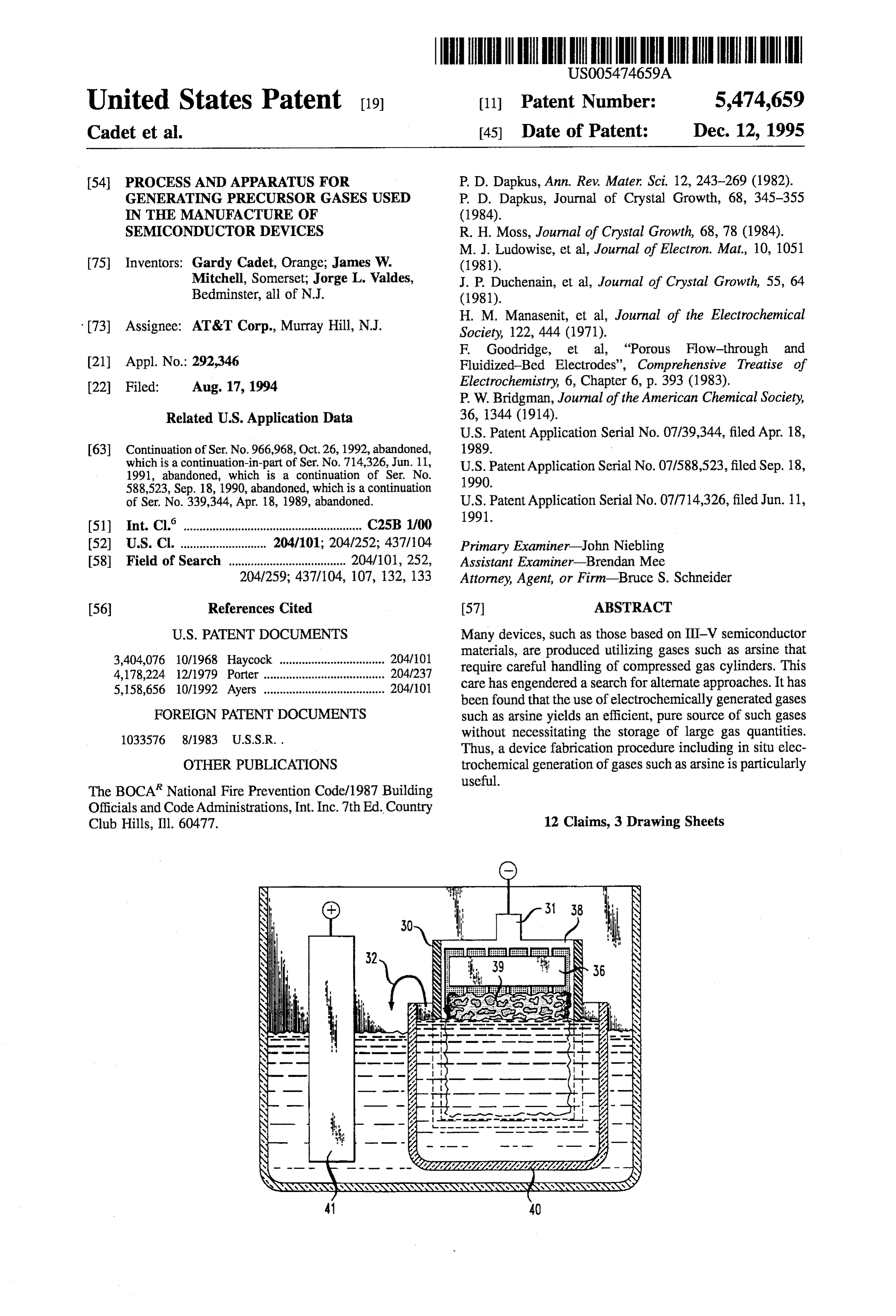
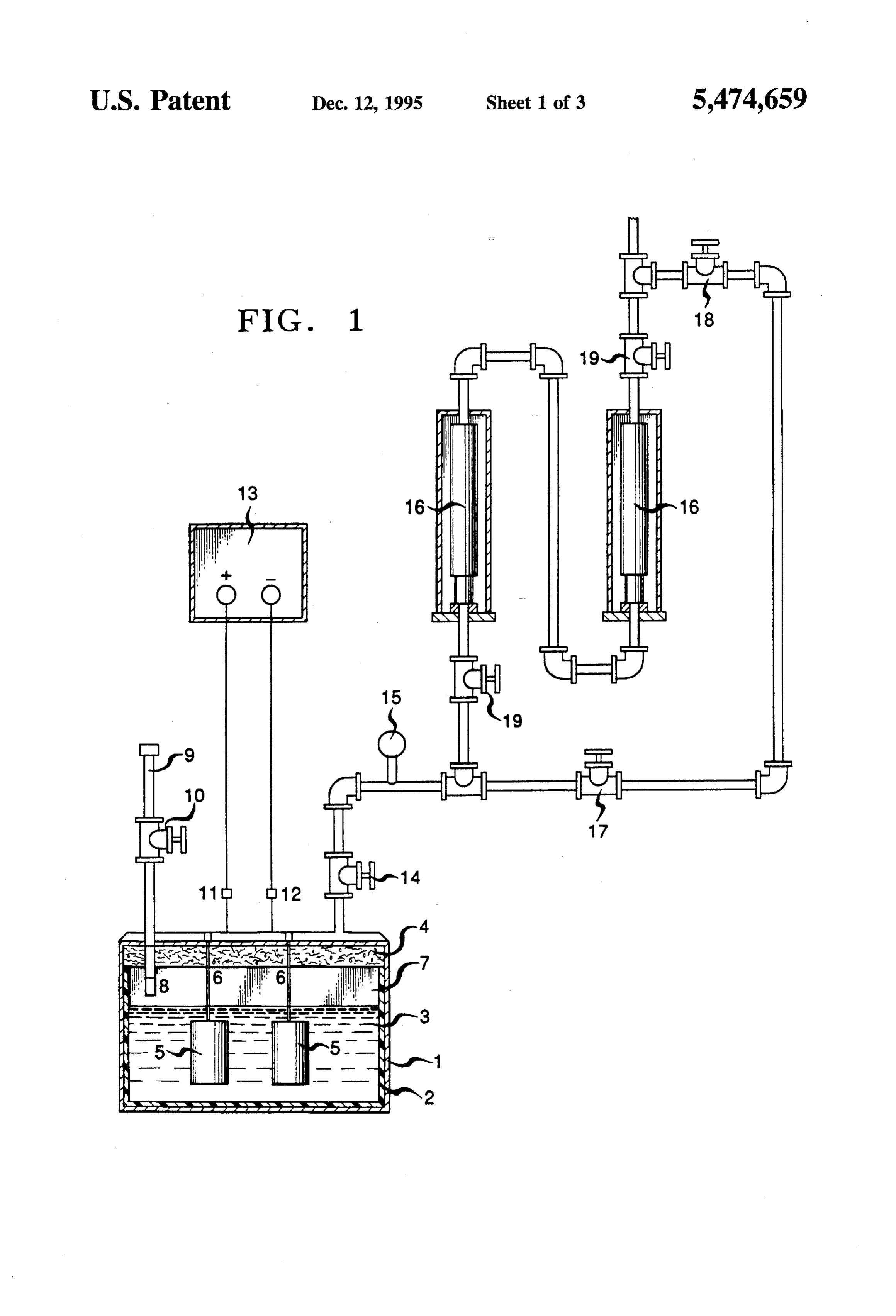
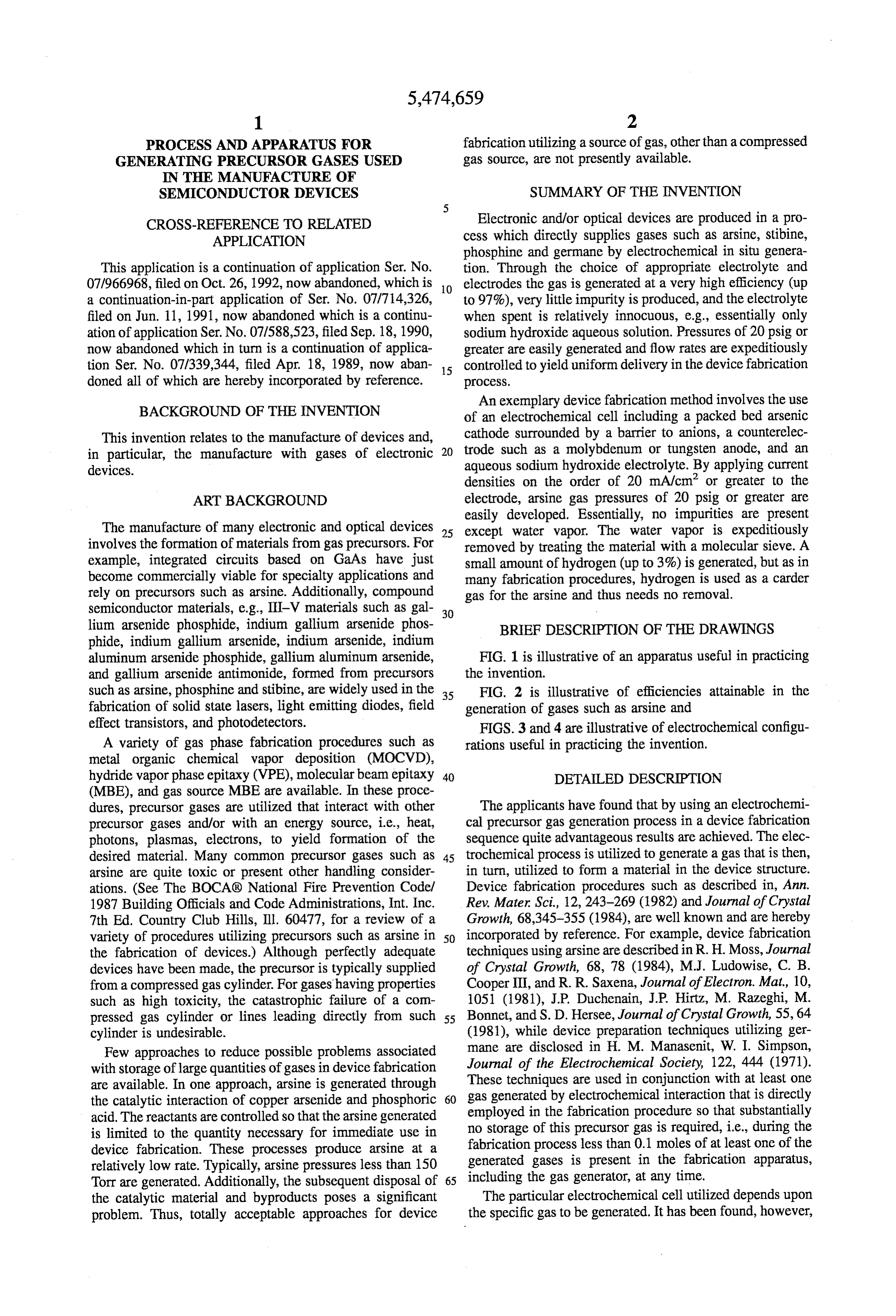
The manufacture of many electronic and optical devices 25 except water vapor. The water vapor is expeditiously involves the formation of materials from gas precursors. For removed by treating the material with a molecular sieve. A example, integrated circuits based on GaAs have just small amount of hydrogen (up to 3%) is generated, but as in become commercially viable for specialty applications and many fabrication procedures, hydrogen is used as a carder rely on precursors such as arsine. Additionally, compound gas for the arsine and thus needs no removal. semiconductor materials, e.g., III-V materials such as gal 30 lium arsenide phosphide, indium gallium arsenide phos BRIEF DESCRIPTION OF THE DRAWINGS phide, indium gallium arsenide, indium arsenide, indium aluminum arsenide phosphide, gallium aluminum arsenide, FIG. 1 is illustrative of an apparatus useful in practicing and gallium arsenide antimonide, formed from precursors the invention.
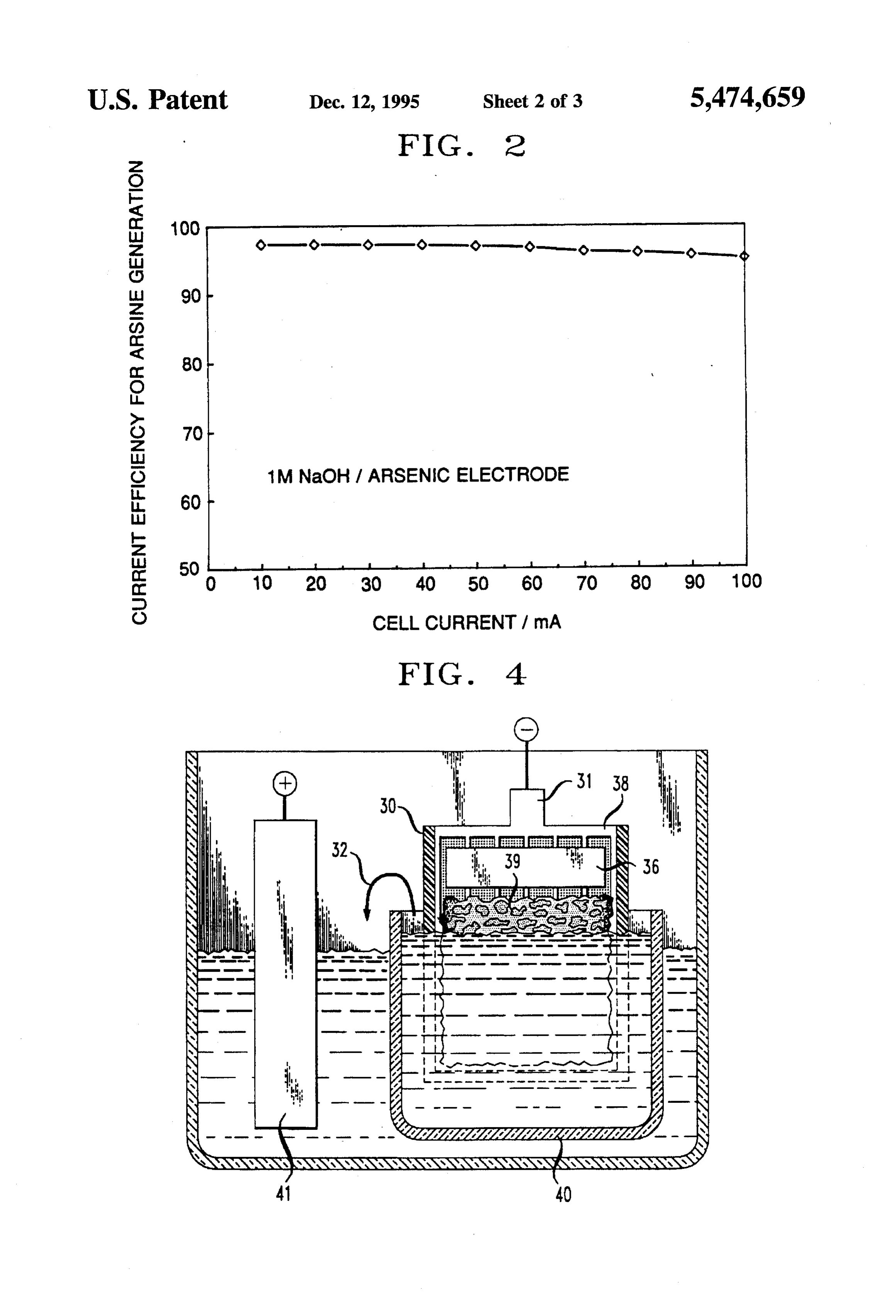
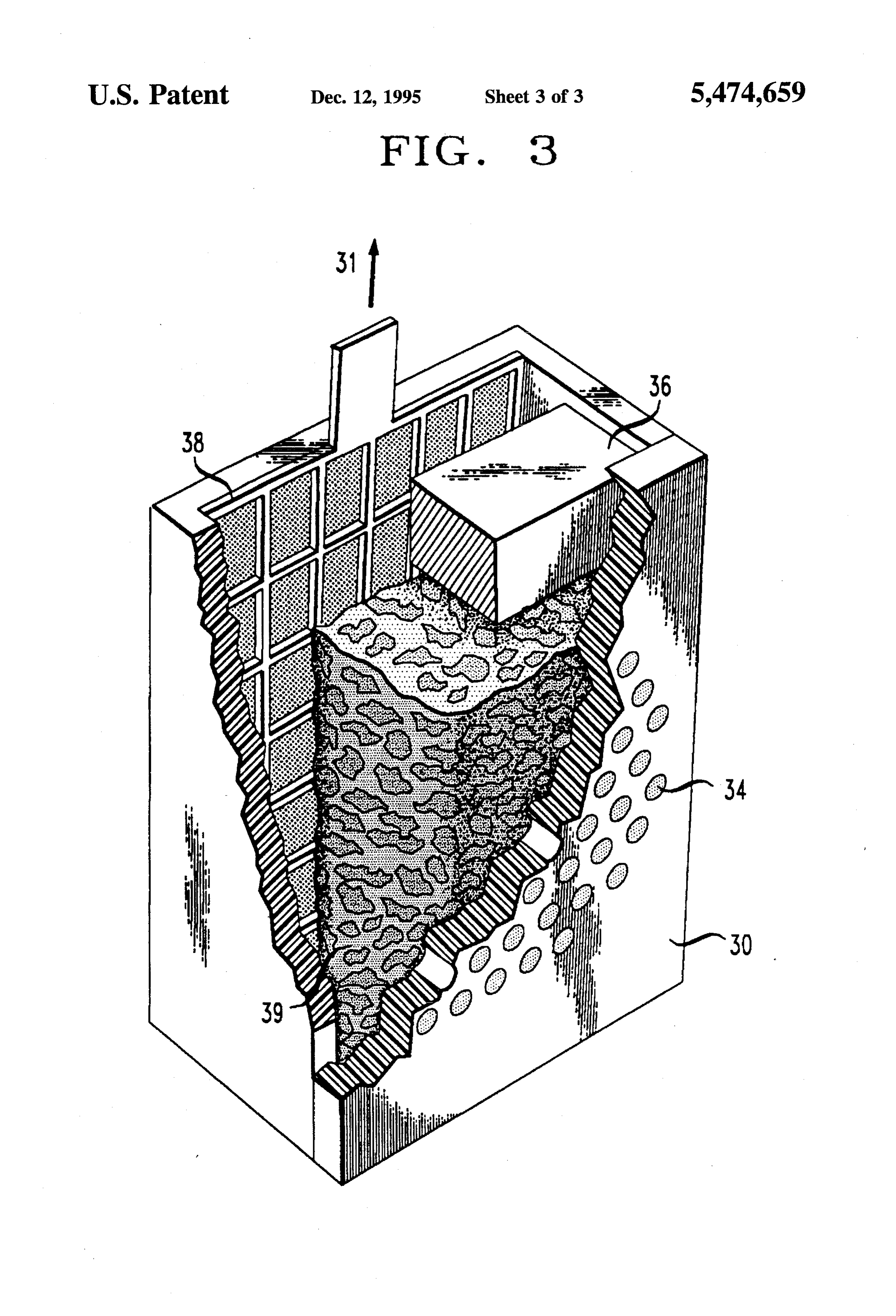
such as arsine, phosphine and stibine, are widely used in the 35 FIG. 2 is illustrative of efficiencies attainable in the fabrication of solid state lasers, light emitting diodes, field generation of gases such as arsine and effect transistors, and photodetectors. FIGS. 3 and 4 are illustrative of electrochemical configu A variety of gas phase fabrication procedures such as rations useful in practicing the invention. metal organic chemical vapor deposition (MOCVD), hydride vapor phase epitaxy (VPE), molecular beam epitaxy 40 DETALED DESCRIPTION (MBE), and gas source MBE are available. In these proce dures, precursor gases are utilized that interact with other The applicants have found that by using an electrochemi precursor gases and/or with an energy source, i.e., heat, cal precursor gas generation process in a device fabrication photons, plasmas, electrons, to yield formation of the sequence quite advantageous results are achieved. The elec desired material. Many common precursor gases such as 45 trochemical process is utilized to generate a gas that is then, arsine are quite toxic or present other handling consider in turn, utilized to form a material in the device structure. ations. (See The BOCAQ National Fire Prevention Code/ Device fabrication procedures such as described in, Ann. 1987 Building Officials and Code Administrations, Int. Inc. Rev. Mater. Sci., 12, 243-269 (1982) and Journal of Crystal 7th Ed. Country Club Hills, Ill. 60477, for a review of a Growth, 68,345-355 (1984), are well known and are hereby variety of procedures utilizing precursors such as arsine in 50 incorporated by reference. For example, device fabrication the fabrication of devices.) Although perfectly adequate techniques using arsine are described in R. H. Moss, Journal devices have been made, the precursor is typically supplied of Crystal Growth, 68, 78 (1984), M.J. Ludowise, C. B. from a compressed gas cylinder. For gases having properties Cooper III, and R. R. Saxena, Journal of Electron. Mat, 10, such as high toxicity, the catastrophic failure of a com 1051 (1981), J.P. Duchenain, J.P. Hirtz, M. Razeghi, M. pressed gas cylinder or lines leading directly from such 55 Bonnet, and S. D. Hersee, Journal of Crystal Growth, 55, 64 cylinder is undesirable. (1981), while device preparation techniques utilizing ger Few approaches to reduce possible problems associated mane are disclosed in H. M. Manasenit, W. I. Simpson, with storage of large quantities of gases in device fabrication Journal of the Electrochemical Society, 122, 444 (1971). are available. In one approach, arsine is generated through These techniques are used in conjunction with at least one the catalytic interaction of copper arsenide and phosphoric 60 gas generated by electrochemical interaction that is directly acid. The reactants are controlled so that the arsine generated employed no storage in the fabrication procedure so that substantially of this precursor gas is required, i.e., during the is limited to the quantity necessary for immediate use in device fabrication. These processes produce arsine at a fabrication generated process less than 0.1 moles of at least one of the gases is present in the fabrication apparatus, relatively low rate. Typically, arsine pressures less than 150
Torr are generated. Additionally, the subsequent disposal of 65 including the gas generator, at any time. the catalytic material and byproducts poses a significant The particular electrochemical cell utilized depends upon problem. Thus, totally acceptable approaches for device the specific gas to be generated. It has been found, however,
Page 6
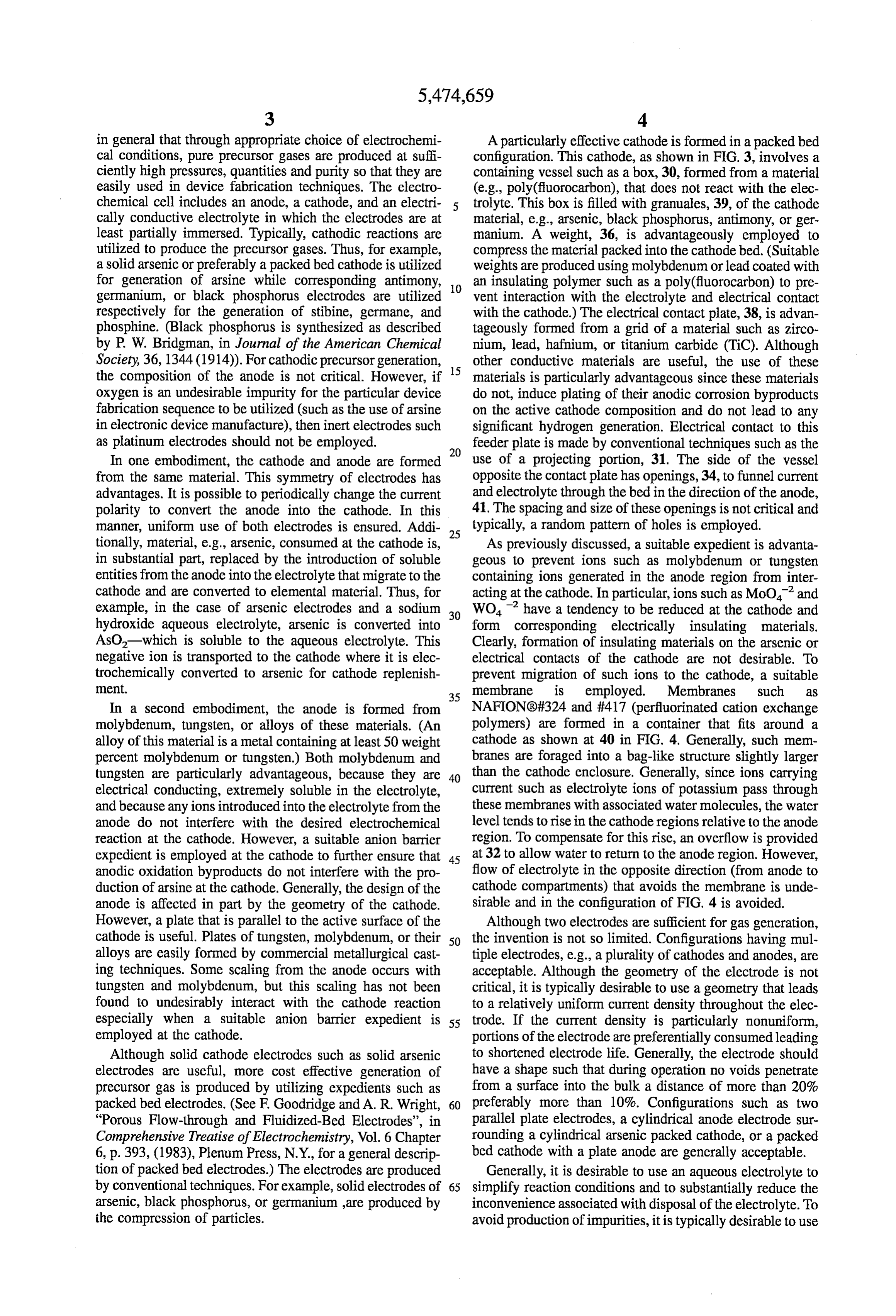
in general that through appropriate choice of electrochemi A particularly effective cathode is formed in a packed bed cal conditions, pure precursor gases are produced at suffi configuration. This cathode, as shown in FIG. 3, involves a ciently high pressures, quantities and purity so that they are containing vessel such as a box, 30, formed from a material easily used in device fabrication techniques. The electro (e.g., poly(fluorocarbon), that does not react with the elec chemical cell includes an anode, a cathode, and an electri trolyte. This box is filled with granuales, 39, of the cathode cally conductive electrolyte in which the electrodes are at material, e.g., arsenic, black phosphorus, antimony, or ger least partially immersed. Typically, cathodic reactions are manium. A weight, 36, is advantageously employed to utilized to produce the precursor gases. Thus, for example, compress the material packed into the cathode bed. (Suitable a solid arsenic or preferably a packed bed cathode is utilized weights are produced using molybdenum or lead coated with for generation of arsine while corresponding antimony, 10 an insulating polymer such as a poly(fluorocarbon) to pre germanium, or black phosphorus electrodes are utilized vent interaction with the electrolyte and electrical contact respectively for the generation of stibine, germane, and with the cathode.) The electrical contact plate, 38, is advan phosphine. (Black phosphorus is synthesized as described tageously formed from a grid of a material such as zirco by P. W. Bridgman, in Journal of the American Chemical nium, lead, hafnium, or titanium carbide (TiC). Although Society, 36, 1344 (1914)). For cathodic precursor generation, 5 other conductive materials are useful, the use of these the composition of the anode is not critical. However, if materials is particularly advantageous since these materials oxygen is an undesirable impurity for the particular device do not, induce plating of their anodic corrosion byproducts fabrication sequence to be utilized (such as the use of arsine on the active cathode composition and do not lead to any in electronic device manufacture), then inert electrodes such significant hydrogen generation. Electrical contact to this as platinum electrodes should not be employed. 20 feeder plate is made by conventional techniques such as the
In one embodiment, the cathode and anode are formed use of a projecting portion, 31. The side of the vessel from the same material. This symmetry of electrodes has opposite the contact plate has openings, 34, to funnel current advantages. It is possible to periodically change the current and electrolyte through the bed in the direction of the anode, polarity to convert the anode into the cathode. In this 41. The spacing and size of these openings is not critical and manner, uniform use of both electrodes is ensured. Addi 25 typically, a random pattern of holes is employed. tionally, material, e.g., arsenic, consumed at the cathode is, As previously discussed, a suitable expedient is advanta in substantial part, replaced by the introduction of soluble geous to prevent ions such as molybdenum or tungsten entities from the anode into the electrolyte that migrate to the containing ions generated in the anode region from inter cathode and are converted to elemental material. Thus, for acting at the cathode. In particular, ions such as MoO, and example, in the case of arsenic electrodes and a sodium 30 WO? have a tendency to be reduced at the cathode and hydroxide aqueous electrolyte, arsenic is converted into form corresponding electrically insulating materials. AsO-which is soluble to the aqueous electrolyte. This Clearly, formation of insulating materials on the arsenic or negative ion is transported to the cathode where it is elec electrical contacts of the cathode are not desirable. To trochemically converted to arsenic for cathode replenish prevent migration of such ions to the cathode, a suitable 35 membrane is employed. Membranes such as ment.
In a second embodiment, the anode is formed from NAFIONG)#324 and #417 (perfluorinated cation exchange molybdenum, tungsten, or alloys of these materials. (An polymers) are formed in a container that fits around a alloy of this material is a metal containing at least 50 weight cathode as shown at 40 in FIG. 4. Generally, such mem percent molybdenum or tungsten.) Both molybdenum and branes are foraged into a bag-like structure slightly larger tungsten are particularly advantageous, because they are 40 than the cathode enclosure. Generally, since ions carrying electrical conducting, extremely soluble in the electrolyte, current such as electrolyte ions of potassium pass through and because any ions introduced into the electrolyte from the these membranes with associated water molecules, the water anode do not interfere with the desired electrochemical level tends to rise in the cathode regions relative to the anode reaction at the cathode. However, a suitable anion barrier region. To compensate for this rise, an overflow is provided expedient is employed at the cathode to further ensure that 45 at 32 to allow water to return to the anode region. However, anodic oxidation byproducts do not interfere with the pro flow of electrolyte in the opposite direction (from anode to duction of arsine at the cathode. Generally, the design of the cathode compartments) that avoids the membrane is unde anode is affected in part by the geometry of the cathode. sirable and in the configuration of FIG. 4 is avoided. However, a plate that is parallel to the active surface of the Although two electrodes are sufficient for gas generation, cathode is useful. Plates of tungsten, molybdenum, or their 50 the invention is not so limited. Configurations having mul alloys are easily formed by commercial metallurgical cast tiple electrodes, e.g., a plurality of cathodes and anodes, are ing techniques. Some scaling from the anode occurs with acceptable. Although the geometry of the electrode is not tungsten and molybdenum, but this scaling has not been critical, it is typically desirable to use a geometry that leads found to undesirably interact with the cathode reaction to a relatively uniform current density throughout the elec especially when a suitable anion barrier expedient is 55 trode. If the current density is particularly nonuniform, employed at the cathode. portions of the electrode are preferentially consumed leading Although solid cathode electrodes such as solid arsenic to shortened electrode life. Generally, the electrode should electrodes are useful, more cost effective generation of have a shape such that during operation no voids penetrate precursor gas is produced by utilizing expedients such as from a surface into the bulk a distance of more than 20% packed bed electrodes. (See F. Goodridge and A. R. Wright, 60 preferably more than 10%. Configurations such as two "Porous Flow-through and Fluidized-Bed Electrodes', in parallel plate electrodes, a cylindrical anode electrode sur Comprehensive Treatise of Electrochemistry, Vol. 6 Chapter rounding a cylindrical arsenic packed cathode, or a packed 6, p. 393, (1983), Plenum Press, N.Y., for a general descrip bed cathode with a plate anode are generally acceptable. tion of packed bed electrodes.) The electrodes are produced Generally, it is desirable to use an aqueous electrolyte to by conventional techniques. For example, solid electrodes of 65 simplify reaction conditions and to substantially reduce the arsenic, black phosphorus, or germanium are produced by inconvenience associated with disposal of the electrolyte. To the compression of particles. avoid production of impurities, it is typically desirable to use
Page 7
an aqueous electrolyte based on hydroxide mobile species. carder downstream from the electrochemical generator or Thus, solutions including the alkali and alkaline-earth introduce the carrier gas into the electrochemical generator hydroxides are advantageously employed. with subsequent flow of the mixture of carrier and the Generally, to avoid production of oxygen and to produce precursor gas from the generator.
highly soluble anodic products with electrodes such as The following examples are illustrative of the conditions arsenic electrodes where such production is unacceptable for useful in the practice of the invention. the device fabrication sequence, a basic electrolyte should be employed. Typically, aqueous hydroxide electrolytes having a concentration between 0.1 M and 19 Mare advantageously Example 1 employed. Concentrations greater than 19 M lead to some 10
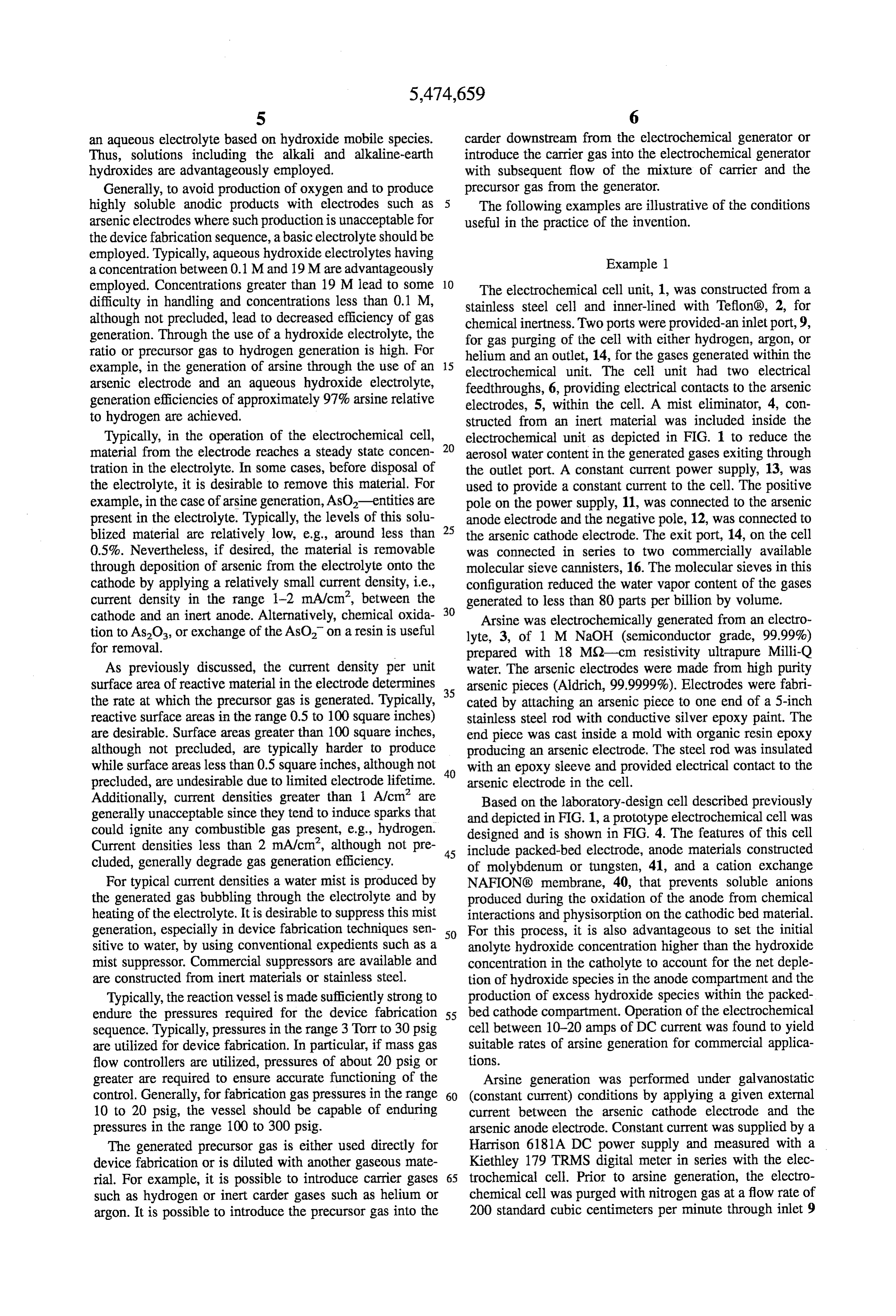
The electrochemical cell unit, 1, was constructed from a difficulty in handling and concentrations less than 0.1 M, stainless steel cell and inner-lined with Teflon(E), 2, for although not precluded, lead to decreased efficiency of gas chemical inertness. Two ports were provided-an inlet port, 9, generation. Through the use of a hydroxide electrolyte, the for gas purging of the cell with either hydrogen, argon, or ratio or precursor gas to hydrogen generation is high. For helium and an outlet, 14, for the gases generated within the example, in the generation of arsine through the use of an 15 electrochemical unit. The cell unit had two electrical arsenic electrode and an aqueous hydroxide electrolyte, feedthroughs, 6, providing electrical contacts to the arsenic generation efficiencies of approximately 97% arsine relative electrodes, 5, within the cell. A mist eliminator, 4, con to hydrogen are achieved. structed from an inert material was included inside the Typically, in the operation of the electrochemical cell, 20 electrochemical unit as depicted in FIG. 1 to reduce the material from the electrode reaches a steady state concen aerosol water content in the generated gases exiting through tration in the electrolyte. In some cases, before disposal of the outlet port. A constant current power supply, 13, was the electrolyte, it is desirable to remove this material. For used to provide a constant current to the cell. The positive example, in the case of arsine generation, AsO2-entities are pole on the power supply, 11, was connected to the arsenic present in the electrolyte. Typically, the levels of this solu 25 anode electrode and the negative pole, 12, was connected to blized material are relatively low, e.g., around less than the arsenic cathode electrode. The exit port, 14, on the cell 0.5%. Nevertheless, if desired, the material is removable was connected in series to two commercially available through deposition of arsenic from the electrolyte onto the molecular sieve cannisters, 16. The molecular sieves in this cathode by applying a relatively small current density, i.e., configuration reduced the water vapor content of the gases current density in the range 1-2 mA/cm, between the generated to less than 80 parts per billion by volume. cathode and an inert anode. Alternatively, chemical oxida 30 Arsine was electrochemically generated from an electro tion to AsO3, or exchange of the AsO on a resin is useful lyte, 3, of 1 M NaOH (semiconductor grade, 99.99%) for removal. prepared with 18 MC2-cm resistivity ultrapure Milli-Q As previously discussed, the current density per unit water. The arsenic electrodes were made from high purity surface area of reactive material in the electrode determines 35 arsenic pieces (Aldrich, 99.9999%). Electrodes were fabri the rate at which the precursor gas is generated. Typically, cated by attaching an arsenic piece to one end of a 5-inch reactive surface areas in the range 0.5 to 100 square inches) stainless steel rod with conductive silver epoxy paint. The are desirable. Surface areas greater than 100 square inches, end piece was cast inside a mold with organic resin epoxy although not precluded, are typically harder to produce producing an arsenic electrode. The steel rod was insulated while surface areas less than 0.5 square inches, although not 40 with an epoxy sleeve and provided electrical contact to the precluded, are undesirable due to limited electrode lifetime. arsenic electrode in the cell.
Additionally, current densities greater than 1 A/cm are Based on the laboratory-design cell described previously generally unacceptable since they tend to induce sparks that and depicted in FIG. 1, a prototype electrochemical cell was could ignite any combustible gas present, e.g., hydrogen. designed and is shown in FIG. 4. The features of this cell Current densities less than 2 mA/cm, although not pre 45 include packed-bed electrode, anode materials constructed cluded, generally degrade gas generation efficiency. of molybdenum or tungsten, 41, and a cation exchange For typical current densities a water mist is produced by NAFIONG) membrane, 40, that prevents soluble anions the generated gas bubbling through the electrolyte and by produced during the oxidation of the anode from chemical heating of the electrolyte. It is desirable to suppress this mist interactions and physisorption on the cathodic bed material. generation, especially in device fabrication techniques sen 50 For this process, it is also advantageous to set the initial sitive to water, by using conventional expedients such as a anolyte hydroxide concentration higher than the hydroxide mist suppressor. Commercial suppressors are available and concentration in the catholyte to account for the net deple are constructed from inert materials or stainless steel. tion of hydroxide species in the anode compartment and the Typically, the reaction vessel is made sufficiently strong to production of excess hydroxide species within the packed endure the pressures required for the device fabrication 55 bed cathode compartment. Operation of the electrochemical sequence. Typically, pressures in the range 3 Torr to 30 psig cell between 10-20 amps of DC current was found to yield are utilized for device fabrication. In particular, if mass gas suitable rates of arsine generation for commercial applica flow controllers are utilized, pressures of about 20 psig or tions.
greater are required to ensure accurate functioning of the Arsine generation was performed under galvanostatic control. Generally, for fabrication gas pressures in the range 60 (constant current) conditions by applying a given external 10 to 20 psig, the vessel should be capable of enduring current between the arsenic cathode electrode and the pressures in the range 100 to 300 psig. arsenic anode electrode. Constant current was supplied by a The generated precursor gas is either used directly for Harrison 6181A DC power supply and measured with a device fabrication or is diluted with another gaseous mate Kiethley 179 TRMS digital meter in series with the elec rial. For example, it is possible to introduce carrier gases 65 trochemical cell. Prior to arsine generation, the electro such as hydrogen or inert carder gases such as helium or chemical cell was purged with nitrogen gas at a flow rate of argon. It is possible to introduce the precursor gas into the 200 standard cubic centimeters per minute through inlet 9
Page 8
and valve 10 using bypass valves 17 and 18. Valve 10 was 7. The process of claim 6 wherein said III-V semicon closed and the electrochemical cell was pumped down to a ductor material comprises GaAs.
total system pressure of approximately 0.2 Torr, as moni 8. The process of claim 1 wherein said basic electrolyte tored by a 10 Torr high precision MKS Barotron, 15. This comprises an aqueous solution.
procedure allowed on-line analysis of the gases generated 9. A process for fabricating a device including a material within the electrochemical cell with a UTI mass spectrom region, said process comprising the steps of supplying a eter. The pumping was terminated, valves 17 and 18 were quantity of previously generated precursor gas and employ closed and valve 19 was opened. Current was applied at a ing said gas towards the completion of said device charac level commensurate with the desired generation rate of arsine. The electrochemical cell was operated at pressures up 10 and suchin that terized that said gas is generated in an electrochemical cell substantial storage of said gas and substantial to 30 psig or more for the generation of arsine. The current generation of oxygen is avoided, where said cell comprises efficiency for arsine generation in the electrochemical cell is a basic electrolyte, molybdenum or tungsten anode, a ger shown in FIG. 2 as a function of the applied cell current in manium packed-bed cathode, and a barrier to prevent anions units of milliamps. The current efficiency was found to be approximately 97% and was essentially constant with 15 produced during the anodic oxidation of molybdenum or applied current. tungsten from contacting the cathode. We claim: 10. A process for fabricating a device including a material 1. A process for fabricating a device including a material region, said process comprising the steps of supplying a region, said process comprising the steps of supplying a quantity of previously generated precursor gas and employ quantity of previously generated precursor gas and employ 20 ing said gas towards the completion of said device charac ing said gas towards the completion of said device charac terized in that said gas is generated in an electrochemical cell terized in that said gas is generated in an electrochemical cell and such that substantial storage of said gas and substantial and such that substantial storage of said gas and substantial generation of oxygen is avoided, where said cell comprises generation of oxygen is avoided, where said cell comprises a basic electrolyte, molybdenum or tungsten anode, an a basic electrolyte, molybdenum or tungsten anode, an 25 antimony packed-bed cathode, and a barrier to prevent arsenic packed-bed cathode, and a barrier to prevent anions anions produced during the anodic oxidation of molybde produced during the anodic oxidation of molybdenum or num or tungsten from contacting the cathode.
tungsten from contacting the cathode. 11. An electrochemical cell for the generation of precursor 2. The process of claim 1 wherein said precursor gas gases, said cell comprising a basic electrolyte, a molybde comprises arsine. 30 num or tungsten anode, an arsenic packed-bed cathode, and 3. The process of claim 2 wherein said device includes a a barrier to prevent anions produced during the anodic region of gallium arsenide. oxidation of molybdenum or tungsten from contacting the 4. The process of claim 1 wherein said device comprises cathode wherein substantial generation of oxygen during an integrated circuit. operation of said cell is avoided. 5. The process of claim 1 wherein said electrolyte is 35 12. The electrochemical cell of claim 11 wherein said between 0.1 and 19 M in hydroxide species. electrolyte is between 0.1 and 19 M in hydroxide. 6. The process of claim 1 wherein said material region comprises a III-V semiconductor material. ck k is k k
Provenance
- Collection
- Cited prior art
- Original PDF
- patentimages.storage.googleapis.com →
- Filed
- 1994-08-17
- Pages
- 8
- Method
- pdftotext (the PDF's own text layer) + pdftoppm 300dpi page scans
- Source
- Google Patents bibliographic record
- Granted
- 1995-12-12
- Inventors
- Gardy Cadet; James W. Mitchell; Jorge L. Valdes; AT&T Corp
- Transcribed from
- patentimages.storage.googleapis.com →