patent · US4117882
Process and apparatus for heat exchange
3 October 1978
Page 1 — bibliographic record
United States Patent (19) (11) 4,117,882 Shurcliff 45 Oct. 3, 1978 (54) PROCESS AND APPARATUS FOR HEAT OTHER PUBLICATIONS
EXCHANGE
Whillier, A., Letter to the Editor, The Sun at Work, vol.
(75. Inventor: William A. Shurcliff, Cambridge, 2, p. 2, 6/57.
Mass. Primary Examiner-Albert W. Davis
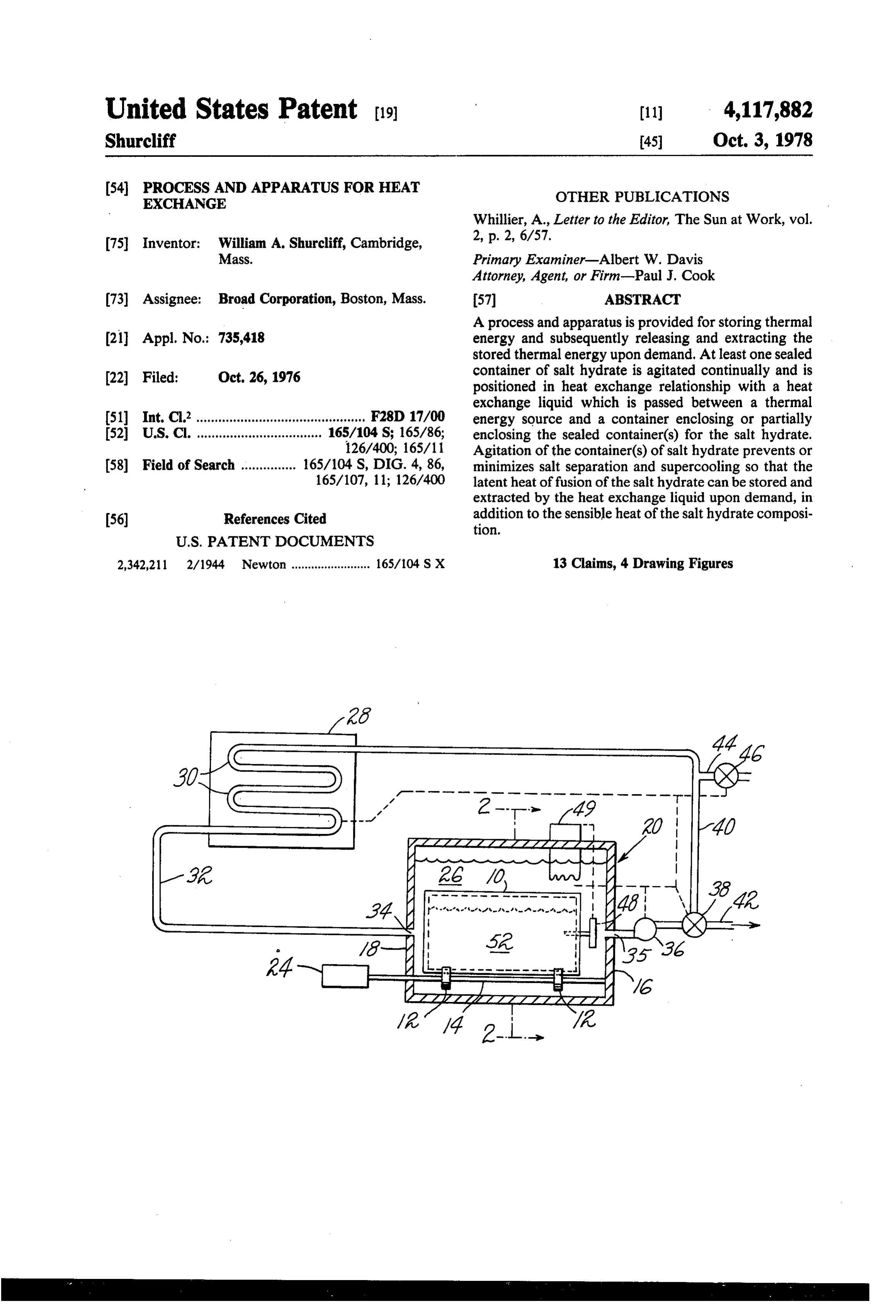
Attorney, Agent, or Firm-Paul J. Cook (73) Assignee: Broad Corporation, Boston, Mass. 57 ABSTRACT A process and apparatus is provided for storing thermal 21 Appl. No.: 735,418 energy and subsequently releasing and extracting the stored thermal energy upon demand. At least one sealed (22 Filed: Oct. 26, 1976 container of salt hydrate is agitated continually and is positioned in heat exchange relationship with a heat exchange liquid which is passed between a thermal 51) Int. C.’.............................................. F28D 17/00 energy source and a container enclosing or partially 52 U.S. C. .................................. 165/104 S; 165/86; enclosing the sealed container(s) for the salt hydrate. 126/400; 165/11 Agitation of the container(s) of salt hydrate prevents or 58 Field of Search ............... 165/104 S, DIG. 4, 86, minimizes salt separation and supercooling so that the 165/107, 11; 126/400 latent heat of fusion of the salt hydrate can be stored and extracted by the heat exchange liquid upon demand, in (56) References Cited addition to the sensible heat of the salt hydrate composi tion.
2,342,211 2/1944 Newton ........................ 165/104 S X 13 Claims, 4 Drawing Figures
Page 2
Drawing sheet — no readable text.
Page 3
provides low cost, effective heat exchange between the
PROCESS AND APPARATUS FOR HEAT salt hydrate and the heat exchange fluid.
EXCHANGE
SUMMARY OF THE INVENTION
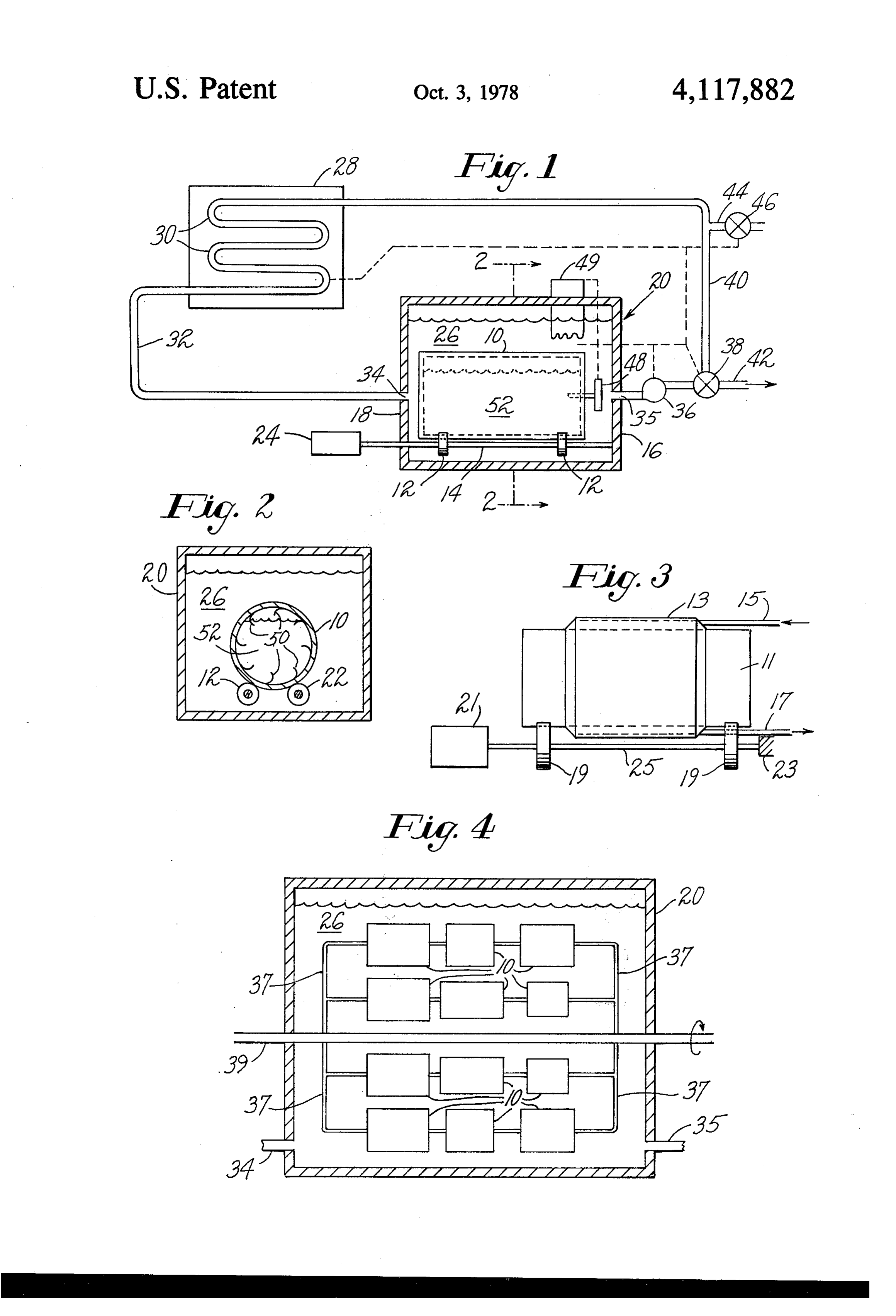
BACKGROUND OF THE INVENTION In accordance with this invention, one or more salt This invention relates to a method and apparatus for hydrates are stored in one or more closed first contain storing and subsequently releasing thermal energy. ers capable of being agitated and which are enveloped More particularly, this invention relates to a method or partially enveloped by a second container containing and apparatus for storing and subsequently releasing a heat exchange liquid capable of extracting thermal thermal solar energy. O energy from the salt hydrate and capable of transmitting Prior to the present invention, a wide variety of salt thermal energy to the salt hydrate. The salt hydrate hydrates have been utilized to store heat for subsequent container(s) are sealed and the container for the heat extraction upon demand. These salt hydrates are useful exchange liquid is provided with inlets and outlets, for this purpose since each is characterized by a rela through which the heat exchange liquid is moved. The tively high heat of fusion but the phase change between 15 volume ratio of heat exchange liquid in the second con solid and liquid in each occurs at a different temperature tainer to the salt hydrate is between about 1 to 20 and 2 within a moderate range of temperatures. Heat can be to 1, preferably between 1 to 10 and 2 to 1. stored both as sensible heat and as the latent heat of In operation the heat exchange liquid is exposed to fusion of the selected salt hydrate for subsequent release any source of thermal energy, including solar radiation. during crystallization of that salt hydrate at its usual 20 The heated liquid is passed into the second container to phase-change temperature by heat exchange with any transmit thermal energy to the salt hydrate and then is of a variety of heat exchange liquids. passed out from the second container either to means of Significant problems associated with all the salt hy extracting energy from the heat exchange liquid or to drates have greatly limited their use as heat storage redirect the liquid to the source of thermal energy. The media. Many salt hydrates are prone to super-cooling so 25 salt hydrate obtains thermal energy from the heat ex that the phase change from liquid to solid does not change liquid as sensible and/or latent heat so that, at a readily occur and the latent heat of fusion is not recov later time, the stored thermal energy can be re-transmit ered when desired. This phenomenon has necessitated ted to the heat exchange liquid for ultimate use. adding nucleating agents to the salt hydrates to mini mize supercooling. Even the presence of nucleating 30 BRIEF DESCRIPTION OF THE DRAWINGS agents does not assure that the salt hydrate will crystal FIG. 1 is a partial cross-sectional view of a thermal lize upon cooling. The salt hydrates also have a ten storage apparatus of this invention. dency to become dehydrated gradually when exposed FIG. 2 is a cross-sectional view of the apparatus of to repeated phase-change thermal cycling. Dehydration FIG. 1 taken along line 2-2.
results in the salts developing different densities depen 35 FIG. 3 is an alternative embodiment wherein heat dent upon the degree of hydration, with accompanying exchange liquid is housed in a jacket surrounding a separation and stratification of the salts. When this sepa sealed container of salt hydrate. ration occurs, it becomes increasingly difficult to cause FIG. 4 is an alternative embodiment of this invention the salts to undergo phase change concurrently since utilizing a plurality of sealed containers for the salt they have developed different melting points. Thus, hydrate composition or compositions.
some of the salts in a container will not undergo a phase DESCRIPTION OF SPECIFIC EMBODIMENTS change and may not release the latent heat of fusion that otherwise would have been extracted during a given Referring to FIGS. 1 and 2, a container 10 houses a thermal cycle. It has been proposed also to suspend the salt hydrate having a heat of fusion greater than about salts in gelatinous types of medium to overcome the 45 50 BTU/lb, preferably greater than 75 BTU/lb. The separation problem. However, this reduces the thermal container is supported on idle rollers 22 and movable capacity of the resultant composition on a volume basis rollers 12 supported on shaft 14 which is rotatably and thereby reduces its heat exchange effectiveness. mounted on walls 16 and 18 of container 20. Idle rollers It has also been proposed to agitate a container of the 22 are mounted also on a shaft (not shown) which is also salt hydrate to prevent or minimize supercooling at or 50 rotatably mounted on walls 16 and 18. The rollers 12 near the temperatures at which the salt hydrate under and 22 are mounted at or near the ends of container 10 goes phase change. In these methods, a heat exchange so that deflection of the walls of the container 10 is fluid is passed continuously into heat exchange relation minimized. Shaft 10 and rollers 22 are activated by ship with the agitated container and then either is di motor 24 attached to shaft 14.
rected back to the source of heat or is directed to the 55 Container 20 houses a heat exchange liquid 26 which area of ultimate use. In these proposals, the salt hydrate surrounds container 10. The heat exchange liquid re is the sole means for thermal storage while the heat ceives thermal energy in heat exchange unit 28 wherein exchange fluid is used solely to carry heat to the area of the source of heat is not critical. For example, the heat thermal demand or to transfer heat from the thermal source can be any means of combustion or direct or energy source to the salt hydrate and this requires rela 60 indirect solar energy radiation or electric energy. In tively high mass flow rates of heat exchange fluid, effec relation to the heat exchange unit 28, there can be solar tive heat exchange surfaces and large amounts of salt panels of any design which receive and trap radiant hydrate. energy and which are in heat exchange relationships Accordingly, it would be desirable to provide a with the heat exchange liquid in the serpentine conduits means for storing thermal energy based upon the use of 65 30. The heated liquid is passed from conduit 30 to con salt hydrates which avoids the problem of supercooling, duit 32, through inlet 34, into container 20. The heated which minimizes or prevents salt separation and modifi liquid in container 20 passes its heat through the con cation caused by repeated thermal cycling and which tainer wall 10 to the salt hydrate in the container 10
Page 4
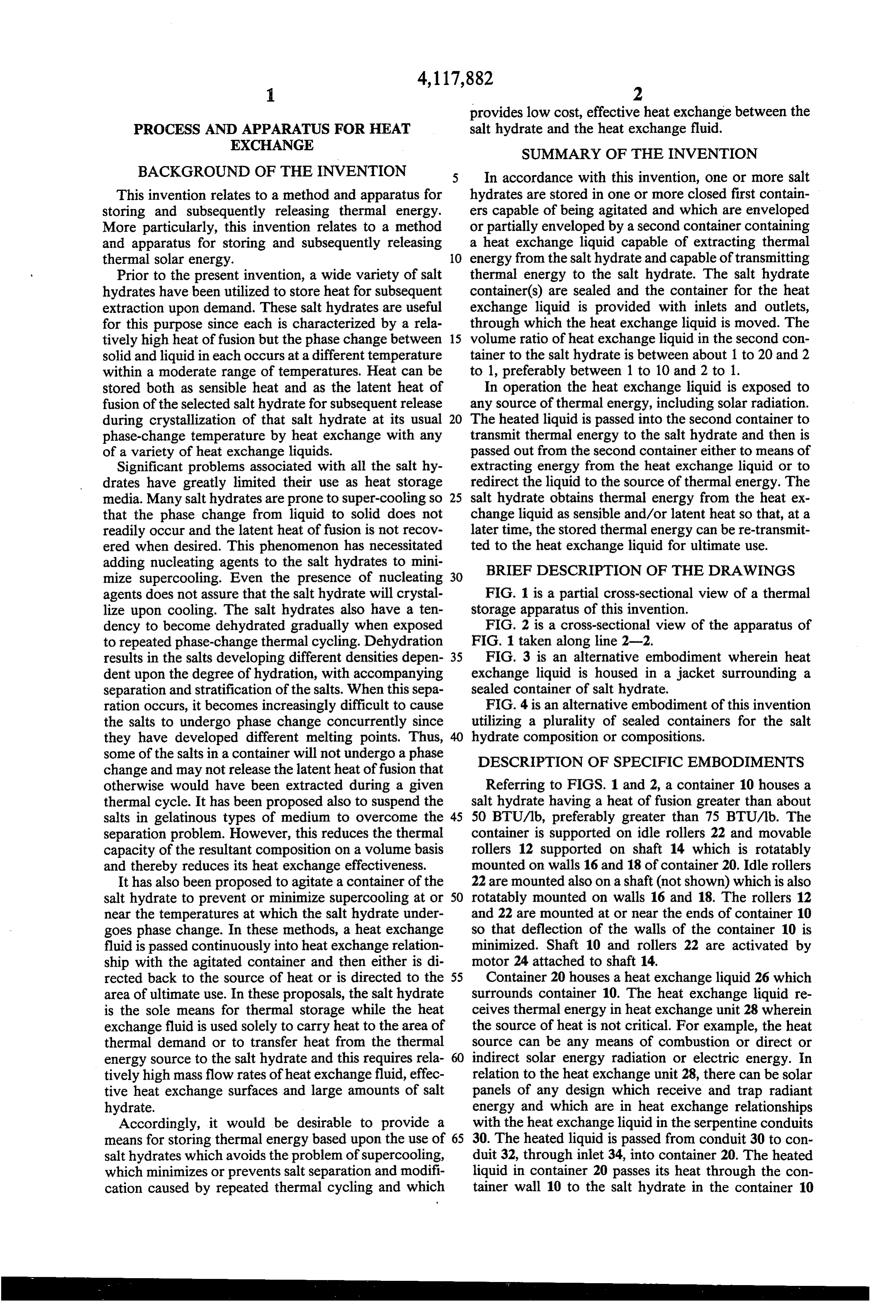
thereby liquefying the salt hydrate so that it acquires exchange liquid is movable, the conduits 15 and 17 are both latent heat and sensible heat which later can be flexibily connected to the jacket 13 to minimize me extracted upon demand. chanical stress in the conduits caused by agitating the Heat exchange liquid is circulated through the system container 11 and jacket 13. In addition, the container 11 by pump 36. Valve 38 is positioned to regulate liquid is agitated in an oscillating mode so that mechanical flow through conduit 40 to recycle liquid to the heat stress on the conduits 15 and 17 is minimized and so that exchanger 28 and/or through conduit 42 to extract heat the conduits do not contact the rollers supporting the for use such as in a home heating system. Liquid from container 11.
which heat has been extracted is returned to the system Referring to FIG. 4, a plurality of sealed containers by conduit 44 when valve 46 is open. 10 10 that contain a salt hydrate composition or composi For a given weight of salt hydrate, the volume of salt tions are immersed in a heat exchange liquid 26 which is hydrate affords a measurement of the quantity of latent enclosed in container 20 provided with an inlet 34 and heat contained therein. The volume of salt hydrate an outlet 35. The containers are mounted on struts 37 increases with the increase of latent heat stored since a which are, in turn, mounted on rotating shaft 39. This greater proportion of the salt hydrate is converted to 15 embodiment enlarged heat exchange surface area be liquid. For example, the volume of sodium thiosulfate tween the heat exchange liquid 26 and the salt hydrate pentahydrate increases about 9% when changing from total solid to total liquid. Accordingly, a pressure gauge sealed within containers 10. In this embodiment, differ ent drums can contain different salt hydrates so that the 48 positioned to communicate with the container inte latent heat of fusion could be extracted or stored over a rior, preferably on its axis of motion, provides an analog 20 wider temperature range than is available when each measurement of the latent heat in the salt hydrate. Ther container contains the same salt hydrate composition. mostats (not shown) are positioned in or adjacent con An important aspect of this invention is the combined duits 30 and in the heat exchange liquid 26 to sense the heat temperature of the heat exchange liquid. The thermo liquidstorage in the and release capacities of the heat exchange container 30 or jacket 13 and the salt hy stats are linked in any conventional manner (as repre drate in container
10. The volume of heat exchange sented by the broken lines) to control pump 36 and liquid in such container valves 38 and 46 such as by pneumatic or electrical tween 1 to 20 and 2 to 1, orjacket should be about be linkage. In addition, valves 38 and 46 and pump 36 can 10 and 2 to 1 volume ratiopreferably between about 1 to be linked electrically or pneumatically to conventional its container. Thus, when employinghydrate to the salt volume in water as the heat control means such as a thermostat in the area of use to 30 control heat exchange liquid flow into the area of use. exchange liquid and sodium thiosulfate pentahydrate as The pressure gauge 48 provides a means by which the the salt hydrate, the ratio of water volume to salt hy drate volume should be between about 1 to 10 and 2 to user can determine the latent heat content of the salt hydrate at any given time. Thus, the user can read perature 1. At volume ratios higher than above stated, the tem gauge 48 and initiate the auxiliary heater 49 (e.g., elec practical change
trical heater) to heat the heat exchange liquid 26. Alter the lesser use. At volume ratios lower than above stated, quantity of water does not provide the desired natively, the user, upon noting that the salt hydrate contains less stored heat than desired, can manually heatRepresentative buffering capacity.
override the automatic system to initiate pump 36 to invention include useful salt hydrates in the present sodium thiosulfate pentahydrates, circulate heat exchange liquid between the heat ex calcium change unit 28 and the container 20. This quick and hydrate, chloride hexahydrate, sodium carbonate deca disodium phosphate dodecahydrate, calcium accurate determination of heat content in the salt hy nitrate tetrahydrate, sodium sulfate decahydrate or mix drate is particularly useful in climates which experience seasonal changes when the heat exchange unit 28 is a tures thereof or the like. Although not essential, the salt solar heat exchange unit. In the winter, the auxiliary 45 hydrate optionally can include a nucleating agent such heater 49 and/or circulation between the solar heat as borax or the like in concentrations generally between exchange unit and the container 20 could be initiated to about 0.5 wt % and 5 wt.% based upon the weight of keep the salt hydrate at a relatively high pressure read the salt hydrate. In addition, the salt hydrate can in ing, while in summer such activation could be related to clude an anticorrosion agent to prevent corrosion of the a different threshold pressure reading. 50 salt hydrate container. Representative suitable anticor The container 10 is continuously rotated or oscillated rosion agents include sodium dichromate or the like. by motor 24 and rollers 22 and is provided internally The anticorrosion agent is not essential when employ with mixing arms 50 extending from the wall of con ing a container made from a corrosion-resistant material tainer 10 so that the salt hydrate 52 is maintained in an such as stainless steel or heavy gauge cold rolled steel. agitated condition. Continuous agitation of the con 55 In one aspect of this invention, water can be added to tainer and of the salt hydrate 52 minimizes or prevents the salt hydrate for a variety of purposes, including but salt hydrate supercooling and minimizes or prevents not limited to (1) promoting slurry-like crystallization in stratification and dehydration of salt hydrate. multiplicity of small crystals, (2) lowering the salt hy Referring to FIG. 3, a container 11 is partially filled drate freezing point so as to relate the heat of fusion with the salt hydrate and is surrounded by a jacket 13. temperature during winter months to the temperature The jacket is sealed to the outer surface of container 11 range of the heat source(s) and of the heat exchange and is filled with heat exchange liquid. The jacket 13 is liquid in winter. In summer months, the added water provided with an inlet conduit 15 and an outlet conduit can be removed to raise the freezing point of the salt 17. The container is mounted on powered rollers 19 and hydrate composition in relation to the temperature idle rollers (not shown) such as in the manner shown in 65 range of the heat exchange liquid and its principal heat FIG. 2. The powered rollers are mounted on shaft 21, source. Representative suitable heat exchange liquids attached to motor 25 and rotatably attached to support include water, Dow-therm, water plus ethylene glycol 23. Since, in this mode, the container 13 for the heat of the like. In addition, the water also is useful to render
Page 5
the salt hydrate crystaline mass less hard and tenacious means for passing the heated liquid into a first con to the wali of the container. tainer which is in heat exchange relationship with a In a representative embodiment of this invention, the salt hydrate composition enclosed in at least one apparatus of FIGS. 1 and 2 can be formed of a sealed sealed container, stainless steel cylinder, 4 feet in diameter and 9 feet long 5 said salt hydrate having a heat fusion of at least about which is 85% to 95% full with sodium thiosulfate penta 50 BTU/lb, hydrate having a phase change temperature of 120 F. the volume ratio of the heat exchange liquid in said The container housing the steel cylinder is formed of first container to said salt hydrate being between wood and is rectangular shaped having 10 ft. x 5 ft. X about 1 to 20 and 2 to 1, 5 ft. dimensions provided with a waterproof liner. The O means for agitating each sealed container continually wooden container houses about 3 tons of water. The to minimize or prevent supercooling of said salt motor is rated at 1/15 HP to effect rotation of the steel hydrate, cylinder at 4 revolutions per hour on a continuous basis. means for monitoring pressure within said sealed At this rate, the motor uses only about 2Kw/hr of en container, ergy per daytime period in winter. In operation, water 15 and means for periodically passing said heat exchange is circulated through the wooden container from a liquid from heat exchange relationship with said source of heat to provide indirect exchange of heat to salt hydrate to extract heat from said liquid. the sodium thiosulfate pentahydrate. The salt hydrate 2. The apparatus of claim 1 which includes means for has a volume of about 104 cubic feet, a density of about recycling said heat exchange liquid from said first con 104 lb/cubic foot, a total mass of about 11,000 pounds 20 tainer to said means for exposing the heat exchange and a latent heat of phase exchange of about 90 BTU/lb. liquid to a heat source.
The total amount of heat liberated when the salt 3. The apparatus of claim 2 wherein the means for changes from liquid to solid is about 990,000 BTU exposing the heat exchange liquid to a heat source is which is enough heat to maintain a moderate size, well adapted to transfer solar heat to said liquid. insulated house in the northeastern United States warm 25 4. The apparatus of claim 3 wherein the second con for 2 days in a typical sunless period in January. tainer houses sufficient heat exchange liquid to totally Continual rotation or oscillation of the steel container immerse said sealed container. prevents or sharply minimizes formation of stagnant 5. The apparatus of claim 2 wherein the second con layers at the inside surface and at the outside surface of tainer houses sufficient heat exchange liquid to totally the steel cylinder. This both improves heat exchange 30 immerse said sealed container.
and greatly extends the number of effective salt hydrate 6. The apparatus of claim 1 wherein the means for heat cyclings. The water in the wooden container re exposing the heat exchange liquid to a heat source is sponds more quickly than the salt hydrate; this assists adapted to transfer solar heat to said liquid. heat transfer to and from the salt hydrate. For example, 7. The apparatus of claim 6 wherein the second con the 3 tons of water mentioned could absorb a sudden 35 tainer houses sufficient heat exchange liquid to totally pulse of 100,000 BTU, and go on transferring it to the immerse said sealed container.
salt hydrate which has a slower rate of response. Like 8. The apparatus of claim 1 wherein the second con wise, 100,000 BTU of heat could quickly be supplied tainer houses sufficient heat exchange liquid to totally from the water, with further heat extraction from the immerse said sealed container. salt hydrate into the water to maintain its supply of heat 9. The apparatus of claim 1 having a plurality of to points of ultimate use. sealed containers for the salt hydrate and wherein said It is to be understood that variations can be made means for monitoring pressure is associated with at least from the specific embodiments described above. For one of said sealed containers.
example, the container for the salt hydrate can be filled 10. The apparatus of claim 9 wherein at least one of only 55 to 60% so that it will float and the floating drum 45 said sealed containers contains a salt hydrate different can be rotated with a perimeter friction-drive motor from a salt hydrate in at least one of the remaining attached to the housing for the heat exchange liquid. sealed containers.
Also, the container for the salt hydrate can include a 11. The apparatus of claim 1 wherein said first con self-cleaning device such as sliding metal disks to clean tainer is attached to said sealed container and is adapted its inner wall of solid salt hydrate. In addition, the con 50 to be agitated with said sealed container. tainer for the salt hydrate and/or the container for the 12. The apparatus of claim 1 including means for heat exchange liquid can be provided with an auxiliary monitoring the temperature of said heat exchange liquid electrical heating element to provide off-peak energy to in said first container and the temperature of said heat the salt hydrate. exchange liquid exposed to said heat source. I claim: 55 13. The apparatus of claim 1 including a second heat 1. Apparatus for storing thermal energy for subse ing means adapted to heat said heat exchange liquid in quent use which comprises: said first container in response to the pressure moni means for exposing a heat exchange liquid to a heat tored within said sealed container.
SOurce,
Provenance
- Collection
- Cited prior art
- Original PDF
- patentimages.storage.googleapis.com →
- Filed
- 1976-10-26
- Pages
- 5
- Method
- pdftotext (the PDF's own text layer) + pdftoppm 300dpi page scans
- Source
- Google Patents bibliographic record
- Granted
- 1978-10-03
- Inventors
- William A. Shurcliff; Broadcom Corp
- Transcribed from
- patentimages.storage.googleapis.com →