patent · US5435894
Process and apparatus for improving quality of water
25 July 1995
Page 1 — bibliographic record
United States Patent 19 11 Patent Number: 5,435,894 Hayakawa 45 Date of Patent: Jul. 25, 1995 54 PROCESS AND APPARATUS FOR 4-277076 10/1992 Japan. IMPROVING QUALITY OF WATER Primary Examiner-John Niebling 76 Inventor: Hideo Hayakawa, 2656-12, Assistant Examiner-Arun S. Phasge Moriya-ko, Moriya-machi, Attorney, Agent, or Firm-Nikaido, Marnelstein, Kita-Soma-gun, Ibaraki-ken, Japan Murray & Oram 21 Appl. No.: 200,692 57 ABSTRACT 22 Filed: Feb. 23, 1994 The invention provides a process and apparatus for 30 Foreign Application Priority Data improving the quality of water in an easy manner and with reasonable cost and high efficiency. The process
Feb. 26, 1993 JP Japan .................................. 5-063248 provides a grounding electrode and a pair of applying Sll Int. Cli............................................. CO2F 1/461 electrodes in water to be treated. First and second high 52 U.S. Cl..................................... 204/149; 204/222; frequency switches are connected respectively to a DC 204/231; 210/748 voltages source through a variable resistor. A switching 58 Field of Search ....................... 204/149, 231, 228; commander circuit, which is a flip-flop circuit, is con 210/748 nected to the first and second switches through a resis tor. An oscillator is connected to the switching (56. References Cited commander circuit. The switching commander circuit
3,627,648 12/1971 Waggener ........................... 204/23 and second switches, in response to a signal from the 5,071,532 12/1991 Taillet et al. . ... 204/228 oscillator, so that the first and second switches are peri 5,326,446 7/1994 Binger ................................. 204/149 odically turned ON and OFF resulting in voltage being alternately applied to the pair of applying electrodes
FOREIGN PATENT DOCUMENTS which causes an ORP value of the water to decrease.
1-317592 12/1989 Japan. 6 Claims, 4 Drawing Sheets
OSC
Page 2
Drawing sheet — no readable text.
Page 3
Drawing sheet — no readable text.
Page 4
Drawing sheet — no readable text.
Page 5
Drawing sheet — no readable text.
Page 6
oxidation-reduction potential (ORP) of the water
PROCESS AND APPARATUS FOR IMPROVING through an electrical treatment which causes no sub QUALITY OF WATER stantial change in pH, to establish the invention. BACKGROUND OF THE INVENTION 5 SUMMARY OF THE INVENTION 1. Field of the Invention Objects of the invention are to provide a process and The present invention relates to a process and appara apparatus for improving the quality of water, which tus for improving the quality of water by applying elec provides water for drinking and other purposes with trical energy thereto without using activated carbon, a O easy, reasonable cost and good efficiency. filter, chemicals or the like. The process and apparatus The objects can be attained by a process for improv are suitable for improving the taste of drinking water ing the quality of water, comprising the steps of provid such as well water and city water. ing a ground electrode and a pair of applying electrodes Nowadays, a source of a water supply has been con in water to be treated, and providing a DC voltage taminated by an increase of waste water from houses source, first and second high-frequency switches con due to popularization of flush toilets and bathes, dis 15 nected respectively to the DC voltage source through a charge of various chemicals including detergents, in variable resistor. A high-frequency switching crease of water in industrial use, discharge of various commander circuit, which is a flip-flop circuit, is con waste water, use of various chemical fertilizers and nected to the high-frequency switches through a resis agricultural chemicals, so that the quality of well water tor, and a high-frequency oscillator is connected to the and city water remarkably decreases. Therefor, there is 20 high-frequency switching commander circuit, wherein a strong demand for the supply of drinking water to be the high-frequency switching commander circuit alter safe and taste good. nately outputs a high-frequency switching command to 2. Description of Related Art the first and second high-frequency switches, in re As quality of modified water, hitherto, alkali-ionized sponse to a high-frequency signal from the high-fre water has been known. This water can be obtained by 25 quency oscillator, so that the first and second high-fre feeding water into an electrolytic cell partitioned by a quency switches are high periodically turned ON and diaphragm into an anode and cathode chambers to apply DC voltage between an anode and cathode in the OFF nately and the resulting high-frequency voltage is alter applied for the pair of applying electrodes to chambers for causing a certain kind of electrolysis. An electrolyte such as NaCl or the like may be added to the 30 decrease
A level
ORP value of the water.
of the signal output from the high-frequency water to increase an electric conductivity. oscillator to the high-frequency switching commander An alkaline water formed in the cathode chamber has been utilized as drinking water Japanese Patent 61 circuit a range is preferable from the view point of safety within of 20-50 KHz and 10-50 V, and a specified
formed in the anode chamber has been utilized for steril 35 frequency and voltage shall be selected within the ization purposes Japanese Patent 1-317592(A). ranges, in response to the quality of water to be treated. In such a conventional water treating process and The material of the applying electrodes is selected by apparatus, one of the electrodes is used as one with taking the quality of water to be treated into consider positive polarity, whereas the other with negative po ation. As the material, zinc, lithium oxide, magnesium larity, and therefore, the electrodes are gradually cov alloys (with zinc), copper, iron, stainless-steel, titanium ered with matters deposited thereon through the treat or the like can be listed, but zinc and magnesium alloys ment, thereby preventing transfer of electricity therebe are preferable for obtaining drinking water, since the tween. For preventing the deposition, there is a way to electrode made by such materials gradually dissolves to periodically change the polarity of DC voltage to be enrich the water in its mineral content. applied to the electrodes. 45 The period of time required for treating the water is With the mere periodic change of polarity in DC different depending on electric resistance of the water. voltage, however, various and different requirements In general, city water has a higher electric resistance, depending on usage of water can not be satisfied and namely it requires about 2-3 hours for decreasing ORP sufficient effect can not be obtained by a single appara value from about 500 mV to about 100 mV, but water tus. Further, the periodic change of polarity requires an 50 from a river, a lake and a marsh shows a tendency in extra constant-voltage circuit, low current circuit, po which ORP decreases in a shorter period of time. larity reverse circuit and others which increase the cost When the AC voltage is alternately applied to the therefor. pair of applying electrodes according to the manner The conventional process utilizes the certain electrol described above, almost all organic matters in the water ysis which is unsuitable for treating a large amount of 55 shall be decomposed and gasified and a part thereof is water, and in which solubility of minerals decreases, as cohered and precipitated. It is preferable for the drink pH of the water becomes 9-10. There are such disad ing water to have ORP value of about 100 mV more or vantages that the alkali-ionized drinking water has a bad less, which riches in ability for dissolving minerals. The effect on persons with hypersensitiveness such as atopic resulting quality improved water is also suitable for diseases, pollinosis and others. vegetables, for instance the same filling a flower vase, In view of above state of the art, the invention has used for a garden plant and the like. For drinking water, energetically studied and investigated to find that vari it is preferable to put into a tank pieces of a stone rich in ous items on pollution, for instance, turbidity, smell, mineral content which gradually dissolves in the water, amount of dissolved oxygen, chemical oxygen demand as ORP value of the water decreases.
(COD), concentration of phosphate and others can be 65 There is no reliable means for verifying phenomena at improved, that cohesion and precipitation of organic a molecular level, such as a structural change of water matters suspended and/or dissolved in water occur, and molecule and the like, in the water by applying a high that solubility of minerals increases, by decreasing frequency AC voltage thereto, but effect of improve
Page 7
ment can be confirmed by measuring a turbidity, smell, mined period of time. When the high-frequency signal amount of dissolved oxygen, COD and concentration of from the high-frequency oscillator 13 is output to the phosphate as indexes for clarification and modification high-frequency switching commander circuit 11, the of water quality. According to the process of the inven circuit 11 issues the high-frequency command to alter tion, a remarkable improvement is attained in each of nately output the same to the first and second high-fre the items as stated later.
quency switches
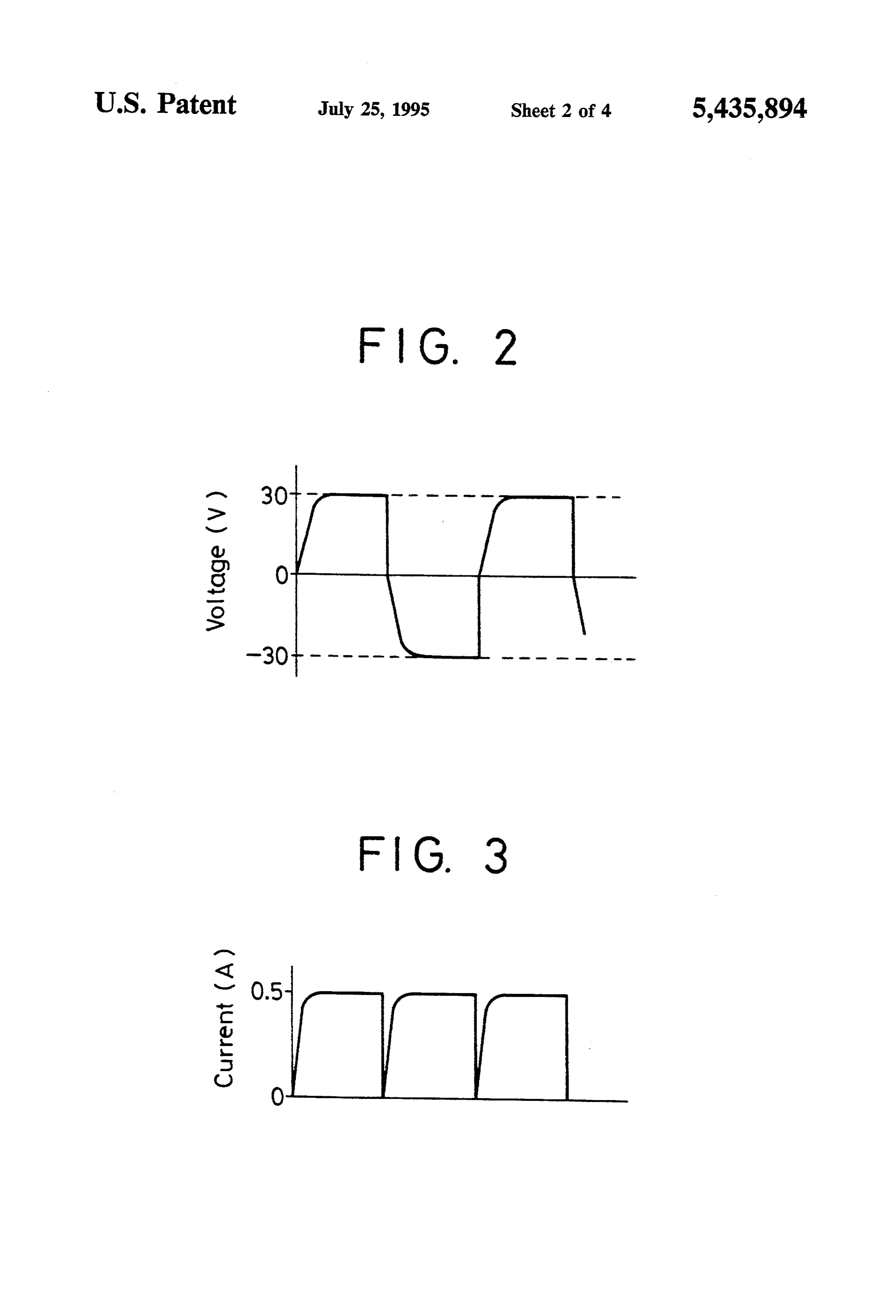
The electric source for the apparatus may be of an from the DC source 6A, 6B which convert the DC voltage electric cell or battery, or the apparatus can be con by 5 to a high-frequency AC voltage nected to a plug socket through an adapter, so that the ing high-frequency AC voltageswitching its high periodic ON-OFF and the result is alternately applied to process according to the invention can be carried out 10 the pair of applying electrodes 3A, 3B in the tank 1. A any place.
When the grounding electrode is arranges as a pair waveform of the AC voltage to be transmitted to each electrodes for alternately grounding with a low cycle, of the applying electrodes 3A, 3B is shown in FIG. 2. an adhesion of foreign matters thereon can be effec The height of voltage wave is determined by a value of resistance pre-set for the variable resistor 7. A form of tively avoided to make possible a long time continuous 15 waves operation. of DC current as shown in FIG. 3 was observed
BRIEF DESCRIPTION OF THE DRAWINGS
between the applying electrode 3A or 3B and the grounding electrode 3C. The form of the waves may be
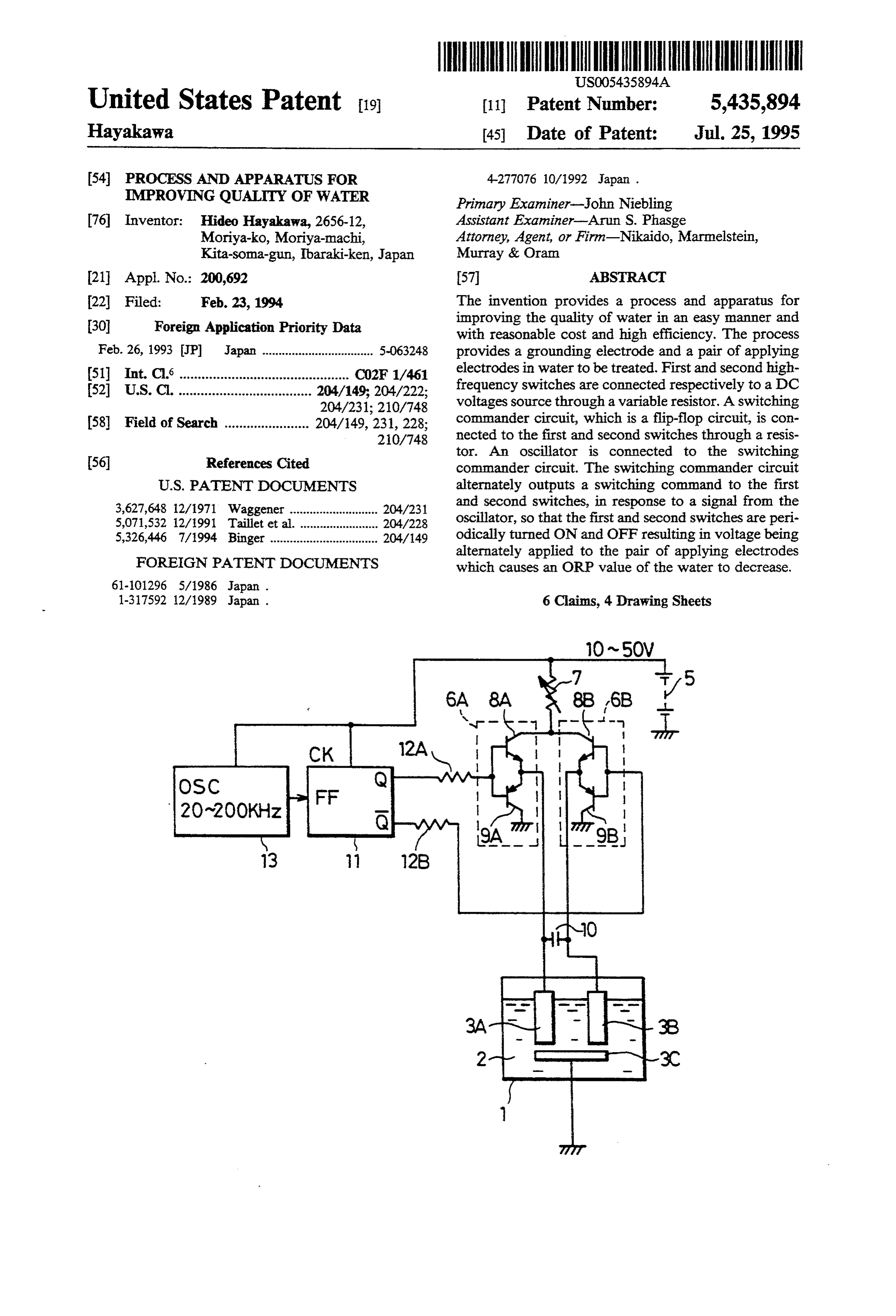
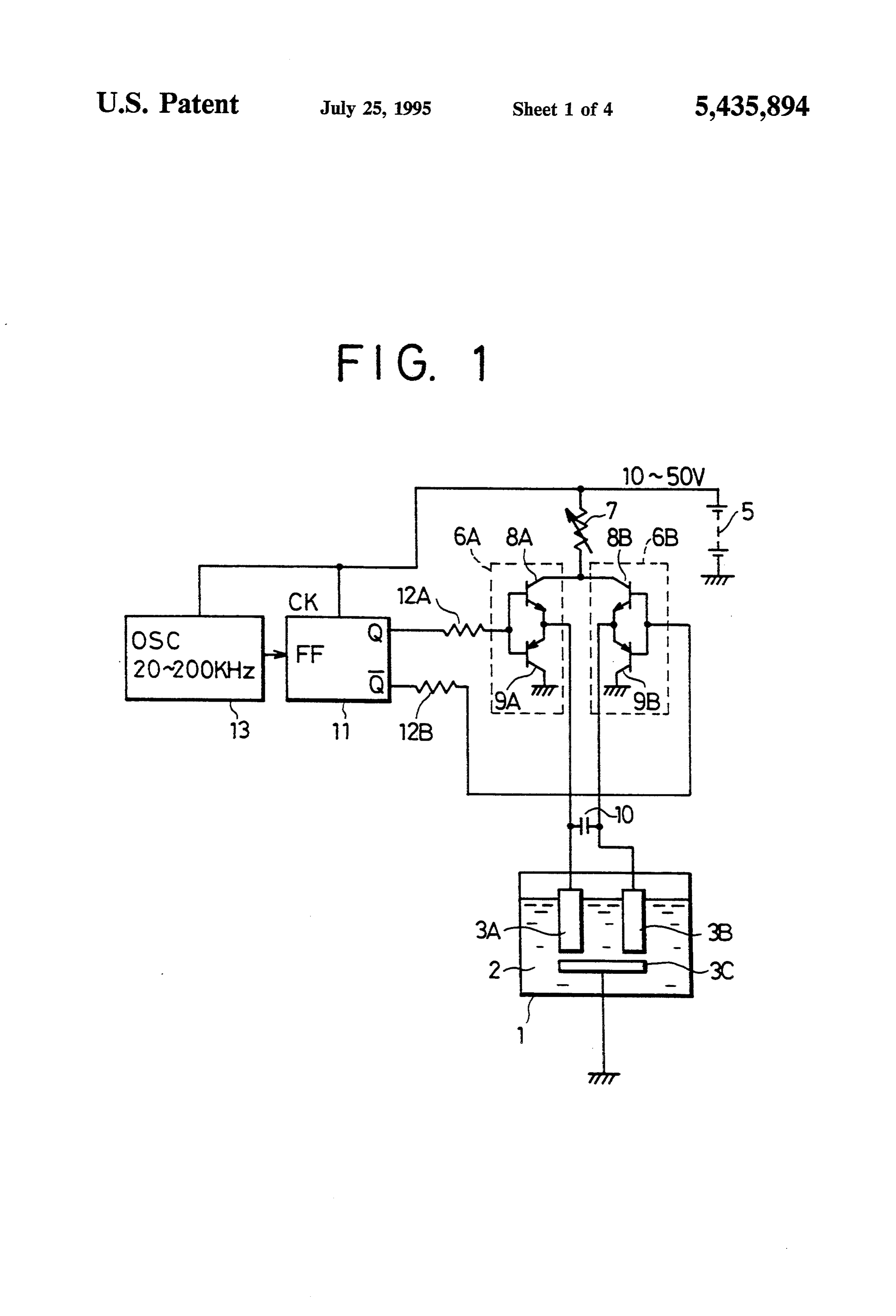
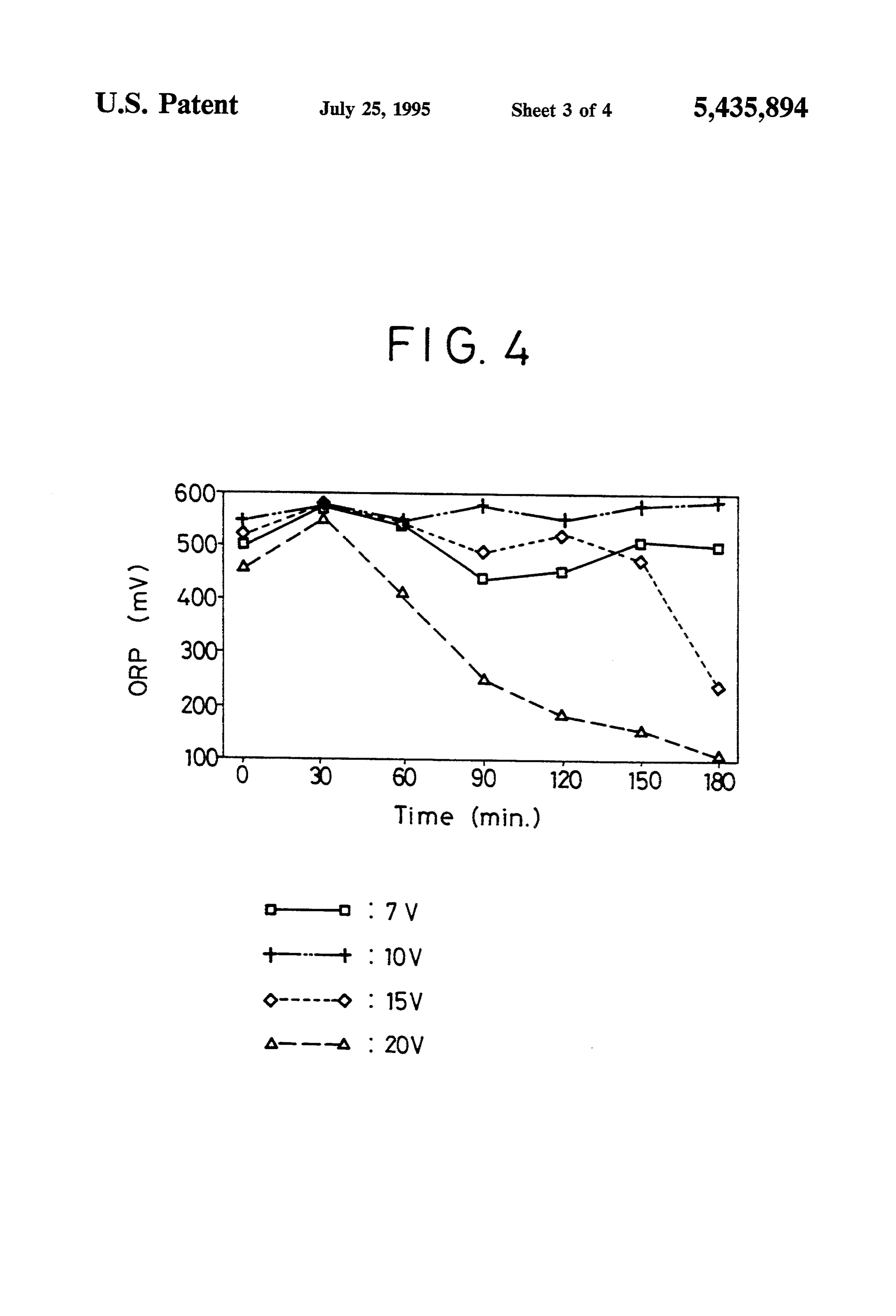
FIG. 1 is a circuit diagram for an apparatus according determined according to the capacitance of the capaci to the invention; 20 tor 10 provided within the applying electrodes 3A and FIG. 2 shows a waveform of high-frequency AC 3B. Such rectangular waves in FIG. 3 are obtained at voltage to be supplied to an applying electrode; the capacitance 203 F which is most effective to de FIG.3 shows a waveform of DC current appearing at crease an ORP value of water in this embodiment. a grounding electrode; A relation between change in ORP value of the city FIG. 4 is a graph showing a relation of applied volt 25 water and applying period of time was checked. Results age, oxidation-reduction potential, and voltage apply are shown in FIG. 4. It can be seen from FIG. 4, the ing period of time; and ORP decrease, as applying voltage is set at a higher FIG. 5 is another circuit diagram for a second em level and the applying period of time is made longer. bodiment of the apparatus. A slightly contaminated water, taken from a marsh of 30 Tega-numa in Chiba-ken, Japan was treated by the
DESCRIPTION OF THE PREFERRED
EMBODIMENTS apparatus as shown in FIG. 1 under the voltage 30 V. Results
A process and apparatus for improving the quality of makes apparentare shown in the following Table 1 which water according to the invention will now be further time, and how the how the ORP of water changed with explained in more detail with reference to the drawings. 35 water improved in quality. In FIG. 1 showing mainly a circuit diagram of the TABLE 1.
apparatus, a grounding electrode 3C and a pair of apply Time ORP (mV) Smell Visual appearance ing electrodes 3A, 3B are arranged in a tank 1 which untreated 330 fairly bad accommodates water 2 to be treated. In this embodi 5 min. 220 detectable organic matters are ment, a stainless-steel plate and zinc plates are selected seen by eyesight for the grounding electrode and applying electrodes, 10 min. -346 hardly deposition of organic respectively, but other materials such as lithium oxide, detectable and inorganic matters noted magnesium alloy, copper, iron, titanium and the like i5 min. -600 no bad smell deposition increased may be used based upon the quality of water to be 18 hours. -300 no bad smell as clear as city water treated, usage of the treated water and other factors. 45 after the (height of deposition First and second high-frequency switches 6A and 6B treatment 7 mm) are connected between the applying electrodes 3A, 3B and a DC source 5 through a variable resistor 7, to When results shown in Table 1 and the graph in FIG. convert DC voltage, from the DC source 5, to high-fre 4 are compared, it is apparent that the time required for quency AC voltage which is output to the applying 50 decreasing the ORP value is remarkably different based electrodes 3A and 3B alternately. The first and second upon the water high-frequency switches 6A, 6B have transistors 8A, caused mainly byto abedifference treated. The difference should be in electric resistance of 9A and 8B, 9B, respectively. The applying electrodes the water. Namely, the contaminated marsh water as in 3A and 3B are connected through a capacitor 10. Volt age is adjusted by the variable resistor 7 in a range of 55 Table 1 contains various foreign matters therein to 10-50 V, in response to the quality of water to be show a lower electric resistance, but a content of for treated. eign matters in the city water as in FIG. 4 is relatively To the first and second high-frequency switches 6A low to show a higher electric resistance. and 6B, a high-frequency switching commander circuit At any rate, it has been confirmed that the decrease of 11, consisting of a flip-flop circuit, is connected through ORP value can be made an index on quality modifica resistors 12A, 12B for applying a high-frequency tion or improvement of the water.
switching command to the switches 6A and 6B. A high Measurements on various items were carried out frequency oscillator 13 is connected to the circuit 11 for using the contaminated marsh water as in the above and outputting a signal of 20-200 KHz high-frequency to then the water was treated for 15 minutes by the appara the circuit 11. 65 tus as shown in FIG. 1. The treated water was left to In operation, a switch (not shown) is turned ON, after stand for 18 hours in the tank and measurements on the filling the tank 1 with water to be treated, such as city same items was carried out. Results are shown in the water, and setting a timer (not shown) to be predeter following Table 2.
Page 8
TABLE 2 cell or battery, so that it can easily be moved in order to Items Before After Notes use the same in various places. I claim:
turbidity 25° 2 measured by 1. A process for improving quality of water, compris turbidity gauge 5 ing the steps of:
PC-06, Kyoto
Denshi Kogyo providing a grounding electrode and a pair of apply smell corrupted no smell ing electrodes in water to be treated; algae-like connecting first and second switches respectively to a smell DC voltage source through a variable resistor; electric 340 mho/cm 231 mho/cm Yokogawa, O connecting a switching commander circuit which is a
oxygen content 9.1 ppm 11.75 ppm flip-flop circuit to the switches through a resistor; pH 8.786 7.6 and
ORP 300 InV - -300 mV Toukou Kagaku connecting a oscillator to the switching commander Kenkyusho, circuit, wherein the switching commander circuit
TRX-90 Type
Central Kagaku 15 alternately outputs a switching command to the
HC-407 first and second switches, in response to a signal phosphate 0.9 ppm 0.05 ppm Kyoritsu Kagaku from the oscillator, so that the first and second Kenkyusho, switches are periodically turned ON and OFF
F-Type resulting in voltage being alternately applied to the 20 pair of applying electrodes which causes an ORP
As apparent from the above, the water treating pro value of the water to decrease. cess according to the invention shows improvements in 2. A process as claimed in claim 1, wherein said elec all items. trode is made of materials selected from the group con sisting of zinc, lithium oxide, magnesium alloy, copper,
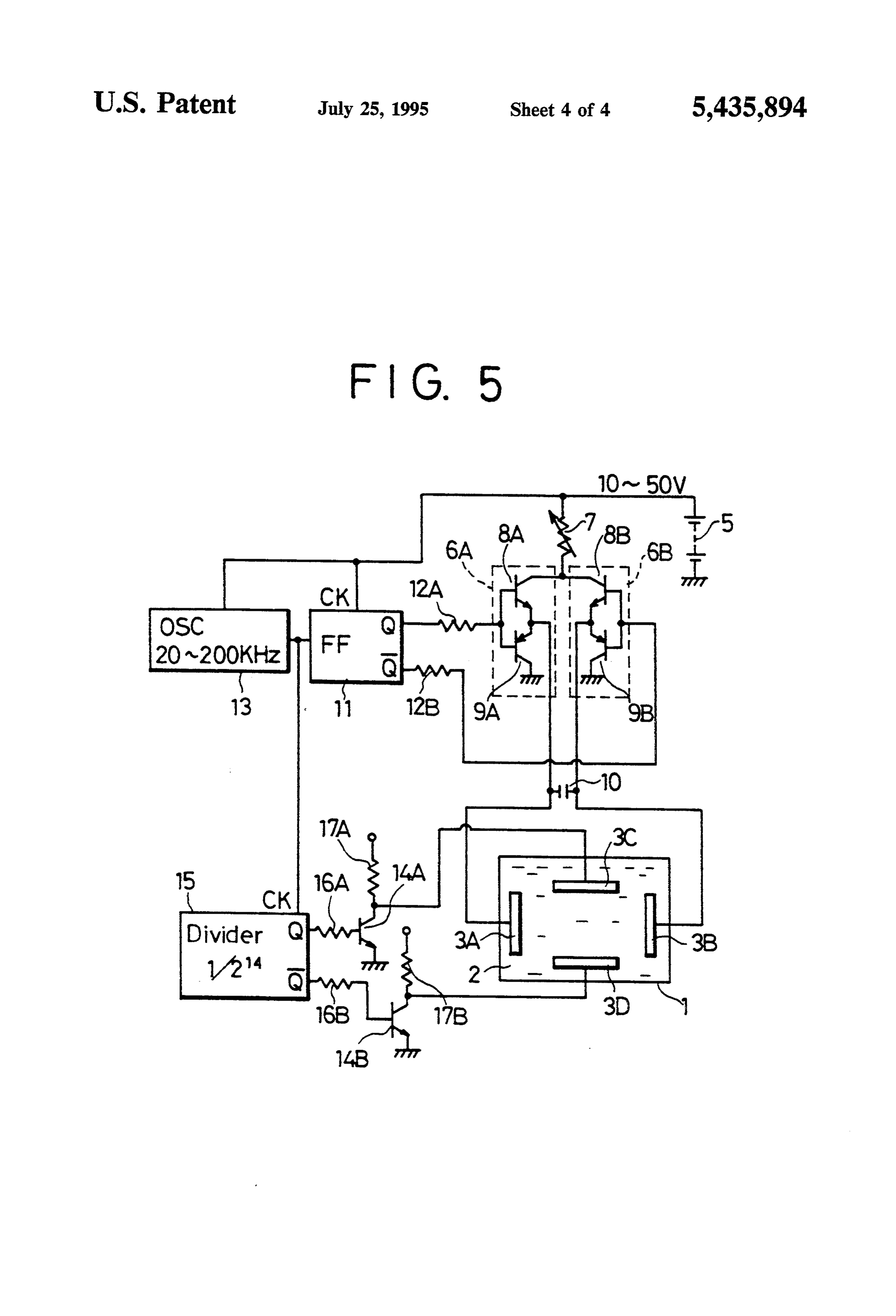
FIG. 5 shows another embodiment for carrying out 25 iron, stainless-steel and titanium.
the process of the invention. The embodiment is sub 3. A process as claimed in claim 1, wherein said stantially the same as the fist embodiment shown in grounding electrode is arranged as a pair of electrodes FIG. 1, except that two grounding electrodes are pro opposing each other and alternately grounded. vided and a low-frequency switching circuit for alter nately grounding one of the electrodes with a low cycle 30 source supplies as10-50 4. A process claimed in claim 1, wherein said DC
V and said oscillator outputs to are also provided. Therefore, the same reference nu said switching commander circuit a signal of 20-200 merals or symbols are given for identical parts and an KHz.
overlapping explanation is not given. 5. An apparatus for improving quality of water, com In the embodiment, low-frequency switches 14A, prising:
14B are connected to the pair of oppositely arranged 35 a tank;
rounding electrodes 3C, 3D to alternately ground one a grounding electrode;
of the electrodes with a low cycle. The low-frequency a pair of applying electrodes, wherein all of said elec switches 14A, 14B are connected to a low-frequency trodes being arranged in said tank; switching commander circuit 15 through resistors 16A, a DC source;
16B. The low-frequency commander circuit 15 is a first and second switches, each being connected to frequency divider to divide a 20-200 KHz signal from said DC source through a variable resistor to con the high-frequency oscillator 13 to 14 for outputting vert the DC voltage from said DC source to AC the divided signal to the low-frequency switches 14A, voltage for alternately applying the AC voltage to 14B. one of said applying electrodes; Resistors 17A, 17B, connected to the low-frequency 45 a switching commander circuit which is a flip-flop switches 14A, 14B, connect a collector of the low-fre circuit connected to said switches through a resis quency switch to the positive side of the DC source to tor for outputting a switching command; and keep the grounding electrode 3C, 3D at a positive po a oscillator outputting a signal to said Switching tential at switching-off time. commander circuit.
50 6. An apparatus as claimed in claim 5, wherein two
As explained as above, the quality of the water can be electrodes opposed to each other are arranged as said improved by the process according to the invention grounding electrode, each electrode being connected to with a simple apparatus and reasonable cost. The inven a third and fourth switches which are connected to said tion can be applied for supplying water for industrial oscillator through a second switching commander cir use, in addition to water for drinking and plant cultiva 55 tion and other purposes. Further, the apparatus accord cuit, wherein said two grounding electrodes are alter nately grounded.
ing to the invention may be operated with an electric sk
Provenance
- Collection
- Cited prior art
- Original PDF
- patentimages.storage.googleapis.com →
- Filed
- 1994-02-23
- Pages
- 8
- Method
- pdftotext (the PDF's own text layer) + pdftoppm 300dpi page scans
- Source
- Google Patents bibliographic record
- Granted
- 1995-07-25
- Inventors
- Hideo Hayakawa
- Transcribed from
- patentimages.storage.googleapis.com →