patent · US5376242
Method of cleaning water and apparatus therefor
27 December 1994
Page 1 — bibliographic record
United States Patent (19) 11 Patent Number: 5,376,242 Hayakawa 45) Date of Patent: Dec. 27, 1994 54 METHOD OF CLEANING WATER AND Primary Examiner-John Niebling APPARATUS THEREFOR Assistant Examiner-Arun S. Phasge 76 Inventor: Hideo Hayakawa, 2656-12, Attorney, Agent, or Firm-Nikaido, Marmelstein, Moriya-ko, Moriya-machi, Murray & Oram
Kita-Soma-gun, Ibaraki-ken, Japan 57 ABSTRACT (21) Appl. No.: 112,805 There are provided a method and apparatus for clean 22 Filed: Aug. 27, 1993 ing contaminated water, for instance in lakes, marshes, (30) Foreign Application Priority Data rivers and waste water reservoirs in factory site. A set of fiat electrodes is immersed in the water, which elec
Jun. 28, 1993 JP Japan .................................. 5-156722 trode set includes a pair of voltage application elec 51) Int. C. .............................................. CO2F1/461 trodes made of relatively high electrolysis capability 52 U.S.C. .................................... 204/149; 204/228; material and a grounding electrode placed in the vicin 204/231; 204/267; 204/271 ity of the voltage application electrode. An alternating 58) Field of Search ............... 204/149, 131, 228, 231, current voltage of relatively high frequency is applied 204/267, 271 to the pair of voltage applying electrodes to give an
electric power to the water. A degree of quality of resulting water is determined as an index a measured
3,767,046 10/1973 Hartkorn ............................. 204/149 4,140,609 2/1979 Zucker ............................ 204/180 R 3 Claims, 4 Drawing Sheets
Page 2
Drawing sheet — no readable text.
Page 3
Drawing sheet — no readable text.
Page 4
Drawing sheet — no readable text.
Page 5
Drawing sheet — no readable text.
Page 6
a pair of voltage application electrodes in the water to
METHOD OF CLEANING WATER AND be treated, the electrodes being made of a material of APPARATUS THEREFOR relatively high electrolysis capability; placing at least one grounding electrode in the vicinity of said voltage
BACKGROUND OF THE INVENTION 5 application electrodes in the water; and applying an 1. Field of the Invention alternating current voltage relatively high frequency to The present invention relates to a method of cleaning the voltage application electrodes, thereby reducing contaminated water by charging electrical energy to oxidation-reduction potential of the water. the water in lakes, rivers, marshes or waste water reser O The high frequency alternating current voltage may voirs in factory sites, and an apparatus therefor. be produced by converting direct current voltage from The term "cleaning” in this specification is defined as a direct current voltage source into the same, and in this decrease of oxidation-reduction potential (ORP), tur case, a portable battery may be used as the direct cur bidity, smell, chemical oxygen demand (COD), phos rent voltage source, whereby the method according to phate concentration as well as increase in amount of 15 the invention can be carried out in any place, even if at dissolved oxygen in the water. the place where no commercial electricity is available. 2. Related Art When a pair of grounding electrodes are arranged in Nowadays water in lakes, rivers and others has been the water and one of them is alternatively connected to contaminated with waste from general homes, factories, the earth with a relatively low cycle, deposition of golf links and other sources to cause a serious public foreign substances on the grounding electrodes can be pollution. restrained, whereby it keeps effectiveness over ex Hitherto, an aeration treatment has been well known tended period of time.
for cleaning the water in lakes and others, which has A water cleaning apparatus according to the inven been widely employed for treating sewage. The aera tion comprises a floatable casing having a hollow body tion treatment is effected by blowing fresh air into con and a lid; a flat electrode set secured on side wall of the taminated water and/or sucking-up contaminated water 25 casing and comprising a pair of voltage application in depth layer to expose the same to atmospheric air. electrodes made of relatively high electrolysis capabil With recourse to such aeration treatment, however, ity material arranged laterally side by side, and a pair of an economically inhibited huge installation would be flat grounding electrodes arranged oppositely to the required for cleaning of water in lakes or marshes, and voltage application electrodes at equi-distances from such mechanical water cleaning would be limited to 30 the opposing grounding electrodes; and a control box relatively small areas, and the treatment of whole water accommodated in the casing, electrically connected to in lakes or marshes would be almost impossible. The the electrode set through wirings, and comprising a first degree of contamination is determined in terms of tur and second high-frequency switching means connected bidity, offensive smell, content of dissolved oxygen, to a direct current voltage source via an associated chemical oxygen demand, phosphate concentration and 35 other factors. The mechanical water cleaning can im variable resistor for converting the direct current volt age to alternating current voltage of relatively high prove the quality of water in terms of selected items frequency and for applying the so converted alternating only.
In contrast to such mechanical water cleaning, an current voltage to the voltage application electrodes, a electrical water treatment is found to be useful in treat high-frequency switching command circuit having a ing a relatively small amount of water, for instance for flip-flop circuit to give high-frequency switching com the purpose of improving quality of drinking water such mand signals to the first and second high-frequency as city water, well water and the like, but conventional switching means via an associated resistor, and a high electrical water cleaning methods and apparatuses are frequency oscillator to give high-frequency signals to practically useless in treating a lot of badly contami 45 the high-frequency switching command circuit. nated water in lakes and others. Therefore, there has The flat electrode set may be secured on each of four been an ever increasing demand on practical water side walls of the floatable casing. An upper flange of the cleaning method and apparatus to be applied to contam casing body has an edge area extending outwardly and inated water in lakes and others for improving human downwardly, which is useful to prevent entrance of life environment. 50 water into an inner space of the hollow body, conjointly
SUMMARY OF THE INVENTION
with the lid with circumferential area having a form corresponding to that of the flange of floatable casing.
An object of the invention is to provide an electrical When an alternating current voltage is applied to the method which is capable of cleaning a lot of contami pair of voltage application electrodes submerged in the nated water in lakes, marshes, rivers and others without 55 water to be treated such as a lake, marsh, river, factory causing any adverse effect to aquatic animals and plants, waste reservoir or the like, value of oxidation-reduction requiring a low electric power. potential of water shall be reduced to about - 600 mV Another object of the invention is to provide an appa in a relatively short period of time. Almost all organic ratus for carrying out the method, which is simple in materials in the water are decomposed into gas, and the structure, and can be constructed and maintained with 60 remainder agglomerates to cause precipitation. The reasonable cost. voltage application electrodes are liable to be heated by The present invention is based on the finding that application of alternating current voltage thereto to contaminated water in lakes and others can be cleaned raise the temperature of the surrounding water, thereby with good efficiency by electrically reducing oxidation causing a convection of water near the electrodes. In reduction potential of the water to be treated. 65 case that the water temperature is below 15 C., value of According to the invention, the first object can be the oxidation-reduction potential shows little or no attained by a method for cleaning contaminated water, decrease. Since the temperature of the water surround which comprises the steps of arranging with a distance ing the electrodes rises as referred to, however, how
Page 7
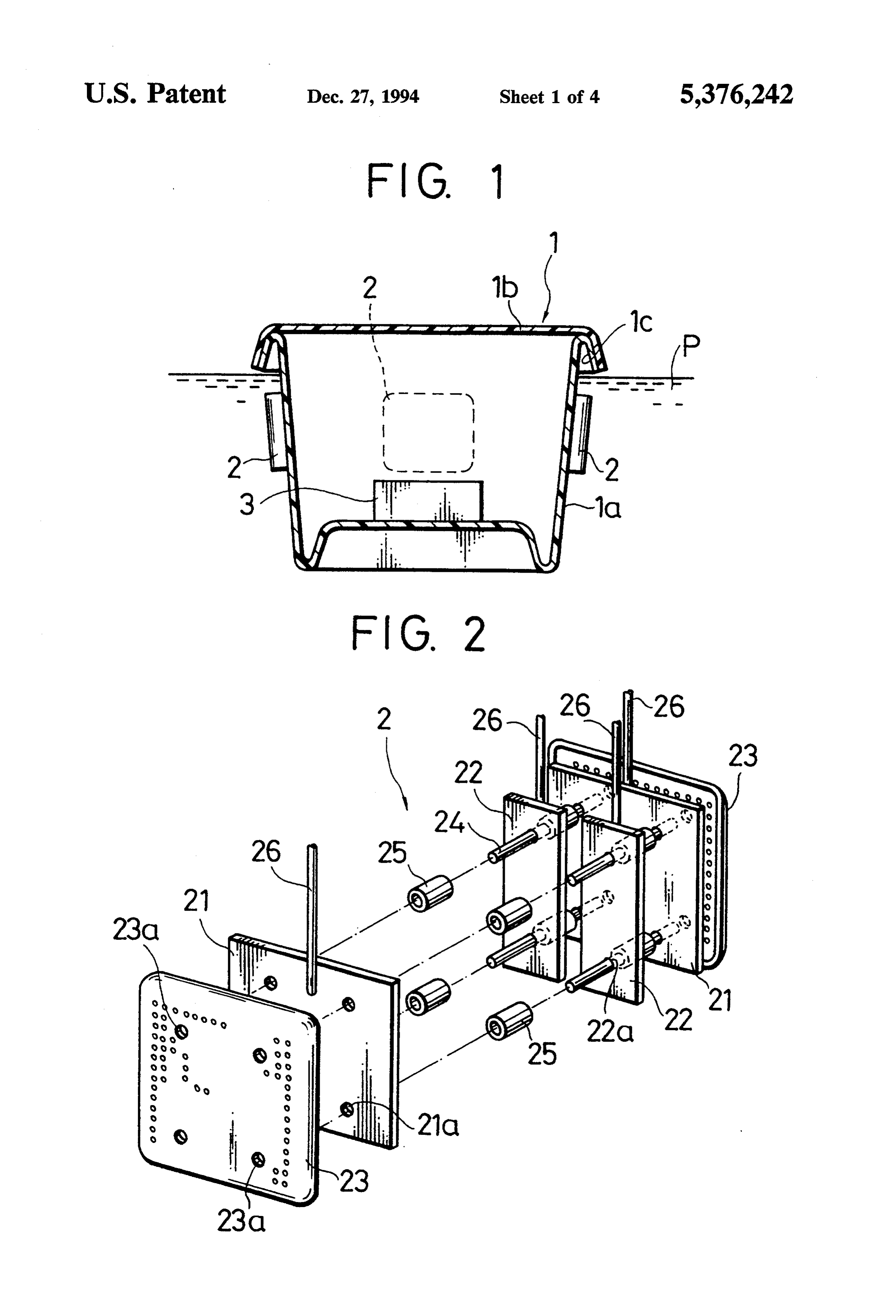
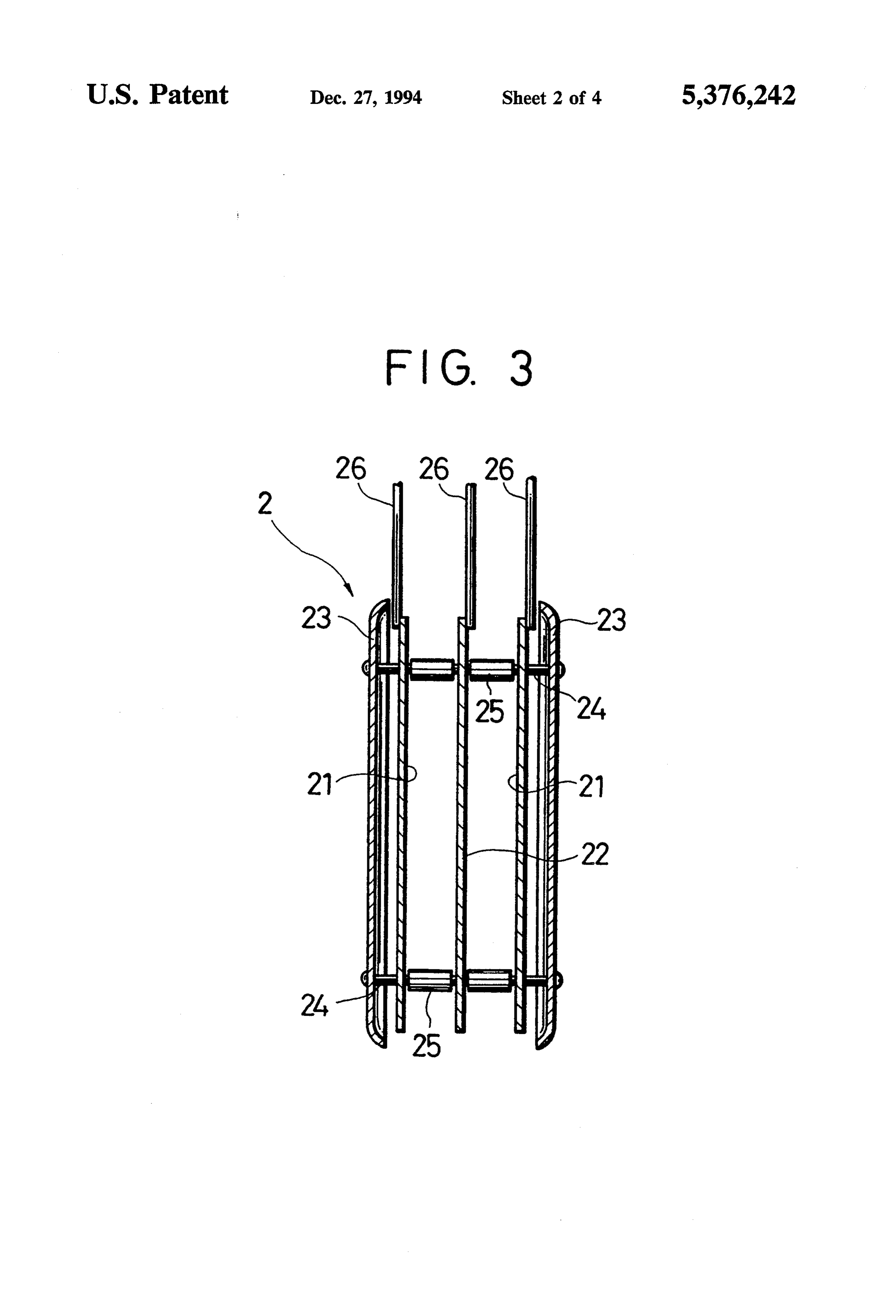
ever, decrease of the oxidation-reduction potential of 23 placed on the outside of each grounding electrode water can be recognized, even if the water temperature 21. All electrodes 21, 22 and protection plates 23 are is below 15 C. assembled by connecting rods 24 made of electric insu An experience, wherein city water colored with a lation material and passing through apertures 21a, 22a dye-stuff and having oxidation-reduction potential of 5 and 23a of the electrodes 21, 22 and protection plates 23, 500 mV was treated as referred to above, showed that and the grounding electrodes 21 and the voltage appli the water was discolored, when the oxidation-reduction cation electrodes 22 are separated by tubular spacers 25 potential decreased near the value of -600 mV. made of electrical insulation material. For instance, the There is almost no reliable means to verify what distance between the opposing grounding electrodes is phenomena have caused on the water, for instance in 10 set by about 80 mm, and that between the voltage appli water molecules, by applying high-frequency alternat cation electrodes 22, 22 is set by about 30 mm laterally ing current voltage thereto, but in any event, the results from each other. The perforated protection plate 23 was of water cleaning can be determined in terms of turbid subjected to anti-rusting treatment. In this embodiment, ity, offensive smell, content of dissolved oxygen, chemi the zinc plates were employed for the voltage applica cal oxygen demand, phosphate concentration and other 15 tion electrodes, but another plate of lithium oxide, mag factors. Particularly, the degree of water quality can be nesium alloy, copper, iron, stainless-steel or the like of estimated in terms of the value of oxidation-reduction relatively high electrolysis capability may be used. potential. The contaminated water can be cleaned with Each electrode 21 or 22 is connected to a titanium rod decrease of its oxidation-reduction potential. 26 which passes through an aperture (not shown) When the apparatus according to the invention is put 20 formed in the side wall of the body 1a to be connected in operation, the high-frequency switching command to an electric circuit (FIG. 4) accommodated in the circuit responds to high-frequency signals from the control box 3.
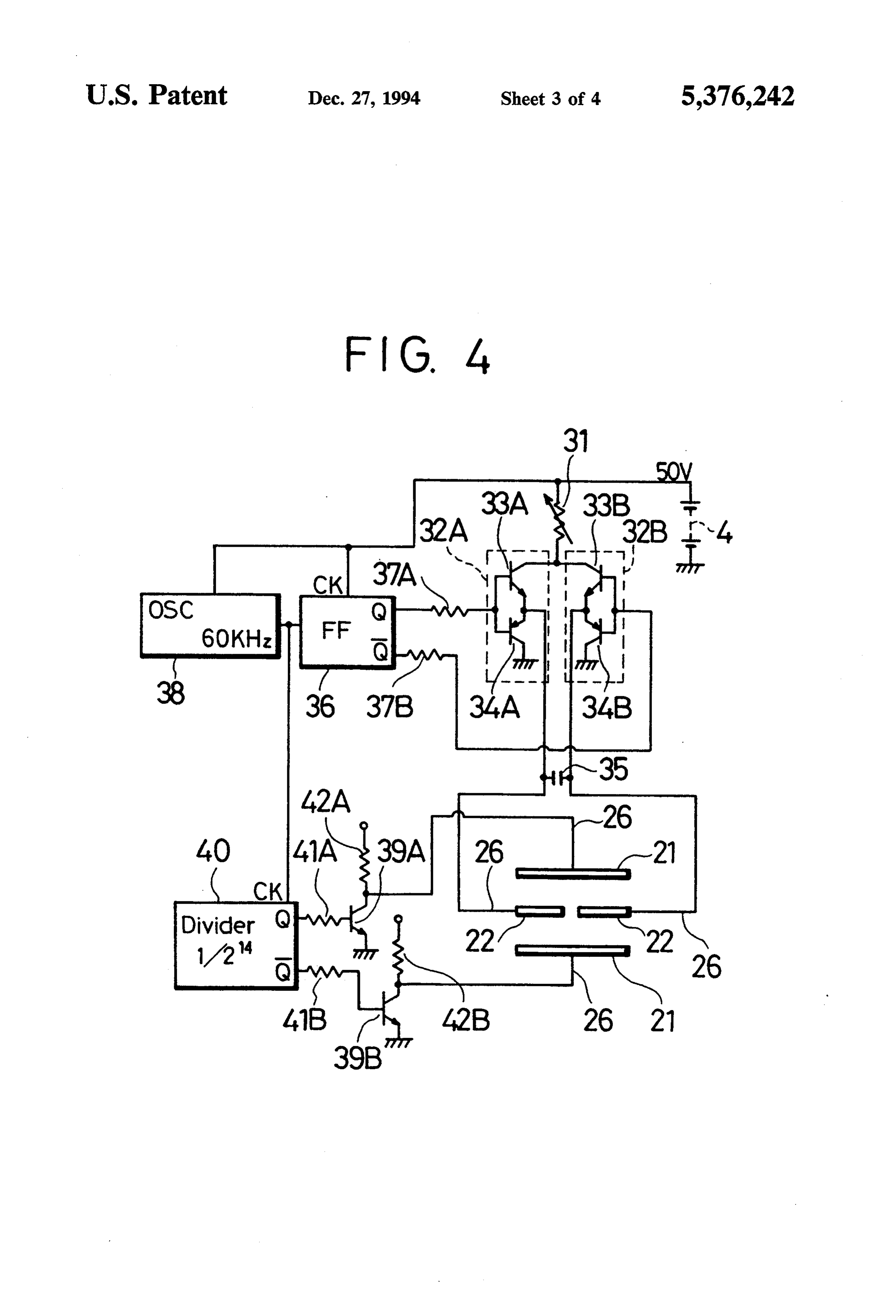
high-frequency oscillator to provide switching com FIG. 4 shows the electric circuit arranged in the mand signals to the first and second high-frequency control box 3. As shown, first and second high-fre switching means, thereby permitting these switching 25 quency switching means 32A and 32B are connected means to close and open alternately so that the direct between an exterior direct current voltage source 4 (50 current voltage from the direct current voltage source V) and the voltage application electrodes 22, 22 via a may be converted to the high-frequency alternating variable resistor 31 for converting direct current volt current voltage, which is applied to the pair of voltage age from the voltage source to alternating current volt application electrodes, alternately. 30 age to be applied to the voltage application electrodes BRIEF DESCRIPTION OF THE DRAWINGS 22, 22 alternately. Each switching means 32A or 32B is composed of transistors 33A, 34A or 33B, 34.B. A ca
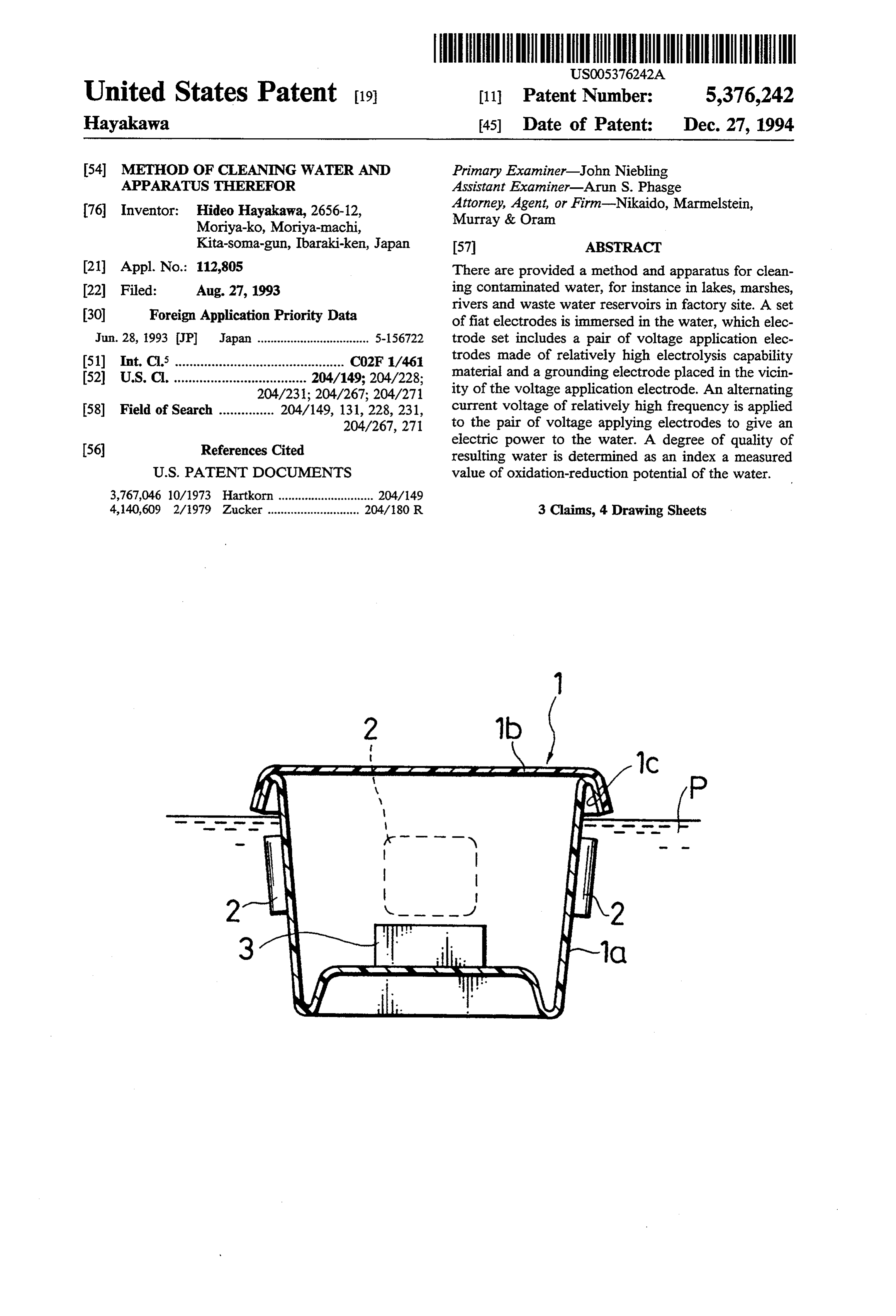
FIG. 1 is a vertical section of a water cleaning appa pacitor 35 is connected between voltage application ratus according to the invention; electrodes 22. 22.
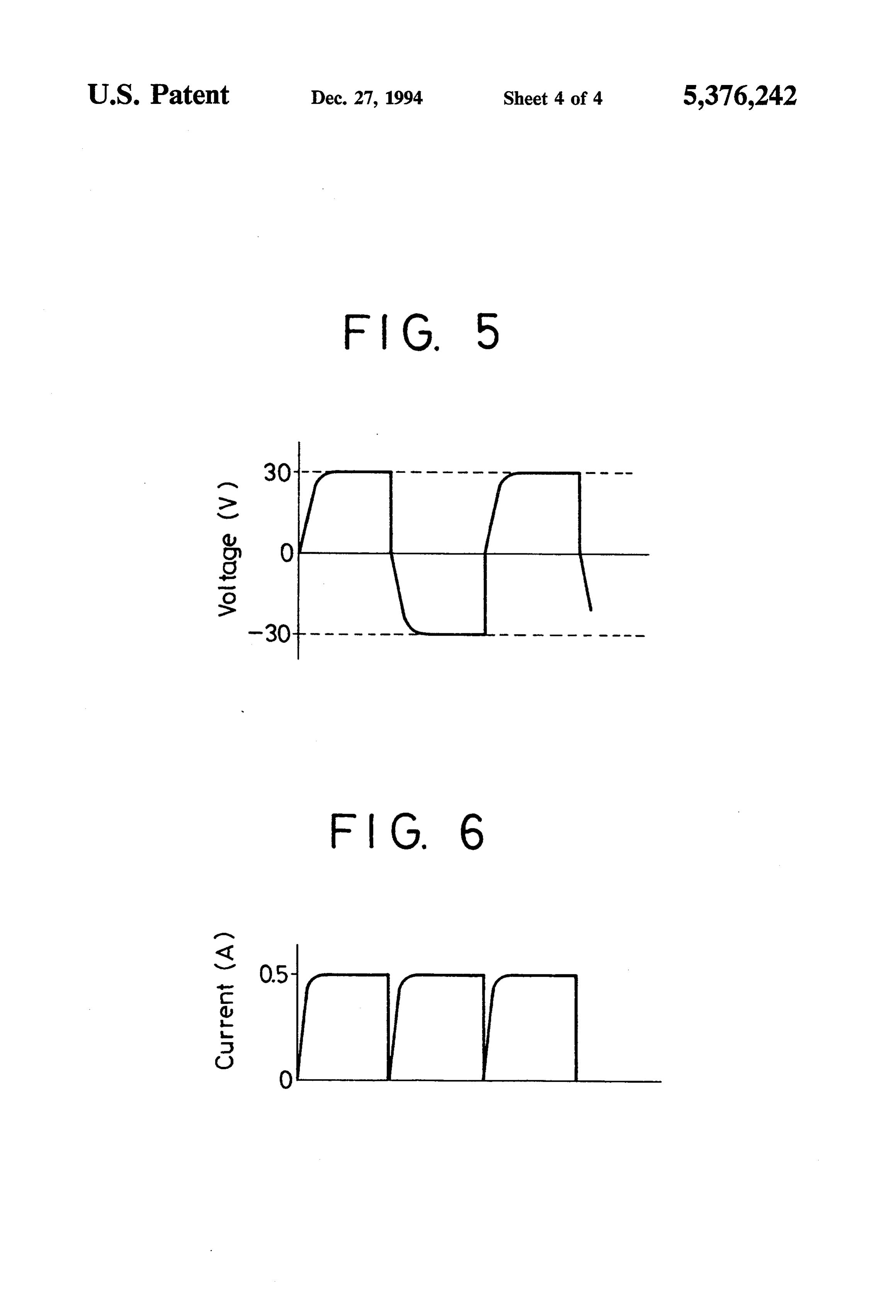
FIG. 2 is an exploded perspective view of a electrode 35 To the first and second high-frequency switching set used for the apparatus; means 32A and 32B, a common high-frequency switch FIG. 3 is a vertical section of the electrode set; ing command circuit 36 is connected through associated FIG. 4 is an electric circuit for the apparatus; resistor 37A or 37B, which circuit comprises a flip-flop FIG. 5 is a wave form of high-frequency alternating circuit to give high-frequency switching command sig current voltage to be applied to the voltage application 40 nals to the first and second high-frequency switching electrodes of the apparatus; and means 32A and 32B. A high-frequency oscillator 38 is FIG. 6 is a wave form of direct current voltage flow connected to the high-frequency switching command ing through the grounding electrodes of the apparatus. circuit 36 for providing signals of 60 KHz thereto. DESCRIPTION OF THE PREFERRED The first and second low-frequency switching means 45 39A and 39B are connected to the grounding electrodes
EMBODIMENTS
21, 21 to allow these electrodes to be grounded alter
Referring to FIG. 1, a water cleaning apparatus ac nately at a relatively low cycle. A low-frequency cording to the invention comprises a box-like casing 1 switching command circuit 40 is connected to these floatable on water P, flat electrode sets 2, which are low-frequency switching means 39A and 39B via asso secured on the outer surface of the four side walls of the 50 ciated resistors 41A, 41B. The low-frequency switching casing 1, and a control box 3 accommodated in the command circuit 40 is connected to the high-frequency casing 1. oscillator 38, so that the high-frequency signal from the The floatable casing 1 is made of a reinforced syn oscillator 38 shall be divided for instance by 1 for thetic resin material, and is composed of a box-like applying the so divided signal to the low-frequency hollow body 1a and a lid 1b for closing upper open end 55 switching means 39A and 39B.
of the body. A circumferential flange at upper open end Resistors 42A and 42B are connected to the low-fre of the body 1a is bent outwardly and downwardly to quency switching means 39A, 39B respectively, to con form a circumferential overhanging edge 1c to prevent nect its collector to plus side of the direct current volt entrance of water into the inner space of body, and a age source to keep the grounding electrodes 21, 21 at circumferential edge of lid 1b is bent inwardly so as to 60 positive potential, when these low-frequency switching be complementary with the overhanging edge 1c of means 39A, 39B are turned off. body 1. In use, the box-like floatable casings 1 as many as As seen from FIGS. 2 and 3, the electrode set 2 con required for the purpose are anchored at suitable places prises a pair of grounding electrodes 21, 21 of stainless in a lake or the like, and associated switches are turned steel place and arranged oppositely, a pair of flat zinc 65 on. For example, each apparatus with four electrode voltage application electrodes 22, 22 arranged laterally sets (see FIGS. 1 and 2) has an ability for cleaning con side by side at the equi-distances from each grounding taminated water of about 1 ton/day with consumption electrode, and a pal, of perforated protection plates 23, of 600 watts. Accordingly, the number of required ap
Page 8
paratuses can be determined for performing the clean TABLE 2-continued ing the in a lake or the like. Items Pre-treatment Post-treatment Notes In operation, when associated switches are turned on, the high-frequency oscillator 38 is put in operation, algae-like smell directing high-frequency signals to the high-frequency 5 electric 340 231 Yokogawa, switching command circuit 36 in the form of flip-flop conductivity SC82 Type circuit, and then the high-frequency switching com dissolved O2 9.1 11.75 mand circuit 36 provides high-frequency switching ORP pH 8.786 7.6
command signals to the first and second high-frequency Kenkyusho, switching means 32A and 32B alternately, thus allowing O TRX-90 Type these high-frequency switching means 32A and 32B to COD 50 ppm 10 ppm Central Kagaku
turn on and off at high frequency. The resulting high phosphate 0.9 ppm 0.05 ppm Kyoritsu Kagaku frequency alternating current voltage is applied to volt Kenkyusho, age application electrodes 22, 22. FIG. 5 shows a wave 15 F-Type form of the alternating current voltage appearing be tween voltage application electrodes 22, 22. The wave As may be understood from the above, the water height can be controlled by adjusting the variable resis cleaning method according to the invention permits an tor 31. FIG. 6 shows a wave form of the direct current effective, economical treatment of lake, marsh or the voltage flowing between the voltage application elec 20 like contaminated trodes 22, 22 and grounding electrodes 21, 21 alter stallation. The water water without requiring a huge in nately. cleaning apparatus according to After determining the direction of water circulation the invention permits use of batteries, and therefore, it in a lake or the like, the floatable water cleaning appara can be carried out and used everywhere in the field. tuses may be advantageously anchored at selected up 25 time apparatus
The can be used for an extended period of by alternately connecting its grounding electrodes stream places to allow water to pass therethrough. For to earth cleaning of stagnant contaminated water for instance in depositionatofa foreign relatively low cycle, thereby preventing substances thereon. The apparatus ditches, the apparatuses may be moved place to place at prevents invasion of water by the overhanging edge in a suitable time interval.
Experiment of water cleaning according to the pres 30 the circumferential flange at upper open end of the hollow body, which open end is covered with the lid, so ent invention was made with a single electrode set (see that it can be used in wavy places.
FIG. 2) put in contaminated water. I claim:
Two portable containers were filled with badly con 1. A method for cleaning contaminated water, com taminated water (40 liters), which was taken from the prising the steps of:
Tega-numa (Tega marsh) in Chiba-ken, Japan, particu 35 providing an apparatus for cleaning contaminated larly around a boat harbor thereof. The water was put water comprising a floatable casing having a hol in a plastic reservoir in a laboratory. Table 1 shows how low body and a lid, a flat electrode set secured on the oxidation-reduction potential (ORP) of the water a side wall of the casing, and comprising a pair of changed with the lapse of time, and how bad smell and voltage application electrodes made of relatively visual appearance were improved. high electrolysis capability material arranged later TABLE 1. ally side by side, and a pair of flat grounding elec Time ORP (mV) Smell Visual appearance trodes arranged oppositely to the voltage applica untreated 330 fairly bad tion electrodes at equal distances from the oppos 5 min. 220 detectable suspended organic matters ing grounding electrodes, and a control box ac can be visually observed 45 commodated in the casing and electrically con 10 min. -346 hardly precipitate of organic and nected to the electrode set through wirings, and detectable inorganic matters is noted including a first and second high-frequency switch 15 min. -600 almost no amount of precipitate bad smell increased ing means connected to a direct current voltage 18 hours. - 300 no smell as clear as city water source via an associated variable resistor for con after (thickness of precipitate: 50 verting the direct current voltage to alternating treatnet about 7 mm) current voltage and for applying the alternating current voltage to the voltage application elec
As seen from Table 1, the value of ORP decreases, as trodes, and a high-frequency switching command the water becomes clean-up. It means the value of ORP circuit having a flip-flop circuit to provide high can be made as an index showing a degree of water 55 frequency switching command signals to the first cleaning. and second high-frequency switching means via an Next, measurement results of different items on the associated resistor, and a high-frequency oscillator water which was left 18 hours after 15 minute-long to give high-frequency signals to said high-fre water cleaning operation according to the present in quency switching command circuit; said method vention are shown in following Table 2. 60 further comprising the steps of TABLE 2 arranging said pair of voltage application electrodes Items Pre-treatment Post-treatment Notes in the water to be treated;
placing at least one of said flat grounding electrodes water temp.
turbidity 18 C. 9° C. in a vicinity of said voltage application electrodes 25 2 measured by 65 in the water; and (degree) turbidity gauge
PC-06, Kyoto applying said alternating current voltage to said volt
Denshi Kogyo age application electrodes, thereby reducing smell corrupted no smell oxidation-reduction potential of the water.
Page 9
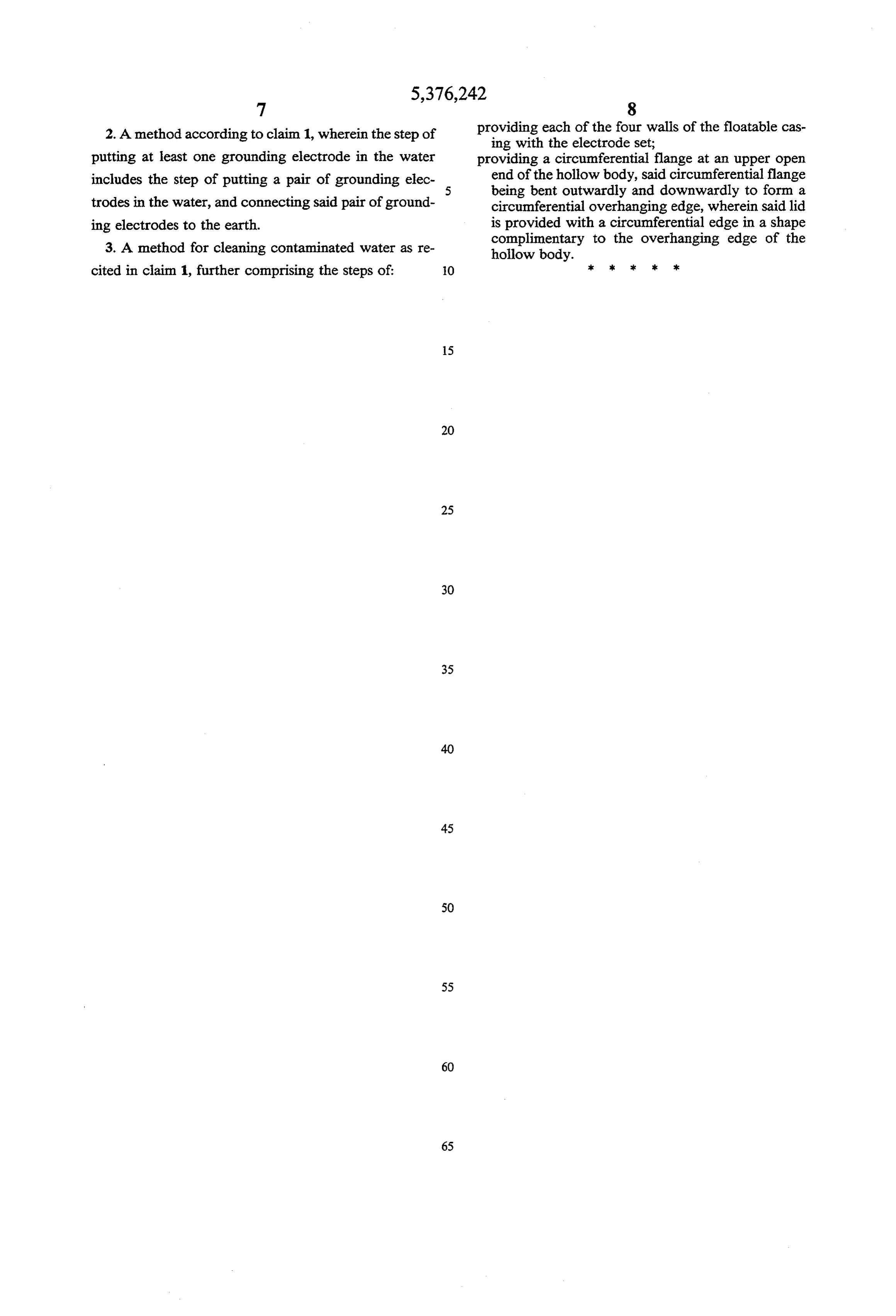
2. A method according to claim 1, wherein the step of providing each of the four walls of the floatable cas ing with the electrode set;
putting at least one grounding electrode in the water providing a circumferential flange at an upper open includes the step of putting a pair of grounding elec end of the hollow body, said circumferential flange being bent outwardly and downwardly to form a trodes in the water, and connecting said pair of ground circumferential overhanging edge, wherein said lid ing electrodes to the earth. is provided with a circumferential edge in a shape 3. A method for cleaning contaminated water as re complimentary to the overhanging edge of the hollow body.
cited in claim 1, further comprising the steps of: O
Provenance
- Collection
- Cited prior art
- Original PDF
- patentimages.storage.googleapis.com →
- Filed
- 1993-08-27
- Pages
- 9
- Method
- pdftotext (the PDF's own text layer) + pdftoppm 300dpi page scans
- Source
- Google Patents bibliographic record
- Granted
- 1994-12-27
- Inventors
- Hideo Hayakawa
- Transcribed from
- patentimages.storage.googleapis.com →