patent · US5246061
Thermal storage by heavy water phase change
21 September 1993
Page 1 — bibliographic record
United States Patent (19) 11) Patent Number: 5,246,061 Zalite 45 Date of Patent: Sep. 21, 1993 (54) THERMAL STORAGE BY HEAVY WATER 5,115,859 5/1992 Roebelen, Jr. et al. ........... 62/259.3 PHASE CHANGE Primary Examiner-Albert W. Davis, Jr. (75) Inventor: Edgar P. Zalite, Bayville, N.Y. Attorney, Agent, or Firm-Pollock, Vande Sande & 73 Assignee: Grumman Aerospace Corporation, Priddy
Bethpage, N.Y. 57 ABSTRACT (21) Appl. No.: 921,345 Water coolant circulating in a closed loop may be cooled by passing it through a heat exchanger coil en (22) Filed: Jul. 29, 1992 bedded within a block of heavy water ice. The ice will 51) Int. Cl. .............................................. F28D 20/00 maintain the water, passing through the coil, at a tem 52 U.S. C. ........................................ 165/10; 165/41; perature approximately 39 F. Maintenance of the 62/59; 62/259.3; 252/70 working fluid at this temperature prevents it from freez 58 Field of Search ...................... 165/10, 104.11, 41, ing in coolant tubes. The system is particularly adapted 165/902; 62/59, 259.3, 430, 434; 252/70 for a liquid cooling space garment which must effec (56) References Cited tively conduct away heat from an astronaut's body when an astronaut exerts himself during physical activ
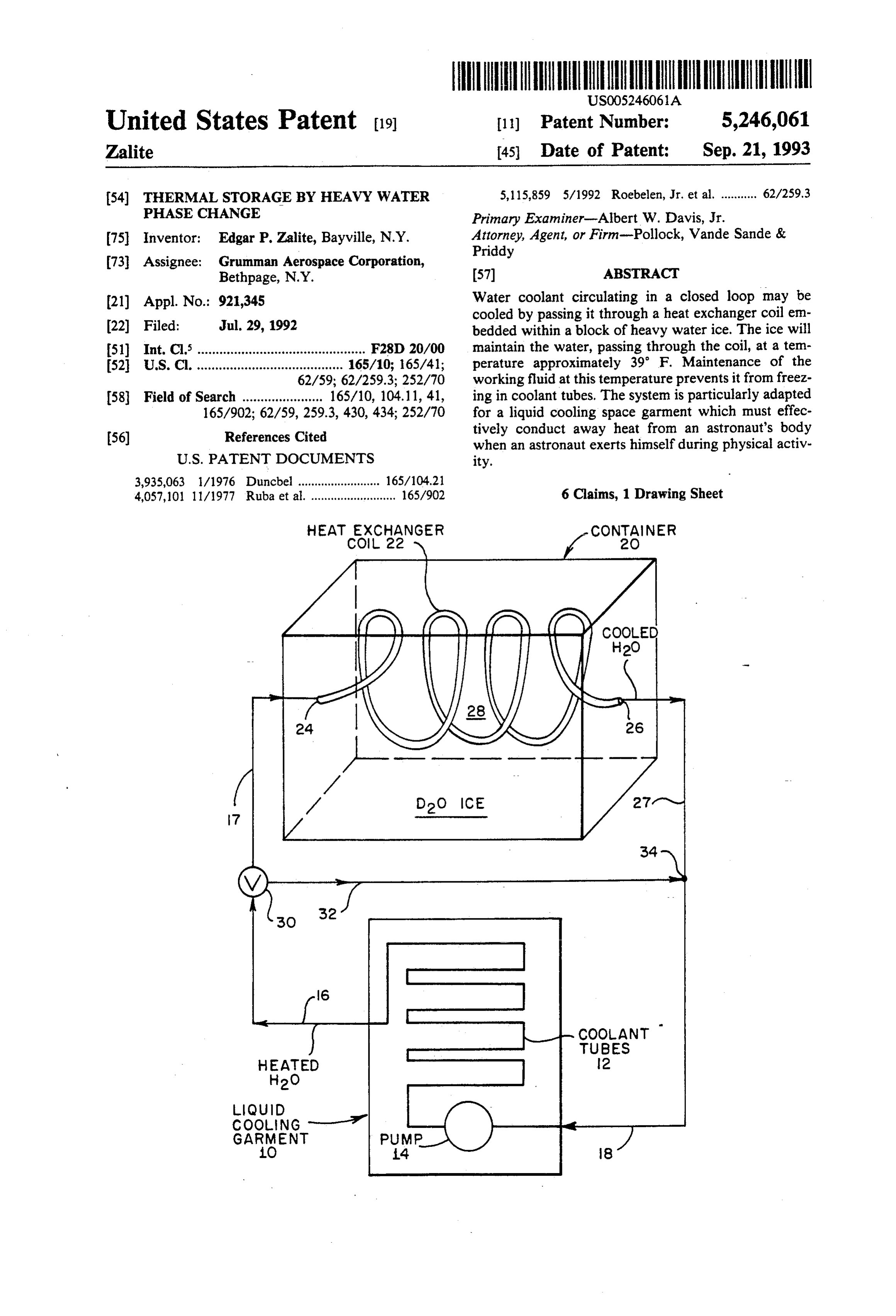
3,935,063 1/1976 Duncbel ......................... 165/104.21 4,057,101 11/1977 Ruba et al. .......................... 165/902 6 Claims, 1 Drawing Sheet HEAT EXCHANGER CONTA NER
(2S) COOLED
COOLANT
TUBES
HEATED 2
LIQUID
COONG -7
GARMENT
Page 2
Drawing sheet — no readable text.
Page 3
heavy water ice, instead of a block of regular water ice.
THERMAL STORAGE BY HEAVY WATER PHASE A pump is integrated into the space garment so that the CHANGE regular water flowing through the garment will be circulated through the heat exchanger coil embedded in
FIELD OF THE INVENTION the heavy water ice. The latter serves as a heat sink into The present invention relates to heat exchangers, and which excess body heat may be dumped to maintain a more particularly to a heavy water thermal storage suitable comfort range for an astronaut. device for space suits. Deuterium oxide is simply water with an isotope of
BACKGROUND OF THE INVENTION
hydrogen instead of "normal' hydrogen. It has a melt 10 ing point of 39 F., so that the "heavy ice'(frozen D2O)
To work in the extremely cold temperatures of outer cannot freeze the normal water working fluid circulat space, astronauts must wear protective space suits so ing through the garment. This eliminates the need for that body heat may be maintained. However, liquid special heating devices adjacent to the flow path of the cooling of such garments is necessary in order to avoid 15 working fluid. The end result is a saving of energy as heat build-up within the suit, which can cause discom well as a reduction in the amount of ice needed since the fort or heat exhaustion, particularly during periods of heat added by heating devices to maintain the working physical activity. fluid in an unfrozen state has to be eventually absorbed The prior art has often used tubes within the garment by the ice. Heavy water is also completely non-toxic so to carry water which conducts excessive body heat 20 that, if a working fluid leak occurs in the space garment, away from the astronaut. A heat exchanger for the it will not be catastrophic. Finally, the heavy water heated water often takes the form of a sublimator which forms specks of ice on the back of the garment. Heat does not add much weight to the system. Whereas the transfer from the heated water of the space suit tubes D2O it isfusion heat of for normal water is 143 (BTU/Lb), for causes the specks of ice to undergo a phase change-to 25 temperatures (35-40materials 136. Other
that freeze at appropriate have much lower heats of vapor. The vaporization of the ice enables the body fusion. These materials may include temperature of an astronaut within the suit to be com and certain exotic salts. These lowerorganic heats materials of fusion fortably regulated. However, a problem with the use of require 3-10 times the weight for the same amount of sublimators occurs when the evaporated ice becomes suspended in space as a vapor, due to the lack of grav heat storage capability in melting ice. For the system of ity. Oftentimes, this vapor will become deposited on an 30 the present invention, the heavy water ice is initially astronaut's visor or optical equipment he carries, which maintained at a temperature ranging 32-39 F. As the is obviously disadvantageous. n ice melts when subjected to heat exchange from the In order to replace the sublimator design of the pres working fluid, the working fluid re-enters the garment ent invention, one might consider employing a heat tubing at a temperature close to 39 F, safely protected storage system which avoids the emission of vapor in 35 from freezing.
the immediate space of a working astronaut. By securing a backpack-mounted container with fro Heat can be stored effectively and efficiently in a zen heavy water therein, it is possible to sustain the constant temperature heat sink by pumping a working working fluid water within the garment at temperatures fluid through ice. As the ice melts it cools the working below 45 F. which will ensure a comfortable garment fluid and uses the heat to change from a solid to a liquid 40 temperature for a working astronaut. For example, in a phase. If water were used as a working liquid and if an space garment one 8-hour EVA (extra-vehicular activ astronaut is relatively still and therefore not generating ity) produces about 12,000 BTUs. This requires about excess heat, there is a likelihood that water flowing 88 pounds of heavy water ice for thermal storage. In a through the space garment tubes will freeze at points, gravity-free environment, this is quite an acceptable particularly near the ice. This would require the utiliza 45 load to be carried in a backpack. tion of special heaters to ensure that the working fluid As previously mentioned, the temperature of the (water) does not freeze. The utilization of such heaters working water fluid is lowered to about 39 F., which is will then use up some of the ice storage capacity as well cool enough to keep an astronaut comfortable even at as adding extra complexity to the system.
A logical extension of this reasoning suggests the 50 the highest metabolic rates. For low metabolic periods, when warmer working water fluid is required, the substitution of another liquid for water. Although cer cooled water can be mixed with uncooled water. tain liquids could function properly to achieve a liquid cooling effect of an astronaut's garment, such liquids, BRIEF DESCRIPTION OF THE FIGURE such as anti-freeze, are toxic when breathed in high The above-mentioned objects and advantages of the concentrations for a prolonged period of time. Since 55 present invention will be more clearly understood when such liquids would be circulating within a space suit, the considered in conjunction with the accompanying chances of accidental leakage preclude their use. drawing, in which:
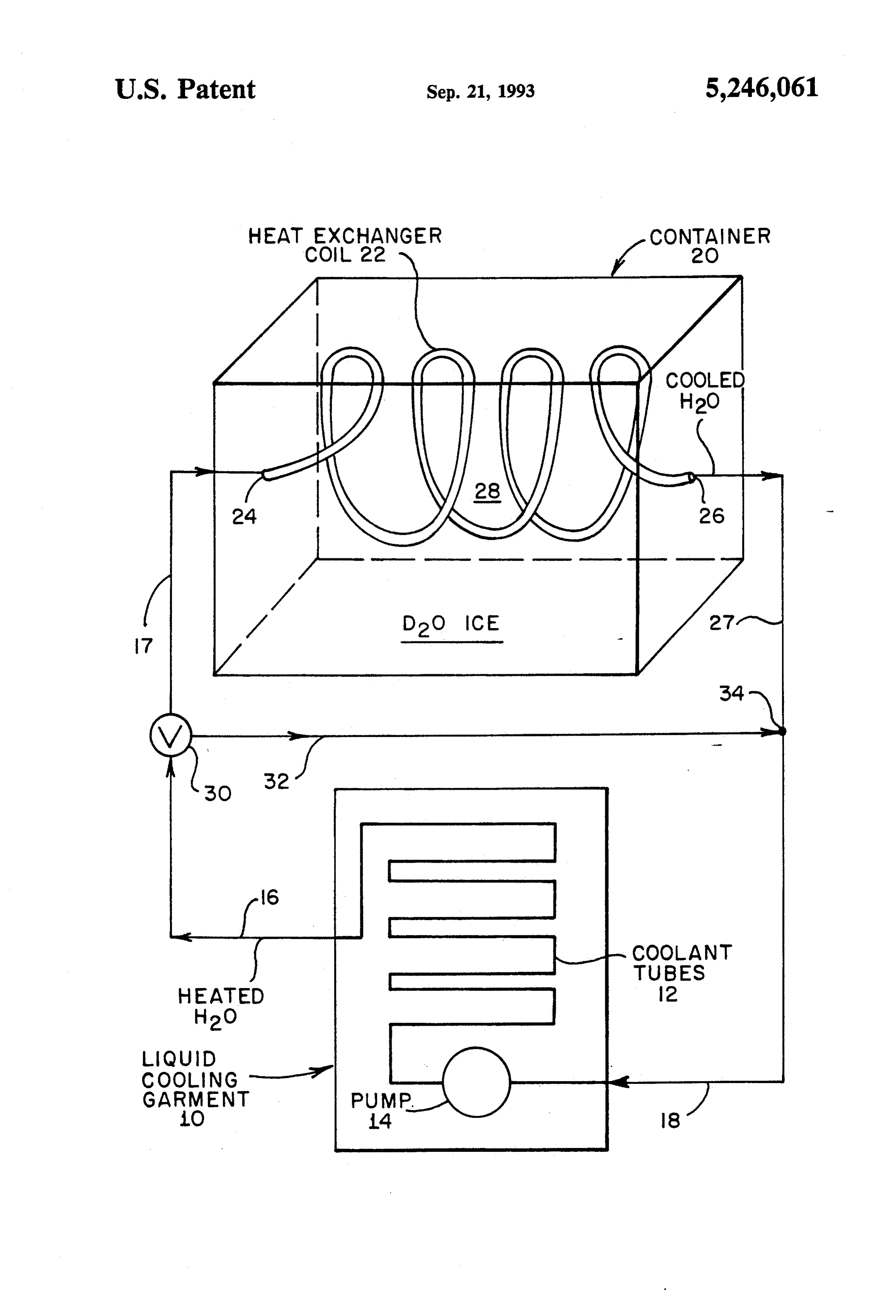
BRIEF DESCRIPTION OF THE INVENTION the figure is a schematic representation of the present The present invention utilizes heavy water (deute 60 invention.
rium oxide, D2O) which is frozen and maintained in a storage container through which a space garment cool
DETAILED DESCRIPTION OF THE
INVENTION
ant passes to dump excess body heat and maintain a comfortable interior garment temperature for an astro The body portion of a space suit, also referred to as a naut. In a preferred embodiment of the present inven 65 liquid-cooling garment, is generally indicated by refer tion, the working fluid which flows through a closed ence numeral 10. Coolant tubes 12 of conventional ma loop is regular water. Part of the loop includes a heat terial and design are incorporated in the garment 10 and exchanger coil which is embedded within a block of act as a radiator for picking up excessive body heat of an
Page 4
astronaut. A pump 14 is included in-line with the tubes water is the working fluid which must be cooled to near 12 to pass normal water through the coolant tubes 12. freezing yet still protected against freezing. Excessive body heat raises the temperature of the It should be understood that the invention is not lim working fluid (water) as it exits the garment along tube ited to the exact details of construction shown and de section 16. As will be explained shortly, the heated scribed herein for obvious modifications will occur to water becomes cooled by a heat exchanger existing persons skilled in the art.
I claim:
within container 20. The result is the cooling of the 1. A fusible heat sink comprising: working fluid as it exits container 20 at tube section 18 for recirculation through the coolant tubes 12. This 10 a container;
mass of heavy water ice (D2O) located in the con forms a closed loop for recirculating working water tainer;
fluid. In a preferred embodiment of the invention, con a heat exchanger coil located in the container and tainer 20 may be carried in a backpack (not shown) embedded within the ice;
which is worn by an astronaut. The interior of container a heat exchanger coil inlet introducing heated normal 20 includes a heat exchanger coil 22 which has an inlet 15 water (H2O) into the coil for non-contacting circu 24. This inlet has a coolant tube section 17 connected lation through the heavy water ice; and thereto which will allow heated normal water flowing a heat exchanger coil outlet for making available through tube section 16 to undergo passage through cooled normal water at a temperature above its heat exchanger coil 22 when an astronaut is exerting freezing point.
himself. The heat exchanger coil 22 is embedded within 20 2. The structure set forth in claim 1 together with a heavy water (D2O) block of ice 28. The outlet 26 of coolant tubes connected between the inlet and outlet in the heat exchanger coil 22 is connected with a coolant a closed loop for carrying circulating normal water tube section 27 that directs the cooled working water from a heated space to the heat exchanger coil. liquid back into the garment 10 where it is circulated 25 pump3. The structure set forth in claim 2 together with a through coolant tubes 12 to maintain a comfortable for forcing water circulation through the loop. garment temperature for an astronaut. 4. A space suit cooling system comprising: The heavy water ice 28 is initially at a temperature a container borne by a wearer;
between 32-39 F. As time goes on the heavy water ice a mass of heavy water ice (D2O) located in the con tainer;
heats up and melts as heat from the circulating water is 30 a heat exchanger coil located in the container and removed. The water exiting outlet 26 will be at a tem embedded within the ice;
perature close to 39 F., safely protecting the coolant a heat exchanger coil inlet for introducing heated tubes 12 and tube sections 16, 17, 18, and 27 from freez normal water (H2O) into the coil for non-contacting ing. circulation through the heavy water ice; It is anticipated that in a space garment 10 one 8-hour 35 a heat exchanger coil outlet for making available EVA (extra-vehicular activity) will produce about cooled normal water at a temperature above its 12,000 BTUs. This will require about 88 pounds of freezing point;
heavy water ice for thermal storage. The exit tempera a plurality of coolant tubes distributed in the suit and ture at output 26 is approximately 39 F. which is cool circulating normal water for absorbing excess enough to keep an astronaut comfortable even at the 40 wearer body heat, the tubes connected in a closed highest metabolic rates. For lower metabolic periods loop between the inlet and outlet; and when warmer working water liquid is required, a valve a pump for circulating the normal water through the 30 may be turned so that a portion of the heated water closed loop.
5. The structure set forth in claim 4 together with in tube section 16 can bypass the heat exchanger coil 22 45 valve means connected in line with the inlet and outlet and instead flow through bypass tube section 32. The for selectively mixing cooled and uncooled normal latter tube section terminates in a T connector 34 which water thereby allowing regulation of heat absorption. directs the bypassed uncooled working fluid back into 6. A method for cooling the interior of a space suit the garment 10. By adjusting valve 30 a mixture of comprising the steps:
cooled and uncooled working fluid can be mixed for 50 containing a mass of heavy water ice (D2O); entry into garment 10. The valve 30 may be a simple exchanging heat between normal heated water circu hand-actuated valve of conventional design or a con lating in a closed loop through the ice, thereby ventional thermostatically controlled valve which auto cooling the normal water; and matically adjusts the working fluid temperature in re circulating the cooled water through the interior of a sponse to changes in metabolic rates of an astronaut. 55 space suit thus conducting away excess heat from Although the present system has been explained in the interior of the suit and maintaining a comfort connection with a liquid cooling garment for space use, able suit temperature for the wearer. it can be used for any fusible heat sink application where s
Provenance
- Collection
- Cited prior art
- Original PDF
- patentimages.storage.googleapis.com →
- Filed
- 1992-07-29
- Pages
- 4
- Method
- pdftotext (the PDF's own text layer) + pdftoppm 300dpi page scans
- Source
- Google Patents bibliographic record
- Granted
- 1993-09-21
- Inventors
- Edgar P. Zalite; Grumman Aerospace Corp
- Transcribed from
- patentimages.storage.googleapis.com →