patent · US4797185
Hydrogen separation and electricity generation using novel electrolyte membrane
10 January 1989
Page 1 — bibliographic record
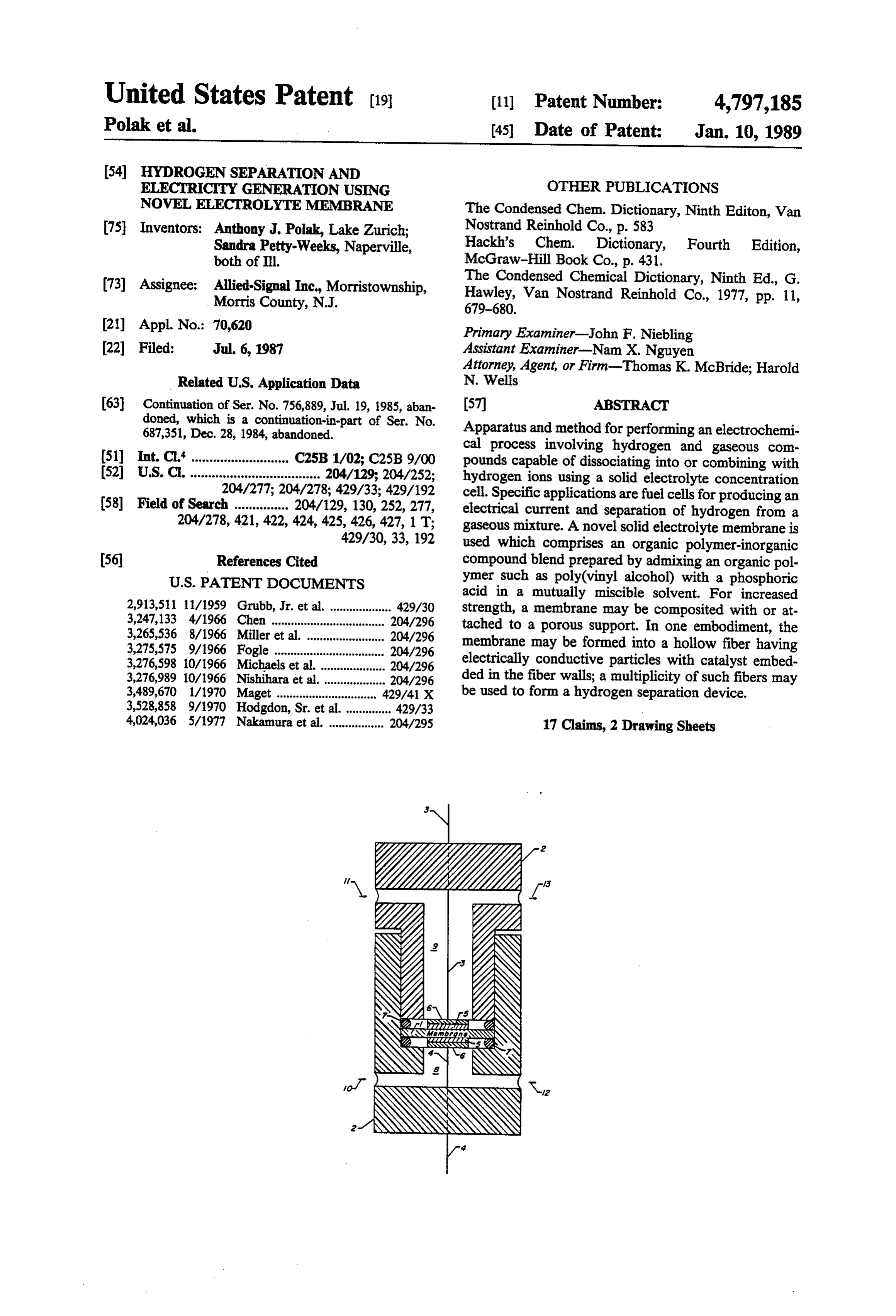
United States Patent (19) 11 Patent Number: 4,797,185 Polak et al. (45. Date of Patent: Jan. 10, 1989
(54) HYDROGEN SEPARATION AND
ELECTRICTY GENERATION USING OTHER PUBLICATIONS NOVEL ELECTROLYTE MEMBRANE The Condensed Chem. Dictionary, Ninth Editon, Van 75 Inventors: Anthony J. Polak, Lake Zurich; Nostrand Reinhold Co., p. 583 Sandra Petty-Weeks, Naperville, Hackh's Chen. Dictionary, Fourth Edition, both of Ill. McGraw-Hill Book Co., p. 431.
(73) Assignee: Allied-Signal Inc., Morristownship, The Condensed Chemical Dictionary, Ninth Ed., G. Morris County, N.J. Hawley, Van Nostrand Reinhold Co., 1977, pp. 11,
(21) Appl. No.: 70,620 Primary Examiner-John F. Niebling 22 Filed: Jul. 6, 1987 Assistant Examiner-Nam X. Nguyen Attorney, Agent, or Firm-Thomas K. McBride; Harold
Related U.S. Application Data N. Wells 63 Continuation of Ser. No. 756,889, Jul. 19, 1985, aban 57 ABSTRACT doned, which is a continuation-in-part of Ser. No. Apparatus and method for performing an electrochemi
cal process involving hydrogen and gaseous com (51) Int. Cl'........................... C25B 1/02; C25B 9/00 pounds capable of dissociating into or combining with (52) U.S. C. .................................... 204/129; 204/252; hydrogen ions using a solid electrolyte concentration 204/277; 204/278; 429/33; 429/192 cell. Specific applications are fuel cells for producing an (58) Field of Search ............... 204/129, 130, 252,277, electrical current and separation of hydrogen from a 204/278, 421, 422, 424, 425, 426, 427, 1 T; gaseous mixture. A novel solid electrolyte membrane is 429/30, 33, 192 used which comprises an organic polymer-inorganic (56) References Cited compound blend prepared by admixing an organic pol
acid in a mutually miscible solvent. For increased 2,913,511 11/1959 Grubb, Jr. et al. ................... 429/30 strength, a membrane may be composited with or at 3,247,133 4/1966 Chen ................................... 204/296 tached to a porous support. In one embodiment, the 3,265,536 8/1966 Miller et al. ........................ 204/296 membrane may be formed into a hollow fiber having 3,275,575 9/1966 Fogle .................................. 204/296 electrically conductive particles with catalyst embed 3,276,598 10/1966 Michaels et al..................... 204/296 3,276,989 10/1966 Nishihara et al. ................... 204/296 ded in the fiber walls; a multiplicity of such fibers may 3,489,670 1/1970 Maget ....................... ... 429/41 X be used to form a hydrogen separation device.
4,024,036 5/1977 Nakamura et al. ................. 204/295 17 Claims, 2 Drawing Sheets
Narsay
Page 2
Drawing sheet — no readable text.
Page 3
Drawing sheet — no readable text.
Page 4
HYDROGEN SEPARATION AND ELECTRICTY
composition of matter which is useful in electrochemi
GENERATION USNG NOVEL ELECTROLYTE cal processes. This membrane is capable of acting as a MEMBRANE proton conductor in a fuel cell or hydrogen separation system where a hydrogen compound yields protons on
CROSS REFERENCE TO RELATED one side of the membrane, protons are transported APPLICATION through the membrane, and protons are combined with a substance on the other side.
This is a continuation application of pending applica In addition, the composition of matter utilized for tion Ser. No. 756,889, filed on July 19, 1985, which is a said membrane may be composited on a porous support continuation-in-part of application Ser. No. 687,351, 10 to form a composite membrane which possesses in filed Dec. 28, 1984, all abandoned. creased strength as well as being a protonic conductor. FIELD OF THE INVENTION Examples of material used for such porous support include glass cloth, polysulfone, and ceramics.
This invention relates to an electrochemical process 15 The invention involving movement of protons through a membrane electrolyte is said utilizes membrane a concentration cell whose or composite membrane.
and applications thereof. More specifically, it relates to A membrane is mounted in a membrane housing having the use of a novel solid electrolyte and a catalyst in a first gas chamber and a second gas chamber, which electrochemical processes such as producing electricity chambers are separated by a partition comprising the from hydrogen or gases capable of dissociating to yield hydrogen ions or in removing hydrogen from a gaseous 20 membrane. Molecular transport through the membrane mixture having a component capable of dissociating to may be sufficiently slow so that gases will not mix by yield hydrogen ions. The solid electrolyte may be diffusing through it. Temperature of the gas or gases formed by blending an inorganic compound and an and/or the membrane housing may be controlled at a organic polymer or by compositing a membrane com previously established value. A portion of catalytic prising these components with a porous support. This 25 agent for promotion of dissociation or combination is in invention also involves the use of hollow fibers com intimate contact with the membrane on the membrane prised of this membrane and electrically conductive surface in common with the first gas chamber and also particles with catalyst for hydrogen separation. on the surface exposed to the second gas chamber. It is INFORMATION DISCLOSURE not necessary that the same catalytic agent be used on 30 both sides. Means for forming electrical contact and
U.S. Pat. No. 4,024,036 (Nakamura et al.) describes a transferring electrons to and from an external circuit are proton permselective solid state member capable of provided on each side of the electrolyte in intimate exhibiting ionic conductivity. contact with catalytic agent. The catalytic agent may be U.S. Pat. Nos. 3,265,536 (Miller et al.), 4,306,774 platinum, palladium, or alloys thereof. The catalytic (Nicholson), 3,276,910 (Grasselli et al.), and 4,179,491 35 agent may be electrically conductive. (Howe et al.) deal with substances capable of conduct The method of a broad embodiment of the invention ing hydrogen ions. may be stated as a method for accomplishing an electro An article by Lundsgaard et al. (Solid State Iopnics 7, chemical process involving a gaseous mixture having a 1982, Northholland Publishing Co.) describes experi component which is capable, in the presence of a cata ments done using a substance which conducts hydrogen lytic agent, of dissociating to yield hydrogen ions, such
A survey article on the separation of hydrogen may method comprising contacting said gaseous mixture with a first surface of a thin polymer-blend membrane be found in the October 1983 Platinum Metals Review, produced by Johnson Matthey, London. Membrane and forming an electrical connection between two sepa rate portions of catalytic agent effective to promote separation systems are treated on page 63 and following 45 dissociation and combination, where a first portion of of the July 13, 1981 issue of Chemical Engineering. catalytic agent is in contact with said first surface and a A selection of U.S. Pat. Nos. dealing with hydrogen second separation are 4,313,013 (Harris), 2,824,620 (deRosset), second portion of catalytic agent is in contact with a surface of said membrane, which membrane
3,401,099 (McEvoy). 50 isolates said gaseous mixture from a second gas com A survey article on hollow fiber membranes may be prising hydrogen compounds formed at said second found in Encyclopedia of Polymer Science, Vol. 15, p. portion of catalyst, and which membrane has said sec 258. Other references of interest in regard to fabrication ond surface exposed to the second gas, said membrane of hollow fibers are U.S. Pat. No. 3,724,672 (Leonard et comprising a blend of a compound selected from the al.) and an article in Journal of Applied Polymer Science, 55 group consisting of phosphoric acids and sulfuric acid Vol. 20, p. 2377, John Wiley & Sons. and a polymer which is compatible with said com A survey article on fuel cells may be found in Journal pound.
of the Electrochemical Society, March, 1978, p. 77C. It is among the objects of the present invention to BRIEF SUMMARY OF THE INVENTION provide an improved fuel cell utilizing a fuel gas com prising hydrogen or a gaseous component capable of
The present invention provides methods and appara dissociating into hydrogen ions. The first and second tus for hydrogen separation and electricity production. chambers of the membrane housing serve as a fuel gas A novel solid electrolyte membrane is used in the pres chamber and an oxidant gas chamber. The fuel gas ent invention. I have discovered that a macroscopically chamber contains a gas comprising hydrogen or a com homogenous thin film polymer-blended membrane may 65 ponent capable of dissociating to form hydrogen ions. be fabricated by admixing sulfuric acid or a phosphoric In the other chamber is an oxidant gas, such as a gas acid with an organic polymer which is at least partially comprising oxygen, which combines with hydrogen compatible with said acid to form a polymer-blend ions which have passed through the membrane.
Page 5
It is also among the objects of the present invention to by fugacities. Another factor which may need to be provide methods and apparatus of separating hydrogen considered in regard to a particular system is the rate of from a gaseous mixture containing hydrogen or a com dissociation to form the ions which pass through the ponent capable of dissociating to yield hydrogen ions. solid electrolyte. This may be a limiting factor to the Practice of the invention may be viewed as resulting in 5 transfer of ions through the electrolyte. The rate of purification of the mixture by removal of hydrogen, dissociation can be calculated by means of the equilib purification of hydrogen, or addition of hydrogen to rium constant for the dissociation reaction. another gas. The first and second chambers of the mem In a majority of cases, the admixture of an organic brane housing serve as a pure gas chamber and a mix compound, especially in a polymeric state, with an ture gas chamber. The term pure gas, as used herein, 10 inorganic compound, results in a phase separation, due means hydrogen separated from the gas mixture along to the fact that the two systems are immiscible in nature. with whatever gas, if any, is in the pure gas chamber However, we have discovered that a macroscopically with the separated hydrogen. homogeneous thin film polymer-blend membrane may The membrane may be in the form of tubing, or hol be fabricated by admixing the organic and inorganic low fibers, having electrically conductive particles em 15 bedded in it such that each particle is exposed to the components not merely a discussed herein; the resulting substance is physical mixture, but exhibits a degree of atmosphere existing both on the exterior and interior of interaction, that the tubing. A gaseous mixture is contained on the inside exists. Substancesis, some amount of chemical interaction which are permeable by gases in a of the tubing and pure gas is on the outside, isolated selective manner are known and utilized in a variety of from the gaseous mixture by the tubing wall. Alterna- 20 applications. A membrane formed in accordance with tively, gaseous mixture may be on the outside and pure the gas on the inside. A catalytic agent for promotion of ions and gases, includingis hydrogen present disclosure substantially impermeable to gas, but does allow dissociation or combination is in intimate contact with the particles on both sides of the membrane. It is not hydrogen ions to pass through it. It should be noted that necessary that the same catalytic agent be used on both 25 the membrane is not expected to be totally impermeable sides. The electrically conductive particles replace the and that substances in addition to hydrogen ion may external circuit of the concentration cell; that is, elec pass through it. Permeability experimentation has not trons from the gaseous mixture side of the tubing travel been done, except to the extent indicated herein. For through the particles to combine with hydrogen ions background information relating to the principles of the passing through the membrane at the catalyst on the 30 present invention, reference may be made to the book surface of the particles in common with the pure gas Solid Electrolytes and Their Applications, edited by Sub side of the membrane. barao, Plenum Press, 1980.
BRIEF DESCRIPTION OF THE DRAWINGS
Low mechanical strength has been a common prob lem when attempting to apply permselective mem
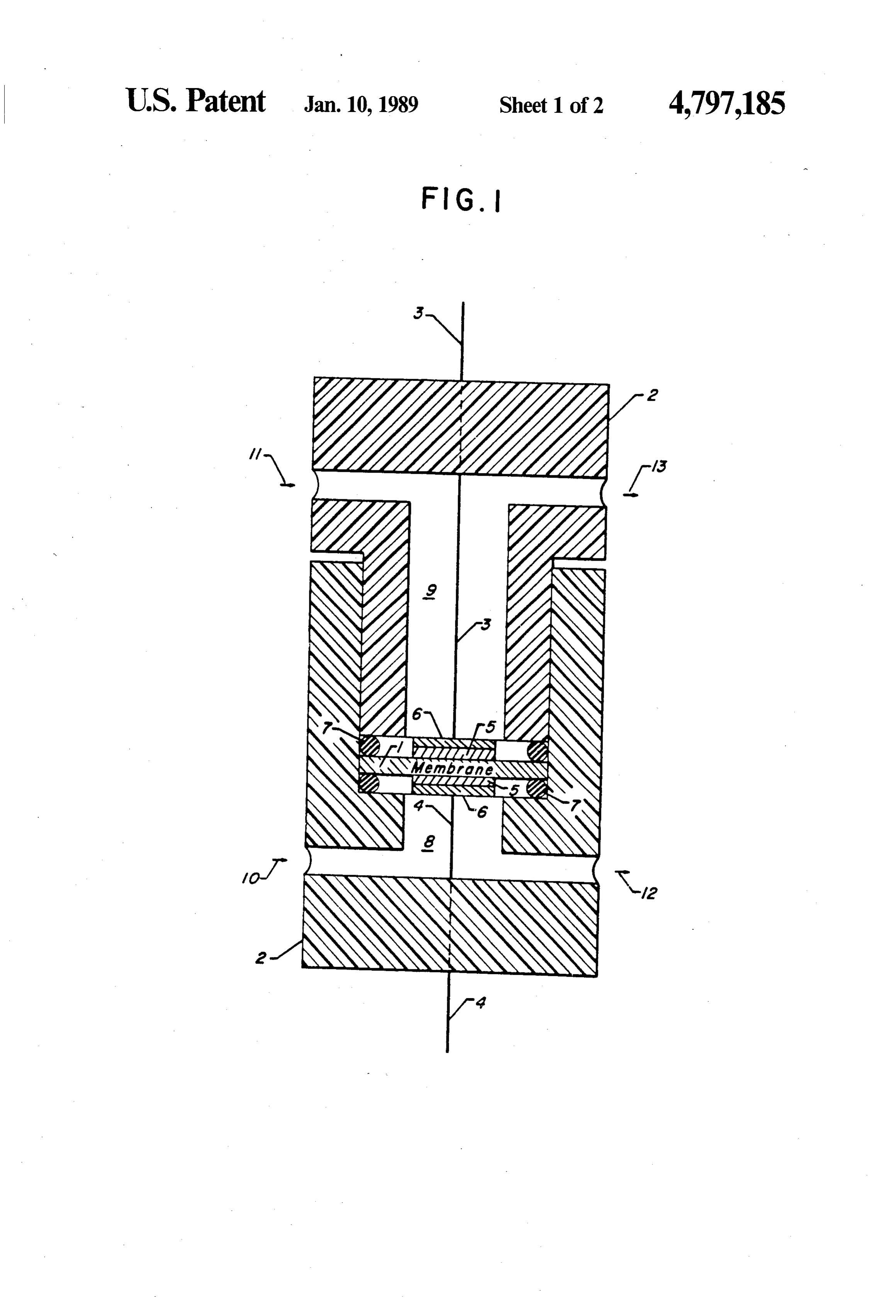
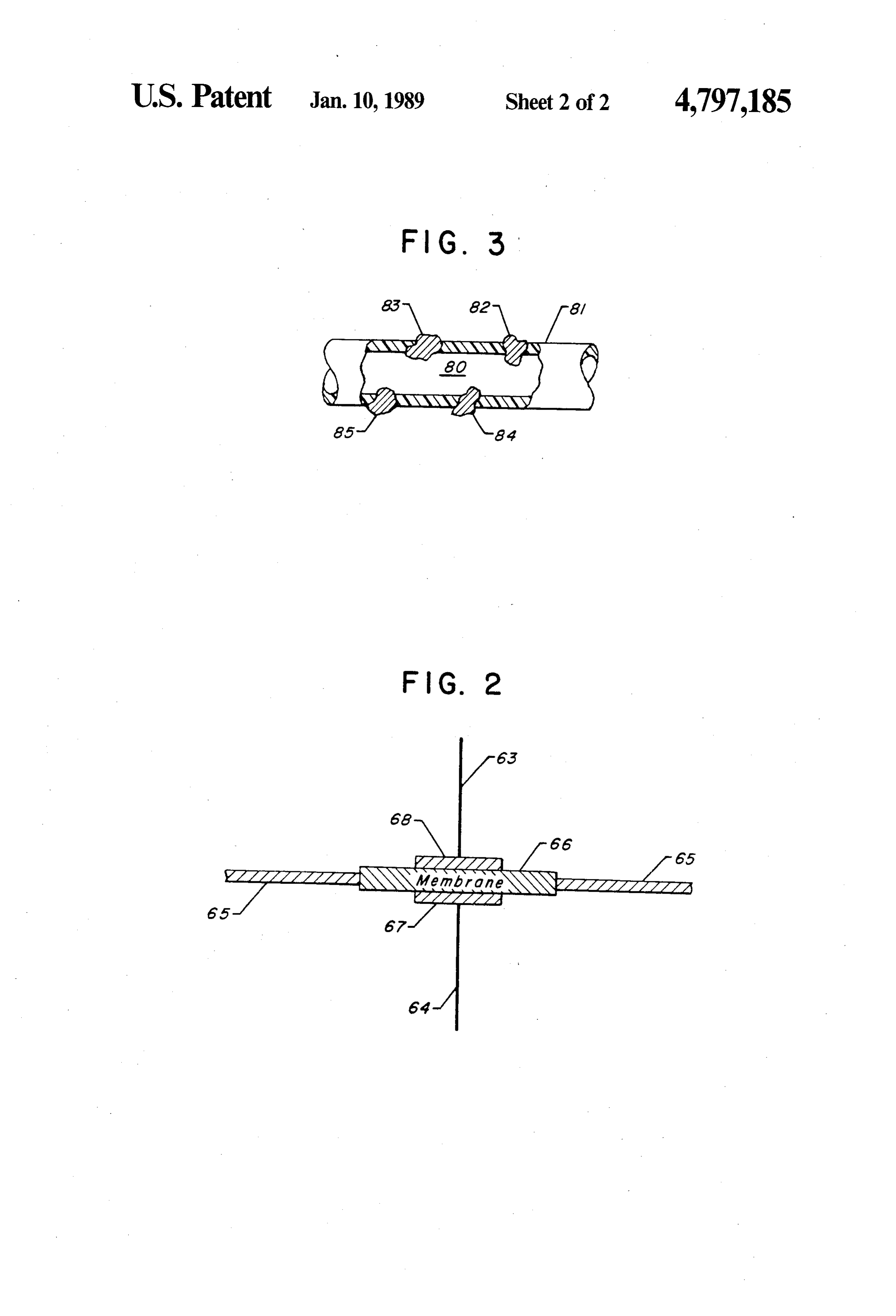
FIG. 1 is a schematic representation, in cross-section, 35 branes. The present invention provides a membrane of a test sensor used in initial proof of principle experi whose mechanical strength is increased by compositing mentation. The drawing is not to scale. it with other materials, but whose desirable properties FIG. 2 depicts an embodiment of the invention, in a are not lost as a result of doing so. sectional view, in which a membrane is part of a parti In a simple hydrogen-oxygen fuel cell, the fuel gas is tion separating a fuel gas chamber from an oxidant gas 40 hydrogen and the oxidant gas is oxygen. Hydrogen chamber or a pure gas chamber from a mixture gas dissociates into hydrogen ions and electrons at the cata chamber. lyst on the fuel gas side of the membrane. The hydrogen FIG. 3 depicts tubing and particles of one embodi ions pass through the electrolyte element while the ment of the invention in a partial sectional view. It is not electrons flow through the external circuit, doing elec to scale. 45 trical work before forming water by combining with, at BACKGROUND OF THE INVENTION the catalytic agent on the oxidant gas side of the mem brane, hydrogen ions which passed through the mem
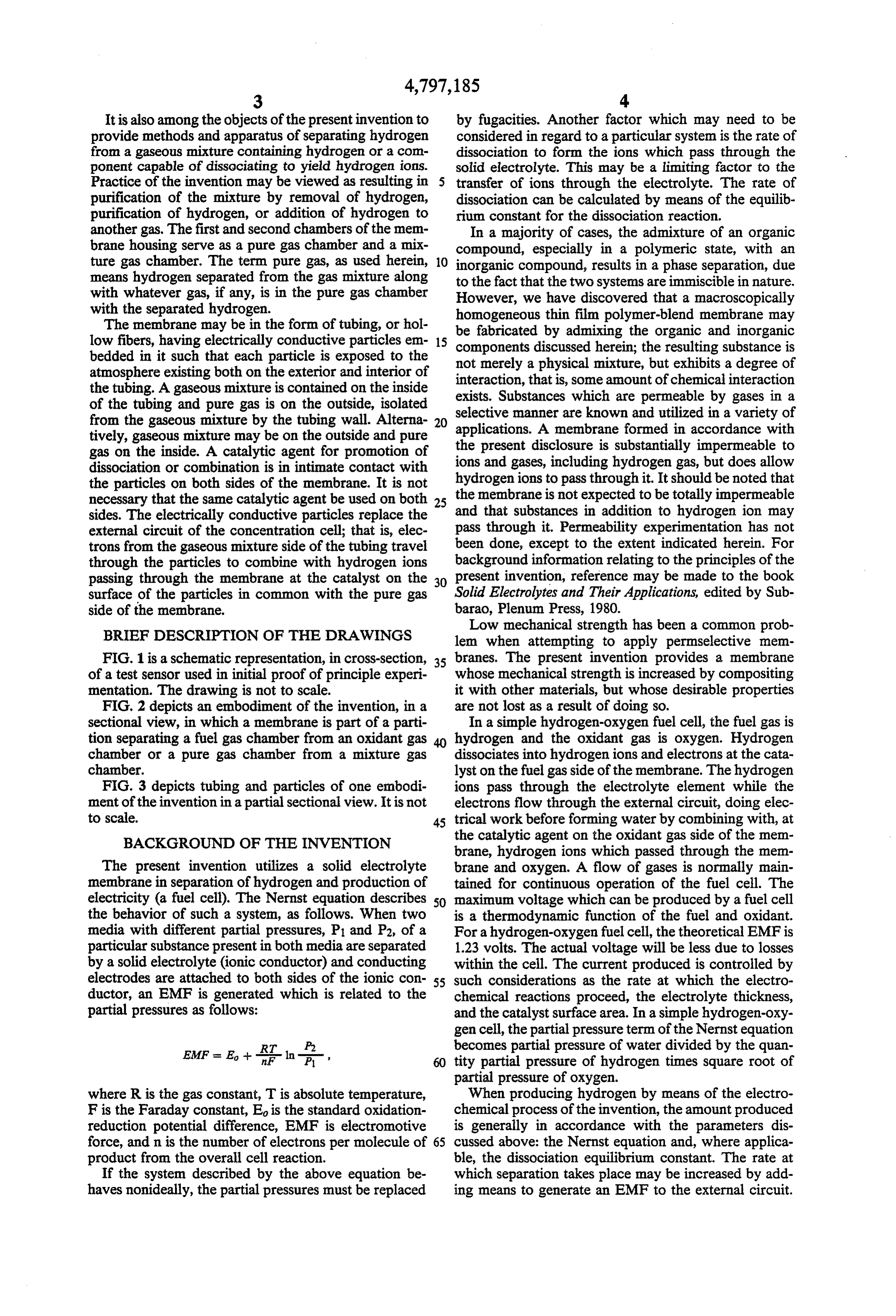
The present invention utilizes a solid electrolyte brane and oxygen. A flow of gases is normally main membrane in separation of hydrogen and production of tained for continuous operation of the fuel cell. The electricity (a fuel cell). The Nernst equation describes so maximum voltage which can be produced by a fuel cell the behavior of such a system, as follows. When two is a thermodynamic function of the fuel and oxidant. media with different partial pressures, P1 and P2, of a For a hydrogen-oxygen fuel cell, the theoretical EMF is particular substance present in both media are separated 1.23 volts. The actual voltage will be less due to losses by a solid electrolyte (ionic conductor) and conducting within the cell. The current produced is controlled by electrodes are attached to both sides of the ionic con 55 such considerations as the rate at which the electro ductor, an EMF is generated which is related to the chemical reactions proceed, the electrolyte thickness, partial pressures as follows: and the catalyst surface area. In a simple hydrogen-oxy gen cell, the partial pressure term of the Nernst equation
EMF = E - F In
RT P becomes partial pressure of water divided by the quan , tity partial pressure of hydrogen times square root of partial pressure of oxygen.
where R is the gas constant, T is absolute temperature, When producing hydrogen by means of the electro F is the Faraday constant, E is the standard oxidation chemical process of the invention, the amount produced reduction potential difference, EMF is electromotive is generally in accordance with the parameters dis force, and n is the number of electrons per molecule of 65 cussed above: the Nernst equation and, where applica product from the overall cell reaction. ble, the dissociation equilibrium constant. The rate at If the system described by the above equation be which separation takes place may be increased by add haves nonideally, the partial pressures must be replaced ing means to generate an EMF to the external circuit.
Page 6
That is, a difference in partial pressures is sufficient to nol formaldehyde resins, poly(vinyl pyrrolidone), provide the driving force for hydrogen ion transport poly(ethyloxazoline), poly(acrylamide), poly(N-isopro through the membrane, but applying an externally gen pyl acrylamide), poly(N,N-dimethyl acrylamide), erated driving force will increase hydrogen ion flux. In poly(vinyl 4-pyridine), polyimide, poly(vinyl sulfonic the practice of all embodiments of this invention, it acid), etc. Further examples of organic polymers which should be noted that exact adherence to theoretical may be employed include copolymers having monomer relationships is not required of commercially used meth units of these exemplary polymers. In terms of mono ods and apparatus. mer repeat units, the polymer-blend membrane com DETALED DESCRIPTION OF THE prises a polymer selected from a group of polymers 10 made from 2-ethyl-2 oxazoline or a polymer or copoly
INVENTION
mer having repeat units selected from a group compris
As was mentioned above, in attempting to blend an ing hydroxyethylene, vinyl fluoride, ethyleneimine, organic polymer with an inorganic compound, the usual acrylic acid, ethylene glycol, cellulose acetate, acrylam result is to obtain a phase separation. It has now been ide, N-isopropyl acrylamide, N,N-dimethyl acrylamide, discovered that a useful blend may be obtained by ad 15 4-pyridylethylene, imide, vinyl sulfonic acid, N-pyr mixing certain organic polymeric compounds with sul rolidonylethylene, and polyphenolic structures such as furic acid or a phosphoric acid. The resulting composi phenol formaldehyde resins.
tion of matter is formed into a thin film membrane The other component of the organic-inorganic blend which may be utilized in electrochemical systems such will comprise a phosphoric acid or sulfuric acid. Exam as gas separation processes and electric power produc ples of acids which may be employed will include hypo tion. The utility of these membranes in electrochemical phosphoric acid, metaphosphoric acid, orthophos systems is due to the fact that the membranes possess a phoric acid, pyrophosphoric acid, polyphosphoric acid, high protonic conductivity, especially at room or ambi or sulfuric acid. The sulfuric acid which is employed ent temperature. will comprise an aqueous sulfonic acid which may con Usually, high conductivity is observed in polymer 25 tain from about 10% to about 40% sulfuric acid in aque complexes only when the temperature is above the glass ous solution. It is to be understood that the aforemen transition temperature (Tg), that is, above the tempera tioned organic polymers and phosphoric acids or sulfu ture at which the substance changes from a solid to a ric acid are only representative of the class of compo liquid (the melting point of a polymer is usually above its glass transition temperature). Indications of the 30 nents which make up the membrane blends used in the present invention.
change of a polymer from solid to liquid are abrupt The novel compositions of matter used in the present changes in certain properties, such as coefficient of invention are prepared by admixing the two compo expansion and heat capacity. The polymer-blend com nents of the blend in a mutually miscible solvent at positions of the present invention exhibit high protonic solution conductivity at temperatures well below the observed 35 form the conditions desired for a period of time sufficient to blend. In the preferred membrane the glass transition temperatures of the individual homopol mutually miscible solvent which is employed to dis ymers. A device utilizing an ion-conductive polymer solve the components comprises water, although it is must operate below the Tg of the polymer; the polymer contemplated within the scope of this application that is not usable at higher temperatures due to loss of any other mutually miscible solvent, either inorganic or strength, tackiness, etc. A polymer-blend of the present 40 organic in nature may also be employed. The mixing of invention will exhibit two second order transition tem the two components of the composition of matter may peratures, which are attributable to the individual com be effected at solution conditions which will include a ponents. Note that the glass transition is a second order temperature in the range of from about ambient transition. A transition associated with a polymer in a (20-25° C) up to the boiling point of the mutually blend of the present invention will occur at A different 45 miscible solvent which, for example, in the case of value than the transition temperature determined for water is 100 C. As an example poly(vinyl alcohol) and that polymer when it is not mixed with any other sub orthophosphoric acid may be placed in a flask and dis stance. The transition temperature associated with the solved in water which has been heated to 100 C. The inorganic component depends on the polymer compo blend is cast upon a suitable casting surface which may nent in the blend. Thus, it may be appreciated that there 50 consist of any suitable material sufficiently smooth in is a degree of interaction between the components, that nature so as to provide a surface free of any defects is, at least some chemical interaction exists between the which may cause imperfections on the surface of the components. membrane. Examples of suitable casting surfaces may A distinct advantage which is possessed by the include metals such as stainless steel, aluminum, etc., polymer-blend membranes of the present invention 55 glass, polymer or ceramics. After casting the solution over other organic-inorganic blend membranes is that upon the surface, the solvent is then removed by any these membranes possess low resistivities (resistance conventional means including natural evaporation or times area divided by thickness), which are four to five forced evaportion by the application of elevated tem orders of magnitude less than the other organic-inor peratures whereby said solvent is evaporated and the ganic blends. desired membrane comprising a thin film of the poly The desired membrane comprises a blend of an or meric blend is formed. The thickness of the film can be ganic polymer and a phosphoric acid or sulfuric acid, controlled by the amount of phosphoric or sulfuric acid the polymer being at least partially compatible with the and/or polymer which is present in the reaction mix acid. Examples of organic polymers which may be em ture. The thin film organic-inorganic blend which is ployed as one component of the blend of the present 65 prepared according to the process of the present inven invention will include poly(vinyl alcohol), also known tion will possess a thickness which may range from as PVA, poly(vinyl fluoride), polyethylenimine, poly(a- about 0.1 to over 500 microns and preferably from crylic acid), polyethylene glycol, cellulose acetate, phe about 20 to about 60 microns.
Page 7
The amounts of phosphoric or sulfuric acid and or Electrical contact was made to the platinum through ganic polymer may vary over a relatively wide range. copper platens 6, which were held in place by springs For example, the acid may be present in the blend in a (not shown) extending between the platens and interior range of from abut 1% to about 70% by weight of the surfaces of the sample cell. Platens 6 did not cover the blend while the organic polymer may be present in an entire surface of the catalytic agent, though FIG. 1 amount in the range of from about 99% to about 30% shows this to be the case. Note that when the catalytic by weight of the blend. Whenever a composition is agent is electrically conductive and not discontinuous, expressed herein, it is to be understood that it is based, electrical contact need be made only at one point, the in the case of polymers, on the monomer repeat unit. catalytic agent thus serving as an electrode. Wire leads Examples of novel thin film polymer blends which O 3 and 4 extended from the platens out of the test fixture may be prepared according to the process of this inven through means for sealing against gas leakage (not tion will include poly(vinyl alcohol)-orthophosphoric shown). Leads 3 and 4 were connected to EMF and acid, poly(vinyl fluoride)-orthophosphoric acid, cellu current detection means (not shown). Membrane 1 was lose acetate orthophosphoric acid, polyethylene glycol orthophosphoric acid, poly(vinyl alcohol)-pyrophos 15 sealed into test fixture 2 by O-rings 7 so that there were no gas leakage paths between first gas chamber 8 and phoric acid, poly(vinyl fluoride)-pyrophosphoric acid, second gas chamber 9. In a fuel cell embodiment, these cellulose acetate-pyrophosphoric acid, polyethylene chambers are denoted fuel gas chamber and oxidant gas glycol-pyrophosphoric acid, poly(vinyl alcohol)-meta chamber, while in a hydrogen separation embodiment, phosphoric acid, poly(vinyl fluoride)-metaphosphoric they are called pure gas chamber and mixture gas cham acid, polyethylene glycol-metaphosphoric acid, poly(- 20 ber. Tubing (not shown) was connected at the gas inlets vinyl alcohol)-sulfuric acid, poly(vinyl fluoride)-sulfu as denoted by arrows 10 and 11 to provide gas flow into ric acid, cellulose acetate-sulfuric acid, polyethylene chambers 8 and 9 and was also connected to the gas glycol-sulfuric acid, etc.
It is to be understood that the aforementioned list of outlets away as denoted by arrows 12 and 13 to conduct gas from the chambers. Gas cylinders and gas mixing polymer blends is only representative of the class of and flow control
apparatus (not shown) were used to polymer blended membranes which may be prepared provide gas for testing in accordance with the herein and that the invention is not necessarily limited thereto. described experiments. Several cylinders of hydrogen/- It will be helpful in gaining an understanding of the nitrogen gas mixtures were purchased; an analysis of the invention to examine initial proof of principle experi contents was supplied with each cylinder. In some ex mentation. The information presented in regard to this 30 experimentation is not meant to limit the scope of the periments, gas was passed through the test fixture di rectly from a cylinder and in other cases a blend was invention in any way. This experimentation was di prepared from analyzed cylinder gas and pure nitrogen rected to obtaining information on gas detection, as well using the gas mixing apparatus. It must be noted that the as the specific applications described above. gas mixing apparatus was capable of accuracy suitable Several samples of a novel polymer blend membrane for proof of principle experimentation
but not for more were prepared by dissolving 0.25 gram of poly(vinyl rigorous work. Also, no attempt was made to separately alcohol) and 0.1 ml of 14.7M orthophosphoric acid in analyze boiling deionized water, the amount of organic polymer chased the gas mixtures prepared by diluting pur and acid being sufficient to impart a 63/37 weight per gas using said gas mixing apparatus. cent ratio to the resulting polymer blend membrane. Gas flows were established through the chambers of The molecular weight of the PVA was 76,000. Com the sample cell with both chamber pressures at about mercially available PVA of molecular weight 3,000 or one atmosphere, since the chambers were vented di rectly to atmosphere. One flow was pure hydrogen 133,000 could have been used, as it was in preparing (hydrogen partial pressure of approximately 1.0 atm.) other samples. The solution was then poured into an evaporation dish and the water was allowed to evapo 45 and the other was alternated between pure hydrogen rate for a period of 18 hours. The resulting film was and about a 10% by volume mixture of hydrogen in nitrogen (hydrogen partial pressure of approximately transparent and possessed a thickness of 30 microns.
A thin film membrane was cut into a disc having a 1' 0.1 atm). The voltage across wires 3 and 4 was re diameter to form membrane 1 of FIG. 1 and platinum corded by means of a standard laboratory strip chart was sputter-deposited onto both sides of the disc. The 50 recorder. The voltage versus time plot was a substan deposited platinum discs each had a thickness of about tially perfect square wave form. Voltage varied consis 400 Angstroms and a diameter of about 1 cm. Deposi tently between 0.0 millivolts and negative 29.2 mv. tion was accomplished by means of a Hummer II sput Response was Nernstian; the calculated voltage is also ter deposition system supplied by Technics Co. A bi 29.2 mv (at a room temperature of about 22 C.). Note ased screen between the target and film was used to 55 that this is open circuit voltage.
reduce the electron flux to the membrane. There are When an ammeter was connected to wires 3 and 4, many alternative methods which could have been used the measured current was about 3X 10.3 ma. This cor to form the platinum deposits, such as thermal evapora responds to a current density of about 3X 10.3 ma/cm2 tion or deposition by means of an ink. The porous struc and a hydrogen flux of 4.1 x 105 ft/ft2 hr; both fig ture of sputter-deposited catalytic agent is helpful in ures being based on the area of the membrane covered facilitating spillover of hydrogen ions onto the mem by platinum. The resistance of the membrane was mea brane, but it is not required. Note that hydrogen will sured when 100% hydrogen was flowing through both migrate through solid platinum. chambers of the sample cell. It was about 10 ohms for Referring to FIG. 1, membrane 1 was mounted in test a 30 micron thick membrane with 1 cm2 of platinum on fixture 2, which may also be referred to as a sample cell, 65 each surface. This applies to a totally dry membrane. membrane housing, or test sensor. The above men When a membrane which had dried for only 18 hours, tioned platinum deposits 5 served as catalytic agent to as mentioned above, was placed under test, the initial promote dissociation and reassociation or combination. resistance was lower. The increase in resistance is due
Page 8
to removal of the water used in the casting process have been fabricated to possess the necessary porosity, during initial operation of a sensor. etc. The amount of blend which is cast upon the flexible The resistance, amperage, and voltage of a single porous membrane were monitored over approximately 100 thin filmsupport will be that which is sufficient to form a membrane having a thickness within the range days of continuous testing. Deviation of voltage from 5 herein set forth. After the theoretically expected value was always less than solvent such as water casting, the mutually miscible 1%. In these tests, the accuracy of the sensor is felt to be means such as normal evaporation orby is removed conventional forced evapora limited by the equipment used.
In another series of tests at slightly different tempera tion by the application of external heat, application of vacuum, etc., and the desired membrane comprising the ture, the following representative data was collected. A 10 thin film blend composited on the porous support may gas containing hydrogen from analyzed cylinders was passed through a test fixture, as above, the voltage gen be recovered and utilized in an appropriate gas sensor erated was recorded, and a concentration of hydrogen, apparatus. A polymer blend was prepared by dissolving 0.5 expressed as partial pressure, was determined from the gram
EMF, using the Nernst equation. Partial pressure are 15 and 0.2ofml16,000 molecular weight poly(vinyl alcohol) of orthophosphoric acid in boiling deionized expressed in atmospheres and EMF in millivolts.
water, the amount of organic polymer and acid being sufficient to impart a 63/37 wt.% ratio to the resulting
Fixture
Analysis polymer blend. After a period of time sufficient to form 46 0.892 0.8973 20 the blend had passed, the solution was stirred and 28.7 0.104 0.1034 poured onto the top of a fine glass cloth which was 57.4 0.01.07 0.0109 positioned in a standard Petrie dish. The water was allowed to evaporate for a period of 48 hours and the
In experimentation with the fuel cell application membranemembrane resulting composited composite comprising a thin film on, or with, the glass cloth hav using a PVA/orthophosphoric acid membrane with air 25 ing a thickness of 95 microns was recovered. as the oxidant gas and pure hydrogen as the fuel gas, In like manner, a polymer blend membrane was pre open circuit voltages consistently in the range of 890 pared by dissolving 0.17 cc of sulfuric acid and 0.5 gram mv were observed. Current density (closed circuit) was of 16,000 molecular weight poly(vinyl alcohol) in boil about 1X 10-samp/cm2. Open circuit voltage behavior 30 ing is excellent; a typical hydrogen-oxygen fuel cell will which a blend water.
deionized After a period of time during display values from 0.6 to 0.85 volts. If pure oxygen had onto the top of ahad formed, the solution was poured fine glass cloth positioned in a standard been used as an oxidant gas instead of air, the open Petrie dish. The water was allowed to evaporate during circuit voltage would have been higher. No attempts a period of 48 hours and the resulting membrane com were made to optimize performance.
In addition to platinum, palladium was deposited on 35 posite was recovered.
membranes for use as catalytic agent. Nernstian voltage The PVA/H3PO4 composite membrane was cut into response was observed when palladium was used and a circle having a 1" diameter and platinum electrodes 3" the strip chart record was indistinguishable from that in diameter were sputter-dispersed on each side of the generated when platinum was used. Other catalytic membrane. The membrane was then placed in a sample agents are available and known to those skilled in the 40 housing similar to that of FIG. 1. A first gas consisting art. The catalytic agent need not be electrically conduc of 100% hydrogen and a second gas comprising tive; however, then the means for forming electrical 90.013% nitrogen and 9.987% hydrogen were each connection must be in contact with the catalytic agent passed through the two chambers. An EMF of 29.6 mv over a broad area, to facilitate movement of electrons was measured; this compares to a calculated voltage of from sites of the catalytic agent to the electrically con 45 29.5 millivolts at a temperature of 25.3 C. In addition, ductive substance, or electrode. Areas of membrane it was found that the resistivity was 0.375x10⁵ ohm-cm. which are not adjacent to catalytic agent are not effec In a similar manner, the PVA/H2 SO4 membrane was tive in the invention. Hydrogen ions spill over from the tested and the voltage was found to be the same as that catalytic agent to the membrane and then the protons when the membrane comprising a blend of poly(vinyl move through the membrane. 50 alcohol) and orthophosphoric acid was used. However, It can be seen that a membrane mounted in a cell such the resistivity was higher.
as depicted in FIG. 1 may be subjected to high differen As an illustration of the greater structural strength of tial pressures which may deform or burst the mem the polymer blend composited on a porous solid sup brane. A composite membrane may be fabricated by port as exemplified by the blends of the present inven casting a solution prepared as described above on a 55 tion when compared to unsupported membranes, two flexible porous support. A supported membrane assem polymer blend membranes were prepared. The polymer bly may be fabricated by attaching a membrane which is blend was prepared by dissolving 0.5 gram of poly(vi cast and dried as above to a rigid porous support. In the nyl alcohol) having a molecular weight of 16,000 and case of a PVA/H3PO4 membrane, attachment is accom 0.2 ml of orthophosphoric acid in boiling deionized plished by moistening the surface of the membrane and 60 water. The resulting blend was cast onto a glass cloth support and pressing the moistened surface together. having a thickness of 30 microns. A second blend was The moisture will evaporate. prepared by admixing like proportions of poly(vinyl It is contemplated that any porous substrate which alcohol) and orthophosphoric acid and casting the re possesses a structural strength greater than the thin film sulting blend onto a Petrie dish without a support. After membrane may be employed. Some examples of these 65 removal of the solvent, the two membranes were recov porous supports will include substances such as glass ered.
cloth, polysulfone, cellulose acetate, polyamides, ce Each membrane was placed in a holder which en ramics such as alumina, glass, porcelain, etc. which abled air pressure to be exerted against one side of the
Page 9
membrane while the other side was at atmospheric hydrogen is the gaseous mixture component which pressure. When exposed to 5 psig, the unsupported dissociates to form hydrogen ions. If the component is membrane burst at its center in less than 1 minute. At 2 not hydrogen, the equilibrium hydrogen partial pres psig another sample of unsupported membrane bulged sure associated with the gaseous mixture component and was permanently deformed. The composite mem 5 must be at a higher value than the partial pressure of brane was subjected to various pressure levels in 5 psig hydrogen in the pure gas chamber, where the product increments with one minute hold time between in gas comprising hydrogen is collected. creases in pressure. It burst at 35 psig, shearing at the It should be noted that the Nernst equation contains a edges of the test hole in the holder. The point of failure temperature term. Since temperature is a factor in the leads one to believe that holder design caused the shear O separation it may be desirable to change the tempera ing and that a higher burst pressure would be observed ture of the gases before the electrochemical reaction in a different holder. takes place.
A poly(vinyl pyrrolidone)/orthophosphoric acid Referring to FIG. 2, an embodiment of the invention membrane composited on a fine glass cloth was pre in which a membrane 66 serves as part of partition 65 is pared. The composition was 45 mole percent polymer 5 shown. Partition 65 separates a mixture gas chamber and 55 mole percent acid. With pure hydrogen and 10% from a pure gas chamber. Catalytic agents 67 and 68 and hydrogen flowing, the EMF was 29.1 mv. Current after wire leads 63 and 64 perform the functions discussed 24 hours was 0.0076 ma and resistivity was 7.4x10⁵ above. Leads 63 and 64 must be connected to one an ohn-cm. other. Separation apparatus may take many forms; FIG. A poly(ethyloxazoline)/orthophosphoric acid mem 20 2 shows a simple and basic form. A cascade arrange brane composited on a fine glass was prepared. The ment might be used, in which the gaseous mixture is composition was 50/50, expressed as mole percent. compressed and then allowed to flow through a plural EMF was 29.2 mv with a 10:1 gas ratio. Current was ity of mixture chambers, each at a lower pressure. 0.0026 ma and resistivity was 5.2x 10⁵ ohm-cm. The design of fuel cells is well known. Many configu Any substance capable of dissociating in the presence 25 rations are possible; FIG. 1 provides an example of one of a catalyst to yield hydrogen ions may be the subject type. FIG. 2 depicts an embodiment of the present in of separation in the same manner as is elemental hydro vention useful in producing electricity as well as in gen. The Nernst equation is applicable; the Eo term is separation. Partition 65 separates a fuel gas chamber not 0, as it is when the same substance is present on both from an oxidant gas chamber. Electrically conductive sides of the membrane, and the partial pressure term of 30 catalytic agent is present on both sides of membrane 66, the equation contains the partial pressures of the sub as shown by reference numbers 67 and 68. Wire leads 63 stances of the reaction, raised to the proper power if and 64 extend to connect to electricity utilizing means more than one molecule of a substance is involved. As (not shown).
examples, certain hydrocarbons come readily to mind as It may be desirable to use a membrane in the form of substances which may be hydrogenated or dehydroge 35 tubing, or hollow fibers, instead of in a flat configura nated, these hydrocarbons including cyclopentadiene, tion. The advantages are well known to those familiar 1,3-pentadiene, isoprene, benzene, 2-butene-1,4-diol, with such applications and need not be repeated herein. n-hexane, cyclohexane, and isoamylene. In the embodiment of the invention depicted in FIG. 1, In the embodiment of the invention depicted in FIG. when test fixture 2 is used for gas separation, it is neces 1, when test fixture 2 is used for gas separation, it is sary that lead 3 be connected to lead 4 by an electrical necessary that lead 3 be connected to lead 4 by an elec conduction path. This path permits the electrons result trical conduction path. This path permits the electrons ing from the dissociation of hydrogen (or other gaseous resulting from the dissociation of hydrogen (or other mixture component) at one catalyst portion 5 to travel gaseous mixture component) at one catalyst portion 5 to to the other side of the membrane to combine at the travel to the other side of the membrane to combine at 45 other catalyst portion with hydrogen ions which have the other catalyst portion with hydrogen ions which passed through the membrane. It can be seen that cer have passed through the membrane. If means for gener tain problems arise in regard to the external circuit and ating an EMF are inserted into the electrical conduction catalyst when it is desired to use tubing rather than a flat path, that is, if electrical power from a source external membrane. FIG.3 depicts an embodiment of the inven to the separation apparatus is supplied to the apparatus 50 tion which solves these problems. A very short section through the means for forming electrical connection of a hollow fiber, or portion of a single tube, is shown. such as leads 3 and 4, the rate of removal of hydrogen Electrically conductive particles are contained in and from the gaseous mixture will increase. form a portion of the tubing wall, as shown by particles For a practical separation process, the partial pres 82, 83, 84, and 85. Each particle has catalytic agent in sure of hydrogen in the chamber from which hydrogen 55 contact with it. FIG. 3 does not show the catalyst as a is removed, the mixture gas chamber, must be higher separate material. The catalyst material and particle than the partial pressure of hydrogen in the chamber in material may be the same substance, such as platinum which hydrogen collects after removal, the pure gas particles. The catalytic agent may cover only that sur chamber. In an industrial application of the invention, a face of each particle which is exposed to the interior of compressor might be used to compress the gaseous 60 the tubing, or in common with the interior surface of mixture from which hydrogen is to be removed, main the tubing, or exposed to the atmosphere exterior to the taining the hydrogen partial pressure in the mixture gas tubing. It may cover only a portion of said exposed chamber higher than that in the pure gas chamber. The surface. For the purpose of convenience in fabricating partial pressure of hydrogen increases as the total pres the apparatus, it may cover the entire surface of each sure is increased. The pure gas chamber might be sub 65 particle. A gaseous mixture from which hydrogen is to jected to a negative pressure, or vacuum, thus removing be separated may be inside the tube in the space 80 or hydrogen as it collects, or forms. The references to outside the tube, in contact with the tube exterior sur hydrogen partial pressure deal with a case in which face 81. Pure gas is partitioned from the gaseous mixture
Page 10
by the tube walls. As discussed herein, the particles charged to the apparatus, such as in the dehydrogena provide the necessary electron path. It is readily seen tion of a hydrocarbon. A fuel gas may have only one that a membrane with particles need not be formed into component or more than one. Compatible may be taken tubing but can also be used for hydrogen separation in to mean that compatible compounds will form the the same manner as described above. A particle contain polymer-blend composition of matter. ing solution can be cast on an appropriate surface as We claim as our invention:
described above. 1. Apparatus for performing an electrochemical pro The particles may be any electrically conductive cess involving a gaseous mixture having a component material compatible with the gases which will bond to which is capable, in the presence of a catalytic agent, of the membrane during manufacture of the tubing. Carbo O dissociating to yield hydrogen ions or of combining naceous material or metals such as copper may be used. with hydrogen ions, comprising:
The catalyst material is as discussed above. The tubing (a) a thin film macroscopically homogeneous poly may be fabricated by forcing a solution through a die mer blend membrane possessing a high protonic while making provision for maintaining a hollow core, conductivity and which is formed by removing the such as by injecting a gas or liquid. The solution is 15 solvent from a solution of a phosphoric acid and an discussed above. It is not necessary to detail manufac organic polymer, wherein said phosphoric acid is turing methods; these are well known to those skilled in present in the blend in an amount in the range of the art, as shown by the above-referenced publications. about 10% to about 70% by weight of the blend The particles may be added to the solution before the and is selected from a group consisting of hypo tubes are formed. Catalyst may be placed on the parti 20 phosphoric acid, metaphosphoric acid, orthophos cles before or after the tubing is formed. For example, phoric acid, pyrophosphoric acid, and polyphos copper or carbon particles may be coated with platinum phoric acid, and wherein said organic polymer is by adding chloroplatinic acid and decomposing to leave present in the blend in an amount in the range of elemental platinum. Catalytic agent may be added by about 90% to about 30% by weight of the blend vapor deposition after the tubing has been formed. 25 and is selected from a group consisting of poly(vi Tubing of outside diameter of approximately 0.001 nyl alcohol), poly(vinyl fluoride), polyethylen mm and larger may be formed. The outside diameter imine, poly(ethylene glycol), cellulose acetate, may be as large as one-half to one inch when tubing is poly(ethyloxazoline), poly(vinyl sulfonic acid), formed by solution extrusion methods. Tubes may be poly(vinyl pyridine), poly(vinyl pyrrolidone), formed from flat sheets of membrane. Tubes may also 30 polyimide, poly(acrylamide), poly(acrylic acid), be formed over or inside of a support material, such as poly(N-isopropyl acrylamide), poly(N,N-dimethyl a perforated pipe or porous tubing. The wall thickness acrylamide), and copolymers having as repeat units of the tubing will vary depending on the application. the monomer units used in the polymers of said The primary consideration here is strength. A thicker group.
wall is required as the operating pressure differential 35 (b) a membrane housing comprising a first gas cham between inside and outside increases. Tubing is nor ber and a second gas chamber separated by a parti mally formed into bundles containing a plurality of tion comprising said membrane, said membrane separate tubes, means for supplying gaseous mixture having a first surface in common with the first gas and removing hydrogen-depleted gaseous mixture, and chamber and a second surface in common with the means for supplying pure gas, if any is used, and remov 40 second gas chamber;
ing hydrogen-rich pure gas. Such a bundle and accom (c) two separate portions of catalytic agent effective panying supply and removal means is quite similar to to promote dissociation and combination, a first the well-known shell and tube heat exchanger. portion in contact with said first surface and a Sample cell or membrane housing or test fixture re second portion in contact with said second surface fers to a housing or fixture which holds an electrolyte 45 of said membrane; and element and other required components. FIG. 1 depicts (d) means for forming electrical connection in opera a membrane housing. Membrane or electrolyte element tive contact with said catalytic agent at said first refers to an ionconducting substance suitable for use an surface and with said catalytic agent at said second an electrolyte in the concentration cell of this invention surface.
which has been formed into a particular physical entity, 50 2. The apparatus of claim 1 further comprising means either with or without additional substances, for use in to supply fuel gas to one of said gas chambers and oxi the invention. Where an electrolyte element surface is dant gas to the other of said gas chambers. referred to as in common with a gas or gas chamber, the 3. The apparatus of claim 1 further comprising means meaning is the same as exposed to a gas or gas chamber to supply said gaseous mixture to one gas of said cham and such reference does not preclude the presence of 55 bers and to remove pure gas comprising hydrogen from catalytic agent and electrodes at or covering the sur the other of said gas chambers.
face. Gas may diffuse through covering material. Gas 4. The apparatus of claim 1 further comprising means chamber refers to any space in which gas which is the for generating an EMF connected between said means subject of this electrochemical process exists. The term for forming electrical connection. "gas” is used herein to include vaporized liquids regard 5. The apparatus of claim 1 further characterized in less of boiling point characteristics of the substance. As that said catalytic agent comprises a substance selected used herein, miscible means capable of being mixed from a group consisting of platinum, palladium, and where there may only be a very small degree of solubil alloys thereof.
ity. As is familiar to those skilled in the art, the terms concentration and partial pressure are often used inter 65 that6. said
The apparatus of claim 1 further characterized in catalytic agent is electrically conductive.
changeably; partial pressure expresses concentration. A 7. The apparatus of claim 1 further characterized in gaseous mixture may be formed in the apparatus by the that said catalytic agent is porous to said gaseous com dissociation of hydrogen when a single compound is ponent.
Page 11
8. The apparatus as set forth in claim 1 in which said and is selected from a group consisting of hypo membrane possesses a thickness of from about 0.1 to phosphoric acid, metaphosphoric acid, orthophos about 500 microns. phoric acid, pyrophosphoric acid, and polyphos 9. The apparatus as set forth in claim 1 in which said phoric acid, and wherein said organic polymer is polymer comprises poly(vinyl alcohol) and said acid 5 present in the blend in an amount in the range of comprises orthophosphoric acid. about 90% to about 30% by weight of the blend 10. The apparatus as set forth in claim 1 in which said and is selected from a group consisting of poly(vi blend is composited with a flexible porous support. nyl alcohol), poly(vinyl fluoride), polye 11. The apparatus as set forth in claim 1 in which said thylenimne, poly(ethylene glycol), cellulose ace polymer comprises poly(ethyloxazoline) and said acid 10 tate, poly(ethyloxazoline), poly(vinyl sulfonic comprises orthophosphoric acid. acid), poly(vinyl pyridine), poly(vinyl pyrrol 12. A method for accomplishing an electrochemical idone), polyimide, poly(acrylamide), poly(acrylic process involving a gaseous mixture having a compo acid), poly(N-isopropyl acrylamide), poly(N,Nnent which is capable, in the presence of a catalytic dimethyl acrylamide), and copolymers having as agent, of dissociating to yield hydrogen ions, such 15 repeat units the monomer units used in the poly method comprising contacting said gaseous mixture mers of said group;
with a first surface of a thin film polymer blend men (b) a multiplicity of electrically conductive particles brane and forming an electrical connection between contained in and forming portions of the walls of two separate portions of catalytic agent effective to said tubing, each particle having a first surface promote dissociation and combination, wherein a first exposed to the interior of said tubing and a second portion of catalytic agent is in contact with said first surface in common with the exterior surface of said surface and a second portion of catalytic agent is in tubing;
contact with a second surface of said membrane, which (c) two portions of catalytic agent effective to pro membrane isolates said gaseous mixture from a second mote dissociation and combination associated with gas comprising hydrogen compounds formed at said 25 each particle, one portion in contact with said first second portion of catalyst, and which membrane has surface and one portion in contact with said second said second surface exposed to the second gas, said surface of each particle; and membrane comprising a thin film macroscopically ho (d) means to maintain said gaseous mixture in contact mogeneous polymer blend membrane possessing a high with one of said tubing surfaces and means to re protonic conductivity and which is formed by remov 30 cover hydrogen formed at the other of said tubing ing the solvent from a solution of a phosphoric acid and surfaces.
an organic polymer, wherein said phosphoric acid is 16. Apparatus for separation of hydrogen from a present in the blend in an amount in the range of about gaseous mixture having a component which is capable, 10% to about 70% by weight of the blend and is se in the presence of a catalytic agent, of dissociating to lected from a group consisting of hypophosphoric acid, yield hydrogen ions,
comprising:
metaphosphoric acid, orthophosphoric acid, pyrophos phoric acid, and polyphosphoric acid, and wherein said (a) a thin film macroscopically homogeneous poly organic polymer is present in the blend in an amount in ner blend membrane possessing a high protonic the range of about 90% to about 30% by weight of the conductivity and which is formed by removing the blend and is selected from a group consisting of poly(vi solvent from a solution of a phosphoric acid and an nyl alcohol), poly(vinyl fluoride), polyethylenimine, organic polymer, wherein said phosphoric acid is poly(ethylene glycol), cellulose acetate, poly(ethylox present in the blend in an amount in the range of azoline), poly(vinyl sulfonic acid), poly(vinyl pyridine), about 10% to about 70% by weight of the blend poly(vinyl pyrrolidone), polyimide, poly(acrylamide), and is selected from a group consisting of hypo poly(acrylic acid), poly(N-isopropyl acrylamide), po phosphoric acid, metaphosphoric acid, orthophos ly(N,N-dimethyl acrylamide), and copolymers having phoric acid, pyrophosphoric acid, and polyphos as repeat units the monomer units used in the polymers phoric acid, and wherein said organic polymer is of said group. present in the blend in an amount in the range of 13. The method of claim 12 further characterized in about 90% to about 30% by weight of the blend that said electrochemical process comprises producing SO and is selected from a group consisting of poly(vi electricity from a fuel gas comprising said gaseous mix nyl alcohol), poly(vinyl fluoride), polyethylen ture and an oxidant gas comprising said second gas. imine, poly(ethylene glycol), cellulose acetate, 14. The method of claim 12 further characterized in poly(ethyloxazoline), poly(vinyl sulfonic acid), that said electrochemical process comprises separating poly(vinyl pyridine), poly(vinyl pyrrolidone), pure gas comprising hydrogen from said gaseous mix 55 polyimide, poly(acrylamide), poly(acrylic acid), ture. poly(N-isopropyl acrylamide), poly(N,N-dimethyl 15. Apparatus for separation of hydrogen from a acrylamide), and copolymers having as repeat units gaseous mixture having a component which is capable, the monomer units used in the polymers of said in the presence of a catalytic agent, of dissociating to group;
yield hydrogen ions, comprising: 60 (b) a membrane housing comprising a first gas cham (a) tubing which is substantially imporous comprised ber and a second gas chamber separated by a parti of a thin film macroscopically homogeneous poly tion comprising said membrane, said membrane mer blend membrane possessing a high protonic having a first surface in common with the first gas conductivity and which is formed by removing the chamber and a second surface in common with the solvent from a solution of a phosphoric acid and an 65 second gas chamber;
organic polymer, wherein said phosphoric acid is (c) a multiplicity of electrically conductive particles present in the blend in an amount in the range of contained in and forming portions of said mem about 10% to about 70% by weight of the blend brane, each particle having a first surface exposed
Page 12
to said first gas chamber and a second surface ex lytic agent in contact with the second particle surface, posed to said second gas chamber; which membrane isolates said gaseous mixture from a (d) two. portions of catalytic agent effective to pro pure gas comprising hydrogen separated from the gase mote dissociation and combination associated with ous mixture, and which membrane has said second sur each particle, one portion in contact with said first face exposed to the pure gas, said membrane consisting surface and one portion in contact with said second of a thin film macroscopically homogeneous polymer surface of each particle; blend membrane possessing a high protonic conductiv (e) means to supply said gaseous mixture to said first ity and which is formed by removing the solvent from gas chamber; and, a solution of a phosphoric acid and an organic polymer, (f) means to recover hydrogen formed in said second 10 wherein said phosphoric acid is present in the blend in gas chamber. an amount in the range of about 10% to about 70% by 17. A method for separation of hydrogen from a weight of the blend and is selected from a group consist gaseous mixture having a component which is capable, ing of hypophosphoric acid, metaphosphoric acid, or in the presence of a catalytic agent, of dissociating to thophosphoric acid, pyrophosphoric acid, and poly yield hydrogen ions, such method comprising contact 15 phosphoric acid, and wherein said organic polymer is ing said gaseous mixture with a first surface of a thin present in the blend in an amount in the range of about film polymer blend membrane and recovering hydro 90% to about 30% by weight of the blend and is se gen formed at a second surface of said membrane, said lected from a group consisting of poly(vinyl alcohol), membrane having a multiplicity of electrically conduc poly(vinyl fluoride), polyethylenimine, poly(ethylene tive particles contained in and forming a portion of it, 20 glycol), cellulose acetate, poly(ethyloxazoline), poly(vi each particle having a first particle surface in common nyl sulfonic acid), poly(vinyl pyridine), poly(vinyl pyr with said first membrane surface and a second particle rolidine), polyimide, poly(acrylamide), poly(acrylic surface in common with a second surface of said mem acid), poly(N-isopropyl acrylamide), poly(N,Nbrane, two portions of catalytic agent effective to pro dimethyl acrylamide), and copolymers having as repeat mote dissociation and combination are associated with 25 units the monomer units used in the polymers of said each particle, one portion of catalytic agent in contact group.
with the first particle surface and one portion of cata k
Page 13
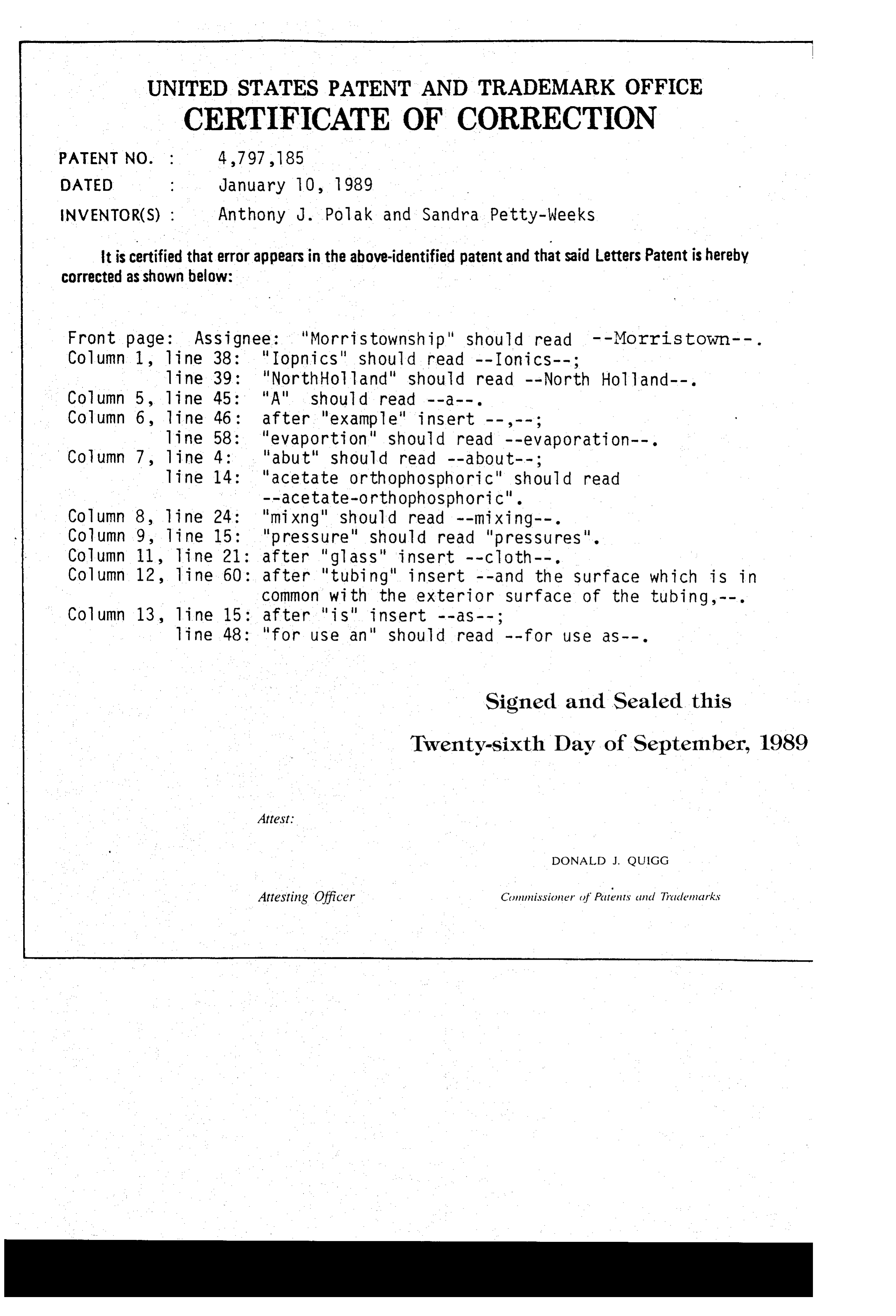
UNITED STATES PATENT AND TRADEMARK OFFICE
CERTIFICATE OF CORRECTION
NVENTOR(S) : Anthony J. Polak and Sandra Petty-Weeks it is certified that error appears in the above-identified patent and that said Letters Patent is hereby corrected as shown below:
Front page: Assignee: "Morristownship" should read --Morristown--. Column 1, line 38: "Iopnics" should read --Ionics--; line 39: "North Holland" should read --North Holland--. Column 5, line 45: "A" should read -- a--.
Column 6, line 46: after "example" insert --, --; line 58: "evaportion" should read --evaporation--. Column 7, line 4: "abut" should read -- about--; line 14: "acetate orthophosphoric" should read
Column 8, line 24: "mixng" should read --mixing--. Column 9, line 15: "pressure" should read "pressures". Column 11, line 21; after "glass" insert --cloth --. Column 12, line 60: after "tubing" insert --and the surface which is in common with the exterior surface of the tubing, --. Column 13, line 15: after "is" insert --as-- ;
line 48: "for use an " should read -- for use as--.
Signed and Sealed this
Twenty-sixth Day of September, 1989
Attest:
DONALD J. QUICG
Attesting Officer Commissioner of Patents and Tracteniarks
Provenance
- Collection
- Cited prior art
- Original PDF
- patentimages.storage.googleapis.com →
- Filed
- 1987-07-06
- Pages
- 13
- Method
- pdftotext (the PDF's own text layer) + pdftoppm 300dpi page scans
- Source
- Google Patents bibliographic record
- Granted
- 1989-01-10
- Inventors
- Anthony J. Polak; Sandra Petty-Weeks; AlliedSignal Inc
- Transcribed from
- patentimages.storage.googleapis.com →