patent · US4753181
Incineration process
28 June 1988
Page 1 — bibliographic record
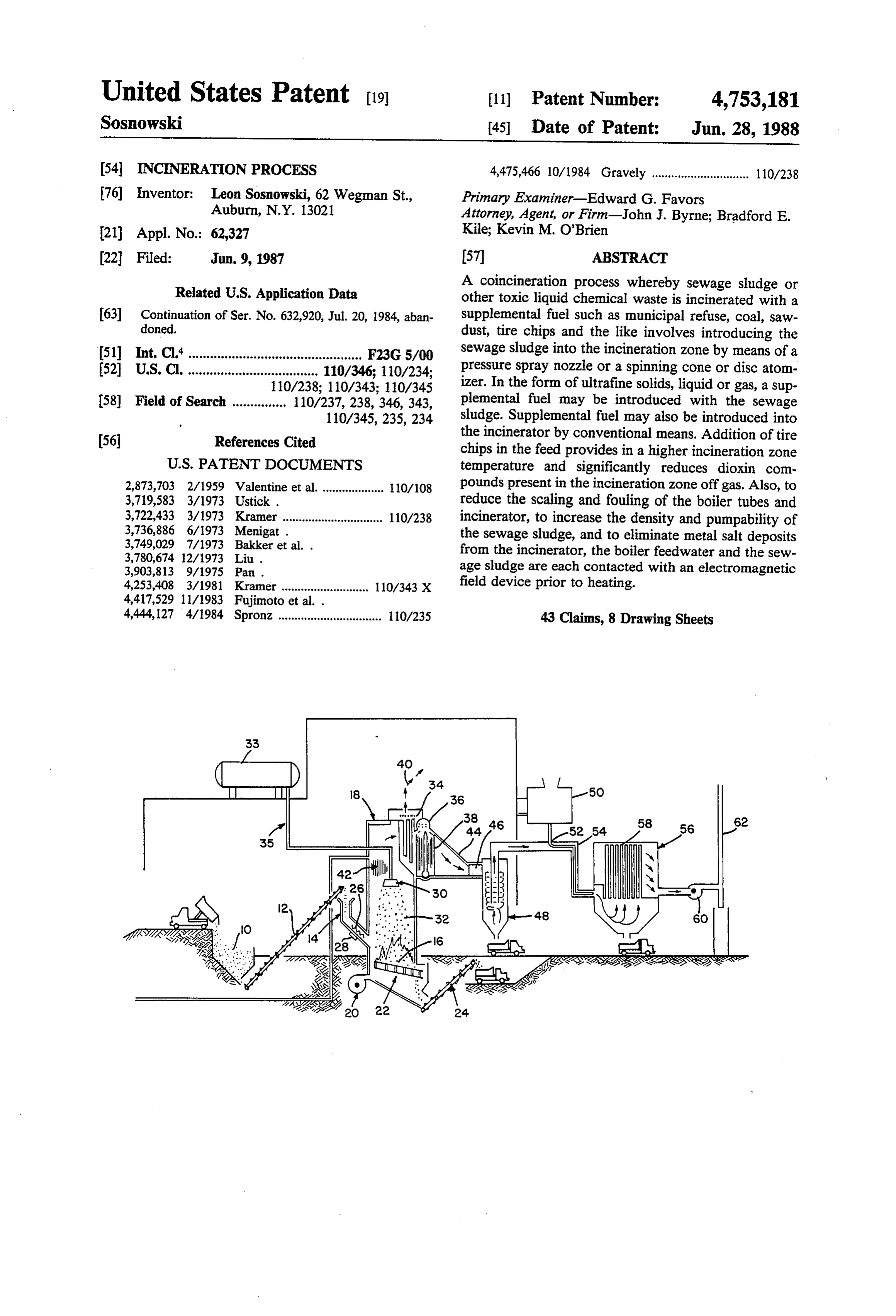
United States Patent (19) 11) Patent Number: 4,753,181 Sosnowski (45) Date of Patent: Jun. 28, 1988 (54) INCINERATION PROCESS 4,475,466 10/1984 Gravely .............................. 110/238 76 Inventor: Leon Sosnowski, 62 Wegman St., Primary Examiner-Edward G. Favors Auburn, N.Y. 13021 Attorney, Agent, or Firm-John J. Byrne; Bradford E. (21) Appl. No.: 62,327 Kile; Kevin M. O'Brien (22 Filed: Jun. 9, 1987 (57) ABSTRACT A coincineration process whereby sewage sludge or
Related U.S. Application Data other toxic liquid chemical waste is incinerated with a 63 Continuation of Ser. No. 632,920, Jul. 20, 1984, aban supplemental fuel such as municipal refuse, coal, saw doned. dust, tire chips and the like involves introducing the 51 Int. Cl. ................................................ F23G 5/00 sewage sludge into the incineration zone by means of a 52 U.S. Cl. .................................... 110/346; 110/234; pressure spray nozzle or a spinning cone or disc atom 110/238; 110/343; 110/345 izer. In the form of ultrafine solids, liquid or gas, a sup 58) Field of Search ............... 110/237, 238, 346, 343, plemental fuel may be introduced with the sewage 110/345, 235, 234 sludge. Supplemental fuel may also be introduced into (56) References Cited the incinerator by conventional means. Addition of tire chips in the feed provides in a higher incineration zone
2,873,703 2/1959 Valentine et al. ................... 10/108 pounds present in the incineration zone off gas. Also, to 3,719,583 3/1973 Ustick. reduce the scaling and fouling of the boiler tubes and 3,722,433 3/1973 Kramer ............................... 110/238 incinerator, to increase the density and pumpability of 3,736,886 6/1973 Menigat . the sewage sludge, and to eliminate metal salt deposits 3,749,029 7/1973 Bakker et al. . from the incinerator, the boiler feedwater and the sew
3,903,813 9/1975 Pan . age sludge are each contacted with an electromagnetic 4,253,408 3/1981 Kramer ........................... 110/343 X field device prior to heating.
4,444,127 4/1984 Spronz ................................ 110/235 43 Claims, 8 Drawing Sheets
Page 2
Drawing sheet — no readable text.
Page 3
Drawing sheet — no readable text.
Page 4
Drawing sheet — no readable text.
Page 5
Drawing sheet — no readable text.
Page 6
Drawing sheet — no readable text.
Page 7
Drawing sheet — no readable text.
Page 8
Drawing sheet — no readable text.
Page 9
Drawing sheet — no readable text.
Page 10
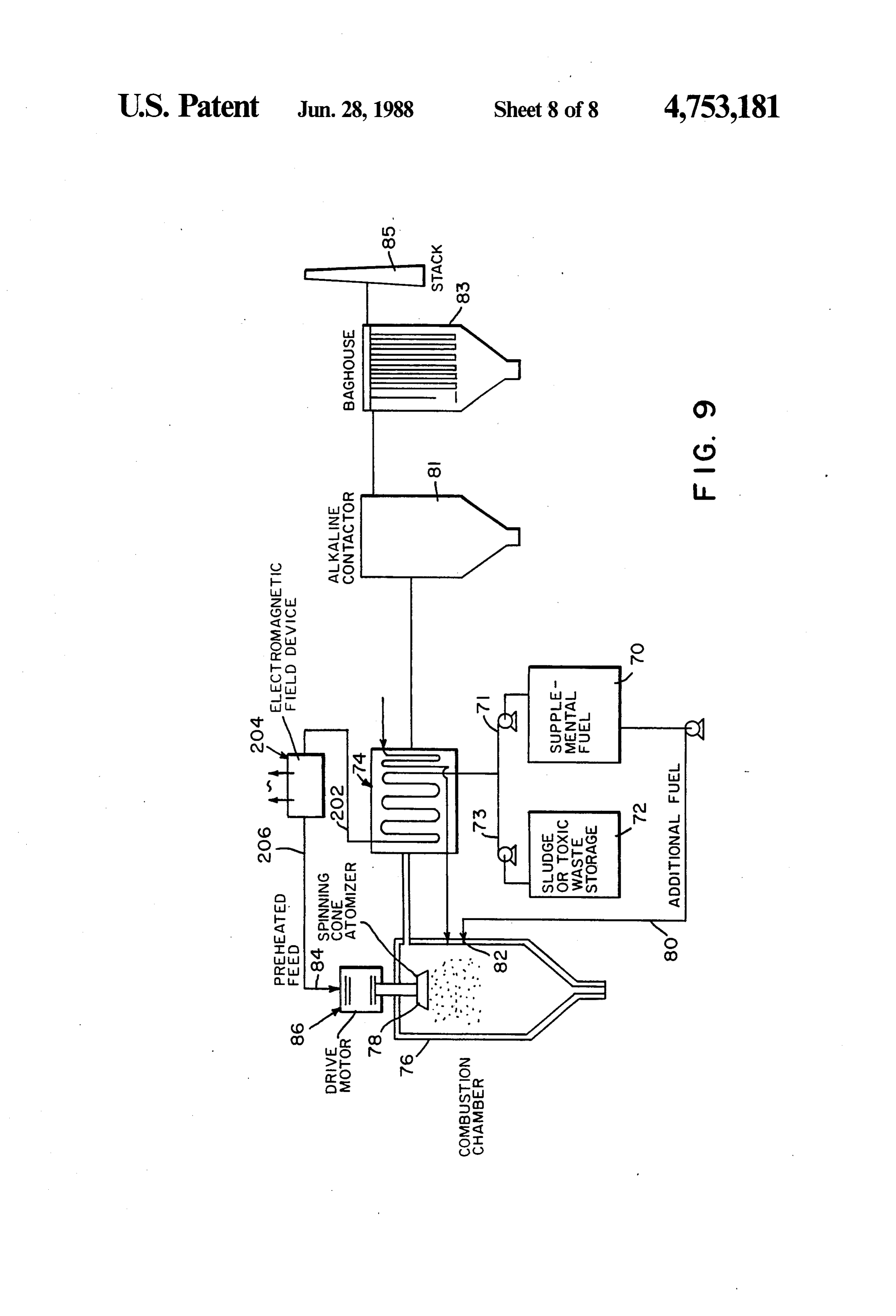
NCNERATION PROCESS
combustible material. In such prior art systems wherein the liquid and solid waste were combined during stor
This application is a continuation of application Ser. age, if the moisture content of the refuse feed exceeded acceptable limits additional fuel such as coal, oil or gas
No. 632,920, filed July 20, 1984 now abandoned. 5 was required to lower the overall fuel/moisture ratio, BACKGROUND OF THE INVENTION thereby reducing the amount of waste in both solid and This invention relates to an improved coincineration liquid form which could be incinerated for a given amount of fuel.
process. More particularly, this invention relates to a coincineration process whereby sewage sludge or toxic 10 theAsliquid stated above, coincineration systems which mixed liquid chemical waste is removed and combined with a frequentlyand solid waste together prior to incineration supplemental fuel from the environment and incinerated fuel such as coal, wood instances encountered where an additional or gas was required to reduce to produce steam for heating and/or the production of the overall moisture level of the feed. In addition, the electrical power.
In recent years, a large amount of research and in- 15 decreased rate of feed of the municipal waste to the incinerator resulted in an accumulation of the waste and vestment has been directed to the development of alter a corresponding increase in the offensive odor and ap native and economically feasible fuel substitutes for pearance petroleum based fuels due to diminishing fuel reserves offensive associated with the incineration site. This and rising costs of heating and generating electricity by respect to condition has been particularly acute with conventional means. In this connection, among the 20 commonly odors runs attributable to sewage sludge, which between 92 and 98% water, in instances more important avenues of research are those which where the incoming sewage sludge was stored for rela have concentrated upon the incineration of various tively long periods of time apart waste materials such as municipal refuse and sewage an effort to reduce the moisturefrom the solid waste in content of the solid sludge as well as other materials having combustible refuse to the incinerator.
potential or calorific value. 25
In addition to the investment in the development of Another significant problem associated with hereto alternative fuel sources, a substantial expenditure of duction fore known coincineration processes has been the pro effort has also been made to find acceptable substitutes of excessive amounts of toxic dioxin com for landfill programs to dispose of sewage sludge and pounds in the incinerator off gases. Dioxin compounds, liquid toxic chemical waste. Among the problems fre- 30 such as 2, 3, 7, 8-tetrachloro dibenzo-p-dioxin quently associated with landfill programs at the present (C12H4O2Cl4), are toxic in a parts per billion range and, time are: landfills are not sufficiently sanitary, resulting therefore, must be eliminated from incinerator stack in considerable leaching which interferes with water gases.
supply systems; landfills have become exceedingly Dioxin compounds are produced in significant quan costly due to the increased transportation costs neces- 35 tities from the incineration of plastics, rubbers and the sary to bring waste to the landfill and due to the in like, and may be eliminated by thermal degradation at creased charges for land requiring strict environmental temperatures of between 2000 F. and 2300 F. How controls; and a generally negative public view with ever, the combustion temperature of most coincinera which expansion of existing landfills or establishment of tion systems is between 1500' F. and 1800' F. which is new landfills is often viewed. 40 insufficient to thermally degrade these compounds. The In view of the above, there is at the present time a problems associated with the presence of dioxin com significant need for a system capable of efficiently burn pounds in incinerator off gases has been particularly ing sewage sludge or liquid toxic chemical waste along acute in systems using the above described bulk injec with solid municipal refuse or other supplemental fuel tion method, as incomplete incineration of plastic and such as coal, oil, gas and the like. Such a system would 45 rubber materials tended to increase the quantity of toxic not only advantageously use the energy content present compounds produced. Also, prior attempts to raise the in the waste products, but also efficiently dispose of the incinerator temperature such as by adding high energy waste products, thereby reducing landfill and other content refuse materials, such as tire chips, resulted in disposal problems associated with improving the envi an unacceptable level of smoke and particulates re rondent. 50 leased to the atmosphere.
Prior systems which have attempted to coincinerate Still a further problem frequently encountered by sewage sludge and supplemental fuel have suffered coincineration systems of the prior art involved the from a variety of limitations. In this connection, many deposit of noncombustible materials contained in the coincineration systems have mixed both liquid waste sewage sludge in the lower sections of the incinerator. and solid municipal waste together, for example in the 55 These noncombustible materials, comprising metal salts same storage pit, prior to introduction of the combined such as iron and calcuim oxides, tended to accumulate feed to an incinerator by a bulk injection method. Coin near the walls and grate in the lower section of the cineration processes using a bulk injection method of incinerator and restrict airflow through the incinerator, this type have frequently been unsuccessful, however, thus requiring periodical cleaning. The metal salts in the because the overall moisture content of the combined 60 sewage sludge also adversely affected the consistency feed frequently exceeded an acceptable moisture level. and burning character of the sewage sludge and the When steam generation is desired, the moisture content pumpability of the sludge. Heretofore, no effective of the overall feed to the incinerator must generally be method has been developed to eliminate or substantially maintained below about 30 weight 7% and, more prefer reduce metal salts in the sewage sludge prior to intro ably, below about 27 weight%. Operation of an inciner 65 duction of the sludge to the incinerator. ation process at a moisture content of the feed above While such systems, as noted above, have achieved at about 27 weight % generally results in inefficient heat least a degree of industry recognition and utilization, utilization due to the relatively slow burning of this room for significant improvement remains.
Page 11
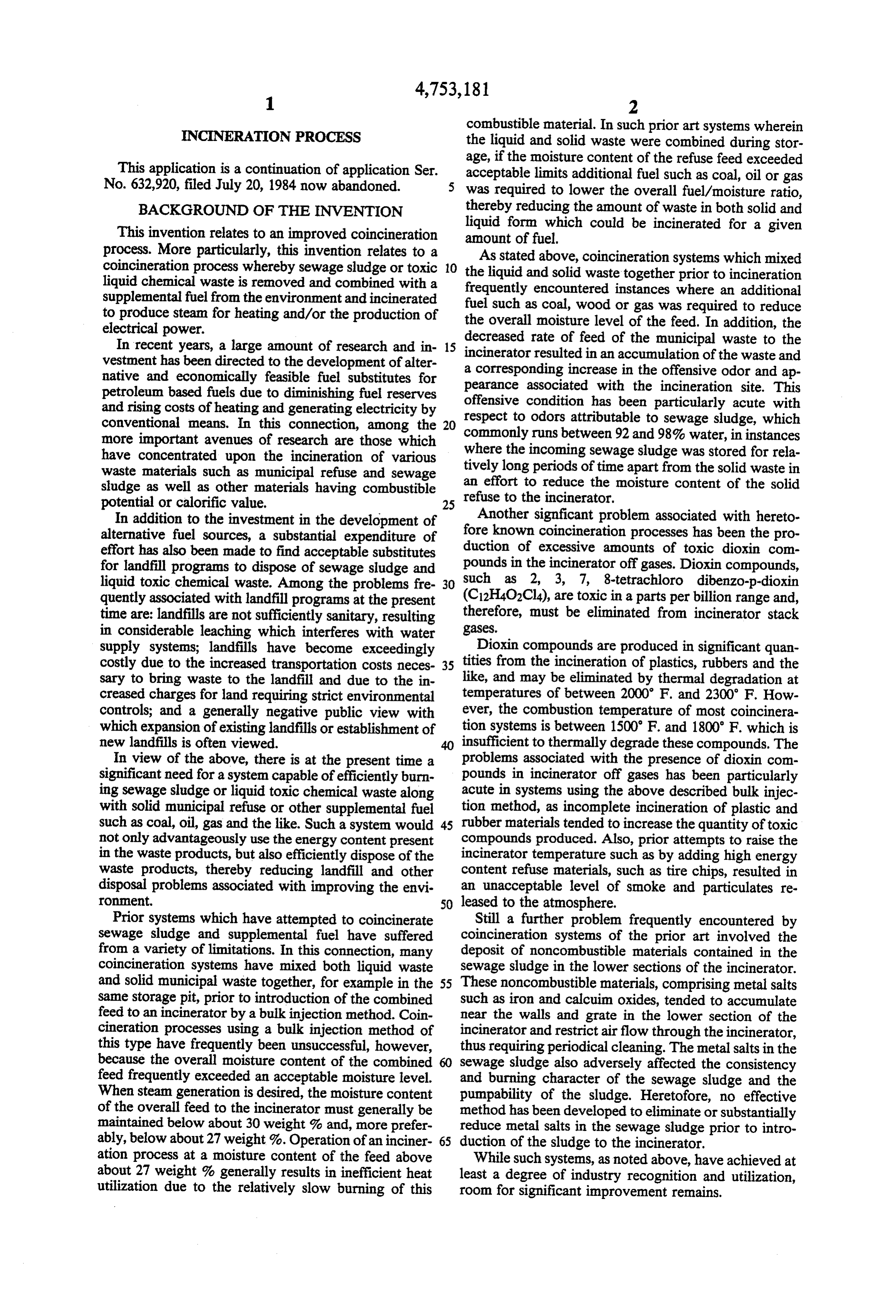
In this regard, prior art systems have been severely ditions to produce a flame front intermediate the verti limited as to the quantity of municipal waste which may cal length of the incineration zone. The sewage sludge be introduced into the incinerator by the relatively high or toxic liquid chemical waste is dispersed downwardly water content of the sewage sludge and by the method over the flame front in the incineration zone in small of introduction of the sewage sludge to the incinerator droplets to evaporate the water and to burn combustible whereby the sewage sludge is combined with the sup material present in the droplets and to produce gaseous plemental fuelina bulkinjection procedure. This limita products and ash. The hot incineration off gases are tion on the quantity of municipal waste fuel to the incin then recovered from the incineration zone and, if ob erator has resulted in an increased dependency on addi served, passed to an energy recovery zone to produce tional fuel sources such as coal, oil and gas, a decreased 10 steam for heating and/or electrical powers. amount of waste material which could be incinerated, In another embodiment, the present invention com and increased odor and visual incongruity associated prises a process for coincinerating sewage sludge or with solid and liquid waste disposal. Moreover, the toxic liquid chemical waste and a supplemental fuel relatively low incinerator temperature of the prior art whereby both the sewage sludge or toxic liquid chemi systems has not been sufficient to reduce or eliminate 15 cal waste and the supplemental fuel are dispersed in toxic dioxin compounds which are formed as a result of relatively small droplets or solid particles over the the coincineration process, and no acceptable solution flame front in the incineration zone to produce hot has heretofore been developed. Still further, deposit of incineration gases.
incombustible material in the lower section of the incin In yet another embodiment, the present invention erator has resulted in an increased need for cleaning 20 comprises a process for efficiently eliminating dioxin operations and a restriction in air flow through the products of coincineration whereby the fuel to the in incinerator.
The problems suggested in the proceeding are not cinerationchips and zone comprises at least 15% by weight tire whereby the hot incineration off gases are intended to be exhaustive, but rather are among many passed directly which may tend to reduce the effectiveness of prior 25 oxin compoundstopresent an afterburner zone wherein the di in the gases are either ther coincineration processes. Other noteworthy problems mally or catalytically decomposed. The heat present in may also exist; however, those presented above should the off gases from the afterburner zone is then recov be sufficient to demonstrate that coincineration pro ered by indirect heat exchange, and the acidic gas and cesses appearing in the prior art have not been alto particulate matter is removed from the off gases by a gether satisfactory. 30 pollution control unit.
OBJECTS OF THE INVENTION In a further embodiment, the sewage sludge for liquid It is, therefore, a general object of the invention to toxic to the chemical waste is pre-treated before introduction incineration zone by the application of an electro provide a coincineration process which will obviate or magnetic field device which removes noncombustible minimize problems of the type previously described. 35 materials such as metal salts from the sludge, concen It is a particular object of the invention to provide a novel coincineration process for the elimination of sew trates the combustible material in the sludge and im proves pumping, atomization and incineration charac age sludge and toxic liquid chemical waste. teristics. The electromagnetic field device may also be It is another object of the invention to provide a used in the process whereby both the sewage sludge or novel process for producing steam and/or electricity by 40 coincinerating sewage sludge and a supplemental fuel in toxic liquid chemical waste and supplemental fuel are an efficient manner. contacted with the device prior to dispersal above the flame front in the incineration zone in relatively small
It is yet another object of the present invention to droplets provide a novel process for the coincineration of com or particles.
bustible fuel under conditions which reduce or elimi 45 In still a further embodiment, the present invention nate the production of dioxin compounds. comprises an incineration process whereby feedwater It is still another object of the invention to provide a to a boiler is pre-treated with an electromagnetic field novel coincineration process which reduces or elimi device to decrease dissolved solids present therein. By nates the release of substantially all of the acid com this process, fouling or scaling of boiler tube walls is pounds and particulate material produced by the pro 50 significantly reduced.
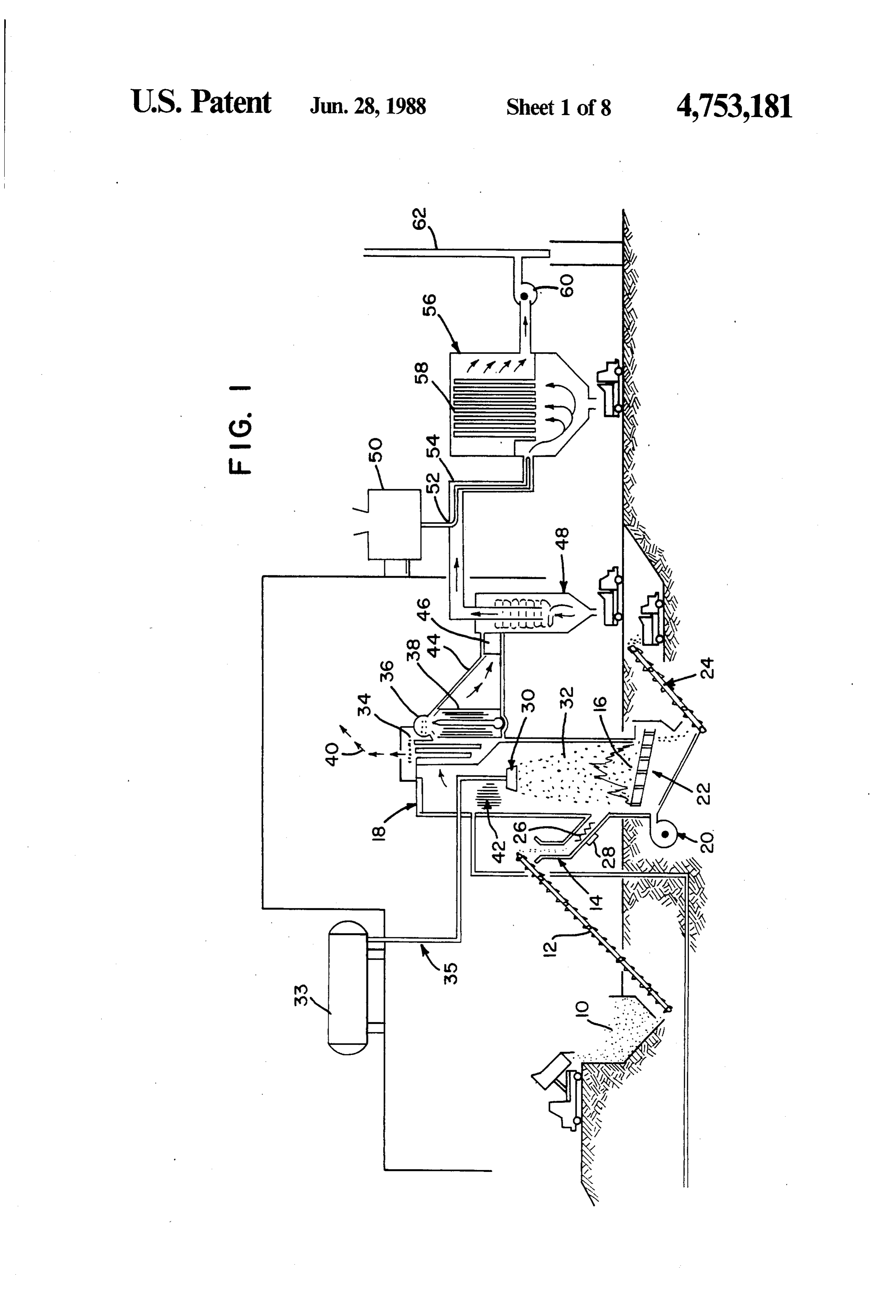
cess into the atmosphere. BRIEF DESCRIPTION OF THE DRAWINGS It is a further object of the present invention to pro vide a novel coincineration process operable to elimi Other objects and advantages of the present invention nate metal salts from the sludge and to increase sludge will become apparent from the following detailed de concentration and consistency characteristics. 55 scription of preferred embodiments taken in conjunc It is still a further object of the present invention to tion with the accompanying drawings wherein: provide a novel coincineration process whereby a mix FIG. 1 is a schematic view of one preferred embodi ture of sewage sludge and supplemental fuel is pre ment of the present invention wherein supplemental treated to the mixture to improve the combustion char fuel is introduced at a point intermediate a vertical acteristics of the mixture. length of an incineration zone and sewage sludge or
SUMMARY OF THE INVENTION
toxic liquid chemical waste is dispersed over a flame front by a spinning cone atomizer
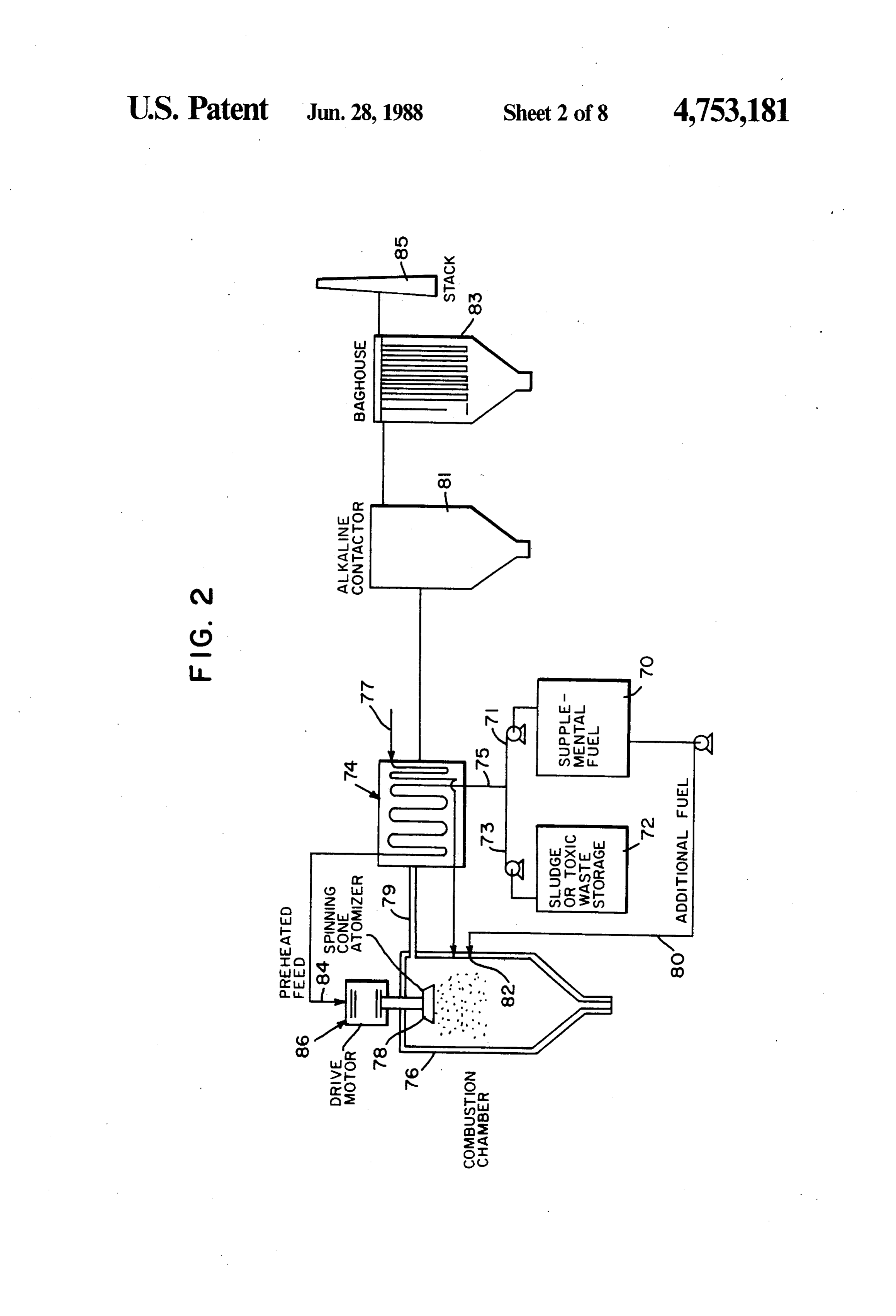
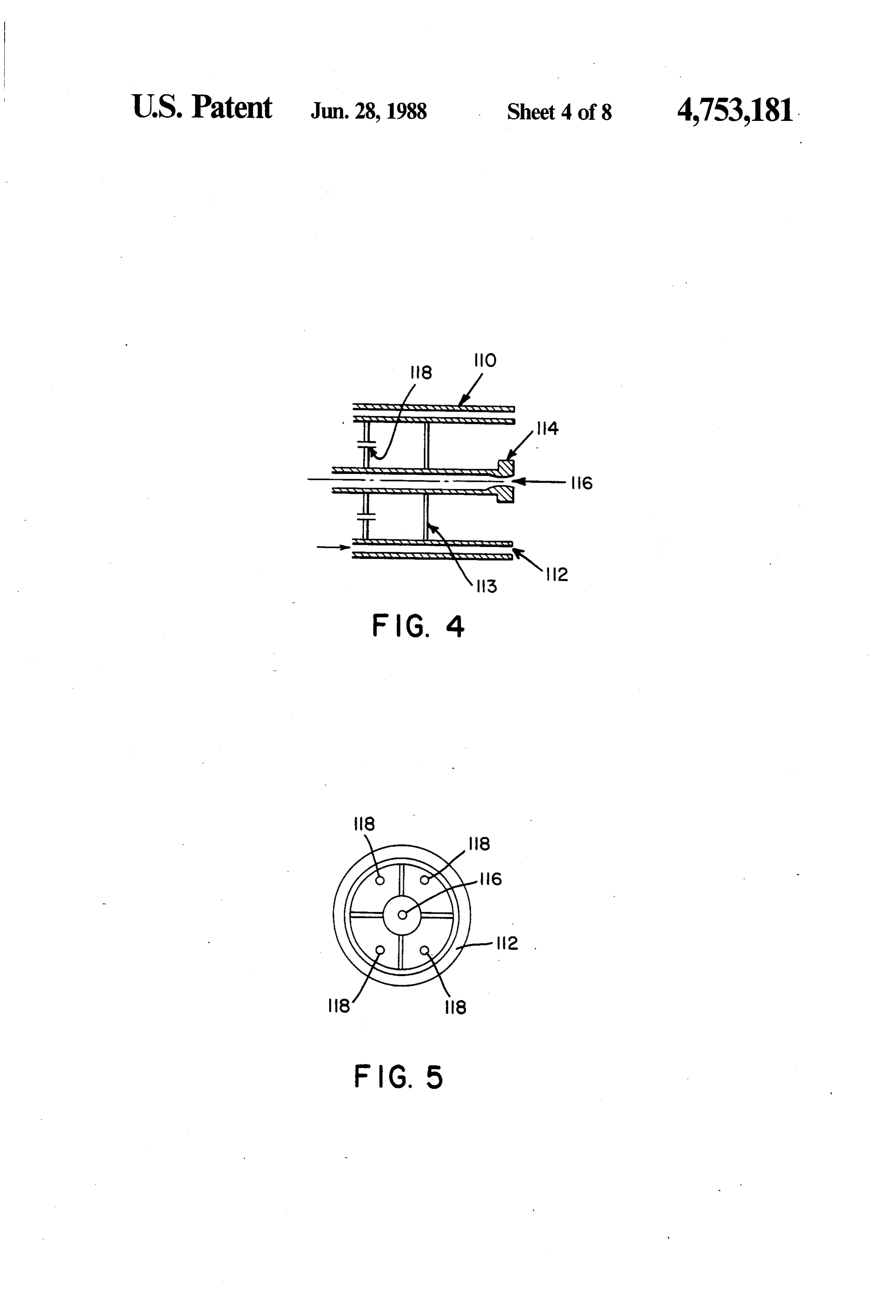
One preferred embodiment of the invention which is FIG. 2 is a schematic view wherein sewage sludge or intended to accomplish at least some of the foregoing toxic liquid chemical waste and supplemental fuel are objects comprises a process for coincinerating sewage 65 dispersed in combination over the flame front in the sludge or toxic liquid chemical waste and a supplemen incineration zone by a spinning cone atomizer and addi tal fuel whereby the supplemental fuel is introduced tional fuel is introduced to the incineration zone by into an incineration zone operating at incineration con conventional means.
Page 12
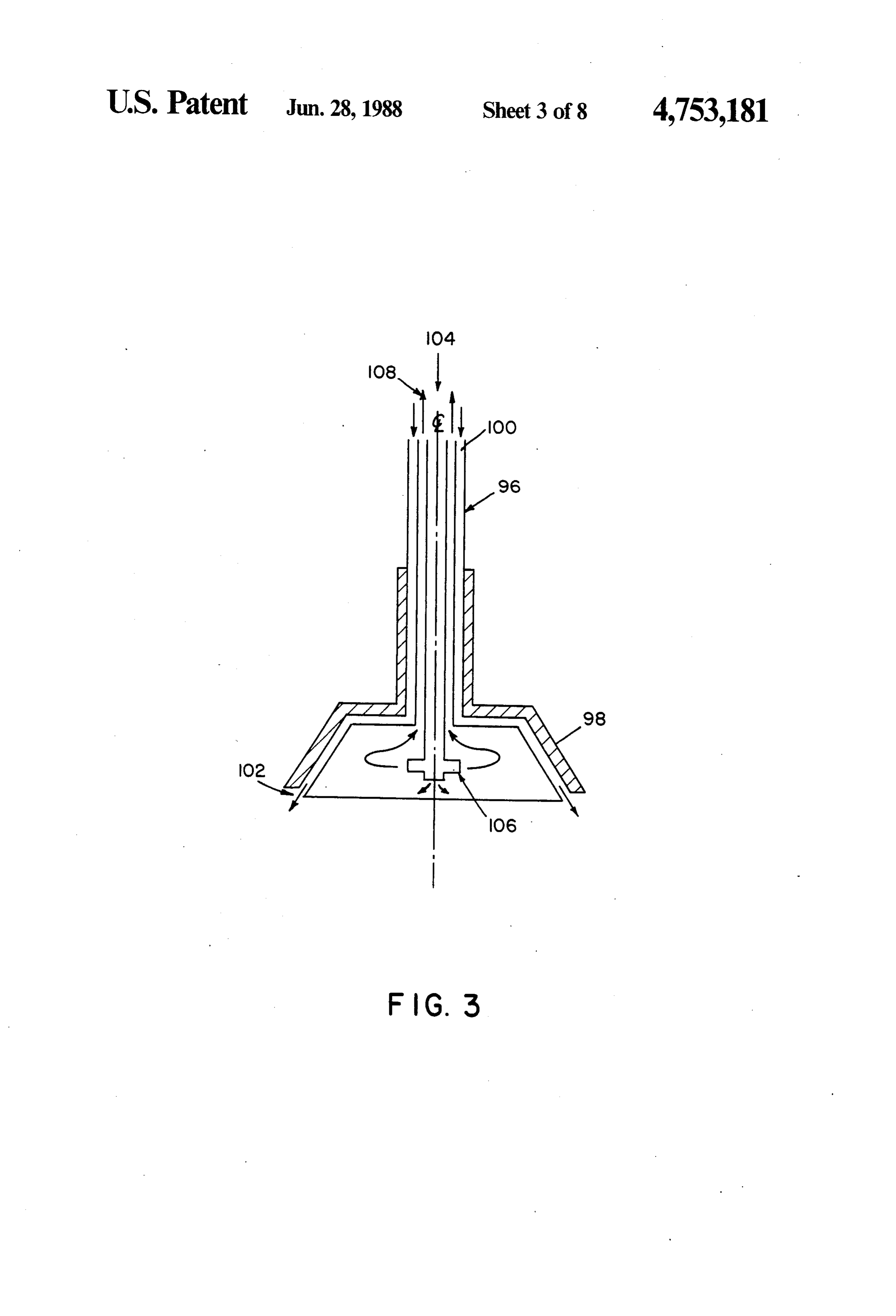
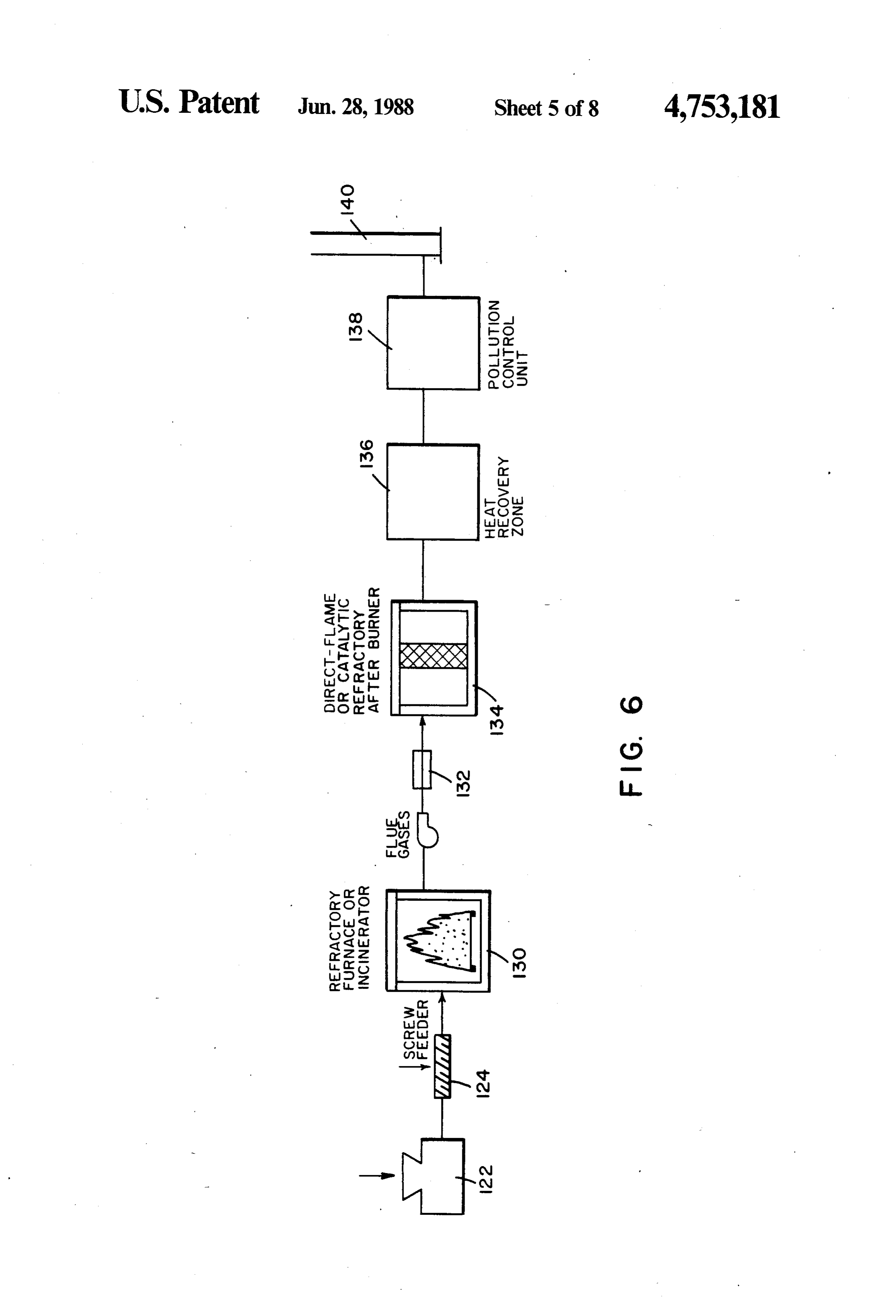
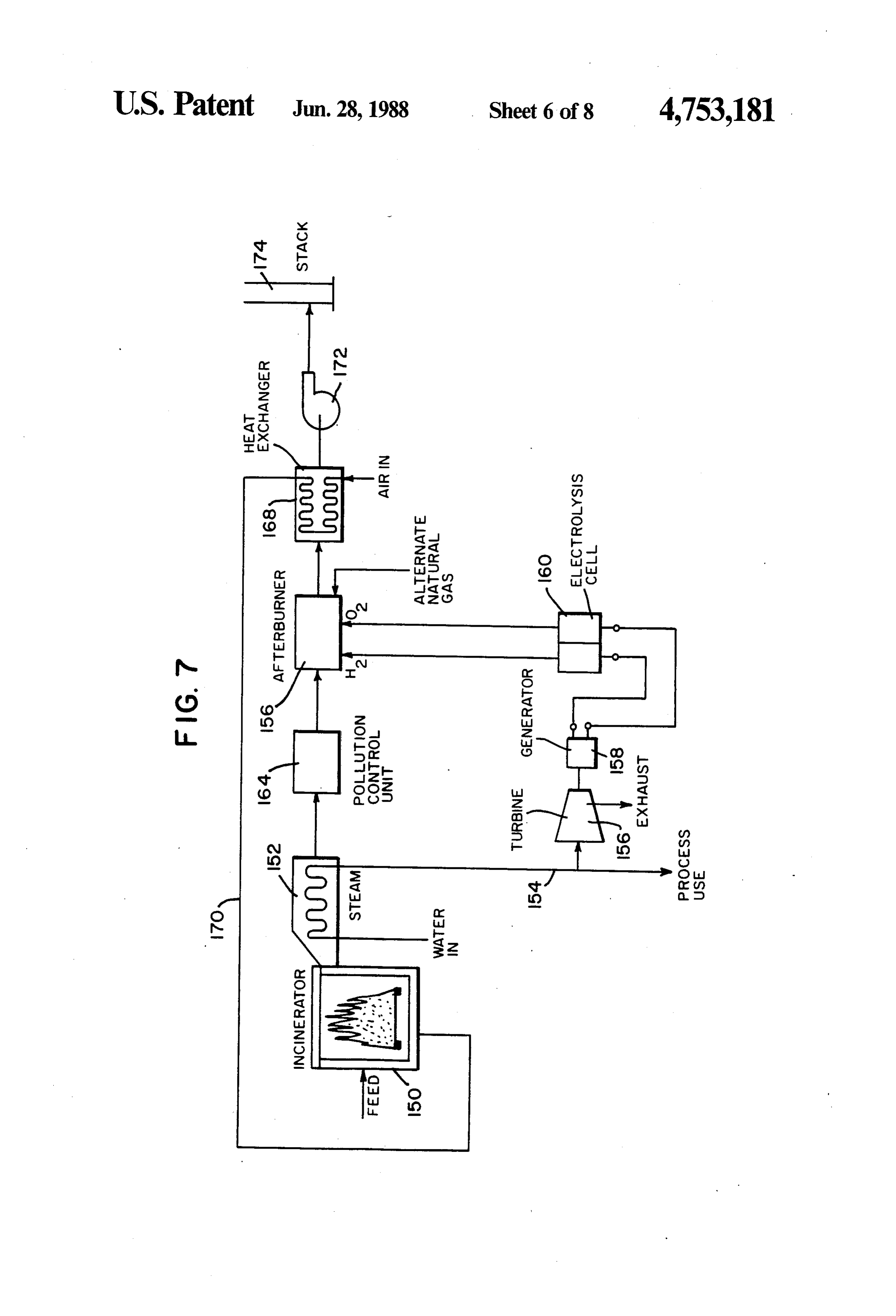
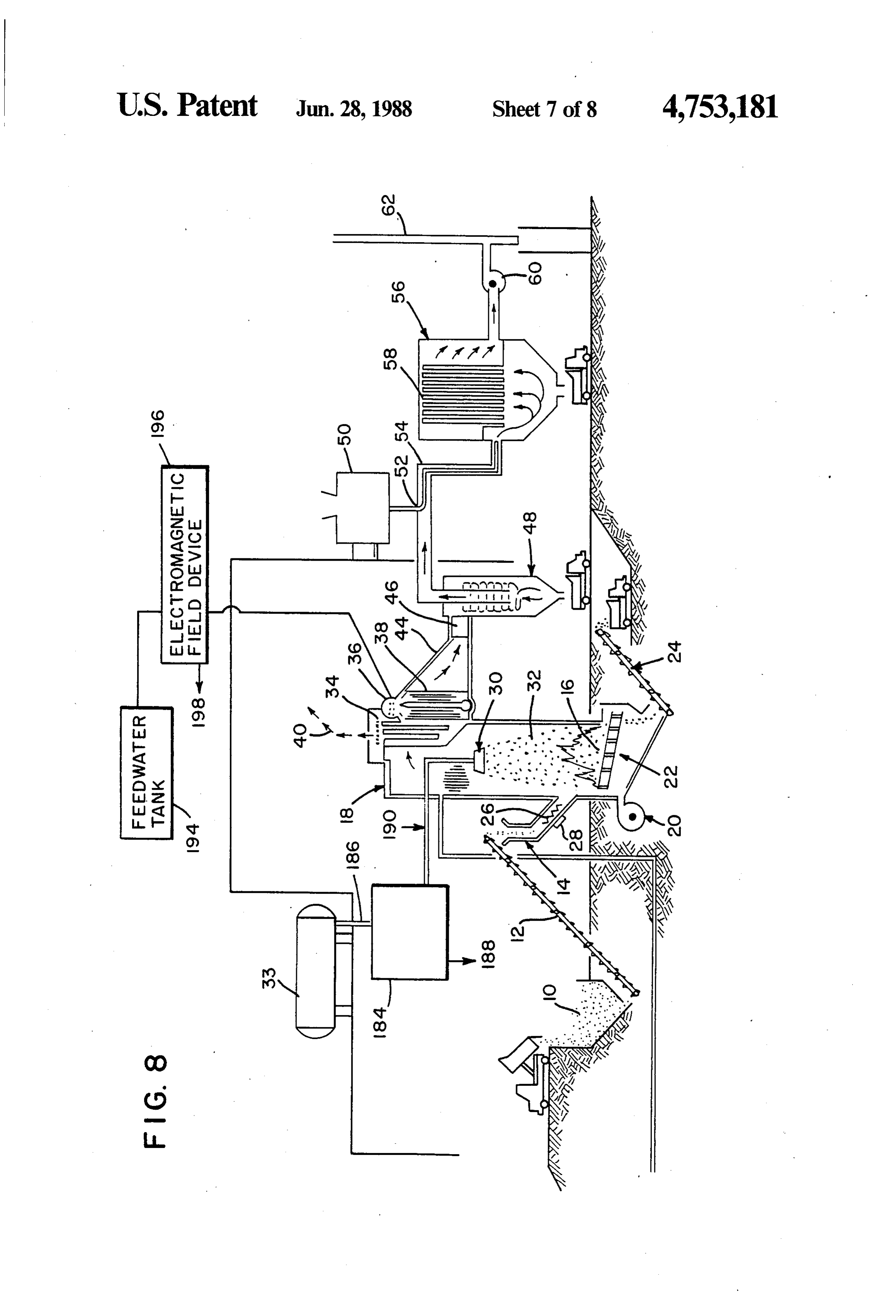
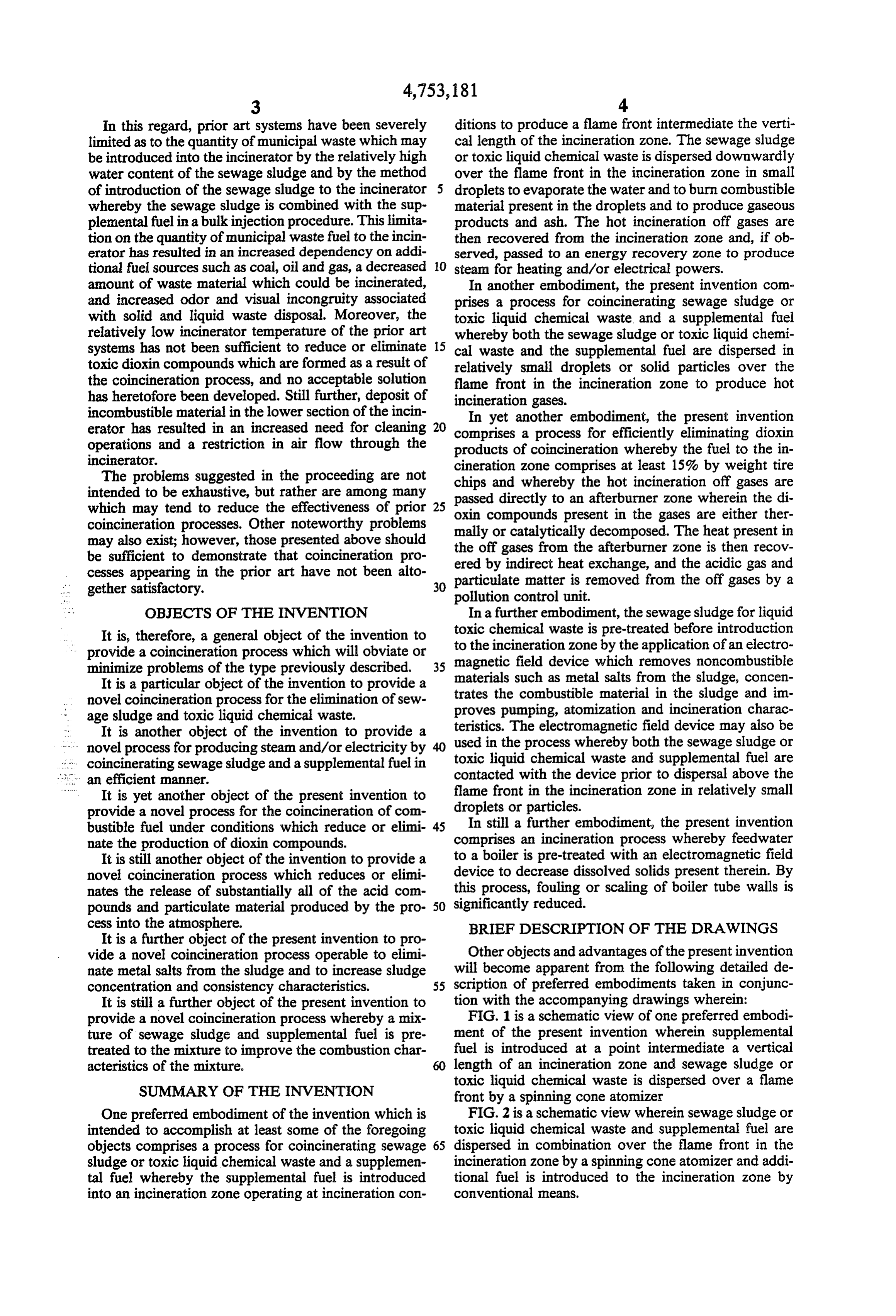
FIG. 3 is a schematic cross-sectional side view of a Control of the amount of moisture present in the spinning cone atomizer such as may be used as a dis combustible fuel to the incinerator is significant since pensing means in the present invention. the overall moisture control in the feed should be main FIG. 4 is a schematic cross-sectional side view of an tained at below 30% by weight and preferably below alternate design of a fuel dispensing nozzle such as may 5 27% by weight if steam generation is desired in order to be used in the present invention. avoid inefficient heat utilization and slow burning. One FIG. 5 is an end view of FIG. 4 sharing additional of the advantages of the present invention is, therefore, details of the fuel dispensing nozzle. that the sewage sludge, which is commonly between FIG. 6 is a schematic view of another embodiment of 2% and 8% solids, is stored and may be introduced the present invention illustrating an efficient removal of 10 separately from the solid refuse. By the present inven dioxin material produced in an incineration zone. tion, the need for additional fuel such as coal, oil and the FIG. 7 is a schematic view of an embodiment of the like is frequently avoided. In instances wherein the solid present invention including an electrolysis apparatus by refuse is sufficiently moist to result in an overall fuel which hydrogen and oxygen are produced and directed 15 moisture content exceeding 27% if the sewage sludge to an afterburner for destruction of dioxin compounds were introduced at a normal rate, the amount of sewage produced by incineration. sludge introduced to the incinerator is reduced until the FIG. 8 is a schematic view of an embodiment of the overall moisture content is below 27%. The sludge rate present invention whereby sewage sludge and boiler may be maintained at a relatively low rate until the solid feedwater are each contacted with an electromagnetic 20 may refuse is replaced by a drier supply. Conversly, there device to remove dissolved solids and metal salts. be instances when the solid refuse fuel is unusually FIG. 9 is a schematic view of an embodiment of the dry, and relatively large amounts of sewage sludge can present invention whereby sewage sludge and supple be incinerated.
mental fuel are admixed and contacted with an electro By the present invention, the amount of sewage sludge fed to the incinerator can be controlled in accor magnetic field device prior to introduction to the incin 25 dance eration zone. with the moisture content of the solid refuse, which is commonly about 12% but which can vary
DETAILED DESCRIPTION OF THE widely, thus substantially reducing the need for addi INVENTION tional fuels. Also, since either the solid or the liquid The subject invention comprises an advantageous waste or both will generally be fed to the incinerator on process for eliminating sewage sludge and toxic liquid 30 a continuous basis, problems of odor and appearance chemical waste while producing steam for heating and associated with an accumulation of municipal refuse is /or the production of electrical power, particularly by largely reduced.
The solid refuse mixture in storage hopper 10 is con burning municipal refuse without substantially contani veyed by conveyor belt 12 into the double-walled feed nating the atmosphere. Initially, it must be pointed out that this system is contemplated as being used in a mu 35 hopper 14 wherein it is funneled onto grate 16 in incin erator 18 and burned at temperatures of up to about nicipal town or village. It is recommended that such 2300 municipality implement a source sizing system for col monly F.operate As mentioned previously, incinerators com
lecting the household trash so it can be collected in a ever, by the addition compactor type truck. This will remove large items, chips, the process of of the at least 15% by weight of tire present invention allows ele such as stoves, refrigerators, so that they need not be vated incineration temperatures which significantly sorted. The compactor trucks can then go directly to reduces the quantity of harmful pollutants such as diox the incineration plant and unload the refuse directly into ins from the incinerator off gas.
a storage hopper without the necessity of sorting and Underneath the grate 16 is a fan 20 which forces air shredding the refuse. By coincinerating liquid and solid 45 and/or waste in the manner described herein, it is expected that ensuringoxygen complete into the lower part of the grate, thus combustion of the combustible mate landfill volumes can be reduced by up to 90%.
Before discussing the various methods of carrying air is the theoretical aamount rials in the trash. As general rule, about 7.5 pounds of required to release 10,000 out the present invention, it will be realized that, al BTU from sludge. To ensure complete combustion, though the essential components have been shown, for 50 however, it is preferred to add from 5% to 150% excess the sake of clarity, certain conventional pumps, temper air of that required in the overall incineration process. ature sensors, water supply inlets, etc. well known to The grate 16 may be a movable grate (moved by a those skilled in the art have been eliminated from the motor or other means not shown) so that the ashes can drawings in some instances. Also, it will be understood be released into the ash pit 22 where they are cooled that the term sewage sludge as used herein also refers to 55 and conveyed by conveyor 24 into a dump truck, where toxic liquid chemical wastes in general.
Turning now to the drawings, wherein like numerals the and ashes with such materials as iron compounds, glass aluminum are removed and disposed in a suitable indicate like parts, a process for eliminating sewage landfiling operation, and/or used for water drainage fill sludge and/or toxic liquid chemical waste and munici or as building material or storage in landfill for later use pal refuse is illustrated in FIG. 1. Trucks loaded with as a salable by-product.
trash, dump the refuse in the refuse storage hopper 10. With respect to the feed hopper 14, this is water It is preferred that the refuse is mixed at this point with cooled to by-pass water between the walls of the dou at least 15% by weight of the total feed to the incinera ble-walled construction to prevent premature melting tor of shredded tire chips to increase the burning capac of materials, such as plastics, etc., which may otherwise ity thereof. Also, although the mixture is primarily solid 65 melt and clog up the throat of the hopper feeding de combustible material, the mixture which is feed to the vice. This melting of plastics produces a so-called incinerator through feed hopper 14 may comprise up to “bridging' or clogging effect. To further minimize the 12% or more moisture by weight. possibility of such a clogging operation, a special screw
Page 13
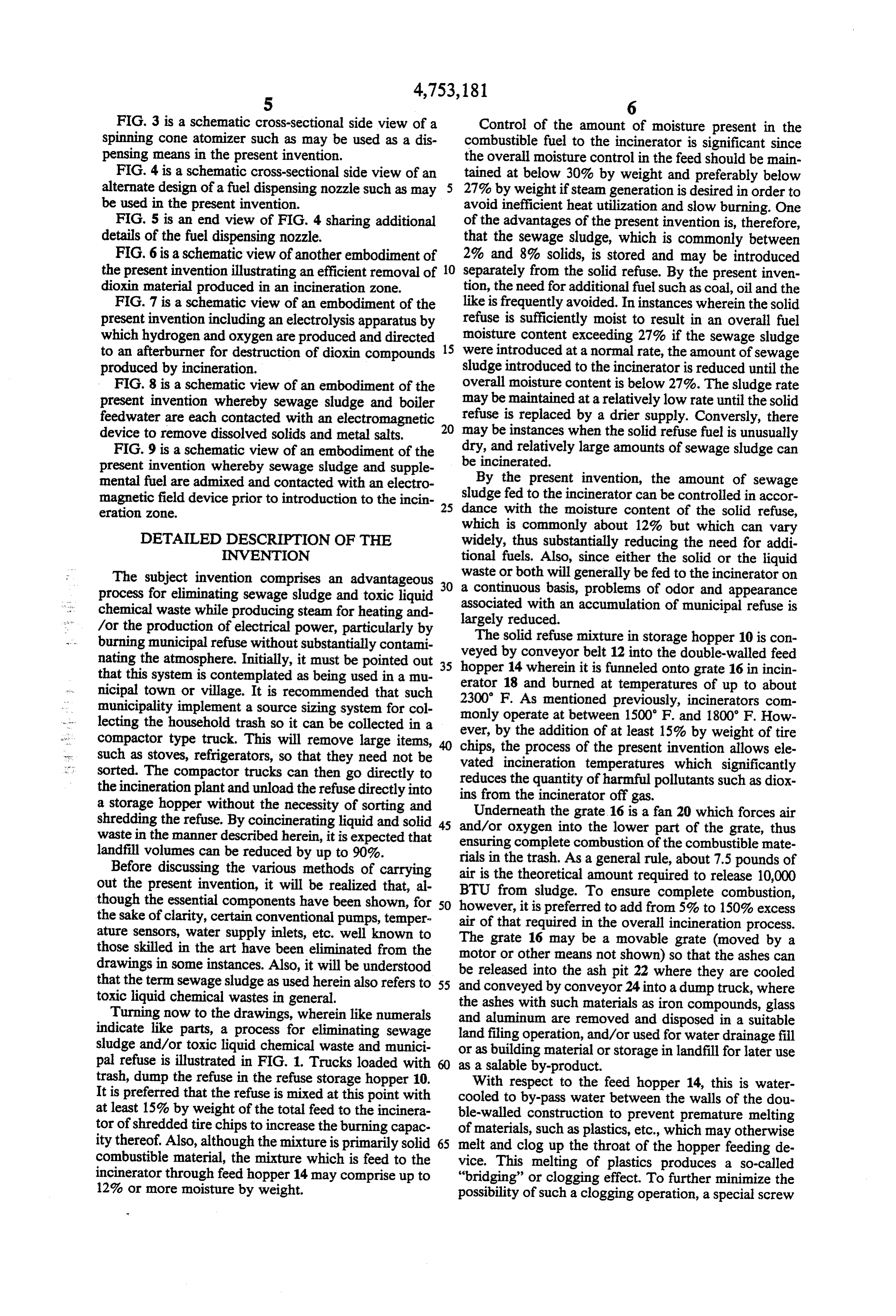
drive 26 or auger may be used to force the material TABLE 1-continued down the throat of the hopper 14. This auger is prefera Fuel Heating Value bly located at the lower portion of the hopper feed 14, Coal 12,000-14,000 BTU per pound where clogging is more apt to occur, although it can be Tire Chips 12,500 BTU per pound located at the top thereof. Of course, more than one 5 Oil 20,000-22,000 BTU per pound refuse storage hopper or feed hopper system may be Natural gas 22,000-23,000 BTU per pound employed.
The auger 26 is a screw conveyor which propels the trash down the hopper and is also preferably water Thus are it is readily apparent from Table 1 that if tire chips added to the supplemental fuel mixture, then an cooled to prevent premature heating of the materials. increased amount
This auger is of a conventional structure usually having to the incinerator. of sewage sludge may be introduced a central shaft containing spiral blades radiating from the center of the shaft so as to propel objects in this case in InFIG.the embodiment of the present invention presented 1, the hot incineration off gases are used to in a downward direction towards entrance into the generate steam and/or electricity. Accordingly, the furnace as the auger is rotated. 15 sewage
In certain cases, wire and other components may get incineration zone sludge present in the combustible fuel to the caught up in the auger device and, therefore, an access incineration zone isisoperated significantly less than when the for the primary purpose of door 28 may be supplied, which permits an operator to removing liquid waste from the environment. When it is unclog the hopper chute periodically. Of course, one or 20 desired to generate steam from the more access doors may be used. This door may be a gases, the amount of sewage sludgeincineration should zone off generally be sliding door or a hinged door. At any rate, the existence no more than 15% by weight of the total combustible of more than one feed hopper or refuse storage hopper fuel to the incineration zone. The optimum figure will will insure continuous operation of the furnace during depend on the properties of the particular fuel used, but the periods when one of the chutes may be clogged up. it has been found that for a typical municipal refuse and Referring now to the upper section of incinerator 18, 25 a sewage sludge atomizer is shown at 30 dispersing sewage nicipal sludge feed, an optimum mix will be 93% mu refuse and 7% liquid sludge.
droplets of sewage sludge 32 into the combustion zone It is preferred that tire chips are added to the inciner of incinerator 18. Although reference has been made to ation zone to increase the energy available for sludge sewage sludge in this process, it is understood that drop 30 combustion and energy recovery. For example, if at lets 32 could be other known forms of toxic liquid least 15% weight tire chips are present in the overall chemical waste.
In any case, sewage sludge from storage tank 33 feed, than up to 15% weight sewage sludge may be passes through conduit 35 and into atomizer 30 for introduced ceptable to the incinerator while maintaining an ac steam production level dispersion into incinerator 18. In the incinerator, the 35 water contained in the sewage sludge droplets evapo As shown in FIG. 1, the heat produced from the rates and the combustible material is burned to produce combustion of the fuel heats up the super heater, drum recoverable energy in the form of hot incineration off and boiler tube assembly designated 34, 36, and 38 re spectively and produces steam through steam exit 40 gases.
The quantity of sewage sludge that can be burned 40 pose which is used for heating purposes and/or for the pur is with the refuse depends upon whether sufficient heat tor 18ofhasgenerating electricity. Refuse burning incinera a water-cooled or double-walled construction "... recovery is desired in order to generate steam or power.
If no recovery of energy is contemplated, but only the in which water is circulated through the double wall elimination of municipal refuse and sludge, then the construction for cooling and heat transfer. The inside of sludge may comprise up to 50 weight percent of the fuel the incinerator is preferably lined with a refractory to the incineration zone. It is to be understood that this 45 material such as refractory bricks 42 partially shown in figure applies to average properties of sludge and refuse FIG. 1. The double wall construction of incinerator 18 and that deviation from these average conditions will be containswater water circulating therethrough and the pre reflected in the mix ratio. That is, municipal solid waste heated supplied to the superheater or steam gen derived from residential and commercial refuse typi 50 erating pipes serves the dual purpose of cooling the cally contains an energy content of approximately 5,000 walls of the incinerator and at the same time generating BTU per pound, taking into account the moisture steam to be passed through steam exit 40.
which may be up to 30% by weight of the refuse and The exhaust gas from the steam generation zone inerts. Also, the heating value of sewage sludge from a passes through exhaust flue 44 and into economizer 46. storage tank such as has been described with reference The economizer is water-cooled and reduces the tem to FIG. 1 will typically be approximately 1,500 BTU 55 perature of the off gases to between about 350 and 550 per pound. F., depending upon the initial temperature of the gas. If other combustible fuels are added to the incinera The construction of such economizers is well known in tion Zone with the municipal refuse and sewage sludge, the art and such a device is known to cool the gases and then the weight percent of the sewage sludge in the precipitate or generally eliminate a majority of the soot overall fuel mixture may be adjusted in accordance with or ash particles. Particles suspended in the off gas are the heating value of the added fuel. Table 1 presents further removed by means of cylone separator 48. examples of fuels which may be used in process of the The cooled gases from cyclone separator 46, which present invention with the typical heating value of these contain acidic pollutants such as SO2, SO3, and HCl are fuels. passed through a further pollution control system prior 65 to being released to the atmosphere. As shown in FIG.
TABLE 1. 1, a preferred means of removing pollutants from the off Fuel Heating Value gases is by means of an alkaline contactor where an Wood 7,000-8,000 BTU per pound intimate contacting of an alkaline powder or slurry/-
Page 14
spray with the gases is conducted. The alkaline material with reference to FIG. 1, or another suitable pollution which is stored in vessel 50 is contacted with the off control unit, prior to release to the atmosphere. gases at injection point 52 and passes with the off gases The combined sludge and supplemental fuel stream is through the alkaline contactor section 54. Alkaline dust introduced to the incineration zone 76 by means of such as soda ash, trona, nahcolite, lime, etc. or slurried spinning cone atomizer 78 and dispersed into the incin materials such as a lime/limestone, soda ash, trona, erator in small droplets or particles. In this embodiment, nahcolite, etc. react with the acid gases to produce inert additional fuel may also be passed by means of conduit innocuous salts which can be readily separated from the 80 into incinerator 76 at a point below that at which the gas stream. The alkaline material introduced in the form combustible fuel is dispersed by atomizer 78. of a dust or spray also acts as a collector so that im 10 Although FIG. 2 shows a supplementary fuel intro pingement and inpaction eliminates particulates from duced into the incinerator by means of atomizer 78 the off gas stream. In addition, alkaline material intro which is the same as the additional fuel introduced by duced in the form of a wet mist further cools the gas means of conduit 80 at point 82, it is not essential that stream. the combustible fuel introduced at these points be the The neutralized off gases pass from the alkaline con 15 same. For example, ultrafine coal may be mixed with tactor to a bag house where the dry powder and partic the sewage sludge in conduit 75, and municipal refuse ulates are collected. After passing the off gas through including tire chips may be added to the incinerator filter bags 58 in the baghouse, the gas is directed through conduit 80.
through draft fan 60 to stack 62 for release to the atmo In any case, the supplemental fuel dispersed by atom sphere. By means of a pollution control system de 20 izer 78 should be a liquid such as oil or a gas such as scribed above including an alkaline contactor and a natural gas or an ultrafine solid such as pulverized coal baghouse, up to 99% of the particulatic present in the or sawdust. There is no such requirement on the addi incinerator off gases are removed even if substantial tional fuel introduced at point 82, however, and this fuel quantities of tire chips are included in the feed to the 25 may be any of the types generally described above, incinerator. including municipal waste, tire chips, wood, coal, etc. It should be noted that other pollution control ar As shown in FIGS. 1 and 2, the liquid sludge may be rangements may be used in the present invention. For atomized either alone or in combination with a supple example, a wet scrubbing system based on lime/line sludge mental fuel such as ultrafine solids, liquid or gas. If the is atomized with a supplemental fuel, the sludge stone, sodium carbonate, magnesium oxide, double al 30 and supplemental kali, or sodium sulfite may be used. The wet scrubbing duits or mixed andfuel may be carried by separate con dispersed by way of a single conduit systems, however, have a problem with equipment and 84 to an atomizer such as spinning cone atomizer 78 maintenance. Usually thickeners, centrifuges, vacuum which is driven by drive motor 86. Mixing the sewage filters, and mixers are required. In addition, slurry sludge with a supplemental fuel such as ultrafine coal pumping requirements are significant and wet scrubbing 35 will be advantageous at times when a relatively high systems are subject to scaling and require more mainte flow rate of sludge is desired, such as when liquid waste nance and instrumentation on wet scrubbing systems accumulation is a concern, or when the solid feed to the can be complex. incinerator is sufficiently moist to allow only a rela In contrast, the dry scrubbing systems such as that tively small amount of sludge to be fed to the incinera described above have a nuimber of advantages over wet tor under ordinary conditions. Addition of 10%-25% systems. For example, the waste from the dry system ultrafine coal or, for example, 1 quart of coal per gallon can be handled by conventional fly-ash handling sys of sewage sludge tems, thereby eliminating sludge handling. Equipment erator and allowsraises the energy content of the incin needed for wet system preparation and recycle is sludge to the incineratorintroduction
than would otherwise be ac largely eliminated, while slurry pumping requirements 45 ceptable.
are much lower. There is no scaling in the dry systems As shown in greater detail in FIG. 3, a spinning cone and instrumentation and control is considerably less atomizer complex. Finally, dry systems are less capital intensive, contains asuch as would be used in the present invention concentric set of flow pipes indicated gener are less subject to corrosion problems, and are not ally at 96. The flow pipes 96 are attached at one end to plagued by SO3 emissions which can be generated in 50 a conical distributor 98 which is water cooled and pro wet scrubber systems. tected by refractory material from the heat of the incin An alternate embodiment of the present invention is erator. The refractory material covering the cone por illustrated in FIG. 2 wherein supplementary combusti tion of the atomizer may be made of a refractory ble fuel is combined with sewage sludge and passed in rial well known to those in the art, such as siliconmate car admixture to the incinerator 76 by means of a spinning 55 bide.
cone 78 atomizer. As shown in this figure, supplemen Sewage sludge and supplemental fuel enter the spin tary fuel in conduit 71 from storage vessel 70 and sew ning cone atomizer through annular conduit 100 and age sludge in conduit 73 from storage vessel 72 are flow through the length of the cone, exiting at point combined in conduit 75 and passed to a feed pre-heat 102. The sludge in the fuel mixture is atomized both zone 74 prior to introduction into incineration zone 76. through a pressure drop and by a centrifugal action, as Combustion air in conduit 77 is also passed to preheat the opening at point 102 is relatively small and the entire zone 74, where the combustion air and the sewage spinning cone atomizer is rotating such as through the sludge and supplemental fuel mixture are heated by action of a drive motor shown at 86 in FIG. 2. Alterna indirect contact with incinerator off gases passed to the tively, rotation of the atomizer can be affected by place pre-heat zone 74 through conduit 79. The cooled off 65 ment of a fluid deflection plate at exit point 102. Cooling gases may undergo further heat exchange before being water enters the atomizer at 104 and passes out distribu contacted with a pollution control unit including alka tion ports 106 and into the internal part of the distribu line contactor 81, baghouse 83 and stack 85 as described tion cone in order to cool the atomizer and protect it
Page 15
from severe high temperatures. The cooling water the heating of the solid particle to the combustion tem passes out of the atomizer through an annular pipe at perature and the resultant degration to gaseous prod 108. ucts and ash.
In another embodiment, the supplementary fuel and In still another embodiment, alkaline material in the the liquid sludge are not mixed prior to introduction to 5 form of a dust or slurry is introduced in admixture with the incineration zone, but are introduced by means of the sludge, the supplemental fuel, or both. Alterna separate conduits in the dispensing device or through a tively, the alkaline material may be introduced to the plurality of dispensing devices. Thus, for example, as incineration zone through a separate dispensing device shown in FIGS. 4 and 5, the supplemental fuel and to effect neutralization of the acidic gases before these sewage sludge may be introduced by means of a pres- 10 gases leave the incinerator.
sure nozzle in which the supplemental fuel enters the In a preferred embodiment, wherein steam is pro incinerator through a conduit separate from that of the duced and sludge is introduced to the incineration zone sewage sludge. In a pressure nozzle of this type, the in a weight of approximately 7% of the total fuel to the supplemental fuel such as ultrafine coal, sawdust, oil, incinerator, ultrafine coal is mixed with the sewage combustible gases or mixtures thereof flows, preferably 15 sludge in an amount of about 1 quart of coal per gallon with supplementary air, through annular conduit 110. of sludge, and the remaining fuel is introduced in the The annular orifice opening shown at 112 is sized to form of municipal refuse at a point in the incinerator provide atomization characteristics suitable for the fuel below the atomizer. As previously mentioned, this pro to be used in accordance with generally known proce cess has been developed to coincinerate municipal dures. The sewage sludge passes through conduit 114 20 waste sludge having energy content of approximately and through atomization orifice 116. If supports 113 are 1,500 BTU per pound, with the sludge containing at not a solid plate, such as has been described with respect least about 5% solids, and will provide an acceptable to FIG. 3, and if cooling water is not necessary, tubes level of steam production.
118 may carry secondary combustion air. As shown in FIGS. 6 and 7, the present invention also In still another embodiment, a plurality of atomiza- 25 provides a method for eliminating dioxin compounds tion devices may be used wherein the sewage sludge is formed by the incineration of sewage sludge and other dispersed to the incineration zone by means of a spin materials described above. Dioxins are polyhalogenated ning cone atomizer and a supplemental fuel is intro dibenzo-p-dioxin compounds, which have the general duced to the incinerator by means of a pressure nozzle formula C12H8-y-ZO2 wherein Zrepresents either chlo with the dispersion of the sewage sludge and the fuel 30 rine, iodine or bromine, and Y can range from 0 to 8. being intimately mixed for uniform combustion. It is The most prevalant members of this class are the chlori understood that other combinations of atomization de nated members, such as the tetra, penta, hexa, hepta, vices could also be used in the dispersing procedure. In and octochlorodibenzo-p-dioxins. One dioxin com any case, the construction of the atomizing device may pound in particular, tetrachloro dibenzo-p-dioxin, be in accordance with the design of such units generally 35 C12H4O2Cl4, is toxic in the parts per billion range and, known in the art. That is, if a spinning cone or disc therefore, must be completely eliminated from incinera atomizer is used, deflection plates may be used at the tor stack gases.
outlet of the atomizer to rotate the device in place of a As mentioned previously, the combustion tempera motor. Also, the construction of the atomizer should ture of many incinerator systems is between 1500' F. take into account the content of the liquid sludge so as 40 and 1800' F. This temperature range is insufficient to - s to specify the droplet diameter which will provide for eliminate dioxin compounds. By the present invention, ... complete combustion of the combustible material in the however, it has been discovered that the addition of sludge. In this regard, the rotational speed of the atom about 15% by weight tire chips to the incineration pro izer must be specified in order to achieve a given drop cess permits the incineration zone to operate at a tem size distribution and the height of the incinerator must 45 perature significantly above typical prior art incinera be sufficient to provide the particles the required resi tion systems and eliminate or substantially reduce the dence time in the hot gases. The drop diameter of the dioxin compounds present in the incinerator off gases. sludge droplet is also of concern because, together with With the addition of approximately 15% tire chips to the density of the drop and viscosity of the gas, it con the incineration zone, the incinerator may be operated trols the settling velocity of the droplet. Too light a 50 at temperatures of from 2000 F. or more which sub droplet will be swept out before it can undergo proper stantially eliminates the dioxin compounds. The dioxins processing. Too heavy a droplet will settle too rapidly remaining in the incinerator off gas, if any, may be and also not be processed properly. Moreover, since the removed passing the gases to a thermal or a catalytic gases evolving from the combustible fuel are convect afterburner.
ing upward with a velocity dependent upon the burning 55 As shown in FIG. 6, solid municipal waste is mixed rate, the settling velocity of the droplet must be greater with tire chips in storage hopper 122. The tire chips are than the upward convective velocity so that the particle present in an amount of at least 15% by weight of the will descend slowly into the flame front. fuel to the incinerator and are preferably introduced in In the first stage of the incineration of atomized sew fragments between 1 to 4 inches in size. The feed mix age sludge, the diameter of the droplet will decrease as 60 ture is passed by means of screw auger 124 to incinera the evaporation of water occurs, which will change the tor 130 wherein sewage sludge is preferably introduced settling velocity of the droplet. The second stage which by means of an atomizer such that shown at 30 and 78 in the sludge droplet experiences is the precipitation of FIGS. 1 and 2 respectively.
dissolved solids and the congealing of suspended solids The addition of at least 15 weight % tire chips in into a solid core. The original droplet which was mostly 65 creases the energy content of the incinerator and allows liquid is at this point a solid wet particle. The third stage the incinerator to be operated at temperatures of from involves the drying of the particle to a hard core which 2000' F. to 2300 F. or higher, which substantially re shrinks even more in size, and the fourth stage involves duces or eliminates dioxin compounds formed by the
Page 16
incineration process. The dioxin content of the gases dioxin compounds present in the off gases are elimi leaving the incinerator 130 is measured, and ifunaccept nated. The hot afterburner exit gases may then be ably high, the incinerator off gases leaving incinerator passed to heat recovery zone 168 wherein incineration 130 are passed directly to an afterburner pre-heat zone combustion gas in conduit 170 is heated by indirect heat 132 and then to a afterburner 134. The afterburner may exchange. The cooled and substantially dioxin free be a thermal afterburner operating at between 2000 F. gases would then be directed by means of draft fan 172 and 2300' F. or a catalytic afterburner operating at from to stack 174 for release to the atmosphere. 700' F. to 1200' F. If a catalytic afterburner is used, the As shown in FIGS. 8 and 9, the present invention catalyst should contain a noble metal material such as additionally provides a process whereby sewage sludge platinum or palladium. Also, in a catalytic afterburner 10 may be pretreated with an electromagnetic field device system, an afterburner preheat zone may not be neces prior to introduction to the incinerator. Treatment with sary. It has been found that if an afterburner is required, an electromagnetic field device significantly reduces a significant energy savings results if the incinerator off the metals and other incombustible impurities in the gases are passed directly to the afterburner zone with sludge such as iron and calcium components. Removal out cooling, as opposed to a method whereby incinera 15 of these incombustible materials prior to introduction of tor off gases are passed to a heat recovery zone, and the sludge into the incinerator is a significant advantage then the cooled gases are reheated to the afterburner over prior processes because these materials tend to temperature. accumulate in the lower section of the incinerator such If a thermal afterburner is employed to eliminate as on the incinerator walls and grate. Accumulation of dioxin compounds, it is recommended that the after 20 these materials blocks the flow of combustion air to the burner be lined with a refractory material such as silicon incinerator and requires periodic cleaning of the unit, carbide to protect the unit from the high temperatures. and the present invention substantially reduces this In addition, since particulates are also present in the problem by prior removal of these noncombustibles. incinerator off gases, it is imperative in the design of the As shown in FIG. 8, the electromagnetic field device afterburner that "trapping' or settling of the particu 25 184 may be used to treat sludge stream 184 prior to lates be avoided. This requires that the flow distribution atomization. In this embodiment, sludge from storage within the afterburner be uniform and that cyclonic tank 33 is introduced through conduit 186 to electro effects which would exert a centrifugal force on the magnetic device 184. In the electromagnetic field de particulates causing them to stratify in the gas stream be vice, a field strength of at least 1,000 oersteds is applied avoided. However, immediately after the dioxin materi 30 to the sludge feed to effect a physiochemical change in als in the gases and particulates have been destroyed, it the sludge, and metal impurities are separated from the has been found to be an advantage of the present inven combustible sludge material and removed with waste tion to incorporate within the end sections of the after water through conduit 188. By this treatment, the burner a separation device such as cylone separator in sludge is concentrated, the consistency of the sludge is order to rid the gas stream of much of the particular 35 improved and the pumpability of the sludge is in matter present therein. In this regard, it has been found creased.
that under steady state conditions, the residence term in The coincineration process shown in FIG. 8 is oper the thermal or catalytic afterburner is generally from ated in accordance with the description of FIG. 1. That about 0.5 to 4.0 seconds. is, sludge from electromagnetic device 184 is directed to After leaving the afterburner and particle separation atomizer 30 and incineration zone 18, through flow zone, the still hot incineration off gases may then be conduit 190. It should be noted that treatment with the passed to a heat recovery zone 136 to produce steam electromagnetic field device in this manner not only and a pollution control zone 138 before being dispersed increases the density and consistency of the sludge, but to the atmosphere by means of stack 140. It should be also provides a sludge which is more readily atomized noted that incineration of the above feed mixture gener 45 and combusted once in the incineration zone. ates a significant quantity of acidic gases and particulate As also seen in FIG. 8, the use of an electromagnetic matter. Accordingly, a pollution control unit such as field device is not limited to treatment of the sewage that described in FIG. 1 including an alkaline contact sludge but may also be used to treat the feedwater to the zone and a particulate recovery zone is recommended boiler tubes in instances where steam generation is de before release of the off gases to the atmosphere. 50 sired. By this process, water from feedwater tank 194 is The operation of heat recovery zone 136, pollution directed to electromagnetic field device 196, and an control 138 and stack 140 may be as described with electromagnetic field having a strength of at least 1,000 regard to FIG.1. Alternatively, as illustrated in FIG. 7, the off gases from incinerator 150 may be passed di oersteds is applied. As a result, dissolved solids and metal salts in the feedwater are substantially removed rectly to a heat recovery zone 152 to generate steam. 55 through conduit 198, and a relatively pure feedwater is The steam produced by this process may then be di directed to the boiler through conduit 200. Pretreating rected through conduit 154 to drive turbine 156 and the boiler feedwater in this manner substantially re generator 158, which are operated in connection with duces the instances of scaling and fouling of boiler tubes an electrolysis cell such as at 160 to produce hydrogen thus increasing the durability and efficiency of the over and oxygen. The off gases from the heat recovery zone all incineration process.
152 containing particulate matter as well as acidic com The process illustrated in FIG. 9 is operated in accor pounds may then be passed to a pollution control unit dance with the process described with reference to 164 including a particulate separator and an alkaline FIG. 2, and additionally, shows the use of an electro contactor such as that described with reference to FIG. magnetic field device to treat a sewage sludge feed prior 1 above. The cooled exhaust gases from the pollution 65 to incineration in combination with a supplemental fuel control unit 164 may then be passed to afterburner unit mixture. Accordingly, the sludge and supplemental fuel 156, which is fueled at least in part with hydrogen and mixture which exits incineration preheat zone 74 in oxygen gas produced by electrolysis cell 160, wherein conduit 202 may be passed to electromagnetic field
Page 17
device 204 for further treatment. In addition to the fall within the purview of the invention as defined in the advantages described, which include further concen following claims.
trating the sewage sludge, increasing consistency, pro What is claimed is:
viding relatively easy pumpability and atomization and 1. A process for coincinerating sewage sludge or removing incombustible materials from the incineration 5 toxic liquid chemical waste and a supplemental fuel zone, pretreatment of the sludge and supplemental fuel comprising the steps of:
mixture in this manner provides for effective dispersion introducing non-gaseous supplemental fuel into an of the sludge within the supplemental fuel to ensure incineration zone at a point intermediate a vertical uniform atomization characteristics. length of said incineration zone to produce a flame Electromagnetic field devices which may be em O front intermediate the vertical length of said incin ployed on the feedwater and sludge or sludge/supple eration zone;
mental fuel stream are of the type generally known in incinerating said introduced non-gaseous supplemen the art. Such devices may be obtained, for example, tal fuel to achieve a combustion temperature ap from Electronic Water Conditioners, Inc. under the 15 proximately between 1800 to 2300 Fahrenheit; trademark Electro-Mag. dispersing said sewage sludge or toxic liquid chemical Having described in detail a preferred embodiment of waste in relatively small droplets downwardly over said flame front in said incineration zone to the invention and before continuing with the claim evaporate water in said droplets and to destroy portion of the specification, it may be useful to briefly toxicity of toxic waste by combustion in said incin set forth some of the major advantages of the invention. eration zone;
SUMMARY OF MAJOR ADVANTAGES OF THE recovering hot incineration off gases from said incin INVENTION eration zone, wherein the mixture of said sewage In describing a coincineration process in accordance sludge or toxic liquid chemical waste and said sup with preferred embodiments of the invention, those 25 plemental fuel comprises about 84% trash, 15% skilled in the art will recognize several advantages tire chips and 1% sewage sludge or liquid chemical Waste.
which singularly distinguish the subject invention from 2. A coincineration process as defined in claim 1 the heretofore known prior art. A particular advantage wherein:
of the subject invention is the separate introduction of the overall moisture content of the feed to the incin the sewage sludge to the incineration zone in atomized 30 erator is less than 27% by weight. form. By this process, exact control can be maintained 3. A coincineration process as defined in claim 1 over the amount of liquid waste and the amount of wherein:
supplemental fuel introduced to the incineration zone so said supplemental fuel includes municipal waste and that each may be adjusted in accordance with the mois wherein said waste is introduced into said incinera ture content thereof. Also, the introduction of the 35 tion zone by means of a water-cooled hopper to sludge in atomized form above the flame front in the prevent premelting of the waste material in the incineration zone provides for a large contact area for hopper.
the dispersed sludge material and the incineration com 4. A coincineration process as defined in claim 1 bustion gases, thus providing for relatively complete wherein:
combustion of the sludge. said incineration zone comprises a double-walled Another significant advantage of the subject inven construction and is water-cooled by passing water tion is the provision of an integral coincineration pro between the walls of such double-walled construc cess whereby the heat generated from the combustion tion.
operation is recovered to produce steam and whereby 5. A coincineration process as defined in claim 1 the acidic gases and particulates produces from this 45 wherein:
process are effectively eliminated prior to release of the said incineration zone contains at least one moveable off gas to the atmosphere. grate at the bottom thereof and said process further Still a further advantage associated with the present comprising blowing air, oxygen or mixtures invention is the operation of the incineration zone at a thereof in the bottom of said furnace and onto the temperature of at least 2000' F. to reduce or eliminate 50 bottom of said grate to insure complete combus dioxin compounds formed by the incineration of waste tion.
materials. Unlike prior coincineration systems, the pres 6. A coincineration process as defined in claim 1 ent invention may attain such temperatures by the inclu wherein: combustion air is introduced to the incinera sion of at least 15 weight % of tire chips. tion zone in an amount 50% to 150% in excess of the Still a further advantage of the present invention is 55 stoichiometric amount.
inclusion of an electromagnetic field device on the 7. A process for coincinerating semi-solid waste sludge feed line prior to introduction of the sludge to sludge, and a supplemental fuel for detoxicating toxicity the incineration zone. The electromagnetic field device in said sludge and evaporating water in said sludge effectively removes noncombustible materials such as comprising the steps of:
metal salts from the sludge, which reduces fouling of 60 spraying said semi-solid waste sludge in combination the incinerator as well as increasing the concentration, with said supplemental fuel in droplets into an consistency, pumpability, and atomization characteris upper end of an incineration zone having an upper tics of the sludge. end and a lower end;
In describing the invention, reference has been made incinerating said sprayed combination in said inciner to preferred embodiments. Those skilled in the art, 65 ation zone to produce a flame front intermediate however, and familiar with the disclosure of the subject the vertical length of said incinerator zone in a invention, may recognize additions, deletions, substitu temperature range of between approximately 1800 tions, modifications and/or other changes which will F. and 2300 F. for destroying toxicity in said semi
Page 18
solid waste sludge and for evaporating water con said incineration zone off gases are passed directly tent of said droplets; and from said incineration zone to an afterburner zone recovering hot incineration off gases from said incin wherein said dioxin compounds in said gases are eration zone. thermally or catalytically decomposed. 8. A coincineration process as defined in claim 7 5 20. A coincineration process as defined in claim 18 wherein: and further comprising:
said semi-solid sludge in combination with said sup passing the off gases from said afterburner zone to an plemental fuel are sprayed into said incineration indirect heat recovery zone to produce steam. zone by means of a spinning cone or disc atomizer. 21. A coincineration process as defined in claim 18 9. A coincineration process as defined in claim 7 10 and further comprising:
wherein: passing the off gases from said afterburner zone di said semi-solid sludge in combination with said sup rectly to an afterburner preheat zone to preheat plemental fuel are sprayed into said incineration said incineration zone off gases. zone by means of a pressure spray nozzle. 22. A process for incinerating a combustible fuel as 10. A coincineration process as defined in the steps of 15 defined in claim 18 and further comprising: claim 7 wherein: passing the off gases from said afterburner zone di said supplemental fuel sprayed into said incineration rectly to an incineration preheat zone to preheat zone comprises ultrafine coal, sawdust, oil or gas. fuel to said incineration zone. 11. A coincineration process as defined in claim 7 23. A coincineration process as defined in claim 7 and wherein: 20 further comprising:
said semi-solid sludge and said supplemental fuel contacting sewage sludge or toxic liquid chemical apart from said waste are sprayed into said inciner waste with an electromagnetic field device prior to ation zone through separate flow conduits in a passing said sludge or liquid waste to said incinera spraying means. tion zone.
12. A coincineration process as defined in claim 11 25 24. A coincineration process as defined in claim 23 wherein: wherein:
said semi-solid waste sludge and said supplemental the field strength applied to said sewage sludge or fuel apart from said waste are sprayed into said toxic liquid chemical waste is 1000 orsteads. incineration zone through separate flow conduits in 25. A coincineration process as defined in claim 7 a spraying means; and 30 wherein:
alkaline material is sprayed into said incineration zone feedwater is passed to a heat recovery zone for indi with said semi-solid sludge and said supplemental rect heat exchange with said hot off gases, and said fuel to neutralize acidic gases produced by inciner feedwater is contacted with an electromagnetic ation. field device prior to heating. 13. A coincineration process as defined in claim 7 35 26. A coincineration process as defined in claim 25 wherein: wherein:
a solid combustible fuel is additionally introduced to the field strength applied to said sewage sludge or said incineration zone at an intermediate point toxic liquid chemical waste is 1000 oersteds. along the vertical length of said incineration zone 27. A coincineration process as defined in claim 24 and below the point at which combustible fuel is wherein:
sprayed into said Zone. said semi-solid sludge is passed through said electro 14. A coincineration process as defined in claim 13 magnetic field device in admixture with supplemental wherein: fuel.
said solid combustible fuel which is introduced at said 28. A coincineration process for incinerating sewage intermediate point in said incineration zone com 45 sludge or toxic liquid chemical waste in combination prises up to 15% tire chips by weight. with a supplemental fuel while minimizing dioxin con 15. A coincineration process as defined in claim 7 tent of incineration off gases comprising: wherein: introducing a combustible fuel into an incineration sewage sludge or toxic liquid chemical waste is intro zone, said combustible fuel comprising at least 15% duced to said incineration zone in an amount be 50 tire chips by weight;
tween 5 and 50 weight percent of the combustible incinerating said introduced combustible fuel in said fuel to the incineration zone. incineration zone to achieve a combustion tempera 16. A coincineration process as defined in claim 15 ture range of between approximately 1800' F. and wherein: 2300 F;
the amount of sewage sludge or toxic liquid chemical 55 coincinerating said sewage sludge or toxic liquid waste is 15% by weight of said combustible fuel chemical waste in said combustion zone along with introduced. said combustible fuel, in combustion temperature 17. A coincineration process as defined in claim 13 of between approximately 1800' F. and 2300 F. to wherein: destroy toxicity in toxic waste and to evaporate sewage sludge comprises up to 90% of the combusti water content of sludge;
ble fuel introduced to the incinerator zone by whereby dioxin content of incineration off gas is spraying. effectively reduced in said combustion zone; and 18. A coincineration process as defined in claim 7 recovering said incineration off gases having said wherein: reduced dioxin content from said incineration zone. said incineration zone off gases comprise dioxin com 65 29. A coincineration process for incinerating sewage pounds. sludge or toxic liquid chemical waste in combination 19. A coincineration process as defined in claim 18 with a supplemental fuel while minimizing dioxin con wherein: tent of incineration off gases comprising:
Page 19
introducing a fraction of solid combustible fuel in 39. A coincineration process as defined in claim 37 cluding tire chips at least 15% by weight of said wherein combustion of said toxic liquid waste in said combustible fuel into an incineration zone having incineration zone effectively eliminates toxicity of said an upper section and a lower section; toxic liquid chemical waste.
incinerating said introduced fuel to produce a flame 40. A process for coincinerating semi-solid sludge front intermediate vertical length of said incinera waste or toxic liquid chemical waste, and a supplemen tion zone, said flame having a temperature at least tal fuel for detoxicating said liquid waste and evaporat in a range of between approximately 1800' F. and ing water in said sludge comprising the steps of: 2300 F; spraying said sludge or toxic liquid chemical waste in dispersing sewage sludge or toxic liquid chemical 10 combination with said supplemental fuel in drop waste in relatively small droplets over the flame lets into an upper end of an incineration zone hav front in said incinerating zone to coincinerate said ing an upper end and a lower end, whereby toxic combustible material in said droplets for evaporat liquid chemical waste is coincinerated with said ing water content and destroying toxicity in said supplemental fuel;
droplets, 15 incinerating said sprayed combination in said inciner whereby dioxin content of incineration off gases is ation zone to produce a flame front intermediate effectively reduced; and the vertical length of said incinerator zone in a recovering said incineration off gases having said temperature range of between approximately 1800 reduced dioxin content from said incineration zone. F. and 2300 F. for destroying any toxicity of said 30. A coincineration process as defined in claim 28 or 20 liquid waste and for evaporating water content of 29 and additionally comprising the steps of: said droplets; and passing said incineration zone off gases directly to a recovering hot incineration gases from said incinera thermal afterburner preheat zone; tion zone.
passing the exit gases from said afterburner preheat 41. A process for coincinerating sewage sludge or zone to a thermal afterburner zone to thermally 25 toxic liquid chemical waste, and a supplemental fuel for decompose said dioxin compounds; detoxicating said liquid waste and evaporating water in passing afterburner off gases to an indirect heat ex said sludge comprising the steps of: change zone wherein the temperature of said gases spraying said sewage sludge or toxic liquid chemical is lowered; and waste in combination with said supplemental fuel in passing the relatively cool off gases to a pollution 30 droplets into an upper end of an incineration zone control zone. having an upper end and a lower end; 31. A coincineration process as defined in claim 28 or incinerating said sprayed combination in said inciner 29 comprising the steps of: ation zone to produce a flame front intermediate passing said incineration zone off gases directly to a the vertical length of said incinerator zone and catalytic afterburner Zone; 35 having a temperature range of between approxi passing the afterburner off gases to an indirect heat mately 1800' F. and 2300' F. for destroying toxic exchange zone wherein the temperature of said ity of said liquid waste and for evaporating water gases is lowered; and content of said droplets; and passing the relatively cool off gases to a pollution recovering hot incineration gases from said incinera control zone. 40 tion zone, wherein a fraction of said sewage sludge 32. A coincineration process as defined in claim 28 or or toxic liquid chemical waste is admixed with said 29 wherein: supplemental fuel prior to spraying into said incin said incinerator zone is operated at a temperature of erator.
from 2000-2300' F. 42. A process for coincinerating sewage sludge or 33. A coincineration process as defined in claim 27 45 toxic liquid chemical waste and a supplemental fuel wherein: said thermal afterburner zone is operated at a comprising tire chips in an amount of at least 15% by temperature from 2000' F. to 2500' F. weight having the steps of:
34. A coincineration process as defined in claim 28 introducing non-gaseous supplemental fuel into an wherein: incineration zone at a point intermediate a vertical said catalytic afterburner is operated at a temperature 50 length of said incineration zone to produce a frame of from 700' F. to 1200 F. front intermediate the verticle length of said incin 35. A process for removing dioxin compounds from eration zone;
incineration off gases as defined in claim 28 wherein: incinerating said introduced non-gaseous supplemen said catalytic afterburner zone comprises a noble tal fuel to achieve a combustion temperature of at metal catalyst. 55 least approximately 2,000 degrees Fahrenheit; 36. A process for removing dioxin compounds from dispersing said sewage sludge or toxic liquid chemical incineration off gases as defined in claims 27 or 28 waste in relatively small droplets downwardly wherein: over said flame front in said incineration zone by said pollution control zone comprises an alkaline means of a pressure atomizing nozzle to evaporate contact zone followed by a particulate collection 60 water in said droplets and to destroy toxicity of 2O. toxic waste by combustion in said incineration 37. A coincineration process as defined in claim 28 or Zone;
29 wherein toxic liquid chemical waste is coincinerated recovering hot incineration off-gases from said incin with said supplemental fuel. eration zone; and 38. A coincineration process as defined in claim 28 or 65 passing said off gases to an alkaline contact zone to 29 wherein both semi-solid sludge waste and toxic liq neutralize acidic components in said gases. uid chemical waste are coincinerated with said supple 43. A process for coincinerating sewage sludge or mental fuel. toxic liquid chemical waste and a supplemental fuel
Page 20
comprising tire chips in an amount of at least 15% by dispersing said sewage sludge or toxic liquid chemical weight having the steps of: waste in relatively small droplets downwardly introducing non-gaseous supplemental fuel into a over meanssaid of aflame frontcone spinning in or saiddisk incineration atomizing zone by to evap single incineration zone at a point intermediate a 5 orate water in said droplets and to destroy toxicity vertical length of said incineration zone to produce of toxic waste by combustion in said incineration a frame front intermediate the verticle length of zone;
said incineration zone; recovering hot incineration off-gases from said incin
incinerating said introduced nongaseous supplemen tal fuel to achieve a combustion temperature of at 10 passing said off gases to an alkaline contact zone to neutralize acidic components in said gases.
least approximately 2,000 degrees Fahrenheit; it is a sk
Provenance
- Collection
- Cited prior art
- Original PDF
- patentimages.storage.googleapis.com →
- Filed
- 1987-06-09
- Pages
- 20
- Method
- pdftotext (the PDF's own text layer) + pdftoppm 300dpi page scans
- Source
- Google Patents bibliographic record
- Granted
- 1988-06-28
- Inventors
- Leon Sosnowski
- Transcribed from
- patentimages.storage.googleapis.com →