patent · US4470894
Nickel electrodes for water electrolyzers
11 September 1984
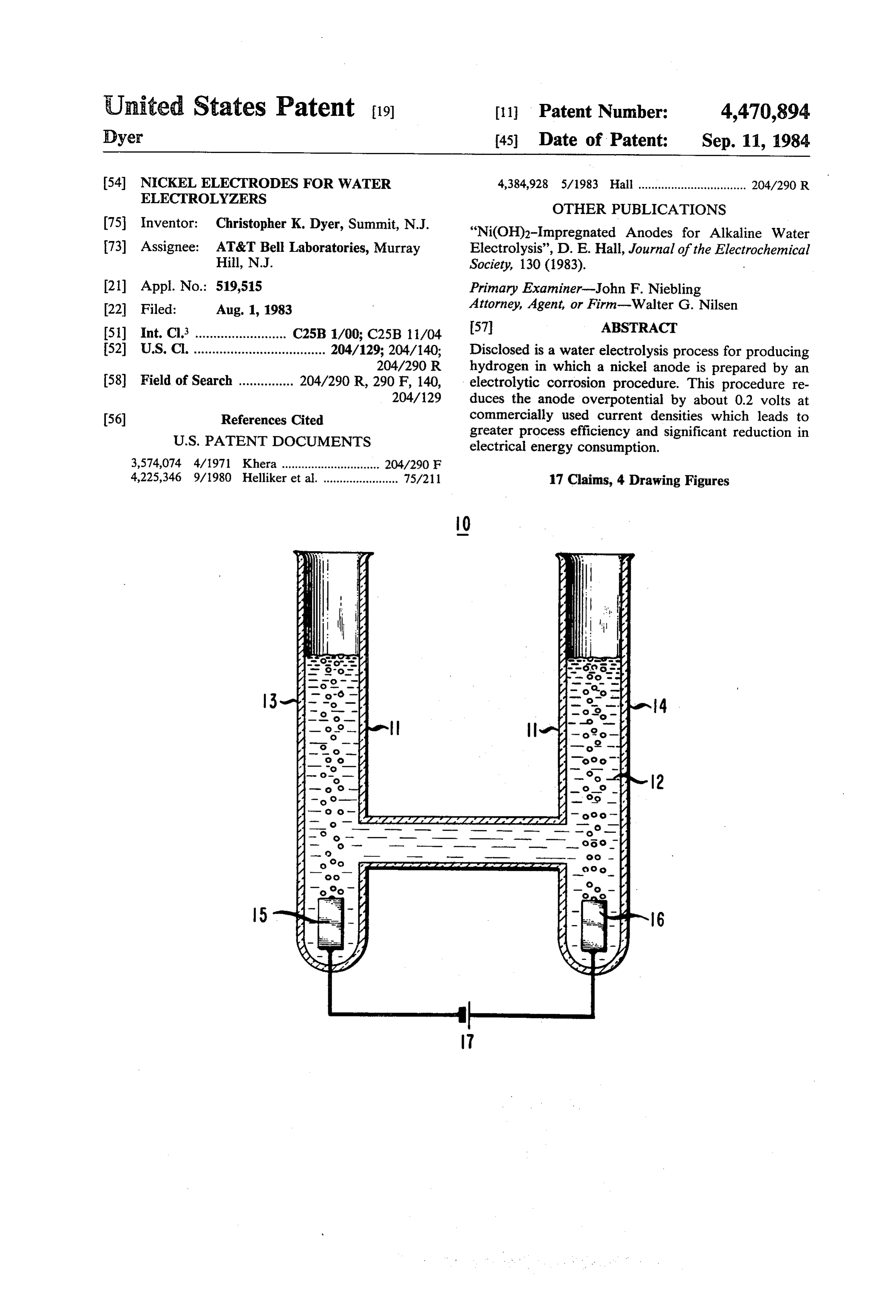
Page 1 — bibliographic record
United States Patent (19) 11 Patent Number: 4,470,894 Dyer 45 Date of Patent: Sep. 11, 1984 54 NCKEL ELECTRODES FOR WATER 4,384,928 5/1983 Hall ................................. 204/290 R
ELECTROLYZERS
OTHER PUBLICATIONS
(75) Inventor: Christopher K. Dyer, Summit, N.J. "Ni(OH)2-Impregnated Anodes for Alkaline Water 73) Assignee: AT&T Bell Laboratories, Murray Electrolysis', D. E. Hall, Journal of the Electrochemical Hill, N.J. Society, 130 (1983).
21) Appl. No.: 519,515 Primary Examiner-John F. Niebling 22 Filed: Aug. 1, 1983 Attorney, Agent, or Firm-Walter G. Nilsen 51) Int. Cl. ......................... C25B 1/00; C25B 11/04 57 ABSTRACT (52) U.S. Cl. .................................... 204/129; 204/140; Disclosed is a water electrolysis process for producing 204/290 R hydrogen in which a nickel anode is prepared by an (58) Field of Search ............... 204/290 R, 290 F, 140, electrolytic corrosion procedure. This procedure re 204/129 duces the anode overpotential by about 0.2 volts at 56) References Cited commercially used current densities which leads to
greater process efficiency and significant reduction in electrical energy consumption.
3,574,074 4/1971 Khera .............................. 204/290 F 4,225,346 9/1980 Helliker et al. ....................... 75/211 17 Claims, 4 Drawing Figures
Page 2
Drawing sheet — no readable text.
Page 3
Drawing sheet — no readable text.
Page 4
cycle. It is believed that the dissolution effect is due to
NICKEL ELECTRODES FOR WATER dissolution or breakdown of the protective or passivat ELECTROLYZERS ing film. (believed to be an oxide film) on the nickel surface. Typical substances to meet this requirement are
TECHNICAL FIELD 5 halide ions (particularly chloride and bromide ions) The invention is a process involving the electrolysis which are usually introduced in the form of alkali-metal of water. halides such as DC or KBr salts. Although the process is not highly sensitive to pH, generally pH values close
BACKGROUND OF THE INVENTION to neutral (i.e., pH 3 to 10) are preferred with 6-8 most Electrolytic processes involving water are of consid preferred. These pH ranges are preferred because of the erable importance commercially. Such processes in high rates for producing active material (nickel ions volve the electrodeposition of metals, electrochemical believed to be in the form of nickel hydroxide) and the synthesis procedures, electrochemical loading of elec ease of handling solutions close to neutral pH. Indeed, a trodes for batteries, etc. A particularly important indus particular advantage of the procedure is that it does not trial process involving the electrolysis of water is the involve use of corrosive or dangerous materials. Nickel production of hydrogen gas. Hydrogen gas is an excel anodes made in accordance with the above process lent source of energy and has many other uses in chemi have significantly lower overpotentials than conven cal technology and industry. tional anodes for the oxidation of water in a water elec It is highly desirable to reduce the cost of processes trolysis process. Also, nickel cathodes made by the involving the oxidation of water including hydrogen 20 same process also have lower overpotentials although production. Most of this cost is involved with the con the reduction is not usually as great as with the anode. sumption of electrical energy. Reduction of cell voltage Such reduced overpotentials make possible the produc at a given current density reduces the amount of electri tion of hydrogen by the electrolysis of water with con cal energy needed to produce a given amount of hydro siderably reduced consumption of electrical power. gen gas. 25
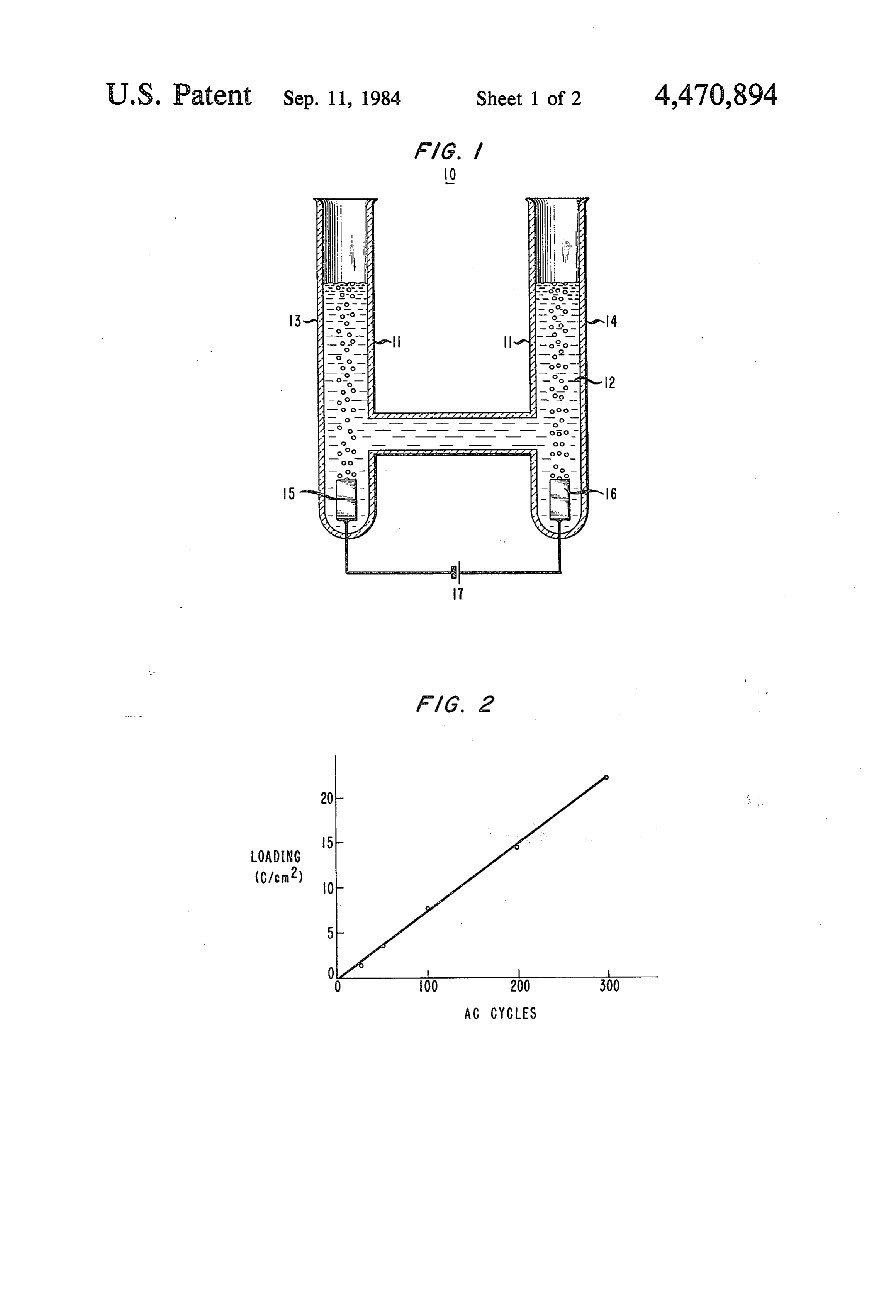
Much of the cell voltage in water electrolysis origi BRIEF DESCRIPTION OF THE DRAWING nates in the overpotential at the electrodes, especially FIG. 1 shows a typical apparatus for the electrolysis the anode. Nickel and its alloys are the preferred materi of water; r als for electrodes, especially anodes in the electrolysis FIG. 2 shows a graph of amount of loading as a func of water in alkaline solutions due to their high corrosion 30 tion of the number of cycles to which the nickel anode resistance at anodic potentials in aqueous alkaline solu is exposed in the loading process;
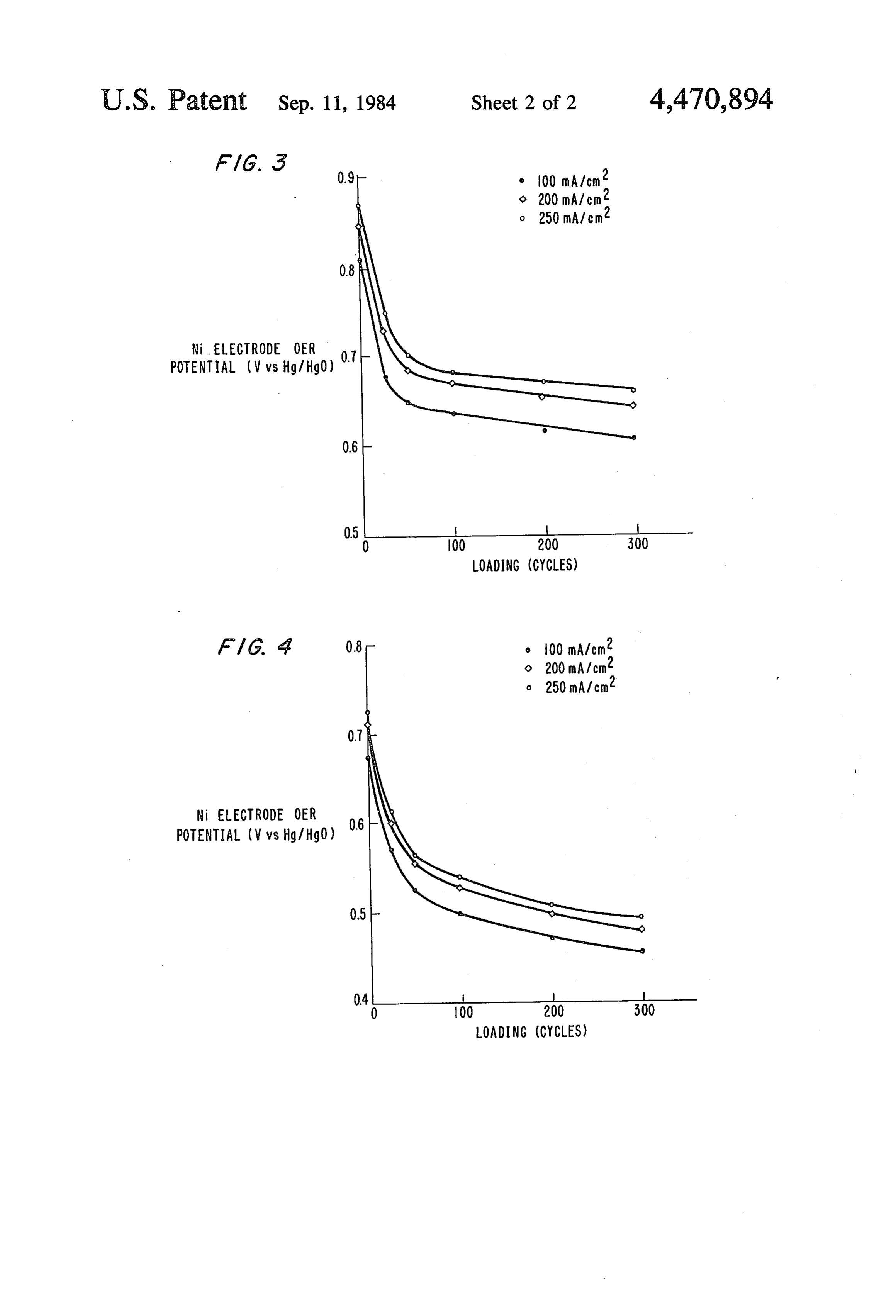
tions and their low cost. Many of the characteristics of FIG. 3 shows a graph of anode potential (using nickel anodes in the electrolysis of water are described Hg/HgO as a standard electrode) versus amount of in a publication entitled, "Ni(OH)2-Impregnated An loading for several current densities at room tempera odes for Alkaline Water Electrolysis” by D. E. Hall; 35
Journal of the Electrochemical Society, 130, 317 (1983). tures; and
Of particular interest is the disclosure. that nickel hy 80FIG. 4 shows the same type data at a temperature of degrees C.
droxide produced by electrochemical precipitation methods on the nickel anode reduces the oxygen evolu DETAILED DESCRIPTION tion overvoltage. However, even lower overvoltages 40 In broad terms, the invention is a process for oxidiz for either or both electrodes are highly desirable partic ularly for efficient and low-cost production of hydro ing water at an anode which has been made by a special electrolytic process. Such anodes have significantly gen. Much information on the production of hydrogen lower over voltages which have a number of significant by water electrolysis is contained in a book entitled, advantages. It significantly reduces the electrical en Hydrogen. Its Technology and Implications-Volume 1: 45 ergy consumption and significantly reduces costs asso Production Technology, K. E. Cox and K. D. William ciated with such processes. Often, undesirable side reac son, Jr. editors, CRC Press, Inc., Boca Raton, Fla. tions are reduced. A similar procedure for making the SUMMARY OF THE INVENTION cathode also leads to lower overvoltages, but the reduc The invention is a process involving the oxidation of 50 tion is usually not as great. The cathode is involved in water in which the anode is prepared in a special way. theAlthough reduction of water to form hydrogen. a large variety of electrolytic processes
The anode structure contains nickel and is treated by an involve the oxidation of water, overvoltage reduction is electrochemical process in which the anode structure is most significant economically in water electrolysis. It is subjected to alternating anodic and cathodic pulses. The first convenient to describe a typical water electrolysis same procedure reduces the overvoltage at the cathode 55 process but the reduction is usually not as great. The electro process. and a typical apparatus for carrying out such a The electrolysis of water invovles the oxida lytic process for preparing the electrode involves im pressing an alternating potential on the nickel electrode tion of water at an anode to form oxygen gas and the structure such that nickel metal dissolves on the oxidiz reduction of water at the cathode to form hydrogen gas. ing part of the cycle and nickel ions precipitate on the 60 Commercially, the process is principally used to pro reducing part of the cycle. It is believed that the nickel duce pure hydrogen (free of hydrocarbons obtained ions precipitate on the reducing part of the cycle be when hydrogen is produced by catalytic cracking of cause of the increase in pH inside the nickel structure. petroleum products).
The efficiency of the water electrolysis process de
The electrolytic solution should be sufficiently conduc tive to allow reasonable rates for the conversion process 65 pends on a number of factors including the voltage (conductivity greater than 0.001 mho-cm) and contain a necessary to pass a given amount of current through the substance (usually an anion) that enhances the dissolu electrolysis apparatus, the conductivity of the water, tion of nickel during the anodic or oxidizing part of the etc. For practical purposes, the water should have a
Page 5
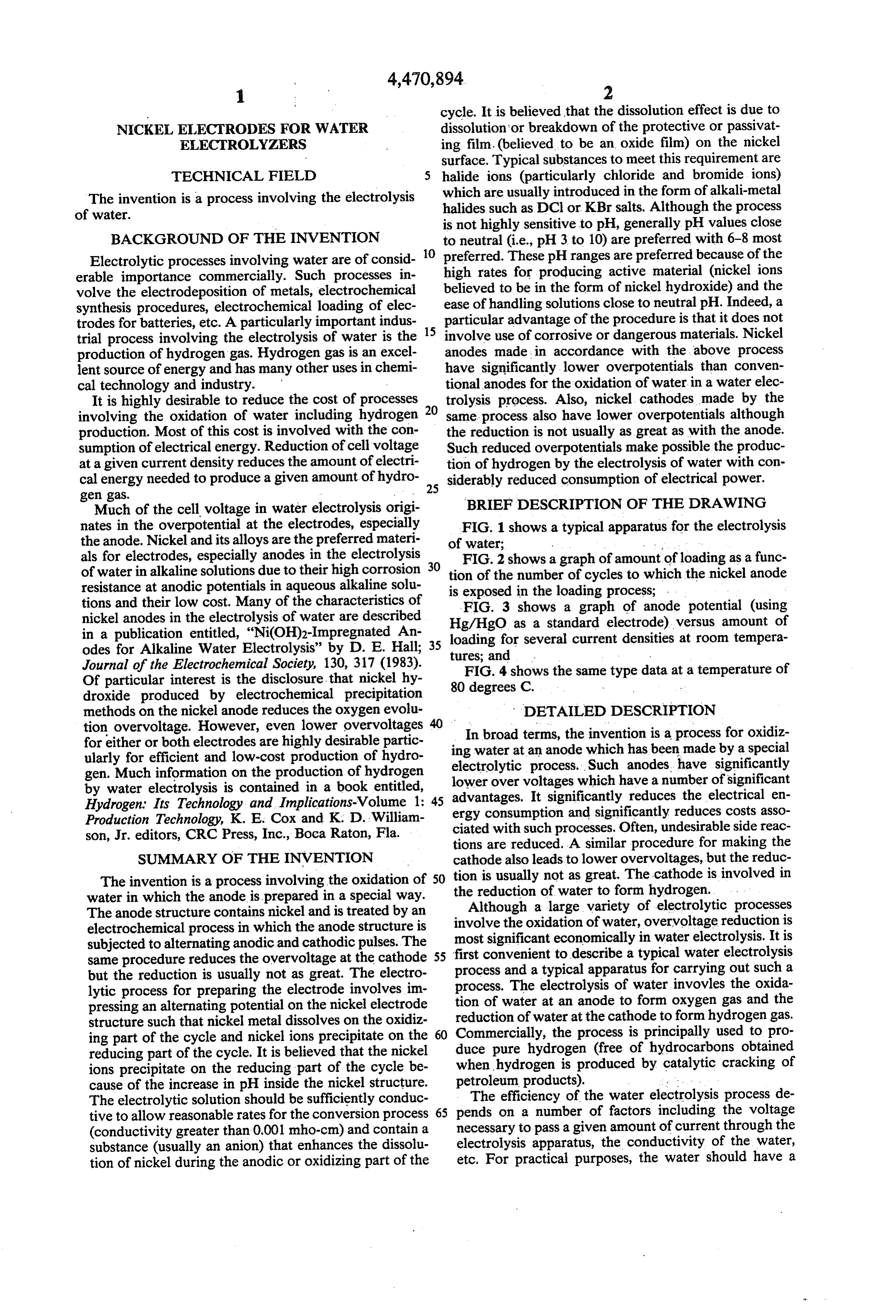
conductivity of at least 1 mho-cm but most electrolysis As stated above, the electrolytic solution should con processes have conductivities much greater than 1 mho tain sufficient electrolyte for a conductivity of at least cm, say 10 or 100 or higher mho-cm. 0.001 mho-cm and a substance which promotes anodic Generally, the electrolysis is carried out in highly dissolution of nickel. Various salts might be added to conducting solutions with pH greater than 7. Such solu improve conductivity.
tions may have a variety of compositions including high Preferred for the composition of the electrolytic solu salt concentrations, salts plus base, etc. Generally, the tion is an aqueous solution containing a halide ion, pref highest conductivities are obtained using aqueous alkali erably bromide or chloride with chloride most pre ferred. Although any convenient cation can be used in metal hydroxide solutions. Various concentrations are O the useful (e.g., 10 or 20 weight percent) but the highest electrolytic solution, generally an alkali-metal ion conductivity is obtained with a concentration of about (potassium, sodium, etc.) is most convenient. More than 30 weight percent (within about +20 percent) potas one cation and/or anion may be used.
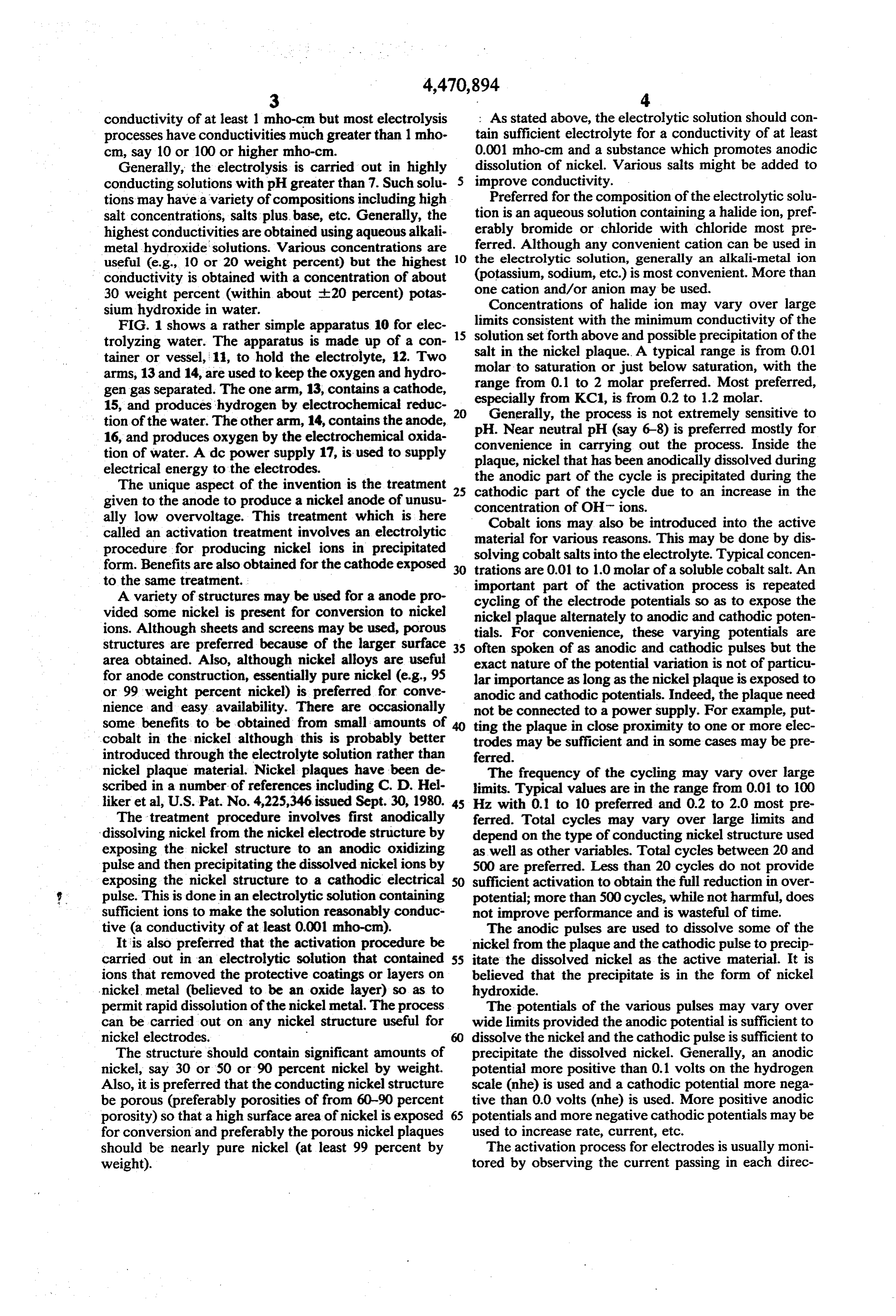
sium hydroxide in water. Concentrations of halide ion may vary over large FIG. 1 shows a rather simple apparatus 10 for elec 15 limits consistent with the minimum conductivity of the trolyzing water. The apparatus is made up of a con solution set forth above and possible precipitation of the tainer or vessel, 11, to hold the electrolyte, 12. Two salt in the nickel plaque. A typical range is from 0.01 arms, 13 and 14, are used to keep the oxygen and hydro molar to saturation or just below saturation, with the range from 0.1 to 2 molar preferred. Most preferred, gen gas separated. The one arm, 13, contains a cathode, especially from KC1, is from 0.2 to 1.2 molar. 15, and produces hydrogen by electrochemical reduc 20 Generally, the process is not extremely sensitive to tion of the water. The other arm, 14, contains the anode, pH. Near neutral pH (say 6-8) is preferred mostly for 16, and produces oxygen by the electrochemical oxida convenience in carrying tion of water. A dc power supply 17, is used to supply plaque, nickel that has beenout the process. Inside the anodically dissolved during electrical energy to the electrodes.
The unique aspect of the invention is the treatment 25 the anodic part of the cycle is precipitated during the cathodic part of the cycle due to an increase in the given to the anode to produce a nickel anode of unusu concentration of OH ions.
ally low overvoltage. This treatment which is here Cobalt ions may also be introduced into the active called an activation treatment involves an electrolytic material for various reasons. This may be done by dis procedure for producing nickel ions in precipitated solving cobalt salts into the electrolyte. Typical concen form. Benefits are also obtained for the cathode exposed 30 trations are 0.01 to 1.0 molar of a soluble cobalt salt. An to the same treatment. important part of the activation process is repeated A variety of structures may be used for a anode pro cycling of the electrode potentials so as to expose the vided some nickel is present for conversion to nickel nickel plaque alternately to anodic and cathodic poten ions. Although sheets and screens may be used, porous tials. For convenience, these varying potentials are structures are preferred because of the larger surface 35 often spoken of as anodic and cathodic pulses but the area obtained. Also, although nickel alloys are useful exact nature of the potential variation is not of particu for anode construction, essentially pure nickel (e.g., 95 lar importance as long as the nickel plaque is exposed to or 99 weight percent nickel) is preferred for conve anodic and cathodic potentials. Indeed, the plaque need nience and easy availability. There are occasionally not be connected to a power supply. For example, put some benefits to be obtained from small amounts of 40 ting the plaque in close proximity to one or more elec cobalt in the nickel although this is probably better trodes may be sufficient and in some cases may be pre introduced through the electrolyte solution rather than ferred.
nickel plaque material. Nickel plaques have been de The frequency of the cycling may vary over large scribed in a number of references including C. D. Hel limits. Typical values are in the range from 0.01 to 100 liker et al, U.S. Pat. No. 4,225,346 issued Sept. 30, 1980. 45 Hz with 0.1 to 10 preferred and 0.2 to 2.0 most pre The treatment procedure involves first anodically ferred. Total cycles may vary over large limits and - dissolving nickel from the nickel electrode structure by depend on the type of conducting nickel structure used exposing the nickel structure to an anodic oxidizing as well as other variables. Total cycles between 20 and pulse and then precipitating the dissolved nickel ions by 500 are preferred. Less than 20 cycles do not provide exposing the nickel structure to a cathodic electrical SO sufficient activation to obtain the full reduction in over pulse. This is done in an electrolytic solution containing potential; more than 500 cycles, while not harmful, does sufficient ions to make the solution reasonably conduc not improve performance and is wasteful of time. tive (a conductivity of at least 0.001 mho-cm). The anodic pulses are used to dissolve some of the It is also preferred that the activation procedure be nickel from the plaque and the cathodic pulse to precip carried out in an electrolytic solution that contained 55 itate the dissolved nickel as the active material. It is ions that removed the protective coatings or layers on believed that the precipitate is in the form of nickel nickel metal (believed to be an oxide layer) so as to hydroxide.
permit rapid dissolution of the nickel metal. The process The potentials of the various pulses may vary over can be carried out on any nickel structure useful for wide limits provided the anodic potential is sufficient to nickel electrodes. 60 dissolve the nickel and the cathodic pulse is sufficient to The structure should contain significant amounts of precipitate the dissolved nickel. Generally, an anodic nickel, say 30 or 50 or 90 percent nickel by weight. potential more positive than 0.1 volts on the hydrogen Also, it is preferred that the conducting nickel structure scale (nhe) is used and a cathodic potential more nega be porous (preferably porosities of from 60-90 percent tive than 0.0 volts (nhe) is used. More positive anodic porosity) so that a high surface area of nickel is exposed 65 potentials and more negative cathodic potentials may be for conversion and preferably the porous nickel plaques used to increase rate, current, etc. should be nearly pure nickel (at least 99 percent by The activation process for electrodes is usually moni weight). tored by observing the current passing in each direc
Page 6
tion. The exact waveform of the potential is not gener electrochemical processes involving the oxidation of ally of importance. A sinusoidal variation is often con Water.
venient but a square waveform is often more convenient Some benefits are also obtained by preparing the for monitoring the activation process. Various other cathode in the same way as the anode. Overvoltage waveforms including asymmetric waveforms are also reductions of about 50 mv are obtained. The mechanism useful. The ratio of anodic to cathodic charge in a given for this reduction of overvoltage is not immediately cycle may vary between 10 and 0.1.
A number of experiments were carried out to ascer apparent.
surface of
It might involve modification of the nickel the plaque rather than the presence of nickel tain the voltage reduction obtained through the activa tion procedure and the optimum amount of loading 10 compounds in the nickel plaque. What is claimed is:
required for a given voltage reduction. The activation 1. An electrochemical process comprising the step of procedure is meant to produce a highly uniform layer of passing current through anode, aqueous electrochemi active nickel hydroxide within a porous nickel structure cal without blocking the pores so as to permit electrolytes the solution anode to and cathode in which water is oxidized at form oxygen, the anode is made from an to enter into the nickel pores. The electrode structure anode structure by an electrolytic procedure and the was made of sintered nickel having an average porosity 15 anode structure comprises nickel characterized in that of 77.5 percent with a mean pore size of 12.7 mm. This the electrolytic procedure comprises the step of expos nickel structure was supported on a nickel wire mesh ing the anode structure to alternate anodic made with a 1 cm2 projected area. The sintered nickel potentials in an electrolytic solution, saidand cathodic electrolytic electrode structure was subjected to activation treat solution having conductivity greater than 0.001 mho ments of -125 ma (peak to peak) altering current at a 20 frequency of 0.25 Hz and using a squarre waveform. cm and said electrolytic solution comprising ions that enhance the dissolution of metallic nickel.
The electrode was a 1 molar aqueous solution of potas 2. The process of claim 1 in which the electrolytic sium chloride.
Different amounts of activation were used so as to solution has a pH between 3 and 10. ascertain the characteristics of the electrode as a func 25 3. The process of claim 1 in which the electrolytic tion of activation. After the activation process, the elec solution comprises halide ion. 4. The process of claim 3 in which the halide ion is a trodes were washed in distilled water. They were then chloride ion.
subjected to a charge/discharge cycle at 250 ma/cm2 in 30 percent potassium hydroxide in order to determine 5. The process of claim 4 in which the concentration their coulombic capacity. This is a direct measure of the 30 of6.chloride ion is between 0.01 molar and saturation. The process of claim 5 in which the concentration load level of active nickel hydroxide in the porous of chloride ion is between 0.1 and 2 molar. Structure.
The results of this part of the tests are shown in FIG. in 7.theThe process of claim 6 in which the chloride ion is form of dissolved KCl and the concentration of 2. Here, loading as measured by electrode capacity in chloride units of coulombs/cm2 of projected area is shown as a 35 8. Theion is between 0.2 and 1.2 molar. process of claim 1 in which the electrolytic function of the number of cycles in the activation proce dure. This graph can also be used to interpret the load solution comprises cobalt ions.
ings in the graphs of FIG. 3 and 4. As can be seen from 9. The process of claim 1 in which the electrochemi FIG. 2, the loading increases linearly with the number cal process is the electrolysis of water. of cycles used in the activation procedure. 10. The process of claim 1 in which the conductivity Each electrode was then recharged to oxygen evolu of the aqueous electrochemical solution is greater than tion potentials in 30 percent potassium hydroxide at a 100 mho-cm.
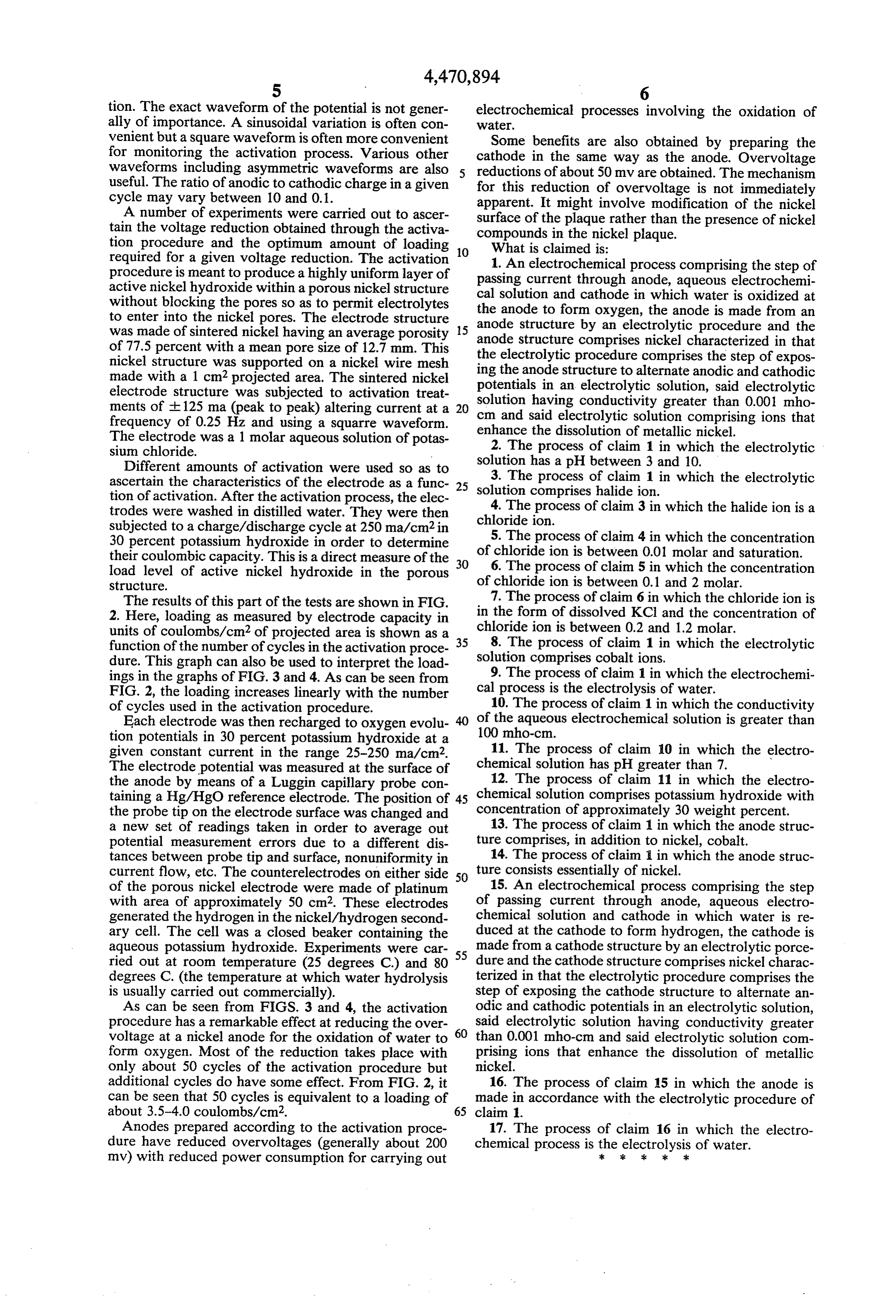
given constant current in the range 25-250 ma/cm2. 11. The process of claim 10 in which the electro The electrode potential was measured at the surface of chemical solution has pH greater than 7. the anode by means of a Luggin capillary probe con 12. The process of claim 11 in which the electro taining a Hg/HgO reference electrode. The position of 45 chemical solution comprises potassium hydroxide with the probe tip on the electrode surface was changed and concentration of approximately 30 weight percent. a new set of readings taken in order to average out 13. The process of claim 1 in which the anode struc potential measurement errors due to a different dis ture comprises, in addition to nickel, cobalt. tances between probe tip and surface, nonuniformity in 14. The process of claim in which the anode struc current flow, etc. The counterelectrodes on either side 50 ture consists essentially of nickel. of the porous nickel electrode were made of platinum 15. An electrochemical process comprising the step with area of approximately 50 cm2. These electrodes of passing current through anode, aqueous electro generated the hydrogen in the nickel/hydrogen second chemical solution and cathode in which water is re ary cell. The cell was a closed beaker containing the duced at the cathode to form hydrogen, the cathode is aqueous potassium hydroxide. Experiments were car 55 made from a cathode structure by an electrolytic porce ried out at room temperature (25 degrees C.) and 80 dure and the cathode structure comprises nickel charac degrees C. (the temperature at which water hydrolysis terized in that the electrolytic procedure comprises the is usually carried out commercially). step of exposing the cathode structure to alternate an As can be seen from FIGS. 3 and 4, the activation odic and cathodic potentials in an electrolytic solution, procedure has a remarkable effect at reducing the over 60 said electrolytic solution having conductivity greater voltage at a nickel anode for the oxidation of water to than 0.001 mho-cm and said electrolytic solution com form oxygen. Most of the reduction takes place with prising ions that enhance the dissolution of metallic only about 50 cycles of the activation procedure but nickel.
additional cycles do have some effect. From FIG. 2, it 16. The process of claim 15 in which the anode is can be seen that 50 cycles is equivalent to a loading of made in accordance with the electrolytic procedure of about 3.5-4.0 coulombs/cm2. 65 claim 1.
Anodes prepared according to the activation proce 17. The process of claim 16 in which the electro dure have reduced overvoltages (generally about 200 chemical process is the electrolysis of water. mv) with reduced power consumption for carrying out sk : ck k k
Provenance
- Collection
- Cited prior art
- Original PDF
- patentimages.storage.googleapis.com →
- Filed
- 1983-08-01
- Pages
- 6
- Method
- pdftotext (the PDF's own text layer) + pdftoppm 300dpi page scans
- Source
- Google Patents bibliographic record
- Granted
- 1984-09-11
- Inventors
- Christopher K. Dyer; AT&T Bell Laboratories Inc
- Transcribed from
- patentimages.storage.googleapis.com →