patent · US4403576
Fuel system for and a method of operating a spark-ignited internal combustion engine
13 September 1983
Page 1 — bibliographic record
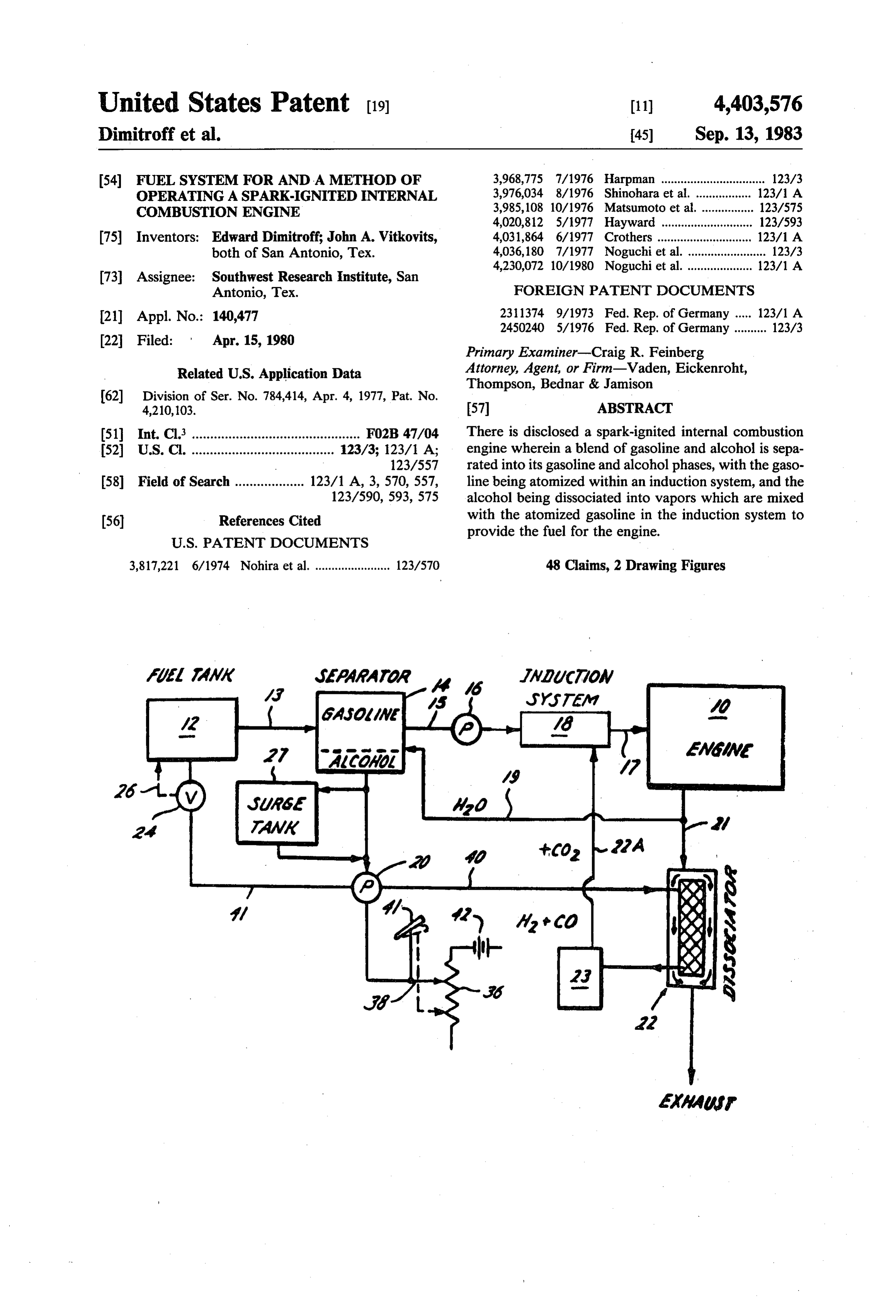
United States Patent (19) 11) 4,403,576 Dimitroff et al. 45) Sep. 13, 1983 54 FUEL SYSTEM FOR AND A METHOD OF 3,968,775 7/1976 Harpman ................................ 123/3 OPERATING ASPARK-GNITED INTERNAL 3,976,034 8/1976 Shinohara et al. .... 8 was a 123/1 A
COMBUSTION ENGINE 3,985, 108 10/1976 Matsumoto et al. .. a ---- 123/575
4,020,812 5/1977 Hayward ... 123/593 (75) Inventors: Edward Dimitroff; John A. Vitkovits, 4,031,864 6/1977 Crothers .... 123/1 A both of San Antonio, Tex. 4,036,180 7/1977 Noguchi et al. ........................ 123/3 4,230,072 10/1980 Noguchi et al. .................... 123/1 A (73) Assignee: Southwest Research institute, San
Antonio, Tex. FOREIGN PATENT DOCUMENTS 21 Appl. No.: 140,477 23i 1374 9/1973 Fed. Rep. of Germany ..... 123/1 A
Primary Examiner-Craig R. Feinberg
Related U.S. Application Data Attorney, Agent, or Firm-Vaden, Eickenroht,
Thompson, Bednar & Jamison
(51) Int. Cl' .............................................. FO2B 47/04 There is disclosed a spark-ignited internal combustion 52 U.S. C. ....................................... 123/3; 123/1 A; engine wherein a blend of gasoline and alcohol is sepa 123/557 rated into its gasoline and alcohol phases, with the gaso 58 Field of Search ................... 123/1 A, 3, 570, 557, line being atomized within an induction system, and the 123/590, 593, 575 alcohol being dissociated into vapors which are mixed (56) References Cited with the atomized gasoline in the induction system to provide the fuel for the engine.
3,817,221 6/1974 Nohira et al. ....................... 123/570 48 Claims, 2 Drawing Figures
Page 2
Drawing sheet — no readable text.
Page 3
,, ..." spark-ignited internal combustion engine in which en FUEL SYSTEM FOR AND A METHOD OF gine efficiency is improved over that which would be OPERATING ASPARK-IGNITED INTERNAL . obtained with the use of a conventional fuel system. COMBUSTON ENGINE Another object is to provide a fuel system and 5 method of operating a spark-ignited internal combus
This is a divisional of application Ser. No. 784,414, tion engine which permits dissociation of the alcohol filed Apr. 4, 1977, by Edward Dimitroff and John A. without the necessity for a catalyst. Vitkovits, entitled 'Fuel System for and a Method of These and other objects are accomplished, in accor Operating a Spark-Ignited Internal Combustion Sys dance with the illustrated embodiment of the present tem', now U.S. Pat. No. 4,210,103. 10 invention, by a fuel system for such an engine in which This invention relates to an improved fuel system for gasoline is atomized within an induction system, a hy a spark-ignited internal combustion engine and a drocarbon alcohol of 1 to 3 carbon atoms is dissociated method of operating the engine using such a system. into vapors including hydrogen, carbon monoxide and The need for finding alternative sources of fuel has carbon dioxide, and the vapors and atomized gasoline become critical in view of the rapidly decreasing petro 15 are mixed in the induction system in order to provide a leum reserves from which gasoline is made. Sources fuel for the engine. Since only the gasoline flows which have in the past and are now receiving consider through the fuel pump and carburetor, there is no op able attention in this respect are hydrocarbon alcohols, portunity for the alcohol to cause corrosion of these such as methyl alcohol, ethyl alcohol, propyl alcohol parts. Furthermore, since the gasoline is introduced and isopropyl alcohol, all of which are of 1 to 3 carbon 20 directly into a carburetor of the induction system and atoms. Of these alcohols, methyl alcohol or methanol is the vapors are introduced directly into the intake mani preferred, because, among other things, it can be pro fold of the induction system, there is no opportunity for duced from non-petroleum sources, such as coal. vapor lock. Still further, since the alcohol is dissociated However, if alcohols of this type are supplied to the before induction into the engine, it is possible to take induction system, similarly to gasoline, several design 25 advantage of superior thermal efficiency of its vapors changes must be made in the induction system and en due to their wider ignitability range. gine in order to obtain, proper combustion. Further In the preferred operation of the engine, the amount more, not all of these changes can be made in existing of vapors mixed with the atomized gas is regulated in engines. - response to the mass ratio of air to gasoline being atom It has also been suggested that the methanol be 30 ized in the induction system or the engine load. More cracked into its component vapors including hydrogen, particularly, only atomized gasoline is supplied to the carbon monoxide and carbon dioxide which are then engine until it starts, and less vapors are supplied to the supplied to the engine. In addition to requiring a modi induction system as the engine load increases, up to a fied engine and induction system, this method of operat point at which the supply of vapors is discontinued ing the engine requires catalysts, such as reduced cop 35 when the mass ratio of air to gasoline becomes greater per and nickel, in order to crack the alcohol. These than 13 to 1 or an engine load of greater than 60 percent. catalysts are not only expensive, but also must be re The addition of less vapors as the air to gasoline mass placed periodically in order to maintain the cracking ratio increases has been found to provide a more com efficiency. plete combustion of the atomized gasoline at lower Efforts to use a blend of alcohol and gasoline as a fuel 40. loads, which develops more engine power at a lower for operating engines of this type having conventional specific fuel consumption. Moreover, as is well known, induction systems have encountered several problems. the emissions from such an engine are greater at lower For one thing, there is a significant deterioration of air to gasoline mass ratios and at certain engine load drivability due to the engine's "leaning' effect-i.e., the conditions, such as idle, and by adding the vapors at response to acceleration decreases as more alcohol is 45 these lower ratios and conditions, CO, NOx and un added to the blend. Also, the blends are water sensitive, burned hydrocarbon emissions are decreased as com so that a little water in the fuel tank causes the blend to pared with a 100 percent gasoline fuel. However, it was separate into its phases, resulting in serious engine mal found that these advantages are lost and begin to deteri functions. Furthermore, the alcohol will evaporate in orate when the air to gasoline mass ratio is greater than hot climates, thus causing vapor lock, and it is difficult 50 13 to 1 or an engine load of greater than 60 percent. to maintain the alcohol and gasoline in a blend at sub Preferably, the alcohol is dissociated into its vapors freezing, temperatures. Still further, when the alcohol within a chamber so disposed in the engine exhaust pipe ... contacts lead, magnesium, aluminum and certain plas as to be in heat exchange relation with the exhaust gas tics, such as may be used in the induction system, it therein. More particularly, the alcohol is introduced causes corrosion and degradation. .. 55 into a thermal pyrolysis chamber which produces the It is therefore the primary object of the present inven vapors by heat alone, and thus without the use of cata tion to provide a fuel system for and a method of operat lysts.
ing a spark-ignited internal combustion engine which It is also preferred that a blend of the gasoline and may use an alcohol-gasoline blend as a fuel, without alcohol be stored in a fuel tank and then supplied to encountering the aforementioned problems. . . . 60 another tank in which they may be separated into their Moreover, it is an aim of the present invention to phases for supply to the carburetor and dissociator upon provide such a fuel system for and a method of operat demand. In this manner, the system may be empioyed ing a spark-ignited internal combustion engine that pro for operating the engine of a vehicle with a minimum of duces lower CO, NOx and unburned hydrocarbon ex alteration of the fuel system, and the phase separation haust emissions than those produced from an engine 65. characteristics of alcohol-gasoline blends by the addi that uses 100 percent gasoline as a fuel. tion of water is changed from a handicap to an asset. In Further, it is an aim of the present invention to pro the illustrated embodiment of the invention, the blend is vide a fuel system for and a method of operating a separated by water which is supplied to the separator
Page 4
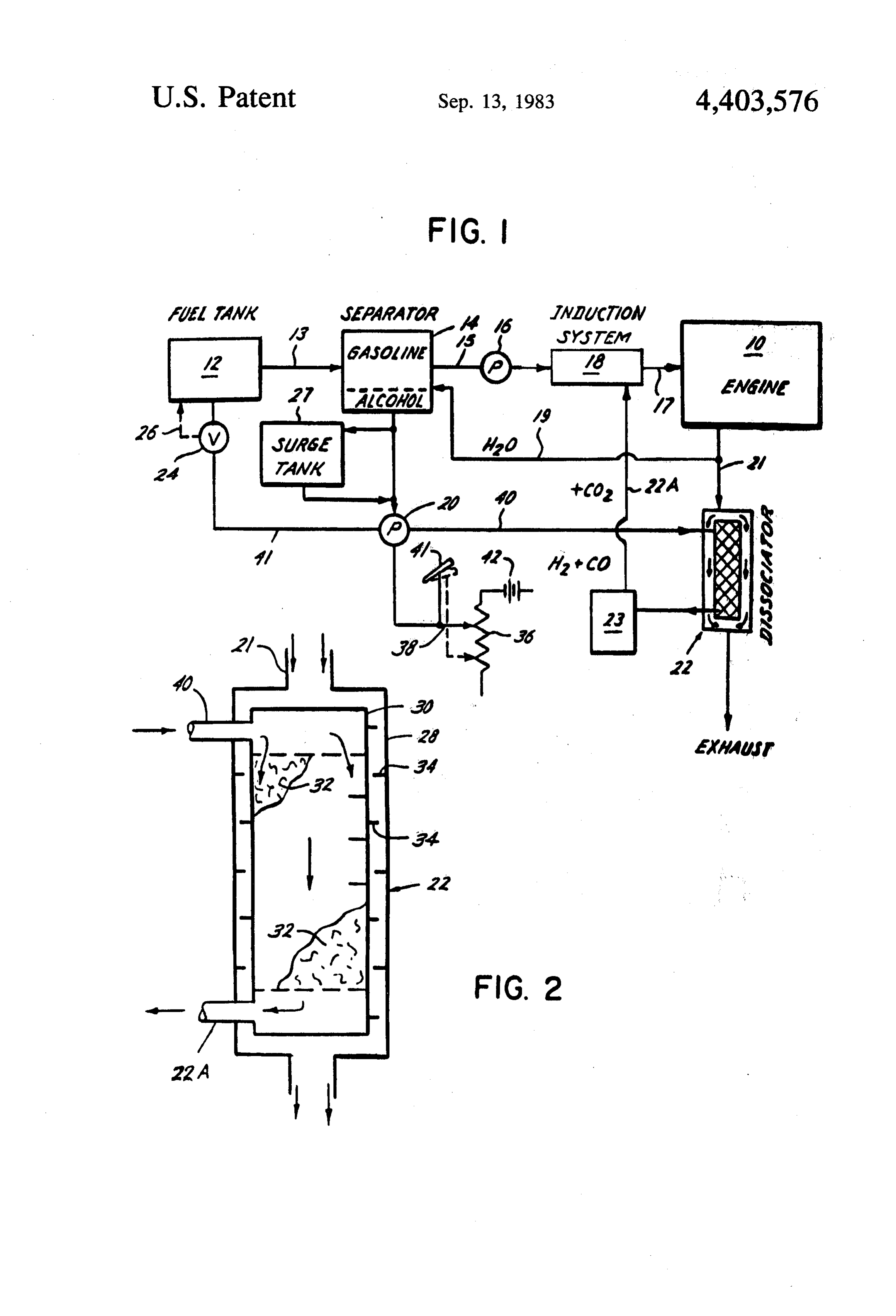
tank from the exhaust system of the engine. Addition intermediate portion 32 of the chamber is filled with ally, means may be provided for supplying the alcohol steel wire mesh through which the alcohol is caused to to the dissociator automatically in response to separa pass from the inlet to the outlet of the chamber. tion of the alcohol from the gasoline, if it should occur During passage through the chamber 32, the alcohol in the fuel tank. is vaporized by virtue of the heat alone resulting from In the drawings, wherein like reference characters the circulation of the exhaust in heat exchange relation are used throughout to designate like parts: about the chamber 30. A chamber of this sort, in which FIG. 1 is a diagrammatic illustration of a spark vaporization dissociation occurs solely in response to ignited internal combustion engine having a fuel system heat, and thus without the need for catalysts, is known constructed in accordance with the present invention; 10 as a thermal pyrolysis chamber. The wire mesh within and the intermediate portion of the chamber provides large FIG. 2 is an enlarged diagrammatic illustration of the surface areas which the alcohol is caused to contact and dissociator of the system. thus promote vaporization.
With reference now to the details of FIG. 1, the As previously described, this invention contemplates, spark-ignited internal combustion engine 10 is supplied 15 in its broadest aspects, that the synthetic fuel may use a with fuel by means of a fuel system which includes an hydrocarbon alcohol of 1 to 3 carbon atoms, including induction system 18 having a conventional carburetor not only methanol (methyl alcohol), but also ethyl alco in which gasoline may be atomized, and requiring a hol, propyl alcohol and isopropyl alcohol. Methanol is minimum alteration of an intake manifold into which preferred, however, for one reason because of its ability the alcohol vapors may be introduced, and from which to dissociate in response to the heat and temperature the fuel may be supplied to the engine through line. 17. provided by the exhaust of engine 10, which normally The system also includes a tank 12 in which the blend of varies from 900 F. to 1150 F. It was found that metha alcohol and gasoline may be stored; and in accordance nol begins dissociating around 600 F. and sufficient with this invention, this tank may be a conventional fuel heat transfer takes place in dissociator 22 to cause con tank of a vehicle powered by the engine 10. 25 tinuous dissociation of methanol without use of a cata Normally, the gasoline and alcohol phases will not lyst at all demand rates of induction system 18. In par separate in the tank 12, but will be supplied through a ticular, the methanol is dissociated into vapors which line 13 to another tank 14 in which they are caused to include hydrogen, carbon monoxide and carbon diox separate. When separated from the alcohol, the gasoline ide. In this system, it has been determined that the disso is supplied to the carburetor of induction system 18 by 30 ciation of methanol results in a vapor composition, by means of a pump 16 within supply line 15 connecting volume, of 60 to 65 percent hydrogen, 20 to 25 percent separator tank 14 with the carburetor. The pump may carbon monoxide, 5 to 15 percent carbon dioxide and 5 also be a conventional part of the standard fuel system to 10 percent methane. Filter 23 is disposed within line used when gasoline is the only fuel. 22A leading from the dissociator to the induction sys The gasoline and alcohol are caused to separate by 35 tem for the purpose of removing carbon particles from the introduction to the tank 14 of water through a line the dissociated vapors.
19. Water may be supplied from condensation in the As shown, baffles 34 are provided on the inner sur exhaust pipe 21 leading from engine 10, and, for this face of the enlarged portion 28 of the exhaust pipe, and purpose, the supply line 19 connects tank 14 with the on the outer surfaces of chamber 30, in order that the exhaust pipe, as shown in FIG. 1. dissociator will cooperate with the exhaust pipe in pro The alcohol is withdrawn from separator tank 14 by viding a muffling action for the exhaust. means of a pump 20 in a line 40 connecting tank 14 with As previously described, this invention further con a dissociator 22, where, as previously described, the templates that the amount of vapors mixed with the alcohol is dissociated into its vapors. A small amount of atomized gasoline supplying fuel to the engine 10 may water may be carried with the alcohol from separator 45 be regulated in response to the mass ratio of air to gaso tank 14 to dissociator 22, which may be helpful in caus line or to the engine load. For this purpose, pump 20 is ing a decrease in carbon particle formation and a slight of an electric type having its output controlled by a increase in hydrogen vapor formation. The vapors are means. This means may be responsive to the air to gaso then supplied to the intake manifold of the induction line mass ratio supplied the engine resulting from move system 18 through line 22A connecting the dissociator 50 ment of the throttle by depression of an accelerator therewith. The vapors and atomized gasoline are mixed pedal 40, as when the carburetor is a fixed throat type. within the manifold, and the mixture then supplied to Or, this means may be responsive to the load on the the engine 10 through line 17 connecting the manifold engine resulting from movement of the throttle by, de to the engine for providing fuel to operate the engine. pression of accelerator pedal 40, as when the carburetor, As also shown in FIG. 1, a line 41 connects fuel tank 55 is a variable throat type. ". . . . 10 to supply line 40 upstream of the pump 20 so as to Power is supplied to the pump from a battery 42 supply alcohol to the dissociator 22 in the event it sepa through a variable resistor 36, and a slide 38 is con rates from the gasoline in the fuel tank 12. For this nected to accelerator pedal 40 for movement as the purpose, a valve 24 in line 41 is caused to open automati latter is depressed so as to vary the potential from the cally in response to separation in the fuel tank which is battery to the pump. Thus, as the pedal is depressed to sensed by suitable means connecting with the valve increase the amount of air flowing into engine 10, pump through a line 26. 20 is caused to supply less alcohol to the dissociator, As best shown in FIG. 2, dissociator 22 includes a which in turn supplies less vapors to the induction sys chamber 30 disposed concentrically within an enlarged tem 12. s: . . . . . portion 28 of the exhaust pipe 21. The chamber 30 has 65 It has been found that burning the vapors of methanol an inlet at one end to which supply line 40 is connected adversely affects the engine's efficiency at higher air to: and an outlet at its opposite end to which supply line gas mass ratio and at higher engine loads, and varying 22A leading to the induction system is connected. The the amount of methanol in the blend from 5 percent to
Page 5
75 percent by volume will improve the engine effi separated gasoline from the separator tank to the induc ciency. More particularly, this invention contemplates tion system through a first conduit means in order to that if the supply of vapors to the induction system is atomize the gasoline, supplying separated liquid alcohol discontinued, and only atomized gasoline supplied to from the separator tank through a second conduit the engine when the air to gasoline mass ratio is greater means separate from the first conduit means to a means than 13 to 1 or the engine load is greater than 60 per in which the liquid alcohol is dissociated into vapors cent, this will improve the efficiency of the engine over including hydrogen, carbon monoxide and carbon diox that which would result from the use of the same blend ide, supplying the vapors to the induction system for used in a system which would supply alcohol continu mixing with the atomized gasoline to provide a fuel for ously. The conventional induction system is inherently 10 the engine, and regulating the amount of vapors mixed designed to provide the best specific gasoline consump with the atomized gasoline by supplying less vapors to tion and the worst specific alcohol consumption at the engine as the mass ratio of air to gasoline in the higher engine loads and air to gasoline mass ratios. induction system increases and discontinuing the supply Therefore, proper utilization of the alcohol-gasoline of vapors when the engine load becomes greater than 60 blend requires the discontinuation of the alcohol vapors 15 percent.
at engine loads greater than 60 percent and air to gaso 4. In a method as set forth in claim 3, wherein the line mass ratios of greater than 13 to 1. dissociated vapors are supplied to the induction system Since the amount of alcohol supplied to the dissocia only after the engine is started with gasoline alone. tor is regulated, a surge tank 27 is disposed within sup 5. In a method of operating a spark-ignited internal ply line 40 upstream of the pump 20 and the connection 20 combustion engine having an induction system to which to the supply line of the auxiliary line 41. Consequently, gasoline may be supplied for atomization, the steps of alcohol may be stored in the surge tank 27 when the dissociating a liquid hydrocarbon alcohol of from 1 to 3 pump is not being used, such as during highway driving carbon atoms into vapors including hydrogen, carbon with a medium engine load and a mass ratio of air to fuel monoxide and carbon, dioxide, supplying the vapors to of greater than 13 to 1. On the other hand, it provides an 25 the induction system for mixing with atomized gasoline additional source of alcohol when the demand for it is to provide a fuel for the engine, and regulating the increased, as previously described. amount of vapors mixed with the atomized gasoline by While the invention has been described in connection supplying less vapors to the engine as the mass ratio of with a preferred embodiment and procedure, it will be air to gasoline in the induction system increases and understood that it is not intended to limit the invention 30 discontinuing the supply of vapors when the engine to that particular embodiment and procedure. On the load becomes greater than 60 percent.
contrary, it is intended to cover all alternatives, modifi 6. In a method as set forth in claim 5, wherein the cations and equivalents as may be included within the dissociated vapors are supplied to the induction system spirit and scope of the invention as defined by the ap only after the engine is started with gasoline alone. pended claims. 35 7. In a method of operating a spark-ignited internal What is claimed is: combustion engine having an induction system to which 1. In a method of operating a spark-ignited internal gasoline may be supplied for atomization, the steps of combustion engine having an induction system in which circulating a liquid hydrocarbon alcohol of from 1 to 3 gasoline may be atomized, the steps of storing a blend of carbon atoms through a pyrolysis chamber, passing gasoline and a liquid hydrocarbon alcohol of from 1 to 40 exhaust from the engine in heat exchange with said 3 carbon atoms in a fuel tank, receiving the blend from chamber in order to produce vapors including hydro the fuel tank into a separator tank in which the blend is gen, carbon monoxide and carbon dioxide in response to separated into gasoline and liquid alcohol, supplying heat without the need for catalysts, introducing the separated gasoline from the separator tank to the induc vapors to the induction system for mixing with the tion system through a first conduit means in order to 45 atomized gasoline to provide a fuel for the engine, regu atomize the gasoline, supplying separated liquid alcohol lating the amount of vapors mixed with the atomized from the separator tank through a second conduit gasoline by supplying less dissociated vapors to the means separate from the first conduit to a means in engine as the mass ratio of air to gasoline in the induc which the liquid alcohol is dissociated into vapors in tion system increases and discontinuing the supply of cluding hydrogen, carbon monoxide and carbon diox 50 vapors when the air to gasoline mass ratio becomes ide, supplying the vapors to the induction system for greater than 13 to 1.
mixing with the atomized gasoline to provide a fuel for 8. In a method as set forth in claim 7, wherein the the engine, and regulating the amount of vapors mixed dissociated vapors are supplied to the induction system with the atomized gasoline by supplying less dissociated only after the engine is started with gasoline alone. vapors to the engine as the mass ratio of air to gasoline 55 9. In a method of operating a spark-ignited internal in the induction system increases and discontinuing the combustion engine having an induction system in which supply of vapors when the air to gasoline mass ratio gasoline may be atomized, the steps of supplying gaso becomes greater than 13 to 1. line to the induction system for atomization, circulating 2. In a method as set forth in claim 1, wherein the a liquid hydrocarbon alcohol of from 1 to 3 carbon dissociated vapors are supplied to the induction system atoms through a thermal pyrolysis chamber, passing only after the engine is started with gasoline alone. exhaust from the engine in heat exchange relation with 3. In a method of operating a spark-ignited internal said chamber in order to produce vapors including combustion engine having an induction system in which hydrogen, carbon monoxide and carbon dioxide in re gasoline may be atomized, the steps of storing a blend of sponse to heat without the need for catalysts, introduc gasoline and a liquid hydrocarbon alcohol of from 1 to 65 ing the vapors to the induction system for mixing with 3 carbon atoms in a fuel tank, receiving the blend from the atomized gasoline to provide a fuel for the engine, the fuel tank into a separator tank in which the blend is and regulating the amount of vapors mixed with the separated into gasoline and liquid alcohol, supplying atomized gasoline by supplying less vapors to the en
Page 6
gine as the mass ratio of air to gasoline in the induction 5. In a method of operating a spark-ignited internal system increases and discontinuing the supply of vapors combustion engine having an induction system in which when the engine load becomes greater than 60 percent. gasoline may be atomized, the steps of providing a dis 10. In a method as set forth in claim 9, wherein the sociator having a thermal pyrolysis chamber in which dissociated vapors are supplied to the induction system 5 an alcohol of from 1 to 3 carbon atoms may be dissoci only after the engine is started with gasoline alone. ated into vapors including hydrogen, carbon monoxide, 11. In a method of operating a spark-ignited internal and carbon dioxide, the steps of supplying gasoline to combustion engine having an induction system in which the carburetor in order to atomize same, supplying gasoline may be atomized, an exhaust, and means for essentially only the alcohol in the pyrolysis chamber in supplying gasoline to a carburetor in the induction sys- 10 order to produce the vapors, in the absence of addi tem for atomization; the steps of circulating essentially tional air so as to substantially prevent oxidation only a liquid hydrocarbon of from 1 to 3 carbon atoms thereof, and supplying the vapors and gasoline to the through a thermal pyrolysis chamber in heat exchange induction system and mixing the vapors with atomized relation with the exhaust gases in order to dissociate gasoline therein in order to provide a fuel for the en said alcohol into vapors including hydrogen, carbon gine.
16. In a method of the character defined in claim 15, monoxide and carbon dioxide in the absence of addi tional air so as to substantially prevent oxidation thereof including the further step of regulating the amount of and solely in response to such heat and without need for vapors mixed with the atomized gasoline by supplying less vapors to the engine as the mass ratio of air to gaso catalysts, and then supplying the vapors to the induc 20 line in the induction system increases and discontinuing tion system for mixing with the atomized gasoline to the supply of vapors when the air to gasoline mass ratio provide a fuel for the engine.
12. In a method of operating a spark-ignited internal becomes greater than 13 to 1. 17. In a method of the character defined in claim 5, combustion engine having an induction system in which gasoline may be atomized, an exhaust, and means for 25 including the further step of supplying the dissociated supplying gasoline to the induction system for atomiza gasoline alone.engine only after the engine is started with vapors to the tion; the steps of circulating essentially only a liquid i8. In a method of operating a spark-ignited internal hydrocarbon alcohol of from 1 to 3 carbon atoms combustion through a thermal pyrolysis chamber in heat exchange gasoline mayengine be having an induction system in which atomized when supplied thereto and relation with the exhaust gases in order to dissociate 30 used in a vehicle with a storage substantially all of said alcohol into vapors including a blend of the gasoline and antank, the steps of storing alcohol of from 1 to 3 hydrogen, carbon monoxide, and carbon dioxide solely carbon atoms within the fuel tank, causing in response to heat without the need for catalysts, and in and gasoline to be separated, supplying thetheseparated alcohol the absence of additional air so as to substantially pre gasoline to the induction system for atomizing same, vent oxidation thereof and introducing the vapors to the 35 supplying essentially only the alcohol to a dissociator induction system for mixing with the atomized gasoline having a thermal pyrolysis chamber in which it is disso to provide a fuel for the engine. ciated into vapors including hydrogen, carbon monox 13. In a method of operating a spark-ignited internal ide and carbon dioxide, and in the absence of additional combustion engine having an induction system in which air so as to substantially prevent oxidation thereof, and gasoline may be atomized, an exhaust, and means for 40 supplying the vapors to the induction system for mixing supplying gasoline to a carburetor in the induction sys with the atomized gasoline in order to provide a fuel for ten for atomization; the steps of circulating essentially the engine.
only a liquid hydrocarbon alcohol of from 1 to 3 carbon 9. In a method of the character defined in claim 8, atoms containing no more than a small amount of water including the further steps of supplying the blend from through a thermal pyrolysis chamber in heat exchange 45 the fuel tank to a separator tank, and adding an agent to relation with the exhaust gases, in order to dissciate said the blend in the separator tank in order to separate the alcohol into vapors including hydrogen, carbon monox gasoline and alcohol.
ide and carbon dioxide in the absence of additional air 20. In a method of the character defined in claim 39, so as to substantially prevent oxidation thereof and wherein the agent is water supplied from the engine solely in response to such heat and without need for 50 exhaust.
catalysts, and then supplying the vapors to the induc 2i. In a method of operating a spark-ignited internal tion system for mixing with the atomized gasoline to combustion engine, the steps of introducing essentially provide a fuel for the engine. only methyl alcohol into a thermal pyrolysis chamber of 14. In a method of operating a spark-ignited internal a dissociator, circulating exhaust gases from the engine combustion engine having an induction system in which 55 in heat exchange relation to the chamber to dissociate gasoline may be atomized, an exhaust, and means for by heat alone, and in the absence of additional air so as supplying gasoline to a carburetor in the induction sys to substantially prevent oxidation thereof, the methyl tem for atomization; the steps of circulating essentially alcohol into vapors including hydrogen, carbon monox only a liquid hydrocarbon alcohol of from 1 to 3 carbon ide, carbon dioxide, and methane, and supplying the atoms through a thermal pyrolysis chamber in heat 60 dissociated vapors to an induction system of the engine. exchange relation with the exhaust gases in order to 22. The method set forth in claim 25, including the dissociate substantially all of said alcohol into vapors step of flowing the methyl alcohol over a stainless steel including hydrogen, carbon monoxide and carbon diox mesh disposed within the chamber to increase the sur ide in the absence of additional air so as to substantially face area to be contacted by the alcohol within the prevent oxidation thereof and solely in response to such 65 chamber.
heat and without need for catalysts, and then supplying 23. The method set forth in claim 25, including the the vapors to the induction system for mixing with the step of muffling the exhaust as the exhaust circulates in atomized gasoline to provide a fuel for the engine. heat exchange relation with the chamber.
Page 7
24. In a method of operating a spark-ignited internal first conduit means in order to atomize the gasoline, combustion engine having an induction system in which supplying essentially only the liquid alcohol from the gasoline may be atomized, and means for supplying separator tank to a thermal pyrolysis chamber in heat gasoline to a carburetor in the induction system for exchange relation with the exhaust gases in order to atomization; the steps of circulating essentially only a dissociate said alcohol into vapors including hydrogen, liquid hydrocarbon alcohol of from 1 to 3 carbon atoms carbon monoxide, and carbon dioxide, solely in re through a thermal pyrolysis chamber in order to disso sponse to such heat and without the need for catalysts, ciate said alcohol into vapors including hydrogen, car and in the absence of additional air so as to substantially bon monoxide and carbon dioxide solely in response to prevent oxidation thereof and supplying the vapors heat and without need for catalysts, and in the absence 10 from the pyrolysis chamber to the induction system for of additional air so as to substantially prevent oxidation mixing with the atomized gasoline to provide a fuel for thereof and then supplying the vapors to the induction the engine.
system for mixing with the atomized gasoline to provide 35. In the method set forth in claim 34, the further a fuel for the engine. step of supplying water from condensation in the ex 25. In a method of the character defined in claim 24, 15 haust into the separator tank to cause separation of the including the further step of regulating the amount of blend into gasoline and liquid alcohol. vapors mixed with the atomized gasoline to supply less 36. In the method set forth in claim 34, wherein alco vapors as the mass ratio of air to gasoline being atom hol is supplied directly to said pyrolysis chamber auto ized is increased. matically in response to separation of the blend in the 26. In a method as set forth in claim 25, the wherein 20 fuel tank.
the dissociated vapors are supplied to the induction 37. In a method as set forth in claim 34, including the system only after the engine is started with gasoline further step of regulating the amount of vapors mixed alone. with the atomized gasoline to supply less vapors as the 27. In a method as set forth in claim 24, including the mass ratio of air to gasoline is increased. further step of regulating the amount of vapors mixed 25 38. In a method as set forth in claim 37, wherein the with the atomized gasoline to supply less vapors as the dissociated vapors are supplied to the induction system load on the engine is increased. only after the engine is started with gasoline alone. 28. In a method as set forth in claim 27, wherein the 39. In a method as set forth in claim 34, including the dissociated vapors are supplied to the induction system further step of regulating the amount of vapors mixed only after the engine is started with gasoline alone. 30 with the atomized gasoline to supply less vapors as the 29. In a method of operating a spark-ignited internal load on the engine is increased.
combustion engine having an induction system in which 40. In a method as set forth in claim 39, wherein the gasoline may be atomized, an exhaust, and means for dissociated vapors are supplied to the induction system supplying gasoline to the induction system for atomiza only after the engine is started with gasoline alone. tion; the steps of circulating essentially only a liquid 35 41. In a method of operating a spark-ignited internal hydrocarbon alcohol of from 1 to 3 carbon atoms combustion engine, the steps of atomizing gasoline through a pyrolysis chamber in heat exchange relation within an induction system for the engine, introducing with the exhaust gases in order to dissociate said alcohol essentially only alcohol of from 1 to 3 carbon atoms into into vapors including hydrogen, carbon monoxide and a thermal pyrolysis chamber in order to dissociate the carbon dioxide solely in response to heat without the 40: alcohol into vapors including hydrogen, carbon monox need for catalysts, and in the absence of additional air so ide and carbon dioxide by heat alone, and in the absence as to substantially prevent oxidation thereof and intro of additional air so as to substantially prevent oxidation ducing the vapors into the induction system for mixing thereof, and mixing said vapors with said atomized with the atomized gasoline to provide a fuel for the gasoline in the induction system in order to provide a engine. 45 fuel for the engine.
30. In a method as set forth in claim 29, including the 42. In a method of the character defined in claim 41, further step of regulating the amount of vapors mixed including the further steps of circulating the engine with the atomized gasoline to supply less vapors as the exhaust gases in heat exchange relation with the cham mass ratio of air to gasoline is increased. ber in order to create dissociation. 31. In a method as set forth in claim 30, wherein the 50 43. In a method of the character defined in claim 41, dissociated vapors are supplied to the induction system wherein the alcohol is methanol.
only after the engine is started with gasoline alone. 44. In a method of the character defined in claim 41, 32. In a method as set forth in claim 29, including the including the further step of regulating the amount of further step of regulating the amount of vapors mixed vapors mixed with the atomized gasoline by supplying with the atomized gasoline to supply less vapors as the 55 less vapors to the engine as the mass ratio of air to gaso load on the engine is increased. line in the induction system increases and discontinuing 33. In a method as set forth in claim 32, wherein the the supply of vapors when the air to gasoline mass ratio dissociated vapors are supplied to the induction system becomes greater than 13 to 1.
only after the engine is started with gasoline alone. 45. In a method of the character defined in claim 44, 34. In a method of operating a spark-ignited internal 60 including the further step of supplying the dissociated combustion engine having an induction system in which vapors to the engine only after the engine is started with the gasoline may be atomized, an exhaust, and a fuel gasoline alone.
tank, the steps of storing a blend of gasoline and a liquid 46. In a method of the character defined in claim 41, hydrocarbon alcohol of from 1 to 3 carbon atoms within including the further steps of separating a blend of gaso the fuel tank, receiving the blend from the fuel tank into 65 line and alcohol into alcohol and gasoline, and then a separator tank in which said blend separates into gaso supplying the gasoline to the induction system and the line and liquid alcohol, supply separated gasoline from alcohol to the pyrolysis chamber for dissociation into the separator tank to the induction system through a the vapors.
Page 8
47. The method of operating an engine set forth in a separator tank in which they are separated by water introduced into the tank.
claim 46, wherein the blend of gasoline and alcohol are 48. In a method of the character defined in claim 47, wherein the water is supplied from the engine exhaust.
stored in a fuel tank and supplied from the fuel tank to 5 :k :: *k sk. k.
Provenance
- Collection
- Cited prior art
- Original PDF
- patentimages.storage.googleapis.com →
- Filed
- 1980-04-15
- Pages
- 8
- Method
- pdftotext (the PDF's own text layer) + pdftoppm 300dpi page scans
- Source
- Google Patents bibliographic record
- Granted
- 1983-09-13
- Inventors
- Edward Dimitroff; John A. Vitkovits; Southwest Research Institute SwRI
- Transcribed from
- patentimages.storage.googleapis.com →