patent · US4389464
Black chrome coating for solar collectors and method of electrodepositing said coating
21 June 1983
Page 1 — bibliographic record
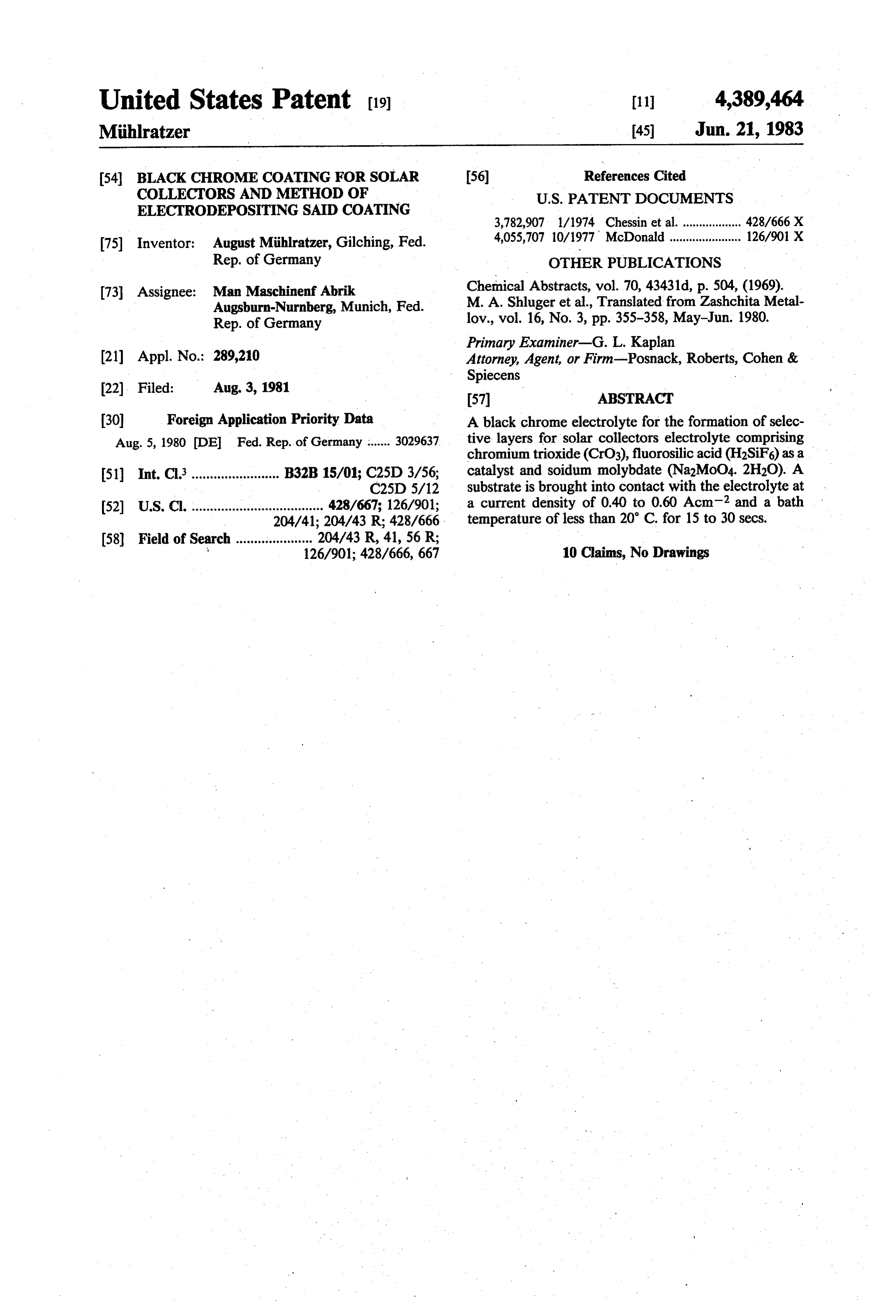
United States Patent (19) 11 4,389,464 Miihlratzer 45 Jun. 21, 1983 54 BLACK CHROME COATING FOR SOLAR 56) References Cited COLLECTORS AND METHOD OF U.S. PATENT DOCUMENTS
ELECTRODEPOSITING SAID COATING
75) Inventor: August Miihlratzer, Gilching, Fed. 4,055,707 10/1977 McDonald ...................... 126/901 X Rep. of Germany OTHER PUBLICATIONS 73 Assignee: Man Maschinenf Abrik Chemical Abstracts, vol. 70, 43431d, p. 504, (1969). Augsburn-Nurnberg, Munich, Fed. M. A. Shluger et al., Translated from Zashchita Metal Rep. of Germany lov., vol. 16, No. 3, pp. 355-358, May-Jun. 1980. Primary Examiner-G. L. Kaplan (21) Appl. No.: 289,210 Attorney, Agent, or Firm-Posnack, Roberts, Cohen & Spiecens 22). Filed: Aug. 3, 1981 57 ABSTRACT 30 Foreign Application Priority Data A black chrome electrolyte for the formation of selec Aug. 5, 1980 DE Fed. Rep. of Germany ....... 3029637 tive layers for solar collectors electrolyte comprising chromium trioxide (CrO3), fluorosilic acid (H2SiF6) as a 51) Int. Cl......................... B32B15/01; C25D 3/56, catalyst and soidum molybdate (Na2MoC)4.2H2O). A C25D 5/12 substrate is brought into contact with the electrolyte at 52 U.S. C. .................................... 428/667; 126/901; a current density of 0.40 to 0.60 Acm2 and a bath 204/41; 204/43 R; 428/666 temperature of less than 20 C. for 15 to 30 secs.
58) Field of Search ..................... 204/43 R, 41, 56 R;
126/901; 428/666, 667 10 Claims, No Drawings
Page 2
lyzer, and additionally sodium molybdate (Na2MoCl4.2-
BLACK CHROME COATING FOR SOLAR H2O).
COLLECTORS AND METHOD OF Using a bath of this composition, deep-black layers ELECTRODEPOSITING SAID COATING have successfully been achieved in a matter of seconds only.
FIELD OF THE INVENTION It has been noted that the addition of sodium molyb date makes for very uniform deposition enabling con
This invention relates to a sulphate-free black chrome siderable electrolyte containing chromium and a fluoride-con depth of blackness to be achieved with thin taining catalyst for solar selective collectors, and to a 10 layers, and thus enabling absorber surfaces to be manu method for manufacturing the solar selective layers by factured from adequately thin layers. The chromium electrodeposition from the black chrome electrolyte. bath is ideally suited, therefore, for the generation of selectively absorbing layers, where upon using a light
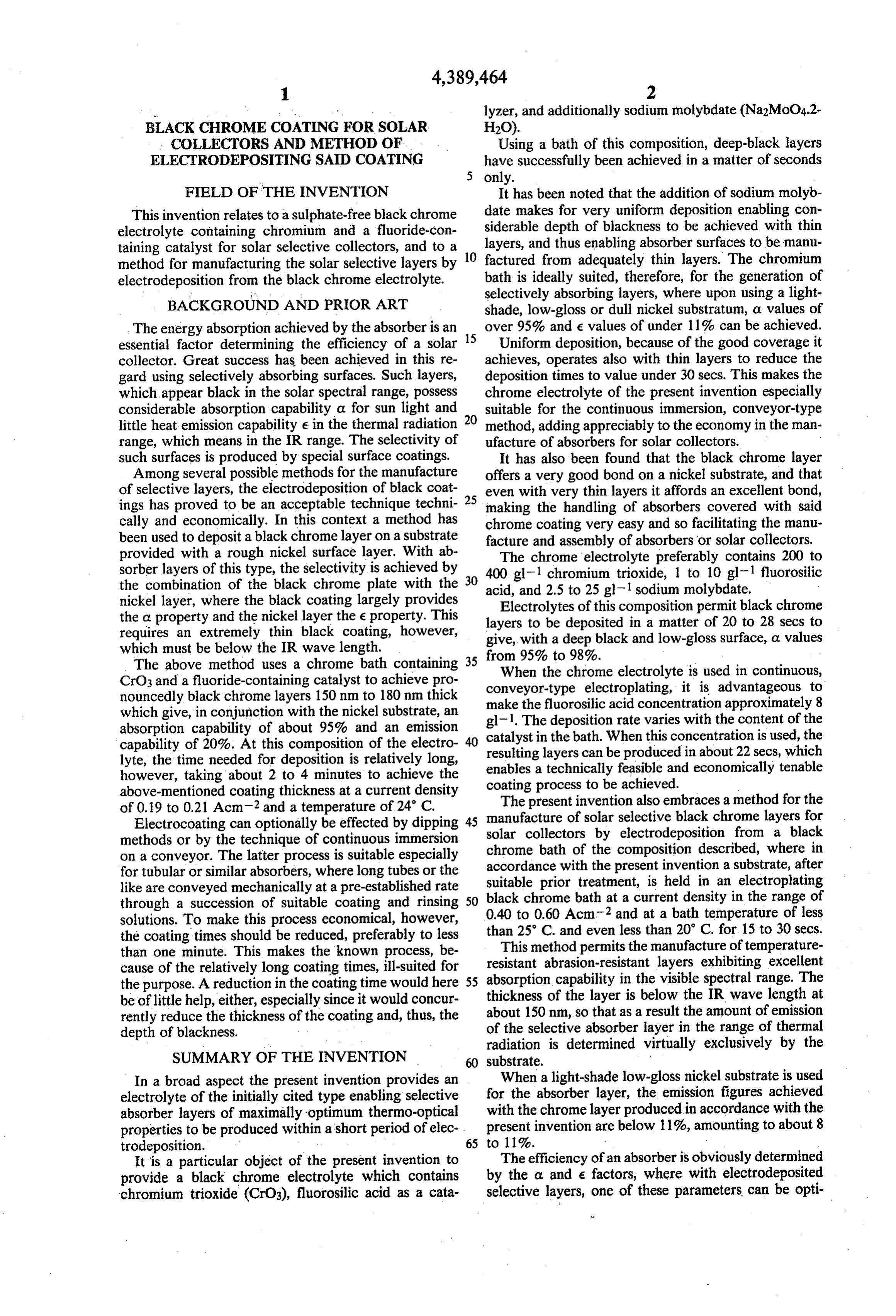
BACKGROUND AND PRIOR ART shade, low-gloss or dull nickel substratum, a values of The energy absorption achieved by the absorber is an 15 over 95% and e values of under 11% can be achieved. essential factor determining the efficiency of a solar Uniform deposition, because of the good coverage it collector. Great success has been achieved in this re achieves, operates also with thin layers to reduce the gard using selectively absorbing surfaces. Such layers, deposition times to value under 30 secs. This makes the which appear black in the solar spectral range, possess chrome electrolyte of the present invention especially considerable absorption capability a for sun light and 20 suitable for the continuous immersion, conveyor-type little heat emission capability e in the thermal radiation method, adding appreciably to the economy in the man range, which means in the IR range. The selectivity of ufacture of absorbers for solar collectors. such surfaces is produced by special surface coatings. It has also been found that the black chrome layer Among several possible methods for the manufacture offers a very good bond on a nickel substrate, and that of selective layers, the electrodeposition of black coat even with very thin layers it affords an excellent bond, ings has proved to be an acceptable technique techni 25 making the handling of absorbers covered with said cally and economically. In this context a method has chrome coating very easy and so facilitating the manu been used to deposit a black chrome layer on a substrate facture and assembly of absorbers or solar collectors. provided with a rough nickel surface layer. With ab The chrome electrolyte preferably contains 200 to sorber layers of this type, the selectivity is achieved by 400 gll chromium trioxide, 1 to 10 gll fluorosilic the combination of the black chrome plate with the 30 acid, and 2.5 to 25 gll sodium molybdate. nickel layer, where the black coating largely provides Electrolytes of this composition permit black chrome the a property and the nickel layer the e property. This layers to be deposited in a matter of 20 to 28 secs to requires an extremely thin black coating, however, give, with a deep black and low-gloss surface, a values which must be below the IR wave length.
The above method uses a chrome bath containing 35 from 95% to 98%.
When the chrome electrolyte is used in continuous,
CrO3 and a fluoride-containing catalyst to achieve pro conveyor-type electroplating, it is advantageous to nouncedly black chrome layers 150 nm to 180 nm thick make the fluorosilic acid concentration approximately 8 which give, in conjunction with the nickel substrate, an gll. The deposition rate varies with the content of the absorption capability of about 95% and an emission catalyst capability of 20%. At this composition of the electro 40 resultinginlayers the bath. When this concentration is used, the can be produced in about 22 secs, which lyte, the time needed for deposition is relatively long, enables a technically however, taking about 2 to 4 minutes to achieve the coating process to befeasible and economically tenable achieved.
above-mentioned coating thickness at a current density The present invention also embraces a method for the of 0.19 to 0.21 Acm-2 and a temperature of 24' C. manufacture of solar selective black chrome layers for Electrocoating can optionally be effected by dipping 45 solar methods or by the technique of continuous immersion chromecollectors by electrodeposition from a black bath of the composition described, where in on a conveyor. The latter process is suitable especially for tubular or similar absorbers, where long tubes or the accordance with the present invention a substrate, after like are conveyed mechanically at a pre-established rate suitable prior treatment, is held in an electroplating through a succession of suitable coating and rinsing 50 black chrome bath at a current density in the range of solutions. To make this process economical, however, 0.40 to 0.60 Acm-2 and at a bath temperature of less the coating times should be reduced, preferably to less than 25 C. and even less than 20 C. for 15 to 30 secs. than one minute. This makes the known process, be resistant This method permits the manufacture of temperature cause of the relatively long coating times, ill-suited for absorption abrasion-resistant layers exhibiting excellent the purpose. A reduction in the coating time would here 55 capability in the visible spectral range. The thickness of the layer is below the IR wave length at be of little help, either, especially since it would concur about rently reduce the thickness of the coating and, thus, the 150 nm, so that as a result the amount of emission depth of blackness. of the selective absorber layer in the range of thermal radiation is determined virtually exclusively by the
SUMMARY OF THE INVENTION substrate.
In a broad aspect the present invention provides an When a light-shade low-gloss nickel substrate is used electrolyte of the initially cited type enabling selective for the absorber layer, the emission figures achieved absorber layers of maximally optimum thermo-optical with the chrome layer produced in accordance with the properties to be produced within a short period of elec present invention are below 11%, amounting to about 8 trodeposition. 65 to 11%.
It is a particular object of the present invention to The efficiency of an absorber is obviously determined provide a black chrome electrolyte which contains by the a. and e factors, where with electrodeposited chromium trioxide (CrO3), fluorosilic acid as a cata selective layers, one of these parameters can be opti
Page 3
mized only at the expense of the other. But since the ing process at a current density of 0.25 Acm-2 and an efficiency is determined chiefly by the absorption ca electrolyte temperature of 15° C. The deposition rate pacity a, the determinant here is not strictly the ratio was slower than that of example 2, and the black a/e but rather this ratio in connection with a maximally chrome layer exhibited a somewhat glossy surface. high a. EXAMPLE 5 In this regard a further measure of the method of the present invention, where the absorber is subjected to Using the process as described in example 4, consider the electrocoating process at a current density of about able heat was generated when the current density was 0.50 Acm2 and a fluorosilic acid concentration of 8 raised to 0.7 Acm-l.
gll for a duration of about 22 secs, achieves an a value 10 EXAMPLE 6 of 98% for optimum efficiency when used together with a light-shade low-gloss nickel substrate. When the electrolyte temperature was varied, with DESCRIPTION OF PREFERRED the other conditions remaining unchanged, it was EMBODIMENTS shown that electrolyte temperatures above 18 C. and 15 below 10° C. produce rather grey or brown hues of the
The invention will be described hereafter in detail chrome coating.
with reference to the following examples representing What is claimed is:
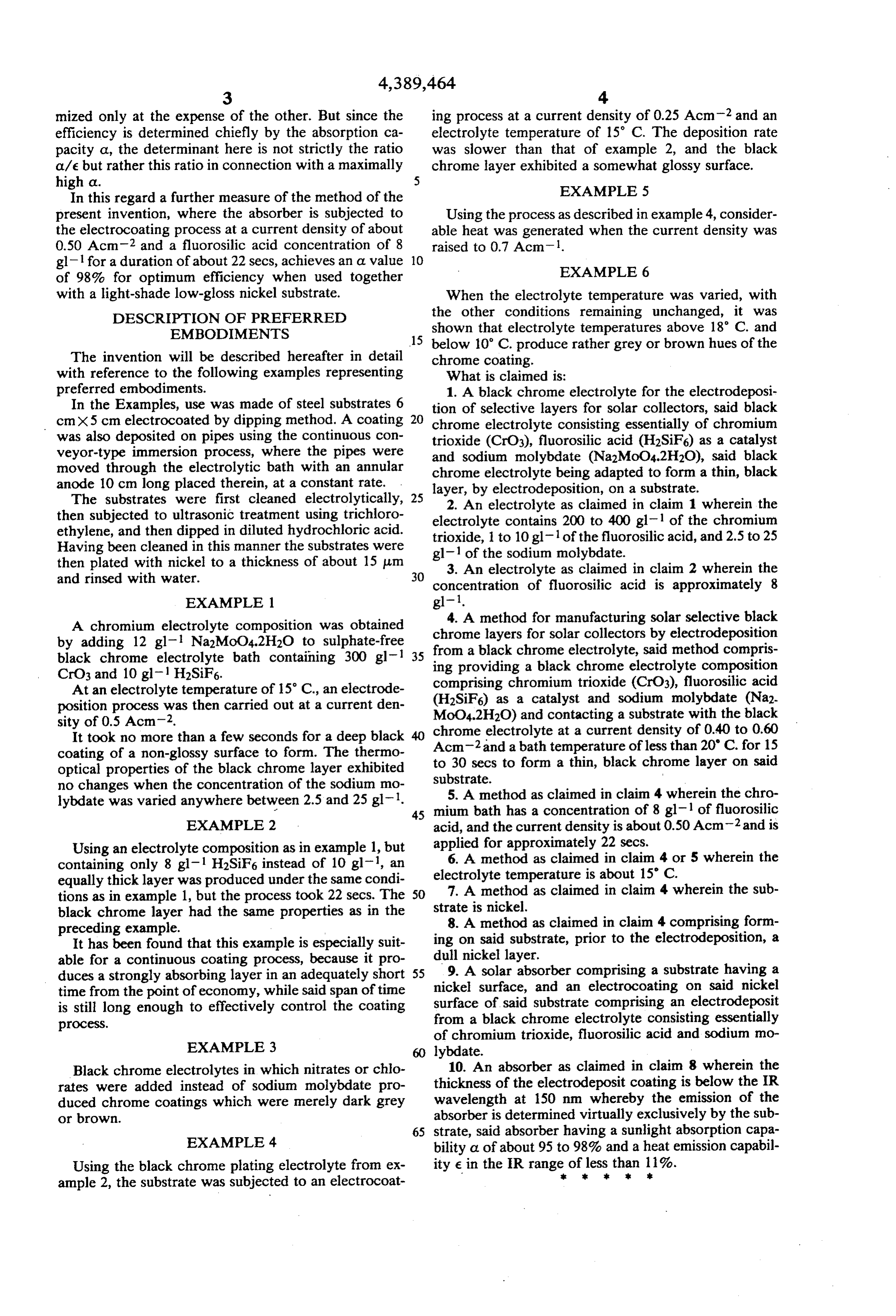
preferred embodiments. 1. A black chrome electrolyte for the electrodeposi In the Examples, use was made of steel substrates 6 tion of selective layers for solar collectors, said black cm X5 cm electrocoated by dipping method. A coating 20 chrome electrolyte consisting essentially of chromium was also deposited on pipes using the continuous con trioxide (CrO3), fluorosilic acid (H2SiF6) as a catalyst veyor-type immersion process, where the pipes were moved through the electrolytic bath with an annular and chrome sodium molybdate (Na2MoC)4.2H2O), said black electrolyte being adapted to form a thin, black anode 10 cm long placed therein, at a constant rate. layer, by electrodeposition, on a substrate. The substrates were first cleaned electrolytically, 25 2. An electrolyte as claimed in claim 1 wherein the then subjected to ultrasonic treatment using trichloro electrolyte contains 200 to 400 gll of the chromium ethylene, and then dipped in diluted hydrochloric acid. trioxide, 1 to 10 gll of the fluorosilic acid, and 2.5 to 25 Having been cleaned in this manner the substrates were gll of the sodium molybdate.
then plated with nickel to a thickness of about 15 um 3. An electrolyte as claimed in claim 2 wherein the
concentration of fluorosilic acid is approximately 8
A chromium electrolyte composition was obtained chrome 4. A method for manufacturing solar selective black by adding 12 gll Na2MoC)4.2H2O to sulphate-free from layers for solar collectors by electrodeposition black chrome electrolyte bath containing 300 gll ing providingchrome 35 a black electrolyte, said method compris a black chrome electrolyte composition
CrO3 and 10 gl-1 H2SiF6.
At an electrolyte temperature of 15 C., an electrode comprisingaschromium trioxide (CrO3), fluorosilic acid position process was then carried out at a current den (H2SiF6) a catalyst and sodium molybdate (Na2 MoO4.2H2O) and contacting a substrate with the black sity of 0.5 Acm2.
It took no more than a few seconds for a deep black chrome electrolyte at a current density of 0.40 to 0.60 coating of a non-glossy surface to form. The thermo to 30 secs toa bath
Acm-2 and temperature of less than 20' C. for 15 optical properties of the black chrome layer exhibited substrate. form a thin, black chrome layer on said no changes when the concentration of the sodium mo 5. A method as claimed in claim 4 wherein the chro lybdate was varied anywhere between 2.5 and 25 gll. mium bath has a concentration of 8 gll of fluorosilic
EXAMPLE 2 acid, and the current density is about 0.50 Acm-2 and is Using an electrolyte composition as in example 1, but applied
for approximately 22 secs.
method as claimed in claim 4 or 5 wherein the containing only 8 gll H2SiF6 instead of 10 gll, an equally thick layer was produced under the same condi electrolyte temperature is about 15 C. tions as in example 1, but the process took 22 secs. The 50 7. Aismethod as claimed in claim 4 wherein the sub black chrome layer had the same properties as in the strate nickel.
8. A method as claimed in claim 4 comprising form preceding example.
It has been found that this example is especially suit ing on said substrate, prior to the electrodeposition, a able for a continuous coating process, because it pro dull nickel layer.
duces a strongly absorbing layer in an adequately short 55 9. A solar absorber comprising a substrate having a time from the point of economy, while said span of time nickel surface, and an electrocoating on said nickel is still long enough to effectively control the coating surface of said substrate comprising an electrodeposit process. from a black chrome electrolyte consisting essentially of chromium trioxide, fluorosilic acid and sodium mo
Black chrome electrolytes in which nitrates or chlo 10. An absorber as claimed in claim 8 wherein the rates were added instead of sodium molybdate pro thickness of the electrodeposit coating is below the IR duced chrome coatings which were merely dark grey wavelength at 150 nm whereby the emission of the or brown. absorber is determined virtually exclusively by the sub 65 strate, said absorber having a sunlight absorption capa
EXAMPLE 4 bility a of about 95 to 98% and a heat emission capabil Using the black chrome plating electrolyte from ex ity e in the IR rangest of22lessk thant 11%. k ample 2, the substrate was subjected to an electrocoat
Provenance
- Collection
- Cited prior art
- Original PDF
- patentimages.storage.googleapis.com →
- Filed
- 1981-08-03
- Pages
- 3
- Method
- pdftotext (the PDF's own text layer) + pdftoppm 300dpi page scans
- Source
- Google Patents bibliographic record
- Granted
- 1983-06-21
- Inventors
- August Muhlratzer; MAN Maschinenfabrik Augsburg Nuernberg AG
- Transcribed from
- patentimages.storage.googleapis.com →