patent · US4384135
Preparation of fluorine-containing diphenyl ethers
17 May 1983
Page 1 — bibliographic record
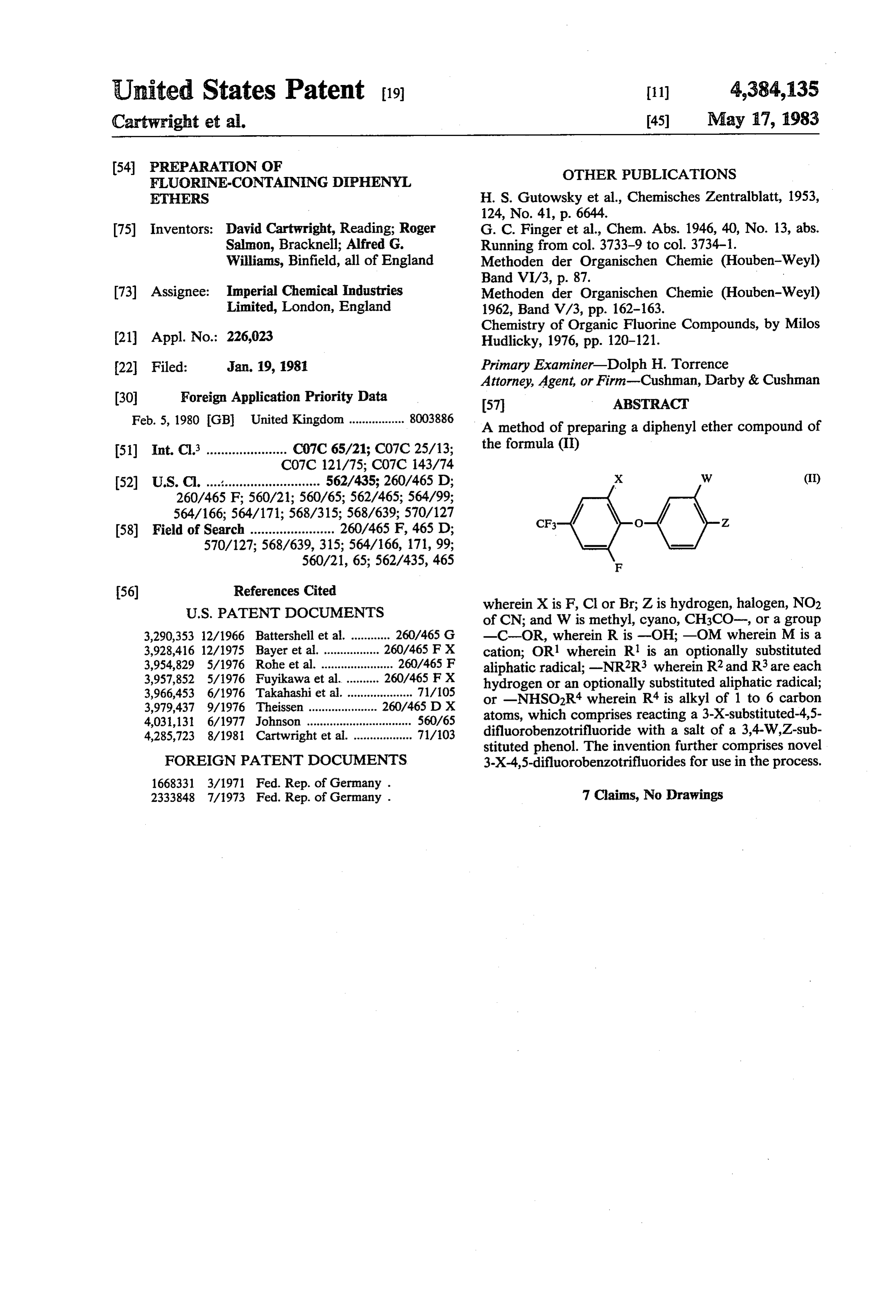
United States Patent (19) 11) 4,384,135 Cartwright et al. 45) May 17, 1983 54 PREPARATION OF OTHER PUBLICATIONS
FLUORNE-CONTAINING OPHENYL
ETHERS H. S. Gutowsky et al., Chemisches Zentralblatt, 1953,
75) Inventors: David Cartwright, Reading; Roger G. C. Finger et al., Chem. Abs. 1946, 40, No. 13, abs. Salmon, Bracknell; Alfred G. Running from col. 3733-9 to col. 3734-1. Williams, Binfield, all of England Methoden der Organischen Chemie (Houben-Weyl)
73) Assignee: Imperial Chemical Industries Methoden der Organischen Chemie (Houben-Weyl) Limited, London, England 1962, Band V/3, pp. 162-163.
Chemistry of Organic Fluorine Compounds, by Milos 21 Appl. No.: 226,023 Hudlicky, 1976, pp. 120-121. 22 Filed: Jan. 19, 1981 Primary Examiner-Dolph H. Torrence Attorney, Agent, or Firm-Cushman, Darby & Cushman 30 Foreign Application Priority Data 57 ABSTRACT Feb. 5, 1980 GB United Kingdom ................. 8003886 A method of preparing a diphenyl ether compound of 51) Int. Cl. ...................... C07C 65/21; CO7C 25/13; the formula (II)
52 U.S. C. .............................. 562/435; 260/465 D; X W (II)
of CN; and W is methyl, cyano, CH3CO-, or a group 3,290,353 12/1966 Battershell et al. ............ 260/465 G -C-OR, wherein R is -OH, -OM wherein M is a 3,928,416 12/1975 Bayer et al.......... ... 260/465 FX cation; OR1 wherein R1 is an optionally substituted 3,954,829 5/1976 Rohe et al. ...................... 260/465 F aliphatic radical; -NR2R3 wherein R2 and R3 are each 3,957,852 5/1976 Fuyikawa et al.... 260/465 FX hydrogen or an optionally substituted aliphatic radical; 3,966,453 6/1976 Takahashi et al. .................... 71/105 or -NHSO2R4 wherein R4 is alkyl of 1 to 6 carbon
4,031,131 6/1977 Johnson ................................ 560/65 atoms, which comprises reacting a 3-X-substituted-4,5- 4,285,723 8/1981 Cartwright et al. .................. 71/03 difluorobenzotrifluoride with a salt of a 3,4-W,Z-sub stituted phenol. The invention further comprises novel
FOREIGN PATENT DOCUMENTS 3-X-4,5-difluorobenzotrifluorides for use in the process.
2333848 7/1973 Fed. Rep. of Germany. 7 Claims, No Drawings
Page 2
cuprous chloride to give methyl 5(2-chloro-6-fluoro-4-
PREPARATION OF FLUORNE-CONTAINING trifluoromethylphenoxy)-2-nitrobenzoate. DPHENYLETHERS (9) Hydrolysis of methyl 5(2-chloro-6-fluoro-4-tri
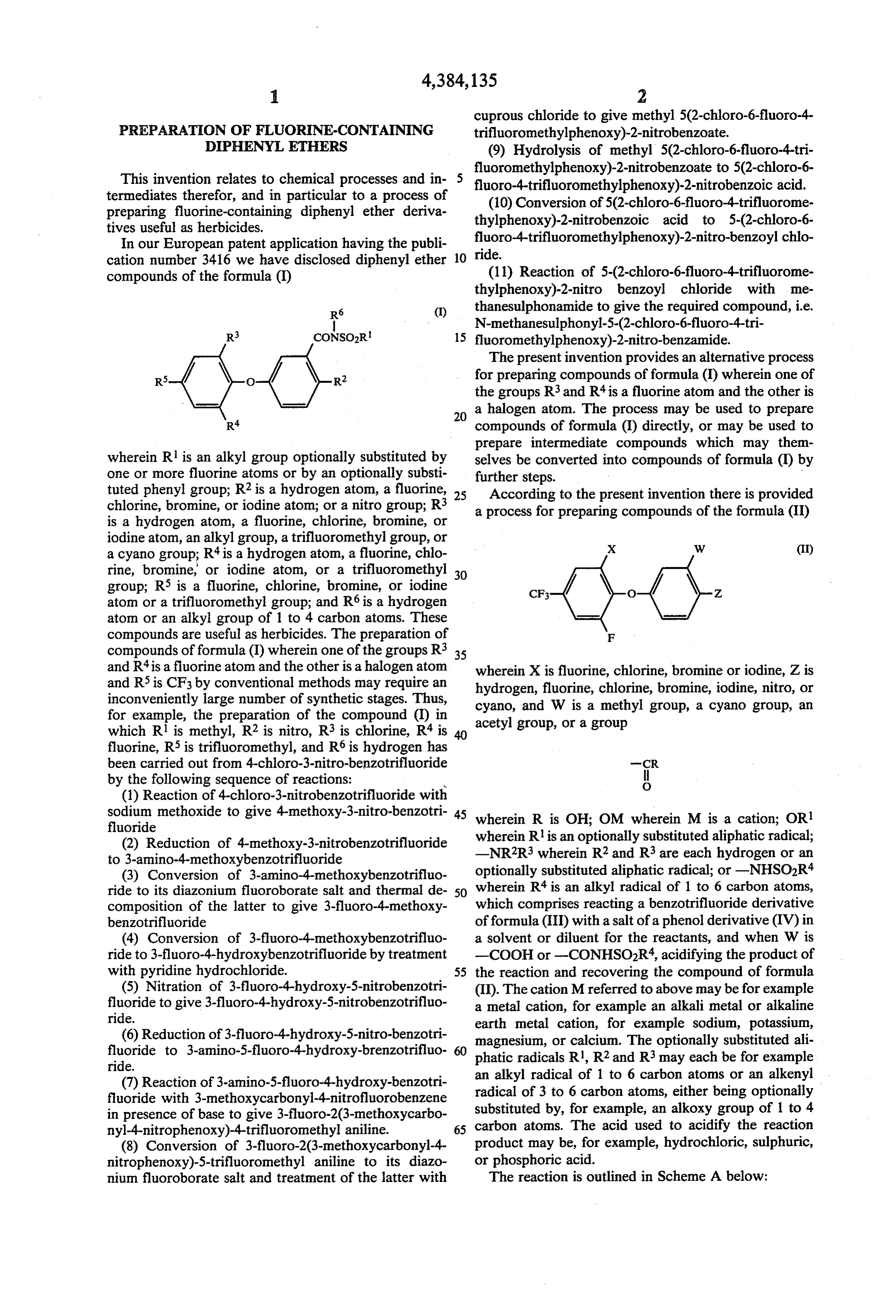
This invention relates to chemical processes and in- 5 fluoro-4-trifluoromethylphenoxy)-2-nitrobenzoic acid. termediates therefor, and in particular to a process of (10) Conversion of 5(2-chloro-6-fluoro-4-trifluorome preparing fluorine-containing diphenyl ether deriva thylphenoxy)-2-nitrobenzoic acid to 5-(2-chloro-6- tives useful as herbicides.
In our European patent application having the publi fluoro-4-trifluoromethylphenoxy)-2-nitro-benzoyl ride.
chlo cation number 3416 we have disclosed diphenyl ether 10 compounds of the formula (I) (11) Reaction of 5-(2-chloro-6-fluoro-4-trifluorome thylphenoxy)-2-nitro benzoyl chloride with me
R6 (D thanesulphonamide to give the required compound, i.e.
R3 CONSOR 15 fluoromethylphenoxy)-2-nitro-benzamide.
The present invention provides an alternative process
R5 O R2 for preparing compounds of formula (I) wherein one of the groups R3 and R is a fluorine atom and the other is a halogen atom. The process may be used to prepare
R4 20 compounds of formula (I) directly, or may be used to prepare intermediate compounds which may them wherein R1 is an alkyl group optionally substituted by selves be converted into compounds of formula (D by one or more fluorine atoms or by an optionally substi further steps.
tuted phenyl group; R2 is a hydrogen atom, a fluorine, 25 According to the present invention there is provided chlorine, bromine, or iodine atom; or a nitro group; R a process for preparing compounds of the formula (II) is a hydrogen atom, a fluorine, chlorine, bromine, or iodine atom, an alkyl group, a trifluoromethyl group, or a cyano group; R is a hydrogen atom, a fluorine, chlo X W (II) rine, bromine, or iodine atom, or a trifluoromethyl 30 group; R5 is a fluorine, chlorine, bromine, or iodine CF3 O Z. atom or a trifluoromethyl group; and R is a hydrogen atom or an alkyl group of 1 to 4 carbon atoms. These compounds are useful as herbicides. The preparation of F compounds of formula (I) wherein one of the groups R 35 and Ris a fluorine atom and the other is a halogen atom wherein X is fluorine, chlorine, bromine or iodine, Z is and R5 is CF3 by conventional methods may require an hydrogen, fluorine, chlorine, bromine, iodine, nitro, or inconveniently large number of synthetic stages. Thus, cyano, and W is a methyl group, a cyano group, an for example, the preparation of the compound (I) in acetyl group, or a group which R1 is methyl, R2 is nitro, R3 is chlorine, R is fluorine, R5 is trifluoromethyl, and R6 is hydrogen has been carried out from 4-chloro-3-nitro-benzotrifluoride -CR by the following sequence of reactions: A. O (1) Reaction of 4-chloro-3-nitrobenzotrifluoride with sodium methoxide to give 4-methoxy-3-nitro-benzotri 45 wherein R is OH; OM wherein M is a cation; OR fluoride (2) Reduction of 4-methoxy-3-nitrobenzotrifluoride wherein R is an optionally substituted aliphatic radical; to 3-amino-4-methoxybenzotrifluoride -NR2R3 wherein R2 and R3 are each hydrogen or an (3) Conversion of 3-amino-4-methoxybenzotrifluo optionally substituted aliphatic radical; or -NHSO2R ride to its diazonium fluoroborate salt and thermal de 50 wherein R is an alkyl radical of 1 to 6 carbon atoms, composition of the latter to give 3-fluoro-4-methoxy which comprises reacting a benzotrifluoride derivative benzotrifluoride of formula (III) with a salt of a phenol derivative (IV) in (4) Conversion of 3-fluoro-4-methoxybenzotrifluo a solvent or diluent for the reactants, and when W is ride to 3-fluoro-4-hydroxybenzotrifluoride by treatment -COOH or -CONHSO2R, acidifying the product of with pyridine hydrochloride. 55 the reaction and recovering the compound of formula (5) Nitration of 3-fluoro-4-hydroxy-5-nitrobenzotri (II). The cation M referred to above may be for example fluoride to give 3-fluoro-4-hydroxy-5-nitrobenzotrifluo a metal cation, for example an alkali metal or alkaline ride. earth metal cation, for example sodium, potassium, (6) Reduction of 3-fluoro-4-hydroxy-5-nitro-benzotri magnesium, or calcium. The optionally substituted ali fluoride to 3-amino-5-fluoro-4-hydroxy-brenzotrifluo phatic radicals R, R2 and R3 may each be for example ride.
(7) Reaction of 3-amino-5-fluoro-4-hydroxy-benzotri an alkyl radical of 1 to 6 carbon atoms or an alkenyl fluoride with 3-methoxycarbonyl-4-nitrofluorobenzene radical of 3 to 6 carbon atoms, either being optionally in presence of base to give 3-fluoro-2(3-methoxycarbo substituted by, for example, an alkoxy group of 1 to 4 nyl-4-nitrophenoxy)-4-trifluoromethyl aniline. 65 carbon atoms. The acid used to acidify the reaction (8) Conversion of 3-fluoro-2(3-methoxycarbonyl-4- product may be, for example, hydrochloric, sulphuric, nitrophenoxy)-5-trifluoromethyl aniline to its diazo or phosphoric acid.
nium fluoroborate salt and treatment of the latter with The reaction is outlined in Scheme A below:
Page 3
an intermediate which may then be converted into a
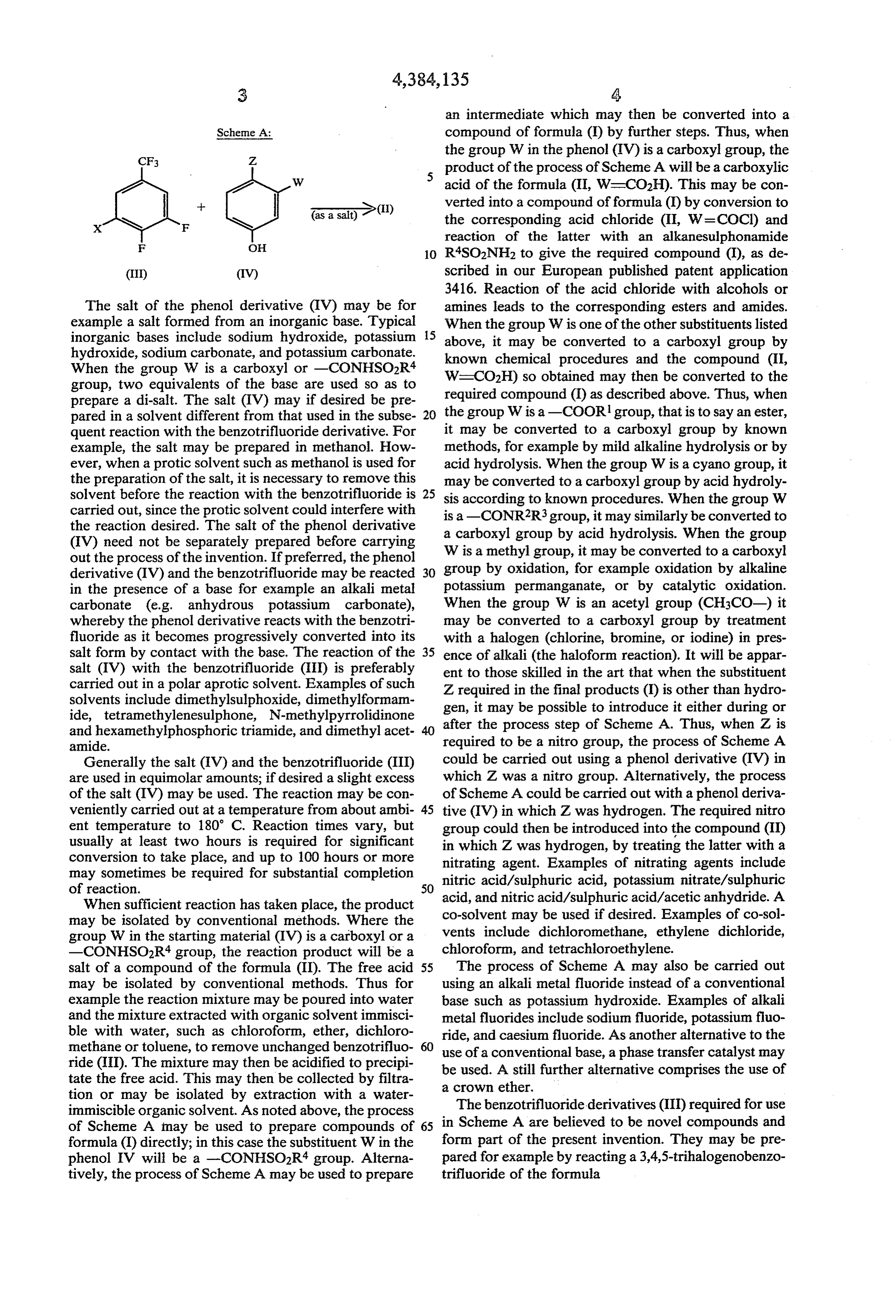
Scheme A: compound of formula (I) by further steps. Thus, when
the group W in the phenol (IV) is a carboxyl group, the product of the process of Scheme A will be a carboxylic
W acid of the formula (II, W=CO2H). This may be con verted into a compound of formula () by conversion to -- as a salo (II) the corresponding acid chloride (II, W = COCl) and
reaction of the latter with an alkanesulphonamide
10 RSO2NH2 to give the required compound (I), as de
(III) (IV) scribed in our European published patent application 3416. Reaction of the acid chloride with alcohols or
The salt of the phenol derivative (IV) may be for amines leads to the corresponding esters and amides. example a salt formed from an inorganic base. Typical When the group W is one of the other substituents listed inorganic bases include sodium hydroxide, potassium 15 above, it may be converted to a carboxyl group by hydroxide, sodium carbonate, and potassium carbonate. known chemical procedures and the compound (II, When the group W is a carboxyl or -CONHSO2R' W=CO2H) so obtained may then be converted to the group, two equivalents of the base are used so as to required compound (I) as described above. Thus, when prepare a di-salt. The salt (IV) may if desired be pre pared in a solvent different from that used in the subse 20 the group W is a -COOR group, that is to say an ester, quent reaction with the benzotrifluoride derivative. For it may be converted to a carboxyl group by known example, the salt may be prepared in methanol. How methods, for example by mild alkaline hydrolysis or by ever, when a protic solvent such as methanol is used for acid hydrolysis. When the group W is a cyano group, it the preparation of the salt, it is necessary to remove this may be converted to a carboxyl group by acid hydroly solvent before the reaction with the benzotrifluoride is 25 sis according to known procedures. When the group W carried out, since the protic solvent could interfere with the reaction desired. The salt of the phenol derivative ais carboxyl a -CONR2R3 group, it may similarly be converted to group by acid hydrolysis. When the group
(IV) need not be separately prepared before carrying W is a methyl group, it may be converted to a carboxyl out the process of the invention. If preferred, the phenol derivative (IV) and the benzotrifluoride may be reacted 30 group by oxidation, for example oxidation by alkaline in the presence of a base for example an alkali metal potassium permanganate, or by catalytic oxidation. carbonate (e.g. anhydrous potassium carbonate), When the group W is an acetyl group (CH3CO-) it whereby the phenol derivative reacts with the benzotri may be converted to a carboxyl group by treatment fluoride as it becomes progressively converted into its with a halogen (chlorine, bromine, or iodine) in pres salt form by contact with the base. The reaction of the 35 ence of alkali (the haloform reaction). It will be appar salt (IV) with the benzotrifluoride (III) is preferably ent to those skilled in the art that when the substituent carried out in a polar aprotic solvent. Examples of such Z required in the final products (I) is other than hydro solvents include dimethylsulphoxide, dimethylforman gen, it may be possible to introduce it either during or ide, tetramethylenesulphone, N-methylpyrrolidinone and hexamethylphosphoric trianide, and dimethyl acet after the process step of Scheme A. Thus, when Z is amide. required to be a nitro group, the process of Scheme A Generally the salt (IV) and the benzotrifluoride (III) could be carried out using a phenol derivative (IV) in are used in equimolar amounts; if desired a slight excess which Z was a nitro group. Alternatively, the process of the salt (IV) may be used. The reaction may be con of Scheme A could be carried out with a phenol deriva veniently carried out at a temperature from about ambi 45 tive (IV) in which Z was hydrogen. The required nitro ent temperature to 180° C. Reaction times vary, but group could then be introduced into the compound (II) usually at least two hours is required for significant in which Z was hydrogen, by treating the latter with a conversion to take place, and up to 100 hours or more nitrating agent. Examples of nitrating agents include may sometimes be required for substantial completion nitric acid/sulphuric acid, potassium nitrate/sulphuric of reaction. 50 acid, and nitric acid/sulphuric acid/acetic anhydride. A
When sufficient reaction has taken place, the product co-solvent may be isolated by conventional methods. Where the may be used if desired. Examples of co-sol group W in the starting material (IV) is a carboxyl or a vents include dichloromethane, ethylene dichloride, -CONHSO2R group, the reaction product will be a chloroform, and tetrachloroethylene.
salt of a compound of the formula (II). The free acid 55 The process of Scheme A may also be carried out may be isolated by conventional methods. Thus for using an alkali metal fluoride instead of a conventional example the reaction mixture may be poured into water base such as potassium hydroxide. Examples of alkali and the mixture extracted with organic solvent immisci metal fluorides include sodium fluoride, potassium fluo ble with water, such as chloroform, ether, dichloro ride, and caesium fluoride. As another alternative to the methane or toluene, to remove unchanged benzotrifluo use of a conventional base, a phase transfer catalyst may ride (III). The mixture may then be acidified to precipi be used. A still further alternative comprises the use of tate the free acid. This may then be collected by filtra tion or may be isolated by extraction with a water a crown The ether.
benzotrifluoride-derivatives (III) required for use immiscible organic solvent. As noted above, the process of Scheme A may be used to prepare compounds of 65 in Scheme A are believed to be novel compounds and formula (I) directly; in this case the substituent W in the form part of the present invention. They may be pre phenol IV will be a -CONHSO2R group. Alterna pared for example by reacting a 3,4,5-trihalogenobenzo tively, the process of Scheme A may be used to prepare trifluoride of the formula
Page 4
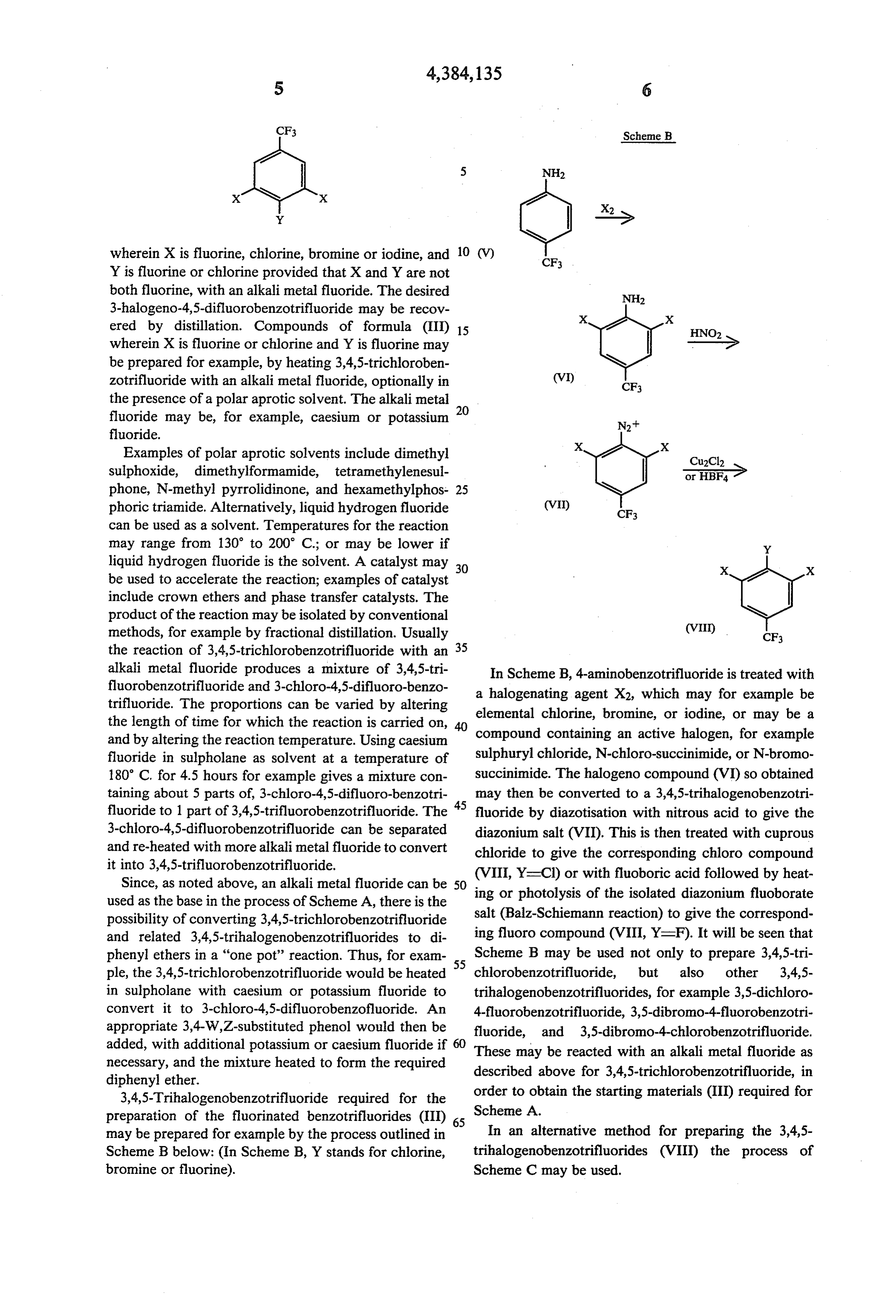
CF3 Scheme B
X X X
Y - G
wherein X is fluorine, chlorine, bromine or iodine, and 10 (V) CF
Y is fluorine or chlorine provided that X and Y are not both fluorine, with an alkali metal fluoride. The desired NH2 3-halogeno-4,5-difluorobenzotrifluoride may be recov X X ered by distillation. Compounds of formula (III) 15 HNO2 wherein X is fluorine or chlorine and Y is fluorine may - Ge. be prepared for example, by heating 3,4,5-trichloroben zotrifluoride with an alkali metal fluoride, optionally in (VI) CF3 the presence of a polar aprotic solvent. The alkali metal fluoride may be, for example, caesium or potassium fluoride.
Examples of polar aprotic solvents include dimethyl
Sulphoxide, dimethylformamide, tetramethylenesul or HBF4 G phone, N-methyl pyrrolidinone, and hexamethylphos 25 phoric triamide. Alternatively, liquid hydrogen fluoride II
can be used as a solvent. Temperatures for the reaction may range from 130 to 200 C.; or may be lower if Y liquid hydrogen fluoride is the solvent. A catalyst may 30 X X be used to accelerate the reaction; examples of catalyst include crown ethers and phase transfer catalysts. The product of the reaction may be isolated by conventional I methods, for example by fractional distillation. Usually (VIII) CF the reaction of 3,4,5-trichlorobenzotrifluoride with an 35 alkali metal fluoride produces a mixture of 3,4,5-tri In Scheme B, 4-aminobenzotrifluoride is treated with fluorobenzotrifluoride and 3-chloro-4,5-difluoro-benzo a halogenating agent X2, which may for example be trifluoride. The proportions can be varied by altering elemental chlorine, bromine, or iodine, or may be a the length of time for which the reaction is carried on, 40 and by altering the reaction temperature. Using caesium compound containing an active halogen, for example fluoride in sulpholane as solvent at a temperature of sulphuryl chloride, N-chloro-succinimide, or N-bromo 180°C, for 4.5 hours for example gives a mixture con succinimide. The halogeno compound (VI) so obtained taining about 5 parts of, 3-chloro-4,5-difluoro-benzotri 45 may then be converted to a 3,4,5-trihalogenobenzotri fluoride to 1 part of 3,4,5-trifluorobenzotrifluoride. The fluoride by diazotisation with nitrous acid to give the 3-chloro-4,5-difluorobenzotrifluoride can be separated diazonium salt (VII). This is then treated with cuprous and re-heated with more alkali metal fluoride to convert chloride to give the corresponding chloro compound it into 3,4,5-trifluorobenzotrifluoride. (VIII, Y=Cl) or with fluoboric acid followed by heat Since, as noted above, an alkali metal fluoride can be 50 used as the base in the process of Scheme A, there is the ing or photolysis of the isolated diazonium fluoborate possibility of converting 3,4,5-trichlorobenzotrifluoride salt (Balz-Schiemann reaction) to give the correspond and related 3,4,5-trihalogenobenzotrifluorides to di ing fluoro compound (VIII, Y=F). It will be seen that phenyl ethers in a "one pot' reaction. Thus, for exam 55 Scheme B may be used not only to prepare 3,4,5-tri ple, the 3,4,5-trichlorobenzotrifluoride would be heated chlorobenzotrifluoride, but also other 3,4,5- in sulpholane with caesium or potassium fluoride to trihalogenobenzotrifluorides, for example 3,5-dichloro convert it to 3-chloro-4,5-difluorobenzofluoride. An 4-fluorobenzotrifluoride, 3,5-dibromo-4-fluorobenzotri appropriate 3,4-W,Z-substituted phenol would then be fluoride, and 3,5-dibromo-4-chlorobenzotrifluoride. added, with additional potassium or caesium fluoride if 60 These may be reacted with an alkali metal fluoride as necessary, and the mixture heated to form the required described above for 3,4,5-trichlorobenzotrifluoride, in diphenyl ether.
3,4,5-Trihalogenobenzotrifluoride required for the order to obtain the starting materials (III) required for preparation of the fluorinated benzotrifluorides (III) 65 Schene A.
may be prepared for example by the process outlined in In an alternative method for preparing the 3,4,5- Scheme B below: (In Scheme B, Y stands for chlorine, trihalogenobenzotrifluorides (VIII) the process of bromine or fluorine). Scheme C may be used.
Page 5
aliphatic radical, for example an optionally substituted
Scheme C (e.g. halogeno) alkyl radical of 1 to 6 carbon atoms;
halogen (i.e. fluorine, chlorine, bromine, or iodine); a group
wherein R is alkyl of 1 to 4 carbon atoms and R8 is
Y Y hydrogen or an optionally substituted aliphatic radical NH2 NH2 Cl Cl for example an alkyl radical of 1 to 6 carbon atoms; an HNO2 15 amino group -NR'R10 wherein R9 is hydrogen, an then G> optionally substituted aliphatic radical (e.g. an alkyl
Cu2Cl2 radical of 1 to 6 carbon atoms) or an alkylcarbonyl
CF3 CF3 radical of 2 to 6 carbon atoms, and R10 is hydrogen oran optionally substituted aliphatic radical (e.g. alkyl of 1 to
(X) CXI) 20 6 carbon atoms); or an optionally substituted alkyl radi cal (e.g. an alkyl radical of 1 to 6 carbon atoms).
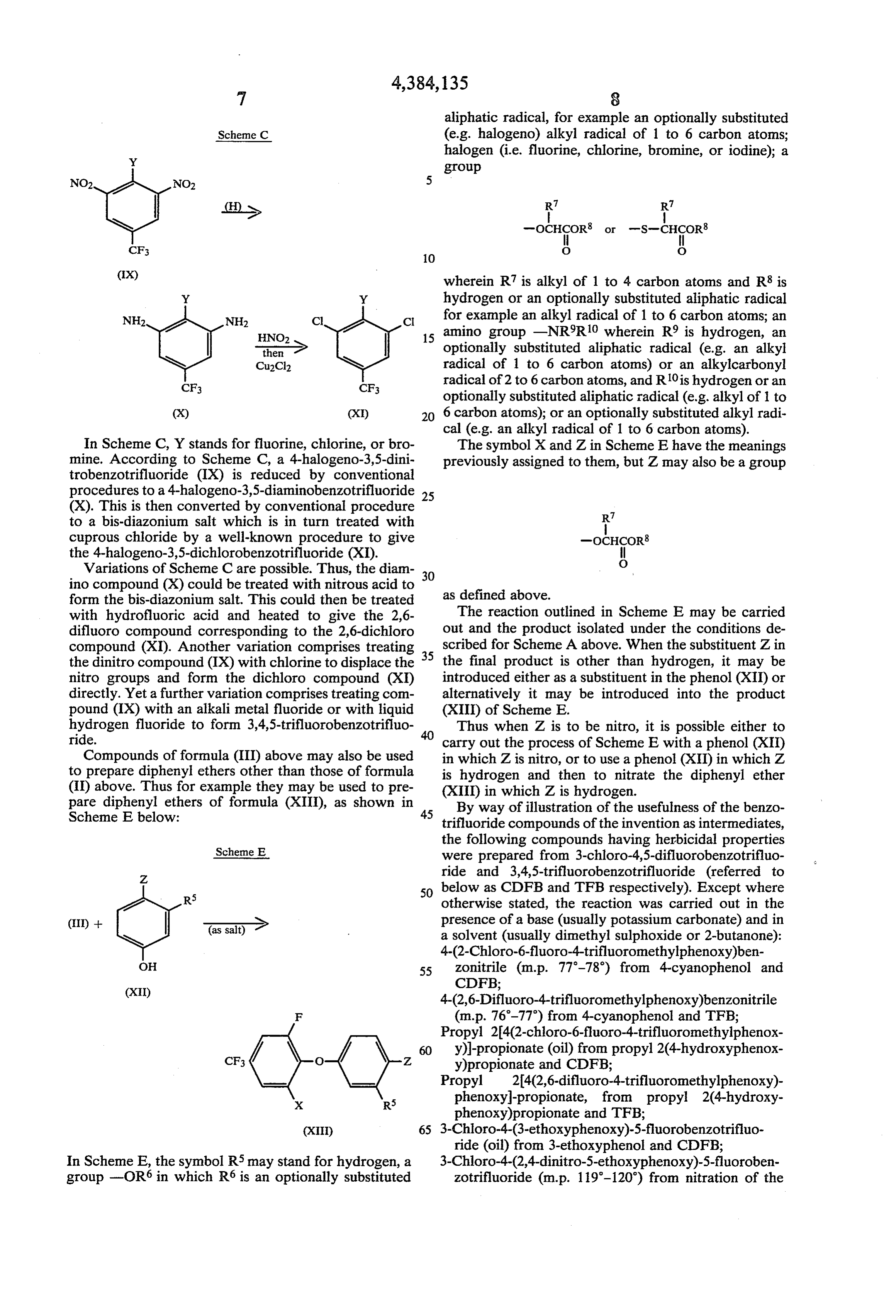
In Scheme C, Ystands for fluorine, chlorine, or bro The symbol X and Z in Scheme E have the meanings mine. According to Scheme C, a 4-halogeno-3,5-dini previously assigned to them, but Z. may also be a group trobenzotrifluoride (IX) is reduced by conventional procedures to a 4-halogeno-3,5-diaminobenzotrifluoride 25
(X). This is then converted by conventional procedure R7 to a bis-diazonium salt which is in turn treated with cuprous chloride by a well-known procedure to give -OCHCOR8 the 4-halogeno-3,5-dichlorobenzotrifluoride (XI). O Variations of Scheme Care possible. Thus, the diam ino compound (X) could be treated with nitrous acid to 30 as defined above.
form the bis-diazonium salt. This could then be treated with hydrofluoric acid and heated to give the 2,6- The reaction outlined in Scheme E may be carried difluoro compound corresponding to the 2,6-dichloro out and the product isolated under the conditions de compound (XI). Another variation comprises treating 35 scribed for Scheme A above. When the substituent Z in the dinitro compound (IX) with chlorine to displace the the final product is other than hydrogen, it may be nitro groups and form the dichloro compound (XI) introduced either as a substituent in the phenol (XII) or directly. Yet a further variation comprises treating com alternatively it may be introduced into the product pound (IX) with an alkali metal fluoride or with liquid (XIII) of Scheme E.
hydrogen fluoride to form 3,4,5-trifluorobenzotrifluo Thus when Z is to be nitro, it is possible either to ride. carry out the process of Scheme E with a phenol (XII) Compounds of formula (III) above may also be used in which Z is nitro, or to use a phenol (XII) in which Z to prepare diphenyl ethers other than those of formula is hydrogen and then to nitrate the diphenyl ether (II) above. Thus for example they may be used to pre (XIII) in which Z is hydrogen.
pare diphenyl ethers of formula (XIII), as shown in 45 By way of illustration of the usefulness of the benzo Scheme E below: trifluoride compounds of the invention as intermediates, the following compounds having herbicidal properties
Scheme E were prepared from 3-chloro-4,5-difluorobenzotrifluo Z. ride and 3,4,5-trifluorobenzotrifluoride (referred to R5 50 below as CDFB and TFB respectively). Except where otherwise stated, the reaction was carried out in the
(III) -- as said presence of a base (usually potassium carbonate) and in a solvent (usually dimethyl sulphoxide or 2-butanone):
OH 55 zonitrile (m.p. 77-78) from 4-cyanophenol and (XII) CDFB;
F (m.p. 76-77) from 4-cyanophenol and TFB;
Propyl 24(2-chloro-6-fluoro-4-trifluoromethylphenox y)-propionate (oil) from propyl 204-hydroxyphenox
CF O Z y)propionate and CDFB;
Propyl 24(2,6-difluoro-4-trifluoromethylphenoxy)-
phenoxyl-propionate, from propyl 204-hydroxy phenoxy)propionate and TFB;
CXIII) 65 3-Chloro-4-(3-ethoxyphenoxy)-5-fluorobenzotrifluo ride (oil) from 3-ethoxyphenol and CDFB;
In Scheme E, the symbol R5 may stand for hydrogen, a 3-Chloro-4-(2,4-dinitro-5-ethoxyphenoxy)-5-fluoroben group -OR6 in which R6 is an optionally substituted zotrifluoride (m.p. 119-120) from nitration of the
Page 6
last foregoing compound with potassium nitrate in (c) Preparation of N-methanesulphonyl-5-hydroxy-2- the presence of concentrated sulphuric acid. nitrobenzamide.
4-(2-Chloro-6-fluoro-4-trifluoromethylphenoxy)nitro The product from (b) (0.4 g) was heated and stirred benzene (m.p. 78-79) from p-nitrophenol and under reflux with thionyl chloride (2 ml) for 90 minutes. CDFB; The excess of thionyl chloride was removed under 4-(2-Chloro-6-fluoro-4-trifluoromethylphenoxy)-2- reduced pressure, acetonitrile added, and the solution hydroxynitrobenzene (oil) from 2,4-dihydroxy nitro re-evaporated. Methanesulphonamide (0.4 g), butyl benzene and CDFB;
Ethyl 25(2-Chloro-6-fluoro-4-trifluoromethylphenoxy) acetate and the (8 ml) and caesium fluoride (2.4 g) were added mixture stirred and heated under reflux for 2 2-nitrophenoxylpropionate (oil), from the last forego hours. The
solvent was decanted from a dark tar. The ing compound and ethyl 2-bromopropionate.
3-Chloro-4-(3-ethoxy-4-nitrophenoxy)-5-fluoro-benzo tar was washed twice with hexane and then triturated trifluoride (m.p. 90-91) made by nitration of 3 with water and then agitated with 2-molar hydrochloric chloro-4-(3-ethoxyphenoxy)-5-fluorobenzotrifluoride acid and ether. The ether layer was washed succes with sodium nitrite and trifluoroacetic acid. 15 sively with water and brine and then dried and evapo The invention is illustrated by the following Exam rated. The residue was purified by thin layer chroma ple, in which all parts are by weight and all tempera tography on silica gel using hexane: ethyl acetate: acetic tures in degrees Celsius unless otherwise stated. acid (45:55:2) as the solvent. The major band was ex EXAMPLE 1. tracted with acetonitrile and methanol. The extract was 20 filtered and evaporated. Hydrochloric acid (2 molar)
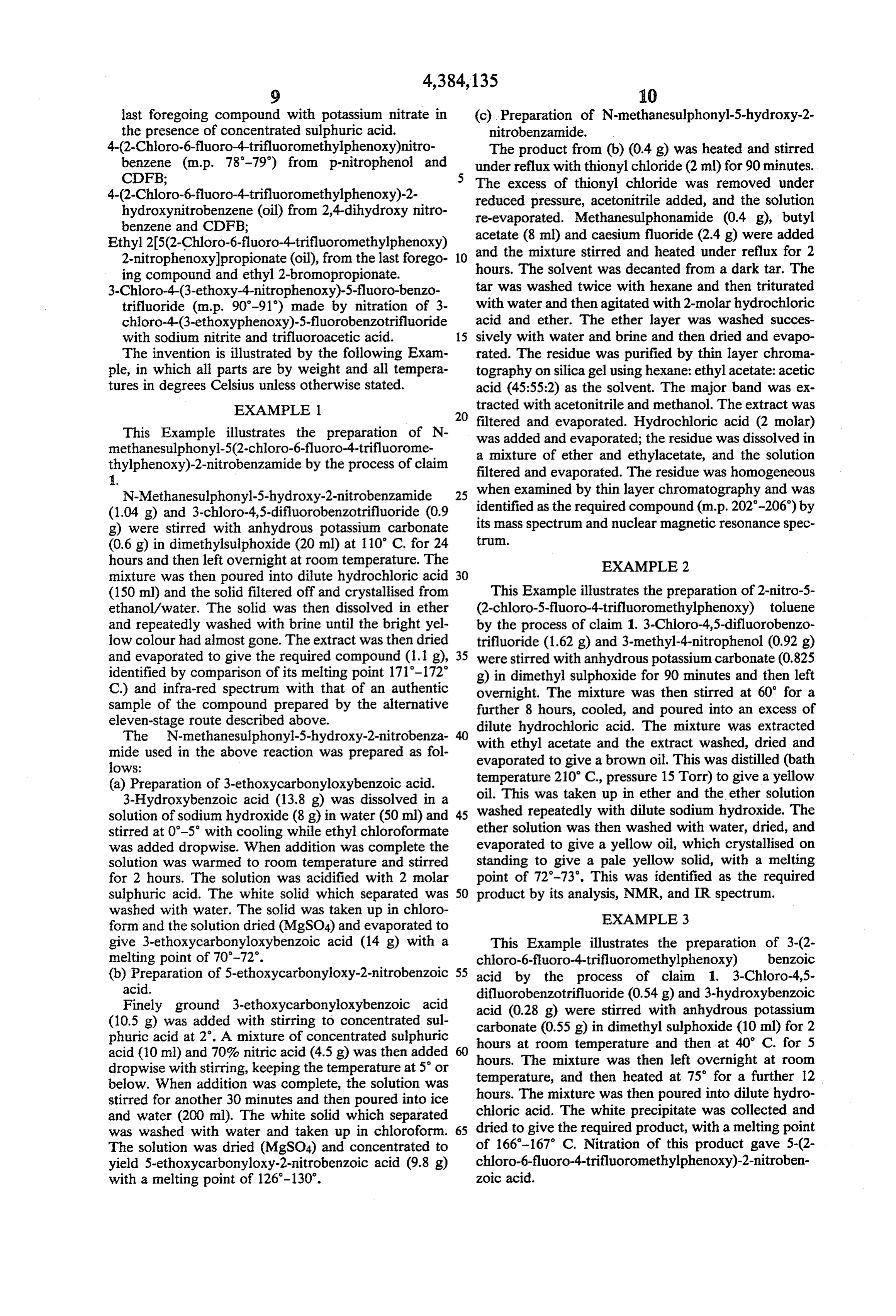
This Example illustrates the preparation of N was added and evaporated; the residue was dissolved in methanesulphonyl-5(2-chloro-6-fluoro-4-trifluorome a mixture of ether and ethylacetate, and the solution thylphenoxy)-2-nitrobenzamide by the process of claim filtered and evaporated. The residue was homogeneous
N-Methanesulphonyl-5-hydroxy-2-nitrobenzamide 25 when examined by thin layer chromatography and was (1.04 g) and 3-chloro-4,5-difluorobenzotrifluoride (0.9 identified its mass as the required compound (m.p. 202-206) by spectrum and nuclear magnetic resonance spec g) were stirred with anhydrous potassium carbonate (0.6 g) in dimethylsulphoxide (20 ml) at 110 C. for 24 trun.
hours and then left overnight at room temperature. The EXAMPLE 2 mixture was then poured into dilute hydrochloric acid 30 (150 ml) and the solid filtered off and crystallised from This Example illustrates the preparation of 2-nitro-5- ethanol/water. The solid was then dissolved in ether (2-chloro-5-fluoro-4-trifluoromethylphenoxy) toluene and repeatedly washed with brine until the bright yel by the process of claim 1. 3-Chloro-4,5-difluorobenzo low colour had almost gone. The extract was then dried trifluoride (1.62 g) and 3-methyl-4-nitrophenol (0.92 g) and evaporated to give the required compound (1.1 g), 35 were stirred with anhydrous potassium carbonate (0.825 identified by comparison of its melting point 171-172 g) in dimethyl sulphoxide for 90 minutes and then left C.) and infra-red spectrum with that of an authentic overnight. The mixture was then stirred at 60 for a sample of the compound prepared by the alternative further 8 hours, cooled, and poured into an excess of eleven-stage route described above.
The N-methanesulphonyl-5-hydroxy-2-nitrobenza dilute hydrochloric acid. The mixture was extracted mide used in the above reaction was prepared as foll evaporated acetate with ethyl to give and the extract washed, dried and a brown oil. This was distilled (bath lows:
(a) Preparation of 3-ethoxycarbonyloxybenzoic acid. temperature 210 C., pressure 15 Torr) to give a yellow 3-Hydroxybenzoic acid (13.8 g) was dissolved in a oil. This was taken up in ether and the ether solution solution of sodium hydroxide (8 g) in water (50 ml) and 45 washed repeatedly with dilute sodium hydroxide. The stirred at 0-5 with cooling while ethyl chloroformate ether solution was then washed with water, dried, and was added dropwise. When addition was complete the evaporated to give a yellow oil, which crystallised on solution was warmed to room temperature and stirred standing to give a pale yellow solid, with a melting for 2 hours. The solution was acidified with 2 molar point of 72-73. This was identified as the required sulphuric acid. The white solid which separated was 50 product by its analysis, NMR, and IR spectrum. washed with water. The solid was taken up in chloro EXAMPLE 3 form and the solution dried (MgSO4) and evaporated to give 3-ethoxycarbonyloxybenzoic acid (14 g) with a This Example illustrates the preparation of 3-(2- melting point of 70-72. chloro-6-fluoro-4-trifluoromethylphenoxy) benzoic (b) Preparation of 5-ethoxycarbonyloxy-2-nitrobenzoic 55 acid by the process of claim 1, 3-Chloro-4,5- acid.
Finely ground 3-ethoxycarbonyloxybenzoic acid difluorobenzotrifluoride (0.54 g) and 3-hydroxybenzoic acid (0.28 g) were stirred with anhydrous potassium (10.5 g) was added with stirring to concentrated sul carbonate (0.55g) in dimethyl sulphoxide (10 ml) for 2 phuric acid at 2. A mixture of concentrated sulphuric hours acid (10 ml) and 70% nitric acid (4.5 g) was then added hours. atTheroom temperature and then at 40 C. for 5 mixture was then left overnight at room dropwise with stirring, keeping the temperature at 5 or temperature, and then heated at 75 for a further 12 below. When addition was complete, the solution was hours. The mixture was then poured into dilute hydro stirred for another 30 minutes and then poured into ice and water (200 ml). The white solid which separated chloric acid. The white precipitate was collected and was washed with water and taken up in chloroform. 65 dried to give the required product, with a melting point The solution was dried (MgSO4) and concentrated to of 166-167° C. Nitration of this product gave 5-(2- yield 5-ethoxycarbonyloxy-2-nitrobenzoic acid (9.8 g) chloro-6-fluoro-4-trifluoromethylphenoxy)-2-nitroben with a melting point of 126°-130'. zoic acid.
Page 7
EXAMPLE 4
4-Chloro-3,5-dinitrobenzotrifluoride (43 kg), isopro panol (150 liters), and iron powder (43 kg) were heated
This Example illustrates the preparation of 3-chloro under reflux. Hydrochloric acid (36% w/v; 4.77 liters) 4,5-difluorobenzotrifluoride and 3,4,5-trifluorobenzotri in water (56 liters) was then added over a period of 3 fluoride. 5 hours 40 minutes. Heating was discontinued during the (a) Preparation of 2,6-dichloro-4-trifluoromethylaniline addition, since the reaction was sufficiently exothermic Chlorine was passed into a solution of p-trifluorome to maintain reflux. After addition was complete, the thylaniline (3.46 kg) in glacial acetic acid (7 liters). mixture was heated under reflux for another 2 hours 15 After 90 minutes the temperature had reached 60 and a minutes. The isopropanol and water was then distilled solid was separating. Chlorination was continued for 10 off over a period of 4 hours. Dichloromethane (100 13.5 hours, keeping the temperature between 60 and liters) was then added and the mixture stirred with 90 with occasional warming. The suspension was fil Hyflo Supercel (Hyflo Supercel is a Trade Mark for a tered and the residue washed with 1 liter of cold acetic filtration aid comprising diatomaceous earth), and fil acid. The residue was then twice stirred with water (8 15 tered. The residue was thoroughly washed with dichlo liters) and sucked dry on the filter to give the required romethane. The dichloromethane was evaporated to dichloro compound. give an oil which was poured on to trays to solidify. (b) Preparation of 3,4,5-trichlorobenzotrifluoride The yield was 28 kg (84% of the theoretical yield based 2,6-Dichloro-4-trifluoromethylaniline (3.3 kg) in con on the dinitro starting material) of 4-chloro-3,5- centrated hydrochloric acid (25 liters) was stirred for 1 diaminobenzotrifluoride with a melting point of 79-85 hour and then cooled to -6. C. A solution of sodium 20 C.
nitrite (1.41 kg) in water (3 liters) was added over a Alternative preparation of period of 4 hours keeping the temperature between -5 4-chloro-3,5-diaminobenzotrifluoride by catalytic and -12. The mixture was then stirred between -5 hydrogenation of 4-chloro-3,5-dinitrobenzotrifluoride and 0 until all solid had dissolved (3.5 hours). The 25 4-Chloro-3,5-dinitrobenzotrifluoride (5.4 g) in etha mixture was then added in 2 liter portions over a period of 35 minutes to a solution of cuprous chloride (1.5 kg) nol (50 ml) was heated to 50 and stirred with 5% plati num on carbon catalyst (0.1 g) under an atmosphere of in concentrated hydrochloric acid with stirring. The hydrogen in a pressure vessel (hydrogen pressure 30 dark solution was left to stand for 30 minutes, filtered, pounds per square inch). After 8 hours the catalyst was and extracted with dichloromethane (1X 15 liters, then 30 filtered off and the solvent removed to give the required 2x 10 liters). The extracts were washed with water diamino compound as a buff solid with a melting point (2x25 liters) dried (MgSO4) and evaporated under of 83-85 (literature value 88-91).
reduced pressure to give 3,4,5-trichlorobenzotrifluoride (b) Preparation of 3,4,5-trichlorobenzotrifluoride from (2.2 kg) with a boiling range of 98°-100/40 Torr. 4-chloro-3,5-diaminobenzotrifluoride (c) Preparation of 3-chloro-4,5-difluorobenzotrifluoride 35 Concentrated hydrochloric acid (75 liters) was and 3,4,5-trifluorobenzotrifluoride. cooled to -20° C. and stirred while a solution of so The above trichloro compound (750 g) was added to dium nitrite (10.5 kg) in water (22.5 liters) and a solution a solution of potassium fluoride (900 g) in sulpholane of 4-chloro-3,5-diaminobenzotrifluoride (7.5 kg) in di (3.75 liters) which had previously been heated until chloromethane (22.5 liters) were both slowly added. liquid was distilling from the mixture at a still-head 40 The total time taken for addition was 6 hours. The temperature of 270, so as to dry the reactants. The flask temperature of the mixture was kept between -12 and was then fitted with a Vigreaux column (24' long) (61 -6. The mixture was stirred for a further 30 minutes at cm) and a reflux divider. The mixture was heated under between -6 and -9, and then transferred slowly on reflux for 5 hours, and the reflux divider then adjusted to a mixture of cuprous chloride (7 kg) and concen to collect liquid boiling at 120 or less. Heating was 45 trated hydrochloric acid (40 liters), kept at a tempera continued for 25 hours and 530 grams of distillate was ture between 13 and 23 by water-cooling. The mixture collected. This was combined with a further quantity was then stirred for about 90 minutes at 15. The dichlo (520 g) of liquid obtained from a similar preparation. A romethane layer was separated and the aqueous layer portion (745 g) was distilled at atmospheric pressure re-extracted with more dichloromethane (2X20 liters). after washing with water and drying (MgSO4). The 50 The combined dichloromethane extracts were washed first runnings of the distillate (b.p. 98-106) were pure with water (3X30 liters) and then evaporated leaving 3,4,5-trifluorobenzotrifluoride (15g). The next fraction an oil (6.06 kg). This was distilled (some material lost by (b. p. 106-130) contained a mixture of the trifluoro spillage) at a pressure of 30 Torr to give the required compound with some 3-chloro-4,5-difluorobenzotri 3,4,5-trichlorobenzotrifluoride (boiling range 84-92). fluoride (55 g). Finally, essentially pure 3-chloro-4,5- 55 The yield (based on 4-chloro-3,5-diaminobenzotrifluo difluorobenzotrifluoride (b. p. 130-136) was collected ride starting material) was 36% of the theoretical. (580 g). A part of this material was re-heated with potas EXAMPLE 5 sium fluoride in sulpholane under reflux for 36 hours.
Fractional distillation through a Vigreaux column as This Example illustrates the preparation of 2-chloro described above then gave a further quantity of 3,4,5- 60 5-(2-chloro-6-fluoro-4-trifluoromethylphenoxy)-ben trifluorobenzotrifluoride and some unchanged 3 zoic acid by the process of claim 1. chloro-4,5-difluorobenzotrifluoride. 2-Chloro-5-hydroxybenzoic acid (1.5 g), 3-chloro The 3,4,5-trichlorobenzotrifluoride required for use 4,5-difluorobenzotrifluoride (1.88 g) and potassium car in the above synthesis may also be prepared by an alter bonate (5 g) were heated with stirring in dimethylsulph native route described below: 65 oxide at 80 for 2.5 hours. The mixture was agitated (a) Preparation of 4-chloro-3,5-diaminobenzotrifluoride with ethyl acetate and dilute hydrochloric acid. The by iron reduction of 4-chloro-3,5-dinitrobenzotrifluo ethyl acetate layer was separated, washed with water, ride dried (MgSO4) and evaporated to give a clear oil. Tritu
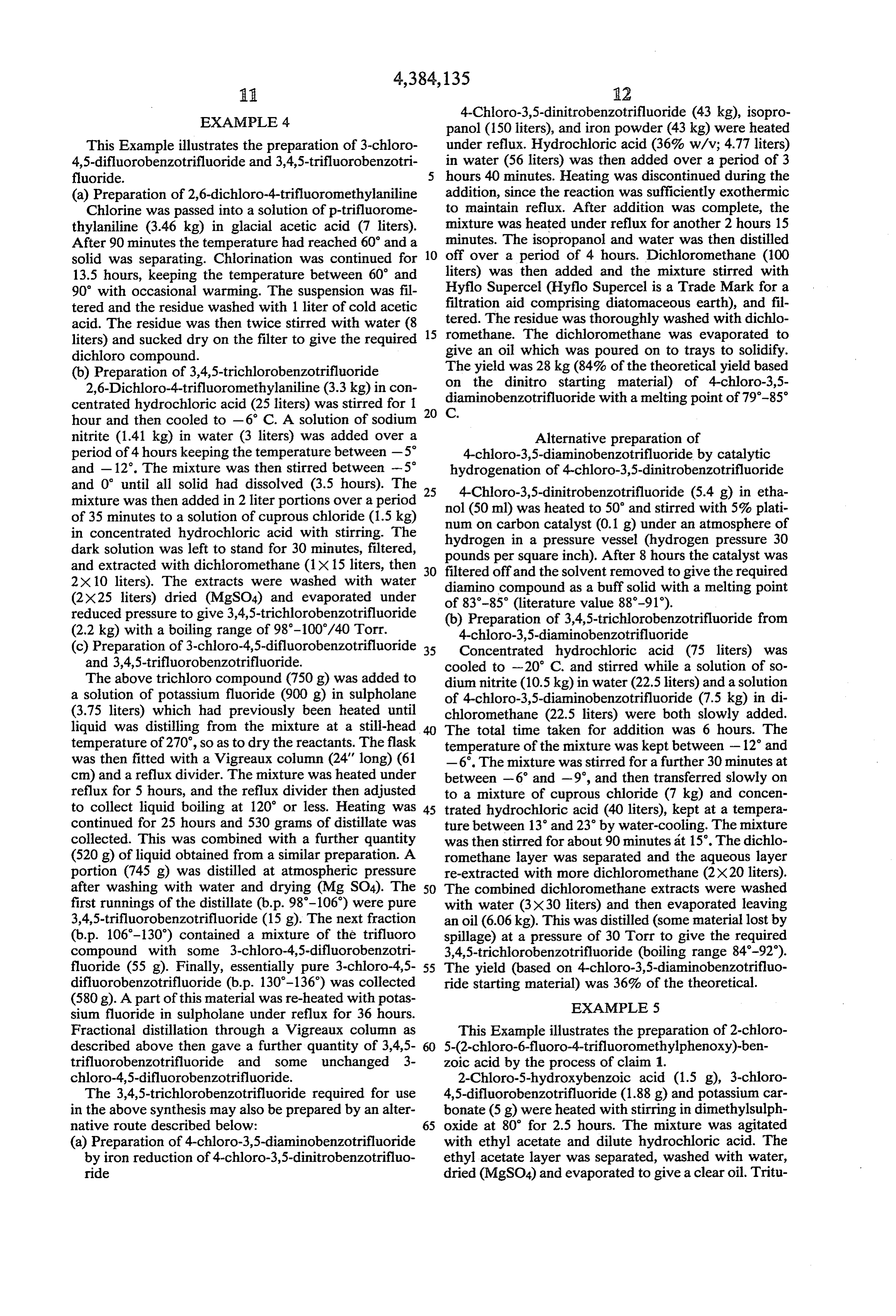
Page 8
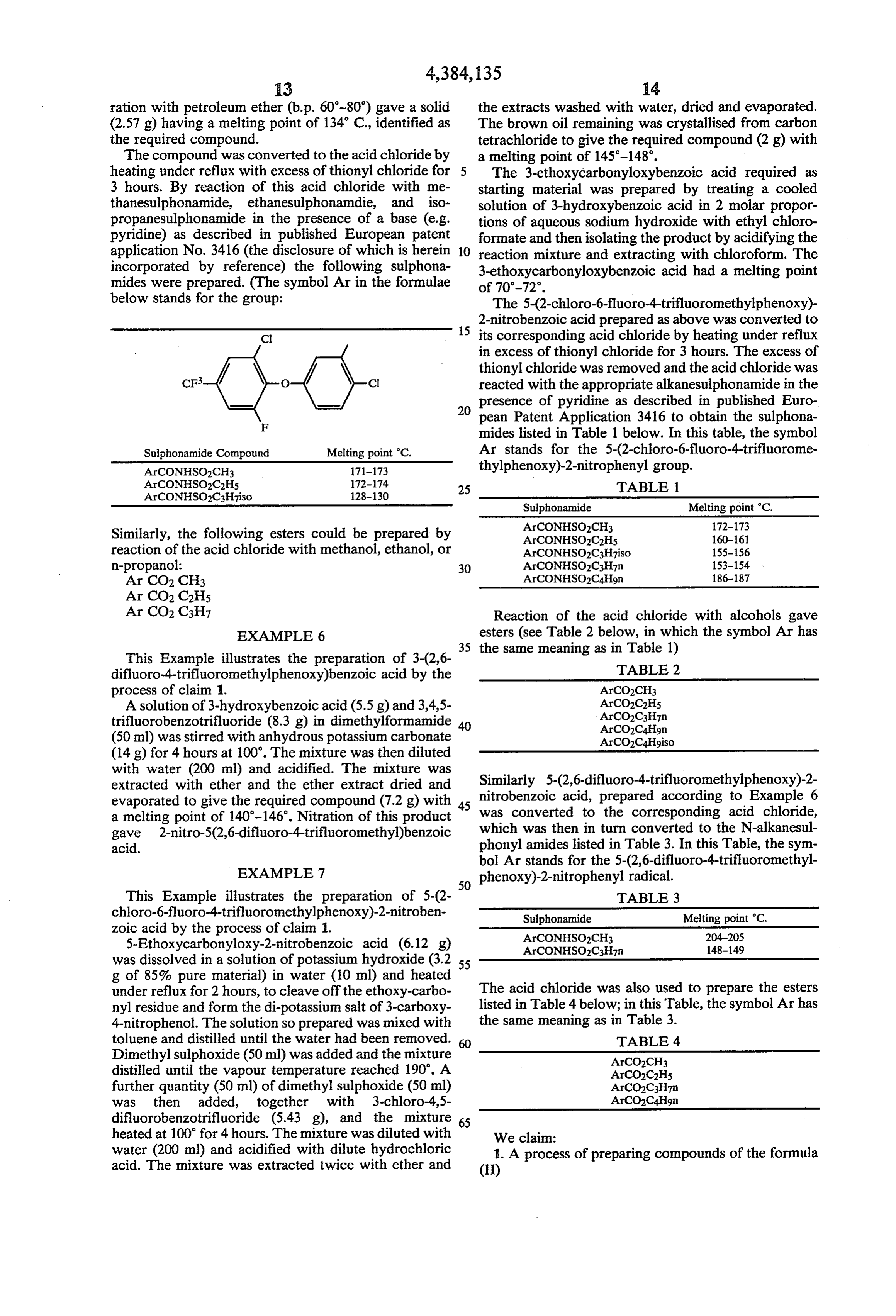
ration with petroleum ether (b. p. 60-80) gave a solid the extracts washed with water, dried and evaporated. (2.57 g) having a melting point of 134 C., identified as The brown oil remaining was crystallised from carbon the required compound. tetrachloride to give the required compound (2 g) with The compound was converted to the acid chloride by a melting point of 145-148. heating under reflux with excess of thionyl chloride for The 3-ethoxycarbonyloxybenzoic acid required as 3 hours. By reaction of this acid chloride with me starting material was prepared by treating a cooled thanesulphonamide, ethanesulphonandie, and iso solution of 3-hydroxybenzoic acid in 2 molar propor propanesulphonamide in the presence of a base (e.g. tions of aqueous sodium hydroxide with ethyl chloro pyridine) as described in published European patent formate and then isolating the product by acidifying the application No. 3416 (the disclosure of which is herein 10 incorporated by reference) the following sulphona reaction mixture and extracting with chloroform. The 3-ethoxycarbonyloxybenzoic acid had a melting point mides were prepared. (The symbol Ar in the formulae of 70-72.
below stands for the group: The 5-(2-chloro-6-fluoro-4-trifluoromethylphenoxy)- 2-nitrobenzoic acid prepared as above was converted to 5 its corresponding acid chloride by heating under reflux
in excess of thionyl chloride for 3 hours. The excess of thionyl chloride was removed and the acid chloride was
C reacted with the appropriate alkanesulphonamide in the
presence of pyridine as described in published Euro pean Patent Application 3416 to obtain the sulphona mides listed in Table 1 below. In this table, the symbol
Sulphonamide Compound Melting point C. Ar stands for the 5-(2-chloro-6-fluoro-4-trifluorome
thylphenoxy)-2-nitrophenyl group.
ArCONHSO2C2H5 172-174 25 TABLE 1
Sulphonamide Melting point C.
Similarly, the following esters could be prepared by ArCONHSO2C2H5 160-61 reaction of the acid chloride with methanol, ethanol, or ArCONHSO2C3H7iso 155-156 n-propanol: 30 ArCONHSO2C3H7n 153-154 Air CO2CH3 ArCONHSO2C4H9n 186-187
Ar CO2 C3H7 Reaction of the acid chloride with alcohols gave EXAMPLE 6 esters (see Table 2 below, in which the symbol Ar has 35 the same meaning as in Table 1)
This Example illustrates the preparation of 3-(2,6- TABLE 2 difluoro-4-trifluoromethylphenoxy)benzoic acid by the process of claim 1.
A solution of 3-hydroxybenzoic acid (5.5 g) and 3,4,5- trifluorobenzotrifluoride (8.3 g) in dimethylformamide (50 ml) was stirred with anhydrous potassium carbonate (14 g) for 4 hours at 100'. The mixture was then diluted with water (200 ml) and acidified. The mixture was Similarly 5-(2,6-difluoro-4-trifluoromethylphenoxy)-2- extracted with ether and the ether extract dried and evaporated to give the required compound (7.2 g) with 45 nitrobenzoic acid, prepared according to Example 6 a melting point of 140-146. Nitration of this product which was converted to the corresponding acid chloride, gave 2-nitro-5(2,6-difluoro-4-trifluoromethyl)benzoic was then in turn converted to the N-alkanesul acid. phonyl amides listed in Table 3. In this Table, the sym bol Arstands for the 5-(2,6-difluoro-4-trifluoromethyl
EXAMPLE 7 phenoxy)-2-nitrophenyl radical.
This Example illustrates the preparation of 5-(2- TABLE 3 chloro-6-fluoro-4-trifluoromethylphenoxy)-2-nitroben Sulphonamide Melting point C. zoic acid by the process of claim 1. ArCONHSO2CH3 204-205 5-Ethoxycarbonyloxy-2-nitrobenzoic acid (6.12 g) ArCONHSO2C3H7n 148-49 was dissolved in a solution of potassium hydroxide (3.2 55 g of 85% pure material) in water (10 ml) and heated under reflux for 2 hours, to cleave off the ethoxy-carbo The acid chloride was also used to prepare the esters nyl residue and form the di-potassium salt of 3-carboxy listed in Table 4 below; in this Table, the symbol Ar has 4-nitrophenol. The solution so prepared was mixed with the same meaning as in Table 3.
toluene and distilled until the water had been removed. TABLE 4 Dimethylsulphoxide (50 ml) was added and the mixture distilled until the vapour temperature reached 190. A further quantity (50 ml) of dimethyl sulphoxide (50 ml) was then added, together with 3-chloro-4,5- difluorobenzotrifluoride (5.43 g), and the mixture 65 heated at 100 for 4 hours. The mixture was diluted with We claim:
water (200 ml) and acidified with dilute hydrochloric 1. A process of preparing compounds of the formula acid. The mixture was extracted twice with ether and (II)
Page 9
S 16
10 wherein X is fluorine, chlorine or bromine.
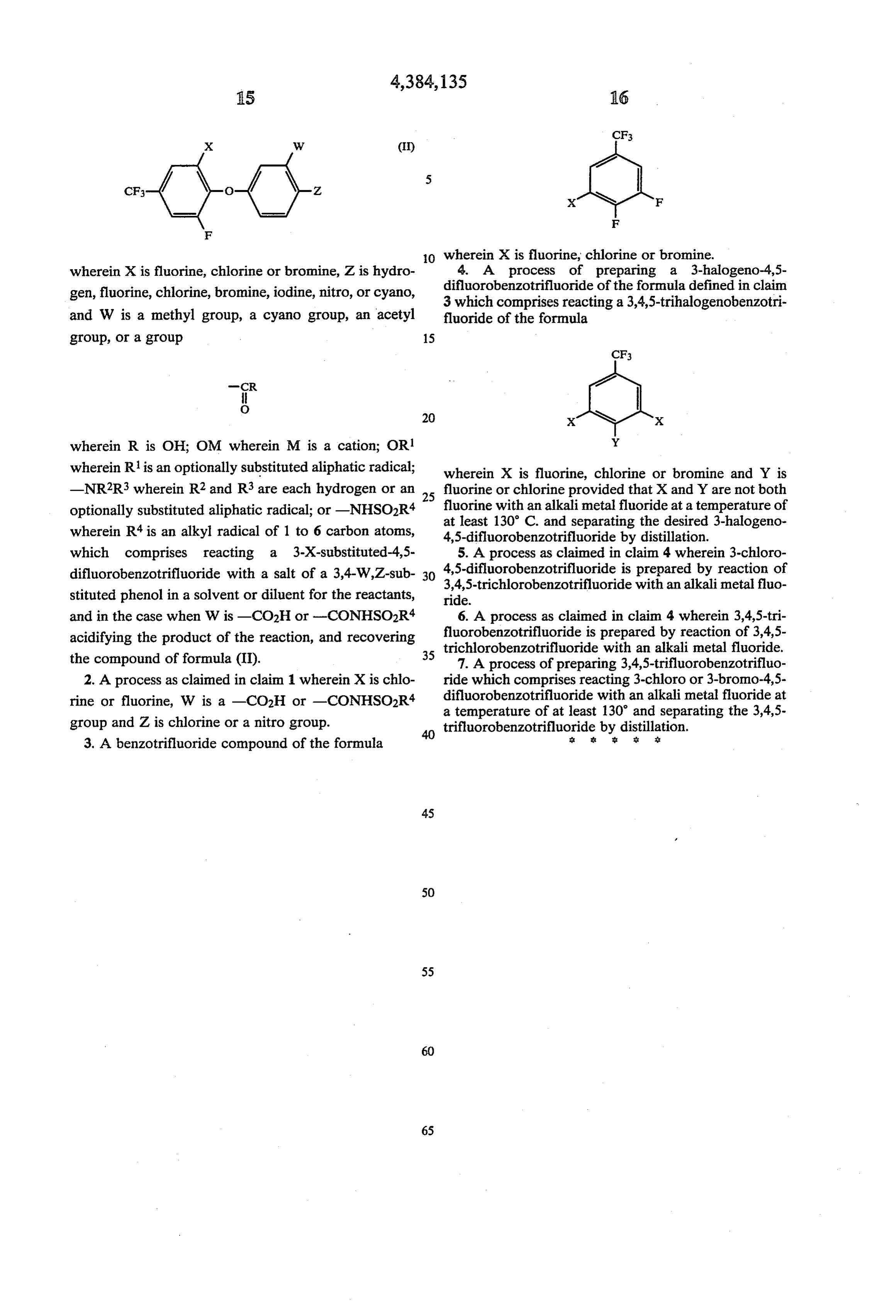
wherein X is fluorine, chlorine or bromine, Z is hydro 4. A process of preparing a 3-halogeno-4,5- difluorobenzotrifluoride of the formula defined in claim gen, fluorine, chlorine, bromine, iodine, nitro, or cyano, 3 which comprises reacting a 3,4,5-trihalogenobenzotri and W is a methyl group, a cyano group, an acetyl fluoride of the formula group, or a group 15
CFs
wherein R is OH; OM wherein M is a cation; OR wherein R1 is an optionally substituted aliphatic radical; wherein X is fluorine, chlorine or bromine and Y is -NR2R3 wherein R2 and R3 are each hydrogen or an 25 fluorine or chlorine provided that X and Y are not both optionally substituted aliphatic radical; or -NHSO2R' fluorine with an alkali metal fluoride at a temperature of at least 130 C. and separating the desired 3-halogeno wherein R is an alkyl radical of 1 to 6 carbon atoms, 4,5-difluorobenzotrifluoride by distillation. which comprises reacting a 3-X-substituted-4,5- 5. A process as claimed in claim 4 wherein 3-chloro difluorobenzotrifluoride with a salt of a 3,4-W,Z-sub 30 4,5-difluorobenzotrifluoride is prepared by reaction of 3,4,5-trichlorobenzotrifluoride with an alkali metal fluo stituted phenol in a solvent or diluent for the reactants, ride.
and in the case when W is -CO2H or -CONHSO2R 6. A process as claimed in claim 4 wherein 3,4,5-tri fluorobenzotrifluoride is prepared by reaction of 3,4,5- acidifying the product of the reaction, and recovering trichlorobenzotrifluoride
with an alkali metal fluoride.
the compound of formula (II). 7. A process of preparing 3,4,5-trifluorobenzotrifluo 2. A process as claimed in claim 1 wherein X is chlo ride which comprises reacting 3-chloro or 3-bromo-4,5- rine or fluorine, W is a -CO2H or -CONHSO2R difluorobenzotrifluoride with an alkali metal fluoride at a temperature of at least 130 and separating the 3,4,5- group and Z is chlorine or a nitro group. trifluorobenzotrifluoride by distillation.
3. A benzotrifluoride compound of the formula
Provenance
- Collection
- Cited prior art
- Original PDF
- patentimages.storage.googleapis.com →
- Filed
- 1981-01-19
- Pages
- 9
- Method
- pdftotext (the PDF's own text layer) + pdftoppm 300dpi page scans
- Source
- Google Patents bibliographic record
- Granted
- 1983-05-17
- Inventors
- David Cartwright; Roger Salmon; Alfred G. Williams; Imperial Chemical Industries Ltd
- Transcribed from
- patentimages.storage.googleapis.com →