patent · US4212725
Electrodes for electrolysis purposes
15 July 1980
Page 1 — bibliographic record
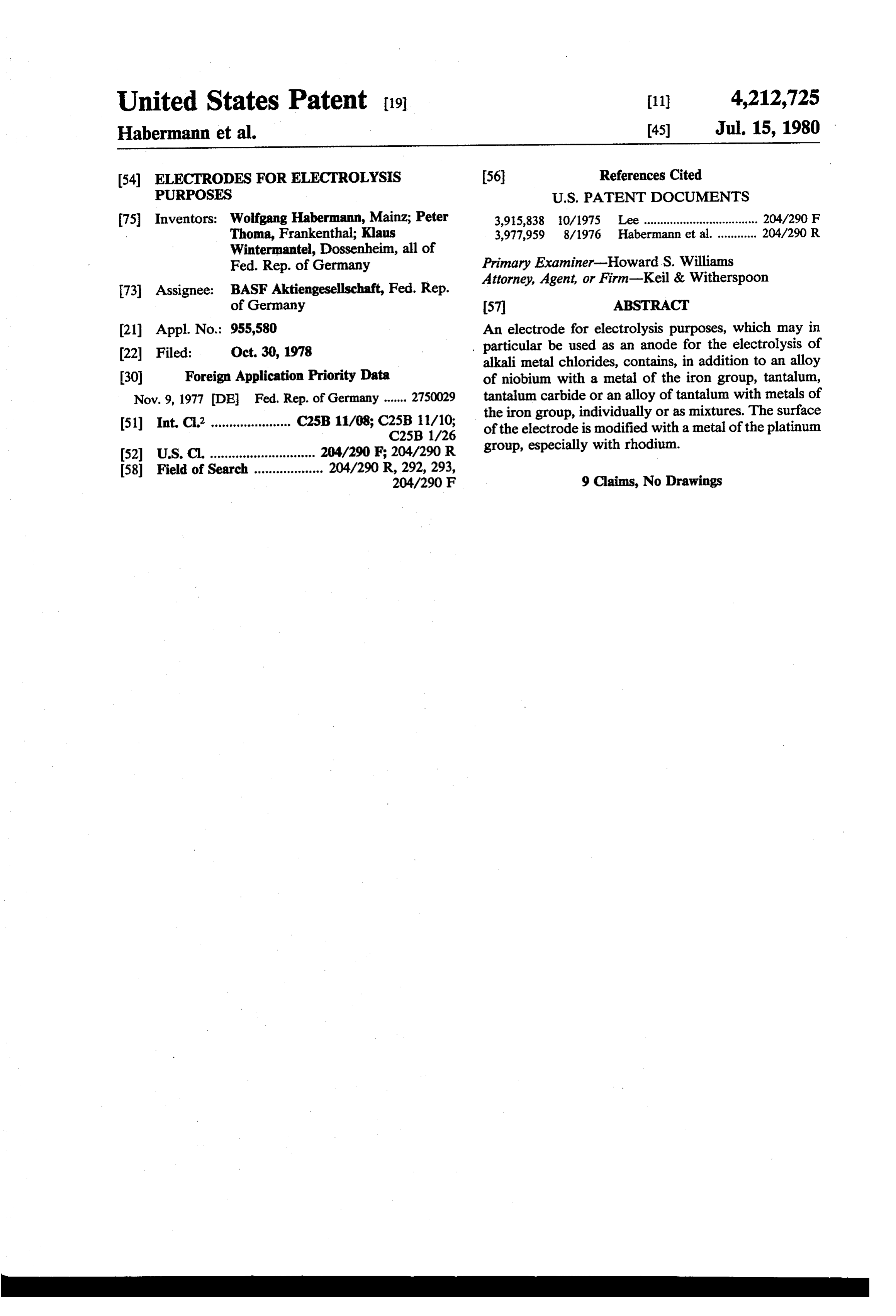
United States Patent (19) 11 4,212,725 Habermann et al. 45 Jul. 15, 1980 54 ELECTRODES FOR ELECTROLYSIS 56) References Cited PURPOSES U.S. PATENT DOCUMENTS 75) Inventors: Wolfgang Habermann, Mainz; Peter 3,915,838 10/1975 Lee ................................... 204/290 F Thoma, Frankenthal; Klaus 3,977,959 8/1976 Habermann et al. ............ 204/290 R Wintermantel, Dossenheim, all of
Fed. Rep. of Germany Primary Examiner-Howard S. Williams
Attorney, Agent, or Firm-Keil & Witherspoon 73) Assignee: BASF Aktiengesellschaft, Fed. Rep.
of Germany (57 ABSTRACT (21) Appl. No.: 955,580 An electrode for electrolysis purposes, which may in 22 Filed: Oct. 30, 1978 particular be used as an anode for the electrolysis of alkali metal chlorides, contains, in addition to an alloy (30) Foreign Application Priority Data of niobium with a metal of the iron group, tantalum, Nov. 9, 1977 (DE Fed. Rep. of Germany ....... 2750029 tantalum carbide or an alloy of tantalum with metals of the iron group, individually or as mixtures. The surface 51) Int. Cl” ...................... C25B 11/08; C25B 11/10; of the electrode is modified with a metal of the platinum
52 U.S. C. ............................. 204/290 F 204/290 R group, especially with rhodium.
Page 2
respect of adhesion to the electrode surface at high
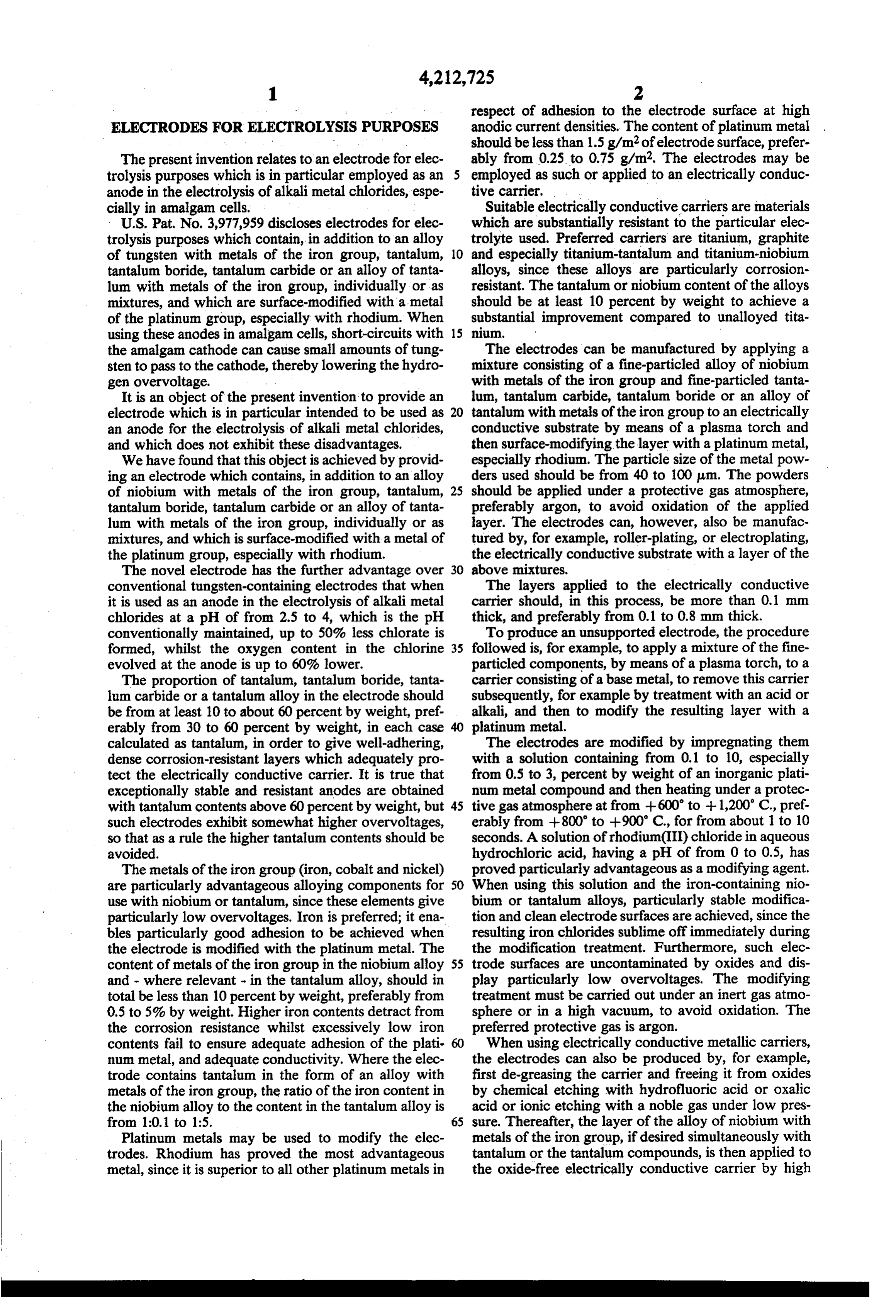
ELECTRODES FOR ELECTROLYSIs PURPOSES anodic current densities. The content of platinum metal should be less than 1.5 g/m2 of electrode surface, prefer
The present invention relates to an electrode for elec ably from 0.25 to 0.75 g/m2. The electrodes may be trolysis purposes which is in particular employed as an 5 employed as such or applied to an electrically conduc anode in the electrolysis of alkali metal chlorides, espe tive carrier. . . .
cially in amalgam cells. Suitable electrically conductive carriers are materials U.S. Pat. No. 3,977,959 discloses electrodes for elec which are substantially resistant to the particular elec trolysis purposes which contain, in addition to an alloy trolyte used. Preferred carriers are titanium, graphite of tungsten with metals of the iron group, tantalum, 10 and especially titanium-tantalum and titanium-niobium tantalum boride, tantalum carbide or an alloy of tanta alloys, since these alloys are particularly corrosion lum with metals of the iron group, individually or as resistant. The tantalum or niobium content of the alloys mixtures, and which are surface-modified with a metal should be at least 10 percent by weight to achieve a of the platinum group, especially with rhodium. When substantial improvement compared to unalloyed tita using these anodes in amalgam cells, short-circuits with 15 11.
the amalgam cathode can cause small amounts of tung The electrodes can be manufactured by applying a sten to pass to the cathode, thereby lowering the hydro mixture consisting of a fine-particled alloy of niobium gen overvoltage. with metals of the iron group and fine-particled tanta It is an object of the present invention to provide an lum, tantalum carbide, tantalum boride or an alloy of electrode which is in particular intended to be used as 20 tantalum with metals of the iron group to an electrically an anode for the electrolysis of alkali metal chlorides, conductive substrate by means of a plasma torch and and which does not exhibit these disadvantages. then surface-modifying the layer with a platinum metal, We have found that this object is achieved by provid especially rhodium. The particle size of the metal pow ing an electrode which contains, in addition to an alloy ders used should be from 40 to 100 um. The powders of niobium with metals of the iron group, tantalum, 25 should be applied under a protective gas atmosphere, tantalum boride, tantalum carbide or an alloy of tanta preferably argon, to avoid oxidation of the applied lum with metals of the iron group, individually or as layer. The electrodes can, however, also be manufac mixtures, and which is surface-modified with a metal of tured by, for example, roller-plating, or electroplating, the platinum group, especially with rhodium. the electrically conductive substrate with a layer of the The novel electrode has the further advantage over 30 above mixtures.
conventional tungsten-containing electrodes that when The layers applied to the electrically conductive it is used as an anode in the electrolysis of alkali metal carrier should, in this process, be more than 0.1 mm chlorides at a pH of from 2.5 to 4, which is the pH thick, and preferably from 0.1 to 0.8 mm thick. conventionally maintained, up to 50% less chlorate is To produce an unsupported electrode, the procedure formed, whilst the oxygen content in the chlorine 35 followed is, for example, to apply a mixture of the fine evolved at the anode is up to 60% lower. particled components, by means of a plasma torch, to a The proportion of tantalum, tantalum boride, tanta carrier consisting of a base metal, to remove this carrier lum carbide or a tantalum alloy in the electrode should subsequently, for example by treatment with an acid or be from at least 10 to about 60 percent by weight, pref alkali, and then to modify the resulting layer with a erably from 30 to 60 percent by weight, in each case platinum metal.
calculated as tantalum, in order to give well-adhering, The electrodes are modified by impregnating them dense corrosion-resistant layers which adequately pro with a solution containing from 0.1 to 10, especially tect the electrically conductive carrier. It is true that from 0.5 to 3, percent by weight of an inorganic plati exceptionally stable and resistant anodes are obtained num metal compound and then heating under a protec with tantalum contents above 60 percent by weight, but 45 tive gas atmosphere at from --600 to +1,200 C., pref. such electrodes exhibit somewhat higher overvoltages, erably from +800' to +900 C., for from about 1 to 10 so that as a rule the higher tantalum contents should be seconds. A solution of rhodium(III) chloride in aqueous avoided. hydrochloric acid, having a pH of from 0 to 0.5, has The metals of the iron group (iron, cobalt and nickel) proved particularly advantageous as a modifying agent. are particularly advantageous alloying components for 50 When using this solution and the iron-containing nio use with niobium or tantalum, since these elements give bium or tantalum alloys, particularly stable modifica particularly low overvoltages. Iron is preferred; it ena tion and clean electrode surfaces are achieved, since the bles particularly good adhesion to be achieved when resulting iron chlorides sublime off immediately during the electrode is modified with the platinum metal. The the modification treatment. Furthermore, such elec content of metals of the iron group in the niobium alloy 55 trode surfaces are uncontaminated by oxides and dis and - where relevant - in the tantalum alloy, should in play particularly low overvoltages. The modifying total be less than 10 percent by weight, preferably from treatment must be carried out under an inert gas atmo 0.5 to 5% by weight. Higher iron contents detract from sphere or in a high vacuum, to avoid oxidation. The the corrosion resistance whilst excessively low iron preferred protective gas is argon.
contents fail to ensure adequate adhesion of the plati 60 When using electrically conductive metallic carriers, num metal, and adequate conductivity. Where the elec the electrodes can also be produced by, for example, trode contains tantalum in the form of an alloy with first de-greasing the carrier and freeing it from oxides metals of the iron group, the ratio of the iron content in by chemical etching with hydrofluoric acid or oxalic the niobium alloy to the content in the tantalum alloy is acid or ionic etching with a noble gas under low pres from 1:0.1 to 1:5. 65 sure. Thereafter, the layer of the alloy of niobium with Platinum metals may be used to modify the elec metals of the iron group, if desired simultaneously with trodes. Rhodium has proved the most advantageous tantalum or the tantalum compounds, is then applied to metal, since it is superior to all other platinum metals in the oxide-free electrically conductive carrier by high
Page 3
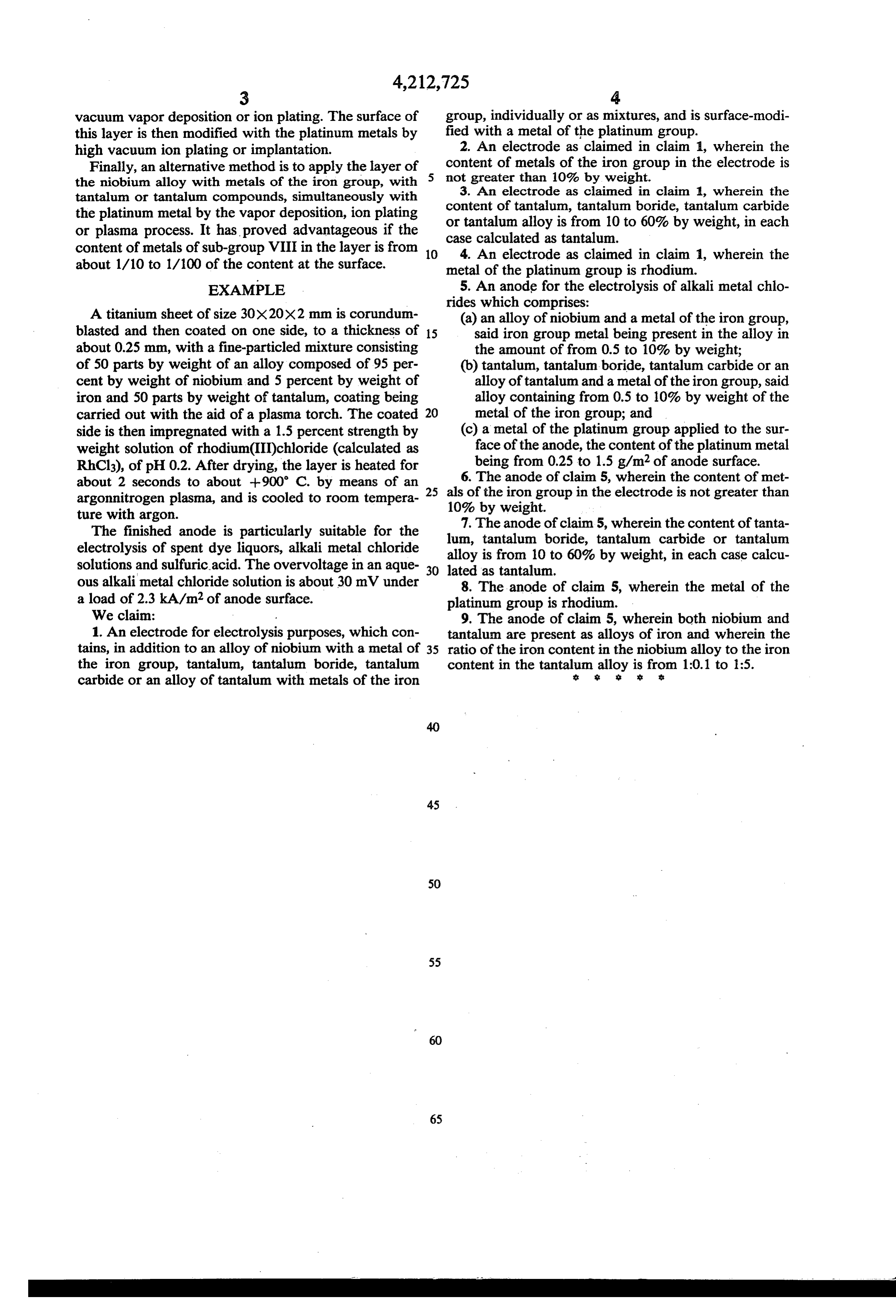
vacuum vapor deposition or ion plating. The surface of group, individually or as mixtures, and is surface-modi this layer is then modified with the platinum metals by fied with a metal of the platinum group. high vacuum ion plating or implantation. 2. An electrode as claimed in claim , wherein the Finally, an alternative method is to apply the layer of content of metals of the iron group in the electrode is the niobium alloy with metals of the iron group, with not greater than 10% by weight. tantalum or tantalum compounds, simultaneously with 3. An electrode as claimed in claim 1, wherein the the platinum metal by the vapor deposition, ion plating content of tantalum, tantalun boride, tantalum carbide or plasma process. It has proved advantageous if the or tantalum alloy is from 10 to 60% by weight, in each case calculated as tantalum.
content of metals of sub-group VIII in the layer is from 1.O 4. An electrode as claimed in claim 1, wherein the about 1/10 to 1/100 of the content at the surface. metal of the platinum group is rhodium. EXAMPLE 5. An anode for the electrolysis of alkali metal chlo rides which comprises:
A titanium sheet of size 30X20X2 mm is corundum (a) an alloy of niobium and a metal of the iron group, blasted and then coated on one side, to a thickness of 1 5 said iron group metal being present in the alloy in about 0.25 mm, with a fine-particled mixture consisting the amount of from 0.5 to 10% by weight; of 50 parts by weight of an alloy composed of 95 per (b) tantalum, tantalum boride, tantalum carbide or an cent by weight of niobium and 5 percent by weight of alloy of tantalum and a metal of the iron group, said iron and 50 parts by weight of tantalum, coating being alloy containing from 0.5 to 10% by weight of the carried out with the aid of a plasma torch. The coated 20 metal of the iron group; and side is then impregnated with a 1.5 percent strength by (c) a metal of the platinum group applied to the sur weight solution of rhodium(III)chloride (calculated as face of the anode, the content of the platinum metal RhCl3), of pH 0.2. After drying, the layer is heated for being from 0.25 to 1.5 g/m2 of anode surface. about 2 seconds to about --900 C. by means of an 25 6. The anode of claim 5, wherein the content of met argonnitrogen plasma, and is cooled to room tempera als of the iron group in the electrode is not greater than 10% by weight.
ture with argon. 7. The anode of claim 5, wherein the content of tanta The finished anode is particularly suitable for the lum, tantalum boride, tantalum carbide or tantalum electrolysis of spent dye liquors, alkali metal chloride solutions and sulfuric acid. The overvoltage in an aque 3O alloy is from 10 to 60% by weight, in each case calcu lated as tantalum.
ous alkali metal chloride solution is about 30 mV under 8. The anode of claim 5, wherein the metal of the a load of 2.3 kA/m2 of anode surface. platinum group is rhodium.
We claim: 9. The anode of claim 5, wherein both niobium and 1. An electrode for electrolysis purposes, which con tantalum are present as alloys of iron and wherein the tains, in addition to an alloy of niobium with a metal of 35 ratio of the iron content in the niobium alloy to the iron the iron group, tantalum, tantalum boride, tantalum content in the tantalum s alloys is from 1:0.1 to 1:5.
carbide or an alloy of tantalum with metals of the iron
Provenance
- Collection
- Cited prior art
- Original PDF
- patentimages.storage.googleapis.com →
- Filed
- 1978-10-30
- Pages
- 3
- Method
- pdftotext (the PDF's own text layer) + pdftoppm 300dpi page scans
- Source
- Google Patents bibliographic record
- Granted
- 1980-07-15
- Inventors
- Wolfgang Habermann; Peter Thoma; Klaus Wintermantel; BASF SE
- Transcribed from
- patentimages.storage.googleapis.com →