patent · US4185593
Transformation of electrical energy to physical energy
29 January 1980
Page 1 — bibliographic record
United States Patent (19) 11 4,185,593 McClure 45) Jan. 29, 1980 54) TRANSFORMATION OF ELECTRICAL 3,444,098 5/1969 Bottazi et al. .... ... 123/191 A ENERGY TO PHYSICAL ENERGY 3,648,668 3/1972 Pacheco .............................. 123/1 A 3,921,985 11/1975 Fimml .............................. 123/119 E 76) Inventor: Kenneth S. McClure, Rte. 1, Thayer, 3,939,806 2/1976 Bradley ..... ... 123/DIG. 12 Kans, 66776 4,009,006 2/1977 Hreha....................................... 123/3 4,031,865 6/1977 Dufour ......... ... 123/1 A 21 Appl. No.: 571,975 4,052, 39 10/1977 Paillaud et al. ..................... 123/1 A 22 Filed: Oct. 31, 1977 Primary Examiner-Charles J. Myhre (51) Int. Cl. .............................................. F02B 43/08 Assistant Examiner-Craig R. Feinberg (52) U.S.C. ....................................... 123/1 A; 123/3; Attorney, Agent, or Firm-John H. Widdowson 123/25 B; 123/25 D; 123/119 E; 123/DIG. 12 57 ABSTRACT 58) Field of Search .................. 123/1 A, 3, DIG. 12, An improved means and process for providing for the
References Cited removal of hydrogen from a catalytic cathode means 56 whereby the hydrogen may be recombined with oxygen
2,780,602 2/957 Berkman .......................... 123/191 A tion engine.
3,318,293 5/1967 Hickling et al ... 123/1.19 E 3,381,675 5/1968 Schiavone ........ ... 123/193 H 13 Claims, 4 Drawing Figures
Page 2
Drawing sheet — no readable text.
Page 3
possessing ordinary skill in the art and as the following
TRANSFORMATION OF ELECTRICAL ENERGY description proceeds are attained by this novel transfor TO PHYSICAL ENERGY mation of electrical energy to physical energy, a pre ferred embodiment shown in the accompanying draw
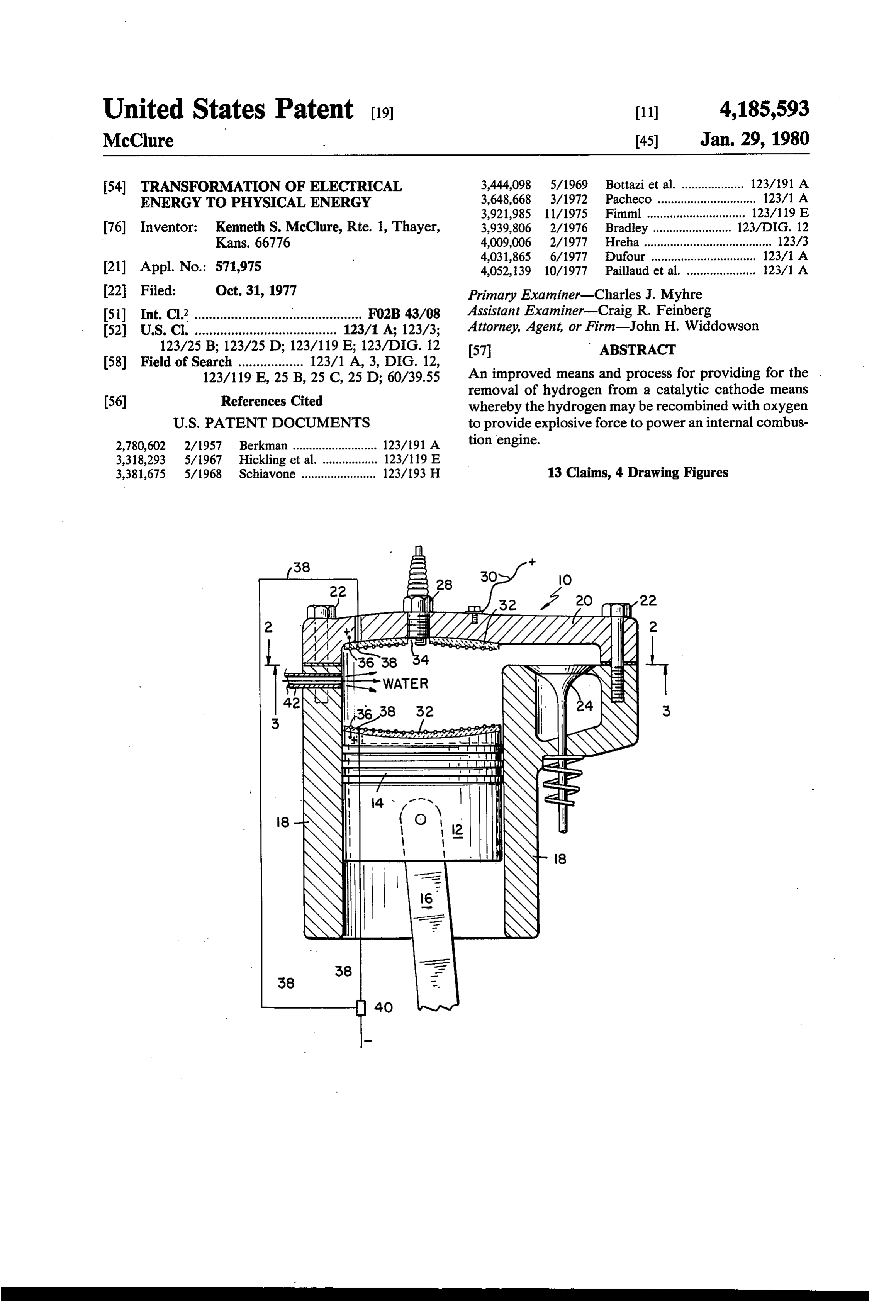
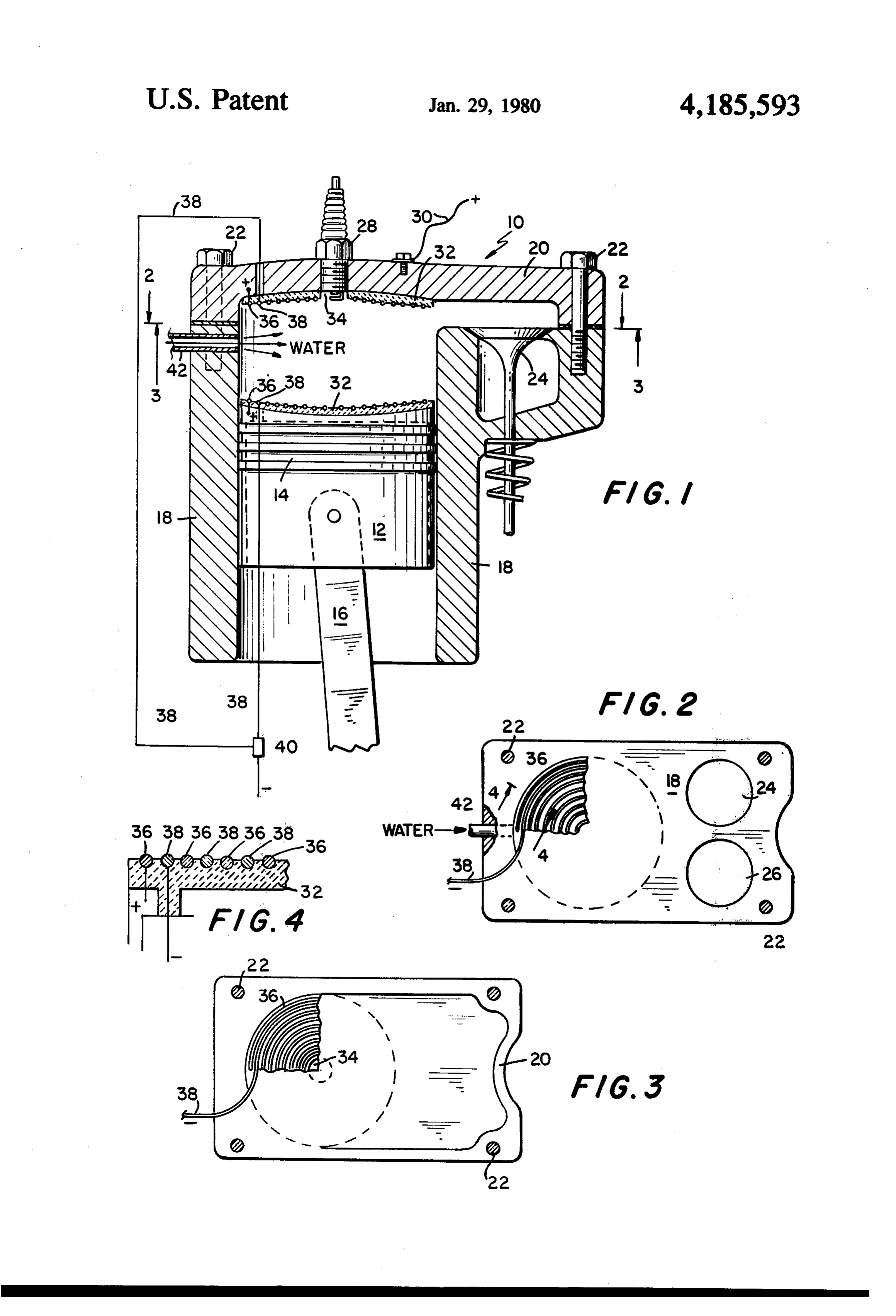
BACKGROUND OF THE INVENTION 5 ings, by way of example only, wherein: 1. Field of the Invention BRIEF DESCRIPTION OF THE DRAWINGS This invention is related to the transformation of electrical energy to physical energy. More particularly, FIG. 1 is a vertical sectional view of a head assembly this invention provides an improved means and process O of an internal combustion engine showing a preferred for providing for the removal of hydrogen from a palla embodiment of the invention.
dium conductor to mix with oxygen to provide explo FIG. 2 is a horizontal sectional view taken along the sive force to power an internal combustion engine. plane of line 2-2 in FIG. 1.
2. Description of the Prior Art FIG. 3 is a horizontal sectional view taken along the U.S. Pat. No. 3,248,871, May 3, 1966, and U.S. Pat. 15 plane of line 3-3 in FIG. 1.
No. 3,256,686, June 21, 1966, to J. E. Lindberg, Jr., FIG. 4 is a fragmentary vertical sectional view taken teach ingassing (taking in gas in either a chemical or along the plane of line 4-4 in FIG. 2. physical action) or degassing (also called "out-gassing") DETAILED DESCRIPTION OF THE upon the application or removal of heat to effect expan INVENTION sion within a confined area against a movable face to 20 activate the following devices, which are capable of Referencing the drawings wherein identical refer applying mechanical force: hydraulic systems, gas tur ence numerals represent similar parts of the invention, bines, loudspeakers, and valve actuators. None of these there is seen a head assembly, generally illustrated as 10, patents or any other art teach the improved transforma tion of electrical to physical energy which is the subject of an internal combustion engine (not shown in the drawings), having a piston 12 with compressor seal
rings 14 and a crankshaft 16 attached thereto. Piston 12
SUMMARY OF THE INVENTION is slidably positioned within the lower part 18 of the It is therefore an object of this invention to provide head assembly 10 which also has an upper part 20 con necting to the lower part 18 by bolts 22. Head assembly an improved means and process for the transformation 10 additionally includes an intake valve 24 and an ex of electrical energy to physical energy. 30 haust valve 26 along with an ignition plug 28 and
It is another object of this invention to provide an ground wire 30. An insulation means 32, which is pref. improved means and process for providing for the re erably a ceramic material or the like, is attached to the moval of hydrogen from a catalytic cathode means. top of piston 12 and to the upper part 20 which includes It is yet another object of this invention to provide an an aperture 34 for the ignition plug 28. A catalytic improved means and economical process for providing 35 anode for the removal of hydrogen from a palladium conduc catalyticmeans 36, preferably a silver conductor, and a cathode means 38, which is a preferred em tor to mix with oxygen to provide explosive force to power an internal combustion engine. bodiment of the invention is a palladium conductor, Still other objects will be apparent to those skilled in have a source of electricity (not shown in the drawings) the art from the following description of this invention. and are spirally wound (as shown in FIGS. 2 and 3) and The foregoing objects are achieved according to the attached to the insulation 32. The cathode 38, leading practice of this invention. Broadly, this invention pro from the insulation 32 which is attached to upper part vides an improved means and process for providing for 20, connects with the cathode 38 leading from the insu the removal of hydrogen from a catalytic cathode lation 32 that is connected to the piston 12 via a sliding means whereby the hydrogen may be recombined with 45 brush contact 40. Head assembly 10 also comprises a oxygen to provide explosive force to power an internal basified water conduit 42 which is in communication combustion engine. Water is sprayed into a housing with a basified water source (not shown in the draw Zone at a temperature below about 100 C. and at a ings). The anode 36 and the cathode 38 are spacedly pressure below about 14.7 psia; the housing zone in-, juxtaposed, as shown in FIG. 4, such that the basified cludes the catalytic cathode means and a catalytic 50 water can bridge the space therebetween and electro anode means spacedly juxtaposed thereto. Insulation lytic decomposition of the basified water is initiated by means is positioned between the catalytic cathode the electrification of the anode 36 and the cathode 38, means and the catalytic anode means, and the cathode and a hydrogen surface film and interstitial hydrogen is means and the anode means are electrified. The water formed in and on the cathode 38. A means for raising bridges the space between the cathode means and the 55 the temperature of the cathode 38 above about 250 C. anode means such that electrolytic decomposition of is, in a preferred embodiment of the invention, the com the water is initiated by the electrification. The im pression stroke of the piston 12 which causes an adia proved means and process also provides for forming a batic temperature rise within the space above the top of hydrogen surface film and interstitial hydrogen in and piston 12 and beneath the upper part 20 and purges on the catalytic cathode means by the cathode and 60 molecular hydrogen from the cathode 38. anode means being electrified and associated with the With continued reference to the drawings for opera water. Molecular hydrogen is expelled by purging the tion of the invention, cool air at a pressure below about hydrogen surface film on the cathode means and the 14.7 psia is drawn through intake valve 24 and cools the interstitial hydrogen dissolved in the cathode means. silver 36/palladium 38/ceramic 32 gridwork to a tem Purging results from the raising of the temperature of 65 perature below about 100° C. The ceramic 32 (or other the cathode means to above about 250 C. suitable isulating base) controls the palladium distortion These, together with various ancillary objects and normally associated with palladium-hydrogen absorp features which will become apparent to those artisans tion-desorption cycling. Hydrogen peroxide treated
Page 4
distilled water is sprayed through conduit 42 onto the 5. The process of claim 3, additionally including electrified silver 36/palladium 38/ceramic 32 gridwork purging from said combustion chamber said steam for such that the water bridges the space between the silver further utilization as an energy source. 36 and palladium 38 and catalyzed electrolytic decom 6. The process of claim 3, additionally including spi position of the basified water is initiated, and a hydro- 5 rally positioning with respect to a horizontal plane said gen surface film and interstitial hydrogen is formed on cathode means and said anode means within said com and in, respectively, the palladium 38. When piston 12 bustion chamber.
starts upward, adiabatic compression commences and 7. The process of claim 6, wherein said cathode the temperature within the head assembly 10 increases means is palladium wire, said anode means is silver wire, from below 100° C. to above about 250° C. This temper and said insulation is ceramic.
ature rise purges the hydrogen surface film on the palla 10 8. An improved means for providing explosive force dium 38 and the interstitial hydrogen dissolved in the to power an internal combustion engine having a head palladium 38. Residual basified water on the silver assembly, a piston slidably situated within said head 36/palladium 38/ceramic 32 gridwork is converted to assembly, an intake and exhaust valve positioned in said steam which terminates the current flow on the electri head assembly and in communication with the top of fied gridwork. A compression ratio of at least 8:1 (yield 15 the piston, the improvement comprising: ing a pressure within the head assembly of at least 117.6 (a) an insulation means;
psia) would be sufficient to increase the temperature (b) a catalytic cathode means and a catalytic anode from below about 100° C. to above about 250 C. and means spacedly juxtaposed to said cathode means, purge molecular hydrogen from the palladium 38. said cathode and anode means being attached to The expelled molecular hydrogen combines with the 20 said insulation means and positioned within said oxygen available in the compressed air and is capable of head assembly in the space above said piston and being ignited by ignition plug 28 to provide an explosive on top of said piston;
violence at a head assembly 10 temperature above about . (c) a means for electrifying said cathode and anode 250° C. In a preferred embodiment, the temperature of means;
the head assembly is somewhat above 400° C. An inter- 25 (d)anode a means for spraying water onto said cathode and means such that said water bridges the space nal combustion engine of higher compression ratio between said cathode and anode means and elec would provide sufficient temperature on adiabatic com trolytic decomposition of the water is initiated by pression to cause the released hydrogen to ignite in the said electrification and a hydrogen surface film and presence of air at 600 C. and eliminate the need for interstitial hydrogen is formed in and on said cath ignition plug 28. Superheated steam is removed from 30 ode means; and the head assembly 10 via exhaust valve 26 for further (e) a means for raising the temperature of the cathode utilization as an energy source. means to above about 250 C. to purge the hydro I claim:
1. A process for providing for the removal of hydro gen surface film on the cathode means and the gen from a catalytic cathode means whereby the hydro 35 interstitial hydrogen dissolved in the cathode gen may be recombined with oxygen to provide explo means such as to expell molecular hydrogen which sive force to power an internal combustion engine mixes with available oxygen to be capable of ex which comprises: ploding to provide explosive force to power the (a) spraying water into a combustion chamber of an internal combustion engine. 9. The improved means engine at a temperature below about 100 C. and a cluding an electrical spark means of claim 8, additionally in pressure below about 14.7 psia, a combustion assembly to ignite the mixture of oxygen attached to said head and hydrogen chamber containing a catalytic cathode means and with explosive violence.
a catalytic anode means spacedly juxtaposed 10. The improved means of claim 8 wherein said thereto, insulation means positioned between said cathode means and said anode means are spirally wound catalytic cathode means and said catalytic anode to said insulation means.
means, said cathode means and said anode means 45 11. The improved means of claim 10 wherein said being electrified, said water bridging the space insulation means is a ceramic material and is positioned between said cathode means and said anode means to the top of said piston, said cathode means is a palla such that electrolytic decomposition of the water is dium wire and extends through the piston, said anode initiated by said electrification; means is a silver wire and is grounded to said piston. (b) forming a hydrogen surface film and interstitial 50 12. The improved means of claim 11, wherein a sec hydrogen in and on said catalytic cathode means ond ceramic material is attached to the head assembly in by said cathode means and said anode means being the space having communication with said intake and electrified and associated with said water; and said exhaust valves, said second ceramic material in (c) purging said hydrogen surface film on said cath cludes a second silver wire and a second palladium wire ode means and said interstitial hydrogen dissolved 5 spirally situated thereto and spacedly juxtaposed such in said cathode means by raising the temperature of that water can bridge between the second silver wire said cathode means to above about 250 C., said and the second palladium wire, said second silver wire purging being in the form of expelled molecular is grounded to the head assembly, and said second palla hydrogen which mixes with said available oxygen. dium wire extends through the head assembly, and a 2. The process of claim 1, additionally including pro viding an electrical spark means to ignite said mixture of 60 sliding brush contact interconnects the second palla dium wire with the palladium wire that extends through oxygen and hydrogen with explosive violence. said piston.
3. The process of claim 2, additionally including in 13. The improved means of claim 12, wherein said creasing the pressure of said catalytic cathode means tosecond ceramic material has a structure defining an about 117.6 psia to vaporize residual water into steam aperture, an electrical spark means extends through said and stop the current flow between said cathode means 65 aperture and is attached to said head assembly, said and said anode means. spark means ignites the mixture of oxygen and hydro 4. The process of claim 3, wherein said increasing is gen with explosive violence. s simultaneous to said purging step (c).
Provenance
- Collection
- Cited prior art
- Original PDF
- patentimages.storage.googleapis.com →
- Filed
- 1977-10-31
- Pages
- 4
- Method
- pdftotext (the PDF's own text layer) + pdftoppm 300dpi page scans
- Source
- Google Patents bibliographic record
- Granted
- 1980-01-29
- Inventors
- Kenneth S. McClure
- Transcribed from
- patentimages.storage.googleapis.com →