patent · US4112876
Method and apparatus for starting up a gas generator for converting hydrocarbons into a fuel gas, and an internal combustion engine to be supplied with the fuel gas
12 September 1978
Page 1 — bibliographic record
United States Patent (19) (11) 4,112,876 Mentschel (45) Sep. 12, 1978 54 METHOD AND APPARATUS FOR 3,926,850 12/1975 Kostka ..................................... 123/3 STARTING UPA GAS GENERATOR FOR 3,954,423 5/1976 Hamper ................................... 123/3 CONVERTNG HYDROCARBONS INTO A 3,982,910 9/1976 Houseman et al. .................... 23/281 4,018,573 4/1977 Mentschel ................................ 123/3
FUEL GAS, AND AN INTERNAL
COMBUSTON ENGINE TO BESUPPLIED FOREIGN PATENT DOCUMENTS
WTH THE FUEL GAS 2,431,207 1/1976 Fed. Rep. of Germany ............. 48/107 75 Inventor: Hellmuth Mentschel, Erlangen, 2,431,251 1/1976 Fed. Rep. of Germany ............. 48/107 Germany Primary Examiner-Charles J. Myhre 73 Assignee: Siemens Aktiengesellschaft, Munich, Assistant Examiner-Craig R. Feinberg Germany Attorney, Agent, or Firm-Kenyon & Kenyon Reilly Carr & Chapin (21) Appl. No.: 721,851 57 ABSTRACT
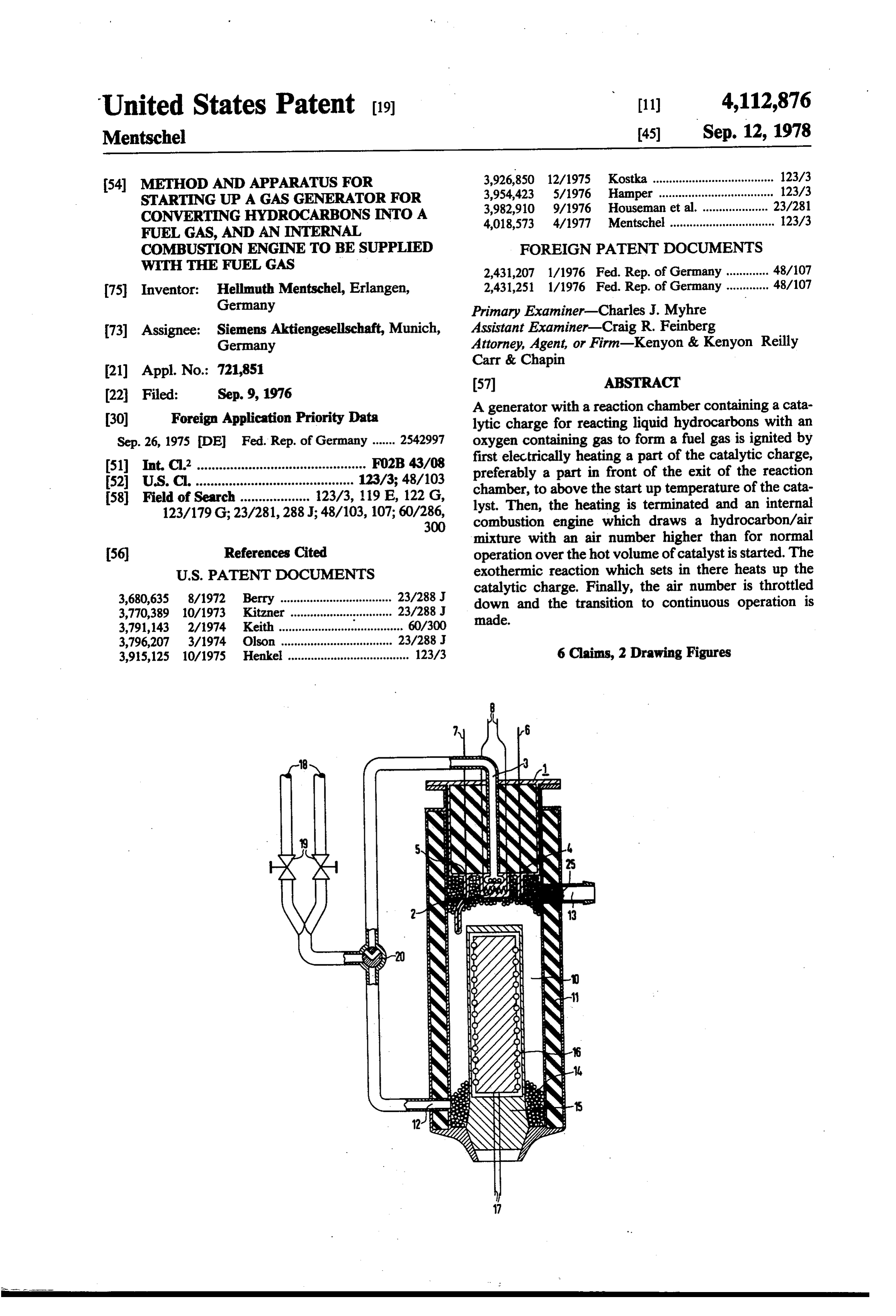
A generator with a reaction chamber containing a cata (30) Foreign Application Priority Data lytic charge for reacting liquid hydrocarbons with an Sep. 26, 1975 DE Fed. Rep. of Germany ....... 2542997 oxygen containing gas to form a fuel gas is ignited by 51) int. Cl’.............................................. FO2B 43/08 first electrically heating a part of the catalytic charge, 52 U.S.C. ........................................... 123/3; 48/103 preferably a part in front of the exit of the reaction 58 Field of Search ................... 123/3, 119 E, 122 G, chamber, to above the start up temperature of the cata 123/179 G; 23/281,288J;48/103, 107; 60/286, lyst. Then, the heating is terminated and an internal 300 combustion engine which draws a hydrocarbon/air mixture with an air number higher than for normal (56) References Cited operation over the hot volume of catalyst is started. The
catalytic charge. Finally, the air number is throttled 3,680,635 8/1972 ... 23/288 J down and the transition to continuous operation is 3,770,389 10/1973 23/288 J made.
3,791,143 2/1974 Keith ...................................... 60/300 3,796,207 3/1974 23/288 J 3,915,125 10/1975 Henkel ..................................... 123/3 6 Claims, 2 Drawing Figures
Page 2
Drawing sheet — no readable text.
Page 3
Drawing sheet — no readable text.
Page 4
reaction chamber. In the combustion chamber a
METHOD AND APPARATUS FOR STARTING UP gasoline/air mixture is ignited simultaneously with the A GAS GENERATOR FOR CONVERTING starting of the internal combustion engine connected to HYDROCARBONS INTO A FUEL GAS, AND AN the reformed gas generator. The flaming combustion of INTERNAL COMBUSTION ENGINE TO BE 5 the gasoline produces hot flame gases which are drawn SUPPLIED WITH THE FUEL GAS by the internal combustion engine through the reaction chamber together with a further reaction mixture of gasoline and combustion air. These gases heat the cata
BACKGROUND OF THE INVENTION lytic charge contained therein up to the start up temper This invention relates to gas generators in general and 10 ature of the catalyst. From then on, the reaction mixture more particularly to a method for starting up a gas in the reformed gas generator itself is reacted and the generator for the catalytic reaction of hydrocarbons flame is extinguished.
with an oxygen containing gas to form a fuel gas and for In U.S. Pat. No. 3,954,423 and in U.S. Application starting up an internal combustion engine which is to be Ser. cede
No. 633,609, further starting devices which pre the inlet to the reaction chamber of the reformed supplied with the fuel gas, wherein catalytic material is 15 temporarily electrically heated in a reaction chamber gas generator, which consist of a starting generator containing a catalytic charge; a mixture of hydrocar with a separate starting catalyst of small volume are bons and air, richer in oxygen than the mixture used in described. Upon starting the internal combustion en continuous operation, is conducted over the catalytic 20 gine, a gasoline/air mixture is also ignited in the starting material, is reacted there exothermically for further generator. The hot flame gases of the latter are drawn heating of the catalytic charge, and the fuel gas pro by the internal combustion engine through the starting duced is fed to the internal combustion engine; as well catalyst and heat the latter up quickly. Then, a gasoline as apparatus for implementing this method. /air mixture is fed to the starting catalyst and is con Gas generators can be used, for instance, to catalyti verted there into a hot fuel gas which in turn is drawn, cally convert hydrocarbon containing fuels into a fuel 25 for heating up the catalytic charge of the reformed gas gas which is better suited for the operation of internal generator, through the reaction chamber of the latter. combustion engines than liquid fuel. For, in internal At the same time, the flame is extinguished. This gener combustion engines supplied with liquid fuel, for in ates a fuel gas with which the internal combustion en stance, in motor vehicles, the incomplete evaporation of gine can be operated without load, shortly after the the fuel and the uneven mixing with combustion air lead 30 internal combustion engine is started, even before the to incomplete combustion and emission of harmful sub ing reformed gas generator itself is heated up to the operat stances. In addition, antiknock agents must as a rule be temperature. However, the starting generator, admixed to the fuel causing the content of substances in which precedes the inlet to the reaction chamber, re the exhaust gas which are harmful to the health to be quires additional space of its own, although such space increased further. The hazardous pollution of the air 35 is relatively small.
can largely be prevented if the internal combustion In U.S. Pat. No. 3,915,125, a starting procedure is engine is operated with fuel gas. This fuel gas can be described which makes use of an electric starting device generated, as is described, for instance, in the U.S. Pa which is arranged in the interior of the reaction cham tent Application Ser. No. 633,609, in a reformed gas ber and precedes at least part of the catalyst in the flow generator by partial catalytic oxidation of evaporated direction. This starting device may consist, for instance, or vaporized liquid fuel with an oxygen containing gas, of incandescent electric wires which are coated with and the fuel gas then burned, together with additional catalytic material and are connected into an external combustion air, in the internal combustion engine. Since circuit. To start the generator, the internal combustion this fuel gas (reformed gas) has a high octane number, engine is driven, for instance, by an electric starter, the the addition of antiknock agents is not required. 45 external circuit is closed and a slightly understoichiom A mixture of air and exhaust gas of the internal com etric hydrocarbon/air mixture is ignited at the incandes bustion engine, for instance, can be used as the oxygen cent wires. The strongly exothermic reaction initiated containing gas for the reaction where the reaction is thereby, which may take place with a flame or will at endothermic if the exhaust gas content is high and exo least have a tendency to an ignition, allows hot gases to thermic if the air content is high. To carry out the reac 50 be produced which heat the catalytic charge to above tion, the catalyst must have an operating temperature the start up temperature of the catalyst. The reaction of which is above the start up temperature of the catalyst, the hydrocarbon/air mixture can also be initiated at an the start up temperature of a catalyst being understood, electric starting device which consists of an electric as usual, to be that temperature at which the effect of heater resistor of catalytic material. This heater resistor the catalyst leads to a noticeable reaction. The operat 55 is heated by an external circuit until the catalytic charge ing temperature can be maintained by supplying heat to is heated above the start up temperature of the catalyst. the generator from the outside, for instance, through an At the same time, with the further heating of the cata exchange with the hot exhaust gases of the internal lytic charge the throughput of hydrocarbons is in combustion engine or by a supplemental electric heater. creased step by step and the air supply is throttled until However, the temperature of the catalyst can also be 60 the catalyst is heated to a reaction temperature suited controlled by changing the composition of the oxygen for continuous operation and the transition to continu containing gas, i.e., the air/exhaust gas mixture, and by ous operation can be made.
changing the thermal balance of the reaction accord In all known devices and starting methods, the hy ingly. Thus, a compensation of the heat losses of the drocarbon fuel is overstoichiometrically or slightly generator can be achieved by a light exothermic reac 65 understoichiometrically reacted with air during start tion. ing, so that a short starting time of the gas generator is In one known device a combustion chamber with a achieved through violent development of heat and the flame ignition plug is arranged at the entrance of the internal combustion engine, which is to be operated
Page 5
with the fuel gas produced, can be put in operation ready switched off, the starter battery is not overloaded quickly. it is a disadvantage in such operation that, with by the simultaneous operation of the start up heater and this relatively large supply of air, in the flame gases and the starter motor. At first, the air content in the reaction at the catalyst initiating the reaction, temperatures mixture is increased over that of continuous operation. occur which may lead to damage of the temperature Where the air number A is understood to mean the ratio sensitive catalysts. In the interest of greater safety, of the amount of air supplied to the amount of air re moreover, methods would be preferable, in which a quired for stoichiometric combustion (N = 1) of the flame reaction of the reaction mixture is avoided. In hydrocarbons employed, then the air number of the addition, a product gas is generated, at the beginning of mixture drawn in during the second starting phase can the starting process, which has only a low calorific 10 advantageously lie between about 0.3 and 0.4. If there value and which must be drawn through the generator are no cavities in the reaction chamber of the generator by the internal combustion engine in order to heat up for a flame to develop, flame combustion is not possible the catalytic charge. However, to accomplish this, the with air numbers below 0.5. The fuel gas produced then internal combustion engine must first be kept running also has a calorific value sufficient for the internal com by an external energy source until the generator pro 15 bustion engine to start up. The reaction zone of the duces a gas with a calorific value sufficient to operate exothermal reaction now spreads and heats up the cata the internal combustion engine. In this last described lytic charge quickly to the extent that in the continuous prior art method, the vehicle's external energy source, operation which follows the starting process, and dur e.g., the starter battery is simultaneously loaded by the ing which the air number in the reaction mixture sup start up heater and by the starter motor. 20 plied is throttled down, the reaction mixture can be SUMMARY OF THE INVENTION converted in the heated parts. If the internal combustion engine is not at first operated at full load after the start
It is an object of the present invention to provide a ing process is completed, then it is not necessary to wait method and apparatus for starting a gas generator for for continuous operation until almost the entire cata generating fuel gas, and for starting an internal combus 25 lytic charge is heated to the operating temperature. As tion engine to be supplied with the fuel gas, using an a rule, it will then be sufficient if part of the catalytic electrical start up heater in such a manner that no flame charge has reached the operating temperature. Even if reaction takes place in the gas generator and thus, the the reaction mixture is at first not completely reacted, in occurrence of excessively high temperatures is avoided. the heated parts of the catalytic charge, a small content A further object is to avoid a condition where the 30 of unreacted fuel gases in the generated gas mixture will starter battery has to supply an excessively large not lead to operating difficulties.
amount of power even for a short time. The method requires no voluminous components for Further objects are to insure that the gas generator its implementation. In addition, it ensures a quick and delivers a fuel gas with sufficient calorific value even operationally safe starting of the generator and the in after a short start up time and that the device required 35 ternal combustion engine without excessively loading for the starting process has a few additional components an external energy source.
and requires as little space as possible. It is advantageous to apportion the amount of the According to the present invention, this problem is hydrocarbons supplied during the second start up phase solved by electrically heating a small part of the volume in such a manner that the generated mixture of fuel and, of the catalytic charge at least to the start up tempera 40 possibly, unreacted hydrocarbons covers, but not sub ture of the catalyst; terminating the electrical heating, stantially exceeds, the demand on the internal combus driving the internal combustion engine, introducing the tion engine when idling. The internal combustion en hydrocarbon/air mixture, reacting it at the heated part gine can then keep running by itself during the second of the volume without flame and further heating the start up phase.
catalytic charge by the spreading of the exothermic 45 It is particularly advantageous if a part of the volume reaction, and finally, feeding the hydrocarbons and the of the catalytic charge which is in the proximity of the oxygen containing gas, to the generator with an oxygen outlet of the reaction chamber is heated electrically. In component provided for the reaction in continuous the reaction chamber of the gas generator, which is operation after the catalytic charge is sufficiently hot. designed for continuous operation with a lower air The method according to the present invention thus 50 number, i.e., for a less strongly exothermic reaction, the proceeds in two stages. First, with the supply of hydro reaction of the more oxygen rich mixture first spreads in carbon and air shut off, an electric start up heater, the catalytic charge. If the mixture is introduced here which is preferably embedded in the catalytic charge, is via the inlet of the reaction chamber, then the reaction switched on and quickly heats up part of the volume of takes place in a relatively narrow reaction zone which the catalytic charge. The temperature of this subvolume 55 travels against the flow direction toward the inlet. reaches the start up temperature of the catalytic mate Thus, layers of the catalytic charge lying one behind the rial within a few seconds. For example, a subvolume of other are heated up quickly, without the reaction al catalyst which, together with the fuel gas produced by ways occurring in the same zones of the catalytic reaction in the subvolume and, if necessary, with addi charge, which might heat up too much in this manner. tional, unreacted hydrocarbons, in just sufficient to 60 It is even more advantageous to feed at least part of cover the demand of the internal combustion engine the mixture directly to the heated subvolume, for in when idling can be heated up. stance, via an auxiliary feed line. After the reaction has At the beginning of the second stage, the start up spread through the catalytic charge, the mixture can heater is switched off. Simultaneously or immediately then be fed to the entrance of the reaction chamber and thereafter, the hydrocarbon/air mixture is fed in and the 65 the auxiliary feed line shut off. internal combustion engine is started, for instance, elec Other reactors in which a reaction mixture is reacted trically. By its suction, the reaction mixture is drawn exothermically at a catalyst can also be started in this through the generator. Since the start up heater is al manner. To this end, a partial volume of the catalyst
Page 6
adjacent to the outlet of the reaction chamber is first heated by the start-up heater during the second start up heated. This can be accomplished by electrical heating phase. Preferably, a temperature sensor is provided in and a heavily exothermic reaction which takes place in the vicinity of the start up heater, which indicates when this heated subvolume. Now, the reaction mixture is fed the start up temperature in the subvolume of the cata to the reaction chamber via the inlet with a composition lyst is reached. In addition, a further temperature sensor which leads to a more strongly exothermic reaction can be arranged in the reaction chamber to indicate the than in continuous operation. The reaction front of the spreading of the hot reaction zone into the catalytic incipient reaction travels quickly through the catalyst charge. A supplemental heater attached at the reaction toward the inlet. If the catalyst is sufficiently hot, then chamber, which may be coupled, for instance, to the the reaction mixture can be fed into the reaction cham 10 further temperature sensor and switched on when the ber with a composition sufficient for continuous opera internal combustion engine is running, if the tempera tion. The reaction travels through the reaction chamber ture in the reaction chamber drops below the operating even more quickly if, during the starting process, the temperature is also advantageous.
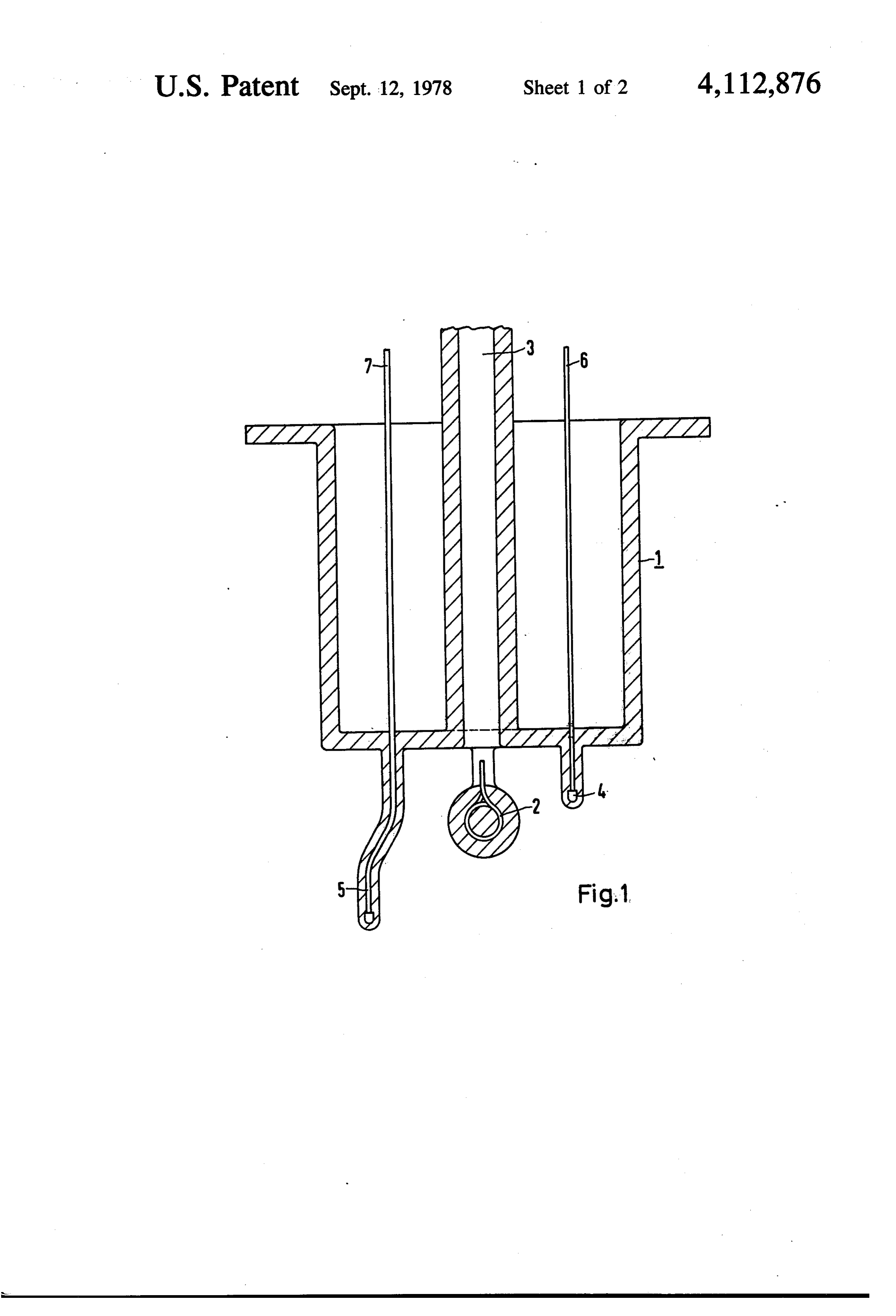
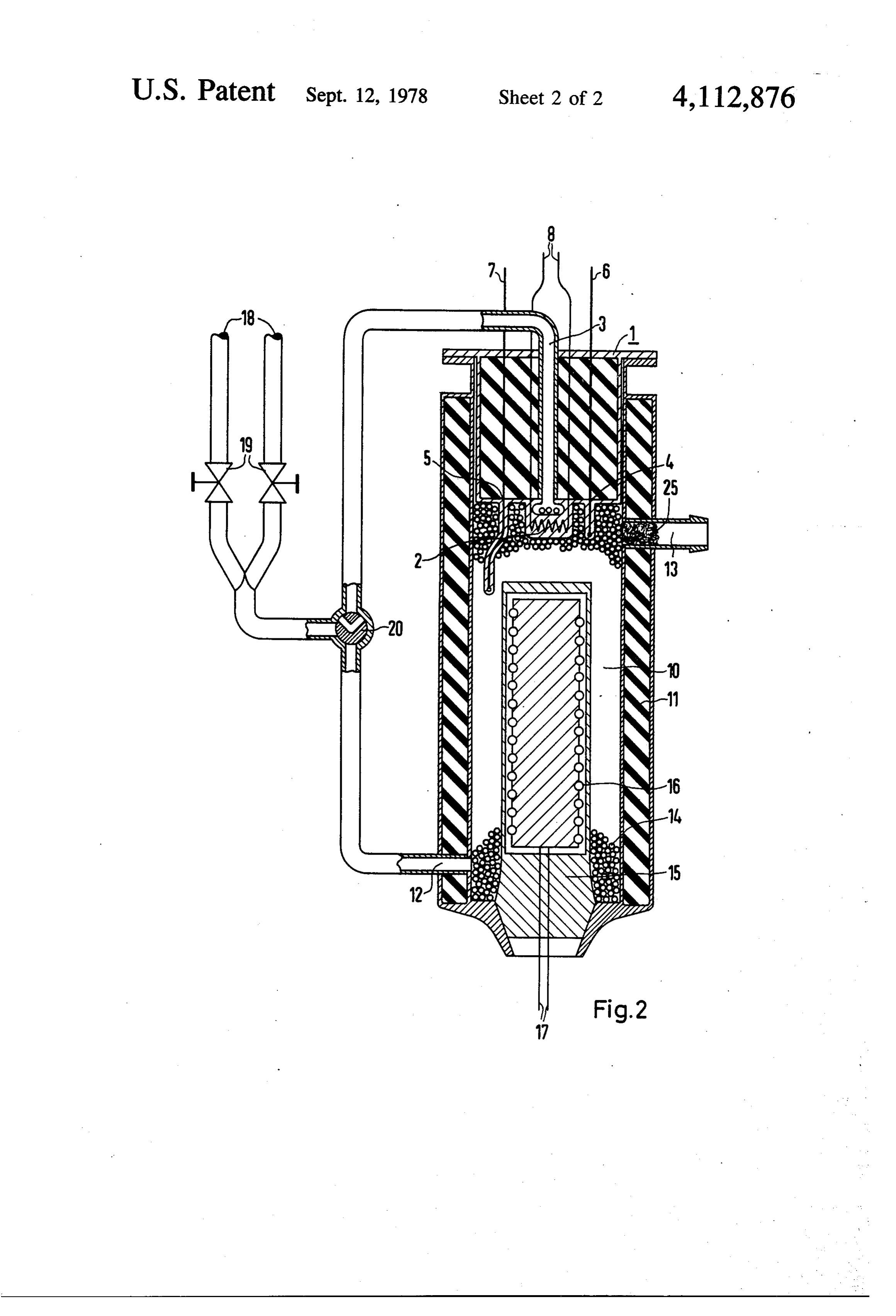
supply of the reaction mixture is throttled below the supply used in continuous operation, for which the 15 BRIEF DESCRIPTION OF THE DRAWINGS reactor is designed. In some cases, for instance, with FIG. 1 is a longitudinal cross section through a start cylindrical catalyst chambers, this migration can also be up heater designed as an insert for a generator with an achieved by throttling the supply alone without chang auxiliary feed line.
ing the composition of the reaction mixture. FIG. 2 is a schematic cross section through a genera When the internal combustion engine has exceeded a 20 tor equipped with the insert of FIG. 1 for carrying out minimum speed sufficient for driving the electric gener the method according to the invention. ator, the reaction chamber can advantageously be DETALED DESCRIPTION OF THE heated if the temperature falls below the operating tem INVENTION perature. A temperature drop could be due, for in stance, to interference in the gasoline supply and can be 25 The insert 1 shown in FIG. 1 is provided with an prevented by an electric heater, the energy for which is electric heater at its lower end which protrudes into the supplied, for instance, by the electric generator driven reaction chamber of the generator. Toward this lower by the internal combustion engine itself. end an auxiliary feed line 3 for the mixture of hydrocar The method according to the present invention is bon and air is directed. In the insert 1, two temperature advantageously implemented with a generator which 30 sensors 4 and 5 are also attached. The first temperature comprises a reaction chamber containing a catalytic sensor 4 is arranged in the vicinity of the electric heater charge, lines with metering devices for the supply of coil 2, and the other temperature sensor 5 at some dis hydrocarbons and air to the reaction chamber, and an tance therefrom. The lead wires of the electric heater electric start up heater arranged in the reaction cham coil, not shown in the figure, and the connecting cables ber, this electric start up heater being embedded in the 35 6 and 7 of the temperature sensors are surrounded by an catalytic charge. The start up heater is preferably em insulating jacket and are brought out of the insert 1 to bedded in a part of the catalytic charge, which is dis the control devices of the generator. posed in the vicinity of the outlet of the reaction cham The generator shown in FIG. 2 consists of a cylindri ber. The start up heater is preferably designed, with cal reaction chamber 10, which is surrounded by a dou respect to the heating area and energy consumption, in ble walled jacket A1 filled with insulating material. such a manner that within a short time, at most within a Chamber 10 has an inlet 12 for the raw materials of the few seconds, a part of the catalytic charge having a reaction at one end and an outlet 13 for the product gas volume sufficient for the catalytic generation of an at the other end. The insert 1, of FIG. 1, with the parts amount of fuel gas which largely covers the demand of labelled with the same reference numerals as FIG. 1, the internal combustion engine when idling is heated 45 protrudes into the reaction chamber up to the outlet 13. up. A heater plug 15 with an electric heater winding 16 and In order to keep the energy consumption low during connecting leads 17 protrudes further into the reaction the heating up period, the start up heater can advanta chamber as a supplemental heater. The hydrocarbons geously be embedded in a catalytic material with a heat and the oxygen containing gas are conducted via supply capacity as low as possible. At least the part of the 50 lines 18, which are equipped with adjustable metering catalytic charge surrounding the start up heater consists valves 19, to a three-way valve 20, through which they preferably of porous, ceramic hollow spheres or of are fed as desired to the auxiliary feed line 3 or to the inorganic fibers. For instance, hollow spheres of a inlet 12 of the reaction chamber 10.
aluminum oxide with about 2 to 3 mm diameter can be The reaction chamber contains a bed of catalyst, e.g., considered. These are commercially available as what is 55 spherical hollow bodies 14 of a-AlO3, known as spheri known as spherical corundum. Also a layer of felt-like cal corundum, with a diameter of about 2 to 3 mm. The fibers, such as quartz glass wool or aluminum oxide outlet of the reaction chamber is closed off by a plug 35 wool, is highly suited. The aluminum oxide can be addi of aluminum oxide wool.
tionally impregnated with catalytically active compo A heater coil 2 is embedded in the spherical corun nents. At temperatures between 750 and 800' C, the dum bed. It is fused into a quartz cylinder forming a reaction of hydrocarbons with air sets in at such materi heating surface of about 4 cm and electrically heats the als to form a fuel gas containing CO, CO, Hand CH catalytic material surrounding the heater surface to a with a worthwhile yield. depth of about two spherical corundum diameters. In a particularly advantageous embodiment of the However, the heater coil 2 can also be embedded in starting device, an auxiliary feed line opens into the 65 the aluminum oxide wool. The start up temperature of reaction chamber in the vicinity of the start up heater. the aluminum oxide for the reaction of hydrocarbons Through this auxiliary feed line, a more oxygen rich such as gasoline, with air is at about 750 C, and at air fuel/air mixture is fed to the subvolume of the catalyst numbers between 0.3 and 0.4. Reaction temperatures of
Page 7
between 800 and 1200 C are obtained. For continuous combustion engine, the heat required for the evapora operation, temperatures of about 900 C and air num tion must be supplied by the reaction itself. If in the bers of between 0.1 and 0.3 are provided. The aluminum event of a load change, the gasoline supply is increased oxide may also be impregnated with an additional active rapidly. This can cause the temperature in the reaction component in order to catalyze, for instance, an endo chamber to drop below the start up temperature under thermic reaction of hydrocarbons with an air/exhaust certain conditions, if the air numbers are below 0.25. In gas mixture. that case, the heater plug 15 is switched on; the "on' In a series of tests, the generator shown in the figures signal to do this can be given by the temperature sensor was started by applying a voltage of 10 V from a volt 5. Such load changes are expected, however, only dur age source to the terminals 8 of the start up heater 2. 10 ing operation with the internal combustion engine run With a heater area of about 4 cm and a current drain of ning, where the internal combustion engine can supply about 17 amps, electric energy of less than 1 watt was the heating energy required for the supplemental heater required for the start up heater to bring the corundum itself via its electric generator. spheres surrounding the start up heater to the start up The method according to the present invention can temperature of about 750° C. Within 10 to 20 seconds, 15 also be carried out without temperature measurement the temperature sensor 4 signalled via an indicator lamp during the starting phase. Thus, the experimental gener connected to its connecting lead 6 that the start up ator shown in FIG. 2 has also been started by carrying temperature was reached. The start up heater was out the electrical heating and the switching from the turned off and a hydrocarbon/air mixture was con auxiliary feed line 3 to the inlet 12 in accordance with a ducted into the reaction chamber. For this purpose, the fixed timing plan. The heating time of the start up heater one input of the three-way valve 20 was connected to a was predetermined and one minute after the start up compressor for the air and the other input to a gasoline heater was switched off, the gasoline supply was tank. The compressor was also connected with the switched over and at the same time, the throughput was gasoline tank via a branch line, to let the gasoline, changed to about 0.8 to 3-1/hr and the air number to which served as the hydrocarbon containing fuel, flow 25 about 0.2, i.e., to conditions for continuous operation. under pressure to the three-way valve 20. At the throt At the same time, a thermostat system consisting of the tling devices 19, a gasoline/air mixture was adjusted temperature sensor 5 and the heater plug 15 was which had a throughput of about 0.3 1/hr and an air switched on. With the fuel gas now produced, an inter number of about 0.35. By setting the three-way valve nal combustion engine could already be operated at accordingly, the mixture was conducted via the auxil 30 partial load. In tests with a fixed heating time of the start iary feed line 3 to the hot catalyst material, where the up heater of 10 seconds, ignition occurred only sporadi gasoline was evaporated and reached. After less than a cally; with heating times of 15 seconds, only a single minute, the temperature sensor 5 also indicated via an misfiring occurred in 5 tests, and heating times of 20 indicator lamp connected to its cable 7 that now, a seconds always led to a successful start of the generator. larger volume of catalyst was heated to temperatures of 35 The generator can also be started by conducting only between 800 and 900 C. The supply of the reaction part of the gasoline/air mixture, after the start up heater mixture was then switched from the auxiliary feed line is switched off, directly to the hot catalyst volume and 3 to the inlet 12 of the reactor. The reaction of the by conducting a further part into the reaction chamber gasoline now took place in a relatively narrow reaction via other inlets, e.g., the inlet 12. In this process, a mix zone, which could be recognized by the glowing of the 40 ture of reacted and unreacted gasoline is produced. spherical corundum and which moved toward the reac However, this mixture is accepted by the internal com tor inlet 12 rapidly, even after the air number had been bustion engine more easily than a mixture of uncon throttled down from 0.35 to 0.2. Also, in this process, verted gasoline and air during the conventional starting the remaining catalytic charge was heated up quickly. of an internal combustion engines. The generator can After the air supply was throttled down, a fuel gas with 45 also be started, for instance, by still retaining the in a higher calorific value was generated in the reactor, creased air number initially, while the gasoline through and when the flow of gasoline was at the same time put is increased when the gasoline/air supply is somewhat increased, a fuel gas was obtained which was switched from the auxiliary feed line 3 to the inlet 12 of suited for down, a fuel gas with a higher calorific value the reactor. Then, the auxiliary feed line can be was generated in the reactor, and when the flow of 50 switched off even earlier and an amount of fuel gas such gasoline was at the same time somewhat increased, a that the internal combustion engine can be operated at fuel gas was obtained which was suited for operating partial load can be fed already at this time to the internal the internal combustion engine at partial load, even if combustion engine. The starting cycle is completed by not yet at full load. going to the lower air numbers provided for continuous In this test, an internal combustion engine was not yet 55 operation.
connected to the generator. The gasoline, using com The method described here can be applied to particu pressed air and being present in liquid form, was fed into lar advantage to motor vehicles, where the starting up the generator, evaporated there and reacted with the of the generator and the internal combustion engine 2. connected thereto can take place in such a manner that Deviating from the test described in the foregoing, 60 with the first operation of the ignition key, the start up the gasoline/air mixture is normally transported to the heater connected to the starter battery is switched on. internal combustion engine during operation by its own In indicator lamp 4 connected to the temperature sensor suction; a known device for gasifying, atomizing or also 4 indicates when the start up temperature has been evaporating the gasoline, which is to be drawn in with reached in the subvolume of the catalyst surrounding the air, may be connected in series with the three-way 65 the start up heater. Via a relay or by further operation valve 20, of the ignition key, the startup heater 2 is now switched If liquid gasoline is fed to the reaction chamber, off and the internal combustion engine started at the which is also possible in operation with an internal same time, the suction of which draws a gasoline/air
Page 8
mixture into the generator via the auxiliary feed line 3. (a) electrically heating a small part of the volume of After the catalytic charge has been heated up further, the catalytic charge to the start up temperature of the temperature sensor 5 gives a signal to shut off the the catalyst;
auxiliary feed line 3, and an indicator lamp connected to (b) then terminating the electric heating; the temperature sensor 5 indicates that the generator is (c) cranking the internal combustion engine; (d) introducing the hydrocarbon/air mixture and now ready for continuous operation also at higher reacting it at the heated small part of the volume loads. The shutting off of the auxiliary feed line 3 and without flame causing the catalytic charge to be throttling the air number when going to continuous further heated through the spreading of the exo operation can easily be automated through the use of an 10 thermic reaction; and electronic control. If the internal combustion engine has (e) after the remainder of the volume of the catalytic exceeded the already mentioned minimum speed and if charge is sufficiently heated feeding the hydrocar the electric generator is generating current, the thermo bons and the oxygen containing gas to the remain statunit for the reaction chamber, consisting the supple 15 der of the volume of the catalytic charge in the mental heater 15 and the temperature sensor 5 is generator together along with an oxygen compo switched on. Since the supplemental heater prevents the nent for the reaction during continuous operation. catalytic charge from cooling off, the internal combus amount 2. The method according to claim 1, wherein the of hydrocarbons fed in is at first apportioned so tion engine can also be fully loaded quickly after the that the mixture of fuel gas and possibly unreacted hy transition to continuous operation is made. With this 20 drocarbons covers, and does not substantially exceed, method of starting the motor vehicle is ready to drive the demand of the internal combustion engine when shortly after the beginning of the starting process. idling.
What is claimed is: 3. The method according to claim 1 and further in 1. In a method for starting a gas generator for the cluding the step of heating the reaction chamber if the catalytic conversion of hydrocarbons with an oxygen 25 temperature drops below the operating temperature, containing gas to form a fuel gas and for starting an after the internal combustion has exceeded a minimum internal combustion engine which is supplied with the speed sufficient for driving an electric generator. fuel gas, comprising the steps of temporarily electrically small part method 4. The according to claim 1 wherein said heating catalytic material disposed in a reaction cham 30 vicinity ofofthetheoutlet volume of the catalytic charge is in the of the reaction chamber.
ber containing a catalytic charge, conducting a mixture 5. The method according to claim 4 wherein the of hydrocarbons and air, which is richer in oxygen than fuel-air mixture is fed, at least partially, directly to the in continuous operation, over the catalytic material; and heated small part.
exothermically reacting the mixture for further heating 6. The method according to claim 5, wherein after the up the catalytic charge and feeding the fuel gas pro 35 reaction has spread into the catalytic charge, the mix duced to the internl combustion engine, the improve ture is fed in via theisinlet. of. the. reaction
chamber.
ment comprising:
Provenance
- Collection
- Cited prior art
- Original PDF
- patentimages.storage.googleapis.com →
- Filed
- 1976-09-09
- Pages
- 8
- Method
- pdftotext (the PDF's own text layer) + pdftoppm 300dpi page scans
- Source
- Google Patents bibliographic record
- Granted
- 1978-09-12
- Inventors
- Hellmuth Mentschel; Siemens AG
- Transcribed from
- patentimages.storage.googleapis.com →