patent · US409989
Florence linsley
27 August 1889
Page 1
Drawing sheet — no readable text.
Page 2
UNITED STATES PATENT OFFICE.
NEWTON LINSLEY, OF FREEPORT, ILLINOIS; FLORENCE LINSLEY EXECU
TRIX OF SAID NEWTON LINSLEY, DECEASED.
TO O L HANDLE.
SPECIFICATION forming part of Letters Patent No. 409,989, dated August 27, 1889. Application filed December 19, 1885, Serial No. 186,144 (No model.)
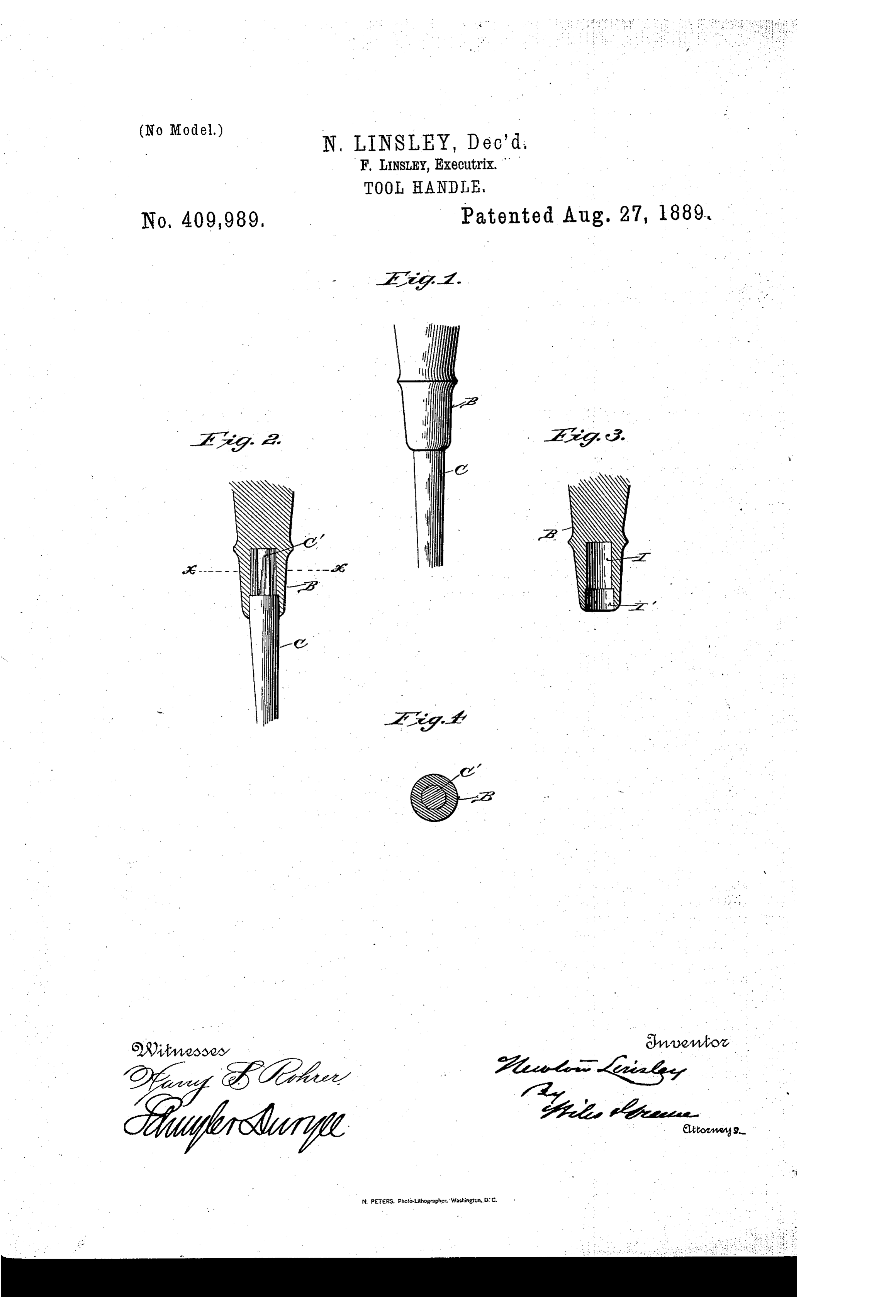
To all tuhon it invay concern: thus forced into position, the cylindrical part Be it known that I, NEWTON LINSLEY, a of the shank enters and fits in the part I of resident of Freeport, in the county of Ste the recess and there remain no visible traces phenson and State of Illinois, have invented of the securing process; yet the attachment certain new and useful Improvements in is so firm that if the handle be of iron and the 45 Tool-Handles; and I do hereby declare the fol shank of steel the latter may be broken by lowing to be a full, clear, and exact description torsion without its loosening, and its direct of the invention, such as will enable others withdrawal is practically impossible. Were skilled in the art to which it pertains to make the outer end of the recess not enlarged the IO and use the same. shank would be weak at its junction with the 5o The invention is fully described and claimed handle, for it is at this point that lateral in this specification and shown in the accom strain upon the shank is the greatest, and at panying drawings, in which this point it would be cut away to form the Figure 1 shows the lower portion of a han prismatic portion. With this construction, dle with the Shank of a tool fixed therein. however, the Weakening begins at some dis- 55 Fig. 2 is a section through the axis of the tance within the supporting-walls of the re handle, the shank being in position. Fig. 3 cess. Again, in the construction supposed, is a section through the axis of the handle the end of the handle, even if of iron, would alone. Fig. 4 is a section on the line at ac, be very liable to split, when the shank was Fig. 1. forced into place if the proportions were such 6o In the drawings, B is the end of a metallic as to require the degree of force that is usul handle, provided with an axial opening of ally and safely employed practically with the cylindrical form but having its outer or end present construction.
portion I of greater diameter than the re What I claim as new, and desire to secure mainder I. by Letters Patent, is 65 C is a cylindrical tool-shank laterally cut The combination, with a handle having a away near its end to form a prism whose cylindrical socket, whose outer portion is of angles are elements of the original surface of greater diameter than its inner portion, of a the shank, of which the diameter is equal to tool-shank equal in diaineter to said outer 3O the diameter of the outer and larger portion portion, and having a prismatic end adapted of the recess in the handle. From the con to readily enter said outer portion, but re struction it is evident that when the shankis quiring pressure to force it into said inner inserted in the outer part of the recess in the portion, substantially as set forth. handle the prismatic angles will meet the In testimony whereof. I have signed this 35 shoulder formed at the point where the diame specification in the presence of two subscrib 75 ter is diminished; but if the parts be prop ing witnesses.
erly proportioned by the application of great NEWTON LINSLEY. force the shank may, nevertheless, be pushed Witnesses:
into the diminished part of the recess, its CHAS. GILBERT, angles cutting their way in the metal. When J. A. CRAIN.
Provenance
- Collection
- Cited prior art
- Original PDF
- patentimages.storage.googleapis.com →
- Pages
- 2
- Method
- pdftotext (the PDF's own text layer) + pdftoppm 300dpi page scans
- Source
- Google Patents bibliographic record
- Granted
- 1889-08-27
- Transcribed from
- patentimages.storage.googleapis.com →