patent · US3956030
Coatings for ferrous substrates
11 May 1976
Page 1 — bibliographic record
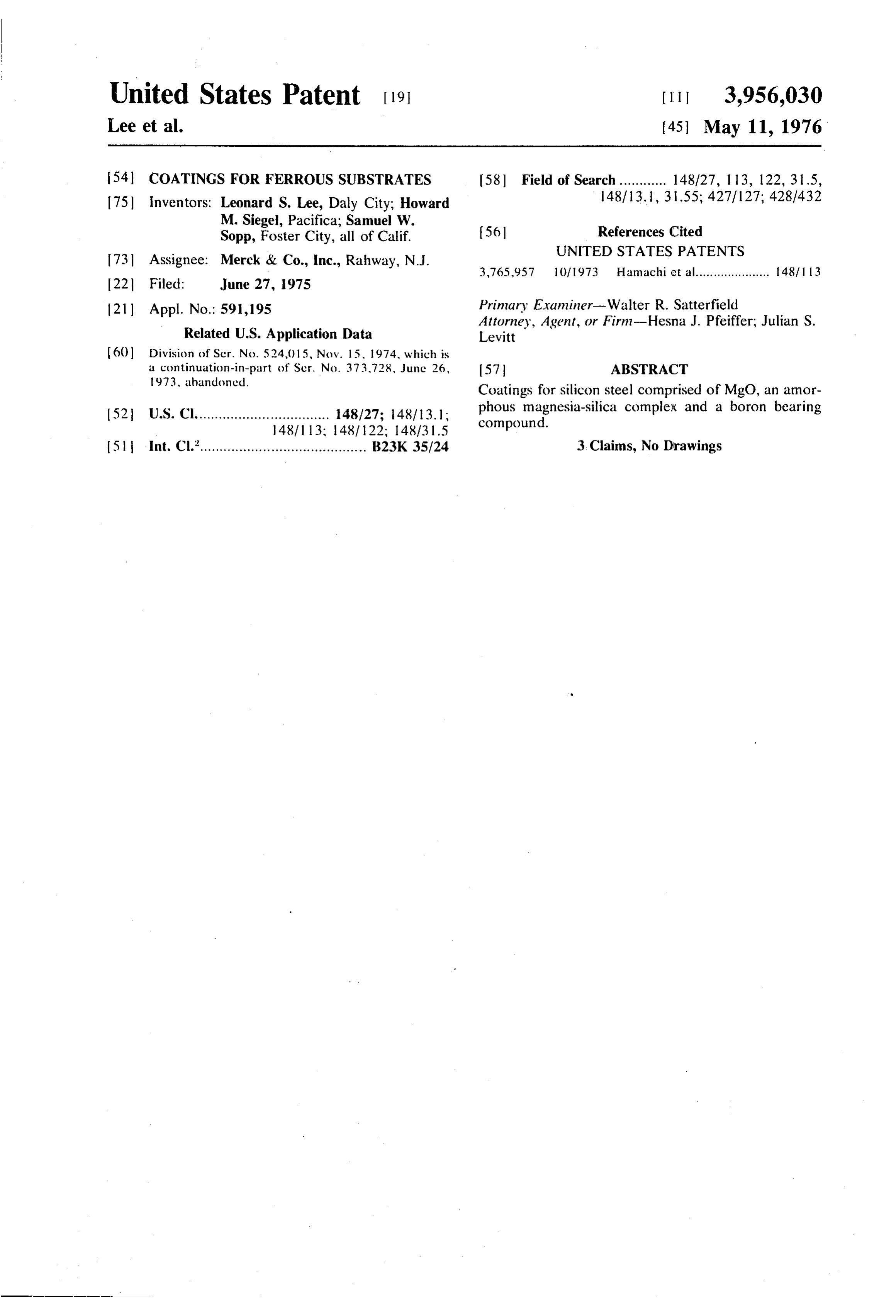
United States Patent (19) 11 3,956,030 Lee et al. (45 May 11, 1976 54 COATINGS FOR FERROUS SUBSTRATES 58) Field of Search ............ 148/27, 113, 122, 31.5, 75 Inventors: Leonard S. Lee, Daly City; Howard 148/13.1, 31.55; 427/127; 428/432 M. Siegel, Pacifica; Samuel W. 56 References Cited
Sopp, Foster City, all of Calif.
UNITED STATES PATENTS
73 Assignee: Merck & Co., Inc., Rahway, N.J.
3,765,957 10/1973 Hamachi ct al..................... i48? 113
21 Appl. No.: 591,195 Primary Examiner-Walter R. Satterfield Attorney, Agent, or Firm-Hesna J. Pfeiffer; Julian S.
Related U.S. Application Data Levitt
a continuation-in-part of Ser. No. 373,728, June 26, 57 ABSTRACT 973, handoned.
Coatings for silicon steel comprised of MgO, an amor 52 U.S. Cl.................................. 148/27; 48/13.1; phous magnesia-silica complex and a boron bearing
compound.
51 Int. Cl........................................... B23K 35/24 3. Claims, No Drawings
Page 2
provide optimum grain growth and grain orientation
COATINGS FOR FERROUS SUBSTRATES which develops the magnetic properties of the silicon steel. This anneal is usually carried out in a hydrogen
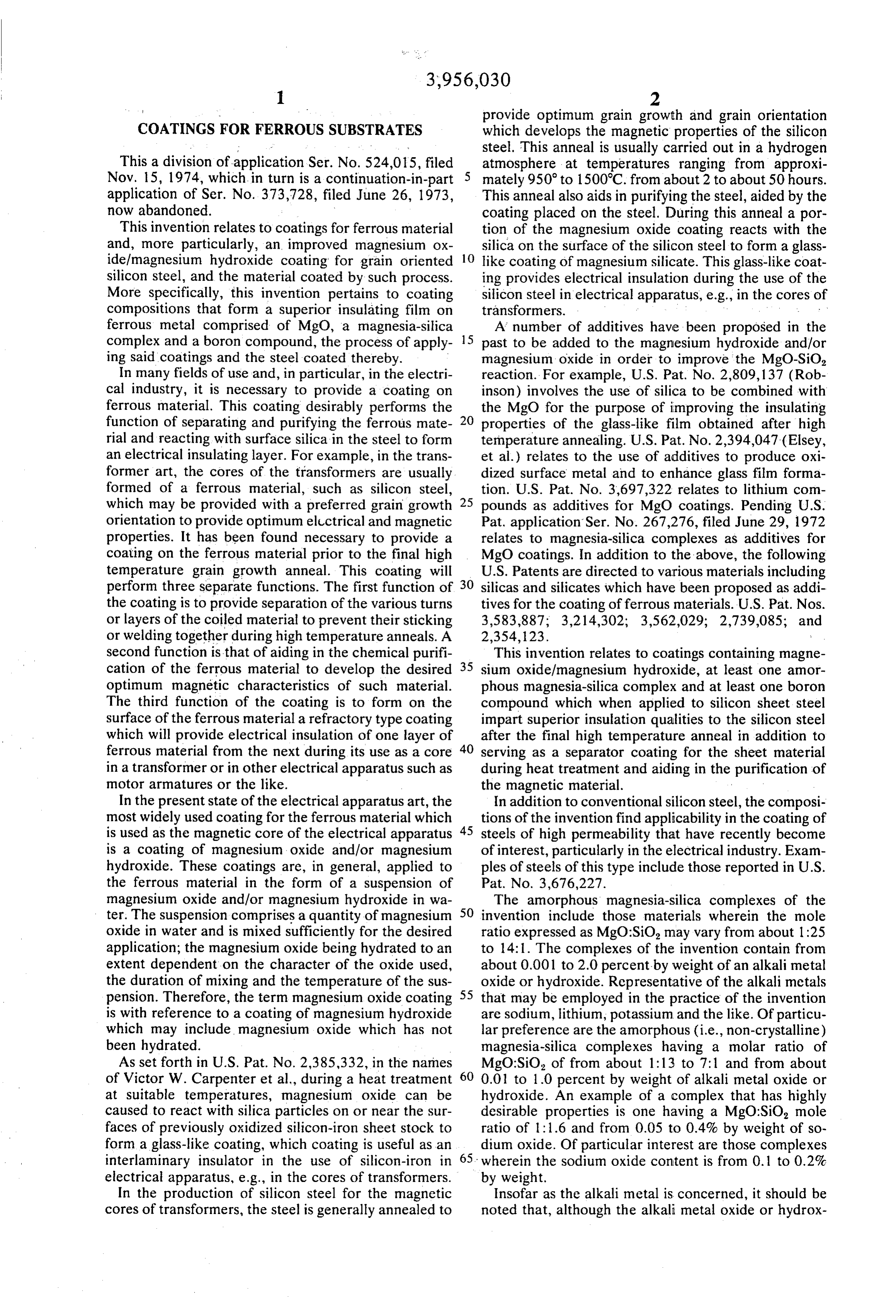
This a division of application Ser. No. 524,015, filed atmosphere at temperatures ranging from approxi Nov. 15, 1974, which in turn is a continuation-in-part mately 950 to 1500°C. from about 2 to about 50 hours. application of Ser. No. 373,728, filed June 26, 1973, This anneal also aids in purifying the steel, aided by the now abandoned. . coating placed on the steel. During this anneal a por This invention relates to coatings for ferrous material tion of the magnesium oxide coating reacts with the and, more particularly, an improved magnesium ox silica on the surface of the silicon steel to form a glass ide/magnesium hydroxide coating for grain oriented 10 like coating of magnesium silicate. This glass-like coat silicon steel, and the material coated by such process. ing provides electrical insulation during the use of the More specifically, this invention pertains to coating silicon steel in electrical apparatus, e.g., in the cores o compositions that form a superior insulating film on transformers.
ferrous metal comprised of MgO, a magnesia-silica A number of additives have been proposed in the complex and a boron compound, the process of apply 15 past to be added to the magnesium hydroxide and/or ing said coatings and the steel coated thereby. magnesium oxide in order to improve the MgO-SiO, In many fields of use and, in particular, in the electri reaction. For example, U.S. Pat. No. 2,809,137 (Rob cal industry, it is necessary to provide a coating on inson) involves the use of silica to be combined with ferrous material. This coating desirably performs the the MgO for the purpose of improving the insulating function of separating and purifying the ferrous mate 20 properties of the glass-like film obtained after high rial and reacting with surface silica in the steel to form temperature annealing. U.S. Pat. No. 2,394,047 (Elsey, an electrical insulating layer. For example, in the trans et al.) relates to the use of additives to produce oxi former art, the cores of the transformers are usually dized surface metal and to enhance glass film forma formed of a ferrous material, such as silicon steel, tion. U.S. Pat. No. 3,697,322 relates to lithium com which may be provided with a preferred grain growth 25 pounds as additives for MgO coatings. Pending U.S. orientation to provide optimum eluctrical and magnetic Pat. application Ser. No. 267,276, filed June 29, 1972 properties. It has been found necessary to provide a relates to magnesia-silica complexes as additives for coating on the ferrous material prior to the final high MgO coatings. In addition to the above, the following temperature grain growth anneal. This coating will U.S. Patents are directed to various materials including perform three separate functions. The first function of 30 silicas and silicates which have been proposed as addi the coating is to provide separation of the various turns tives for the coating of ferrous materials. U.S. Pat. Nos. or layers of the coiled material to prevent their sticking 3,583,887; 3,214,302; 3,562,029; 2,739,085; and or welding together during high temperature anneals. A 2,354,123.
second function is that of aiding in the chemical purifi This invention relates to coatings containing magne cation of the ferrous material to develop the desired 35 sium oxide/magnesium hydroxide, at least one amor optimum magnetic characteristics of such material. phous magnesia-silica complex and at least one boron The third function of the coating is to form on the compound which when applied to silicon sheet steel surface of the ferrous material a refractory type coating impart superior insulation qualities to the silicon steel which will provide electrical insulation of one layer of after the final high temperature anneal in addition to ferrous material from the next during its use as a core 40 serving as a separator coating for the sheet material in a transformer or in other electrical apparatus such as during heat treatment and aiding in the purification of motor armatures or the like. the magnetic material.
In the present state of the electrical apparatus art, the In addition to conventional silicon steel, the composi most widely used coating for the ferrous material which 45 tions of the invention find applicability in the coating of is used as the magnetic core of the electrical apparatus steels of high permeability that have recently become is a coating of magnesium oxide and/or magnesium of interest, particularly in the electrical industry. Exam hydroxide. These coatings are, in general, applied to ples of steels of this type include those reported in U.S. the ferrous material in the form of a suspension of Pat. No. 3,676,227.
magnesium oxide and/or magnesium hydroxide in wa The amorphous magnesia-silica complexes of the ter. The suspension comprises a quantity of magnesium 50 invention include those materials wherein the mole oxide in water and is mixed sufficiently for the desired ratio expressed as MgO:SiO, may vary from about 1:25 application; the magnesium oxide being hydrated to an to 14:1. The complexes of the invention contain from extent dependent on the character of the oxide used, about 0.001 to 2.0 percent by weight of an alkali metal the duration of mixing and the temperature of the sus oxide or hydroxide. Representative of the alkali metals pension. Therefore, the term magnesium oxide coating 55 that may be employed in the practice of the invention is with reference to a coating of magnesium hydroxide are sodium, lithium, potassium and the like. Of particu which may include magnesium oxide which has not lar preference are the amorphous (i.e., non-crystalline) been hydrated. magnesia-silica complexes having a molar ratio of As set forth in U.S. Pat. No. 2,385,332, in the names MgO:SiO, of from about 1:13 to 7:1 and from about of Victor W. Carpenter et al., during a heat treatment 60 0.01 to 1.0 percent by weight of alkali metal oxide or at suitable temperatures, magnesium oxide can be hydroxide. An example of a complex that has highly caused to react with silica particles on or near the sur desirable properties is one having a MgO:SiO, mole faces of previously oxidized silicon-iron sheet stock to ratio of 1:1.6 and from 0.05 to 0.4% by weight of so form a glass-like coating, which coating is useful as an dium oxide. Of particular interest are those complexes interlaminary insulator in the use of silicon-iron in 65. wherein the sodium oxide content is from 0.1 to 0.2% electrical apparatus, e.g., in the cores of transformers. by weight.
In the production of silicon steel for the magnetic Insofar as the alkali metal is concerned, it should be cores of transformers, the steel is generally annealed to noted that, although the alkali metal oxide or hydrox
Page 3
ide is expressed throughout the specification and Another convenient method of preparation is as fol claims as a component of the magnesia-silica complex, lows:
one skilled in the art will readily appreciate that the 1. Sodium hydroxide and magnesium chloride or alkali metal oxide or hydroxide may be provided from sulfate are reacted to form Mg(OH)2. a source separate from the magnesia-silica complex. 5 2. Mix the Mg(OH), slurry with sodium silicate. For example, the appropriate level of alkali metal oxide 3. React 2 with hydrochloric acid to form the or hydroxide may be provided by either the complex magnesia-silica complex.
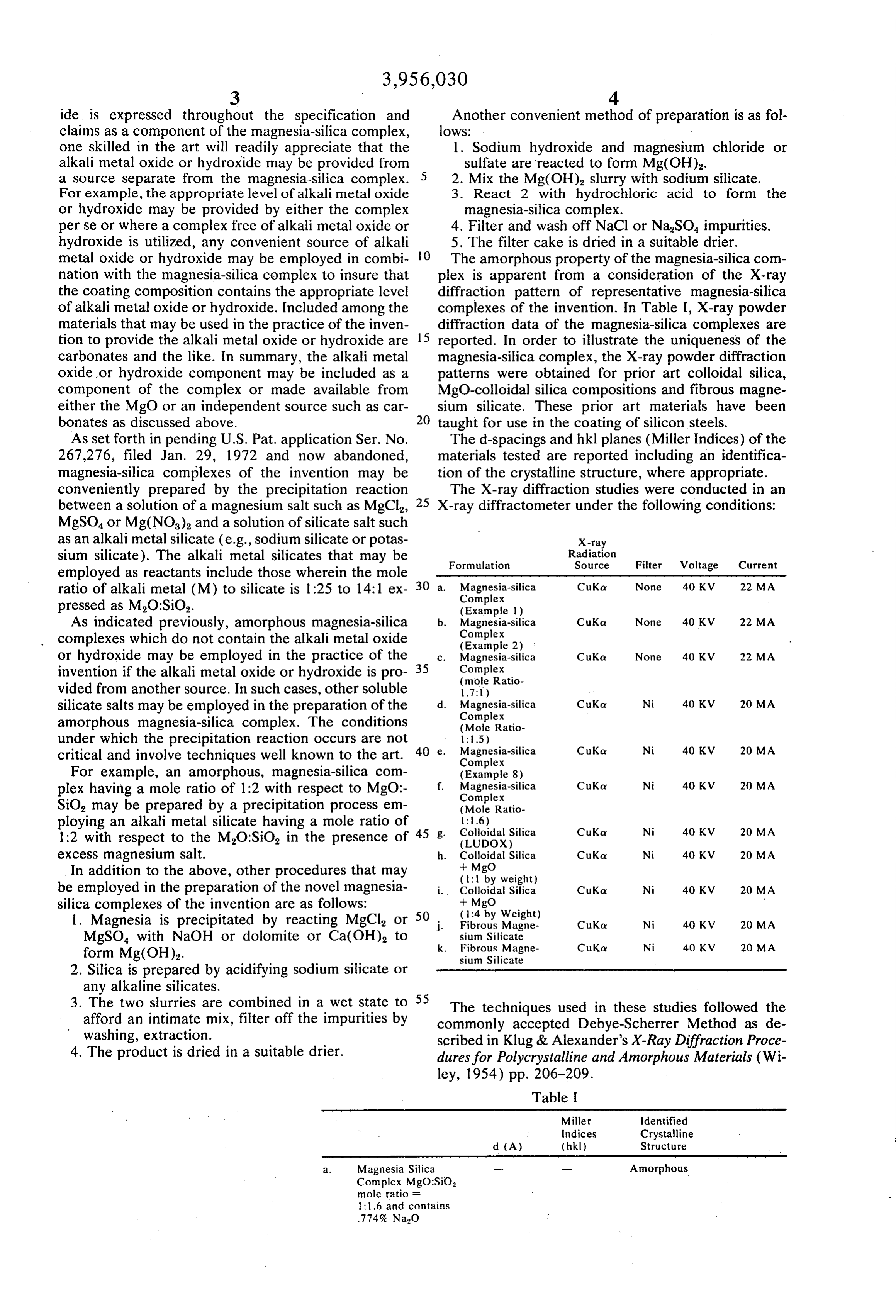
perse or where a complex free of alkali metal oxide or 4. Filter and wash off NaCl or NaSO impurities. hydroxide is utilized, any convenient source of alkali 5. The filter cake is dried in a suitable drier. metal oxide or hydroxide may be employed in combi- 10 The amorphous property of the magnesia-silica com nation with the magnesia-silica complex to insure that plex is apparent from a consideration of the X-ray the coating composition contains the appropriate level diffraction pattern of representative magnesia-silica of alkali metal oxide or hydroxide. Included among the complexes of the invention. In Table I, X-ray powder materials that may be used in the practice of the inven- diffraction data of the magnesia-silica complexes are tion to provide the alkali metal oxide or hydroxide are 15 reported. In order to illustrate the uniqueness of the carbonates and the like. In summary, the alkali metal magnesia-silica complex, the X-ray powder diffraction oxide or hydroxide component may be included as a patterns were obtained for prior art colloidal silica, component of the complex or made available from MgO-colloidal silica compositions and fibrous magne either the MgO or an independent source such as car- sium silicate. These prior art materials have been bonates as discussed above. 20 taught for use in the coating of silicon steels. As set forth in pending U.S. Pat. application Ser. No. The d-spacings and hkl planes (Miller Indices) of the 267,276, filed Jan. 29, 1972 and now abandoned, materials tested are reported including an identifica magnesia-silica complexes of the invention may be tion of the crystalline structure, where appropriate. conveniently prepared by the precipitation reaction The X-ray diffraction studies were conducted in an between a solution of a magnesium salt such as MgCl2, 25 X-ray diffractometer under the following conditions: MgSO4 or Mg(NO), and a solution of silicate salt such as an alkali metal silicate (e.g., sodium silicate or potas- X-ray sium silicate). The alkali metal silicates that may be Formulation
Radiation
Source Filter Voltage Current employed as reactants include those wherein the mole ratio of alkali metal (M) to silicate is 1:25 to 14:1 ex- 30 a. Complex
Magnesia-silica Cuko None 40 KV 22 MA pressed as MO:SiO. (Example 1)
As indicated previously, amorphous magnesia-silica b. Magnesia-silica Cuko None 40 KW 22 MA complexes which do not contain the alkali metal oxide E. 2) or hydroxide may be employed in the practice of the c. Magnesia-silica Cuko None 40 KW 22 MA invention if the alkali metal oxide or hydroxide is pro-35 Complex (mole Ratio vided from another source. In such cases, other soluble 1.7: ) silicate salts may be employed in the preparation of the d. Magnesia-silica Cuka Ni 40 KW 20 MA amorphous magnesia-silica complex. The conditions Statio.
under which the precipitation reaction occurs are not 1:1.5) critical and involve techniques well known to the art. 40 e Esilica Cuko N 40 KW 20 MA For example, an amorphous, magnesia-silica com- Ei. 8) plex having a mole ratio of 1:2 with respect to MgO:- f. Esilica Cuko Ni 40 KW 20 MA SiO, may be prepared by a precipitation process em- St. Ratio ploying an alkali metal silicate having a mole ratio of 6) 1:2 with respect to the MO:SiO, in the presence of 458 fissilica Cuko Ni 40 KW 20 MA excess magnesium salt. h. Colloidal Silica Cuko Ni 40 KW 20 MA In addition to the above, other procedures that may |M. weight) be employed in the preparation of the novel magnesia- i. ki. SE Cuko N 40 KW 20 MA silica complexes of the invention are as follows: t Weight) 1. Magnesia is precipitated by reacting MgCl, or 50 j. E. ME Cuko N 40 KW 20 MA MgSO, with NaOH or dolomite or Ca(OH), to sium Silicate form Mg(OH )2. k. Fibrous Magne- Cuko Ni 40 KW 20 MA sium Silicate 2. Silica is prepared by acidifying sodium silicate or any alkaline silicates.
3. The two slurries are combined in a wet state to The techniques used in these studies followed the afford an intimate mix, filter off the impurities by commonly accepted Debye-Scherrer Method as de washing, extraction. scribed in Klug & Alexander's X-Ray Diffraction Proce 4. The product is dried in a suitable drier. dures for Polycrystalline and Amorphous Materials (Wi
Table
Miller Identified
Indices Crystalline
3. Magnesia Silica o Amorphous
Complex MgO:SiO, mole ratio = !: 1.6 and contains
Page 4
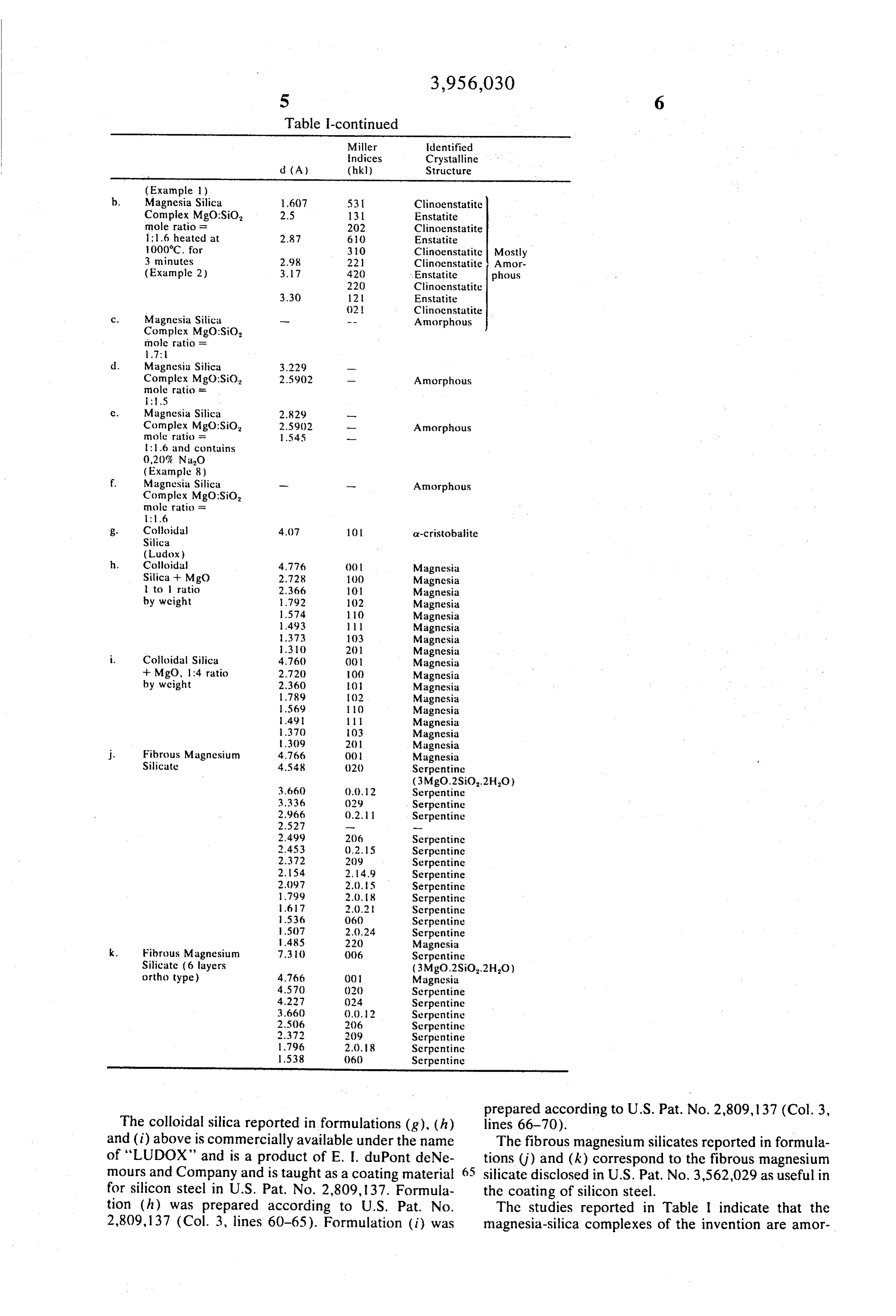
Table I-continued
Miller identified indices Crystalline
(Example 1) b. Magnesia Silica 1,607 53 Clinoenstatite
000°C. for 310 Clinoenstatite Mostly 3 minutes 2.98 221 Clinoenstatite. Amor
(Example 2) 3.17 420 "En statite phous 220 Clinoenstatite
()21 Clinoenstatite
Complex MgO:SiO, mole ratio =
mole ratio =
:1.6 and contains
(Example 8)
Complex MgO:SiO, mole ratio =
8. Coloidal 4.07 1() ox-cristobalite
Silica
(Ludox)
prepared according to U.S. Pat. No. 2,809,137 (Col. 3,
The colloidal silica reported in formulations (g), (h) lines 66-70). and (i) above is commercially available under the name The fibrous magnesium silicates reported in formula of "LUDOX' and is a product of E. I. duPont deNe- tions (j) and (k) correspond to the fibrous magnesium mours and Company and is taught as a coating material 65 silicate disclosed in U.S. Pat. No. 3,562,029 as useful in for silicon steel in U.S. Pat. No. 2,809, 137. Formula- the coating of silicon steel. tion (h) was prepared according to U.S. Pat. No. The studies reported in Table I indicate that the 2,809,137 (Col. 3, lines 60-65). Formulation (i) was magnesia-silica complexes of the invention are amor
Page 5
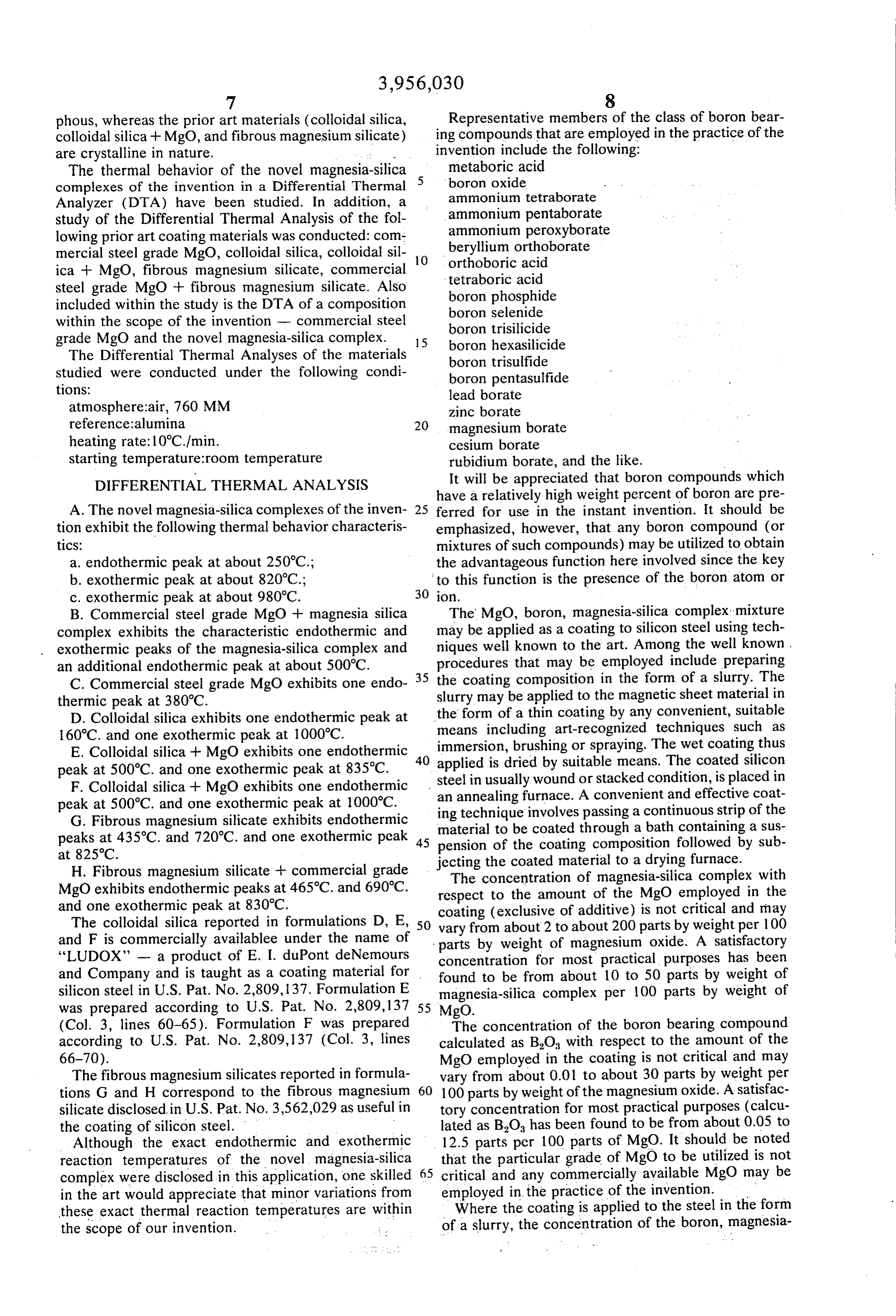
phous, whereas the prior art materials (colloidal silica, Representative members of the class of boron bear colloidal silica + MgO, and fibrous magnesium silicate) ing compounds that are employed in the practice of the are crystalline in nature. .. . invention include the following: The thermal behavior of the novel magnesia-silica 5 metaboric acid complexes of the invention in a Differential Thermal boron oxide
Analyzer (DTA) have been studied. In addition, a ammonium tetraborate study of the Differential Thermal Analysis of the fol ammonium pentaborate lowing prior art coating materials was conducted: com ammonium peroxyborate mercial steel grade MgO, colloidal silica, colloidal sil O beryllium orthoborate ica - MgO, fibrous magnesium silicate, commercial orthoboric acid tetraboric acid steel grade MgO + fibrous magnesium silicate. Also boron phosphide included within the study is the DTA of a composition boron selenide within the scope of the invention - commercial steel boron trisilicide grade MgO and the novel magnesia-silica complex. 15 boron hexasilicide The Differential Thermal Analyses of the materials boron trisulfide studied were conducted under the following condi boron pentasulfide tions: lead borate atmosphere:air, 760 MM zinc borate reference:alumina 20 magnesium borate heating rate: 10°C./min. cesium borate starting temperature:room temperature rubidium borate, and the like. DIFFERENTIAL THERMAL ANALYSIS It will be appreciated that boron compounds which have a relatively high weight percent of boron are pre
A. The novel magnesia-silica complexes of the inven 25 ferred for use in the instant invention. It should be tion exhibit the following thermal behavior characteris emphasized, however, that any boron compound (or tics: mixtures of such compounds) may be utilized to obtain a. endothermic peak at about 250°C.; the advantageous function here involved since the key
this function is the presence of the boron atom or c. exothermic peak at about 980°C.
B. Commercial steel grade MgO + magnesia silica The MgO, boron, magnesia-silica complex mixture complex exhibits the characteristic endothermic and may be applied as a coating to silicon steel using tech exothermic peaks of the magnesia-silica complex and niques well known to the art. Among the well known. an additional endothermic peak at about 500°C. procedures that may be employed include preparing 35 the coating composition in the form of a slurry. The
C. Commercial steel grade MgO exhibits one endo slurry may be applied to the magnetic sheet material in thermic peak at 380°C.
D. Colloidal silica exhibits one endothermic peak at the means form of a thin coating by any convenient, suitable including art-recognized techniques such as 160°C. and one exothermic peak at 1000°C. immersion, brushing or spraying. The wet coating thus E. Colloidal silica -- MgO exhibits one endothermic 40 applied is dried by suitable means. The coated silicon peak at 500°C. and one exothermic peak at 835°C.
F. Colloidal silica + MgO exhibits one endothermic an annealing furnace. Aorconvenient steel in usually wound stacked condition, is placed in and effective coat peak at 500°C. and one exothermic peak at 1000°C. ing technique involves passing a continuous strip of the G. Fibrous magnesium silicate exhibits endothermic material to be coated through a bath containing peaks at 435°C. and 720°C. and one exothermic peak 45 pension of the coating composition followed bya sub sus
H. Fibrous magnesium silicate -- commercial grade jecting the coated material to a drying furnace. The concentration of magnesia-silica complex with
MgO exhibits endothermic peaks at 465°C. and 690°C. respect to the amount of the MgO employed in the and one exothermic peak at 830°C. coating (exclusive of additive) is not critical and may The colloidal silica reported in formulations D, E, 50 vary from about 2 to about 200 parts by weight per 100 and F is commercially availablee under the name of parts by weight of magnesium oxide. A satisfactory "LUDOX' - a product of E. I. duPont deNemours concentration for most practical purposes has been and Company and is taught as a coating material for found to be from about 10 to 50 parts by weight of magnesia-silica complex per 100 parts by weight of silicon steel in U.S. Pat. No. 2,809,137. Formulation E was prepared according to U.S. Pat. No. 2,809,137 55 MgO.
(Col. 3, lines 60-65). Formulation F was prepared f concentration of the boron bearing compound according to U.S. Pat. No. 2,809,137 (Col. 3, lines calculated as B.O. with respect to the amount of the 66-70). MgO employed in the coating is not critical and may The fibrous magnesium silicates reported in formula vary from about 0.01 to about 30 parts by weight per tions G and H correspond to the fibrous magnesium 60 100 parts by weight of the magnesium oxide. A satisfac tory concentration for most practical purposes (calcu silicate disclosed in U.S. Pat. No. 3,562,029 as useful in the coating of silicon steel. - lated as BO has been found to be from about 0.05 to Although the exact endothermic and exothermic 12.5 parts per 100 parts of MgO. It should be noted reaction temperatures of the novel magnesia-silica 65 that the particular grade of MgO to be utilized is not complex were disclosed in this application, one skilled critical and any commercially available MgO may be in the art would appreciate that minor variations from employed in the practice of the invention. these exact thermal reaction temperatures are within ofWhere
the coating is applied to the steel in the form slurry, the concentration of the boron, magnesia the scope of our invention.
Page 6
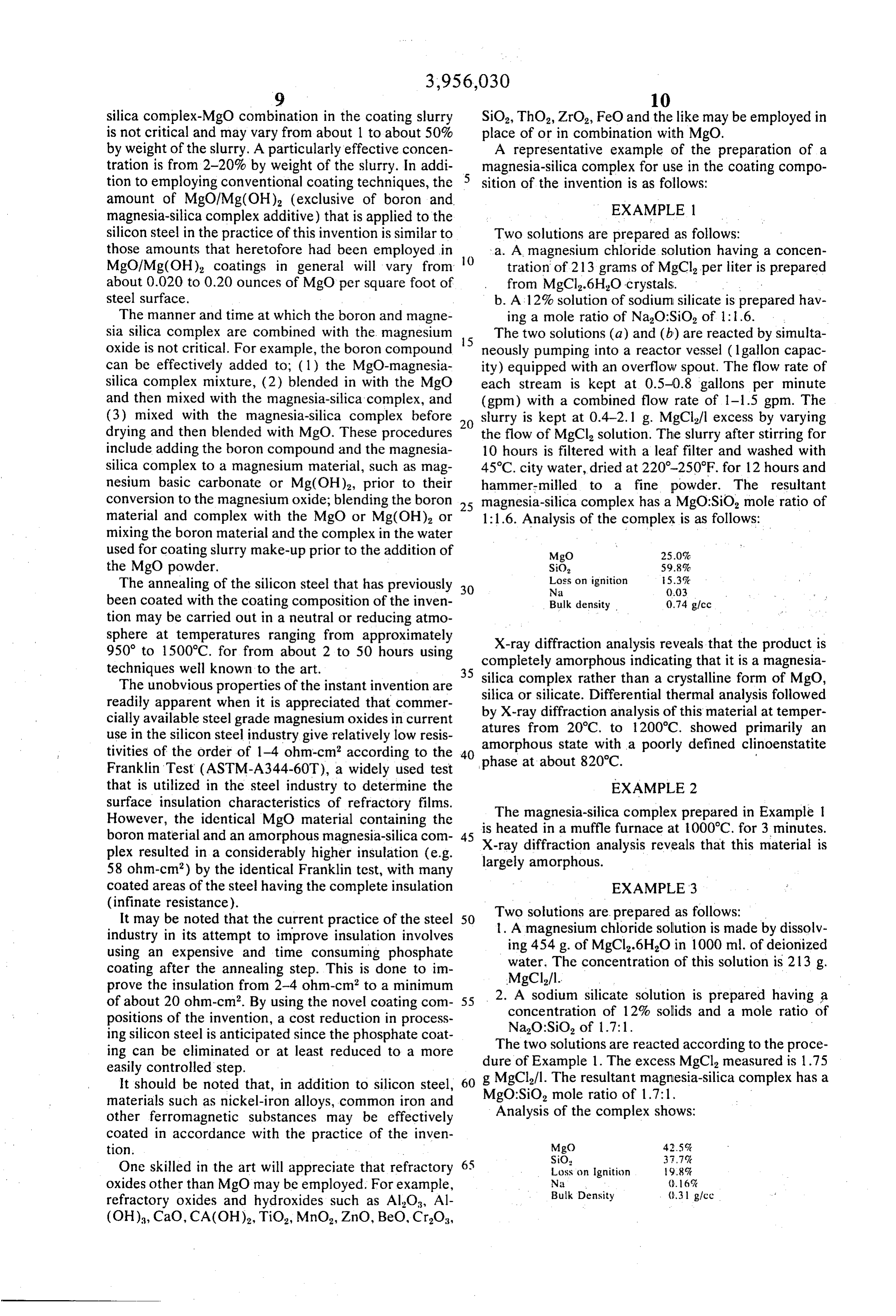
silica complex-MgO combination in the coating slurry SiO, ThC), ZrO, Fe0 and the like may be employed in is not critical and may vary from about 1 to about 50% place of or in combination with MgO. by weight of the slurry. A particularly effective concen A representative example of the preparation of a tration is from 2-20% by weight of the slurry. In addi magnesia-silica complex for use in the coating compo tion to employing conventional coating techniques, the sition of the invention is as follows: amount of MgO/Mg(OH) (exclusive of boron and magnesia-silica complex additive) that is applied to the EXAMPLE 1 silicon steel in the practice of this invention is similar to Two solutions are prepared as follows: those amounts that heretofore had been employed in O a. A magnesium chloride solution having a concen MgO/Mg(OH), coatings in general will vary from tration of 213 grams of MgCl, per liter is prepared about 0.020 to 0.20 ounces of MgO per square foot of from MgCl2.6HO crystals. , , , steel surface. b. A 12% solution of sodium silicate is prepared hav The manner and time at which the boron and magne ing a mole ratio of NaO:SiO, of 1:1.6. sia silica complex are combined with the magnesium 15 The two solutions (a) and (b) are reacted by simulta oxide is not critical. For example, the boron compound neously pumping into a reactor vessel (lgallon capac can be effectively added to; (1) the MgO-magnesia ity) equipped with an overflow spout. The flow rate of silica complex mixture, (2) blended in with the MgO each stream is kept at 0.5-0.8 gallons per minute and then mixed with the magnesia-silica complex, and (gpm) with a combined flow rate of 1-1.5 gpm. The (3) mixed with the magnesia-silica complex before slurry is kept at 0.4-2. lg. MgCl/l excess by varying drying and then blended with MgO. These procedures 20 the flow of MgCl, solution. The slurry after stirring for include adding the boron compound and the magnesia 10 hours is filtered with a leaf filter and washed with silica complex to a magnesium material, such as mag 45°C. city water, dried at 220-250F. for 12 hours and nesium basic carbonate or Mg(OH), prior to their hammer-milled to a fine powder. The resultant conversion to the magnesium oxide; blending the boron 25 magnesia-silica complex has a MgO:SiO, mole ratio of material and complex with the MgO or Mg(OH), or 1:1.6. Analysis of the complex is as follows: mixing the boron material and the complex in the water used for coating slurry make-up prior to the addition of MgO 25.0% the MgO powder. SiO, 59.8% The annealing of the silicon steel that has previously 30 Loss on ignition 5.3%
been coated with the coating composition of the inven Bulk density 0.74 g/cc tion may be carried out in a neutral or reducing atmo sphere at temperatures ranging from approximately X-ray diffraction analysis reveals that the product is 950 to 1500°C. for from about 2 to 50 hours using completely amorphous indicating that it is a magnesia techniques well known to the art. 35 silica complex rather than a crystalline form of MgO, The unobvious properties of the instant invention are readily apparent when it is appreciated that commer silica or silicate. Differential thermal analysis followed cially available steel grade magnesium oxides in current by X-ray diffraction analysis of this material at temper use in the silicon steel industry give relatively low resis atures from 20°C. to 1200°C. showed primarily an amorphous state with a poorly defined clinoenstatite tivities of the order of 1-4 ohm-cm according to the 40 phase at about 820°C. Franklin Test (ASTM-A344-60T), a widely used test that is utilized in the steel industry to determine the EXAMPLE 2 surface insulation characteristics of refractory films.
However, the identical MgO material containing the is The magnesia-silica complex prepared in Example l heated in a muffle furnace at 1000°C. for 3 minutes.
boron material and an amorphous magnesia-silica com 45 X-ray plex resulted in a considerably higher insulation (e.g. largelydiffraction amorphous.
analysis reveals that this material is 58 ohm-cm) by the identical Franklin test, with many coated areas of the steel having the complete insulation EXAMPLE 3 (infinate resistance).
It may be noted that the current practice of the steel 50 Two1. A solutions are prepared as follows:
magnesium chloride solution is made by dissolv industry in its attempt to improve insulation involves ing 454g. of MgCl2.6HO in 1000 ml. of deionized using an expensive and time consuming phosphate coating after the annealing step. This is done to im water. The concentration of this solution is 213 g. prove the insulation from 2-4 ohm-cm to a minimum of about 20 ohm-cm. By using the novel coating com 55 2. concentration
A sodium silicate solution is prepared having a of 12% solids and a mole ratio of positions of the invention, a cost reduction in process NaO:SiO of 1.7:1.
ing silicon steel is anticipated since the phosphate coat The two solutions are reacted according to the proce ing can be eliminated or at least reduced to a more dure of Example 1. The excess MgCl, measured is 1.75 easily controlled step.
It should be noted that, in addition to silicon steel, 60 gMgO:SiO,
MgCl/l. The resultant magnesia-silica complex has a mole ratio of 1.7:1.
materials such as nickel-iron alloys, common iron and Analysis of the complex shows: other ferromagnetic substances may be effectively coated in accordance with the practice of the inven MgO 42.5% tion.
One skilled in the art will appreciate that refractory 65 Loss on Ignition 9.8% oxides other than MgO may be employed. For example, N:
Bulk Density
refractory oxides and hydroxides such as AlO3, Al
(OH), CaO, CA(OH), TiO, MnO, ZnO, BeO, CrO,
Page 7
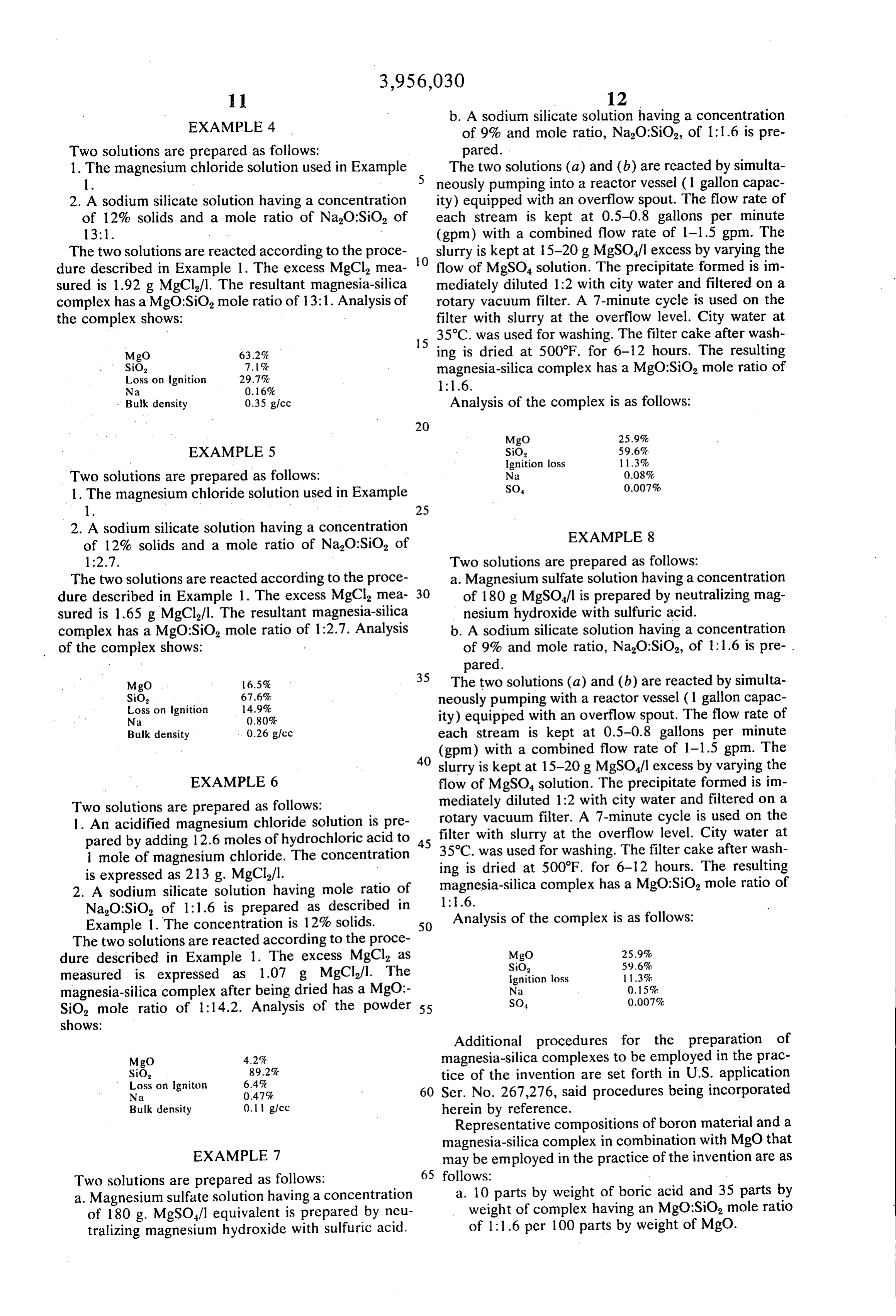
EXAMPLE 4 b. A sodium silicate solution having a concentration of 9% and mole ratio, NaO:SiO, of 1:1.6 is pre
Two solutions are prepared as follows: pared.
1. The magnesium chloride solution used in Example 5 The two solutions (a) and (b) are reacted by simulta 1 neously pumping into a reactor vessel (1 gallon capac 2. A sodium silicate solution having a concentration ity) equipped with an overflow spout. The flow rate of of 12% solids and a mole ratio of NaO:SiO of each stream is kept at 0.5-0.8 gallons per minute 13:1. (gpm) with a combined flow rate of 1-1.5 gpm. The The two solutions are reacted according to the proce slurry is kept at 15-20 g MgSO4/l excess by varying the dure described in Example 1. The excess MgCl, mea- O flow of MgSO solution. The precipitate formed is im sured is 1.92 g MgCl2/l. The resultant magnesia-silica mediately diluted 1:2 with city water and filtered on a complex has a MgO:SiO, mole ratio of 13:1. Analysis of rotary vacuum filter. A 7-minute cycle is used on the the complex shows: filter with slurry at the overflow level. City water at 15 35°C. was used for washing. The filter cake after wash
MgO 63.2% ing is dried at 500F. for 6-12 hours. The resulting SiO,
Loss on lgnition
magnesia-silica complex has a MgO:SiO, mole ratio of
- Bulk density 0.35 g/cc Analysis of the complex is as follows:
EXAMPLE 5 SiO, 59.6%
Two solutions are prepared as follows: Na 0.08%
1. The magnesium chloride solution used in Example
2. A sodium silicate solution having a concentration EXAMPLE 8 of 12% solids and a mole ratio of NaO:SiO of 1:2.7. Two solutions are prepared as follows: The two solutions are reacted according to the proce a. Magnesium sulfate solution having a concentration dure described in Example 1. The excess MgCl, mea 30 of 180g MgSO/l is prepared by neutralizing mag sured is 1.65 g MgCl/l. The resultant magnesia-silica nesium hydroxide with sulfuric acid. complex has a MgO:SiO, mole ratio of 1:2.7. Analysis b. A sodium silicate solution having a concentration of the complex shows: of 9% and mole ratio, NaO:SiO, of 1:1.6 is pre pared.
MgO . 16.5% 35 The two solutions (a) and (b) are reacted by simulta SiO,
Loss on lgnition
neously pumping with a reactor vessel (1 gallon capac
Na 0.80% ity) equipped with an overflow spout. The flow rate of Bulk density 0.26 g/cc each stream is kept at 0.5-0.8 gallons per minute (gpm) with a combined flow rate of 1-1.5 gpm. The 40 slurry is kept at 15-20 g MgSO/l excess by varying the
EXAMPLE 6 flow of MgSO solution. The precipitate formed is im Two solutions are prepared as follows: mediately diluted 1:2 with city water and filtered on a rotary vacuum filter. A 7-minute cycle is used on the 1. An acidified magnesium chloride solution is pre filter pared by adding 12.6 moles of hydrochloric acid to 45 with slurry at the overflow level. City water at 1 mole of magnesium chloride. The concentration ing 35°C. was used for washing. The filter cake after wash is expressed as 213 g. MgCl2/l. is dried at 500F. for 6-12 hours. The resulting
2. A sodium silicate solution having mole ratio of l: i.6. complex has a MgO:SiO, mole ratio of NaO:SiO, of 1:1.6 is prepared as described in
Example 1. The concentration is 12% solids. 50 Analysis of the complex is as follows: The two solutions are reacted according to the proce dure described in Example 1. The excess MgCl2 as MgO 25.9%
measured is expressed as 1.07 g. MgCl/l. The ignition loss 11.3% magnesia-silica complex after being dried has a MgO:- Na
SiO, mole ratio of 1:14.2. Analysis of the powder 55 shows:
Additional procedures for the preparation of
MgO 4.2% magnesia-silica complexes to be employed in the prac SiO,
Loss on lgnition
tice of the invention are set forth in U.S. application
Na 0.47% 60 Ser. No. 267,276, said procedures being incorporated Bulk density 0.11 g/cc herein by reference.
Representative compositions of boron material and a magnesia-silica complex in combination with MgO that
EXAMPLE 7 may be employed in the practice of the invention are as 65 follows:
Two solutions are prepared as follows: a. 10 parts by weight of boric acid and 35 parts by a. Magnesium sulfate solution having a concentration weight of complex having an MgO:SiO, mole ratio of 180 g. MgSO/l equivalent is prepared by neu tralizing magnesium hydroxide with sulfuric acid. of 1:1.6 per 100 parts by weight of MgO.
Page 8
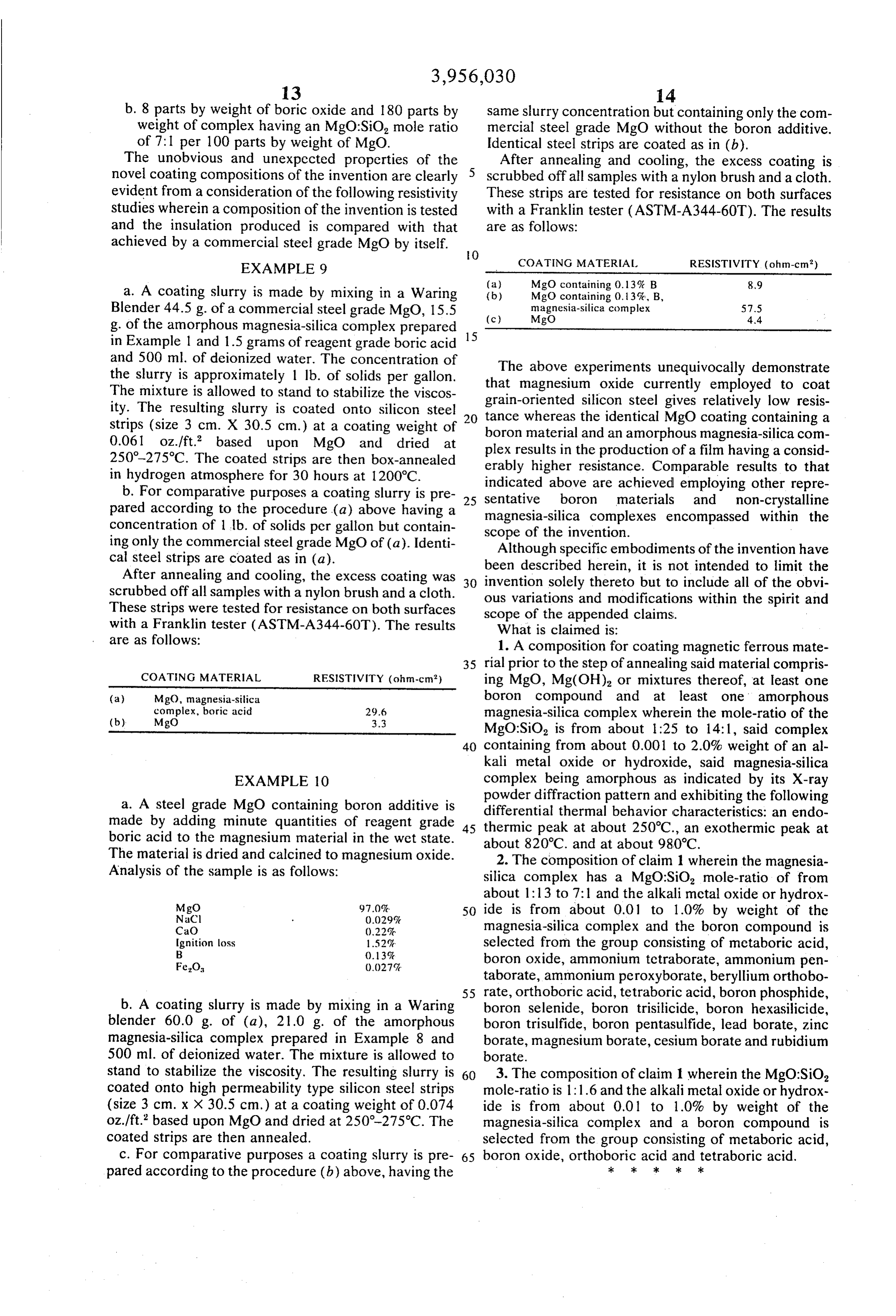
b. 8 parts by weight of boric oxide and 180 parts by same slurry concentration but containing only the com weight of complex having an MgO:SiO, mole ratio mercial steel grade MgO without the boron additive. of 7:l per 100 parts by weight of MgO. Identical steel strips are coated as in (b). The unobvious and unexpected properties of the After annealing and cooling, the excess coating is novel coating compositions of the invention are clearly scrubbed off all samples with a nylon brush and a cloth. evident from a consideration of the following resistivity These strips are tested for resistance on both surfaces studies wherein a composition of the invention is tested with a Franklin tester (ASTM-A344-60T). The results and the insulation produced is compared with that are as follows:
achieved by a commercial steel grade MgO by itself. O
EXAMPLE 9 COATING MATERIAL RESISTIVITY (ohm-cm)
a. A coating slurry is made by mixing in a Waring (b) MgO containing 0.13%, B, Blender 44.5 g. of a commercial steel grade MgO, 15.5 magnesia-silica complex 57.5 g. of the amorphous magnesia-silica complex prepared 15 (c) MgO 4.4 in Example l and 1.5 grams of reagent grade boric acid and 500 ml. of deionized water. The concentration of the slurry is approximately 1 lb. of solids per gallon. thatThe above experiments unequivocally demonstrate The mixture is allowed to stand to stabilize the viscos magnesium oxide currently employed to coat grain-oriented silicon steel gives relatively low resis ity. The resulting slurry is coated onto silicon steel 20 tance whereas the strips (size 3 cm. X 30.5 cm.) at a coating weight of boron material and identical MgO coating containing a 0.061 oz./ft.” based upon MgO and dried at plex results in the production of a magnesia-silica an amorphous film having a com consid 250-275°C. The coated strips are then box-annealed erably higher resistance. Comparable results to that in hydrogen atmosphere for 30 hours at 1200°C. indicated above are achieved employing other repre b. For comparative purposes a coating slurry is pre 25 sentative boron materials and non-crystalline pared according to the procedure (a) above having a magnesia-silica complexes encompassed within the concentration of 1 lb. of solids per gallon but contain scope of the invention.
ing only the commercial steel grade MgO of (a). Identi Although specific embodiments of the invention have cal steel strips are coated as in (a). been described herein, it is not intended to limit the After annealing and cooling, the excess coating was 30 invention solely thereto but to include all of the obvi scrubbed off all samples with a nylon brush and a cloth. ous variations and modifications within the spirit and These strips were tested for resistance on both surfaces scope of the appended claims. with a Franklin tester (ASTM-A344-60T). The results What is claimed is:
are as follows: 1. A composition for coating magnetic ferrous mate 35rial prior to the step of annealing said material compris
COATING MATERIAL RESISTIVITY (ohm-cm) ing MgO, Mg(OH) or mixtures thereof, at least one (a) MgO, magnesia-silica boron compound and at least one amorphous
complex, boric acid
MgO
magnesia-silica complex wherein the mole-ratio of the
MgO:SiO is from about 1:25 to 14:1, said complex 40 containing from about 0.001 to 2.0% weight of an al kali metal oxide or hydroxide, said magnesia-silica
EXAMPLE 10 complex being amorphous as indicated by its X-ray powder diffraction pattern and exhibiting the following a. A steel grade MgO containing boron additive is differential made by adding minute quantities of reagent grade 45 thermic peakthermal at behavior characteristics: an endo about 250°C., an exothermic peak at boric acid to the magnesium material in the wet state. about 820°C. and at about 98.0°C. The material is dried and calcined to magnesium oxide. 2. The composition of claim 1 wherein the magnesia Analysis of the sample is as follows: silica complex has a MgO:SiO, mole-ratio of from about 1:13 to 7:1 and the alkali metal oxide or hydrox
MgO 97.0% 50 ide is from about 0.01 to 1.0% by weight of the
CaO ().22% magnesia-silica complex and the boron compound is Ignition loss
selected from the group consisting of metaboric acid,
FeO. 0.027% boron oxide, ammonium tetraborate, ammonium pen taborate, ammonium peroxyborate, beryllium orthobo 55 rate, orthoboric acid, tetraboric acid, boron phosphide, b. A coating slurry is made by mixing in a Waring boron selenide, boron trisilicide, boron hexasilicide, blender 60.0 g of (a), 21.0 g of the amorphous boron trisulfide, boron pentasulfide, lead borate, zinc magnesia-silica complex prepared in Example 8 and borate, magnesium borate, cesium borate and rubidium 500 ml. of deionized water. The mixture is allowed to borate.
stand to stabilize the viscosity. The resulting slurry is 60 3. The composition of claim 1 wherein the MgO:SiO, coated onto high permeability type silicon steel strips mole-ratio is 1:1.6 and the alkali metal oxide or hydrox (size 3 cm. x X 30.5 cm.) at a coating weight of 0.074 ide is from about 0.01 to 1.0% by weight of the oz/ft. based upon MgO and dried at 250°-275°C. The magnesia-silica complex and a boron compound is coated strips are then annealed. selected from the group consisting of metaboric acid, c. For comparative purposes a coating slurry is pre 65 boron oxide, orthoboric acid and tetraboric acid. pared according to the procedure (b) above, having the 2k ck sk k ck
Provenance
- Collection
- Cited prior art
- Original PDF
- patentimages.storage.googleapis.com →
- Filed
- 1975-06-27
- Pages
- 8
- Method
- pdftotext (the PDF's own text layer) + pdftoppm 300dpi page scans
- Source
- Google Patents bibliographic record
- Granted
- 1976-05-11
- Inventors
- Leonard S. Lee; Howard M. Siegel; Samuel W. Sopp; Merck and Co Inc
- Transcribed from
- patentimages.storage.googleapis.com →