patent · US3895102
Solid fuel for the generation of hydrogen and method of preparing same
15 July 1975
Page 1 — bibliographic record
United States Patent 19 11) 3,895,102 Gallagher (45) July 15, 1975 54 SOLID FUEL FOR THE GENERATION OF 2,676, 153 4/1954 MacMahon.................. 252/188.3 X HYDROGEN AND METHOD OF 3,540,485 l l / 1970 Kummins.......................... 136/86 C PREPARNG SAME 3,669,751 6/1972 Richman........................... 136/86 C (75) inventor: John P. Gallagher, Wilmington, FOREIGN PATENTS OR APPLICATIONS Mass. 126,872 7/1959 U.S.S.R.
73 Assignee: Delta FCorporation, Woburn, Mass.
1-. Primary Examiner-Allen B. Curtis 22 Filed: Sept. 10, 1973 Attorney, Agent, or Firm-Richard L. Stevens
Related U.S. Application Data 57 ABSTRACT 63 abandoned.
continuation of ser. No. 192,948, Oct. 27, 1971, A Solid porous rigid fuel composition for the genera tion of hydrogen gas by the reaction of a liquid hy droxide solution with the solid fuel, the fuel composi 52 U.S. Cl................. 423/657; 136/86 C; 252/88 tion comprising silicon-containing metal particles, (51 Int. Cl........................... C01b. 1703; CO9k 3/00 such as ferrosilicon, and a powdered salt compound, 58 Field of Search........... 136/86 C; 423/657, 192, such as an alkali metal halide like sodium chloride, the 423/948; 252/188 metal silicon particles bonded together into a rigid po rous mass, and the salt compound present within the 56) References Cited porous mass to inhibit the formation of slow dissolving UNITED STATES PATENTS silicate cement on the surface of the silicon metal par 909,536 1/1909 Brendley 423/657 X ticles on repeated reaction of the silicon particles with 2.533,937 12/1950 Hybinette et al... ;S., a liquid hydroxide solution.
2,623,812 12/1952 Eborall et al......... ... 423/657 X 13 Claims, 2 Drawing Figures
Page 2
Drawing sheet — no readable text.
Page 3
SOLID FEL FOR THE GENERATION OF stages of the reaction, the fuel cell electrode starves for HYDROGEN AND METHOD OF PREPARING SAME hydrogen gas. Also the Kipp generator operation and design is such that it is often difficult to incorporate ad
This is a continuation of application Ser. No. ditional amounts of the solid ferrosilicon in order to 9,948 filed Oct. 27, 1971 now abandoned. provide a constant reaction rate. Thus, the generator BACKGROUND OF THE INVENTION design and the variation in reaction rate has, in the past, prevented the employment of the design and the
Hydrogen gas has been generated by the reaction of reaction to be utilized in fuel cell technology. a solid reagent, such as a metal, with a liquid acid or Where aluminum metal alone is employed as the base. In one process, silicon, in the form of a solid fer solid reagent to react with the hydroxide, aluminum hy rosilicon, is reacted with a liquid hydroxide, such as so droxide is left as a residue. This aluminum hydroxide dium hydroxide. The reaction is typically carried out by forms as a very hard cake which clogs the reactor, par reacting ferrosilicon, in powder or granulated form, ticularly any Screen pores surrounding the solid alumi with a sodium hydroxide solution at a temperature typi num reagent. Further, the hard cake of aluminum hy cally ranging from about 60° to 100°C. The reactions 15 droxide is extremely difficult to remove. The employ involved in this form of generating hydrogen gas are as ment of as little as 10 percent by weight aluminum in follows: combination with the ferrosilicon, although it enhances NaOH -- Si* + HO --> NaSiO3 + 2H the reaction rate initially, fails to provide a constant re 2. Si* + 2HO - SiO, + 2H action rate, while further, the aluminum hydroxide by 3, NaSiO, + HO - 2NaOH + SiO, product creates a clogging problem on the screen re * Silicon present in the form of ferrosilicon metal (75-99% weight sili taining pores, thereby inhibiting the further rewetting U.S. Pat. No. 1,037,919 discloses reacting granulated of the aluminum or ferrosilicon metal with the hydrox ide solution.
ferrosilicon with sodium hydroxide to generate hydro gen gas. In addition, it is also known that the reaction SUMMARY OF THE INVENTION may he accelerated by employing aluminum (see My invention concerns a new and improved solid fuel Chemical Abstract), 56:31 14E and U.S.S.R. Pat. No.
| 6,872 ( 1960)). for the generation of hydrogen gas, a method of prepar A number of fuel cells are known containing a hydro ing andincludesusing such fuel, and to a fuel cell apparatus gen gas electrode, such as a hydrogen gas-air fuel cell. 30 which my solid fuel.
a Kipp hydrogen generator employing
In particular, my invention relates to a
Such fuel cells require a constant supply of hydrogen gas of high purity during operation. A generator which solid fuel composition which contains an admixture of is designed to provide hydrogen gas to a hydrogen gas a salt compound with silicon-containing metal, such as electrode in a fuel cell must have a sensitive response ferrosilicon particles, the solid fuel so formed reactive to the fluctuating fuel demand of the hydrogen gas with a liquid hydroxide to provide for the controlled 35 generation of hydrogen gas, particularly for use in Sup electrode. Such a hydrogen gas generator should, at the plying hydrogen to a gas electrode of a fuel cell. My same time, he inexpensive and simple to manufacture solid fuel composition provides for a more controlled and to operate. Hydrogen gas may be generated and steady reaction rate, thereby overcoming many of through the above reactions in a Kipp generator, and the prior art difficulties associated with the prior use of the hydrogen so generated provided to the hydrogen gas electrode of a fuel cell. A Kipp generator provides ferrosilicon generation or other metals reactive with caustic for the of hydrogen, particularly in a Kipp genera for the generation of hydrogen from the reaction of the solid ferrosilicon in one compartment, and the liquid tor or method.
reagent, such as sodium hydroxide, in another com paring Further, my invention is directed to a method of pre a solid porous fuel, particularly a fuel which may partment. In a typical Kipp generator design, the liquid be employed phase periodically contacts and moves away from the liquid hydroxide, in a Kipp generator in a reaction with a solid reagent. The liquid phase moves away from the ration which method provides for the prepa of a solid fuel composition containing metal par solid reagent as the hydrogen gas is produced and the ticles reactive pressure increased; that is, as the liquid reagent wets with a caustic to produce hydrogen and the solid reagent, the reaction proceeds. The hydrogen 50 which has a cement-like material which forms on the gas, under pressure, then forces back the liquid reagent surface of the metal which inhibits the reaction rate, so that the solid reagent is wetted periodically due to such as ferrosilicon particles. My method provides for this movement of the liquid phase, and often dried by thea use of a salt compound with the metal in the form the exothermic generation of heat by the reaction or air of preformed granulated porous rod, or in the partic ular form of wafers, both suitable for use in a hydrogen dried during the rewetting periods.
The employment of a Kipp hydrogen generator to generator. Further, my method of forming ferrosilicon supply hydrogen gas to an electrode is not wholly satis powders into a porous mass, such as a rod, overcomes factory in providing a controlled sensitive response to the difficulties of the prior art, and, in particular, such the generation of hydrogen gas. One difficulty associ preforming permits, in the use of such rods, the reac ated with this generator and employing a Solid ferrosili tion to proceed for a longer period of time with a liquid con fuel and sodium hydroxide is that the reaction and hyroxide prior to the onset of an insufficient reaction generation of hydrogen gas, although vigorous at first, rate. Further, my method of preforming permits the steadily diminishes so that hydrogen is produced pro preparation of porous thin wafers of my solid fuel com gressively at a slower rate. The early vigorous reaction position, the use of such wafers, prolonging the re of the generation of hydrogen at the early stages of the quired reaction rate activities, and having other advan reaction is often wasteful of hydrogen gas where the de tages as hereinafter set forth. Furthermore, I have dis mand for the hydrogen gas by the fuel cell electrode covered a fuel cell apparatus which includes a fuel cell may be, at that time, low or fluctuating, while in later having a hydrogen gas electrode and a Kipp generator
Page 4
to provide hydrogen gas. My invention permits the cm consti met in the reactic in r driven iff by evaporation. ployment of a Kipp generator in combination with a or hoth. Accordingly. have discovered that apprecia fuel cell where such generator employs my Solid fuel he amounts of Sociuna Silicate remain unhydrolyzed in composition and method. the continued operation of a Kipp generator design, My solid fuel used for reacting with a liquid like hy s and after several wettings and rewettings of the ferrosil drovide, Such as Socium hydroxide, to generate h\ (tro icon, the Surface of the ferrosilicon particles employed, gen gas then comprises granulated or pow clerei metal Say, in granulted rod form. becomes coated with a sili particles like Silicon-containing particles, particularly cite compound which has a slow rate of dissolution in ferrosilicon particles. admixed with a salt compound. the liquid hydroxide reactant. I have discovered that particularly in incrganic salt compound and inn re nur this Silicate compound acts as a passivating cement. ticular in alkali metal or other water-soluhle Slts, an Since the rite of dissolution of the silicate is quite slow, preferably a Sodium salt compound, such as Sc dium and, thus is one cause of the hydrogen gas generation chloride, the metal particles hinded, such as cennent eti, rate gradually diminishing below accepted levels in a together in a desired shape. particularly in the form of Kinn generator design.
a porous Sintered rod or wafer shape ue rived from such s have found that a particular method of forming the rod by a thin exterior coating of a cement-like by . Silicon-containing powder into sintered rods or wafers, product. Such as a silicate compound, on the grailu or other porous bonded formed structure or mass lated metal particles, the silicate compound derived avoids some of the difficulties associated with rapidly from reaction between the Silicon-contining fuel and falling rate of hydrogen generation. I have discovered the particular hydroxide employed to generate the hy () that forming the ferrosilicon powder into a porous drogen which would be sodium silicate where : Scyclium mass, e.g., rodshy first confining it in a preshaped con hydroxide is employed. tainer, such as a porous cylindrical container, and, My invention also comprises a method of preparing thereafter, soaking the powder very briefly, typically a skiid silicon-containing fuel, such as a ferrosilicon less than one minute, in a liquid hydroxide solution; for 5 example, in a 5 to 25 percent sodium hydroxide solu fuel, which method comprises admixing the Solid sili con-contlining particles, such as granulated or pow tion at 40 to 80°C, e.g., 60°C, provides certain signifi dered ferrosilicon particles, typically 10X down mesh cant and definite advantages in utilization of the ferro particles, with a solid salt compound, preferably an al silicon as a fuel. The preshaping of the ferrosilicon kali metal Sult, such as an alkali metal halide. Such as powder into a norous preshaped rod-like form has sev stlt. r ther incrganic water-soluble compouncis, eral advantages when the rod is employed in a Kipp forming the p w dered admixture into a desire shape, generator. First, upon repeating wettings, the rod has such as rid-like shape; and honding the dnaivture to Significantly less tendency to be reshaped and to have gether, such as by reacting the admixture with a hy the particles clog the reactor chamber. Although the drun vice Slution, such as for examplc, an alkali () T ill RS cementing action of the silicate still occurs, my pre kali metal hydro vide, particularly sodium or potassium shaping method allows the reaction rate to roceed at hydroxide, for a brief period of time to provide a sili a satisfactory level for a longer period of time before an cate cement to bond the particles together (typically insufficient rate of hydrogen genration results. In addi less than cine minute, more particularly between 3() to tion. the preparation of a preformed porous sintered 6() seconds where a l () to 30 percent sculium hydroxide rod of ferrosilicon has the advantages that the rod may solution is used at 5 () to 60°C) to form a thin coating then he sliced into wafer-like sections: for example, as of a silicate compound derived from the reaction on the thin as (). inch. and the wafers subsequently employed surface of the silicon particles, drying the wetted parti as desired to generate hydrogen. The employment of cles, typically the drying accelerated due to the exc wafers eliminates the wicking action of a porous rod thermic heat of reaction, thereby cementing the granu with the hydroxide solution. Elimination of a wicking lated particles together in a desired shape and provid action first in less surging of hydrogen gas when the liq ing a porous mass suitable for use in a Kipp generator uid hydroxide first contacts the ferrosilicon so that the design. Additionally, my method also comprises the reaction has a better response to the hydrogen gas de further step of either forming the solid fuel composition mands. Secondly. I have found that the employment of into wafer-like elements, or preparing such wafer-like wafers reduces the amount of powdered metal that is elements from the porous solid fuel rod. Such as by a wetted each time the liquid contacts the metal, which cutting operation, thereby providing wafers which may has the effect of prolonging the required reaction rate be incrementally added as required to a hydrogen gel activity of metals in that less metal is wetted during erator containing a liquid hydroxide solution to pro each contacting time period. Although my above duce controlled amounts of hydrogen gas, Verconny method and the rods so prepared are quite beneficial some of the difficulties associated with the use of a no for extending the reaction life of the ferrosilicon at the rous red-like solid fuel element. required hydrogen rate generation, this approach is Where it silicon-containing solid matcrial is reacted ust in it wholly Satisfactory. When longer reaction peri with a hydro vide in the presence of a cataly St. Such as Ods are desired, the repeated wettings and dryings con iron. that is, the reaction of, say, sodium hydroxide with tinue to leave an appreciable percentage of fuel passiv silicon as show in in the above reaction, an insoluble Sili ated by the formation of the silicate cement. cate, such as sodium silicate, is formed. In the presence have found that the reaction rate of metal particles; of water, the silicate is hydrolyzed with a hydroxide . . '.g., ; Silicon-containing porous solid reagent like a fer silicate dioxide. However, in the Kip) hydrogen ge::c: Silicon, with a reagent to produce hydrogen may be ator design, the liquid phase periodically in es ''. it ther significantly extended and controlled by admix from the solid metal phase. have found that bec, i. g \ ith the ferrosilicon, prior to its formation into the the reaction is exothermic, any remaining liquid on tic desired porous shape, a compound which inhibits or re particle surfaces of the solid metal reagent is cuickly tirds the rate of the formation of the hard slow dis
Page 5
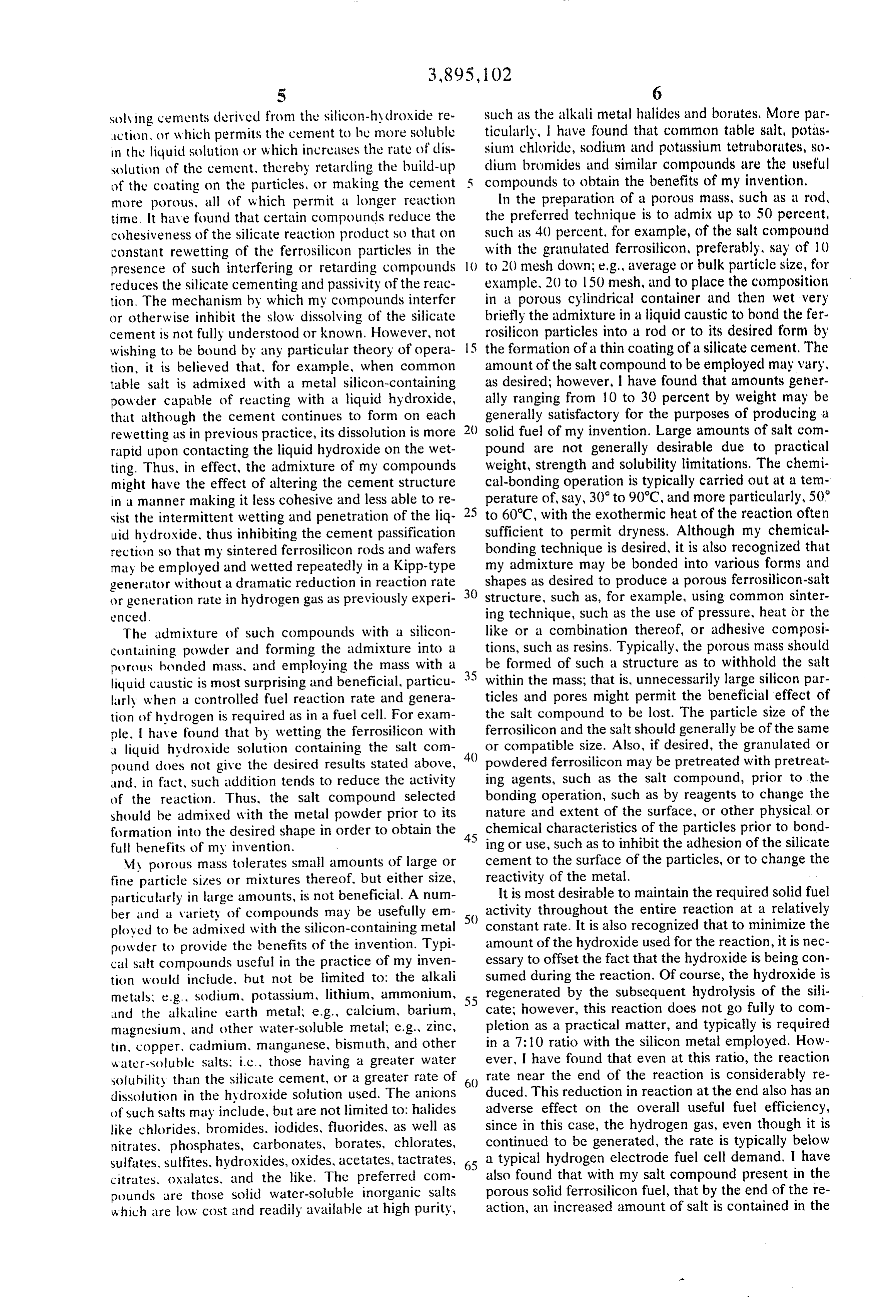
S 6 solving cements derived from the silicon-hydroxide re such as the alkali metal halides and borates, More par action, or which permits the cement to be more scluble ticularly, I have found that common table salt, potas in the liquid solution or which increases the rate of dis sium chloride, sodium and potassium tetraborates, so solution of the cenhent, thereby retarding the build-up dium bromides and similar compounds are the useful of the coating on the particles, or making the cement compounds to obtain the benefits of my invention. more porous, all of which permit a longer reaction In the preparation of a porous mass, such as a rod, time. It have found that certain compounds reduce the the preferred technique is to admix up to 50 percent, cohesiveness of the silicate reaction product so that on such as 40 percent, for example, of the salt compound constant rewetting of the ferrosilicon particles in the with the granulated ferrosilicon, preferably, say of 1() presence of such interfering or retarding compounds to 20 mesh down; e.g., average or bulk particle size, for reduces the silicate cementing and passivity of the reac example, 2() to 150 mesh, and to place the composition tion. The mechanism by which my compounds interfer in a porous cylindrical container and then wet very or otherwise inhibit the slow dissolving of the silicate briefly the admixture in a liquid caustic to bond the fer cement is not fully understood or known. However, not rosilicon particles into a rod or to its desired form by wishing to be bound by any particular theory of opera the formation of a thin coating of a silicate cement. The tion, it is believed that, for example, when common amount of the salt compound to be employed may vary, table salt is admixed with a metal silicon-containing as desired; however, I have found that amounts gener powder capable of reacting with a liquid hydroxide, ally ranging from 10 to 30 percent by weight may be that although the cement continues to form on each generally satisfactory for the purposes of producing a rewetting as in previous practice, its dissolution is more 2C) solid fuel of my invention. Large amounts of salt com rapid upon contacting the liquid hydroxide on the wet pound are not generally desirable due to practical ting. Thus, in effect, the admixture of my compounds weight, strength and solubility limitations. The chemi might have the effect of altering the cement structure cal-bonding operation is typically carried out at a tem in a manner making it less cohesive and less able to re 2 5 perature of, say, 30 to 90°C, and more particularly, 50° sist the intermittent wetting and penetration of the liq to 60°C, with the exothermic heat of the reaction often uid hydroxide, thus inhibiting the cement passification sufficient to permit dryness. Although my chemical rection so that my sintered ferrosilicon rods and wafers bonding technique is desired, it is also recognized that may be employed and wetted repeatedly in a Kipp-type my admixture may be bonded into various forms and generator without a dramatic reduction in reaction rate 30 shapes as desired to produce a porous ferrosilicon-salt or generation rate in hydrogen gas as previously experi structure, such as, for example, using common sinter enced. ing technique, such as the use of pressure, heat or the The admixture of such compounds with a silicon like or a combination thereof, or adhesive composi containing powder and forming the admixture into a tions, such as resins. Typically, the porous mass should porous honded mass, and employing the mass with a be formed of such a structure as to withhold the salt liquid caustic is most surprising and beneficial, particu within the mass; that is, unnecessarily large silicon par. larly when a controlled fuel reaction rate and genera ticles and pores might permit the beneficial effect of tion of hydrogen is required as in a fuel cell. For exam the salt compound to be lost. The particle size of the ple, have found that by wetting the ferrosilicon with ferrosilicon and the salt should generally be of the same a liquid hydroxide solution containing the salt com 40 or compatible size. Also, if desired, the granulated or pound does not give the desired results stated above, powdered ferrosilicon may be pretreated with pretreat and, in fact, such addition tends to reduce the activity ing agents, such as the salt compound, prior to the of the reaction. Thus, the salt compound selected bonding operation, such as by reagents to change the should be admixed with the metal powder prior to its nature and extent of the surface, or other physical or formation into the desired shape in order to obtain the chemical characteristics of the particles prior to bond full benefits of my invention. ing or use, such as to inhibit the adhesion of the silicate My porous mass tolerates small amounts of large or cement to the surface of the particles, or to change the fine particle sizes or mixtures thereof, but either size, reactivity of the metal.
particularly in large amounts, is not beneficial. A num It is most desirable to maintain the required solid fuel ber and a variety of compounds may be usefully em 50 activity throughout the entire reaction at a relatively ployed to be admixed with the silicon-containing metal constant rate. It is also recognized that to minimize the powder to provide the benefits of the invention. Typi amount of the hydroxide used for the reaction, it is nec cal salt compounds useful in the practice of my inven essary to offset the fact that the hydroxide is being con tion would include, but not be limited to: the alkali sumed during the reaction. Of course, the hydroxide is metals, e.g., sodium, potassium, lithium, ammonium, regenerated by the subsequent hydrolysis of the sili and the alkaline earth metal, e.g., calcium, barium, cate; however, this reaction does not go fully to com magnesium, and other water-soluble metal; e.g., zinc, pletion as a practical matter, and typically is required tin, copper, cadmium, manganese, bismuth, and other in a 7:10 ratio with the silicon metal employed. How water-soluble salts; i.e., those having a greater water ever, I have found that even at this ratio, the reaction solubility than the silicate cement, or a greater rate of rate near the end of the reaction is considerably re dissolution in the hydroxide solution used. The anions duced. This reduction in reaction at the end also has an of such salts may include, but are not limited to: halides adverse effect on the overall useful fuel efficiency, like chlorides, bromides, iodides, fluorides, as well as since in this case, the hydrogen gas, even though it is nitrates, phosphates, carbonates, borates, chlorates, continued to be generated, the rate is typically below sulfates, sulfites, hydroxides, oxides, acetates, tactrates, 65 a typical hydrogen electrode fuel cell demand. I have citrates, oxalates, and the like. The preferred com also found that with my salt compound present in the pounds are those solid water-soluble inorganic Salts porous solid ferrosilicon fuel, that by the end of the re which are low cost and readily available at high purity, action, an increased amount of salt is contained in the
Page 6
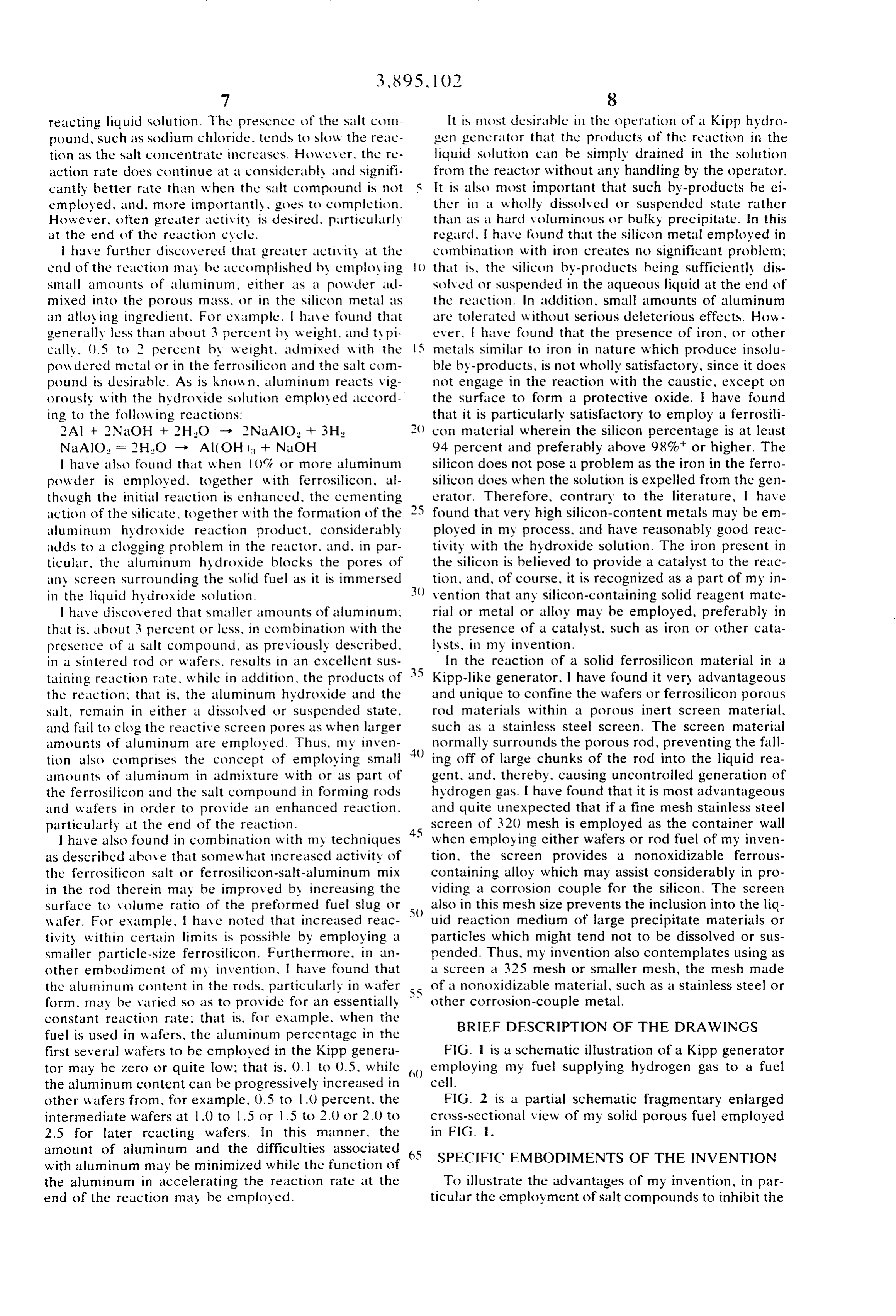
reacting liquid solution. The presence of the salt com lt is most desirable in the operation of a Kipp hydro pound, such as sodium chloride, tends to slow the reac gen generator that the products of the reaction in the tion as the salt concentrate increases. However, the re liquid Solution can be simply drained in the solution action rate does continue at a considerably and signifi from the reactor without any handling by the operator. cantly better rate than when the salt compound is not 5 It is also most important that such by-products he ei employed, and, more importantly, goes to completion. ther in a wholly dissolved or suspended state rather However, often greater activity is desired particularly than as a hard voluminous or bulky precipitate. In this at the end of the reaction cycle. regard, I have found that the silicon metal employed in have further discovered that greater activity at the combination with iron creates no significant problem, end of the reaction may be accomplished hy employing () that is, the silicon by-products being sufficientlydis small amounts of aluminum, either as a powder al Solved or suspended in the acqueous liquid at the end of mixed into the porous mass, or in the silicon metal as the reaction. In addition, Small amounts of aluminum an alloying ingredient. For ex:imple. I have found that are tolerated without serious deleterious effects. How generally less than about 3 percent by weight, and typi ever, have found that the presence of iron, or other cally. ().5 to 2 percent by weight. admixed with the 5 metals similar to iron in nature which produce in solu powdered metal or in the ferrosilicon and the salt com ble by-products, is not wholly satisfactory, since it does pound is desirable. As is known, aluminum reacts vig not engage in the reaction with the caustic, except on orously with the hydroxide solution employed accord the surface to form a protective oxide. I have found ing to the following reactions: that it is particularly satisfactory to employ a ferrosili 2Al + 2 NaOH + 2 HO - 2 NaAlO -- 3H () con material wherein the silicon percentage is at least NaAlO = 2HO - Al(OH) + NaOH 94 percent and preferably above 98%" or higher. The I have also found that when ()% or more aluminum silicon does not pose a problem as the iron in the ferro powder is employed, together with ferrosilicon, al silicon does when the solution is expelled from the gen though the initial reaction is enhanced, the cementing erator. Therefore, contrary to the literature, I have action of the silicate, together with the formation of the 5 found that very high silicon-content metals may be em aluminum hydroxide reaction product, considerably ployed in my process, and have reasonably good reac adds to a clogging problem in the reactor, and, in par tivity with the hydroxide solution. The iron present in ticular, the aluminum hydroxide blocks the pores of the silicon is believed to provide a catalyst to the reac any screen surrounding the solid fuel as it is immersed 3) tion, and, of course, it is recognized as a part of my in in the liquid hydroxide solution. vention that any silicon-containing solid reagent mate have discovered that smaller amounts of aluminum, rial or metal or alloy may be employed, preferably in that is, about 3 percent or less, in combination with the the presence of a catalyst, such as iron or other cata presence of a salt compound, as previously described, lysts, in my invention.
in a sintered rod or wafers, results in an excellent Sus In the reaction of a solid ferrosilicon material in a taining reaction rate, while in addition, the products of 35 Kipp-like generator, have found it very advantageous the reaction, that is, the aluminum hydroxide and the and unique to confine the wafers or ferrosilicon porous salt, remain in either a dissolved or Suspended State. rod materials within a porous inert Screen material, and fail to clog the reactive screen pores as when larger such as a stainless steel screen. The screen material amounts of aluminum are employed. Thus, my inven normally surrounds the porous rod, preventing the fall tion also comprises the concept of employing Small ing off of large chunks of the rod into the liquid rea amounts of aluminum in admixture with or as part of gent, and, thereby, causing uncontrolled generation of the ferrosilicon and the salt compound in forming rods hydrogen gas. I have found that it is most advantageous and wafers in order to provide an enhanced reaction, and quite unexpected that if a fine mesh stainless steel particularly at the end of the reaction. screen of 320 mesh is employed as the container wall I have also found in combination with my techniques when employing either wafers or rod fuel of my inven as described above that somewhat increased activity of tion, the screen provides a nonoxidizable ferrous the ferrosilicon salt or ferrosilicon-salt-aluminum mix containing alloy which may assist considerably in pro in the rod therein may be improved by increasing the viding a corrosion couple for the silicon. The screen surface to volume ratio of the preformed fuel slug or also in this mesh size prevents the inclusion into the lic wafer. For example, I have noted that increased reac uid reaction medium of large precipitate materials or tivity within certain limits is possible by employing a particles which might tend not to be dissolved or sus smaller particle-size ferrosilicon. Furthermore, in an pended. Thus, my invention also contemplates using as other embodiment of my invention, I have found that a screen a 325 mesh or smaller mesh, the mesh made the aluminum content in the rods, particularly in wafer of a nonoxidizable material, such as a stainless steel or form, may be varied so as to provide for an essentially other corrosion-couple metal.
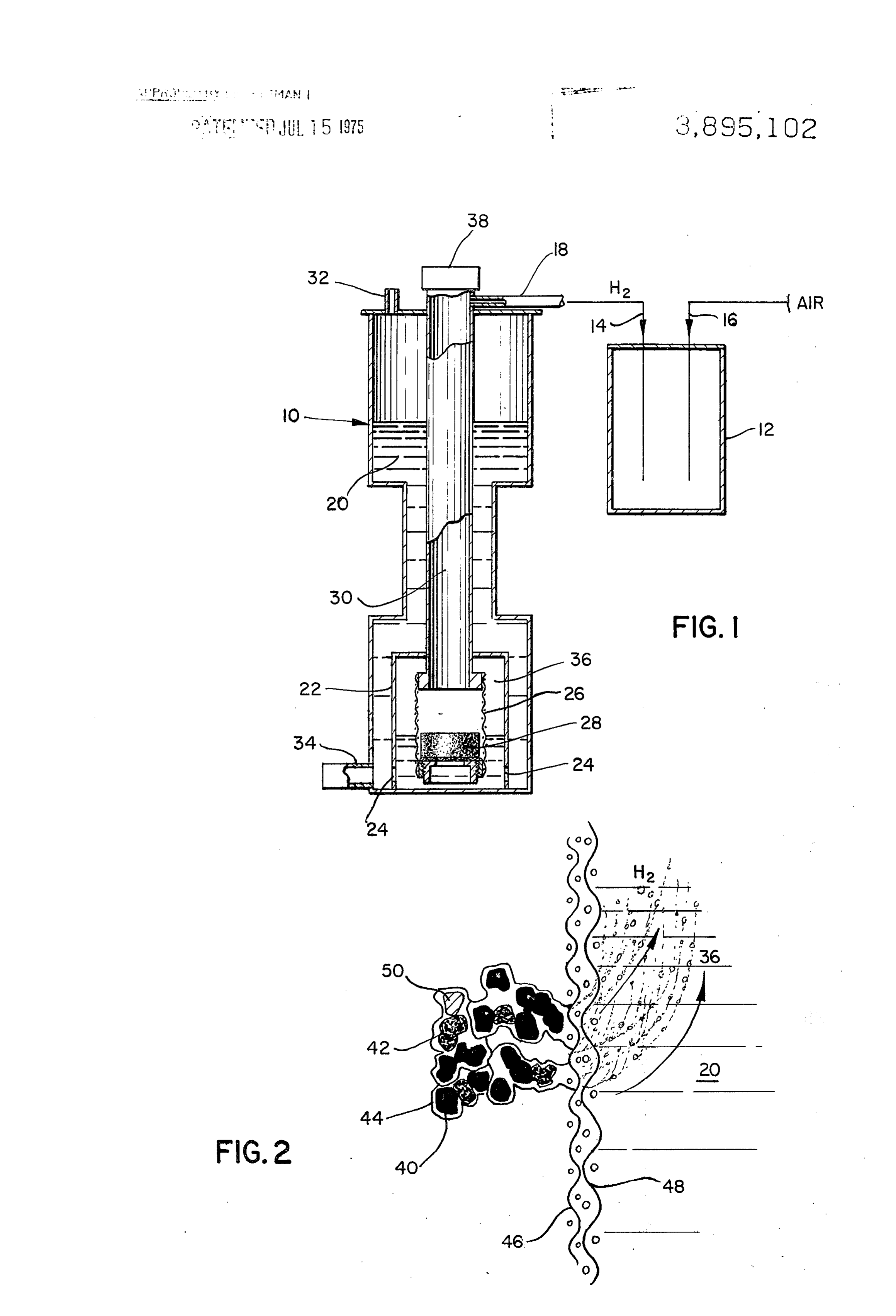
constant reaction rate; that is, for example, when the BRIEF DESCRIPTION OF THE DRAWINGS fuel is used in wafers, the aluminum percentage in the first several wafers to be employed in the Kipp genera FIG. 1 is a schematic illustration of a Kipp generator tor may be zero or quite low; that is, (). 1 to 0.5, while 6) employing my fuel supplying hydrogen gas to a fuel the aluminum content can be progressively increased in cell.
other wafers from, for example, 0.5 to 1.0 percent, the FIG. 2 is a partial schematic fragmentary enlarged intermediate wafers at 1.0 to 1.5 or 1.5 to 2.0 or 2.0 to cross-sectional view of my solid porous fuel employed 2.5 for later reacting wafers. In this manner, the in FIG, .
amount of aluminum and the difficulties associated 65
SPECIFIC EMBODIMENTS OF THE INVENTION
with aluminum may be minimized while the function of the aluminum in accelerating the reaction rate at the To illustrate the advantages of my invention, in par end of the reaction may be employed. ticular the employment of salt compounds to inhibit the
Page 7
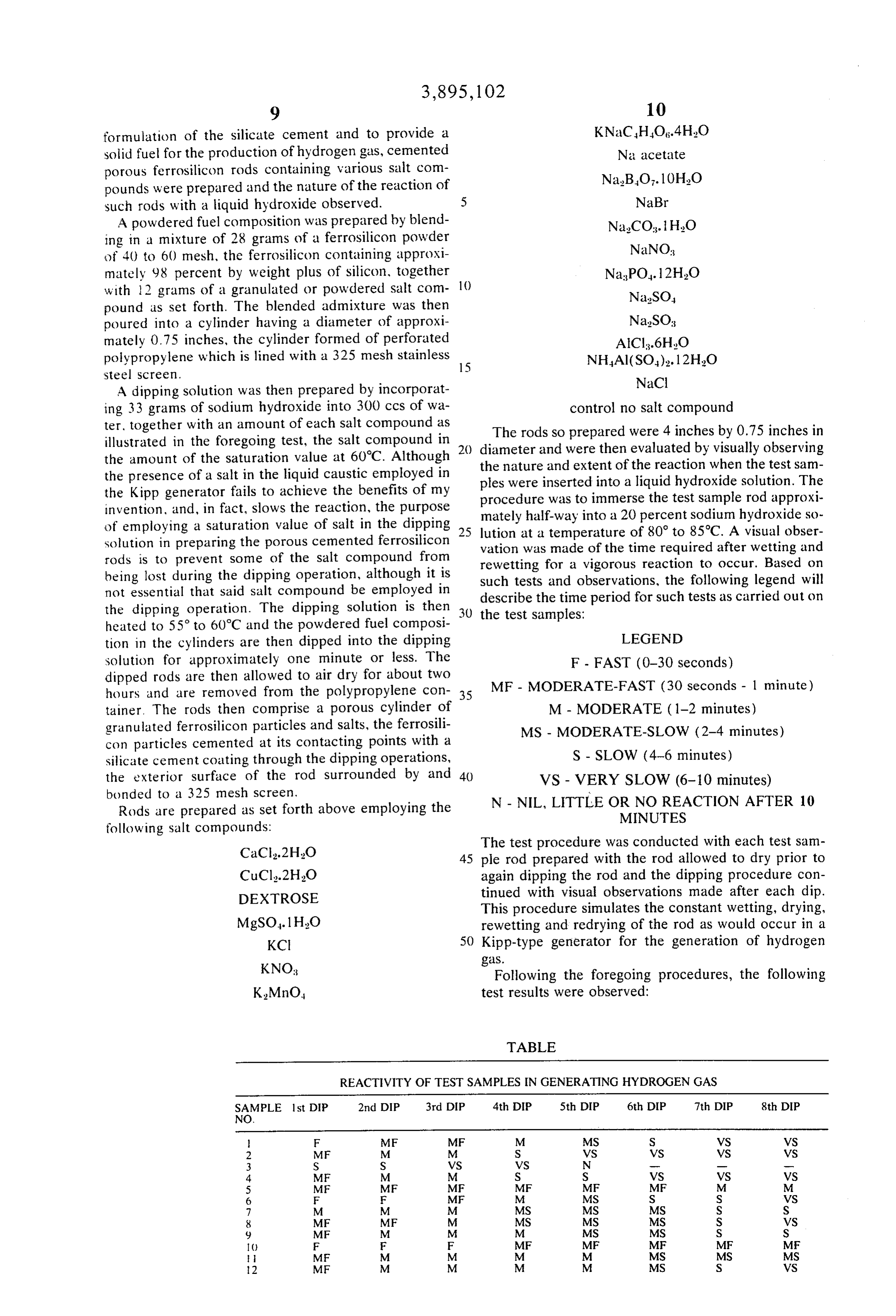
formulation of the silicate cement and to provide a KNaCHO.4H2O solid fuel for the production of hydrogen gas, cemented Na acetate porous ferrosilicon rods containing various Salt com NaBO. 10HO pounds were prepared and the nature of the reaction of such rods with a liquid hydroxide observed. 5 NaBr A powdered fuel composition was prepared by blend NaCO. HO ing in a mixture of 28 grams of a ferrosilicon powder NaNO of 40 to 60 mesh, the ferrosilicon containing approxi mately 98 percent by weight plus of silicon, together NaPO. 12HO with 2 grams of a granulated or powdered salt com- 10 NaSO pound as set forth. The blended admixture was then poured into a cylinder having a diameter of approxi NaSO mately 0.75 inches, the cylinder formed of perforated AlC6HO polypropylene which is lined with a 325 mesh stainless NH4Al(SO4). 12HO steel screen.
A dipping solution was then prepared by incorporat NaCl ing 33 grams of sodium hydroxide into 300 ccs of wa control no salt compound ter, together with an amount of each salt compound as The rods so prepared were 4 inches by 0.75 inches in illustrated in the foregoing test, the salt compound in 20 diameter the amount of the saturation value at 60°C. Although the natureand were then evaluated by visually observing and extent of the reaction when the test sam the presence of a salt in the liquid caustic employed in the Kipp generator fails to achieve the benefits of my ples were inserted into a liquid hydroxide solution. The procedure was to immerse the test sample rod approxi invention, and, in fact, slows the reaction, the purpose mately half-way into a 20 percent sodium hydroxide so of employing a saturation value of salt in the dipping 25 lution at a temperature of 80° to 85°C. A visual obser solution in preparing the porous cemented ferrosilicon vation was made of the time required after wetting and rods is to prevent some of the salt compound from rewetting for a vigorous reaction to occur. Based on being lost during the dipping operation, although it is such tests and observations, the following legend will not essential that said salt compound be employed in describe the time period for such tests as carried out on the dipping operation. The dipping solution is then 30 the test samples:
heated to 55° to 60°C and the powdered fuel composi tion in the cylinders are then dipped into the dipping LEGEND solution for approximately one minute or less. The F - FAST (0-30 seconds) dipped rods are then allowed to air dry for about two MF - MODERATE-FAST (30 seconds - 1 minute) hours and are removed from the polypropylene con- 35 tainer. The rods then comprise a porous cylinder of M - MODERATE (1-2 minutes) granulated ferrosilicon particles and salts, the ferrosili MS - MODERATE-SLOW (2-4 minutes) con particles cemented at its contacting points with a silicate cement coating through the dipping operations, S - SLOW (4-6 minutes) the exterior surface of the rod surrounded by and 40 VS - VERY SLOW (6-10 minutes) bonded to a 325 mesh screen.
Rods are prepared as set forth above employing the N - NIL, LITTLE OR NO REACTION AFTER 10
MINUTES
following salt compounds:
The test procedure was conducted with each test sam
CaCl2HO 45 ple rod prepared with the rod allowed to dry prior to CuCl2HO again dipping the rod and the dipping procedure con DEXTROSE tinued with visual observations made after each dip. This procedure simulates the constant wetting, drying,
MgSO.1 HO rewetting and redrying of the rod as would occur in a KC 50 Kipp-type generator for the generation of hydrogen gas.
KNO. Following the foregoing procedures, the following KMnO, test results were observed:
TABLE
REACTIVITY OF TEST SAMPLES IN GENERATING HYDROGEN GAS
SAMPLE 1st DIP 2nd DIP 3rd DIP 4th DIP 5th DIP 6th DIP 7th DIP 8th DIP
F MF MF M MS S VS VS 2 MF M M S VS VS VS VS 3 S S VS VS N - - - 4. MF M M S S VS VS VS 5 MF MF MF MF MF MF M M 6 F F MF M MS S S VS 7 M M M MS MS MS S S 8 MF MF M MS MS MS S VS 9. MF M M M MS MS S S () F F F MF MF MF MF MF MF M M M M MS MS MS 12 MF M M M M MS S WS
Page 8
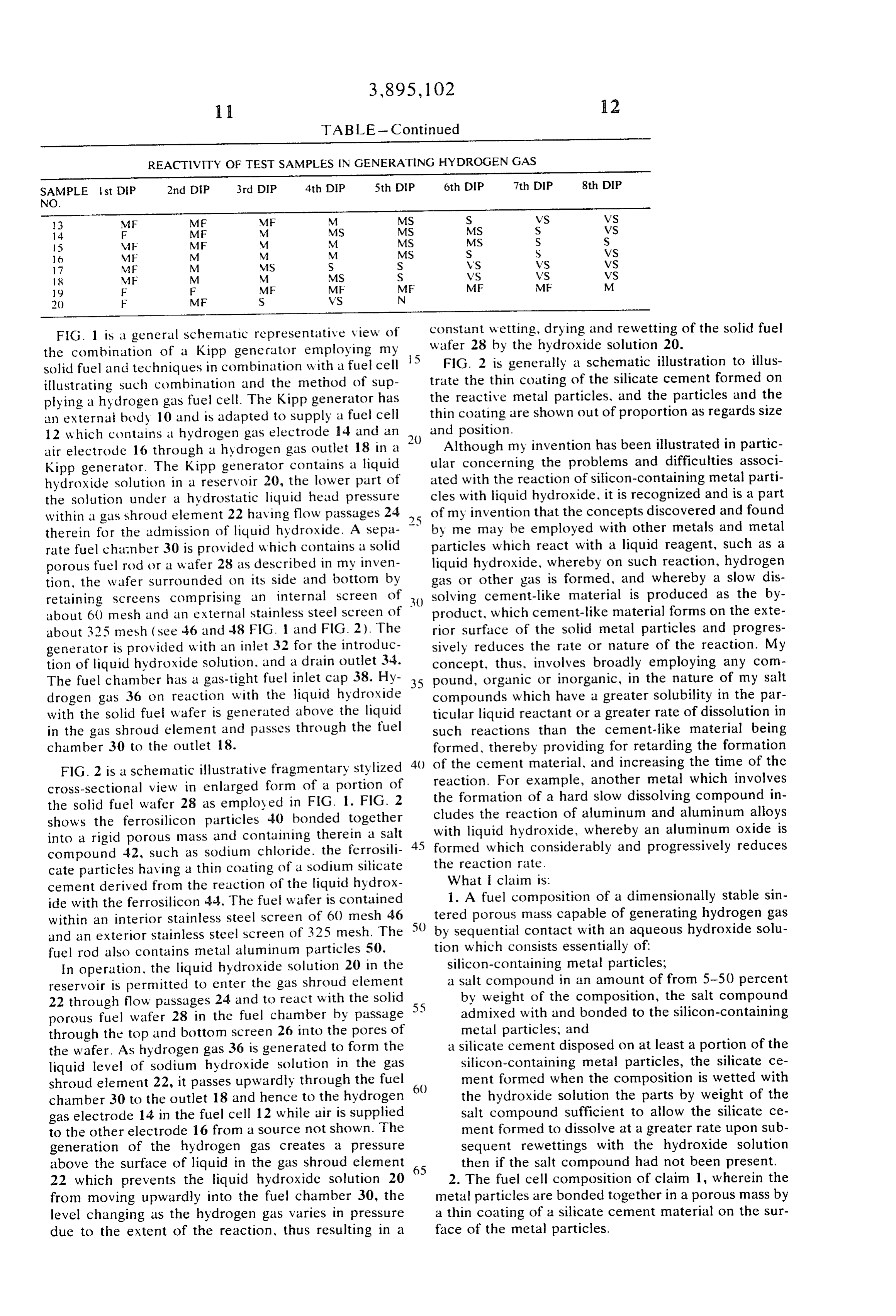
TABLE - Continued
REACTIVITY OF TEST SAMPLES IN GENERATING HYDROGEN GAS
SAMPLE 1st DIP 2nd DP 3rd DIP 4th DIP 5th DP 6th DIP 7th DP 8th DIP
13 MF MF MF M MS S VS VS 14 F MF M MS MS MS S VS 5 MF MF M M MS MS S S 16 M. M M M MS S S VS 7 MF M MS S S WS VS VS 8 MF M M MS S VS WS VS 19 F F MF MF MF MF MF M
FIG. 1 is a general schematic representative view of constant wetting, drying and rewetting of the solid fuel the combination of a Kipp generator employing my 5 wafer 28 by the hydroxide solution 20. solid fuel and techniques in combination with a fuel cell FIG. 2 is generally a schematic illustration to illus illustrating such combination and the method of sup trate the thin coating of the silicate cement formed on plying a hydrogen gas fuel cell. The Kipp generator has the reactive metal particles, and the particles and the an external body 10 and is adapted to supply a fuel cell thin coating are shown out of proportion as regards size 12 which contains a hydrogen gas electrode 14 and an 20 and position.
air electrode 16 through a hydrogen gas outlet 18 in a Although my invention has been illustrated in partic Kipp generator. The Kipp generator contains a liquid ular concerning the problems and difficulties associ hydroxide solution in a reservoir 20, the lower part of ated with the reaction of silicon-containing metal parti the solution under a hydrostatic liquid head pressure cles with liquid hydroxide, it is recognized and is a part within a gas shroud element 22 having flow passages 24 2 5 of my invention that the concepts discovered and found therein for the admission of liquid hydroxide. A sepa by me may be employed with other metals and metal rate fuel chamber 30 is provided which contains a solid particles which react with a liquid reagent, such as a porous fuel rod or a wafer 28 as described in my inven liquid hydroxide, whereby on such reaction, hydrogen tion, the wafer surrounded on its side and bottom by gas or other gas is formed, and whereby a slow dis retaining screens comprising an internal screen of solving cement-like material is produced as the by about 60 mesh and an external stainless steel screen of product, which cement-like material forms on the exte about 325 mesh (see 46 and 48 F.G. 1 and FIG. 2). The rior surface of the solid metal particles and progres generator is provided with an inlet 32 for the introduc sively reduces the rate or nature of the reaction. My tion of liquid hydroxide solution, and a drain outlet 34. concept, thus, involves broadly employing any com The fuel chamber has a gas-tight fuel inlet cap 38. Hy 35 pound, organic or inorganic, in the nature of my salt drogen gas 36 on reaction with the liquid hydroxide compounds which have a greater solubility in the par with the solid fuel wafer is generated above the liquid ticular liquid reactant or a greater rate of dissolution in in the gas shroud element and passes through the fuel such reactions than the cement-like material being chamber 30 to the outlet 18. formed, thereby providing for retarding the formation FIG. 2 is a schematic illustrative fragmentary stylized of the cement material, and increasing the time of the reaction. For example, another metal which involves cross-sectional view in enlarged form of a portion of the formation of a hard slow dissolving compound in the solid fuel wafer 28 as employed in FIG. 1. FIG. 2 cludes the reaction of aluminum and aluminum alloys shows the ferrosilicon particles 40 bonded together with liquid hydroxide, whereby an aluminum oxide is into a rigid porous mass and containing therein a salt 45 formed which considerably and progressively reduces compound 42, such as sodium chloride, the ferrosili the reaction rate.
cate particles having a thin coating of a sodium silicate What i claim is:
cement derived from the reaction of the liquid hydrox ide with the ferrosilicon 44. The fuel wafer is contained 1. A fuel composition of a dimensionally stable sin within an interior stainless steel screen of 60 mesh 46 50 tered porous mass capable of generating hydrogen gas and an exterior stainless steel screen of 325 mesh. The by sequential contact with an aqueous hydroxide solu fuel rod also contains metal aluminum particles 50. tion which consists essentially of: In operation, the liquid hydroxide solution 20 in the silicon-containing metal particles; reservoir is permitted to enter the gas shroud element a salt compound in an amount of from 5-50 percent 22 through flow passages 24 and to react with the solid 55 by weight of the composition, the salt compound porous fuel wafer 28 in the fuel chamber by passage admixed with and bonded to the silicon-containing through the top and bottom screen 26 into the pores of metal particles, and the wafer. As hydrogen gas 36 is generated to form the a silicate cement disposed on at least a portion of the liquid level of sodium hydroxide solution in the gas silicon-containing metal particles, the silicate ce shroud element 22, it passes upwardly through the fuel ment formed when the composition is wetted with chamber 30 to the outlet 18 and hence to the hydrogen the hydroxide solution the parts by weight of the gas electrode 14 in the fuel cell 12 while air is supplied Salt compound sufficient to allow the silicate ce to the other electrode 16 from a source not shown. The ment formed to dissolve at a greater rate upon sub generation of the hydrogen gas creates a pressure Sequent rewettings with the hydroxide solution above the surface of liquid in the gas shroud element then if the Salt compound had not been present. 22 which prevents the liquid hydroxide solution 20 65 2. The fuel cell composition of claim 1, wherein the from moving upwardly into the fuel chamber 30, the metal particles are bonded together in a porous mass by level changing as the hydrogen gas varies in pressure a thin coating of a silicate cement material on the sur due to the extent of the reaction, thus resulting in a face of the metal particles.
Page 9
3. The composition of claim 1, wherein the salt com on reaction of the aqueous hydroxide solution, the pound is an alkali metal salt compound. salt compound present in said admixture in an 4. The composition of claim 1, wherein the composi amount up to 50 percent by weight, the metal parti tion includes not more than 3 percent by weight of alu cles and powdered salt compound having an aver minum bonded to the porous mass. 5 age particle size of between about 10-325 mesh; 5. The composition of claim 1, wherein the salt com b. forming the admixture so prepared into a desired pound is selected from the group consisting of sodium form; and chloride, sodium borate, potassium chloride, potassium c. dipping the formed admixture into a liquid hydrox bromide, or combinations thereof. ide solution for a period of time sufficient to pro 6. The composition of claim 1, wherein the salt com () vide for the bonding in place of all particles at their pound is present in the amount of from about 10-30 contacting points, a silicate cement material percent by weight. formed on at least a portion of the silicon 7. A method of controlling the generation of hydro containing metal particles, thereby providing a po gen gas when a fuel comprising a sintered dimension rous, rigid mass of all particles. ally integral porous mass of silicon-containing metal 5 9. The method of claim 8, which includes admixing particles and not more than 50 percent by weight of a salt compound bonded to said metal particles is period the more metal particles and powdered salt compound not than 3 percent by weight of aluminum particles.
ically wetted with an aqueous hydroxide solution, 10. The method of claim 8, wherein the salt com whereby a hard, slow-dissolving silicate compound forms on the surface of the silicon, which would inhibit 20 pound is selected from the group consisting of sodium chloride, potassium chloride, potassium bromide, or the generation of hydrogen gas after such repeated sodium tetraborate.
contacts, which comprises: 11. The method of claim 8, wherein the weight of the wetting the composition with the aqueous hydroxide ferrosilicon particles have from about 75-99- percent solution;
generating hydrogen and simultaneously forming a 25 by12. weight of silicon.
The method of claim 8, which includes dipping silicate cement which adheres to at least a portion of the surface of the silicon-containing metal parti the formed admixture into a hydroxide solution at a cles, temperature of between about 40-80°C for a period of withdrawing the hydroxide solution from the compo about 1 minute or less.
sition; 30 13. The method of claim 8, which comprises: rewetting the composition with the hydroxide solu adding the admixture to a porous non-reactive cylin tion to generate hydrogen and to remove a portion drical tube;
of the slow-dissolving silicate compound formed dipping the cylindrical tube containing the admixture when the hydroxide solution wets and is removed into the liquid hydroxide solution; from the composition. 35 removing the tube from the liquid hydroxide solu 8. A method of preparing a solid porous fuel compo tion; bonding of the ferrosilicon particles together; sition for reaction with liquid hydroxide to generate hy drying the porous bonded mass of ferrosilicon parti drogen gas, which method comprises: cles; and a. admixing silicon-containing metal particles and a recovering a porous rigid rod of bonded particles powdered water-soluble inorganic salt compound, 40 from the cylindrical tube.
said compound selected to alter the formation of silicate cement on the surface of the metal particles k k k is k
Provenance
- Collection
- Cited prior art
- Original PDF
- patentimages.storage.googleapis.com →
- Filed
- 1973-09-10
- Pages
- 9
- Method
- pdftotext (the PDF's own text layer) + pdftoppm 300dpi page scans
- Source
- Google Patents bibliographic record
- Granted
- 1975-07-15
- Inventors
- John P Gallagher; Delta F Corp
- Transcribed from
- patentimages.storage.googleapis.com →