patent · US3888621
Monitoring and controlling kiln operation in calcination of coke
10 June 1975
Page 1 — bibliographic record
United States Patent (19) 11) 3,888,621 Williams
(54) MONITORNG AND CONTROLLING IKLN
OPERATION IN CALCINATION OF COKE Primary Examiner-John J. Camby (75) Inventor: Merlyn Morris Williams, Kitimat, Attorney, Agent, or Firm-Cooper, Dunham, Clark, British Columbia, Canada Griffin & Moran 73 Assignee: Alcan Research and Development
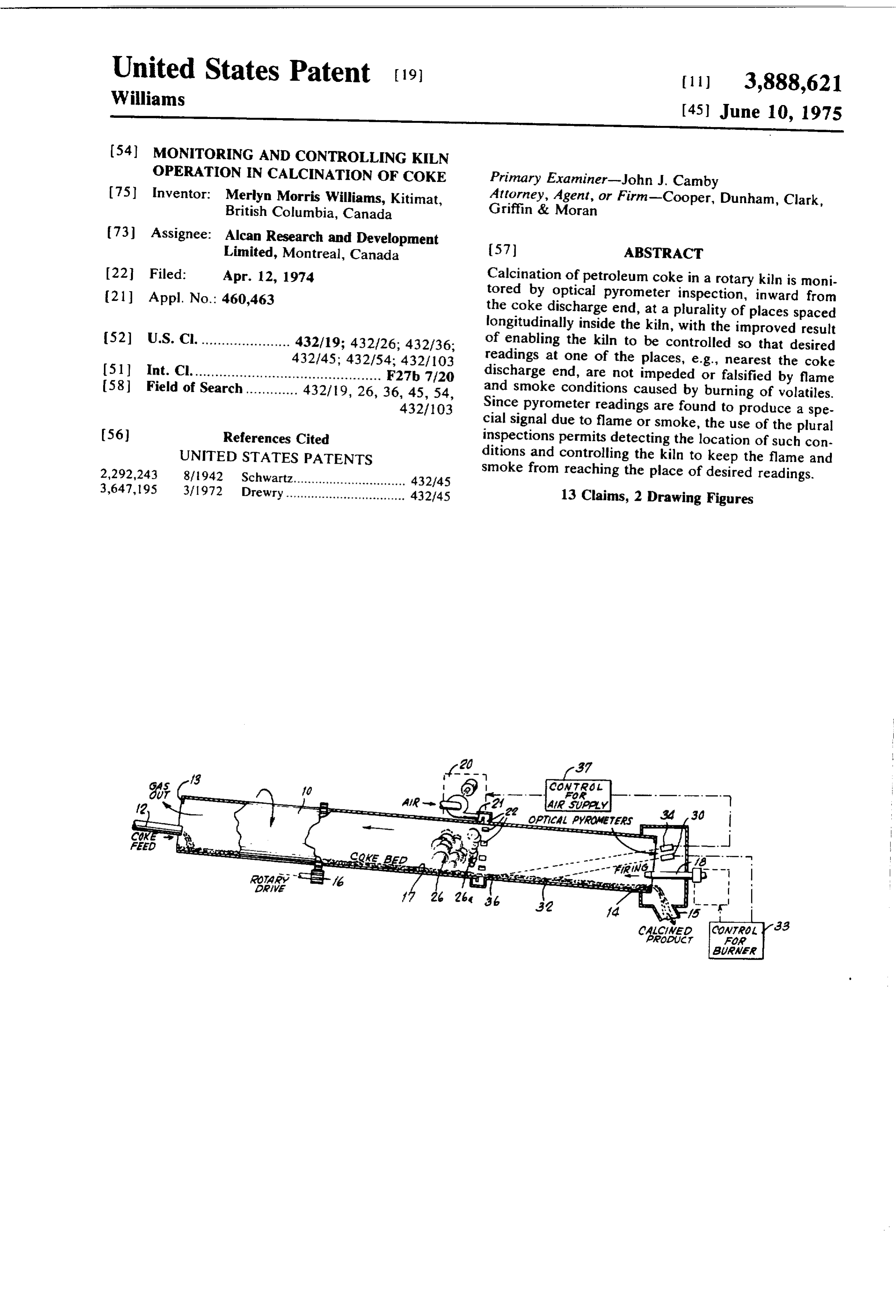
Limited, Montreal, Canada (57) ABSTRACT 22 Filed: Apr. 12, 1974 Calcination of petroleum coke in a rotary kiln is moni 21 Appl. No.: 460,463 tored by optical pyrometer inspection, inward from the coke discharge end, at a plurality of places spaced longitudinally inside the kiln, with the improved result (52) U.S. Cl. ...................... 432/19; 432/26; 432/36; of enabling the kiln to be controlled so that desired 432/45; 432/54; 432f 103 readings at one of the places, e.g., nearest the coke (51) Int. Cl. .............................................. F27b 7/20 discharge end, are not impeded or falsified by flame 58 Field of Search............. 432/19, 26, 36, 45, 54, and smoke conditions caused by burning of volatiles. 432/103 Since pyrometer readings are found to produce a spe cial signal due to flame or smoke, the use of the plural (56) References Cited inspections permits detecting the location of such con UNITED STATES PATENTS ditions and controlling the kiln to keep the flame and 2,292,243 8/1942 Schwartz............................... 432/45 smoke from reaching the place of desired readings. 3,647, 195 3/1972 Drewry................................. 432/45 13 Claims, 2 Drawing Figures
MYfe
calcited roofer cowreet
eigaafe
Page 2
Drawing sheet — no readable text.
Page 3
MONTORING AND CONTROLLING IKLN the desired temperature is exceeded in the coke that OPERATION IN CALCINATION OF COKE approaches the discharge, the burner cuts out. At the BACKGROUND OF THE INVENTION same time, if possible there must also be appropriate attention to the amount of air that is advantageously
This invention relates to the calcination of coke, par 5 supplied to the interior of the kiln at an intermediate ticularly petroleum coke such as intended to provide region or regions, for the desired combustion of the carbon for making electrodes or the like. Calcining op volatiles, the object being to obtain a substantial quan erations of this sort are commonly performed in a ro tity of heat without having so much air that oxidizing tary kiln into which the green petroleum coke in suit conditions prevail in the sense of promoting combus able particulate form is fed at one end, for delivery of 0. tion of the carbon itself.
treated product at the other end. In the kiln, the coke A serious difficulty in operations of this sort has now is calcined at high temperature, to drive off the vola been noted, particularly in relation to efforts to achieve tiles and shrink the coke to a predetermined, desired the controlled, high product temperature while pro density. The calcined product is useful for carbon ele moting good utilization of the burning of volatiles and ments and structures, notably for various situations of 15 corresponding effectiveness in the calcining operation. electrical function, such as in high temperature electro Thus it has been observed that the volatiles distilling chemical operations, and most particularly for anodes from the coke, as they burn, can be described as and lining compositions in aluminum reduction cells. smoky, with the effect of producing a combustion dis The calcining process is endothermic, and desired re turbance visible as extending across the kiln interior at sults require adequate heating but very preferably with the locality of the coke path where the combustion oc out appreciable combustion of the carbon itself. A curs, specifically the place furthest downstream in the prime indicator of desired operation is found to be the direction of coke travel where volatile burning begins temperature of the calcined or nearly-calcined mate although such burning may presumably extend through rial, for example as it approaches the end of the kiln. localities further up the kiln, i.e., toward the coke feed A considerable amount of heat is obtained by burning 25 end to which the burning or burned gases flow. This op the released volatiles, i.e., ordinarily a substantial pro tically detectable disturbance, being the beginning of portion of them. The excess of volatiles is carried off in the volatile burning operation in the path of travel of the countercurrent flow of all gases including combus air and gas toward the feed end, can be variously de tion products, out the gas discharge, which is the feed scribed as a wall of flame or a smoke curtain, and may end of the kiln, and such excess of volatiles can be re have an appearance of mingled flame and smoke ex covered or otherwise made available for external utili tending substantially across the kiln, so as to obscure or zation. confuse an attempted inspection of interior regions of A common past practice, for maintaining tempera the kiln at and beyond the curtain.
ture control, has been to provide separate heat, as With changing conditions, this combustion distur needed, by combustion of supplemental fuel, for exam bance tends to move lengthwise of the kiln, and partic ple employing a gas or oil burner at the product dis ularly when the air supply is low, may move down the charge end of the kiln, to project the hot products of coke path, toward the discharge end, to and beyond the combustion, e.g., flame and burned gas, into the kiln. locality where temperature is measured by the optical It has been proposed to measure the temperature of the 40 pyrometer. When this happens, the signals of the py travelling coke, for instance at a locality 25 feet within rometer become abnormal, being characterized by a the kiln from the discharge end, by focusing an optical rapid, substantial fluctuation. This represents a false or pyrometer on a suitable section at such place that can meaningless reading of temperature and may corre function as representing a black body state, being ei spondingly produce a false control of the supplemental ther the coke bed or adjacent interior kiln surface. In burner, for example to bring it into operation when it a broad sense, this temperature serves as an indicator would not be needed, thereby drawing in more fuel to of kiln operation, particularly in that failure to reach a compete for the already inadequate oxygen in the kiln. desired value, for instance 1,250°C, indicates incom Since insufficient oxygen or air is often responsible for plete calcining, to be corrected by use or increased use thc downward travel of the smoky curtain, the un of the supplemental burner. wanted operation of the burner can lead to a worsening In recognized instances, the effect of variations in 50 of conditions, reducing the actual combustion of vola feed or nature of the green coke can be controlled by tiles and impairing rather than improving the kiln oper changing the feed rate or changing the time of passage ation.
through the kiln, i.e., by altering rotation speed. To a In all cases, regardless of the use of the temperature considerable extent, however, changes in calcining ef 55 signals from the pyrometer - i.e., whether they control fect revealed by unsatisfactory temperature in the dis the burner or indicate the need for it or whether they charge section of the kiln may be corrected by altering are employed for some different function or aid in kiln the amount of heat, as for instance with increase of the control - the unwanted movement of the combustion amount of air supplied into the kiln for burning vola disturbance obscuring the locality of the primary tem tiles, and most usually with addition or increase of sup 60 perature reading is seriously objectionable, since there plemental fuel-fircd heat. is then no proper temperature detection. As will be un Thus one practice is to read the coke temperature as derstood, the present invention is designed to obviate above, on a continuous or like basis. Considcring the these difficulties and to provide a superior way of moni supplemental heat to be inoperative unless required, toring, i.e., controlling kiln operation, by the use of departure of the temperature below a predetermined 65 temperature readings.
value (such as 1,250°C) signals the need for more heat, SUMMARY OF THE INVENTION whereupon manually or automatically the burner is brought into operation, using the ancillary fuel. When For the improvement of the operation of calcining
Page 4
petroleum coke in a rotary kiln, performed as de basic control is preferably exercised over the air supply scribed above, the invention embraces a process to the kiln, e.g., to increase such air when the combus wherein radiant energy inspection, i.e., by optical py tion disturbance has been detected at the second py rometer means, is maintained at a plurality of succes rometer inspection locality. In consequence, the vola sive localities along the kiln, notably in that portion of tile burning zone is caused to move upward of the kiln, the kiln which can be considered the downstream re away from the second inspection locality, as will be de gion of the coke path, and advantageously in a portion termined by absence of the abnormal or unstable tem which approaches the downstream end, the optical in perature signal. Thus the monitoring procedure basi spection procedure being so aimed and utilized as to cally involves adjusting conditions so that when the ab provide for continued maintenance of the significant O normal signal appears, it is caused to disappear, and at kiln temperature readings, without interference by the the same time the process achieves the primary object combustion disturbance as it may undesirably tend to of preventing the combustion disturbance from ever travel along the interior of the kiln and thus occupy an reaching (by further downstream travel) the first local unwanted locality. ity of temperature inspection, which is deemed of Specifically, in its basic concept, the invention pro 5 major importance for primary control of kiln opera vides for monitoring the operation of a kiln by optical tion.
pyrometer inspection, e.g., from the discharge end. A further feature of the invention embraces a more This operation comprises effecting such inspection of elaborate monitoring procedure and system, specifi a first kiln locality suitable for temperature reading sig cally including provision for inspection by optical py nificant of kiln operation, e.g., in the last half, and in rometer means at a third kiln locality, further upstream deed preferably in the last quarter, of the kiln, the lo (toward the coke feed end) than the second of the lo cality being downstream of a place where the volatile calities described above. This further locality is advan combustion is desired to occur, or at least downstream tageously chosen as appropriate for combustion of vol of the place below which such combustion and its dis 25 atiles, or more strictly, as lying within a zone which in turbance should not move. The procedure also includes desired, normal operation of the kiln would be ob effecting such inspection at another kiln locality, up scured by the curtain of combustion disturbance, and stream in the coke path, from the first locality of in thus would normally result in the characteristic insta spection but downstream also of the permitted place of bility, i.e., fluctuation, of the temperature signals re disturbance. As explained, it will be understood that sulting from inspection there.
each optical pyrometer inspection is such that if the With the three readings or inspections of the interior wall of smoke and flame embraces the inspected local of the kiln, e.g. each at the coke bed or close to it so ity or comes downstream of it, the temperature signal that the observed wall temperature in effect measures will have a characteristic instability which is distinctive the coke bed temperature, the operation is as follows: of the local occurrence of the combustion disturbance. The object, as before, is to maintain unaffected read In accordance with the invention, the temperature 35 ings from the first locality, so that the desired continu readings of the second, more upstream pyrometer are ous or frequent measurement of calcined coke temper observed, by the attendant or automatically, and if they ature is obtained. The control or interpretation from are characterized by an abnormal condition, the opera the readings of the other two localities is that if both lo tion to maintain monitoring is brought into play, as by 40 calities yield the abnormal instability of temperature altering the calcining conditions of the kiln so that the signal, adjustment is effected, as by increasing supply volatile combustion zone is caused to move upstream of combustion air in the kiln by the blowers or by other and to depart from a location where it obscures the Sec alteration of kiln conditions, so that the combustion ond or higher locality of optical pyrometer inspection. disturbance or curtain moves back up the kiln and the An unusually effective adjustment for such purpose, reading of the second locality becomes stable. At the manually or automatically, is to increase the Supply of 45 same time, the control is conveniently exercised so that air to the interior of the kiln for enhanced burning of instability is maintained at the third locality, thus plac volatiles. This may be effected by adjusting the blower ing the burning of volatiles or the front or beginning of arrangements conventionally attached to the side of the such burning at a position upstream (as the coke trav kiln for introducing air at intermediate localities. With 50 els) of the second inspection locality but at or down this or other suitable adjustment, the obscuring com stream of the third locality.
bustion disturbance is caused to move back up the kiln Indeed, the operation can include response to disap (toward the feed end) so as to serve the primary pur pearance of abnormal instability in the signals from the pose of preventing such disturbance from ever reaching third locality, such that the flow of air is somewhat de the first locality of pyrometer inspection; the tempera 55 creased, or other suitable adjustment made, to cause ture readings from the latter are thus kept accurate for the combustion curtain to move along the kiln to such their desired function of indicating the operating condi locality. That is to say, if all three pyrometer readings tion of the kiln. At the same time the adjustment in it become stable, the combustion curtain can be consid self usually serves corrective functions, e.g., in re ered to be moved too far up the kiln, and the above or storing the locality of volatile combustion to a desired 60 other change of condition can then be desirable to place and restoring the extent of such combustion to a move the combustion region back downstream. It will desired value. be understood that this more complete operation and Other procedures to move the wall of flame and system, involving three pyrometer readings, is believed smoke and to serve the above purposes may be fol to be advantageous, for maximum stability of kiln func lowed, alternatively or additionally, such as reducing 65 tion. Very effective kiln operation and control, how the feed rate of coke or slowing the travel of the coke ever, are attainable with the simpler provision of two by reducing the rotation of the kiln. In the main, how inspections, especially in that in many cases unwanted ever, and as a particular feature of the invention, the upstream movement of the combustion disturbance
Page 5
does not ordinarily occur or tends to be self-correcting. least a very substantial supply of heat derived by com As will be appreciated, the described procedures are bustion of the volatile materials driven off the coke, the highly effective for monitoring kiln operation, espe travelling coke is effectively calcined, becoming essen cially in order to permit true temperature reading near tially pure carbon with at least nearly all of the material the discharge end, continuously or as frequently as may 5 driven off. The quality of the product is also measur be desired, for a variety of purposes, whether to control able by its density, i.e., so-called real density, which in the supply of supplemental heat or indeed to control or creases substantially by reason of the heating during record the state of kiln operation regardless of the use the calcining process.
of such heat. As will be understood, the present im In the above operation, it has been sought to deter provements not only embrace the described proce O mine the success of calcining, not only by examination dures, but novel apparatus including the combinations and analysis of the product from time to time, but also of instrumentalities as herein set forth. by some reading of the temperature of the coke as it ap
BRIEF DESCRIPTION OF THE DRAWINGS
proaches the discharge end. Considering the supple mental burner 18 as being normally inoperative while
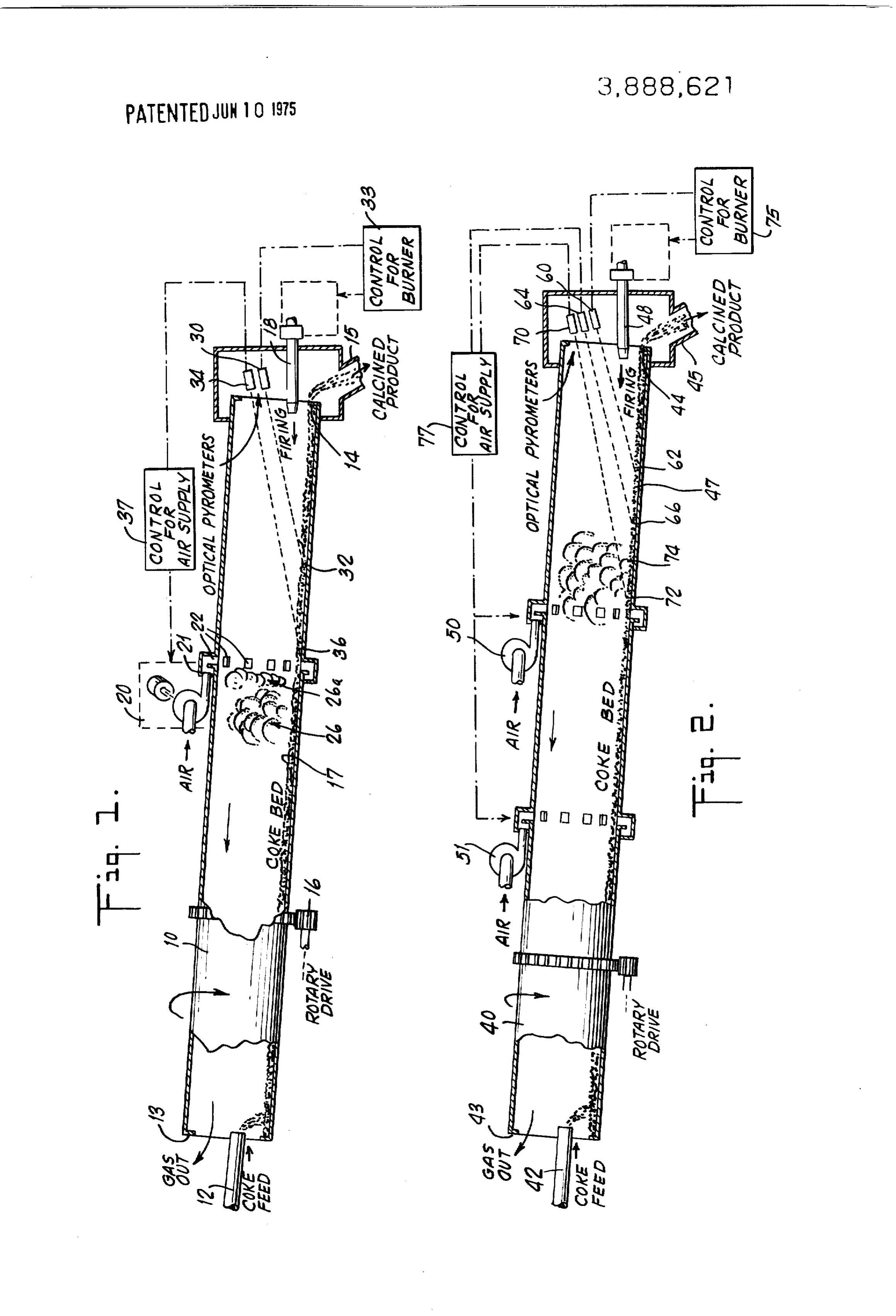
FIG. 1 is a diagrammatic view, showing a rotary kiln 5 heat is continuously supplied by burning the combusti mostly in longitudinal vertical section and illustrating ble volatile material as at region 26 and upstream the operations and arrangements of a first form of the thereof toward the feed end 13, the temperature has invention. been found to have a relation to the product quality. If FIG. 2 is a like diagrammatic view of a rotary kiln il the temperature near the discharge end of the kiln is lustrating a second form of the invention. below a given value, that is found to be indicative of DETALED DESCRIPTION less than optimum calcination, and the burner 18 is then brought into operation, providing additional heat.
In the way of specific examples, the invention is illus When the temperature reaches a desirable value again, trated in the above-mentioned figures, wherein with the burner is cut out and reliance is placed solely on reference first to FIG. 1, a rotary kiln 10 is shown into 25 combustion of volatiles by air supplied through the which granular petroleum coke is fed through an ap means 20, 21, 22, plus any further air that may be intro propriate duct 12 at one end, and the calcined coke is duced at the discharge end 14.
caused to be discharged at the opposite end 14, e.g., by As will be appreciated, adjustment of the air supply gravity down through a suitable outlet 15. The kiln is through the fan 20 is also feasible, the desired condi arranged with a slope downwards, of suitable small an tions being to maintain as much burning as possible and gle, from the feed to discharge ends so that as it is con optimum utilization of heat without introducing so tinuously rotated around the longitudinal axis through much air as to create oxidizing conditions which would appropriate drive means such as a pinion and ring gear unduly burn up the carbon itself. At the same time, in arrangement illustrated at 16, the granular coke ad sufficient air represents inefficiency and indeed pre vances as a continuous bed 17 along the inside bottom cludes optimum heating for calcination. of the kiln. For purposes of determining the kiln temperature, For one type of operation described hereinabove, and controlling the operation as above or in any other supplemental heat is directed into the kiln, e.g., from desired way, an optical pyrometer 30 may be aimed, the discharge end 14, such heat being illustrated by the i.e., focused, to a portion of the kiln wall some distance fuel burner 18 directed to project flaming or otherwise 40 in from the kiln end 14, so that this pyrometer, viewing hot gaseous products of combustion into the kiln, up such locality 32 of the coke bed or adjacent wall stream of the coke travel, it being understood that air through the kiln end, provides signals which represent is also supplied, at least as necessary for the combus the temperature at the locality. It will be understood tion of the fuel, and that the path of gases through the 45 that optical pyrometers of suitable nature are well kiln is countercurrent to the feed of coke, all such gases known and that they are preferably used, in suitable fo being discharged at the feed end 13. cus, for optically reading the radiating condition (e.g., At least a substantial quantity of the air employed for in visible and infrared light radiation) of the observed combustion of the volatile material removed from the locality, the latter being deemed to constitute a so coke by calcining is conveniently supplied at intermedi SO called black body. The response of the pyrometer, of ate localities of the kiln. In FIG. 1, although a plurality course, is read out as signals having values, as tempera of air supply means can be used, one arrangement is ture, corresponding to the optical radiation of the in shown including a fan or blower 20 carried by the shell spected place.
of the kiln 10 and rotating with it. The blower 20 deliv While in the situation of the calcining procedure, ers air into an annular distributor or manifold 21 from 55 such pyrometers may be focused on the coke bed itself, which a plurality of openings or tuyeres 22 permit in as indicated for simplicity in the drawings, it is ordi troduction of the air. This sytem is appropriately ar narily preferable to make inspection of some immedi ranged, as will be known, so that the air is introduced ately adjacent portion of the interior kiln wall, e.g., without undue disturbance of the travelling coke bed where it has just left the coke bed, for more even deter 24. 60 mination, which can be taken as substantially equal to As will now be understood, the normal operation of the coke temperature, or differing from it by a small, calcining petroleum coke in a kiln of this sort involves constant amount for which allowance is made. It will be continuous feed of the coke particles, which are caused understood that the pyrometer 30 may be connected to to travel as a substantial bed in the bottom of the kiln, suitable control instrumentalities 33 which in turn gov by reason of the rotation of the latter, so that they even 65 ern the operation of the burner 18, as by initiating tually discharge over the end 14 of the cylindrical kiln burning when the temperature falls below a given value shell. During this time, with heat initially supplied by and interrupting burning when it substantially exceeds the burner 18, and (after the bed is heated up) with at such value.
Page 6
As has been explained, the burning of volatile materi Although the adjustment of kiln conditions in re als which are driven off the coke as a desired purpose sponse to appearance of the combustion disturbance as of calcination, creates what may be defined as a com viewed by the pyrometer 34, is readily accomplished by bustion disturbance, which can be considered to occur manual attention of an operator, FIG. 1 shows connec at 26 and to have a front 26a optically detectable, even tions of the pyrometer to a control device 37 (having visible, from the discharge end of the kiln. That is to appropriate electronic or other means to discriminate say, this combustion disturbance is represented by a between abnormal, fluctuating signals and normal, wall or curtain of smoke or flame, indecd usually a mix level signals), whereby the fan or other air supply ture of both, across the kiln. So long as this combustion means 20 is adjusted, for example to increase the air disturbance remains upstream (relative to coke travel) () supply when the pyrometer signals from 36 are abnor of the temperature-inspection locality 32, the kiln op mal and to maintain such increased air flow as long as eration is readily controlled, but it has a tendency to necessary, and preferably at least until the signals have move longitudinally of the kiln, particularly in the remained at a restored, level state for a considerable downstream direction, toward the discharge end 14. If time.
the disturbance comes down to the locality 32, it has 5 Another form of the invention is shown in FIG. 2, in been found that the reading of the pyrometer 30 be cluding an additional step or feature in the monitoring comes abnormal, especially in having a rapid instability operation which is of advantage in a number of situa or fluctuation. In consequence, the burner 18, because tions. Here, as in FIG. 1, there is a rotary kiln 40, hav of a false reading, ay be brought into operation when ing coke feed 42 at one end 43 which also discharges such is not desired, or alternatively if there is a false gases, so arranged as before that by rotation of the high reading, there may be a failure of the burner to be downward sloping kiln 40 with means such as shown in started. In either case, the desired control of process FIG. 1 but not here, the coke bed is advanced to the conditions is greatly impaired. Particularly if the burner discharge end 44 for removal in a duct 45. Supplemen is fired when it is unneeded (as most usually occurs tal heat for calcining the coke in the bed 47 is provided when the smoke 26 a reaches 32), the result is to bring 2 5 by a burner 48, it being understood that principal heat in more fuel, which competes for the already inade is derived by burning the released volatile materials quate oxygen within the kiln, and instead of reducing with the aid of air supply instrumentalities such as the smoky curtain or moving it back, there is a worsen shown at 50 and 51, at successive localities lengthwise ing of kiln conditions. In such case, of course, the kiln of the kiln.
conditions really did not require more heat, and to say 30 The system is provided with a first optical pyrometer the least, the firing of the burner represented ineffi 60 functioning to inspect a locality 62 to read the de ciency without useful effect. sired coke temperature that is of primary significance in accordance with the present invention, the system for control of kiln operation. There is also a second py of FIG. 1 includes a second optical pyrometer 34, also 35 rometer 64 which senses a locality 66, upstream in the inspecting the interior of the kiln from the discharge coke path from the first locality 62. Finally, there is a end 14, but focused upon a locality 36 further upstream third pyrometer 70 which senses the temperature of the than the locality 32. As in the case of pyrometer 30, coke bed at a third locality 72 still further upstream this may be a suitable locality of the coke bed 24 or ad from the second locality 66. All of these localities of vantageously an adjacent locality of the rotating kiln 40 sensing, where the pyrometers may actually be focused wall, i.e., a place just traversed by the coke. This py on adjacent portions of the wall, are disposed in a por rometer yields signals which, if obscured by the com tion of the kiln well within the second half (toward the bustion disturbance 26a, have the characteristic rapid discharge end 44) and indeed usually well within 40 or fluctuation described above, i.e., abnormal instability, 50 feet of such end.
which is readily recognized. Normally, it is desired that 45 In preferred operation, the kiln is controlled so that the combustion disturbance remain upstream, i.e., the wall of flame or smoke, i.e., the combustion distur closer to the coke feed and gas removal end 13. In con bance 74, is maintained at a place between the locali sequence, normal reading of the pyrometer 34 is a rela ties 72 and 66, considered lengthwise of the kiln. Under tively steady temperature. However, when the signals these circumstances, an abnormal, fluctuating signal is of this second pyrometer indicate, by their abnormal 50 continuously received from the locality 72, while level condition, that the wall of flame and smoke 26a has ad or even signals are produced by inspection of localities vanced to the locality 36, down the kiln, suitable ad 66 and 62. In the procedure of FIG. 2, this situation is justment operation of kiln conditions can be made, as intended to persist, i.e., to represent desired operating by increasing the air supply through the tuyeres 22, so conditions, as to cause the combustion region 26 to move up the 55 lf the wall of smoke and flame moves down the kiln kiln toward the feed end. This frees the kiln interior toward the discharge end 44, i.e., far enough to obscure from being obscured at the locality 36 and restores the the locality 66, an abnormal signal is produced by the signals of the pyrometer 34 to normal, level, nonfluctu pyrometer 64, indicating that corrective action is ating condition. Most importantly, this monitoring pro needed to avoid further movement of the combustion cedure insures that the disturbance is always kept well 60 disturbance toward the primary sensing locality 62. Ac upstream of the chief temperature-sensing locality 32, cordingly, adjustment of kiln operation, as explained in whereby the desired control of the kiln operation, in connection with the process of FIG. 1, is effected, man cluding specifically the stated control of the burner 18, ually or automatically, so as to cause the locality of vol is made possible without false action. That is to say, the atile combustion and the corresponding disturbance to detection of the disturbance at the locality 34, and the 65 move upstream of coke travel toward the feed end. Ad described corrective action can always be effected well vantageously this may involve increase in air supply to before the disturbance might move all the way down to the intermediate regions of the kiln, as by adjusting the the region 32. blower instrumentalities 50 and 51. When such adjust
Page 7
ment has moved the combustion disturbance back to scan the required two or three localities (in FIG. 1 away from the locality 66, the control of the monitoring or FIG. 2), so as to obtain selectable periodic readings operation is returned to normal. which can function in somewhat similar fashion to con If the combustion disturbance should for any reason tinuous readings, unusually effective operation is move upward, i.e., toward the feed end to a point 5 achieved with separate pyrometer means for each lo where the locality 72 is no longer obscured and the sig cality of inspection, as illustrated. nals of the third pyrometer 70 become level and non Rotary kilns of suitable type for calcining petroleum fluctuating, the arrangement in FIG. 2 contemplates a coke may range in length, for example, from 100 to 200 corrective action to restore the combustion distur feet and may preferably have a slope of approximately bance to its intended place at or just downstream of lo O one fourth to 1 inch (for example, one half inch) per cality 72. This can be by appropriate adjustment of kiln linear foot, or more or less as may suit requirements. In operation in one or another of the ways indicated one operation according to FIG. 1, the main pyrometer above, e.g., to speed up the passage of coke or most ad 18, for sensing the primary control temperature of kiln vantageously by decreasing the air supply at the inter operation, was focused on a place (identified at 32) 25 mediate localities. When the combustion disturbance feet inside the kiln, from the discharge end, at the inter has moved back down so that the so-called abnormal face between the coke bed and the brick lining of the signals, i.e., fluctuating temperature signals, are pro kiln. The second pyrometer 30 for determining the lo duced by the pyrometer 70, the corrective action is in cation of the combustion disturbance, was focused at terrupted and the system is deemed to be restored to a locality 36 about 40 feet inward from the discharge intended, normal condition. end, actually on the kiln lining structure, next to the Stated in another way, the operation of the proce coke bed, at the region of the air-supply tuyere 22 near dure of FIG. 2 involves sensing the localities 66 and 72 est to the discharge end.
with pyrometers 64 and 70. If both pyrometers show an The specific kiln in which the process was so used in abnormal, fluctuating signal, adjustment of the air sup FIG. I was 127 feet long and had two air supply fans, ply can be made to move the combustion disturbance 2. 5 respectively supplying air to the interior through duct upstream toward the feed end until only the locality 72 ing to respective groups of inlets (note FIG. 2), the in yields a fluctuating signal at the pyrometer 70. If nei lets in each group being spread helically along the kiln. ther of the pyrometers 64 and 70 show an abnormal sig One group of inlets was spread between 46 and 52 feet nail, this situation calls for reverse corrective action, for from the feed end 13, and the second group of six inlets example by decreasing the air supply to the interior of 30 was spaced approximately 4 feet apart, with the last the kiln, so that the combustion disturbance will move inlet being 87 feet from the feed end. The process was downstream of the coke bed travel (toward the dis practiced effectively, and adjustment of the amount of charge end) and again obscure the locality 72, re air supply by the fans was effective to keep the wall of storing the readings of the pyrometers 70 and 64 to flame or smoke 26a well away from the primary point their intended state. As will be seen, the process of FIG. 35 32 of temperature observation and indeed, as desired, 2 serves to insure uninterrupted, accurate reading of upstream of the second locality 36 of pyrometer in the kiln temperature conditions, desired from locality spection. This enabled the kiln operation to be effec 62, and also coacts to keep the combustion disburb tively controllcd by the burner at a desired temperature ance from moving too far down the kiln, thus directly 40 of 1,250°C for locality 32, in the manner which has achieving a desired improvement in kiln operating con been described.
ditions, all as explained in connection with F.G. 1. An arrangement for utilizing the process of FIG. 2 in The reading from the locality of FIG. 2 by pyrometer volves locating the successive places of inspection, 62, 60 can be employed for general kiln control, as for ex 66, and 72, respectively, for example, at distances of 20 ample in bringing the burner 48 into and out of opera 45 feet, 30 feet, and 40 feet from the discharge end 44 of tion according as the temperature falls below or rises the kiln. With operation as described, the function is to above a desired value (which may, in all cases, be a sin keep the combustion disturbance generally between gle temperature, or sometines a range) - this being the locality 72 and 66, and in any event to restore it to achieved automatically via the control 75 if desired. such place, all before it can get far away and with com The process in FIG. 2, however, fulfills a further, effec plete assurance that it never reaches a primary place of tive function in relation to the control of the combus temperature oobservation, i.e. locality 62. Again, a de tion of volatiles, in that the position of the combustion sired temperature, e.g. 1,250°C, may be maintained front can be maintained at a desired place, against there, as by control of the burner 48 or other kiln con movement in either direction lengthwise of the kiln. As ditions.
will be understood, this control can be exercised manu The invention affords an effective mode of monitor ally, or automatically by means similar to that de ing kiln operation for calcining petroleum coke, per scribed above for FIG. 1, e.g., including a control sys mitting efficient control of the kiln atmosphere, so as tem 77 which is sensitive to the nature of signals in the to accomplish the desired calcining job, yielding a high readouts from the pyrometers 64 and 70, for effecting density product with minimum of residual volatile, increase or decrease of air through the fans 50, 51, or 60 while economically using the available heat and avoid in monitoring no change, as has been explained above. ing significant combustion of the carbon itself. As will be understood, various instrumentalities such It is to be understood that the invention is not limited as the optical pyrometers, fuel burner, air supply to the specific steps and elements herein described, but means, and other parts of the kiln, are shown diagram may be carried out in other ways without departure matically, and being well known instrumentalitics, need 65 from its spirit.
no further details. Although other modes of optical py I claim:
rometer inspection can be employed, as for example by 1. In a method of calcining coke wherein the coke is employing a single pyrometer device which is arranged advanced from feed end to discharge end in a rotary
Page 8
kiln countercurrent to gas flow and wherein by causing to move upstream along the coke path comprises one heat to traverse the kiln, combustible volatiles are re or more of adjusting the rotation of the kiln to a lower moved from the traveling coke and are caused to burn rate; increasing supply of air into the kiln said burning: continuously in an intermediate region of the kiln and adjusting feed of coke into the kiln to a lower rate. thereby to produce heat used in continuing removal of 5 6. A method as defined in claim 1 which includes volatiles, said burning creating a condition of flame providing a controllable supply of heat by combustion and/or smoke constituting a combustion disturbance of fuel, directed into the discharge end of the kiln for across the kiln that is observable from the discharge coaction with the heat of said burning of volatiles in end, and the place of said burning being indicated by calcining the coke, and controlling said discharge end the place of said observable disturbance and being O Supply of heat in accordance with said inspection of movable, with accompaniment by corresponding said first kiln locality, to maintain the temperature at movement of said observable disturbance, lengthwise said locality substantially at a predetermined value. of the kiln in accordance with operating conditions: 7. A method as defined in claim 6 in which air is sup the procedure of monitoring kiln operation by optical plied at one or more intermediate locations of the kiln, pyrometer inspection of the interior of the kiln 15 for use in said burning of volatiles, and in which said from the discharge end, such inspection of said discharge end supply of heat comprises directing hot combustion disturbance yielding a distinctive insta bility of temperature signals that is detectable as gases of combustion into the kiln and said control of said heat supply comprises initiating same when the such but is meaningless as a reading of kiln temper temperature at the first locality falls below said prede ature, said procedure comprising a. effecting said inspection of a first kiln locality termined value and interrupting same when said tem perature rises above said value.
downstream in the coke path from a desired 8. A method as defined in claim 7 in which the inter place for said combustion disturbance, to obtain mediate supply of air is adjustable and in which the step temperature signals significant to the effective of adjusting the condition of kiln operaticn to control ness of the calcining operation, b. effecting said inspection of a second kiln locality said air combustion disturbance comprises adjusting said supply, including increasing said supply to cause the spaced upstream in said path from the first local place of said burning and combustion to move in a di ity but also downstream of said desired place, to rection upstream of the coke path. determine, by appearance of temperature signals 9. A method as defined in claim 6 which includes having or lacking said instability, whether said 3O disturbance is or is not occurring at said second d. effecting said optical pyrometer inspection of a locality, and third kiln locality which is upstream of the second c. when said inspection of said second locality indi locality and is representative of the desired place cates occurrence of said disturbance, adjusting 35 e, saidsaidadjustment for burning and disturbance, in condition of kiln operation the kiln operation as to condition, to cause said being effected to maintain instability of tempera volatile burning and disturbance to move up ture signals in said third locality inspection and to stream toward the desired place, away from the second locality, for keeping said disturbance prevent or remove said instability as to said second away from said first locality. locality inspection, whereby to tend to keep said 2. A method as defined in claim which includes 40 combustion disturbance upstream of the second d. effecting said optical pyrometer inspection of a locality but not upstream of the third locality. third kiln locality which is upstream of the second 10. A method as defined in claim 9 in which locality and is representative of the desired place fair is adjustably supplied at one or more intermedi for said burning and disturbance, ate locations of the kiln, for use in said burning of e. said adjustment is condition of kiln operation being 45 volatiles, and said discharge-end supplying of heat effected to maintain instability of temperature sig comprises directing hot gases of combustion into nals in said third locality inspection and to prevent the kiln, or remove said instability as to said second locality g. said control of said heat supply comprising initiat inspection, whereby to tend to keep said combus SO ing same when the temperature at the first locality tion disturbance upstream of the second locality falls below said predetermined value and interrupt but not upstream of the third locality. ing same when said temperature rises above said 3. A method as defined in claim 2 in which air is ad value, and justably supplied at one or more intermediate locations h. Said step of adjusting the condition of kiln opera of the kiln, for use in said burning of volatiles, said step tion to control said combustion disturbance com of adjusting the condition of kiln operation comprising prises adjusting said air supply, including increas adjusting said air supply, including increasing said Sup ing said supply to cause the place of said burning ply to cause the place of said burning and combustion and combustion to move in a direction upstream of to move in a direction upstream of the coke path. the coke path.
4. A method as defined in claim 1 in which air is ad 11. A method as defined in claim 5 which includes justably supplied at one or more intermediate locations furnishing heat when desired by burning a stream of fuel and directing same into the discharge end, and of the kiln, for use in said burning of volatiles, said step of adjusting the condition of kiln operation comprising controlling said furnished heat to maintain the temper adjusting said air supply, including increasing said Sup ature as detected at the first locality substantially at a ply to cause the place of said burning and combustion 65 predetermined value, by respectively initiating and in to move in a direction upstream of the coke path. terrupting said burning when the detected temperature 5. A method as defined in claim 1 in which said ad falls below and rises above said value. justment to cause the volatile burning and disturbance 12. Apparatus for calcining coke comprising
Page 9
a. a rotary kiln having a coke feed end and a coke dis ity, and charge end and arranged for travel of gases coun . . means controlled by said pyrometer means and re tercurrent to the travel of coke, sponsive to such distinctive instability of tempera b. adjustable means for supplying air at least at one ture signals from the second means, for adjusting locality intermediate the ends of the kiln, for use in the air supply means to increase the air supplied burning volatiles removed from the coke, the place thereby for causing the burning of volatiles to be of said burning being observable by combustion displaced upstream of said second locality. disturbance of said burning, 13. Apparatus as defined in claim 12 in which c. optical pyrometer means for inspecting the interior g. said pyrometer means also includes third means for of the kiln from the discharge end at a plurality of O inspecting the kiln interior at a third locality up localities to yield temperature signals, said pyrome stream of the second locality, to produce tempera ter means yielding a distinctive instability of tem ture signals indicative of presence or absence of perature signals when inspecting a locality at or up combustion disturbance at said locality, and stream of such combustion disturbance, said py h. said means controlled by said pyrometer means is rometer means comprising 15 also responsive to presence or absence of such dis d. first means for inspecting the kiln interior at a first tinctive instability of temperature signals from the locality closer to the discharge end than the feed third means, for so adjusting the air supply means end, to produce temperature signals indicative of as to maintain the said instability of signals from the effectiveness of calcining, and the third means, for keeping the combustion distur e. second means for inspecting the kiln interior at a bance at a position which, while upstream of the second locality upstream of the first locality, to second locality, is not upstream of the third local produce temperature signals indicative of presence ity.
or absence of combustion disturbance at said local
Provenance
- Collection
- Cited prior art
- Original PDF
- patentimages.storage.googleapis.com →
- Filed
- 1974-04-12
- Pages
- 9
- Method
- pdftotext (the PDF's own text layer) + pdftoppm 300dpi page scans
- Source
- Google Patents bibliographic record
- Granted
- 1975-06-10
- Inventors
- Merlyn Morris Williams; Alcan Research and Development Ltd
- Transcribed from
- patentimages.storage.googleapis.com →