patent · US3821358
Closed-cycle thermochemical production of hydrogen and oxygen
28 June 1974
Page 1 — bibliographic record
United States Patent (19) (11) 3,821,358 Interrante et al.
54) CLOSED-CYCLE THERMOCHEMICAL 3,567,378 3/971 . Ferris.................................. 423/635
PRODUCTION OF HYDROGEN AND
OXYGEN FOREIGN PATENTS OR APPLICATIONS (75) Inventors: Leonard V. Interrante, 447,688 1/1913 France................................ 423/657 Schenectady; Robert H. Wentorf,
Jr., both of Schenectady, N.Y. Primary Examiner-Oscar R. Vertiz 73) Assignee: General Electric Company, N.Y. Assistant Examiner-Hoke S. Miller Attorney, Agent, or Firm-Leo I. Malossi; Joseph T.
22) Filed: Feb. 1, 1973 Cohen; Jerome C. Squillaro
(52) U.S. Cl.................................. 4231579,423/657 A process is disclosed for the multi-step closed-cycle 51 Int. Cl. ........................ C01b 13/00, COlb 1/02 thermochemical production of hydrogen and oxygen. 58) Field of Search........... 423/579, 657, 497, 635, Water is split into hydrogen and oxygen at separate 423/493, 481,500, 504 stations by the use of copper compounds circulating in a sub-cycle, magnesium compound circulating in a 56 References Cited sub-cycle and chlorine generated in the copper sub UNITED STATES PATENTS cycle.
1,763,781 6/1930 Heath et al......................... 423f493 7 Claims, 1 Drawing Figure
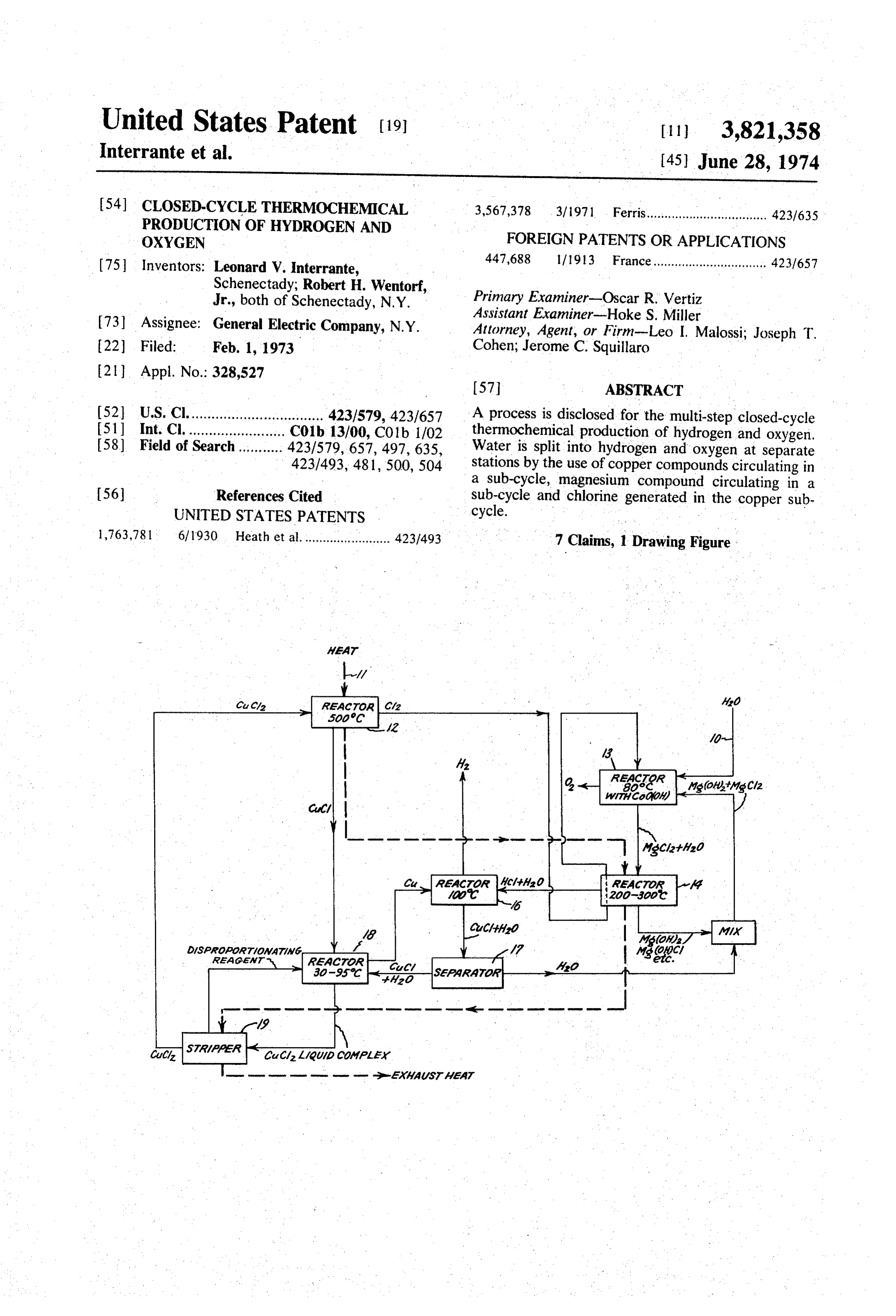
Ayaay
Arafavor a ad soap
Agger
so-se (f2 Saaaarava
(c/A/Quo COMAZA.
Page 2
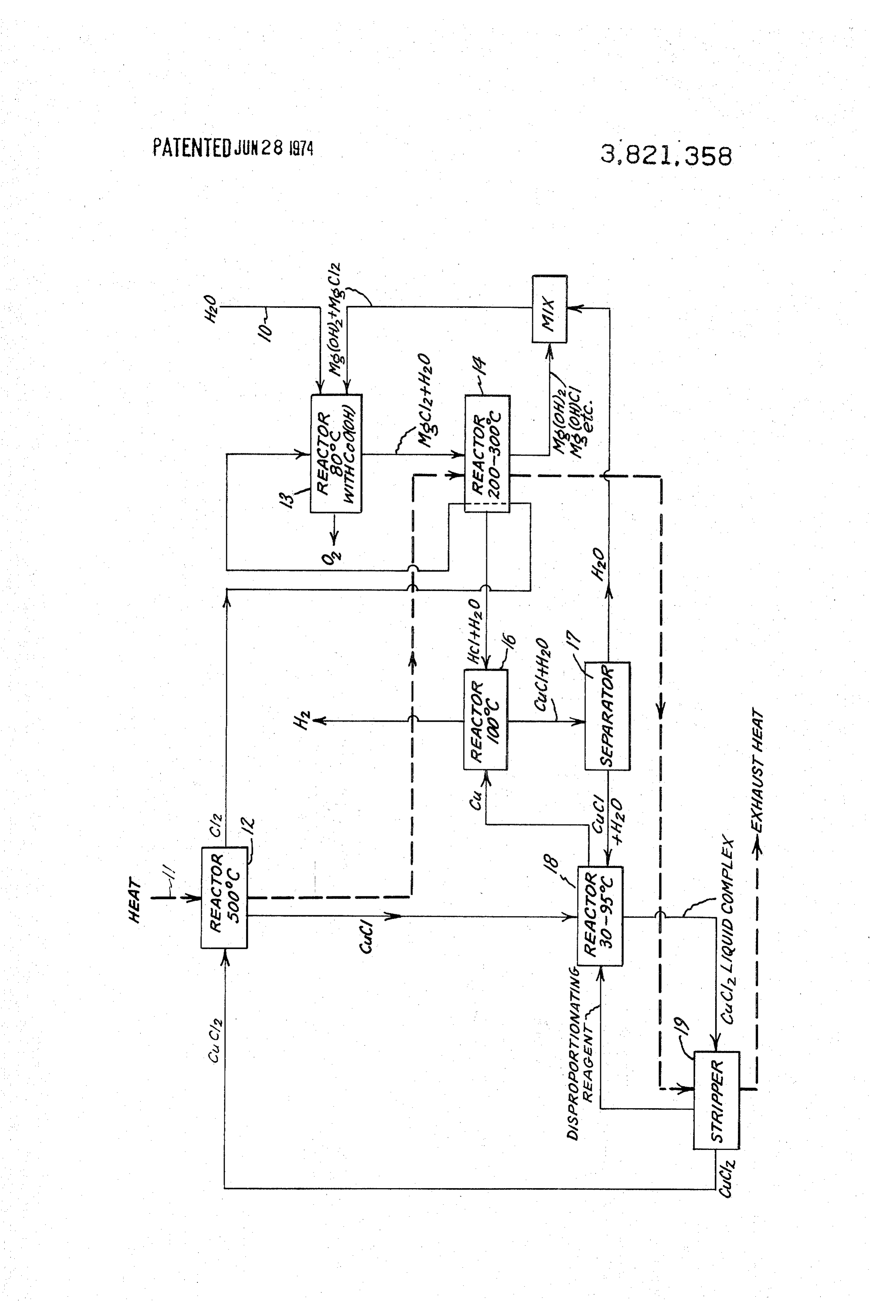
Drawing sheet — no readable text.
Page 3
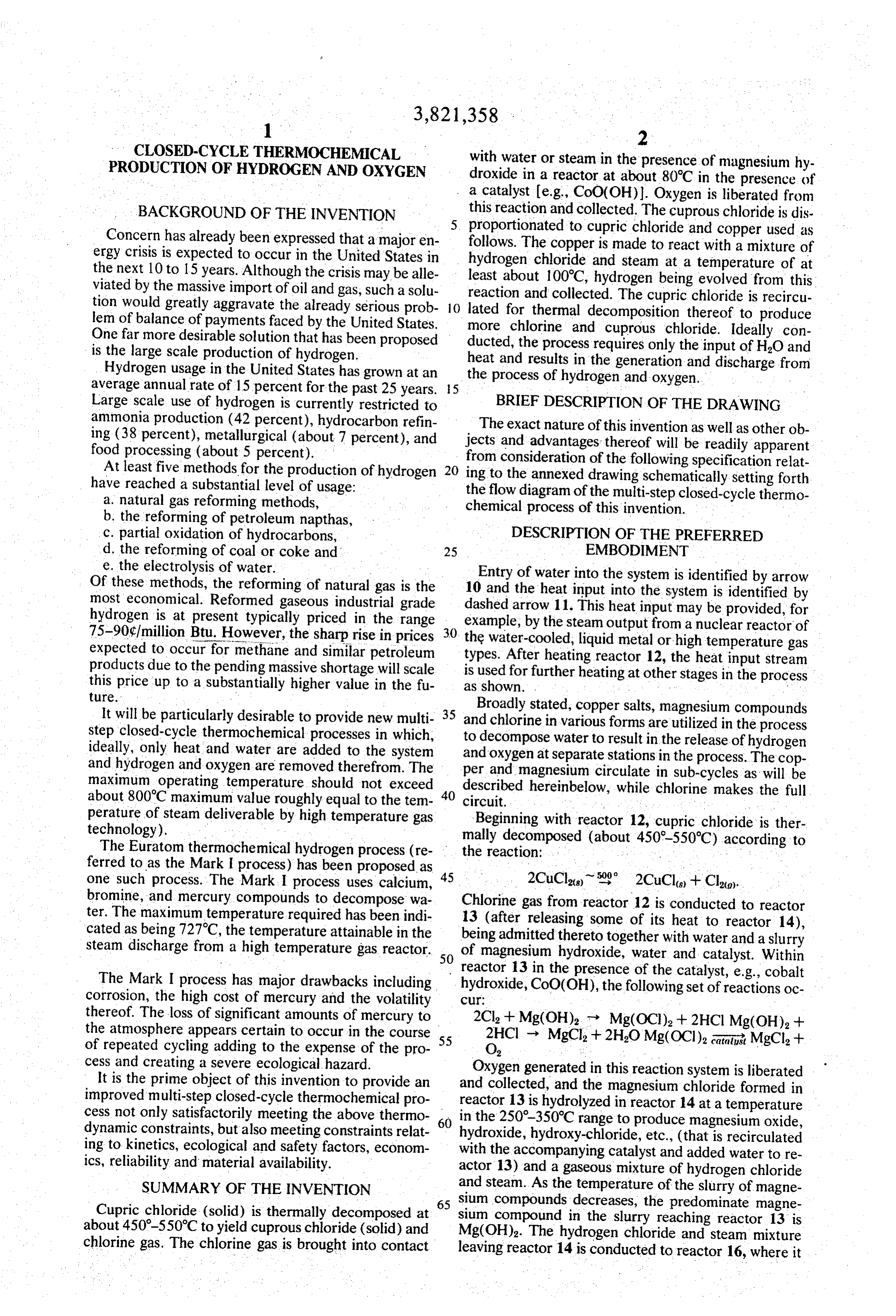
CLOSED-CYCLE THERMOCHEMICAL with water or steam in the presence of magnesium hy PRODUCTION OF HYDROGEN AND OXYGEN droxide in a reactor at about 80°C in the presence of a catalyst (e.g., CoO(OH)). Oxygen is liberated from
BACKGROUND OF THE INVENTION this reaction and collected. The cuprous chloride is dis proportionated
Concern has already been expressed that a major en follows. The copper to cupric chloride and copper used as ergy crisis is expected to occur in the United States in hydrogen chloride and is made to react with a mixture of the next 10 to 15 years. Although the crisis may be alle least about 100°C, hydrogen steam at a temperature of at viated by the massive import of oil and gas, such a solu reaction and collected. The cupric being evolved from this tion would greatly aggravate the already serious prob 10 lated for thermal decomposition thereof chloride is recircu lem of balance of payments faced by the United States. more chlorine and cuprous chloride. Ideally to produce One far more desirable solution that has been proposed ducted, the process requires only the input of H2Ocon and is the large scale production of hydrogen. heat and results in the generation and discharge from Hydrogen usage in the United States has grown at an average annual rate of 15 percent for the past 25 years. 5 the process of hydrogen and oxygen. Large scale use of hydrogen is currently restricted to BRIEF DESCRIPTION OF THE DRAWING ammonia production (42 percent), hydrocarbon refin The exact nature of this invention as well as other ob ing (38 percent), metallurgical (about 7 percent), and jects and advantages thereof will be readily apparent food processing (about 5 percent). from consideration of the following specification relat At least five methods for the production of hydrogen 20 ing to the annexed drawing schematically setting forth have reached a substantial level of usage: the flow diagram of the multi-step closed-cycle thermo a. natural gas reforming methods, chemical process of this invention. b. the reforming of petroleum napthas, c. partial oxidation of hydrocarbons, DESCRIPTION OF THE PREFERRED d. the reforming of coal or coke and 25 EMBODIMENT e. the electrolysis of water.
Of these methods, the reforming of natural gas is the 10Entry of water into the system is identified by arrow most economical. Reformed gaseous industrial grade dashed arrowheat and the
input into the system is identified by
This heat input may be provided, for hydrogen is at present typically priced in the range example, by the steam 75-90/million Btu. However, the sharp rise in prices 30 the water-cooled, liquidoutput from a nuclear reactor of expected to occur for methane and similar petroleum types. After heating reactor 12,orthe metal high temperature gas heat input stream products due to the pending massive shortage will scale is used for further heating at other stages in the process this price up to a substantially higher value in the fu as shown. . . . . . ture.
Broadly stated, copper salts, magnesium compounds
It will be particularly desirable to provide new multi 35 and chlorine in various forms are utilized in the process step closed-cycle thermochemical processes in which, to decompose water to result in the release of hydrogen ideally, only heat and water are added to the system and oxygen at separate stations in the process. The cop and hydrogen and oxygen are removed therefrom. The per and magnesium circulate in sub-cycles as will be maximum operating temperature should not exceed described hereinbelow, while chlorine makes the full about 800°C maximum value roughly equal to the tem 40 circuit. - .. .. .. " perature of steam deliverable by high temperature gas Beginning with reactor 12, cupric chloride is ther
The Euratom thermochemical hydrogen process (re mally decomposed (about 450°-550°C) according to
ferred to as the Mark I process) has been proposed as one such process. The Mark I process uses calcium, 45 2CuClao-g" 2CuClo + Clo. bromine, and mercury compounds to decompose wa Chlorine gas from reactor 12 is conducted to reactor ter. The maximum temperature required has been indi 13 (after releasing some of its heat to reactor 14), cated as being 727°C, the temperature attainable in the being admitted thereto together with water and a slurry steam discharge from a high temperature gas reactor. 50 of magnesium hydroxide, water and catalyst. Within reactor 13
The Mark I process has major drawbacks including hydroxide, CoO(OH), in the presence of the catalyst, e.g., cobalt the following set of reactions oc corrosion, the high cost of mercury and the volatility C:
thereof. The loss of significant amounts of mercury to the atmosphere appears certain to occur in the course 55 2Cl2 + Mg(OH), Mg(OCl) + 2HCl Mg(OH) + 2HCl - MgCl, +2HO Mg(OCl), anti, MgCl, + of repeated cycling adding to the expense of the pro O cess and creating a severe ecological hazard.
It is the prime object of this invention to provide an andOxygen generated in this reaction system is liberated collected, and the magnesium chloride formed in improved multi-step closed-cycle thermochemical pro reactor 13 is hydrolyzed cess not only satisfactorily meeting the above thermo 60 in the 250-350°C range intoreactor 14 at a temperature produce magnesium oxide, dynamic constraints, but also meeting constraints relat hydroxide, hydroxy-chloride, etc., (that is recirculated ing to kinetics, ecological and safety factors, econom with the accompanying catalyst and added water to re ics, reliability and material availability. actor 13) and a gaseous mixture of hydrogen chloride SUMMARY OF THE INVENTION and steam. As the temperature of the slurry of magne 65 sium compounds decreases, the predominate magne
Cupric chloride (solid) is thermally decomposed at sium compound in the slurry reaching reactor 13 is about 450-550°C to yield cuprous chloride (solid) and Mg(OH). The hydrogen chloride and steam mixture chlorine gas. The chlorine gas is brought into contact leaving reactor 14 is conducted to reactor 16, where it
Page 4
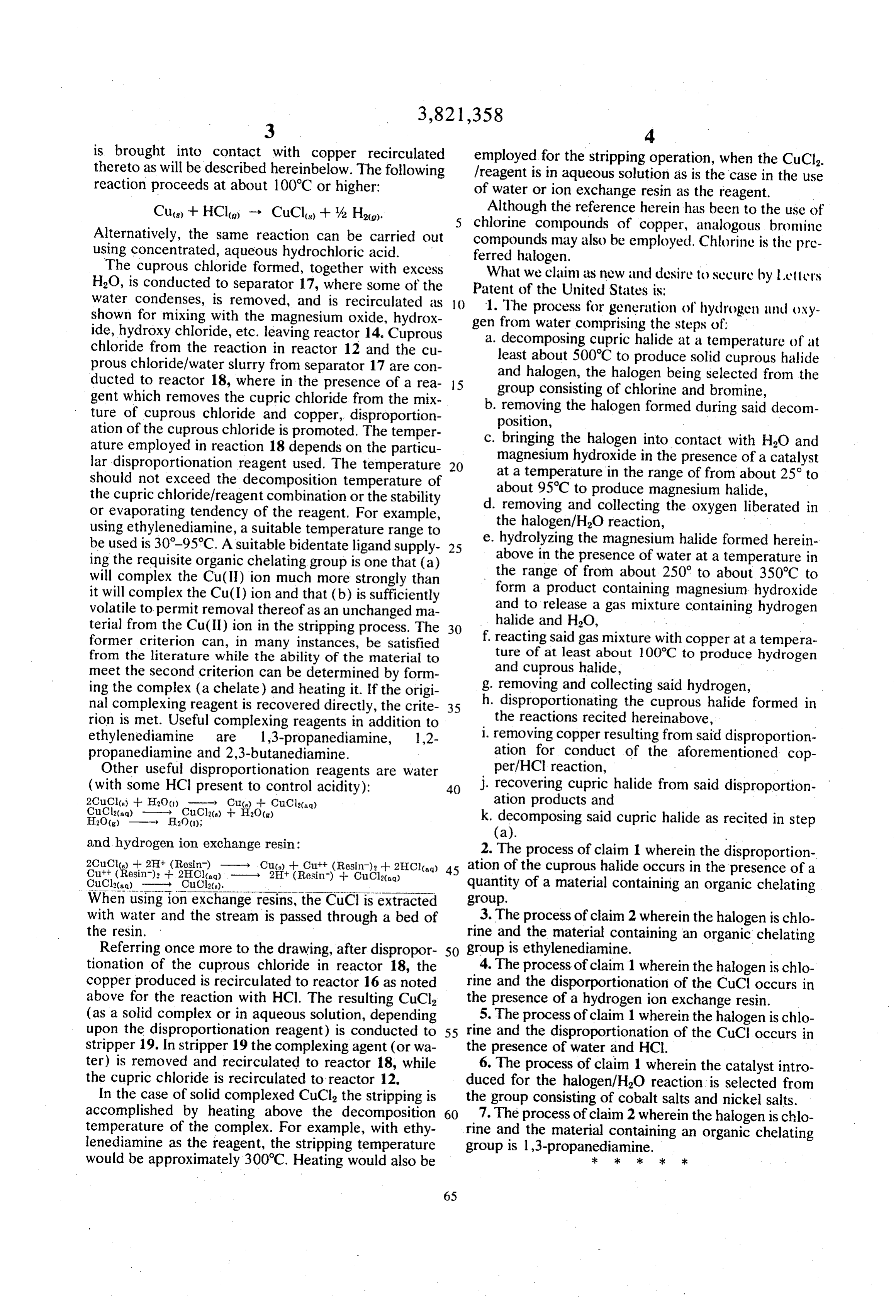
is brought into contact with copper recirculated employed for the stripping operation, when the CuCl2. thereto as will be described hereinbelow. The following /reagent is in aqueous solution as is the case in the use reaction proceeds at about 100°C or higher: of water or ion exchange resin as the reagent. Cuts) -- HCl) wild CuCls -- Az H2(a). Although the reference herein has been to the use of chlorine compounds of copper, analogous bromine
Alternatively, the same reaction can be carried out compounds may also be employed. Chlorine is the pre using concentrated, aqueous hydrochloric acid. ferred halogen.
The cuprous chloride formed, together with excess What we claim as new and desire to secure hy letters HO, is conducted to separator 17, where some of the Patent of the United States is: water condenses, is removed, and is recirculated as shown for mixing with the magnesium oxide, hydrox gen from process
water for generation of hydrogen and oxy.
comprising the steps of:
ide, hydroxy chloride, etc. leaving reactor 14. Cuprous a. decomposing cupric halide at a temperature of at chloride from the reaction in reactor 12 and the cu prous chloride/water slurry from separator 17 are con least about 500°C to produce solid cuprous halide ducted to reactor 18, where in the presence of a rea 15 and halogen, the halogen being selected from the gent which removes the cupric chloride from the mix group consisting of chlorine and bromine, ture of cuprous chloride and copper, disproportion b. removing the halogen formed during said decom ation of the cuprous chloride is promoted. The temper position, ature employed in reaction 18 depends on the particu c. bringing the halogen into contact with HO and lar disproportionation reagent used. The temperature 20 magnesiumat a hydroxide in the presence of a catalyst temperature in the range of from about 25 to should not exceed the decomposition temperature of about 95°C to produce magnesium halide, the cupric chloride/reagent combination or the stability d. removing and collecting the oxygen liberated in or evaporating tendency of the reagent. For example, the halogen/HO reaction, using ethylenediamine, a suitable temperature range to be used is 30°-95°C. A suitable bidentate ligand supply 25 e. above hydrolyzing the magnesium halide formed herein in the presence of water at a temperature in ing the requisite organic chelating group is one that (a) will complex the Cu(II) ion much more strongly than the range of from about 250 to about 350°C to it will complex the Cu(I) ion and that (b) is sufficiently form a product containing magnesium hydroxide volatile to permit removal thereofas an unchanged ma and to release a gas mixture containing hydrogen terial from the Cu(II) ion in the stripping process. The 30 halide and H2O, former criterion can, in many instances, be satisfied f. reacting said gas mixture with copper at a tempera from the literature while the ability of the material to ture of at least about 100°C to produce hydrogen meet the second criterion can be determined by form and cuprous halide, ing the complex (a chelate) and heating it. If the origi g. removing and collecting said hydrogen, nal complexing reagent is recovered directly, the crite 35 h. disproportionating the cuprous halide formed in rion is met. Useful complexing reagents in addition to the reactions recited hereinabove, ethylenediamine are 1,3-propanediamine, 1,2- i. removing copper resulting from said disproportion propanediamine and 2,3-butanediamine. ation for conduct of the aforementioned cop Other useful disproportionation reagents are water per/HCl reaction, - (with some HCl present to control acidity): 40 j. recovering cupric halide from said disproportion
ation products and
O(g) --> Ed2O (1): k. decomposing said cupric halide as recited in step and hydrogen ion exchange resin: (a).
2. The process of claim 1 wherein the disproportion 2CuCl() -- 2 (Resin) - Cu(s) - Cut (Resin) -- 2HCl() 45 ation of the cuprous halide occurs in the presence of a Cutt (Resin) -- 2HCla) - 2Ht (Resin) -- CuCl2(a)
CuCl2(a) - ... CuCl2(a). - quantity of a material containing an organic chelating When using ion exchange resins, the CuCl is extracted group.
with water and the stream is passed through a bed of 3. The process of claim 2 wherein the halogen is chlo the resin. rine and the material containing an organic chelating Referring once more to the drawing, after dispropor 50 group is ethylenediamine.
tionation of the cuprous chloride in reactor 18, the 4. The process of claim 1 wherein the halogen is chlo copper produced is recirculated to reactor 16 as noted rine and the disporportionation of the CuCl occurs in above for the reaction with HCl. The resulting CuCl2 the presence of a hydrogen ion exchange resin. (as a solid complex or in aqueous solution, depending 5. The process of claim 1 wherein the halogen is chlo upon the disproportionation reagent) is conducted to 55 rine and the disproportionation of the CuCl occurs in stripper 19. In stripper 19 the complexing agent (or wa the presence of water and HCl.
ter) is removed and recirculated to reactor 18, while 6. The process of claim 1 wherein the catalyst intro the cupric chloride is recirculated to reactor 12. duced for the halogen/HO reaction is selected from In the case of solid complexed CuCl2 the stripping is the group consisting of cobalt salts and nickel salts. accomplished by heating above the decomposition 60 7. The process of claim 2 wherein the halogen is chlo temperature of the complex. For example, with ethy rine and the material containing an organic chelating lenediamine as the reagent, the stripping temperature group is 1,3-propanediamine.
would be approximately 300°C. Heating would also be ck :k sk. k. xk
Provenance
- Collection
- Cited prior art
- Original PDF
- patentimages.storage.googleapis.com →
- Filed
- 1973-02-01
- Pages
- 4
- Method
- pdftotext (the PDF's own text layer) + pdftoppm 300dpi page scans
- Source
- Google Patents bibliographic record
- Granted
- 1974-06-28
- Inventors
- L Interrante; R Wentorf; General Electric Co
- Transcribed from
- patentimages.storage.googleapis.com →