patent · US3746498
Reducing no{11 {11 emissions by additive injection
17 July 1973
Page 1 — bibliographic record
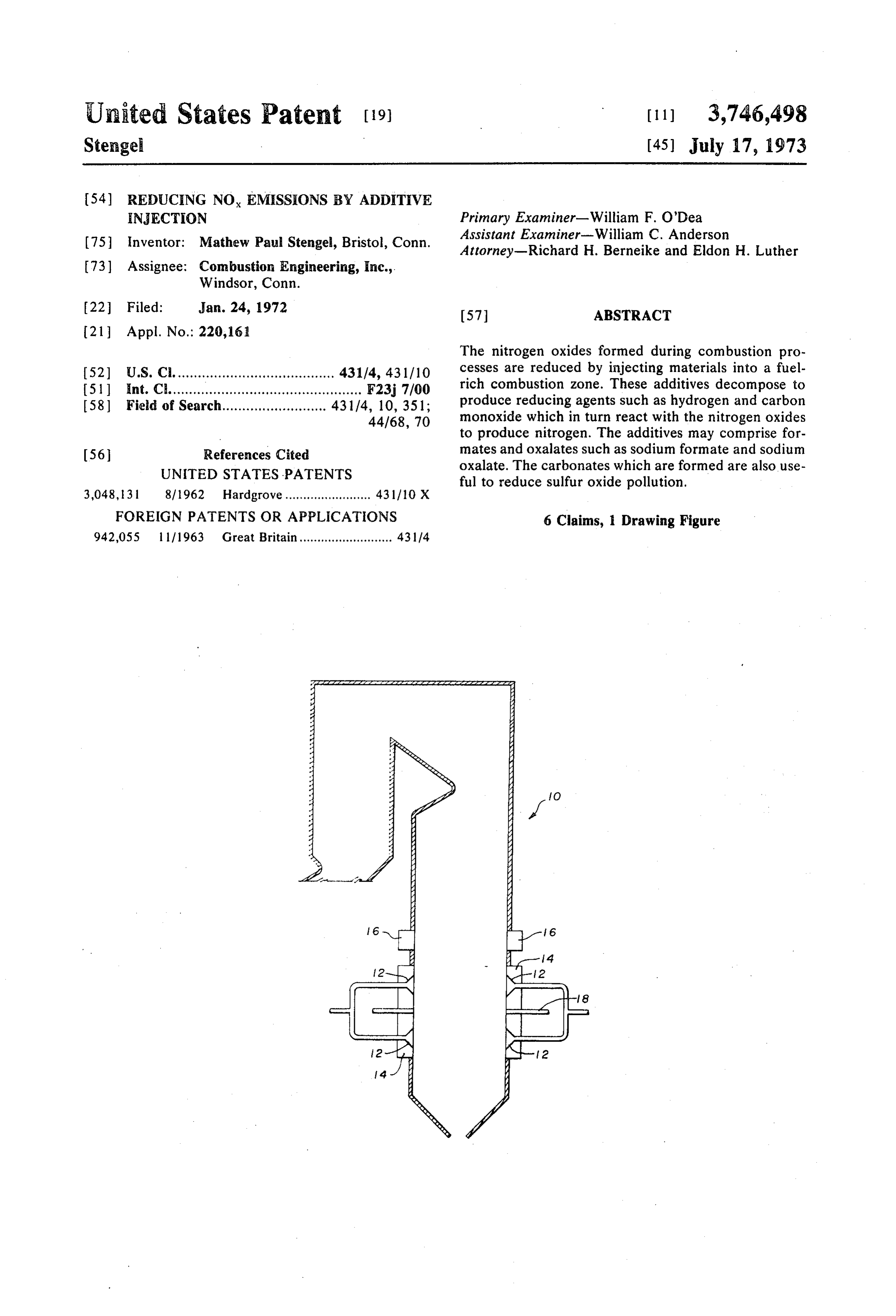
United States Patent (19) [11] 3,746,498 Stenge (45) July 17, 1973
54) REDUCING NO. EMISSIONS BY ADDITIVE
NECTION Primary Examiner-William F. O'Dea Assistant Examiner-William C. Anderson (75. Inventor: Mathew Paul Stengel, Bristol, Conn. Attorney-Richard H. Berneike and Eldon H. Luther 73) Assignee: Combustion Engineering, Inc.,
Windsor, Conn.
22 Filed: Jan. 24, 1972 57 ABSTRACT
The nitrogen oxides formed during combustion pro (52) U.S. C. ....................................... 431/4, 431/10 cesses are reduced by injecting materials into a fuel 51) int. C. ............................................... F237/00 rich combustion zone. These additives decompose to 58) Field of Search.......................... 431/4, 10, 351; produce reducing agents such as hydrogen and carbon 44/68, 70 monoxide which in turn react with the nitrogen oxides to produce nitrogen. The additives may comprise for 56 References Cited mates and oxalates such as sodium formate and sodium oxalate. The carbonates which are formed are also use
UNITED STATES PATENTS
ful to reduce sulfur oxide pollution.
FOREIGN PATENTS OR APPLICATIONS 6 Claims, 1 Drawing Figure 942,055 l l 1963 Great Britain.......................... 43114
Page 2
Drawing sheet — no readable text.
Page 3
REDUCING NO. EMISSIONS BY ADDITIVE trogen in Combustion Processes' by J. D. Sensen baugh, published by Combustion Engineering, Inc. and
NECTEON
presented at the Air Pollution Training Course - Rob
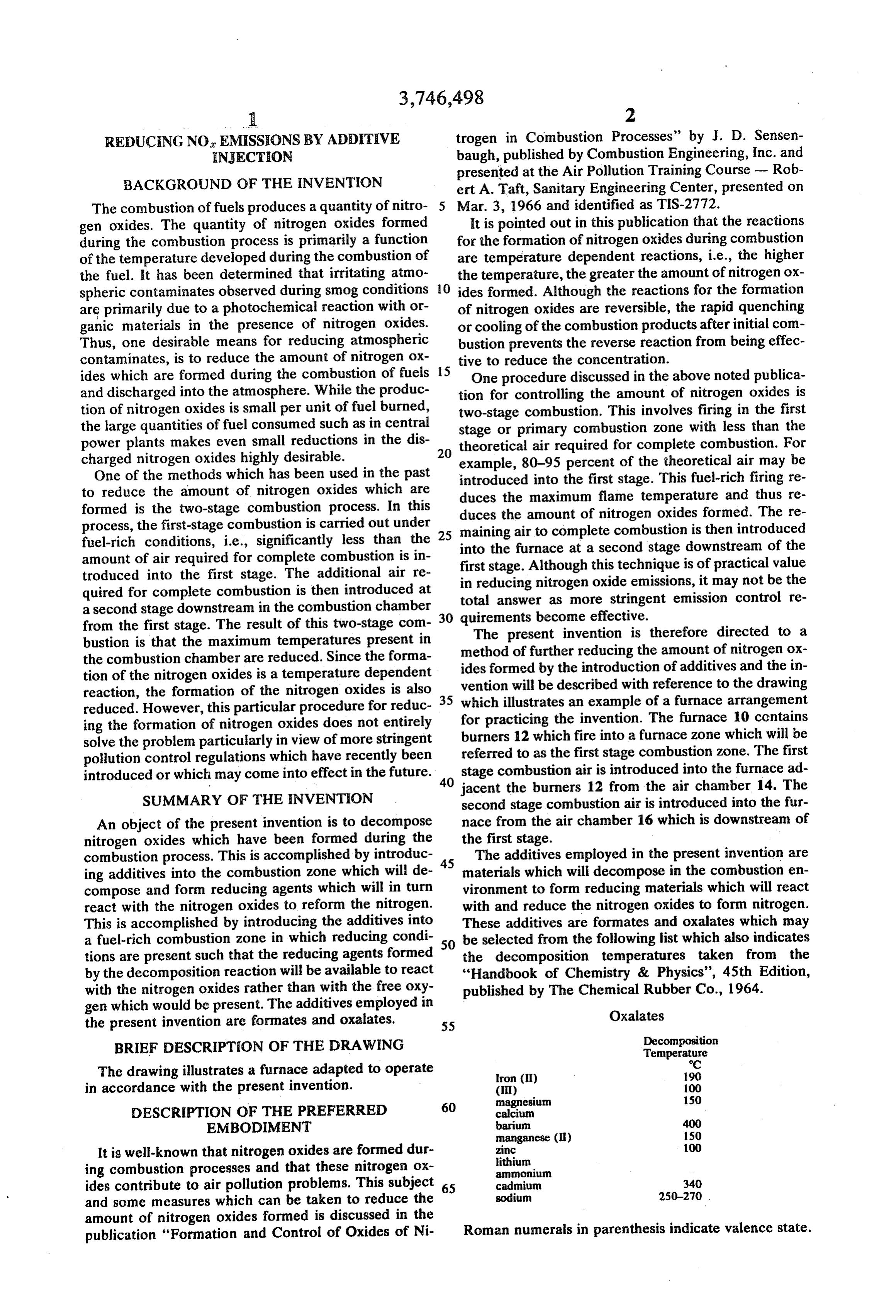
BACKGROUND OF THE INVENTION ert A. Taft, Sanitary Engineering Center, presented on The combustion of fuels produces a quantity of nitro- 5 Mar. 3, 1966 and identified as TIS-2772. gen oxides. The quantity of nitrogen oxides formed It is pointed out in this publication that the reactions during the combustion process is primarily a function for the formation of nitrogen oxides during combustion of the temperature developed during the combustion of are temperature dependent reactions, i.e., the higher the fuel. It has been determined that irritating atmo the temperature, the greater the amount of nitrogen ox spheric contaminates observed during smog conditions O ides formed. Although the reactions for the formation are primarily due to a photochemical reaction with or of nitrogen oxides are reversible, the rapid quenching ganic materials in the presence of nitrogen oxides. or cooling of the combustion products after initial com Thus, one desirable means for reducing atmospheric bustion prevents the reverse reaction from being effec contaminates, is to reduce the amount of nitrogen ox 5 tive to reduce the concentration. ides which are formed during the combustion of fuels One procedure discussed in the above noted publica and discharged into the atmosphere. While the produc tion for controlling the amount of nitrogen oxides is tion of nitrogen oxides is small per unit of fuel burned, two-stage combustion. This involves firing in the first the large quantities of fuel consumed such as in central stage or primary combustion zone with less than the power plants makes even small reductions in the dis O theoretical air required for complete combustion. For charged nitrogen oxides highly desirable. example, 80-95 percent of the theoretical air may be One of the methods which has been used in the past introduced into the first stage. This fuel-rich firing re to reduce the amount of nitrogen oxides which are duces the maximum flame temperature and thus re formed is the two-stage combustion process. In this process, the first-stage combustion is carried out under 25 duces the amount of nitrogen oxides formed. The re fuel-rich conditions, i.e., significantly less than the into the air maining to complete combustion is then introduced furnace at a second stage downstream of the amount of air required for complete combustion is in first stage. Although this technique is of practical value troduced into the first stage. The additional air re in reducing nitrogen oxide emissions, it may not be the quired for complete combustion is then introduced at total answer as more stringent emission control re a second stage downstream in the combustion chamber 3O quirements become effective.
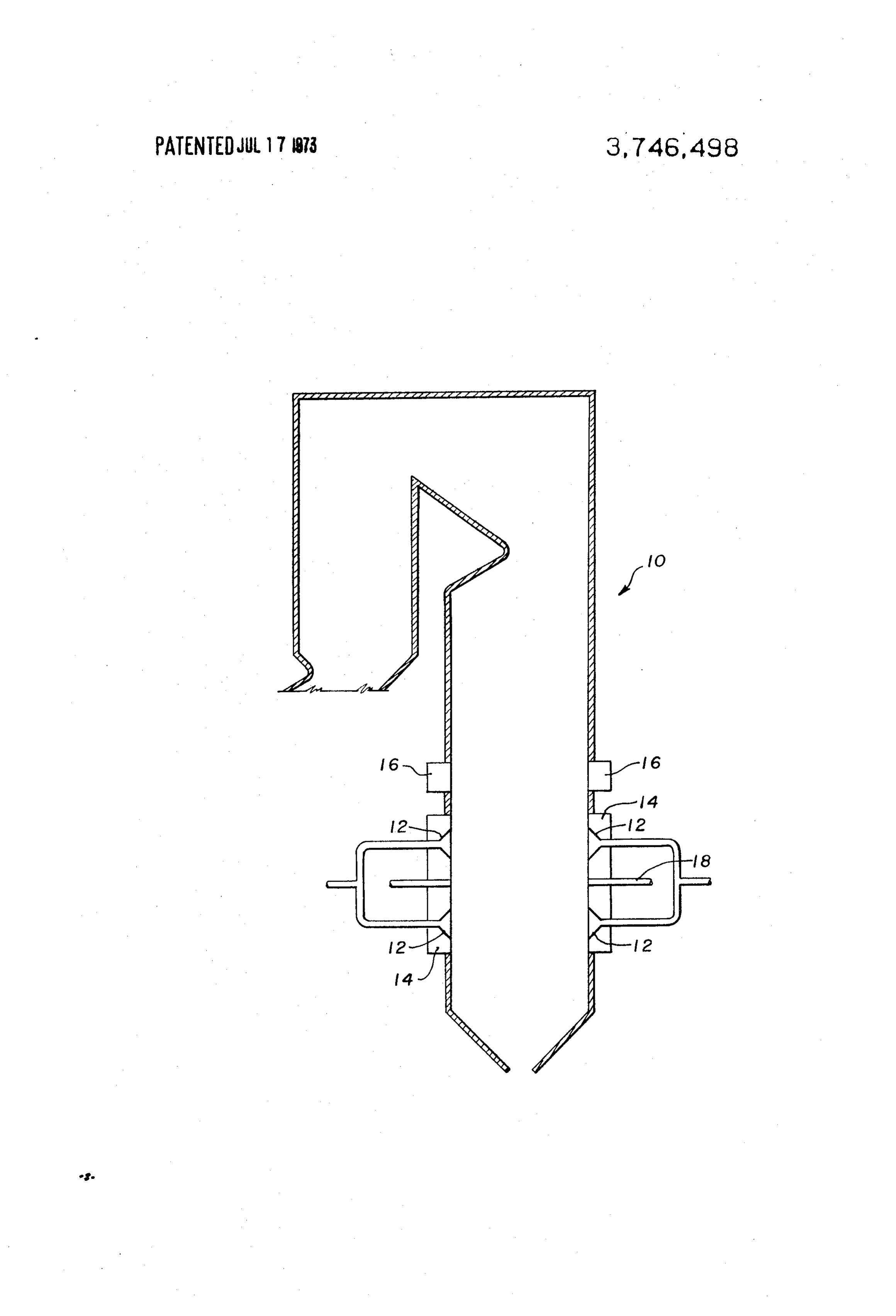
from the first stage. The result of this two-stage com The present invention is therefore directed to a bustion is that the maximum temperatures present in method of further reducing the amount of nitrogen ox the combustion chamber are reduced. Since the forma tion of the nitrogen oxides is a temperature dependent ides formed by the introduction of additives and the in vention will be described with reference to the drawing reaction, the formation of the nitrogen oxides is also 3 5 which reduced. However, this particular procedure for reduc illustrates an example of a furnace arrangement for practicing the invention. The furnace 10 contains ing the formation of nitrogen oxides does not entirely burners solve the problem particularly in view of more stringent 12 which fire into a furnace zone which will be pollution control regulations which have recently been referred to as the first stage combustion zone. The first introduced or which may come into effect in the future. 4. stage combustion air is introduced into the furnacead
SUMMARY OF THE INVENTION
O jacent the burners 12 from the air chamber 14. The second stage combustion air is introduced into the fur
An object of the present invention is to decompose nace from the air chamber 16 which is downstream of nitrogen oxides which have been formed during the the first stage.
combustion process. This is accomplished by introduc 4.5 The additives employed in the present invention are ing additives into the combustion zone which will de materials which will decompose in the combustion en compose and form reducing agents which will in turn vironment to form reducing materials which will react react with the nitrogen oxides to reform the nitrogen. with and reduce the nitrogen oxides to form nitrogen. This is accomplished by introducing the additives into These additives are formates and oxalates which may a fuel-rich combustion zone in which reducing condi 5O be selected from the following list which also indicates tions are present such that the reducing agents formed the decomposition temperatures taken from the by the decomposition reaction will be available to react “Handbook of Chemistry & Physics', 45th Edition, with the nitrogen oxides rather than with the free oxy published by The Chemical Rubber Co., 1964. gen which would be present. The additives employed in the present invention are formates and oxalates. 5 Oxalates
Decomposition
BRIEF DESCRIPTION OF THE DRAWING Temperature
The drawing illustrates a furnace adapted to operate Iron (II) 190 in accordance with the present invention. (III) 00
DESCRIPTION OF THE PREFERRED calcium
EMBODIMENT barium 400
It is well-known that nitrogen oxides are formed dur zinc 100 lithium ing combustion processes and that these nitrogen ox annonium ides contribute to air pollution problems. This subject 65 cadmium 340 and some measures which can be taken to reduce the sodium 250-270 amount of nitrogen oxides formed is discussed in the publication "Formation and Control of Oxides of Ni Roman numerals in parenthesis indicate valence state.
Page 4
in the furnace to form sodium oxide which can then be
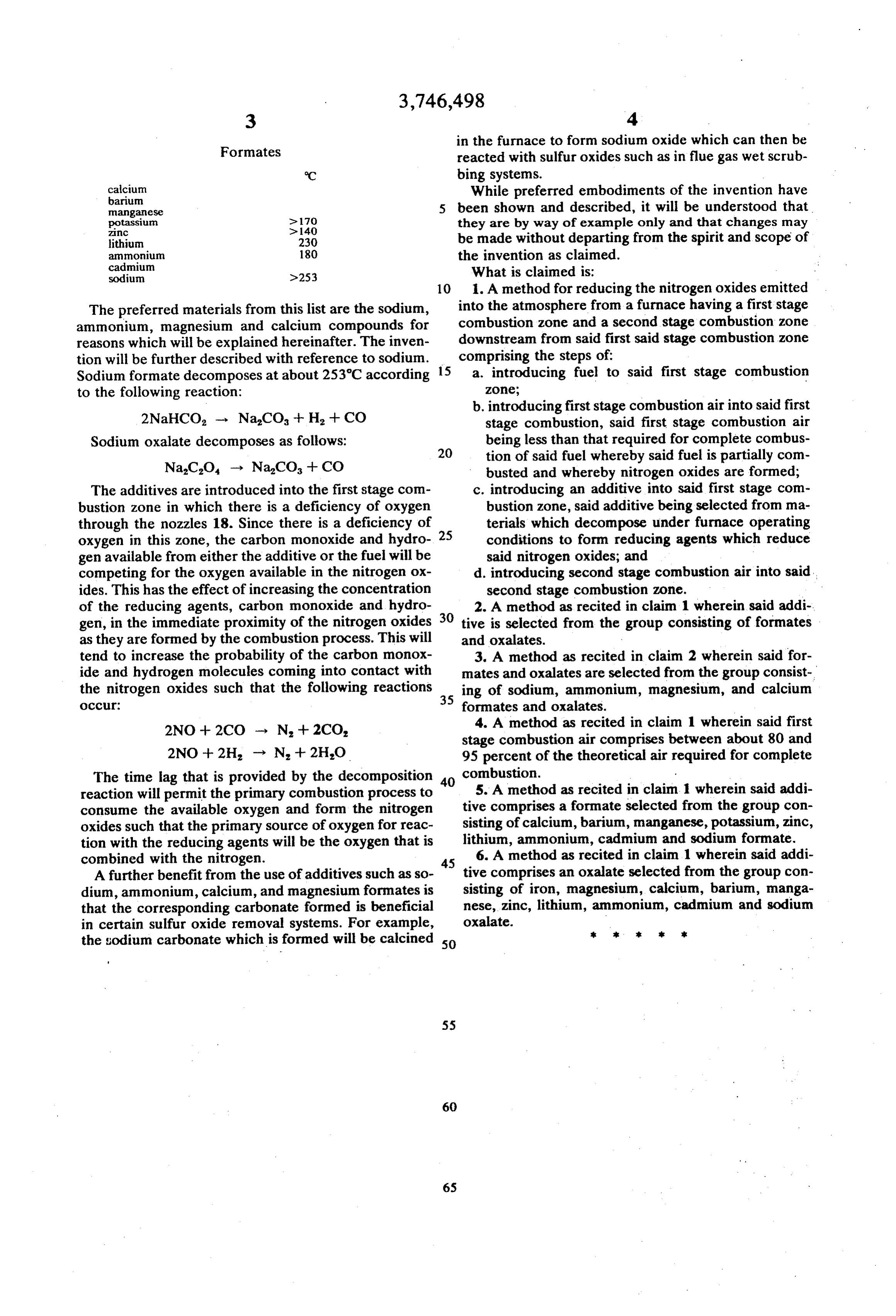
Formates reacted with sulfur oxides such as in flue gas wet scrub
calcium barium
While preferred embodiments of the invention have manganese been shown and described, it will be understood that potassium zinc
they are by way of example only and that changes may lithium 230 be made without departing from the spirit and scope of ammonium 180 the invention as claimed.
cadmium What is claimed is:
1. A method for reducing the nitrogen oxides emitted
The preferred materials from this list are the sodium, into the atmosphere from a furnace having a first stage ammonium, magnesium and calcium compounds for combustion zone and a second stage combustion zone reasons which will be explained hereinafter. The inven downstream from said first said stage combustion zone tion will be further described with reference to sodium. comprising the steps of:
Sodium formate decomposes at about 253°C according 15 a. introducing fuel to said first stage combustion to the following reaction: Zone;
b. introducing first stage combustion air into said first 2NaHCO - NaCO + H + CO stage combustion, said first stage combustion air Sodium oxalate decomposes as follows: being less than that required for complete combus tion of said fuel whereby said fuel is partially com
NaCO -> NaCO + CO busted and whereby nitrogen oxides are formed; The additives are introduced into the first stage com . . introducing an additive into said first stage com bustion zone in which there is a deficiency of oxygen bustion zone, said additive being selected from ma through the nozzles 18. Since there is a deficiency of 25 terials which decompose under furnace operating oxygen in this zone, the carbon monoxide and hydro conditions to form reducing agents which reduce gen available from either the additive or the fuel will be said nitrogen oxides; and competing for the oxygen available in the nitrogen ox d. introducing second stage combustion air into said ides. This has the effect of increasing the concentration second stage combustion zone. of the reducing agents, carbon monoxide and hydro 30 2. A method as recited in claim 1 wherein said addi gen, in the immediate proximity of the nitrogen oxides tive is selected from the group consisting of formates as they are formed by the combustion process. This will and oxalates.
tend to increase the probability of the carbon monox 3. A method as recited in claim 2 wherein said for ide and hydrogen molecules coming into contact with mates and oxalates are selected from the group consist the nitrogen oxides such that the following reactions 35 ing of sodium, ammonium, magnesium, and calcium OCC formates and oxalates.
4. A method as recited in claim 1 wherein said first 2NO + 2CO - N + 2CO, stage combustion air comprises between about 80 and 2NO + 2H, - N, + 2H.O. 95 percent of the theoretical air required for complete The time lag that is provided by the decomposition 40 combustion.
reaction will permit the primary combustion process to 5. A method as recited in claim 1 wherein said addi consume the available oxygen and form the nitrogen tive comprises a formate selected from the group con oxides such that the primary source of oxygen for reac sisting of calcium, barium, manganese, potassium, zinc, tion with the reducing agents will be the oxygen that is lithium, ammonium, cadmium and sodium formate.
6. A method as recited in claim 1 wherein said addi
A further benefit from the use of additives such as so tive comprises an oxalate selected from the group con dium, ammonium, calcium, and magnesium formates is sisting of iron, magnesium, calcium, barium, manga that the corresponding carbonate formed is beneficial nese, zinc, lithium, ammonium, cadmium and sodium in certain sulfur oxide removal systems. For example, oxalate. k k xx the sodium carbonate which is formed will be calcined 50
Provenance
- Collection
- Cited prior art
- Original PDF
- patentimages.storage.googleapis.com →
- Filed
- 1972-01-24
- Pages
- 4
- Method
- pdftotext (the PDF's own text layer) + pdftoppm 300dpi page scans
- Source
- Google Patents bibliographic record
- Granted
- 1973-07-17
- Inventors
- M Stengel; Combustion Engineering Inc
- Transcribed from
- patentimages.storage.googleapis.com →