patent · US3400249
Heating system
3 September 1968
Page 1
Drawing sheet — no readable text.
Page 2
Drawing sheet — no readable text.
Page 3
Drawing sheet — no readable text.
Page 4
Drawing sheet — no readable text.
Page 5
Drawing sheet — no readable text.
Page 6
United States Patent Office 3,400,249 Patented Sept. 3, 1968
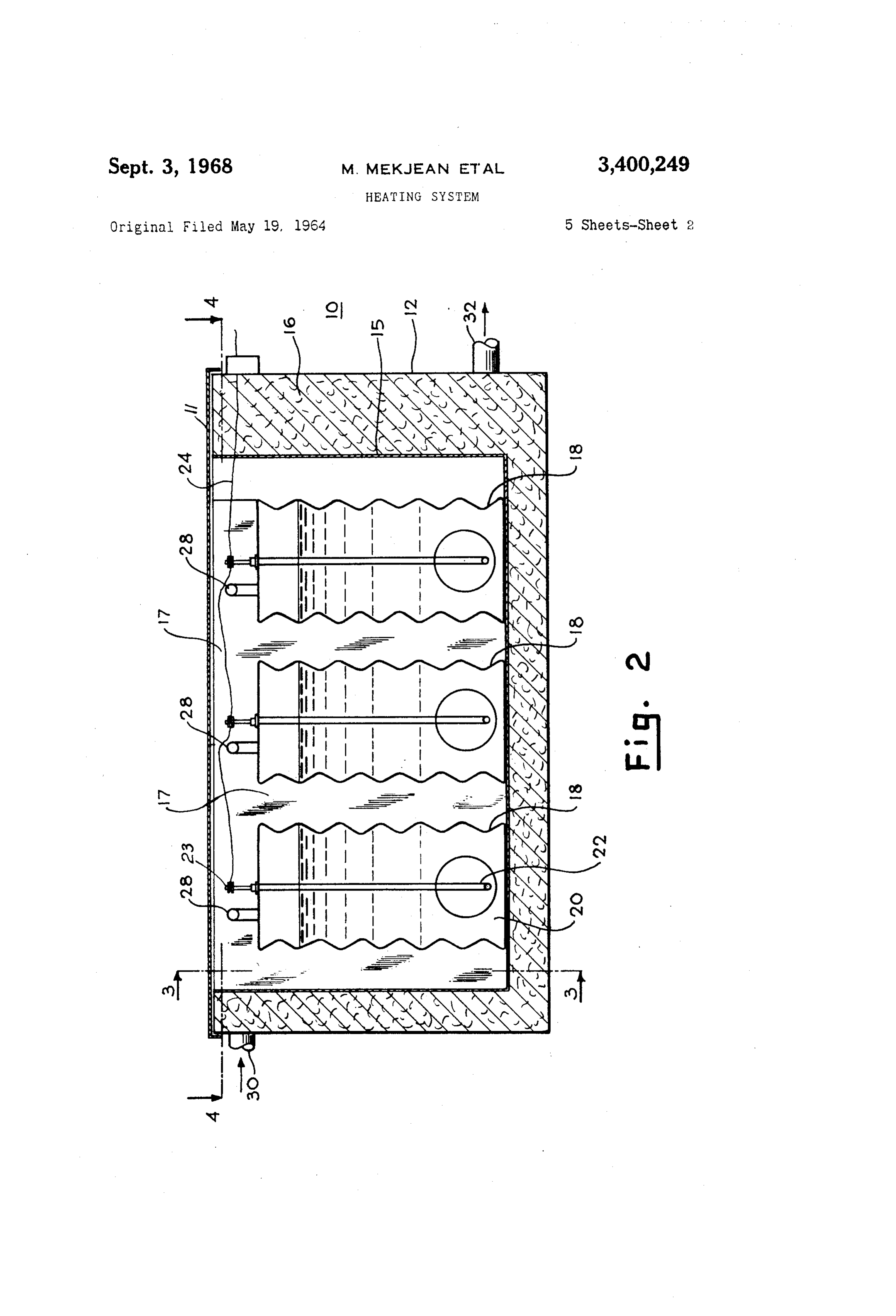
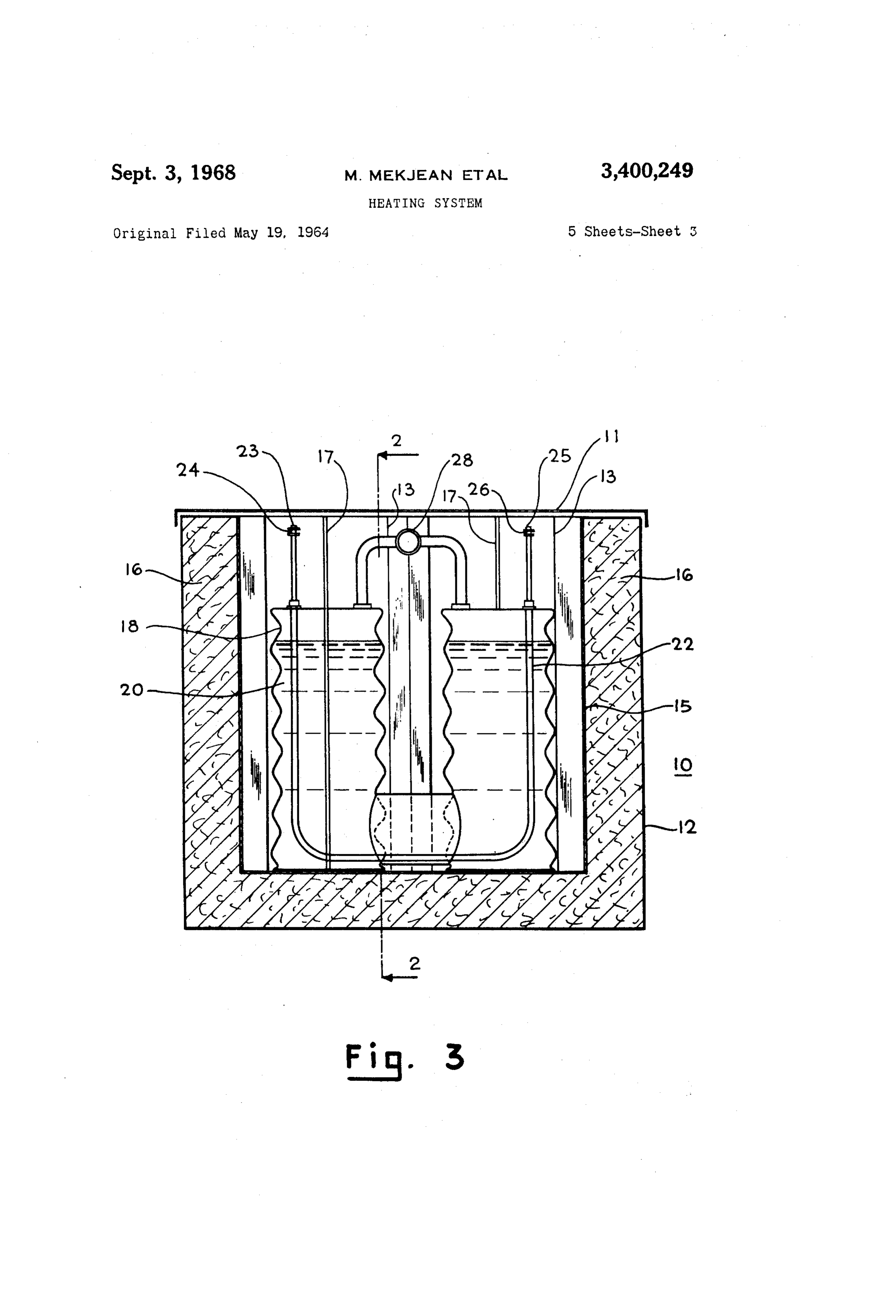
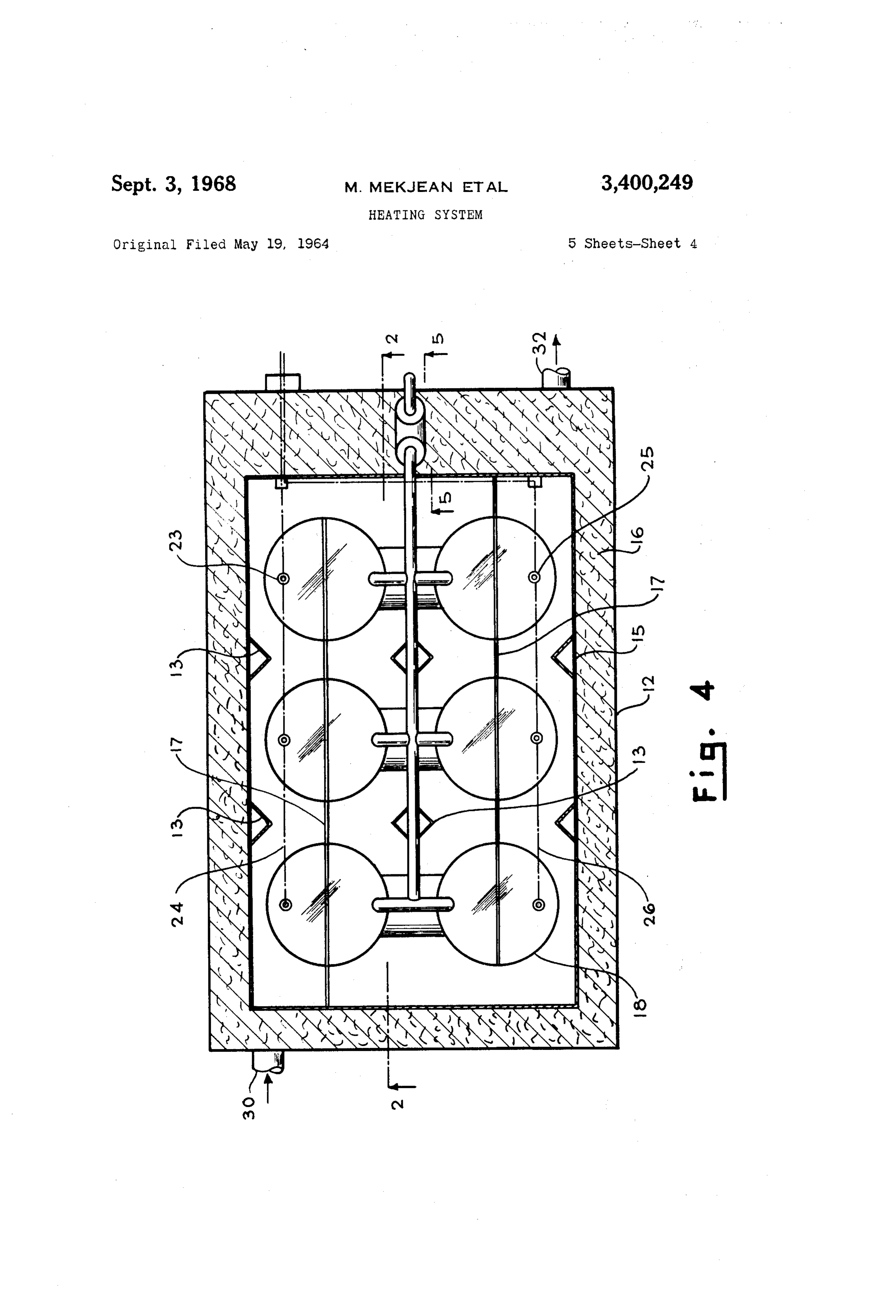
walls 15, cover 11, baffle means 13, unit dividers 17, 3,400,249 inlet 30 and outlet 32, houses heat storage reservoir 18. HEATING SYSTEM These reservoirs 18 contain heat storage medium 20 and Matthew Mekjean and James S. Sconce, Niagara Falls, electrical
N.Y., assignors to Hooker Chemical Corporation, Ni 5 26 are inheating elements 22. Power supply lines 24 and operative relationship with the terminals 23 agara Falls, N.Y., a corporation of New York
Continuation of application Ser. No. 368,590, My 19, and 25, respectively, of the heating elements 22. The source of power 134 is illustrated in FIG. 1.
1964. This application Oct. 26, 1966, Ser. No. 589,764 Manifold means 28 is in operative relationship with
the heat storage reservoirs and a “fluid piston' vent seal
O ing means 36.
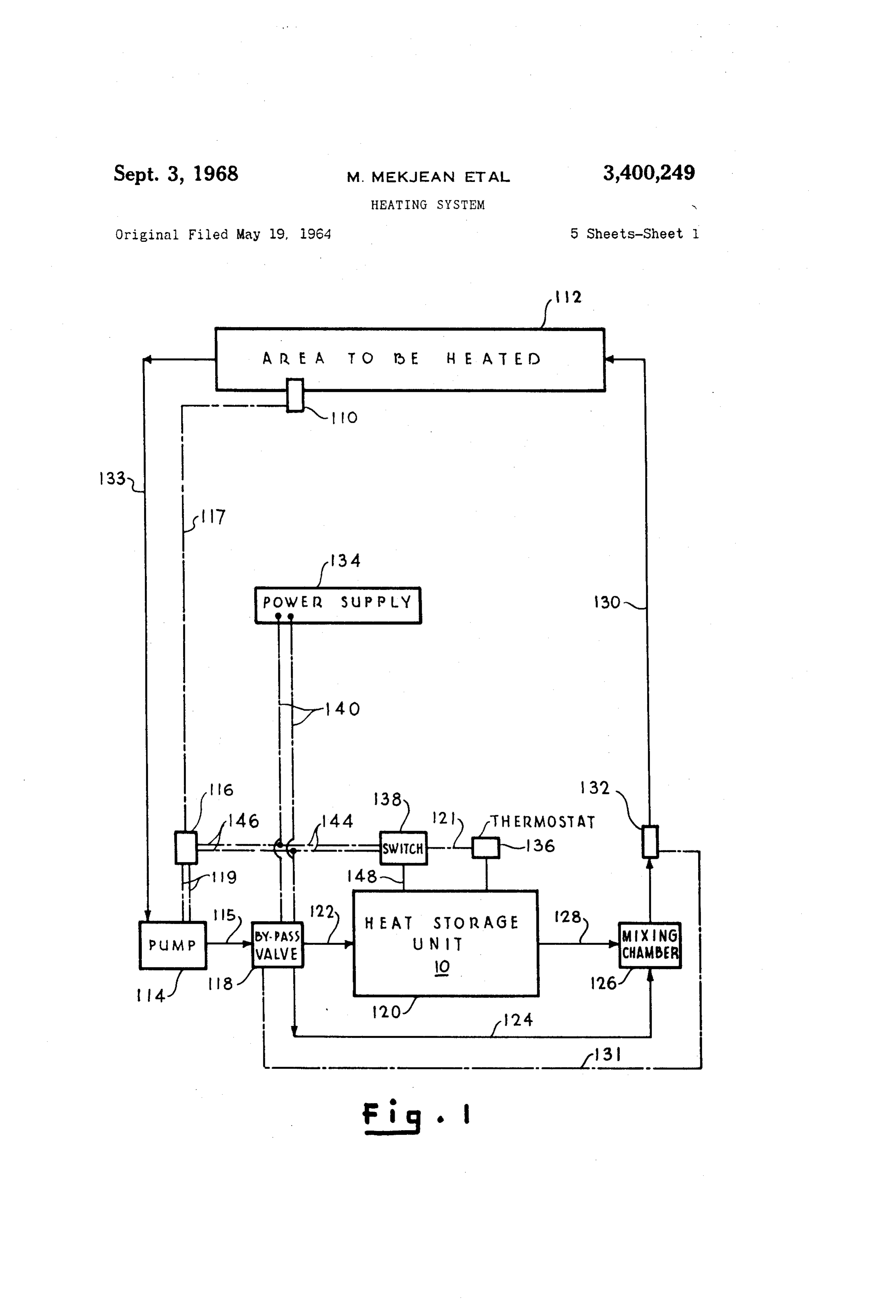
ABSTRACT OF THE DISCLOSURE The operation of the heating system is clearly shown A heating system comprising means for conducting a toby beFIG. 1. When thermostat 110, located in an area 112 heated, calls for heat via signal line 117 and power heat transfer medium to a heat storage unit, a heat Stor line 119, pump 114, activated by switch 116 forces a heat age unit comprising a substantially anhydrous heat stor. transfer medium, such as air, through conduit 115 to and age medium comprised of a major proportion of an alkali through a by-pass valve 118. Some of the heat transfer metal hydroxide and a minor proportion of a non-reduc medium is conveyed through the casing 120 of the heat ing agent and a corrosion inhibitor, said heat storage unit storage unit 10 via line 122 while another portion of having heating means within said heat storage medium for heating said heat storage medium to a temperature 20 the heat transfer medium is conveyed through by-pass above the fusion point of the heat storage medium, means medium 124 conduit to a mixing chamber 126. The heat transfer is conveyed over or through heat storage res for bringing said heat transfer medium into thermal con ervoirs within the heat storage unit 10 and is then di tact with said heat storage unit, means for conducting rected through line 128 to mixing chamber 126. Non said heat transfer medium from said heat transfer unit heated medium and heated medium from by-pass con and means for withdrawing heat therefrom to cool said duit 124 and line 128, respectively, are mixed in mixing heat storage medium below its fusion point. chamber 126. The mixed medium then passes through heat transfer conduit 130 to the area 112 that requires heat. Return line 133 conveys the heat transfer medium
This is a continuation of S.N. 368,590, filed May 19, back to pump or blower 114. Positioned in or on the heat 1964 which is in turn a continuation-in-part of S.N. 30 transfer conduit 130 is a temperature control thermostat 329,246, filed Dec. 9, 1963, both now abandoned. 132 that is connected in operative relation with mixing This invention relates to a novel heating System. More valve 118 so that the temperature of the heat transfer particularly, it relates to a heating system capable of stor medium is maintained within a predetermined range. With ing heat at high temperatures for a substantial period of respect to the electrical power supply 134 power lines time and of giving up this heat, when desired. 35 49, 119, 144, 146 and 148 supply power to the by-pass The present invention provides a novel approach to valve 118, pump 14, switches 138 and 116, and heat the heating of heat transfer media and includes a heat storage unit 10, respectively. Lines 117, 121, and 131 sup storage unit that does not require a continuous Supply ply signals from thermost at 110 to switch 116, from of external heat, such as is obtained from electricity, gas, thermostat 136 to switch 138 and from thermostat 132 or oil. The invention can supply stored heat to a heat 40 to by-pass valve 118, respectively. transfer medium rapidly and efficiently and needs a The baffles 13 in the heating unit, as illustrated in FIGS. minimum amount of maintenance. 3 and 4, are positioned in such a manner that there is an The various aspects and features of the invention will efficient flow of heat transfer medium through the heat become apparent from the following description and the Storage unit 10. Although the heat storage medium, as accompanying drawings in which: illustrated, by the drawings, is heated with electricity, it FIG. 1 is a diagrammatic representation of the novel is to be understood that gas, oil and other suitable heat heating system of the invention; ing means may be adapted to heat the medium 20 in the FIG. 2 is a vertical sectional view of a heating unit heat storage reservoir 18.
of the invention along line 2-2 of FIGURE 3; According to the invention a modified alkali metal FIG. 3 is a vertical sectional view of a heating unit of 50 hydroxide heat storage medium is added to the reservoir the invention along line 3-3 of FIGURE 2; 18 and heated to a temperature of from about 60 to about FIG. 4 is a plan view of a heating unit of the invention 680 degrees centigrade. The heat in this medium is sub along line 4-4 of FIG. 2, showing baffle units; and Sequently extracted by passing over the outside of the FIG. 5 is a section of a vent sealing means along line reservoir a heat transfer medium such as air, high tem 5-5 of FIGURE 4. 55 perature oil, liquid sodium and the like, air being the It has been discovered that a novel heating system preferred medium. Of course, these media may be used comprising means for conveying a heat transfer medium to heat other heat-transfer media, such as air, water, to a heat storage unit, a heat storage medium comprising diphenyl, diphenyl ether and so forth. The heat storage an alkali metal hydroxide, a non-reducing agent and a medium 20 is described in copending application S.N. corrosion inhibitor within said heat storage unit to convey 60 329,246 filed Dec. 9, 1963, now abandoned. It comprises heat to the heat transfer medium, heating means within a major proportion of an alkali metal hydroxide and a said heating unit to heat the heat storage medium and minor proportion of a non-reducing agent. The term “non means for conveying said heat transfer medium from said reducing Salt' as utilized in this description means a salt heating unit, is an economical, quiet, substantially non that will yield an “oxidizing bath' or a “neutral bath,” corrosive, clean and rapid means for supplying heat. 65 as this terminology is employed in the alloy steel indus Referring to the drawings, heating unit 10, having in try. In this industry molten alkali metal hydroxide salt sulation 16 between the exterior walls 12, and interior baths assist in the conversion of the heat scale, developed
Page 7
in annealing and hot rolling mill operations, to a soluble are not preferred. If, for example, a salt solution of so form for subsequent removal. These descaling baths are dium hydroxide and sodium nitraté is placed in an open alkaline baths, e.g., modified molten caustic baths, and container and heated to about 260 degrees centigrade, the type of additives incorporated in the caustic melt de corrosion will not be a problem. When the same mix termines the classification of the bath. For example, if 5 ture is placed in a closed steel container, undesirable ef Sodium nitrate, an oxidizing agent under these conditions, fects result, i.e., some corrosion of the container is caused. is added to the anhydrous caustic melt, an oxidizing bath It has been found that corrosion becomes insignificant is formed, whereas, if a neutral agent (one neither oxidiz when the inhibitor additives set forth herein are added to ing nor reducing) is added, e.g., sodium sulfate, a neutral an alkali hydroxide salt bath composition that is kept out bath is formed. The term "non-reducing salt bath' there O of contact with the atmosphere, e.g., a system where the fore means an alkali metal hydroxide bath that contains only air that enters and exits is that moved by the heat either an additive that acts as an oxidizing agent or a ing and cooling of the storage medium and where out neutral agent in an alkali metal hydroxide salt bath. side air is not brought in. is The term "heat storage medium,' as utilized in this de Examples of inhibitors that may be utilized, substan scription, means a medium from which useful heat may tially to reduce the corrosion of the reservoir, are alkali be withdrawn at a rate of not less than 7,500 B.t.u. per metal chromates, dichromates, phosphates and pyrophos hour per 100,000 B.t.u. of useful heat storage capacity. phates; ferrophosphorus; iron; iron compounds and mix Examples of alkali metal hydroxides that may be tures thereof, such as, sodium chromate, potassium chro utilized in this invention are hydroxides of potassium, so mate, potassium dichromate, lithium dichromate, sodium dium, lithium, rubidium, cesium, and mixtures thereof. 20 phosphate, potassium pyrophosphate, iron oxide, iron par Sodium hydroxide and sodium-potassium hydroxide mix ticles, and so forth. These inhibitors reduce corrosion in tures are preferred. The alkali metal hydroxide is usually low carbon steel reservoirs, such as, steel bearing an present in the bath in a major proportion, from 51 to American Iron and Steel Institute Number 1020, and about 99 percent by weight of the mixture, with the pre lower, classification. Nickel steel and nickel may also be ferred proportion of alkali metal hydroxide in the bath be utilized as reservoir containers for the medium disclosed ing from 70 to about 99 percent of the mixture. In some herein with beneficial results. It has been found that by instances a minor amount of alkali metal hydroxide may saturating the salt bath with iron particles, corrosion will be utilized, e.g., 20 percent by Weight of a medium may be also be inhibited. The amount of corrosion inhibitor ad sodium hydroxide and about 80 percent sodium nitrate ditive that may be added to the salt composition may vary with corrosion inhibitors such as sodium dichromate also 30 from about 0.1 percent to about 30 percent by weight of present. the heat storage composition depending on solubilities and As stated above, non-reducing agents include "neutral melting points desired. It is one of the desirable charac agents' and “oxidizing agents.' These additives are usual teristics of the medium to be employed that it have a low ly present in the heat storage medium in proportion from melting point and remain in a liquid state over a range of 1 to 49 percent by weight of the mixture, with good re about 380 centigrade degrees to allow for a more efficient sults being achieved when the additive comprises from 1 to removal of heat from the medium. Good results with about 30 percent by weight of the heat storage medium. respect to corrosion have been obtained when the addi The most beneficial results, however, are obtained when tive is present in from 0.1 to about 5 percent of the salt from 5 to 10 percent by weight of the mixture is made up medium with best results being obtained when the salt of the non-reducing agent or agents. 40 medium contains from 0.1 to 2.0 percent of an inhibitor. Examples of neutral agents that may be utilized in the The aforementioned inhibitors are useful in both media invention are alkali metal and alkaline earth metal Sul free of air and in contact with air, but are preferred t fates, phosphates, halides, carbonates, stannates, silicates, be utilized in media that are free of air. ,. " fluosilicates, fluoborates, tetraborates, metaborates, alu It is preferred to utilize a minor proportion of an oxi minates, bismuthates, borates, molybdates, tungstates, 45 dizing agent in the practice of the invention. However, vanadates, and mixtures thereof, such as sodium car this does not limit the invention to such agents, as a neu bonate, sodium sulfate, potassium sulfate, lithium car tral agent with the alkali metal hydroxide is also satisfac bonate, calcium iodate, magnesium chloride, magnesium torily employed. It has been further found that upon utiliz orthophosphate, magnesium pyrophosphate, sodium ing the salt bath compositions set forth herein, heating metaphosphate, potassium metasilicate, sodium tetra 50 them between a temperature from about 60 to 520 degrees borate, potassium bromate, lithium iodide, potassium meta centigrade and removing the source of heat, the loss of aluminate, and the like. heat from the composition is gradual and in a series of Examples of oxidizing agents that may be utilized in the steps. It has been found that about one-third of the heat invention are alkali metal and alkaline earth metal ni is released from between 520 degrees centigrade to its trates, nitrites, manganates, permanganates, iodates, chlo 55 freezing point, about 290 degrees centigrade, depending rates, perchlorates, persulfates, chromates, dichromates, on composition. Thereafter, about one-third of its heat hypochlorites, oxides, perborates, such as, sodium nitrate, is released at the freezing point as the heat of crystalliza sodium nitrite, magnesium nitrate, calcium nitrite, potas tion, with the balance of stored heat from the composi sium manganate, potassium permanganate, sodium chlo tion being released as it cools to about 81 degrees centi rates, sodium perchlorate, lithium chromate, potassium 60 grade. . . . . .
hypochlorite, sodium hypochlorite, sodium metaborate It has seen that the salt compositions of the present in peroxyhydrate and oxides such as manganese dioxide, vention have been found to be surprisingly desirable as stannous oxide, stannic dioxide, titanium dioxide, molyb they have a long liquid range between the melting point denum trioxide, chromium trioxide, vanadium pentoxide, and boiling point. . . .. ‘. . . phosphorus pentoxide, tungsten trioxide, and so forth, and 65 To more fully understand-the invention, one may com mixtures thereof that will form non-reducing agents. pare the composition disclosed herein with water. Water Although it is preferred to utilize sodium hydroxide as may be utilized as a heat storage medium, but it has in the major constituent of the heat storage medium, mix herent physical properties which limit its desirability. It tures of the alkali metal hydroxides, e.g., Sodium and can store heat only at low temperature levels (at atmos potassium hydroxides, may also be employed. Generally, 70 pheric pressure), making the volume of water required to this mixture of a non-reducing hydroxy salt bath. When store heat unacceptable and impractical. For example, to exposed to the atmosphere does not cause a corrosion store 350,000 B.t.u. at atmospheric pressure at a tempera problem. However, when placed in an environment which ture of from about 40 degrees centigrade to about 100 excludes air, or includes only a small proportion thereof, degrees centigrade, a water system would require a tank not in communication with the atmosphere, these baths 75 with a minimum capacity of 58.3 cubic feet, or 437 gal
Page 8
lons, without allowing any space for air or vapor above ciety for Testing Materials. In these examples steel cou the liquid. In contrast to water, a preferred anhydrous pons having a Society of Automotive Engineers' Classi alkali metal hydroxide mixture of the invention, about 90 fication number 1020 were subjected to contact with the percent sodium hydroxide, 8.0 percent sodium nitrate, and heat storage media for three successive periods of 48 about 1 percent sodium dichromate operating from 120 5 hours, 48 hours, and 168 hours, a total of 264 hours, and degrees centigrade to about 540 degrees centigrade, can were weighed before and after each period. (Two thou store 350,000 B.t.u. in a volume of 6.3 cubic feet, or 47.2 sand parts of the salt composition were utilized in each gallons. example.)
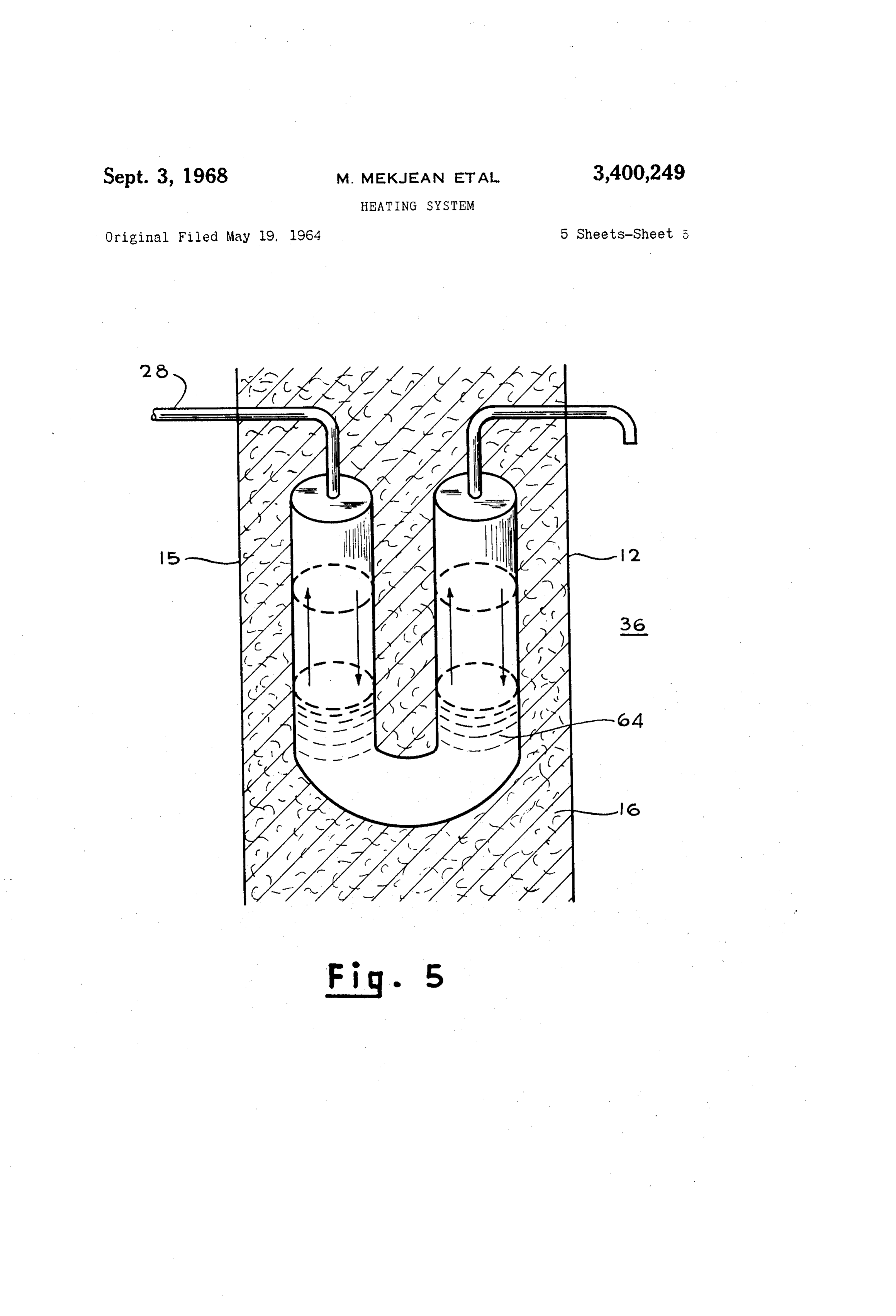
FIG. 5 illustrates another feature of the invention. The A temperature of about 640 degrees centigrade was heat storage medium 20, in the proposed mode of opera IO maintained as an accelerated time test. It was found that tion, is to be kept substantially out of communication with the composition of Example 2, which contained an in the atmosphere. In fact, the only air in the reservoir will hibitor therein, reduced the amount of corrosion by a fac be that initially kept in to compensate for expansion and tor of about six.
contraction of the heat storage medium. The drawing ill Heat storage media containing sodium phosphate, lustrates a "fluid piston' 38. In operation, trapped pre mixed oxides of iron, dissolved iron particles, sodium fer dried air from the reservoirs is prevented from escaping rite and sodium tetraborate also gave similar results. by a high temperature fluid, such as orthodichlorobenzene Similar results are also obtained when these and the 64. This dry air can be confined within the reservoir and other heat storage compositions of this invention are maintained free of external contamination. The level of utilized in apparatuses and methods in accordance with the the high temperature fluid will of course change, depend 20 invention, wherein the confined compositions are repeat ing on the heating and cooling cycles of the heat storage edly heated and cooled in contact with apparatus walls medium. A bellows type of apparatus may also be utilized and parts of the described materials of construction. Thus, as a vent sealing means. the apparatuses last longer, due to stabilizing of the heat FIG. 2 illustrates the configuration of the walls of storage media and lower corrosion rates. The apparatuses reservoir 18. These walls may be straight, but a cor 25 and methods are safer and the use of the invention is rugated configuration, as illustrated, whereby the sides more trouble-free.
of the reservoirs are in contact with each other, will While there have been described various embodiments reduce the possibility of any distortion of the reservoir of the invention, the compositions and methods described walls occurring as the heat storage medium expands and are not intended to be understood as limiting the scope of contracts on heating and cooling. 30 the invention, as it is realized that changes therein are Insulation 16 in the heat storage system may be rock possible and it is further intended that each element wool, glass wool, Sil-O-Cel, Liofelt, Dry Zero or any recited in any of the following claims is to be understood other insulating material known to the art or described as referring to all equivalent elements for accomplishing in Handbook of Chemistry and Physics, forty-third edi substantially the same results in substantially the same tion, published by The Chemical Rubber Publishing Co., or equivalent manner, it covering the invention broadly Cleveland, Ohio, (1961-1962), pages 2477 and 2478. in whatever form its principle may be utilized. Synthetic organic resin foams such as Hetrofoam (R), What is claimed is:
produced from a polyester resin manufactured by Hooker 1. A heating system comprising means for conducting Chemical Corporation, Niagara Falls, N.Y., may be a heat transfer medium to a heat storage unit, a heat stor placed on the interior of the heating unit and allowed 40 age unit comprising a container formed of a metal selected to be cured by heating the heat storage medium to a from the group of steel and nickel, a substantially anhy curing temperature. Additional insulation material is drous heat storage medium in said container comprising a placed over this resin foam. This latter procedure will major proportion of alkali metal hydroxide and a minor seal any possible heat leaks in the unit, improving in proportion of a non-reducing agent selected from the sulation efficiency. group consisting of alkali metal and alkaline earth metal The heating element 22 of the invention may comprise sulfates, phosphates, halides, carbonates, stannates, sili a resistor material, such as, nichrome, covered by a ma cates, fluosilicates, fluoborates, aluminates, bismuthates, terial such as gold, low carbon steel, e.g., American Iron borates, molybdates, tungstates, vanadates, nitrates, ni and Steel Institute Number 1020, and lower, classifica trites, manganates, permanganates, iodates, chlorates, tion and having an insulating material such as magnesium 50 perchlorates, perSulfates, oxides, perborates and mixtures oxide, between the resistor and the cover. Other heating thereof and a corrosion inhibitor selected from the group elenents that can be utilized in the practice of this in consisting of iron, iron compounds, and alkali metal vention are disclosed in, copending application S.N. chromates, dichromates, phosphates, pyrophosphates and 366,471 filed May 11, 1964 now Patent No. 3,356,834, mixtures thereof, said heat storage unit having heating granted Dec. 5, 1967. 55 means within said heat storage medium for heating said The following examples are given to illustrate the pres heat storage medium to a temperature above the fusion ent invention and are not to be taken as limitative. All point of the heat storage medium, means for bringing parts are by weight and temperatures are in degrees centi said heat transfer medium into thermal contact with said grade, unless otherwise set forth. heat storage medium, means for conducting said heat Examples 1 and 2 60 transfer medium from said heat storage unit and means for withdrawing heat from said heat transfer medium to cool
Heat storage media having the following compositions said heat storage medium below its fusion point. were prepared. 2. The heating system of claim 1 wherein the heat transfer medium is air.
Component
Percent by weight 65 3. The heating system of claim 1 wherein the heating
Example Example 2 means is heated with electricity.
Sodium hydroxide-------------- 89.0 84.0 4. The heating system of claim 1 wherein the alkali
Potassium hydroxide.-- 0.8 0.8 metal hydroxide is sodium hydroxide. Sodium nitrate----------
Sodium chloride------
5. The heating system of claim 1 wherein the non-re
Sodium carbonate. 10 10 O ducing agent is an alkali metal nitrate and the corrosion Manganese dioxide-- -- - 0.2 0.2 inhibitor is an alkali metal chromate. Sodium chromate----------------------------------- 5.0 6. The heating system of claim 1 wherein the heat stor age medium is maintained in the range of 60 to about 680
These compositions were tested in accordance with a degrees centigrade by the heating means. standard corrosion test A-279-44T of the American So 5 7. The heating system of claim 1 wherein the heat
Page 9
transfer medium is air, the alkali metal hydroxide, is ''': . . . References Cited .. ' ' . . . . sodium hydroxide, the non-reducing agent is sodium UNITED STATES PATENTS nitrate, the corrosion inhibitor is sodium dichromate and , ,. . . . . . .. .. . . .. .. . . . . . . . . . . .. . . . . . . . . . .. . .. . . the heat storage medium is maintained in the range of 60 3,299,945 1/1967 Rice et al. ------- 126-400X to. . 8.about 680 degrees centigrade by the heating means. . 5 3,320,408 5/1967: Mekjean ----------219-530
The heating system of claim 1 wherein the container w k .
is formed of low carbon steel. JAMES W. WESTHAVER, Primary Examiner.
Provenance
- Collection
- Cited prior art
- Original PDF
- patentimages.storage.googleapis.com →
- Filed
- 1966-10-26
- Pages
- 9
- Method
- pdftotext (the PDF's own text layer) + pdftoppm 300dpi page scans
- Source
- Google Patents bibliographic record
- Granted
- 1968-09-03
- Inventors
- Mekjean Matthew; James S Sconce; Hooker Chemical Corp
- Transcribed from
- patentimages.storage.googleapis.com →