patent · US3394062
Method for the electrolytic production of hydrogen and oxygen
23 July 1968
Page 1 — bibliographic record
United States Patent Office 3,394,062 Patented July 23, 1968
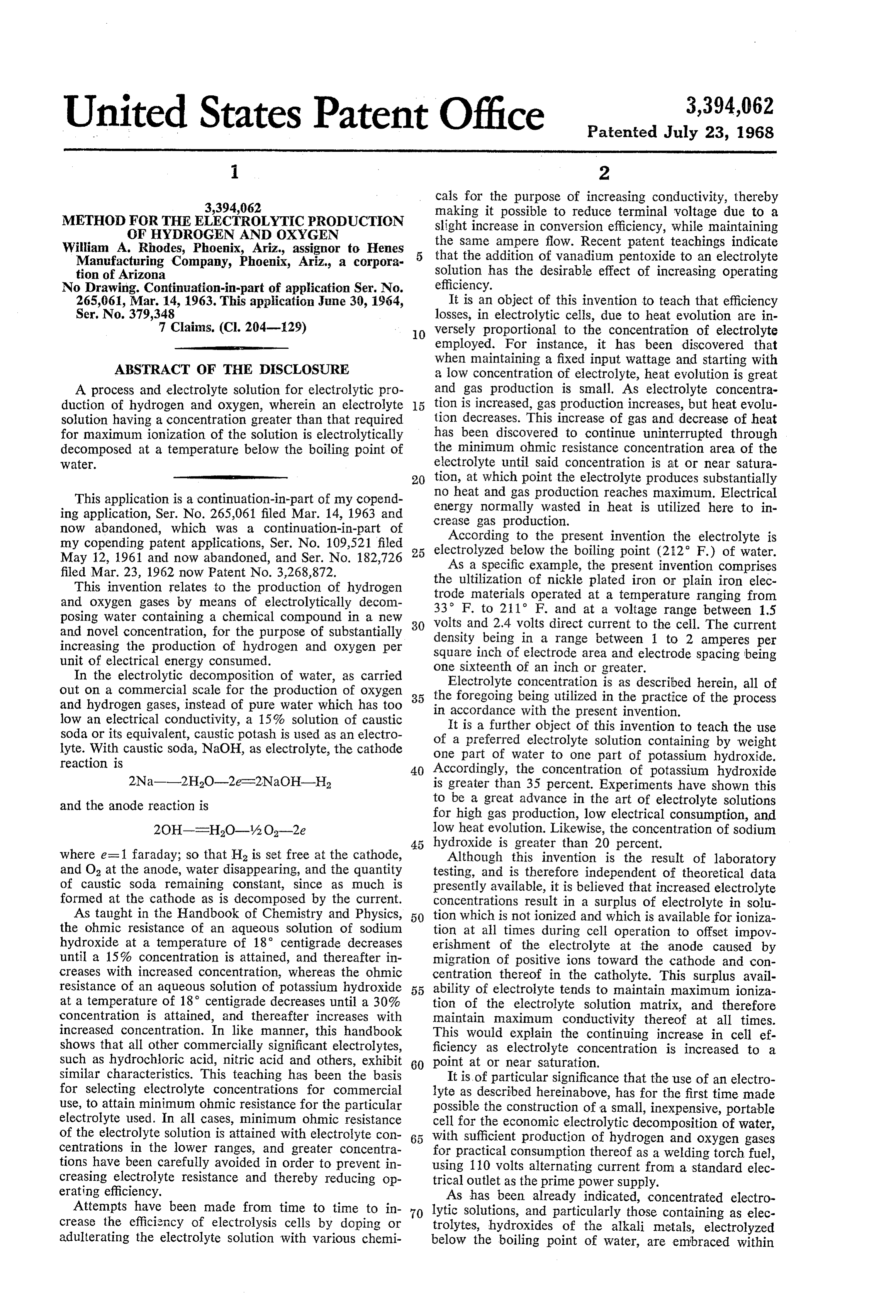
cals for the purpose of increasing conductivity, thereby 3,394,062 making it possible to reduce terminal voltage due to a METHOD FOR THE ELECTROLYTIC PRODUCTION slight increase in conversion efficiency, while maintaining OF HYDROGEN AND OXYGEN the same ampere flow. Recent patent teachings indicate William A. Rhodes, Phoenix, Ariz., assignor to Henes that the addition of vanadium pentoxide to an electrolyte Manufacturing Company, Phoenix, Ariz., a corpora solution has the desirable effect of increasing operating tion of Arizona
No Drawing. Continuation-in-part of application Ser. No. efficiency.
265,061, Mar. 14, 1963. This application June 30, 1964, It is an object of this invention to teach that efficiency Ser. No. 379,348 losses, in electrolytic cells, due to heat evolution are in 7 Claims. (C. 204-129) versely proportional to the concentration of electrolyte employed. For instance, it has been discovered that when maintaining a fixed input wattage and starting with
ABSTRACT OF THE DISCLOSURE a low concentration of electrolyte, heat evolution is great A process and electrolyte solution for electrolytic pro and gas production is small. As electrolyte concentra duction of hydrogen and oxygen, wherein an electrolyte 15 tion is increased, gas production increases, but heat evolu solution having a concentration greater than that required tion decreases. This increase of gas and decrease of heat for maximum ionization of the solution is electrolytically has been discovered to continue uninterrupted through decomposed at a temperature below the boiling point of the minimum ohmic resistance concentration area of the Water. electrolyte until said concentration is at or near satura 20 tion, at which point the electrolyte produces substantially
This application is a continuation-in-part of my copend no heat and gas production reaches maximum. Electrical ing application, Ser. No. 265,061 filed Mar. 14, 1963 and energy normally wasted in heat is utilized here to in now abandoned, which was a continuation-in-part of crease gas production.
my copending patent applications, Ser. No. 109,521 filed According to the present invention the electrolyte is May 12, 1961 and now abandoned, and Ser. No. 182,726 electrolyzed below the boiling point (22 F.) of water. filed Mar. 23, 1962 now Patent No. 3,268,872. As a specific example, the present invention comprises This invention relates to the production of hydrogen the ultilization of nickle plated iron or plain iron elec trode materials operated at a temperature ranging from and oxygen gases by means of electrolytically decom 33° F. to 211 F. and at a voltage range between 1.5 posing water containing a chemical compound in a new 30 volts and novel concentration, for the purpose of substantially densityandbeing 2.4 volts direct current to the cell. The current in a range between 1 to 2 amperes per increasing the production of hydrogen and oxygen per square inch of electrode area and electrode spacing being unit of electrical energy consumed. one sixteenth of an inch or greater. In the electrolytic decomposition of water, as carried out on a commercial scale for the production of oxygen 35 theElectrolyte concentration is as described herein, all of foregoing being utilized in the practice of the process and hydrogen gases, instead of pure water which has too in accordance with the present invention. low an electrical conductivity, a 15% solution of caustic It is a further object of this invention to teach the use soda or its equivalent, caustic potash is used as an electro of a preferred electrolyte lyte. With caustic soda, NaOH, as electrolyte, the cathode one part of water to one solution part of containing by weight potassium hydroxide.
reaction is 40 Accordingly, the concentration of potassium hydroxide 2Na-2H2O-2e-2NaOH-H2 is greater than 35 percent. Experiments have shown this and the anode reaction is to be a great advance in the art of electrolyte solutions for high gas production, low electrical consumption, and 2OH-FH2O-/2 O-2e low heat evolution. Likewise, the concentration of sodium 45 hydroxide is greater than 20 percent.
where e=1 faraday; so that H2 is set free at the cathode, Although this invention is the result of laboratory and O at the anode, water disappearing, and the quantity testing, and is therefore independent of theoretical data of caustic soda remaining constant, since as much is presently available, it is believed that increased electrolyte formed at the cathode as is decomposed by the current. concentrations result in a surplus of electrolyte in solu As taught in the Handbook of Chemistry and Physics, 50 tion which is not ionized and which is available for ioniza the ohmic resistance of an aqueous solution of Sodium tion at all times during cell operation to offset impov hydroxide at a temperature of 18 centigrade decreases erishment of the electrolyte at the anode caused by until a 15% concentration is attained, and thereafter in migration of positive ions toward the cathode and con creases with increased concentration, whereas the ohmic centration thereof in the catholyte. This surplus avail resistance of an aqueous solution of potassium hydroxide 55 ability of electrolyte tends to maintain maximum ioniza at a temperature of 18 centigrade decreases until a 30% tion of the electrolyte solution matrix, and therefore concentration is attained, and thereafter increases with maintain maximum conductivity thereof at all times. increased concentration. In like manner, this handbook This would explain the continuing increase in cell ef shows that all other commercially significant electrolytes, ficiency as electrolyte concentration is increased to a such as hydrochloric acid, nitric acid and others, exhibit 60 point at or near saturation.
similar characteristics. This teaching has been the basis It is, of particular significance that the use of an electro for selecting electrolyte concentrations for commercial lyte as described hereinabove, has for the first time made use, to attain minimum ohmic resistance for the particular possible the construction of a small, inexpensive, portable electrolyte used. In all cases, minimum ohmic resistance cell for the economic electrolytic decomposition of water, of the electrolyte solution is attained with electrolyte con 65 with sufficient production of hydrogen and oxygen gases centrations in the lower ranges, and greater concentra for practical consumption thereof as a welding torch fuel, tions have been carefully avoided in order to prevent in using 110 volts alternating current from a standard elec creasing electrolyte resistance and thereby reducing op trical outlet as the prime power supply. erating efficiency. As has been already indicated, concentrated electro Attempts have been made from time to time to in lytic solutions, and particularly those containing as elec crease the efficiency of electrolysis cells by doping or 70 trolytes, hydroxides of the alkali metals, electrolyzed adulterating the electrolyte solution with various chemi below the boiling point of water, are embraced within
Page 2
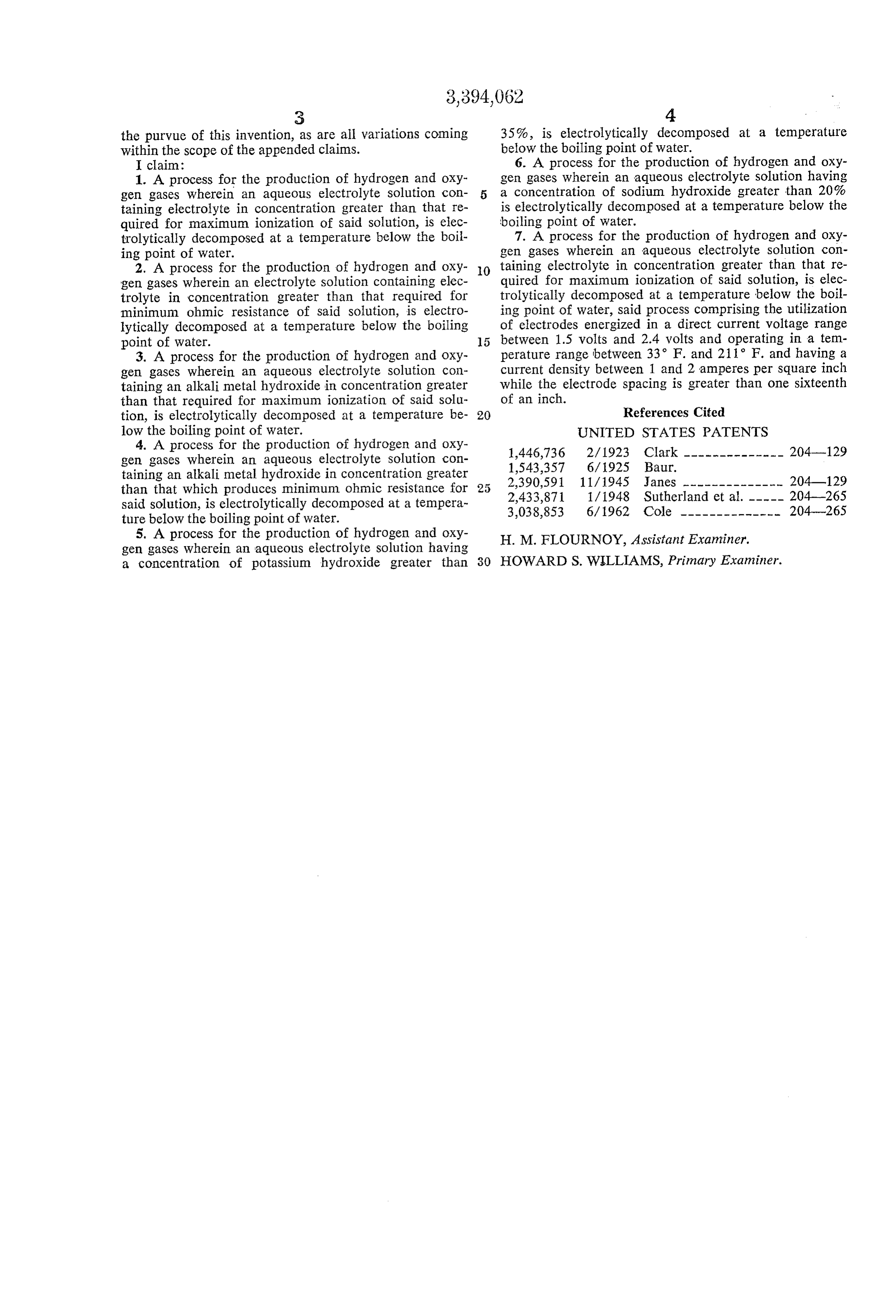
the purvue of this invention, as are all variations coming 35%, is electrolytically decomposed at a temperature within the scope of the appended claims. below the boiling point of water. claim: 6. A process for the production of hydrogen and oxy 1. A process for the production of hydrogen and oxy gen gases wherein an aqueous electrolyte Solution having gen gases wherein an aqueous electrolyte Solution con 5 a concentration of sodium hydroxide greater than 20% taining electrolyte in concentration greater than that re is electrolytically decomposed at a temperature below the quired for maximum ionization of said solution, is elec boiling point of Water.
trolytically decomposed at a temperature below the boil 7. A process for the production of hydrogen and oxy ing point of water. gen gases wherein an aqueous electrolyte solution con 2. A process for the production of hydrogen and oxy 0. taining electrolyte in concentration greater than that re gen gases wherein an electrolyte solution containing elec quired for maximum ionization of said solution, is elec trolyte in concentration greater than that required for trolytically decomposed at a temperature below the boil minimum ohmic resistance of Said solution, is electro ing point of water, said process comprising the utilization lytically decomposed at a temperature below the boiling of electrodes energized in a direct current voltage range point of water. 5 between 1.5 volts and 2.4 volts and operating in a tem 3. A process for the production of hydrogen and oxy perature range between 33 F. and 211 F. and having a gen gases wherein an aqueous electrolyte solution con current density between 1 and 2 amperes per square inch taining an alkali metal hydroxide in concentration greater while the electrode spacing is greater than one sixteenth than that required for maximum ionization of said solu of an inch.
tion, is electrolytically decomposed at a temperature be 20 References Cited low the boiling point of water. UNITED STATES PATENTS 4. A process for the production of hydrogen and oxy 1,446,736 2/1923 Clark -------------- 204-129 gen gases wherein an aqueous electrolyte solution con 1,543,357 6/1925 Baur.
taining an alkali metal hydroxide in concentration greater 2,390,591 11/1945 Janes -------------- 204-129 than that which produces minimum ohmic resistance for 2,433,871 1/1948 Sutherland et al. ----- 204-265 said solution, is electrolytically decomposed at a tempera 3,038,853 6/1962 Cole -------------- 204-265 ture below the boiling point of water.
5. A process for the production of hydrogen and oxy H. M. FLOURNOY, Assistant Examiner. gen gases wherein an aqueous electrolyte solution having a concentration of potassium hydroxide greater than 30 HOWARDS. WILLIAMS, Primary Examiner.
Provenance
- Collection
- Cited prior art
- Original PDF
- patentimages.storage.googleapis.com →
- Filed
- 1964-06-30
- Pages
- 2
- Method
- pdftotext (the PDF's own text layer) + pdftoppm 300dpi page scans
- Source
- Google Patents bibliographic record
- Granted
- 1968-07-23
- Inventors
- William A Rhodes; Henes Manufacturing Co
- Transcribed from
- patentimages.storage.googleapis.com →