patent · US3925164
Method for the determination of cholesterol
9 December 1975
Page 1 — bibliographic record
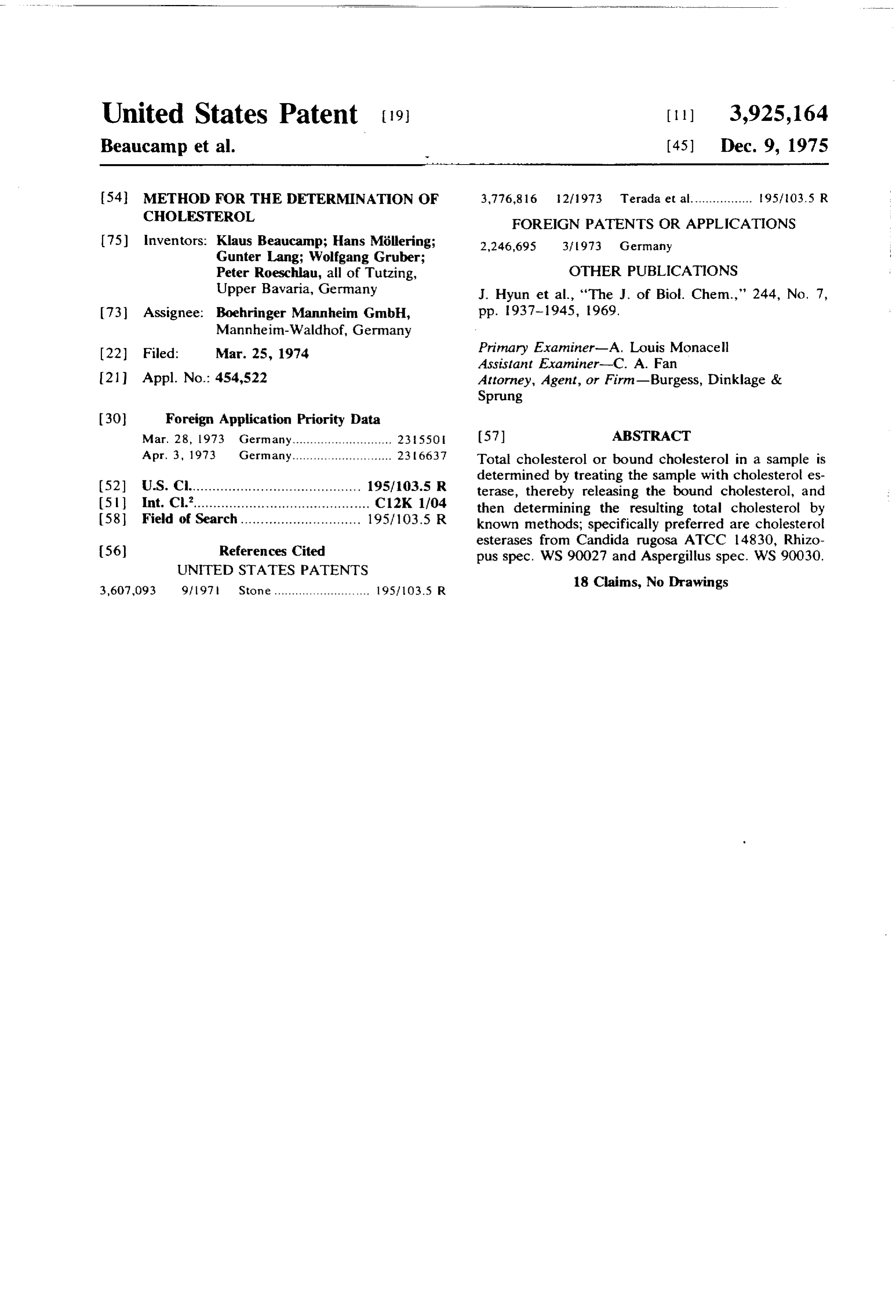
United States Patent (19) 11) 3,925, 164 Beaucamp et al. (45) Dec. 9, 1975 54 METHOD FOR THE DETERMINATION OF 3,776,816 2/1973 Terada et al................. 95/103.5 R CHOLESTEROL FOREIGN PATENTS OR APPLICATIONS (75) Inventors: Klaus Beaucamp; Hans Möllering; 2246,695 3/1973 Germany Gunter Lang; Wolfgang Gruber; - r Wy
Peter Roeschlau, all of Tutzing, OTHER PUBLICATIONS
Upper Bavaria, Germany J. Hyun et al., “The J. of Biol. Chem...," 244, No. 7, 73 Assignee: Boehringer Mannheim GmbH, pp. 1937-1945, 1969.
Mannheim-Waldhof, Germany 22 Filed: Mar. 25, 1974 Primary Examiner-A. Louis Monacell Assistant Examiner-C. A. Fan 21 Appl. No.: 454,522 Attorney, Agent, or Firm-Burgess, Dinklage & Sprung (30) Foreign Application Priority Data
Mar, 28, 1973 Germany............................ 23 55O (57) ABSTRACT Apr. 3, 1973 Germany............................ 286637 Total cholesterol or bound cholesterol in a sample is determined by treating the sample with cholesterol es 52 U.S. C.r - -- - r > 1& 1 a a - - - - - - - - - - 195/103.5 R terase, thereby releasing the bound cholesterol, and 5 Int, Cl’............................................ C12K 1104 then determining the resulting total cholesterol by 58 Field of Search.............................. 1951 103.5 R known methods; specifically preferred are cholesterol 4. esterases from Candida rugosa ATCC 14830, Rhizo 56 References Cited pus spec. WS 90027 and Aspergillus spec. WS 90030.
UNITED STATES PATENTS
3,607,093 9, 197 Stone ........................... 1951 103.5 R 18 Claims, No Drawings
Page 2
It is already known that in the pancreas and liver a
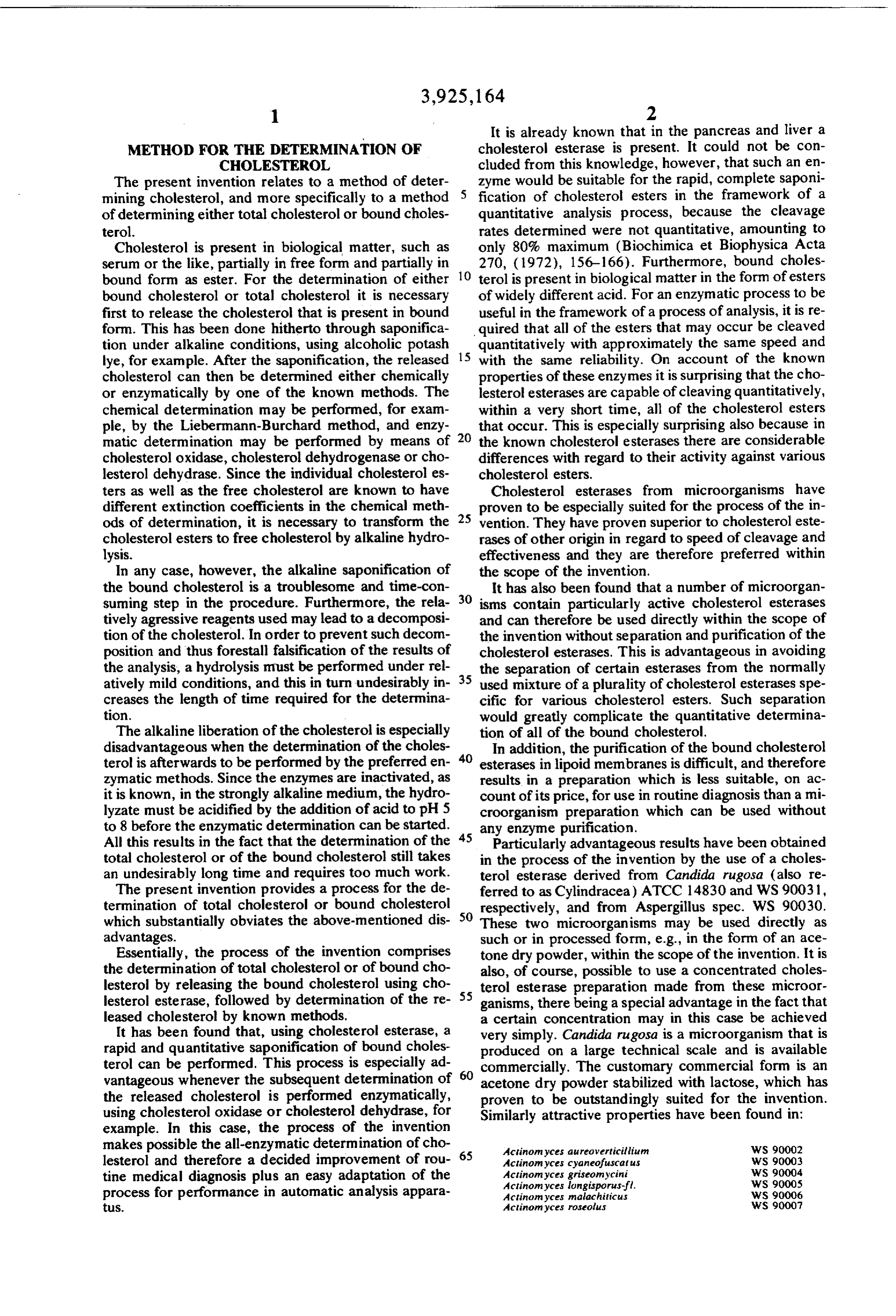
METHOD FOR THE DETERMINATION OF cholesterol esterase is present. It could not be con CHOLESTEROL cluded from this knowledge, however, that such an en The present invention relates to a method of deter 5 zyme would be suitable for the rapid, complete saponi mining cholesterol, and more specifically to a method fication of cholesterol esters in the framework of a of determining either total cholesterol or bound choles quantitative analysis process, because the cleavage terol. rates determined were not quantitative, amounting to Cholesterol is present in biological matter, such as only 80% maximum (Biochimica et Biophysica Acta serum or the like, partially in free form and partially in 10 270, (1972), 156-166). Furthermore, bound choles bound form as ester. For the determination of either terol is present in biological matter in the form of esters bound cholesterol or total cholesterol it is necessary of widely different acid. For an enzymatic process to be first to release the cholesterol that is present in bound useful in the framework of a process of analysis, it is re form. This has been done hitherto through saponifica quired that all of the esters that may occur be cleaved tion under alkaline conditions, using alcoholic potash 15 quantitatively with approximately the same speed and lye, for example. After the saponification, the released with the same reliability. On account of the known cholesterol can then be determined either chemically properties of these enzymes it is surprising that the cho or enzymatically by one of the known methods. The lesterol esterases are capable of cleaving quantitatively, chemical determination may be performed, for exam within a very short time, all of the cholesterol esters ple, by the Liebermann-Burchard method, and enzy that occur. This is especially surprising also because in matic determination may be performed by means of 20 the known cholesterol esterases there are considerable cholesterol oxidase, cholesterol dehydrogenase or cho differences with regard to their activity against various lesterol dehydrase. Since the individual cholesterol es cholesterol esters.
ters as well as the free cholesterol are known to have Cholesterol esterases from microorganisms have different extinction coefficients in the chemical meth proven to be especially suited for the process of the in ods of determination, it is necessary to transform the 25 vention. They have proven superior to cholesterol este cholesterol esters to free cholesterol by alkaline hydro rases of other origin in regard to speed of cleavage and lysis. effectiveness and they are therefore preferred within In any case, however, the alkaline saponification of the scope of the invention.
the bound cholesterol is a troublesome and time-con It has also been found that a number of microorgan suming step in the procedure. Furthermore, the rela 30 isms contain particularly active cholesterol esterases tively agressive reagents used may lead to a decomposi and can therefore be used directly within the scope of tion of the cholesterol. In order to prevent such decom the invention without separation and purification of the position and thus forestall falsification of the results of cholesterol esterases. This is advantageous in avoiding the analysis, a hydrolysis must be performed under rel the separation of certain esterases from the normally atively mild conditions, and this in turn undesirably in 35 used mixture of a plurality of cholesterol esterases spe creases the length of time required for the determina cific for various cholesterol esters. Such separation tion. would greatly complicate the quantitative determina The alkaline liberation of the cholesterol is especially tion of all of the bound cholesterol. disadvantageous when the determination of the choles In addition, the purification of the bound cholesterol terol is afterwards to be performed by the preferred en 40 esterases in lipoid membranes is difficult, and therefore zymatic methods. Since the enzymes are inactivated, as results in a preparation which is less suitable, on ac it is known, in the strongly alkaline medium, the hydro count of its price, for use in routine diagnosis than a mi lyzate must be acidified by the addition of acid to pH 5 croorganism preparation which can be used without to 8 before the enzymatic determination can be started. any enzyme purification.
All this results in the fact that the determination of the 45 Particularly advantageous results have been obtained total cholesterol or of the bound cholesterol still takesin the process of the invention by the use of a choles an undesirably long time and requires too much work. terol esterase derived from Candida rugosa (also re The present invention provides a process for the de ferred to as Cylindracea) ATCC 14830 and WS 90031, termination of total cholesterol or bound cholesterol respectively, and from Aspergillus spec. WS 90030. which substantially obviates the above-mentioned dis 50 These two microorganisms may be used directly as advantages. such or in processed form, e.g., in the form of an ace Essentially, the process of the invention comprises tone dry powder, within the scope of the invention. It is the determination of total cholesterol or of bound cho also, of course, possible to use a concentrated choles lesterol by releasing the bound cholesterol using cho 55 terol esterase preparation made from these microor lesterol esterase, followed by determination of the re ganisms, there being a special advantage in the fact that leased cholesterol by known methods. a certain concentration may in this case be achieved It has been found that, using cholesterol esterase, a very simply. Candida rugosa is a microorganism that is rapid and quantitative saponification of bound choles produced on a large technical scale and is available terol can be performed. This process is especially ad 60 commercially. The customary commercial form is an vantageous whenever the subsequent determination of acetone dry powder stabilized with lactose, which has the released cholesterol is performed enzymatically, proven to be outstandingly suited for the invention. using cholesterol oxidase or cholesterol dehydrase, for Similarly attractive properties have been found in: example. In this case, the process of the invention makes possible the all-enzymatic determination of cho 65 Actinomyces aureoverticillium WS 90002 lesterol and therefore a decided improvement of rou acrinomyces cyaneofuscattus WS 90003 tine medical diagnosis plus an easy adaptation of the Acrinomyces griseonycini Actinomyces lungisporus-fl.
process for performance in automatic analysis appara Actinomyces malachiticus WS 90.006 tus. Actinomyces roseolus WS 90007
Page 3
-continued plier, such as glycerin, and in the second stage on a
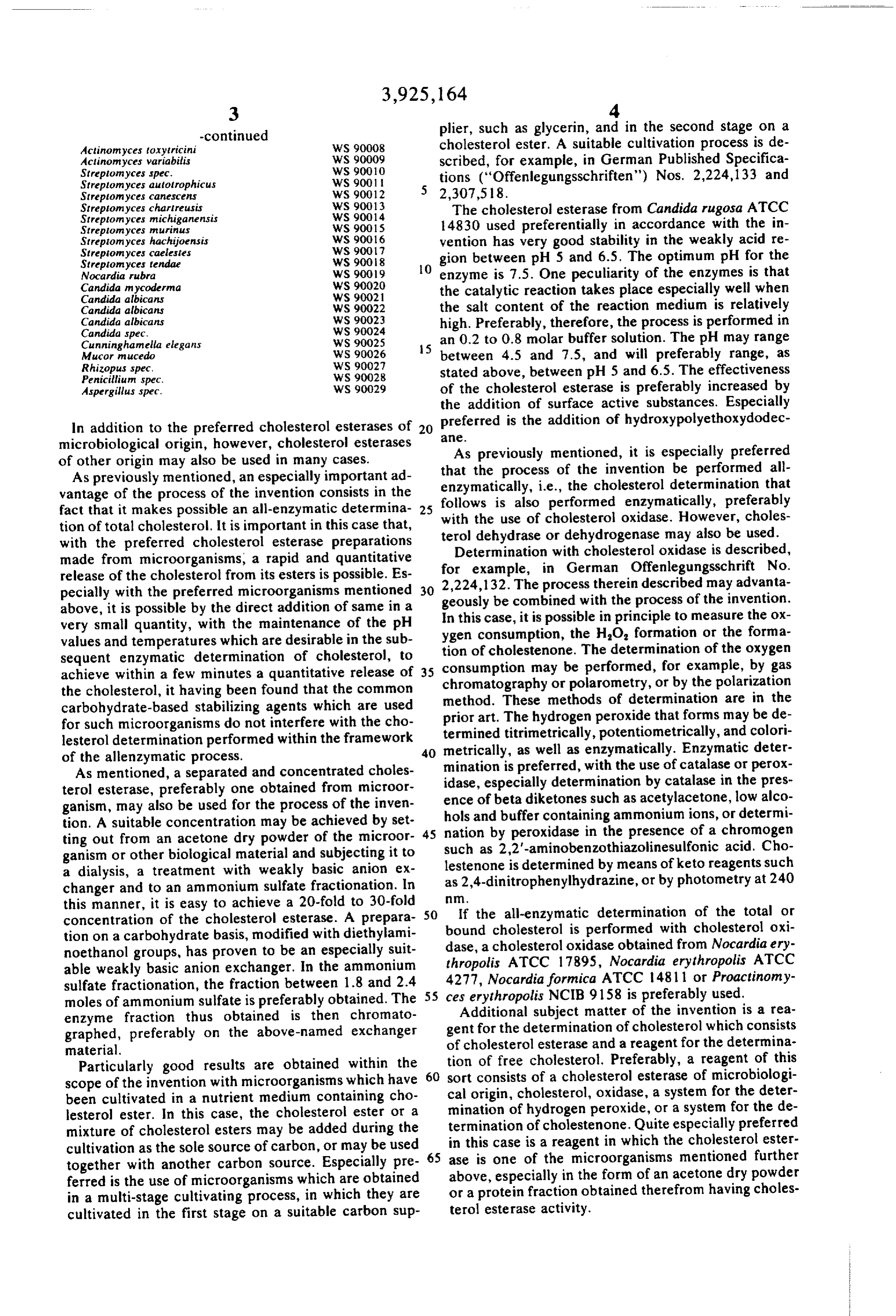
Actinomyces toxytricini WS 90008 cholesterol ester. A suitable cultivation process is de Actinomyces variabilis
Streptomyces spec.
scribed, for example, in German Published Specifica
Streptomyces autotrophicus WS 9001 tions ("Offenlegungsschriften") Nos. 2,224,133 and Streptomyces canescens WS 90012 2,307,518.
Streptomyces chartreusis WS 90013 The cholesterol esterase from Candida rugosa ATCC Streptornyces michiganensis WS 90014
Streptomyces murinus WS 90015 14830 used preferentially in accordance with the in Streptomyces hachijoensis
Streptomyces caelestes
vention has very good stability in the weakly acid re
Streptomyces tendae WS 9008 gion between pH 5 and 6.5. The optimum pH for the O enzyme is 7.5. One peculiarity of the enzymes is that
Candida mycoderma
Candida albicans
WS 90-021 the catalytic reaction takes place especially well when
Candida albicans WS 90022 the salt content of the reaction medium is relatively Candida albicans
Candida spec.
high. Preferably, therefore, the process is performed in
an 0.2 to 0.8 molar buffer solution. The pH may range
Micor nucedo
Rhizopus spec.
between 4.5 and 7.5, and will preferably range, as
Penicillium spec. WS 90028 stated above, between pH 5 and 6.5. The effectiveness Aspergillus spec. WS 90029 of the cholesterol esterase is preferably increased by the addition of surface active substances. Especially
In addition to the preferred cholesterol esterases of 20 preferred is the addition of hydroxypolyethoxydodec microbiological origin, however, cholesterol esterases 22. As previously mentioned, it is especially preferred of other origin may also be used in many cases. that the process of the invention be performed all As previously mentioned, an especially important ad vantage of the process of the invention consists in the enzymatically, follows is also i.e., the cholesterol determination that performed enzymatically, preferably fact that it makes possible an all-enzymatic determina with the use of cholesterol
oxidase. However, choles tion of total cholesterol. It is important in this case that, terol dehydrase or dehydrogenase may also be used. with the preferred cholesterol esterase preparations made from microorganisms, a rapid and quantitative forDetermination with cholesterol oxidase is described, example, in German Offenlegungsschrift No.
release of the cholesterol from its esters is possible. Es 2,224,132. The process therein described may advanta pecially with the preferred microorganisms mentioned 30 geously be combined with the process of the invention. above, it is possible by the direct addition of same in a In this case, it is possible in principle to measure the ox very small quantity, with the maintenance of the pH ygen consumption, the HO, formation or the forma values and temperatures which are desirable in the sub tion of cholestenone. The determination of the oxygen sequent enzymatic determination of cholesterol, to achieve within a few minutes a quantitative release of 35 consumption may be performed, for example, by gas the cholesterol, it having been found that the common chromatography or polarometry, or by the polarization method. These methods of determination are in the carbohydrate-based stabilizing agents which are used prior art. The hydrogen peroxide that forms may be de for such microorganisms do not interfere with the cho termined lesterol determination performed within the framework 40 metrically,titrimetrically, as well as potentiometrically, and colori enzymatically. Enzymatic deter of the allenzymatic process.
As mentioned, a separated and concentrated choles idase, especially determination by catalase in or mination is preferred, with the use of catalase perox the pres terol esterase, preferably one obtained from microor ence of beta diketones such as acetylacetone, low alco ganism, may also be used for the process of the inven hols and tion. A suitable concentration may be achieved by set 45 nation bybuffer containing ammonium ions, or determi peroxidase in the presence of a chromogen ting out from an acetone dry powder of the microor such as 2,2'-aminobenzothiazolinesulfonic acid. Cho ganism or other biological material and subjecting it to lestenone is determined by means of keto reagents such a dialysis, a treatment with weakly basic anion ex changer and to an ammonium sulfate fractionation. In as 2,4-dinitrophenylhydrazine, or by photometry at 240 this manner, it is easy to achieve a 20-fold to 30-fold If the all-enzymatic determination of the total or concentration of the cholesterol esterase. A prepara 50 bound cholesterol is performed with cholesterol oxi tion on a carbohydrate basis, modified with diethylami noethanol groups, has proven to be an especially suit dase, a cholesterol oxidase obtained from Nocardia ery thropolis ATCC 17895, Nocardia erythropolis ATCC able weakly basic anion exchanger. In the ammonium 4277, Nocardia formica ATCC 14811 or Proactinomy sulfate fractionation, the fraction between 1.8 and 2.4 55 ces erythropolis NCIB 9158 is preferably used. moles of ammonium sulfate is preferably obtained. The Additional subject matter of the invention is a rea enzyme fraction thus obtained is then chromato gent for the determination of cholesterol which consists graphed, preferably on the above-named exchanger material. of cholesterol esterase and a reagent for the determina Particularly good results are obtained within the 60 tion of free cholesterol. Preferably, a reagent of this scope of the invention with microorganisms which have sort consists of a cholesterol esterase of microbiologi been cultivated in a nutrient medium containing cho cal origin, cholesterol, oxidase, a system for the deter mination of hydrogen peroxide, or a system for the de lesterol ester. In this case, the cholesterol ester or a mixture of cholesterol esters may be added during the termination in this case of cholestenone. Quite especially preferred is a reagent in which the cholesterol ester cultivation as the sole source of carbon, or may be used together with another carbon source. Especially pre 65 ase is one of the microorganisms mentioned further above, especially in the form of an acetone dry powder ferred is the use of microorganisms which are obtained or a protein fraction obtained therefrom having choles in a multi-stage cultivating process, in which they are cultivated in the first stage on a suitable carbon sup terol esterase activity.
Page 4
S 6
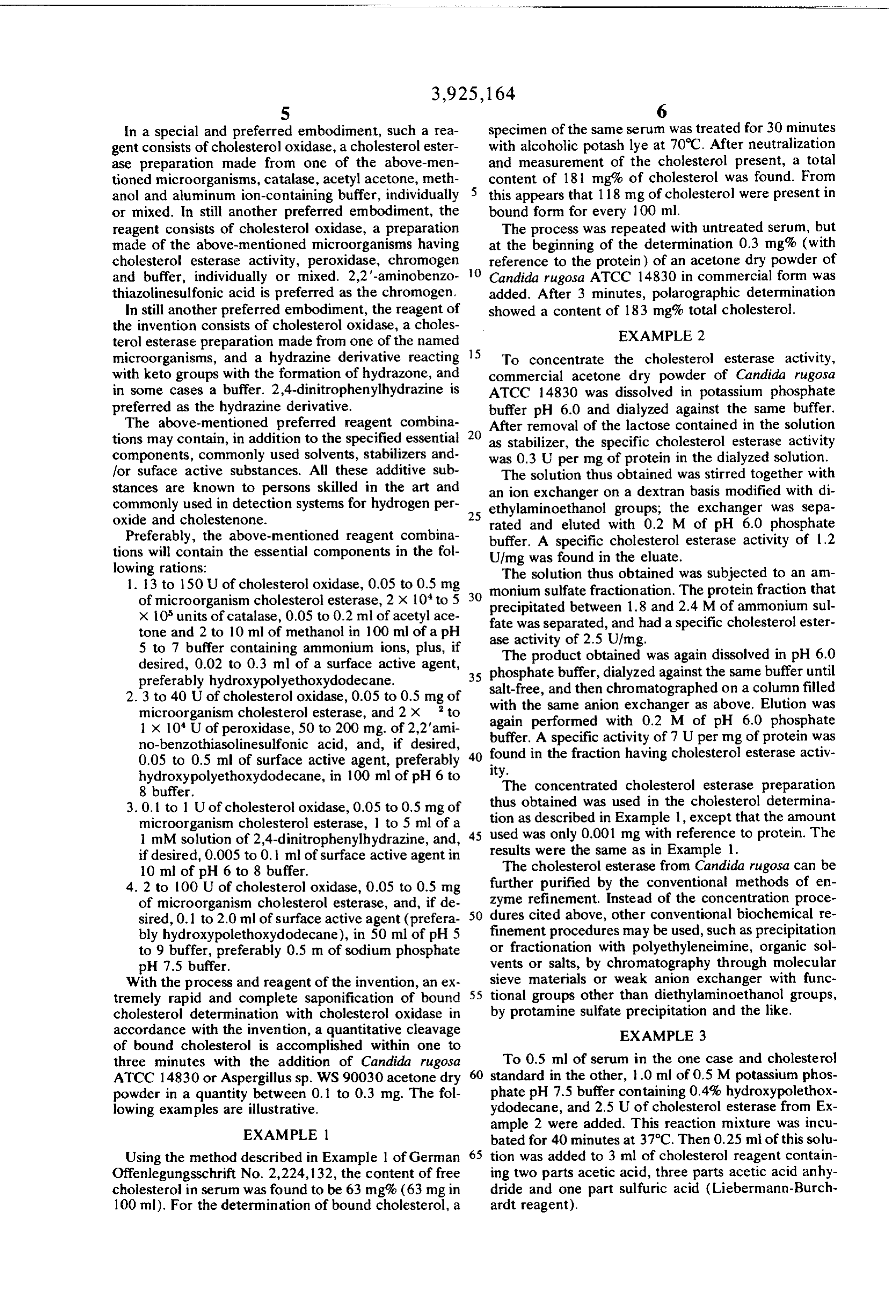
In a special and preferred embodiment, such a rea specimen of the same serum was treated for 30 minutes gent consists of cholesterol oxidase, a cholesterol ester with alcoholic potash lye at 70°C. After neutralization ase preparation made from one of the above-men and measurement of the cholesterol present, a total tioned microorganisms, catalase, acetyl acetone, meth content of 181 mg% of cholesterol was found. From anol and aluminum ion-containing buffer, individually this appears that 118 mg of cholesterol were present in or mixed. In still another preferred embodiment, the bound form for every 100 ml.
reagent consists of cholesterol oxidase, a preparation The process was repeated with untreated serum, but made of the above-mentioned microorganisms having at the beginning of the determination 0.3 mg% (with cholesterol esterase activity, peroxidase, chromogen O reference to the protein) of an acetone dry powder of and buffer, individually or mixed. 2,2'-aminobenzo Candida rugosa ATCC 14830 in commercial form was thiazolinesulfonic acid is preferred as the chromogen. added. After 3 minutes, polarographic determination In still another preferred embodiment, the reagent of showed a content of 183 mg% total cholesterol. the invention consists of cholesterol oxidase, a choles EXAMPLE 2 terol esterase preparation made from one of the named 15 microorganisms, and a hydrazine derivative reacting To concentrate the cholesterol esterase activity, with keto groups with the formation of hydrazone, and commercial acetone dry powder of Candida rugosa in some cases a buffer. 2,4-dinitrophenylhydrazine is ATCC 14830 was dissolved in potassium phosphate preferred as the hydrazine derivative. buffer pH 6.0 and dialyzed against the same buffer. The above-mentioned preferred reagent combina 20 After removal of the lactose contained in the solution tions may contain, in addition to the specified essential as stabilizer, the specific cholesterol esterase activity components, commonly used solvents, stabilizers and was 0.3 U per mg of protein in the dialyzed solution. for suface active substances. All these additive sub The solution thus obtained was stirred together with stances are known to persons skilled in the art and an ion exchanger on a dextran basis modified with di commonly used in detection systems for hydrogen per 25 ethylaminoethanol groups; the exchanger was sepa oxide and cholestenone. rated and eluted with 0.2 M of pH 6.0 phosphate Preferably, the above-mentioned reagent combina buffer. A specific cholesterol esterase activity of l.2 tions will contain the essential components in the fol U/mg was found in the eluate.
lowing rations: The solution thus obtained was subjected to an am 1. 13 to 150 U of cholesterol oxidase, 0.05 to 0.5 mg 30 monium sulfate fractionation. The protein fraction that of microorganism cholesterol esterase, 2 X 10 to 5 precipitated between 1.8 and 2.4 M of ammonium sul X 10 units of catalase, 0.05 to 0.2 ml of acetylace fate was separated, and had a specific cholesterol ester tone and 2 to 10 ml of methanol in 100 ml of a pH ase activity of 2.5 U/mg.
5 to 7 buffer containing ammonium ions, plus, if The product obtained was again dissolved in pH 6.0 desired, 0.02 to 0.3 ml of a surface active agent, 35 phosphate buffer, dialyzed against the same buffer until preferably hydroxypolyethoxydodecane.
2.3 to 40 U of cholesterol oxidase, 0.05 to 0.5 mg of with the samethen salt-free, and chromatographed on a column filled anion exchanger as above. Elution was microorganism cholesterol esterase, and 2 X to again performed with 0.2 M of pH 6.0 phosphate
no-benzothiasolinesulfonic acid, and, if desired, 40 buffer. A specific activity of 7U per mg of protein was 0.05 to 0.5 ml of surface active agent, preferably found in the fraction having cholesterol esterase activ hydroxypolyethoxydodecane, in 100 ml of pH 6 to ity.
8 buffer. The concentrated cholesterol esterase preparation thus obtained was used in the cholesterol determina 3.0.1 to 1 U of cholesterol oxidase, 0.05 to 0.5 mg of tion microorganism cholesterol esterase, 1 to 5 ml of a usedaswasdescribed in Example 1, except that the amount only 0.001 mg with reference to protein. The 1 mM solution of 2,4-dinitrophenylhydrazine, and, 45 if desired, 0.005 to 0.1 ml of surface active agent in results were the same as in Example 1. The cholesterol esterase from Candida rugosa can be 10 ml of pH 6 to 8 buffer.
4. 2 to 100 U of cholesterol oxidase, 0.05 to 0.5 mg further purified by the conventional methods of en of microorganism cholesterol esterase, and, if de zyme refinement. Instead of the concentration proce sired, 0.1 to 2.0 ml of surface active agent (prefera 50 dures cited above, other conventional biochemical re bly hydroxypolethoxydodecane), in 50 ml of pH 5 finement procedures may be used, such as precipitation to 9 buffer, preferably 0.5 m of sodium phosphate or fractionation with polyethyleneimine, organic sol pH 7.5 buffer. vents or salts, by chromatography through molecular With the process and reagent of the invention, an ex 55 sieve materials or weak anion exchanger with func tremely rapid and complete saponification of bound tional groups other than diethylaminoethanol groups, cholesterol determination with cholesterol oxidase in by protamine sulfate precipitation and the like. accordance with the invention, a quantitative cleavage EXAMPLE 3 of bound cholesterol is accomplished within one to three minutes with the addition of Candida rugosa 60 To 0.5 ml of serum in the one case and cholesterol ATCC 14830 or Aspergillus sp. WS 90030 acetone dry standard in the other, 1.0 ml of 0.5 M potassium phos powder in a quantity between 0.1 to 0.3 mg. The fol phate pH 7.5 buffer containing 0.4% hydroxypolethox lowing examples are illustrative. ydodecane, and 2.5 U of cholesterol esterase from Ex
EXAMPLE 1
ample 2 were added. This reaction mixture was incu bated for 40 minutes at 37°C. Then 0.25 ml of this solu
Using the method described in Example 1 of German 65 tion was added to 3 ml of cholesterol reagent contain Offenlegungsschrift No. 2,224,132, the content of free ing two parts acetic acid, three parts acetic acid anhy cholesterol in serum was found to be 63 mg% (63 mg in dride and one part sulfuric acid (Liebermann-Burch 100 ml). For the determination of bound cholesterol, a ardt reagent).
Page 5
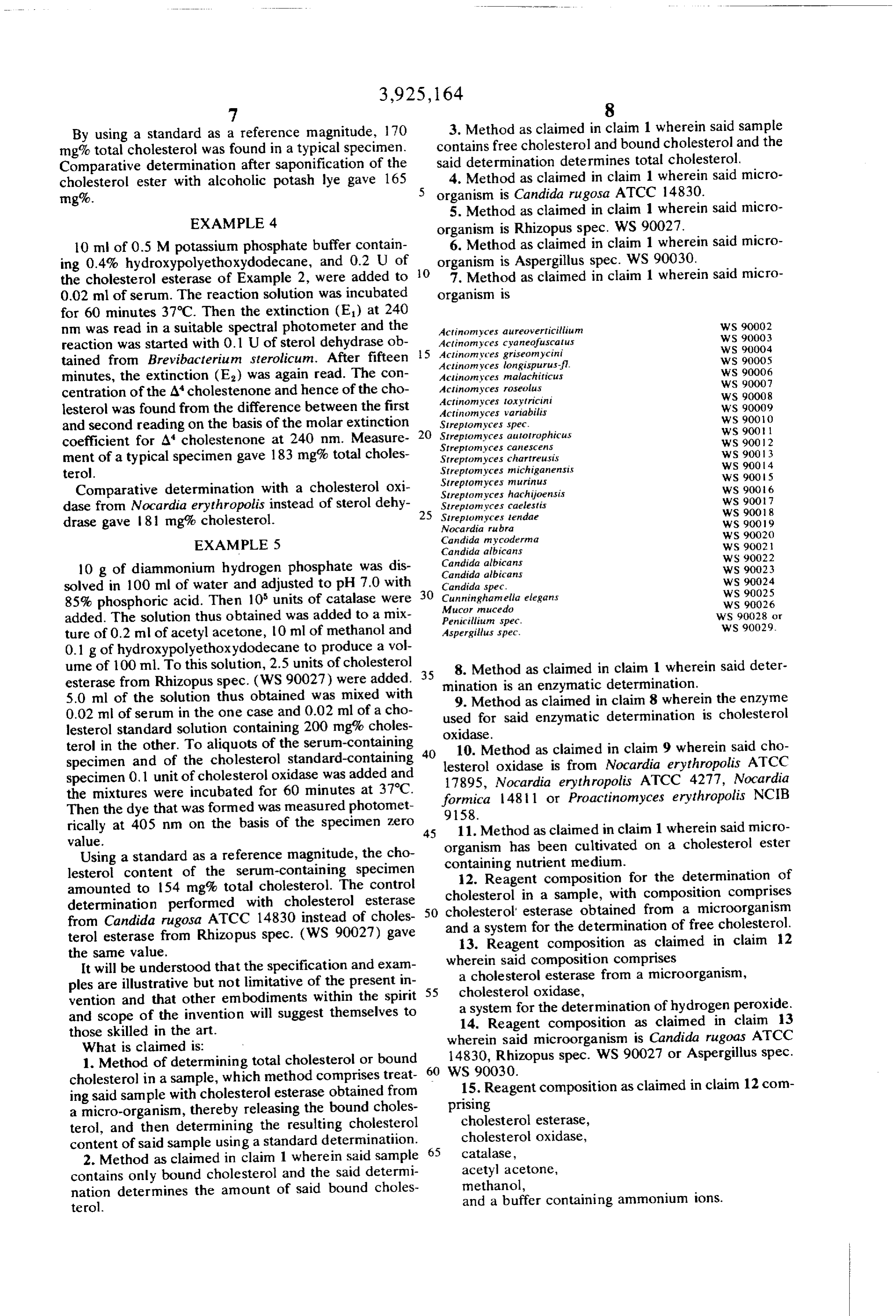
By using a standard as a reference magnitude, 170 3. Method as claimed in claim 1 wherein said sample mg% total cholesterol was found in a typical specimen. contains free cholesterol and bound cholesterol and the Comparative determination after saponification of the said determination determines total cholesterol. 4. Method as claimed in claim 1 wherein said micro cholesterol ester with alcoholic potash lye gave 165 5 organism is Candida rugosa ATCC 14830.
5. Method as claimed in claim 1 wherein said micro
EXAMPLE 4 organism is Rhizopus spec. WS 90027.
10 ml of 0.5 M potassium phosphate buffer contain 6. Method as claimed in claim 1 wherein said micro ing 0.4% hydroxypolyethoxydodecane, and 0.2 U of O organism is Aspergillus spec. WS 90030. the cholesterol esterase of Example 2, were added to 7. Method as claimed in claim 1 wherein said micro 0.02 ml of serum. The reaction solution was incubated organism is for 60 minutes 37°C. Then the extinction (E) at 240 nm was read in a suitable spectral photometer and the Actinomyces aureoverticillium WS 900O2 Actinomyces cyaneofuscatus reaction was started with 0.1 U of sterol dehydrase ob 5 Actinomyces WS 90003
tained from Brevibacterium sterolicum. After fifteen Actinoryces longispurus-fl. WS 90005 minutes, the extinction (E) was again read. The con Actinomyces malachiricus
Actinomyces roseolus
centration of the Acholestenone and hence of the cho Acrinomyces toxytricini WS 90008 lesterol was found from the difference between the first Acrinomyces variabilis WS 90009 and second reading on the basis of the molar extinction Srreptomyces autotrophicus
coefficient for A cholestenone at 240 nm. Measure 20 Streptomyces
Srrepromyces canescers
ment of a typical specimen gave 183 mg% total choles Srreptomyces charrreusis
Streptomyces nichiganensis
terol.
Comparative determination with a cholesterol oxi Streptomyces murinus
Streptomyces hachijoensis
dase from Nocardia erythropolis instead of sterol dehy 25 Streptomyces
Streptomyces caelestis tendae
drase gave 81 mg% cholesterol. Nocardia rubra WS 9009
EXAMPLE 5 Candida albicants WS 9002 10 g of diammonium hydrogen phosphate was dis Candida albicans
Candida albicans
solved in 100 ml of water and adjusted to pH 7.0 with 30 Candida spec. WS 90024 85% phosphoric acid. Then 10 units of catalase were Cunninghamella
Mucor mucedo
added. The solution thus obtained was added to a mix Penicillium spec. WS 90.028 or ture of 0.2 ml of acetyl acetone, 10 ml of methanol and Aspergillus spec. WS 90029. 0.1 g of hydroxypolyethoxydodecane to produce a vol ume of 100 ml. To this solution, 2.5 units of cholesterol 35 8. Method as claimed in claim 1 wherein said deter esterase from Rhizopus spec. (WS90027) were added. mination is an enzymatic determination. 5.0 ml of the solution thus obtained was mixed with 9. Method as claimed in claim 8 wherein the enzyme 0.02 ml of serum in the one case and 0.02 ml of a cho used for said enzymatic determination is cholesterol lesterol standard solution containing 200 mg% choles oxidase.
terol in the other. To aliquots of the serum-containing 10. Method as claimed in claim 9 wherein said cho specimen and of the cholesterol standard-containing 40 lesterol oxidase is from Nocardia erythropolis ATCC specimen 0.1 unit of cholesterol oxidase was added and 17895, Nocardia erythropolis ATCC 4277, Nocardia the mixtures were incubated for 60 minutes at 37°C. formica 14811 or Proactinomyces erythropolis NCIB Then the dye that was formed was measured photomet 9158.
rically at 405 nm on the basis of the specimen zero 45 11. Method as claimed in claim 1 wherein said micro value.
Using a standard as a reference magnitude, the cho organism containing has been cultivated on a cholesterol ester nutrient medium.
lesterol content of the serum-containing specimen amounted to 154 mg% total cholesterol. The control cholesterol in acomposition 12. Reagent sample, for the determination of with composition comprises determination performed with cholesterol esterase 50 cholesterol esterase obtained from from Candida rugosa ATCC 14830 instead of choles and a system for the determination ofafree microorganism cholesterol.
terol esterase from Rhizopus spec. (WS 90027) gave 13. Reagent composition as claimed in claim 12 the same value.
It will be understood that the specification and exam wherein said composition comprises ples are illustrative but not limitative of the present in 55 acholesterol cholesterol esterase from a microorganism, oxidase, vention and that other embodiments within the spirit a system for the determination of hydrogen peroxide. and scope of the invention will suggest themselves to 14. Reagent composition as claimed in claim 13 those skilled in the art.
What is claimed is: wherein said microorganism is Candida rugoas ATCC
1. Method of determining total cholesterol or bound WS 90030. Rhizopus spec. WS 90027 or Aspergillus spec. cholesterol in a sample, which method comprises treat 60 15. Reagent composition as claimed in claim 12 com ing said sample with cholesterol esterase obtained from prising a micro-organism, thereby releasing the bound choles terol, and then determining the resulting cholesterol cholesterol esterase, content of said sample using a standard determination. 65 cholesterol oxidase, 2. Method as claimed in claim 1 wherein said sample catalase, contains only bound cholesterol and the said determi acetyl acetone, nation determines the amount of said bound choles methanol, terol. and a buffer containing ammonium ions.
Page 6
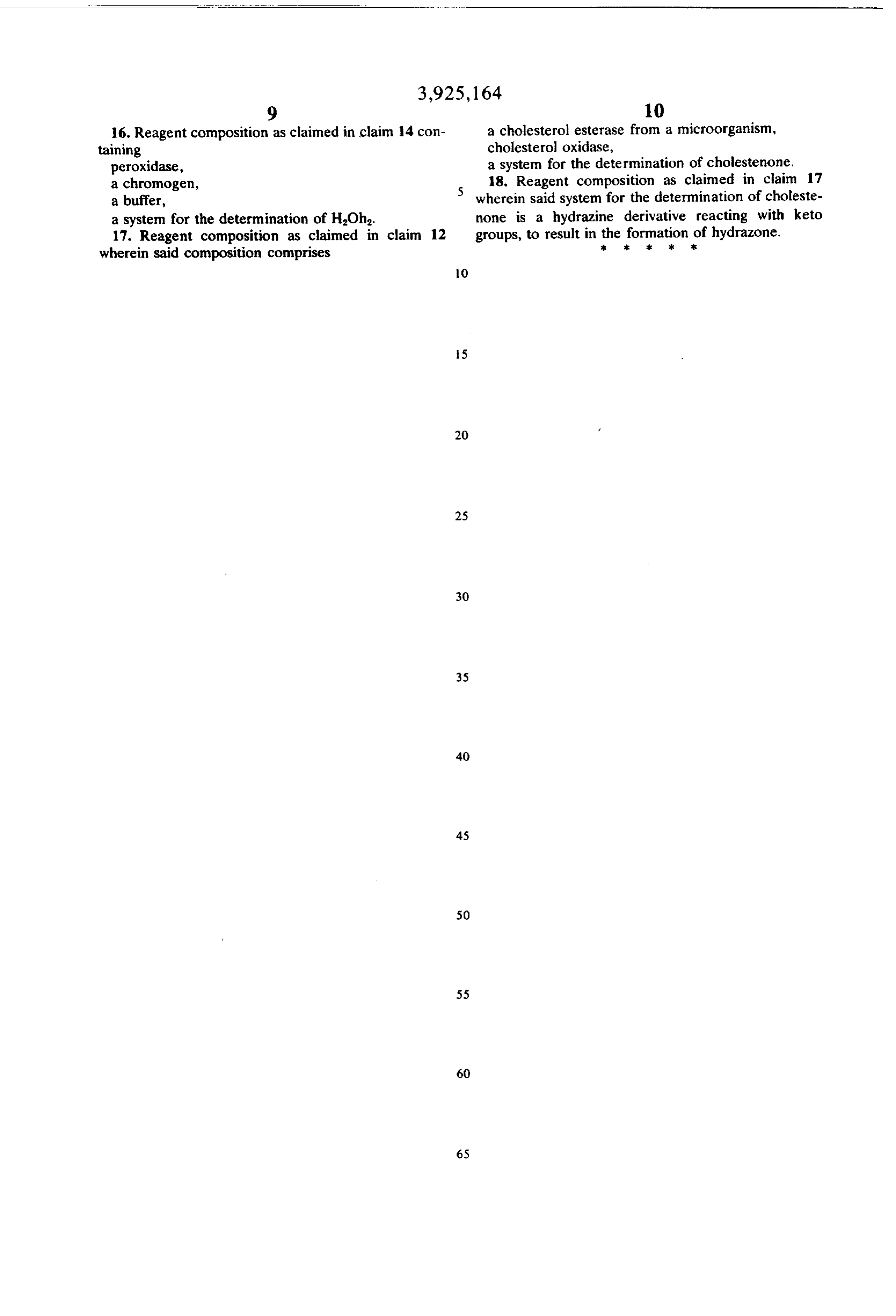
16. Reagent composition as claimed in claim 14 con a cholesterol esterase from a microorganism, taining cholesterol oxidase, peroxidase, a system for the determination of cholestenone. a chromogen, 18. Reagent composition as claimed in claim 17 a buffer, wherein said system for the determination of choleste a system for the determination of HOh. none is a hydrazine derivative reacting with keto 17. Reagent composition as claimed in claim 12 groups, to result in the
formation
hydrazone.
wherein said composition comprises
Provenance
- Collection
- Cited prior art
- Original PDF
- patentimages.storage.googleapis.com →
- Filed
- 1974-03-25
- Pages
- 6
- Method
- pdftotext (the PDF's own text layer) + pdftoppm 300dpi page scans
- Source
- Google Patents bibliographic record
- Granted
- 1975-12-09
- Inventors
- Klaus Beaucamp; Hans Mollering; Gunter Lang; Wolfgang Gruber; Peter Roeschlau; Boehringer Mannheim GmbH
- Transcribed from
- patentimages.storage.googleapis.com →