patent · US2113602
Internal combustion engine
12 April 1938
Page 1
Drawing sheet — no readable text.
Page 2
Drawing sheet — no readable text.
Page 3
Patented Apr. 2, 1938 2,113,602
UNITED STATES2,113,602PATENT OFFICE
NTERNAL coMBUSTION EGREE
Nathaniel P. Pratt, Atlanta, Ga.
Application July 10, 1933, serial No. 6,982
This invention relates to internal combustion present invention will hereafter be described in engines, and has as its object the development detail in connection with the accompanying of greater power and the more efficient and eco drawings wherein:
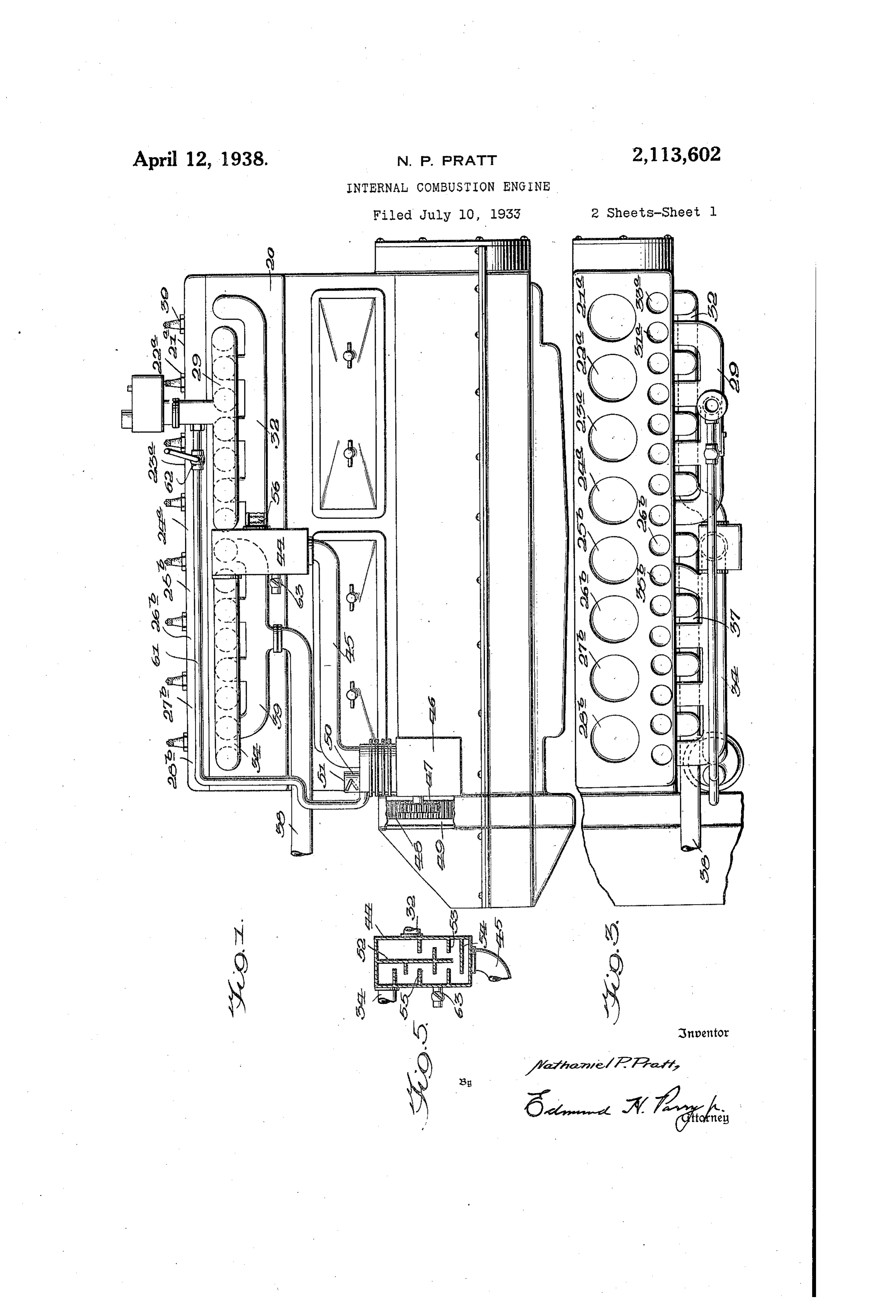
nomical use of fuel whereby all of the combustible Fig. 1 is a view in longitudinal elevation of a 5 values in the fuel are completely consumed in conventional line engine with the present inven the engine and enter into the production of tion applied thereto;
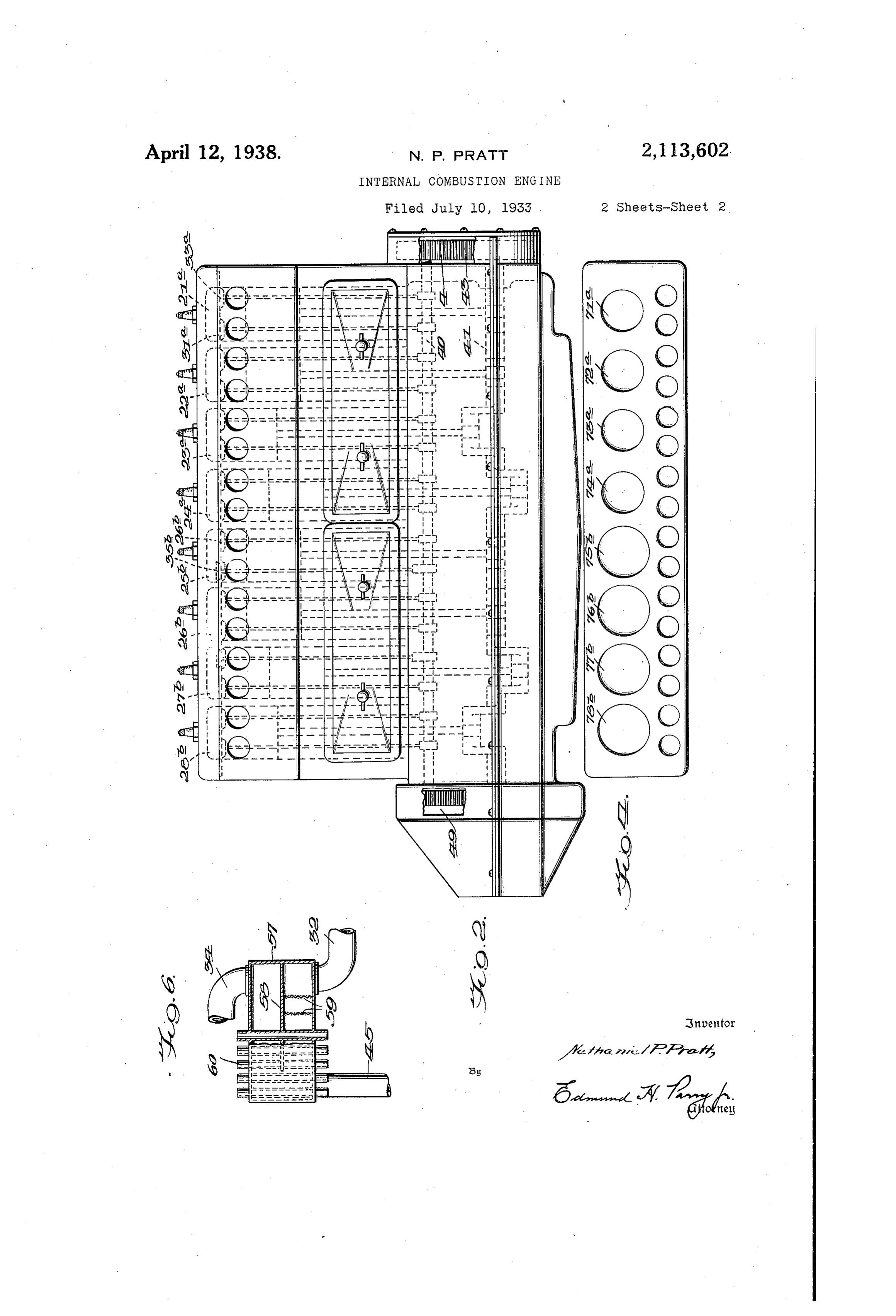
power. Fig. 2 is a view of the engine shown in Flg. I In conventional internal combustion engines with the intake and exhaust manifolds of the charges of fresh fuel are supplied successively present invention removed and showing more or O to all of the combustion cylinders for the pro less diagrammatically the valves, crank shaft O duction of power, which means that a quantity and other interior operating parts; of fresh fuel: is necessary to the production of TFig. 3 is a top view of the engine shown in power in every cylinder, and by reason of the Fig. with the cylinder head removed; relatively low efficiency of combustion engines Fig. 4 is a view corresponding to Fig. 3 show 5 and their known inability to use all the available ing a modified construction wherein different energy in the fuel in the production of power, groups of cylinders have different displacements; the fuel consumption is relatively high and the Fig. 5 is a sectional elevation of one of the operation of the engines Costly. - parts of the engine shown in Fig. 1; and, According to the present invention only a por Fig. 6 is a view partially in section and par 20 tion of the cylinders of an engine utilize charges tially in elevation showing a device which may be 20 of fresh fuel for their explosive power impulses, substituted for the construction of Fig. 5. but at the same time the remaining engine cyl In accordance with the method described in inders produce explosive power impulses. The the above identified application, cylinders includi explosive charges for the latter cylinders are ing those utilizing the exhaust gases as the source 5 obtained from the products of combustion of the of their charge operate conventionally on the 25 first cylinders. The exhaust gases discharged four-cycle principle, each to draw in, compress, from the first cylinders, which I will designate explode, and finally discharge its particular as the primary cylinders, instead of passing into charge. The prior application points out that the atmosphere are collected and treated to pro the products of combustion, or exhaust, from 30 vide a new explosive mixture which is then passed engine cylinders which operate on fresh fuel to and exploded in the other, or secondary, cyl charges, as from a carburetor, contain substan- . 30 inders. By this arrangement each portion of fuel tial quantities of combustible constituents in ad initially introduced into the engine is made to yield two explosive power impulses by successive dition to inert gases in the form of carbon monox ide, hydrogen and methane. The actual quantity 5 and distinct explosion in one cylinder and then of these combustible constituents will depend upon 35 another. The fuel consumption is reduced ap the richness or leanness of the air fuel mixture proximately by a half since each initial fuel charge introduced-or, more properly, the fuel that the tooriginal supplied the cylinders, but it has been found air fuel mixture may be pro charge", and the products of combustion of the 40 fuel charge-produce explosive power impulses portioned to produce substantial quantities of 40 combustibles in the exhaust without perceptibly in a plurality instead of a single cylinder of an decreasing engine. r the power developed by the explosion In my co-pending application Serial No. 658,- of the fuel charge. Assuming that a relatively 986, filed February 28th, 1933, I have disclosed rich fuel mixture is used wherein the fuel and a method of utilizing fuel in engines, the essence air are in the proportions of :9 by weight the 45 of which involves the operation of combustion completeness of combustion is only 50% and the engine cylinders by explosion of the exhaust gases. exhaust gases will contain. 21.7% combustibles. resulting from the combustion of fuel in other If the air fuel mixture is made even richer there engine cylinders. The present invention is par may be some loss of power in the explosion ticularly directed to an engine construction developed although greater quantities of com 50 adapted to carry out such method, and also to bustibles will be derived in the exhaust. The show how the existing engines may be readily mixture may be made somewhat leaner, say per modified for the same purpose. haps up to a ratio of 1:12 or 1:14 as sufficient pro 55 The engine constituting one embodiment of the portions of combustibles will be yielded into the 55
Page 4
exhaust as are capable of explosion under suit erative communication with the exhaust mani able conditions. fold 32 of the primary cylinders. With such ar It is further pointed out in the prior applica rangement the exhaust gases from the various tion that the combustible constituents present primary cylinders will be collected in the mani in the exhaust may be utilized as the basis of fold 32 and thereafter conducted to manifold 34 a charge suitable for re-explosion by mixing the for admission selectively and at the proper time same with air or oxygen in proportions deter into the various secondary cylinders under reg mined by the quantities of combustibles present, ulation of valve control intake ports 35b. The precautions being taken to extinguish any flame discharge of exhaust gases from the secondary O present in the exhaust gases and reduce their cylinders 25b-28b is regulated by valve control 0. temperature below the point of spontaneous con exhaust ports 36b and the gases are conducted bustion prior to admixture with the air. These away by an exhaust manifold 37 and the ex various operations are taken care of in the en haust line 38.
gine now to be described. All of the primary cylinders will be provided 5 An engine incorporating the features and Op with charge-igniting means such as the Spark 5 erating as above generally described may include plugs 39, and it is deemed preferable also to pro any desired number of cylinders arranged in any vide the secondary cylinders with similar firing desired relation. Each cylinder will operate con means, although in the latter instance it may ventionally according to the four-cycle principle under some conditions be found that the exhaust 20 of operation. It will be understood that all of gases may be ignited and exploded in the sec 20 the cylinders and their operating parts need not ondary cylinders with spontaneous combustion necessarily be altered from conventional con after they have been compressed therein. Each struction in order to utilize the invention. On of the cylinders, both primary and secondary, the other hand, the invention involves essential will at the appropriate time draw in a charge 25 ly a re-arrangement and division in the auxiliary upon the downward stroke of its piston as the 25 parts of the engine which supply fuel to and dis valve control intake port (3a and 35b) is opened charge the expended gases from the various cyl through a can on the cam shaft 40 which is inders. In order that these points may be fully driven by the crank shaft 4f as through gears appreciated and also to make clear how the in 42 and 43 (see Fig. 2). The charge will then be vention may be applied to present day engines I compressed and the igniting means will then Op 30 have in the drawings, reference being had in erate to fire the charge and produce a downward particular to Figs. 1, 2, and 3, illustrated a line explosive stroke of the piston and impart a power type engine 20, the same having any desired num impulse to the crankshaft. On the next upward ber of cylinders, eight in number being disclosed. stroke of the piston the expended charge will 35 While all of the cylinders and the valve mecha pass out into the appropriate manifold (32 or 35 nism therefor operate conventionally and in ac 37). The exhaust gases from the secondary cyl cordance with any desired firing order, only a inders will either pass out into the atmosphere part of the cylinders will utilize fresh fuel. I through the exhaust line 38 or be put to some have as a matter of convenience selected the first desired use, while the exhaust gases from the 40 four cylinders 2 fa, 22a, 23a, and 24a as the pri primary cylinders passing into the manifold 32 40 mary cylinders, the remaining cylinders 25b, 26th, will be treated to put the combustible constituents 27b, and 28b being intended to utilize as their present therein in condition for re-explosion in explosive charge a mixture formed from the ex the secondary cylinders.
haust gases of the primary cylinders after the To provide an explosive charge for the second 45 gases have been treated to put them in explosive ary cylinders the exhaust gases, or products of 45 condition. Depending perhaps on the firing or combustion from the primary cylinders, are sup der for the various cylinders, it may in some cases plemented by air in proportions. Such as to sup be desirable to agroup the primary and secondary port explosion of the combustible constituents in cylinders differently from what has just been the gases. As pointed out, the quantity of air 50 Suggested. The various primary cylinders are necessary will be determined by the quantity of 50 connected by a supply line or intake manifold 29 combustibles present, and this in turn is depend with a fresh fuel charge forming device such as ent upon the air fuel ratio of the original fuel the carburetor 30. Such device will receive a charge exploded in the primary cylinders as regul supply of gasoline or other fuel from a suitable lated in the charge forming device 30. Air is 55 Source and vaporize the same with air in propor therefore supplied to and admixed with the ex 55 tions such as to provide an air fuel ratio which haust gases prior to their introduction into the when exploded in the primary cylinders will leave various secondary cylinders. The formation of Substantial quantities of combustible materials, the new charge may be conveniently effected by methane, hydrogen and carbon monoxide, in the interposing in the manifold line 32-34 a cham 60 residual gases. The fuel charge will be distrib ber 44. The air supply may be introduced into uted to the various primary cylinders 2a-24a such a chamber in any convenient way, it being through the intake manifold, admission to the pointed out in this connection that relatively respective cylinders being regulated by conven little pressure is developed in the manifolds by tional valve-control intake ports such as 3 a. reason of the fact that the secondary cylinders 65 An exhaust manifold 32 for the various primary 25b-28b withdraw the gases from the manifold 65 Cylinders is provided, the discharge of gases foll line as fast as they are produced and discharged lowing explosion in the cylinders being regulated from the primary cylinders 2a-24a. As one con as conventionally by valve-control exhaust ports venient way of supplying air to the exhaust gases Such as 33a. I have shown an air line 45 communicating with 70 The fresh fuel charge intake manifold 29 does the mixing chamber 34. An air pump 46 may be 70 not supply the secondary cylinders 25th-28b, but utilized to force air through the line 45 and into on the other hand a separate intake manifold the chamber, the pump being conveniently driven is provided for the secondary cylinders. As in any suitable manner as by means of a gear will be evident from Figs. 1 and 3 such intake 47 meshing with teeth 48 on the fly wheel 4.
5. manifold forms a continuation of and is in op The pump will have an air intake 50 which may 75
Page 5
be provided with a control valve 5 adapted to as the carburetor 36 which supplies the primary regulate to Some degree the Volune of air Sup cylinders. Such line is provided with a control plied to the exhaust gases. The speed of the air Valve 62 so that the same may be rendered oper pump and the rate of supply of air thereby will ative or inoperative at Will. Where the air pump Wary directly as the rate of flow of exhaust gases 46 is utilized to supply air to the exhaust gases under various conditions of engine speed by rega the fuel line 6G may connect with the pump in Son of its driving connection with the engine fly take 50 so that fuel Will be drawn through the wheel. Depending on the quantities of combus line from the carburetor and introduced through tible constituents in the exhaust gases as deter the supply line 45 to the exhaust gases in the O mined by the original fresh fuel charge air fuel mixing chamber 44. The air inlet control valve ratio, it appears necessary to Supply roughly be 5 may be partially or wholly closed when it is tween 30% and 50% by volume of air in order to desired to admix fresh fuel with the exhaust gases. Constitute with the exhaust gases an explosive It Will be understood, of course, that the Supply charge. ing of fresh fuel to the secondary cylinders is ef s It will be recognized that the function of the fected only when conditions are such as to render chanber 34 is that of a charge-forming device, it necessary to insure explosion therein. . its function with respect to the secondary cylin In the event that it is found that the Secondary de's being the same as the function of the car cylinders 256-28th of the engines shown in FigS. buretor 30 in connection with the primary cylin and 3 are not able to handle the total Volume 20 ders--the admixture of air and combustible ma of exhaust gases supplied from the primary cylin 20 terials in proportions such as to provide an ex ders as supplemented by air, Several expedients plosive mixture. In order to insure a thorough may be resorted to in order to overcome the diffi admixing of the air with the exhaust gases dur cuity. The simplest expedient is the provision ing transit to the secondary cylinders, the mix of a manually or automatically pressure Con 25 ing chamber or charge-forming device 436 may be trolled escape waive at Some point along the 25 constructed as shown in Fig. 5, a series of baffles supply line between the primary and secondary 52, 53, 56, and 55 being provided. Such baffles cylinders. In Figs. 1 and 5 I have show. Sigi a. cause the exhaust gases to take a tortuous path valve, 53 in association with the Iniking cham which serves to some extent to reduce the tem her (343.
30 perature of the exhaust gases. The exhaust gases The arrangement just described is, however, 3. enter through the manifold 32 and during transit wasteful in that the total available energy present are mixed with the air coming in through the in all exhaust gases from the primary cylinders air line 45 and finally after being integrated with are not utilized by reason of the eScape of a por the air pass out as a combustible charge into the tion of the exhaust gases into the atmosphere, manifold 36 for distribution to the various sec While involving some departure from conven 35 Ondary cylinders. In order to prevent spon tional engine construction, this objection may taneous combustion and to insure the absence of be overcome by constructing the engine so that flane in the exhaust gases prior to admixture the secondary cylinders have a larger displace With the air it may be found desirable to provide ment than the primary cylinders. Such arrange A. a flane trap or screen. Such device may be lo ment is illustrated in Fig. 4, the primary cylin 40 cated at any conver Snt point between the sec ders - 6a, being oored to a Smaller diameter Ondary cylinders and the air supply line (35. In than the secondary cylinders 5b-8b. In other Fig. i. Such means is provided in the form of a respects the modified engine will be the same as Series of Screens 56 in the outlet end of the pri that of Figs. 1 and 2 heretofore described. 5 nary exhaust manifold 32. As heretofore pointed out, both the primary The mixing chamber for treating the exhaust and secondary cylinders Will operate on the four gases may be constructed in other ways than cycle principle to draw in their respective charges, that just described. For example, it may take compress, explode, and finally discharge the the form of the device shown in Fig. 6 wherein Sazine. In a sense it may be said that the primary 5) a chamber 5 is provided having a longitudinal and secondary cylinders operate independently of 50 partition 58. The exhaust gases enter at 32, are each other in that there need be no predeter admixed with air entering at 45 and pass out mined order of firing of the various primary cylin through 36. A series of flame screens 59 are in ders with reference to the Warious secondary terposed in the chamber adjacent the inlet end cylinders by reason of the fact that all of the and a Series of tubes 60 extend through the cham primary cylinders discharge their exhaust gases ber around which the gases pass both before and into a common manifold 32 and Such gases ad after admixture with the air. The purpose of mixed with air are distributed to the various Such tubes is in part to cause thorough integra secondary cylinders as required under control of tion of the air and exhaust gases. They are the secondary valve controlled intake ports. O also desirably made hollow so as to permit the It will be evident that in the engine described circulation of the air from the outside there an original fuel charge supplied by the carburetor 60 through so as to somewhat reduce the tempera 3 will be exploded in the primary cylinders and ture of the gases and guard against spontaneous thereafter in the form of exhaust gases be intro combustion. duced and exploded in the Secondary engine In order to promote explosion of the exhaust cylinders. An original fuel charge therefore 65 gas charge in the secondary cylinders when the passes successively through several cylinders in engine is first started, and again to provide a each of which it produces an explosive power in kindler serving to promote explosion of the gases pulse on the crank shaft, thus performing double when a relatively lean fresh fuel mixture is sup the amount of Work that it accomplishes in con plied to and exploded in the primary cylinders, ventional internal combustion engines and result 70 it is deemed advisable to provide an auxiliary ing in tremendous fuel economy. It will now be appreciated that the invention is source of fresh fuel for introduction at appropri capable ate tirnes in the secondary cylinders. To this of ready application to existing engines end an auxiliary fuel line 6 may be provided merely by a relatively inexpensive re-arrange 5 connecting with a Suitable source of fuel such ment of the exhaust and intake manifolds there
Page 6
for together with suitable means for supplying air, charge and discharge the exhaust gases after ex and it is therefore evident that the invention has plosion, valve-controlled intake and exhaust a wide application. Of course the Various fea ports in each cylinder, a source of. fuel and an tures of the invention may be incorporated in intake manifold connecting with intake ports different types of engines than that illustrated of certain of the cylinders in communication with 5 and described and considerable modification and the source of fuel, an exhaust manifold connect equivalency may be carried out without departing ing with the exhaust ports of said same cylinders, from the essential principles of construction here independent intake and exhaust manifolds con in Set forth. necting with the valve-controlled intake and ex 0 I an aware of course that it has heretofore haust ports of the other combustion cylinders, a 0 been proposed to utilize the heat developed by charge forming chamber having a source of air exhaust gases from internal combustion engines supply connecting therewith interconnecting the in expansion cylinders. In such instances only exhaust manifold of said certain cylinders and the heat energy of the exhaust gases is utilized the intake manifold of said other cylinders adapt 5 and the power developed therein is far less than ed to supply said other cylinders with a combusti- 5 that obtained according to the present invention ble charge formed of exhaust gases and air un wherein the exhaust gases are formed into a new der control of the valves controlling the intake charge and exploded in combustion cylinders in ports of said other cylinders, and flame extin the Same manner as a fresh fuel charge is op guishing means through which the exhaust gases 20 erated upon. - pass prior to admixture with the air. 20 The present application is a continuation in 4. In an internal combustion engine, a plu part of my prior application Serial No. 413,837, rality of combustion cylinders each having valve controlled intake and exhaust ports and Operat filed December 13th, 1929. All of the basic fea ing to receive, compress, explode and discharge tures in the present application are disclosed in 25 the previous case, but I have now introduced combustible charges, an intake manifold connect- 25 certain collateral features and improvements ing with the intake ports of one group of Said adapted to increase the utility and efficiency of cylinders, a fuel charge device supplying a charge the basic construction. of fresh fuel to said group of cylinders through I claim: said intake manifold, gas conducting means con 30 1. In an internal combustion engine, a plu necting with said group of cylinders through 80 rality of combustion cylinders, means for car the exhaust ports therein and also with the in bureting fresh liquid fuel and air to provide a take ports of a second group of the engine cylin preformed explosive fuel charge, means for sup ders and adapted to conduct the exhaust gases plying said, charge in explosive condition to from the first mentioned group of cylinders to various of the engine cylinders constituting a the second group of cylinders, charge forming 25 primary group, means for selectively admitting, means including a source of air in the gas con compressing and exploding the charge in the ducting means to form the exhaust gases during Various cylinders of said group, and means for transit into a new combustible charge for explo discharging the exhaust gases from the cylinders sion in the second group of cylinders, the dis 40 following explosion, in combination with means charge of exhaust gases from the cylinders of 40 receiving, said discharged exhaust gases and form the first mentioned group and the intake of the ing therefrom a distinct new charge including new charge by the cylinders of the second group means supplying a regulated quantity of air to being regulated by the exhaust and intake valves. provide a mixture wherein the combustibles in 5. In an internal combustion engine, a plu the gases and the air are in a ratio to render the rality of combustion cylinders each having valve- 5 new charge capable of explosion, means for selec controlled intake and exhaust ports and operat tively admitting, compressing and firing the new ing to receive, compress, explode and discharge mixture in other of said plurality of cylinders combustible charges, an intake manifold connect constituting a second group, and means for dis ing with the intake ports of a first group of said 50 charging the exhaust gases from the cylinders of cylinders, a fuel charge device supplying a charge so the Second group following explosion. of fresh fuel to Said group of cylinders through 2. In an internal combustion engine, a plu said intake manifold, gas conducting means con rality of Combustion cylinders each adapted to necting with the first group of cylinders through receive, compress and explode a combustible the exhaust ports therein and also with the in 55 charge and discharge the exhaust gases after ex take ports of a second group of the engine cylin- 55 plosion, valve-controlled intake and exhaust ders and adapted to conduct the exhaust gases ports in each cylinder, a source of fuel and an from the first group of cylinders to the Second intake manifold connecting with intake ports group of cylinders, means for extinguishing any of certain of the cylinders in communication with flame present in the exhaust gases during pas 60 the source of fuel, an exhaust manifold connect Sage from one to the other group of cylinders, 60 ing with the exhaust ports of said same cylinders, means including a source of air in the gas con independent intake and exhaust manifolds con ducting means to form the exhaust gases after necting with the valve-controlled intake and extinction of any flame into a new combusti exhaust ports of the other combustion cylinders, ble charge for introduction and explosion in 65 and a charge forming chamber having a source the second group of cylinders, the discharge of 65 of air supply connecting therewith interconnect exhaust gases from the cylinders of the first ing the exhaust manifold of said certain cylinders group and the intake of the new charge by the and the intake manifold of said other cylinders cylinders of the Second group being regulated by adapted to supply said other cylinders with a the exhaust and intake valves.
70 combustible charge formed of exhaust gases and 6. In an internal combustion engine, a plural- 70 air under control of the valves controlling the ity of combustion cylinders each having valve intake ports of said other cylinders. controlled intake and exhaust ports and operat 3. In an internal combustion engine, a plu ing to receive, compress, explode and discharge rality of combustion cylinders each adapted to combustible charges, an intake manifold connect 75 receive, compress and explode a combustible ing with the intake ports of a first group of said 75
Page 7
cylinders, a fuel charge device supplying a charge ity of combustion cylinders each having valve of fresh fuel to said group of cylinders through controlled intake and exhaust ports and Operat said intake manifold, gas conducting means con ing to receive, compress, explode and discharge necting with the first group of cylinders through combustible charges, an intake manifold con the exhaust ports therein and also with the in necting with the intake ports of a first group of take ports of a second group of the engine cylin said cylinders, a fuel charge device Supplying ders and adapted to conduct the exhaust gases fresh fuel charges to said group of cylinders from the first group of cylinders to the second through said intake manifold, gas conducting group of cylinders, charge forming means includ means connecting with the first group of cylin O ing an arangement for supplying air to the gas ders through the exhaust ports therein and also O conducting means to form the exhaust gases into. with the intake ports of a second group of the a new combustible charge for introduction to and engine cylinders and adapted to conduct the ex explosion in the second group of cylinders, means haust gases from the first group of cylinders to for reducing the temperature of the exhaust the Second group of cylinders, means including 5 gases and destroying any flame present prior to an air pump connecting With the gas conducting 5 the point of admixture of the gases with the air, means to form the exhaust gases into a new com the discharge of exhaust gases from the cylin bustible charge for introduction to and explosion ders of the first group and the intake of the new in the second group of cylinders, the discharge charge by the cylinders of the Second group being of exhaust gases from the cylinders of the first regulated by the exhaust and intake Valves. group and the intake of the new charge by the 20 7. In an internal combustion engine, a plural cylinders of the second group being regulated by ity of combustion cylinders each having valve the exhaust and intake Valves.
Controlled intake and exhaust ports and operat 10. In an internal combustion engine, a plural ing to receive, compress, explode and discharge ity of combustion cylinders each having Walve Combustible charges, an intake manifold con controlled intake and exhaust ports and operat 25 necting with the intake ports of a first group of ing to receive, compress, explode and discharge said cylinders, a fuel charge device supplying a combustible charges, an intake manifold con charge of fresh fuel to said group of cylinders necting With the intake ports of a first group of through Said intake manifold, gas conducting said cylinders, a fuel charge device Supplying said means connecting with the first group of cylin group of cylinders through Said intake manifold, 30 ders through the exhaust ports therein and also gas. Conducting means connecting With the first with the intake ports of a second group of the group of cylinders through the exhaust ports engine cylinders and adapted to conduct the ex therein and also with the intake ports of a sec haust gases from the first group of cylinders to ond group of the engine cylinderS and adapted the second group of cylinders, charge forming to conduct the exhaust gases from the first group 35 means intermediate the several groups of cylin of cylinders to the second group of cylinders, a. ders including an arrangement for supplying air baffled mixing chamber in the gas conducting to the gas conducting means to form the exhaust means intermediate the exhaust ports of the first gases into a new independent combustible charge group of cylinders and the intake ports of the for introduction to and explosion in the second second group of cylinders having a Source of air 40 group of cylinders, the discharge of exhaust gases connecting therewith and adapted to mix the from the cylinders of the first group and the in exhaust gases with air to form a new combustible take of the new charge by the cylinders of the charge for explosion in the Second group of cyl Second group being regulated by the exhaust and inders, the discharge of exhaust gases from the intake valves, and valve-controlled fresh fuel cylinders of the first group and the intake of 45 auxiliary supply means for the second group of the new charge by the cylinders of the second Cylinders communicating with the gas conducting group being regulated by the exhaust and intake
8. In an internal combustion engine, a plural 11. In an internal combustion engine, a plu ity of combustion cylinders each having valve rality of combustion cylinders each having valve 50 controlled intake and exhaust ports and operat controlled intake and exhaust ports and oper ing to receive, compress, explode and discharge atting to receive, compress, explode and discharge combustible charges, an intake manifold con combustible charges, an intake manifold con necting With the intake ports of a first group of necting with the intake ports of a first group Said cylinders, a fuel charge device supplying of said cylinders, a fuel charge device supplying 55 fresh fuel charges to said group of cylinders said group of cylinders through said intake mani through Said intake manifold, gas conducting fold, gas conducting means connecting with the means connecting with the first group of cylin first group of cylinders through the exhaust ders through the exhaust ports therein and also ports therein and also with the intake ports of With the intake ports of a second group of the a Second group of the engine cylinders and engine cylinders and adapted to conduct the ex adapted to conduct the exhaust gases from the haust gases from the first group of cylinders to first group of cylinders to the second group of the second group of cylinders, means including cylinders, a baffled mixing chamber in the gas an arrangement for Supplying air to the gas con conducting means intermediate the exhaust ports ducting means to form the exhaust gases into a of the first group of cylinders and the intake 65 new conibustible charge for introduction to and ports of the second group of cylinders having a explosion in the Second group of cylinders, the source of air connecting therewith and adapted discharge of exhaust gases from the cylinders of to mix the exhaust gases with air to form a new the first group and the intake of the new charge combustible charge for explosion in the second O by the cylinders of the Second group being regu group of cylinders, and means for extinguishing O lated by the exhaust and intake valves, the com any flame present in the exhaust gases prior to . bustion cylinders which utilize the exhaust gas the addition of air in the mixing chamber, the air charge being of greater displacement than discharge of exhaust gases from the cylinders the cylinders utilizing fresh fuel. of the first group and the intake of the new 75 9. In an internal combustion engine, a plural charge by the cylinders of the second group be- 75
Page 8
ing regulated by the exhaust and intake valves. ary cylinder group receiving from the primary 12. In an internal combustion engine a group group the products of combustion of the fresh of primary combustion cylinders having firing fuel charge and forming the same into a gaseous means and valve-controlled intake and exhaust explosive charge with air, together with means ports and operating to receive, compress, explode for supplying the gaseous charge as the operat and discharge a fuel charge, a group of Second ing charge to the secondary cylinder group, and ary combustion cylinders having intake and ex means for firing the respective charges in the haust ports, a fuel charge forming device, an primary and Secondary cylinders. intake manifold connecting with the fuel charge 16. In an internal combustion engine, a plu 10 forming device and supplying the primary cylin rality of four cycle combustion cylinders, means 10 ders with fuel through the intake ports therein, for Supplying a combustible fresh fuel charge to an exhaust manifold connecting with the exhaust one group of Said cylinders as the operating ports of the primary cylinders, a separate intake charge therefor, means for firing the charga manifold for the Secondary cylinders communi therein, a charge forming device receiving the 5 cating with the exhaust manifold of the primary gaseous products of combustion discharged from cylinders and adapted to supply the exhaust gases the cylinder group utilizing said fresh fuel charge, to the secondary cylinders, means for Iowering said charge forming device serving to supply and the temperature of the exhaust gases and elimi mix with said products of combustion a regulated nating any flame therein, means for admixing the quantity of air proportioned with relation to the 20 exhaust gases with air to form an explosive mix combustible portions of said gaseous products So ture for the secondary cylinders, the Secondary as to form a gaseous explosive charge, and a con cylinders having firing means and valves con duit connecting with said charge forming device trolling their intake and exhaust ports and Oper and serving to supply the charge developed as ating to receive, compress, explode and then dis the operating charge to another - group of Said 25 charge the exhaust gas mixture in the same main cylinders, and means for firing said gaseous ner as the primary cylinders operate upon the charge in said latter cylinder group. fresh fuel charge. it. In an internal combustion engine a plural 13. In an internal combustion engine, a plu ity of explosion chambers, means for admixing rality of combustion cylinders arranged in line fresh vaporizable fuel and air to produce an ex 30 and having pistons working through a Common plosive mixture, means for periodically admit 30 crankshaft, each of said cylinders having charge ting portions of said explosive mixture into cer firing means and valve-controlled intake and ex tain of Said chambers, means for exploding said haust ports, an intake manifold communicating portions of said mixture in said chambers, means with the intake ports of certain of said cylin responsive to the resulting explosions and pro 35 ders defining a group, a Separate intake mani pelled thereby to convert the explosive impulses fold communicating with the intake ports of into mechanical power, means for bringing about other engine cylinders defining another group, the withdrawal from said chambers of the gases separate exhaust manifolds communicating with resulting from said explosions, means including the exhaust ports of the several groups of cylin air inlet means for reforming said gases into a 40 diers, a charge forming device Communicating Separate, new, non-faming explosive mixture, 40 With the intake manifold of one group of cylin means for periodically admitting portions of said ders and supplying said group of cylinders with new explosive mixture into certain of said cham fresh fuel charges for compression and explosion bers, the arrangement being such that the ex therein, the intake manifold for the other group haust gases taken from one chamber will be in 45 of cylinders connecting with the exhaust mani troduced into a different chamber, means for fold of Said one group, means for admixing air exploding said portions of the new explosive mix With the exhaust gases from said one group of ture in said chambers, and means responsive to cylinders to form the same into a combustible the resulting explosions and propelled thereby to charge prior to their passage into the other convert the explosive impulses into additional 50 group of cylinders, the valved intake ports per mechanical power. 50 mitting the introduction of the new mixture into 18. In an internal combustion engine a plu the cylinders of the other group at any desired rality of explosion chambers, means for admix intervals for compression and explosion therein. ing fresh vaporizable fuel and air to produce an 14. In an internal combustion engine, a plu explosive mixture, means for periodically admit 55 rality of four-cycle combustion cylinders, means ting portions of said explosive mixture into cer for supplying a combustible fresh fuel charge tain of said chambers, means for exploding said to one group of said cylinders as the operating portions of Said mixture in said chambers, means charge therefor, means for firing the charge responsive to the resulting explosions and pro therein, a charge forming device having an in pelled thereby to convert the explosive impulses 60 take receiving from said cylinder group the gas into mechanical power, means for bringing about 60 eous products of combustion of said fresh fuel the withdrawal from said chambers of the gases charge and including means for admixing air resulting from said explosions, means including with said products in said device to form there air and fresh fuel inlet means for reforming said from a distinct new explosive charge, a conduit gases into a separate, new, non-flaming explosive receiving the gaseous charge formed in said mixture, means for periodically admitting por charge forming device and supplying the same to tions of said new explosive mixture into certain another cylinder group as the operating charge of said chambers, the arrangement being such therefor, and means for firing said gaseous that the exhaust gases taken from one chamber charge in said other cylinder group. will be introduced into a different chamber, O 15. In an internal combustion engine, a plu means for exploding said portions of the new rality of four-cycle combustion cylinders Com explosive mixture in said chambers, and means prising a primary group and a secondary group, responsive to the resulting explosions and pro a charge forming device supplying an explosive pelled thereby to convert the explosive impulses fresh fuel charge to the primary cylinder group, into additional mechanical power. 5 a separate charge forming device for the Second 19. In an internal combustion engine, a plu 5
Page 9
rality of combustion cylinders each having valve of cylinders for collecting the exhaust gases dis Controlled intake and exhaust ports and oper charged therefrom, charge forming means for atting to receive, compress, explode and discharge admixing air with said exhaust gases from the COmbustible charges, an intake manifold con fresh fuel cylinders to form therefrom a new ex necting with the intake ports of a first group of plosive gaseous charge, and means for controlling Said cylinders, a fuel charge device Supplying the proportioning of said new charge ingredients fresh fuel charges to said group of cylinders in accordance with the air-fuel ratio of the fresh through said intake manifold, gas conducting fuel charge which determines the composition means connecting with the first group of cylin and combustibility of the exhaust gases, a sepa O ders through the exhaust ports therein and also rate intake manifold connecting With a second With the intake ports of a second group of the cylinder group comprising other cylinders of the engine cylinders and adapted to conduct the ex engine for distributing the new gaseous charge haust gases from the first group of cylinders to thereto as the explosive operating charge, and a the second group of cylinders, means including Separate exhaust manifold for said Second group 5 an arrangement for supplying air in the gas con of cylinders.
ducting means to form the exhaust gases into 22. In combination, a first group of four cycle a new combustible charge for introduction to firing engine cylinders, a carburetor adapted to and explosion in the second group of cylinders, form an explosive charge of fresh liquid fuel, an the discharge of exhaust gases from the cylin intakemanifold distributing said fresh fuel charge 20 ders of the first group and the intake of the new to said group of cylinders as the operating charge 2. charge by the cylinders of the second group be therefor, an exhaust manifold collecting the ex ing regulated by the exhaust and intake valves, haust gases discharged from said cylinders, a sec and means for introducing an auxiliary supply ond group of four cycle firing engine cylinders, of fresh fuel into the new charge prior to ex an intake manifold for conducting the exhaust 25 plosion in the second group of cylinders, the sec gases from the exhaut manifold of the cylinders Ond group of cylinders being of greater displace of the first group to the second group of cylinders, ment than the first group of cylinders. and charge forming means for proportioning and 20. An internal combustion engine comprising mixing said exhaust gases during transit to the
a plurality of four cycle firing cylinders, a carsecond group of cylinders with air in controlled buretor adapted to form an explosive charge of proportions in accordance with the air-fuel ratio 3. fresh liquid fuel, an intake manifold connecting of the original fresh fuel charge and providing With said carburetor and distributing the charge a new explosive gaseous mixture as the Operat formed thereby to a first group of the engine ing charge for said second group of cylinders, and
cylinders as the operating charge therefor, an ex a separate exhaust manifold receiving the dis halist manifold for said first group of cylinders charge from the second group of cylinders. 35 having an extension connecting with and con 23. An internal combustion engine comprising stituting the intake manifold for a second differ a first group of four cycle firing cylinderS Operat ent group of the engine cylinders, a charge form ing by the explosion of a fresh liquid fuel charge ing device including an air intake interposed in and a second group of other four cycle firing cyl Said common manifold between the exhaust ports inders operating by the explosion of an explosive of the cylinders of the first group and the inlet gaseous charge developed from the exhaust gases ports of the cylinders of the second group and be of the first cylinder group, and including Separate ing adapted to supply and admix with the exhaust intake manifolds and separate exhaust manifolds gases received from the cylinders of the first for the different groups of cylinders, a carburetor group a proportioned amount of air to supple adapted to supply a fresh liquid fuel charge con Inent the air-fuel ratio of the original charge, necting With one of the intake manifolds to Sup which determines the composition of the exhaust ply the operating charge to the cylinders of said gases, and providing a new explosive charge for first group for explosion therein, and charge distribution by the manifold to the cylinders of . forming means including an air pump Supplying a the second group as the operating charge there Variable amount of air under variations in engine for, and a separate exhaust manifold for the sec speed for proportioning and mixing air and the Ond group of cylinders. exhaust gases from said first group of cylinders 2. An internal combustion engine comprising to provide a new explosive gaseous charge, said a plurality of four cycle firing cylinders, a car charge forming means interconnecting the ex buretor adapted to form an explosive charge of haust manifold of said first group of cylinders fresh liquid fuel, an intake manifold connecting and the intake manifold of the other group of with said carburetor and distributing the charge cylinders and supplying the explosive charge for formed thereby to a first group of the engine cyl the latter group of cylinders. inders as the operating charge therefor, an ex haust manifold connecting with said first group NATANE, P. PRA.
Provenance
- Collection
- Cited prior art
- Original PDF
- patentimages.storage.googleapis.com →
- Filed
- 1933-07-10
- Pages
- 9
- Method
- pdftotext (the PDF's own text layer) + pdftoppm 300dpi page scans
- Source
- Google Patents bibliographic record
- Granted
- 1938-04-12
- Inventors
- Nathaniel P Pratt
- Transcribed from
- patentimages.storage.googleapis.com →