patent · US1404223
Gaseous fuel
24 January 1922
Page 1 — bibliographic record
UNITED STATES PATENT OFFICE.
JAMES R. ROSE, OF EDGEWORTH, PENNSYLVANIA, AND JOHN HARRIs, of LAKEwood,
OHIO, ASSIGNORS TO CARBO-OXYGEN COMPANY, OF PITTSBURGH, PENNsylvania,
A CORPORATION OF DELAWARE.
GASEOUS FUEL.
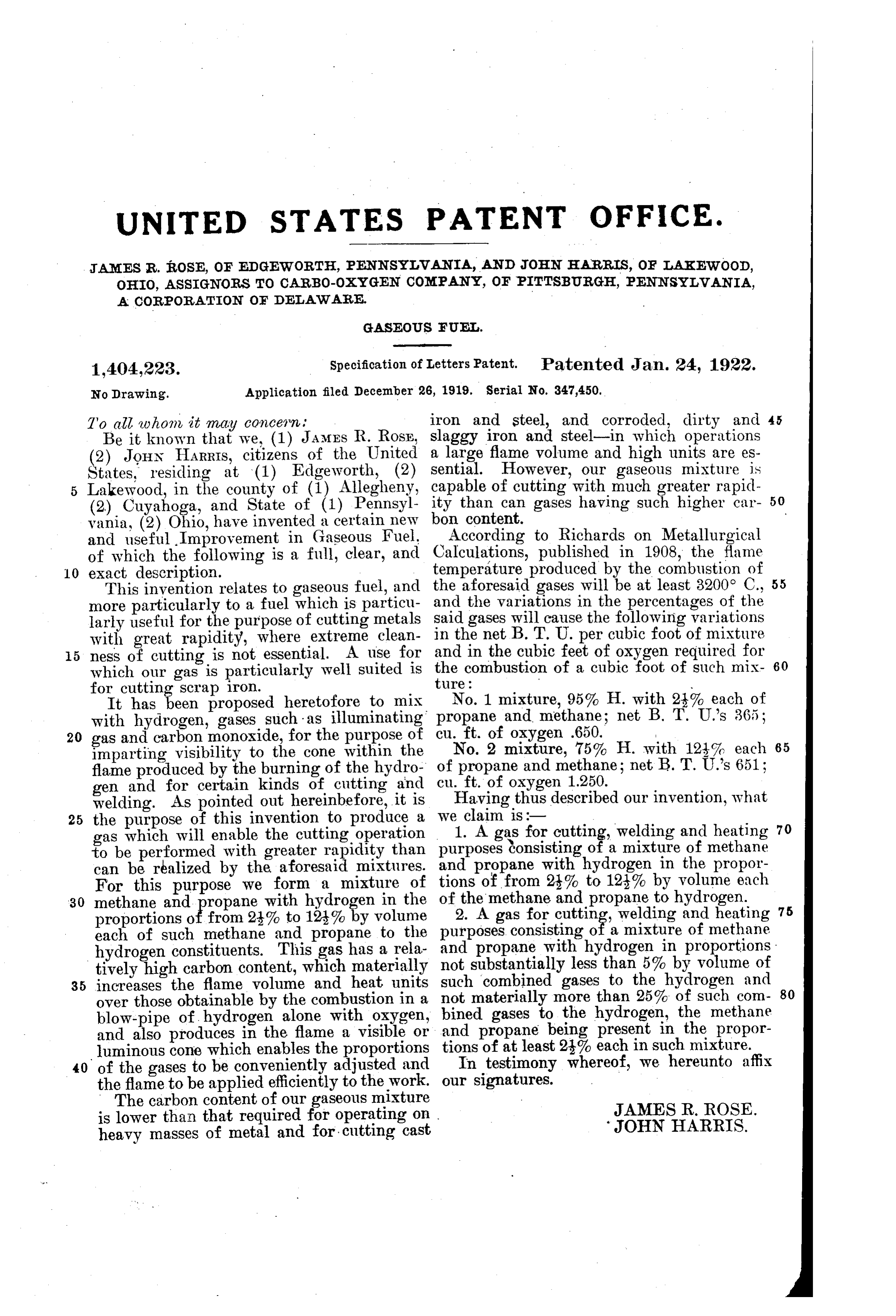
1,404,223. Specification of Letters Patent. Patented Jan. 24, 1922. No Drawing. Application filed December 26, 1919. serial No. 347,450. To all whom it may concern: iron and steel, and corroded, dirty and 45 Be it known that we, (1) JAMEs R. RoSE, slaggy iron and steel-in which operations 2) JoHN HARRIs, citizens of the United a large flame volume and high units are es States, residing at (1) Edgeworth, (2) Sential. However, our gaseous mixture is Lakewood, in the county of (1) Allegheny, capable of cutting with much greater rapid 50 (2) Cuyahoga, and State of (1) Pennsyl ity than can gases having such higher car vania, (2) Ohio, have invented a certain new bonAccording content.
to Richards on Metallurgical and useful Improvement in Gaseous Fuel.
of which the following is a full, clear, and temperature publishedbyinthe1908, the fame combustion of 55 exact description.
This invention relates to gaseous fuel, and the aforesaid gases will be at least 3200° C. more particularly to a fuel which is particu and the variations in the percentages of the larly useful for the purpose of cutting metals said gases will cause the following variations with great rapidity, where extreme clean inandtheinnet B. T. U. per cubic foot of mixture the cubic feet of oxygen required for 60 5 ness of cutting is not essential. A use for the combustion of a cubic foot of such mix which our gas is particularly well suited is ture :
forItciting scrap iron.
has been proposed heretofore to mix No. 1 mixture, 95% H. with 2% each of with hydrogen, gases such as illuminating propane and methane; net B. T. U.'s 365; 20 gas and carbon monoxide, for the purpose of cu.No. ft. of oxygen .650. I
imparting visibility to the cone within the flame produced by the burning of the hydro of propane and methane; net B. T. U.’s 651: gen and for certain kinds of cutting and cu. ft. of oxygen 1.250.
welding. As pointed out hereinbefore, it is Having thus described our invention, what 25 the purpose of this invention to produce a we claim is:- gas which will enable the cutting operation purposes 1. A gas for cutting, welding and heating 70 to be performed with greater rapidity than onsisting of a mixture of methane can be realized by the aforesaid mixtures. and propane with hydrogen in the propor For this purpose we form a mixture of of tions of from 2% to 12% by volume each 30 methane and PE with hydrogen in the the methane and propane to hydrogen. proportions of from 2% to 12% by volume 2. A gas for cutting, welding and heating each of such methane and propane to the purposes and consisting of a mixture of methane propane with hydrogen in proportions hydrogen constituents. This gas has a rela not substantially less than 5% by volume of tively high carbon content, which materially such combined gases to the hydrogen and 35 increases the flame volume and heat units over those obtainable by the combustion in a binednot materially more than 25% of such com 80 blow-pipe of hydrogen alone with oxygen, and propane gases to the hydrogen, the methane and also produces in the flame a visible or being present in the propor luminous cone which enables the proportions tions of at least 2% each in such mixture. 40 of the gases to be conveniently adjusted and In testimony whereof, we hereunto affix the flame to be applied efficiently to the work. our signatures.
The carbon content of our gaseous mixture JAMES R. ROSE. is lower than that required for operating on . JOHN HARRIS. heavy masses of metal and for cutting cast
Provenance
- Collection
- Cited prior art
- Original PDF
- patentimages.storage.googleapis.com →
- Filed
- 1919-12-26
- Pages
- 1
- Method
- pdftotext (the PDF's own text layer) + pdftoppm 300dpi page scans
- Source
- Google Patents bibliographic record
- Granted
- 1922-01-24
- Inventors
- James R Rose; Harris John; CARBO OXYGEN Co
- Transcribed from
- patentimages.storage.googleapis.com →