patent · US1936156
Gaseous fuel
21 November 1933
Page 1 — bibliographic record
Patented Nov. 21, 1933 1936,156
UNITED STATES PATENT OFFICE
GASEOUS FUE,
Luis de Florez, Pomfret, Conn., assignor to The
Texas Company, New York, N. Y., a corpora tion of Delaware
No Drawing. Original application November 4.
1928, Seria No. 39,448. Divided and this ap plication September 25, 1933. Serial No.
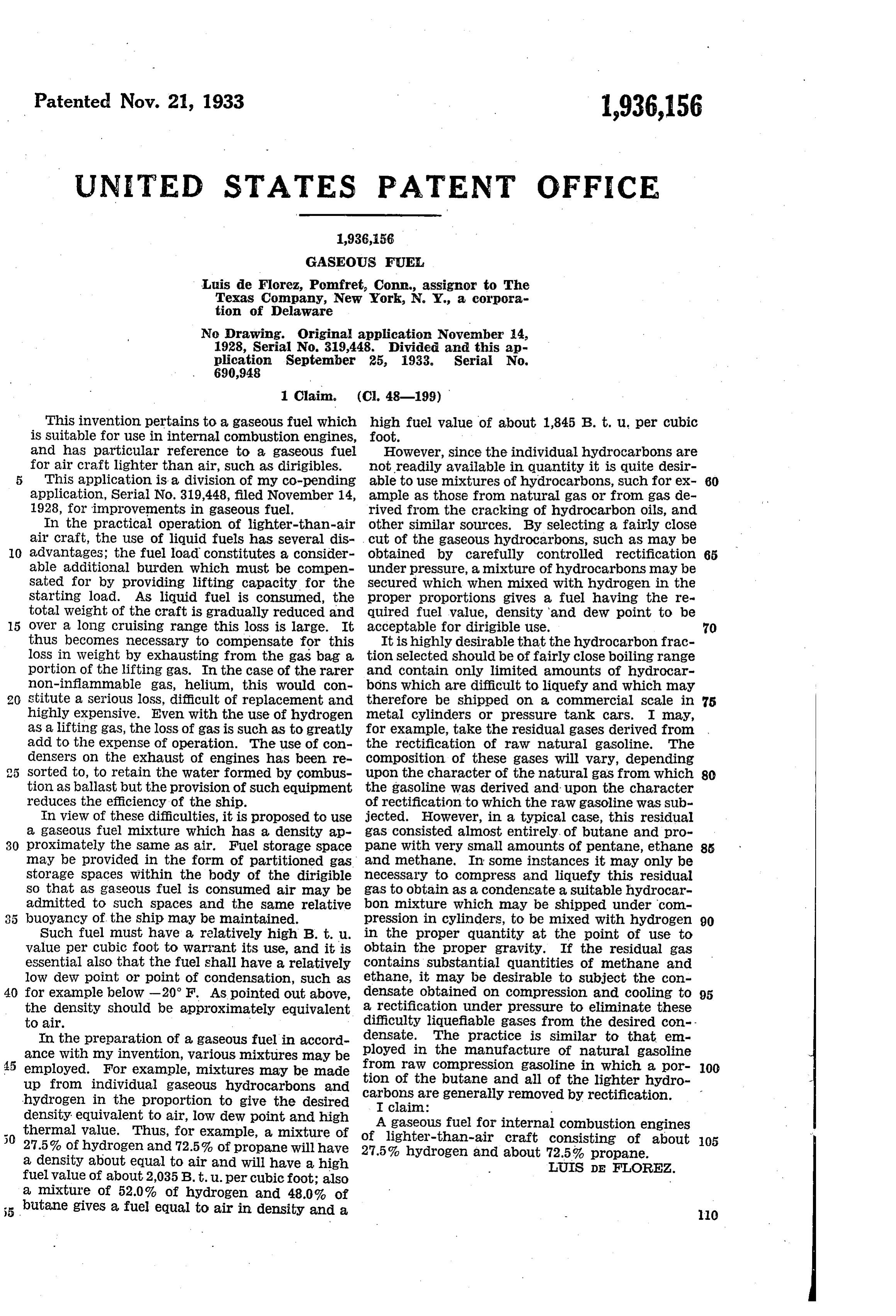
This invention pertains to a gaseous fuel which high fuel value of about 1,845 B. t. u, per cubic is Suitable for use in internal combustion engines, foot.
and has particular reference to a gaseous fuel However, since the individual hydrocarbons are for air craft lighter than air, such as dirigibles. not readily available in quantity it is quite desir This application is a division of my co-pending able to use mixtures of hydrocarbons, such for ex- 60 application, Serial No. 319,448, filed November 14, ample as those from natural gas or from gas de 1928, for improvements in gaseous fuel. rived from the cracking of hydrocarbon oils, and In the practical operation of lighter-than-air other similar Sources. By Selecting a fairly close air Craft, the use of liquid fuels has several dis cut of the gaseous hydrocarbons, such as may be 0. advantages; the fuel load constitutes a consider obtained by carefully controlled rectification 65 able additional burden which must be compen under pressure, a mixture of hydrocarbons may be sated for by providing lifting capacity for the secured which when mixed with hydrogen in the starting load. As liquid fuel is consumed, the proper proportions gives a fuel having the re total weight of the craft is gradually reduced and quired fuel value, density and dew point to be 15 Over a long Cruising range this loss is large. It acceptable for dirigible use. 70 thus becomes necessary to compensate for this It is highly desirable that the hydrocarbon frac loSS in Weight by exhausting from the gas bag a tion selected should be of fairly close boiling range portion of the lifting gas. In the case of the rarer and contain only limited amounts of hydrocar non-inflammable gas, helium, this would con bons which are difficult to liquefy and which may 20 stitute a serious loss, difficult of replacement and therefore be shipped on a commercial scale in 75 highly expensive. Even with the use of hydrogen metal cylinders or pressure tank cars. I may, as a lifting gas, the loss of gas is such as to greatly for example, take the residual gases derived from add to the expense of operation. The use of con the rectification of raw natural gasoline. The densers on the exhaust of engines has been re composition of these gases will vary, depending SOrted to, to retain the water formed by combus upon the character of the natural gas from which 80 tion as ballast but the provision of such equipment the gasoline was derived and upon the character reduces the efficiency of the ship. of rectification to which the raw gasoline was sub In view of these difficulties, it is proposed to use jected. However, in a typical case, this residual a gaseous fuel mixture which has a density ap gas consisted almost entirely, of butane and pro 30 proximately the Same as air. Fuel storage space pane with very small amounts of pentane, ethane 85. may be provided in the form of partitioned gas and methane. In some instances it may only be storage spaces within the body of the dirigible necessary to compress and liquefy this residual So that as gaseous fuel is consumed air may be gas to obtain as a condensate a suitable hydrocar admitted to Such spaces and the same relative bon mixture which may be shipped under com 35 buoyancy of the ship may be maintained. pression in cylinders, to be mixed with hydrogen 90 Such fuel must have a relatively high B. t. u. in the proper quantity at the point of use to value per cubic foot to warrant its use, and it is obtain the proper gravity. If the residual gas essential also that the fuel shall have a relatively contains Substantial quantities of methane and low dew point or point of condensation, such as ethane, it may be desirable to subject the con 40 for example below -20°F. As pointed out above, densate obtained on compression and cooling to 95 the density should be approximately equivalent a rectification under pressure to eliminate these to air. difficulty liquefiable gases from the desired con- . In the preparation of a gaseous fuel in accord densate. The practice is similar to that em ance With my invention, various mixtures may be ployed in the manufacture of natural gasoline 45 employed. For example, mixtures may be made from raw compression gasoline in which a por- 100 up from individual gaseous hydrocarbons and tion of the butane and all of the lighter hydro carbons are generally removed by rectification.
hydrogen in the proportion to give the desired - density equivalent to air, low dew point and high A claim:
gaseous fuel for internal combustion engines thermal value. Thus, for example, a mixture of of lighter-than-air craft consisting of about 105 27.5% of hydrogen and 72.5% of propane will have 27.5% hydrogen and about 72.5% propane. a density about equal to air and will have a high LUIS DE FLOREZ. fuel value of about 2,035B.t. u.per cubic foot; also a mixture of 52.0% of hydrogen and 48.0% of 55. butane gives a fuel equal to air in density and a 10
Provenance
- Collection
- Cited prior art
- Original PDF
- patentimages.storage.googleapis.com →
- Filed
- 1933-09-25
- Pages
- 1
- Method
- pdftotext (the PDF's own text layer) + pdftoppm 300dpi page scans
- Source
- Google Patents bibliographic record
- Granted
- 1933-11-21
- Inventors
- Florez Luis De; Texaco Inc
- Transcribed from
- patentimages.storage.googleapis.com →