patent · US1396919
Automatic operation of electrolytic cells
15 November 1921
Page 1
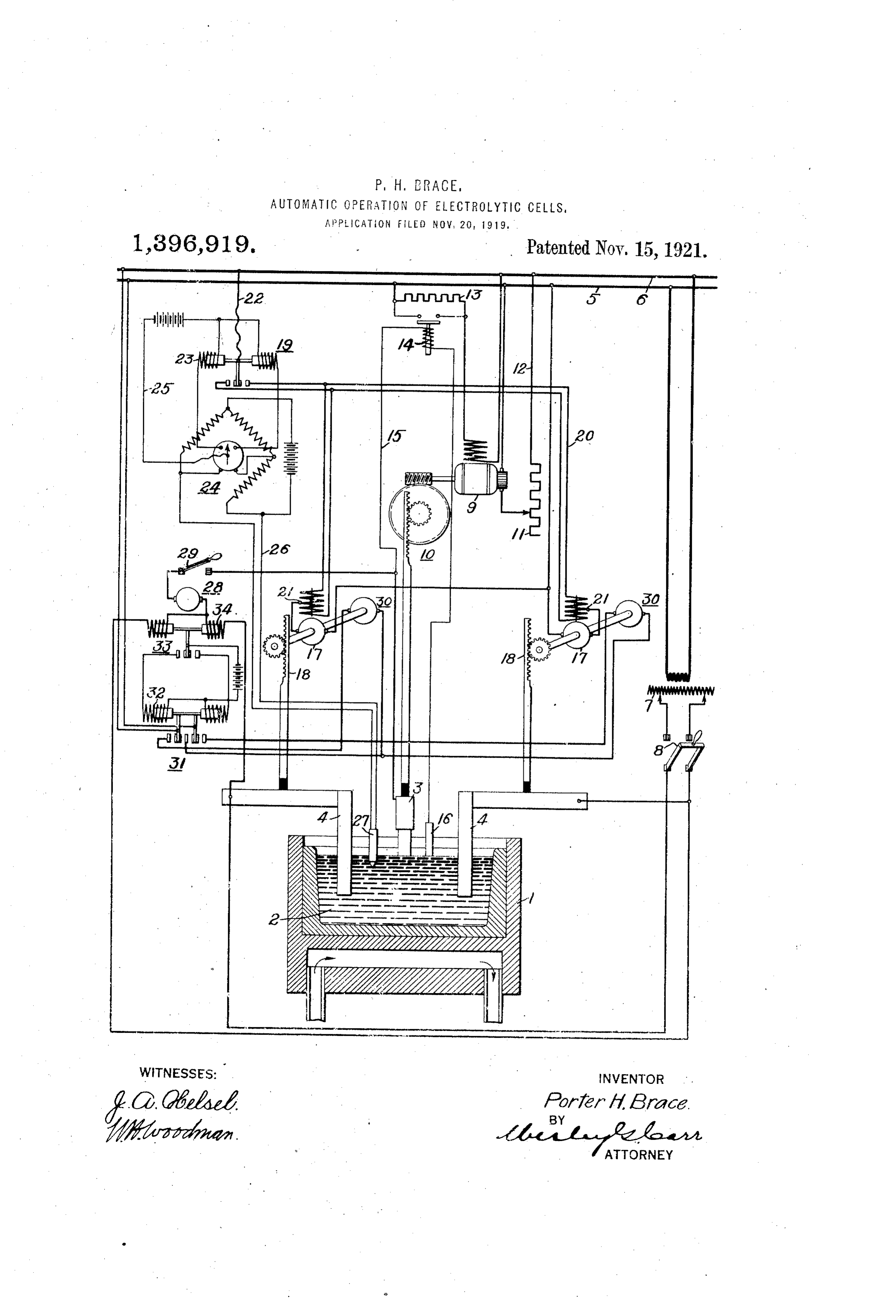
Drawing sheet — no readable text.
Page 2
UNITED STATES PATENT office.
PORTER. H. BRACE, OF PITTSBURGH, PENNsy Liv ANIA, AssIGNOR. To westriNg HOUSE, ELECTRIC st MANUFACTURING COMPANY, A CoRPORATION OF PENN
SYLVANIA,
AUTOMATIC OPERATION OF ELECTROLYTIC CELLs, 1,396,919. specification of Letters Patent, Patented Nov. 15, 1921. Application filed November 20, 1919. Serial No. 339,509.
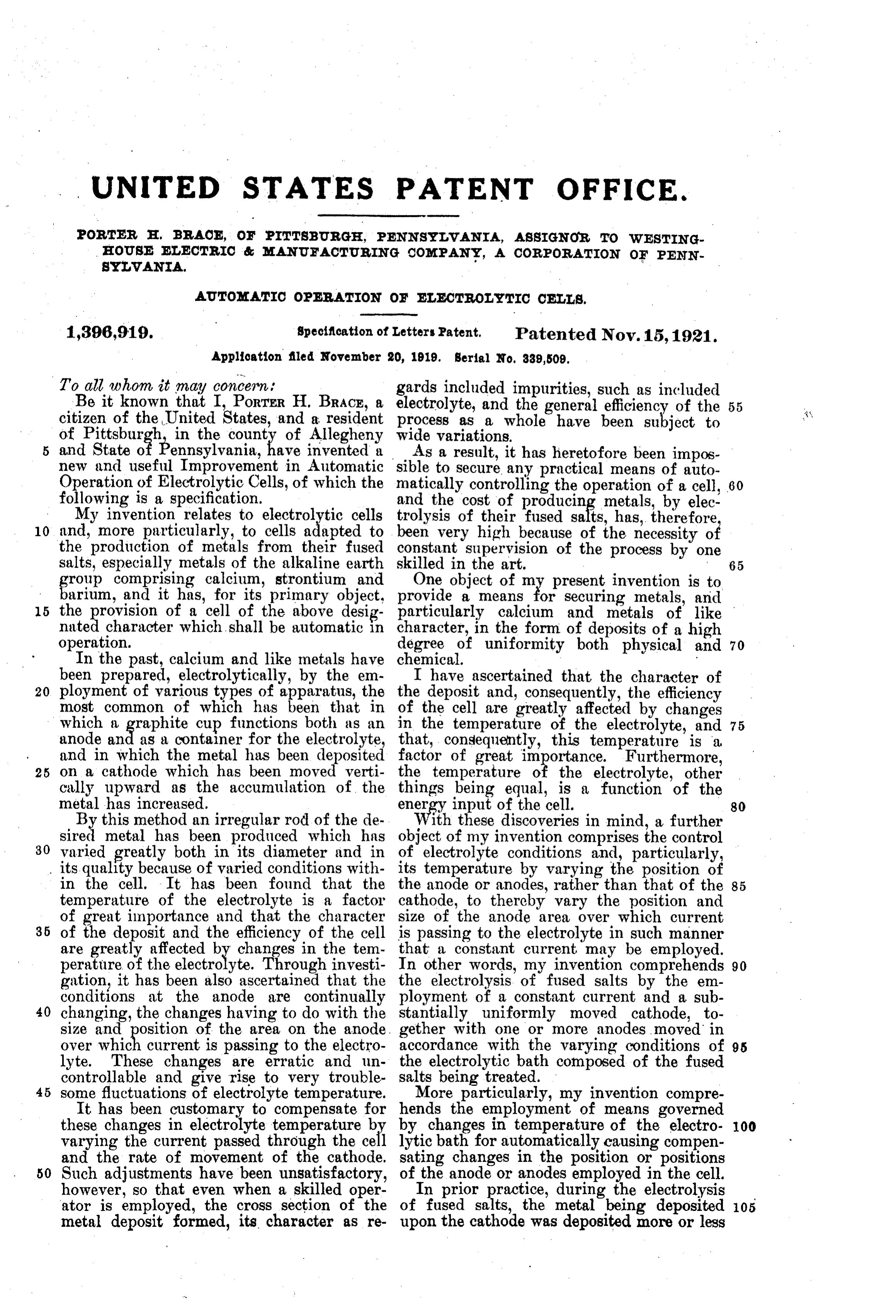
To all whom it may concern; gards included impurities, such as included Be it known that I, PoRTER H. BRACE, a electrolyte, and the general efficiency of the 55 citizen of the United States, and a resident process as a whole have been subject to of Pittsburgh, in the county of Allegheny wide variations.
and State E. Pennsylvania, Fa invented a As a result, it has heretofore been impos new and useful Improvement in Automatic sible to secure any practical means of auto Operation of Electrolytic Cells, of which the matically controlling the operation of a cell, 60 following is a specification. and the cost of producing metals, by elec My invention relates to electrolytic cells trolysis of their fused salts, has, therefore 10 and, more particularly, to cells adapted to been very high because of the necessity of the production of metals from their fused constant supervision of the process by one salts, especially metals of the alkaline earth skilled in the art, 65 E. comprising calcium, strontium and One object of m present invention is to arium, and it has, for its primary object, provide a means or securing metals, and 15 the provision of a cell of the above desig particularly calcium and metals of like Nie character which shall be automatic in operation. character, in the form of deposits of a high 70 degree of uniformity both physical and
In the past, calcium and like metals have chemical.
been prepared, electrolytically, by the em I have ascertained that the character of 20 ployment of various types of apparatus, the the deposit and, consequently, the efficiency most common of which has been that in of the cell are greatly affected by changes which a graphite cup functions both as an in the temperature of the electrolyte, and 75 anode and as a container for the electrolyte, that, consequently, this temperature is a and in which the metal has been deposited factor of great importance. Furthermore, 25 on a cathode which has been moved verti the temperature of the electrolyte, other cally upward as the accumulation of the things being equal, is a function of the metal has increased.
By this method an irregular rod of the de en, input of the cell.
ith these discoveries in mind, a further sired metal has been produced which has object of my invention comprises the control 30 yaried greatly bothin its diameter and in of electrolyte conditions and particularly, its quality because of varied conditions with its temperature by varying the position of in the cell. It has been found that the the anode or anodes, rather than that of the 85 temperature of the electrolyte is a factor cathode, to thereby vary the position and of great importance and that the character size of the anode area over which current 35 of the deposit and the efficiency of the cell is passing to the electrolyte in such manner are greatly affected by changes in the tem that a constant current may be employed. perature of the electrolyte. Through investi In other words, my invention comprehends 90 gation, it has been also ascertained that the the electrolysis of fused salts by the em conditions at the anode are continually ployment of a constant current and a sub 40 changing, the changes having to do with the stantially uniformly moved cathode, to size and osition of the area on the anode. gether with one or more anodes moved in over which current is passing to the electro accordance with the varying conditions of 95 lyte. These changes are erratic and un the electrolytic bath composed of the fused controllable and give rise to very trouble salts being treated.
45 some fluctuations of electrolyte temperature. More particularly, my invention compre It has been customary to compensate for hends the employment of means governed these changes in electrolyte temperature by by changes in temperature of the electro OO varying the current passed through the cell lytic bath for automatically causing compen and the rate of movement of the cathode, sating changes in the position or positions SO Such adjustments have been unsatisfactory, of the anode or anodes employed in the cell. however, so that even when a skilled oper In prior practice, during the electrolysis ator is employed, the cross section of the of fused salts, the metal being deposited 105 metal deposit formed, its character as re upon the cathode was deposited more or less
Page 3
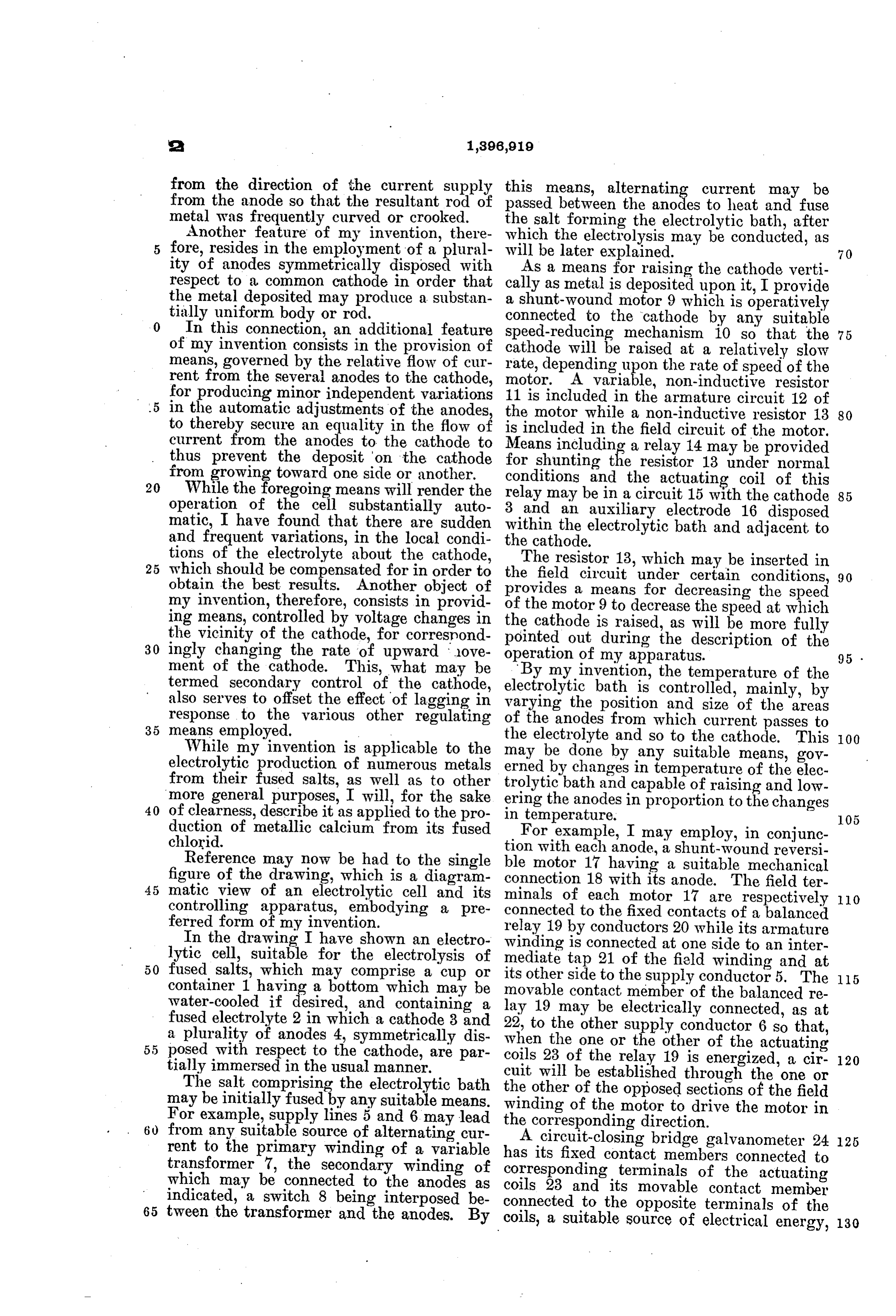
from the direction of the current supply this means, alternating current may be from the anode so that the resultant rod of passed between the anodes to heat and fuse metal was frequently curved or crooked. the salt forming the electrolytic bath, after Another feature of my invention, there fore, resides in the employment of a plural which the electrolysis may be conducted, as will be later explained.
ity of anodes symmetrically disposed with As a means for raising the cathode verti 70 respect to a common cathode in order that cally as metal is deposited upon it, I provide the metal deposited may produce a substan a shunt-wound motor 9 which is operatively tially uniform body or rod. connected to the cathode by any suitable In this connection, an additional feature speed-reducing mechanism 10 so that the of my invention consists in the provision of cathode will be raised at a relatively slow means, governed by the relative flow of cur rate, depending upon the rate of speed of the rent from the several anodes to the cathode, motor. A variable, non-inductive resistor for producing minor independent variations 11 is included in the armature circuit 12 of in the automatic adjustments of the anodes, the motor while a non-inductive resistor 13 to thereby secure an equality in the flow of is included in the field circuit of the motor. 80 current from the anodes to the cathode to Means including a relay 14 may be provided thus prevent the deposit on the cathode for shunting the resistor 13 inder normal from growing toward one side or another. conditions, and the actuating coil of this 20 While the foregoing means will render the operation of the cell substantially auto 3relay may be in a circuit 15 with the cathode 85 and an auxiliary electrode 16 disposed matic, I have found that there are sudden within the electrolytic bath and adjacent to and frequent variations, in the local condi the cathode.
tions of the electrolyte about the cathode, 25 which should be compensated for in order to The resistor 13, which may be inserted in obtain the best results. Another object of the field circuit under certain conditions, 90 provides a means for decreasing the speed my invention, therefore, consists in provid of ing means, controlled by voltage changes in thethecathode motor 9 to decrease the speed at which the vicinity of the cathode, for corresnond pointed out isduring 30 ingly changing the rate of upward love operation of my apparatus.
raised, as will be more fully the description of the ment of the cathode. This, what may be By my invention, the temperature of the 95 termed secondary control of the cathode, electrolytic bath is controlled, mainly, by also serves to offset the effect of lagging in varying the position and size of the areas response to the various other regulating of the anodes from which current passes to 35 means employed. the electrolyte and so to the cathode. This 00 While my invention is applicable to the may electrolytic production of numerous metals ernedbebydone by any suitable means, gov changes in temperature of the elec from their fused salts, as well as to other trolytic bath and capable of raising and low more general purposes, I will, for the sake ering the anodes in proportion to the changes 40 of clearness, describe it as applied to the pro in temperature.
duction of metallic calcium from its fused For example, I may employ, in conjunc 105 chlorid.
Reference may now be had to the single tion with each anode, a shunt-wound reversi figure of the drawing, which is a diagram connection 1718 having ble motor with its a suitable mechanical anode. The field ter 45 matic view of an electrolytic cell and its minals of each motor 17 are respectively controlling apparatus, embodying a pre connected to the fixed contacts of a balanced O ferred form of my invention.
In the drawing I have shown an electro relay winding 19 by conductors 20 while its armature is connected at one side to an inter lytic cell, suitable for the electrolysis 50 fused salts, which may comprise a cup or of mediate tap 21 of the field winding and at its other container 1 having a bottom which may be movable contact side to the supply conductor 5. The 15 member of the balanced re water-cooled if desired, and containing a lay 19 may be electrically connected, as at fused electrolyte 2 in which a cathode 3 and 22, to the other supply conductor 6 so that, a plurality of anodes 4, symmetrically dis when the one or the other of the actuating 55 posed with respect to the cathode, are par tially immersed in the usual manner. coils 23 of the relay 19 is energized, a cir 120 The salt comprising the electrolytic bath the other be cuit will
established through the one or the opposed sections of the field may be initially fused by any suitable means. winding of the motor to drive the motor in For example, supply lines 5 and 6 may lead 60 from any suitable source of alternating cur the corresponding direction. rent to the primary winding of a variable hasA itscircuit-closing bridge galvanometer 24 25 fixed contact members connected to transformer 7, the secondary winding of corresponding terminals of the actuating which may be connected to the anodes as coils 23 and its movable contact member indicated, a switch 8 being interposed be connected to the opposite terminals of the 65 tween the transformer and the anodes. By coils, a suitable source of electrical energy, 130
Page 4
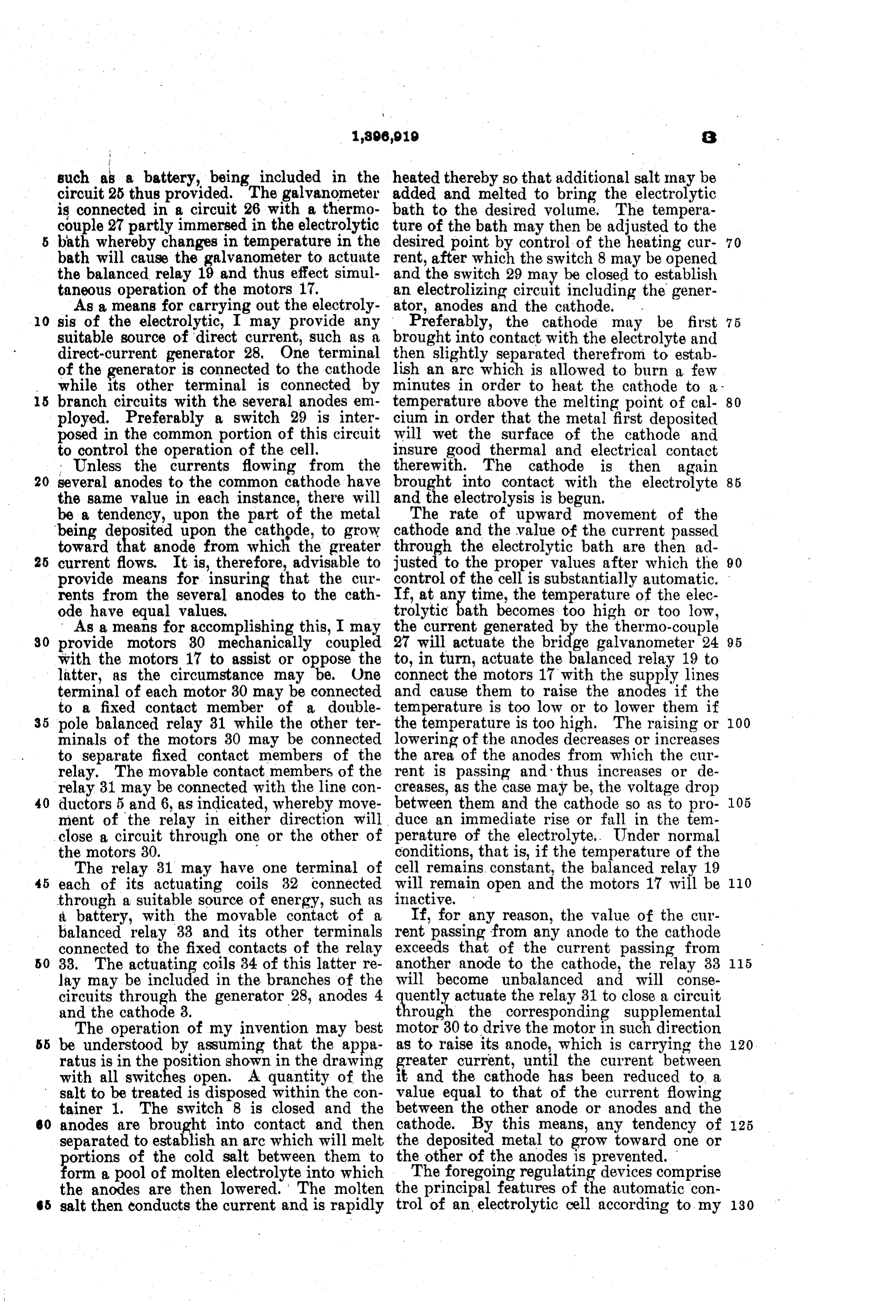
such as a battery, being included in the heated thereby so that additional salt may be circuit 25 thus provided. The galvanometer added and melted to bring the electrolytic iscouple connected in aimmersed 27 partly circuit 26in with a thermo bath to the desired volume. The tempera the electrolytic bath whereby changes in temperature in the ture of the bath may then be adjusted to the desired point by control of the heating cur 70 bath will cause the galvanometer to actuate rent, after which the switch 8 may be opened the balanced relay 19 and thus effect simul and the switch 29, may be closed to establish taneous operation of the motors 17. an electrolizing circuit including the gener As a means for carrying out the electroly ator, anodes and the cathode. . O sis of the electrolytic, I may provide any Preferably, the cathode may be first 75 suitable source of direct current, such as a brought into contact with the electrolyte and direct-current generator 28. One terminal then slightly separated therefrom to estab of the generator is connected to the cathode lish an arc which is allowed to burn a few while its other terminal is connected by minutes in order to heat the cathode to a - 15 branch circuits with the several anodes em temperature above the melting point of cal 80 ployed. Preferably a switch 29 is inter cium in order that the metal first deposited posed in the common portion of this circuit will wet the surface of the it. and to control the operation of the cell. insure good thermal and electrical contact Unless the currents flowing from the therewith. The cathode is then again 20 several anodes to the common cathode have brought into contact with the electrolyte 85 the same value in each instance, there will and the electrolysis is begun. be a tendency, upon the part of the metal The rate of upward movement of the being deposited upon the cathgde, to grow cathode and the value of the current passed toward that anode from which the greater through the electrolytic bath are then ad 25 current flows. It is, therefore, advisable to justed to the proper values after which the 90 provide means for insuring that the cur control of the cell is substantially automatic. rents from the several anodes to the cath If, at any time, the temperature of the elec ode have equal values, trolytic bath becomes too high or too low, As a means for accomplishing this, I may the current generated by the thermo-couple 30 provide motors 30 mechanically coupled 27 will actuate the bridge galvanometer 24 95 with the motors 17 to assist or oppose the to, in turn, actuate the balanced relay 19 to latter, as the circumstance may be. One connect the motors 17 with the supply lines terminal of each motor 30 may be connected and cause them to raise the anodes if the to a fixed contact member of a double temperature is too low or to lower them if 35 pole balanced relay 31 while the other ter the temperature is too high. The raising or 100 minals of the motors 30 may be connected lowering of the anodes decreases or increases to separate fixed contact members of the the area of the anodes from which the cur relay. The movable contact members of the rent is passing and thus increases or de relay 31 may be connected with the line con creases, as the case may be, the voltage drop 40 ductors 5 and 6, as indicated, whereby move between them and the cathode so as to pro- 105 ment of the relay in either direction will duce an immediate rise or fall in the tem close a circuit through one or the other of perature of the electrolyte. Under normal the motors 30. O conditions, that is, if the temperature of the The relay 31 may have one terminal of cell remains, constant, the balanced relay 19 45 each of its actuating coils 32 connected will remain open and the motors 17 will be 110 through a suitable source of energy, such as inactive.
a battery, with the movable contact of a If, for any reason, the value of the cur balanced relay 33 and its other terminals rent passing from any anode to the cathode connected to the fixed contacts of the relay exceeds that of the current passing from 50 33. The actuating coils 34 of this latter re another anode to the cathode, the relay 33 115 lay may be included in the branches of the will become unbalanced and will conse circuits through the generator 28, anodes 4 uently actuate the relay 31 to close a circuit and the cathode 3. through the corresponding supplemental The operation of my invention may best motor 30 to drive the motor in such direction 65 be understood by assuming that the appa as to raise its anode, which is carrying the 120. ratus is in the position shown in the drawing greater current, until the current between with all switches open. A quantity of the it and the cathode has been reduced to a salt to be treated is disposed within the con value equal to that of the current flowing tainer 1. The switch 8 is closed and the between the other anode or anodes and the O anodes are brought into contact and then cathode. By this means, any tendency of 125 separated to establish an arc which will melt the deposited metal to grow toward one or portions of the cold salt between them to the other of the anodes is prevented. form a pool of molten electrolyte into which The foregoing regulating devices comprise the anodes are then lowered. The molten the principal features of the automatic con 5 salt then eonducts the current and is rapidly trol of an electrolytic cell according to my 130
Page 5
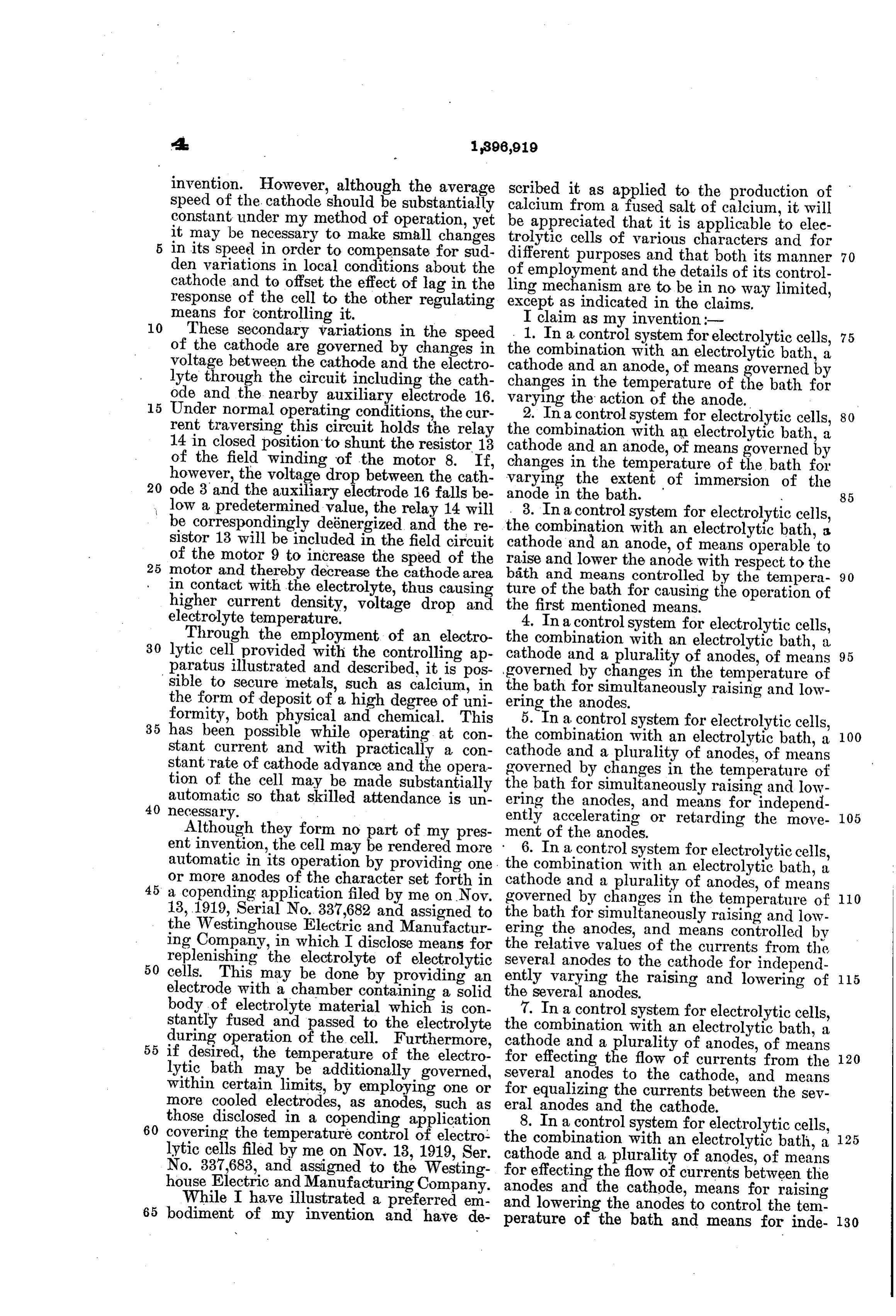
invention. However, although the average scribed it as applied to the production of speed of the cathode should be substantially calcium from a fused salt of calcium, it will constant under my method of operation, yet be appreciated it may be necessary to make small changes trolytic cells ofthat it is applicable to elee various characters and for in its speed in order to compensate for sud different purposes and that both its manner 70 den variations in local conditions about the of employment and the details cathode and to offset the effect of lag in the ling mechanism are to be in noofway its control response of the cell to the other regulating except as indicated in the claims. limited, means for controlling it.
10 These secondary variations in the speed I1. claim In a
control system for electrolytic cells, of the cathode are governed by changes in the combination with voltage between the cathode and the electro cathode and an anode, an of electrolytic bath, a means governed by lyte through the circuit including the cath changes in the temperature of the bath for ode and the nearby auxiliary electrode 5 Under normal operating conditions, the cur 16. varying the action of the anode.
In a control system for electrolytic cells, 80 rent traversing this circuit holds the relay the2. combination 14 in closed position to shunt the resistor 13 cathode and an anode,with an electrolytic bath, a of the field winding of the motor 8. If, changes in the temperature of means governed by however, the voltage drop between the cath varying the extent of immersion of the bath for 20 ode 3 and the auxiliary electrode 16 falls be anode in the bath.
of the low a predetermined value, the relay 14 will 3. In a control system for electrolytic cells, 85 be correspondingly definergized and the re the combination with an electrolytic bath, a sistor 13 will be included in the field circuit cathode and an anode, of means operable to of the motor 9 to increase the speed of the 25 motor and thereby decrease the cathode area. raise and lower the anode with respect to the báith and means controlled by the tempera 90 in contact with the electrolyte, thus causing ture higher current density, voltage drop and the first of the bath for causing the operation of mentioned means.
electrolyte temperature. 4. In a control system for electrolytic cells, Through the employment of an electro the combination with an electrolytic bath, a 30 lytic cell provided with the controlling ap cathode and a plurality of anodes, of means paratus illustrated and described, it is pos governed by changes in the temperature of sible to secure metals, such as calcium, in the form of deposit of a high degree of uni the bath for simultaneously raising and low ering the anodes.
formity, both physical and chemical.
35 has been possible while operating at con
This 5. In a control system for electrolytic cells, the combination stant current and with practically a con cathode and a plurality with an electrolytic bath, a 100 stant rate of cathode advance and the opera governed by changes in oftheanodes, of means temperature of tion of the cell may be made substantially automatic so that skilled attendance is un the bath for simultaneously raising and low ering the anodes, and means for independ 40 necessary.
Although they form no part of my pres ment ently accelerating or retarding the move of the anodes.
ent invention, the cell may be rendered more 6. In a control system for electrolytic cells, automatic in its operation by providing one. the combination with an electrolytic bath, a or more anodes of the character set forth in cathode and a plurality of anodes, of means 45 a copending application filed by me on Nov.
governed by changes in the temperature of 0
the Westinghouse Electric and Manufactur the bath for simultaneously raising and low ering the anodes, and means controlled by ing Company, in which I disclose means for the relative values of the currents from the replenishing the electrolyte of electrolytic 50 cells. This may be done by providing an several anodes to the cathode for independ ently varying the raising and lowering of ll 5 electrode with a chamber containing a solid the several anodes.
body of electrolyte material which is con stantly fused and passed to the electrolyte the7. combination
In a control system for electrolytic cells, with an electrolytic bath, a during operation of the cell. Furthermore, 55 if desired, the temperature of the electro cathode and a plurality of anodes, of means for effecting the flow lytic bath may be additionally governed, several anodes to the cathode, of currents from the 120 within certain limits, by employing one or for equalizing the currents between and means more cooled electrodes, as anodes, such as eral anodes and the cathode. the sev those disclosed in a copending application 8. In a control system for electrolytic cells, 60 covering the temperature control of electro lytic cells filed by me on Nov. 13, 1919, Ser. the combination with an electrolytic bath, a 125 cathode and a plurality of anodes, of means
No. 337,683, and assigned to the Westing for effecting the flow of currents between the house Electric and Manufacturing Company. anodes and the cathode, means for raising While I have illustrated a preferred 65 bodiment of my invention and have de em and lowering the anodes to control the tem perature of the bath and means for inde
Page 6
pendently retarding or accelerating the 14. In a control system for electrolytic movement of the anodes to equalize the re.
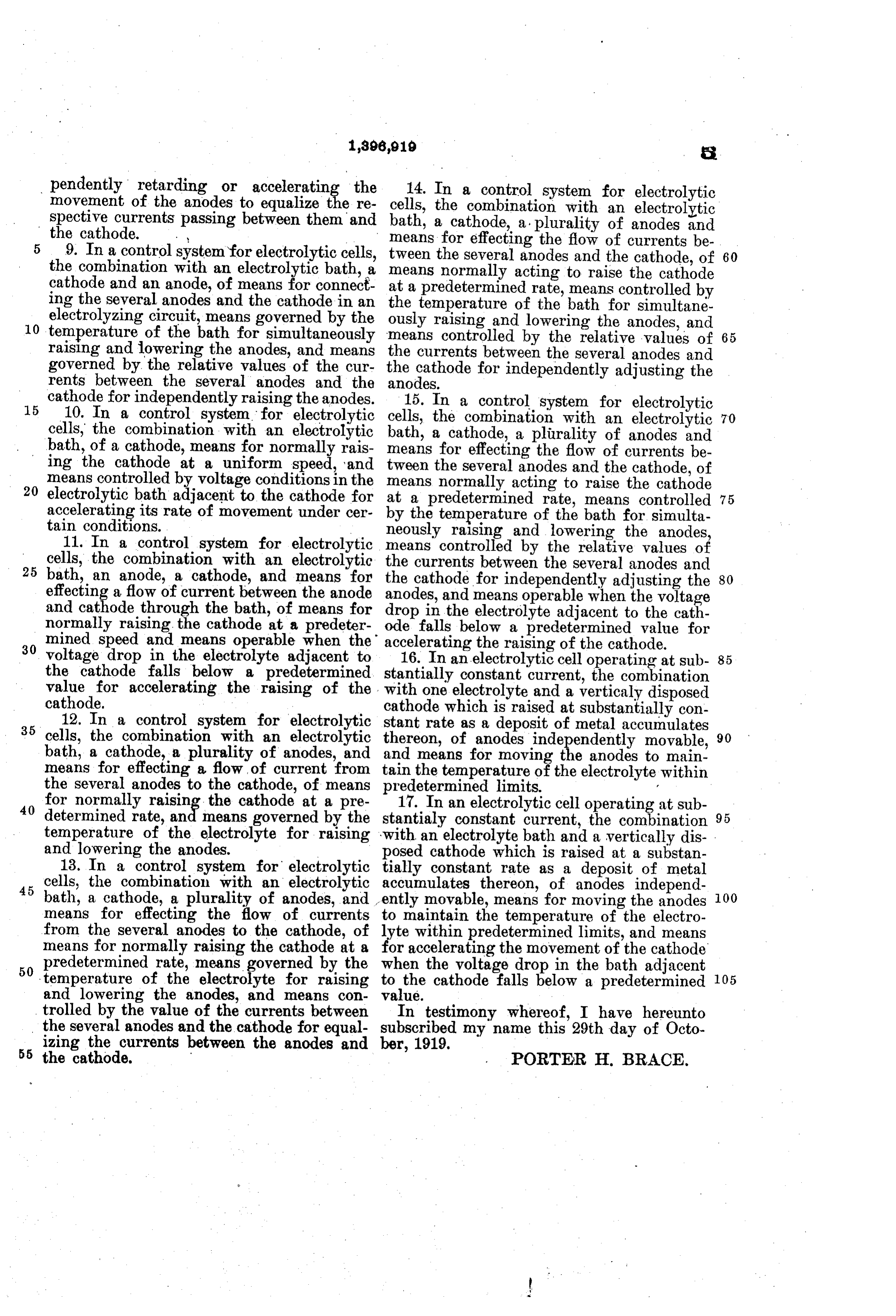
spective currents passing between them and cells, the combination with an electrolytic the cathode. bath, a cathode, a plurality of anodes and means for effecting the flow of currents be 9. In a control system for electrolytic cells, tween the combination with an electrolytic bath, a means the several anodes and the cathode, of 60 normally acting to raise the cathode cathode and an anode, of means for connect at a predetermined rate, means controlled by ing the several anodes and the cathode in an the temperature of the bath for simultane electrolyzing circuit, means governed by the
O temperature of the bath for simultaneously ously raising and lowering the anodes, and raising and lowering the anodes, and means the means controlled by the relative values of 65 currents between the several anodes and governed by the relative values of the cur the cathode for independently adjusting the rents between the several anodes and the anodes.
cathode for independently raising the anodes. 15. In a control system for electrolytic 5 10. In a control system for electrolytic cells, the combination with an electrolytic 70 cells, the combination with an electrolytic bath, a cathode, a plurality of anodes and bath, of a cathode, means for normally rais. means for effecting the flow of currents be ing the cathode at a uniform speed, and tween the several anodes and the cathode, of means controlled by voltage conditions in the 20 electrolytic bath adjacent to the cathode for at a normally acting to raise the cathode means predetermined rate, means controlled 75 accelerating its tain conditions.
rate of movement under cer by the temperature oflowering the bath for simulta neously raising and the 11. In a control system for electrolytic means controlled by the relative values of anodes,
cells, the combination with an electrolytic the currents between the several anodes and bath, an anode, a cathode, and means for the cathode for independently adjusting the 80 effecting a flow of current between the anode anodes, and means operable when the voltage and cathode through the bath, of means for drop in the electrolyte adjacent to the cath normally raising the cathode at a predeter ode falls below a predetermined value for 30 mined speed and means operable when the accelerating the raising of the cathode. voltage drop in the electrolyte adjacent to 16. In an electrolytic cell operating at sub- 85 the cathode falls below a predetermined stantially constant current, the combination value for accelerating the raising of the with one electrolyte and a vertically disposed cathode. cathode which is raised at substantially con
12. In a control system for electrolytic stant rate as a deposit of metal accumulates cells, the combination with an electrolytic thereon, bath, a cathode, a plurality of anodes, and and meansof for anodes independently movable, 90 moving the anodes to main means for effecting a flow of current from tain the temperature of the electrolyte within the several anodes to the cathode, of means predetermined limits.
for normally raising the cathode at a pre 17. In an electrolytic cell operating at sub determined rate, and means governed by the stantially constant current, the combination 95 temperature of the electrolyte for raising with an electrolyte bath and a vertically dis and lowering the anodes. posed cathode which is raised at a substan 13. In a control system for electrolytic tially constant rate as a deposit of metal 45 cells, the combination with an electrolytic accumulates thereon, of anodes independ bath, a cathode, a plurality of anodes, and ently movable, means for moving the anodes 100 means for effecting the flow of currents to maintain the temperature of the electro from the several anodes to the cathode, of lyte within predetermined limits, and means means for normally raising the cathode at a or accelerating the movement of the cathode 50 predetermined rate, means governed by the when the voltage drop in the bath adjacent temperature of the electrolyte for raising to the cathode falls below a predetermined 105 and lowering the anodes, and means con value.
trolled by the value of the currents between In testimony whereof, I have hereunto the several anodes and the cathode for equal subscribed my name this 29th day of Octo izing the currents between
- PORTER. H. BRACE.
Provenance
- Collection
- Cited prior art
- Original PDF
- patentimages.storage.googleapis.com →
- Filed
- 1919-11-20
- Pages
- 6
- Method
- pdftotext (the PDF's own text layer) + pdftoppm 300dpi page scans
- Source
- Google Patents bibliographic record
- Granted
- 1921-11-15
- Inventors
- Porter H Brace; Westinghouse Electric Corp
- Transcribed from
- patentimages.storage.googleapis.com →