(Fe)
Iron atom
Also written Iron ions · Iron ion
Where it is first named
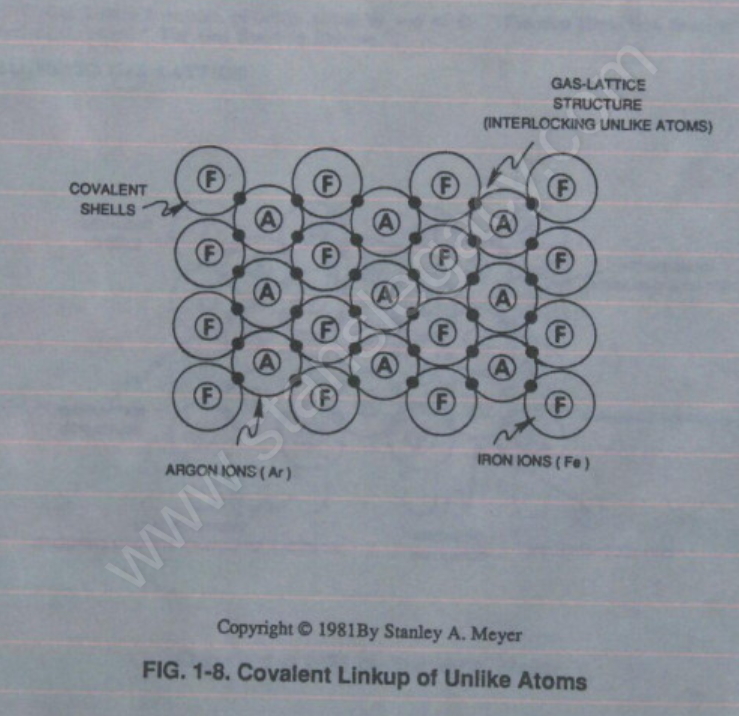
Covalent bonding of Iron ions (Fe+) to the Argon ion (Ar+) continues until a geometrical Gas-Lattice Structure is formed, as illustrated in Figure 1-8.
How it is written
- (Fe+) 2×
- (Fe) 1×
Drawings 6
-
The forming Argon ion (Ar+) is now exposed to Iron ions (Fe+) (magnetic properties) experiencing and undergoing the same Electron Extraction Process. · Magnetic Gas Lattice
-
Figure (1-8) · Atomic Interaction to Voltage Stimulation
-
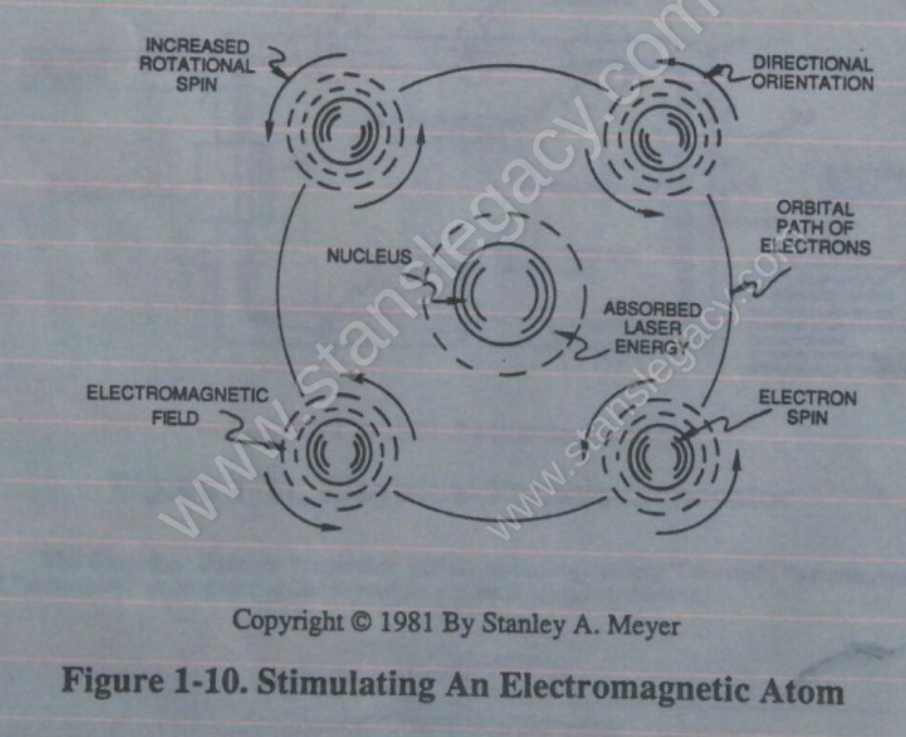
Oscillation (back and forth movement) of electrically charged particles by way of voltage deflection is hereinafter called "Resonant Action", as illustrated in Figure (1-10). · Voltage Dissociation of The Water Molecule
-
Figure (1-8) · Electron Extraction Process
-
Laser activated or laser primed gas ions repel the "dislodged" electrons being consumed as illustrated in Figure (1-8) as to Figure (1-20). · Electron Extraction Process
-
The figure it sits on · Funneling Effect
Where it is named · 3
Magnetic Gas Lattice 2×
-
Iron ions (Fe+)
Covalent bonding of Iron ions (Fe+) to the Argon ion (Ar+) continues until a geometrical Gas-Lattice Structure is formed, as illustrated in Figure 1-8.
-
Iron atom (Fe)
Stable-state of the Gas-Lattice occurs when the covalent shell of each unlike atom structure becomes full or filled up… the Argon atom (Ar) sees an covalent shell of 8 electrons while, at the same time, the Iron atom (Fe) sees an covalent shell (M shell) of 14 electrons.
Electromagnetic Enhancement 1×
-
Iron ion (Fe+)
Since the electrons of the Iron ion (Fe+) spin in one direction only (SEE FIGURE 1-10) (Nickel ions and Cobalt ions in like manner), the magnetic field of each Iron ion (called Domains) unite and form a "Discrete" magnetic field called an "Magnetic Flux-Line".