patent · US6234166
Absorber-reflector for solar heating
22 May 2001
Page 1 — bibliographic record
(12) United States Patent (10) Patent No.: US 6,234,166 B1 Katsir et al. (45) Date of Patent: May 22, 2001
(54) ABSORBER-REFLECTOR FOR SOLAR Solar Energy Materials and Solar Cells, 44 (1996) 69-78, HEATING “Cathodic ARC Deposition of Solar Thermal Selective”, by Y. Yin et al.
(75) Inventors: Dina Katsir, Beer Sheva; Zvi AIAA, (1992), 88–97, “Estimation of the End-Of-Life Finkelstein, Aseret, Israel
Tartakovsky; Irina Tartakovsky, both Optical Properties of Z-93 Thermal Control Coating for the of Kiryat Gat, all of (IL) Space Station Freedom” by Mark M. Hasegawa et al. (73) Assignee: Acktar Ltd., Kiryat Gat (IL) * cited by examiner (*) Notice: Subject to any disclaimer, the term of this patent is extended or adjusted under 35 Primary Examiner-Carl D. Price
U.S.C. 154(b) by 0 days. (74) Attorney, Agent, or Firm-Hedman & Costigan, P.C.
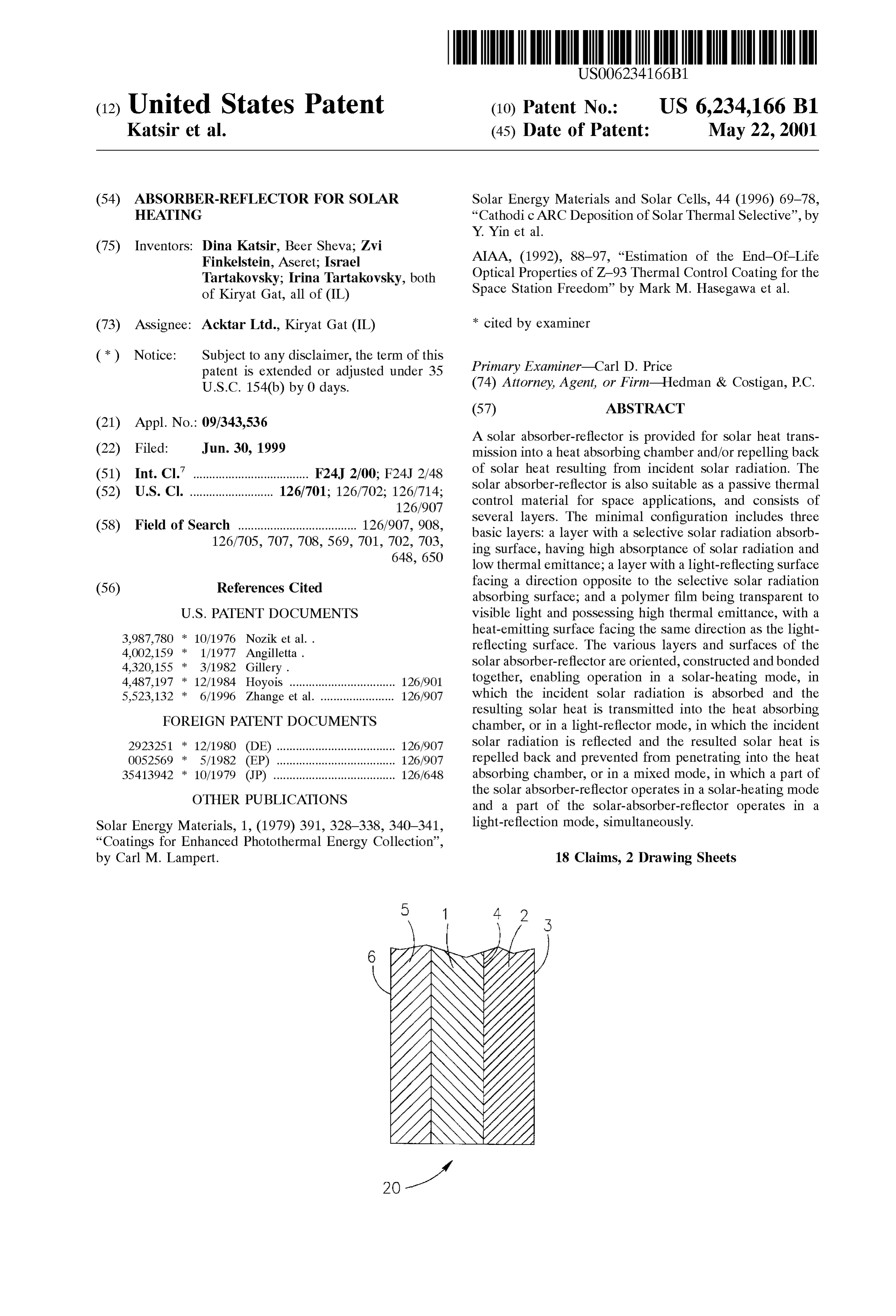
A solar absorber-reflector is provided for Solar heat trans (22) Filed: Jun. 30, 1999 mission into a heat absorbing chamber and/or repelling back (51) Int. Cl. .................................... F24J 2700; F24J 2/48 of Solar heat resulting from incident Solar radiation. The (52) U.S. Cl. .......................... 126/701; 126/702; 126/714; Solar absorber-reflector is also Suitable as a passive thermal 126/907 control material for Space applications, and consists of (58) Field of Search ..................................... 126/907, 908, Several layers. The minimal configuration includes three 126/705, 707, 708, 569, 701, 702, 703, basic layers: a layer with a Selective Solar radiation absorb
ing Surface, having high absorptance of Solar radiation and low thermal emittance; a layer with a light-reflecting Surface (56) References Cited facing a direction opposite to the Selective Solar radiation absorbing Surface; and a polymer film being transparent to
heat-emitting Surface facing the same direction as the light 3,987,780 * 10/1976 Nozik et al.. reflecting Surface. The various layers and Surfaces of the 4,002,159 * 1/1977 Angilletta. Solar absorber-reflector are oriented, constructed and bonded 4,320,155 * 3/1982 Gillery. together, enabling operation in a Solar-heating mode, in 4,487,197 12/1984 Hoyois ................................. 126/901 5,523,132 * 6/1996 Zhange et al. ....................... 126/907 which the incident Solar radiation is absorbed and the resulting Solar heat is transmitted into the heat absorbing
FOREIGN PATENT DOCUMENTS chamber, or in a light-reflector mode, in which the incident 2923251 * 12/1980 (DE) ..................................... 126/907 Solar radiation is reflected and the resulted Solar heat is 0052569 * 5/1982 (EP). ... 126/907 repelled back and prevented from penetrating into the heat 35413942 * 10/1979 (JP) ...................................... 126/648 absorbing chamber, or in a mixed mode, in which a part of
OTHER PUBLICATIONS
the Solar absorber-reflector operates in a Solar-heating mode and a part of the Solar-absorber-reflector operates in a
Solar Energy Materials, 1, (1979) 391, 328-338, 340–341, light-reflection mode, Simultaneously. “Coatings for Enhanced Photothermal Energy Collection”, by Carl M. Lampert. 18 Claims, 2 Drawing Sheets
Page 2
Drawing sheet — no readable text.
Page 3
Drawing sheet — no readable text.
Page 4
ABSORBER-REFLECTOR FOR SOLAR overheating of the layer of material with the Selective Solar HEATING radiation absorbing Surface, and hence in an increase of heat
FIELD AND BACKGROUND OF THE
losses by both convection heat transfer and re-emission of
INVENTION
additional heat by this surface. Furthermore, Solar absorber reflectors with a Selective Solar radiation absorbing Surface,
The present invention relates to utilization of Solar energy while operating in the light-reflection mode, Still feature a and, more particularly, to a Solar absorber-reflector for certain heating of the light-reflecting Surface under exposure alternately transmitting and repelling back Solar heat result to Solar radiation, resulting in an undesired heat transfer into ing from incident Solar radiation. the room interior, as with the venetian blinds described There already exist Solar absorber-reflectors, Such as the above.
Venetian blinds taught in U.S. Pat. No. 4,002,159. These There exists a certain type of absorbers of Solar radiation blinds, usually installed at room windows, have slats that are with thermal efficiency which is significantly higher than rotatable through 180 degrees, where one face is bearing a that of the above mentioned Solar absorber-reflectors, when layer of material with a usual black nonselective light 15 operating in the Solar-heating mode. Such absorbers of Solar absorbing Surface, while the other face is a light-reflecting radiation contain, besides the material layer with a Selective Surface. Solar radiation absorbing Surface, an additional material For room heating in cold weather, the Venetian blind Slats layer with a heat-emitting Surface facing the direction oppo are oriented in Such a way that their light-reflecting Surfaces Site to the Selective Solar radiation absorbing Surface. face the interior of the room, and their light-absorbing The above mentioned overheating of the material layer Surfaces are directed outward. This is a Solar-heating mode, with the Selective Solar radiation absorbing Surface does not in which the light-absorbing Surface absorbs Solar radiation, occur in absorbers of Solar radiation with a heat-emitting which is converted into heat and transferred into the room Surface, due to intensive heat transfer from the layer of interior. In hot weather, the Venetian blind slats are rotated material with the Selective Solar absorbing Surface into the through 180 degrees. This is a light-reflection mode, in 25 room interior through the heat-emitting Surface which which the Solar radiation is reflected, preventing from over increases the thermal efficiency of these absorbers of Solar heating the room interior. radiation. However, Solar absorber-reflectors, utilizing a However, the thermal efficiency of such venetian blinds is Selective Solar radiation absorbing Surface together with a rather low. First of all, high thermal emittance of the heat-emitting Surface for the Solar-heating mode, as well as nonselective light-absorbing Surface results in a loSS of a a light-reflecting Surface for the light-reflection mode, have Significant part of the heat absorbed in Solar-heating mode, not yet been practically configured. In order to obtain a due to the re-emission from the light-absorbing Surface Surface most Simple from the technological point of View, (unless the Venetian blind is shielded by a window pane, and and possessing simultaneously the properties of light reflec the warmed up air circulates into the room interior). tion and heat emittance, special paints can be applied. Furthermore, when operating in the light-reflection mode, a 35 (Further details can be found in the publication “Estimation certain heating of the light-reflecting Surface occurs under of the end-of-life optical properties of Z-93 thermal control exposure to Solar radiation, resulting in an undesired heat coating for the space station Freedom”, by M. M. Hasegava transfer into the room interior. and H. W. Babel, AIAA Papers, AIAA-92-2168-CP, 1992, p. The thermal efficiency of devices similar to the venetian 88). However, these paints are very expensive, and require blinds described above can be increased to a certain extent, 40 thorough and complicated pre-painting preparation of the by replacing the nonselective light-absorbing Surfaces with Surface. Therefore, Solar absorber-reflectors utilizing these Selective Solar radiation absorbing Surfaces. Selective Solar paints
Such are not worthwhile economically. Furthermore, even
Solar absorber-reflectors, while operating in the light radiation absorbing Surfaces are Surfaces with reduced reflection mode, Still feature a certain heating of the light amount of re-emission losses of the absorbed Solar radiation, reflecting Surface under exposure to Solar radiation, resulting and hence increased efficiency of Solar heating. This is 45 achieved by low thermal emittance combined with high the in an undesired heat transfer into the room interior, as with absorptance of the Solar radiation. Materials that can be used previously mentioned Solar absorber-reflectors. for manufacturing Selective Solar radiation absorbing Sur There is thus a widely recognized need for, and it would faces exist in many varieties. (Further details can be found be highly advantageous to have, a multi-layer Solar in the publication “Coating for enhanced photothermal 50 absorber-reflector, that is Simple to manufacture, install and energy collection” by C. M. Lampert, “Solar Energy operate, utilizing the Solar energy for room heating in Materials”, 1,319-341, 1979). efficient manner, on an attractive economical basis. Namely, A method for making a multiple layer Solar absorber the properties of the Solar absorber-reflector should include reflector is taught in U.S. Pat. No. 4,320,155. A transparent providing intensive heat transfer through a light-absorbing Substrate Such as Soda-lime-Silica glass is vacuum coated 55 Surface into the room interior in the Solar-heating mode for with a first layer of a reflective metal Such as aluminum, a heat accumulation, Such as in cold weather, and reducing Second layer of a light absorbing Semi-conducting material heating of a light-reflecting Surface under exposure to Solar Such as germanium or Silicon, and a third layer of an radiation in the light-reflection mode, Significantly prevent antireflective material Such as Silicon monoxide, for enhanc ing Solar heat from penetrating into the room interior, Such ing the absorption of the light absorbing layer. 60 as in hot weather.
However, the thermal efficiency of Solar absorber SUMMARY OF THE INVENTION reflectors still remains rather low, even with the use of
Selective Solar radiation absorbing Surfaces. In the Solar The present invention provides a device and method to heating mode, intensive heat transfer from the layer of Satisfy the aforementioned need.
material with the Selective Solar radiation absorbing Surface 65 According to the present invention there is provided a to the room interior, is prevented due to poor thermal Solar absorber-reflector for alternatively transmitting into a emittance of the light-reflecting Surface. This results in heat absorbing chamber and repelling back Solar heat result
Page 5
ing from incident Solar radiation, including; (a) a first set of light-reflection mode in which the light-reflecting Surface is layers, including: (i) a layer with a selective Solar radiation exposed to the incident Solar radiation; and (C) a layer with absorbing Surface, for absorbing the Solar heat in a Solar a heat-emitting Surface facing a same direction as the heating mode in which the Selective Solar radiation absorb light-reflecting Surface, for re-emitting the Solar heat into the ing Surface is exposed to the incident Solar radiation, (ii) a chamber in the Solar-heating mode, and for repelling the layer with a light-reflecting Surface facing a direction oppo Solar heat from penetrating into the chamber in the light Site to the Selective Solar radiation absorbing Surface, for reflection mode, wherein the Selective Solar radiation reflecting the Solar radiation in a light-reflection mode in absorbing Surface of the Second Set of layerS faces in a which the light-reflecting Surface is exposed to the incident direction opposite to the Selective Solar radiation absorbing Solar radiation; and (iii) a layer with a heat-emitting Surface Surface of the first set of layers; and (b) positioning the Solar facing the same direction as the light-reflecting Surface, for absorber-reflector in a mixed mode in which the first set of re-emitting the Solar heat into the heat absorbing chamber in layerS is positioned in the Solar-heating mode, and the the Solar-heating mode, and for repelling the Solar heat from Second Set of layerS is positioned in the light-reflection penetrating into the heat absorbing chamber in the light mode, Simultaneously.
reflection mode. 15 The Solar absorber-reflector according to the present According to the present invention there is provided a invention allows for absorbing incident Solar radiation and method for Solar heating of a chamber, comprising the Steps transmitting the resulting heat into a heat absorbing of: (a) providing a Solar absorber-reflector for alternately chamber, Such as a room interior, and/or reflecting the transmitting into the chamber and repelling back Solar heat incident Solar radiation and preventing the resulting heat resulting from incident Solar radiation, including: (i) a first from penetrating into the heat absorbing chamber, depend Set of layers, including: (A) a layer with a selective Solar ing on the position of the Solar-absorber toward the incident radiation absorbing Surface, for absorbing the Solar heat in Solar radiation. The Solar absorber-reflector according to the a Solar-heating mode in which the Selective Solar radiation present invention is also Suitable as a passive thermal control absorbing Surface is exposed to the incident Solar radiation, material for Space applications.
(B) a layer with a light-reflecting Surface facing a direction 25 The Solar absorber-reflector according to the present opposite to the Selective Solar radiation absorbing Surface, invention consists of Several layers, where the minimal for reflecting the Solar radiation in a light-reflection mode in configuration includes three basic layers. The first basic which the light-reflecting Surface is exposed to the incident layer is an polymer film which is transparent to visible light Solar radiation; and (C) a layer with a heat-emitting Surface and possesses high thermal emittance. The outer Surface of facing the same direction as the light-reflecting Surface, for the polymer layer is the heat-emitting Surface of the Solar re-emitting the Solar heat into the chamber in the Solar absorber-reflector. The polymer layer Serves as a Substrate to heating mode, and for repelling the Solar heat from pen the Second basic layer, which has a light-reflecting Surface etrating into the chamber in the light-reflection mode; and adjacent to the polymer film. The Second basic layer Serves (b) positioning the Solar absorber-reflector in an orientation as a Substrate to the third basic layer having high absorp Selected from the group consisting of: (i) the Solar-heating 35 tance of Solar radiation and low thermal emittance. The outer mode, in which the light-reflecting and heat-emitting Sur Surface of the third basic layer is the Selective Solar radiation faces are facing the chamber, and the Selective Solar radia absorbing surface of the Solar absorber-reflector. The second tion absorbing Surface is facing outward, being exposed to and third basic layers are preferably made of aluminum and Solar radiation; and (ii) the light-reflection mode, in which aluminum black, respectively. These layers are preferably the Selective Solar radiation absorbing Surface is facing the 40 manufactured using a common process of vacuum deposi chamber, and the light-reflecting and heat-emitting Surfaces tion. (A Short review of deposition technologies can be are facing outward, being eXposed to Solar radiation. found in the publication “Cathodic arc deposition of Solar According to the present invention there is provided a thermal selective surfaces”, by Y. Yin et al., “Solar Energy method for Solar heating of a chamber, including the Steps Materials and Solar Cells”, 1996, Vol. 44, pp. 69–78). of: (a) providing a Solar absorber-reflector for alternately 45 The basic configuration of a Solar absorber-reflector transmitting into the chamber and repelling back Solar heat according to the present invention, and the other configu resulting from incident Solar radiation, including: (i) a first rations described below, which include several more inter Set of layers, including: (A) a layer with a selective Solar mediate material layerS and Substrates, have Some prominent radiation absorbing Surface, for absorbing the Solar heat in advantages over the prior art. Similar to the prior art, the a Solar-heating mode in which the Selective Solar radiation 50 heat-emitting Surface, while operating in a Solar-heating absorbing Surface is exposed to the incident Solar radiation; mode, ensures intensive heat transfer from the material layer (B) a layer with a light-reflecting Surface facing a direction with Selective Solar absorbing Surface to the heat absorbing opposite to the Selective Solar radiation absorbing Surface, chamber, which increases the thermal efficiency of the Solar for reflecting the Solar radiation in a light-reflection mode in absorber-reflector Significantly. However, a physical Sepa which the light-reflecting Surface is exposed to the incident 55 ration between the light-reflecting and heat-emitting Sur Solar radiation; and (C) a layer with a heat-emitting Surface faces in the preferred embodiments of the present invention, facing a Same direction as the light-reflecting Surface, for makes it possible to avoid using costly materials and re-emitting the Solar heat into the chamber in the Solar methods, Such as applying Special paints, that were previ heating mode, and for repelling the Solar heat from pen ously required for creation of Surfaces that possess light etrating into the chamber in the light-reflection mode; and 60 reflecting and heat-emitting properties simultaneously. (ii) a Second set of layers, including: (A) a layer with a Furthermore, placing a light transparent material layer Selective Solar radiation absorbing Surface, for absorbing the with a heat-emitting Surface, in the preferred embodiments Solar heat in a Solar-heating mode in which the Selective of the present invention, in front of a light-reflecting Surface Solar radiation absorbing Surface is exposed to the incident alongside of the Solar absorber-reflector exposed to incident Solar radiation; (B) a layer with a light-reflecting Surface 65 Solar radiation in the light-reflection mode, reduces heating facing a direction opposite to the Selective Solar radiation of the light-reflecting Surface and repels back the Solar heat, absorbing Surface, for reflecting the Solar radiation in a preventing the heat from penetrating into the heat absorbing
Page 6
S 6 chamber. This Solar heat removal is achieved due to the fact DESCRIPTION OF THE PREFERRED that though the incident Solar radiation, passing through the EMBODIMENTS material layer with the heat-emitting Surface and reflected backward by the light-reflecting Surface, heats up the Solar The present invention is of a solar absorber-reflector, absorber-reflector, this heat is removed by heat emission heating.canSpecifically, 5 which be used for utilization of Solar energy for room the present invention can be used for from the heat-emitting Surface. efficient absorption of Solar heat into a heat absorbing According to another preferred embodiment of the present chamber, Such as a room interior in cold weather (Solar invention, the Solar absorber-reflector includes the same heating mode), and for reflecting Solar radiation and pre basic three material layers, but the substrate for the third venting Solar heat Significantly from penetrating into the basic material layer with the Selective Solar radiation absorb heat absorbing chamber, Such as a room interior in hot ing Surface is not the Second basic material layer with the weather (light-reflection mode).
light-reflecting Surface, but a metal Substrate layer, which is bonded to the Second basic material layer by an adhesive according The principles and operation of a Solar absorber-reflector layer. The metal substrate layer is preferably made of to the present invention may be better understood aluminum, because aluminum is one of the best light 15 with reference to the drawings and the accompanying reflectors, and there are well known techniques of applying description.
layers with Selective Solar radiation absorbing Surface, Such Before explaining the present invention in detail, it should as a aluminum black, to aluminum. be explained that the present invention is not limited in its As a variation of the preferred embodiment of the present application to the details of construction and the arrange invention including a metal Substrate layer, a Surface of the ment of the components Set forth in the following descrip metal Substrate layer Serves as the light-reflecting Surface of tion or illustrated in the drawings. The present invention is the Solar absorber-reflector. In this case, the metal Substrate capable of other embodiments or of being practiced or layer is bonded to the polymer film by an adhesive layer that carried out in various ways. Also, it is to be understood that is transparent to visible light. the phraseology and terminology employed herein is for the 25 purpose of description and should not be regarded as lim
According to further feature in the preferred embodiments iting.
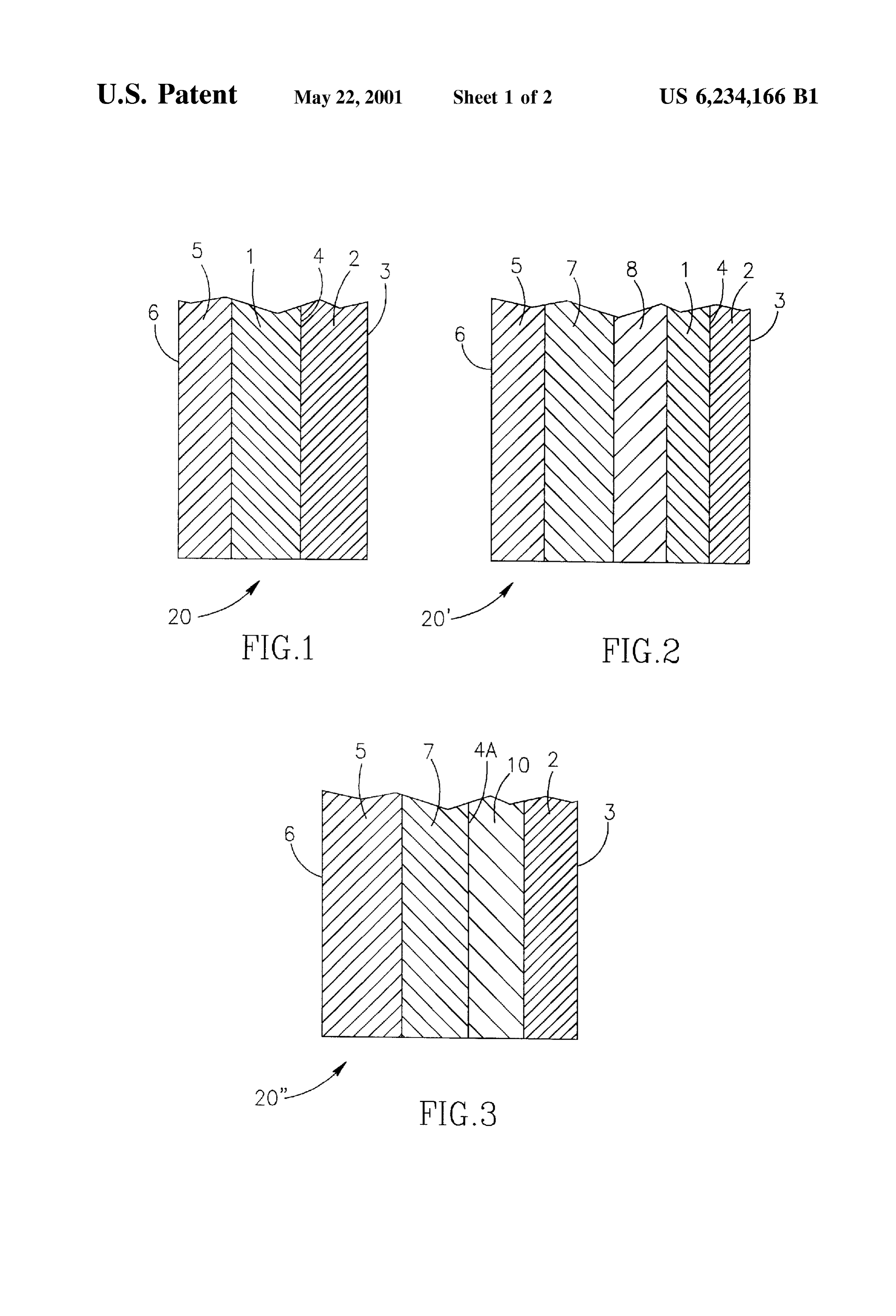
described below, the various material layerS and Substrates of the Solar absorber-reflector are made of flexible materials, Referring now to the drawings, FIGS. 1-3 illustrate cross enabling rolling up the Solar absorber-reflector and thus Sectional views of a Solar absorber-reflector according to Simplifying the transportation, Storage and utilization of the Several preferred embodiments of the present invention. Solar absorber-reflector. As shown in FIG. 1, a Solar absorber-reflector 20 accord According to Still further feature in the described pre ing to a preferred embodiment of the present invention ferred embodiments, the Solar absorber-reflector is con includes Several layers. A polymer film 2 is transparent to Strued So that part of the Solar absorber-reflector operates in visible light, and possesses high thermal emittance that a Solar-heating mode, absorbing the incident Solar radiation 35 increases with the thickness of the film. The material for and transmitting the resulting heat into the heat absorbing polymer film 2 preferably is, but is not limited to, chamber, and part of the Solar absorber-reflector operates in polyethyleneterephtalat, polycarbonate, or any other mate a light-reflection mode, reflecting the incident Solar radiation rial that one ordinarily skilled in the art can easily Select, and repelling back the resulting heat, Simultaneously. In based on the well known technological level. Such a mixed mode, of Simultaneous heat-absorbing and 40 Referring further to FIG. 1, polymer film 2 has an outer light-reflection, the proportion between heat transmission surface 3, which is a heat-emitting surface. Polymer film 2 and heat repelling can be adjusted according to the position Serves as a Substrate for a layer 1 with a light-reflecting of the Solar absorber-reflector toward the incident Solar Surface 4 adjacent to polymer film 2. Layer 1, in turn, Serves radiation. as a Substrate for a layer 5 having an outer Surface 6, which The present invention Successfully addresses the short 45 is a Selective Solar radiation absorbing Surface, with having comings of the presently known configurations by providing absorptance of Solar radiation and low thermal emittance. a multi-layer Solar absorber-reflector, that is simple to Layer 1 with light-reflecting surface 4, and Layer 5 with manufacture, install and operate, enabling controlled Solar Selective Solar radiation absorbing Surface 6, preferably are heat transmission into heat absorbing chambers and/or repel made of, but are not limited to, Vacuum deposited aluminum ling back the Solar heat, on efficient and cost-effective basis. 50 and aluminum black, respectively. Using aluminum has two BRIEF DESCRIPTION OF THE DRAWINGS major advantages. First, aluminum is one of the best light reflectors, and Second, there are well known techniques of
The invention is herein described, by way of example applying layers with Selective Solar radiation absorbing only, with reference to the accompanying drawings, Surface, Such as aluminum black, to aluminum.
wherein:
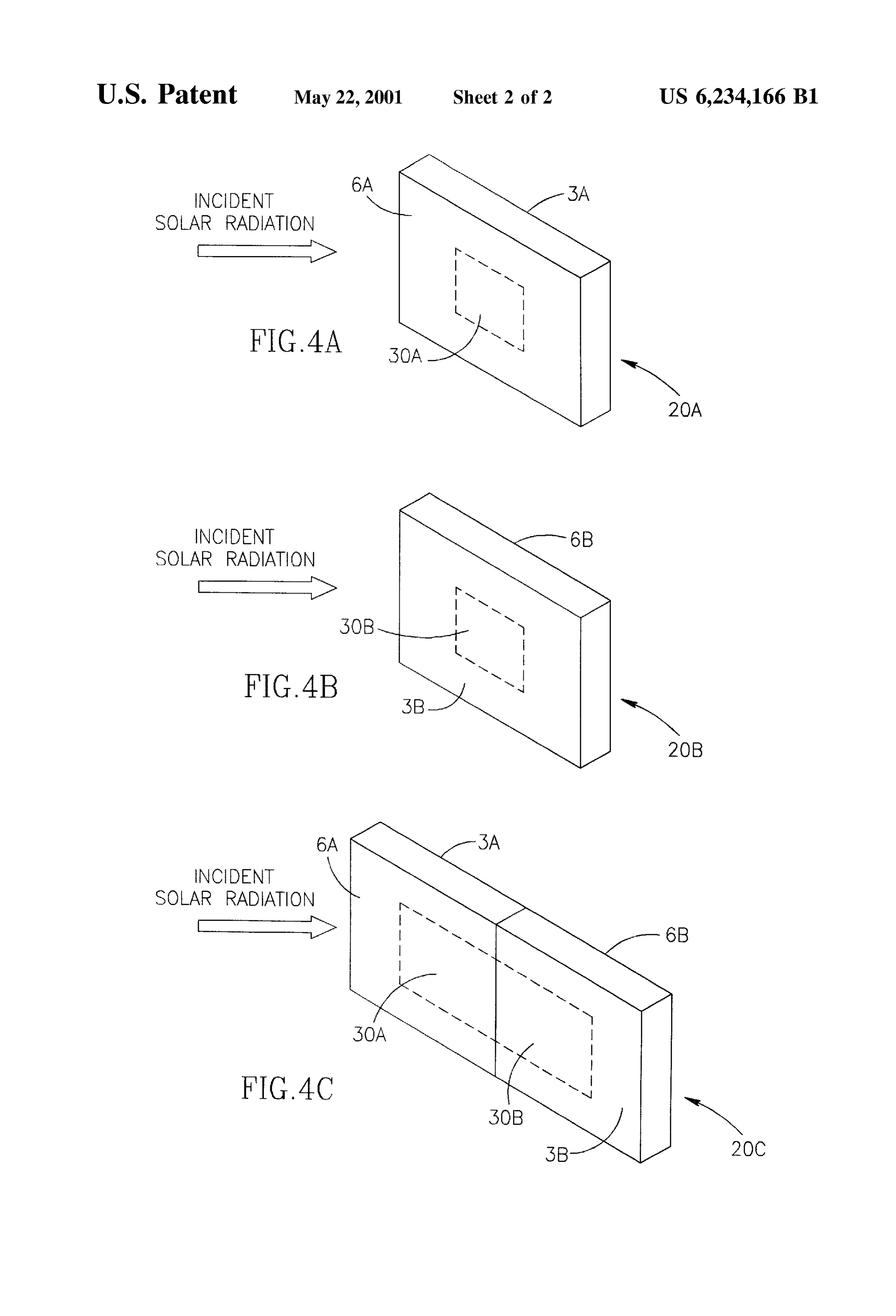
FIG. 1 is a Schematic croSS Sectional view of a Solar 55 Furthermore, Solar absorber-reflector 20 of FIG. 1, besides having a minimum number of layers, where each absorber-reflector according to a preferred embodiment of layer has a definite function and also serves as a Substrate for the present invention; the next layer, is also simple to manufacture. Such a Solar FIG. 2 is a Schematic croSS Sectional view of a Solar absorber-reflector can be manufactured by means of vacuum absorber-reflector according to another preferred embodi 60 deposition of aluminum on polymer film with the use of web ment of the present invention; (roll) coaters with further vacuum deposition of aluminum FIG. 3 is a schematic cross sectional view of a Solar black over the formed aluminum deposit. This is a simple absorber-reflector according to yet another preferred and Straightforward technology because it allows using one embodiment of the present invention; and and the same basic material (aluminum) and one and the FIGS. 4a-c are schematic perspective views of Solar 65 Same equipment for manufacturing the Solar absorber absorber-reflectors according to the present invention, in reflector. (Aluminum black deposit is a result is a result of various positions relative to incident Solar radiation. the So called reactive deposition, based on evaporation of
Page 7
aluminum in an oxidizing environment). By contrast, the made non-drying. The use of a non-drying adhesive allows prior art method of making a multiple layer Solar absorber the user to remove polymer film 2 and to use the remaining reflector as taught in U.S. Pat. No. 4,320,155 is more part of Solar absorber-reflector 20" with adhesive applied to complicated, because different materials are used for the it, in devices requiring Selective Solar radiation absorbing light-reflecting and light-absorbing layers (Such as alumi Surfaces, for example-Solar water and air heaters. num and germanium, respectively). As a useful variation of the preferred embodiments of the Furthermore, using the same basic material (aluminum) in present invention, the elements of the Solar absorber Solar absorber-reflector 20, for both layer 1 with light reflector are made of flexible materials, enabling rolling up reflecting Surface 4, and layer 5 with Selective Solar radiation the Solar absorber-reflector and thus simplifying the absorbing Surface 6, also increases the adhesion Strength and transportation, Storage and utilization of the Solar absorber reflector.
the corrosion resistance of the applied layers.
Solar absorber-reflectors, such as the one depicted in FIG. Yet another useful variation of the preferred embodiments 1, operate as follows. In Solar-heating mode, Such as during of the present invention is shown in FIG. 4c. While FIG. 4a cold weather, Solar absorber-reflector 20 is oriented to let the shows a Schematic perspective View of Solar absorber incident Solar radiation impinge on Selective Solar radiation 15 reflector 20a in a Solar-heating mode, in which incident Solar absorbing Surface 6. Heat-emitting Surface 3 faces the heat broken lineimpinges radiation on an active area 30a marked with a on a Selective Solar radiation absorbing Surface absorbing chamber. Selective Solar radiation absorbing Sur 6a, and a heat-emitting Surface 3a is facing away from the face 6 is heating by the incident Solar radiation. The heat is incident Solar radiation, and while FIG. 4b shows a sche further transmitted through heat-emitting Surface 3 into the matic perspective view of a Solar absorber-reflector 20b in a heat absorbing chamber. Selective Solar radiation absorbing light-reflection mode, in which incident Solar radiation Surface 6 with high absorptance of Solar radiation and low impinges on an active area 30b marked with a broken line on thermal emittance, ensures efficient Solar heat transfer into the heat absorbing chamber, while preventing heat losses aabsorbing heat-emitting Surface 3b, and a Selective Solar radiation Surface 6b is facing away from the incident Solar from the chamber.
25 radiation, FIG. 4c shows a Schematic perspective view of a
In light-reflection mode, Such as during hot weather, Solar Solar absorber-reflector 20c in a mixed Solar-heating and absorber-reflector 20 is oriented to let the incident Solar radiation impinge on heat-emitting Surface 3 of polymer film light-reflection mode. Solar absorber-reflector 20c includes two set of layers, in Such a way that heat-emitting Surface 3b 2. The incident Sunbeams then reach light-reflecting Surface of the Second Set of layerS is facing the Same direction as 4 and are reflected outward. Under exposure to Solar Selective Solar radiation absorbing Surface 6a of the first Set radiation, Solar absorber-reflector 20 heats up to a certain of layers, and Selective Solar radiation absorbing Surface 6b extent. However, due to the high thermal emittance of of the Second Set of layerS is facing the Same direction as heat-emitting Surface 3, a considerable amount of the heat-emitting Surface 3a of the first set of layers. In a mixed absorbed Solar heat is re-emitted outward. Selective Solar Solar-heating and light-reflection mode, as shown in FIG. 4c, radiation absorbing Surface 6 with low thermal emittance, 35 part of the incident Solar radiation impinges on active area now oriented inward the heat absorbing chamber, reduces 30a on Selective Solar radiation absorbing Surface 6a, and the Solar heat transfer into the heat absorbing chamber part of the incident Solar radiation impinges on active area Significantly. 30b on heat-emitting Surface 3b, simultaneously. In such a As shown in FIG. 2, a Solar absorber-reflector 20' accord mixed mode, the proportion between heat transmission and ing to another preferred embodiment of the present inven 40 heat repelling can be adjusted according to the proportion tion includes the same basic layers as Solar absorber between the size of Selective Solar radiation absorbing reflector 20; polymer film 2 with heat-emitting surface 3, Surface 6a and the size of heat-emitting Surface 3b exposed layer 1 with light-reflecting surface 4, and layer 5 with to Solar radiation.
Selective Solar radiation absorbing Surface 6. However, the Although the invention has been described with respect to substrate for layer 5 of Solar absorber-reflector 20' is not 45 a limited number of embodiments, it is evident that many layer 1, but a metal Substrate layer 7, preferably made of alternatives, modifications and variation will be apparent to aluminum, bonded to layer 1 by an adhesive layer 8. those skilled in the art. Accordingly, the invention is Furthermore, polymer layer 2 of Solar absorber-reflector intended to embrace all Such alternatives, modifications and 20' is not Subjected to heating during the manufacturing variations that fall within the spirit and broad scope of the process of the Solar absorber-reflector as in Solar absorber 50 appended claims.
reflector 20, because polymer layer 2 of Solar absorber What is claimed is:
reflector 20' is not involved in the process of applying layer 1. A Solar absorber-reflector for alternately transmitting 5 of aluminum black to metal substrate layer 7. This results into a heat absorbing chamber and repelling back Solar heat in diminished requirements for thermal Stability of polymer resulting from incident Solar radiation, comprising: layer 2, thus increasing the variety of polymers that can be 55 (a) a first set of layers, including in the following used. Sequence:
Yet another preferred embodiment 20" of a Solar absorber (i) a layer with a selective Solar radiation absorbing reflector according to the present invention is shown in FIG. Surface, for absorbing the Solar heat in a Solar 3. Metal substrate layer 7 in FIG. 3, preferably made of heating mode in which said Selective Solar radiation aluminum, Serves as a Substrate for layer 5, as does metal 60 absorbing Surface is exposed to the incident Solar substrate layer 7 in FIG. 2, but with the difference that a radiation;
surface 4a of metal substrate layer 7 in FIG. 3 serves as the (ii) a layer with a light-reflecting Surface facing a light-reflecting Surface, So that metal Substrate layer 7 in reverse direction in relation to Said Selective Solar FIG. 3 is bonded to polymer film 2 by a light transparent radiation absorbing Surface, for reflecting the Solar adhesive layer 10. 65 radiation in a light-reflection mode in which Said As a further example of a preferred embodiment of the light-reflecting Surface is exposed to the incident present invention, light transparent adhesive layer 10 may be Solar radiation; and
Page 8
(iii) a layer with a heat-emitting Surface facing said 13. The Solar absorber-reflector of claim 12, wherein said reverse direction, for re-emitting the Solar heat in aluminum layer is made in a vacuum deposition process. Said Solar-heating mode, and for repelling the Solar 14. The Solar absorber-reflector of claim 1, wherein at heat in Said light-reflection mode. least Some of Said layers are bonded together by adhesive. 2. The Solar absorber-reflector of claim 1, wherein said 15. The Solar absorber-reflector of claim 14, wherein said layer with Said heat-emitting Surface includes a polymer. adhesive is transparent to visible light. 3. The Solar absorber-reflector of claim 2, wherein said polymer is transparent to visible light. 16. The Solar absorber-reflector of claim 14, wherein said 4. The Solar absorber-reflector of claim 1, wherein said adhesive is a non-drying adhesive. layer with Said light-reflecting Surface includes a metal. 1O 17. The Solar absorber-reflector of claim 1, wherein at 5. The Solar absorber-reflector of claim 4, wherein said least Some of Said layers are flexible. metal includes aluminum. 18. The Solar absorber-reflector of claim 1, further com 6. The Solar absorber-reflector of claim 5, wherein said prising:
aluminum layer is made in a vacuum deposition process. (b) a Second set of layers, including in the following 7. The Solar absorber-reflector of claim 1, wherein said 15 Sequence:
layer with Said Selective Solar radiation absorbing Surface is (i) a layer with a selective Solar radiation absorbing an aluminum black layer. Surface, for absorbing the Solar heat in a Solar 8. The Solar absorber-reflector of claim 7, wherein said heating mode in which said Selective Solar radiation aluminum black layer is made in a vacuum deposition absorbing Surface is exposed to the incident Solar proceSS.
9. The Solar absorber-reflector of claim 1, wherein said radiation;
layer with Said heat-emitting Surface Serves as a Substrate for (ii) a layer with a light-reflecting Surface facing a Said layer with Said light-reflecting Surface. reverse direction in relation to Said Selective Solar 10. The Solar absorber-reflector of claim 1, wherein said radiation absorbing Surface, for reflecting the Solar layer with Said light-reflecting Surface Serves as a Substrate 25 radiation in a light-reflection mode in which Said for Said layer with Said Selective Solar radiation absorbing light-reflecting Surface is exposed to the incident Surface. Solar radiation; and 11. The Solar absorber-reflector of claim 1, wherein said (iii) a layer with a heat-emitting Surface facing said first layer further includes: reverse direction, for re-emitting the Solar heat in (iv) a metal layer Serving as a Substrate for said layer with Said Solar-heating mode, and for repelling the Solar Said Selective Solar radiation absorbing Surface. heat in Said light-reflection mode. 12. The Solar absorber-reflector of claim 11, wherein said metal Substrate layer includes aluminum.
Provenance
- Collection
- Cited prior art
- Original PDF
- patentimages.storage.googleapis.com →
- Filed
- 1999-06-30
- Pages
- 8
- Method
- pdftotext (the PDF's own text layer) + pdftoppm 300dpi page scans
- Source
- Google Patents bibliographic record
- Granted
- 2001-05-22
- Inventors
- Dina Katsir; Zvi Finkelstein; Israel Tartakovsky; Irina Tartakovsky; Acktar Ltd
- Transcribed from
- patentimages.storage.googleapis.com →