patent · US6207747
Acrylic flexible light pipe of improved photo-thermal stability
27 March 2001
Page 1 — bibliographic record
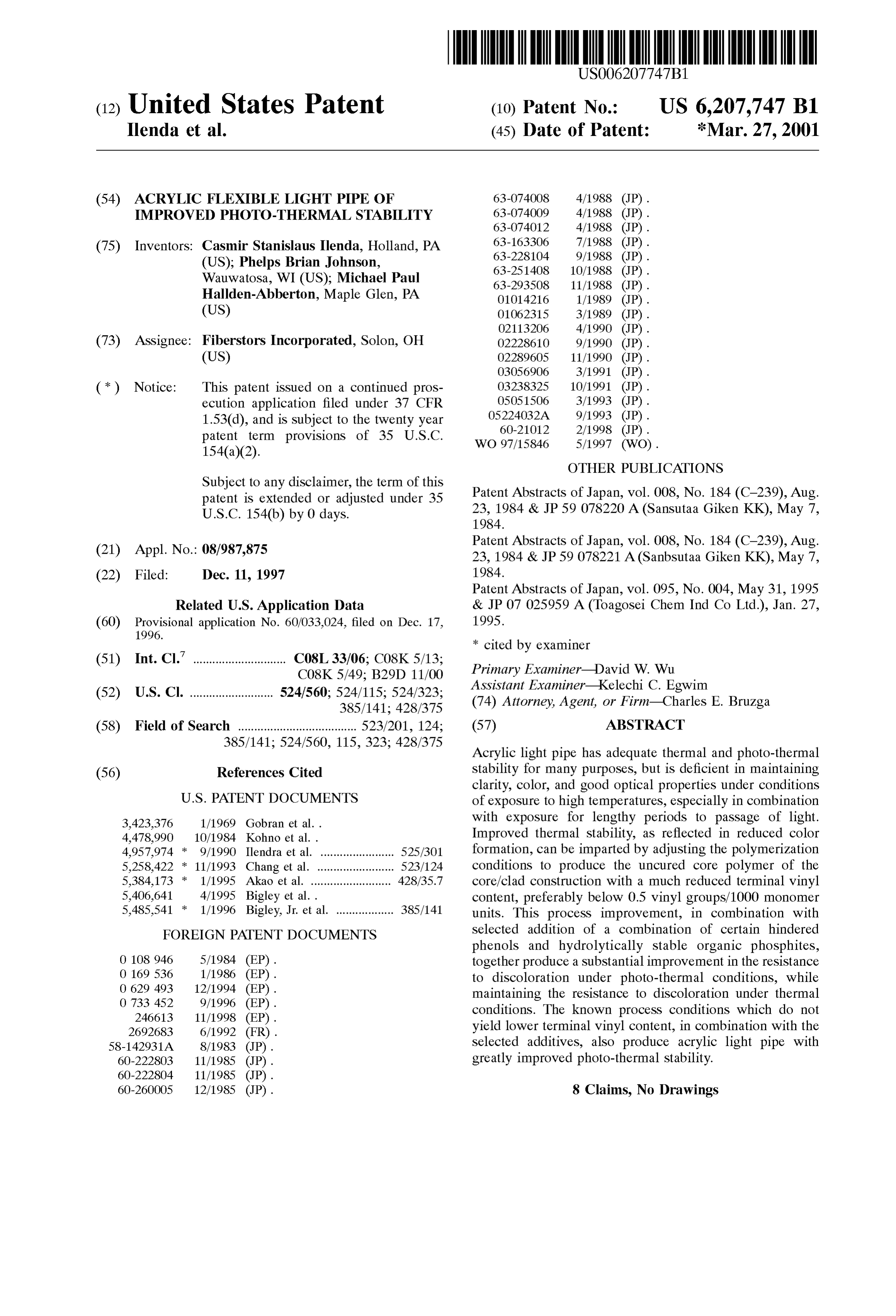
(12) United States Patent (10) Patent No.: US 6,207,747 B1 Ilenda et al. (45) Date of Patent: *Mar. 27, 2001
(54) ACRYLIC FLEXIBLE LIGHT PIPE OF 63-074008 4/1988 (JP). IMPROVED PHOTO-THERMAL STABILITY 63-074009 4/1988 (JP).
(75) Inventors: Casmir Stanislaus Ilenda, Holland, PA 32.8 o SE (US); Phelps Brian Johnson,
Wauwatosa, WI (US); Michael Paul
Hallden-Abberton, Maple Glen, PA O101.4216 1/1989 (JP).
(US) 01062315 3/1989 (JP).
(73) Assignee: Fiberstors Incorporated, Solon, OH O2228610 9/1990 (JP). (US) 02289605 11/1990 (JP).
(*) Notice: This patent issued on a continued pros- 03238325 10/1991 (JP). ecution application filed under 37 CFR 05051506 3/1993 (JP).
1.53(d), and is subject to the twenty year 0.5 gE. SE patent term provisions of 35 U.S.C.
154(a)(2). WO 97/15846 5/1997 (WO).
OTHER PUBLICATIONS
Subject to any disclaimer, the term of this patent is extended or adjusted under 35 Patent Abstracts of Japan, vol. 008, No. 184 (C-239), Aug. U.S.C. 154(b) by 0 days. 23, 1984 & JP 59 078220 A (Sansutaa Giken KK), May 7,
Patent Abstracts of Japan, vol. 008, No. 184 (C-239), Aug.
(21) Appl. No.: 08/987,875 23, 1984 & JP59 078221 A (Sanbsutaa Giken KK), May 7, (22) Filed: Dec. 11, 1997 1984.
Patent Abstracts of Japan, vol. 095, No. 004, May 31, 1995
Related U.S. Application Data & JP 07025959 A (Toagosei Chem Ind Co Ltd.), Jan. 27, (60) Provisional application No. 60/033,024, filed on Dec. 17, 1995.
* cited by examiner (51) Int. Cl. ............................. C08L33/06; CO8K 5/13;
C08K 5/49; B29D 11/00 Primary Examiner—David W. Wu (52) U.S. CI. 524/560; 524/115; 524/323; Assistant Examiner Kelechi C. Egwim ---- ------------- --- --- --- 385/1 41:42s(375 (74) Attorney, Agent, or Firm-Charles E. Bruzga
(58) Field of Search ..................................... 523/201, 124; (57) ABSTRACT 385/141; 524/560, 115,323; 428/375 -
Acrylic light pipe has adequate thermal and photo-thermal (56) References Cited Stability for many purposes, but is deficient in maintaining clarity, color, and good optical properties under conditions
3.423.376 1/1969 Gobran et al. . with exposure for lengthy periods to passage of light. 4.478,990 10/1984 Kohno et al. . Improved thermal stability, as reflected in reduced color 4,957,974 9/1990 Ilendra et al. ....................... 525/301 formation, can be imparted by adjusting the polymerization 5,258,422 * 11/1993 Chang et al. ..... ... 523/124 conditions to produce the uncured core polymer of the 5,384,173 * 1/1995 Akao et al. ......................... 428/35.7 core/clad construction with a much reduced terminal vinyl 5,406,641 4/1995 Bigley et al.. content, preferably below 0.5 vinyl groups/1000 monomer 5,485,541 * 1/1996 Bigley, Jr. et al. .................. 385/141 units. This process improvement, in combination with FOREIGN PATENT DOCUMENTS Selected addition of a combination of certain hindered phenols and hydrolytically stable organic phosphites,
O 108 946 5/1984 (EP). together produce a Substantial improvement in the resistance O 169536 1/1986 (EP). to discoloration under photo-thermal conditions, while O 629 493 12/1994 (EP). maintaining the resistance to discoloration under thermal 0 733 452 9/1996 (EP). conditions. The known process conditions which do not
(FR) yield lower terminal vinyl content, in combination with the 58-142931A 8/1983 (JP). Selected additives, also produce acrylic light pipe with 60-222803 11/1985 (JP). greatly improved photo-thermal Stability.
60-260005 12/1985 (JP). 8 Claims, No Drawings
Page 2
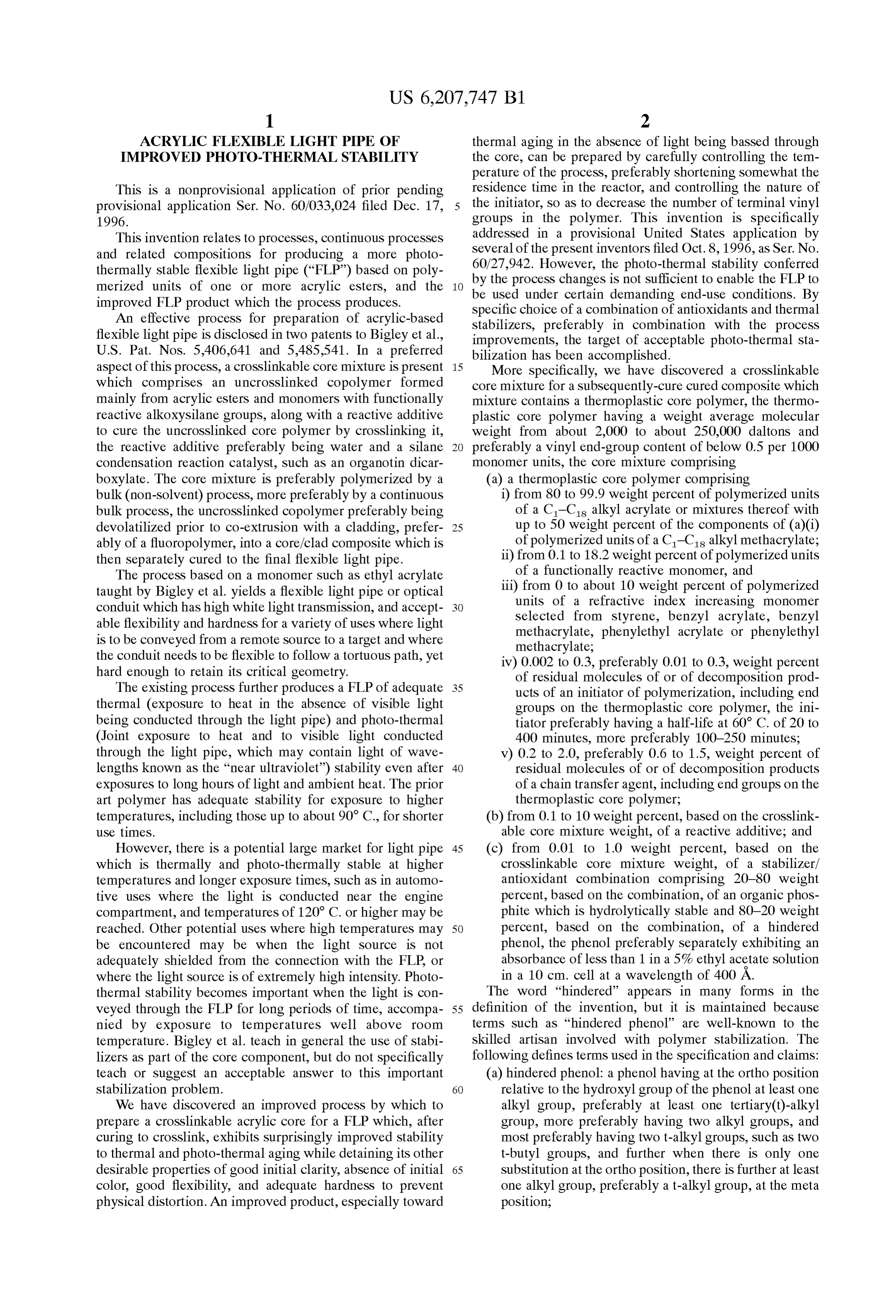
ACRYLC FLEXBLE LIGHT PIPE OF thermal aging in the absence of light being bassed through IMPROVED PHOTO-THERMAL STABILITY the core, can be prepared by carefully controlling the tem perature of the process, preferably shortening Somewhat the
This is a nonprovisional application of prior pending residence time in the reactor, and controlling the nature of provisional application Ser. No. 60/033,024 filed Dec. 17, the initiator, So as to decrease the number of terminal vinyl 1996. groups in the polymer. This invention is Specifically This invention relates to processes, continuous processes addressed in a provisional United States application by and related compositions for producing a more photo several of the present inventors filed Oct. 8, 1996, as Ser. No. thermally stable flexible light pipe (“FLP") based on poly by 60/27,942. However, the photo-thermal stability conferred merized units of one or more acrylic esters, and the be the process changes is not sufficient to enable the FLP to used under certain demanding end-use conditions. By improved FLP product which the process produces.
An effective process for preparation of acrylic-based Specific choice of a combination of antioxidants and thermal flexible light pipe is disclosed in two patents to Bigley et al., Stabilizers, preferably in combination with the process improvements, the target of acceptable photo-thermal Sta
U.S. Pat. Nos. 5,406,641 and 5,485,541. In a preferred bilization has been accomplished.
aspect of this process, a crosslinkable core mixture is present 15 More specifically, we have discovered a crosslinkable which comprises an uncrosslinked copolymer formed core mixture for a Subsequently-cure cured composite which mainly from acrylic esters and monomers with functionally mixture contains a thermoplastic core polymer, the thermo reactive alkoxysilane groups, along with a reactive additive plastic core polymer having a weight average molecular to cure the uncrosslinked core polymer by crosslinking it, weight from about 2,000 to about 250,000 daltons and the reactive additive preferably being water and a silane preferably a vinyl end-group content of below 0.5 per 1000 condensation reaction catalyst, Such as an organotin dicar monomer units, the core mixture comprising boxylate. The core mixture is preferably polymerized by a (a) a thermoplastic core polymer comprising bulk (non-Solvent) process, more preferably by a continuous i) from 80 to 99.9 weight percent of polymerized units bulk process, the uncrosslinked copolymer preferably being of a C-C alkyl acrylate or mixtures thereof with devolatilized prior to co-extrusion with a cladding, prefer 25 up to 50 weight percent of the components of (a)(i) ably of a fluoropolymer, into a core/clad composite which is of polymerized units of a C-C alkyl methacrylate; then Separately cured to the final flexible light pipe. ii) from 0.1 to 18.2 weight percent of polymerized units The process based on a monomer Such as ethyl acrylate of a functionally reactive monomer, and taught by Bigley et al. yields a flexible light pipe or optical iii) from 0 to about 10 weight percent of polymerized conduit which has high white light transmission, and accept units of a refractive indeX increasing monomer able flexibility and hardness for a variety of uses where light Selected from Styrene, benzyl acrylate, benzyl methacrylate, phenylethyl acrylate or phenylethyl is to be conveyed from a remote Source to a target and where methacrylate;
the conduit needs to be flexible to follow a tortuous path, yet iv) 0.002 to 0.3, preferably 0.01 to 0.3, weight percent hard enough to retain its critical geometry. of residual molecules of or of decomposition prod The existing process further produces a FLP of adequate 35 ucts of an initiator of polymerization, including end thermal (exposure to heat in the absence of visible light groups on the thermoplastic core polymer, the ini being conducted through the light pipe) and photo-thermal tiator preferably having a half-life at 60° C. of 20 to (Joint exposure to heat and to visible light conducted 400 minutes, more preferably 100-250 minutes; through the light pipe, which may contain light of wave v) 0.2 to 2.0, preferably 0.6 to 1.5, weight percent of lengths known as the “near ultraviolet”) stability even after 40 residual molecules of or of decomposition products exposures to long hours of light and ambient heat. The prior of a chain transfer agent, including end groups on the art polymer has adequate Stability for exposure to higher thermoplastic core polymer; temperatures, including those up to about 90° C., for shorter (b) from 0.1 to 10 weight percent, based on the crosslink use times. able core mixture weight, of a reactive additive; and However, there is a potential large market for light pipe 45 (c) from 0.01 to 1.0 weight percent, based on the which is thermally and photo-thermally stable at higher crosslinkable core mixture weight, of a Stabilizer/ temperatures and longer exposure times, Such as in automo antioxidant combination comprising 20-80 weight tive uses where the light is conducted near the engine percent, based on the combination, of an organic phos compartment, and temperatures of 120° C. or higher may be phite which is hydrolytically stable and 80-20 weight reached. Other potential uses where high temperatures may 50 percent, based on the combination, of a hindered be encountered may be when the light Source is not phenol, the phenol preferably Separately exhibiting an adequately shielded from the connection with the FLP, or absorbance of less than 1 in a 5% ethyl acetate solution where the light source is of extremely high intensity. Photo in a 10 cm. cell at a wavelength of 400 A. thermal Stability becomes important when the light is con The word “hindered” appears in many forms in the veyed through the FLP for long periods of time, accompa 55 definition of the invention, but it is maintained because nied by exposure to temperatures well above room terms such as “hindered phenol” are well-known to the temperature. Bigley et al. teach in general the use of Stabi skilled artisan involved with polymer stabilization. The lizers as part of the core component, but do not specifically following defines terms used in the Specification and claims: teach or Suggest an acceptable answer to this important (a) hindered phenol: a phenol having at the ortho position stabilization problem. 60 relative to the hydroxyl group of the phenol at least one We have discovered an improved process by which to alkyl group, preferably at least one tertiary(t)-alkyl prepare a crosslinkable acrylic core for a FLP which, after group, more preferably having two alkyl groups, and curing to crosslink, exhibits Surprisingly improved Stability most preferably having two t-alkyl groups, Such as two to thermal and photo-thermal aging while detaining its other t-butyl groups, and further when there is only one desirable properties of good initial clarity, absence of initial 65 Substitution at the ortho position, there is further at least color, good flexibility, and adequate hardness to prevent one alkyl group, preferably a t-alkyl group, at the meta physical distortion. An improved product, especially toward position;
Page 3
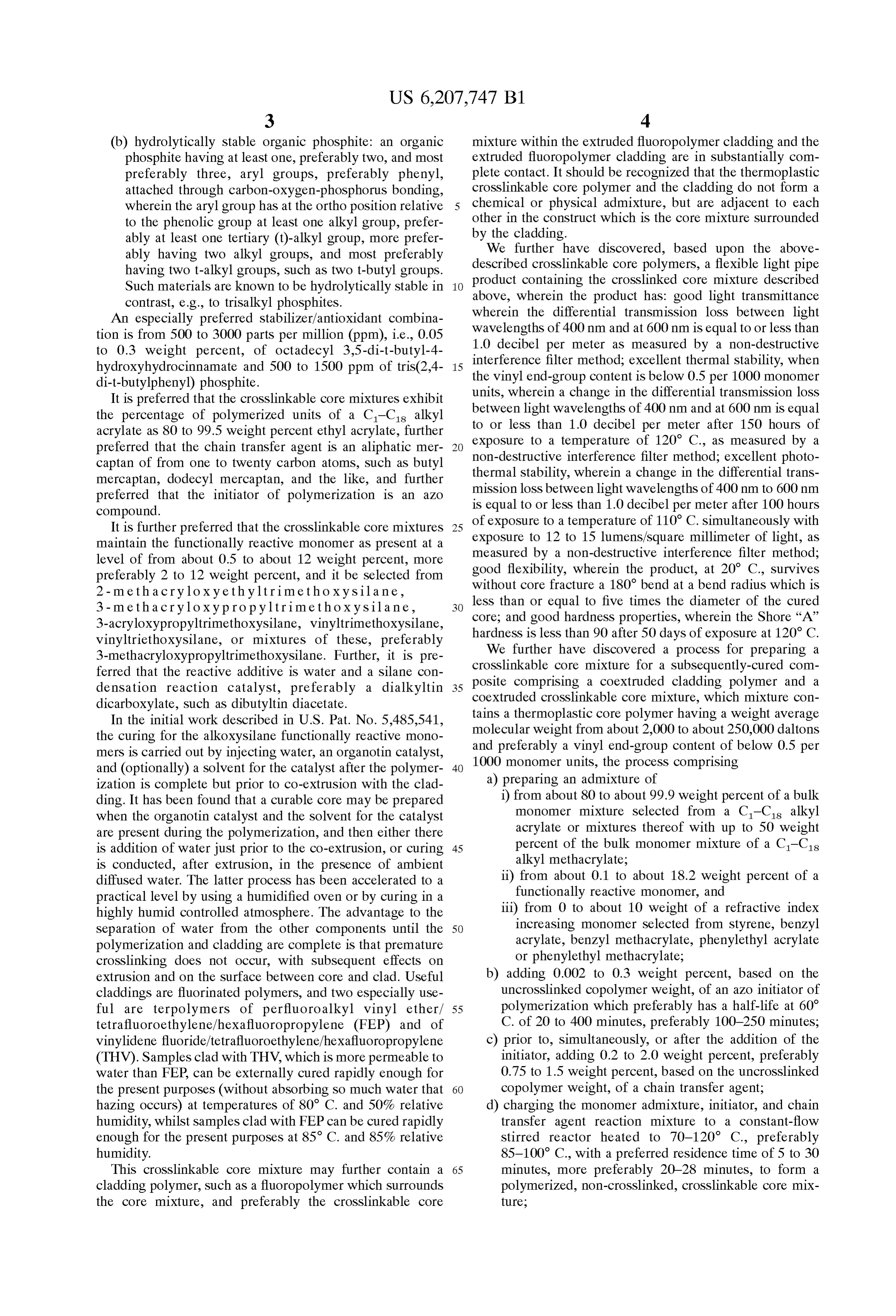
(b) hydrolytically stable organic phosphite: an organic mixture within the extruded fluoropolymer cladding and the phosphite having at least one, preferably two, and most extruded fluoropolymer cladding are in Substantially com preferably three, aryl groups, preferably phenyl, plete contact. It should be recognized that the thermoplastic attached through carbon-oxygen-phosphorus bonding, crosslinkable core polymer and the cladding do not form a wherein the aryl group has at the ortho position relative chemical or physical admixture, but are adjacent to each to the phenolic group at least one alkyl group, prefer other in the construct which is the core mixture Surrounded ably at least one tertiary (t)-alkyl group, more prefer by the cladding.
ably having two alkyl groups, and most preferably We further have discovered, based upon the above having two t-alkyl groups, Such as two t-butyl groups. described crosslinkable core polymers, a flexible light pipe Such materials are known to be hydrolytically stable in product containing the crosslinked core mixture described above, wherein the product has: good light transmittance contrast, e.g., to trisalkyl phosphites.
An especially preferred Stabilizer/antioxidant combina wherein wavelengths the differential transmission loss between light of 400 nm and at 600 nm is equal to or less than tion is from 500 to 3000 parts per million (ppm), i.e., 0.05 1.0 decibel per meter as measured by a non-destructive to 0.3 weight percent, of octadecyl 3,5-di-t-butyl-4- hydroxyhydrocinnamate and 500 to 1500 ppm of tris(2,4- 15 interference filter method; excellent thermal stability, when the vinyl end-group content is below 0.5 per 1000 monomer di-t-butylphenyl) phosphite.
It is preferred that the crosslinkable core mixtures exhibit units, wherein a change in the differential transmission loSS the percentage of polymerized units of a C-C alkyl between light wavelengths of 400 nm and at 600 nm is equal acrylate as 80 to 99.5 weight percent ethyl acrylate, further to or less than 1.0 decibel per meter after 150 hours of preferred that the chain transfer agent is an aliphatic mer exposure to a temperature of 120° C., as measured by a captain of from one to twenty carbon atoms, Such as butyl non-destructive interference filter method; excellent photo mercaptan, dodecyl mercaptan, and the like, and further thermal Stability, wherein a change in the differential trans preferred that the initiator of polymerization is an azo mission loss between light wavelengths of 400 nm to 600 nm compound. is equal to or less than 1.0 decibel per meter after 100 hours of exposure to a temperature of 110° C. simultaneously with
It is further preferred that the crosslinkable core mixtures exposure
maintain the functionally reactive monomer as present at a to 12 to 15 lumens/Square millimeter of light, as level of from about 0.5 to about 12 weight percent, more good measured by a non-destructive interference filter method; preferably 2 to 12 weight percent, and it be Selected from withoutflexibility, wherein the product, at 20° C., Survives core fracture a 180° bend at a bend radius which is 2-methacrylo Xy ethyltrime th o Xy Silane, 3 - me thacrylo Xy propyl trime thoxy Silane, less than or equal to five times the diameter of the cured 3-acryloxypropyltrimethoxysilane, Vinyltrimethoxysilane, core; and good hardneSS properties, wherein the Shore “A” Vinyltriethoxysilane, or mixtures of these, preferably hardness is less than 90 after 50 days of exposure at 120° C. 3-methacryloxypropyltrimethoxysilane. Further, it is pre We further have discovered a process for preparing a ferred that the reactive additive is water and a Silane con crosslinkable core mixture for a Subsequently-cured com densation reaction catalyst, preferably a dialkyltin 35 posite comprising a coextruded cladding polymer and a dicarboxylate, Such as dibutyltin diacetate. coextruded crosslinkable core mixture, which mixture con In the initial work described in U.S. Pat. No. 5,485,541, tains a thermoplastic core polymer having a weight average the curing for the alkoxysilane functionally reactive mono molecular weight from about 2,000 to about 250,000 daltons merS is carried out by injecting water, an organotin catalyst, and preferably a vinyl end-group content of below 0.5 per and (optionally) a Solvent for the catalyst after the polymer 40 1000 monomer units, the process comprising ization is complete but prior to co-extrusion with the clad a) preparing an admixture of ding. It has been found that a curable core may be prepared i) from about 80 to about 99.9 weight percent of a bulk when the organotin catalyst and the Solvent for the catalyst monomer mixture Selected from a C-C alkyl are present during the polymerization, and then either there acrylate or mixtures thereof with up to 50 weight is addition of water just prior to the co-extrusion, or curing 45 percent of the bulk monomer mixture of a C-Cls is conducted, after extrusion, in the presence of ambient alkyl methacrylate;
diffused water. The latter process has been accelerated to a ii) from about 0.1 to about 18.2 weight percent of a practical level by using a humidified oven or by curing in a functionally reactive monomer, and highly humid controlled atmosphere. The advantage to the iii) from 0 to about 10 weight of a refractive index Separation of water from the other components until the 50 increasing monomer Selected from Styrene, benzyl polymerization and cladding are complete is that premature acrylate, benzyl methacrylate, phenylethyl acrylate crosslinking does not occur, with Subsequent effects on or phenylethyl methacrylate; extrusion and on the Surface between core and clad. Useful b) adding 0.002 to 0.3 weight percent, based on the claddings are fluorinated polymers, and two especially use uncrosslinked copolymer weight, of an azo initiator of ful are terpolymers of perfluoroalkyl vinyl ether/ 55 polymerization which preferably has a half-life at 60 tetrafluoroethylene/hexafluoropropylene (FEP) and of C. of 20 to 400 minutes, preferably 100-250 minutes; vinylidene fluoride/tetrafluoroethylene/hexafluoropropylene c) prior to, simultaneously, or after the addition of the (THV). Samples clad with THV, which is more permeable to initiator, adding 0.2 to 2.0 weight percent, preferably water than FEP, can be externally cured rapidly enough for 0.75 to 1.5 weight percent, based on the uncrosslinked the present purposes (without absorbing So much water that 60 copolymer weight, of a chain transfer agent; hazing occurs) at temperatures of 80° C. and 50% relative d) charging the monomer admixture, initiator, and chain humidity, whilst samples clad with FEP can be cured rapidly transfer agent reaction mixture to a constant-flow enough for the present purposes at 85 C. and 85% relative stirred reactor heated to 70–120° C., preferably humidity. 85-100° C., with a preferred residence time of 5 to 30 This crosslinkable core mixture may further contain a 65 minutes, more preferably 20–28 minutes, to form a cladding polymer, Such as a fluoropolymer which Surrounds polymerized, non-crosslinked, crosslinkable core mix the core mixture, and preferably the crosslinkable core ture,
Page 4
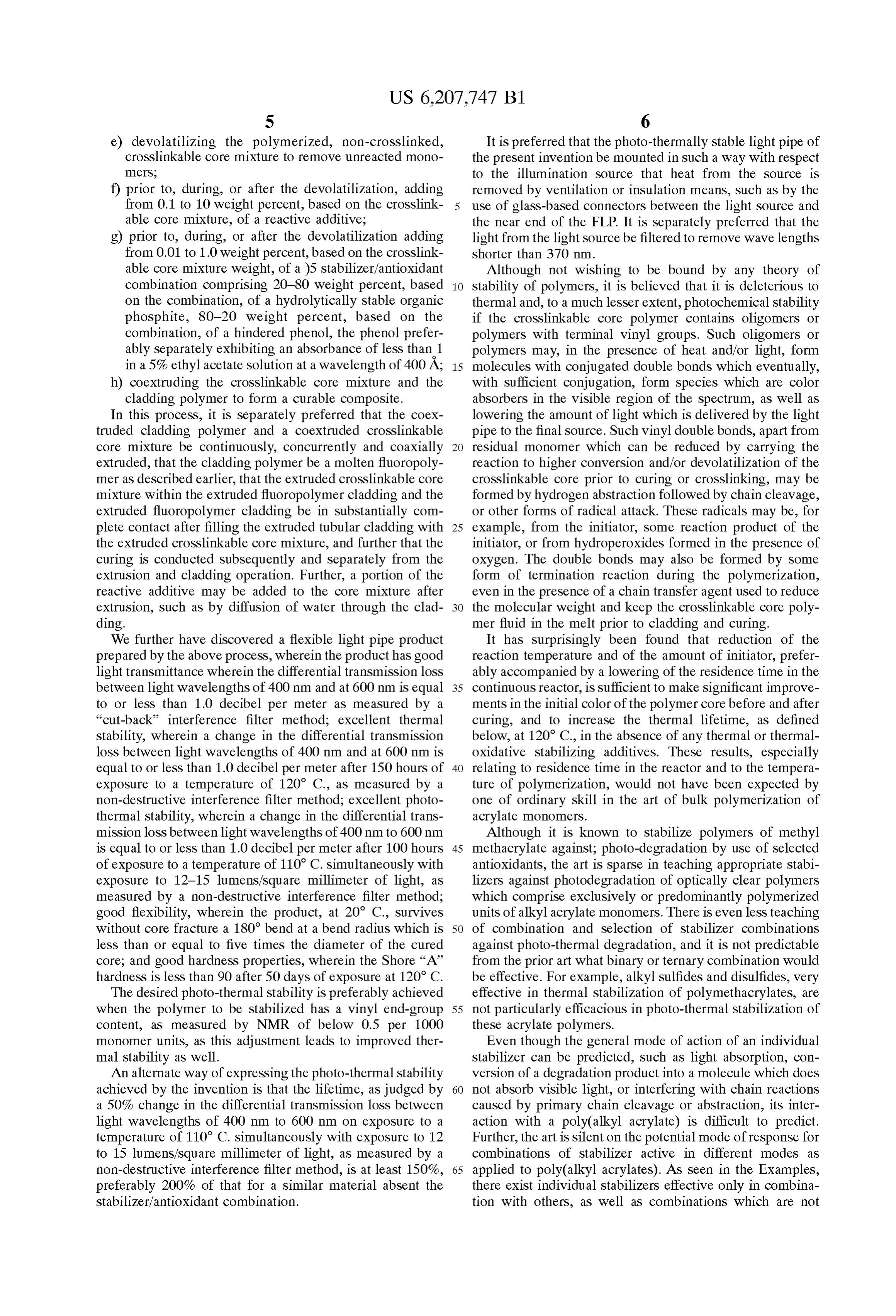
S 6 e) devolatilizing the polymerized, non-crosslinked, It is preferred that the photo-thermally stable light pipe of crosslinkable core mixture to remove unreacted mono the present invention be mounted in Such a way with respect merS, to the illumination Source that heat from the Source is f) prior to, during, or after the devolatilization, adding removed by Ventilation or insulation means, Such as by the from 0.1 to 10 weight percent, based on the crosslink use of glass-based connectors between the light Source and able core mixture, of a reactive additive; the near end of the FLP. It is separately preferred that the g) prior to, during, or after the devolatilization adding light from the light Source be filtered to remove wave lengths from 0.01 to 1.0 weight percent, based on the crosslink shorter than 370 nm.
able core mixture weight, of a)5 stabilizer/antioxidant Although not wishing to be bound by any theory of combination comprising 20-80 weight percent, based 1O stability of polymers, it is believed that it is deleterious to on the combination, of a hydrolytically stable organic thermal and, to a much lesser extent, photochemical Stability phosphite, 80-20 weight percent, based on the if the crosslinkable core polymer contains oligomers or combination, of a hindered phenol, the phenol prefer polymers with terminal vinyl groupS. Such oligomers or ably Separately exhibiting an absorbance of less than 1 polymers may, in the presence of heat and/or light, form in a 5% ethyl acetate solution at a wavelength of 400 A; 15 molecules with conjugated double bonds which eventually, h) coextruding the crosslinkable core mixture and the with Sufficient conjugation, form Species which are color cladding polymer to form a curable composite. absorbers in the visible region of the Spectrum, as well as In this process, it is separately preferred that the coex lowering the amount of light which is delivered by the light truded cladding polymer and a coextruded crosslinkable pipe to the final Source. Such vinyl double bonds, apart from core mixture be continuously, concurrently and coaxially residual monomer which can be reduced by carrying the extruded, that the cladding polymer be a molten fluoropoly reaction to higher conversion and/or devolatilization of the meras described earlier, that the extruded crosslinkable core crosslinkable core prior to curing or crosslinking, may be mixture within the extruded fluoropolymer cladding and the formed by hydrogen abstraction followed by chain cleavage, extruded fluoropolymer cladding be in Substantially com or other forms of radical attack. These radicals may be, for plete contact after filling the extruded tubular cladding with 25 example, from the initiator, Some reaction product of the the extruded crosslinkable core mixture, and further that the initiator, or from hydroperoxides formed in the presence of curing is conducted Subsequently and Separately from the oxygen. The double bonds may also be formed by some extrusion and cladding operation. Further, a portion of the form of termination reaction during the polymerization, reactive additive may be added to the core mixture after even in the presence of a chain transfer agent used to reduce extrusion, Such as by diffusion of water through the clad the molecular weight and keep the crosslinkable core poly ding. mer fluid in the melt prior to cladding and curing. We further have discovered a flexible light pipe product It has Surprisingly been found that reduction of the prepared by the above process, wherein the product has good reaction temperature and of the amount of initiator, prefer light transmittance wherein the differential transmission loSS ably accompanied by a lowering of the residence time in the between light wavelengths of 400 nm and at 600 nm is equal 35 continuous reactor, is Sufficient to make Significant improve to or less than 1.0 decibel per meter as measured by a ments in the initial color of the polymer core before and after "cut-back' interference filter method; excellent thermal curing, and to increase the thermal lifetime, as defined Stability, wherein a change in the differential transmission below, at 120° C., in the absence of any thermal or thermal loss between light wavelengths of 400 nm and at 600 nm is oxidative Stabilizing additives. These results, especially equal to or less than 1.0 decibel per meter after 150 hours of 40 relating to residence time in the reactor and to the tempera exposure to a temperature of 120° C., as measured by a ture of polymerization, would not have been expected by non-destructive interference filter method; excellent photo one of ordinary skill in the art of bulk polymerization of thermal Stability, wherein a change in the differential trans acrylate monomers.
mission loss between light wavelengths of 400 nm to 600 nm Although it is known to stabilize polymers of methyl is equal to or less than 1.0 decibel per meter after 100 hours 45 methacrylate against; photo-degradation by use of Selected of exposure to a temperature of 110° C. simultaneously with antioxidants, the art is sparse in teaching appropriate Stabi exposure to 12-15 lumenS/Square millimeter of light, as lizers against photodegradation of optically clear polymers measured by a non-destructive interference filter method; which comprise exclusively or predominantly polymerized good flexibility, wherein the product, at 20 C., Survives units of alkyl acrylate monomers. There is even leSS teaching without core fracture a 180° bend at a bend radius which is 50 of combination and Selection of Stabilizer combinations less than or equal to five times the diameter of the cured against photo-thermal degradation, and it is not predictable core; and good hardness properties, wherein the Shore “A” from the prior art what binary or ternary combination would hardness is less than 90 after 50 days of exposure at 120° C. be effective. For example, alkylsulfides and disulfides, very The desired photo-thermal stability is preferably achieved effective in thermal Stabilization of polymethacrylates, are when the polymer to be Stabilized has a vinyl end-group 55 not particularly efficacious in photo-thermal Stabilization of content, as measured by NMR of below 0.5 per 1000 these acrylate polymers.
monomer units, as this adjustment leads to improved ther Even though the general mode of action of an individual mal stability as well. Stabilizer can be predicted, Such as light absorption, con An alternate way of expressing the photo-thermal Stability version of a degradation product into a molecule which does achieved by the invention is that the lifetime, as judged by 60 not absorb visible light, or interfering with chain reactions a 50% change in the differential transmission loss between caused by primary chain cleavage or abstraction, its inter light wavelengths of 400 nm to 600 nm on exposure to a action with a poly(alkyl acrylate) is difficult to predict. temperature of 110° C. simultaneously with exposure to 12 Further, the art is Silent on the potential mode of response for to 15 lumenS/Square millimeter of light, as measured by a combinations of stabilizer active in different modes as non-destructive interference filter method, is at least 150%, 65 applied to poly(alkyl acrylates). AS Seen in the Examples, preferably 200% of that for a similar material absent the there exist individual stabilizers effective only in combina Stabilizer/antioxidant combination. tion with others, as well as combinations which are not
Page 5
efficient enough to achieve the Stabilization goal which can 3-methacryloxypropyltrimethoxysilane (MATS) (5 wt.% be achieved by certain selected additives. based on monomer weight (b.o.m.), 6.4 g. of initiator
EXPERIMENTAL
(recrystallized 2,2'-azobis(2-methylbutyronitrile) (0.064 wt.
%) and 100 g. of n-dodecyl mercaptan (1 wt.%). The
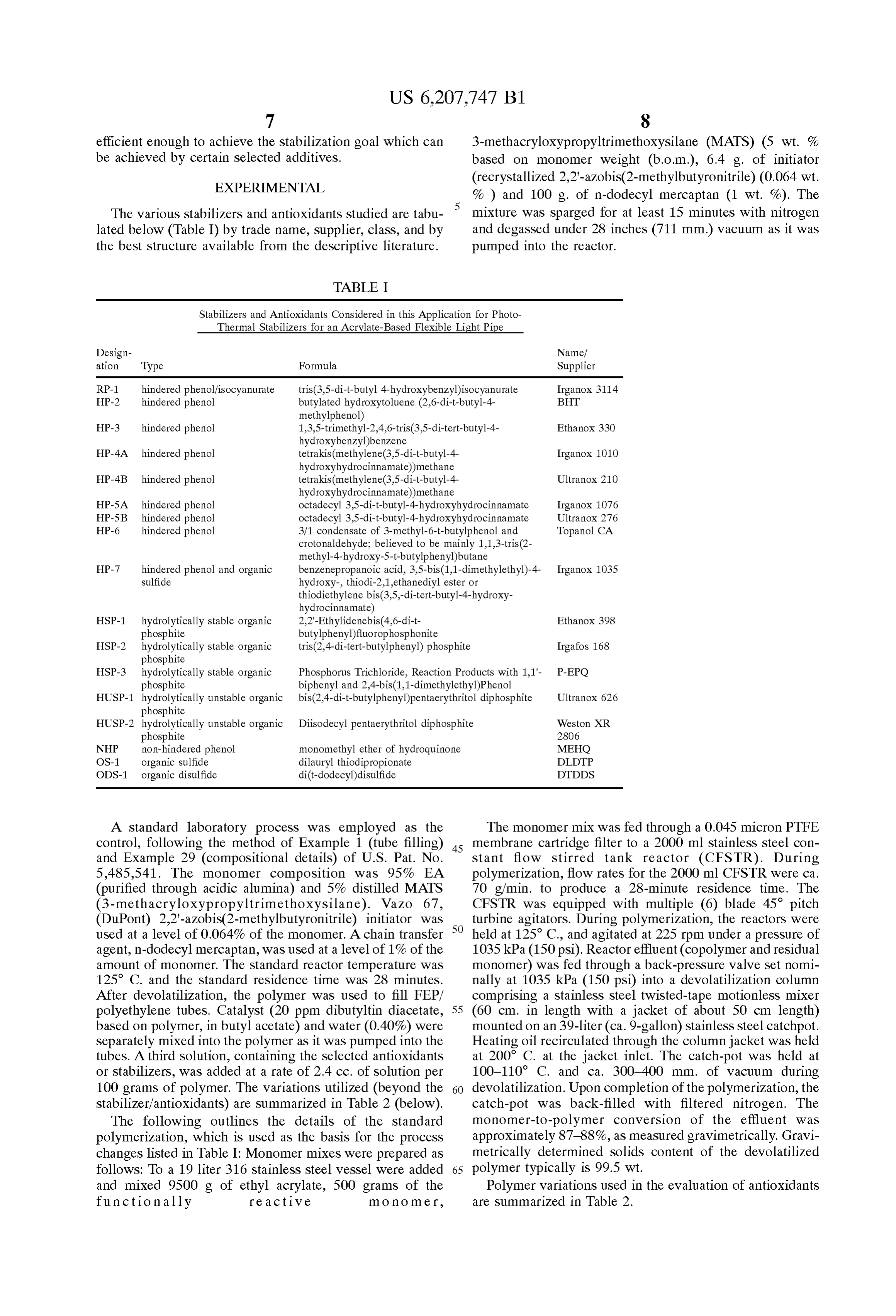
The various Stabilizers and antioxidants Studied are tabu mixture was sparged for at least 15 minutes with nitrogen lated below (Table I) by trade name, Supplier, class, and by and degassed under 28 inches (711 mm.) Vacuum as it was the best structure available from the descriptive literature. pumped into the reactor.
TABLE I
Stabilizers and Antioxidants Considered in this Application for Photo
Thermal Stabilizers for an Acrylate-Based Flexible Light Pipe
Design- Name? ation Type Formula Supplier RP-1 hindered phenol/isocyanurate tris(3,5-di-t-butyl 4-hydroxybenzyl)isocyanurate Irganox 3114 HP-2 hindered pheno butylated hydroxytoluene (2,6-di-t-butyl-4- BHT methylphenol)
HP-3 hindered pheno 1,3,5-trimethyl-2,4,6-tris(3,5-di-tert-butyl-4- Ethanox 330
HP-4A hindered pheno tetrakis(methylene(3,5-di-t-butyl-4- Irganox 1010
HP-4B hindered pheno tetrakis(methylene(3,5-di-t-butyl-4- Ultranox 210
HP-5A hindered pheno octadecyl 3,5-di-t-butyl-4-hydroxyhydrocinnamate Irganox 1076 HP-5B hindered pheno octadecyl 3,5-di-t-butyl-4-hydroxyhydrocinnamate Ultranox 276 HP-6 hindered pheno 3/1 condensate of 3-methyl-6-t-butylphenol and Topanol CA crotonaldehyde; believed to be mainly 1,1,3-tris(2-
HP-7 hindered phenol and organic benzenepropanoic acid, 3,5-bis(1,1-dimethylethyl)-4- Irganox 1035 sulfide hydroxy-, thiodi-2,1,ethanediyl ester or thiodiethylene bis(3,5-di-tert-butyl-4-hydroxy hydrocinnamate)
HSP-1 hydrolytically stable organic 2,2'-Ethylidenebis(4,6-di-t- Ethanox 398 phosphite butylphenyl)fluorophosphonite
HSP-2 hydrolytically stable organic tris(2,4-di-tert-butylphenyl) phosphite Irgafos 168 phosphite
HSP-3 hydrolytically stable organic Phosphorus Trichloride, Reaction Products with 1,1'- P-EPQ phosphite biphenyl and 2,4-bis(1,1-dimethylethyl)Phenol
HUSP-1 hydrolytically unstable organic bis(2,4-di-t-butylphenyl)pentaerythritol diphosphite Ultranox 626 phosphite
HUSP-2 hydrolytically unstable organic Diisodecyl pentaerythritol diphosphite Weston XR phosphite 2806
NHP non-hindered phenol monomethyl ether of hydroquinone MEHO OS-1 organic sulfide dilauryl thiodipropionate DLDTP ODS-1 organic disulfide di(t-dodecyl)disulfide DTDDS
A Standard laboratory proceSS was employed as the The monomer mix was fed through a 0.045 micron PTFE control, following the method of Example 1 (tube filling) 45 membrane cartridge filter to a 2000 ml stainless steel con and Example 29 (compositional details) of U.S. Pat. No. stant flow stirred tank reactor (CFSTR). During 5,485,541. The monomer composition was 95% EA polymerization, flow rates for the 2000 ml CFSTR were ca. (purified through acidic alumina) and 5% distilled MATS 70 g/min. to produce a 28-minute residence time. The (3-methacryloxypropyltrimethoxysilane). Vazo 67, CFSTR was equipped with multiple (6) blade 45 pitch (DuPont) 2,2'-azobis(2-methylbutyronitrile) initiator was turbine agitators. During polymerization, the reactors were used at a level of 0.064% of the monomer. A chain transfer 50 held at 125 C., and agitated at 225 rpm under a pressure of agent, n-dodecyl mercaptan, was used at a level of 1% of the 1035 kPa (150 psi). Reactor effluent (copolymer and residual amount of monomer. The Standard reactor temperature was monomer) was fed through a back-pressure valve set nomi 125 C. and the standard residence time was 28 minutes. nally at 1035 kPa (150 psi) into a devolatilization column After devolatilization, the polymer was used to fill FEP/ comprising a stainleSS Steel twisted-tape motionless mixer polyethylene tubes. Catalyst (20 ppm dibutyltin diacetate, 55 (60 cm. in length with a jacket of about 50 cm length) based on polymer, in butyl acetate) and water (0.40%) were mounted on an 39-liter (ca. 9-gallon) stainless Steel catchpot. Separately mixed into the polymer as it was pumped into the Heating oil recirculated through the column jacket was held tubes. A third Solution, containing the Selected antioxidants at 200 C. at the jacket inlet. The catch-pot was held at or Stabilizers, was added at a rate of 2.4 cc. of Solution per 100-110° C. and ca. 300-400 mm. of vacuum during 100 grams of polymer. The variations utilized (beyond the 60 devolatilization. Upon completion of the polymerization, the stabilizer/antioxidants) are summarized in Table 2 (below). catch-pot was back-filled with filtered nitrogen. The The following outlines the details of the standard monomer-to-polymer conversion of the effluent was polymerization, which is used as the basis for the proceSS approximately 87-88%, as measured gravimetrically. Gravi changes listed in Table I: Monomer mixes were prepared as metrically determined solids content of the devolatilized follows: To a 19 liter 316 stainless steel vessel were added 65 polymer typically is 99.5 wt.
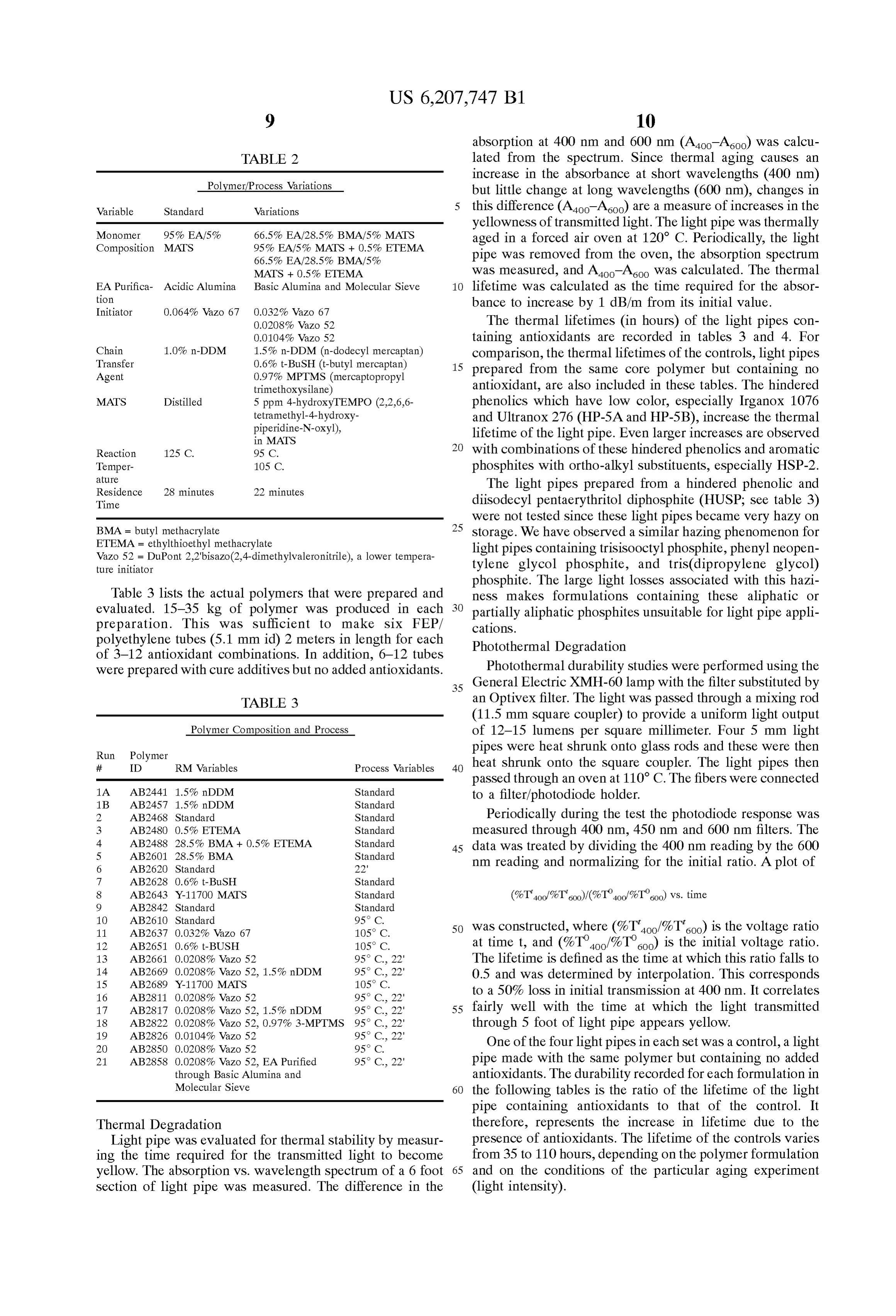
and mixed 9500 g of ethyl acrylate, 500 grams of the Polymer variations used in the evaluation of antioxidants functionally reactive m O no me r, are Summarized in Table 2.
Page 6
absorption at 400 nm and 600 nm (Aloo-Asoo) was calcu
TABLE 2 lated from the Spectrum. Since thermal aging causes an
Polymer/Process Variations increase in the absorbance at short wavelengths (400 nm) but little change at long wavelengths (600 nm), changes in
Variable Standard Variations this difference (Aloo-Asoo) are a measure of increases in the yellowneSS of transmitted light. The light pipe was thermally
Composition MATS
aged in a forced air oven at 120° C. Periodically, the light 66.5% EA/28.5% BMAF5% pipe was removed from the oven, the absorption spectrum
MATS + O.5% ETEMA was measured, and Al-Asoo was calculated. The thermal
EA Purifica- Acidic Alumina tion
Basic Alumina and Molecular Sieve lifetime was calculated as the time required for the absor
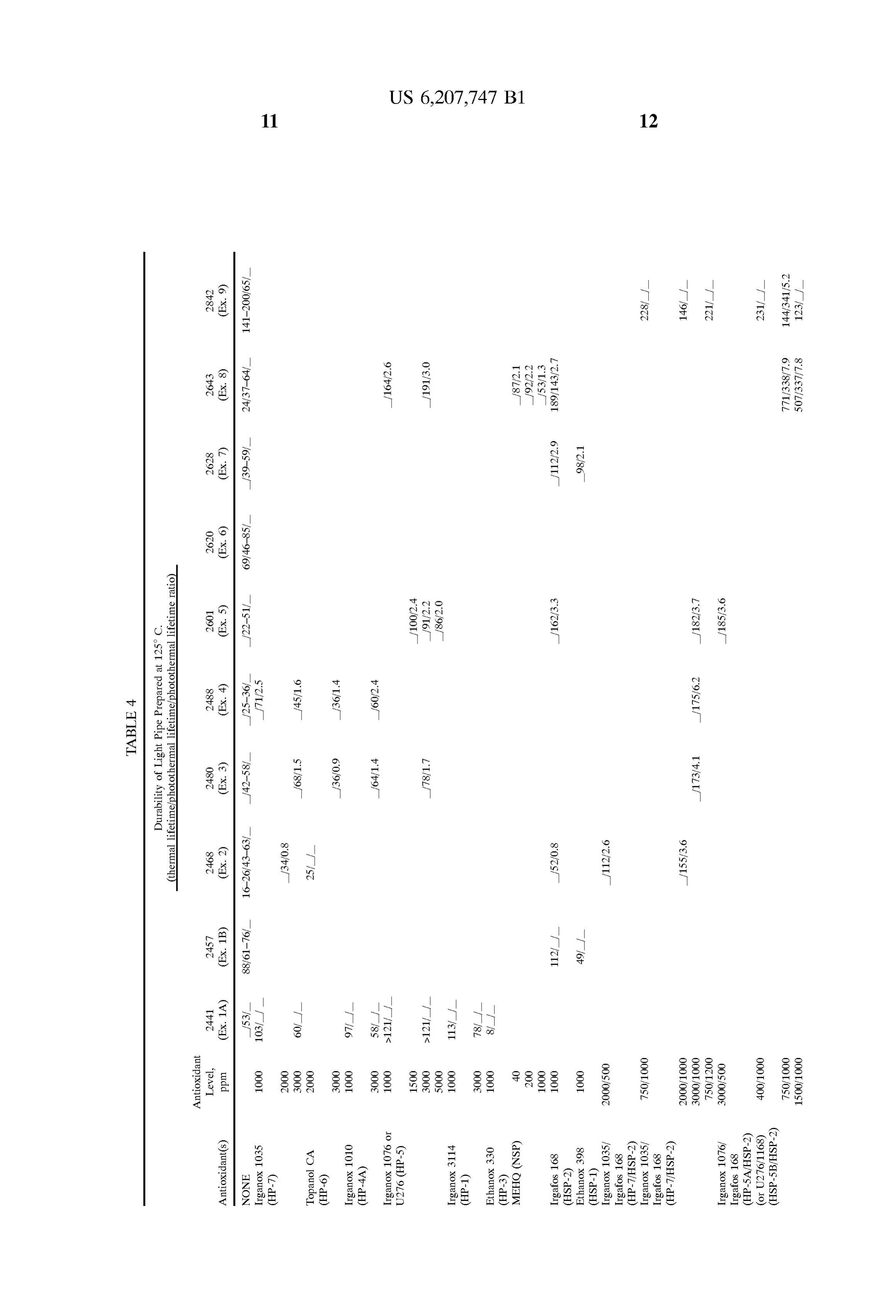
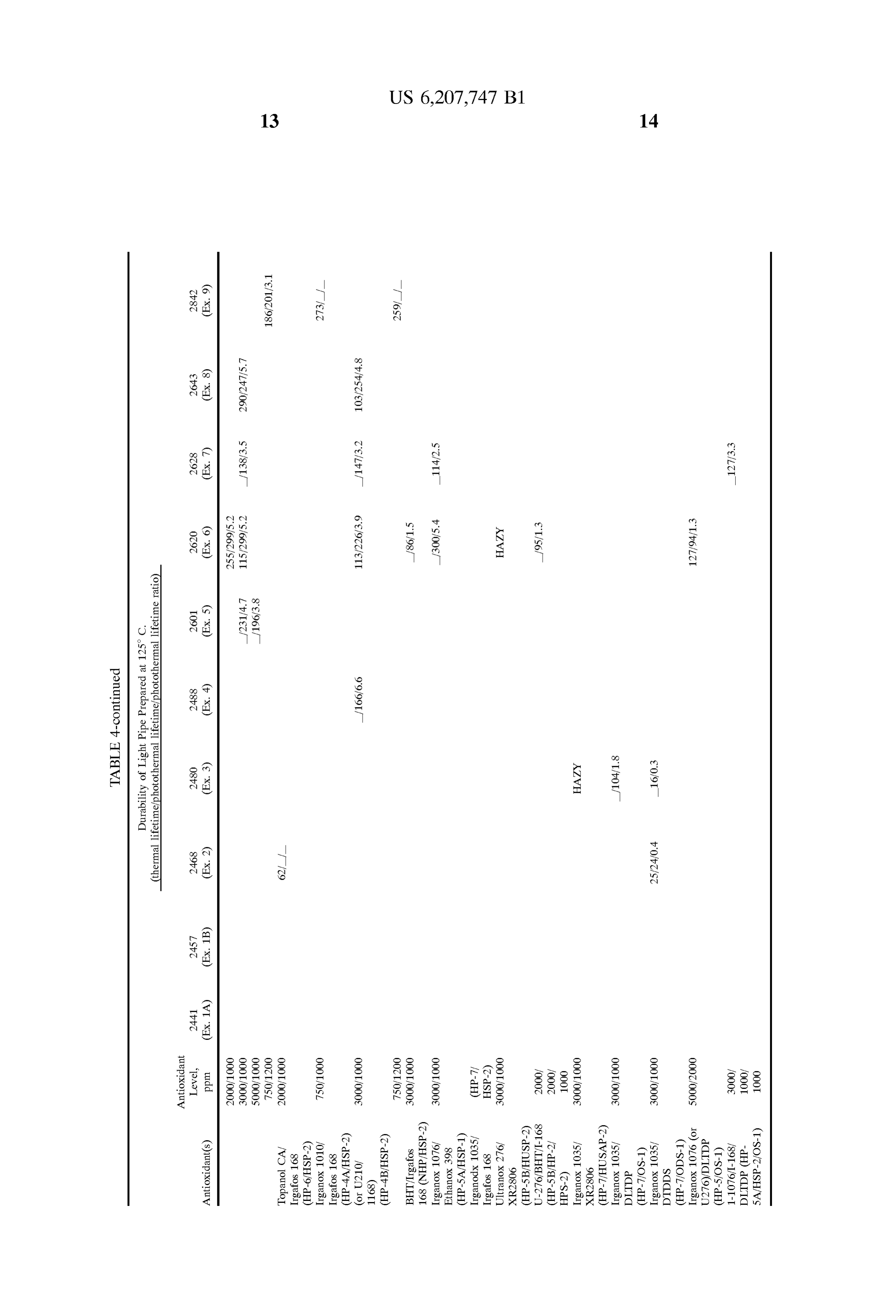
Initiator O.O64% Wazo 67 O.O.32% Wazo 67 bance to increase by 1 dB/m from its initial value. O.O2O8%. Wazo 52 The thermal lifetimes (in hours) of the light pipes con 0.01.04% WaZO 52 taining antioxidants are recorded in tables 3 and 4. For
Chain 1.0% n-DDM 1.5% n-DDM (n-dodecyl mercaptan) comparison, the thermal lifetimes of the controls, light pipes Transfer 0.6% t-BuSH (t-butyl mercaptan) 15 prepared from the Same core polymer but containing no Agent 0.97%. MPTMS (mercaptopropyl trimethoxysilane) antioxidant, are also included in these tables. The hindered
MATS Distilled 5 ppm 4-hydroxyTEMPO (2.2,6,6- phenolics which have low color, especially Irganox 1076 tetramethyl-4-hydroxy and Ultranox 276 (HP-5A and HP-5B), increase the thermal piperidine-N-oxyl), lifetime of the light pipe. Even larger increases are observed in MATS
Reaction 125 C. 95 C. with combinations of these hindered phenolics and aromatic Temper- 105 C. phosphites with ortho-alkyl substituents, especially HSP-2. ature
Residence 28 minutes 22 minutes
The light pipes prepared from a hindered phenolic and
Time diisodecyl pentaerythritol diphosphite (HUSP; see table 3)
were not tested Since these light pipes became very hazy on
BMA = butyl methacrylate Storage. We have observed a similar hazing phenomenon for ETEMA = ethylthioethyl methacrylate light pipes containing trisisooctyl phosphite, phenyl neopen Vazo 52 = DuPont 2,2'bisazo(2,4-dimethylvaleronitrile), a lower tempera tylene glycol phosphite, and tris(dipropylene glycol) ture initiator phosphite. The large light losses associated with this hazi
Table 3 lists the actual polymers that were prepared and neSS makes formulations containing these aliphatic or evaluated. 15-35 kg of polymer was produced in each partially aliphatic phosphites unsuitable for light pipe appli preparation. This was sufficient to make six FEP/ cations.
polyethylene tubes (5.1 mm id) 2 meters in length for each Photothermal Degradation of 3-12 antioxidant combinations. In addition, 6-12 tubes were prepared with cure additives but no added antioxidants. Photothermal durability studies were performed using the 35 General Electric XMH-60 lamp with the filter substituted by
TABLE 3 an OptiveX filter. The light was passed through a mixing rod (11.5 mm Square coupler) to provide a uniform light output
Polymer Composition and Process of 12-15 lumens per square millimeter. Four 5 mm light Run Polymer pipes were heat shrunk onto glass rods and these were then # ID RM Variables Process Variables 40 heat shrunk onto the Square coupler. The light pipes then passed through an oven at 110°C. The fibers were connected
Standard
Standard to a filter/photodiode holder.
2 AB2468 Standard Standard Periodically during the test the photodiode response was 3 AB248O O.5% ETEMA Standard measured through 400 nm, 450 nm and 600 nm filters. The 4 AB2488 28.5% BMA+ O.5% ETEMA Standard 45 data was treated by dividing the 400 nm reading by the 600 5 AB26O1 28.5% BMA Standard 6 AB2620 Standard 22' nm reading and normalizing for the initial ratio. A plot of 7 AB2628 0.6% t-BuSH Standard 8 AB2643 Y-117OO MATS Standard 9 AB2842 Standard Standard 1O AB2610 Standard 95° C.
11 AB2637 O.O32%. Vazo 67 105° C. 50 was constructed, where (%Too/%Too) is the Voltage ratio 12 AB2651 O.6% t-BUSH 105° C. at time t, and (%Too/%Too) is the initial voltage ratio. 13 AB2661 0.0208% WaZO 52 95° C., 22' The lifetime is defined as the time at which this ratio falls to
0.5 and was determined by interpolation. This corresponds 16 AB2811 0.0208% WaZO 52 95° C., 22' to a 50% loss in initial transmission at 400 nm. It correlates 17 AB2817 0.0208% Vazo 52, 1.5% nDDM 95° C., 22' fairly well with the time at which the light transmitted
18 AB2822 0.0208% Vazo 52, 0.97% 3-MPTMS 95° C., 22' through 5 foot of light pipe appears yellow.
2O AB285O O.O2O8%. Wazo 52 95° C. One of the four light pipes in each Set was a control, a light 21 AB2858 0.0208% Vazo 52, EA Purified 95° C., 22' pipe made with the Same polymer but containing no added through Basic Alumina and antioxidants. The durability recorded for each formulation in Molecular Sieve 60 the following tables is the ratio of the lifetime of the light pipe containing antioxidants to that of the control. It
Thermal Degradation therefore, represents the increase in lifetime due to the Light pipe was evaluated for thermal Stability by measur presence of antioxidants. The lifetime of the controls varies ing the time required for the transmitted light to become from 35 to 110 hours, depending on the polymer formulation yellow. The absorption vs. wavelength spectrum of a 6 foot 65 and on the conditions of the particular aging experiment Section of light pipe was measured. The difference in the (light intensity).
Page 7
Drawing sheet — no readable text.
Page 8
Drawing sheet — no readable text.
Page 9
Drawing sheet — no readable text.
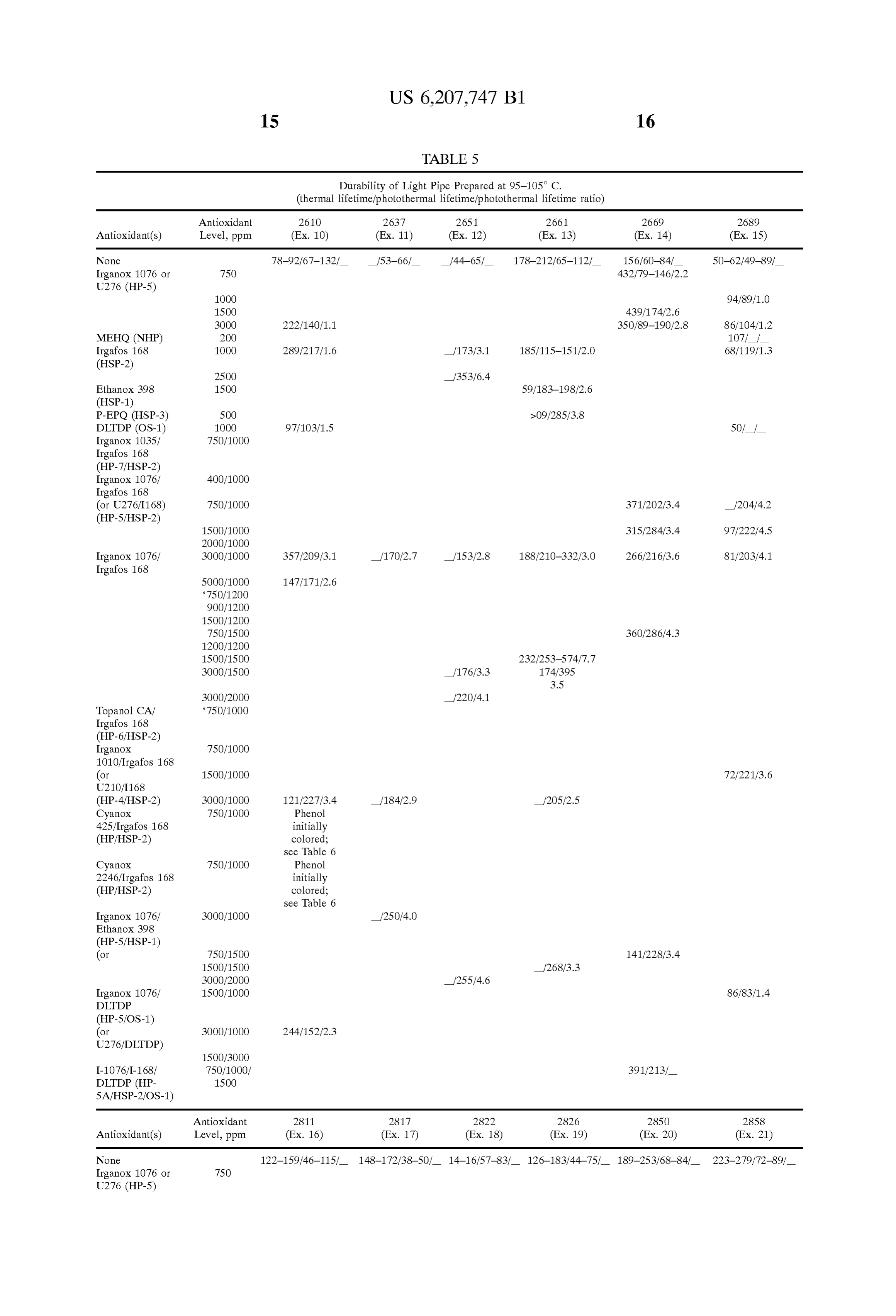
Page 10
TABLE 5-continued
Durability of Light Pipe Prepared at 95-105 C.
(thermal lifetime/photothermal lifetime/photothermal lifetime ratio)
MEHQ (NHP)
Irgafos 168
Irganox 1035/ OOO 235/131/2.4
Irgafos 168
Irganox 1076/ OOO 313/124/1.7 Irgafos 168 (or U276/I168) OOO 237/348/3.0 235/171.f4.5 329/179f2.4 297,
15OOf OOO 239f2O1-414/3.6 228/134-279/3.5 31f111f1.6 311/261/3.5 287/219/3.2 297/246/2.8 2OOOf OOO 297, Irganox 1076/ 3OOOf OOO 182/196-272/2.4 156,155-261f4.1 27/108/1.6 27Of Irgafos 168
OOO 2OO 275/156/3.5 2OO 306 2OO 298,315/3.8
2OO 310, 500 286/295/3.5
Topanol CA/ OOO 271/138/2.6 Irgafos 168
Irganox OOO 236/142?2.6
Cyanox OOO 37.
Cyanox OOO 39,
Irganox 1076/ 3OOOf OOO
Ethanox 398
DLTDP
1500/3OOO 106/1.6
The results in Tables 4 and 5 indicate: Thioether antioxidants increase the photothermal lifetime Hindered phenolic antioxidants at a level of 0.075-0.5% by about 50%.
(750-5000 ppm) increase the photothermal lifetime by about Combinations of hindered phenolics and hydrolysis resis 50-200%. 60 tant phosphites consistently result in large increases in Phosphite antioxidants (0.05–0.25%) increase the photo photothermal lifetime (about 150–700%).
thermal lifetime by about 30-500%. Hydrolysis resistant Combinations of hindered phenolics and thioethers give phosphites (such as Irgafos 168 (HSP-2), P-EPQ (HSP-3), an increase in photothermal lifetime of about 30-130%. Ethanox 398 (HSP-1), and those of similar structure) are EXAMPLE 22 required since those that are not hydrolysis resistant lead to 65 hazing of the light pipe and large white light losses (see the The absorption spectra of a Series of hindered phenolics results with Weston XR2806 (HUSP-2)). were measured. A 5% solution of the hindered phenolic in
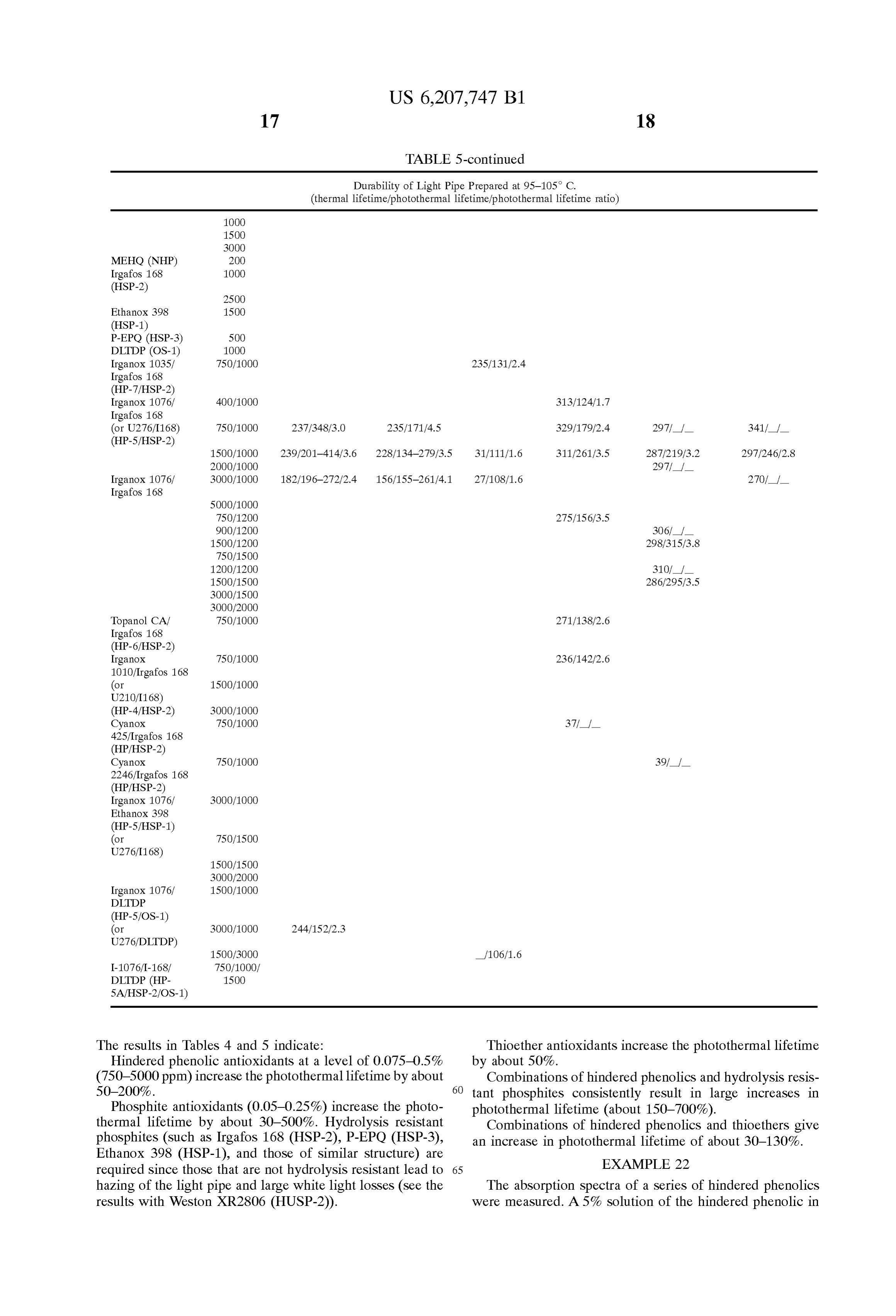
Page 11
ethyl acetate was prepared. The absorption spectrum was polymerization, including end groups on the thermo recorded in a 10 cm cell. The absorbance at 400 nm is plastic core polymer;
recorded in Table 6. The absorbance ranges from very low v) from 0.2 to 2.0 weight percent of residual molecules to over 3. The absorbance at 400 nm may not be due to the of or of decomposition products of a chain transfer electronic absorption of the hindered phenolic, but may 5 agent, including end groups on the thermoplastic result from impurities in the commercial product. core polymer;
(b) from 0.1 to 10 weight percent, based on the crosslink
TABLE 6 able core mixture weight, of a reactive additive; and (c) from 0.01 to 1.0 weight percent, based on the
Comparison of Hindered Phenolics 1O crosslinkable core mixture weight, of a Stabilizer/
antioxidant combination comprising 20-80 weight
Absorbance Thermal Photothermal percent, based on the combination, of an organic phos Antioxidant (1) Lifetime (hours) Lifetime (hours) phite which is hydrolytically stable and 80-20 weight percent, based on the combination, of a hindered phe
None 126-183 44-75 nol.
IrganOX O.O53 329 179 15
2. The crosslinkable core mixture of claim 1, wherein the 5A) thermoplastic core polymer has a vinyl end-group content of IrganOX O.160 236 142 below 0.5 per 1000 monomer units. 1010 (HP 3. The crosslinkable core mixture of claim 1 or 2, further 4A) containing at least one fluorocarbon cladding polymer which Topanol CA 0.625 271 138 Surrounds the core mixture.
(HP-6) 4. The crosslinkable core mixture of claim 1 or 2 wherein
1035 (HP-7) the percentage of polymerized units of a C-C alkyl Cyanox 425 3.303 37 not measured acrylate is 80 to 99.5 weight percent ethyl acrylate, wherein (2) (HP) the chain transfer agent is an aliphatic mercaptain of from Cyanox 3.048 39 not measured 25 one to twenty carbon atoms, and wherein the initiator of 2246 (3) polymerization is an azo compound having a half-life at 60 (HP) C. of 20 to 400 minutes.
330 (HP-3) 5. The crosslinkable core mixture of claim 1 or 2 wherein the functionally reactive monomer is present at a level of (1) 5% hindered phenolic in ethyl acetate, 10 cm cell from about 0.5 to about 12 weight percent and is selected (2) Cyanox 425: 2,2'-Methylenebis(4-ethyl-6-tert-butylphenol) (3) Cyanox 2246: 2,2'-Methylenebis(4-methyl-6-tert-butylphenol) from 2-methacryloxyethyltrime thoxy Silane, 3 - me thacrylo Xy propyltrime thoxy Silane,
The thermal and photothermal data for the light pipes 3-acryloxypropyltrimethoxysilane, vinyltrimethoxysilane, prepared with 750 ppm hindered phenolic and 1000 ppm Vinyltriethoxysilane, or mixtures of these, wherein the reac Irgafos 168 from table 4 are re-summarized in Table 6. The 35 tive additive is water and a Silane condensation reaction data indicate that the ones with a 400 nm absorbance of less catalyst, wherein the hindered phenol is from 500 to 3000 than 1, provide increased thermal and photothermal Stability. parts per million of octadecyl 3,5-di-t-butyl-4- The measured thermal lifetimes are 235-329 hours and the hydroxyhydrocinnamate and the hydrolytically stable measured photothermal lifetimes are 131-179 hours. The organic phosphite is from 500 to 1500 parts per million of two high absorbing antioxidants (used as available, without 40 tris(2,4-di-t-butylphenyl) phosphite.
purification) that were tested result in thermal lifetimes less 6. The crosslinkable core mixture of claim 3 wherein the than 40 hours, significantly lower than that of the control functionally reactive monomer is present at a level of from with no added antioxidant. The preferred hindered phenolics about 0.5 to about 12 weight percent and is selected from are those that have an absorbance of less than 1 at 400 nm. 2-methacrylo Xy ethyltrime thoxy Silane, (5% solution in ethyl acetate, 10 cm cell). This low absor 45 3 - me thacrylo Xy propyl-trime thoxy Silane, bance is also beneficial at minimizing any color Shift in the 3-acryloxypropyltrimethoxysilane, Vinyltrimethoxysilane, transmitted light. Vinyltriethoxysilane, or mixtures of these, wherein the reac We claim: tive additive is water and a Silane condensation reaction 1. A crosslinkable core mixture for a Subsequently-cured catalyst, wherein the hindered phenol is from 500 to 3000 composite which mixture contains a thermoplastic core 50 parts per million of octadecyl 3,5-di-t-butyl-4- polymer, the thermoplastic core polymer having a weight hydroxyhydro-cinnamate and the hydrolytically stable average molecular weight from about 2,000 to about 250, organic phosphite is from 500 to 1500 parts per million of 000 daltons, the core mixture comprising tris(2,4-di-t-butylphenyl) phosphite.
(a) a thermoplastic core polymer comprising 7. A process for preparing a crosslinkable core mixture for i) from 80 to 99.9 weight percent of polymerized units 55 a Subsequently-cured composite comprising a coextruded of a C-C alkyl acrylate or mixtures thereof with cladding polymer and a coextruded crosslinkable core up to 50 weight percent of the components of (a)(i) mixture, which mixture contains a thermoplastic core poly of polymerized units of a C-C alkyl methacrylate; mer having a weight average molecular weight from about ii) from 0.1 to 18.2 weight percent of polymerized units 2,000 to about 250,000 daltons, the process comprising of a functionally reactive monomer, and 60 a.) preparing an admixture of iii) from 0 to about 10 weight percent of polymerized i) from about 80 to about 99.9 weight percent of a bulk units of a refractive indeX increasing monomer monomer mixture Selected from a C-C alkyl Selected from Styrene, benzyl acrylate, benzyl acrylate or mixtures thereof with up to 50 weight methacrylate, phenylethyl acrylate or phenylethyl percent of the bulk monomer mixture of a C-Cls methacrylate; 65 alkyl methacrylate;
iv) 0.002 to 0.3 weight percent residual molecules of or ii) from about 0.1 to about 18.2 weight percent of a of decomposition products of an initiator of functionally reactive monomer, and
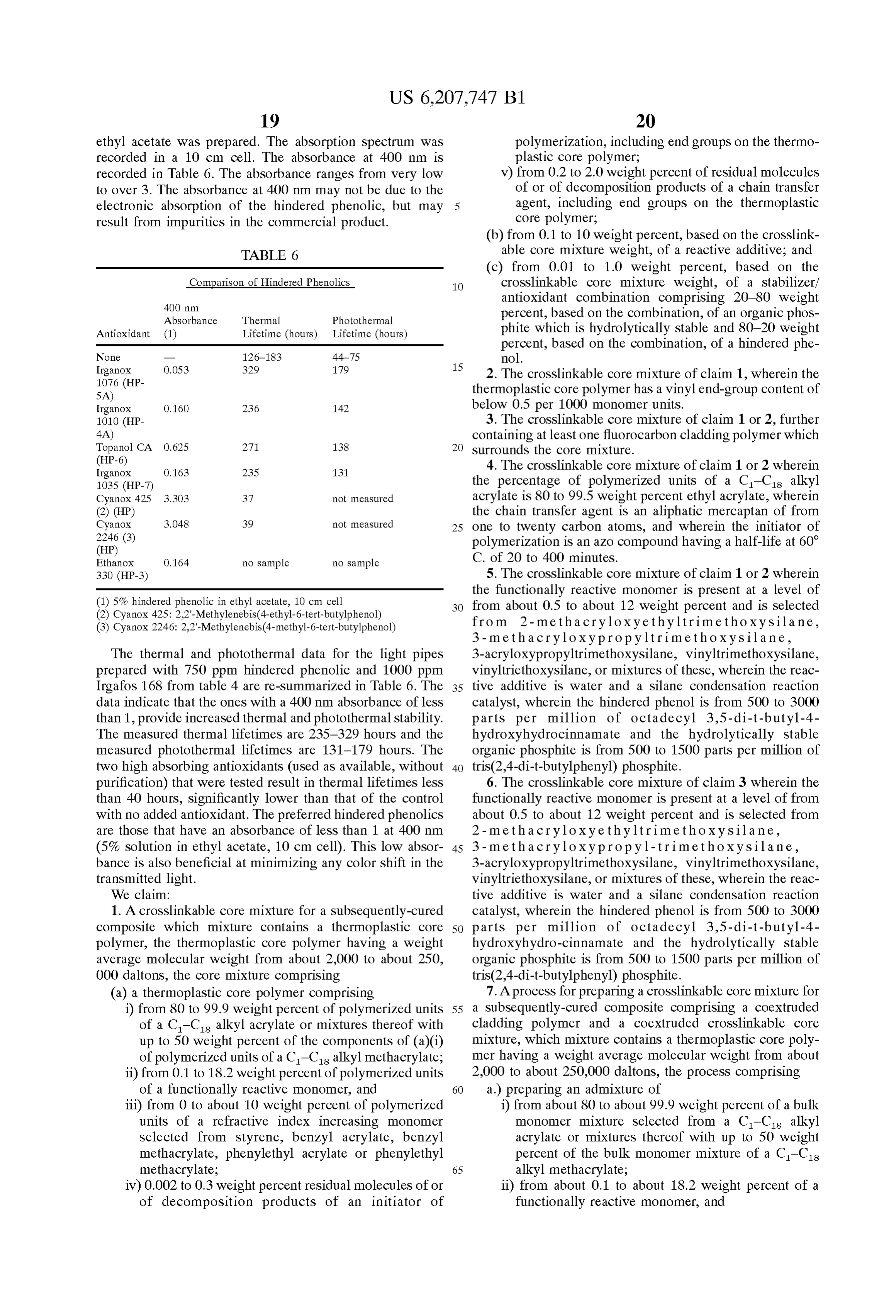
Page 12
iii) from 0 to about 10 weight of a refractive index able core mixture weight, of a Stabilizer/antioxidant increasing monomer Selected from Styrene, benzyl combination comprising 20-80 weight percent, based acrylate, benzyl methacrylate, phenylethyl acrylate on the combination, of a phosphite which is hydrolyti or phenylethyl methacrylate; cally stable and 80-20 weight percent, based on the b) adding 0.002 to 0.3 weight percent, based on the combination, of a hindered phenol; uncrosslinked copolymer weight, of an azo initiator of h) coextruding the crosslinkable core mixture and the polymerization;
cladding polymer to form a curable composite.
c) prior to, Simultaneously, or after the addition of the 8. The process of claim 7 wherein the coextruded cladding initiator, adding 0.2 to 2.0 weight percent, based on the uncrosslinked copolymer weight, of a chain transfer polymer and a coextruded crosslinkable core mixture are agent, continuously, concurrently and coaxially extruded, wherein d) charging the monomer admixture, initiator, and chain the cladding polymer is a molten fluoropolymer, wherein the transfer agent reaction mixture to a constant-flow extruded crosslinkable core mixture within the extruded stirred reactor heated to 70–120° C., to form a 15 fluoropolymer cladding and the extruded fluoropolymer polymerized, non-crosslinked, crosslinkable core mix cladding are in Substantially complete contact after filling ture the extruded tubular cladding with the extruded crosslink e) devolatilizing the polymerized, non-crosslinked, able core mixture, wherein further the curing is conducted crosslinkable core mixture to remove unreacted mono Subsequently and Separately from the extrusion and cladding merS, operation, and wherein the hindered phenol is from 500 to f) prior to, during, or after the devolatilization and/or 3000 parts per million of octadecyl 3,5-di-t-butyl-4- co-extrusion, adding from 0.1 to 10 weight percent, hydroxyhydrocinnamate and the hydrolytically stable based on the crosslinkable core mixture weight, of a organic phosphite is from 500 to 1500 parts per million of reactive additive; tris(2,4-di-t-butylphenyl) phosphite. g) prior to, during, or after the devolatilization adding 25 from 0.01 to 1.0 weight percent, based on the crosslink k k k k k
Provenance
- Collection
- Cited prior art
- Original PDF
- patentimages.storage.googleapis.com →
- Filed
- 1997-12-11
- Pages
- 12
- Method
- pdftotext (the PDF's own text layer) + pdftoppm 300dpi page scans
- Source
- Google Patents bibliographic record
- Granted
- 2001-03-27
- Inventors
- Casmir Stanislaus Ilenda; Phelps Brian Johnson; Michael Paul Hallden-Abberton; Fiberstars Inc
- Transcribed from
- patentimages.storage.googleapis.com →