patent · US6159688
Methods of producing polynucleotide variants
12 December 2000
Page 1 — bibliographic record
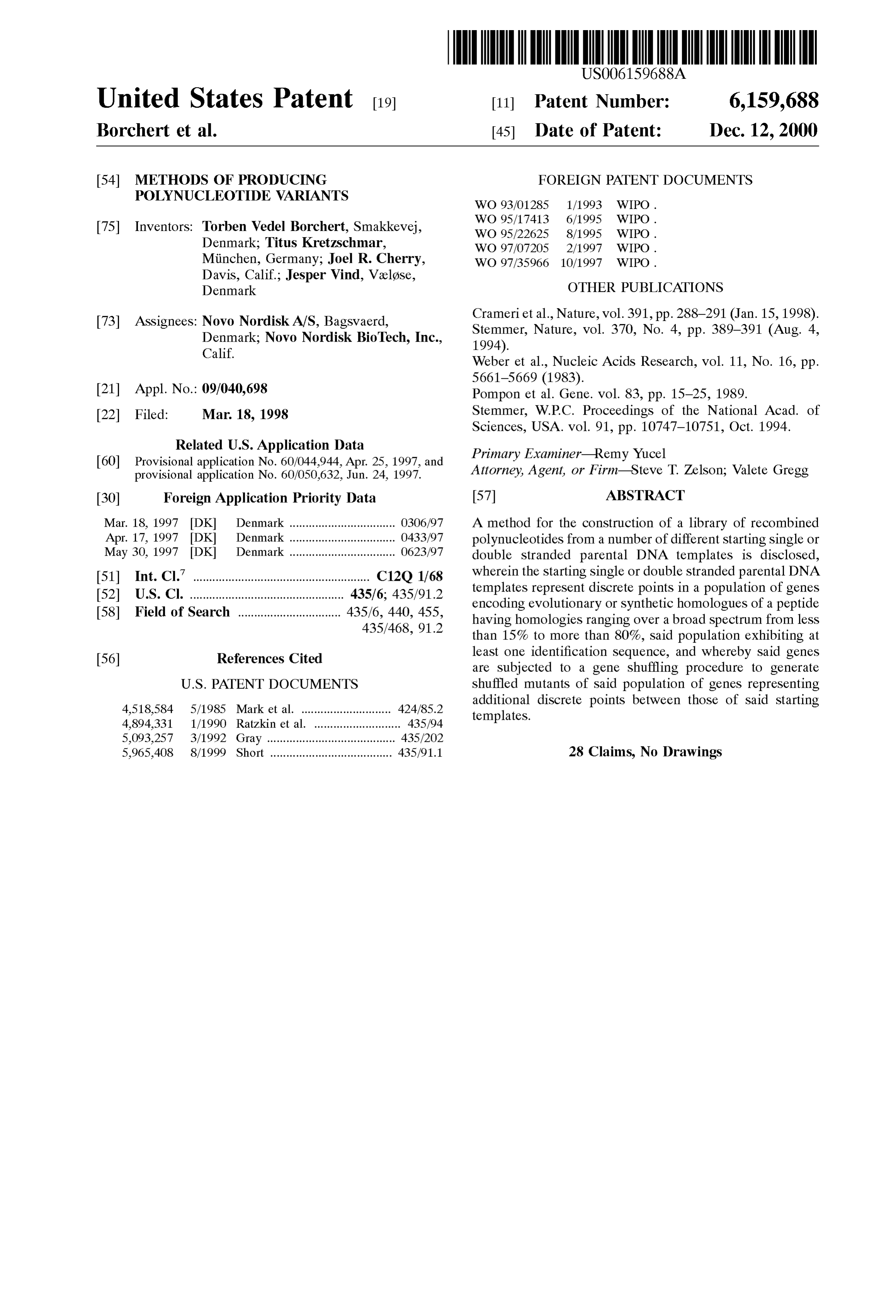
United States Patent (19) 11 Patent Number: 6,159,688 BOrchert et al. (45) Date of Patent: Dec. 12, 2000 54 METHODS OF PRODUCING FOREIGN PATENT DOCUMENTS
POLYNUCLEOTIDE WARLANTS
75 Inventors: Torben Vedel Borchert, Smakkevei, WO95/22625 8/1995 WIPO. Denmark; Titus Kretzschmar, WO 97/07205 2/1997 WIPO.
Minchen, Germany; Joel R. Cherry, WO 97/35966 10/1997 WIPO.
Davis, Calif.; Jesper Vind, Vaelgse,
Denmark OTHER PUBLICATIONS
73 Assignees: Novo Nordisk A/S, Bagsvaerd, Crameri et al., Nature, vol.391, pp. 288-291 (Jan. 15, 1998). Denmark; Novo Nordisk BioTech, Inc., Stemmer, Nature, vol. 370, No. 4, pp. 389–391 (Aug. 4, Calif. 1994).
Weber et al., Nucleic Acids Research, vol. 11, No. 16, pp.
22 Filed: Mar 18, 1998 Stemmer, W.P.C. Proceedings of the National Acad. of
Related U.S. Application Data Primary Examiner-Remy Yucel 60 Provisional application No. 60/044.944, Apr. 25, 1997, and Attorney, Agent, or Firm-Steve T. Zelson; Valete Gregg provisional application No. 60/050,632, Jun. 24, 1997.
30 Foreign Application Priority Data 57 ABSTRACT Mar. 18, 1997 DK) Denmark ...... ... 0306/97 A method for the construction of a library of recombined Apr. 17, 1997 DK Denmark ...... ... 0433/97 polynucleotides from a number of different Starting Single or May 30, 1997 DKI Denmark ................................. O623/97 double stranded parental DNA templates is disclosed, (51) Int. Cl." ....................................................... C12O 1/68 wherein the Starting Single or double Stranded parental DNA 52 U.S. Cl. ................................................ 435/6; 435/91.2 templates represent discrete points in a population of genes encoding evolutionary or Synthetic homologues of a peptide 58 Field of Search ................................ 435/6, 440, 455, having homologies ranging over a broad Spectrum from leSS 435/468, 91.2 than 15% to more than 80%, said population exhibiting at 56 References Cited least one identification sequence, and whereby said genes are Subjected to a gene Shuffling procedure to generate
4,518,584 5/1985 Mark et al. ............................ 424/85.2 additional discrete points between those of Said Starting 4,894,331 1/1990 Ratzkin et al. ........................... 435/94 templates.
5,093,257 3/1992 Gray ................. ... 435/2O2 5,965,408 8/1999 Short ...................................... 435/91.1 28 Claims, No Drawings
Page 2
METHODS OF PRODUCING Specificity, thermal, pH and Salt Stability, pH-optimum, pI, POLYNUCLEOTIDE WARLANTS K, V, etc., has successfully been performed to obtain polypeptides with improved properties.
CROSS-REFERENCE TO RELATED For instance, within the technical field of enzymes the APPLICATIONS Washing and/or dishwashing performance of e.g. proteases, lipases, amylases and cellulases have been improved Sig
This application claims priority under 35 U.S.C. 119 of nificantly.
Danish application Ser. Nos. 0306/97, 0433/97 and 0623/97 An alternative general approach for modifying proteins filed on Mar. 18, 1997, Apr. 17, 1997 and May 30, 1997 and and enzymes has been based on random mutagenesis, for U.S. provisional application Ser. Nos. 60/044,944 and instance, as disclosed in U.S. Pat. No. 4,894,331 and WO 60/050,632 filed on Apr. 25, 1997 and Jun. 24, 1997, the 93/O1285 contents of which are fully incorporated herein by reference.
AS it is a cumberSome and time consuming process to
FIELD OF THE INVENTION obtain polypeptide variants or mutants with improved func tional properties a few alternative methods for rapid prepa
The present invention relates to optimizing DNA 15 ration of modified polypeptides have been Suggested. Sequences in order to (a) improve the properties of a protein Weber et al., (1983), Nucleic Acids Research, vol. 11, of interest by artificial generation of genetic diversity of 5661-5661, describes a method for modifying genes by in genes encoding proteins having a biological activity of Vivo recombination between two homologous genes. A interest by the use of the so-called gene-or DNA shuffling linear DNA sequence comprising a plasmid vector flanked technique to create a large library of "genes', expressing by a DNA sequence encoding alpha-1 human interferon in Said library of genes in a Suitable expression System and the 5'-end and a DNA sequence encoding alpha-2 human Screening the expressed proteins in respect of Specific char interferon in the 3'-end is constructed and transfected into a acteristics to determine Such proteins exhibiting desired rec Apositive strain of E. coli. Recombinants were identified properties or (b) improve the properties of regulatory ele and isolated using a resistance marker. ments Such as promoters or terminators by generation of a 25 Pompon et al., (1989), Gene 83, p. 15-24, describes a library of these elements, transforming Suitable hosts there method for shuffling gene domains of mammalian cyto with in operable conjunction with a structural gene, express chrome P-450 by in vivo recombination of partially homolo ing Said Structural gene and Screening for desirable proper gous Sequences in Saccharomyces cerevisiae by transform ties in the regulatory element. ing Saccharomyces cerevisiae with a linearized plasmid with filled-in ends, and a DNA fragment being partially homolo
BACKGROUND OF THE INVENTION gous to the ends of Said plasmid.
It is generally found that a protein performing a certain In WO97/07205 a method is described whereby polypep bioactivity exhibits a certain variation between genera and tide variants are prepared by Shuffling different nucleotide Sequences of homologous DNA sequences by in Vivo recom even between members of the same Species differences may bination using plasmid DNA as template. exist. This variation is of course even more outspoken at the 35 genomic level. U.S. Pat. No. 5,093,257 (Assignee: Genencor Int. Inc.) This natural genetic diversity among genes coding for discloses a method for producing hybrid polypeptides by in proteins having basically the same bioactivity has been vivo recombination. Hybrid DNA sequences are produced generated in Nature over billions of years and reflects a by forming a circular vector comprising a replication Sequence, a first DNA sequence encoding the amino natural optimization of the proteins coded for in respect of 40 terminal portion of the hybrid polypeptide, a second DNA the environment of the organism in question. Sequence encoding the carboxy-terminal portion of Said In today's Society the conditions of life are vastly hybrid polypeptide. The circular vector is transformed into removed from the natural environment and it has been found a rec positive microorganism in which the circular vector is that the naturally occurring bioactive molecules are not 45 amplified. This results in recombination of Said circular optimized for the various uses to which they are put by vector mediated by the naturally occurring recombination mankind, especially when they are used for industrial pur mechanism of the rec positive microorganism, which pOSes. include prokaryotes Such as Bacillus and E. coli, and eukary It has therefore been of interest to industry to identify such otes Such as Saccharomyces cerevisiae. bioactive proteins that exhibit optimal properties in respect 50 One method for the shuffling of homologous DNA of the use to which it is intended. Sequences has been described by Stemmer (Stemmer, This has for many years been done by Screening of natural (1994), Proc. Natl. Acad. Sci. USA, Vol. 91, 10747–10751; Sources, or by use of mutagenesis. For instance, within the Stemmer, (1994), Nature, vol. 370, 389–391). The method technical field of enzymes for use in e.g. detergents, the concerns shuffling homologous DNA sequences by using in Washing and/or dishwashing performance of e.g. naturally 55 vitro PCR techniques. Positive recombinant genes contain occurring proteases, lipases, amylases and cellulases have ing shuffled DNA sequences are selected from a DNA been improved significantly, by in vitro modifications of the library based on the improved function of the expressed enzymes. proteins.
In most cases these improvements have been obtained by The above method is also described in WO95/22625. WO Site-directed mutagenesis resulting in Substitution, deletion 60 95/22625 relates to a method for shuffling of homologous or insertion of Specific amino acid residues which have been DNA sequences. An important Step in the method described chosen either on the basis of their type or on the basis of their in WO95/22625 is to cleave the homologous template location in the Secondary or tertiary Structure of the mature double-Stranded polynucleotide into random fragments of a enzyme (see for instance U.S. Pat. No. 4,518.584). desired size followed by homologously reassembling of the In this manner the preparation of novel polypeptide 65 fragments into full-length genes.
variants and mutants, Such as novel modified enzymes with A disadvantage inherent to the method of WO95/22625 altered characteristics, e.g. Specific activity, Substrate is, however, that the diversity generated through that method
Page 3
is limited due to the use of homologous gene Sequences (as DEFINITIONS defined in WO95/22625). Prior to discussing this invention in further detail, the Another disadvantage in the method of WO95/22625 lies following terms will first be defined. in the production of the random fragments by the cleavage “Shuffling’: The term “shuffling herein means recombi of the template double-Stranded polynucleotide. nation of nucleotide sequence fragment(s) between two or A further reference of interest is WO95/17413 describing more polynucleotides resulting in output polynucleotides a method of gene or DNA shuffling by recombination of (i.e. polynucleotides having been Subjected to a shuffling Specific DNA sequences-So-called design elements (DE)- cycle) having a number of nucleotide fragments exchanged, either by recombination of synthesized double-stranded in comparison to the input polynucleotides (i.e. starting fragments or recombination of PCR generated Sequences to point polynucleotides).
produce so-called functional elements (FE) comprising at “Homology of DNA sequences or polynucleotides” In the least two of the design elements. According to the method present context the degree of DNA sequence homology is described in WO95/17413 the recombination has to be performed among design elements that have DNA sequences indicating a as determined the degree of identity between two Sequences derivation of the first Sequence from the Second.
with Sufficient Sequence homology to enable hybridization The homology may suitably of the different Sequences to be recombined. be determined by means of computer programs known in the art, Such as GAP provided
WO95/17413 therefore also entails the disadvantage that in the GCG program package (Program Manual for the the diversity generated is relatively limited. Furthermore the Wisconsin Package, Version 8, August 1994, Genetics Com methods described are time consuming, expensive, and not puter Group, 575 Science Drive, Madison, Wis., U.S.A. Suited for automation.
Despite the existence of the above methods there is still a Journal of Molecular Biology, 48, 443-453). need for better iterative in vivo recombination methods for “Homologous: The term “homologous' means that one preparing novel polypeptide variants. Such methods should Single-Stranded nucleic acid Sequence may hybridize to a also be capable of being performed in Small Volumes, and 25 complementary Single-Stranded nucleic acid Sequence. The amenable to automation. degree of hybridization may depend on a number of factors Furthermore, there also is a need for methods providing including the amount of identity between the Sequences and the possibility of being able to shuffle genes with relatively the hybridization conditions Such as temperature and Salt low homology. concentration as discussed later (vide infra). SUMMARY OF THE INVENTION Using the computer program GAP (vide Supra) with the following Settings for DNA sequence comparison: GAP
The present invention relates to a method for the con creation penalty of 5.0 and GAP extension penalty of 0.3, it Struction of a library of recombined polynucleotides from a is in the present context believed that two DNA sequences number of different starting Single or double Stranded paren will be able to hybridize (using low stringency hybridization tal DNA templates, wherein Said Starting Single or double 35 conditions as defined below) if they mutually exhibit a Stranded parental DNA templates represent discrete points in degree of identity preferably of at least 70%, more prefer a population of genes encoding evolutionary or Synthetic homologues of a peptide having homologies ranging over a ably at least 80%, and even more preferably at least 85%. broad spectrum from less than 15% to more than 80%, said “heterologous: If two or more DNA sequences mutually population exhibiting at least one identification Sequence, 40 exhibit a degree of identity which is less than above and whereby Said genes are Subjected to a gene Shuffling Specified, they are in the present context Said to be "heter procedure to generate Shuffled mutants of Said population of ologous'.
genes representing additional discrete points between those “Hybridization: Suitable experimental conditions for of Said Starting templates. determining if two or more DNA sequences of interest do The gene shuffling procedure to be used according to the 45 hybridize or not is herein defined as hybridization at low invention can be any Suitable method Such as those Stringency as described in detail below.
described above or a procedure as described in our Molecules to which the oligonucleotide probe hybridizes co-pending patent application filed on the same date, and under these conditions are detected using a X-ray film or a outlined below. phosphoimager.
According to that procedure template shifts of newly 50 “primer'': The term “primer' used herein especially in synthesized DNA strands during in vitro DNA synthesis are connection with a PCR reaction is an oligonucleotide utilized to achieve DNA shuffling. (especially a “PCR-primer') defined and constructed In a further aspect the invention relates to a method of according to general Standard Specification known in the art identifying polypeptides exhibiting improved properties in (“PCR A practical approach” IRL Press, (1991)). comparison to naturally occurring polypeptides of the same 55 “A primer directed to a Sequence: The term "a primer bioactivity, whereby a library of recombined polynucle directed to a sequence” means that the primer (preferably to otides produced by the above proceSS are cloned into an be used in a PCR reaction) is constructed to exhibit at least appropriate vector, Said vector is then transformed into a 80% degree of Sequence identity to the Sequence part of Suitable host System, to be expressed into the corresponding interest, more preferably at least 90% degree of Sequence polypeptides, Said polypeptides are then Screened in a Suit 60 identity to the Sequence part of interest, which Said primer able assay, and positive results Selected. consequently is “directed to’. The primer is designed in In a still further aspect the invention relates to a method order to specifically anneal at the region at a given tempera for producing a polypeptide of interest as identified in the ture it is directed towards. Especially identity at the 3' end preceding process, whereby a vector comprising a poly of the primer is essential for the function of the polymerase, nucleotide encoding Said polypeptide is transformed into a 65 i.e. the ability of a polymerase to extend the annealed primer. Suitable host, Said host is grown to express Said polypeptide, “Flanking.” The term “flanking used herein in connection and the polypeptide recovered and purified. with DNA sequences comprised in a PCR-fragment means
Page 4
S 6 the outermost partial Sequences of the PCR-fragment, both intermediate Sequences ranging from genes being rather in the 5' and 3' ends of the PCR fragment. Similar to genes being rather dissimilar, but Still having the “Polypeptide' Polymers of amino acids sometimes same evolutionary origin (function). only then a shuffling of referred to as protein. The Sequence of amino acids deter even rather heterologous Sequences is feasible. The Stepwise mines the folded conformation that the polypeptide assumes, Shuffling of, first, quite homologous genes creates new and this in turn determines biological properties Such as Species which are not contained in the Starting population, activity. Some polypeptides consist of a single polypeptide and which, in the Subsequent shuffling rounds, will recom chain (monomeric), whilst other comprise Several associated fromwith bine each other and with other more heterologous genes the Starting population, and So on.
polypeptides (multimeric). All enzymes and antibodies are polypeptides. Finally, hybrids are generated in which Sequence parts "Enzyme’ A protein capable of catalysing chemical reac from Very heterologous Starting genes can be found. These tions. Specific types of enzymes are a) hydrolases including retrieved Starting genes would have never been Shuffled amylases, cellulases and other carbohydrases, proteases, and without having the intermediate Species in the Starting lipases, b) oxidoreductases, c) Ligases, d) Lyases, e) 15 population because of a too large “Sequence Space' distance. Isomerases, f) Transferases, etc. Of specific interest in Having this condition fulfilled it was found that it was relation to the present invention are enzymes used in possible to generate genes encoding novel functional detergents, Such as proteases, lipases, cellulases, amylases, polypeptides having a homology as low as the minimum etc. degree of homology represented in the Starting population. In principle the homology range in the final population may
DETAILED DESCRIPTION OF THE be even greater than that for the Starting population.
INVENTION
The present invention relates in its first aspect to a method
All possible genes encoding a polypeptide of the same for the construction of a library of recombined polynucle evolutionary origin can be seen as a very large population of otides from a number of different starting Single or double DNA sequences (e.g. {Gsp the set of genes encoding a Stranded parental DNA templates, wherein Said Starting serine protease). It has been found that the homology 25 Single or double Stranded parental DNA templates represent between the polypeptides encoded by Single members of discrete points in a population of genes encoding evolution Such a population may be even as Small as less than 15% (the ary or Synthetic homologues of a peptide having homologies genes originating from "distant’ organisms). ranging over a broad spectrum from less than 15% to more When Searching for polypeptides Suited for the various than 80%, Said population exhibiting at least one identifi purposes that mankind has developed, it has been found cation Sequence, and whereby Said genes are Subjected to a difficult, if not impossible at our present level of knowledge, gene Shuffling procedure to generate Shuffled mutants of Said to conclude in a rational manner on the optimal configura population of genes representing additional discrete points tion of the polypeptide in question. Therefore it was found between those of said starting templates. desirable to provide a simple method of generating a Sub 35 According to the invention it is possible to use parental population of the above mentioned very large population, DNA templates representing homologies ranging from leSS but representing a Substantial part of the variation possible than 45%, 40%, 35%, 30%, 25%, 20%, or 15% to more than within the large population. 80%, 85%, 90%, 95%, or 99%.
The object of the present invention is thus to provide a In Specific embodiments at least one identification method whereby it is possible to shuffle components of 40 Sequence is identified and primers constructed to anneal genes encoding polypeptides of the same functionality, but thereto. These Sequences can be located anywhere on the having only low homologies. geneS.
To this end it is necessary to obtain a reasonable knowl In a preferred embodiment at least two identification edge of the population in question, meaning having at Sequences are identified. These Sequences can be located at disposal a number of individual members (e.g. 5, 10, 15 or 45 any distance from each other, but it is preferred that they are more members) representing as high a variation as possible. located as far as possible from each other on the genes. This Small Sub-population is then used as a starting point for According to these embodiments Said identification generating a much larger Sub-population of genes. The Sequences may correspond to an amino acid Sequence of corresponding polypeptides of the large Sub-population from 4 to 8 amino acid residues, which Sequence is highly obtained are then displayed and Screened in an appropriate 50 conserved among the peptides encoded by the collection of manner to identify Such members of the large Sub Starting Single or double Stranded parental DNA templates, population that are optimal for the intended purpose. preferably from 5 to 7 amino acid residues. It was found that the expansion of the Starting Sub It is preferred that the identification Sequences are located population to the large Sub-population could be accom a distance apart corresponding to the average size of the plished using gene Shuffling methods. 55 genes in said collection with a variation of up to 40%. The Such methods as described in the literature provide means longer apart the Sequences are the larger a part of the gene to exchange DNA fragments between genes coding for is shuffled.
polypeptides of a reasonably high homology, typically to be However, Situations may arise, where it is desired only to above 80%, resulting in the generation of novel genes Shuffle the Sequences between identification Sequences encoding polypeptides having homologies between 80% and 60 located quite close to each other.
99%. AS indicated above the gene shuffling method used in the It was also found that in the method of the invention it was method of the invention is of leSS or no significance. In necessary as Starting population to use genes encoding principle any method will work.
polypeptides that are at least from 70% to 80% homologous Thus the methods disclosed in WO95/22625 and WO to at least one other gene in the Starting population. 65 95/17413 are fully operable in the present invention. Details According to the invention it is thus important to Start showing how these methods may be used for practising the from a population or Sub-set of genes which comprises present invention are indicated in the Examples below.
Page 5
Therefore further gene shuffling methods described in tion (SOE-PCR) using the isolated PCR fragments as co-filed patent applications are also contemplated for use in templates are pooled.
the present method. vi) The PCR fragment(s) obtained in step (v) are isolated, According to one of these procedures template shifts of whereby the isolated PCR fragment comprise numerous newly synthesized DNA strands during in vitro DNA syn different shuffled Sequences containing a shuffled mixture thesis are utilized to achieve DNA shuffling. of the PCR fragments isolated in step (iv). More specifically that method provides for the construc In Specific embodiments various modifications can be tion of a library of recombined homologous polynucleotides made in the process of the invention. For example it is from a number of different starting Single or double Stranded advantageous to apply a defective polymerase either an parental DNA templates and primers by induced template error-prone polymerase to introduce mutations in compari shifts during an in Vitro polynucleotide Synthesis using a Son to the templates, or a polymerase that will discontinue polymerase, whereby the polynucleotide Synthesis prematurely to effect the arrest A. extended primerS or polynucleotides are Synthesized by of the reaction.
a) denaturing parental double Stranded DNA templates to According to a Specific embodiment the peptide is a produce Single Stranded templates, protease, especially a Subtilase. b) annealing said primers to the single Stranded DNA 15 In the case of a Subtilase identification Sequences may be templates, located around the aspartic acid in position 32, or the c) extending said primers by initiating Synthesis by use of histidine in position 64 and the active Serine in position 221 Said polymerase, of Subtilisin BPN'.
d) cause arrest of the Synthesis, and In a further embodiment the peptide is an amylase, e) denaturing the double Strand to separate the extended especially an O-amylase.
primers from the templates, In that case of identification Sequences may be located B. a template shift is induced by around the Asp in position 100 and the Asp in position 328 a) isolating the newly synthesized single Stranded of B. licheniformis C.-amylase.
extended primers from the templates and repeating Steps For O-amylases from Bacillus Species the identification A.b) to A.e) using said extended primers produced in (A) as 25 Sequences may preferentially be located around Tyr in both primers and templates, or position 8 and around Ser in position 476. b) repeating Steps A.b) to A.e), In further embodiments the peptide is a lipase, or a C. the above process is terminated after an appropriate cellulase.
number of cycles of process steps A. and B.a), A. and In respect of lipases, Suitable identification Sequences B.b), or combinations thereof, and may be found by using the lipase alignment shown in A. D. optionally the produced polynucleotides are amplified in Svendsen et al. (1995) : Biochemical properties of cloned a Standard PCR reaction with Specific primers to Selec lipases from the Pseudomonas family, Biochinica et Bio tively amplify polynucleotides of interest. physica Acta 12599-17. Examples could be around the Pro In a further specific embodiment the gene Shuffling is in position 10 or around the His in position 285 (using P. performed by the method described in our co-filed 35 glumae lipase numbering).
application, whereby conserved regions of heterologous In respect of cellulases, in particular cellulases from DNA sequences are identified for shuffling of heterologous family 45 cellulases (see WO 96/29397), suitable identifi DNA sequences of interest having at least one conserved cation Sequences may be the conserved region “Thr Arg Tyr region comprising the following Steps: Trp Asp Cys Cys Lys Pro/Thr” and the conserved region i) One or more conserved region(s) (designated “A,B,C 40 “Trp Arg Phe/Tyr Asp Trp Phe”. For further details relating etc.) in two or more of the heterologous sequences are to those cellulase identification Sequences reference is made identified. to (PCT DK97/00216). See in particular in example 3 of ii) Two sets of PCR primers (each set comprising a Sense and (PCT DK97/00216).
an anti-sense primer) for one or more conserved region(s) In respect of Xylanases, in particular Xylanases from identified in (i) are constructed. 45 family 11 Xylanases, Suitable identification Sequences may In these primers, one set (named: “a'=sense primer; be the conserved regions “DGGTYDIY” and “EGYOSSG”. “a'=anti-Sense primer) is directed to a sequence region 5' For further details relating to those Xylanase identification (Sense Strain) of the conserved region (e.g. conserved region sequences reference is made to (PCTDK97/00216). See in “A”), and the second set (named: “b'=sense primer; “b'= particular in example 1.2 of (PCT DK97/00216). anti-sense primer) is directed to a sequence region 3' (sense 50 PCR-primers:
Strain) of the conserved region (e.g. conserved region “A”), The PCR primers are constructed according to the Stan and the antisense primer “a” and the sense primer “b' have dard descriptions in the art. Normally they are 10-75 base a homologous sequence overlap of at least 10 base pairs (bp) pairs (bp) long. However, for the specific embodiment using within the conserved region. random or Semi-random primers the length may be Substan iii) for one or more identified conserved region of interest in 55 tially longer as indicated above. step (i) two PCR amplification reactions are performed PCR-reactions:
using the heterologous DNA sequences from Step (i) as If not otherwise mentioned the PCR-reaction performed templates, whereby one of the PCR reactions is using the according to the invention are performed according to 5' primer set identified in step (ii) (e.g. named “a”,"a" Standard protocols known in the art. and the second PCR reaction is using the 3' primer set 60 The term “Isolation of PCR fragment” is intended to identified in Step cover as broad as simply an aliquot containing the PCR (ii) (e.g. named “b”,"b"). fragment. However preferably the PCR fragment is isolated iv) The PCR fragments generated as described in step (iii) to an extend which remove Surplus of primers, nucleotides for one or more of the identified conserved region in Step templates etc.
(i); are isolated. 65 In an embodiment of the invention the DNA fragment(s) v) Two or more PCR fragments isolated from step (iv) and is(are) prepared under conditions resulting in a low, medium performance of a Sequence overlap extension PCR reac or high random mutagenesis frequency.
Page 6
To obtain low mutagenesis frequency the DNA sequence glucagon, Somatostatin, Somatotropin, thymosin, parathy (s) (comprising the DNA fragment(s)) may be prepared by roid hormone, pituary hormones, Somatomedin, a standard PCR amplification method (U.S. Pat. No. 4,683, erythropoietin, lute inizing hormone, chorionic 202 or Saiki et al., (1988), Science 239, 487–491). gonadotropin, hypothalamic releasing factors, antidiuretic A medium or high mutagenesis frequency may be hormones, thyroid Stimulating hormone, relaxin, interferon, obtained by performing the PCR amplification under con thrombopoeitin (TPO) and prolactin. ditions which increase the misincorporation of nucleotides, It is also contemplated according to the invention to for instance as described by Deshler, (1992), GATA 9(4), Shuffle parental polynucleotides as indicated above originat 103-106; Leung et al., (1989), Technique, Vol. 1, No. 1, ing from wild type organisms of different genera. 11-15. The starting parental DNA sequences may be any DNA It is also contemplated according to the invention to Sequences including wild-type DNA sequences, DNA combine the PCR amplification (i.e. according to this Sequences encoding variants or mutants, or modifications embodiment also DNA fragment mutation) with a mutagen thereof, Such as extended or elongated DNA sequences, and esis Step using a Suitable physical or chemical mutagenizing may also be the outcome of DNA sequences having been agent, e.g., one which induces transitions, transversions, 15 subjected to one or more cycles of shuffling (i.e. output DNA inversions, Scrambling, deletions, and/or insertions. Sequences) according to the method of the invention or any Expressing the recombinant protein from the recombinant other method (e.g. any of the methods described in the prior Shuffled Sequences art Section), or Synthetic sequences or otherwise Expression of the recombinant protein encoded by the mutagenized Sequences.
When using the method of the invention the resulting
Shuffled Sequence in Step vi) of the Second and third aspect recombined of the present invention may be performed by use of polynucleotides (i.e. shuffled DNA sequences), Standard expression vectors and corresponding expression have had a number of nucleotide fragments exchanged. This Systems known in the art. results in replacement of at least one amino acid within the Screening and Selection polypeptide variant, if comparing it with the parent polypep In the context of the present invention the term “positive 25 tide. It is to be understood that also Silent eXchanges are polypeptide variants' means resulting polypeptide variants contemplated (i.e. nucleotide exchange which does not possessing functional properties which has been improved in result in changes in the amino acid sequence). comparison to the polypeptides producible from the corre MATERIALS AND METHODS Sponding input DNA sequences. Examples, of Such EXAMPLES improved properties can be as different as e.g. enhance or lowered biological activity, increased wash performance, EXAMPLE 1. thermostability, oxidation Stability, Substrate Specificity, Shuffling of a pool/population of evolutionary homologues antibiotic resistance etc. originating from bacterial hosts. Consequently, the Screening method to be used for iden In this Example a gene Shuffling method similar to the one tifying positive variants depend on which property of the 35 described in WO95/22625 is used:
polypeptide in question it is desired to change, and in what A population of Subtilase-encoding genes or parts of Such direction the change is desired. genes are generated through isolation or by Synthesis. A number of Suitable Screening or Selection Systems to Sources for the genes may be as described in SieZen et al. Screen or Select for a desired biological activity are Protein Engineering 4 1991 719–737. The population may described in the art. Examples are: 40 also comprise genes encoding the pre-pro Subtilases as Strauberg et al. (Biotechnology 13: 669-673 (1995), defined in GenBank entries A13050 1, D26542, A22550, describes a Screening System for Subtilisin variants having a Swiss-Prot entry SUBT BACAM P00782, and PD498 Calcium-independent Stability; (Patent Application No. WO 96/34963) with homologies Bryan et al. (Proteins 1:326-334 (1986)) describes a (similarities) ranging from 32% to 64% as calculated by the Screening assay for protease having enhanced thermal Sta 45 MegAlign software from DNASTAR Inc. (WI 53715, USA) bility; and using the Clustal Method.
PCT-DK96/00322 describes a screening assay for lipases The Substrates used in the Shuffling reaction are repre having an improved wash performance in Washing deter sented by linear double stranded DNA generated by PCR gents. amplification using primers located at/directed towards the An embodiment of the invention comprise Screening or 50 ends of the DNA to be shuffled. In this instance the primers Selection of recombinant protein(s), wherein the desired can conveniently be constructed using the Sequences Sur biological activity is performance in dish-wash or laundry rounding the histidine in pos 64 of Subtilisin BPN' and the detergents. Examples of Suitable dish-wash or laundry deter serine in position 221 of Subtilisin BPN'. The template for gents are disclosed in PCT-DK96/00322 and WO95/30011. this PCR can either be plasmids containing cloned protease If the improved functional property of the polypeptide is 55 genes or chromosomal DNA extracted from bacterial Strains not Sufficiently good after one cycle of Shuffling, the e.g. protease Secreting bacteria isolated from Soil. The polypeptide may be Subjected to another cycle. Substrate will typically be generated Separately for all the In an embodiment of the invention wherein polynucle templates and pooled before the shuffling reaction. otides representing a number of mutations of the same gene The substrates are fragmented e.g. by DNAse I treatment is used as templates at least one shuffling cycle is a back 60 or shearing by Sonication as described in WO95/22625. The crossing cycle with the initially used DNA fragment, which generated fragments are separated according to Size by may be the wild-type DNA fragment. This eliminates non agarose gel electrophoresis and generated fragment of the essential mutations. Non-essential mutations may also be desired size, e.g. from 10 to 50 bp. or from 30 to 100 bp, or eliminated by using wild-type DNA fragments as the ini from 50 to 150 bp, or from 100 to 200 bp are purified from tially used input DNA material. 65 the gel.
Also contemplated to be within the invention is polypep These fragments are reassembled by PCR as described in tides having biological activity Such as insulin, ACTH, WO95/22625. Optionally, correctly assembled DNA frag
Page 7
ments are amplified by Subjecting the product from the 13. The method of claim 12, wherein the C-amylase is assembly reaction to another PCR including two primers obtained from Bacillus licheniformis. able to anneal to the ends of correctly assembled fragments. 14. The method of claim 13, wherein the conserved The resulting fragments can be cloned into Suitable expres regions are located at a Asp residue in position 100 and at a Sion plasmids, and Subsequently Screened for a specific Asp residue in position 328.
property, Such as thermoStability using assays well known in 15. The method of claim 13, wherein the conserved the art.
What is claimed is: regions are located at a Tyr residue in position 8 and at a Ser 1. A method for generating recombined polynucleotide residue in position 476.
Sequences encoding functionally similar polypeptides, com 16. The method of claim 6, wherein the polypeptide of prising: interest is a lipase.
(a) identifying at least one conserved region in a known 17. The method of claim 16, wherein the lipase is obtained polynucleotide encoding a functional polypeptide of from Pseudomonas glumae.
interest; 18. The method of claim 17, wherein the conserved (b) designing at least one set of primers directed to the at 15 regions are located at a Pro residue in position 10 and at a least one conserved region(s), wherein a set of primers His residue in position 285.
comprises a Sense primer and an antisense primer; 19. The method of claim 1, wherein the conserved regions (c) contacting the at least one set of primers of step (b) correspond to amino acid Sequences of from 4 to 8 amino with DNA from a first population of polynucleotide acid residues.
Sequences encoding the functional polypeptide of inter est under conditions wherein the primers anneal and 20. The method of claim 19, wherein the conserved extension Sequences are generated; Sequences corresponds to amino acid Sequences of from 5 to (d) contacting DNA from a second population of poly 7 amino acid residues.
nucleotide Sequences encoding the functional polypep 21. The method of claim 19, wherein the polypeptide of tide of interest with the extension Sequences generated interest is a protease.
in Step (c) wherein, the extension sequences generated 25 22. The method of claim 1, wherein the at least one set of in Step (c) anneal to DNA from the Second population primerS is two or more Sets.
of polynucleotide Sequences encoding the functional 23. The method of claim 22, wherein the at least one set polypeptide of interest to generate further extension of primerS is two or more Sets.
Sequences, wherein the extension sequences of step (d) 24. The method of claim 1, wherein at least one genera act as primerS and templates in one or more annealing tion of extension Sequences occurs under conditions wherein and extending procedures, wherein recombined poly polynucleotide Synthesis is prematurely arrested. nucleotide Sequences are generated. 25. The method of claim 1, wherein the at least one set of 2. The method of claim 1, further comprising cloning the primerS comprise partially random primerS. recombined polynucleotides of step (d) into a vector, trans 26. A method for generating recombined polynucleotide forming a host cell, and expressing the recombined poly 35 Sequences encoding a polypeptide of interest, comprising: nucleotides.
3. The method of claim 1, wherein the conserved region (a) identifying at least one conserved region in an initial population of polynucleotide Sequences encoding the of step (a) is identified by comparing a plurality of poly polypeptide of interest, wherein a member of the popu nucleotide Sequences encoding a known functional polypep lation is Sufficiently homologous to hybridize to at least tide of interest. 40 one other member of the population, and wherein the 4. The method of claim 1, wherein two conserved regions most heterologous members of the population are are identified in Step (a) and one set of primers is designed insufficiently homologous to hybridize to each other, in step (b), wherein one primer is directed to each conserved (b) designing at least one set of primers directed to the at region.
5. A method of identifying a recombined polypeptide of 45 least one conserved region(s), wherein a set of primers interest exhibiting a desired changed property relative to a comprises one Sense primer and one antisense primer; nonrecombined polypeptide of interest, comprising express (c) contacting the at least one set of primers of step (b) ing recombined polynucleotides produced by the method of with DNA from a first population of polynucleotide claim 1, Screening the expressed polypeptides, and Selecting Sequences encoding the functional polypeptide of inter an expressed recombined polypeptide of interest for a 50 est under conditions wherein the primers anneal and desired changed property relative to the nonrecombined extension Sequences are generated; polypeptide of interest. (d) contacting DNA from a second population of poly 6. The method of claim 1, wherein the polypeptide of nucleotide Sequences encoding the functional polypep interest is an enzyme. tide of interest with the extension Sequences generated 7. The method of claim 6, wherein the enzyme is a 55 in Step (c), wherein the extension sequences generated protease. in Step (c) anneal to DNA from the Second population 8. The method of claim 6, wherein the protease is a of polynucleotide Sequences to generate further exten Subtilisin or Subtilase. Sion Sequences, having homologies between the most 9. The method of claim 8, wherein the conserved regions heterologous members of the initial population wherein identified are located around His in position 64 and Ser in 60 recombined polynucleotide Sequences are generated. position 221 of subtilisin BPN'. 27. The method of claim 26, wherein at least one gen 10. The method of claim 8, wherein the protease is a eration of extension Sequences occurs under conditions Subtilisin obtained from Bacillus. wherein polynucleotide Synthesis is prematurely arrested. 11. The method of claim 6, wherein the polypeptide of 28. The method of claim 26, wherein the at least one set interest is an amylase. 65 of primers comprise partially random primerS. 12. The method of claim 11, wherein the polypeptide of interest is an O-amylase. k k k k k
Provenance
- Collection
- Cited prior art
- Original PDF
- patentimages.storage.googleapis.com →
- Filed
- 1998-03-18
- Pages
- 7
- Method
- pdftotext (the PDF's own text layer) + pdftoppm 300dpi page scans
- Source
- Google Patents bibliographic record
- Granted
- 2000-12-12
- Inventors
- Torben Vedel Borchert; Titus Kretzschmar; Joel R. Cherry; Jesper Vind; Novo Nordisk AS; Novo Nordisk Biotech Inc
- Transcribed from
- patentimages.storage.googleapis.com →