patent · US6156269A
Method of protecting high-energy machinery from corrosion damage
5 December 2000
Page 1 — bibliographic record
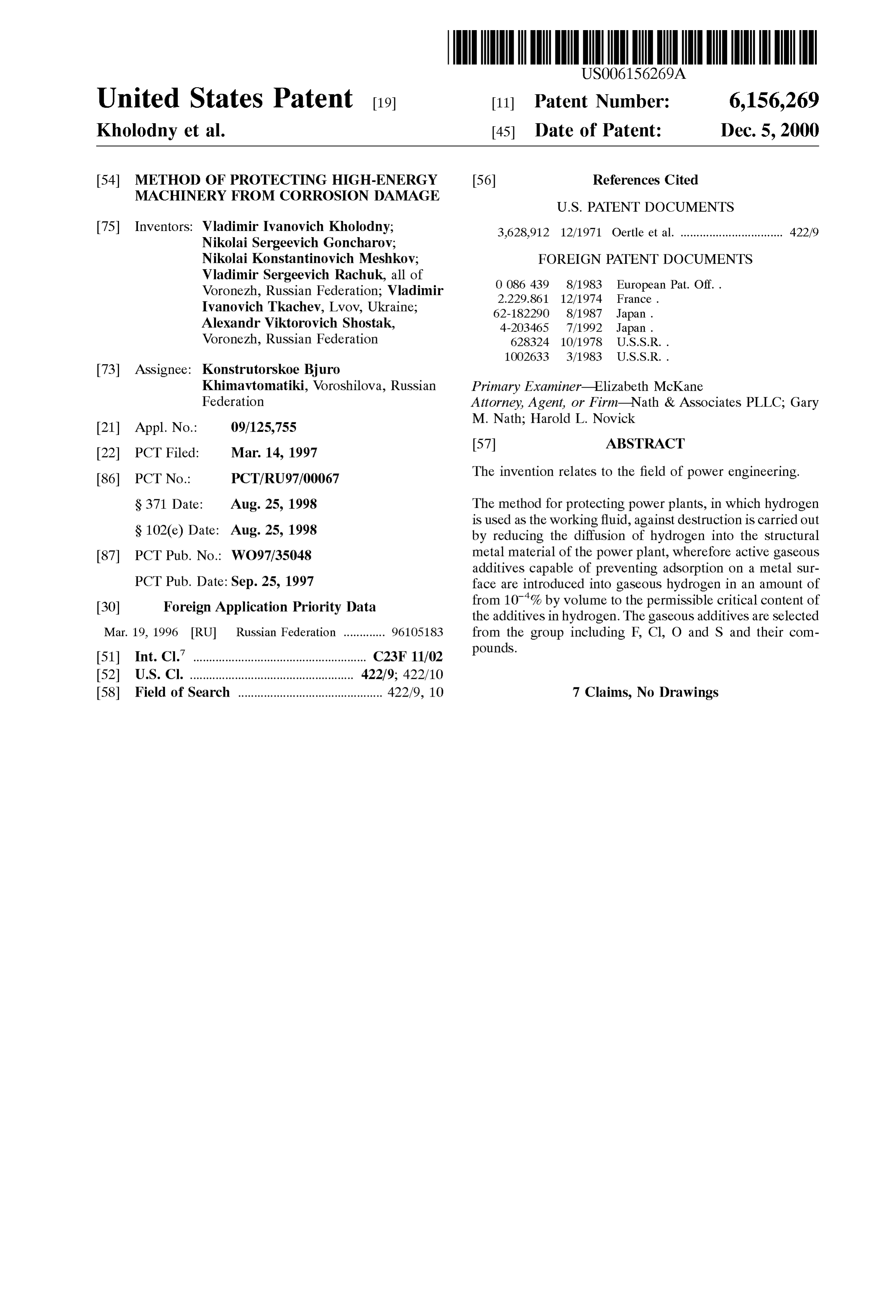
United States Patent (19) 11 Patent Number: 6,156,269 Kholodny et al. (45) Date of Patent: Dec. 5, 2000 54 METHOD OF PROTECTING HIGH-ENERGY 56) References Cited
MACHINERY FROM CORROSION DAMAGE
75 Inventors: Vladimir Ivanovich Kholodny; 3,628,912 12/1971 Oertle et al. ................................ 422/9 Nikolai Sergeevich Goncharov;
Nikolai Konstantinovich Meshkov; FOREIGN PATENT DOCUMENTS
Vladimir Sergeevich Rachuk, all of 0 086 439 8/1983 European Pat. Off..
Voronezh, Russian Federation; Vladimir 2.229.861 12/1974 France.
Ivanovich Tkachev, Lvov, Ukraine; 62-182290 8/1987 Japan.
Alexandr Viktorovich Shostak, 4-203465 7/1992 Japan.
Voronezh, Russian Federation 628324 10/1978 U.S.S.R. .
73 Assignee: Konstrutorskoe Bjuro
Khimavtomatiki, Voroshilova, Russian Primary Examiner Elizabeth McKane
Federation Attorney, Agent, or Firm Nath & Associates PLLC; Gary 21 Appl. No.: 09/125,755 M. Nath; Harold L. Novick
86 PCT No.: PCT/RU97/00067 The invention relates to the field of power engineering. S371 Date: Aug. 25, 1998 The method for protecting power plants, in which hydrogen is used as the working fluid, against destruction is carried out
S 102(e) Date: Aug. 25, 1998 by reducing the diffusion of hydrogen into the Structural 87 PCT Pub. No.: WO97/35048 metal material of the power plant, wherefore active gaseous additives capable of preventing adsorption on a metal Sur
PCT Pub. Date: Sep. 25, 1997 face are introduced into gaseous hydrogen in an amount of 30 Foreign Application Priority Data from 10% by volume to the permissible critical content of the additives in hydrogen. The gaseous additives are Selected
Mar. 19, 1996 RU Russian Federation ............. 961051.83 from the group including F, Cl, O and S and their com pounds.
(51 Int. Cl. ................................................ C23F 11/02 52 U.S. Cl. .................. 422/9; 422/10 58 Field of Search ............................................. 422/9, 10 7 Claims, No Drawings
Page 2
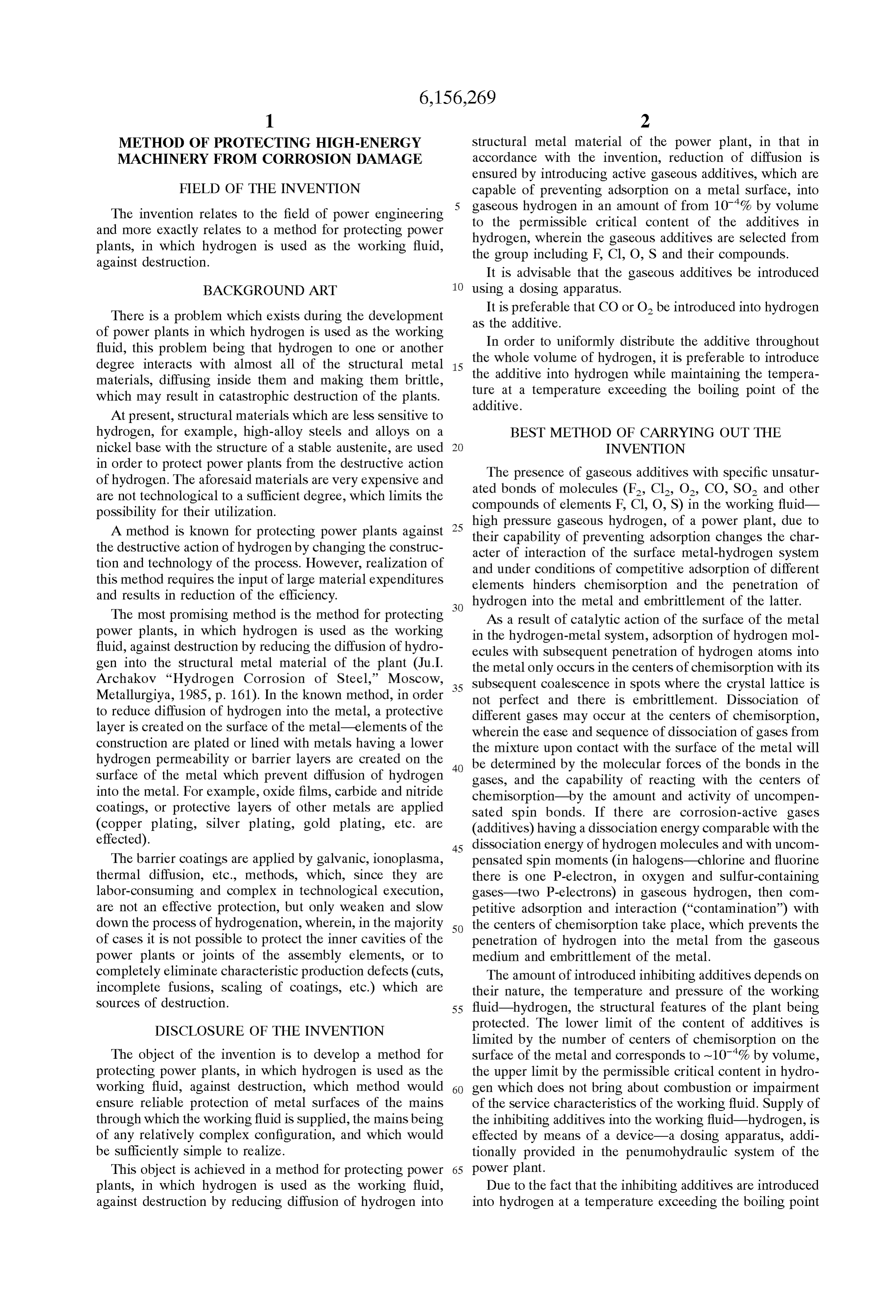
METHOD OF PROTECTING HIGH-ENERGY Structural metal material of the power plant, in that in MACHINERY FROM CORROSION DAMAGE accordance with the invention, reduction of diffusion is ensured by introducing active gaseous additives, which are
FIELD OF THE INVENTION capable of preventing adsorption on a metal Surface, into The invention relates to the field of power engineering gaseous hydrogen in an amount of from 10% by volume and more exactly relates to a method for protecting power to the permissible critical content of the additives in plants, in which hydrogen is used as the working fluid, hydrogen, wherein the gaseous additives are Selected from against destruction. the group including F, Cl, O, S and their compounds. It is advisable that the gaseous additives be introduced
BACKGROUND ART 1O using a dosing apparatus.
There is a problem which exists during the development as Ittheis preferable additive.
that CO or Obe introduced into hydrogen of power plants in which hydrogen is used as the working fluid, this problem being that hydrogen to one or another theInwhole order to uniformly distribute the additive throughout degree interacts with almost all of the Structural metal 15 the additiveVolume into of hydrogen, it is preferable to introduce hydrogen while maintaining the tempera materials, diffusing inside them and making them brittle, ture at a temperature exceeding the boiling point of the which may result in catastrophic destruction of the plants. additive.
At present, Structural materials which are leSS Sensitive to hydrogen, for example, high-alloy Steels and alloys on a BEST METHOD OF CARRYING OUT THE nickel base with the Structure of a stable austenite, are used INVENTION in order to protect power plants from the destructive action The presence of gaseous additives with Specific unsatur of hydrogen. The aforesaid materials are very expensive and ated bonds of molecules (F, Cl, O, CO, SO and other are not technological to a Sufficient degree, which limits the compounds possibility for their utilization. of elements F, Cl, O, S) in the working fluid 25 high pressure gaseous hydrogen, of a power plant, due to
A method is known for protecting power plants against their capability of preventing adsorption changes the char the destructive action of hydrogen by changing the construc acter of interaction of the Surface metal-hydrogen System tion and technology of the proceSS. However, realization of and under conditions of competitive adsorption of different this method requires the input of large material expenditures elements hinders chemisorption and the penetration of and results in reduction of the efficiency. hydrogen into the metal and embrittlement of the latter. The most promising method is the method for protecting power plants, in which hydrogen is used as the working in AS a result of catalytic action of the Surface of the metal the hydrogen-metal System, adsorption of hydrogen mol fluid, against destruction by reducing the diffusion of hydro ecules with Subsequent penetration of hydrogen atoms into gen into the structural metal material of the plant (Ju.I. the metal only occurs in the centers of chemisorption with its Archakov “Hydrogen Corrosion of Steel,” Moscow, Subsequent coalescence in Spots where the crystal lattice is Metallurgiya, 1985, p. 161). In the known method, in order 35 not perfect and there is embrittlement. Dissociation of to reduce diffusion of hydrogen into the metal, a protective different gases may occur at the centers of chemisorption, layer is created on the Surface of the metal-elements of the wherein the ease and Sequence of dissociation of gases from construction are plated or lined with metals having a lower the mixture upon contact with the surface of the metal will hydrogen permeability or barrier layers are created on the 40 be determined by the molecular forces of the bonds in the surface of the metal which prevent diffusion of hydrogen gases, and the capability of reacting with the centers of into the metal. For example, oxide films, carbide and nitride chemisorption-by the amount and activity of uncompen coatings, or protective layers of other metals are applied (copper plating, Silver plating, gold plating, etc. are Sated Spin bonds. If there are corrosion-active gases (additives) having a dissociation energy comparable with the effected). 45dissociation energy of hydrogen molecules and with uncom The barrier coatings are applied by galvanic, ionoplasma, pensated spin moments (in halogens-chlorine and fluorine thermal diffusion, etc., methods, which, Since they are there is one P-electron, in Oxygen and Sulfur-containing labor-consuming and complex in technological execution, gases-two P-electrons) in gaseous hydrogen, then com are not an effective protection, but only weaken and slow petitive adsorption and interaction ("contamination') with down the process of hydrogenation, wherein, in the majority 50 the centers of chemisorption take place, which prevents the of cases it is not possible to protect the inner cavities of the penetration of hydrogen into the metal from the gaseous power plants or joints of the assembly elements, or to medium and embrittlement of the metal. completely eliminate characteristic production defects (cuts, The amount of introduced inhibiting additives depends on incomplete fusions, Scaling of coatings, etc.) which are their nature, the temperature and pressure of the working Sources of destruction. 55 fluid-hydrogen, the Structural features of the plant being DISCLOSURE OF THE INVENTION protected. The lower limit of the content of additives is limited by the number of centers of chemisorption on the
The object of the invention is to develop a method for surface of the metal and corresponds to ~10% by volume, protecting power plants, in which hydrogen is used as the the upper limit by the permissible critical content in hydro working fluid, against destruction, which method would 60 gen which does not bring about combustion or impairment ensure reliable protection of metal Surfaces of the mains of the Service characteristics of the working fluid. Supply of through which the working fluid is Supplied, the mains being the inhibiting additives into the working fluid-hydrogen, is of any relatively complex configuration, and which would effected by means of a device-a dosing apparatus, addi be Sufficiently simple to realize. tionally provided in the penumohydraulic System of the This object is achieved in a method for protecting power 65 power plant.
plants, in which hydrogen is used as the working fluid, Due to the fact that the inhibiting additives are introduced against destruction by reducing diffusion of hydrogen into into hydrogen at a temperature exceeding the boiling point
Page 3
of the additives, the latter, uniformly spreading throughout INDUSTRIAL APPLICABILITY the Volume of the working fluid-gaseous hydrogen, ensure The method for protecting power plants, in which hydro a protective effect in the most hard to reach places in the gen is used as the working fluid, against destruction can be construction of the power plant. Successfully used in internal combustion engines, An example of a concrete embodiment of the method for turbomachines, rocket and jet engines and other apparatuses protecting in accordance with the invention is presented operating on hydrogen.
below to provide better understanding of the essence of the Preferably, the method in accordance with the invention present invention. should be used in jet and rocket engines. What is claimed is:
EXAMPLE 1O 1. A method for protecting power plants, in which hydro gen is used as the working fluid, against destruction by
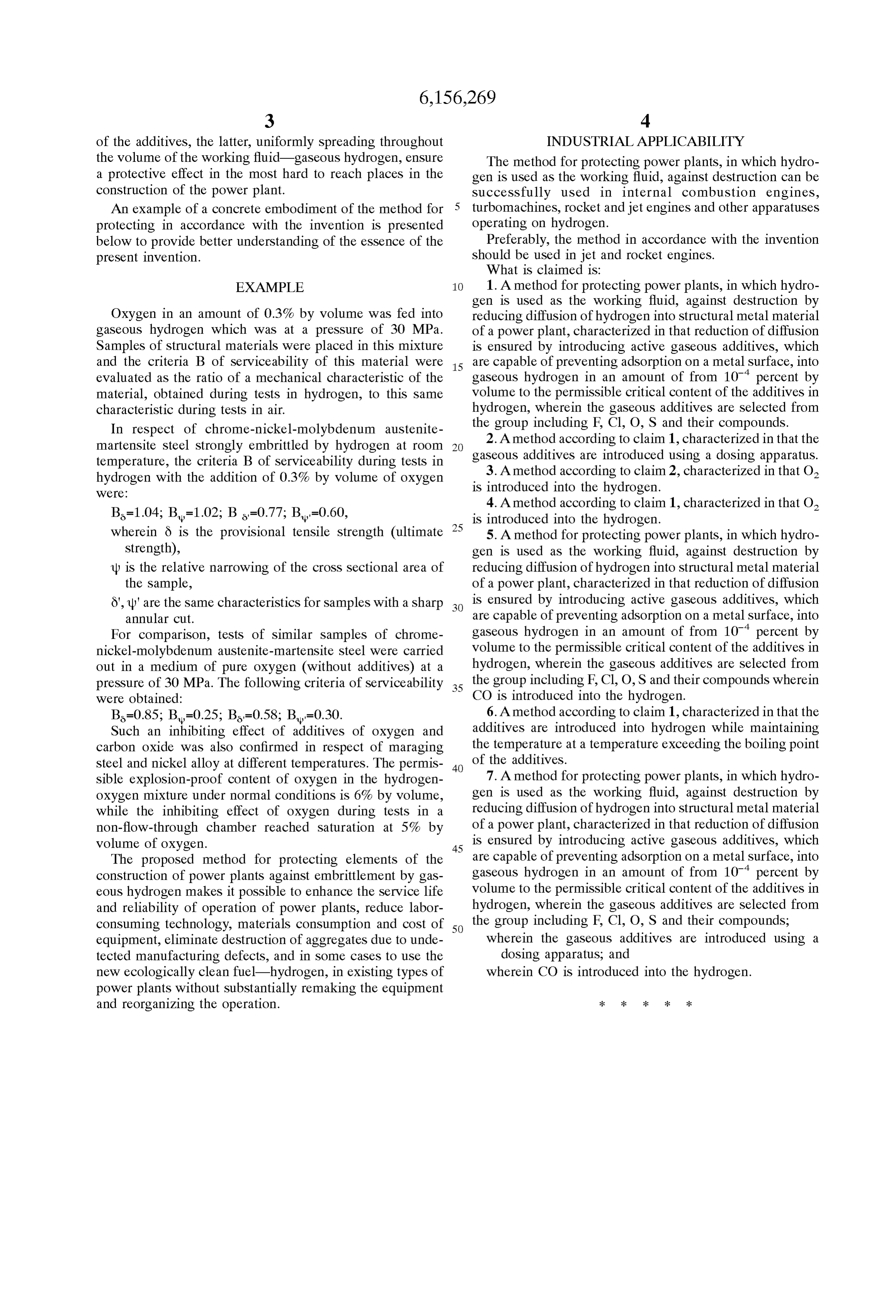
Oxygen in an amount of 0.3% by volume was fed into reducing diffusion of hydrogen into Structural metal material gaseous hydrogen which was at a pressure of 30 MPa. of a power plant, characterized in that reduction of diffusion Samples of Structural materials were placed in this mixture is ensured by introducing active gaseous additives, which and the criteria B of serviceability of this material were 15 are capable of preventing adsorption on a metal Surface, into evaluated as the ratio of a mechanical characteristic of the gaseous hydrogen in an amount of from 10" percent by material, obtained during tests in hydrogen, to this same volume to the permissible critical content of the additives in characteristic during tests in air. hydrogen, wherein the gaseous additives are Selected from In respect of chrome-nickel-molybdenum austenite the group including F, Cl, O, S and their compounds. martensite Steel Strongly embrittled by hydrogen at room 2. A method according to claim 1, characterized in that the temperature, the criteria B of Serviceability during tests in gaseous additives are introduced using a dosing apparatus. hydrogen with the addition of 0.3% by volume of oxygen 3. A method according to claim 2, characterized in that O2 Wee: is introduced into the hydrogen. 4. A method according to claim 1, characterized in that O.
B=1.04; B-1.02; B =0.77; B=0.60, 25 is introduced into the hydrogen.
wherein ö is the provisional tensile strength (ultimate 5. A method for protecting power plants, in which hydro Strength), gen is used as the working fluid, against destruction by up is the relative narrowing of the croSS Sectional area of reducing diffusion of hydrogen into Structural metal material the Sample, of a power plant, characterized in that reduction of diffusion 8', 'are the same characteristics for Samples with a sharp is ensured by introducing active gaseous additives, which annular cut. are capable of preventing adsorption on a metal Surface, into For comparison, tests of Similar Samples of chrome gaseous hydrogen in an amount of from 10" percent by nickel-molybdenum austenite-martensite Steel were carried volume to the permissible critical content of the additives in out in a medium of pure oxygen (without additives) at a hydrogen, wherein the gaseous additives are selected from pressure of 30 MPa. The following criteria of serviceability 35 the group including F, Cl, O, S and their compounds wherein were obtained: CO is introduced into the hydrogen. B=0.85; B=0.25; B-0.58; B=0.30. 6. A method according to claim 1, characterized in that the Such an inhibiting effect of additives of oxygen and additives are introduced into hydrogen while maintaining carbon oxide was also confirmed in respect of maraging the temperature at a temperature exceeding the boiling point Steel and nickel alloy at different temperatures. The permis 40 of the additives.
Sible explosion-proof content of oxygen in the hydrogen 7. A method for protecting power plants, in which hydro oxygen mixture under normal conditions is 6% by Volume, gen is used as the working fluid, against destruction by while the inhibiting effect of oxygen during tests in a reducing diffusion of hydrogen into Structural metal material non-flow-through chamber reached saturation at 5% by of a power plant, characterized in that reduction of diffusion Volume of oxygen. 45 is ensured by introducing active gaseous additives, which
The proposed method for protecting elements of the are capable of preventing adsorption on a metal Surface, into construction of power plants against embrittlement by gas gaseous hydrogen in an amount of from 10" percent by eous hydrogen makes it possible to enhance the Service life volume to the permissible critical content of the additives in and reliability of operation of power plants, reduce labor hydrogen, wherein the gaseous additives are Selected from consuming technology, materials consumption and cost of 50 the group including F, Cl, O, S and their compounds, equipment, eliminate destruction of aggregates due to unde wherein the gaseous additives are introduced using a tected manufacturing defects, and in Some cases to use the dosing apparatus, and new ecologically clean fuel-hydrogen, in existing types of wherein CO is introduced into the hydrogen. power plants without Substantially remaking the equipment and reorganizing the operation. k k k k k
Provenance
- Collection
- Patents citing this work
- Original assignee
- Konstruktorskoe Bjuro Khimavtomatiki
- Pages
- 3
- Method
- pdftotext (the PDF's own text layer) + pdftoppm 300dpi page scans
- Patent office record
- patents.google.com →
- Source
- Google Patents citing-documents table
- Inventors
- Vladimir Ivanovich Kholodny; Nikolai Sergeevich Goncharov; Nikolai Konstantinovich Meshkov; Vladimir Sergeevich Rachuk; Vladimir Ivanovich Tkachev; Alexandr Viktorovich Shostak; Konstruktorskoe Bjuro Khimavtomatiki
- Published
- 2000-12-05
- Transcribed from
- patentimages.storage.googleapis.com →