patent · US6007699
Autothermal methods and systems for fuels conversion
28 December 1999
Page 1 — bibliographic record
United States Patent (19) 11 Patent Number: 6,007,699 Cole (45) Date of Patent: Dec. 28, 1999 54 AUTOTHERMAL METHODS AND SYSTEMS 5,339,754 8/1994 Lyon ....................................... 110/345 FOR FUELS CONVERSION 5,509,362 4/1996 Lyon ....................................... 110/345 75 Inventor: Jerald A. Cole, Long Beach, Calif.
Primary Examiner Wayne Langel 73 Assignee: Energy and Environmental Research Attorney, Agent, or Firm Workman, Nydegger & Seeley Corporation, Irvine, Calif.
21 Appl. No.: 08/700,838 -
A process for oxidizing fuel and transferring the heat pro 22 Filed: Aug. 21, 1996 duced to a particular use in a combustion System Such as 51) Int. Cl. ................................ C01B 3.02. Co1B 3.04; fuels conversion. Abed of a mixture of materials forming an CO1B 3726, C10G 35'06 unmixed combustion catalyst, which in an oxidized State is 52 U.S. Cl. .......................... 208/134; 208/135, 208/136; readily reducible and in a reduced State is readily oxidizable, 208/137; 208/400; 252/373; 422/198; 422/211; is placed in efficient thermal contact with a heat receiver for 423/351; 423/418.2; 423/648.1; 423/652; use in the combustion System. Fuel and air are alternately 423/653; 423/654; 423/658.2; 423/659 contacted with the bed, whereby the fuel is oxidized, the air 58 Field of Search ..................................... 423/659, 650, is depleted of oxygen, and heat is liberated. The heat is 423/651, 652, 351, 418.2, 648.1, 653, 654, efficiently transferred to the heat receiver by careful selec 658.2; 252/373; 422/198, 211; 208/134, tion of the materials of the bed such that the temperatures 400, 135, 136, 137 produced when the fuel is oxidized and when the air is 56) References Cited depleted of oxygen are advantageous to the particular use in the combustion System.
4,216,199 8/1980 Erickson ................................. 423/657 34 Claims, 4 Drawing Sheets
Oxygen Depleted
Compressed Air
Supply of
Fuel and
Steam
Recovery Removal
Device Device
Compressed
Air to
Went
Page 2
Drawing sheet — no readable text.
Page 3
Drawing sheet — no readable text.
Page 4
Drawing sheet — no readable text.
Page 5
Drawing sheet — no readable text.
Page 6
AUTOTHERMAL METHODS AND SYSTEMS providing improvement of thermodynamic efficiency, FOR FUELS CONVERSION however, with no teaching or Suggestion of any means for improving heat transfer.
BACKGROUND OF THE INVENTION Fluid bed combustion is also an alternative to fire. In some 1. The Field of the Invention applications, fluid bed combustion can provide better heat The invention relates generally to methods for producing transfer than can fire. In other applications, there are Sub stantial heat transfer problems that the use of fluid bed and utilizing heat by oxidizing fuels without mixing the combustion does not avoid.
fuels with air and thereby producing a fire. More particularly, the invention is directed to an autothermal One example of an application with Substantial heat proceSS for fuels conversion, including methods and Systems reformingproblems transfer is the industrial process known as Steam in which hydrogen is produced by passing Steam for generating heat by oxidizing fuel without mixing the fuel and a hydrocarbon through a nickel catalyst. Typically this with air, with the Subsequent transfer and utilization of the is done attemperatures in the range of about 700 C. to 800 generated heat being an improvement over the heat transfer which is possible when fire is used to produce heat. 15
C. and at pressures of about 100 to 700 psig. These condi tions are too Severe for the use of reaction vessels made of 2. The Relevant Technology mild Steel or even StainleSS Steel. Despite their great cost, Historically, the primary method by which mankind has inconel or Some other high nickel alloy must be used. used fuel to generate heat has been fire. For many Furthermore, heat must be Supplied Since the reaction is applications, however, the use of fire to produce heat has a highly endothermic. While the heat needed can readily be number of Substantial disadvantages and limitations. One of generated by burning fuel, transferring this heat to where it the limitations of fire is that mixtures of fuel and air must is needed is a problem Since the catalyst is in the form of a contain more than Some critical amount of fuel in order to packed bed. Packedbeds are poor conductors of heat and the burn. This is the well known flammability limit. outer Sections of the bed tend to insulate the inner Sections. Another of the limitations of fire relates to its In order to get an adequate rate of heat transfer to the interior thermodynamics, i.e., fire is an irreversible process. While 25 of the reaction vessel, the reaction vessels used are long energy can neither be created nor destroyed, it can become narrow tubes. Thus, to get an adequate rate of heat transfer leSS available for doing useful work. A fuel contains chemi it is necessary to use very large amounts of expensive alloy cal energy, Some fraction of which is potentially available to tubing.
do useful work. Upon combustion of a fuel by fire, that To avoid this disadvantage there have been proposals to chemical energy is converted into heat energy. The fraction do what is called “adiabatic' Steam reforming. Department of this heat energy which is potentially available to do useful of Defense Report Number AD-A134224, Evaluation of work is less than the fraction of the chemical energy which Adiabatic Reformer in Mixed-Gas-Cycle, by the Power was potentially available to do useful work. Systems Division of United Technologies Corporation A further disadvantage of fire relates to heat transfer. For 35 (1983), is a typical example of this technology. In this all fuels in common usage, combustion produces hot gases. approach, the heat necessary for the endothermic Steam In many applications it is necessary to recover heat from reforming reaction is provided by adding Some air to the these hot gases. This is commonly done by passing the hot Steam hydrocarbon mixture passing through the reactor. The gases over heat transfer Surfaces, but the amount of heat that oxygen in the air reacts with the hydrocarbon, liberating can be transferred between hot gases and a fixed amount of 40 heat. Unfortunately, however, combustible mixtures either Solid Surface is generally relatively low. Thus, to recover the ignite or they do not. If ignition does not occur, the needed heat efficiently, large amounts of heat transfer Surface are heat is not liberated. If ignition does occur, the heat is not needed. For industrial processes using fire as a heat Source, liberated throughout the reactor where it is needed but at the the cost of providing heat transfer Surfaces to recover the point of ignition. Since the heat is not liberated uniformly heat is frequently a major part of the total process cost. 45 throughout the reactor, there is again a Severe heat transfer Fire also has the property of being an intense phenom problem.
enon. For a flame to Sustain itself, large amounts of heat The gasification of coal with water is, like Steam must be liberated at very high temperatures with a very high reforming, an endothermic reaction. A proposal for the rate of heat release. For many applications heating in a more improvement of this endothermic reaction has been controlled manner is needed. For these applications electri 50 advanced in an article by G. P. Curran et al., CO Acceptor cal heating is frequently used. Gasification Process, Fuel Gasification Symposium, ACS In efforts to overcome one or another of the disadvantages Advances in Chemistry Series 69, Chapter 10, pp. 141-165 of fire, a number of alternatives to fire have been proposed. (1966). In this article, which is typical of the art, the use of The flammability limits are a problem in Some situations, CaO as an acceptor for CO2 is Suggested. The reaction i.e., there are industrial operations which produce mixtures 55 CO+CaO=CaCO is highly exothermic thereby supplying of one or more toxic organic materials with air. These the heat consumed by the endothermic gasification reaction. mixtures must be disposed of in an environmentally accept Furthermore, CO and CO are in equilibrium via the water able manner, but frequently they are below the flammability gas shift reaction HO+CO=CO+H. Consequently, remov limit and hence will not Sustain a fire. One frequently ing the CO has the effect of also removing the CO, allowing employed Solution to this problem is the use of catalytic 60 the production of a gas containing a large mole fraction of incineration wherein the mixture of air and toxic organic hydrogen. Unfortunately, however, for this process to be matter is passed through an oxidation catalyst. practical it is necessary to reconvert the CaCO back to CaO. In an article by H. J. Richter et al., Reversibility of While the heat necessary to do this could readily be gener Combustion Processes, Efficiency and Costing, Second Law ated by burning Some fuel, transferring that heat to where it Analysis of Processes, ACS Symposium Series 235, pp. 65 is needed is again a difficult and expensive problem. 71-85 (1983), an alternative to fire is proposed in combus Heat transfer is also a Substantial problem in other indus tion processes. The teachings of this article are restricted to trial processes in which packedbed reactors are used to carry
Page 7
out endothermic reactions. Examples of Such reactions However, in Several applications, this would be a deficiency include but are not limited to the cracking of ammonia to by prohibiting practical use of the process, reducing proceSS make hydrogen/nitrogen mixtures, the gasification of efficiency, or requiring that the proceSS be complicated by biomass, the catalytic reforming of petroleum hydrocarbons, the addition of heat eXchange and heat transfer Surfaces and the decomposition of methanol. which the process of the Lyon Patents is in part intended to Another group of applications in which heat transfer is a avoid.
substantial problem involves the use of packed beds of For example, in the case of the production of hydrogen Sorbents. Typically, a gas containing Some impurity is passed from diesel fuel in a single Step, copending U.S. application through the packed bed, the impurity being removed by a Ser. No. 08/428,032 to Lyon, issued as U.S. Pat. No. sorbent through adsorption or absorption. When the sorbent 5,827,496 on Oct. 27, 1998, the disclosure of which is approaches Saturation with the impurity, the Sorbent must be incorporated by reference, teaches that this process can be regenerated. This is commonly done by heating the packed conducted by using nickel and nickel oxide, respectively, as bed to drive out the impurity. Since, however, the outer the metal and metal oxide. During the first Step of the Lyon portions of the bed tend to insulate the inner portions, heat process, nickel oxide and a fuel, Such as methane or a transfer is not effectively achieved. 15 petroleum distillate, react to produce Some of the energy Yet another example of a technological problem for which required to permit the reforming reaction between additional presently available combustion and heat transfer technology fuel and steam, fuel-i-HO=CO+H and the subsequent do not provide a Satisfactory Solution is the production of water-gas shift reaction, CO+H2O=CO+H, to produce shale oil. The United States has vast reserves of what is hydrogen. The remaining energy required for the production commonly referred to as oil Shale, i.e., deposits of rock of hydrogen from fuel and Steam is provided by the reaction which yield oil when sufficiently heated. No economically between CO and CaO to form CaCO. This total process acceptable method of producing oil from this resource is can in fact be shown to produce more energy than is required presently available because of the limitations of presently to cause the efficient production of hydrogen. The exceSS available combustion and heat transfer technology. For energy is carried away as Sensible heat of the product gases. example, when Shale rock is placed into a packed bed retort 25 During a Subsequent regeneration Step, air is allowed to react and heat is Supplied to the exterior of the retort, the outer with the nickel to produce nickel oxide. The energy pro layers of the Shale rock insulate the inner layers. This results duced by this reaction is sufficient to cause the CaCO to in unacceptably slow rates of heat transfer and liberation of decompose.
the oil from the rock. In principal, use of a fluid bed retort However, it can be shown that while the energy produced would provide a much higher rate of heat transfer, but once in the above Lyon proceSS is Sufficient for the decomposition Shale rock is retorted, it has a tendency to crumble into fine of CaCOs, the resulting temperature of the reactor will not powder. This fine powder tends to fly out of the fluid bed, be high enough to permit the decomposition of all of the making operation of the process quite difficult. CaCO. In other words, the conditions in the reactor as From the examples above, it is clear that there is a need 35 described in the Lyon Patents do not thermodynamically in the art for a new method of burning fuel which allows favor the complete decomposition of the CaCO. Therefore, more effective heat transfer than is possible with fire and the unless an additional Source of heat is Supplied to the reactor presently available alternatives to fire, and accomplishes this during the regeneration Step, for example, by external heat without increasing emissions of pollutants. ing by the effluent gases from a Second reactor that is In the work of R. K. Lyon described in U.S. Pat. Nos. 40 Simultaneously
CaCO will not undergoing the reforming Step, all of the be decomposed. During Subsequent reform 5,339,754 and 5,509,362 (hereafter the “Lyon Patents”), a ing and regeneration Steps, the CaO will be slowly con method is described for improving heat transfer by using a Sumed and will be unable to react with CO, thereby shutting method called unmixed combustion. In unmixed combustion, a metal is dispersed on a high Surface area the reaction down. There exists a method for avoiding this Support. When this metal is exposed to air or a gas contain 45 deficiency within the Lyon proceSS as described, which is to ing oxygen, the metal is oxidized producing a significant reduce that portion of the total fuel that is to be converted to amount of heat. The gaseous product of this reaction is air hydrogen. Thus, the amount of CaCO produced will be that has been depleted of the oxygen consumed by reaction lower relative to the amount of nickel oxide that is reduced with the metal. Subsequently a gaseous organic fuel is to nickel metal, and the heat released during the oxidation of passed over the hot metal oxide. Reaction between the fuel 50 the nickel metal will be sufficient to decompose the smaller and the metal oxide results in the oxidation of the fuel to amount of CaCO. However, this will reduce the thermo produce CO2 and H2O, with the Simultaneous production of dynamic efficiency of the total process. additional heat and chemical reduction of the metal back to SUMMARY AND OBJECTS OF THE the original State. INVENTION
In the process described in the Lyon Patents, a Single 55 metal is used, and although it is Suggested that mixtures of Aprinciple object of the present invention is to provide an metals may be used, no example of this is provided, nor is improved combustion System in which two or more metals any benefit of using mixtures of metals described. Examples and their oxides, as well as other compounds, are combined of metals described by the Lyon Patents include silver, and used in an unmixed combustion method. copper, iron, and nickel. Depending on the process 60 A further object of the invention is to utilize an unmixed temperature, the fuel oxidation Step may either be combustion method in various applications to balance the exothermic, thermoneutral, or endothermic. In general, the amount of heat released between the Steps of oxidation and metal oxidation Step will be strongly exothermic. reduction in order to better meet the needs of the process to Furthermore, in the process described in the Lyon Patents, which it is being applied.
the metal undergoes a transition between the metal in its 65 Still another object of the invention is to provide a Standard State and one or more oxidation States of the metal. combustion System allowing the production and transfer of For many applications, this would not be a deficiency. heat in a readily controlled manner.
Page 8
S 6
Additional objects and advantages of the invention will be to produce hydrogen, the recovery of Shale oil from Shale set forth in the description which follows, or may be learned rock, and the regeneration of Solid Sorbents, among others. by the practice of the invention. The objects and advantages The System further includes a means for alternately contact of the invention may be realized and obtained by means of ing the unmixed combustion catalyst with an oxygen the instruments and combinations particularly pointed out in containing gas to oxidize the catalyst and generate heat, and the appended claims. a reducing gas to reduce the catalyst. A heat eXchanger in To achieve the foregoing objects, and in accordance with communication with the oxygen-containing gas and an the invention as embodied and broadly described herein, outlet from the unmixed combustion catalyst can also be autothermal methods and Systems have been developed in provided in the combustion System. In one embodiment, the which fuel is oxidized without the necessity of mixing the unmixed combustion catalyst is disposed in a catalytic fuel with air by alternately passing the fuel and air through reactor that is Surrounded by an insulating Structure. The a bed of an unmixed combustion catalyst, the catalyst catalytic reactor is in communication with the heat preferably being a mixture of materials which are readily eXchanger and a Source of fuel and water. In another oxidized by air when in a lower oxidation state and which 15 embodiment, the combustion System can employ an are readily reduced by fuel when in a higher oxidation State. unmixed combustion catalyst made of a Single oxidizing/ The invention includes methods and Systems that are reducing material, as long as a heat eXchanger is also used provided for Supplying heat to a packed bed catalytic reactor in the System.
in which endothermic reactions are carried out. The unmixed BRIEF DESCRIPTION OF THE DRAWINGS combustion catalyst may serve as a catalyst for the endot In order to more fully understand the manner in which the hermic reaction or may be mixed with a Second endothermic above-recited and other advantages and objects of the inven reaction catalyst and placed in the reactor. Since these two tion are obtained, a more particular description of the catalysts are in intimate contact, the heat generated by the invention briefly described above will be rendered by ref alternate oxidation and reduction of the unmixed combus erence to Specific embodiments thereof which are illustrated tion catalyst is readily transferred to the endothermic reac 25 in the appended drawings. Understanding that these draw tion catalyst. With the unmixed combustion catalyst uni ings depict only typical embodiments of the invention and formly distributed throughout the packed bed, the packed are not therefore to be considered limiting of its Scope, the bed can be uniformly heated. invention will be described and explained with additional Furthermore, if during each reduction and oxidation Specificity and detail through the use of the accompanying cycle, the amounts of fuel and air passed through the reactor drawings in which:
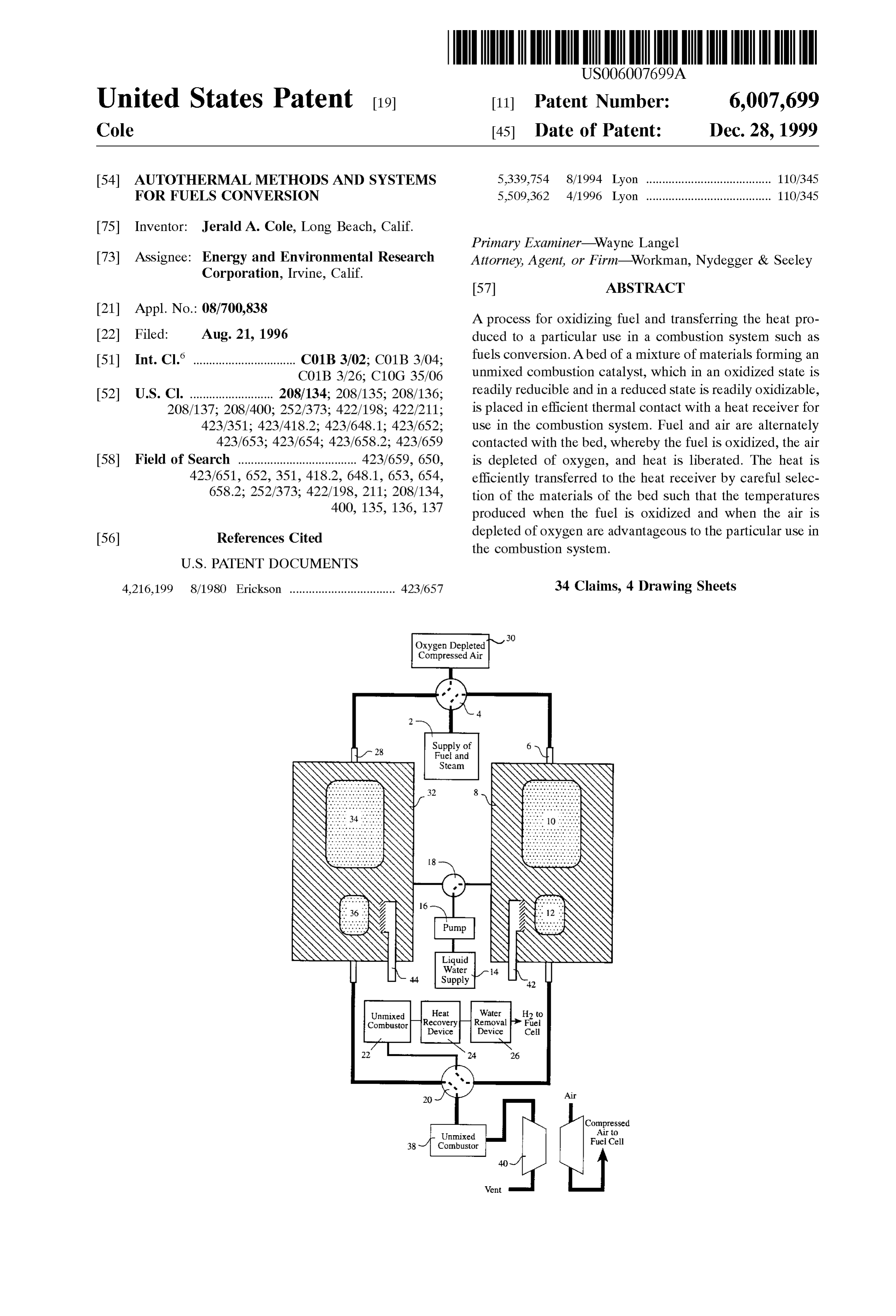
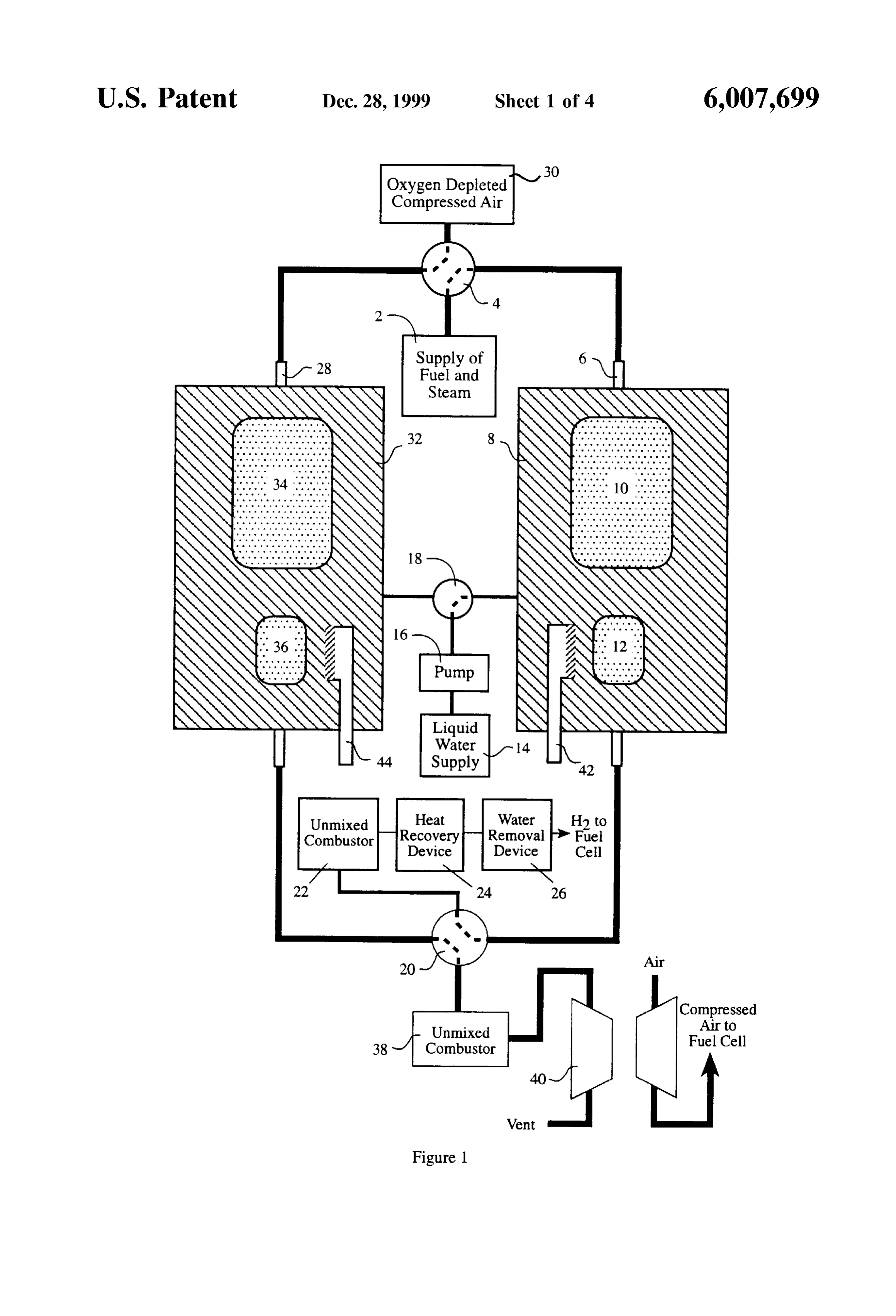
are respectively Sufficient to fully change the oxidation State FIG. 1 illustrates a packed bed reactor system for pro of the unmixed combustion catalyst between the desired ducing high purity hydrogen for use in fuel cells, lower oxidation State and the desired higher oxidation State, FIG. 2 illustrates a packed bed reactor System for dem the amount of heat liberated in any volume of the reactor onstrating the usefulness of unmixed combustion to produce will be uniform and accurately defined. Specifically the heat 35 hydrogen;
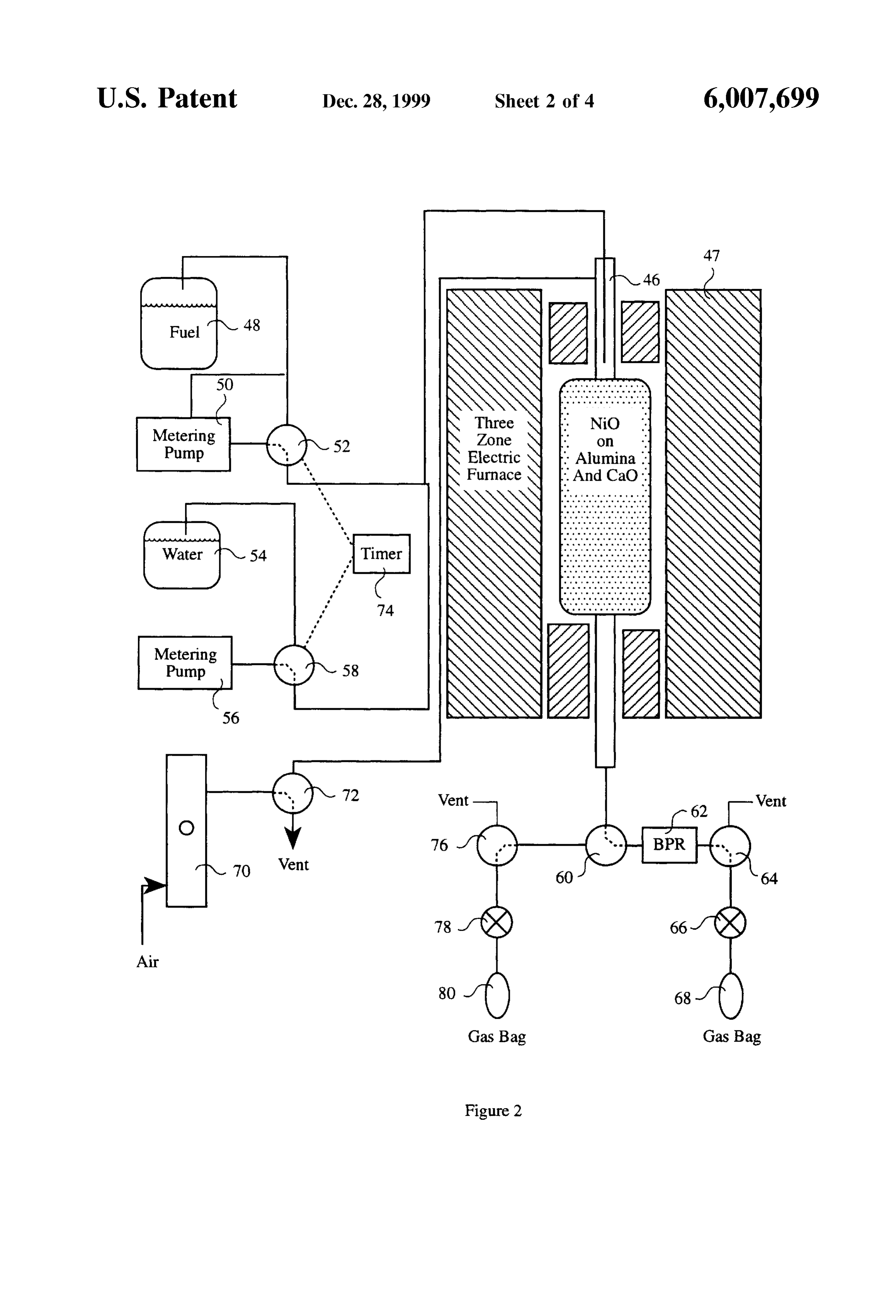
liberated per cycle will be exactly equal to the heat of FIG. 3 shows experimental results from a strip chart reaction that would have been experienced had the fuel been recording allowed to react directly with the air. By choosing an with fuels indicating containing the usefulness of the present invention
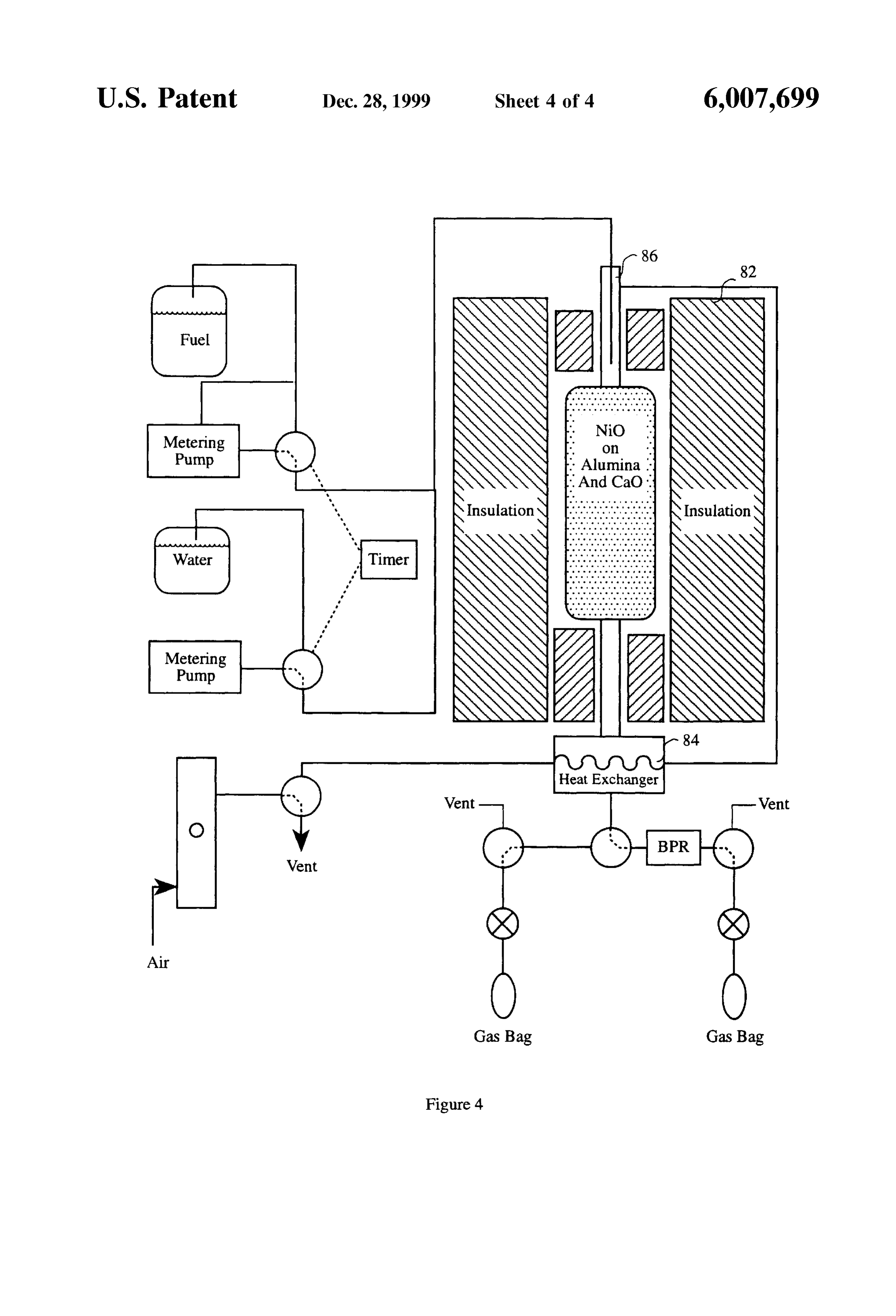
Sulfur, and appropriate concentration for the unmixed combustion FIG. 4 illustrates the reactor system of FIG. 2 with the catalyst, the rate of heat input to the reactor can be controlled 40 addition of a heat eXchanger to absorb heat from the Steam to a desired level.
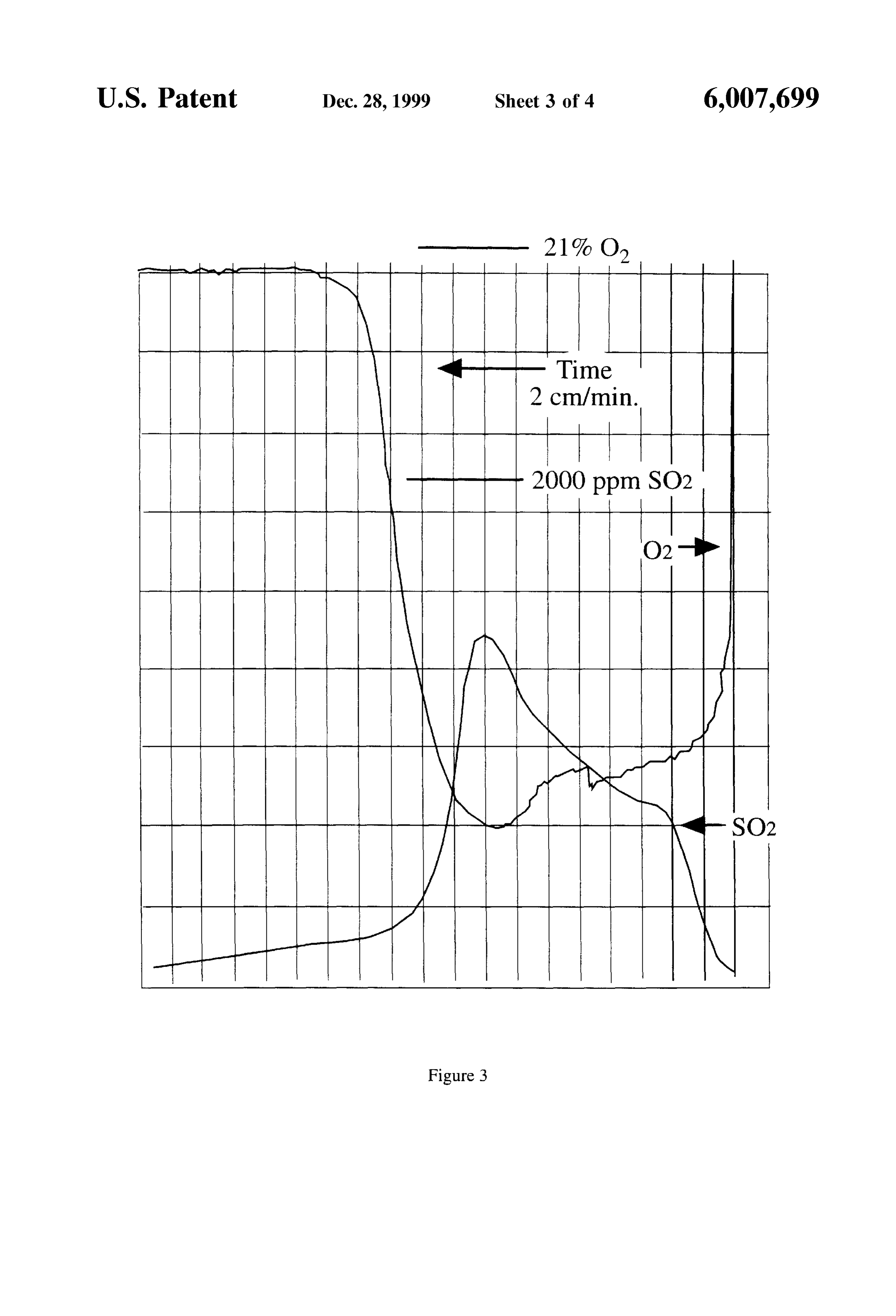
reforming products and transfer heat to air for purposes of
A method of generating and transferring heat in a com improving the efficiency of a reforming reaction. bustion System according to the present invention includes
Selecting a mixture of two or more materials to form an DETAILED DESCRIPTION OF THE unmixed combustion catalyst which in a reduced State is 45 INVENTION readily oxidized and in an oxidized State is readily reduced. The present invention is directed to methods and Systems The mixture of materials is selected Such that the heat for efficiently transferring heat within combustion Systems resulting during an oxidation cycle of the catalyst is in a first for a particular use. The invention represents an improve temperature range useful in operating the combustion ment in the prior State of the art in that the methods and System, and the heat resulting during a reduction cycle of the 50 Systems for efficiently transferring heat within combustion catalyst is in a Second temperature range useful in operating Systems pay particular attention to the temperature at which the combustion System. The unmixed combustion catalyst is that heat is transferred. An autothermal process utilized in placed in efficient thermal contact with a heat receiver in the the invention has been developed in which fuel is oxidized combustion System. The catalyst is alternately contacted, to without the necessity of mixing the fuel with air, by alter release and transfer heat to the heat receiver, with an 55 nately passing the fuel and air through a bed of an unmixed oxygen-containing gas to oxidize the catalyst and generate combustion catalyst. The term “autothermal” as used herein heat in the first temperature range, and with a reducing gas means that the heat required to drive a proceSS is produced to reduce the catalyst. The reaction of the reducing gas with within, not external to, the process and as the heat is needed, the catalyst is an exothermic, thermoneutral, or endothermic both locally and temporally. The term “unmixed combustion reaction, as required to generate or absorb heat to produce 60 catalyst” as used in the Specification and the appended the Second temperature range. claims corresponds to a material or mixture of materials A combustion System for generating and transferring heat which is readily reduced by a fuel or other reducing gas includes the above unmixed combustion catalyst including a when in a higher oxidation State and readily oxidized by an mixture of two or more materials and a heat receiver in oxygen-containing gas Such as air when in a lower oxidation efficient thermal contact with the unmixed combustion cata 65 State.
lyst. A Suitable heat receiver includes endothermic chemical In accordance with the present invention, an unmixed processes Such as the Steam reforming of hydrocarbon fuels combustion catalyst is placed in efficient thermal contact
Page 9
with a heat receiver. Examples of the heat receiver include In another embodiment, the combustion System includes CaCO, boiling water, a reforming reaction in a combustion a catalytic reactor for housing the unmixed combustion System, a catalyst System requiring regeneration, and an catalyst made from a mixture of at least two oxidizable/ adsorbent or absorbent material during regeneration. In reducible materials to carry out an endothermic reaction, and particular, a Suitable heat receiver can be endothermic a Source of a fuel for producing the reducing gas. chemical processes Such as the Steam reforming of hydro carbon fuels to produce hydrogen, the recovery of Shale oil a In an additional embodiment, the combustion System has heat eXchanger in communication with the oxygen from Shale rock, and the regeneration of Solid Sorbents. The containing unmixed combustion catalyst used in the present invention catalyst. Thegascatalystand an outlet from the unmixed combustion is preferably a mixture of materials which are readily reducible material or acan be made from a single oxidizable/ mixture of Such materials when a heat oxidized by air when in a lower oxidation state and which eXchanger is utilized in the combustion System. are readily reduced by a fuel when in a higher oxidation
State. The unmixed combustion catalyst is alternately con ofAlthough all combustion Systems may be within the Scope tacted with a reducing gas to reduce the unmixed combus thethe present invention, for the Sake of clarity and example, present invention is set forth hereinbelow by providing tion catalyst and with a gas containing molecular oxygen to 15 Specific examples of the present invention as related to oxidize the unmixed combustion catalyst in order to release packed bed catalytic reactors. The Specific teachings of the and transfer heat to the heat receiver. The Oxygen-containing gas can be Selected from the group of air, air to which present invention can, however, be applied to any combus additional oxygen has been added, air mixed with combus tion System.
tion products, air from which part of the oxygen has been A. Mass Transfer Catalysis vs. Chemical Reaction Cataly removed, and any of the aforementioned oxygen-containing Sis gases to which inert or combustible gases have been added. The present invention includes methods and Systems for Various configurations are provided herein for alternately effecting oxidation in a combustion device, Such as Supply exposing the reducing gas and the oxygen-containing gas to ing heat to a packed bed catalytic reactor in which an the unmixed combustion catalyst to respectively reduce and 25 endothermic reaction is carried out. It is a feature of the oxidize the catalyst. The present invention provides for the present invention to use a mass transfer catalyst to oxidize oxidation of fuels in combustion Systems wherein the heat fuel.
generated can be transferred more effectively to packed bed Mass transfer catalysis should be considered in contrast to reactors. In addition, the present invention provides com the common chemical reaction catalysis Such as exemplified bustion methods and Systems wherein heat is generated by the pollution control systems used in automobiles. The within a Volume and the rate of heat generation on each exhaust coming out of an engine contains CO and unburned portion of that Volume can be accurately controlled. hydrocarbons. Depending on the air to fuel ratio at which the In one embodiment, discussed in greater detail below, the engine is operating, the exhaust gas may also contain present invention involves a process for Steam reforming oxygen. If it does not, air is added to the exhaust which is hydrocarbon fuels into hydrogen in a packed bed reactor of 35 passed over a noble metal catalyst. The amount of air added a combustion System, wherein heat is more efficiently trans needs to be accurately controlled. If too much cold air is ferred to the packed bed reactor and is transferred at tem added, the temperature of the air/exhaust gas mixture will be peratures advantageous to the Steam reforming process. The too low and the catalyst will not be able to cause complete combustion System includes a first reaction Zone, containing reaction. On the other hand, if too little air is added it will a bed of a mixture of materials forming an unmixed com 40 not be sufficient for complete reaction of the CO and bustion catalyst and calcium oxide, at a temperature in a unburned hydrocarbons, and some of these will be dis range from about 700° C. to 1050° C. at which most of the charged to the atmosphere unoxidized.
reaction between the hydrocarbon and Steam occurs. A The noble metals of iridium, platinum, palladium, Second reaction Zone is also present at a temperature of leSS rhodium, and rhenium are Some of the most effective cata than about 700° C. where the hydrogen produced in the first 45 lysts for the chemical reaction of oxidation. These noble reaction Zone is purified. Compressed air, partially oxygen metals are So effective that noble metal catalysts commonly depleted by use in a fuel cell, is used as an oxidizing agent contain extremely Small amounts of the noble metal, i.e., to oxidize the unmixed combustion catalyst to a higher noble metal catalysts containing only about 0.01 weight oxidation State. This is an exothermic reaction which gen percent noble metal or leSS are common. Thus, when air and erates heat, thereby causing the decomposition of CaCO, 50 exhaust gas are passed through a noble metal catalyst, the produced during a reduction cycle, to CaO and CO, and noble metal promotes the oxidation reaction but does not heating the partially oxygen depleted compressed air. The Store any Significant quantity of oxygen Since there is not partially oxygen depleted compressed air is further heated enough of it present for Such storage. If at any instant the air by passage through a bed of additional unmixed combustion Supplied is not adequate for complete combustion, the catalyst whereby any hydrogen or other fuels in the air are 55 combustion will be incomplete.
oxidized. The oxygen depleted compressed air is then passed Unlike chemical reaction catalysts, a mass transfer cata through a turboexpander to generate power, which drives a lyst facilitates the mass transfer of a reactant, an entirely turbocompressor to produce compressed air for use in the different type of action. The present invention utilizes a mass fuel cell. transfer catalyst to oxidize fuel in various combustion In a further embodiment of the invention, heat is supplied 60 Systems, i.e., the invention uses an unmixed combustion to a packed bed of a Sorbent to thermally regenerate the catalyst.
Sorbent. The unmixed combustion catalyst is placed in the The unmixed combustion catalyst can be formed from a packed bed in efficient thermal contact with the sorbent. wide variety of materials, Such as Silver/silver oxide, copper/ Examples of the Sorbent that can be utilized include acti copper oxide, iron/iron oxide, cobalt/cobalt oxide, tungsten/ Vated carbons and charcoals used to remove volatile organic 65 tungsten oxide, manganese/manganese oxide, molybdenum/ compounds from a ventilation air Stream, or from a proceSS molybdenum oxide, nickel/nickel oxide, tin/tin oxide, waste gas Stream. strontium Sulfide/strontium Sulfate, barium sulfide/barium
Page 10
sulfate, iron(II) oxide/iron(III) oxidc, iron(II) oxide/iron(II, reaction to occur on the inside of metal tubes filled with a III) oxide, iron (II,III) oxide/iron(III) oxide, cobalt(II,III) catalyst while passing hot gases from a fire over the outside oxide/cobalt(IV) oxide, chromium(III) oxide/chromium(IV) of these tubes. This approach, however, has the disadvantage oxide, manganese(II,III) oxide/manganese(IV) oxide, cal that the tubes must tolerate very high temperatures and thus cium molybdite/calcium molybdate, and various mixtures must be made of relatively expensive materials. Since large thereof. The materials are Selected So that the heat generated amounts of these expensive tubes are required to obtain or absorbed during each of the Oxidation and reduction adequate rates of heat transfer, the total cost for this cycles is adjusted to an optimum temperature range for use approach is quite high.
in the combustion System. Calcium oxide (CaO) has been used in hydrogen produc In various preferred embodiments, the unmixed combus tion to avoid the need for external heat and the undesired tion catalyst includes a nickel/nickel oxide material mixed carbon dioxide by-product. An advantage of using CaO is heterogeneously with another oxidizing material Such that that it can react with CO to form CaCO. This removal of the oxidation and reduction cycles result in favorable pro CO drives the equilibrium reaction to the right, allowing the ceSS temperatures that improve thermodynamic efficiency So production of nearly pure hydrogen. Furthermore, Since the as to permit the combustion System to be continuously 15 formation of CaCO is highly exothermic, the heat it gen operated without Supplying an external Source of heat. For erates can Supply the heat needed for the reaction of water example, preferred readily oxidized/readily reduced mix and the hydrocarbon.
tures of materials for use in the present invention include Thus, the use of CaO provided a satisfactory solution to nickel/nickel oxide mixed with either tin/tin oxide, iron/ both problems but it introduced a new problem: how to oxides of iron, or calcium molybdite/calcium molybdate. reconvert the CaCO back to CaO. The decomposition of One preferred catalyst is formed from a mixture of materials CaCO to CaO and CO2 requires Supplying large amounts of that includes nickel/nickel oxide mixed with iron/iron(II) heat, which was not accomplished in a Satisfactory method oxide and iron/iron(III) oxide. The preferred temperature by the prior art.
range for this catalyst as well as the other preferred catalysts The use of unmixed combustion, however, Solves this made from nickel/nickel oxide mixed with tin/tin oxide or 25 problem.
calcium molybdite/calcium molybdate is from about 600 C. the presentFIG. 1 illustrates a packed bed reactor system of to 1100° C. The above preferred catalysts are particularly high purity hydrogenusing invention unmixed combustion to produce for fuel cells. A Supply Source 2 useful in Steam reforming reactions, and have a first tem provides a flowing Stream of Steam and a liquid or gaseous perature range during the oxidation cycle of the catalyst hydrocarbon fuel at a pressure greater than about 60 psig to from about 900 C. to 1100 C., and a second temperature a first four-way valve 4. The hydrocarbon fuel, which forms range during the reduction cycle of the catalyst from about a reducing gas, can be natural gas, a liquid hydrocarbon, a 600° C. to 950° C. Other preferred mixtures of metals and fuel Selected from the group of petroleum distillates includ metal oxides that may be used as the unmixed combustion ing kerosene, gasoline, diesel fuel, and jet fuel, an emulsion catalyst include calcium molybdite/calcium molybdate, of a hydrocarbon or liquid petroleum fuel in water including strontium Sulfide/strontium Sulfate, and barium Sulfide/ 35 barium Sulfate, in various combinations thereof, and having emulsions monoxide, of bitumen or bitumen products in water, carbon or mixtures thereof. The four-way valve 4 in turn other preferred temperature ranges. directs the flowing stream into the top of a first reactor 6. The In Some embodiments of the present invention, the reactor 6 is covered with an insulation layer 8 and has a main unmixed combustion catalyst can be Supported on a porous 40 interior section 10 as well as a smaller interior section 12. ceramic material. The porous ceramic can be Selected from Both main interior section 10 and Smaller interior section 12 materials. Such as Silica, alumina, magnesia, Silicon carbide, contain a mixture of two catalysts. One of the catalysts is a Zeolites, cordierite, and combinations or mixtures thereof. heat receiver which is a CO acceptor Selected from the Preferably, the porous ceramic material is or contains alu group of calcined limestone, calcined dolomite, thermally 45 decomposed Salts of calcium oxide Supported on a porous
B. Supplying of Heat to Packed Bed Reactors ceramic, or mixtures thereof. The other catalyst is Supported There are many industrial processes in which it is neces on a porous ceramic Such as alumina and preferably includes Sary to Supply heat to a packed bed reactor. Fire is an a heterogeneous mixture of nickel/nickel oxide (Ni/NiO) unsatisfactory method for generating Such heat because and tin/tin oxide (Sn/SnO).
transferring heat from the exterior of a packed bed to the 50 Conditions are adjusted So that the temperature in main interior is a slow and difficult process. For some of these interior section 10 is in a range from about 600 C. to about industrial processes, however, it is feasible to blend an 800 C. The steam and hydrocarbon react to form hydrogen unmixed combustion catalyst into the packed bed. This through an endothermic chemical reaction. This reaction allows the heat to be generated where it is needed and thus goes to near completion because CaO reacts with CO to avoids problems of heat transfer. 55 form CaCO. However, the removal of CO and CO is not One instance in which unmixed combustion can be advan entirely complete Since the equilibrium preSSure of CO2 tageously used is in the production of hydrogen. It is well above CaO/CaCO has a finite value when the temperature known that any of a number of catalysts, Such as nickel and is in a range from about 600° C. to 800° C. noble metals Supported on alumina, can be used to catalyze AS the impure hydrogen leaves main interior Section 10, the reaction of hydrocarbons with water to produce hydro 60 liquid water from a liquid water Supply 14 is added via a gen. This method of hydrogen production, however, has two pump 16 and a three-way valve 18 as shown in FIG.1. The problems. First, there is the difficulty that the hydrogen evaporation of the liquid water cools the impure hydrogen produced is not pure but is in equilibrium with CO, CO and and maintains a temperature in Smaller interior Section 12 HO via the reaction CO+HO=CO+H. Second, there is less than about 700° C., and most preferably in a range from the problem that the reaction is Strongly endothermic and 65 about 200° C. to about 550° C. The equilibrium pressure of must be supplied with heat. One of the methods used in the CO above CaO/CaCO has a lower value when the tem prior art to Supply the necessary heat involves causing the perature is in a range from about 200 C. to 550 C. than it
Page 11
does in a range from about 600 C. to about 800 C. oxygen, the amount of this oxygen is, on a time average Consequently, the impure hydrogen becomes Substantially basis, Small relative to the amount of hydrogen passing pure as it passes through Smaller Section 12. The purified through unmixed combustor 22. The heat produced by the hydrogen exits reactor 6 via a Second four-way valve 20, reduction of this Small amount of oxygen is added to the heat passing initially through a first unmixed combustor 22, a recovered by heat recovery device 24. The removal of this heat recovery device 24, and a water removal device 26. The Small amount of oxygen by unmixed combustor 22 purifies purified hydrogen is then directed to a fuel cell. the hydrogen going to the fuel cell. During the formation of hydrogen in main interior Section Heat is required to Start the System of the present inven 10 and its purification in smaller interior section 12, NiO is tion depicted in FIG. 1 when it is first used. Heat may be reduced to Ni, and SnO is reduced to Sn. The reduced Supplied in a number of ways known to those skilled in the art. For example, a first Startup heater 42 and a Second nickel metal So formed acts as a chemical catalyst to increase Startup heater 44 can provide the necessary Startup heat to the rate of the hydrogen production process. It is also within the Scope of the present invention to replace all or part of the reactors 6 and 28, respectively. When the system of FIG. 1 nickel with any noble metal catalyst that may or may not act is shut down and allowed to cool after being used, the as a mass transfer catalyst. Examples of Such noble metal 15 shutdown procedure can involve using both reactors 6 and catalysts include iridium, platinum, palladium, rhodium and 28 to produce hydrogen. When the system is restarted, both rhenium. reactors will contain Ni, Sn and CaCO. The oxidation of While reactor 6 is producing hydrogen, CaCO in a finely divided nickel and tin metals occurs readily at room temperature and is Strongly exothermic. Thus, Simply pass second reactor 28 is being converted back to CaO. Fuel cells ing air first through one reactor then through the other will typically operate at Superatmospheric preSSures, typically in heat them both to an elevated temperature. Subsequently a range from about 15 to about 45 psig. The gas coming passing fuel first through one reactor and then through the away from the anode Side of a fuel cell has a non-zero oxygen content but as compared to air is depleted of oxygen. other, and then repeating the Step of passing air through the Thus, the fuel cell provides oxygen depleted compressed air 25 perature will reactors quickly heat both reactors to operating tem and decompose the CaCO to CaO and CO.
to a Supply Source 30. This oxygen depleted air passes The techniques used to impart heat to the endothermic through four-way valve 4 to a second reactor 28. The second reaction occurring during the Steam reforming of a hydro reactor 28 is covered with an insulation layer 32, and has a carbon fuel to produce hydrogen can also be applied to other main interior section 34 and a smaller interior section 36.
Both main interior section 34 and Smaller interior section 36 endothermic reactions, Such as the decomposition of ammo contain a mixture of two catalysts as in reactor 6, including nia to hydrogen and nitrogen, the reforming of petroleum hydrocarbons, and the decomposition of methanol.
CaO/CaCO and a mixture of Ni/NiO and Sn/SnO on The present invention thus provides methods and Systems porous alumina. The oxidation of the Ni and the Sn to NiO for Supplying heat to packed bed catalytic reactors in which and SnO2 generates heat which partially raises the tempera endothermic reactions are carried out. The unmixed com ture of the catalyst to a temperature in the range of about 700 C. to 1050 C., promoting the decomposition of the 35 bustion catalyst may serve as a catalyst for the endothermic CaCO to CaO and CO. The CO is then Swept out of reaction or may be mixed with a Second endothermic reactor 28 via four-way valve 20 to a second unmixed reaction catalyst and placed in the reactor. Since these two catalysts are in intimate contact, the heat generated by the combustor 38.
alternate oxidation and reduction of the unmixed combus
The heat released by oxidizing the unmixed combustion 40 tion catalyst is readily transferred to the endothermic reac catalyst with the oxygen depleted compressed air is also tion catalyst. With the unmixed combustion catalyst uni retained by the oxygen depleted compressed air. The oxygen formly distributed throughout the packed bed, the packed depleted compressed air is further heated by oxidizing any bed can be uniformly heated.
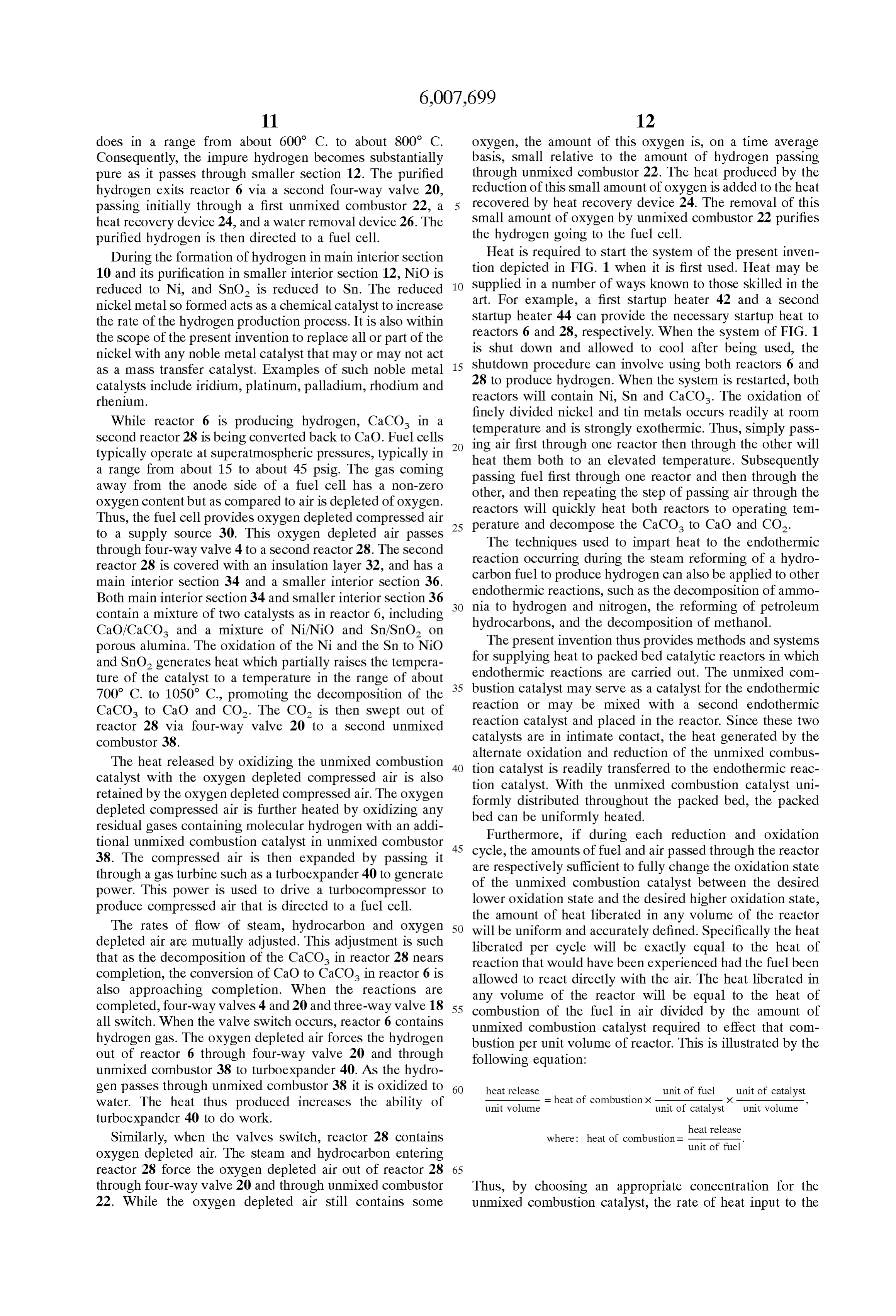
residual gases containing molecular hydrogen with an addi Furthermore, if during each reduction and oxidation tional unmixed combustion catalyst in unmixed combustor 45 cycle, the amounts of fuel and air passed through the reactor 38. The compressed air is then expanded by passing it are respectively Sufficient to fully change the oxidation State through a gas turbine Such as a turboexpander 40 to generate power. This power is used to drive a turbocompressor to of the unmixed combustion catalyst between the desired produce compressed air that is directed to a fuel cell. lower oxidation State and the desired higher oxidation State, The rates of flow of Steam, hydrocarbon and oxygen 50 will the amount of heat liberated in any volume of the reactor depleted air are mutually adjusted. This adjustment is Such liberated be uniform and accurately defined. Specifically the heat per cycle will be exactly equal to the heat of that as the decomposition of the CaCO in reactor 28 nears reaction that would have been experienced had the fuel been completion, the conversion of CaO to CaCO in reactor 6 is allowed to react directly with the air. The heat liberated in also approaching completion. When the reactions are any volume of the reactor will be equal to the heat of completed, four-way valves 4 and 20 and three-way valve 18 55 combustion of the fuel in air divided by the amount of all Switch. When the valve Switch occurs, reactor 6 contains hydrogen gas. The oxygen depleted air forces the hydrogen bustion per unit volumecatalyst unmixed combustion
required to effect that com reactor. This is illustrated by the out of reactor 6 through four-way valve 20 and through following equation:
unmixed combustor 38 to turboexpander 40. As the hydro gen passes through unmixed combustor 38 it is oxidized to 60 heat release unit of fuel unit of catalyst water. The heat thus produced increases the ability of unit volume
unit of catalyst unit volume
turboexpander 40 to do work. heat release Similarly, when the valves switch, reactor 28 contains where: heat of combustion= unit of fuel oxygen depleted air. The Steam and hydrocarbon entering reactor 28 force the oxygen depleted air out of reactor 28 65 through four-way valve 20 and through unmixed combustor Thus, by choosing an appropriate concentration for the 22. While the oxygen depleted air still contains some unmixed combustion catalyst, the rate of heat input to the
Page 12
reactor can be controlled to a desired level. The range of ticular use. These examples are intended to be purely concentrations desired for the unmixed combustion catalyst exemplary of the methods and Systems of the invention and must be determined on a case-by-case basis for each appli should not be viewed as limiting the Scope of the present cation Selected. invention.
Accordingly, the present invention provides an improved combustion System in which two or more metals and their EXAMPLE 1. oxides, or other oxidizing/reducing compounds, are com A packed bed reactor System as shown in FIG. 2 was used bined and used in an unmixed combustion method. In addition, the unmixed combustion method of the invention to demonstrate, on a laboratory Scale, the advantages and can be utilized in various applications to balance the amount hydrogen. Inofthis limitations using unmixed combustion for generating experimental arrangement, a reactor 46 of heat released between the Steps of oxidation and reduction was held within a three-Zone electric furnace 47. A hydro in order to better meet the needs of the process to which it carbon fuel was directed into the top of reactor 46 from a is being applied. The invention also provides a combustion liquid fuel Supply 48 via a first metering pump 50 and System that allows for the production and transfer of heat in through a first three-way supply valve 52. Water was a readily controlled manner. 15
A method of generating and transferring heat in a com directed into the top of reactor 46 from a water Supply 54 via a Second metering pump 56 and through a Second three-way bustion System according to the present invention includes supply valve 58.
Selecting a mixture of two or more materials to form an Reactor 46 had an internal volume of 500 cc and con unmixed combustion catalyst which in a reduced State is readily oxidized and in an oxidized State is readily reduced. tained a mixture of 131.5 grams of CaCO which had been The mixture of materials is selected Such that the heat calcined to CaO, and 223 grams of 21.1 weight percent resulting during an oxidation cycle of the catalyst is in a first nickel oxide on high Surface area alumina. The water and temperature range useful in operating the combustion liquid hydrocarbon trickled down and vaporized in reactor System, and the heat resulting during a reduction cycle of the 46. The hydrocarbon reacted with the NiO reducing it to Ni. catalyst is in a Second temperature range useful in operating 25 The Ni in turn acted as a catalyst for the Steam reforming of the combustion System. The unmixed combustion catalyst is the hydrocarbon and water into a mixture of CO, H, and placed in efficient thermal contact with a heat receiver in the CO. While this reaction is highly endothermic, the reaction combustion System. The catalyst is alternately contacted, to of the CaO with CO to form CaCO is highly exothermic. transfer heat between it and the heat receiver, with an The exothermicity of the latter reaction balanced the endot oxygen-containing gas to oxidize the catalyst and generate hermicity of the former and the overall reaction proceSS was heat in the desired first temperature range, and with a Slightly on the exothermic Side of thermoneutral. reducing gas to reduce the catalyst resulting in generation of Because of the water gas shift reaction CO+HO=H+ heat, consumption of heat, or no release of heat, as required CO, CO was in equilibrium with CO. Consequently to achieve the desired Second temperature range. Thus, the removal of CO by reaction with the CaO also removed the reaction of the reducing gas with the unmixed combustion 35 CO, driving the System toward the production of hydrogen catalyst can result in an exothermic, endothermic, or ther which, on a dry basis, was relatively pure. moneutral reaction, depending on the unmixed combustion The hydrogen thus produced left the reactor via an exit catalyst Selected, in order to generate or absorb heat to three-way valve 60, passed through a back pressure regula produce the Second temperature range. tor (BPR) 62, and was vented via a first three-way vent valve A combustion System for generating and transferring heat 40 64. Samples of the hydrogen for gas chromatograph analysis includes an unmixed combustion catalyst including a mix were taken by Switching three-way vent valve 64 so that the ture of two or more materials, and a heat receiver in efficient hydrogen flowed through a first gas valve 66 into a gas bag thermal contact with the unmixed combustion catalyst. The 68.
System further includes a means for alternately contacting While the hydrogen was being produced, low pressure air the unmixed combustion catalyst with an oxygen-containing 45 flowed through a rotameter 70, to a second three-way vent gas to oxidize the catalyst and generate heat, and a reducing valve 72 and went to vent. At periodic intervals, a timer 74 gas to reduce the catalyst. Such alternate contacting means switched the three-way valves 52, 58, 60, and 72. This can include various valve devices utilized in the System, caused the flows of fuel and water from pumps 50 and 56 to which are discussed in greater detail below. A heat return to Supplies 48 and 54, respectively, and caused the eXchanger in communication with the Oxygen-containing 50 flow of low preSSure air to pass through reactor 46, leaving gas and an outlet from the unmixed combustion catalyst can via valve 60 and going to vent via a third three-way vent also be provided in the combustion System. In one embodi Valve 76. Samples for gas chromatograph analysis of the air ment also discussed in greater detail below, the unmixed leaving reactor 46 were taken by Switching three-way vent combustion catalyst is disposed in a catalytic reactor that is valve 76 so that the air flowed through a second gas valve Surrounded by an insulating Structure. The catalytic reactor 55 78 into a gas bag 80.
is in communication with the heat eXchanger and a Source of Passing air through the reactor caused the nickel to fuel and water. In another embodiment, the combustion
System can employ an unmixed combustion catalyst made of to CaO to oxidize nickel oxide and caused the CaCO to decompose a single oxidizing/reducing material, as long as a heat reaction,andtheCO. heat
Since the former is a strongly exothermic it Supplies allows the latter Strongly eXchanger is also used in the System. 60 endothermic reaction to occur.
EXAMPLES OF THE PREFERRED
EMBODIMENTS EXAMPLE 2
The following examples illustrate use of a material which Hydrogen was produced in a Series of experiments by in its reduced State is readily oxidized and which in its 65 slightly modifying the system illustrated in FIG. 2. The oxidized State is readily reduced as a means of oxidizing fuel System was modified by replacing metering pump 50 and and effectively delivering the heat thus produced to a par liquid fuel Supply 48 with a rotameter and a cylinder of
Page 13
carbon monoxide gas in order to convert carbon monoxide exhausted, Similar to when carbon monoxide was used in by Steam reforming. The reactor was preconditioned by Example 2.
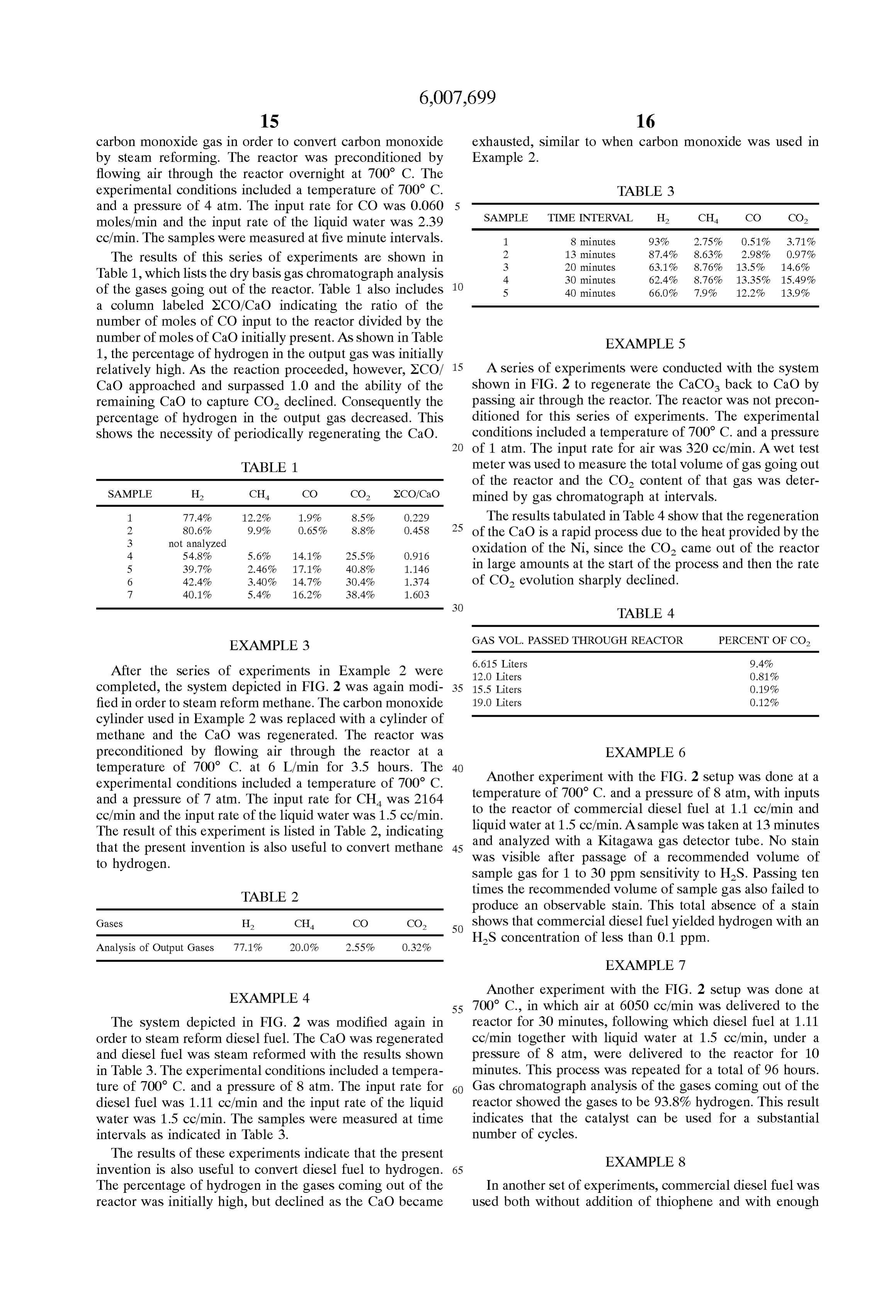
flowing air through the reactor overnight at 700° C. The experimental conditions included a temperature of 700 C. TABLE 3 and a pressure of 4 atm. The input rate for CO was 0.060 SAMPLE TIME INTERVAL H. CH CO CO, moles/min and the input rate of the liquid water was 2.39 cc/min. The Samples were measured at five minute intervals. 1. 8 minutes 93% 2.75% O.51%, 3.71% The results of this Series of experiments are shown in 2 13 minutes 87.4% 8.63%, 2.98% O.97%
Table 1, which lists the dry basis gas chromatograph analysis 4 30 minutes 62.4% 8.76%. 13.35%. 15.49% of the gases going out of the reactor. Table 1 also includes 5 40 minutes 66.0% 7.9%. 12.2%. 13.9% a column labeled XCO/CaO indicating the ratio of the number of moles of CO input to the reactor divided by the number of moles of CaO initially present. As shown in Table EXAMPLE 5 1, the percentage of hydrogen in the output gas was initially relatively high. AS the reaction proceeded, however, XCO/ 15 A Series of experiments were conducted with the System CaO approached and surpassed 1.0 and the ability of the shown in FIG. 2 to regenerate the CaCO back to CaO by remaining CaO to capture CO declined. Consequently the passing air through the reactor. The reactor was not precon percentage of hydrogen in the output gas decreased. This ditioned for this Series of experiments. The experimental shows the necessity of periodically regenerating the CaO. conditions included a temperature of 700° C. and a pressure of 1 atm. The input rate for air was 320 cc/min. A wet test
TABLE 1. meter was used to measure the total Volume of gas going out of the reactor and the CO content of that gas was deter
SAMPLE H CH CO CO, XCOfCaO mined by gas chromatograph at intervals.
The results tabulated in Table 4 show that the regeneration 2 80.6% 9.9% O.65% 8.8% O.458 of the CaO is a rapid process due to the heat provided by the 3 not analyzed 4 54.8% 5.6% 14.1% 25.5% O.916 oxidation of the Ni, since the CO came out of the reactor 5 39.7% 2.46%. 17.1% 40.8% 1.146 in large amounts at the Start of the proceSS and then the rate 6 42.4% 3.40%, 14.7% 30.4% 1.374 of CO evolution sharply declined.
TABLE 4
EXAMPLE 3 GAS VOL. PASSED THROUGH REACTOR PERCENT OF CO,
After the Series of experiments in Example 2 were 12.0 Liters O.81% completed, the System depicted in FIG. 2 was again modi 35 15.5 Liters O.19% fied in order to steam reform methane. The carbon monoxide 19.0 Liters O.12% cylinder used in Example 2 was replaced with a cylinder of methane and the CaO was regenerated. The reactor was preconditioned by flowing air through the reactor at a EXAMPLE 6 temperature of 700° C. at 6 L/min for 3.5 hours. The 40 Another experiment with the FIG. 2 setup was done at a experimental conditions included a temperature of 700 C. temperature of 700° C. and a pressure of 8 atm, with inputs and a pressure of 7 atm. The input rate for CH was 2164 cc/min and the input rate of the liquid water was 1.5 cc/min. to the reactor of commercial diesel fuel at 1.1 cc/min and liquid water at 1.5 cc/min. A Sample was taken at 13 minutes
The result of this experiment is listed in Table 2, indicating and analyzed with a Kitagawa gas detector tube. No Stain that the present invention is also useful to convert methane 45 was visible after passage of a recommended Volume of to hydrogen.
Sample gas for 1 to 30 ppm Sensitivity to H2S. Passing ten
TABLE 2 times the recommended Volume of Sample gas also failed to produce an observable Stain. This total absence of a stain
Gases H CH CO CO, 50 shows that commercial diesel fuel yielded hydrogen with an
HS concentration of less than 0.1 ppm.
EXAMPLE 7
EXAMPLE 4 Another experiment with the FIG. 2 setup was done at 55700 C., in which air at 6050 cc/min was delivered to the
The system depicted in FIG. 2 was modified again in reactor for 30 minutes, following which diesel fuel at 1.11 order to steam reform diesel fuel. The CaO was regenerated cc/min together with liquid water at 1.5 cc/min, under a and diesel fuel was steam reformed with the results shown pressure of 8 atm, were delivered to the reactor for 10 in Table 3. The experimental conditions included a tempera minutes. This process was repeated for a total of 96 hours. ture of 700 C. and a pressure of 8 atm. The input rate for 60 Gas chromatograph analysis of the gases coming out of the diesel fuel was 1.11 cc/min and the input rate of the liquid reactor showed the gases to be 93.8% hydrogen. This result water was 1.5 cc/min. The Samples were measured at time indicates that the catalyst can be used for a Substantial intervals as indicated in Table 3. number of cycles.
The results of these experiments indicate that the present EXAMPLE 8 invention is also useful to convert diesel fuel to hydrogen. 65
The percentage of hydrogen in the gases coming out of the In another Set of experiments, commercial diesel fuel was reactor was initially high, but declined as the CaO became used both without addition of thiophene and with enough
Page 14
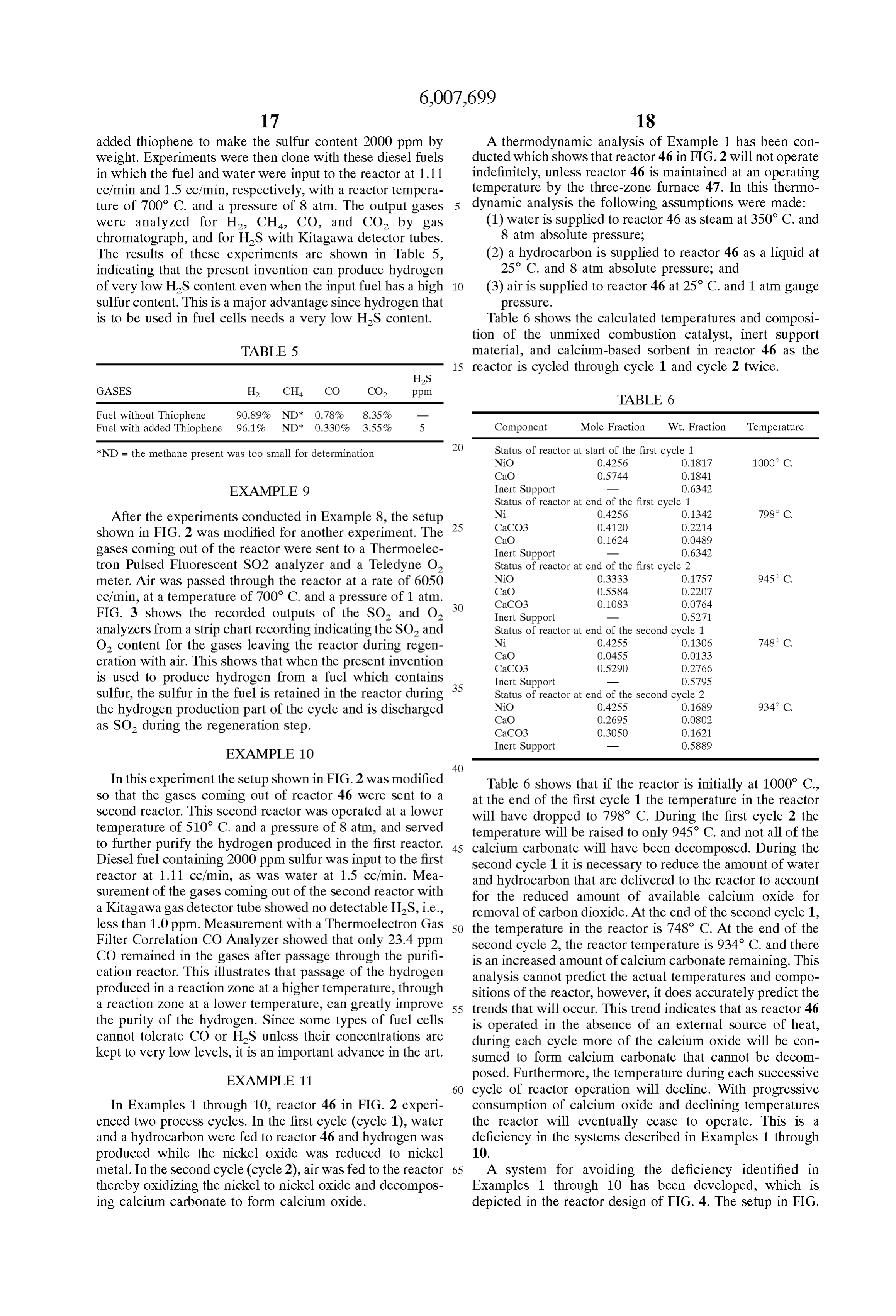
added thiophene to make the Sulfur content 2000 ppm by A thermodynamic analysis of Example 1 has been con weight. Experiments were then done with these diesel fuels ducted which shows that reactor 46 in FIG.2 will not operate in which the fuel and water were input to the reactor at 1.11 indefinitely, unless reactor 46 is maintained at an operating cc/min and 1.5 cc/min, respectively, with a reactor tempera temperature by the three-Zone furnace 47. In this thermo ture of 700 C. and a pressure of 8 atm. The output gases dynamic analysis the following assumptions were made: were analyzed for H2, CH, CO, and CO2 by gas (1) water is supplied to reactor 46 as steam at 350° C. and chromatograph, and for HS with Kitagawa detector tubes. 8 atm absolute pressure; The results of these experiments are shown in Table 5, (2) a hydrocarbon is Supplied to reactor 46 as a liquid at indicating that the present invention can produce hydrogen 25 C. and 8 atm absolute pressure; and of very low HS content even when the input fuel has a high (3) air is Supplied to reactor 46 at 25 C. and 1 atm gauge Sulfur content. This is a major advantage Since hydrogen that preSSure.
is to be used in fuel cells needs a very low HS content. Table 6 shows the calculated temperatures and composi tion of the unmixed combustion catalyst, inert Support
TABLE 5 material, and calcium-based Sorbent in reactor 46 as the 15 reactor is cycled through cycle 1 and cycle 2 twice.
GASES H. CH, CO CO, ppm
TABLE 6
Fuel with added Thiophene 96.1% ND* 0.330% 3.55% 5 Component Mole Fraction Wt. Fraction Temperature
*ND = the methane present was too small for determination Status of reactor at start of the first cycle 1 NO O.4256 O.1817 1OOO C.
EXAMPLE 9 Inert Support O.6342
Status of reactor at end of the first cycle 1
After the experiments conducted in Example 8, the Setup N
shown in FIG. 2 was modified for another experiment. The 25 CaO O.1624 O.O489 gases coming out of the reactor were Sent to a Thermoelec Inert Support O.6342 tron Pulsed Fluorescent SO2 analyzer and a Teledyne O. Status of reactor at end of the first cycle 2 meter. Air was passed through the reactor at a rate of 6050 NO O.3333 O.1757 945° C.
cc/min, at a temperature of 700 C. and a pressure of 1 atm. CaCO3 O.1083 O.O764 FIG. 3 shows the recorded outputs of the SO and O Inert Support 0.5271 analyzers from a Strip chart recording indicating the SO2 and Status of reactor at end of the second cycle 1 O content for the gases leaving the reactor during regen N
CaO
eration with air. This shows that when the present invention CaCO3 O.5290 O.2766 is used to produce hydrogen from a fuel which contains 35 Inert Support 0.5795 Sulfur, the Sulfur in the fuel is retained in the reactor during Status of reactor at end of the second cycle 2 the hydrogen production part of the cycle and is discharged NO
CaO
as SO during the regeneration Step. CaCO3 O.3OSO O.1621
EXAMPLE 10
In this experiment the setup shown in FIG. 2 was modified Table 6 shows that if the reactor is initially at 1000 C., So that the gases coming out of reactor 46 were Sent to a at the end of the first cycle 1 the temperature in the reactor Second reactor. This Second reactor was operated at a lower will have dropped to 798 C. During the first cycle 2 the temperature of 510 C. and a pressure of 8 atm, and served temperature will be raised to only 945 C. and not all of the to further purify the hydrogen produced in the first reactor. 45 calcium carbonate will have been decomposed. During the Diesel fuel containing 2000 ppm Sulfur was input to the first Second cycle 1 it is necessary to reduce the amount of water reactor at 1.11 cc/min, as was water at 1.5 cc/min. Mea and hydrocarbon that are delivered to the reactor to account Surement of the gases coming out of the Second reactor with for the reduced amount of available calcium oxide for a Kitagawa gas detector tube showed no detectable H2S, i.e., removal of carbon dioxide. At the end of the second cycle 1, less than 1.0 ppm. Measurement with a Thermoelectron Gas 50 the temperature in the reactor is 748 C. At the end of the Filter Correlation CO Analyzer showed that only 23.4 ppm second cycle 2, the reactor temperature is 934 C. and there CO remained in the gases after passage through the purifi is an increased amount of calcium carbonate remaining. This cation reactor. This illustrates that passage of the hydrogen analysis cannot predict the actual temperatures and compo produced in a reaction Zone at a higher temperature, through Sitions of the reactor, however, it does accurately predict the a reaction Zone at a lower temperature, can greatly improve 55 trends that will occur. This trend indicates that as reactor 46 the purity of the hydrogen. Since Some types of fuel cells is operated in the absence of an external Source of heat, cannot tolerate CO or HS unless their concentrations are during each cycle more of the calcium oxide will be con kept to very low levels, it is an important advance in the art. Sumed to form calcium carbonate that cannot be decom EXAMPLE 11 posed. Furthermore, the temperature during each Successive 60 cycle of reactor operation will decline. With progressive
In Examples 1 through 10, reactor 46 in FIG. 2 experi consumption of calcium oxide and declining temperatures enced two process cycles. In the first cycle (cycle 1), water the reactor will eventually cease to operate. This is a and a hydrocarbon were fed to reactor 46 and hydrogen was deficiency in the Systems described in Examples 1 through produced while the nickel oxide was reduced to nickel 10.
metal. In the Second cycle (cycle 2), air was fed to the reactor 65 A System for avoiding the deficiency identified in thereby oxidizing the nickel to nickel oxide and decompos Examples 1 through 10 has been developed, which is ing calcium carbonate to form calcium oxide. depicted in the reactor design of FIG. 4. The setup in FIG.
Page 15
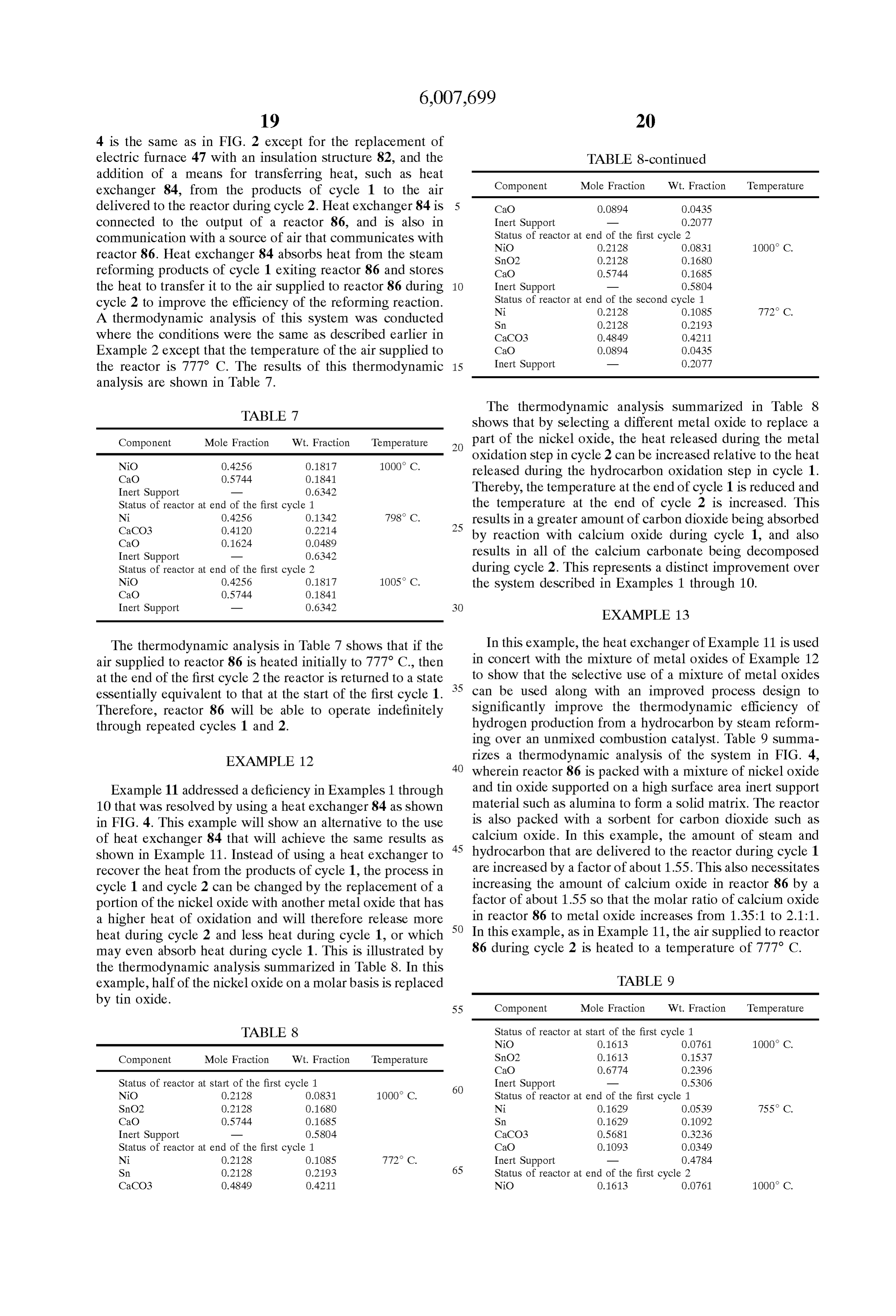
4 is the same as in FIG. 2 except for the replacement of electric furnace 47 with an insulation structure 82, and the TABLE 8-continued addition of a means for transferring heat, Such as heat Component Mole Fraction Wt. Fraction Temperature exchanger 84, from the products of cycle 1 to the air delivered to the reactor during cycle 2. Heat eXchanger 84 is CaO O.O894 O.O435 connected to the output of a reactor 86, and is also in Inert Support 0.2O77 communication with a Source of air that communicates with Status of reactor at end of the first cycle 2 NO O.2128 O.O831 1OOO C.
reactor 86. Heat exchanger 84 absorbs heat from the steam SnO2 O.2128 O.1680 reforming products of cycle 1 exiting reactor 86 and Stores CaO O.5744 O.1685 the heat to transfer it to the air supplied to reactor 86 during Inert Support O.5804 cycle 2 to improve the efficiency of the reforming reaction. Status of reactor at end of the second cycle 1 N O.2128 O.1085 772. C.
A thermodynamic analysis of this System was conducted Sn O.2128 O.21.93 where the conditions were the same as described earlier in CaCO3 O.4849 O4211 Example 2 except that the temperature of the air Supplied to CaO O.O894 O.O435 the reactor is 777 C. The results of this thermodynamic 15 Inert Support 0.2O77 analysis are shown in Table 7.
TABLE 7
The thermodynamic analysis summarized in Table 8 shows that by Selecting a different metal oxide to replace a
Component Mole Fraction Wt. Fraction Temperature part of the nickel oxide, the heat released during the metal NO O.4256 O.1817 1OOO C.
oxidation Step in cycle 2 can be increased relative to the heat
released during the hydrocarbon oxidation Step in cycle 1.
Inert Support O.6342 Thereby, the temperature at the end of cycle 1 is reduced and Status of reactor at end of the first cycle 1 the temperature at the end of cycle 2 is increased. This 25 results in a greater amount of carbon dioxide being absorbed
N O.4256 O.1342 798 C.
CaO O.1624 O.O489 by reaction with calcium oxide during cycle 1, and also Inert Support O.6342 results in all of the calcium carbonate being decomposed Status of reactor at end of the first cycle 2 during cycle 2. This represents a distinct improvement over
CaO
1005 C. the system described in Examples 1 through 10.
EXAMPLE 13
The thermodynamic analysis in Table 7 shows that if the In this example, the heat eXchanger of Example 11 is used air supplied to reactor 86 is heated initially to 777 C., then in concert with the mixture of metal oxides of Example 12 at the end of the first cycle 2 the reactor is returned to a State to show that the Selective use of a mixture of metal oxides essentially equivalent to that at the Start of the first cycle 1. 35 can be used along with an improved process design to Therefore, reactor 86 will be able to operate indefinitely Significantly improve the thermodynamic efficiency of through repeated cycles 1 and 2. hydrogen production from a hydrocarbon by Steam reform ing over an unmixed combustion catalyst. Table 9 Summa
EXAMPLE 12 rizes a thermodynamic analysis of the System in FIG. 4,
wherein reactor 86 is packed with a mixture of nickel oxide
Example 11 addressed a deficiency in Examples 1 through and tin oxide Supported on a high Surface area inert Support 10 that was resolved by using a heat eXchanger 84 as shown material Such as alumina to form a Solid matrix. The reactor in FIG. 4. This example will show an alternative to the use is also packed with a Sorbent for carbon dioxide Such as of heat exchanger 84 that will achieve the same results as 45 calcium oxide. In this example, the amount of Steam and shown in Example 11. Instead of using a heat eXchanger to hydrocarbon that are delivered to the reactor during cycle 1 recover the heat from the products of cycle 1, the proceSS in are increased by a factor of about 1.55. This also necessitates cycle 1 and cycle 2 can be changed by the replacement of a increasing the amount of calcium oxide in reactor 86 by a portion of the nickel oxide with another metal oxide that has factor of about 1.55 So that the molar ratio of calcium oxide a higher heat of oxidation and will therefore release more in reactor 86 to metal oxide increases from 1.35:1 to 2.1:1. heat during cycle 2 and leSS heat during cycle 1, or which 50 In this example, as in Example 11, the air Supplied to reactor may even absorb heat during cycle 1. This is illustrated by 86 during cycle 2 is heated to a temperature of 777 C. the thermodynamic analysis Summarized in Table 8. In this example, half of the nickel oxide on a molar basis is replaced TABLE 9 by tin oxide. 55 Component Mole Fraction Wt. Fraction Temperature TABLE 8 Status of reactor at start of the first cycle 1
NO O.1613 O.O761 1OOO C.
Component Mole Fraction Wt. Fraction Temperature SnO2 O.1613 0.1537
Status of reactor at start of the first cycle 1 60
NO O.2128 O.O831 1OOO C. Status of reactor at end of the first cycle 1 SnO2 O.2128 O.168O N O.1629 O.O539 755° C. CaO O.5744 O.1685 Sn O.1629 O.1092 Inert Support O.5804 CaCO3 O.5681 O.3236 Status of reactor at end of the first cycle 1 CaO O.1093 O.O349 N O.2128 O.1085 772. C. Inert Support O.4784 Sn O.2128 O.219.3 65 Status of reactor at end of the first cycle 2 CaCO3 O.4849 O4211 NO O.1613 O.O761 1OOO C.
Page 16
additional oxygen has been added, air mixed with combus
TABLE 9-continued tion products, air from which part of the oxygen has been removed, and any of the aforementioned oxygen-containing
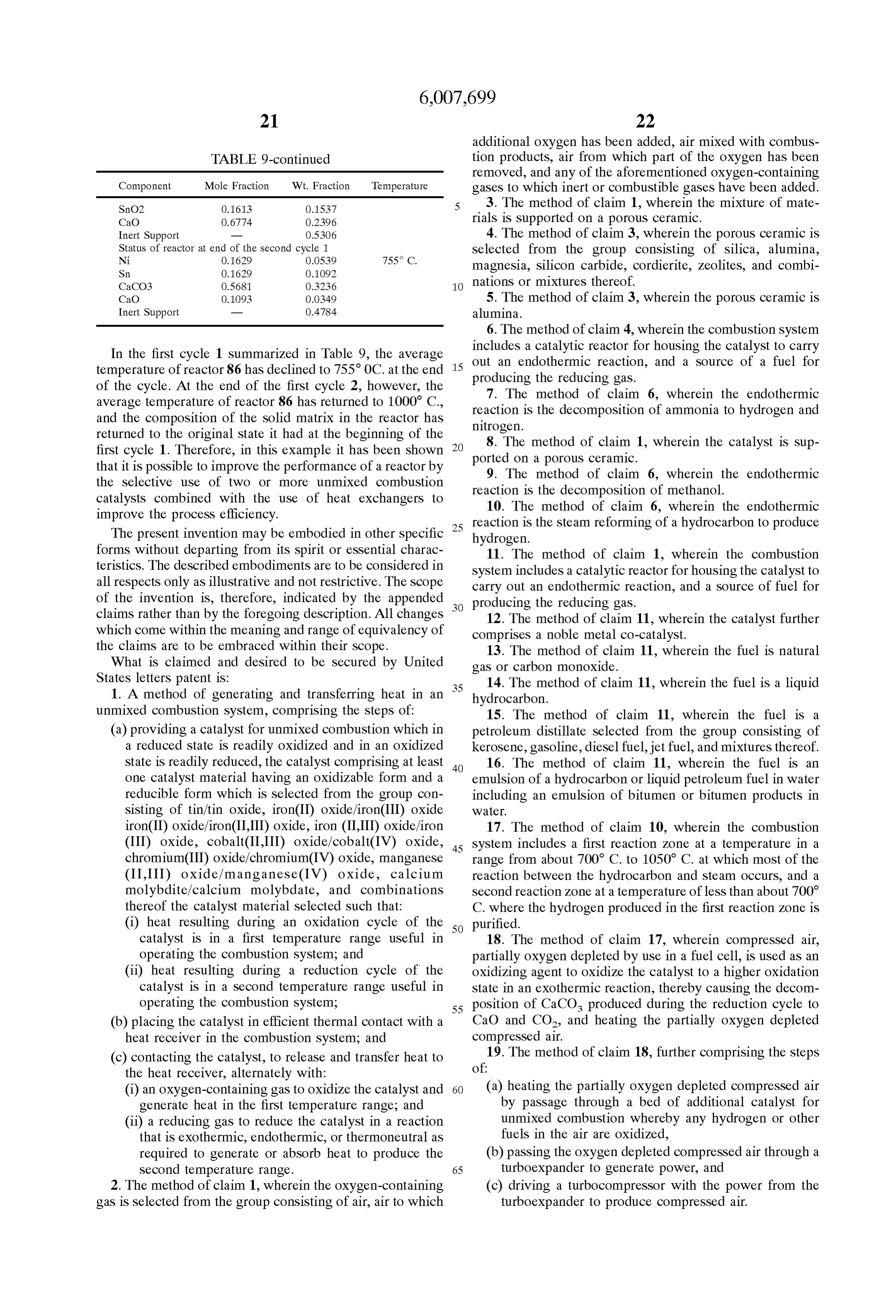
Component Mole Fraction Wt. Fraction Temperature gases to which inert or combustible gases have been added. SnO2 O.1613 0.1537 3. The method of claim 1, wherein the mixture of mate CaO O.6774 O.2396 rials is Supported on a porous ceramic. Inert Support O.5.306 4. The method of claim 3, wherein the porous ceramic is Status of reactor at end of the second cycle 1
N O.1629 O.O539 755° C.
Selected from the group consisting of Silica, alumina,
Sn O.1629 O.1092 magnesia, Silicon carbide, cordierite, Zeolites, and combi CaCO3 O.5681 O.3236 nations or mixtures thereof. CaO O.1093 O.O349 5. The method of claim 3, wherein the porous ceramic is Inert Support O.4784 alumina.
6. The method of claim 4, wherein the combustion system includes a catalytic reactor for housing the catalyst to carry
In the first cycle 1 summarized in Table 9, the average out an endothermic reaction, and a Source of a fuel for temperature of reactor 86 has declined to 755 OC. at the end 15 producing the reducing gas.
of the cycle. At the end of the first cycle 2, however, the average temperature of reactor 86 has returned to 1000 C., reaction is method 7. The the of claim 6, wherein the endothermic decomposition of ammonia to hydrogen and and the composition of the Solid matrix in the reactor has nitrogen.
returned to the original State it had at the beginning of the 8. The method of claim 1, wherein the catalyst is Sup first cycle 1. Therefore, in this example it has been shown ported on a porous ceramic.
that it is possible to improve the performance of a reactor by 9. The method of claim 6, wherein the endothermic the Selective use of two or more unmixed combustion catalysts combined with the use of heat eXchangers to reaction is the decomposition of methanol. improve the process efficiency. 10. The method of claim 6, wherein the endothermic 25 reaction is the Steam reforming of a hydrocarbon to produce
The present invention may be embodied in other specific hydrogen.
forms without departing from its Spirit or essential charac 11. The method of claim 1, wherein the combustion teristics. The described embodiments are to be considered in System includes a catalytic reactor for housing the catalyst to all respects only as illustrative and not restrictive. The Scope carry out an endothermic reaction, and a Source of fuel for of the invention is, therefore, indicated by the appended producing the reducing gas.
claims rather than by the foregoing description. All changes 12. The method of claim 11, wherein the catalyst further which come within the meaning and range of equivalency of comprises a noble metal co-catalyst.
the claims are to be embraced within their Scope. 13. The method of claim 11, wherein the fuel is natural What is claimed and desired to be secured by United gas or carbon monoxide.
States letters patent is: 14. The method of claim 11, wherein the fuel is a liquid 1. A method of generating and transferring heat in an 35 hydrocarbon.
unmixed combustion System, comprising the Steps of: 15. The method of claim 11, wherein the fuel is a (a) providing a catalyst for unmixed combustion which in petroleum distillate Selected from the group consisting of a reduced State is readily oxidized and in an oxidized kerosene, gasoline, diesel fuel, jet fuel, and mixtures thereof. State is readily reduced, the catalyst comprising at least 40 16. The method of claim 11, wherein the fuel is an one catalyst material having an oxidizable form and a emulsion of a hydrocarbon or liquid petroleum fuel in water reducible form which is Selected from the group con including an emulsion of bitumen or bitumen products in sisting of tin/tin oxide, iron(II) oxide/iron(III) oxide Water.
iron(II) oxide/iron(II,III) oxide, iron (II,III) oxide/iron 17. The method of claim 10, wherein the combustion (III) oxide, cobalt(II,III) oxide/cobalt(IV) oxide, 45 System includes a first reaction Zone at a temperature in a chromium(III) oxide/chromium(IV) oxide, manganese range from about 700° C. to 1050° C. at which most of the (II,III) oxide/manganese(IV) oxide, calcium reaction between the hydrocarbon and Steam occurs, and a molybdite/calcium molybdate, and combinations second reaction Zone at a temperature of less than about 700 thereof the catalyst material Selected Such that: C. where the hydrogen produced in the first reaction Zone is (i) heat resulting during an oxidation cycle of the 50 purified.
catalyst is in a first temperature range useful in 18. The method of claim 17, wherein compressed air, operating the combustion System; and partially oxygen depleted by use in a fuel cell, is used as an (ii) heat resulting during a reduction cycle of the oxidizing agent to oxidize the catalyst to a higher oxidation catalyst is in a Second temperature range useful in State in an exothermic reaction, thereby causing the decom operating the combustion System; 55 position of CaCO produced during the reduction cycle to (b) placing the catalyst in efficient thermal contact with a CaO and CO2, and heating the partially oxygen depleted heat receiver in the combustion System; and compressed air.
(c) contacting the catalyst, to release and transfer heat to of:19. The method of claim 18, further comprising the steps the heat receiver, alternately with:
(i) an oxygen-containing gas to oxidize the catalyst and 60 (a) heating the partially oxygen depleted compressed air generate heat in the first temperature range; and by passage through a bed of additional catalyst for (ii) a reducing gas to reduce the catalyst in a reaction unmixed combustion whereby any hydrogen or other that is exothermic, endothermic, or thermoneutral as fuels in the air are oxidized, required to generate or absorb heat to produce the (b) passing the oxygen depleted compressed air through a Second temperature range. 65 turboexpander to generate power, and 2. The method of claim 1, wherein the oxygen-containing (c) driving a turbocompressor with the power from the gas is Selected from the group consisting of air, air to which turboexpander to produce compressed air.
Page 17
20. The method of claim 1, wherein the combustion (ii) heat resulting during a reduction cycle of the System includes a heat eXchanger in communication with the catalyst is in a Second temperature range useful in oxygen-containing gas and an outlet from the catalyst. operating the combustion System; 21. An unmixed combustion System for generating and (b) a heat receiver in efficient thermal contact with the transferring heat, comprising: catalyst, and (a) a catalyst for unmixed combustion which in a reduced (c) means for contacting the catalyst, to release and State is readily oxidized and in an oxidized State is transfer heat to the heat receiver, alternately with: readily reduced, the catalyst comprising a mixture of at least two materials each of which has an oxidizable (i) an oxygen-containing gas to oxidize the catalyst and form and a reducible form, the mixture of materials generate heat in the first temperature range; and Selected Such that: (ii) a reducing gas to reduce the catalyst in a reaction (i) heat resulting during an oxidation cycle of the that is exothermic, endothermic, or thermoneutral as catalyst is in a first temperature range useful in required to generate or absorb heat to produce the operating the combustion System, the first tempera Second temperature range.
ture range during the oxidation cycle being from 15 29. The system of claim 21, wherein the catalyst further about 900 C. to about 1100° C.; and comprises a noble metal co-catalyst.
(ii) heat resulting during a reduction cycle of the 30. The system of claim 21, further comprising a heat catalyst is in a Second temperature range useful in eXchanger in communication with the Oxygen-containing operating the combustion System, the Second tem gas and an outlet from the catalyst.
perature range during the reduction cycle being from 31. A method of generating and transferring heat in an about 600° C. to about 950° C.; unmixed combustion System, comprising the Steps of: (b) a heat receiver in efficient thermal contact with the (a) providing a mixture of two or more materials, each of catalyst, and which has an oxidizable form and a reducible form, to (c) means for contacting the catalyst, to release and form a catalyst for unmixed combustion which in a transfer heat to the heat receiver, alternately with: reduced State is readily oxidized and in an oxidized (i) an oxygen-containing gas to oxidize the catalyst and 25 State is readily reduced, the mixture of materials includ generate heat in the first temperature range; and (ii) a reducing gas to reduce the catalyst in a reaction ing nickel/nickel oxide and at least one material that is exothermic, endothermic, or thermoneutral as Selected from the group consisting of tin/tin oxide, required to generate or absorb heat to produce the chromium(III) oxide/chromium(IV) oxide, iron(II) Second temperature range. oxide/iron(III) oxide, iron(II) oxide/iron(II,III) oxide, 22. The system of claim 21, wherein the catalyst is iron (II,III) oxide/iron(III) oxide, cobalt(II,III) oxide/ Supported on a porous ceramic. cobalt(IV) oxide, manganese(II,III) oxide/manganese 23. The System of claim 21, further comprising a catalytic (IV) oxide, and calcium molybdite/calcium molybdate, reactor for housing the catalyst to carry out an endothermic the mixture of materials Selected Such that: reaction, and a fuel Source for producing the reducing gas. 35 (i) heat resulting during an oxidation cycle of the 24. The system of claim 23, wherein the endothermic catalyst is in a first temperature range useful in reaction is the decomposition of ammonia to hydrogen and operating the combustion System; and nitrogen. (ii) heat resulting during a reduction cycle of the 25. The method of claim 17, wherein compressed air, catalyst is in a Second temperature range useful in partially oxygen depleted by use in a fuel cell, is used as an 40 operating the combustion System; oxidizing agent to oxidize the catalyst in an exothermic (b) placing the catalyst in efficient thermal contact with a reaction, thereby causing the decomposition of CaCO pro heat receiver in the combustion System, the heat duced during the Step of contacting the catalyst with a receiver comprising calcium oxide; and reducing gas to CaO and CO, and heating the partially (c) contacting the catalyst, to release and transfer heat to oxygen depleted compressed air. 45 the heat receiver, alternately with: 26. The system of claim 23, wherein the endothermic (i) an oxygen-containing gas to oxidize the catalyst and reaction is the decomposition of methanol. generate heat in the first temperature range; and 27. The system of claim 23, wherein the endothermic (ii) a reducing gas to reduce the catalyst in a reaction reaction is the Steam reforming of a hydrocarbon to produce that is exothermic, endothermic, or thermoneutral as hydrogen. 50 required to generate or absorb heat to produce the 28. An unmixed combustion System for generating and Second temperature range, wherein calcium carbon transferring heat, comprising: ate produced during the reduction of the catalyst is (a) a catalyst for unmixed combustion which in a reduced Substantially decomposed to calcium oxide and car State is readily oxidized and in an oxidized State is bon dioxide during oxidation of the catalyst. readily reduced, the catalyst comprising at least one 55 32. An unmixed combustion System for generating and catalyst material having an oxidizable form and a transferring heat, comprising:
reducible form which is Selected from the group con (a) a catalyst for unmixed combustion which in a reduced sisting of tin/tin oxide, iron(II) oxide/iron(III) oxide, State is readily oxidized and in an oxidized State is iron(II) oxide/iron(II,III) oxide, iron (II,III) oxide/iron readily reduced, the catalyst comprising a mixture of at (III) oxide, cobalt(II,III) oxide/cobalt(IV) oxide, 60 least two materials each of which has an oxidizable chromium(III) oxide/chromium(IV) oxide, manganese form and a reducible form, the mixture of materials (II,III) oxide/manganese(IV) oxide, calcium including nickel/nickel oxide and at least one material molybdite/calcium molybdate, and combinations Selected from the group consisting of tin/tin oxide, thereof, the catalyst material Selected Such that: chromium(III) oxide/chromium(IV) oxide, iron(II) (i) heat resulting during an oxidation cycle of the 65 oxide/iron(III) oxide, iron(II) oxide/iron(II,III) oxide, catalyst is in a first temperature range useful in iron (II,III) oxide/iron(III) oxide, cobalt(II,III) oxide/ operating the combustion System; and cobalt(IV) oxide, manganese(II,III) oxide/manganese
Page 18
(IV) oxide, and calcium molybdite/calcium molybdate, oxide, chromium(III) oxide/chromium(IV) oxide, the mixture of materials Selected Such that: manganese(II,III) oxide/manganese(IV) oxide, and (i) heat resulting during an oxidation cycle of the calcium molybdite/calcium molybdate, catalyst is in a first temperature range useful in (ii) a second catalyst material different from the first operating the combustion System; and catalyst material and having an oxidizable form and (ii) heat resulting during a reduction cycle of the a reducible form, the Second catalyst material catalyst is in a Second temperature range useful in Selected from the group consisting of tin/tin oxide, operating the combustion System; iron(II) oxide/iron(III) oxide, iron(II) oxide/iron(II, (b) a heat receiver in efficient thermal contact with the III) oxide, iron (II,III) oxide/iron(III) oxide, cobalt catalyst the heat receiver comprising calcium oxide; (II,III) oxide/cobalt(IV) oxide, chromium(III) oxide/ and chromium(IV) oxide, manganese(II,III) oxide/ manganese(IV) oxide, and calcium molybdite/ (c) means for contacting the catalyst, to release and calcium molybdate; the first and Second catalyst transfer heat to the heat receiver, alternately with: materials Selected Such that: (i) an oxygen-containing gas to oxidize the catalyst and 15 (iii) heat resulting during an oxidation cycle of the generate heat in the first temperature range; and catalyst is in a first temperature range useful in (ii) a reducing gas to reduce the catalyst in a reaction operating the combustion System; and that is exothermic, endothermic, or thermoneutral as (iv) heat resulting during a reduction cycle of the required to generate or absorb heat to produce the catalyst is in a Second temperature range useful in Second temperature range, wherein calcium carbon operating the combustion System; ate produced during the reduction of the catalyst is (b) placing the catalyst in efficient thermal contact with a Substantially used to calcium oxide and carbon diox heat receiver in the combustion System; and ide during oxidation of the catalyst. (c) contacting the catalyst, to release and transfer heat to 33. A method of generating and transferring heat in an the heat receiver, alternately with: unmixed combustion System, comprising the Steps of: 25 (i) an oxygen-containing gas to oxidize the catalyst and (a) providing a catalyst for unmixed combustion which in generate heat in the first temperature range; and a reduced State is readily oxidized and in an oxidized (ii) a reducing gas to reduce the catalyst in a reaction State is readily reduced, the catalyst comprising: that is exothermic, endothermic, or thermoneutral as (i) a first catalyst material having an oxidizable form required to generate or absorb heat to produce the and a reducible form Selected from the group con Second temperature range.
Sisting of Silver/silver oxide, copper/copper oxide, 34. The method of claim 33, wherein the second catalyst iron/iron oxide, cobalt/cobalt oxide, tungsten/ material is selected from the group consisting of iron(II) tungsten oxide, manganese/manganese oxide, oxide/iron(III) oxide, iron(II) oxide/iron(II,III) oxide, iron molybdenum/molybdenum oxide, nickel/nickel (II,III) oxide/iron(III) oxide, cobalt(II,III) oxide/cobalt(IV) oxide, tin/tin oxide, Strontium Sulfide/strontium 35 oxide, chromium(III) oxide/chromium(IV) oxide, sulfate, barium sulfide/barium sulfate, iron/iron (II) manganese(II,III) oxide/manganese(IV) oxide, and calcium oxide, iron/iron (III) oxide, iron(II) oxide/iron(III) molybdite/calcium molybdate.
oxide, iron(II) oxide/iron(II,III) oxide, iron (II,III) oxide/iron(III) oxide, cobalt(II,III) oxide/cobalt(IV) k k k k k
Page 19
UNITED STATES PATENT AND TRADEMARK OFFICE
CERTIFICATE OF CORRECTION
PATENT NO. : 6,007,699 Page 1 of 1
INVENTOR(S) : Jerald A. Cole
It is certified that error appears in the above-identified patent and that said Letters Patent is hereby corrected as shown below:
Title page.
References Cited, please insert the following U.S. patent documents:
Column 1
Line 3, please insert the following:
-- This invention was made with Government support under DAAHO1-95-C-R162 awarded by the U.S. Army Aviation and Missile Command. The Government has certain rights in this invention. --
Column 9
Line 1, after "oxide/iron(III)" change "oxidc' to -- oxide -- Column 17
Column 21
Column 25
Line 10, after "catalyst' insert a comma
Line 21, after "substantially” change "used' to -- decomposed -- Column 26
Line 13, after "molybdate,” insert a paragraph break
Signed and Sealed this
Sixth Day of November, 2001
7cAe4, f abée
NCHOLAS P. GODC
Attesting Officer Acting Director of the United States Patent and Trademark Office
Provenance
- Collection
- Cited prior art
- Original PDF
- patentimages.storage.googleapis.com →
- Filed
- 1996-08-21
- Pages
- 19
- Method
- pdftotext (the PDF's own text layer) + pdftoppm 300dpi page scans
- Source
- Google Patents bibliographic record
- Granted
- 1999-12-28
- Inventors
- Jerald A. Cole; Energy and Environmental Research Corp
- Transcribed from
- patentimages.storage.googleapis.com →