patent · US558176
Process of electrizing water for heating purposes
14 April 1896
Page 1
(No Model.)
P. HUBER,
PR00ESS OF ELECTRIZING WATER FOR HEATING PURPOSEs.
No. 558,176, Patented Apr. 14, 1896.
YSSYNaaSNYSSaNYSNNYNYNYNSNNNNYaSNNNNNSSNNNNSNNNNNN
WITNESSES: B (2%. NVENTOR Andrew s.GRAHAM.PHofo-LTHO.W.As NGTON, D.C
Page 2
UNITED STATES PATENT OFFICE.
PHILIPP HUBER, OF SAGINAW, MICHIGAN.
PROCESS OF ELECTRZNG WATER FOR HEATING PURPOSES.
SPECIFICATION forming part of Letters Patent No. 558,176, dated April 14, 1896. Application filed April 1, 1895, Serial No. 543,979. (No model.)
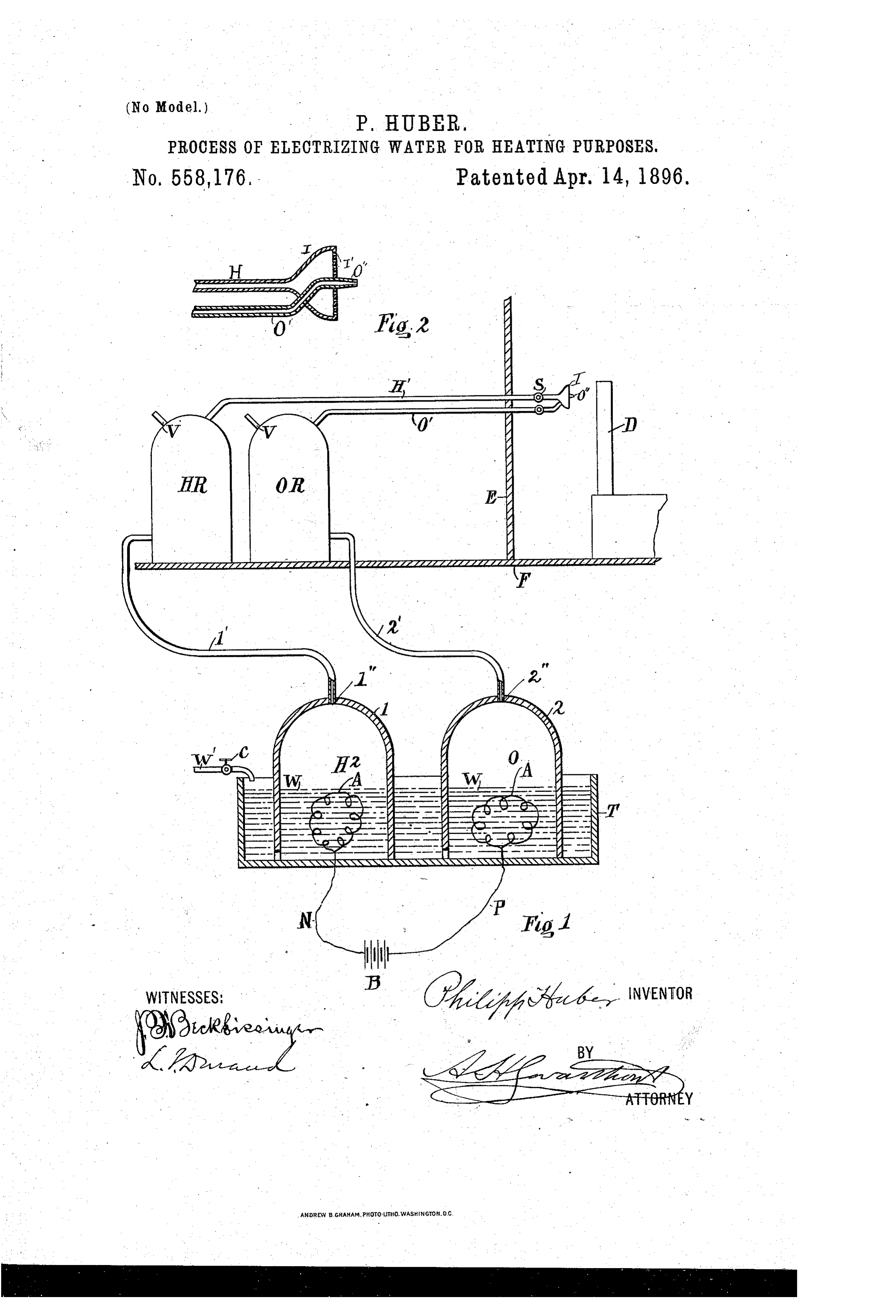
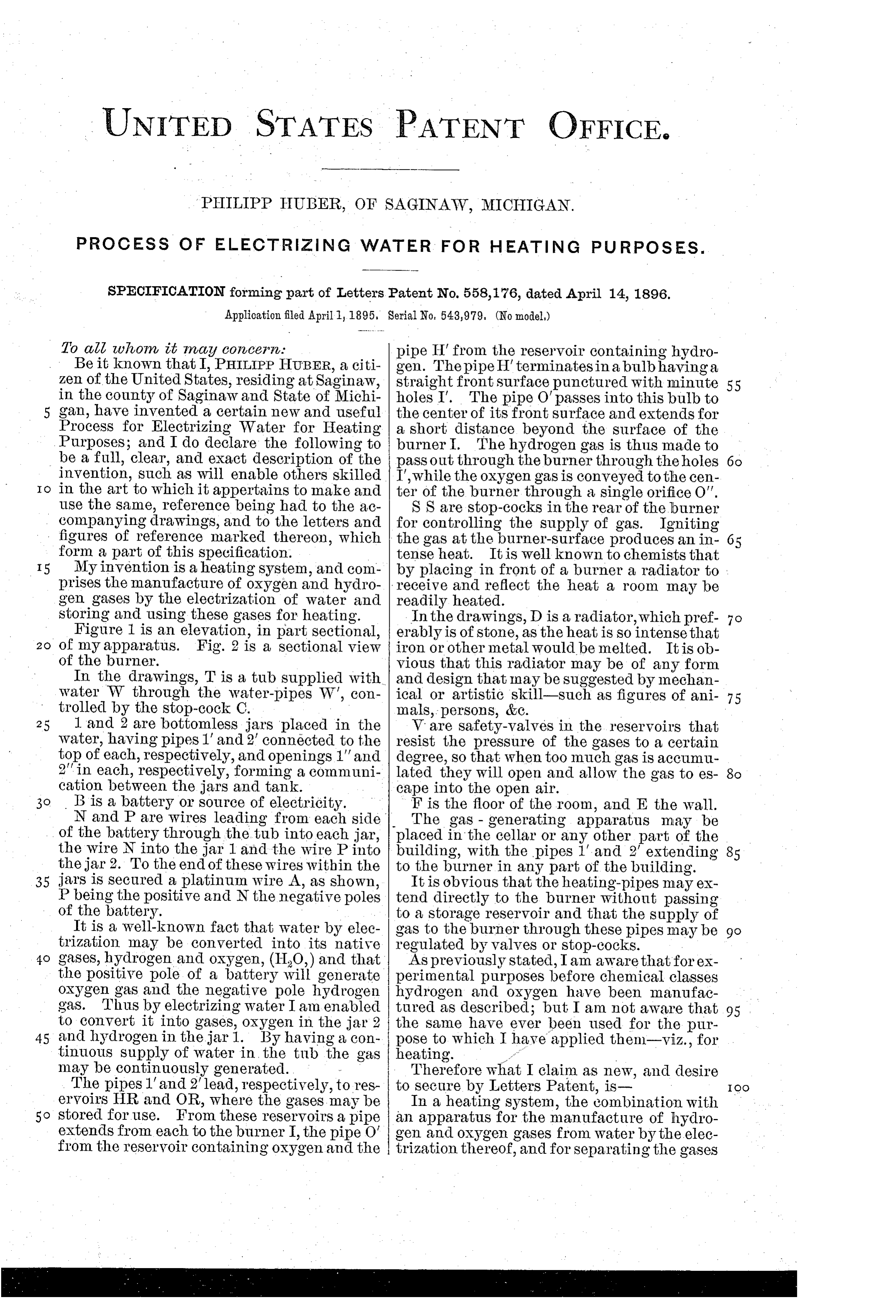
To all whom it may concern. pipe H' from the reservoir containing hydro Beit known that I, PHILIPP HUBER, a citi gen. The pipe H terminatesina bulbhaving a Zen of the United States, residing at Saginaw, straight front surface punctured with minute in the county of Saginaw and State of Michi holes I. The pipe O'passes into this bulb to 55 gan, have invented a certain new and useful the center of its front surface and extends for Process for Electrizing Water for Heating a short distance beyond the surface of the Purposes; and I do declare the following to burner I. The hydrogen gas is thus made to be a full, clear, and exact description of the pass out through the burner through the holes invention, such as Will enable others skilled I', while the oxygen gas is conveyed to the cen IO in the art to which it appertains to make and ter of the burner through a single orifice O'.
use the same, reference being had to the ac SS are stop-cocks in the rear of the burner companying drawings, and to the letters and for controlling the supply of gas. Igniting figures of reference marked thereon, which the gas at the burner-surface produces an in form a part of this specification. tense heat. It is well known to chemists that Myinvention is a heating system, and com by placing in front of a burner a radiator to prises the manufacture of oxygen and hydro receive and reflect the heat a room may be gen gases by the electrization of water and readily heated.
storing and using these gases for heating. In the drawings, D is a radiator, which pref Figure 1 is an elevation, in part sectional, erably is of stone, as the heat is so intense that of my apparatus. Fig. 2 is a sectional view iron or other metal would be meted. It is ob of the burner. vious that this radiator may be of any form In the drawings, T is a tub supplied with and design that may be suggested by mechan water W through the water-pipes W’, con ical or artistic skill-such as figures of ani 75 trolled by the stop-cock C. mals, persons, &c.
25 1 and 2 are bottomless jars placed in the Ware safety-valves in the reservoirs that water, having pipes 1' and 2' connected to the resist the pressure of the gases to a certain top of each, respectively, and openings 1' and degree, so that when too much gas is accumu 2' in each, respectively, forming a communi lated they will open and allow the gas to es cation between the jars and tank. cape into the open air.
B is a battery or source of electricity. F is the floor of the room, and E the wall. N and P are wires leading from each side The gas - generating apparatus may be of the battery through the tub into each jar, placed in the cellar or any other part of the the wire N into the jar 1 and the wire Pinto building, with the pipes 1" and 2' extending the jar 2. To the end of these wires within the to the burner in any part of the building. 35 jars is secured a platinum Wire A, as shown, It is obvious that the heating-pipes may ex P being the positive and N the negative poles tend directly to the burner without passing of the battery. to a storage reservoir and that the supply of It is a well-known fact that water by elec gas to the burner through these pipes may be 9o trization may be converted into its native regulated by valves or stop-cocks. gases, hydrogen and oxygen, (HO,) and that Aspreviously stated, I am aware that for ex the positive pole of a battery will generate perimental purposes before chemical classes Oxygen gas and the negative pole hydrogen hydrogen and oxygen have been manufac gas. Thus by electrizing water I am enabled tured as described; but I am not aware that 95 to convert it into gases, oxygen in the jar 2 the same have ever been used for the pur 45 and hydrogen in the jar 1. By having a con pose to which I have applied them-viz., for tinuous supply of water in the tub the gas heating. -- may be continuously generated. Therefore what I claim as new, and desire The pipes 1" and 2'lead, respectively, to res to secure by Letters Patent, is Ioo ervoirs HR and OR, where the gases may be In a heating system, the combination with stored for use. From these reservoirs a pipe an apparatus for the manufacture of hydro extends from each to the burner I, the pipe O' gen and oxygen gases from Water by the elec from the reservoir containing oxygen and the trization thereof, and for separating the gases
Page 3
and storing them, of tubes conveying the gases front of the burner for receiving and radiat in separate pipes to a burner, the tube con ing the heat, and means as described for veying the oxygen gas passing through the regulating the supply of gas to the burner, face of the burner at the middle thereof and substantially as and for the purpose set forth. 5 terminating just in front of the burner, and In testimony whereof I affix my signature I5 the tube conveying the hydrogen gas having in presence of two witnesses. the burner formed upon the end thereof, the PHILIPP IUBER. burner being circular in form and provided Witnesses:
With small holes on its front face through A. H. SWARTHOUT,
Io which the hydrogen passes, and means in J. F. O'KEEFE.
Provenance
- Collection
- Cited prior art
- Original PDF
- patentimages.storage.googleapis.com →
- Pages
- 3
- Method
- pdftotext (the PDF's own text layer) + pdftoppm 300dpi page scans
- Source
- Google Patents bibliographic record
- Granted
- 1896-04-14
- Transcribed from
- patentimages.storage.googleapis.com →