patent · US5304289
Method and apparatus for treating water
19 April 1994
Page 1 — bibliographic record
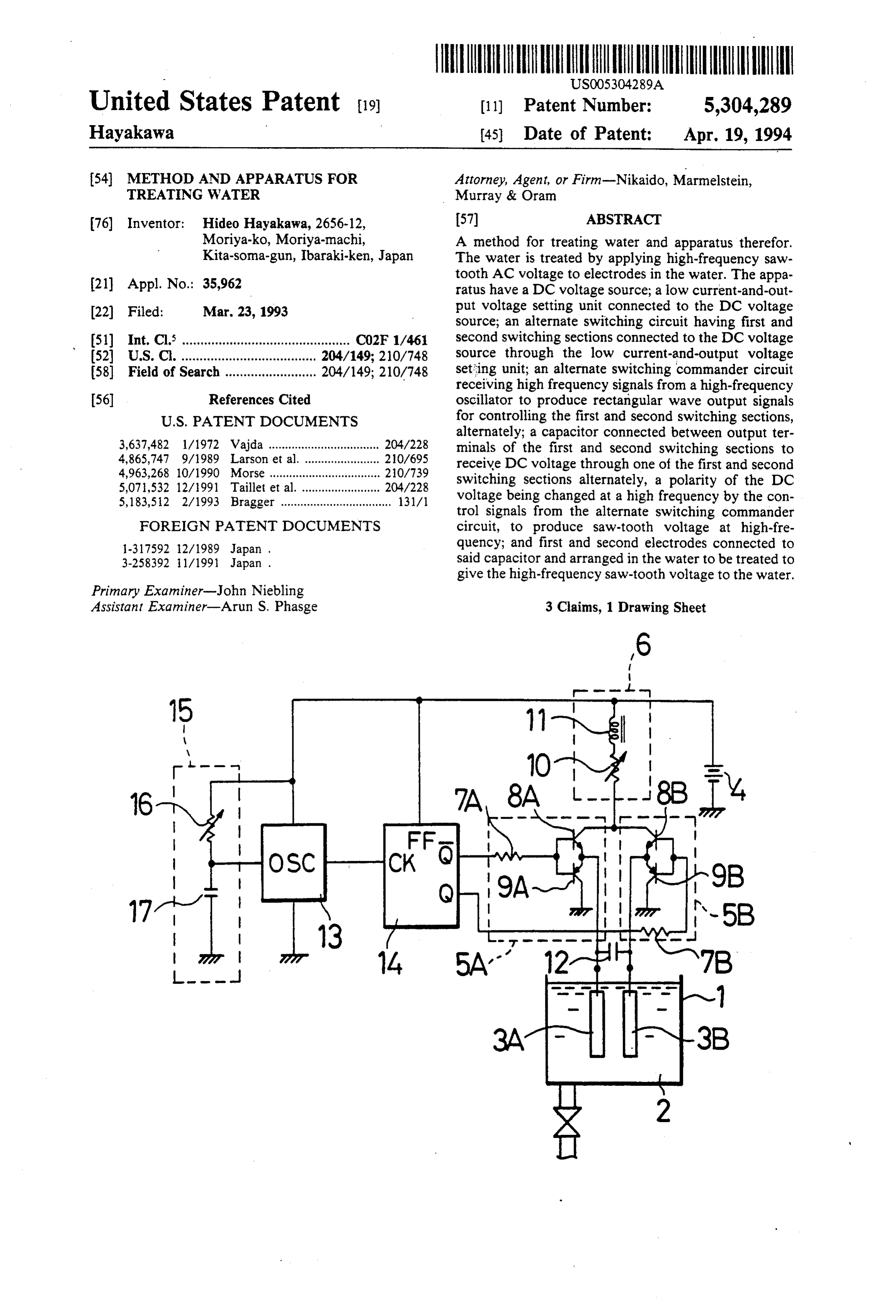
United States Patent (19) 11) Patent Number: 5,304,289 Hayakawa (45) Date of Patent: Apr. 19, 1994 54 METHOD AND APPARATUS FOR Attorney, Agent, or Firm-Nikaido, Marmelstein, TREATING WATER Murray & Oram (76) Inventor: Hideo Hayakawa, 2656-12, 57) ABSTRACT Moriya-ko, Moriya-machi, A method for treating water and apparatus therefor. Kita-soma-gun, Ibaraki-ken, Japan The water is treated by applying high-frequency saw (21) Appl. No.: 35,962 tooth AC voltage to electrodes in the water. The appa ratus have a DC voltage source; a low current-and-out (22) Filed: Mar. 23, 1993 put voltage setting unit connected to the DC voltage source; an alternate switching circuit having first and 51) Int. Cl. .............................................. CO2F 1/461 second switching sections connected to the DC voltage (52) ... 204/149; 210/748 source through the low current-and-output voltage 58) Field of Search ......................... 204/149; 210/748 seting unit; an alternate switching commander circuit receiving high frequency signals from a high-frequency (56) References Cited oscillator to produce rectangular wave output signals
alternately; a capacitor connected between output ter 3,637,482 1/1972 Vajda .................................. 204/228 minals of the first and second switching sections to 4,865,747 9/1989 Larson et al. ... 210/695 receive DC voltage through one of the first and second 4,963,268 10/1990 Morse .......... ... 20/739 switching sections alternately, a polarity of the DC 5,071,532 12/1991 Taillet et al..... ... 204/228 voltage being changed at a high frequency by the con 5, 183,512 2/1993 Bragger .................................. 131/1 trol signals from the alternate switching commander
FOREIGN PATENT DOCUMENTS circuit, to produce saw-tooth voltage at high-fre -317592 2/1989 Japan . quency; and first and second electrodes connected to 3-258392 l/1991 Japan . said capacitor and arranged in the water to be treated to give the high-frequency saw-tooth voltage to the water.
Primary Examiner-John Niebling
Assistant Examiner-Arun S. Phasge 3 Claims, 1 Drawing Sheet
Page 2
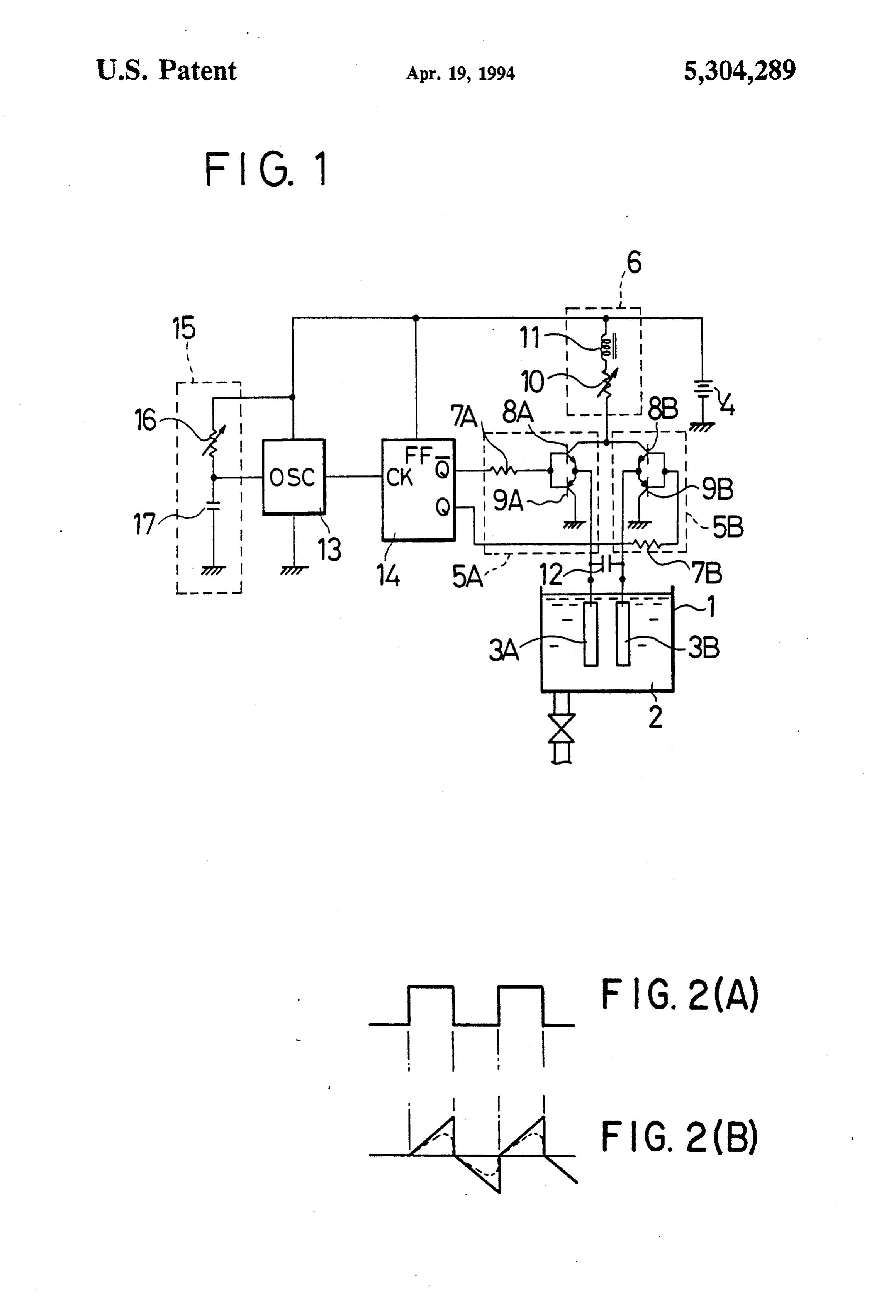
Drawing sheet — no readable text.
Page 3
appropriate from the angles of safety, cost and other
METHOD AND APPARATUS FOR TREATING factors.
WATER The frequency and voltage can be selected within individual ranges to meet requirements for different
BACKGROUND OF THE INVENTION 5 applications of water to be treated, as for instance fol 1. Field of the Invention lows: the water treating apparatus works under condi tions
The present invention relates to a method and appara Vpp voltage in the 27-33 KHz frequency range and in the 1-17 tus for treating water to change washing or cleaning sion and increase range to remarkably decrease surface ten capability and surface activity of water by giving elec 10 suitable to use forsolubilizing ability of water, which is washing purposes.
tric energy thereto. Another object of the invention is to provide an appa 2. Related Arts ratus for carrying out the method as referred to. A conventional method or apparatus for changing the According to the invention, this object can be at quality of water uses first and second electrodes soaked tained by an apparatus for treating water, which com in water, and the water is given energy by applying DC 15 prises a DC voltage source; a low current-and-output voltage between these electrodes. Such a method or voltage setting unit connected to said DC voltage apparatus is shown, for instance in Japanese Patents source; an alternate switching circuit having first and (Hei). 1-317592(A) and (Hei) 3-258392(A). second switching sections connected to said DC volt The former discloses a method of obtaining acidic age source via said low current-and-output voltage water from an anode chamber separated by a membrane 20 setting unit; a high-frequency oscillator connected to from a cathode chamber in an electrolytic cell, to kill said DC voltage source, said oscillator being equipped Escherichia coli and other bacteria. The latter discloses a with frequency setting means; an alternate switching method of sterilizing water, which comprising steps of commander circuit responsive to high-frequency signals introducing water to be treated into cathode and anode from said high-frequency oscillator for supplying a chambers in an electrolytic cell, and adding a predeter 25 series of rectangular wave signals to the first and second mined amount of a hypochlorite salt in the anode cham switching sections in said alternate switching circuit ber until pH of the hypochlorite salt containing solution alternately; a capacitor connected between output ter in the chamber becomes 3 to 7, to attain a relatively minals of said first and second switching sections for high sterilization effect with a relatively low chlorine 30 receiving the DC voltage from said DC voltage source, remaining concentration. but alternately reversed in polarity by the control sig In conventional water treating methods, one of the cuit nals fed from said alternate switching commander cir electrodes is used as one with positive polarity, whereas ducetosaw-tooth said first and second switching sections, to pro voltage at high-frequency; and first and the other with negative polarity, and therefore, the second electrodes electrodes are liable to be covered with deposited sub 35 arranged in waterconnected to be to said capacitor and to be treated to give the high-fre stance caused by the electrolysis after a while, thereby quency sawtooth AC voltage to the water. preventing transfer of electricity therebetween. For preventing the deposition on electrodes, there is a way selected in the 1 to 500 KHz frequency rangewave The frequency and voltage of saw-tooth are to periodically change the polarity of DC voltage to be 0.3 to 100 Vpp voltage range to be most appropriate the and for applied for the electrodes. the purpose, and application of such a saw-tooth wave With recourse to the periodic change of polarity in to the first and second electrodes will cause rise of the DC voltage, however, a single water treating apparatus oxidation-reduction cannot be adjusted to meet requirements for different "ORP”), decrease ofpotential (hereinafter referred to as water treatments. Also, the periodic change of polarity ter, and decrease of the amount oftension the surface of treated wa dissolved oxygen in in DC voltage necessitates an extra polarity reversing 45 treated water, while preventing undesirable electrolysis circuit for a constant voltage source and a low current of the water.
circuit, and accordingly increasing cost of the appara There is no means to determine what phenomena take tuS. place in water by applying such a high-frequency AC SUMMARY OF THE INVENTION voltage thereto, and therefore, nobody can say whether 50 or how the molecular structure of the water is changed,
In view of the above, one object of the present inven but as a matter of fact, the changing of water quality can tion is to provide a method for treating water with a be proved in terms of the change in value of ORP, reasonable cost, which shows an increased efficiency, surface tension and other physical characteristics of the and is capable of meeting requirements different due to treated water, and can be discerned by detergency test a kind of water to be treated. 55 and other experiments. As for the taste of the treated To attain this object, a water treating method accord water, the result of the taste test is liable to vary with ing to the invention comprises a step of applying a high individuals, and therefore, with a view for avoiding frequency sawtooth AC voltage to water to be treated vagueness in data, such test results are shown nowhere through first and second electrodes put in the water. except for appropriate cases. It is preferable to set the voltage and frequency in a In the water treating apparatus according to the in range of 0.3-100 Vpp and 1-500 KHz, respectively. AC vention, application of high-frequency signals from the voltage in the audio-range is liable to give electrical high frequency oscillator to the alternate switching shock to human living, and therefore the value of 1 commander circuit causes appearance of rectangular KHz is selected as the lower limit of the frequency switching command signals at the output terminal of the range because of no fear for electrical shock. 500 KHz 65 alternate switching commander circuit, which rectan is selected as the upper limit of the frequency range, gular switching command signals are directed to the because the water treating effect will descend suddenly first and second switching sections alternately. As a over such a value. The voltage range is determined as result the DC voltage from the DC voltage source is
Page 4
reversed alternately in polarity to be applied across the 14, which directs rectangular output signals (FIG. 2A) saw-tooth wave generating capacitor, thus causing ap to the first and second switching sections 5A and 5B pearance of a saw-tooth AC voltage at a high-frequency alternately.
to be applied for the first and second electrodes soaked As a result, the first and second switching sections in water. 5 SA and 5B turn “ON” alternately, thereby reversing the The water treating apparatus can provide water of DC voltage from the DC voltage source 4 in polarity to increased surface activity and detergency ability at a be applied across the capacitor 12, thus providing a reduced cost, and can provide such treated water that saw-tooth AC voltage wave at a high frequency (see a can meet requirements for different and various applica solid line in FIG. 2B), which saw-tooth voltage wave is tions. 10 directed to the first and second electrodes 3A and 3B. Other objects and advantages of the present invention In case of absence of the delay coil 11 in the low will be understood from the following description of a current-and-output voltage setting unit 6, a saw-tooth sole preferred embodiment which is shown in accompa wave form as shown in a broken line in FIG. 2B will nying drawings.
15 appear. The presence of the delay coil 11 in the low
BRIEF DESCRIPTION OF THE DRAWINGS current-and-output voltage setting unit 6 will cause a FIG. 1 is a wiring diagram of a water treating appara sharp saw-toothresults.
wave form to appear, and accordingly tus according to a preferred embodiment of the inven a high-voltage
Application of high-frequency saw-tooth voltage to tion;
FIG. 2A shows a rectangular wave form appearing at 20 the first and second electrodes 3A and 3B will effec output terminals of an alternate switching commander tively change quality of the water, without accompany circuit; and ing undesired electrolysis of the water 2, and will re FIG. 2B shows a high-frequency saw-tooth voltage duce electric current flowing in water. This may be wave form, showing how it works. attributable to appearance of electric dipoles, and is 25 increasingly conspicuous with the increase of fre
DETAILED DESCRIPTION OF THE quency. More or less electric current will flow in pres
PREFERRED EMBODIMENT
ence of polar molecules (metallic substances).
A water treating apparatus shown in FIG. 1 is de When an alternating current shall be supplied to wa signed to carry out a water treating method according ter, in general, there is existence following relation. to the present invention, and first and second electrodes 30 3A and 3B are put in water 2 to be treated, the water 2 is IXsin cut, being contained in a water tank 1 or flowing in a water channel 1. A dc voltage source 4 supplies 3 to 50 volts. wherein “i' is effective value; "I' is maximum value or An alternate switching circuit having first and second amplitude (fixed value); "co" is angular velocity or an switching sections 5A and 5B is used along with an 35 gular frequency and shown by 2n f; “f” is frequency; associated capacitor 12 for applying a high-frequency and “t' is period of time.
saw-tooth voltage to the first and second electrodes 3A The relation shows that the effective current value and 3B in a low electric current. As shown, the first increases as the frequency increases. The inventor has switching section 5A is made up by a resistor 7A and found, however, that the relation is applied only for the transistors 8A and 9A whereas the second switching case that the frequency is below than 10 KHZ and on the section 5B is made up by a resistor 7B and transistors 8B contrary thereto, the value suddenly decreases when and 9B. The alternate switching circuit is connected to the frequency exceeds 10 KHz, and accordingly causing the first and second electrodes 3A and 3B and to the dc no undesirable electrolysis of the water. voltage source 4 via a low current-and-output voltage setting unit 6, which is made up by a series connection 45 EXPERIMENTS of an output voltage setting resistor 10 and a delay coil A stainless steel water tank (inner volume of 15 liters) 11, said series connection being connected between the was used. Two stainless steel plates (13X20 cm) as voltage source 4 and the first and second switching electrodes were oppositely arranged in the water tank sections 5A and 5B. with a distance of 20 cm. Water to be treated was The capacitor 12 is used for providing a saw-tooth 50 poured voltage wave, and is connected between output termi (about 12intoliters). the water tank by 80% height thereof nals of the first and second switching sections 5A and setting a frequencyNumerous tests were carried out by and voltage in various values, but
A high-frequency oscillator 13 is equipped with fre following which 5 Examples (Groups) are shown, each of groups shows similar results, when the frequency quency setting means 15, which is made up by a series 55 and voltage were set in the ranges described therein. connection of a frequency-setting variable resistor 16 and a frequency-setting variable capacitor 17. The high EXAMPLE 1. frequency oscillator 13 is fed with electricity from the
DC voltage source 4 to provide a high-frequency sig (1) Conditions:
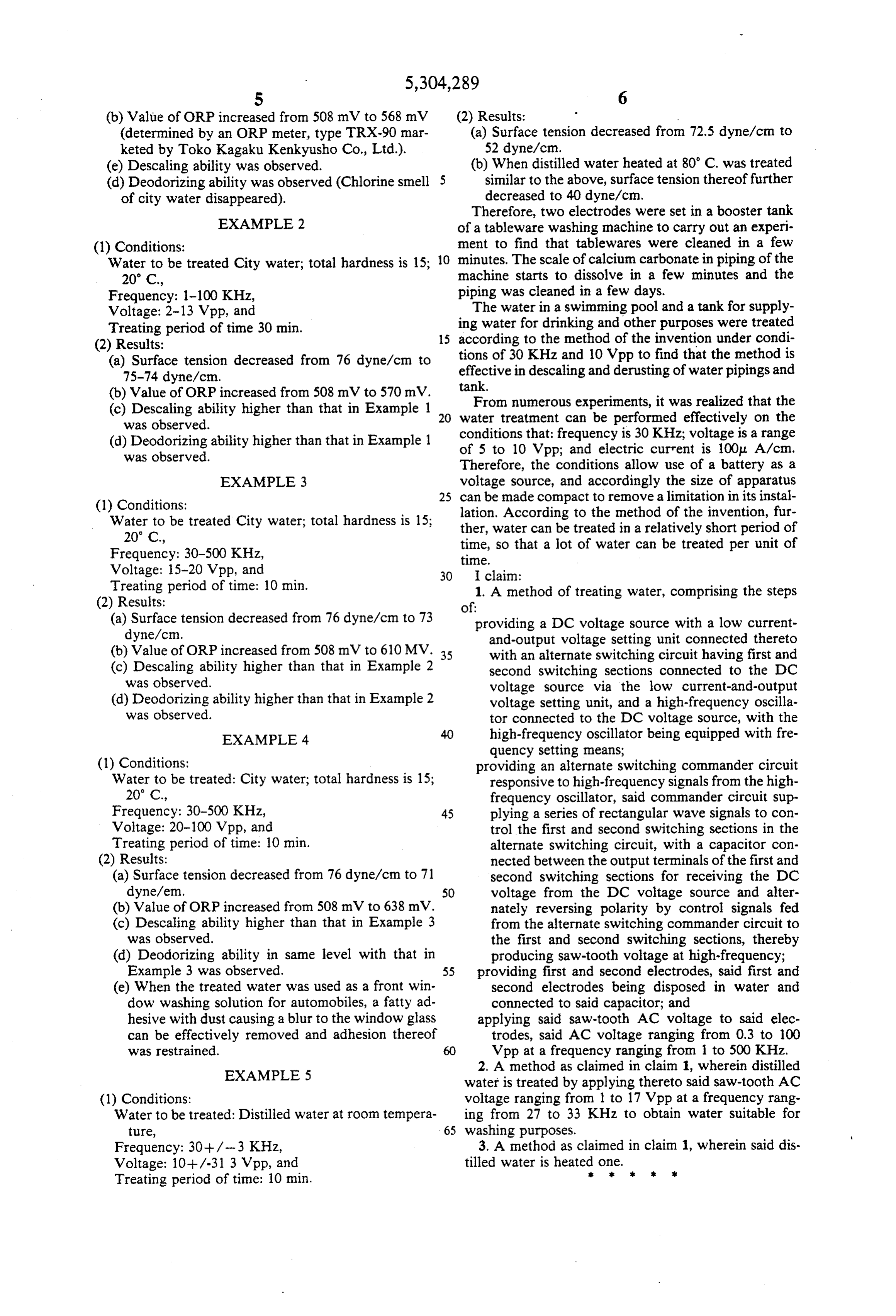
nal, and an alternate switching commander circuit 14 is Water to be treated: City water; total hardness is 15; a flip-flop circuit responsive to signals from the high 20 C., frequency oscillator 13 for supplying a series of rectan Frequency: 1-100 KHz, gular wave signals to the first and 'second switching Voltage: 0.3-2 Vpp, and sections 5A and 5B alternately. Treating period of time: 30 min. The operation of the water treating apparatus is de 65 (2) Results:
scribed below. High-frequency signals ranging from 1 (a) Surface tension (determined by using a 13d plati to 500 KHz are supplied from the high-frequency oscil num ring) decreased from 76 dyne/cm to 75-74 lator 13 to the alternate switching commander circuit dyne/cm.
Page 5
(b) Value of ORP increased from 508 mV to 568 mV (2) Results:
(determined by an ORP meter, type TRX-90 mar (a) Surface tension decreased from 72.5 dyne/cm to keted by Toko Kagaku Kenkyusho Co., Ltd.). 52 dyne/cm.
(e) Descaling ability was observed. (b) When distilled water heated at 80° C. was treated (d) Deodorizing ability was observed (Chlorine smell 5 similar to the above, surface tension thereof further of city water disappeared). decreased to 40 dyne/cm.
Therefore, two electrodes were set in a booster tank
EXAMPLE 2 of a tableware washing machine to carry out an experi (1) Conditions: ment to find that tablewares were cleaned in a few Water to be treated City water; total hardness is 15; 10 minutes. The scale of calcium carbonate in piping of the 20° C., machine starts to dissolve in a few minutes and the Frequency: 1-100 KHz, piping was cleaned in a few days. Voltage: 2-13 Vpp, and The water in a swimming pool and a tank for supply Treating period of time 30 min. ing water for drinking and other purposes were treated 15 according to the method of the invention under condi (2) Results:
(a) Surface tension decreased from 76 dyne/cm to tions of 30 KHz and 10 Vpp to find that the method is effective in descaling and derusting of water pipings and
(b) Value of ORP increased from 508 mV to 570 mV. tank. From numerous experiments, it was realized that the (c) Descaling ability higher than that in Example 1 20 water treatment can be performed effectively on the was observed.
(d) Deodorizing ability higher than that in Example 1 of 5 to 10that:
conditions frequency is 30 KHz; voltage is a range
Vpp; and electric current is 100u A/cm.
was observed.
Therefore, the conditions allow use of a battery as a
EXAMPLE 3 voltage source, and accordingly the size of apparatus (1) Conditions: 25 can be made compact to remove a limitation in its instal lation. According to the method of the invention, fur
Water to be treated City water; total hardness is 15; ther, water can be treated in a relatively short period of 20 C., time, so that a lot of water can be treated per unit of Frequency: 30-500 KHz, time.
Voltage: 15-20 Vpp, and 30 I claim:
Treating period of time: 10 min. 1. A method of treating water, comprising the steps (2) Results: of:
(a) Surface tension decreased from 76 dyne/cm to 73 providing a DC voltage source with a low current dyne/cm. and-output voltage setting unit connected thereto (b) Value of ORP increased from 508 mV to 610 MV. 35 with an alternate switching circuit having first and (c) Descaling ability higher than that in Example 2 second switching sections connected to the DC was observed. voltage source via the low current-and-output (d) Deodorizing ability higher than that in Example 2 voltage setting unit, and a high-frequency oscilla was observed. tor connected to the DC voltage source, with the EXAMPLE 4 40 high-frequency oscillator being equipped with fre quency setting means;
(1) Conditions: providing an alternate switching commander circuit Water to be treated: City water; total hardness is 15; responsive to high-frequency signals from the high 20° C., frequency oscillator, said commander circuit sup Frequency: 30-500 KHz, 45 plying a series of rectangular wave signals to con Voltage: 20-100 Vpp, and trol the first and second switching sections in the Treating period of time: 10 min. alternate switching circuit, with a capacitor con (2) Results: nected between the output terminals of the first and (a) Surface tension decreased from 76 dyne/cm to 71 second switching sections for receiving the DC dyne/em. 50 voltage from the DC voltage source and alter (b) Value of ORP increased from 508 mV to 638 mV. nately reversing polarity by control signals fed (c) Descaling ability higher than that in Example 3 from the alternate switching commander circuit to was observed. the first and second switching sections, thereby (d) Deodorizing ability in same level with that in producing saw-tooth voltage at high-frequency; Example 3 was observed. 55 providing first and second electrodes, said first and (e) When the treated water was used as a front win second electrodes being disposed in water and dow washing solution for automobiles, a fatty ad connected to said capacitor; and hesive with dust causing a blur to the window glass applying said saw-tooth AC voltage to said elec can be effectively removed and adhesion thereof trodes, said AC voltage ranging from 0.3 to 100 was restrained. 60 Vpp at a frequency ranging from 1 to 500 KHz.
EXAMPLE 5
2. A method as claimed in claim 1, wherein distilled water is treated by applying thereto said saw-tooth AC (1) Conditions: voltage ranging from 1 to 17 Vpp at a frequency rang Water to be treated: Distilled water at room tempera ing from 27 to 33 KHz to obtain water suitable for ture, 65 washing purposes.
Frequency: 30--/-3 KHz, 3. A method as claimed in claim 1, wherein said dis Voltage: 10+/-31 3 Vpp, and tilled water is heated one.
Treating period of time: 10 min.
Provenance
- Collection
- Cited prior art
- Original PDF
- patentimages.storage.googleapis.com →
- Filed
- 1993-03-23
- Pages
- 5
- Method
- pdftotext (the PDF's own text layer) + pdftoppm 300dpi page scans
- Source
- Google Patents bibliographic record
- Granted
- 1994-04-19
- Inventors
- Hideo Hayakawa
- Transcribed from
- patentimages.storage.googleapis.com →