patent · US5294329
Process to prevent catalyst deactivation in activated slurry hydroprocessing
15 March 1994
Page 1 — bibliographic record
United States Patent (19) 11) Patent Number: 5,294,329 Kramer (45) Date of Patent: Mar. 15, 1994 54) PROCESS TO PREVENT CATALYST Assistant Examiner-Walter D. Griffin DEACTIVATION N ACTIVATED SILURRY Attorney, Agent, or Firm-W. K. Turner; A. W. HYDROPROCESSING Klaassen 75 Inventor: David C. Kramer, San Anselmo, (57) ABSTRACT Calif. An improved catalytic slurry hydroprocess comprising 73 Assignee: Chevron Research and Technology a hydrogenation zone having a hydrogen partial pres Company, San Francisco, Calif. sure of at least about 100 psia characterized by active catalyst recycle accompanied by minimal catalyst deac 21 Appl. No.: 892,465 tivation from coking or asphaltene agglomeration in 22 Filed: Jun. 2, 1992 which the improvement comprises the steps of: (1) separating at least a portion of active catalyst from (51) int. C. .............................................. COG 47/26 the liquid hydrogenation product eluted from the 52) U.S. C. ................ 208/108; 208/143 hydrogenation zone of said hydroprocess, and 58 Field of Search ................................ 208/108, 143 (2) recycling at least a portion of said separated active 56 References Cited catalyst to said hydrogenation Zone;
said active catalyst under conditions substantially the 4,557,821 12/1985 Lopez et al. .... ... 208/108 same as those encountered in said hydrogenation Zone. 4,719,002 1/1988 Mayer et al..... ... 208/08
Primary Examiner-R. Bruce Breneman 16 Claims, 1 Drawing Sheet
HO Aqueous
Precursor
Reactor Hydrogenation 4
Precursor
Solvent
Cat. 25 39 Reproc. 42 Feed O 32
Page 2
Drawing sheet — no readable text.
Page 3
from which the individual metals are recovered by
PROCESS TO PREVENT CATALYST selective precipitation. The recovered molybdenum is DEACTIVATON IN ACTIVATED SLURRY then processed to make fresh catalyst. A minor portion HYDROPROCESSING of recovered catalyst can be recycled to the hydrogena tion preheater along with unconverted feed oil. For
BACKGROUND OF THE INVENTION example U.S. Pat. No. 4,557,821 issued Dec. 10, 1985 Field of the Invention and its related patents U.S. Pat. No. 4,710,486 issued The present invention relates to a process improve Dec. 1, 1987 and U.S. Pat. No. 4,762,812, issued on Aug. ment which can be used to prevent deactivation of 10 the 9, 1988 all to Lopez et al. and assigned to the assignee of slurry hydroprocessing catalysts. More particularly, the stepspresent invention describe a process which includes present invention provides an improvement in slurry essingfor recovering slurry catalyst from a hydroproc operation. A variety of separation methods are hydroprocessing operations, which improvement com prises separating and recycling active catalyst while suggested each involving the formation of a catalyst maintaining the catalyst under conditions which have 15 concentrate. For instance, catalyst can be concentrated been found to prevent deactivation caused by coking or in the vacuum bottoms of the product stream via distill asphaltene agglomeration. lation. All, or nearly all, of the catalyst is then recov ered by solvent extraction and reprocessed to make
SLURRY HYDROPROCESSING fresh catalyst. Optionally, a minor portion of the recov Slurry hydroprocessing operations employing a cir ered catalyst is recycled with unconverted feed oil to culating slurry catalyst are known to those familiar with 20 the hydrogenation preheater without further process petroleum processing. In a typical slurry hydroprocess ing. Unfortunately it has been found that catalysts recy ing operation the slurry catalyst consisting of very small cled from the bottoms of the hydrogenation product particles made up of extremely small crystallites exists stream possessed essentially no activity. as a substantially homogeneous dispersion in an oil or 25 Since such catalyst separation, recovery, and recycle water/oil mixture. A typical slurry catalyst comprises steps are expensive and result in deactivated catalyst, it Group VIB metal disulfide which is probably struc has been the focus of recent slurry hydroprocessing tured molecularly as basal platelets of Group VIB metal research to maximize the residence time of catalyst in atoms separated by two layers of sulfur atons with the hydrogenation zone. This allows one to enhance activity sites concentrated at the edge of each basal 30 product properties at a given fresh catalyst concentra plane of the Group VIB metal atoms. tion or to reduce the amount of fresh catalyst necessary Such catalysts may be formed by preparing an aque to achieve given product properties. However, at this ous slurry of, for example, molybdenum oxide which is time no reliable method has been reported for selec in turn reacted with aqueous ammonia and then with tively increasing the residence time of the slurry cata hydrogen sulfide in a low temperature, low pressure 35 lyst in the hydrogenation zone.
zone, to produce suspended insoluble ammonium oxy Accordingly, as an alternative approach, if active sulfide compounds in equilibrium with ammonium mo catalyst could be separated and recycled, capital and lybdenum heptamolybdate in solution. The aqueous operating expenses would be greatly reduced. It is the equilibrium slurry leaving the zone constitutes a cata principal object of the present invention to provide a lyst precursor. process for recycling active catalyst in a slurry hydro The catalyst precursor is converted into the final processing operation. This object, and other objects, are catalyst by reaction with hydrogen sulfide and hydro accomplished by the improved process which is sun gen in the presence of the feed oil but in advance of the marized below.
final hydrogenation zone. Typically the aqueous pre cursor catalyst is mixed with all or a portion of the feed 45 SUMMARY OF THE INVENTION oil stream using the dispersal power of a hydrogen In accordance with the present invention, a process hydrogen sulfide recycle stream (and make-up stream, if for recycling active catalyst in a slurry hydroprocessing any) and the admixture is passed through a plurality of operation is provided. The essence of the present inven heating zones prior to the hydrogenation zone. tion resides in the discovery that catalyst deactivation The small particle size of typical slurry catalysts con occurs when the catalyst is removed from a reducing tributes to the high catalytic activity of slurry catalysts. 50
Typically the catalysts will be sufficiently small to be atmosphere as the operating pressure of the process is let down to facilitate catalyst separation. In fact, coking readily dispersed in a heavy oil, allowing the oil to be or asphaltene agglomeration which occurs when cata easily pumped. In many slurry hydroprocessing opera lyst is separated from the hydrogenation products is a tions moderate to large amounts of vanadium and nickel 55 significant are removed from the feed oil and deposited upon or found that cause in of catalyst deactivation. It has been conventional slurry hydroprocessing op carried away by the catalyst particles. However, it has been found that these metals do not significantly impair erations, when catalyst is withdrawn from a high pres sure hydrogen atmosphere, coking and asphaltene ag the activity of the catalyst.
Although slurry catalyst hydroprocessing has the glomeration rapidly deactivate the catalyst. By separat advantage of relatively stable high catalytic activity, ing and recycling active catalyst while maintaining said the costs of fresh catalyst, catalyst separation, and cata active catalyst in a reducing atmosphere under condi lyst rejuvenation have a major impact on the economics tions of temperature and pressure established to main of such processes. In a typical catalyst separation step, tain catalyst activity at a preselected fraction of the the majority of recovered catalyst is roasted to convert activity of fresh catalyst, the process of the present carbon to carbon dioxide and to convert metal sulfides 65 invention overcomes this problem. This discovery has to metal oxides. The roasted catalyst containing molyb led to the present invention which provides an im denum and nickel as well as vanadium, iron, and nickel proved catalytic slurry hydroprocess comprising a hy removed from the oil is then dissolved in alkali solution drogenation zone having a hydrogen partial pressure of
Page 4
at least about 100 pounds per square inch absolute Conditions of temperature and pressure are critical to (“psia') in which the improvement comprises the steps achieve retained activity for separated and recycled of: catalyst. The separation temperature may be as high as (1) separating at least a portion of active catalyst from the hydroprocessing reactor outlet temperature, and the liquid hydrogenation product eluted from the may be as low as about 250 F. Pressures may range hydrogenation zone of said hydroprocess, and from hydroprocessing reactor pressure to as low as (2) recycling at least a portion of said separated active about 100 psia. The following formula describes how catalyst to said hydrogenation zone; the relative catalyst activity can be determined. The wherein said steps are carried out while maintaining 10 activity is defined as the nitrogen removal activity, said active catalyst in a reducing atmosphere under where:
conditions of temperature and pressure established to maintain catalyst activity at a preselected fraction of the nitrogen removal activity of fresh catalyst. activity = 100X(Nitfeed-Nitprod)/Nitfeed. In a preferred embodiment active catalyst is recycled before it leaves the hydrogen loop of the hydroprocess 15 isNitfeed the is the nitrogen content of the liquid feed. Nitprod nitrogen content of the whole product (liquid--- ing operation. For example, active catalyst may be recy gas).
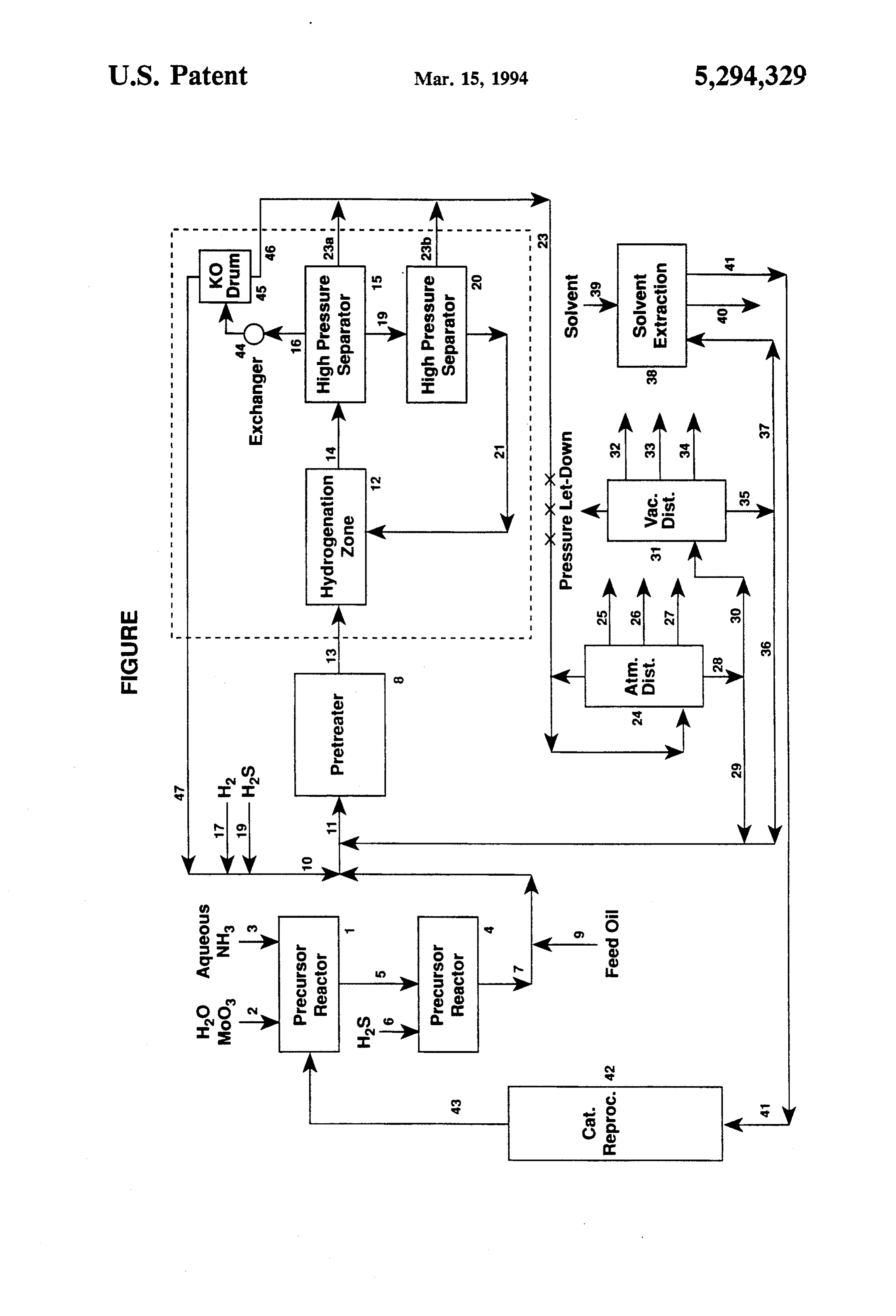
cled directly from a high pressure separator. In a partic A first test, at normal slurry hydroprocessing condi ularly preferred embodiment a high pressure separator also acts as a high pressure settler. Concentrating the 20 tions using fresh catalyst, can be used to determine the baseline activity. A second test can determine the activ active catalyst by settling reduces the amount of liquid ity of recycled product needed to recycle the catalyst. The preferred sure required tocatalyst. The minimum separation pres maintain catalyst activity at a given embodiment summarized above is illustrated in the ac separation temperature is that pressure which main companying FIGURE. tained the nitrogen removal activity of recycle catalyst BRIEF DESCRIPTION OF THE FIGURE 25 at the preselected fraction of initial activity, or above. The accompanying FIGURE illustrates a preferred theThe following estimates provide some guidance on ranges expected to be effective for most applica embodiment of the improved process claimed below. tions:
The FIGURE is a schematic representation of a slurry hydroprocessing operation in which catalyst is recycled 30 from the high pressure loop. Estimated Minimum Separation Separation Temperature, F. H. Pressure
DETAILED DESCRIPTION OF THE 850 F. 1000 psia INVENTION 700 F. 500 psia The full scope of the improved process of the present 35 350 F. 100 psia invention will be apparent to those familiar with slurry hydroprocessing from the following detailed descrip In the first step of the improved process of the present tion of the principal features of the improvement steps invention at least a portion of active catalyst is sepa and from the example which accompanies the descrip rated from hydrogenation product. As used herein the tOn. term "separate" refers to a process step in which the
PRINCIPAL FEATURES
hydrogenation zone effluent is processed to produce a liquid hydrogenation product and a separate recyclable
The present invention provides an improvement to concentrated active catalyst product. In a conventional slurry hydroprocessing operations. The principal fea slurry hydroprocess the product effluent from the hy tures of the improvement arise out of the discovery that 45 drogenation zone will comprise liquid hydrocarbon when recovering catalyst from slurry hydroprocessing product in intimate contact with catalyst wherein the operations, the catalyst undergoes rapid deactivation as weight ratio of catalyst as molybdenum metal to oil will coke and/or asphaltenes agglomerate on the catalytic generally range from about 0.0005 to about 0.25, more sites when catalyst is withdrawn from the hydrogena typically from about 0.001 to about 0.1. Although the tion zone as the operating pressure is reduced to facili SO catalyst can be separated by conventional means such as tate recovery. To overcome this problem, according to filtration, centrifugation, decantation, and the like, a the present invention, slurry hydroprocessing opera distinguishing feature of the present invention is that the tions can be improved by (1) separating and (2) recy separation is carried out while maintaining the catalyst cling active catalyst while maintaining said catalyst in a in a reducing atmosphere. In particular, the hydrogen reducing atmosphere under conditions of temperature 55 partial pressure of the hydrogenation zone and of the and pressure determined as a maximum pressure and a catalyst during separation and recycle typically will be minimum temperature retain a minimum preselected maintained in the range of from at least about 500 psia to catalyst activity. In other words the temperature and about 5000 psia, preferably in the range of from at least pressure of the separation and recycle steps can be es about 1000 psia to about 3000 psia, and even more pref tablished once a minimum acceptable catalyst activity is 60 erably in the range of from at least about 1500 psia to fixed. In general it is desirable to retain the activity of about 2500 psia. In any event the catalyst in the hydro the recycled catalyst at a minimum activity of at least genation zone and during recycling should be main about 25% of the activity of fresh catalyst, preferably at tained in a reducing atmosphere which is one composed a minimum of at least about 40% of the activity of fresh predominantly of hydrogen with a small amount, usu catalyst, an even more preferably at a minimum of at 65 ally less than about 20% and preferably less than about least about 50% of the activity of fresh catalyst. In 15%, of light hydrocarbons and inert gases such as many instances it is possible to retain an activity of nitrogen, with essentially no oxygen present. Those about 75% and higher of the activity of fresh catalyst. familiar with the art will recognize that there are nu
Page 5
merous ways of accomplishing separation in this fash tial pressure, which is in itself sufficient to establish a ion. Conventional high pressure separators, or pressur reducing atmosphere. Consequently, the requirement ized settling vessels can be used. For instance, one that the process steps of the present invention be carried method is to collect product vapors and recycle all out while maintaining the active catalyst under hydro liquids from a single product separator. This separation genation conditions does not necessitate introducing produces a catalyst-free product with minimal operat process variables in addition to those already present. ing difficulties and costs. Alternatively, one may wish Simply stated, the process of the present invention can to increase separator size (or use more than one separa be carried out under the process conditions substantially tor) to allow the catalyst enough time to partially settle the same as those which already exist in order to hydro out of the liquid phase. Then one would collect a vapor O genate the liquid feed.
phase product and a liquid phase product from near the top of the liquid layer in the separator, recycling only SURRY HYDROPROCESSING CONDITIONS from the bottom portion of the liquid layer. This The slurry hydroprocessing operations which can method would reduce oil recycle, but liquid product suitably be improved by the present invention are well would possibly contain some catalyst. In order to speed 15 known. For example, U.S. Pat. No. 4,557,821; U.S. Pat. the separation and increase product recovery, one may No. 4,710,486; and U.S. Pat. No. 4,762,812 (previously mechanically separate the catalyst from the liquid phase referenced) describe in detail typical slurry hydroproc effluent (all under reducing conditions). A hydrocy essing conditions. The full text of each of these patents clone or a centrifuge could be used for this separation. is therefore incorporated herein by reference. Other In most slurry hydroprocessing operations it is desir 20 able to separate substantially all of the catalyst from the suitable
slurry hydroprocesses are described in U.S. Pat.
liquid hydrocarbon product. Thus, the separation step is Pat. No. 4,592,827, issued Jun. 3, 1986 to Galiasso et al.; typically carried out under conditions which maximize U.S. Pat. No. 4,285,804, issued on Aug. 25, 1981 to separation to produce a recyclable active catalyst prod Jacquin et al.; U.S. Pat. No. 4,136,013, issued Jan. 23, uct having a maximum concentration which can be 25 1979 to Moll et al.; U.S. Pat. No. 4,134,825, issued Jan. pumped or conveyed to the feed. This is typically in the 16, 1979 to Bearden; and U.S. Pat. No. 3,622,499, issued range of from about 5 weight percent ("wt. %') to Nov. 23, 1971 to Stine et al. about 75 wt.%, preferably in the range of from about 10 In suitable slurry hydroprocessing operations, a wt.% to about 50 wt.%, and even more preferably in slurry catalyst of very fine metal sulfide particles is used the range of from about 15 wt.% to about 35 wt.%. 30 to convert heavy hydrocarbon oils, such as crude oils, The example accompanying this description of the in vention illustrates a preferred embodiment using high heavy heavy crude oils, residual oils, as well as refractory distillates such as FCC decanted oils and lubri pressure separators to effect such separation. cating oils, to lighter materials under conditions of high In the second step of the improved process of the pressure and temperature.
present invention at least a portion of the separated 35 contains molybdenum andTypically the slurry catalyst active catalyst is recycled to the hydrogenation zone. In slurry hydroprocessing operations are sulfides.
conventional slurry hydroprocessing, all, or nearly all, conditions of high temperature and high pressure.under carried out catalyst recovered from the liquid hydrogenation prod sures may range from about 500 psia to about 5000 Pres psia, uct is treated to separate a metal value which is in turn recycled to the catalyst preparation stages of the pro preferably from about 1000 psia to about 3000 psia, and cess. For instance, in U.S. Pat. No. 4,557,821 (previ even more preferably from about 1500 psia to about 2500 psia. In slurry hydroprocesses the relatively high ously referenced) catalyst and removed metals are re operating pressures and circulating nature of the slurry covered as a bottons product, partially oxidized to convert sulfides to oxides, and recycled to a catalyst catalyst are conducive to the use of elevated hydroge nation temperatures in excess of temperatures used in precursor reactor. This recycle step takes advantage of 45 typical fixed bed operations. For example, temperatures the finding that removed metals, such as vanadium, do may range from about 650 F. to about 1000' F., prefer not deactivate the molybdenum catalyst; in fact, it is reported that an effective circulating catalyst can con ably from about 700 F. to about 900 F. The final cata lyst in slurry with feed oil can be charged to the hydro stitute as much as 85 weight percent of the circulating processing contact zone without any additions to or "
However, catalyst recovered from a conventional removals from the stream. The general reactions condi tions of a slurry hydroprocessing operation are listed slurry hydroprocess is either reprocessed to produce below:
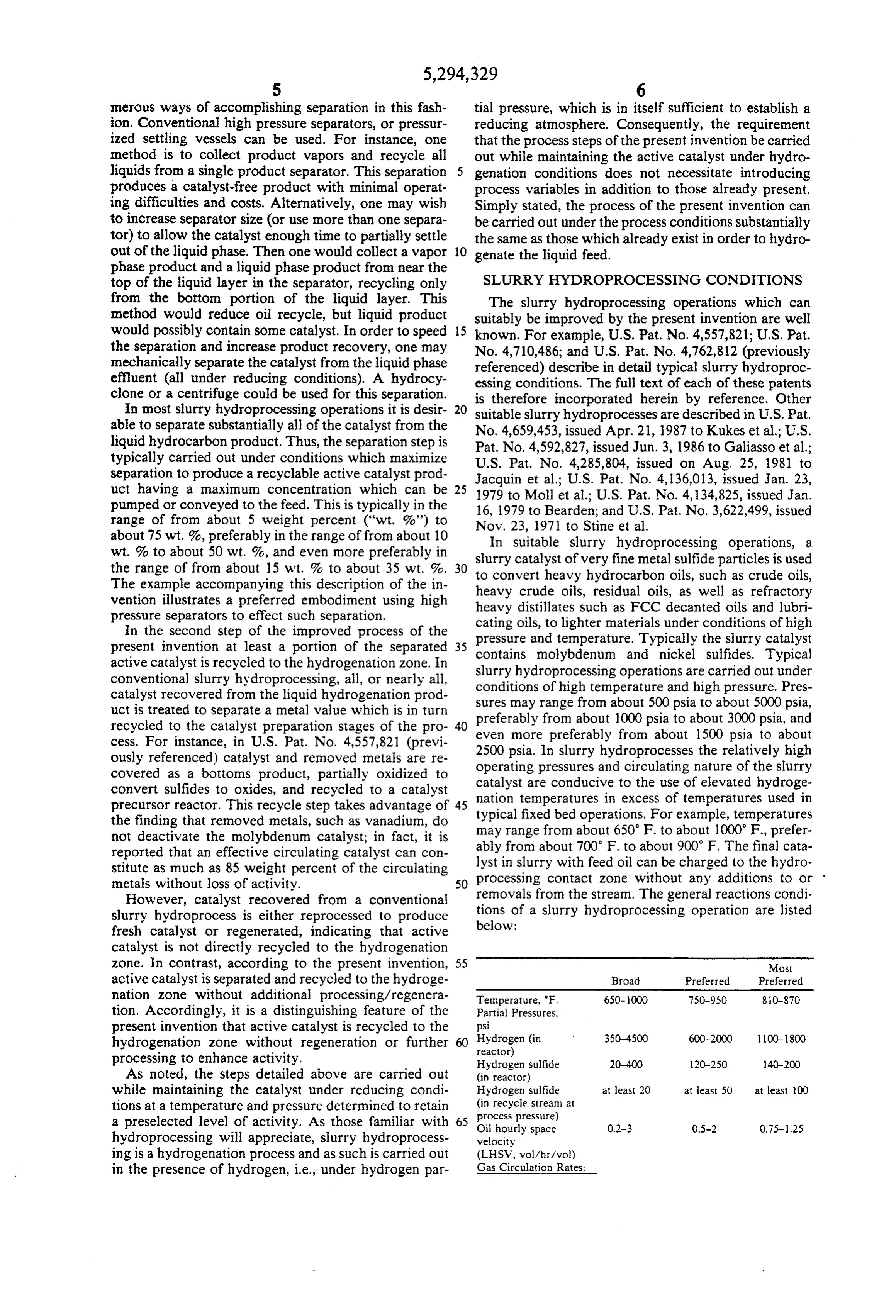
fresh catalyst or regenerated, indicating that active catalyst is not directly recycled to the hydrogenation zone. In contrast, according to the present invention, 55 Most active catalyst is separated and recycled to the hydroge Broad Preferred Preferred nation zone without additional processing/regenera Temperature, F. 650-000 750-950 80-870 tion. Accordingly, it is a distinguishing feature of the Partial Pressures, present invention that active catalyst is recycled to the psi hydrogenation zone without regeneration or further Hydrogen reactor)
processing to enhance activity. Hydrogen sulfide 20-400 120-250 140-200 As noted, the steps detailed above are carried out (in reactor) while maintaining the catalyst under reducing condi Hydrogen sulfide at east 20 at least 50 at least 00 tions at a temperature and pressure determined to retain (in recycle stream at process pressure) a preselected level of activity. As those familiar with Oil hourly space 0.2-3 0.5-2 0.5-1.25 hydroprocessing will appreciate, slurry hydroprocess velocity ing is a hydrogenation process and as such is carried out (LHSV, vol/hravo) in the presence of hydrogen, i.e., under hydrogen par Gas Circulation Rates:
Page 6
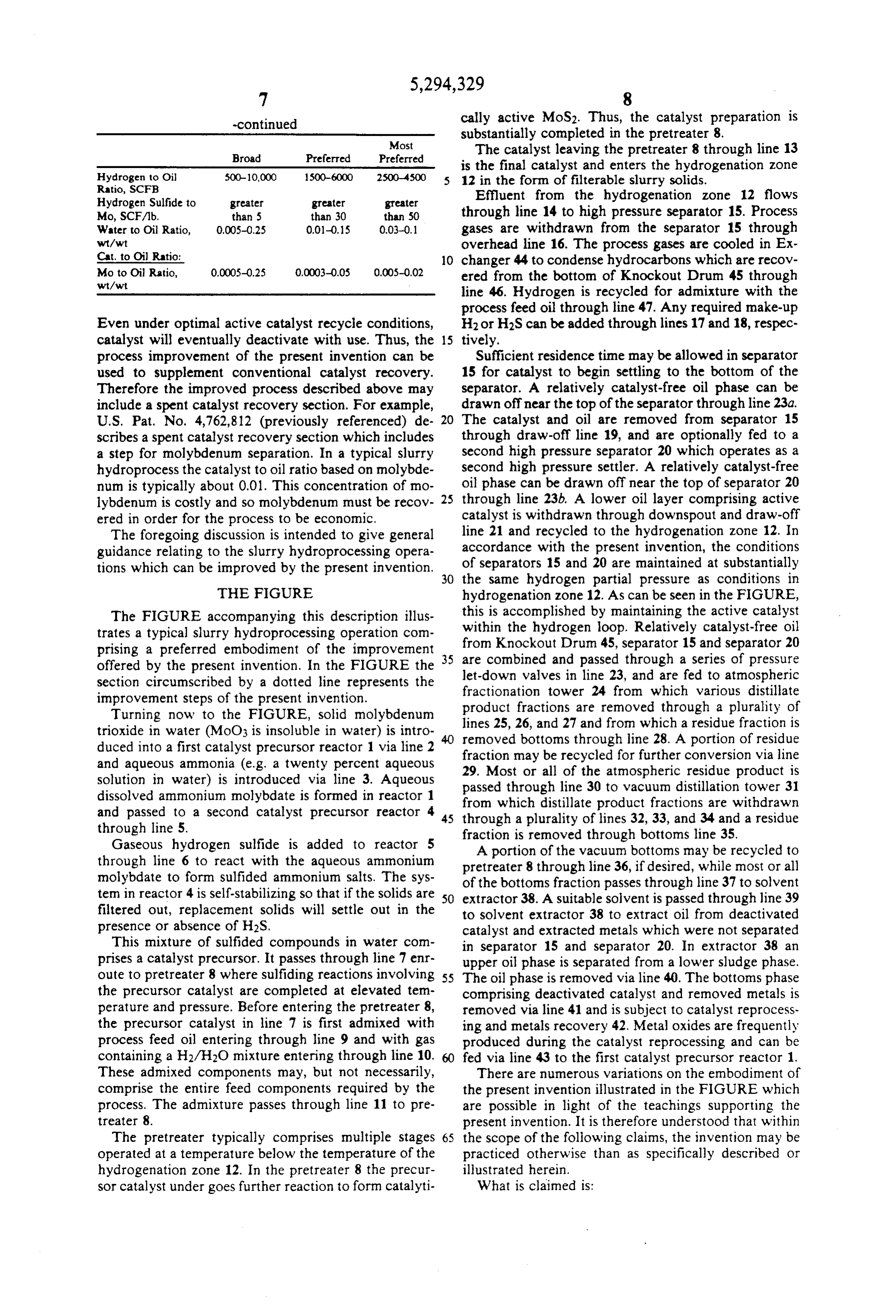
-continued cally active MoS2. Thus, the catalyst preparation is substantially completed in the pretreater 8.
Broad Preferred
Most
Preferred
The catalyst leaving the pretreater 8 through line 13
is the final catalyst and enters the hydrogenation Zone
Ratio, SCFB 5 12 in the form of filterable slurry solids.
Hydrogen Sulfide to greater greater greater Effluent from the hydrogenation zone 12 flows Mo, SCF/1b. than 5 than 30 than 50 through line 14 to high pressure separator 15. Process Water to Oi Ratio, 0,005-0.25 0.01-0.S 0.03-0.1 gases are withdrawn from the separator 15 through
Cat, to Oil Ratio:
overhead line 16. The process gases are cooled in Ex 10 changer 44 to condense hydrocarbons which are recov
Mo to Oil Ratio, 0.0005–0.25 0.0003-0,0S 0.005-0.02 ered from the bottom of Knockout Drum 45 through
line 46. Hydrogen is recycled for admixture with the process feed oil through line 47. Any required make-up
Even under optimal active catalyst recycle conditions, H2 or H2S can be added through lines 17 and 18, respec catalyst will eventually deactivate with use. Thus, the 15 tively.
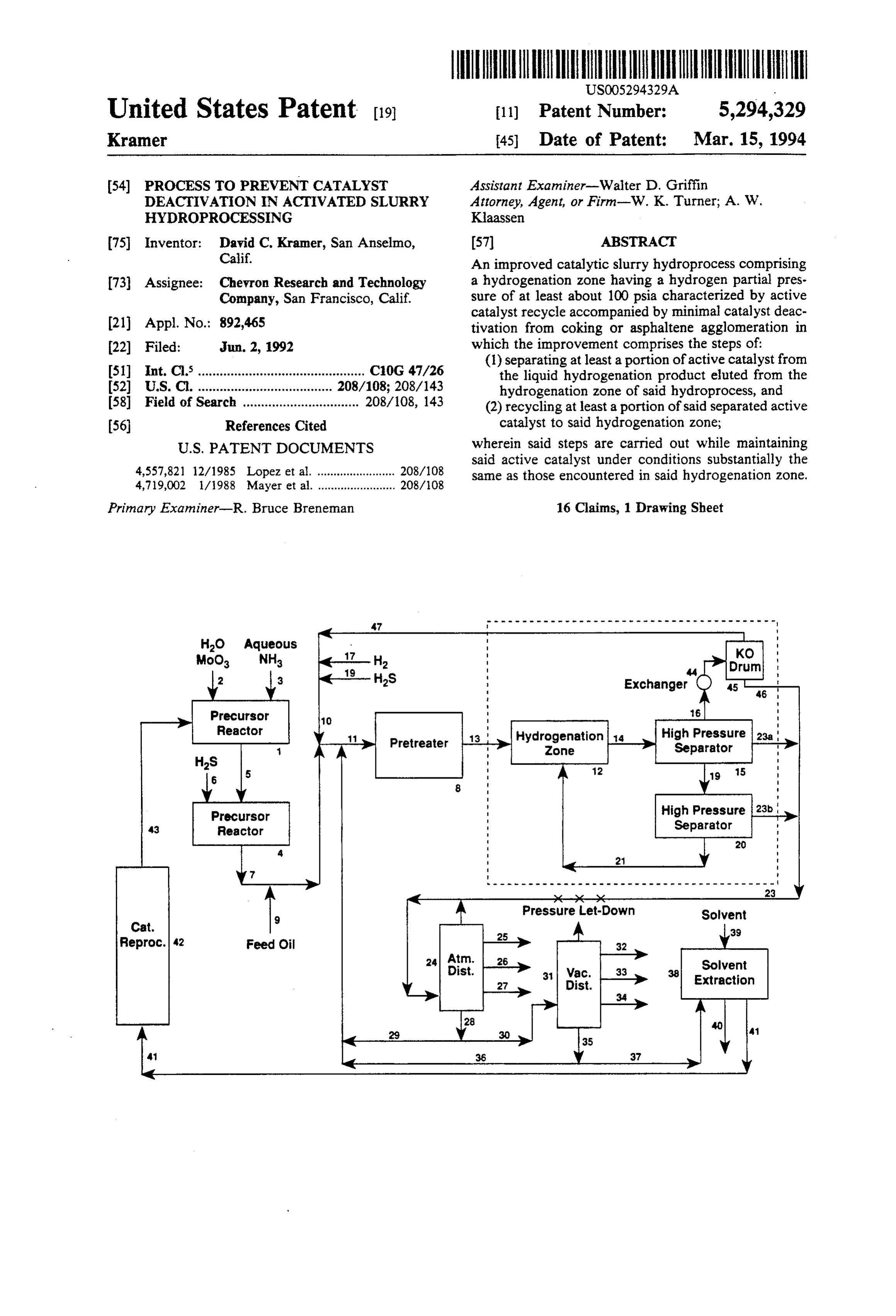
process improvement of the present invention can be Sufficient residence time may be allowed in separator used to supplement conventional catalyst recovery. 15 for catalyst to begin settling to the bottom of the Therefore the improved process described above may separator. A relatively catalyst-free oil phase can be include a spent catalyst recovery section. For example, drawn off near the top of the separator through line 23a. U.S. Pat. No. 4,762,812 (previously referenced) de The catalyst and oil are removed from separator 15 scribes a spent catalyst recovery section which includes through draw-off line 19, and are optionally fed to a a step for molybdenum separation. In a typical slurry second high pressure separator 20 which operates as a hydroprocess the catalyst to oil ratio based on molybde second high pressure settler. A relatively catalyst-free num is typically about 0.01. This concentration of mo oil phase can be drawn off near the top of separator 20 lybdenum is costly and so molybdenum must be recov 25 through line 23b. A lower oil layer comprising active ered in order for the process to be economic. catalyst is withdrawn through downspout and draw-off The foregoing discussion is intended to give general line 21 and recycled to the hydrogenation zone 12. In guidance relating to the slurry hydroprocessing opera accordance with the present invention, the conditions tions which can be improved by the present invention. 30 of separators 15 and 20 are maintained at substantially the same hydrogen partial pressure as conditions in
THE FIGURE hydrogenation zone 12. As can be seen in the FIGURE, The FIGURE accompanying this description illus this is accomplished by maintaining the active catalyst within the hydrogen loop. Relatively catalyst-free oil trates a typical slurry hydroprocessing operation com prising a preferred embodiment of the improvement 35 from Knockout Drum 45, separator 15 and separator 20 offered by the present invention. In the FIGURE the are combined and passed through a series of pressure let-down valves in line 23, and are fed to atmospheric section circumscribed by a dotted line represents the fractionation tower 24 from which various distillate improvement steps of the present invention.
Turning now to the FIGURE, solid molybdenum lines 25, 26, and 27are product fractions and removed through a plurality of from which a residue fraction is trioxide in water (MoC)3 is insoluble in water) is intro removed bottoms through duced into a first catalyst precursor reactor 1 via line 2 fraction may be recycled forlinefurther 28. A portion of residue and aqueous ammonia (e.g. a twenty percent aqueous 29. Most or all of the atmospheric conversion via line solution in water) is introduced via line 3. Aqueous passed through line 30 to vacuum distillation tower 31is residue product dissolved ammonium molybdate is formed in reactor 1 from which distillate product fractions are withdrawn and passed to a second catalyst precursor reactor 4 45 through a plurality of lines 32, 33, and 34 and a residue through line 5.
Gaseous hydrogen sulfide is added to reactor 5 fraction A is removed through bottoms line 35.
portion of the vacuum bottoms may be recycled to through line 6 to react with the aqueous ammonium pretreater 8 through line 36, if desired, while most or all molybdate to form sulfided ammonium salts. The sys of the bottoms fraction passes through line 37 to solvent tem in reactor 4 is self-stabilizing so that if the solids are 50 extractor 38. A suitable solvent is passed through line 39 filtered out, replacement solids will settle out in the to solvent extractor 38 to extract oil from deactivated presence or absence of H2S, catalyst and extracted metals which were not separated This mixture of sulfided compounds in water com in separator 15 and separator 20. In extractor 38 an prises a catalyst precursor. It passes through line 7 enr upper oil phase is separated from a lower sludge phase. oute to pretreater 8 where sulfiding reactions involving 55 The oil phase is removed via line 40. The bottoms phase the precursor catalyst are completed at elevated tem comprising deactivated catalyst and removed metals is perature and pressure. Before entering the pretreater 8, removed via line 41 and is subject to catalyst reprocess the precursor catalyst in line 7 is first admixed with ing and metals recovery 42. Metal oxides are frequently process feed oil entering through line 9 and with gas produced during the catalyst reprocessing and can be containing a H2/H2O mixture entering through line 10. fed via line 43 to the first catalyst precursor reactor 1. These admixed components may, but not necessarily, There are numerous variations on the embodiment of comprise the entire feed components required by the the present invention illustrated in the FIGURE which process. The admixture passes through line 11 to pre are possible in light of the teachings supporting the treater 8. present invention. It is therefore understood that within The pretreater typically comprises multiple stages 65 the scope of the following claims, the invention may be operated at a temperature below the temperature of the practiced otherwise than as specifically described or hydrogenation zone 12. In the pretreater 8 the precur illustrated herein.
sor catalyst under goes further reaction to form catalyti What is claimed is:
Page 7
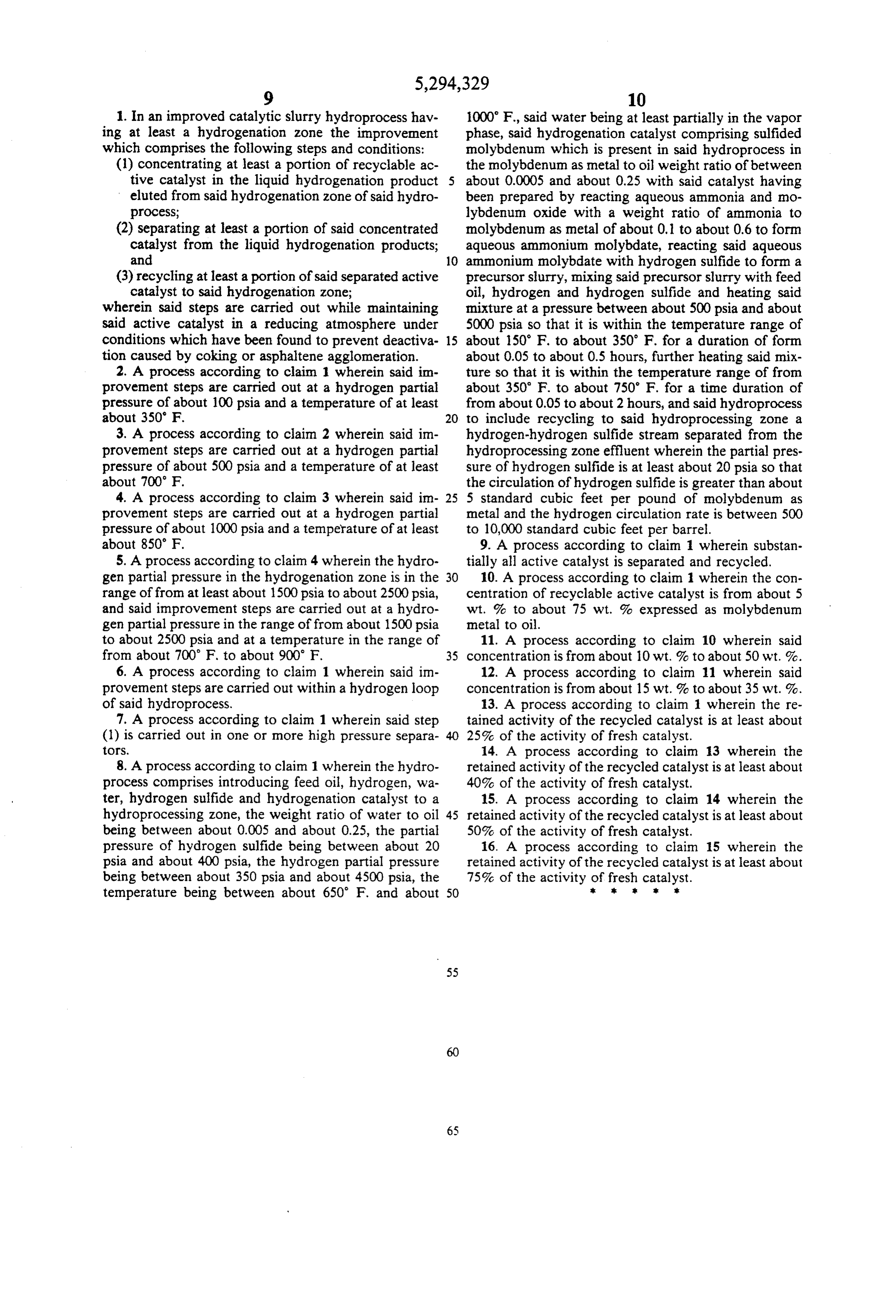
1. In an improved catalytic slurry hydroprocess hav 1000 F., said water being at least partially in the vapor ing at least a hydrogenation zone the improvement phase, said hydrogenation catalyst comprising sulfided which comprises the following steps and conditions: molybdenum which is present in said hydroprocess in (l) concentrating at least a portion of recyclable ac the molybdenum as metal to oil weight ratio of between tive catalyst in the liquid hydrogenation product about 0.0005 and about 0.25 with said catalyst having eluted from said hydrogenation zone of said hydro been prepared by reacting aqueous ammonia and mo process; lybdenum oxide with a weight ratio of ammonia to (2) separating at least a portion of said concentrated molybdenum as metal of about 0.1 to about 0.6 to form catalyst from the liquid hydrogenation products; aqueous ammonium molybdate, reacting said aqueous and 10 ammonium molybdate with hydrogen sulfide to form a (3) recycling at least a portion of said separated active precursor slurry, mixing said precursor slurry with feed catalyst to said hydrogenation zone; oil, hydrogen and hydrogen sulfide and heating said wherein said steps are carried out while maintaining mixture at a pressure between about 500 psia and about said active catalyst in a reducing atmosphere under 5000 psia so that it is within the temperature range of conditions which have been found to prevent deactiva 15 about 150 F. to about 350 F. for a duration of form tion caused by coking or asphaltene agglomeration. about 0.05 to about 0.5 hours, further heating said mix 2. A process according to claim 1 wherein said in ture so that it is within the temperature range of from provement steps are carried out at a hydrogen partial about 350 F. to about 750 F. for a time duration of pressure of about 100 psia and a temperature of at least from about 0.05 to about 2 hours, and said hydroprocess about 350 F. 20 to include recycling to said hydroprocessing zone a 3. A process according to claim 2 wherein said in hydrogen-hydrogen sulfide stream separated from the provement steps are carried out at a hydrogen partial hydroprocessing zone effluent wherein the partial pres pressure of about 500 psia and a temperature of at least sure of hydrogen sulfide is at least about 20 psia so that about 700 F. the circulation of hydrogen sulfide is greater than about 4. A process according to claim 3 wherein said in 25 5 standard cubic feet per pound of molybdenum as provement steps are carried out at a hydrogen partial metal and the hydrogen circulation rate is between 500 pressure of about 1000 psia and a temperature of at least to 10,000 standard cubic feet per barrel. about 850 F. 9. A process according to claim 1 wherein substan 5. A process according to claim 4 wherein the hydro tially all active catalyst is separated and recycled. gen partial pressure in the hydrogenation zone is in the 30 10. A process according to claim 1 wherein the con range of from at least about 1500 psia to about 2500 psia, centration of recyclable active catalyst is from about 5 and said improvement steps are carried out at a hydro wt.% to about 75 wt.% expressed as molybdenum gen partial pressure in the range of from about 1500 psia metal to oil.
to about 2500 psia and at a temperature in the range of 11. A process according to claim 10 wherein said from about 700 F, to about 900 F, 35 concentration is from about 10 wt.% to about 50 wt.%. 6. A process according to claim 1 wherein said in 12. A process according to claim 11 wherein said provement steps are carried out within a hydrogen loop concentration is from about 15 wt.% to about 35 wt.%. of said hydroprocess. 13. A process according to claim 1 wherein the re 7. A process according to claim 1 wherein said step tained activity of the recycled catalyst is at least about (1) is carried out in one or more high pressure separa 25% of the activity of fresh catalyst. tOS. 14. A process according to claim 13 wherein the 8. A process according to claim 1 wherein the hydro retained activity of the recycled catalyst is at least about process comprises introducing feed oil, hydrogen, wa 40% of the activity of fresh catalyst. ter, hydrogen sulfide and hydrogenation catalyst to a 15. A process according to claim 14 wherein the hydroprocessing zone, the weight ratio of water to oil 45 retained activity of the recycled catalyst is at least about being between about 0.005 and about 0.25, the partial 50% of the activity of fresh catalyst. pressure of hydrogen sulfide being between about 20 16. A process according to claim 15 wherein the psia and about 400 psia, the hydrogen partial pressure retained activity of the recycled catalyst is at least about being between about 350 psia and about 4500 psia, the 75% of the activity of fresh catalyst. temperature being between about 650 F. and about 50 k k k
Provenance
- Collection
- Cited prior art
- Original PDF
- patentimages.storage.googleapis.com →
- Filed
- 1992-06-02
- Pages
- 7
- Method
- pdftotext (the PDF's own text layer) + pdftoppm 300dpi page scans
- Source
- Google Patents bibliographic record
- Granted
- 1994-03-15
- Inventors
- David C. Kramer; Chevron Research and Technology Co
- Transcribed from
- patentimages.storage.googleapis.com →