patent · US4150956
Producing medical grade oxygen for human, animal, or laboratory use by paramagnetic separation of oxygen from air
24 April 1979
Page 1 — bibliographic record
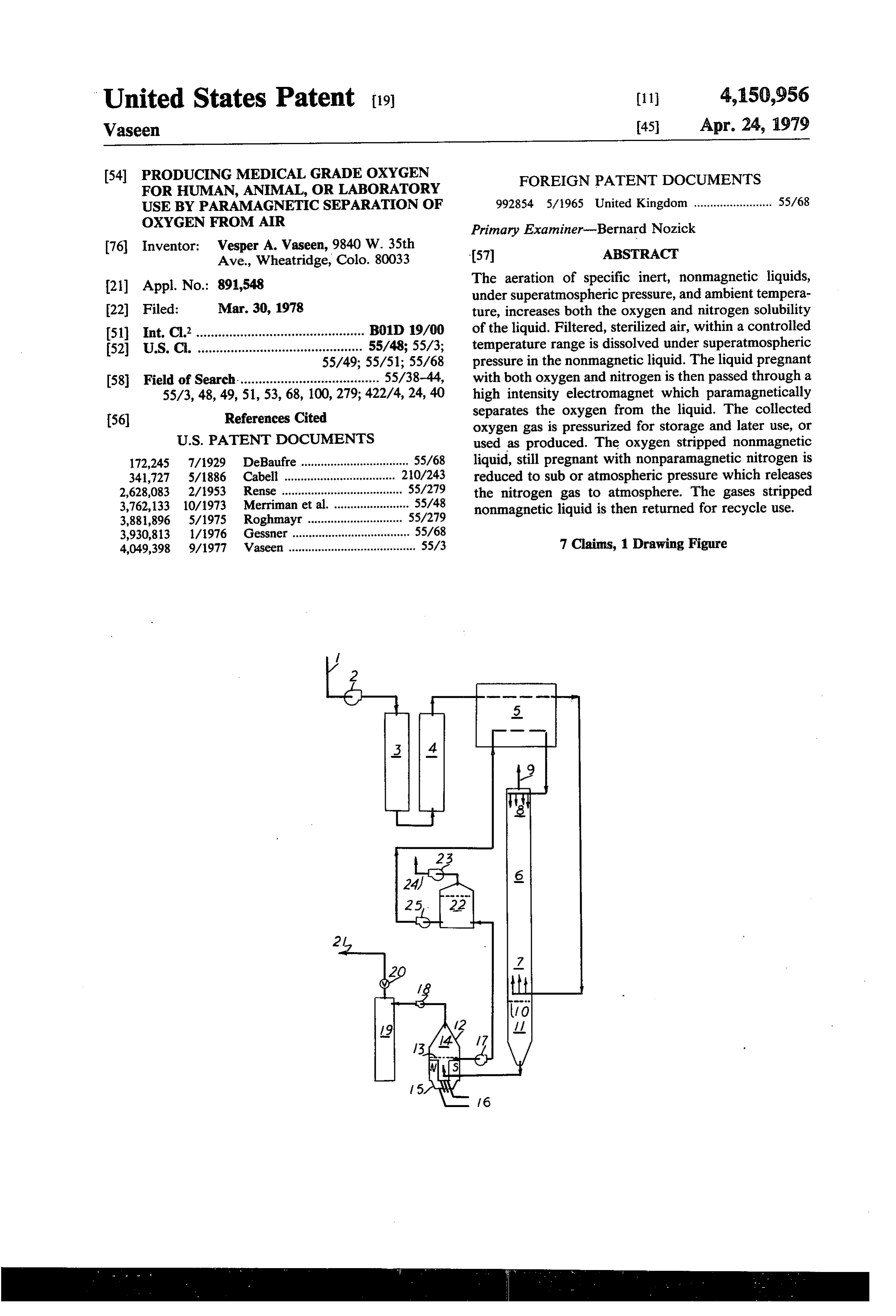
United States Patent (19) (11) 4,150,956 Vaseen 45 Apr. 24, 1979
(54 PRODUCING MEDICAL GRADE OXYGEN FOREIGN PATENT DOCUMENTS
FOR HUMAN, ANIMAL, ORLABORATORY
USE BY PARAMAGNETIC SEPARATION OF 992854 5/1965 United Kingdom ........................ 55/68
OXYGEN FROM AIR
Primary Examiner-Bernard Nozick 76) Inventor: Vesper A. Waseen, 9840 W. 35th (57) ABSTRACT Ave., Wheatridge, Colo. 80033 (21) Appl. No.: 891,548 The aeration of specific inert, nonmagnetic liquids, under superatmospheric pressure, and ambient tempera 22 Filed: Mar. 30, 1978 ture, increases both the oxygen and nitrogen solubility 51 Int. C.’.............................................. B01D 19/00 of the liquid. Filtered, sterilized air, within a controlled 52 U.S. C. ............................................. 55/48; 55/3; temperature range is dissolved under superatmospheric 55/49; 55/51; 55/68 pressure in the nonmagnetic liquid. The liquid pregnant 58 Field of Search....................................... 55/38-44, with both oxygen and nitrogen is then passed through a 55/3, 48, 49, 51, 53, 68, 100,279; 422/4, 24, 40 high intensity electromagnet which paramagnetically 56) References Cited separates the oxygen from the liquid. The collected oxygen gas is pressurized for storage and later use, or
172,245 7/1929 DeBaufre ................................. 55/68 liquid, still pregnant with nonparamagnetic nitrogen is 341,727 5/1886 Cabell .......... 21.0/243 reduced to sub or atmospheric pressure which releases 2,628,083 2/1953 Rense ............... ... 55/279 the nitrogen gas to atmosphere. The gases stripped 3,762,133 10/1973 Merriman et al. ....................... 55/48 nonmagnetic liquid is then returned for recycle use. 3,881,896 5/1975 Roghmayr ....... ... 55/279 3,930,813 1/1976 Gessner .................................... 55/68 4,049,398 9/1977 Vaseen ....................................... 55/3 7 Claims, 1 Drawing Figure
Page 2
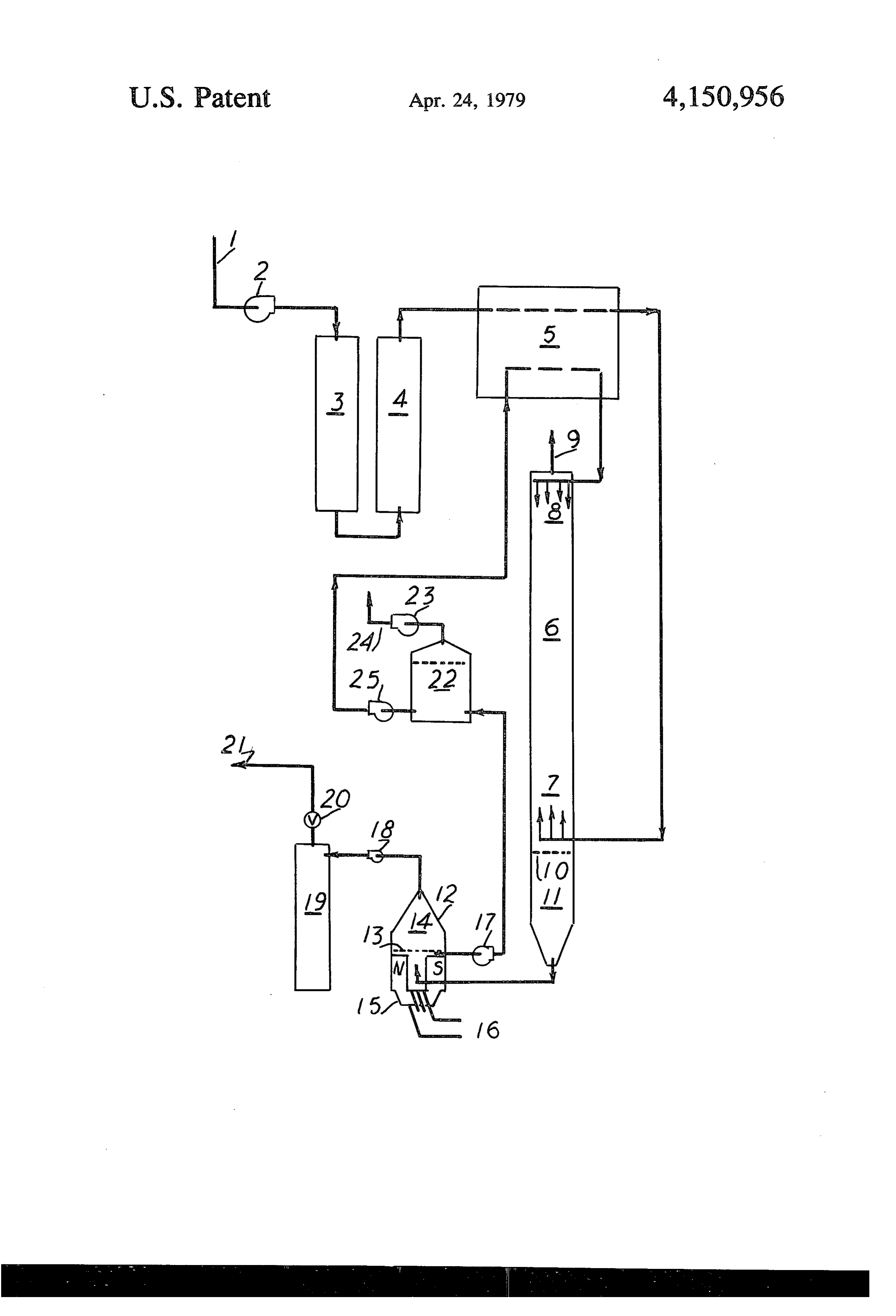
Drawing sheet — no readable text.
Page 3
PRODUCING MEDICAL GRADE OXYGEN FOR REFERENCES
HUMAN, ANIMAL, OR LABORATORY USE BY
PARAMAGNETIC SEPARATION OF OXYGEN U.S. Pat. No.:
FROM AIR 341,727 5/1886 Cabell 210/243
BACKGROUND OF THE INVENTION 1056,244 3/1913 Wiley 55/68 A combination of two physical factors makes it possi 1,722,458 7/1929 DeBaufre 55/68 ble to collect dissolved oxygen from a liquid in a man 3,177,633 4/1965 McDonald, Jr. 55/3
ner applicable to commercial production of gaseous 10 '4,049,398 9/1977 Waseen 55/3 oxygen. These two factors are the affinity of specific, inert, nonmagnetic liquids to dissolve more air, and thus oxygen, than some other liquids; and the fact that oxy SUMMARY OF INVENTION gen molecules are paramagnetic and can be magneti 15 Ambient air is caused to pass through a mechanical cally removed from these specific liquids as gaseous filter, preferably of the type which has replaceable car oxygen. Nitrogen being practically nonparamagnetic tridges. The compressor or blower which causes the air remains as a dissolved gas in the liquid. It is then to pass through the filter is preferably, used to pressur stripped by pressure reduction or heat and the liquid ize the air to the same pressure as is designed into the recovered for reuse.
The inert nonmagnetic liquid selected is one which is 20 absorber vessel, and total system.
The air is filtered to remove particulates, preferably nonmiscible with water. This factor eliminates the ne including 100% removal of all particulates greater than cessity to dry air prior dissolving it in the liquid. 0.5 microns.
The use of medical oxygen by individuals, specially in their homes, offices, laboratories, etc., requires the 25 intoFiltered the air is then sterilized prior to its introduction absorber liquid in the absorber vessel. Steriliza availability of spare oxygen bottles, which introduces a tion can be by heat or radiation. Preferably a means factor of vulnerability to both storage and available such as ultraviolet radiation is used. Heat is destructive supply. of the solubility efficiency of the absorber liquid; and The ability of an individual in need of pure oxygen to prior to the absorber vessel a temperature adjustment is manufacture it from semi portable or portable equip 30 made for this purpose. Sterilization by heat increases ment, from a closed cycle process, by the simple expedi the load on the temperature adjustment apparatus. ent of turning on the equipment by activating an electri The filtered, sterilized, temperature adjusted air is cal switch using household current characteristics is then commingled with the absorber liquid in the ab now possible with this invention. sorber vessel. Commingling is preferably done under The invention expands on the simple function of man 35 superatmospheric pressure in order to increase the ufacturing paramagnetic oxygen as outlined prior to; by quantity of air dissolved per volume of absorber liquid creating a complete cycle of operating equipment used. The commingling is accomplished in many ways, which combined together, accomplish the production by various methods, but preferably by the production of of medical grade oxygen for immediate or later use, by small bubbles of air it is introduced to the absorber the patient, if desired, at any place electrical energy is liquid, such as through a venturi mixer. Air which is not available to operate the equipment. dissolved in the absorber liquid is preferably recycled The invention utilizes the process steps of filtering air back from the top of the absorber vessel to the injection to eliminate particulates; sterilize the air to eliminate nozzel or system.
live virus; bacteria or other hazardous organisms to the Absorber liquid selected has the following general buoy; adjust the temperature of the particulate free, 45 specifications:
sterilized air, dissolve the air in the absorber liquid; 1. Boiling point several times that of water. paramagnetically remove the gaseous oxygen from the 2. Specific gravity either greater or less than water absorber liquid; deliver the collected medical grade for easy separation.
oxygen to the user or store it under pressure for later 3. Practically nonvolatile.
use; strip the absorber liquid of nitrogen gas; and return 50 4. Critical temperature-several times that of boiling the absorber liquid to the absorber vessel. Water.
DESCRIPTION OF PRIOR ART 5. Nonmiscible with water.
6. Nontoxic to bio-organisms.
Principal production of oxygen has been the cumber 7. Stable physical/chemical characteristics at ambient some equipment and process of gases separation by low 55 as well as elevated temperatures (for instance 600 F), temperature, minus 200 F., methods of liquefaction and and at superatmospheric pressure (at least 40 atmo distillation (rectification) of the liquid. Pure oxygen is spheres); and at subatmospheric pressure (at least minus difficult by this method as air contains nine principal 5 atmospheres).
components, each of which have very low boiling 8. Nonbiodegradable.
points, several of which are very close together. 60 9. Nonoxidizable-even with ozone Electrolytic decomposition of water to produce pure 10. A dielectric oxygen and hydrogen, is a viable method, but is both 11. Nonmagnetic expensive of operation as well as hazardous due to ex 12. An affinity for dissolving air plosive hydrogen gas evolved. 13. Reusable for numerous cycles. Chemical or physical breakdown of oxides by chemi 65 14. Nonflammable.
cal or heat action are also viable commercial means of Two of the families of liquids which meet these speci producing oxygen, but they do not lend themselves to fications are the silicone liquids or polyorganosiloxanes; production of medical grade oxygen at point of use. and the halogenated hydrocarbons, specially the halo
Page 4
gen saturated compounds with one or more florine poles, north and south, and at or near the magnetic pole atoms.
The system of aeration of the inert liquid and the surfaces, retain the exceed the solubility ability of the liquid to oxygen as absorbed oxygen, and thus release removal of the dissolved oxygen can both be operated it as bubbles of free collective molecules, to the oxygen as a pressure control system or either the aeration and gas collector also installed at or near the surface of the /or the paramagnetic oxygen collection system by oper ated independently as a pressure (vacuum) control sys liquid and between the two magnetic poles of the elec tromagnet.
ten.
The aeration of the nonmagnetic inert liquid under moved In a pressurized system the oxygen gas can be re positive pressure increases both the oxygen and nitro 10 pression at atmosphere pressure to storage, thence com gen solubility of the fluid; which necessarily requires and use; or in an atmospheric system be col the paramagnetic removal of magnetic oxygen in the age, lected by a vacuum (negative pressure) system to stor electromagnet be kept under at least equal pressure to compression and use.
retain the dissolved nitrogen in solution until the oxy The imposing of very high intensity gauss forces at gen has been paramagnetically removed, thus prevent 15 the electromagnetic to induce paramagnetizm reactions ing nitrogen contamination of the collected oxygen gas. on the absorbed oxygen molecules will produce heat. Negative pressure of reduction from a positive pres This heat can be designed to be collected by the specific sure, at the electromagnet will when following the elec heat capacity of the nonmagnetic inert liquid, to assist in tromagnet, release the dissolved nitrogen for either nitrogen stripping or it can be externally removed by collection or dissipation back to atmosphere. 20 circulating other fluid and heat exchanger transfer from Heat is generated at the electromagnet due to the the magnet core iron to the auxiliary fluid. necessity to highly saturate the iron core of the magnet Collection of the released effervescent oxygen is with gauss forces. This heat is removed by the specific enhanced by the lowering of the pressure at the envi heat factor of the nonmagnetic inert liquid. ronmental space over the poles of the magnet. Weak magnetic materials known as members of the 25 The gaseous oxygen is collected by the vacuum pump paramagnetic group, are not very susceptible to an which reduces the pressure adjacent to the magnetic applied magnetic field. Paramagnetic materials rarely poles, and slightly reduces the environmental space become saturated so their degree of magnetization con pressure receiving the effervescent oxygen; and sent to tinues to increase as the applied magnetic field gets a storage vessel, also under pressure, or through a pres stronger. 30 sure control/rate of flow control apparatus to the user. When a uniform magnetic field is applied to a magne The oxygen stripped absorber liquid is removed from tized particle, the forces acting on the two poles of the the vicinity of the magnetic poles, then its pressure particle are equal and opposite. When an applied mag reduced to atmospheric or subatmospheric, thus so netic field differs in intensity at the two extremes of a particle, then a net differential magentic force acts on 35 decreasing the solubility of the absorber liquid the liq uid pregnant with nonmagnetic nitrogen, releases it by the particle. The net force exerted on a magnetized particle by a magnetic field is proportional to: (1) the effervescence to atmosphere. intensity of the magnetization the field has induced in vessel for recycleliquid
The absorber use.
is then returned to the absorber
A filter for the liquid is optional the particle; (2) the volume of the particle; (3) the gradi in the flow sheet to separate out any particulates which ent of the exerted magnetic field; that is, the difference might occur in the equipment and apparatus cycle. between the intensity of the field at one end of the parti Water vapor which escaped capture or has been carried cle; and the intensity of the field at the other end of the particle. into the absorber with the air, being nonmiscible with Paramagnetic materials require a magnetic field of heat the absorber liquid is also separated out at this time. The of magnetic separation of the oxygen, produced in great enough intensity as to cause magnetization of the 45 the paramagnetic particles, as well as sufficient gauss flux gradient as to ture separator, is removed by a tempera cause the particles to orient with temporary north and adjustment heat exchanger, then the absorber liq south poles. uid returned to the absorber vessel for recycle use. The oxygen molecules when in the presence in an PREFERRED EMBODIMENTS intense magnetic field orient as polar molecules with a 50 It is the intention of this invention to teach the art and north and a south pole. Due to the creation of a gradient field the oxygen molecules are then oriented and by science of producing oxygen of medical grade for use nature of the differential forces on the poles created by by; individuals, human or animal, with a medical or the gradient field attracted north polar oriented to the other need to breath pure oxygen or oxygen enriched south magnetic pole and vice versa. Molecular oxygen 55 air; or for laboratory work requiring medical grade collected at each pole combine as they accumulate to OXygen.
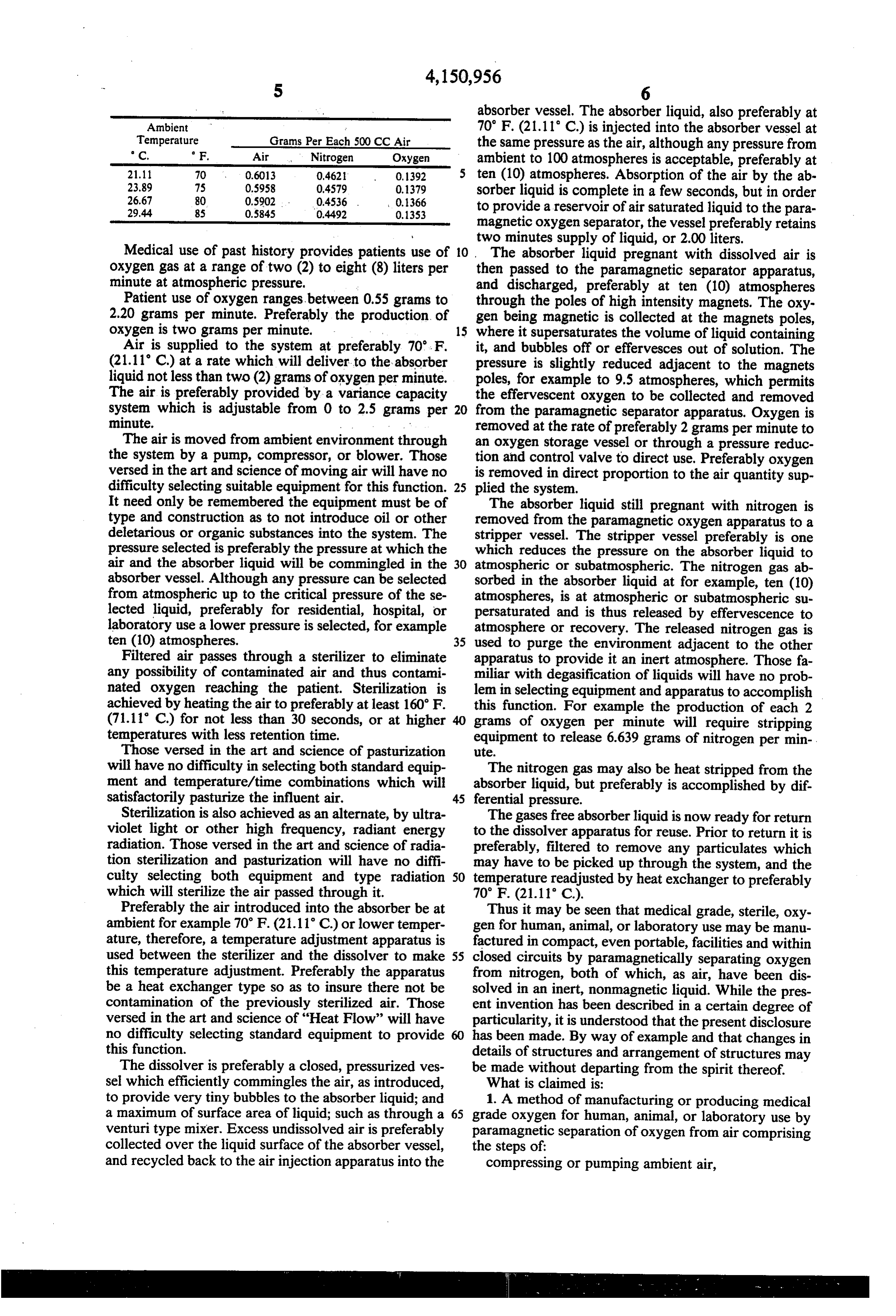
form bubbles of free oxygen gas as the concentration For example this explanation of the art and science exceeds the solubility of the liquid for absorbed oxygen will concern itself with the requirements of a semiporta and release themselves from the liquid as bubbles of ble self contained unit, which preferably will provide in oxygen to be collected for removal to storage and/or 60 excess of one hundred percent of the oxygen require U.S. ments of a large adult male. The selection of a large The air (oxygen) saturated nonmagetic, inert liquid is adult male as the preferred size will therefore produce passed thru the two magnetic poles, north and south, of more than sufficient oxygen for females or children. an electromagnetic in a quantity and with a velocity A large adult male breaths approximately 500 cc each which provide the time required, permit the absorbed 65 tidal cycle (breath in and out). The following table oxygen molecules in the presence of gauss forces suffi illustrates the weight of oxygen and nitrogen (air), per cient to cause paramagnetic magnetization of the oxy each tidal cycle. Preferably not less than this minimum gen molecules, to be magnetically attracted to the two amount of oxygen is produced.
Page 5
absorber vessel. The absorber liquid, also preferably at
Ambient 70 F. (21.11 C.) is injected into the absorber vessel at Temperature Grams Per Each 500 CCAir the same pressure as the air, although any pressure from C. F. Air Nitrogen Oxygen ambient to 100 atmospheres is acceptable, preferably at 21.11 70 0.6013 0,462 0.1392 5 ten (10) atmospheres. Absorption of the air by the ab
sorber liquid is complete in a few seconds, but in order 29.44 85 0,5845 0.4492 0.1353 to provide a reservoir of air saturated liquid to the para magnetic oxygen separator, the vessel preferably retains two minutes supply of liquid, or 2.00 liters.
Medical use of past history provides patients use of 10, The absorber liquid pregnant with dissolved air is oxygen gas at a range of two (2) to eight (8) liters per then passed to the paramagnetic separator apparatus, minute at atmospheric pressure. and discharged, preferably at ten (10) atmospheres Patient use of oxygen ranges between 0.55 grams to through the poles of high intensity magnets. The oxy 2.20 grams per minute. Preferably the production of gen being magnetic is collected at the magnets poles, oxygen is two grams per minute. 15 where it supersaturates the volume of liquid containing Air is supplied to the system at preferably 70'. F. it, and bubbles off or effervesces out of solution. The (21.11 C) at a rate which will deliver to the absorber pressure is slightly reduced adjacent to the magnets liquid not less than two (2) grams of oxygen per minute. poles, for example to 9.5 atmospheres, which permits The air is preferably provided by a variance capacity the effervescent oxygen to be collected and removed system which is adjustable from 0 to 2.5 grams per 20 from the paramagnetic separator apparatus. Oxygen is minute. . removed at the rate of preferably 2 grams per minute to The air is moved from ambient environment through an oxygen storage vessel or through a pressure reduc the system by a pump, compressor, or blower. Those tion and control valve to direct use. Preferably oxygen versed in the art and science of moving air will have no is removed in direct proportion to the air quantity sup difficulty selecting suitable equipment for this function. 25 plied the system.
It need only be remembered the equipment must be of The absorber liquid still pregnant with nitrogen is type and construction as to not introduce oil or other removed from the paramagnetic oxygen apparatus to a deletarious or organic substances into the system. The stripper vessel. The stripper vessel preferably is one pressure selected is preferably the pressure at which the which reduces the pressure on the absorber liquid to air and the absorber liquid will be commingled in the 30 atmospheric or subatmospheric. The nitrogen gas ab absorber vessel. Although any pressure can be selected sorbed in the absorber liquid at for example, ten (10) from atmospheric up to the critical pressure of the se atmospheres, is at atmospheric or subatmospheric su lected liquid, preferably for residential, hospital, or persaturated and is thus released by effervescence to laboratory use a lower pressure is selected, for example atmosphere or recovery. The released nitrogen gas is ten (10) atmospheres. 35 used to purge the environment adjacent to the other Filtered air passes through a sterilizer to eliminate apparatus to provide it an inert atmosphere. Those fa any possibility of contaminated air and thus contami miliar with degasification of liquids will have no prob nated oxygen reaching the patient. Sterilization is lem in selecting equipment and apparatus to accomplish achieved by heating the air to preferably at least 160 F. this function. For example the production of each 2 (71.11 C) for not less than 30 seconds, or at higher grams of oxygen per minute will require stripping temperatures with less retention time. equipment to release 6.639 grams of nitrogen per min Those versed in the art and science of pasturization ute.
will have no difficulty in selecting both standard equip The nitrogen gas may also be heat stripped from the ment and temperature/time combinations which will absorber liquid, but preferably is accomplished by dif satisfactorily pasturize the influent air. 45 ferential pressure.
Sterilization is also achieved as an alternate, by ultra The gases free absorber liquid is now ready for return violet light or other high frequency, radiant energy to the dissolver apparatus for reuse. Prior to return it is radiation. Those versed in the art and science of radia preferably, filtered to remove any particulates which tion sterilization and pasturization will have no diffi may have to be picked up through the system, and the culty selecting both equipment and type radiation 50 temperature readjusted by heat exchanger to preferably which will sterilize the air passed through it. 70 F. (21.11° C).
Preferably the air introduced into the absorber be at Thus it may be seen that medical grade, sterile, oxy ambient for example 70' F. (21.11 C) or lower temper gen for human, animal, or laboratory use may be manu ature, therefore, a temperature adjustment apparatus is factured in compact, even portable, facilities and within used between the sterilizer and the dissolver to make 55 closed circuits by paramagnetically separating oxygen this temperature adjustment. Preferably the apparatus from nitrogen, both of which, as air, have been dis be a heat exchanger type so as to insure there not be solved in an inert, nonmagnetic liquid. While the pres contamination of the previously sterilized air. Those ent invention has been described in a certain degree of versed in the art and science of "Heat Flow' will have particularity, it is understood that the present disclosure no difficulty selecting standard equipment to provide has been made. By way of example and that changes in this function. details of structures and arrangement of structures may The dissolver is preferably a closed, pressurized ves be made without departing from the spirit thereof. sel which efficiently commingles the air, as introduced, What is claimed is:
to provide very tiny bubbles to the absorber liquid; and 1. A method of manufacturing or producing medical a maximum of surface area of liquid; such as through a 65 grade oxygen for human, animal, or laboratory use by venturi type mixer. Excess undissolved air is preferably paramagnetic separation of oxygen from air comprising collected over the liquid surface of the absorber vessel, the steps of:
and recycled back to the air injection apparatus into the compressing or pumping ambient air,
Page 6
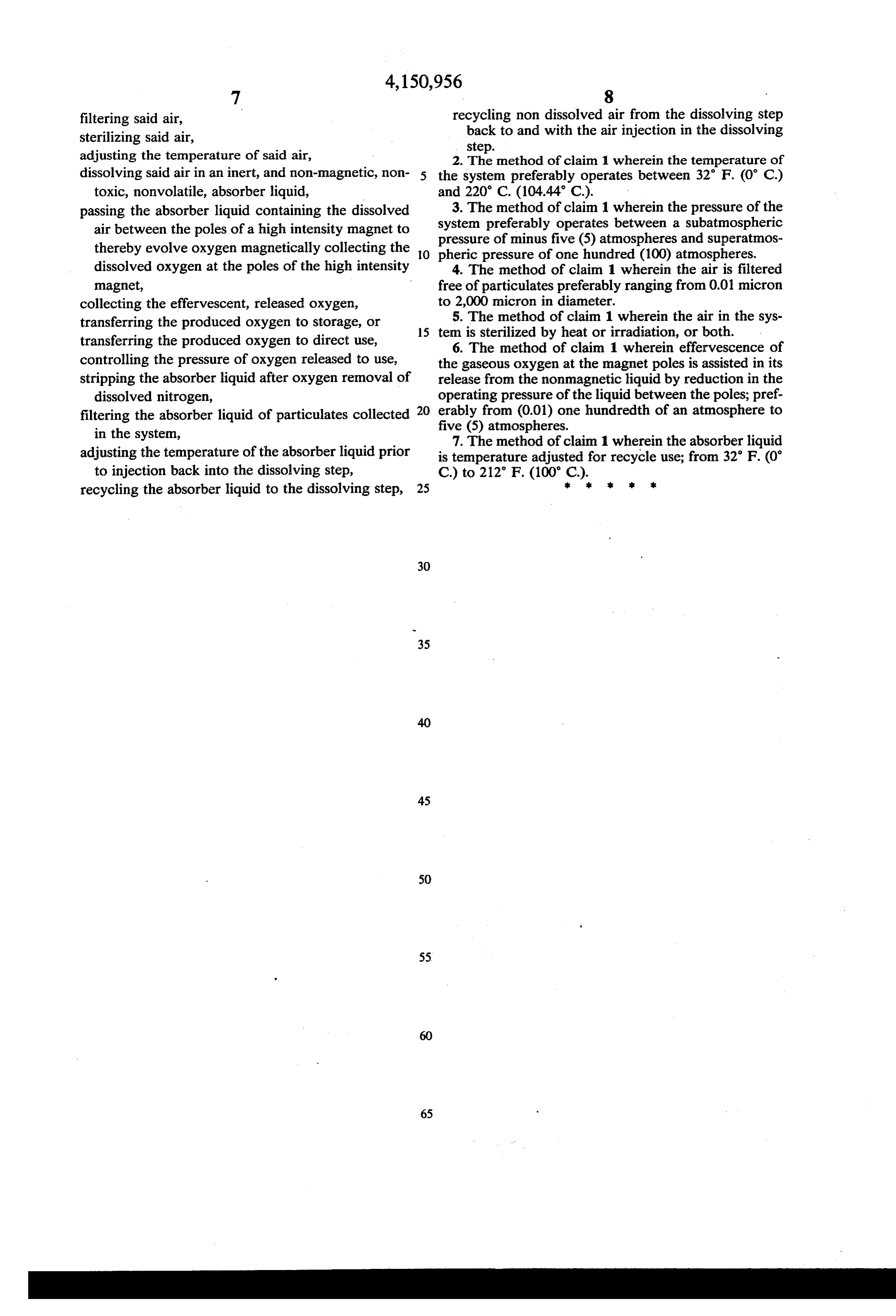
filtering said air, recycling non dissolved air from the dissolving step sterilizing said air, back to and with the air injection in the dissolving Sted.
adjusting the temperature of said air, 2. E. method of claim 1 wherein the temperature of dissolving said air in an inert, and non-magnetic, non- 5 the system preferably operates between 32' F. (O. C.) toxic, nonvolatile, absorber liquid, and 220 C. (104.44 C.).
passing the absorber liquid containing the dissolved 3. The method of claim 1 wherein the pressure of the air between the poles of a high intensity magnet to system pressure preferably operates between a subatmospheric of minus five (5) atmospheres and superatmos thereby evolve oxygen magnetically collecting the O pheric pressure of one hundred (100) atmospheres. dissolved oxygen at the poles of the high intensity 4. The method of claim 1 wherein the air is filtered magnet, free of particulates preferably ranging from 0.01 micron collecting the effervescent, released oxygen, to 2,000 micron in diameter.
transferring the produced oxygen to storage, or 5. The method of claim 1 wherein the air in the sys 15 tem is sterilized by heat or irradiation, or both.
transferring the produced oxygen to direct use, 6. The method of claim 1 wherein effervescence of controlling the pressure of oxygen released to use, the gaseous oxygen at the magnet poles is assisted in its stripping the absorber liquid after oxygen removal of release from the nonmagnetic liquid by reduction in the dissolved nitrogen, operating pressure of the liquid between the poles; pref. erably from (0.01) one hundredth of an atmosphere to filtering the absorber liquid of particulates collected 20 five in the system, (5) atmospheres.
7. The adjusting the temperature of the absorber liquid prior is temperature method of claim 1 wherein the absorber liquid adjusted for recycle use; from 32 F. (O to injection back into the dissolving step, C.) to 212 F. (100 C.).a 2: 32 :
recycling the absorber liquid to the dissolving step, 25
Provenance
- Collection
- Cited prior art
- Original PDF
- patentimages.storage.googleapis.com →
- Filed
- 1978-03-30
- Pages
- 6
- Method
- pdftotext (the PDF's own text layer) + pdftoppm 300dpi page scans
- Source
- Google Patents bibliographic record
- Granted
- 1979-04-24
- Inventors
- Vesper A. Vaseen
- Transcribed from
- patentimages.storage.googleapis.com →