patent · US5286473
Process for the production of hydrogen
15 February 1994
Page 1 — bibliographic record
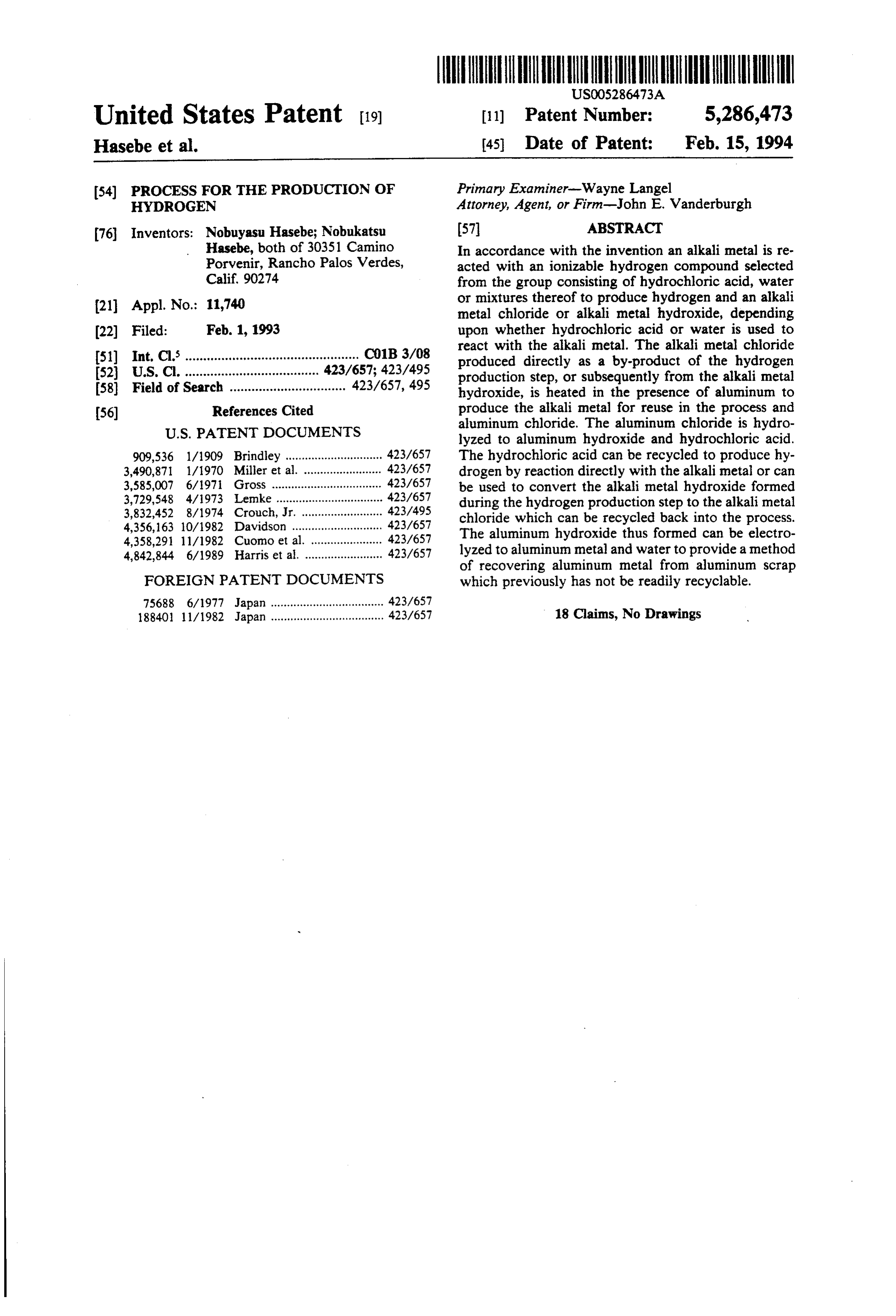
United States Patent (19) 11) Patent Number: 5,286,473 Hasebe et al. (45) Date of Patent: Feb. 15, 1994 54) PROCESS FOR THE PRODUCTION OF Primary Examiner-Wayne Langel HYDROGEN Attorney, Agent, or Firm-John E. Vanderburgh 76) Inventors: Nobuyasu Hasebe; Nobukatsu 57 ABSTRACT Hasebe, both of 30351 Camino In accordance with the invention an alkali metal is re Porvenir, Rancho Palos Verdes, acted with an ionizable hydrogen compound selected Calif. 90274 from the group consisting of hydrochloric acid, water (21) Appl. No.: 11,740 or mixtures thereof to produce hydrogen and an alkali metal chloride or alkali metal hydroxide, depending (22) Filed: Feb. 1, 1993 upon whether hydrochloric acid or water is used to react with the alkali metal. The alkali metal chloride (51) Int, Cl. ............................................... C01B3/08 produced directly as a by-product of the hydrogen 52) ... 423/657; 423/495 production step, or subsequently from the alkali metal 58) Field of Search ................................ 423/657, 495 hydroxide, is heated in the presence of aluminum to (56) References Cited produce the alkali metal for reuse in the process and
lyzed to aluminum hydroxide and hydrochloric acid.
909,536 1/1909 Brindley .............................. 423/657 The hydrochloric acid can be recycled to produce hy 3,490,871 1/1970 Miller et al. ... 42.3/657 drogen by reaction directly with the alkali metal or can 3,585,007 6/1971 Gross .......... ... 423/657 be used to convert the alkali metal hydroxide formed 3,729,548 4/1973 Lemke ..... 423/657 during the hydrogen production step to the alkali metal 3,832,452 8/1974 Crouch, Jr. . 423/495 4,356,163 10/1982 Davidson ............ ... 42.3/657 chloride which can be recycled back into the process. 4,358,291 1/1982 Cuomo et al. ...... ... 42.3/657 The aluminum hydroxide thus formed can be electro 4,842,844 6/1989 Harris et al. ........................ 423/657 lyzed to aluminum metal and water to provide a method of recovering aluminum metal from aluminum scrap
FOREIGN PATENT DOCUMENTS which previously has not be readily recyclable. 75688 6/1977 Japan ................................... 423/657 188401 11/1982 Japan ................................... 423/657 18 Claims, No Drawings
Page 2
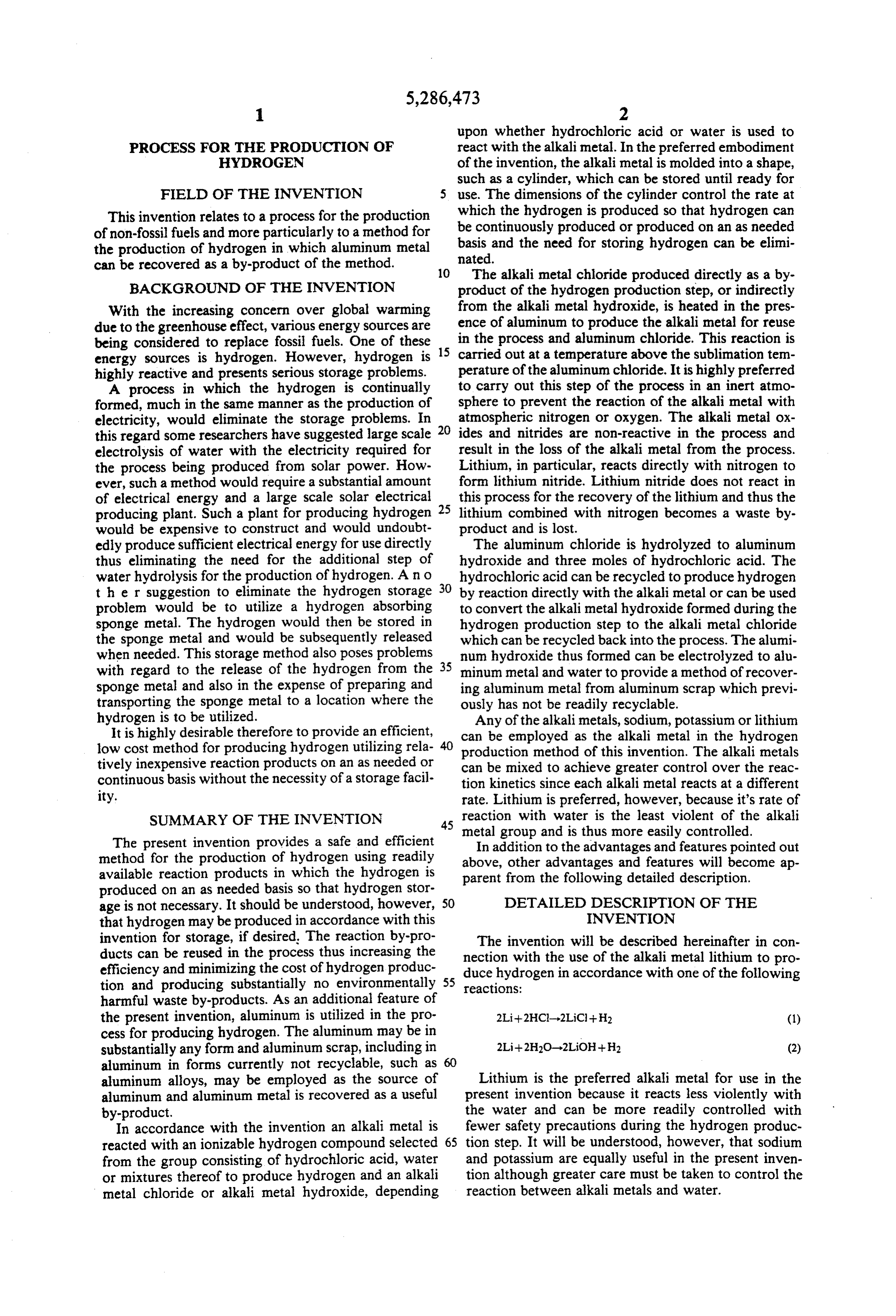
upon whether hydrochloric acid or water is used to
PROCESS FOR THE PRODUCTION OF react with the alkali metal. In the preferred embodiment HYDROGEN of the invention, the alkali metal is molded into a shape, such as a cylinder, which can be stored until ready for
FIELD OF THE INVENTION use. The dimensions of the cylinder control the rate at This invention relates to a process for the production which the hydrogen is produced so that hydrogen can of non-fossil fuels and more particularly to a method for be continuously produced or produced on an as needed the production of hydrogen in which aluminum metal nated. basis and the need for storing hydrogen can be elimi can be recovered as a by-product of the method. 10 The alkali metal chloride produced directly as a by BACKGROUND OF THE INVENTION product of the hydrogen production step, or indirectly With the increasing concern over global warming from the alkali metal hydroxide, is heated in the pres due to the greenhouse effect, various energy sources are ence of aluminum to produce the alkali metal for reuse being considered to replace fossil fuels. One of these 15 in the process and aluminum chloride. This reaction is energy sources is hydrogen. However, hydrogen is carried out at a temperature above the sublimation tem highly reactive and presents serious storage problems. perature of the aluminum chloride. It is highly preferred A process in which the hydrogen is continually to carry out this step of the process in an inert atmo formed, much in the same manner as the production of sphere to prevent the reaction of the alkali metal with electricity, would eliminate the storage problems. In atmospheric nitrogen or oxygen. The alkali metal ox this regard some researchers have suggested large Scale 20 ides and nitrides are non-reactive in the process and electrolysis of water with the electricity required for result in the loss of the alkali metal from the process. the process being produced from solar power. How Lithium, in particular, reacts directly with nitrogen to ever, such a method would require a substantial amount form lithium nitride. Lithium nitride does not react in of electrical energy and a large scale solar electrical 25 this process for the recovery of the lithium and thus the producing plant. Such a plant for producing hydrogen lithium combined with nitrogen becomes a waste by would be expensive to construct and would undoubt product and is lost.
edly produce sufficient electrical energy for use directly The aluminum chloride is hydrolyzed to aluminum thus eliminating the need for the additional step of hydroxide and three moles of hydrochloric acid. The water hydrolysis for the production of hydrogen. A no 30 hydrochloric acid can be recycled to produce hydrogen the r suggestion to eliminate the hydrogen storage by reaction directly with the alkali metal or can be used problem would be to utilize a hydrogen absorbing to convert the alkali metal hydroxide formed during the sponge metal. The hydrogen would then be stored in hydrogen production step to the alkali metal chloride the sponge metal and would be subsequently released which can be recycled back into the process. The alumi when needed. This storage method also poses problems num hydroxide thus formed can be electrolyzed to alu with regard to the release of the hydrogen from the 35 minum metal and water to provide a method of recover sponge metal and also in the expense of preparing and ing aluminum metal from aluminum scrap which previ transporting the sponge metal to a location where the ously has not be readily recyclable. hydrogen is to be utilized. Any of the alkali metals, sodium, potassium or lithium It is highly desirable therefore to provide an efficient, can be employed as the alkali metal in the hydrogen low cost method for producing hydrogen utilizing rela tively inexpensive reaction products on an as needed or production method of this invention. The alkali metals can be mixed to achieve greater control over the reac continuous basis without the necessity of a storage facil tion kinetics since each alkali metal reacts at a different ity. rate. Lithium is preferred, however, because it's rate of SUMMARY OF THE INVENTION reaction with water is the least violent of the alkali
metal group and is thus more easily controlled.
The present invention provides a safe and efficient In addition to the advantages and features pointed out method for the production of hydrogen using readily above, other advantages and features will become ap available reaction products in which the hydrogen is parent from the following detailed description. produced on an as needed basis so that hydrogen stor 50 DETAILED DESCRIPTION OF THE age is not necessary. It should be understood, however, that hydrogen may be produced in accordance with this INVENTION invention for storage, if desired. The reaction by-pro The invention will be described hereinafter in con ducts can be reused in the process thus increasing the nection with the use of the alkali metal lithium to pro efficiency and minimizing the cost of hydrogen produc duce hydrogen in accordance with one of the following tion and producing substantially no environmentally 55 reactions:
harmful waste by-products. As an additional feature of the present invention, aluminum is utilized in the pro 2Li-2HC-2LiCl-H2 (1) cess for producing hydrogen. The aluminum may be in substantially any form and aluminum scrap, including in 2Li+2H2O-2LiOH+H: (2) aluminum in forms currently not recyclable, such as 60 aluminum alloys, may be employed as the source of Lithium is the preferred alkali metal for use in the aluminum and aluminum metal is recovered as a useful present invention because it reacts less violently with by-product. the water and can be more readily controlled with In accordance with the invention an alkali metal is fewer safety precautions during the hydrogen produc reacted with an ionizable hydrogen compound selected 65 tion step. It will be understood, however, that sodium from the group consisting of hydrochloric acid, water and potassium are equally useful in the present inven or mixtures thereof to produce hydrogen and an alkali tion although greater care must be taken to control the metal chloride or alkali metal hydroxide, depending reaction between alkali metals and water.
Page 3
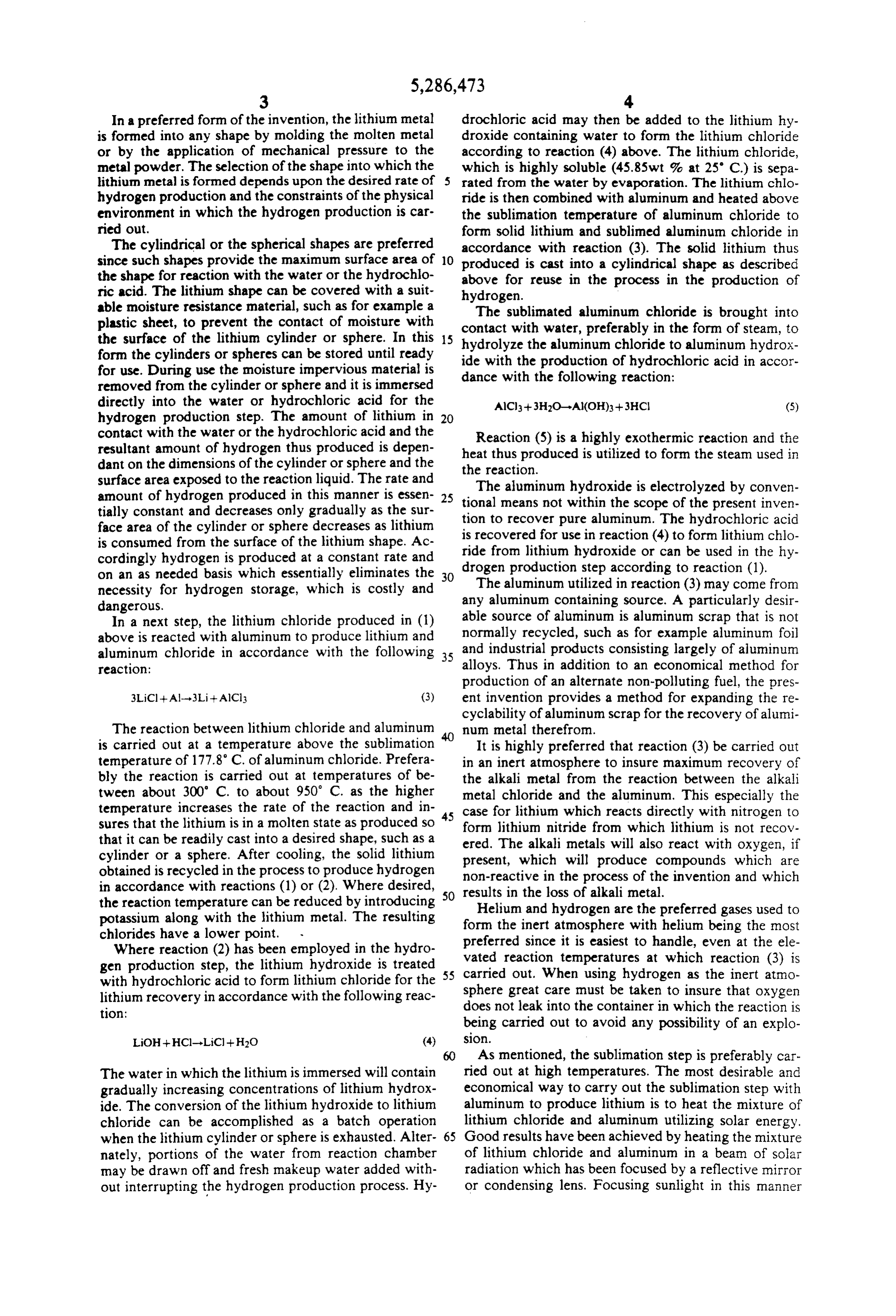
In a preferred form of the invention, the lithium metal drochloric acid may then be added to the lithium hy is formed into any shape by molding the molten metal droxide containing water to form the lithium chloride or by the application of mechanical pressure to the according to reaction (4) above. The lithium chloride, metal powder. The selection of the shape into which the which is highly soluble (45.85 wt % at 25' C.) is sepa lithium metal is formed depends upon the desired rate of 5 rated from the water by evaporation. The lithium chlo hydrogen production and the constraints of the physical ride is then combined with aluminum and heated above environment in which the hydrogen production is car the sublimation temperature of aluminum chloride to ried out. form solid lithium and sublimed aluminum chloride in The cylindrical or the spherical shapes are preferred accordance with reaction (3). The solid lithium thus since such shapes provide the maximum surface area of 10 produced is cast into a cylindrical shape as described the shape for reaction with the water or the hydrochlo above for reuse in the process in the production of ric acid. The lithium shape can be covered with a suit hydrogen.
able moisture resistance material, such as for example a The sublimated aluminum chloride is brought into plastic sheet, to prevent the contact of moisture with contact with water, preferably in the form of steam, to the surface of the lithium cylinder or sphere. In this 15 hydrolyze form the cylinders or spheres can be stored until ready ide with thetheproduction aluminum chloride to aluminum hydrox for use. During use the moisture impervious material is dance with the followingofreaction: hydrochloric acid in accor removed from the cylinder or sphere and it is immersed directly into the water or hydrochloric acid for the AlCl3-3H2O-Al(OH)3 +3HC) (5) hydrogen production step. The amount of lithium in contact with the water or the hydrochloric acid and the Reaction (5) is a highly exothermic reaction and the resultant amount of hydrogen thus produced is depen dant on the dimensions of the cylinder or sphere and the heat thus produced is utilized to form the steam used in the reaction.
surface area exposed to the reaction liquid. The rate and The aluminum hydroxide is electrolyzed by conven amount of hydrogen produced in this manner is essen 25 tional tially constant and decreases only gradually as the Sur tion tomeans not within the scope of the present inven recover pure aluminum. The hydrochloric acid face area of the cylinder or sphere decreases as lithium is recovered for use in reaction (4) to form lithium chlo is consumed from the surface of the lithium shape. Ac ride from lithium cordingly hydrogen is produced at a constant rate and drogen productionhydroxide step or can be used in the hy according to reaction (1).
on an as needed basis which essentially eliminates the necessity for hydrogen storage, which is costly and anyThe aluminum utilized in reaction (3) may come from aluminum containing source. A particularly desir dangerous.
In a next step, the lithium chloride produced in (1) able source of aluminum is aluminum scrap that is not normally recycled, such as for example aluminum foil above is reacted with aluminum to produce lithium and aluminum chloride in accordance with the following 35 and industrial products consisting largely of aluminum reaction: alloys. Thus in addition to an economical method for production of an alternate non-polluting fuel, the pres 3LiCl--Al-3Li-i-AlCl3 (3) ent invention provides a method for expanding the re cyclability of aluminum scrap for the recovery of alumi
The reaction between lithium chloride and aluminum num metal therefron.
is carried out at a temperature above the Sublimation It is highly preferred that reaction (3) be carried out temperature of 177.8°C. of aluminum chloride. Prefera in an inert atmosphere to insure maximum recovery of bly the reaction is carried out at temperatures of be the alkali metal from the reaction between the alkali tween about 300° C. to about 950 C. as the higher metal chloride and the aluminum. This especially the temperature increases the rate of the reaction and in 45 case for lithium which reacts directly with nitrogen to sures that the lithium is in a molten state as produced so form lithium nitride from which lithium is not recov that it can be readily cast into a desired shape, such as a ered. The alkali metals will also react with oxygen, if cylinder or a sphere. After cooling, the solid lithium present, which will produce compounds which are obtained is recycled in the process to produce hydrogen non-reactive in the process of the invention and which in accordance with reactions (1) or (2). Where desired, the reaction temperature can be reduced by introducing 50 results in the loss of alkali metal. Helium and hydrogen are the preferred gases used to potassium along with the lithium metal. The resulting form the inert atmosphere with helium being the most chlorides have a lower point. - preferred since it is easiest to handle, even at the ele Where reaction (2) has been employed in the hydro gen production step, the lithium hydroxide is treated 55 vated carried reaction temperatures at which reaction (3) is out. When using hydrogen as the inert atmo with hydrochloric acid to form lithium chloride for the lithium recovery in accordance with the following reac sphere great care must be taken to insure that oxygen does not leak into the container in which the reaction is tion:
being carried out to avoid any possibility of an explo
As mentioned, the sublimation step is preferably car.
The water in which the lithium is immersed will contain ried out at high temperatures. The most desirable and gradually increasing concentrations of lithium hydrox economical way to carry out the sublimation step with ide. The conversion of the lithium hydroxide to lithium aluminum to produce lithium is to heat the mixture of chloride can be accomplished as a batch operation lithium chloride and aluminum utilizing solar energy. when the lithium cylinder or sphere is exhausted. Alter 65 Good results have been achieved by heating the mixture nately, portions of the water from reaction chamber of lithium chloride and aluminum in a beam of solar may be drawn off and fresh makeup water added with radiation which has been focused by a reflective mirror out interrupting the hydrogen production process. Hy or condensing lens. Focusing sunlight in this manner
Page 4
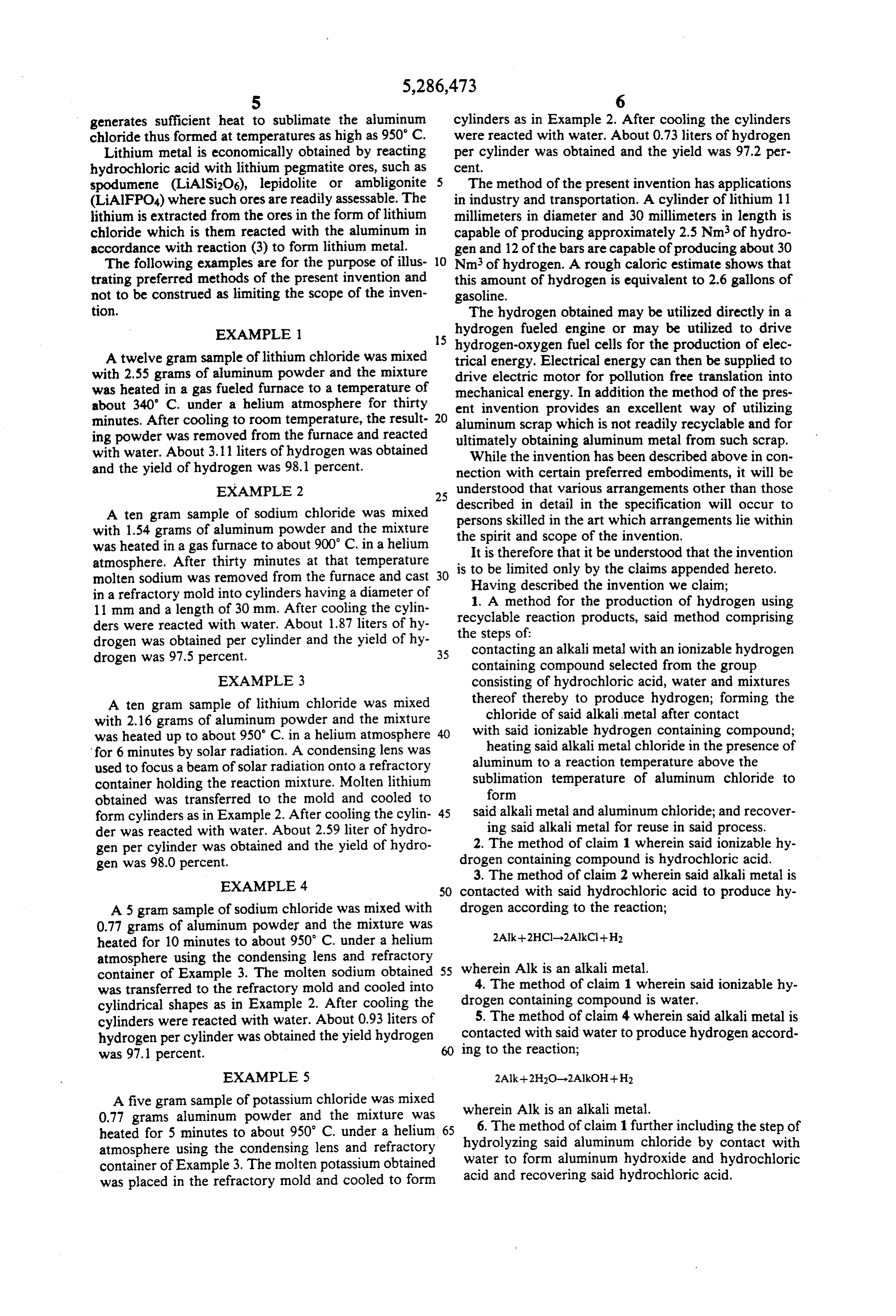
generates sufficient heat to sublimate the aluminum cylinders as in Example 2. After cooling the cylinders chloride thus formed at temperatures as high as 950 C. were reacted with water. About 0.73 liters of hydrogen Lithium metal is economically obtained by reacting per cylinder was obtained and the yield was 97.2 per hydrochloric acid with lithium pegmatite ores, such as Cent.
spodumene (LiAlSi2O6), lepidolite or ambligonite The method of the present invention has applications (LiAlHPO4) where such ores are readily assessable. The in industry and transportation. A cylinder of lithium 11 lithium is extracted from the ores in the form of lithium millimeters in diameter and 30 millimeters in length is chloride which is them reacted with the aluminum in capable of producing approximately 2.5 Nm of hydro accordance with reaction (3) to form lithium metal. gen and 12 of the bars are capable of producing about 30 The following examples are for the purpose of illus 10 Nm of hydrogen. A rough caloric estimate shows that trating preferred methods of the present invention and this amount of hydrogen is equivalent to 2.6 gallons of not to be construed as limiting the scope of the inven gasoline.
tion. The hydrogen obtained may be utilized directly in a EXAMPLE 1. hydrogen fueled engine or may be utilized to drive 5 hydrogen-oxygen fuel cells for the production of elec
A twelve gram sample of lithium chloride was mixed trical energy. Electrical energy can then be supplied to with 2.55 grams of aluminum powder and the mixture drive electric motor for pollution free translation into was heated in a gas fueled furnace to a temperature of mechanical energy. In addition the method of the pres about 340 C. under a helium atmosphere for thirty ent invention provides an excellent way of utilizing minutes. After cooling to room temperature, the result aluminum scrap which is not readily recyclable and for ing powder was removed from the furnace and reacted ultimately obtaining aluminum metal from such scrap. with water. About 3.11 liters of hydrogen was obtained While the invention has been described above in con and the yield of hydrogen was 98.1 percent. nection with certain preferred embodiments, it will be EXAMPLE 2 25 understood that various arrangements other than those A ten gram sample of sodium chloride was mixed described persons in detail in the specification will occur to skilled in the art which arrangements lie within with 1.54 grams of aluminum powder and the mixture the spirit and scope of the invention. was heated in a gas furnace to about 900 C. in a helium It is therefore that it be understood that the invention atmosphere. After thirty minutes at that temperature is to be limited only by the claims appended hereto. molten sodium was removed from the furnace and cast 30 Having described the invention we claim; in a refractory mold into cylinders having a diameter of 1. A method for the production of hydrogen using 11 mm and a length of 30 mm. After cooling the cylin recyclable ders were reacted with water. About 1.87 liters of hy the steps of:reaction products, said method comprising drogen was obtained per cylinder and the yield of hy contacting an alkali metal with an ionizable hydrogen
containing compound selected from the group
EXAMPLE 3 consisting of hydrochloric acid, water and mixtures A ten gram sample of lithium chloride was mixed thereof thereby to produce hydrogen; forming the with 2.16 grams of aluminum powder and the mixture chloride of said alkali metal after contact was heated up to about 950 C. in a helium atmosphere with said ionizable hydrogen containing compound; for 6 minutes by solar radiation. A condensing lens was heating said alkali metal chloride in the presence of used to focus a beam of solar radiation onto a refractory aluminum to a reaction temperature above the container holding the reaction mixture. Molten lithium sublimation temperature of aluminum chloride to obtained was transferred to the mold and cooled to form form cylinders as in Example 2. After cooling the cylin 45 said alkali metal and aluminum chloride; and recover der was reacted with water. About 2.59 liter of hydro ing said alkali metal for reuse in said process. gen per cylinder was obtained and the yield of hydro drogen2. The method of claim 1 wherein said ionizable hy gen was 98.0 percent. containing compound is hydrochloric acid. 3. The method of claim 2 wherein said alkali metal is
EXAMPLE 4 50 contacted with said hydrochloric acid to produce hy A 5 gram sample of sodium chloride was mixed with drogen according to the reaction; 0.77 grams of aluminum powder and the mixture was heated for 10 minutes to about 950 C. under a helium atmosphere using the condensing lens and refractory container of Example 3. The molten sodium obtained 55 wherein Alk is an alkali metal.
was transferred to the refractory mold and cooled into 4. The method of claim 1 wherein said ionizable hy cylindrical shapes as in Example 2. After cooling the drogen containing compound is water. cylinders were reacted with water. About 0.93 liters of 5. The method of claim 4 wherein said alkali metal is hydrogen per cylinder was obtained the yield hydrogen contacted with said water to produce hydrogen accord was 97.1 percent. 60 ing to the reaction;
EXAMPLE 5
A five gram sample of potassium chloride was mixed 0.77 grams aluminum powder and the mixture was 65 wherein 6. The
Alk is an alkali metal.
method of claim 1 further including the step of heated for 5 minutes to about 950 C. under a helium.
atmosphere using the condensing lens and refractory hydrolyzing water to said aluminum chloride by contact with form aluminum hydroxide and hydrochloric container of Example 3. The molten potassium obtained was placed in the refractory mold and cooled to form acid and recovering said hydrochloric acid.
Page 5
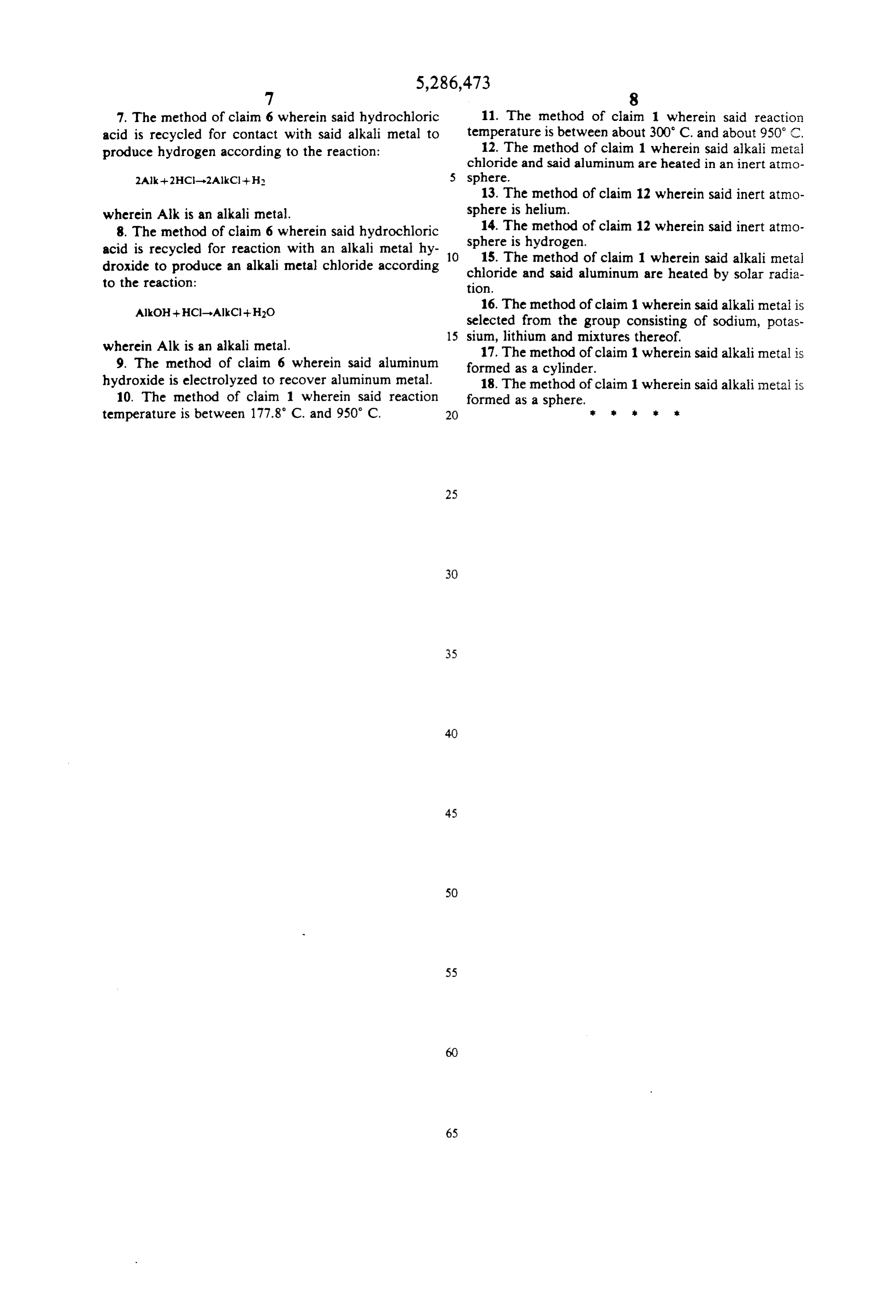
7. The method of claim 6 wherein said hydrochloric 11. The method of claim 1 wherein said reaction acid is recycled for contact with said alkali metal to temperature is between about 300 C. and about 950° C. produce hydrogen according to the reaction: 12. The method of claim 1 wherein said alkali metal chloride and said aluminum are heated in an inert atmo sphere.
13. The method of claim 12 wherein said inert atmo wherein Alk is an alkali metal. sphere is helium.
8. The method of claim 6 wherein said hydrochloric 14. The method of claim 12 wherein said inert atmo sphere is hydrogen.
acid is recycled for reaction with an alkali metal hy 10 15. The method of claim 1 wherein said alkali metal droxide to produce an alkali metal chloride according chloride and said aluminum are heated by solar radia to the reaction: t1O.
Alkoh-i-HCl-AlkC-H2O 16. The method of claim 1 wherein said alkali metal is selected from the group consisting of sodium, potas 15 sium, lithium and mixtures thereof.
wherein Alk is an alkali metal. 17. The method of claim 1 wherein said alkali metal is 9. The method of claim 6 wherein said aluminum formed as a cylinder.
hydroxide is electrolyzed to recover aluminum metal. 18. The method of claim 1 wherein said alkali metal is 10. The method of claim 1 wherein said reaction formed as a sphere.
temperature is between 177.8 C. and 950° C. 20 k
Provenance
- Collection
- Cited prior art
- Original PDF
- patentimages.storage.googleapis.com →
- Filed
- 1993-02-01
- Pages
- 5
- Method
- pdftotext (the PDF's own text layer) + pdftoppm 300dpi page scans
- Source
- Google Patents bibliographic record
- Granted
- 1994-02-15
- Inventors
- Nobuyasu Hasebe; Nobukatsu Hasebe
- Transcribed from
- patentimages.storage.googleapis.com →