patent · US4356163
Process for the production of hydrogen
26 October 1982
Page 1 — bibliographic record
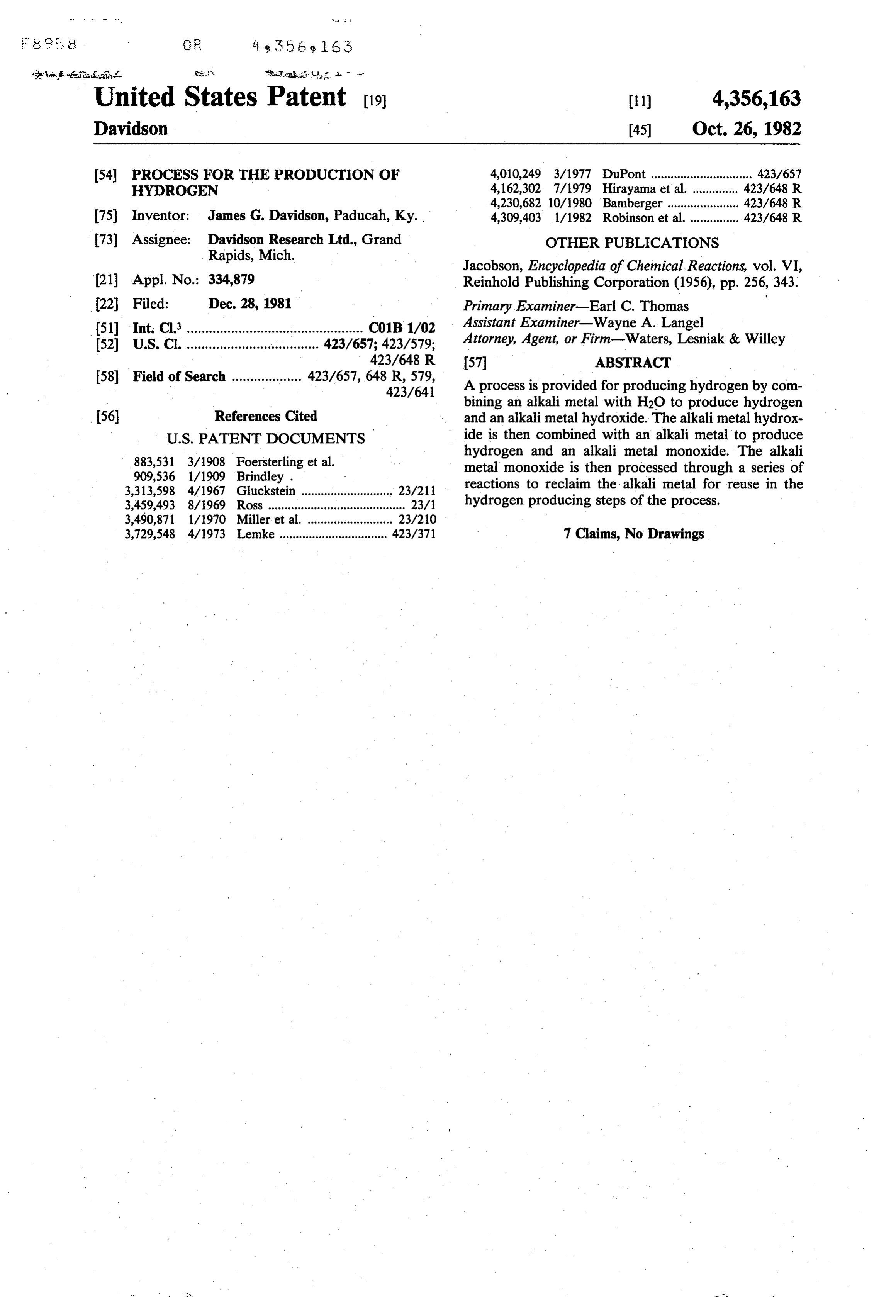
United States Patent 19 (11) 4,356,163 Davidson 45) Oct. 26, 1982 (54) PROCESS FOR THE PRODUCTION OF 4,010,249 3/1977 DuPont ............................... 423/657 HYDROGEN 4,162,302 7/1979 Hirayama et al. .............. 423/648 R
75 Inventor: James G. Davidson, Paducah, Ky. 4,309,403 1/1982 Robinson et al. ............... 423/648 R 73 Assignee: Davidson Research Ltd., Grand OTHER PUBLICATIONS Rapids, Mich.
Jacobson, Encyclopedia of Chemical Reactions, vol. VI, 21 Appl. No.: 334,879 Reinhold Publishing Corporation (1956), pp. 256,343. 22 Filed: Dec. 28, 1981 Primary Examiner-Earl C. Thomas 51) Int. Cl'................................................ C01B 1/02 Assistant Examiner-Wayne A. Langel 52 U.S. C. .................................... 423/657; 423/579; Attorney, Agent, or Firm-Waters, Lesniak & Willey
58 Field of Search ................... 423/657, 648 R, 579, A process is provided for producing hydrogen by com
bining an alkali metal with H2O to produce hydrogen 56) References Cited and an alkali metal hydroxide. The alkali metal hydrox
hydrogen and an alkali metal monoxide. The alkali 909,536 1/1909 Brindley . metal monoxide is then processed through a series of 3,313,598 4/1967 Gluckstein ............................ 23/21 reactions to reclaim the alkali metal for reuse in the 3,459,493 8/1969 Ross .......................................... 23/1 hydrogen producing steps of the process. 3,490,871 1/1970 Miller et al. .. ... 23/20 3,729,548 4/1973 Lemke ................................. 423/371 7 Claims, No Drawings
Page 2
to either the first or the second reaction zones for use in
PROCESS FOR THE PRODUCTION OF the first and second reactions.
HYDROGEN A beneficial feature of the above sequence of reac tions is that all of the reactions except the reaction in the
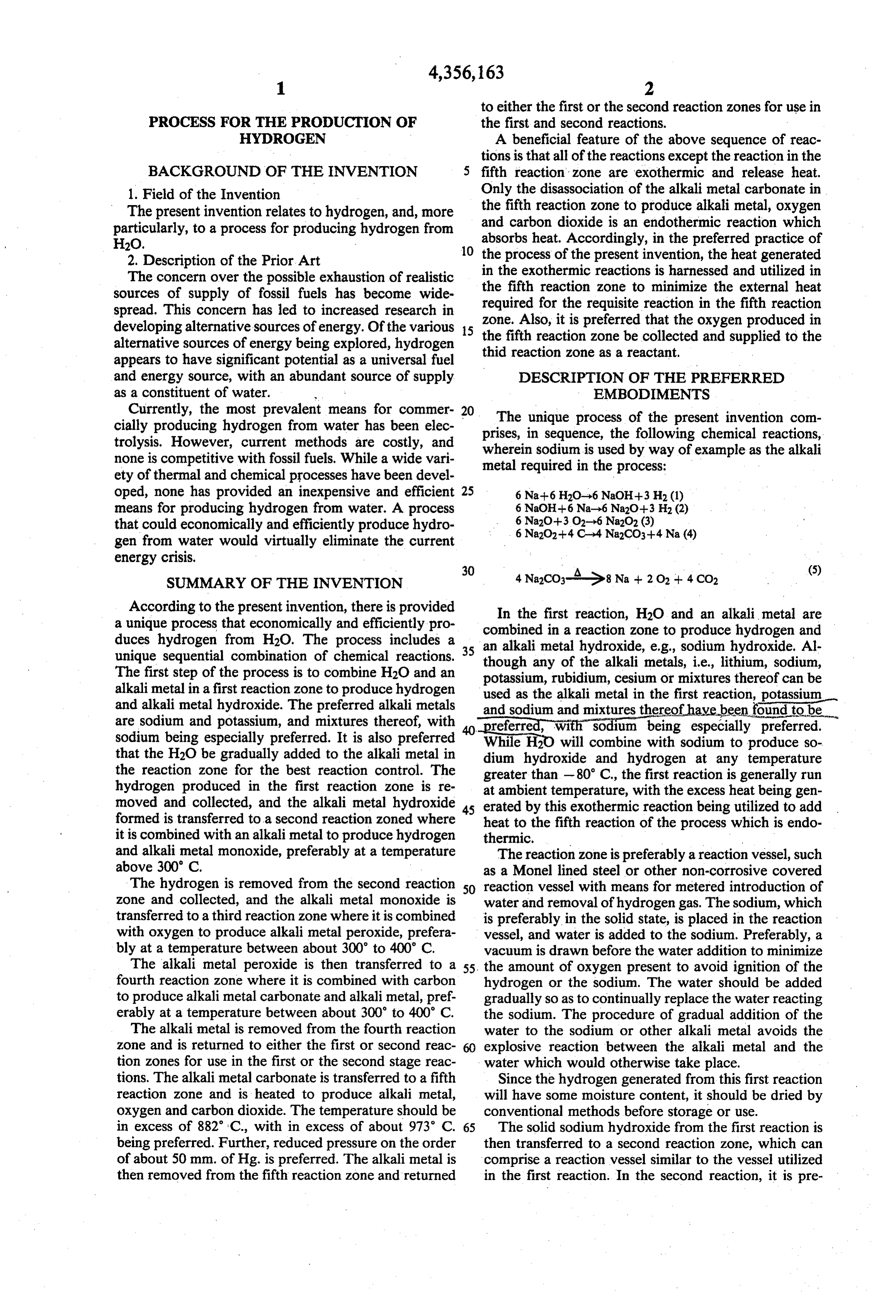
BACKGROUND OF THE INVENTION 5 fifth reaction zone are exothermic and release heat. 1. Field of the Invention Only the disassociation of the alkali metal carbonate in The present invention relates to hydrogen, and, more the fifth reaction zone to produce alkali metal, oxygen particularly, to a process for producing hydrogen from and carbon dioxide is an endothermic reaction which H2O. absorbs heat. Accordingly, in the preferred practice of 10 the process of the present invention, the heat generated 2. Description of the Prior Art in the exothermic reactions is harnessed and utilized in The concern over the possible exhaustion of realistic the fifth reaction zone to minimize the external heat sources of supply of fossil fuels has become wide required for the requisite reaction in the fifth reaction spread. This concern has led to increased research in zone. Also, it is preferred that the oxygen produced in developing alternative sources of energy. Of the various 15 the fifth reaction zone be collected and supplied to the alternative sources of energy being explored, hydrogen appears to have significant potential as a universal fuel thid reaction zone as a reactant.
and energy source, with an abundant source of supply DESCRIPTION OF THE PREFERRED as a constituent of water. w EMBODIMENTS Currently, the most prevalent means for commer 20 The unique process of the present invention com cially producing hydrogen from water has been elec prises, trolysis. However, current methods are costly, and whereininsodium sequence, the following chemical reactions, none is competitive with fossil fuels. While a wide vari metal required inisthe used by way of example as the alkali process:
ety of thermal and chemical processes have been devel oped, none has provided an inexpensive and efficient 25 6 Na-6H2O-6 NaOH-3H (1) means for producing hydrogen from water. A process 6 NaOH-6 Na--6 Na2O+3 Hz (2) that could economically and efficiently produce hydro 6 Na2O+3 O-6 Na2O, (3)
gen from water would virtually eliminate the current energy crisis. 5
SUMMARY OF THE INVENTION 4 Na2CO3-A >8 Na+ 2 O. 4- 4 CO, (5) According to the present invention, there is provided In the first reaction, H2O and an alkali metal are a unique process that economically and efficiently pro combined in a reaction zone to produce hydrogen and duces hydrogen from H2O. The process includes a 35 an alkali metal unique sequential combination of chemical reactions. though any of hydroxide, the alkali e.g., sodium hydroxide. Al metals, i.e., lithium, sodium,
The first step of the process is to combine H2O and an potassium, rubidium, cesium or mixtures thereof can be alkali metal in a first reaction zone to produce hydrogen used as the alkali metal in the first reaction, potassium and alkali metal hydroxide. The preferred alkali metals and sodium and mixtures thereofhave been found tobe. are sodium and potassium, and mixtures thereof, with sodium being especially preferred. It is also preferred preferred, with sodium being b. especially preferred. While H2O will combine with sodium to produce so that the H2O be gradually added to the alkali metal in dium hydroxide and hydrogen at any temperature the reaction zone for the best reaction control. The greater than -80 C., the first reaction is generally run hydrogen produced in the first reaction zone is re at ambient temperature, with the excess heat being gen moved and collected, and the alkali metal hydroxide 45 erated by this exothermic reaction being utilized to add formed is transferred to a second reaction zoned where heat to the fifth reaction of the process which is endo it is combined with an alkali metal to produce hydrogen thermic. m and alkali metal monoxide, preferably at a temperature The reaction zone is preferably a reaction vessel, such above 300' C. as a Monel lined steel or other non-corrosive covered The hydrogen is removed from the second reaction 50 reaction vessel with means for metered introduction of Zone and collected, and the alkali metal monoxide is water and removal of hydrogen gas. The sodium, which transferred to a third reaction zone where it is combined is preferably in the solid state, is placed in the reaction with oxygen to produce alkali metal peroxide, prefera vessel, and water is added to the sodium. Preferably, a bly at a temperature between about 300 to 400° C. vacuum is drawn before the water addition to minimize The alkali metal peroxide is then transferred to a 55. the amount of oxygen present to avoid ignition of the fourth reaction zone where it is combined with carbon hydrogen or the sodium. The water should be added to produce alkali metal carbonate and alkali metal, pref. gradually so as to continually replace the water reacting erably at a temperature between about 300' to 400° C. the sodium. The procedure of gradual addition of the The alkali metal is removed from the fourth reaction water to the sodium or other alkali metal avoids the zone and is returned to either the first or second reac explosive reaction between the alkali metal and the tion zones for use in the first or the second stage reac water which would otherwise take place. tions. The alkali metal carbonate is transferred to a fifth Since the hydrogen generated from this first reaction reaction zone and is heated to produce alkali metal, will have some moisture content, it should be dried by oxygen and carbon dioxide. The temperature should be conventional methods before storage or use. in excess of 882 C., with in excess of about 973 C. 65 The solid sodium hydroxide from the first reaction is being preferred. Further, reduced pressure on the order then transferred to a second reaction zone, which can of about 50 mm. of Hg. is preferred. The alkali metal is comprise a reaction vessel similar to the vessel utilized then removed from the fifth reaction zone and returned in the first reaction. In the second reaction, it is pre
Page 3
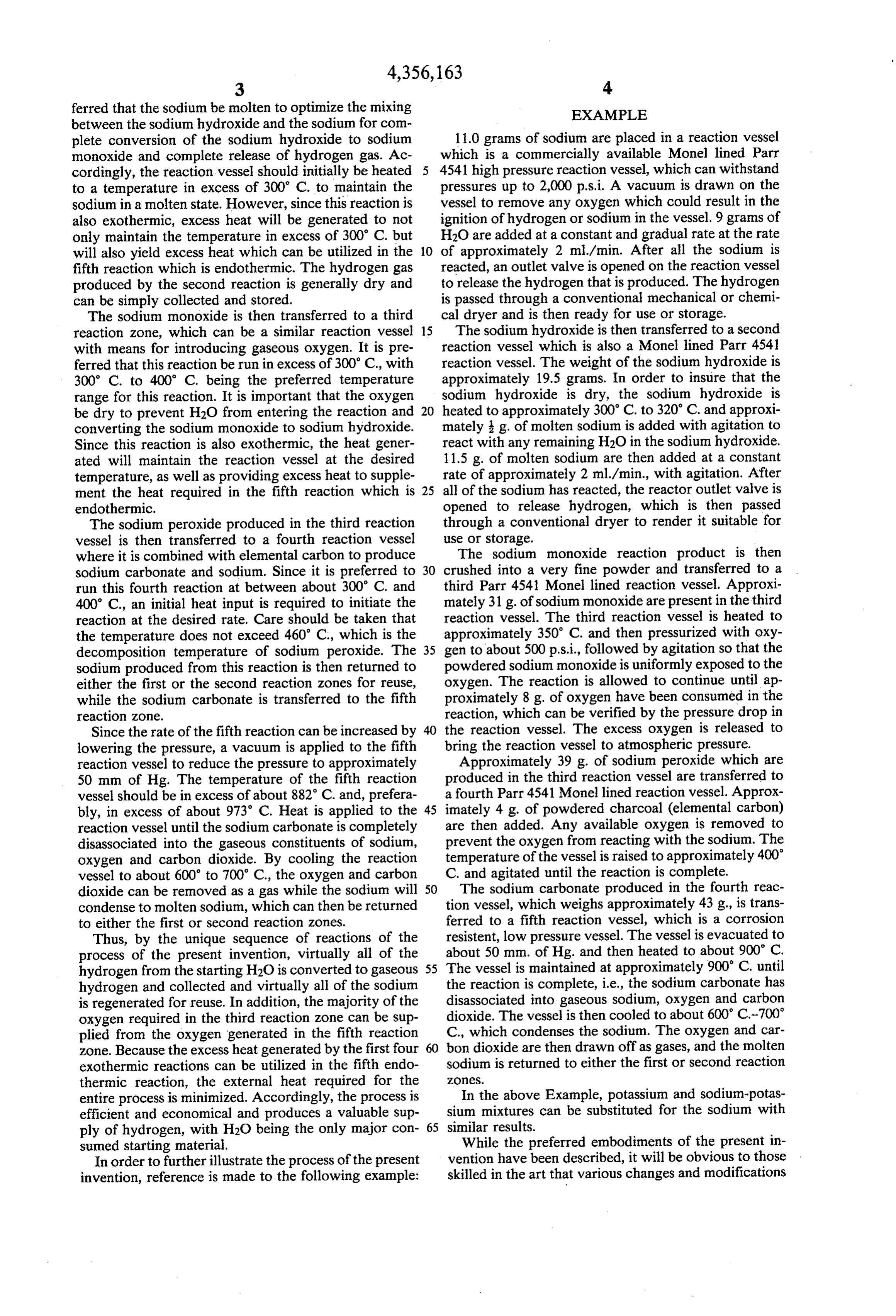
ferred that the sodium be molten to optimize the mixing EXAMPLE between the sodium hydroxide and the sodium for com plete conversion of the sodium hydroxide to sodium 11.0 grams of sodium are placed in a reaction vessel monoxide and complete release of hydrogen gas. Ac which is a commercially available Monel lined Parr cordingly, the reaction vessel should initially be heated 4541 high pressure reaction vessel, which can withstand to a temperature in excess of 300° C. to maintain the pressures up to 2,000 p.s. i. A vacuum is drawn on the sodium in a molten state. However, since this reaction is vessel to remove any oxygen which could result in the also exothermic, excess heat will be generated to not ignition of hydrogen or sodium in the vessel. 9 grams of only maintain the temperature in excess of 300° C. but H2O are added at a constant and gradual rate at the rate will also yield excess heat which can be utilized in the 10 of approximately 2 ml/min. After all the sodium is fifth reaction which is endothermic. The hydrogen gas reacted, an outlet valve is opened on the reaction vessel produced by the second reaction is generally dry and to release the hydrogen that is produced. The hydrogen can be simply collected and stored. is passed through a conventional mechanical or chemi The sodium monoxide is then transferred to a third cal dryer and is then ready for use or storage. reaction zone, which can be a similar reaction vessel 15 The sodium hydroxide is then transferred to a second with means for introducing gaseous oxygen. It is pre reaction vessel which is also a Monel lined Parr 4541 ferred that this reaction be run in excess of 300' C., with reaction vessel. The weight of the sodium hydroxide is 300° C. to 400 C. being the preferred temperature approximately 19.5 grams. In order to insure that the range for this reaction. It is important that the oxygen sodium hydroxide is dry, the sodium hydroxide is be dry to prevent H2O from entering the reaction and 20 heated to approximately 300° C. to 320° C. and approxi converting the sodium monoxide to sodium hydroxide. mately . g. of molten sodium is added with agitation to Since this reaction is also exothermic, the heat gener react with any remaining H2O in the sodium hydroxide. ated will maintain the reaction vessel at the desired 11.5 g. of molten sodium are then added at a constant temperature, as well as providing excess heat to supple rate of approximately 2 ml./min., with agitation. After ment the heat required in the fifth reaction which is 25 all of the sodium has reacted, the reactor outlet valve is endothermic. opened to release hydrogen, which is then passed The sodium peroxide produced in the third reaction through a conventional dryer to render it suitable for vessel is then transferred to a fourth reaction vessel use or storage.
where it is combined with elemental carbon to produce The sodium monoxide reaction product is then sodium carbonate and sodium. Since it is preferred to 30 crushed into a very fine powder and transferred to a run this fourth reaction at between about 300 C. and third Parr 4541 Monel lined reaction vessel. Approxi 400° C., an initial heat input is required to initiate the mately 31 g. of sodium monoxide are present in the third reaction at the desired rate. Care should be taken that reaction vessel. The third reaction vessel is heated to the temperature does not exceed 460 C., which is the approximately 350° C. and then pressurized with oxy decomposition temperature of sodium peroxide. The 35 gen to about 500 p.s. i., followed by agitation so that the sodium produced from this reaction is then returned to powdered sodium monoxide is uniformly exposed to the either the first or the second reaction zones for reuse, oxygen. The reaction is allowed to continue until ap while the sodium carbonate is transferred to the fifth proximately 8 g. of oxygen have been consumed in the reaction zone. reaction, which can be verified by the pressure drop in Since the rate of the fifth reaction can be increased by the reaction vessel. The excess oxygen is released to lowering the pressure, a vacuum is applied to the fifth bring the reaction vessel to atmospheric pressure. reaction vessel to reduce the pressure to approximately Approximately 39 g of sodium peroxide which are 50 mm of Hg. The temperature of the fifth reaction produced in the third reaction vessel are transferred to vessel should be in excess of about 882 C. and, prefera a fourth Parr 4541 Monel lined reaction vessel. Approx bly, in excess of about 973 C. Heat is applied to the 45 imately 4 g. of powdered charcoal (elemental carbon) reaction vessel until the sodium carbonate is completely are then added. Any available oxygen is removed to disassociated into the gaseous constituents of sodium, prevent the oxygen from reacting with the sodium. The oxygen and carbon dioxide. By cooling the reaction temperature of the vessel is raised to approximately 400 vessel to about 600 to 700 C., the oxygen and carbon C. and agitated until the reaction is complete. dioxide can be removed as a gas while the sodium will 50 The sodium carbonate produced in the fourth reac condense to molten sodium, which can then be returned tion vessel, which weighs approximately 43 g., is trans to either the first or second reaction zones. ferred to a fifth reaction vessel, which is a corrosion Thus, by the unique sequence of reactions of the resistent, low pressure vessel. The vessel is evacuated to process of the present invention, virtually all of the about 50 mm. of Hg. and then heated to about 900 C. hydrogen from the starting H2O is converted to gaseous 55 The vessel is maintained at approximately 900 C. until hydrogen and collected and virtually all of the sodium the reaction is complete, i.e., the sodium carbonate has is regenerated for reuse. In addition, the majority of the disassociated into gaseous sodium, oxygen and carbon oxygen required in the third reaction zone can be sup dioxide. The vessel is then cooled to about 600 C.-700 plied from the oxygen generated in the fifth reaction C., which condenses the sodium. The oxygen and car zone. Because the excess heat generated by the first four bon dioxide are then drawn off as gases, and the molten exothermic reactions can be utilized in the fifth endo sodium is returned to either the first or second reaction thermic reaction, the external heat required for the ZOS.
entire process is minimized. Accordingly, the process is In the above Example, potassium and sodium-potas efficient and economical and produces a valuable sup sium mixtures can be substituted for the sodium with ply of hydrogen, with H2O being the only major con 65 similar results.
sumed starting material. While the preferred embodiments of the present in In order to further illustrate the process of the present vention have been described, it will be obvious to those invention, reference is made to the following example: skilled in the art that various changes and modifications
Page 4
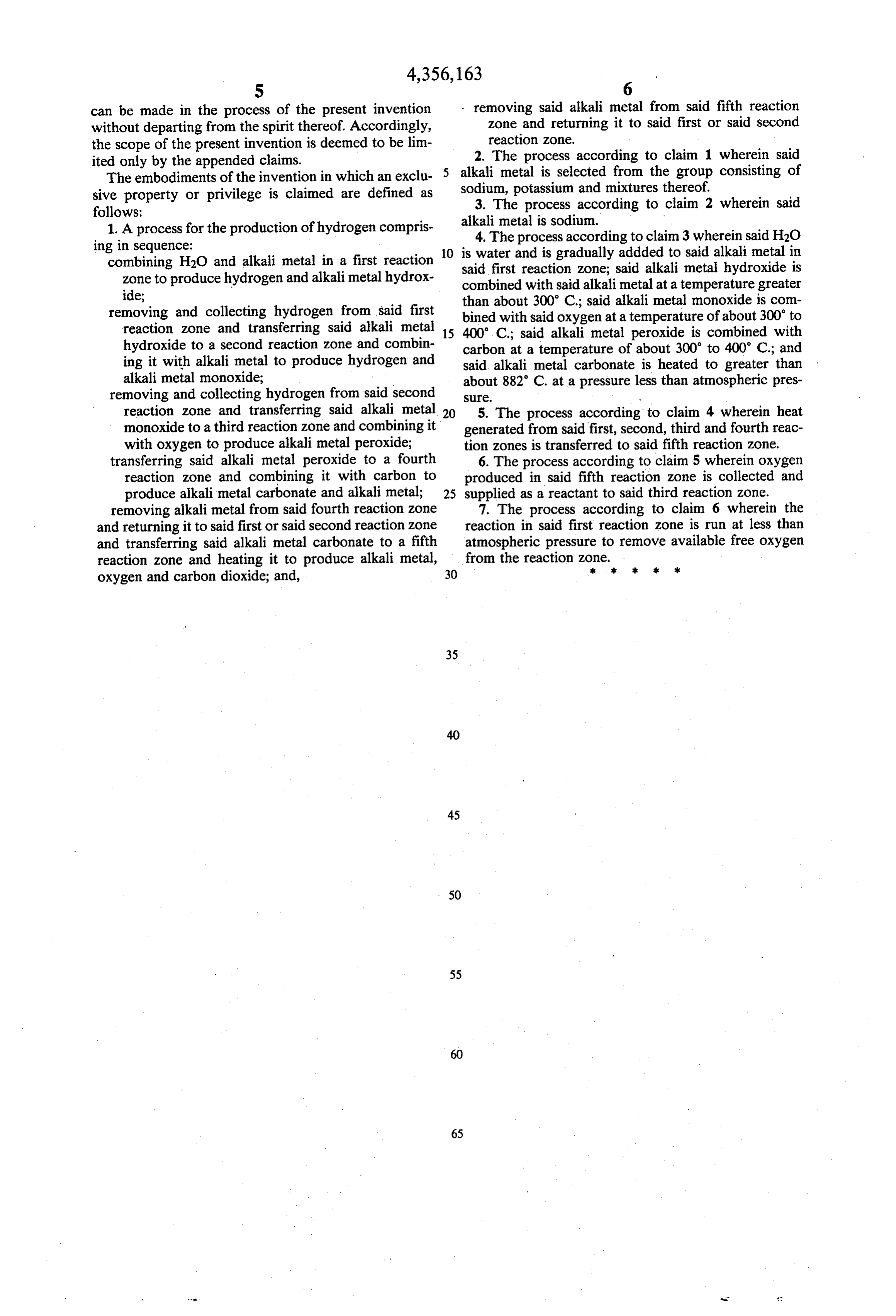
can be made in the process of the present invention - removing said alkali metal from said fifth reaction without departing from the spirit thereof. Accordingly, zone and returning it to said first or said second the scope of the present invention is deemed to be lim reaction zone.
ited only by the appended claims. 2. The process according to claim 1 wherein said The embodiments of the invention in which an exclu 5 alkali metal is selected from the group consisting of sive property or privilege is claimed are defined as sodium, potassium and mixtures thereof. 3. The process according to claim 2 wherein said follows:
1. A process for the production of hydrogen compris alkali metal is sodium.
4. The process according to claim3 wherein said H2O ing in sequence:
combining H2O and alkali metal in a first reaction 10 issaidwater and is gradually addded to said alkali metal in first reaction zone; said alkali metal hydroxide is zone to produce hydrogen and alkali metal hydrox combined with said alkalimetal at a temperature greater ide; than about 300 C.; said alkali metal monoxide is com removing and collecting hydrogen from said first bined with said oxygen at a temperature of about 300' to reaction zone and transferring said alkali metal 15 400 C.; said alkali metal peroxide is combined with hydroxide to a second reaction zone and combin carbon at a temperature of about 300' to 400 C.; and ing it with alkali metal to produce hydrogen and said alkali metal carbonate is heated to greater than alkali metal monoxide; about 882 C. at a pressure less than atmospheric pres removing and collecting hydrogen from said second SUTC.
reaction zone and transferring said alkali metal 20 5. The process according to claim 4 wherein heat monoxide to a third reaction zone and combining it generated from said first, second, third and fourth reac with oxygen to produce alkali metal peroxide; tion zones is transferred to said fifth reaction zone. transferring said alkali metal peroxide to a fourth 6. The process according to claim 5 wherein oxygen reaction zone and combining it with carbon to produced in said fifth reaction zone is collected and produce alkali metal carbonate and alkali metal; 25 supplied as a reactant to said third reaction zone. removing alkali metal from said fourth reaction zone 7. The process according to claim 6 wherein the and returning it to said first or said second reaction zone reaction in said first reaction zone is run at less than and transferring said alkali metal carbonate to a fifth atmospheric pressure to remove available free oxygen reaction zone and heating it to produce alkali metal, from the reaction zone. k k sk s k oxygen and carbon dioxide; and, 30
Provenance
- Collection
- Cited prior art
- Original PDF
- patentimages.storage.googleapis.com →
- Filed
- 1981-12-28
- Pages
- 4
- Method
- pdftotext (the PDF's own text layer) + pdftoppm 300dpi page scans
- Source
- Google Patents bibliographic record
- Granted
- 1982-10-26
- Inventors
- James G. Davidson; Davidson Research Ltd
- Transcribed from
- patentimages.storage.googleapis.com →