patent · US5248566
Fuel cell system for transportation applications
28 September 1993
Page 1 — bibliographic record
United States Patent (19) 11 Patent Number: 5,248,566 Kumar et al. 45 Date of Patent: Sep. 28, 1993 54 FUEL CELL SYSTEM FOR ered Vehicles: Some Design Considerations', 1990 Fuel TRANSPORTATION APPLICATIONS Cell Seminar, Nov. 25-28, 1990.
(75) Inventors: Romesh Kumar, Naperville; Shabbir Lemons R., "Fuel Cells For Transportation', Journal Ahmed, Evanston; Michael Krumpelt, of Power Sources, Jan. 1990, pp. 251-264.
Naperville; Kevin M. Myles, Primary Examiner-Prince Willis, Jr.
Downers Grove, all of Ill. Assistant Examiner-M. Nuzzolillo (73) Assignee: The United States of America as Attorney, Agent, or Firm-Mark P. Dvorscak; Robert J. represented by the United States Fisher; William R. Moser
Department of Energy, Washington, (57) ABSTRACT
D.C. A propulsion system for a vehicle having pairs of front (21) Appl. No.: 796,973 and rear wheels and a fuel tank. An electrically driven motor having an output shaft operatively connected to (22 Filed: Nov. 25, 1991 at least one of said pair of wheels is connected to a fuel 51) Int. Cl. .............................................. H01M 8/14 cell having a positive electrode and a negative electrode 52) U.S. Cl. ........................................ 429/19; 429/17; separated by an electrolyte for producing dc power to 429/20, 180/65.3 operate the motor. A partial oxidation reformer is con 58) Field of Search ............................. 429/17, 19, 20; nected both to the fuel tank and to the fuel cell receives 180/65.3 hydrogen-containing fuel from the fuel tank and water and air and for partially oxidizing and reforming the (56) References Cited fuel with water and air in the presence of an oxidizing
4,365,006 12/1982 Baker .................................... 429/17 gen-containing gas. The hydrogen-containing gas is 4,716,859 1/1988 Konig et al. . sent from the partial oxidation reformer to the fuel cell 4,988,580 1/1991 Ohsaki et al. . negative electrode while air is transported to the fuel 4,999,993 3/1991 Rao . cell positive electrode to produce dc power for operat ing the electric motor.
OTHER PUBLICATIONS
Kumar et al., "Methanol Reformers for Fuel Cell Pow 23 Claims, 3 Drawing Sheets
WATER
AIR
FUEL
WATER
FUEL
PARTIAL OXIDATION REFORMER
AIR
Fu CELL
Page 2
Drawing sheet — no readable text.
Page 3
Drawing sheet — no readable text.
Page 4
Drawing sheet — no readable text.
Page 5
oxidizing and reforming mixtures of water, air and fuel
FUEL CELL SYSTEM FORTRANSPORTATION into a hydrogen-containing gas.
APPLICATIONS The invention, in one aspect, combines a particular oxidation reformer with a fuel cell for using the hydro
CONTRACTUAL ORIGIN OF THE INVENTION 5 gen-containing gas put out by the partial oxidation re former and air to produce dc power which operates an
The U.S. Government has rights in this invention electric pursuant to Contract No. W-31-109-ENG-38 between motor in a transportation vehicle. the U.S. Department of Energy and The University of oxidation another
In yet reformer aspect of the invention, the partial is provided with a third zone hold
Chicago representing Argonne National Laboratory. O ing either an oxidation catalyst or a methanation cata BACKGROUND OF THE INVENTION lyst for converting any carbon monoxide present re Fuel cells are being developed for use in automotive spectively
into carbon dioxide or methane.
another aspect of the invention, an afterburner unit propulsion systems as alternatives for the internal com is used in connection with the exhaust gases from the bustion engine in buses, vans, and passenger cars. The 15 negative electrode of the fuel cell to convert remaining major motivations for developing fuel cell powered hydrogen to heat and water.
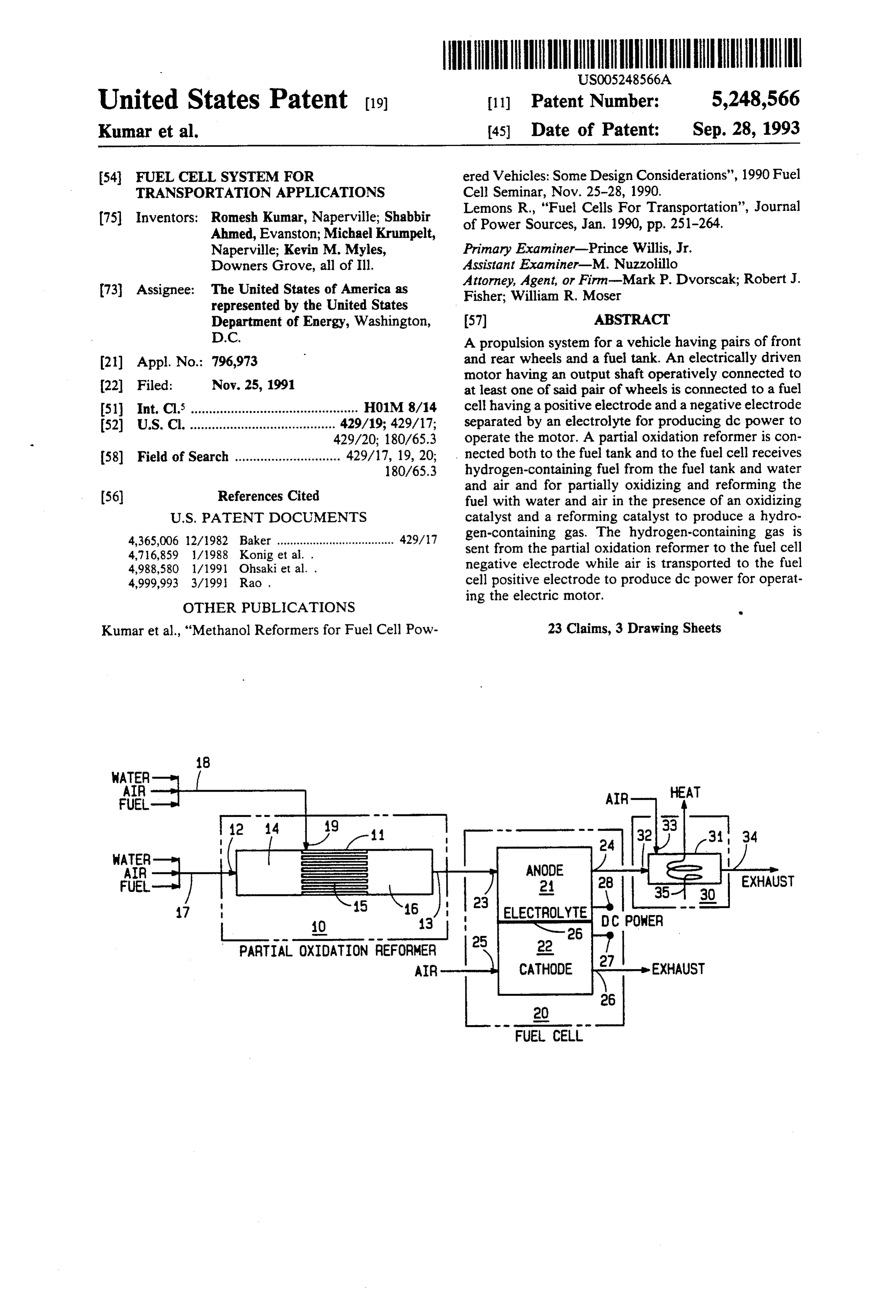
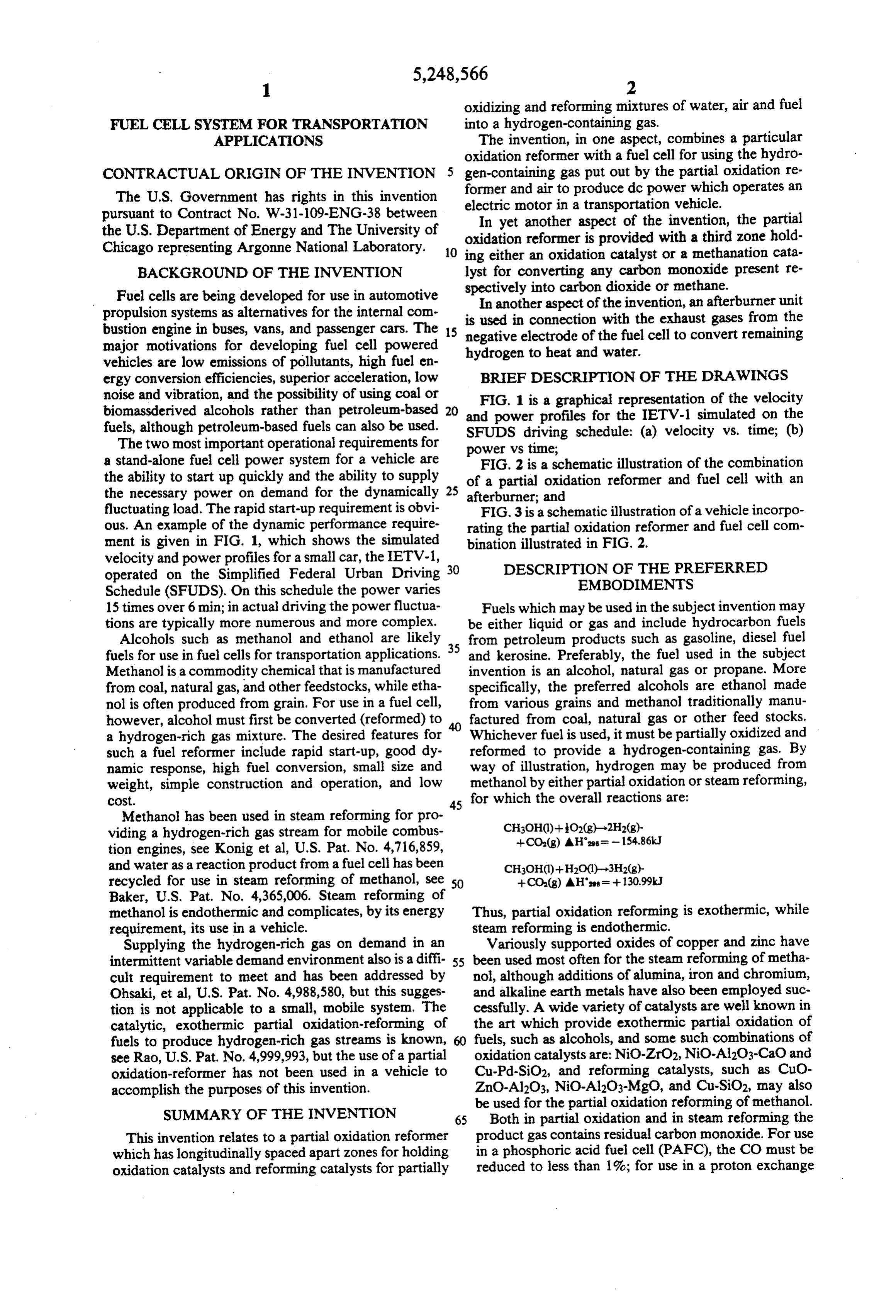
vehicles are low emissions of pollutants, high fuel en ergy conversion efficiencies, superior acceleration, low BRIEF DESCRIPTION OF THE DRAWINGS noise and vibration, and the possibility of using coal or FIG. 1 is a graphical representation of the velocity biomassderived alcohols rather than petroleum-based 20 and power profiles for the IETV-1 simulated on the fuels, although petroleum-based fuels can also be used. SFUDS driving schedule: (a) velocity vs. time; (b) The two most important operational requirements for power vs time;
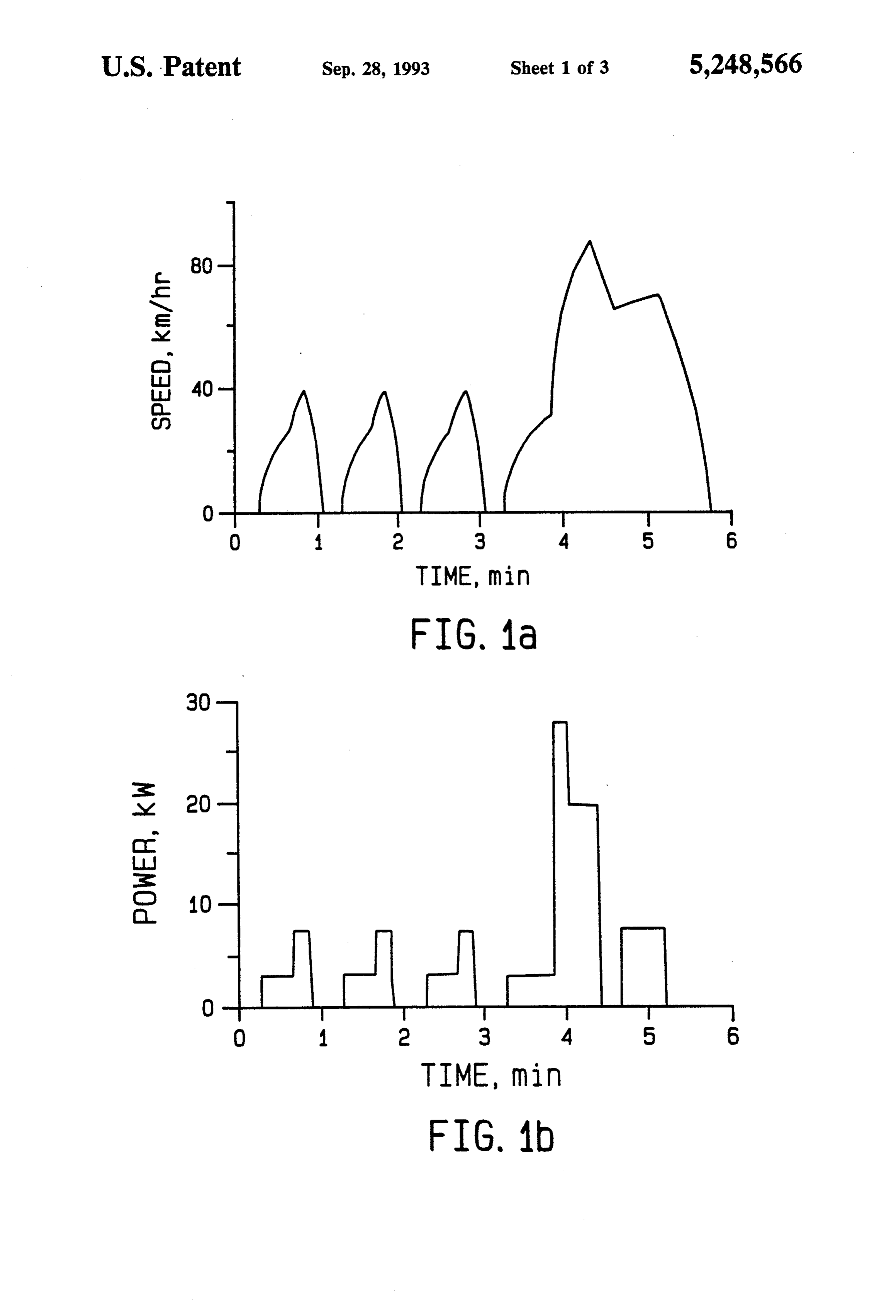
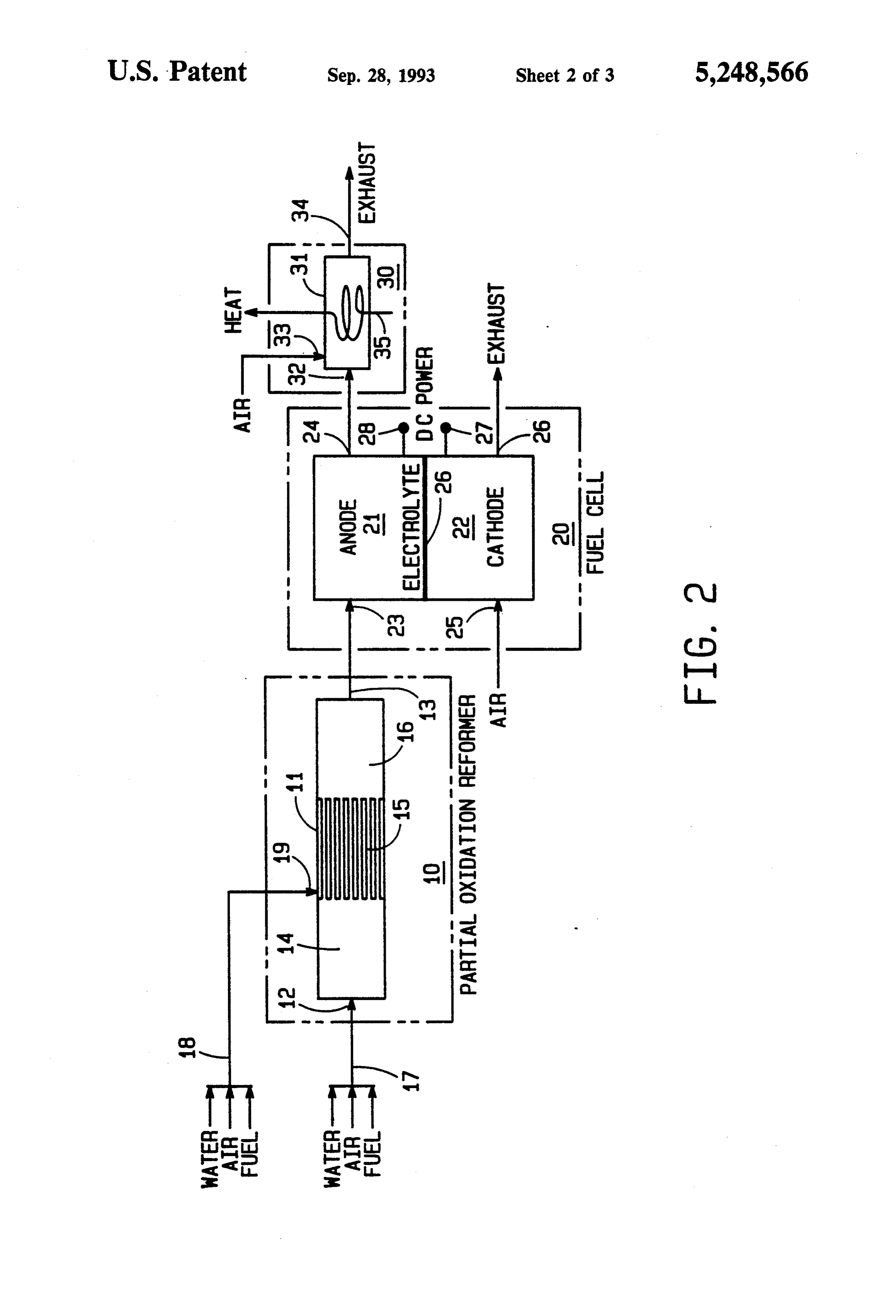
a stand-alone fuel cell power system for a vehicle are FIG. 2 is a schematic illustration of the combination the ability to start up quickly and the ability to supply of a partial oxidation reformer and fuel cell with an the necessary power on demand for the dynamically 25 fluctuating load. The rapid start-up requirement is obvi afterburner; and
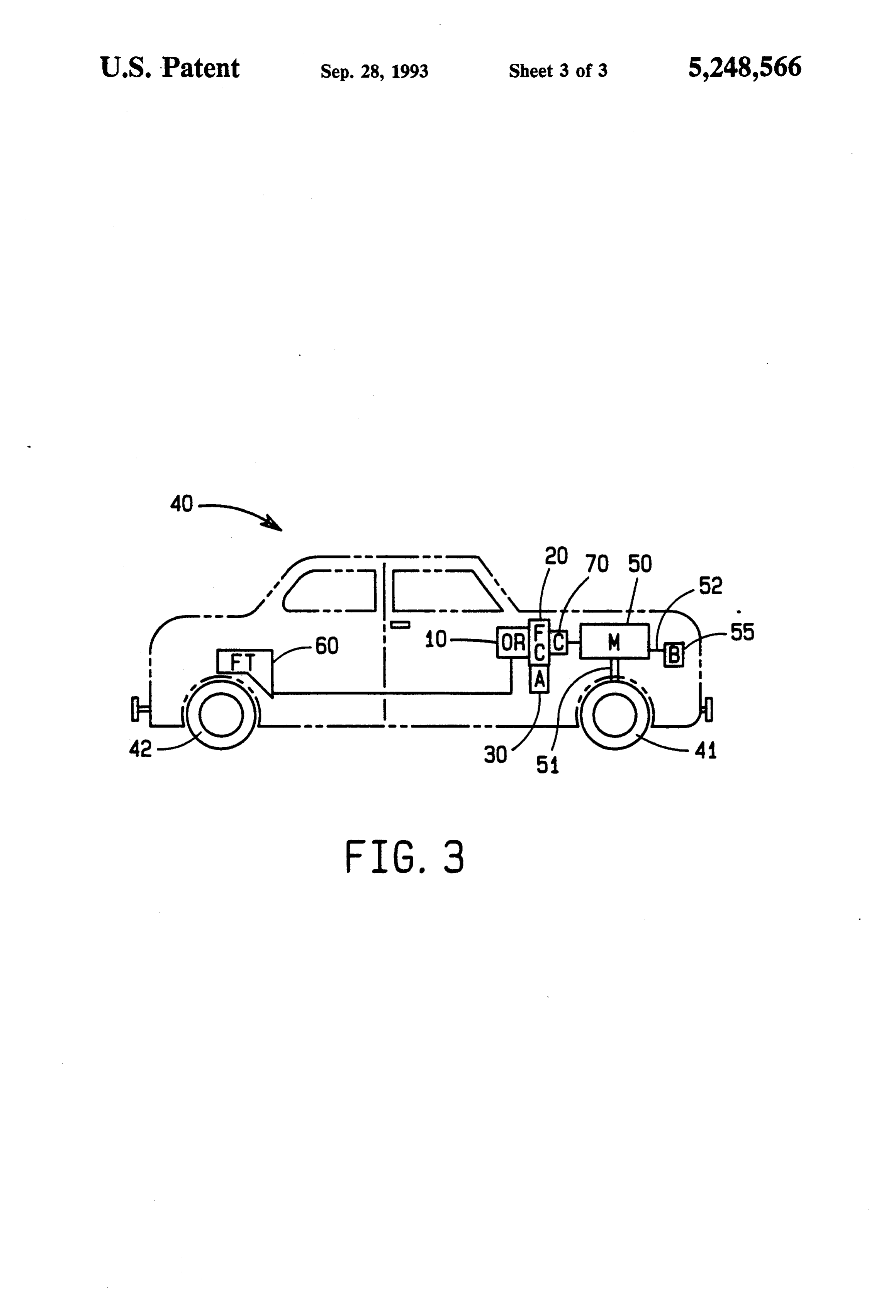
FIG. 3 is a schematic illustration of a vehicle incorpo ous. An example of the dynamic performance require rating the partial oxidation reformer and fuel cell com ment is given in FIG. 1, which shows the simulated bination illustrated in FIG. 2.
velocity and power profiles for a small car, the IETV-1, DESCRIPTION OF THE PREFERRED operated on the Simplified Federal Urban Driving 30 EMBODIMENTS Schedule (SFUDS). On this schedule the power varies 15 times over 6 min; in actual driving the power fluctua Fuels which may be used in the subject invention may tions are typically more numerous and more complex. be either liquid or gas and include hydrocarbon fuels Alcohols such as methanol and ethanol are likely from petroleum products such as gasoline, diesel fuel fuels for use in fuel cells for transportation applications. ' and kerosine. Preferably, the fuel used in the subject Methanol is a commodity chemical that is manufactured invention is an alcohol, natural gas or propane. More from coal, natural gas, and other feedstocks, while etha specifically, the preferred alcohols are ethanol made nol is often produced from grain. For use in a fuel cell, from various grains and methanol traditionally manu however, alcohol must first be converted (reformed) to factured from coal, natural gas or other feed stocks. a hydrogen-rich gas mixture. The desired features for Whichever fuel is used, it must be partially oxidized and such a fuel reformer include rapid start-up, good dy reformed to provide a hydrogen-containing gas. By namic response, high fuel conversion, small size and way of illustration, hydrogen may be produced from weight, simple construction and operation, and low methanol by either partial oxidation or steam reforming, COSt. 45 for which the overall reactions are: Methanol has been used in steam reforming for pro viding a hydrogen-rich gas stream for mobile combus tion engines, see Konig et al, U.S. Pat. No. 4,716,859, and water as a reaction product from a fuel cell has been recycled for use in steam reforming of methanol, see so
Baker, U.S. Pat. No. 4,365,006. Steam reforming of methanol is endothermic and complicates, by its energy Thus, partial oxidation reforming is exothermic, while requirement, its use in a vehicle. steam reforming is endothermic. Supplying the hydrogen-rich gas on demand in an Variously supported oxides of copper and zinc have intermittent variable demand environment also is a diffi- 55 been used most often for the steam reforming of metha cult requirement to meet and has been addressed by nol, although additions of alumina, iron and chromium, Ohsaki, et al, U.S. Pat. No. 4,988,580, but this sugges and alkaline earth metals have also been employed suc tion is not applicable to a small, mobile system. The cessfully. A wide variety of catalysts are well known in catalytic, exothermic partial oxidation-reforming of the art which provide exothermic partial oxidation of fuels to produce hydrogen-rich gas streams is known, 60 fuels, such as alcohols, and some such combinations of see Rao, U.S. Pat. No. 4,999,993, but the use of a partial oxidation catalysts are: NiO-ZrO2, NiO-Al2O3-CaO and oxidation-reformer has not been used in a vehicle to Cu-Pd-SiO2, and reforming catalysts, such as CuO accomplish the purposes of this invention. ZnO-Al2O3, NiO-Al2O3-MgO, and Cu-SiO2, may also be used for the partial oxidation reforming of methanol.
SUMMARY OF THE INVENTION 65 Both in partial oxidation and in steam reforming the This invention relates to a partial oxidation reformer product gas contains residual carbon monoxide. For use which has longitudinally spaced apart zones for holding in a phosphoric acid fuel cell (PAFC), the CO must be oxidation catalysts and reforming catalysts for partially reduced to less than 1%; for use in a proton exchange
Page 6
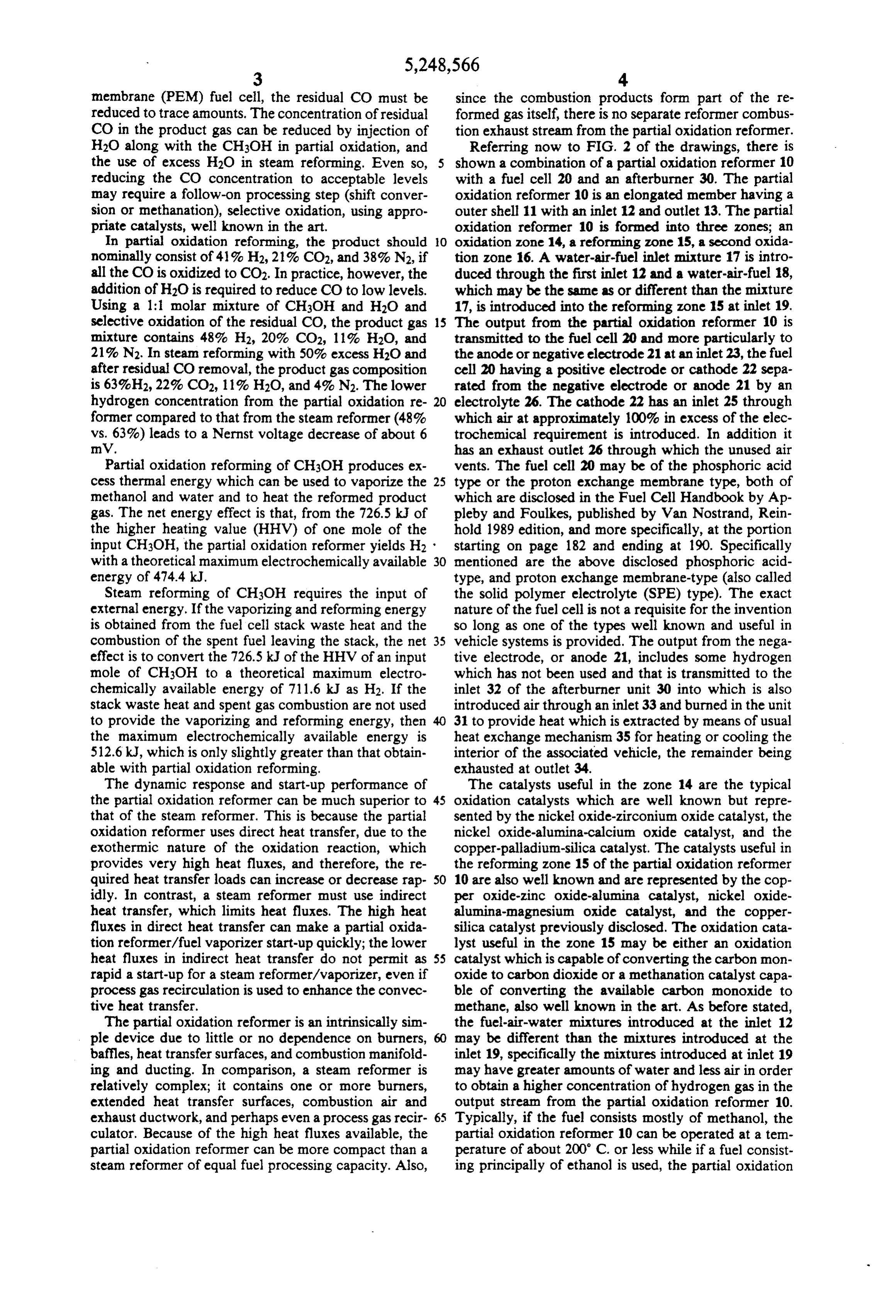
membrane (PEM) fuel cell, the residual CO must be since the combustion products form part of the re reduced to trace amounts. The concentration of residual formed gas itself, there is no separate reformer combus CO in the product gas can be reduced by injection of tion exhaust stream from the partial oxidation reformer. H2O along with the CH3OH in partial oxidation, and Referring now to FIG. 2 of the drawings, there is the use of excess H2O in steam reforming. Even so, shown a combination of a partial oxidation reformer 10 reducing the CO concentration to acceptable levels with a fuel cell 20 and an afterburner 30. The partial may require a follow-on processing step (shift conver oxidation reformer 10 is an elongated member having a sion or methanation), selective oxidation, using appro outer shell 11 with an inlet 12 and outlet 13. The partial priate catalysts, well known in the art. oxidation reformer 10 is formed into three zones; an In partial oxidation reforming, the product should O oxidation zone 14, a reforming zone 15, a second oxida nominally consist of 41% H2, 21% CO2, and 38% N2, if tion zone 16. A water-air-fuel inlet mixture 17 is intro all the CO is oxidized to CO2. In practice, however, the duced through the first inlet 12 and a water-air-fuel 18, addition of H2O is required to reduce CO to low levels. which may be the same as or different than the mixture Using a 1:1 molar mixture of CH3OH and H2O and 17, is introduced into the reforming zone 15 at inlet 19. selective oxidation of the residual CO, the product gas 15 The output from the partial oxidation reformer 10 is mixture contains 48% H2, 20% CO2, 11% H2O, and transmitted to the fuel cell 20 and more particularly to 21% N2. In steam reforming with 50% excess H2O and the anode or negative electrode 21 at an inlet 23, the fuel after residual CO removal, the product gas composition cell 20 having a positive electrode or cathode 22 sepa is 63%H2, 22% CO2, 11% H2O, and 4% N2. The lower rated from the negative electrode or anode 21 by an hydrogen concentration from the partial oxidation re 20 electrolyte 26. The cathode 22 has an inlet 25 through former compared to that from the steam reformer (48% which air at approximately 100% in excess of the elec vs. 63%) leads to a Nernst voltage decrease of about 6 trochemical requirement is introduced. In addition it InV. has an exhaust outlet 26 through which the unused air Partial oxidation reforming of CH3OH produces ex vents. The fuel cell 20 may be of the phosphoric acid cess thermal energy which can be used to vaporize the 25 type or the proton exchange membrane type, both of methanol and water and to heat the reformed product which are disclosed in the Fuel Cell Handbook by Ap gas. The net energy effect is that, from the 726.5 kJ of pleby and Foulkes, published by Van Nostrand, Rein the higher heating value (HHV) of one mole of the hold 1989 edition, and more specifically, at the portion input CH3OH, the partial oxidation reformer yields H2 starting on page 182 and ending at 190. Specifically with a theoretical maximum electrochemically available 30 mentioned are the above disclosed phosphoric acid energy of 474.4 kJ. type, and proton exchange membrane-type (also called Steam reforming of CH3OH requires the input of the solid polymer electrolyte (SPE) type). The exact external energy. If the vaporizing and reforming energy nature of the fuel cell is not a requisite for the invention is obtained from the fuel cell stack waste heat and the so long as one of the types well known and useful in combustion of the spent fuel leaving the stack, the net 35 vehicle systems is provided. The output from the nega effect is to convert the 726.5 kJ of the HHV of an input tive electrode, or anode 21, includes some hydrogen mole of CH3OH to a theoretical maximum electro which has not been used and that is transmitted to the chemically available energy of 711.6 kJ as H2. If the inlet 32 of the afterburner unit 30 into which is also stack waste heat and spent gas combustion are not used introduced air through an inlet 33 and burned in the unit to provide the vaporizing and reforming energy, then 40 31 to provide heat which is extracted by means of usual the maximum electrochemically available energy is heat exchange mechanism 35 for heating or cooling the 512.6 kJ, which is only slightly greater than that obtain interior of the associated vehicle, the remainder being able with partial oxidation reforming. exhausted at outlet 34.
The dynamic response and start-up performance of The catalysts useful in the zone 14 are the typical the partial oxidation reformer can be much superior to 45 oxidation catalysts which are well known but repre that of the steam reformer. This is because the partial sented by the nickel oxide-zirconium oxide catalyst, the oxidation reformer uses direct heat transfer, due to the nickel oxide-alumina-calcium oxide catalyst, and the exothermic nature of the oxidation reaction, which copper-palladium-silica catalyst. The catalysts useful in provides very high heat fluxes, and therefore, the re the reforming zone 15 of the partial oxidation reformer quired heat transfer loads can increase or decrease rap 50 10 are also well known and are represented by the cop idly. In contrast, a steam reformer must use indirect per oxide-zinc oxide-alumina catalyst, nickel oxide heat transfer, which limits heat fluxes. The high heat alumina-magnesium oxide catalyst, and the copper fluxes in direct heat transfer can make a partial oxida silica catalyst previously disclosed. The oxidation cata tion reformer/fuel vaporizer start-up quickly; the lower lyst useful in the zone 15 may be either an oxidation heat fluxes in indirect heat transfer do not permit as 55 catalyst which is capable of converting the carbon mon rapid a start-up for a steam reformer/vaporizer, even if oxide to carbon dioxide or a methanation catalyst capa process gas recirculation is used to enhance the convec ble of converting the available carbon monoxide to tive heat transfer. methane, also well known in the art. As before stated, The partial oxidation reformer is an intrinsically sim the fuel-air-water mixtures introduced at the inlet 12 ple device due to little or no dependence on burners, may be different than the mixtures introduced at the baffles, heat transfer surfaces, and combustion manifold inlet 19, specifically the mixtures introduced at inlet 19 ing and ducting. In comparison, a steam reformer is may have greater amounts of water and less air in order relatively complex; it contains one or more burners, to obtain a higher concentration of hydrogen gas in the extended heat transfer surfaces, combustion air and output stream from the partial oxidation reformer 10. exhaust ductwork, and perhaps even a process gas recir 65 Typically, if the fuel consists mostly of methanol, the culator. Because of the high heat fluxes available, the partial oxidation reformer 10 can be operated at a tem partial oxidation reformer can be more compact than a perature of about 200 C. or less while if a fuel consist steam reformer of equal fuel processing capacity. Also, ing principally of ethanol is used, the partial oxidation
Page 7
reformer 10 is operated at a temperature in the The embodiments of the invention in which an exclu 400-450 C. range, and if a fuel consisting principally sive property or privilege is claimed are defined as of propane is used, the partial oxidation reformer is follows:
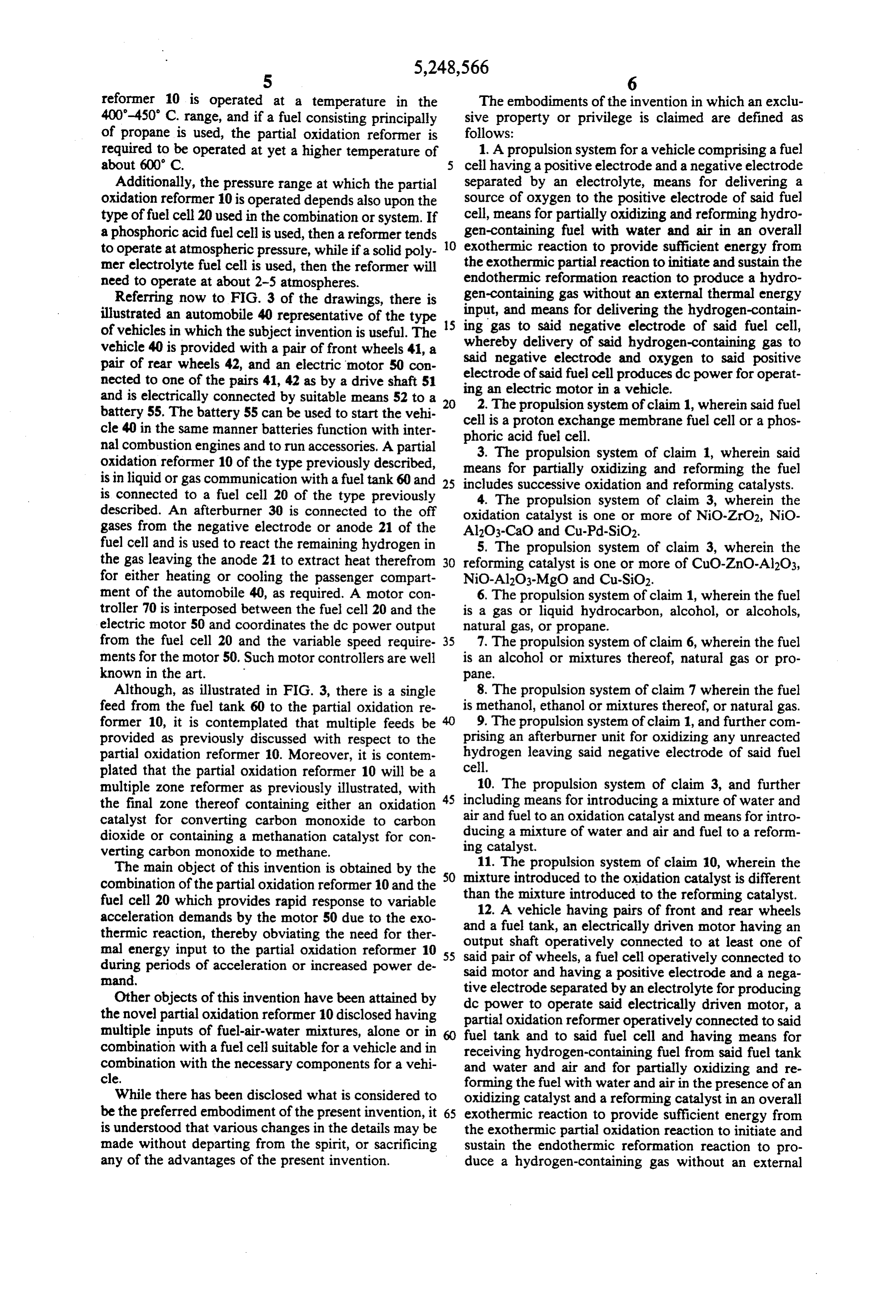
required to be operated at yet a higher temperature of 1. A propulsion system for a vehicle comprising a fuel about 600' C. 5 cell having a positive electrode and a negative electrode Additionally, the pressure range at which the partial separated by an electrolyte, means for delivering a oxidation reformer 10 is operated depends also upon the source of oxygen to the positive electrode of said fuel type of fuel cell 20 used in the combination or system. If cell, means for partially oxidizing and reforming hydro a phosphoric acid fuel cell is used, then a reformer tends gen-containing fuel with water and air in an overall to operate at atmospheric pressure, while if a solid poly 10 exothermic reaction to provide sufficient energy from mer electrolyte fuel cell is used, then the reformer will the exothermic partial reaction to initiate and sustain the need to operate at about 2-5 atmospheres. endothermic reformation reaction to produce a hydro Referring now to FIG. 3 of the drawings, there is gen-containing input, and gas without an external thermal energy means for delivering the hydrogen-contain illustrated an automobile 40 representative of the type 15 ing gas to said negative electrode of said fuel cell, of vehicles in which the subject invention is useful. The whereby delivery of said hydrogen-containing gas to vehicle 40 is provided with a pair of front wheels 41, a pair of rear wheels 42, and an electric motor 50 con said negative electrode and oxygen to said positive electrode of said fuel cell produces dc power for operat nected to one of the pairs 41, 42 as by a drive shaft 51 and is electrically connected by suitable means 52 to a 20 ing2.anTheelectric motor in a vehicle. propulsion system of claim 1, wherein said fuel battery 55. The battery 55 can be used to start the vehi cell is a proton exchange membrane fuel cell or a phos cle 40 in the same manner batteries function with inter phoric acid fuel cell.
nal combustion engines and to run accessories. A partial 3. The propulsion system of claim 1, wherein said oxidation reformer 10 of the type previously described, means for partially oxidizing and reforming the fuel is in liquid or gas communication with a fuel tank 60 and 25 includes successive oxidation and reforming catalysts. is connected to a fuel cell 20 of the type previously 4. The propulsion system of claim 3, wherein the described. An afterburner 30 is connected to the off oxidation catalyst is one or more of NiO-ZrO2, NiO gases from the negative electrode or anode 21 of the Al2O3-CaO and Cu-Pd-SiO2.
fuel cell and is used to react the remaining hydrogen in 5. The propulsion system of claim 3, wherein the the gas leaving the anode 21 to extract heat therefrom 30 reforming catalyst is one or more of CuO-ZnO-Al2O3, for either heating or cooling the passenger compart NiO-Al2O3-MgO and Cu-SiO2.
ment of the automobile 40, as required. A motor con 6. The propulsion system of claim 1, wherein the fuel troller 70 is interposed between the fuel cell 20 and the is a gas or liquid hydrocarbon, alcohol, or alcohols, electric motor 50 and coordinates the dc power output natural gas, or propane.
from the fuel cell 20 and the variable speed require 35 7. The propulsion system of claim 6, wherein the fuel ments for the motor 50. Such motor controllers are well is an alcohol or mixtures thereof, natural gas or pro known in the art. pane.
Although, as illustrated in FIG. 3, there is a single 8. The propulsion system of claim 7 wherein the fuel feed from the fuel tank 60 to the partial oxidation re is methanol, ethanol or mixtures thereof, or natural gas. former 10, it is contemplated that multiple feeds be 9. The propulsion system of claim 1, and further com provided as previously discussed with respect to the prising an afterburner unit for oxidizing any unreacted partial oxidation reformer 10. Moreover, it is contem hydrogen leaving said negative electrode of said fuel plated that the partial oxidation reformer 10 will be a cell.
multiple zone reformer as previously illustrated, with 10. The propulsion system of claim 3, and further the final zone thereof containing either an oxidation 45 including means for introducing a mixture of water and catalyst for converting carbon monoxide to carbon air and fuel to an oxidation catalyst and means for intro dioxide or containing a methanation catalyst for con ing ducing a mixture of water and air and fuel to a reform verting carbon monoxide to methane. catalyst.
The main object of this invention is obtained by the 11. The propulsion system of claim 10, wherein the mixture introduced to the oxidation catalyst is different combination of the partial oxidation reformer 10 and the 50 than fuel cell 20 which provides rapid response to variable the mixture introduced to the reforming catalyst. acceleration demands by the motor 50 due to the exo and12.a A vehicle having pairs of front and rear wheels thermic reaction, thereby obviating the need for ther output shafttank, fuel an electrically driven motor having an mal energy input to the partial oxidation reformer 10 55 said pair of wheels, a fuel connected operatively to at least one of during periods of acceleration or increased power de said motor and having a positive electrodeconnected cell operatively and a
nega mand.
tive electrode separated by an electrolyte for producing
Other objects of this invention have been attained by dc power to operate said electrically driven motor, a the novel partial oxidation reformer 10 disclosed having partial oxidation reformer operatively connected to said multiple inputs of fuel-air-water mixtures, alone or in fuel tank and to said fuel cell and having means for combination with a fuel cell suitable for a vehicle and in receiving hydrogen-containing fuel from said fuel tank combination with the necessary components for a vehi and water and air and for partially oxidizing and re cle. forming the fuel with water and air in the presence of an While there has been disclosed what is considered to oxidizing catalyst and a reforming catalyst in an overall be the preferred embodiment of the present invention, it 65 exothermic reaction to provide sufficient energy from is understood that various changes in the details may be the exothermic partial oxidation reaction to initiate and made without departing from the spirit, or sacrificing sustain the endothermic reformation reaction to pro any of the advantages of the present invention. duce a hydrogen-containing gas without an external
Page 8
thermal energy input, means for transporting the hydro longitudinally spaced from said first zone holding a gen-containing gas from said partial oxidation reformer reforming catalyst, a second inlet near said second Zone, to said fuel cell negative electrode while air is trans means for introducing a first mixture of water and air ported to said fuel cell positive electrode to produce dic and fuel into said first zone, means for introducing a power for operating said electric motor and the pair of 5 second mixture of water and air and fuel into said sec wheels operatively connected thereto. ond zone, said first zone oxidation catalyst in contact 13. The vehicle of claim 12, wherein said partial oxi with said first zone oxidation catalyst in contact with dation reformer has a longitudinal flow path and a mix said first mixture producing a first product gas with ture of water and air and fuel is introduced into said some hydrogen and sufficient heat to initiate and main partial oxidation reformer at longitudinally spaced apart O tain an endothermic reaction in said second Zone to points of the flow path. produce a product gas richer in hydrogen than said 14. The vehicle of claim 13, wherein the oxidizing product from said first zone, whereby to provide oxida catalyst is one or more of NiO-ZrO2 or NiO-Al2O3CaO tion and steam reforming reactions capable of being or Cu-Pd-SiO2. sustained without outside thermal energy. 15. The vehicle of claim 14, wherein the reforming 15 19. The partial oxidation reformer of claim 18, catalyst is one or more of CuO-ZnO-Al2O3, NiO wherein said first zone contains one or more of NiO Al2O3-MgO and Cu-SiO2. A. ZrO2, NiO-Al2O3-CaO and Cu-Pd-SiO2. 16. The vehicle of claim 13, wherein the fuel cell is a 20. The partial oxidation reformer of claim 18, proton exchange membrane cell or a phosphoric acid wherein said second zone contains one or more of CuO cell. 20 ZnO-Al2O3, NiO-Al2O3-MgO and Cu-SiO2. 17. The vehicle of 13, wherein gas containing some 21. The partial oxidation reformer of claim 18 and hydrogen exits from said fuel cell negative electrode further comprising a third zone holding an oxidation during production of dc power and further including a catalyst or a methanation catalyst. unit for oxidizing the hydrogen in the exit gas from said 22. The partial oxidation reformer of claim 21, negative electrode to produce heat which may be used 25 wherein said oxidation catalyst in said third Zone con to heat or cool the vehicle. verts carbon monoxide present to carbon dioxide. 18. A partial oxidation reformer comprising alongitu 23. The partial oxidation reformer of claim 21, dinally extending container having an inlet at one end wherein said methanation catalyst in said third Zone thereof and an outlet at the other end thereof, a first converts carbon monoxide present to methane. Zone holding an oxidation catalyst and a second zone 30 s c
Provenance
- Collection
- Cited prior art
- Original PDF
- patentimages.storage.googleapis.com →
- Filed
- 1991-11-25
- Pages
- 8
- Method
- pdftotext (the PDF's own text layer) + pdftoppm 300dpi page scans
- Source
- Google Patents bibliographic record
- Granted
- 1993-09-28
- Inventors
- Romesh Kumar; Shabbir Ahmed; Michael Krumpelt; Kevin M. Myles; US Department of Energy
- Transcribed from
- patentimages.storage.googleapis.com →