patent · US5143047
Material and method for fast generation of hydrogen gas and steam
1 September 1992
Page 1 — bibliographic record
IIIHHHHHHHHHIIIHIII USOO5143047A
United States Patent (19) 11) Patent Number: 5,143,047 Lee 45) Date of Patent: Sep. 1, 1992 (54) MATERIAL AND METHOD FOR FAST 56) References Cited SEESATION of HYDROGEN GAS AND U.S. PATENT DOCUMENTS 4,643,166 2/1987 Hubele et al. ....................... 26/263 4,730,601 3/1988 Hubeie et al........................ 126/263 (75. Inventor: Woodrow W. Lee, Potomac, Md. 5,020,509 6/1991 Suzuki ........ ... 126/263 5,052,272 10/1991 Lee ............................................ 89/7 73) Assignee: The United States of America as represented by the Secretary of the Primary Examiner-Larry Jones
Navy, Washington, D.C. Attorney, Agent, or Firm-Kenneth E. Walden; Roger D. Johnson * Notice: The portion of the term of this patent (57) ABSTRACT E. to Oct. 1, 2008 has been A high power pulse of electrical current causes a metal SCa1e. conductor to explode and initiate a reaction between an aluminum or aluminum alloy powder and water which 2) Appl. No.: 718,123 generates hydrogen gas at a high temperature and pres sure. The reaction mixture is released into a second 22 Filed: Jun. 20, 1991 larger chamber equipped with heat exchanger which extracts useful heat energy and cools down the reaction
I51) Int. Cl. ................................................. F24, 1/00 mixture. The hydrogen gas is then separated from the 52 U.S. Cl. .................................... 126/263; 126/269; solid metal oxide byproducts in the cooled reaction
122/21 20 Claims, 2 Drawing Sheets
POWER
CONDONER
Page 2
Drawing sheet — no readable text.
Page 3
Drawing sheet — no readable text.
Page 4
reaction between aluminum or aluminum alloy powder
MATERIAL AND METHOD FOR FAST and water.
GENERATION OF HYDROGEN GAS AND STEAM A still further object of this invention is to provide a safe and efficient method of generating heat.
BACKGROUND OF THE INVENTION These and other objects of this invention are This invention relates to the production of hydrogen achieved by providing;
and heat energy and more particularly to the produc a method of generating hydrogen gas and useful heat energy by tion of hydrogen and heat energy by reacting a metal (1) applying a high power pulse of electrical current to with water. 10 a metal electrical conductor causing the metal con It has been proposed to replace conventional hydro ductor to explode and thus disperse pieces of molten carbon fuels with cleaner burning hydrogen in internal metal into a mixture of water and an aluminum fuel combustion engines. Unfortunately existing methods of powder which is storing hydrogen require heavy tanks for the com (a) aluminum metal powder or pressed gas or complicated vessels for the liquid that are 15 (b) an aluminum alloy powder, uneconomical to use. The metal hydride, although it wherein the pieces of dispersed metal from the ex can be claimed as the best existing method of storing ploded conductor provide hot spots which initiate a hydrogen, is still too heavy to be used as a mobile hy chemical reaction between the aluminum fuel and drogen storage medium. Additionally, the large stored water to generate hydrogen at high pressure in a quantities of hydrogen require special safety precau 20 confined first chamber;
tions. It would be desirable to provide a method of (2) continuing to supply the high powered pulse of generating the hydrogen gas fuel as needed. electrical current to drive the reaction between the Some metals like aluminum, magnesium, or lithium aluminum fuel and water after the metal conductor react with water, spontaneously generating hydrogen has exploded;
gas and heat. Among these reactive metals, aluminum is 25 (3) allowing the reaction between the aluminum fuel the most abundant, cheapest and safest metal. But, the and water to go substantially to completion; reaction between aluminum and water is not sustained (4) releasing the reaction mixture into a larger second at ambient temperature due to the protective oxide chamber to complete the reaction; layer formed on the metal surface. Therefore, the use of 30 (5) extracting useful heat energy from the reaction mix aluminum as a fuel to generate heat and hydrogen gas ture by means of a heat exchanger; and requires that the protective layer be efficiently and (6)the separating the hydrogen gas from the remainder of cooled reaction mixture.
continuously removed.
European patent No. 0 055 134 B1 (1986) discloses a BRIEF DESCRIPTION OF THE DRAWING method for the production of hydrogen by inducing 35 FIGURES electrical discharge between aluminum wire and alumi A more complete application of this invention, and num drum both of which are immersed in water. When a voltage is applied between the wire and drum, an readilyofapparent many the attendant advantages thereof, will become as the same becomes better understood arching discharge takes place between them, inducing by reference to the following detailed description when electro-plasmic reaction. The reaction produces hydro considered in conjunction with the accompanying gen and oxygen gas and aluminum oxide. The arcing drawings, wherein:
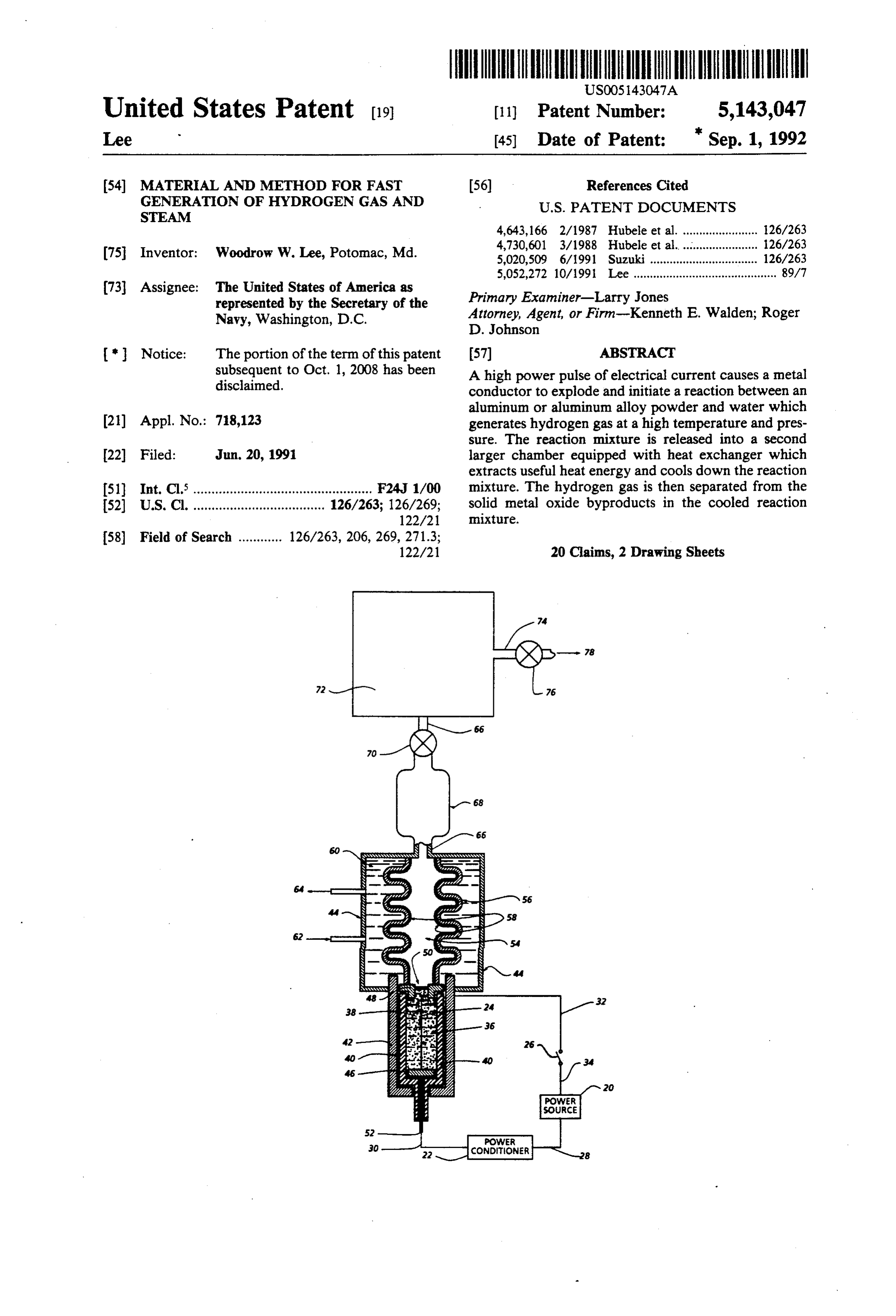
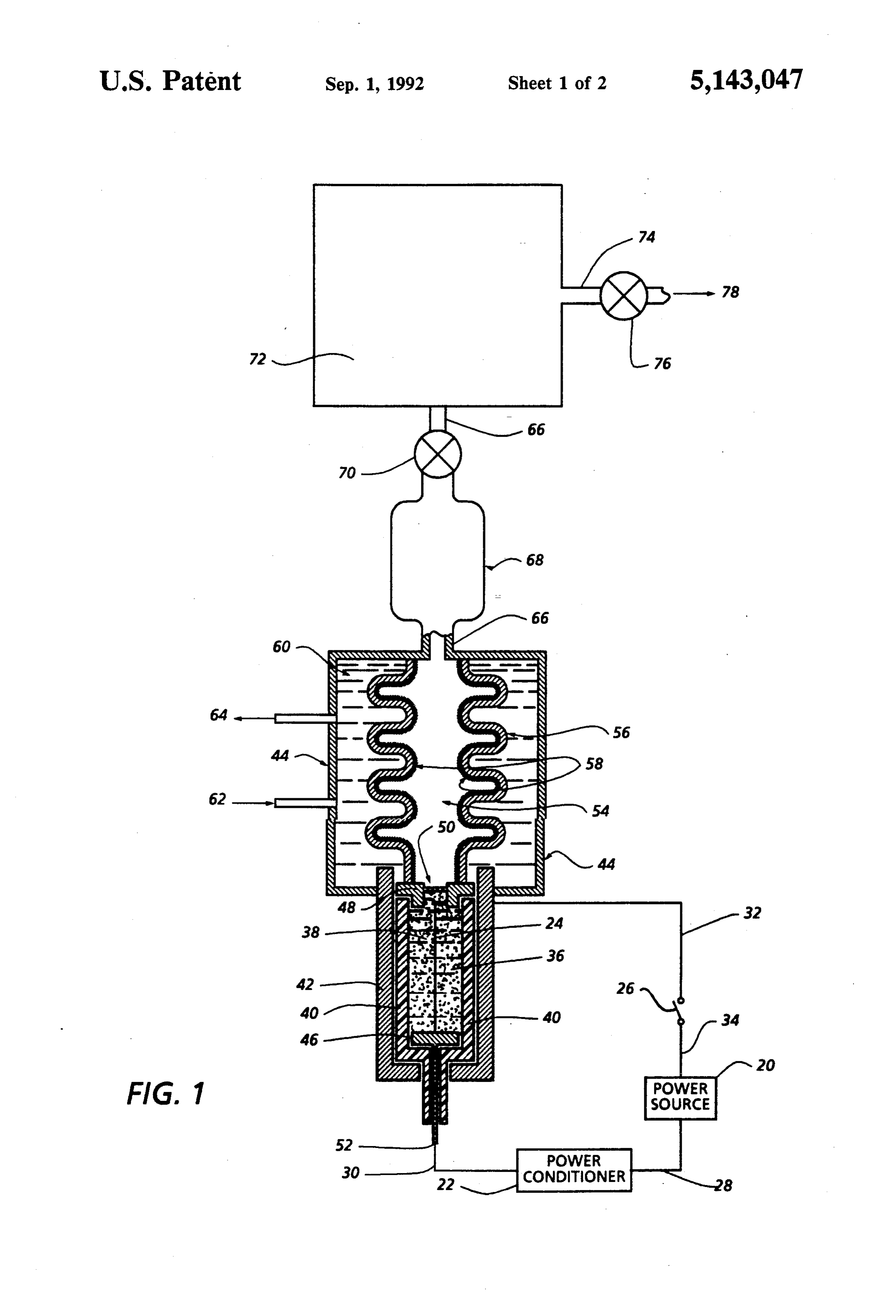
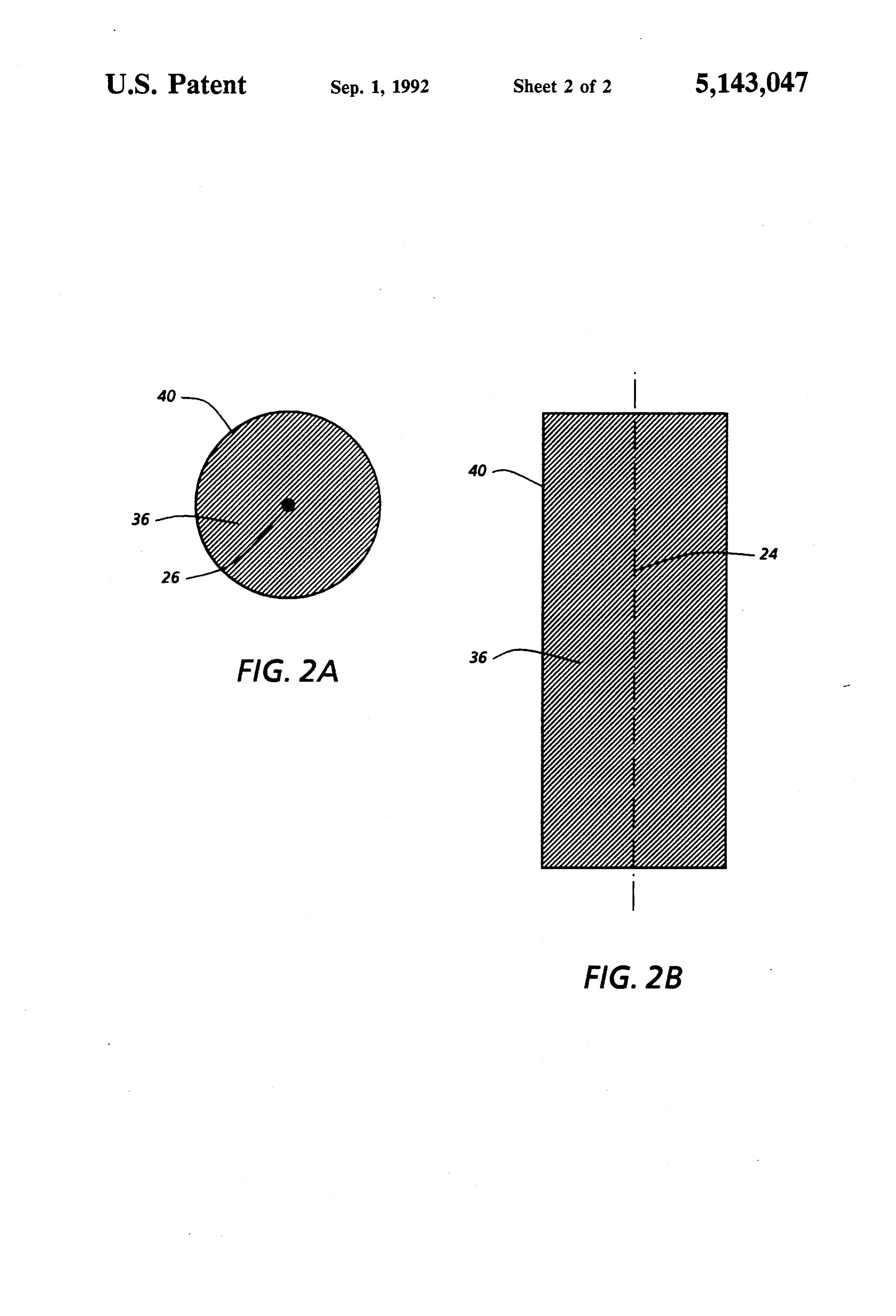
between the wire and drum helps remove the oxide FIG. 1 is a cross-sectional schematic drawing (not to layer formed on the wire tip, exposing fresh aluminum scale) of the test apparatus used to demonstrate the to the water. Thus, a continuous generation of hydro invention;
gen gas is possible when the wire is fed against the 45 FIG. 2A shows a top view schematic drawing and drum. FIG. 2B a side view schematic drawing of a typical This process has two major disadvantages. First, reaction cartridge used in this invention. since the process is slow, the heat generated from the reaction is wasted by being dissipated through the wa DETAILED DESCRIPTION OF THE ter. Second, the electrical energy required to sustain the 50 PREFERRED EMBODIMENT reaction is rather high. It is estimated that around 20 KJ The apparatus and method of this invention rapidly of electrical energy is consumed to generate about 5 generates useful heat energy and hydrogen gas from liter of hydrogen gas at room temperature and a pres reactants that are very safe to store. This is accom sure of one atmosphere. plished by applying pulse power techniques to a system SUMMARY OF THE INVENTION 55 of a metal trigger (conductor) wire or wires and an aluminum fuel powder/water mixture in a first confined
Accordingly an object of this invention is to provide reaction chamber which is preferably in the form of a a safe and economic source of hydrogen gas for use as replaceable reaction cartridge. The electrical energy in fuel. the pulse form explodes the trigger wire which dis Another object of this invention is to provide a 60 perses molten or vaporized metal pieces into the alumi method of rapidly generating heat and hydrogen gas for num fuel powder/water mixture. This initiates a chemi use as fuel. cal reaction between the aluminum fuel powder and A further object of this invention is to provide a water which generates a high temperature, high pres means of generating small or large quantities of hydro sure reaction product mixture of hydrogen and metal gen gas. 65 oxides. After the reaction is substantially completed, the Yet another object of this invention is to provide a reaction mixture is released into a second larger cham method of generating hydrogen gas by using a rela ber having an interior volume substantially larger than tively small amount of electrical energy to initiate a the interior volume of the first confined chamber. The
Page 5
volume of the interior of the second chamber is prefera ramic sponges which prevent the separation of the alu bly from 10 to 100, more preferably from 35 to 65, and minum fuel powder and water. The ceramic materials most preferably about 50 times greater than the volume are light weight, electrically nonconductive, and inert. of the interior of the first confined chamber (or reaction In other words, they add little weight, do not change cartridge). The pressure of the reaction mixture is low- 5 the resistance properties, and do not interfere with the ered proportionally in the transfer from the first cham chemical reactions of the aluminum fuel powder/water ber to the larger second chamber. In the second cham mixture. The ceramic materials also have very high ber, the reaction mixture comes into contact with a heat melting points and boiling points. Therefore the ce exchanger having a large surface area. The heat ex changer is used to extract useful heat energy from the O ramic materials will not melt or vaporize during the reactant mixture. The cooled hydrogen is then sepa high temperature reactions. Of the ceramic materials, rated from the remaining reaction products, alumina (mp 2015 C.; bp 2980 C.) is most preferred. The aluminum fuel components are finely powdered An example of these ceramic materials are the fine alu aluminum metal or finely powdered aluminum alloys. mina fiber bundles which are available in sheets or mats Among the aluminum alloys, aluminum-lithium alloys 15 under the tradename SAFFIL (alumina fibermat), man and aluminum-magnesium alloys are preferred. The ufactured by Imperial Chemical Industries, Ltd., Mond aluminum-lithium alloys contain from more than zero to Division, Runcorn, Cheshire, WA74QS, United King 3.0, preferably from 2.0 to 3.0, more preferably from 2.0 dom. The fine ceramic fibers or ceramic sponges are to 2.8, and still more preferably from 2.2 to 2.6 weight thoroughly and uniformly mixed into a slurry of the percent of lithium, with the remainder of the alloy con 20 aluminum fuel powder and water components. The fine sisting essentially of aluminum. The aluminum-mag nesium alloys contain from more than zero to 5.0 and ceramic fiber bundles or ceramic sponges absorb the preferably from 3.0 to 4.5 weight percent of magnesium water and aluminum fuel powder particles by capillary with the remainder of the alloy consisting essentially of action. The fine ceramic fiber bundles (or ceramic aluminum. As the amount of lithium or magnesium 25 sponges) create small spaces in which the aluminum fuel added to the aluminum is increased, the amount of elec powder and water are held. This prevents the aluminum trical energy required to initiate and cause the complete fuel powder from settling out of the water. reaction between the metal fuel and water is decreased. Using the absorbent ceramic material (e.g., fine fiber The most preferred oxidizer is water. Water is inex bundles or sponges) to take up and hold the water and pensive, nontoxic, noncaustic, nonexplosive, and ther 30 metal fuel powder mixture is like using Kleenex facial mally stable. Moreover, water is stoichiometrically tissue to remove water from a bowl. The tissue absorbs efficient. The oxygen is used up in the oxidation of the and becomes saturated with the water. When the tissue aluminum fuel powders and the hydrogen is released as is removed it takes the water with it. If not enough a gas useful as a fuel. The stoichiometric amount of tissue is used, water remains in the bowl. In the present water which will react with the aluminum, aluminum- 35 case, the ideal situation is when all of the aluminum fuel lithium alloy, or aluminum-magnesium alloy powders is powder/water slurry is absorbed and all of the absor calculated according to the following equations:
bent ceramic material is saturated. The process, how 2 A-3 H2O-Al2O3-3H (1) ever, will still be operative when more or less than the ideal amount of absorbent ceramic material is used. The
Mg-i-H2O-MgO-H2 (2) fine ceramic fibers or ceramic-sponges are added in an 2 Li-i-H2O-Li2O-H2. (3) amount of preferably from about 0.5 to about 3.0, more preferably from 0.5 to 2.0, still more preferably from 0.8
Preferably from about 90 to about 115, more preferably to 1.5 weight percent based on the weight of the dry aluminum fuel powder. Fine fibers are the more pre from 95 to 110, and still more preferably about 100 45 ferred percent of the stoichiometric amount of water is used in form of the ceramic materials. The fibers will the aluminum fuel powder/water slurry. Even greater preferably have a diameter of less than 20 microns. The variation from the stoichiometric amount of water will length of the fibers is not critical although longer fibers produce an operative slurry, but the efficiency of the (e.g., 0.25 inches to several inches) are preferred. Other process will be significantly reduced. The metal con forms of the ceramic materials should be of comparable ductor trigger wire provides additional reactive metal, dimensions.
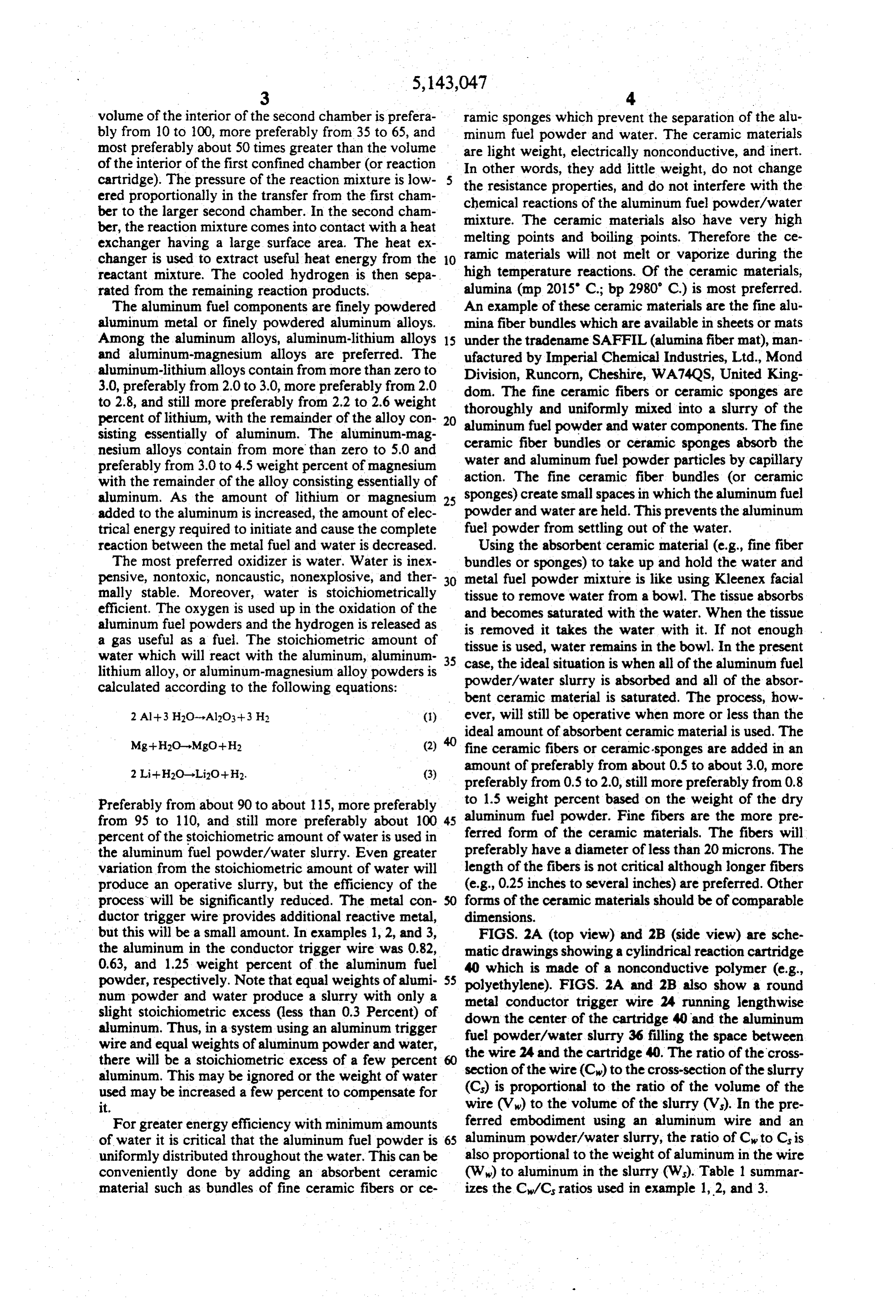
but this will be a small amount. In examples 1, 2, and 3, FIGS. 2A (top view) and 2B (side view) are sche the aluminum in the conductor trigger wire was 0.82, matic drawings showing a cylindrical reaction cartridge 0.63, and 1.25 weight percent of the aluminum fuel powder, respectively. Note that equal weights of alumi 55 40 which is made of a nonconductive polymer (e.g., polyethylene). FIGS. 2A and 2B also show a round num powder and water produce a slurry with only a metal conductor trigger wire 24 running lengthwise slight stoichiometric excess (less than 0.3 Percent) of down the center of the cartridge 40 and the aluminum aluminum. Thus, in a system using an aluminum trigger fuel powder/water slurry 36 filling the space between wire and equal weights of aluminum powder and water, the wire 24 and the cartridge 40. The ratio of the cross there will be a stoichiometric excess of a few percent aluminum. This may be ignored or the weight of water section of the wire (C) to the cross-section of the slurry used may be increased a few percent to compensate for (C) is proportional to the ratio of the volume of the it. wire (V) to the volume of the slurry (V). In the pre For greater energy efficiency with minimum amounts ferred embodiment using an aluminum wire and an of water it is critical that the aluminum fuel powder is aluminum powder/water slurry, the ratio of C to C is uniformly distributed throughout the water. This can be also proportional to the weight of aluminum in the wire conveniently done by adding an absorbent ceramic (W) to aluminum in the slurry (W). Table 1 summar material such as bundles of fine ceramic fibers or ce izes the C/Cs ratios used in example 1, 2, and 3.
Page 6
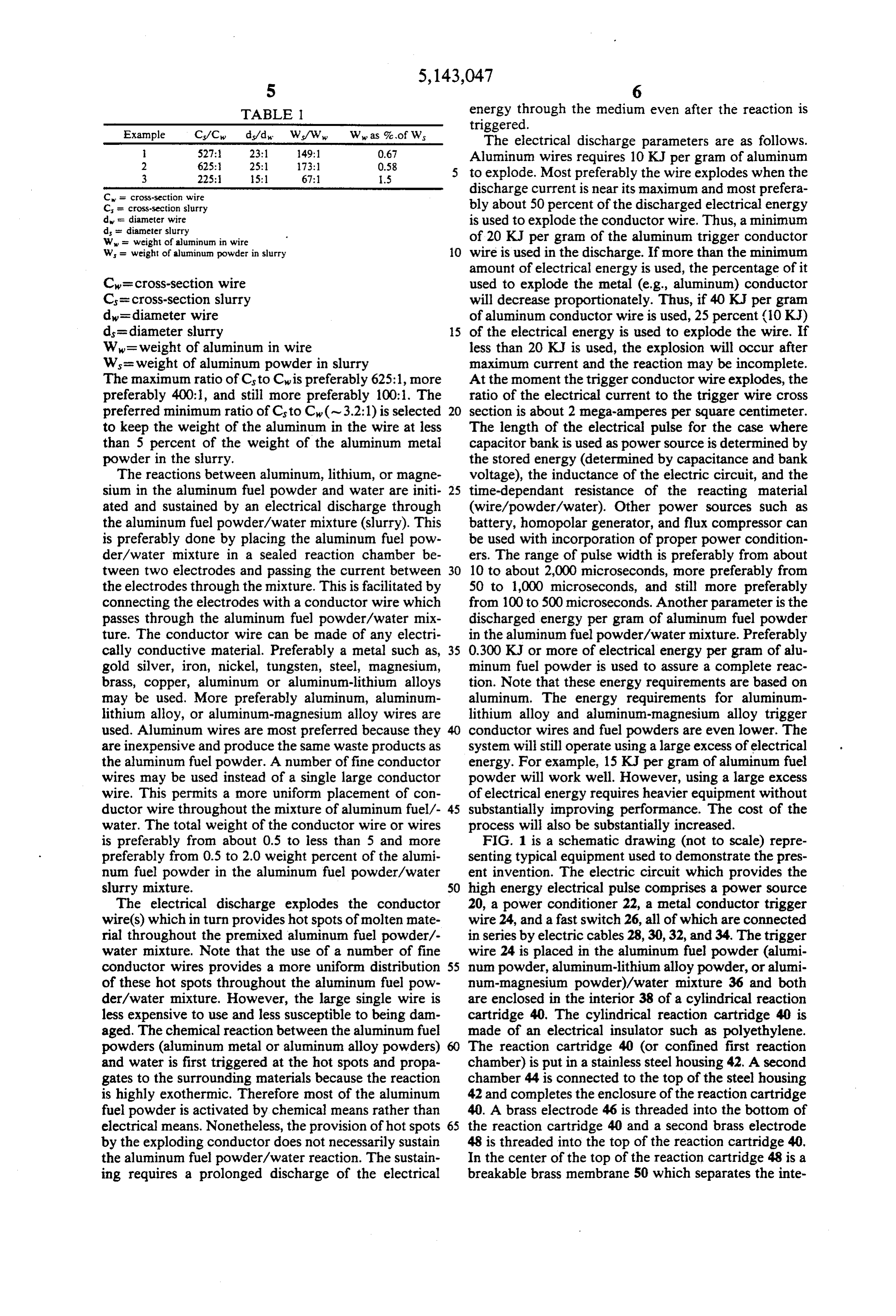
TABLE 1 energy through the medium even after the reaction is triggered.
Example C/C d/d W/W W as % of Ws The electrical discharge parameters are as follows. : 3. : : 0.67 Aluminum wires requires 10 KJ per gram of aluminum 3 i. l 9: 5 to explode. Most preferably the wire explodes when the C = cross-section wire discharge current is near its maximum and most prefera
C = cross-section slurry bly about 50 percent of the discharged electrical energy d = diameter wire d = diameter slurry is used to explode the conductor wire. Thus, a minimum
W = weight of aluminun in wire of 20 KJ per gram of the aluminum trigger conductor W = weight of aluminun powder in slurry O wire is used in the discharge. If more than the minimum amount of electrical energy is used, the percentage of it
C = cross-section wire used to explode the metal (e.g., aluminum) conductor C = cross-section slurry will decrease proportionately. Thus, if 40 KJ per gram d=diameter wire of aluminum conductor wire is used, 25 percent (10 KJ) d = diameter slurry 15 of the electrical energy is used to explode the wire. If w= weight of aluminum in wire less than 20 KJ is used, the explosion will occur after Ws= weight of aluminum powder in slurry maximum current and the reaction may be incomplete. The maximum ratio of Cs to C is preferably 625:1, more At the moment the trigger conductor wire explodes, the preferably 400:1, and still more preferably 100:1. The ratio of the electrical current to the trigger wire cross preferred minimum ratio of Cs to C (-3.2:1) is selected section is about 2 mega-amperes per square centimeter. to keep the weight of the aluminum in the wire at less The length of the electrical pulse for the case where than 5 percent of the weight of the aluminum metal capacitor bank is used as power source is determined by powder in the slurry. the stored energy (determined by capacitance and bank The reactions between aluminum, lithium, or magne voltage), the inductance of the electric circuit, and the sium in the aluminum fuel powder and water are initi 25 time-dependant resistance of the reacting material ated and sustained by an electrical discharge through (wire/powder/water). Other power sources such as the aluminum fuel powder/water mixture (slurry). This battery, homopolar generator, and flux compressor can is preferably done by placing the aluminum fuel pow be used with incorporation of proper power condition der/water mixture in a sealed reaction chamber be ers. The range of pulse width is preferably from about tween two electrodes and passing the current between 30 10 to about 2,000 microseconds, more preferably from the electrodes through the mixture. This is facilitated by 50 to 1,000 microseconds, and still more preferably connecting the electrodes with a conductor wire which from 100 to 500 microseconds. Another parameter is the passes through the aluminum fuel powder/water mix discharged energy per gram of aluminum fuel powder ture. The conductor wire can be made of any electri in the aluminum fuel powder/water mixture. Preferably cally conductive material. Preferably a metal such as, 0.300 KJ or more of electrical energy per gram of alu gold silver, iron, nickel, tungsten, steel, magnesium, minum fuel powder is used to assure a complete reac brass, copper, aluminum or aluminum-lithium alloys tion. Note that these energy requirements are based on may be used. More preferably aluminum, aluminum aluminum. The energy requirements for aluminum lithium alloy, or aluminum-magnesium alloy wires are lithium alloy and aluminum-magnesium alloy trigger used. Aluminum wires are most preferred because they 40 conductor wires and fuel powders are even lower. The are inexpensive and produce the same waste products as system will still operate using a large excess of electrical the aluminum fuel powder. A number of fine conductor energy. For example, 15 KJ per gram of aluminum fuel wires may be used instead of a single large conductor powder will work well. However, using a large excess wire. This permits a more uniform placement of con of electrical energy requires heavier equipment without ductor wire throughout the mixture of aluminum fuel/- 45 substantially improving performance. The cost of the water. The total weight of the conductor wire or wires process will also be substantially increased. is preferably from about 0.5 to less than 5 and more FIG. 1 is a schematic drawing (not to scale) repre preferably from 0.5 to 2.0 weight percent of the alumi senting typical equipment used to demonstrate the pres num fuel powder in the aluminum fuel powder/water ent invention. The electric circuit which provides the slurry mixture. 50 high energy electrical pulse comprises a power source The electrical discharge explodes the conductor 20, a power conditioner 22, a metal conductor trigger wire(s) which in turn provides hot spots of molten mate wire 24, and a fast switch 26, all of which are connected rial throughout the premixed aluminum fuel powder/- in series by electric cables 28, 30, 32, and 34. The trigger water mixture. Note that the use of a number of fine wire 24 is placed in the aluminum fuel powder (alumi conductor wires provides a more uniform distribution 55 num powder, aluminum-lithium alloy powder, or alumi of these hot spots throughout the aluminum fuel pow nun-magnesium powder)/water mixture 36 and both der/water mixture. However, the large single wire is are enclosed in the interior 38 of a cylindrical reaction less expensive to use and less susceptible to being dam cartridge 40. The cylindrical reaction cartridge 40 is aged. The chemical reaction between the aluminum fuel made of an electrical insulator such as polyethylene. powders (aluminum metal or aluminum alloy powders) 60 The reaction cartridge 40 (or confined first reaction and water is first triggered at the hot spots and propa chamber) is put in a stainless steel housing 42. A second gates to the surrounding materials because the reaction chamber 44 is connected to the top of the steel housing is highly exothermic. Therefore most of the aluminum 42 and completes the enclosure of the reaction cartridge fuel powder is activated by chemical means rather than 40. A brass electrode 46 is threaded into the bottom of electrical means. Nonetheless, the provision of hotspots 65 the reaction cartridge 40 and a second brass electrode by the exploding conductor does not necessarily sustain 48 is threaded into the top of the reaction cartridge 40. the aluminum fuel powder/water reaction. The sustain In the center of the top of the reaction cartridge 48 is a ing requires a prolonged discharge of the electrical breakable brass membrane 50 which separates the inte
Page 7
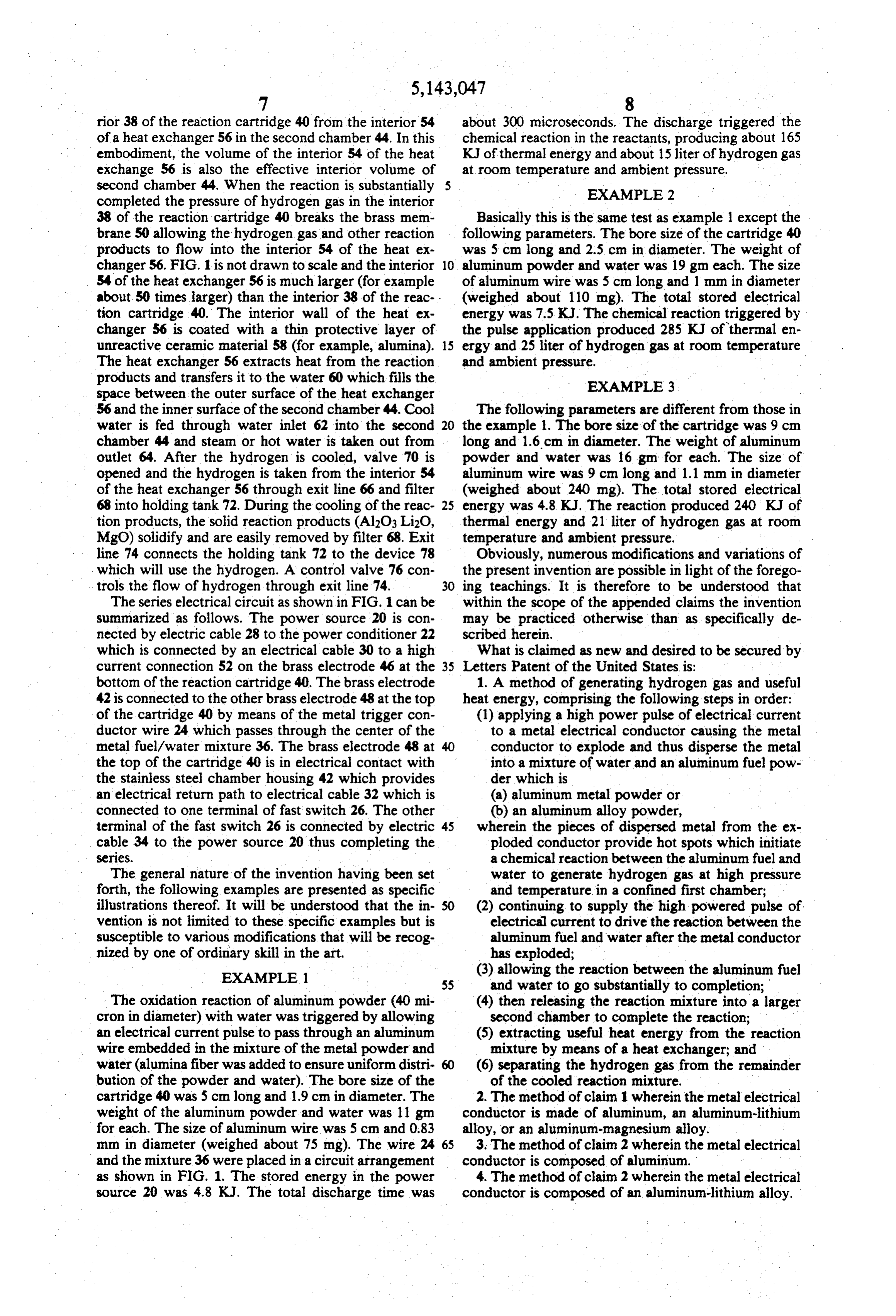
rior 38 of the reaction cartridge 40 from the interior 54 about 300 microseconds. The discharge triggered the of a heat exchanger 56 in the second chamber 44. In this chemical reaction in the reactants, producing about 165 embodiment, the volume of the interior 54 of the heat KJ of thermal energy and about 15 liter of hydrogen gas exchange 56 is also the effective interior volume of at room temperature and ambient pressure. second chamber 44. When the reaction is substantially 5 EXAMPLE 2 completed the pressure of hydrogen gas in the interior 38 of the reaction cartridge 40 breaks the brass mem Basically this is the same test as example 1 except the brane 50 allowing the hydrogen gas and other reaction following parameters. The bore size of the cartridge 40 products to flow into the interior 54 of the heat ex was 5 cm long and 2.5 cm in diameter. The weight of changer 56. FIG. 1 is not drawn to scale and the interior O aluminum powder and water was 19 gm each. The size 54 of the heat exchanger 56 is much larger (for example of aluminum wire was 5 cm long and 1 mm in diameter about 50 times larger) than the interior 38 of the reac (weighed about 110 mg). The total stored electrical tion cartridge 40. The interior wall of the heat ex energy was 7.5 K.J. The chemical reaction triggered by changer 56 is coated with a thin protective layer of the pulse application produced 285 KJ of thermal en unreactive ceramic material 58 (for example, alumina). 15 ergy and 25 liter of hydrogen gas at room temperature The heat exchanger 56 extracts heat from the reaction and ambient pressure.
products and transfers it to the water 60 which fills the EXAMPLE 3 space between the outer surface of the heat exchanger 56 and the inner surface of the second chamber 44. Cool The following parameters are different from those in water is fed through water inlet 62 into the second 20 the example 1. The bore size of the cartridge was 9 cm chamber 44 and steam or hot water is taken out from long and 1.6 cm in diameter. The weight of aluminum outlet 64. After the hydrogen is cooled, valve 70 is powder and water was 16 gm for each. The size of opened and the hydrogen is taken from the interior 54 aluminum wire was 9 cm long and 1.1 mm in diameter of the heat exchanger 56 through exit line 66 and filter (weighed about 240 mg). The total stored electrical 68 into holding tank 72. During the cooling of the reac 25 energy was 4.8 KJ. The reaction produced 240 KJ of tion products, the solid reaction products (Al2O3 Li2O, thermal energy and 21 liter of hydrogen gas at room MgO) solidify and are easily removed by filter 68. Exit temperature and ambient pressure.
line 74 connects the holding tank 72 to the device 78 Obviously, numerous modifications and variations of which will use the hydrogen. A control valve 76 con the present invention are possible in light of the forego trols the flow of hydrogen through exit line 74. 30 ing teachings. It is therefore to be understood that The series electrical circuit as shown in FIG. can be within the scope of the appended claims the invention summarized as follows. The power source 20 is con may be practiced otherwise than as specifically de nected by electric cable 28 to the power conditioner 22 scribed herein.
which is connected by an electrical cable 30 to a high What is claimed as new and desired to be secured by current connection 52 on the brass electrode 46 at the 35 Letters Patent of the United States is: bottom of the reaction cartridge 40. The brass electrode 1. A method of generating hydrogen gas and useful 42 is connected to the other brass electrode 48 at the top heat energy, comprising the following steps in order: of the cartridge 40 by means of the metal trigger con (1) applying a high power pulse of electrical current ductor wire 24 which passes through the center of the to a metal electrical conductor causing the metal metal fuel/water mixture 36. The brass electrode 48 at 40 conductor to explode and thus disperse the metal the top of the cartridge 40 is in electrical contact with into a mixture of water and an aluminum fuel pow the stainless steel chamber housing 42 which provides der which is an electrical return path to electrical cable 32 which is (a) aluminum metal powder or connected to one terminal of fast switch 26. The other (b) an aluminum alloy powder, terminal of the fast switch 26 is connected by electric 45 wherein the pieces of dispersed metal from the ex cable 34 to the power source 20 thus completing the ploded conductor provide hot spots which initiate series. a chemical reaction between the aluminum fuel and The general nature of the invention having been set water to generate hydrogen gas at high pressure forth, the following examples are presented as specific and temperature in a confined first chamber; illustrations thereof. It will be understood that the in SO (2) continuing to supply the high powered pulse of vention is not limited to these specific examples but is electrical current to drive the reaction between the susceptible to various modifications that will be recog aluminum fuel and water after the metal conductor nized by one of ordinary skill in the art. has exploded;
EXAMPLE 1. (3) allowing the reaction between the aluminum fuel 55 and water to go substantially to completion;
The oxidation reaction of aluminum powder (40 mi (4) then releasing the reaction mixture into a larger cron in diameter) with water was triggered by allowing second chamber to complete the reaction; an electrical current pulse to pass through an aluminum (5) extracting useful heat energy from the reaction wire embedded in the mixture of the metal powder and mixture by means of a heat exchanger; and water (alumina fiber was added to ensure uniform distri (6) separating the hydrogen gas from the remainder bution of the powder and water). The bore size of the of the cooled reaction mixture. cartridge 40 was 5 cm long and 1.9 cm in diameter. The 2. The method of claim 1 wherein the metal electrical weight of the aluminum powder and water was 11 gm conductor is made of aluminum, an aluminum-lithium for each. The size of aluminum wire was 5 cm and 0.83 alloy, or an aluminum-magnesium alloy. mm in diameter (weighed about 75 mg). The wire 24 3. The method of claim 2 wherein the metal electrical and the mixture 36 were placed in a circuit arrangement conductor is composed of aluminum.
as shown in FIG. 1. The stored energy in the power 4. The method of claim 2 wherein the metal electrical source 20 was 4.8 K.J. The total discharge time was conductor is composed of an aluminum-lithium alloy.
Page 8
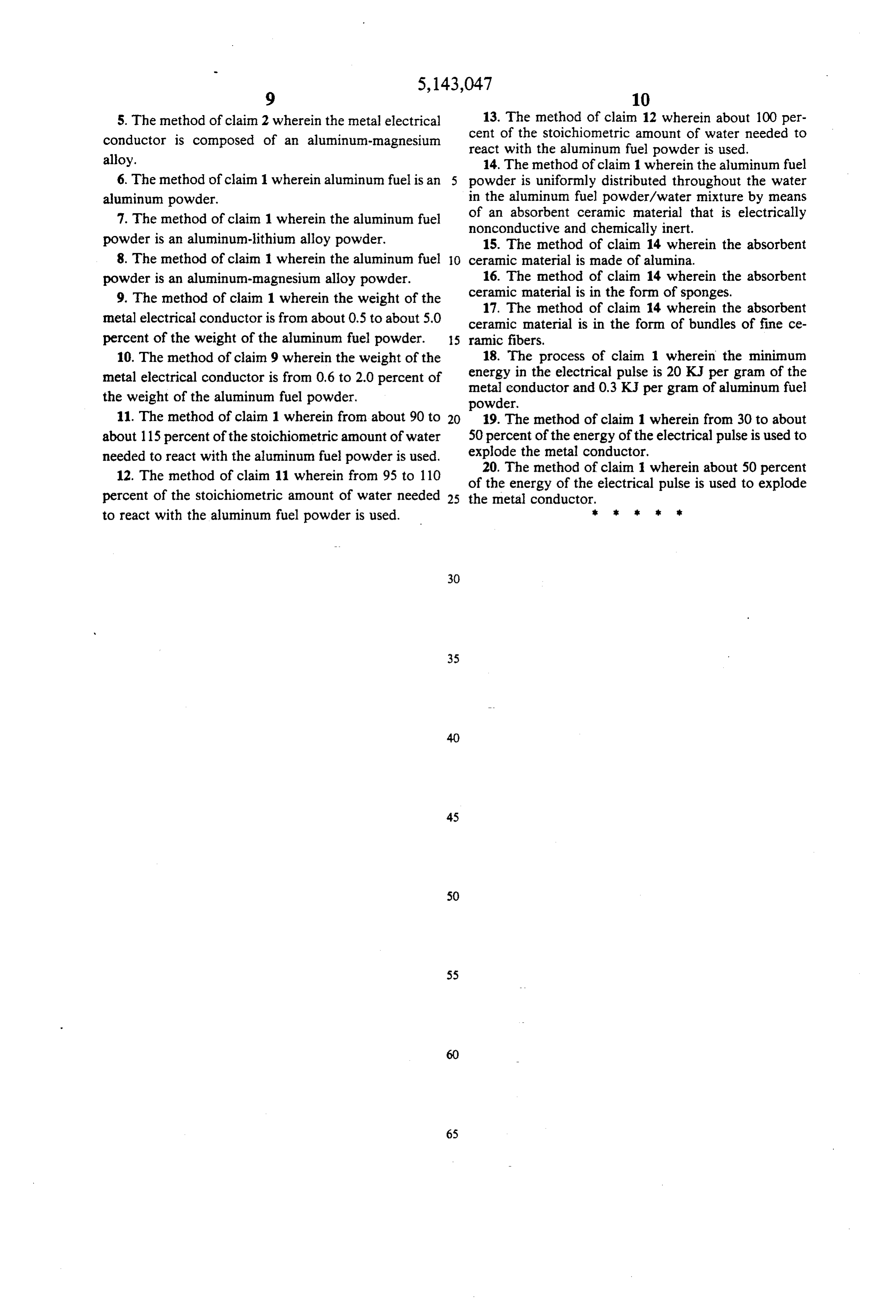
5. The method of claim 2 wherein the metal electrical 13. The method of claim 12 wherein about 100 per conductor is composed of an aluminum-magnesium cent of the stoichiometric amount of water needed to alloy. react with the aluminum fuel powder is used. 14. The method of claim 1 wherein the aluminum fuel 6. The method of claim 1 wherein aluminum fuel is an powder is uniformly distributed throughout the water aluminum powder. in the aluminum fuel powder/water mixture by means 7. The method of claim 1 wherein the aluminum fuel of an absorbent ceramic material that is electrically nonconductive and chemically inert.
powder is an aluminum-lithium alloy powder. 15. The method of claim 14 wherein the absorbent 8. The method of claim 1 wherein the aluminum fuel O ceramic material is made of alumina.
powder is an aluminum-magnesium alloy powder. 16. The method of claim 14 wherein the absorbent 9. The method of claim 1 wherein the weight of the ceramic material is in the form of sponges. 17. The method of claim 14 wherein the absorbent metal electrical conductor is from about 0.5 to about 5.0 ceramic material is in the form of bundles of fine ce percent of the weight of the aluminum fuel powder. 5 ramic fibers.
10. The method of claim 9 wherein the weight of the 18. The process of claim 1 wherein the minimum metal electrical conductor is from 0.6 to 2.0 percent of energy in the electrical pulse is 20 KJ per gram of the the weight of the aluminum fuel powder. metal eonductor and 0.3 KJ per gram of aluminum fuel powder.
11. The method of claim 1 wherein from about 90 to 20 19. The method of claim 1 wherein from 30 to about about 115 percent of the stoichiometric amount of water 50 percent of the energy of the electrical pulse is used to needed to react with the aluminum fuel powder is used. explode the metal conductor. 12. The method of claim 11 wherein from 95 to 110 20. The method of claim 1 wherein about 50 percent of the energy of the electrical pulse is used to explode percent of the stoichiometric amount of water needed 25 the metal conductor.
to react with the aluminum fuel powder is used. k k k
Provenance
- Collection
- Cited prior art
- Original PDF
- patentimages.storage.googleapis.com →
- Filed
- 1991-06-20
- Pages
- 8
- Method
- pdftotext (the PDF's own text layer) + pdftoppm 300dpi page scans
- Source
- Google Patents bibliographic record
- Granted
- 1992-09-01
- Inventors
- Woodrow W. Lee; US Department of Navy
- Transcribed from
- patentimages.storage.googleapis.com →