patent · US5034114
Acid neutralizing combustion additive with detergent builder
23 July 1991
Page 1 — bibliographic record
United States Patent (19) 11 Patent Number: 5,034,114 Kukin (45) Date of Patent: Jul. 23, 1991 (54) ACD NEUTRALIZING COMBUSTION 2,458,049 1/1949 Bloch et al. ......................... 585/950 ADDITIVE WITH DETERGENT BULDER 3,275,566 9/1966 Langguth ....................... 252/389.62 3,617,478 11/1971 King, Jr. ........................ 208/48 AA (76) Inventor: Ira Kukin, 45 Edgemont Rd., West 3,617,479 11/1971 King, Jr. ........ ... 208/48 AA Orange, N.J. 07052 4,681,737 7/1987 Walker et al................... 252/389.62
(21) Appl. No.: 386,122 4,842,617 6/1989 Kukin ...................................... 44/51 22 Filed: Jul. 28, 1989 FOREIGN PATENT DOCUMENTS (51) Int. Cl. .............................................. C10G 45/08 0267673 5/1988 European Pat. Off........ 208/48 AA (52) U.S. C. ................................. 208/48 AA; 208/47; Primary Examiner-Helane E. Myers
252/40; 252/389.1; 252/389.61; 252/389,62; Attorney, Agent, or Firm-James & Franklin 252/8.3; 423/421; 423/425; 423/DIG. 8; 57) ABSTRACT
(58) Field of Search .................... 208/48 AA, 47, 348; Boiler fouling, particularly in air preheater section, is 585/950; 44/51, 457, 603, 580; 252/389.61, minimized by combining with a substance designed to 389.62,389.3, 389.31, 389.2, 389.24, 389.4, neutralize acids a detergent builder such as the sodium, 389.41, 83, 87; 423/421, 423, DIG. 8 potassium and ammonium phosphates, polyphosphates, (56) References Cited silicates, metasilicates, borates, metaborates and sesqui carbonates.
1,925,088 9/1933 Andrus ........................... 252/389.6 21 Claims, No Drawings
Page 2
allows for sulfuric acid condensation within the air
ACID NEUTRALIZING COMBUSTION ADDITIVE preheaters. The sulfur trioxide escaping the air pre WITH DETERGENT BUILDER heater without condensing either condenses in the stack, or outside in the atmosphere producing white
The present invention relates to a method to minimize clouds of sulfuric acid as well as other conditions often boiler air preheater fouling and provide a rapid means rain. referred to as acid Smut, and also being a source of acid to clean air preheaters that have been in service for Hence elimination of sulfur trioxide condensation extended periods, thereby decreasing unit down time willOne reduce environmental problems. approach to minimizing air preheater corrosion and extending the unit service time at considerable sav and fouling without eliminating sulfur trioxide conden ings to the utility or industrial boiler user. 10
A major problem associated with the burning of coal the sation is to introduce acid neutralization substances into and oil fossil fuels in steam generating boilers has been densing unit before the air preheaters to neutralize the con the condensation of sulfuric acid onto the cooler boiler sulfuric acid and render it non-corrosive. Many surfaces, thereby promoting metal corrosion and form different substances have been proposed to this end, ing a sticky surface for the ash present in the fuel to 15 including magnesium oxide, the latter generally intro adhere to. The sulfuric acid results from the oxidation duced as a powder.
of the sulfur dioxide within the boiler hot zones, and Although the use of magnesium oxide as an acid neutralizing mixing of the derived sulfur trioxide with moisture or ous sulfur trioxide substance does help to neutralize the gase water in the boiler cold zones causing condensation of 20 (H2SO4) at the desired (SO3) or the condensed sulfuric acid sulfuric acid. The recent trend towards the use of low location, problems were discov sulfur content fuels has helped reduce the formation of ered in field use preventing the use of magnesium oxide sulfur trioxide within the boiler and subsequent conden by itself. These problems were related to the flow prop sation to sulfuric acid, but sufficient sulfur is present in erties of the magnesium oxide, and its ability to absorb even these fuels to present major problems in boiler water and plug the air preheater elements. Magnesium operation. 25 oxide, by itself, easily clogs distribution hoppers and In a typical industrial or utility boiler, the flue gas transport lines and cannot be fed uniformly or continu produced by a coal or oil fired boiler passes succes ously at the desired low treatment rates, no matter what sively from the furnace through the various steam gen mechanical changes are made to the powder feed equip erating tube sections, an air preheater, an electrostatic ment. from
Moreover, in the presence of moisture (either high relative humidity, or moisture present in the precipitator (usually, but not exclusively, for coal fired units), a stack, and ultimately passes into the atmo gas stream, or a steam coil leak), the magnesium oxide sphere. hardens into a cement-like mass. If this hardening oc Incorporated into the design of every modern steam curs in the injection equipment, oftentimes feed augers generating unit is a means to attempt to prevent sulfuric and other control mechanisms are broken and equip acid condensation and deposit buildup within the air 35 ment failure occurs. If this hardening occurs in the preheater. This is accomplished by extracting some of boiler, large hard encrustations are formed on the air the steam from the system and using it to preheat the air, preheater metal elements preventing adequate gas/air before it enters the air preheaters, from ambient air flow and forcing the unit out of service for cleaning. temperatures to 175-200 F. typically. Although the Other acid neutralizing substances are magnesium hy use of these air-preheating "steam coils' does increase droxide and magnesium carbonate, which may be used the air temperatures to the preheaters, and with it the alone or in combination with one another or with mag gas temperatures exiting the preheaters, the increase is nesium oxide.
never sufficient to eliminate sulfuric acid condensation The powder flow/distribution problem and, to a within the preheater. Additionally, use of the air pre lesser degree, the absorbance of water and product heating steam coils oftentimes causes boiler operational 45 hardening adding flow problem can frequently be overcome by improvement agents and dehydrating problems when one or more of these tubes burst and water is emitted into the air preheater, which in turn agents to the magnesium oxide. Various flow improving causes rapid air preheater pluggage. The use of air pre and dehydrating agents have been utilized, typically heating also utilizes energy, and is costly on that ac talcs, vermiculites, pyrophilites, and high-surface sili COunt. 50 cas, generally admixed with acid-neutralizing enhanc The temperature of the gases leaving the steam gener ing agents, such as those of the sodium and potassium ating tube sections is typically 600-700' F., too high a carbonate and bicarbonate family, as well as Sodium temperature for acid condensation. In the air preheater, aluminates, or combinations thereof. With these addi however, the flue gas is cooled by incoming air to the tions to the magnesium oxide, uninterrupted flow of the furnace and exits the air preheater at typical tempera 55 powdered material at low treatment rates has been ob tures of 250-350 F. when such air-heating steam coils tained in field use, resulting in uniform laydown of a are in service. That temperature, although raised by the magnesium oxide coating on the air preheater surfaces. In spite of these improvements in the storage, han action of the Steam coils, is nevertheless cool enough to allow the condensation of sulfur trioxide to sulfuric dling and effectiveness in such modifications made to acid, although to a lesser degree than if the steam coils the magnesium oxides, there remain problems associ were not used. Although these temperatures are higher ated with the use of these formulations containing these than the acid dewpoint temperature (that temperature known modifiers, because the product may still have an at which condensation starts) the metal of the air pre affinity for water, although not nearly as severe as with heater is subjected to both this gas temperature and that magnesium oxide alone. Moreover, when excessive of the colder, moving air being forced through the air 65 moisture is present in the flue gas or when a steam coil preheater to the furnace. Thus, the air preheater metal ruptures, the air preheater baskets eventually plug with temperature lies somewhere between the temperature hard encrustations. To clean these baskets, the unit has of the incoming air and the outgoing gas, and usually to be removed from service and high pressure water or
Page 3
steam injected by a hand lance directly at the encrusta and ammonium phosphite, HoN2O3P; (NH4)H2PO3. tions. This method of cleaning the air preheater baskets The ammonium salts have a greater tendency to decom is normal, and also is used when no additive treatment pose at elevated temperatures. While the magnesium has been used to clean the ash and unburned carbon and ammonium salts are best introduced in the form of particle's which harden on the cold side preheater ele a powder, the potassium salts can well be introduced in ments following sulfuric acid condensation resulting in liquid form.
the sticky surface for the ash to adhere to. This method The detergent builder is preferably introduced to the of cleaning is undesirable because, in addition to the boiler outlet or air heater inlet in the form of a powder, necessity to remove the unit from service at consider but it is also possible to use a liquid spray or a liquid able cost and scheduling difficulty, the laminated metal 10 slurry spray. When the material is introduced in liquid elements comprising the baskets are oftentimes de form the potassium salts of the polyphosphates, polysili stroyed by the high water pressure involved. cates or polyborates have the advantage that they gen I have discovered that the use of inorganic com erally either are liquid or readily soluble in a water pounds of the class often referred to as detergent build medium, and for certain heavy duty applications, ers, either in place of or in addition to the sodium and 15 whether the additive is injected as a powder, aqueous /or potassium bicarbonate or carbonate, facilitates air liquid or slurry, the potassium salts often function in an preheater cleaning such that the baskets can be cleaned improved manner when compared with the corre down to bare metal with simple water hosing, signifi sponding sodium salts.
cantly decreasing boiler shut-down time and eliminat The above detergent builders were discovered to be ing the need for high pressure water or steam cleaning. 20 best after extensive laboratory testing simulating typical The end result is less down time to obtain a clean air field conditions followed by pilot testing on a small gas preheater without damaging the costly metal compo fired boiler with sulfuric acid sprayed onto an air entS. cooled, stationary air preheater. These substances are Typical of the high temperature detergent builders also products readily commercially available at practi useful in this application are as follows: 25 cal cost and are therefore cost-effective solutions to the 1. Sodium phosphate and the various other phosphates problem.
including sodium polyphosphates, sodium dihydro In the laboratory, powder flowability and acid neu gen phosphate and sodium monohydrogen phos tralization tests were performed, followed by oven phates. Some specific examples, selected because of hardening and washability tests. All tests were designed their availability and cost, and their chemical nomen 30 to differentiate those compounds which flowed freely clature are as follows: and didn't harden significantly on the metal air pre a. Sodium hexametaphosphate, SHMP, also sodium heater, while still providing sufficient acid neutraliza polymetaphosphate, also "Hy-Phos" (NaPO3). tion to prevent corrosion.
--also sodium metaphosphate, also Graham's salt, The test methods used to determine the uniqueness Calgon, Giltex, Quadrafos, Micromet (NaPO3). 35 and applicability of the chemical compositions dis b. Sodium dihydrogen phosphate; sodium phosphate, cussed herein were as follows:
monobasic, sodium biphosphate H2NaO4P. 1) Laboratory Tests-all of the samples were subjected c. Sodium monohydrogen phosphate, sodium phos to the following tests performed in the laboratory: phate dibasic, HNa2O4.P. a) Flowability Test-this test measures the time re d. Sodium acid pyrophosphate (disodium dihydrogen 40 quired for a known weight of material to flow pyrophosphate, H2Na2O7P2). through two standard funnels, and the shape of the e. Sodium hypophosphate Na4O6P2. pile of this material after flow has stopped. f. Sodium phosphate, tribasic, Na3C)4P, trisodium b) Acid Neutralization Test-this test measures the phosphate (TSP; Oakite). quantity of the material being tested necessary to g. Sodium trimetaphosphate, Na3OgP3. 45 neutralize a coal fly ash containing a known h. Sodium tripolyphosphate, STP, STPP, Nash-Olo, amount of sulfuric acid. The acetone extraction also Na5O10P3; Na5P3O10. method ATI-2 was used in reverse, starting with a i. Tetrasodium pyrophosphate, TSPP, NaaP2O7. known fly ash/formula tested mixture, and titrating 2. Sodium metasilicate, Na2O3Si; also sodium silicate, with sulfuric acid to neutrality. Na2SiO3; Na5Si2O2. c) Oven Hardening Test-this ash test was performed 3. Sodium metaborates, BNaO2; also sodium borate, in a laboratory furnace set at a temperature to simu B4Na2O7 (borax; Jaikin). late those encountered in an air preheater of a nor 4. Sodium sesquicarbonate (trona) C2HNa3O6. mal 150-300MW utility boiler. Five grams of each The above substances have the desirable characteris formula was placed in a crucible and baked at 500 tic that they do not decompose at the air heater inlets 55 F. for five hours, then allowed to cool. The sam (where the neutralizing powder is added) and where ples were then visually inspected and prodded for temperatures of the order of 500' F. to 1200' F. may hardness.
exist. Such high temperatures rule out the use of organic d) Washability Test-this test was performed on the detergents and surfactants and necessitate the use of an same sample as the oven hardening test to deter inorganic material. mine the ease in which the samples could be Corresponding potassium and ammonium salts can, as washed off of the sides of the crucible. The purpose a general matter, be used instead of or in conjunction of this was to predict which formulas would facili with the Sodium detergent builder salts. Readily avail tate air preheater cleaning, and which could make able effective potassium salts are tripotassium phos cleaning more difficult. Tap water was used to phate and dipotassium phosphate. Among the most 65 wash the samples, and the ease in which the sample readily available effective ammonium salts are ammo dislodged from the crucible walls was noted. nium phosphate dibasic, H9N2O4P (NH4)2HPO4, am 2) Pilot Test-a small oil fired boiler was constructed monium phosphate monobasic, H5NO4P; (NH4)H2PO4 for pilot testing, with a stationary tubular air pre
Page 4
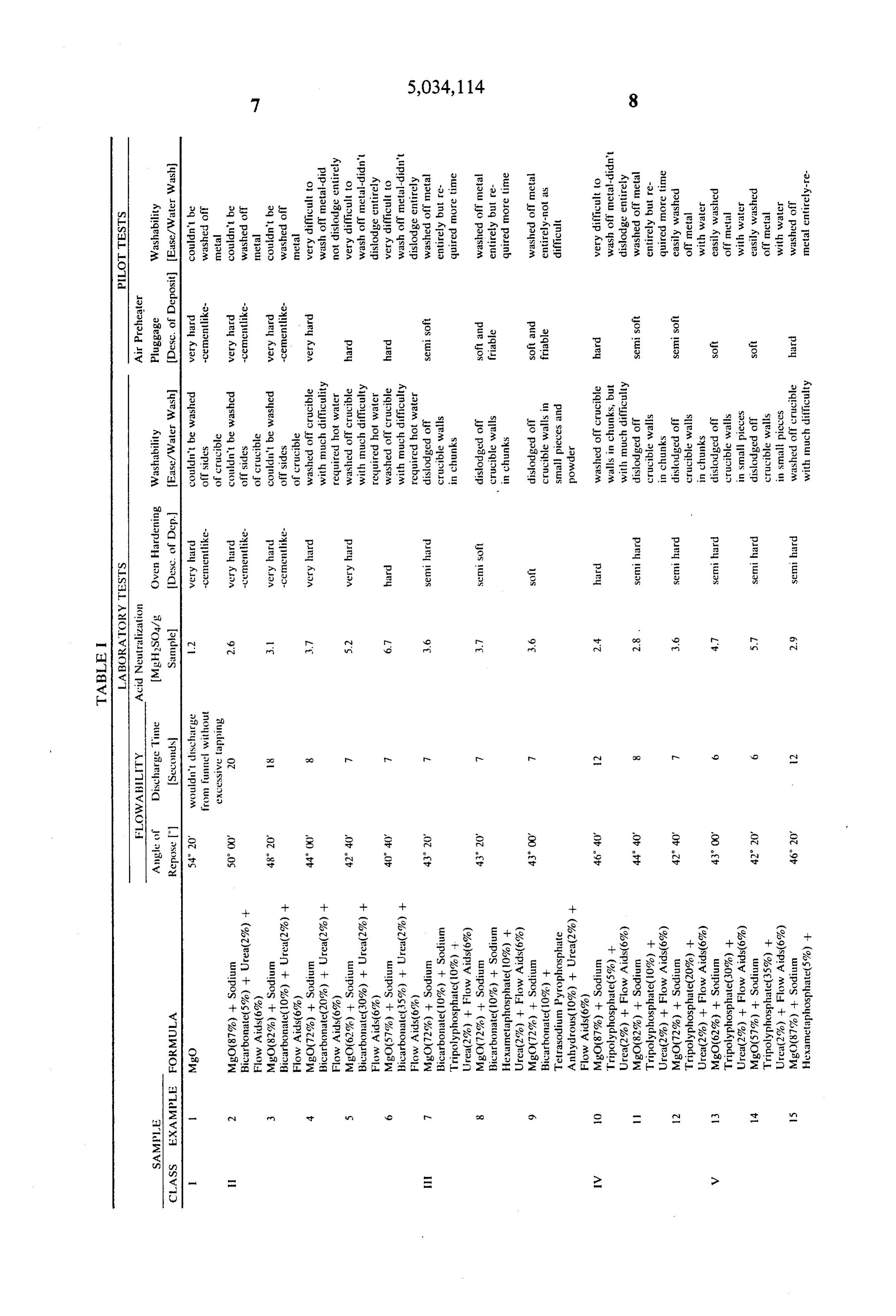
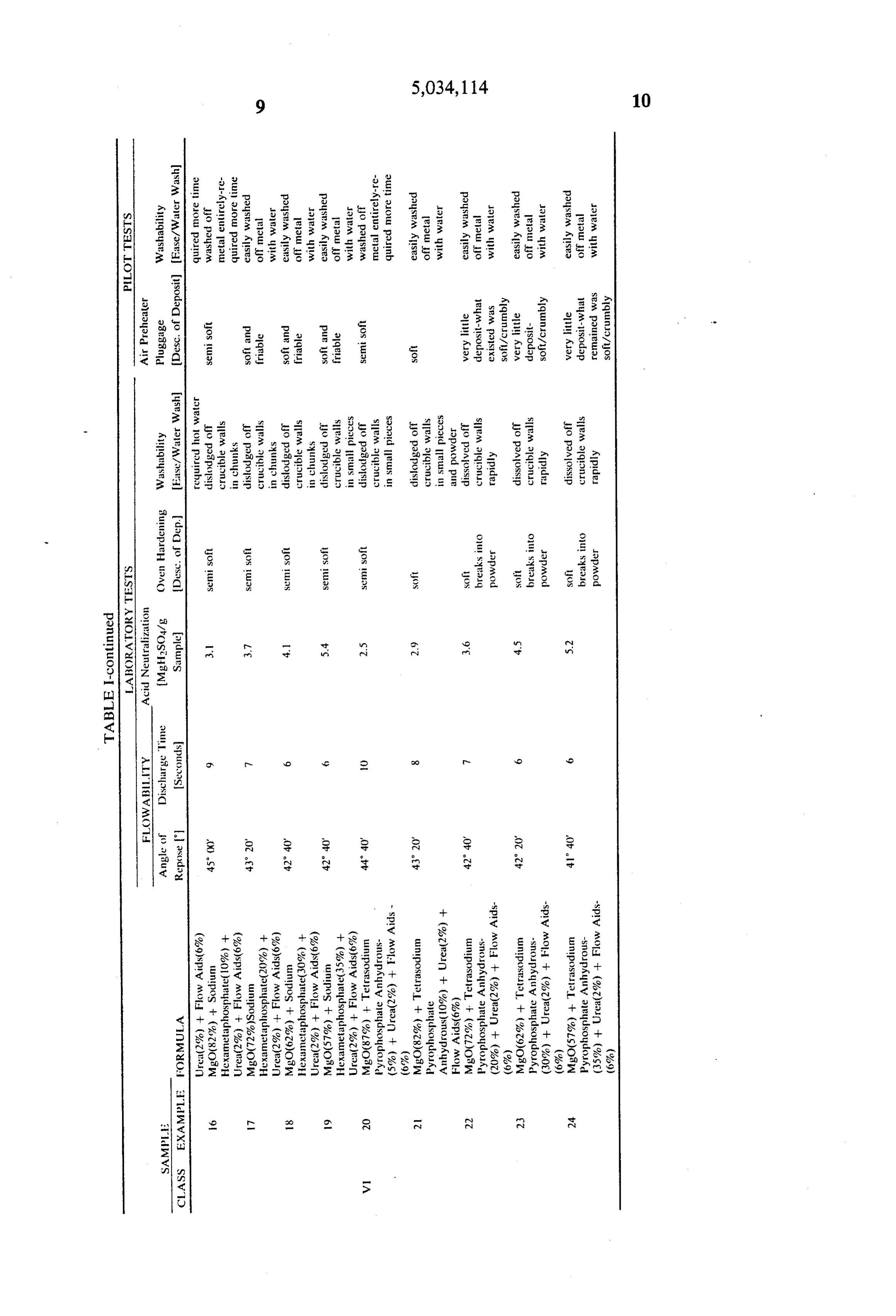
heater constructed to simulate those encountered in a a) Pluggage Test-using the equipment above, this typical 150-300MW unit. Pilot testing consisted of test was performed very much like the laboratory continuous treatment of the different formulas at oven hardening test. After twenty-four hours of continuous injection, the unit was removed from constant rates at the boiler outlet at 650-670 F. Just service and the metal blades inspected with obser upstream of this point, sulfuric acid was sprayed into vations on the type of deposits noted. the gas stream at a constant rate volumetrically b) Washability Test-performed on the deposits of equivalent to what is normally oxidized in a typical the metal fan blades much like the washability tests utility boiler. The stationary preheater was fan cooled O on the laboratory crucible samples, each test run was completed by hosing down the fan blades and to typical temperatures obtained in a utility unit, mak noting the ease of dislodgement of the deposits. ing the pilot unit comparable to real units and useful The different formulas were first tested in the labora in product comparison. The following pilot tests tory, then in the pilot unit. Test results are summarized were performed: in Table I, and discussed below.
Page 5
Drawing sheet — no readable text.
Page 6
Drawing sheet — no readable text.
Page 7
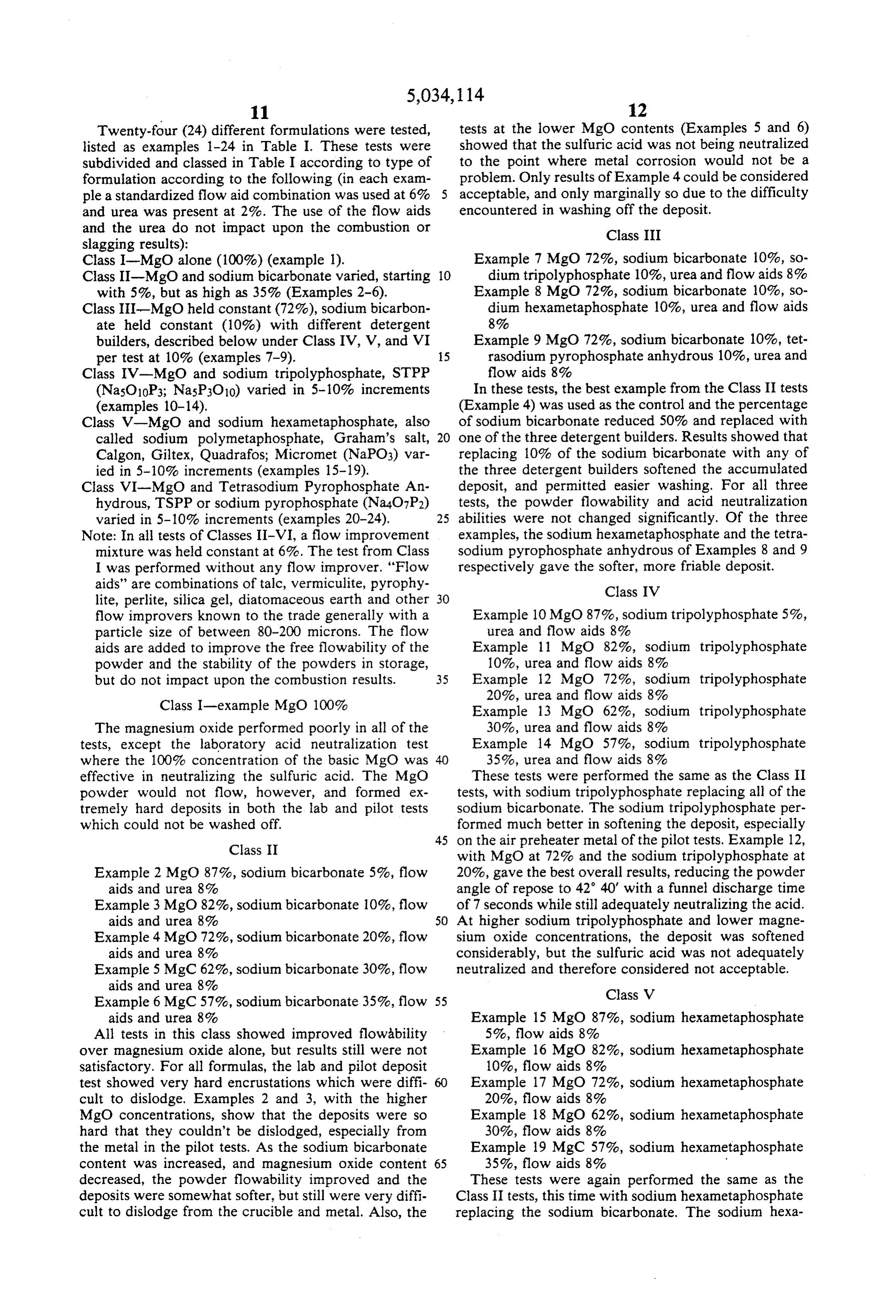
Twenty-four (24) different formulations were tested, tests at the lower MgO contents (Examples 5 and 6) listed as examples 1-24 in Table I. These tests were showed that the sulfuric acid was not being neutralized subdivided and classed in Table I according to type of to the point where metal corrosion would not be a formulation according to the following (in each exam problem. Only results of Example 4 could be considered ple a standardized flow aid combination was used at 6% acceptable, and only marginally so due to the difficulty and urea was present at 2%. The use of the flow aids encountered in washing off the deposit. and the urea do not impact upon the combustion or Class III slagging results):
Class I-MgO alone (100%) (example 1). Example 7 MgO 72%, sodium bicarbonate 10%, so Class II-MgO and sodium bicarbonate varied, starting 10 dium tripolyphosphate 10%, urea and flow aids 8% with 5%, but as high as 35% (Examples 2-6). Example 8 MgO 72%, sodium bicarbonate 10%, so Class III-MgO held constant (72%), sodium bicarbon dium hexametaphosphate 10%, urea and flow aids ate held constant (10%) with different detergent 8% builders, described below under Class IV, V, and VI Example 9 MgO 72%, sodium bicarbonate 10%, tet per test at 10% (examples 7-9). 15 rasodium pyrophosphate anhydrous 10%, urea and Class IV-MgO and sodium tripolyphosphate, STPP flow aids 8%
(Na5O10P3; Nasp3O10) varied in 5-10% increments In these tests, the best example from the Class II tests (examples 10-14). (Example 4) was used as the control and the percentage Class V-MgO and sodium hexametaphosphate, also of sodium bicarbonate reduced 50% and replaced with called sodium polymetaphosphate, Graham's salt, 20 one of the three detergent builders. Results showed that Calgon, Giltex, Quadrafos; Micromet (NaPO3) var replacing 10% of the sodium bicarbonate with any of ied in 5-10% increments (examples 15-19). the three detergent builders softened the accumulated Class VI-MgO and Tetrasodium Pyrophosphate An deposit, and permitted easier washing. For all three hydrous, TSPP or sodium pyrophosphate (Na4O7P2) tests, the powder flowability and acid neutralization varied in 5-10% increments (examples 20-24). 25 abilities were not changed significantly. Of the three Note: In all tests of Classes II-VI, a flow improvement examples, the sodium hexametaphosphate and the tetra mixture was held constant at 6%. The test from Class sodium pyrophosphate anhydrous of Examples 8 and 9 I was performed without any flow improver. "Flow respectively gave the softer, more friable deposit. aids' are combinations of talc, vermiculite, pyrophy Class IV lite, perlite, silica gel, diatomaceous earth and other 30 flow improvers known to the trade generally with a Example 10 MgO 87%, sodium tripolyphosphate 5%, particle size of between 80-200 microns. The flow urea and flow aids 8% aids are added to improve the free flowability of the Example 11 MgO 82%, sodium tripolyphosphate powder and the stability of the powders in storage, 10%, urea and flow aids 8% but do not impact upon the combustion results. 35 Example 12 MgO 72%, sodium tripolyphosphate Class I-example MgO 100% 20%, urea and flow aids 8%
Example 13 MgO 62%, sodium tripolyphosphate
The magnesium oxide performed poorly in all of the 30%, urea and flow aids 8% tests, except the laboratory acid neutralization test Example 14 MgO 57%, sodium tripolyphosphate where the 100% concentration of the basic MgO was 35%, urea and flow aids 8% effective in neutralizing the sulfuric acid. The MgO These tests were performed the same as the Class II powder would not flow, however, and formed ex tests, with sodium tripolyphosphate replacing all of the sodium bicarbonate. The sodium tripolyphosphate per tremely hard deposits in both the lab and pilot tests which could not be washed off. formed much better in softening the deposit, especially 45 on the air preheater metal of the pilot tests. Example 12,
Class II with MgO at 72% and the sodium tripolyphosphate at
Example 2 MgO 87%, sodium bicarbonate 5%, flow 20%, gave the best overall results, reducing the powder aids and urea 8% angle of repose to 42° 40' with a funnel discharge time Example 3 MgO 82%, sodium bicarbonate 10%, flow of 7 seconds while still adequately neutralizing the acid. aids and urea 8% 50 At higher sodium tripolyphosphate and lower magne Example 4 MgO 72%, sodium bicarbonate 20%, flow sium oxide concentrations, the deposit was softened aids and urea 8% considerably, but the sulfuric acid was not adequately Example 5 MgC 62%, sodium bicarbonate 30%, flow neutralized and therefore considered not acceptable. aids and urea 8%
Class V
Example 6 MgC 57%, sodium bicarbonate 35%, flow 55 aids and urea 8% Example 15 MgO 87%, sodium hexametaphosphate All tests in this class showed improved flowability 5%, flow aids 8% over magnesium oxide alone, but results still were not Example 16 MgO 82%, sodium hexametaphosphate satisfactory. For all formulas, the lab and pilot deposit 10%, flow aids 8% test showed very hard encrustations which were diffi Example 17 MgO 72%, sodium hexametaphosphate cult to dislodge. Examples 2 and 3, with the higher 20%, flow aids 8%
MgO concentrations, show that the deposits were so Example 18 MgO 62%, sodium hexametaphosphate hard that they couldn't be dislodged, especially from 30%, flow aids 8% the metal in the pilot tests. As the sodium bicarbonate Example 19 MgC 57%, sodium hexametaphosphate content was increased, and magnesium oxide content 65 35%, flow aids 8% decreased, the powder flowability improved and the These tests were again performed the same as the deposits were somewhat softer, but still were very diffi Class II tests, this time with sodium hexametaphosphate cult to dislodge from the crucible and metal. Also, the replacing the sodium bicarbonate. The sodium hexa
Page 8
metaphosphate worked well, with as little as 10% (Ex quired is that which is appropriate to provide an effec tive film on the walls of the portion of the boiler in ample 16) giving good overall results. The best results volved.
were found in Examples 17 and 18, however, with 20% Likewise, the optimal detergent builder to be and 30% respectively of the sodium hexametaphos used may vary from installation to installation, since phate improving flowability, ease of metal and crucible 5 each boiler situation and environment often requires cleaning, and still providing adequate acid neutraliza individual treatment.
While but a limited number of embodiments have tion. Reducing the MgO content an additional 5% (Ex been here specifically disclosed, it will be apparent that ample 19) did not significantly improve flow nor ease the deposit wash and increased the free acid content many variations may be made with respect thereto, all above the desired upper limit of 5mgH2SO4 per gram of 10 within the scope of the instant invention as defined in sample. the following claims.
I claim:
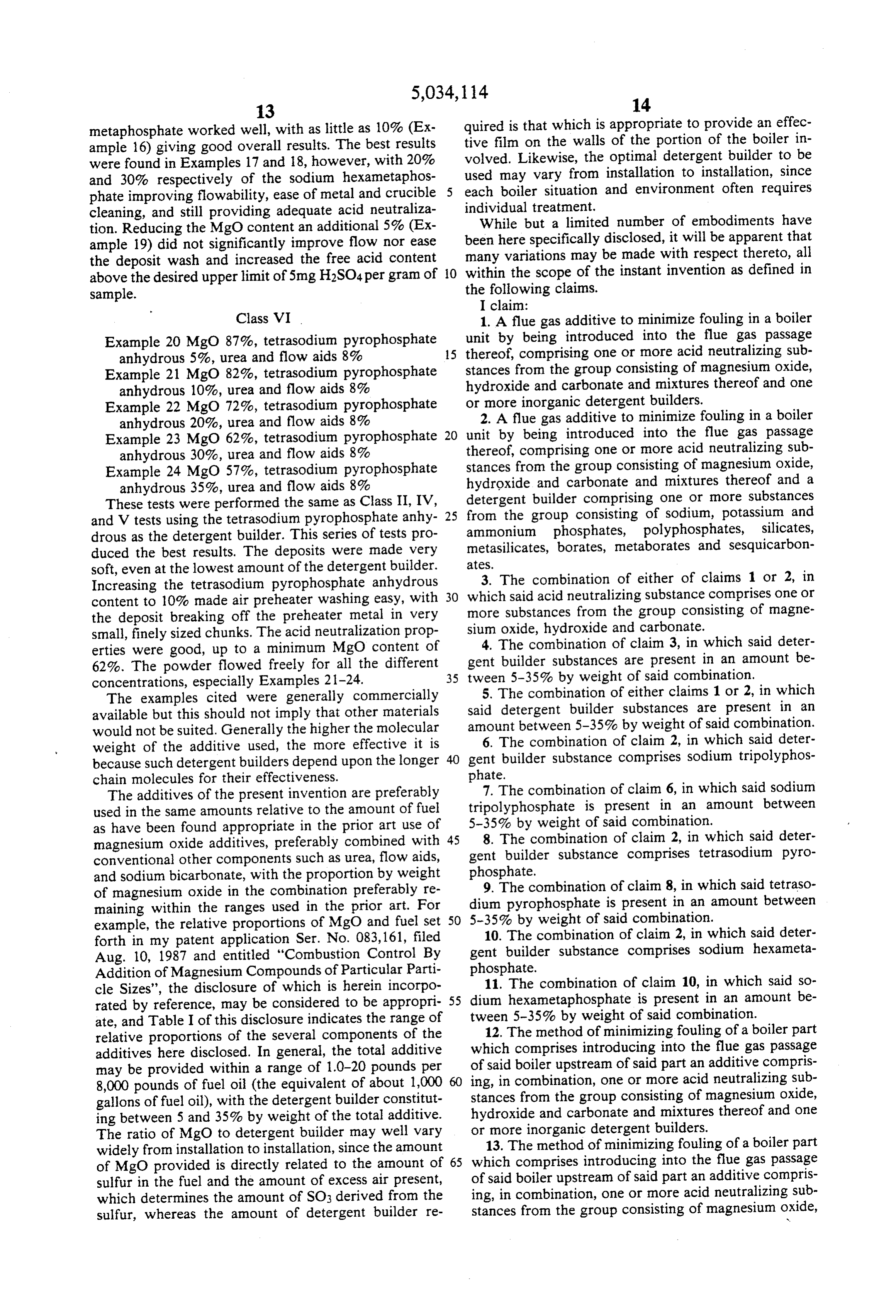
Class VI 1. A flue gas additive to minimize fouling in a boiler Example 20 MgO 87%, tetrasodium pyrophosphate unit by being introduced into the flue gas passage anhydrous 5%, urea and flow aids 8% 15 thereof, comprising one or more acid neutralizing sub Example 21 MgO 82%, tetrasodium pyrophosphate stances from the group consisting of magnesium oxide, anhydrous 10%, urea and flow aids 8% hydroxide and carbonate and mixtures thereof and one Example 22 MgO 72%, tetrasodium pyrophosphate or more inorganic detergent builders.
anhydrous 20%, urea and flow aids 8% 2. A flue gas additive to minimize fouling in a boiler Example 23 MgO 62%, tetrasodium pyrophosphate 20 unit by being introduced into the flue gas passage anhydrous 30%, urea and flow aids 8% thereof, comprising one or more acid neutralizing sub Example 24 MgO 57%, tetrasodium pyrophosphate stances from the group consisting of magnesium oxide, anhydrous 35%, urea and flow aids 8% hydroxide and carbonate and mixtures thereof and a These tests were performed the same as Class II, IV, detergent builder comprising one or more substances and V tests using the tetrasodium pyrophosphate anhy 25 from the group consisting of sodium, potassium and drous as the detergent builder. This series of tests pro ammonium phosphates, polyphosphates, silicates, duced the best results. The deposits were made very metasilicates, borates, metaborates and sesquicarbon soft, even at the lowest amount of the detergent builder. ates.
Increasing the tetrasodium pyrophosphate anhydrous 3. The combination of either of claims 1 or 2, in content to 10% made air preheater washing easy, with 30 which said acid neutralizing substance comprises one or the deposit breaking off the preheater metal in very more substances from the group consisting of magne small, finely sized chunks. The acid neutralization prop sium oxide, hydroxide and carbonate. 4. The combination of claim 3, in which said deter erties were good, up to a minimum MgO content of 62%. The powder flowed freely for all the different 35 gent builder substances are present in an amount be concentrations, especially Examples 21-24. tween 5-35% by weight of said combination. The examples cited were generally commercially 5. The combination of either claims 1 or 2, in which said available but this should not imply that other materials amount detergent builder substances are present in an would not be suited. Generally the higher the molecular between 5-35% by weight of said combination. 6. The weight of the additive used, the more effective it is gent builder combination of claim 2, in which said deter because such detergent builders depend upon the longer 40 substance comprises sodium tripolyphos chain molecules for their effectiveness. phate.
7. The combination of claim 6, in which said sodium
The additives of the present invention are preferably tripolyphosphate used in the same amounts relative to the amount of fuel is present in an amount between as have been found appropriate in the prior art use of 5-35% by weight of said combination. magnesium oxide additives, preferably combined with 45 8. The combination of claim 2, in which said deter conventional other components such as urea, flow aids, gent builder substance comprises tetrasodium pyro and sodium bicarbonate, with the proportion by weight phosphate.
of magnesium oxide in the combination preferably re 9. The combination of claim 8, in which said tetraso maining within the ranges used in the prior art. For dium pyrophosphate is present in an amount between example, the relative proportions of MgO and fuel set 50 5-35% by weight of said combination. forth in my patent application Ser. No. 083,161, filed 10. The combination of claim 2, in which said deter gent builder substance comprises sodium hexameta
Aug. 10, 1987 and entitled "Combustion Control By phosphate.
Addition of Magnesium Compounds of Particular Parti cle Sizes', the disclosure of which is herein incorpo dium 11. The combination of claim 10, in which said so rated by reference, may be considered to be appropri- 55 hexametaphosphate is present in an amount be ate, and Table I of this disclosure indicates the range of tween 5-35% by weight of said combination. 12. The method of minimizing fouling of a boiler part relative proportions of the several components of the which additives here disclosed. In general, the total additive of said comprises introducing into the flue gas passage boiler upstream of said part an additive compris may be provided within a range of 1.0-20 pounds per 8,000 pounds of fuel oil (the equivalent of about 1,000 60 ing, in combination, one or more acid neutralizing sub gallons of fuel oil), with the detergent builder constitut stances from the group consisting of magnesium oxide, ing between 5 and 35% by weight of the total additive. hydroxide and carbonate and mixtures thereof and one The ratio of MgO to detergent builder may well vary or more inorganic detergent builders. 13. The method of minimizing fouling of a boiler part widely from installation to installation, since the amount which of MgO provided is directly related to the amount of 65 comprises introducing into the flue gas passage sulfur in the fuel and the amount of excess air present, of said boiler upstream of said part an additive compris which determines the amount of SO3 derived from the ing, in combination, one or more acid neutralizing sub sulfur, whereas the amount of detergent builder re stances from the group consisting of magnesium oxide,
Page 9
hydroxide and carbonate and mixtures thereof and a 17. The method of claim 16, in which said sodium detergent builder comprising one or more substances tripolyphosphate is present in an amount between from the group consisting of sodium, potassium and 5-35% by weight of said combination. 18. The method of claim 13, in which said detergent ammonium phosphates, polyphosphates, silicates, 5 builder substance comprises tetrasodium pyrophos metasilicates, borates, metaborates and sesquicarbon phate.
ates. 19. The method of claim 18, in which said tetraso 14. The method of claim 12 or 13, in which said deter dium pyrophosphate is present in an amount between gent builder substances are present in an amount be 10 5-35% by weight of said combination. 20. The method of claim 13, in which said detergent tween 5-35% by weight of said combination. builder substance comprises sodium hexametaphos 15. The method of claims 12 or 13, in which said phate.
detergent builder substances are present in an amount 21. The method of claim 20, in which said sodium between 5-35% by weight of said combination. hexametaphosphate is present in an amount between 16. The method of claim 13, in which said detergent 15 5-35% by weight of saidk combination. builder substance comprises sodium tripolyphosphate. k k
Provenance
- Collection
- Cited prior art
- Original PDF
- patentimages.storage.googleapis.com →
- Filed
- 1989-07-28
- Pages
- 9
- Method
- pdftotext (the PDF's own text layer) + pdftoppm 300dpi page scans
- Source
- Google Patents bibliographic record
- Granted
- 1991-07-23
- Inventors
- Ira Kukin
- Transcribed from
- patentimages.storage.googleapis.com →