patent · US4830092
Heat enhancers and salt purifiers for thermal energy storage canister
16 May 1989
Page 1 — bibliographic record
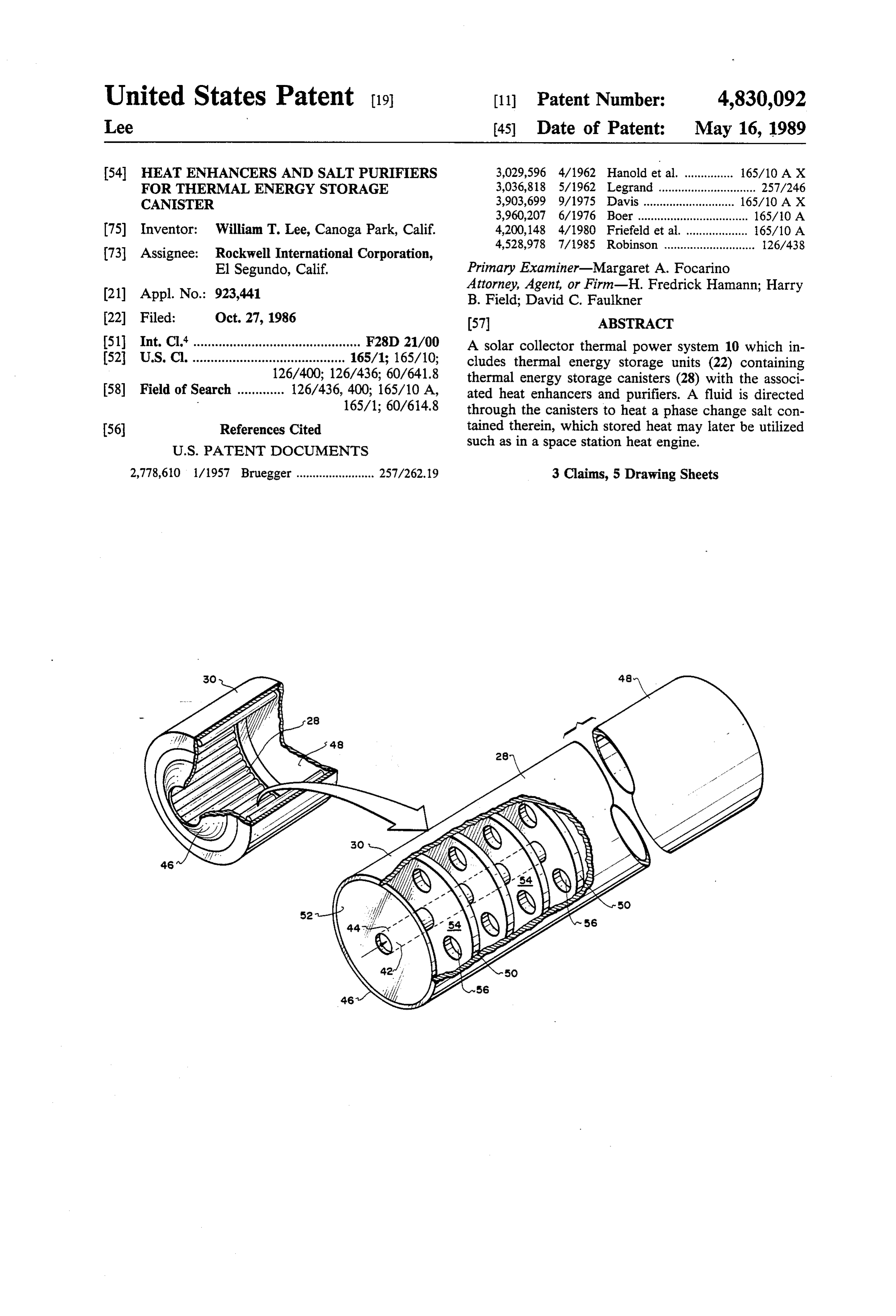
United States Patent (19) 11 Patent Number: 4,830,092 Lee (45) Date of Patent: May 16, 1989 54. HEAT ENHANCERS AND SALT PURIFIERS 3,029,596 4/1962 Hanold et al. ............... 165/10 AX FOR THERMAL ENERGY STORAGE 3,036,818 5/1962 Legrand .............................. 257/246 CANSTER 3,903,699 9/1975 Davis........ ... 165/10 AX 3,960,207 6/1976 Boer .............. ... 165/10 A (75) Inventor: William T. Lee, Canoga Park, Calif. 4,200,148 4/1980 Friefeld et al. ... ... 65/10 A 73 Assignee: Rockwell International Corporation, 4,528,978 7/1985 Robinson ............................ 126/438 El Segundo, Calif. Primary Examiner-Margaret A. Focarino (21) Appl. No.: 923,441 Attorney, Agent, or Firm-H. Fredrick Hamann; Harry B. Field; David C. Faulkner 22 Filed: Oct. 27, 1986 (57) ABSTRACT 51) Int. Cl." .............................................. F28D 21/00 A solar collector thermal power system 10 which in 52 U.S. Cl. .......................................... 165/1; 165/10; cludes thermal energy storage units (22) containing 126/400; 126/436; 60/641.8 thermal energy storage canisters (28) with the associ 58) Field of Search ............. 126/436, 400; 165/10 A, ated heat enhancers and purifiers. A fluid is directed 165/1; 60/614.8 through the canisters to heat a phase change salt con 56 References Cited tained therein, which stored heat may later be utilized
such as in a space station heat engine.
2,778,610 1/1957 Bruegger ........................ 257/262.19 3 Claims, 5 Drawing Sheets
Page 2
Drawing sheet — no readable text.
Page 3
Drawing sheet — no readable text.
Page 4
Drawing sheet — no readable text.
Page 5
Drawing sheet — no readable text.
Page 6
Drawing sheet — no readable text.
Page 7
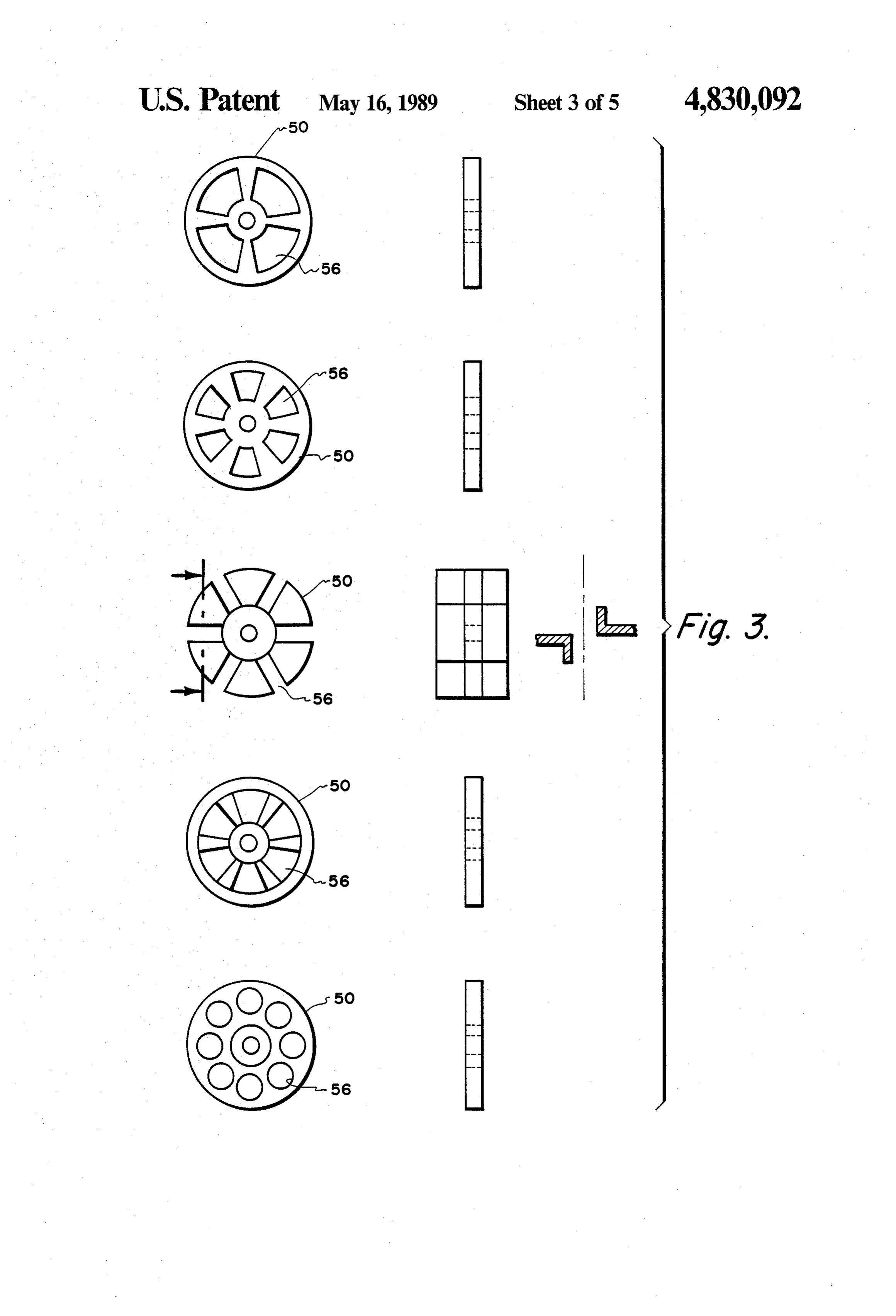
FIG. 3 depicts several possible structural configura
HEAT ENHANCERS AND SALT PURIFIERS FOR tions of the fin elements contained within each canister THERMAL ENERGY STORAGE CANISTER housing.
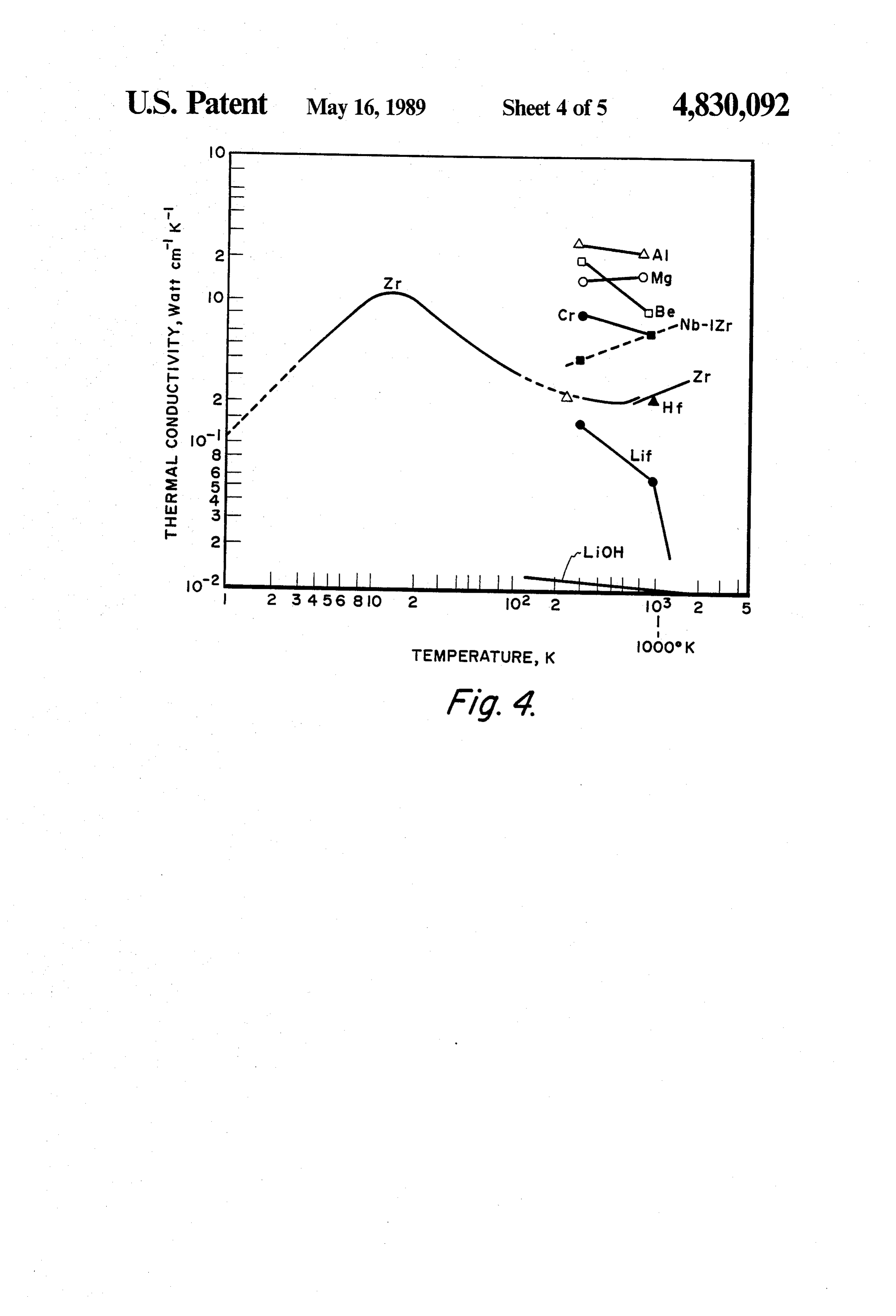
FIG. 4 indicates the thermal conductivities of the
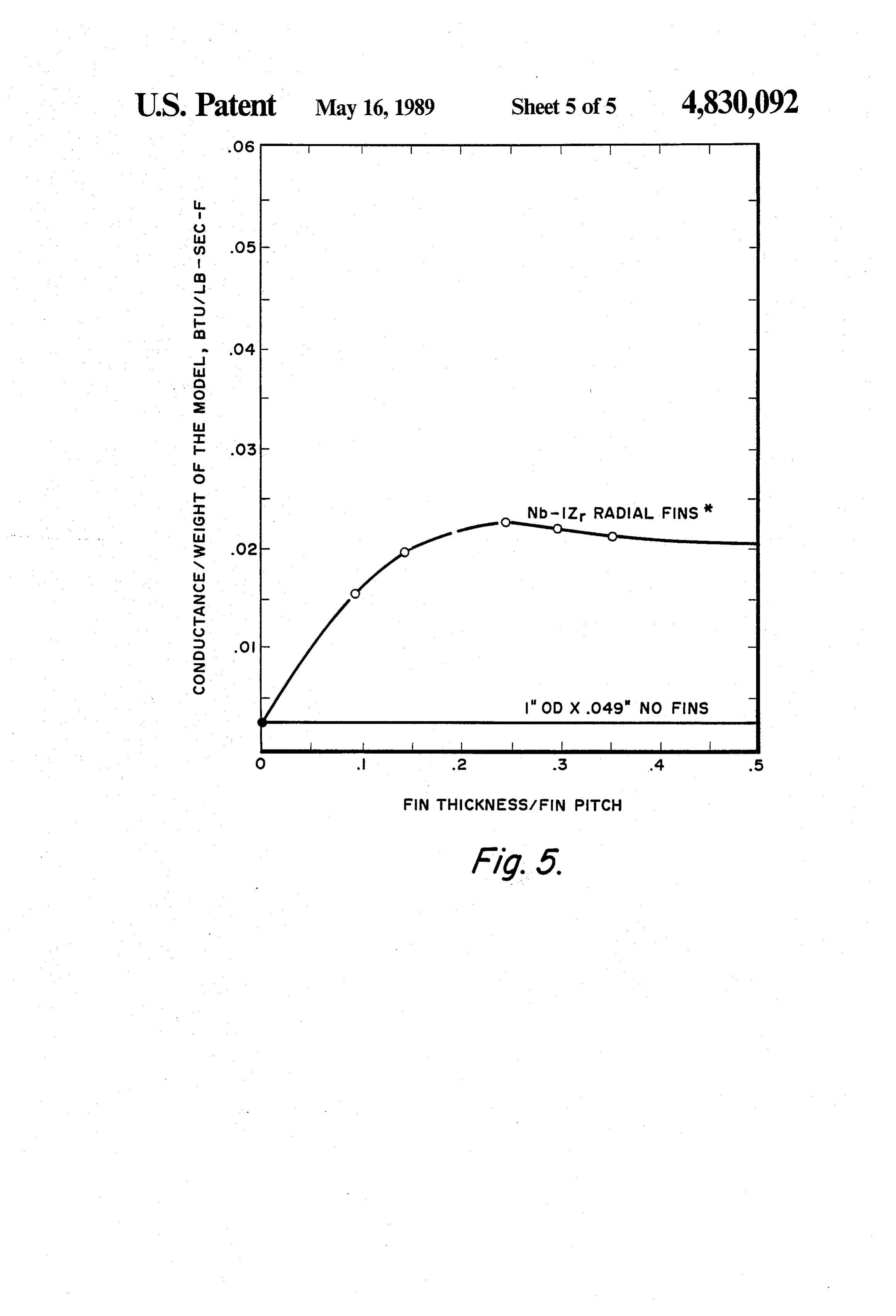
BACKGROUND OF THE INVENTION 5 metals used in canister construction and a relationship 1. Technical Field to the thermal energy salts therein. This invention relates generally to solar collector ductance FIG. 5 shows theoretically the enhancement of con of Nb-lZr fin elements.
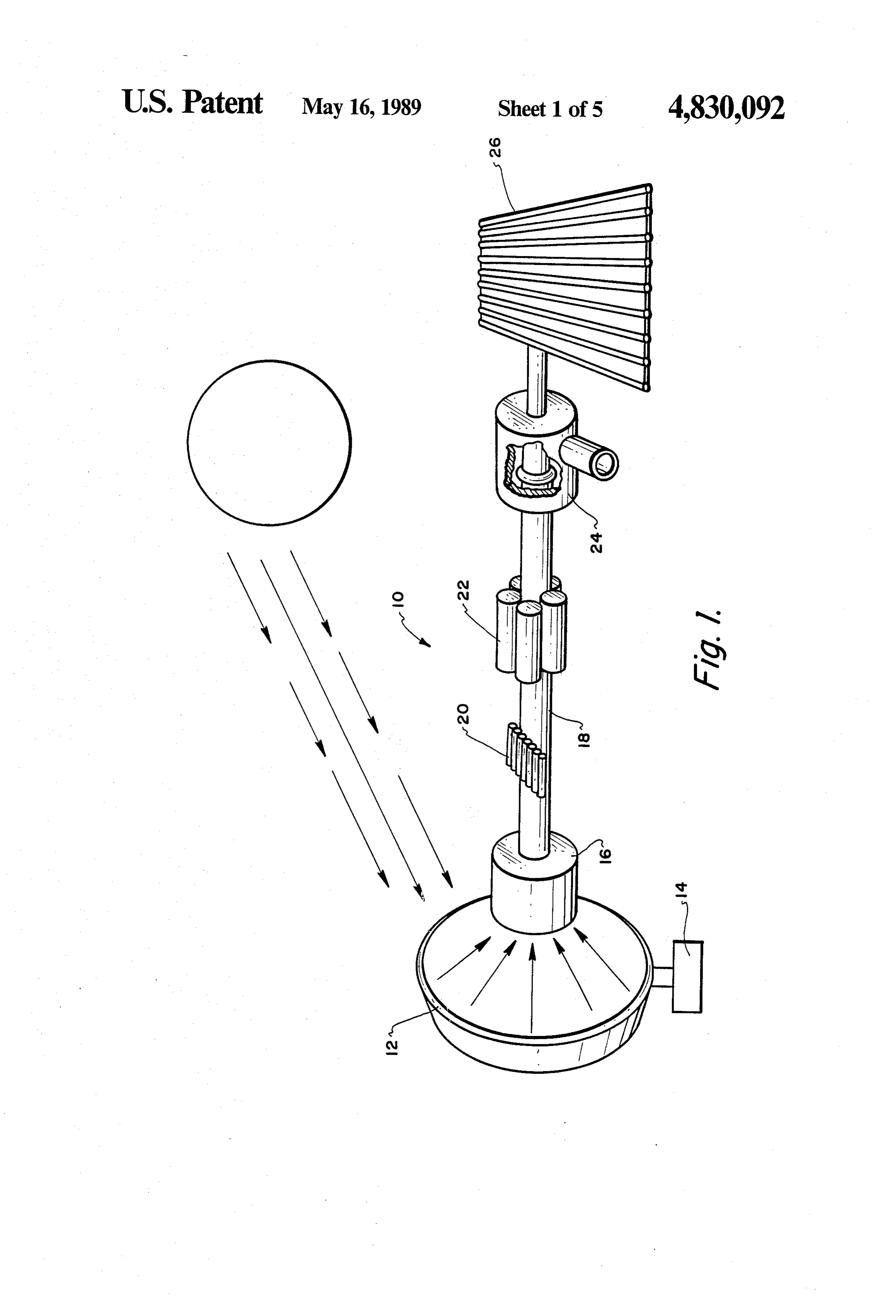
thermal power systems and is directed specifically to thermal energy storage units containing thermal energy O DETAILED DESCRIPTION storage canisters. Referring now to the drawings and more particularly 2. Background of the Prior Art to FIG. 1, there is shown a space-based solar collector Various solar power systems have previously been thermal power system 10. The power system incorpo proposed to meet electrical power or propulsion re rates a solar radiation collector 12 including an orienta quirements of spacecraft, satellites and the space station. 15 tion system 14 and receiver 16. The radiation collector A solar rocket absorber for use in outer space that and receiver are functionally coupled or integrated with heats a liquid by solar energy and outputs the heated a heat pipe (or heat exchanger) 18 having associated fluid to a thruster is disclosed in U.S. Pat. No. 4,528,978 therewith a power control radiator 20, thermal energy to Robinson dated July 16, 1985. storage units 22 and a Vuilleumier cooler 24. The cooler A thermal storage assembly which is charged by 20 24 is in turn associated with a waste heat radiator 26. direct solar radiation and subsequently extracts the The thermal energy storage units 22 contain thermal stored heat from the assembly utilizing a separate heat energy storage canisters 28 as best seen in FIG. 2. The transfer fluid is disclosed in pending U.S. patent applica construction or configuration of the canisters as well as tion Ser. No. 905,536 filed Sept. 10, 1986, titled "Solar the physical characteristics thereof will be more fully Energy Focusing Assembly and Storage Unit', incor 25 detailed hereinbelow.
porated herein by reference. However, construction In operation, solar energy (indicated by arrows) im designs of heat fluid storage and conduit systems as well pinging upon solar collector 12 is directed into receiver as thermal conductivity characteristics thereof have 16 having a fluid conduit system and fluid pumping underscored the need for systems possessing enhanced means (neither shown) such as thermoelectric magnetic structural integrity and improved heat transfer proper 30 pumps, which convey a heated transport fluid (e.g. Li, ties. Na, K, NaK or Xenon-Helium gas) which transport heat from the thermal receiver 16, to the thermal energy
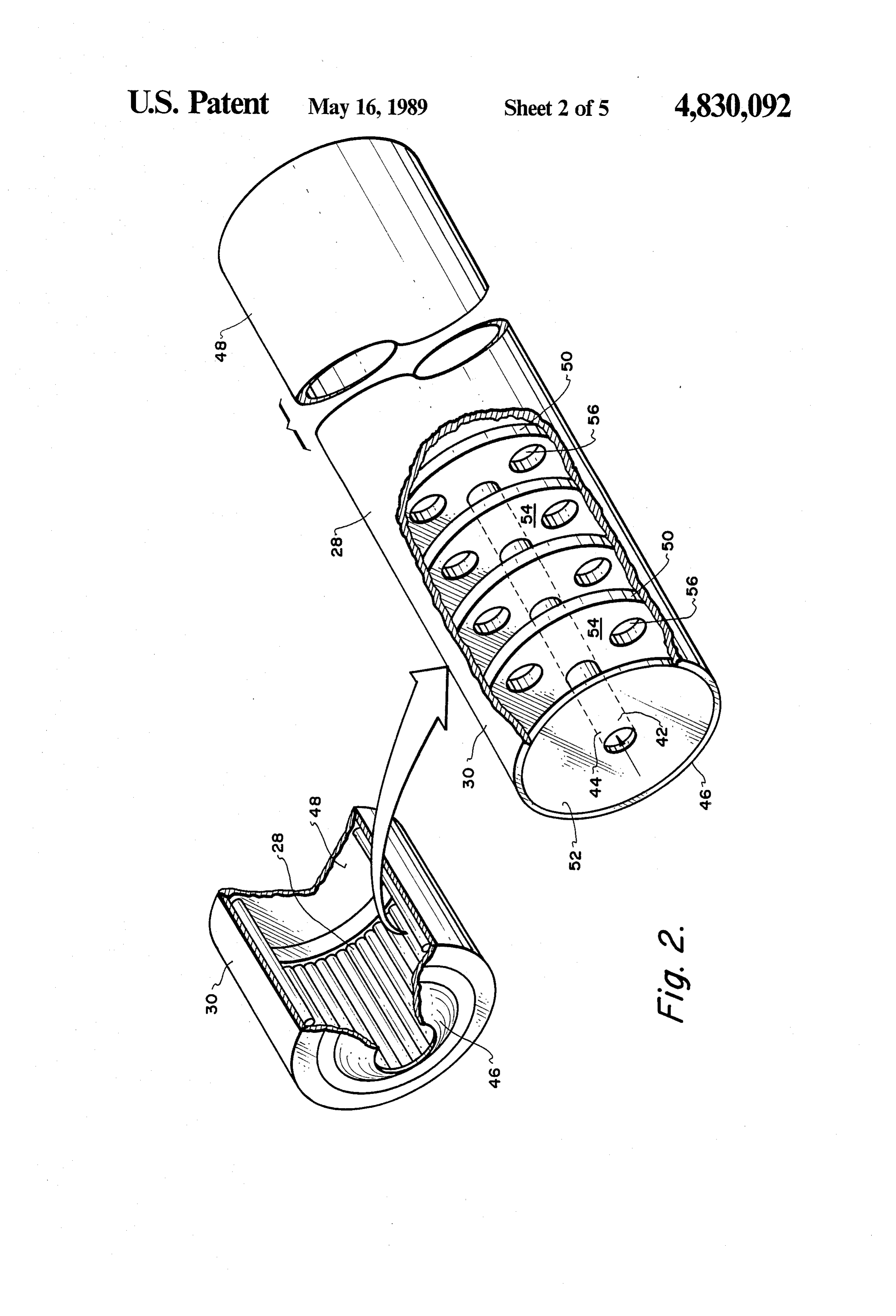
DISCLOSURE OF THE INVENTION storage canisters 28 of storage units 22. The present invention provides thermal energy salt The thermal energy storage canisters include a hous storage canisters which can be utilized in a solar thermal 35 ing 30, which amy be constructed of cobalt based al power system. loys, or metal such as nickel. Each of the thermal energy storage canisters include Internal to each canister housing 30 is a hollow axi a longitudinal housing, an internal thermally conductive ally extending thermally conductive tubular member 42 member passing lengthwise of the housing and attached which may be constructed of metals or alloys such as proximate each end thereof. The member is further Nb-lZr, an outer
Hf, Be, Zr, Cr, etc. Tubular member 42 also has surface 44, and is attached at the opposing ends provided with longitudinally spaced radially extending 46 and 48 fins affixed to the outer surface thereof. These spaced therein are of the canister 28. In spaced relationship fins define a series of compartments within the longitu the outer surface 44 of fins positioned 50 extending radially from the conductive tubular member dinal housing in which a phase change salt is retained. 45 42 which come into contact with the inner surface 52 of It is an object of the present invention to provide canister housing 30.
thermal energy salt storage canisters which can be uti The radially extending fins 50 form annular compart lized in a collector thermal power system. ments 54 within canister housing 30 for retaining a heat Another object of the present invention is to provide exchange salt such has LiF, LiF-CaF2, LiF-MgF2, or thermal energy salt storage canisters designed and con 50 LiOH therein. As shown structed of a select metal or alloy to enhance the struc be perforated or shaped toindefine FIGS. 2 and 3 each fin may communicative open tural integrity thereof. ings 56 therethrough and between compartments 54. Yet another object of the present invention is to pro A heated transport fluid, as previously noted, is con vide thermal energy salt storage canisters having im veyed to and through hollow tubular member 42 associ proved heat transfer properties. 55 ated with each canister 28. This fluid is initially heated These and other objects and features of the present in receiver 16 and transported to each thermal energy invention will be apparent from the following detailed storage unit by a fluid conduit system. description when considered in connection with the As the heated fluid flows through tubular member 42, accompanying drawings. part of the fluid heat is taken up by the phase change salt BRIEF DESCRIPTION OF THE DRAWINGS 60 retained within the housing compartments 54 formed by fins 50. As the space-based solar collector housing
FIG. 1 is a perspective view of a space-based solar power system passes from an in-sun time period to an collector thermal power system incorporating thermal in-shadow time period during each orbit, the fluid pass energy storage canisters according to the present inven ing through thermally conductive tubular member 42 tion within the system's thermal energy storage units. 65 extracts heat from the phase change salt. The thus FIG. 2 is a partial cross-sectional view of one of the heated fluid may then be utilized to function equipment thermal energy storage units depicting a thermal energy such as a space station heat engine during the in-shadow storage canister. time period.
Page 8
The above noted structural design and heat transfer energy storage salts is clear. For example, the thermal properties of the thermal energy storage canisters and conductivity of Nb-Zr is about ten times better than component parts take on added significance due to the that of LiF salt, and about sixteen times better than that reactivity of the phase change salt and the metallic of LiOH Salt at 1000 K.
material used to construct each canister housing 30, 5 As shown in FIG. 5, theoretical calculation shows thermally conductive tubular member 42 and the radi the significant enhancement of the NB-lZr radial fins in ally extending fins 50. 1'ODX0.049" (wall thickness) canisters. Table 1 shows the results of heat transfer enhance Obviously, many modifications and variations of the ment tests comparing a canister without fins and with present invention are possible in light of the above con fins made of copper or nickel metal. For example, in a 10 cepts. It is therefore to be understood that, within the canister having copper radial fins as compared to one scope of the appended claims, the invention may be without fins, the heat transfer enhnacement is shown to practiced otherwise than as specifically described. have increased by a factor of 2.5. In a similar fashion the What is claimed and desired to be secured by Letter cooling rate of a canister subsequent to deactivation of Patent of the United States is:
the heat source was enhanced by a factor of 1.6. 5 1. A method for simultaneous impurity removal and In addition to enhancing heat transfer and reducing heat transfer enhancement in thermal energy storage the internal change in temperature (AT) in the canister, units in a space-based solar collector thermal power the heat enhancer and salt purifier according to the system, wherein each thermal energy storage unit com present invention also purify the salt contained therein prises:
by gettering the trace but harmful impurities in the salt. a longitudinal housing;
These trace impurities are typically O2, H2O, carbon an internal axially extending thermally conductive and sulfur. tubular member having an outer surface contained For the fluoride salts such as LiF, LiF-MgF2 and within the housing;
LiF-CaF2, the canister and fins may be constructed of spaced radially extending fins on the outer surface of Nb-Zr, although other metals (Hf, Zr) having an inher- 25 the tubular member;
ent propensity to getter O2, H2O, C, S, etc., may also be annular compartments within the housing defined by utilized. the radially extending fins; The final selection of the gettering metal or alloy will a phase change salt retained within the housing com depend on the design temperature and environment of partment; and said method consisting of: the system. The gettering properties of the noted metals 30 (1) constructing the canister and fins of a gettering are well known as described in the following publica metal;
tions incorporated by reference herein: (2) retaining a heat exchange salt within the canis 1. A. L. Mathews and C. F. Bres, Jr., “Oxide Chemis ter housing; and try & Thermodynamics of Molten LiF-BeF2 Solutions', (3) gettering impurities resulting from the interac Inorganic Chemistry, Vol. 7, Issue 2, February 1968. 35 tion of the heat exchange salt and the canister 2. W. M. Phillips and John W. Stearns, “Advanced fins.
Latent Heat of Fusion Thermal Energy Storage for 2. The method of claim 1 wherein said canister fins Solar Power Systems', Proceedings of the 20th Interso are constructed from a gettering metal selected from the ciety Energy Conversion Engineering Conference (IE group consisting of niobium, zirconium, hafnium, beryl CEC), August 18-23, 1985, Miami Beach, Fla., pp. 40 lium, chromium or alloys thereof.
2.384-2.391. 3. The method of claim 1 in which the heat exchange As indicated in FIG. 4, the thermal conductivities of salt is selected from the group consisting of LiF, LiF the metals or alloys used in construction of the enhancer MgF2, LiF-CaF2 and LiOH. 8. and related parts and the relationship to the thermal ma s er
Provenance
- Collection
- Cited prior art
- Original PDF
- patentimages.storage.googleapis.com →
- Filed
- 1986-10-27
- Pages
- 8
- Method
- pdftotext (the PDF's own text layer) + pdftoppm 300dpi page scans
- Source
- Google Patents bibliographic record
- Granted
- 1989-05-16
- Inventors
- William T. Lee; Rockwell International Corp
- Transcribed from
- patentimages.storage.googleapis.com →