patent · US4568473
Amine bearing polymeric particles as acid neutralizers for engine oils
4 February 1986
Page 1 — bibliographic record
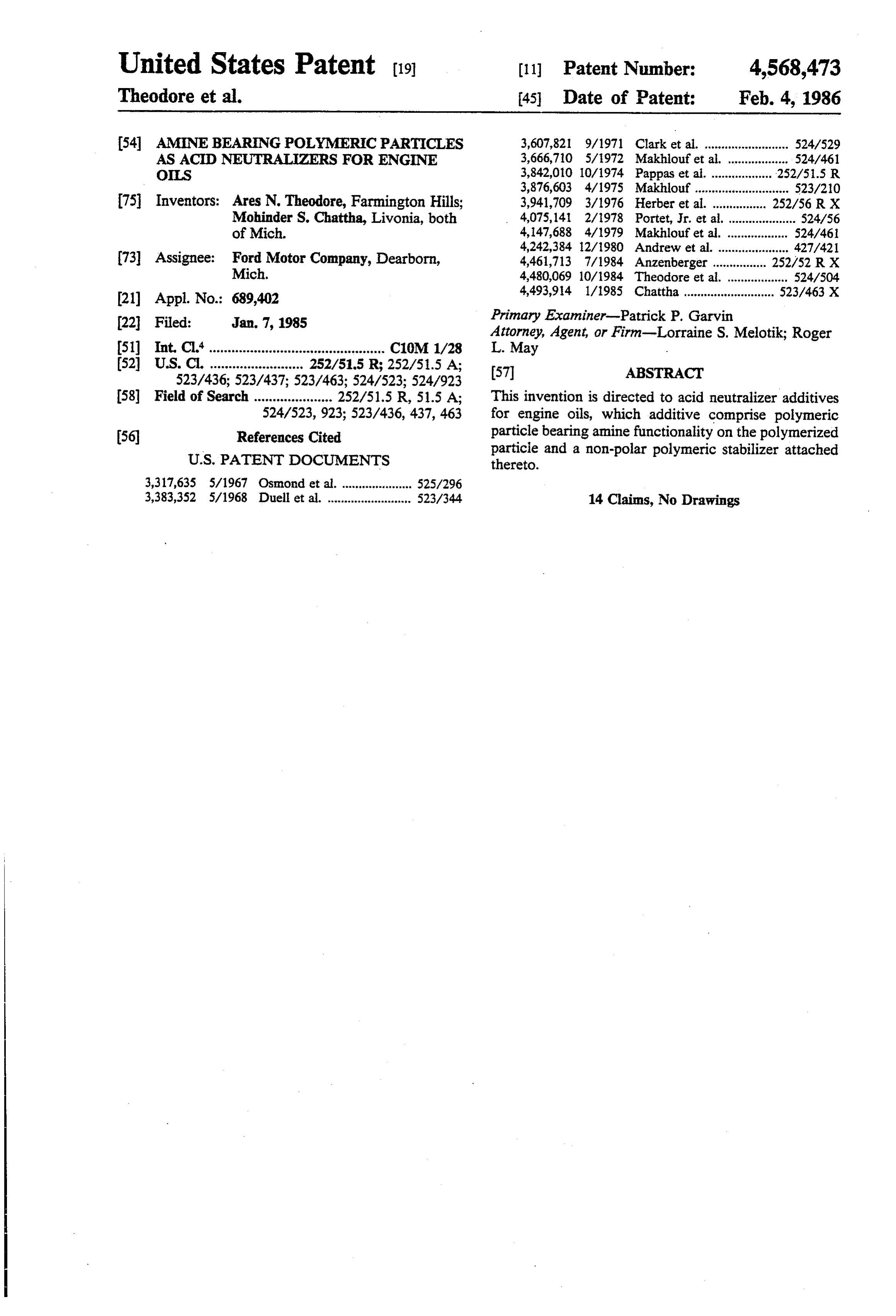
United States Patent (19) (11 Patent Number: 4,568,473 Theodore et al. 45 Date of Patent: Feb. 4, 1986 54 AMINE BEARING POLYMERICPARTICLES 3,607,821 9/1971 Clark et al. ......................... 524/529 ASACD NEUTRALIZERS FOR ENGINE 3,666,710 5/1972 Makhlouf et al. .................. 524/461 OLS 3,842,010 10/1974 Pappas et al. .......... ... 252/5. SR 3,876,603 4/1975 Makhlouf............................ 523/210 75 Inventors: Ares N. Theodore, Farmington Hills; 3,941,709 3/1976 Herber et al. ................ 252/56 RX Mohinder S. Chattha, Livonia, both 4,075,141 2/1978 Portet, Jr. et al. .................... 524/56 of Mich. 4,147,688 4/1979 Makhlouf et al. .................. 524/46 4,242,384 12/1980 Andrew et al. ..................... 427/421 73 Assignee: Ford Motor Company, Dearborn, 4,461,713 7/1984 Anzenberger .......... ... 252/52 RX Mich. 4,480,069 10/1984 Theodore et al. .................. 524/504 4,493,914 1/1985 Chattha ........................... 523/463 X
(22 Filed: Jan. 7, 1985 Primary Examiner-Patrick P. Garvin Attorney, Agent, or Firm-Lorraine S. Melotik; Roger 51 Int. Cl'............................................... C10M 1/28 L. May 52 U.S. C. ......................... 252/515 R; 252/51.5A; 57 ABSTRACT
58 Field of Search ..................... 252/51.5 R, 51.5A; This invention is directed to acid neutralizer additives 524/523,923; 523/436,437, 463 for engine oils, which additive comprise polymeric (56) References Cited particle bearing amine functionality on the polymerized particle and a non-polar polymeric stabilizer attached
3,383,352 5/1968 Duell et al. ......................... 523/344 14 Clains, No Drawings
Page 2
AMINE BEARING POLYMERIC PARTICLES AS
resultant polymer, and (II) polymeric dispersion stabi
ACD NEUTRALIZERS FOR ENGINE OLS
lizer containing at least two segments with one segment being solvated by the non-polar organic liquid and the second segment being of different polarity than the first
Reference is made to commonly assigned and concur 5 segment and relatively insoluble in the non-polar or rently filed U.S. application Ser. No. 689,401, entitled ganic liquid, which second segment of the stabilizer is "Polymeric Particle Acid Neutralizers with Reactive chemically attached to the polymerized particle. Op Epoxy Core for Engine Oils' to Theodore et al. tionally, the stabilizer may also bear epoxide groups. TECHNICAL FIELD Preferably, the particles have a diameter, on average,
This invention is directed to acid neutralizing addi One advantage of the acid neutralizing oil additive of tives for engine oils. In particular, this invention is di the invention of this application is that the additive in rected to such additives which comprise polymeric addition to neutralizing acidic components in engine particles with a reactive amine polymer core and a oils such as formic acid, it also acts as a dispersant. non-polar, stabilizer shell. 15 Still another advantage of the additive of this inven BACKGROUND OF THE INVENTION tion is that the outer shell stabilizer oligomers of the particles are inherently effective lubricants.
Lubricating oils for gasoline-fueled internal combus tion engines are usually formulated with a number of DETALEED DESCRIPTION OF THE additives for enhancing their performance in service. In 20 INVENTION order to reduce corrosive engine wear due to the attack This invention relates to an amine functional poly by acids resulting from incomplete fuel combustion or meric acid neutralizing oil additive and to lubricating oil deterioration, lubricants containing alkaline. materi oil compositions comprising lubricating base oils and als are employed. Among the principal additives are this additive. The lubricating base oil used in this inven overbased sulfonate and phenate salts of alkaline earth 25 tion may be a synthetic oil, straight mineral lubricating metals. Commercially available additive concentrates oil or distillates derived from paraffinic, naphthenic, are commonly colloidal suspensions of calcium or mag asphalic nesium carbonate in an oil solution of calcium sulfonate blends ofor mixed based crude, or if desired, various having long non-polar chains. These overbased materi well as optionaloils these may be employed. This additive as materials which may be incorporated als are stable dispersions with a maximum particle size 30 into the lubricating oil composition of 100 angstroms. However, calcium carbonate parti will be discussed hereinafter in greaterofdetail. this invention cles are undesirably abrasive. The acid neutralizing additive employed in this in Recent interest in the development of methanol vention comprises polymer particles (a) bearing amine fueled passenger vehicles has shown that currently functionality and (b) having a diameter of about 500 available lubricating oil systems are not adequate for 35 A-10,000 A, preferably, on average, a diameter of be lubrication of methanol-fueled spark ignition engines. tween about 500A-3500 A. Since the polymer particles Formic acid generated by the incomplete combustion of of this invention comprise the polymerized particle and methanol fuel may cause excessive piston ring and cyl the stabilizer attached thereto, the diameter of the parti inder bore wear on engines operating at low tempera cles includes that of the tures. Although methanol-fueled engine development ized monomers) and thecore (formed by the polymer surrounding stabilizer shell.
has continued with existing lubricating oils, the need for The particles are formed by reacting polymer particles more effective lubricants has lately become very clear. bearing pendant epoxide groups with a secondary BRIEF DESCRIPTION OF THE INVENTION amine. The polymer particles bearing pendant epoxide The invention of this application is directed to a poly 45 ization are groups
formed by the free radical addition polymer (a) between about 50 and about 100 weight meric particle acid neutralizing oil additive bearing percent of ethylenically amine functionality and a lubricating oil composition an epoxide group, and (b)unsaturated monomers bearing comprising this additive. The lubricating oil composi cent of other ethylenically unsaturated 50monomers, 0 up to about weight per tion comprises a major proportion of lubricating base the presence of: (1) a non-polar organic liquid which inis oil and about 0.1 to 15 weight percent of the acid neu 50 solvent for the polymerizable monomer, but a non-sol tralizing additive. The acid neutralizing additive of this avent for the resultant polymer and (II) polymeric dis invention comprises polymer particles (a) bearing amine persion functionality and (b) having a diameter of between with onestabilizer containing at least two segments, segment being solvated by the non-polar or about 500 A-10,000 A. These amine bearing particles are formed by reacting polymer particles bearing pen 55 ganic polarity liquid and the second segment being of different than the first segment and relatively insoluble dant epoxide groups with a secondary amine in an in the non-polar amount so as to react essentially all of the epoxide of the stabilizer isorganic liquid, which second segment chemically attached to the polymer groups on the epoxide bearing polymer particles with ized particle.
the secondary amine. The polymer particles bearing The polymerizable monomers forming the epoxide pendant epoxide groups are formed by free radical addi bearing polymerized particle (hereinafter referred to as tion polymerization of: the epoxy particle) comprise an ethylenically unsatu (a) between about 50 and 100 weight percent of ethyl rated monomer bearing an epoxide group. Exemplary enically unsaturated monomers bearing a pendant epox of such monomers are glycidyl ethers, such as allyl ide group; and glycidyl ether and glycidyl esters of acrylic and meth (b)0 up to about 50 weight percent of other monoeth 65 acrylic acid, i.e., glycidyl acrylate and glycidyl methac ylenically unsaturated monomers, in the presence of (I) rylate. Preferably, the ethylenically a non-polar organic liquid which is a solvent for the ide bearing monomers employed to unsaturated form the epox epoxide polymerizable monomers, but a non-solvent for the particle is selected from glycidyl acrylate and glycidyl
Page 3
methacrylate. These epoxide group containing mono It is essential that the hydrocarbon be of liquid char mers comprise between about 50 and about 100 weight acter, but it may have a wide boiling range from a mini percent of the monomers used to form the particle, mum of about 30 C. (in which case high pressures may preferably they comprise greater than about 80 weight be percent of the monomers forming this particle. As mayneeded in the polymerization) to a maximum which be as high as 300° C. For most purposes, the boiling would be apparent to those in the art, a mixture of such point should be from about 50' up to about 235 C. A monomers may be employed as this monomer compo great nent in forming the epoxy particle. Optionally up to knownmany such non-polar solvents are available and to those skilled in the art. Exemplary of such about 50 weight percent of the monomers which are copolymerized to form the epoxy particle may be other O solvents which may be employed in forming the acid ethylenically unsaturated monomers. Exemplary of hexane and additive neutralizing particles are heptane, octane, and such commercially available solvents as such monomers are the alkyl esters of acrylic and meth acrylic acid, particular those having about 1 to about 4 VM land) & P Naphtha, Lacolere (both available from Ash and Isopar (available from Exxon).
carbons in the alkyl group. Representative of such com pounds are alkyl acrylates, such as methul acrylate, 15 form thedispersion
The epoxy stabilizer used in this invention to particle contains at least two segments, ethyl acrylate, propyl acrylate and the similar alkyl one segment being solvated by the non-polar organic methacrylates. Other ethylenically unsaturated mono liquid and the second segment being of different polar mers which may be employed include, for example, the ity than the first segment and relatively insoluble in the vinyl aromatic hydrocarbons, such as styrene, alpha non-polar.
methyl styrene, vinyl toluene, unsaturated esters of 20 stabilizer isorganic liquid. This second segment of the chemically attached to the polymerized organic and inorganic acids, such as vinyl acetate, vinyl particle. The polymeric dispersion stabilizer attaches to chloride and the like, and the unsaturated nitriles, such the polymer core of the particle during epoxy particle as acrylonitrile, methacrylonitrile, ethacrylonitrile and formation by means of pendant groups, e.g., ethylenic the like. These other ethylenically unsaturated mono unsaturation, hydroxyl, carboxyl, on the second seg mers may also include doubly unsaturated monomers 25 ment which may react with the ethylenically unsatu such as butadiene which are capable of polymerizing in rated a vinyl-type manner. As will be appreciated by one make monomers the in the polymerization process used to dispersed epoxy particle. Preferably such skilled in the art, a mixture of these other ethylenically chemical attachment is by way of addition copolymer unsaturated monomers may be employed in such parti ization of the ethylenically unsaturated monomers used cle formation. Preferably, the polymerized particle 30 to prepare the epoxy particle with the ethylenic unsatu formed is not a crosslinked particle, however it may be ration on the second segment of the polymeric disper lightly crosslinked by including ethylenically unsatu sion stabilizer. However such chemical attachment may rated monomers which contain a pendant group reac tive with the epoxide group of the particle forming include that formed by reaction between other reactive monomers, e.g., an acid group. Thus, by including in 35 and the respectively groups second present on the particle monomers segment of the stabilizer, e.g., epoxide the epoxy particle forming monomers a small amount of and carboxyl. Various types of such polymeric disper a monomer such as methacrylic acid, the particle may sion stabilizers are well known in the art. U.S. Pat. Nos. be lightly crosslinked. Monomers of this type which 3,666,710, 4,147,688, 3,876,603 to Makhlouf et all teach would crosslink the particle are preferably not included in particle formation, but when included, are only in dispersion and contain stabilizers which are generally polymeric two segments, with one segment being cluded in an amount of up to about 2 weight percent, solvated by the dispersion liquid and the second seg preferably in an amount less than about 1 weight per ment being of different cent of the polymerizable monomers forming the parti and relatively insoluble, polarity than the first segment, cle. By not crosslinking or only lightly crosslinking the in the dispersion medium. Includedtoamong compared the first segment, particles as described, the particles are more permeable 45 sion stabilizers in the Makhlouf patents are the disper polyacryl to the base oil to which they are employed and thus will ates and methacrylates, such as (poly)laury methacry be more effective as acid neutralizing additives therein. lates, and poly(2-ethylhexylacrylate); diene polymers The ethylenically unsaturated monomer or mono and copolymers such as polybutadiene and degraded mers are polymerized in a dispersing liquid which solu rubbers;
bilizes the monomers but in which the resulting poly 50 tolerant aminoplast resins, particularly highly naphtha mers are essentially not soluble and form dispersed resins etherified withsuch compounds as melanine formaldehyde higher alcohols (e.g., alcohols polymer particles. The non-solvent is generally a hy having 4 to 12 carbon atoms); and various copolymers drocarbon medium consisting essentially of liquid ali designed to have desired characteristics. (See column 5, phatic hydrocarbons. A pure aliphatic hydrocarbon or a lines 1-27 of U.S. Pat. No. 4,147,688). Another disper mixture of two or more be employed. To the extent that 55 sion stabilizer which may be employed in this invention any particular polymer produced is mostly insoluble in comprise the hydrocarbon medium resulting, the essentially ali 3,607,821 those taught by Clarke et all in U.S. Pat. No. wherein the stabilizer is chemically reacted phatic hydrocarbon may be modified by the incorpora with dispersed particles of a dispersion (column 1, lines tion of other solvent materials such as aromatic or naph 36-42). Each coreacted stabilizer thenic hydrocarbons, and in certain instances the 1 to 10 (preferably 1 to 4) covalentmolecule links forms from with disperse amount of such non-aliphatic component may attain as polymer. The covalent links between the stabilizer and high as 49 percent by weight of the entire liquid me disperse polymer is formed by coreaction between dium. However, the liquid medium preferably consists essentially of aliphatic hydrocarbons and, in general, chemical groups provided by the stabilizer and comple the compositions of the present invention contain less 65 mentary chemical groups provided by the disperse pol than 25 percent by weight based on the weight of the ymer or by copolymerization reaction (column 1, lines 63-67). Other suitable dispersion stabilizers for use in liquid medium of an aromatic hydrocarbon and often this invention are taught in U.S. Pat. No. 4,075,141 to none at all at this stage. Porter, Jr. et al., U.S. Pat. No. 3,317,635 to Osmond,
Page 4
U.S. Pat. No. 4,242,384 to Andrew etal, and U.S. Pat. the stabilizer, so that epoxide groups remain as pendant No. 3,383,352, to Duell et al. Still other polymeric dis functionality on the second segment of the stabilizer. As persion stabilizers which may be employed in the inven noted above, in U.S. Pat. No. 4,480,069 the second tion of this application include those taught in U.S. Pat. segment of the stabilizer could be made by reacting the No. 4,480,069 to Theodore et al and the stabilizers first segment with methyl methacrylate and hydroxy taught in the applications referenced therein at column ethyl methacrylate, and then reacting this graft copoly 1, lines 6-23: U.S. applications Ser. No. 455,696, now mer with isocyanatoethyl methacrylate. If one wishes U.S. Pat. No. 4,533,695 entitled "Non-aqueous Disper to introduce epoxide groups in the second segment of sions Based on Capped Stabilizers and Reactants Com the stabilizer, glycidyl methacrylate could be included prising Polyfunctional Monomers II", Ser. No. 455,687, 10 with the methyl methacrylate and the hydroxyethyl now U.S. Pat. No. 4,528,317 entitled "Non-aqueous methacrylate to form the graft copolymer which would Dispersions Based on Capped Stabilizers and Vinyl be subsequently reacted with the isocyanatoethyl meth Monomers II'', and Ser. No. 455,701 now U.S. Pat. No. acrylate. Thus not only would ethylenically unsatura 4,530,957, entitled "Non-aqueous Dispersions Based on tion be generated on the second segment by reaction of Capped Stabilizers and Reactants Comprising Poly 15 the hydroxyethyl methacrylate with the isocyanato functional Monomers I”, all to Theodore et all and filed ethyl methacrylate, in addition pendant epoxide groups on Jan. 5, 1983. Further reference is made to commonly would be present from the incorporation of glycidyl assigned related U.S. applications, Ser. No. 468,901 methacrylate. If epoxide groups are introduced into the entitled "Preparation of Non-aqueous Dispersions with stabilizer, they are present in a minor amount as com use of Monofunctional Stabilizer' to Chattha et al., Ser. 20 pared to that present in the particle core. Generally, no No. 468,902, now U.S. Pat. No. 4,493,914 entitled more than about 10% by weight of the monomers used "Crosslinked Flow Control Additives for High Solids to form the second segment, as exemplified above, Paints II' to Chattha, and Ser. No. 468,912, now U.S. would be glycidyl functional monomers, e.g. glycidyl Pat. No. 4,533,681, entitled "Crosslinked Flow Control methacrylate. While this preferred stabilizer of Theo Additives for High Solids Paints I' to Cassatta et al, all 25 dore et all has been used to illustrate one way in which filed Feb. 23, 1983. The stabilizers taught in the Theo epoxide groups may be present in the stabilizer, this dore et al patent and in the noted applications, contain invention is not meant to be limited to this embodiment pendant groups capable of copolymerizing with the for incorporating epoxide groups on the stabilizer. ethylenically unsaturated monomers used to form the Other stabilizer embodiments, which may be modified particles of the dispersion. However, Theodore et al 30 so as to contain pendant epoxide groups would be ap teach that the reaction between the stabilizer and the parent to and within the skill of those in the art. polymerized particles may include that between other The polymers of this invention bearing amine func reactive groups respectively present on the particle tionality are formed by reacting the particles bearing monomers and dispersion stabilizer. The above dis epoxide groups formed as described above with a sec cussed patents and applications are herein expressly 35 ondary amine in an amount so as to react essentially all incorporated by reference for their teachings relative of the epoxide groups on the epoxide bearing polymer various dispersion stabilizers, which stabilizers may be particles (i.e. including the epoxide groups on the poly employed in the invention of this application. merized particles and any epoxide groups which may be The preferred dispersion stabilizers taught by Makh present on the stabilizer) with the secondary amine. louf in U.S. Pat. No. 4,147,688 are graft copolymers Exemplary of second amines which may be employed comprising two types of polymer components wherein include, but are not limited to, diethylamine, dibutyl the first component comprises the condensation reac amine, diethanolamine and N-methyletharolamine. A tion product of 12-hydroxystearic acid reacted with single secondary amine or a mixture of such amines may glycidyl methacrylate. The second polymeric segment be employed in this invention. To form the amine func of the stabilizer is formed by reacting the first segment 45 tional particles, the secondary amine is combined and with methyl methacrylate, glycidyl methacrylate, and reacted with the particles bearing epoxide groups, gen subsequently methacrylic acid. This second segment erally in dispersion, at temperatures necessary to com thus contains ethylenic groups copolymerizable with plete the reaction.
the acrylic monomers employed to form the particle. A The particles of this invention may be left as disper preferred dispersion stabilizer taught by Theodore etal 50 sions in the solvent employed in particle formation or in U.S. Pat. No. 4,480,069 comprises a first segment of a the solvent employed in particle formation may be re capped poly(12-hydroxystearic acid) reacted with glyc moved. These particles, when present as dispersions in idyl methacrylate, which first segment is subsequently the solvent or as a dry powder, can be employed as acid reacted with methyl methacrylate, hydroxyethyl meth neutralizers in oil compositions. Generally, however, acrylate, and subsequently isocyanatoethyl methacry 55 when employed as an oil additive, the particles would late to provide vinyl groups on the second segment be left as a dispersion in the solvent in which they were which are copolymerizable with the monomers forming formed, and employed as a additive "concentrate'. the particle. These polymeric stabilizers described The lubricating oil composition of this invention may above are simply exemplary of the type of polymeric also include other additives, commonly employed in oil stabilizers which may be employed in the invention of 60 formulations such as pour point depressants, rust inhibi this application. tors, detergents, foam depressants and additives which It has also been found that the acid neutralizing abil are included for their antioxidant and antiwear proper ity of the particles in the lubricating oil can be increased ties.
by introducing epoxide groups, into the stabilizer which Although the oil additive of this invention has been surrounds the polymerized particle, i.e., in addition to 65 described as useful in lubricating oils employed in en that present in the epoxy core of the particle. This can gines running on methanol containing fuels, the use of be done by including a glycidyl functional monomer in the additive and oil composition containing the additive addition to those used to form the second segment of of this invention is not limited to such use. They may be
Page 5
employed wherever a lubricating oil composition have mixture was refluxed for two additional hours. The good acid neutralizing properties is desired. solids content was 40.90%, average particle size 0.27 The following examples are presented by way of um and viscosity at 25 C. was 10.10 seconds (Ford Cup description of the composition of the invention and set #4). The above nonaqueous dispersion (203 g) was forth the best mode contemplated by the inventor but placed in round bottom flask and diethylamine (33.00 g) are not to be construed as limiting. was added rapidly with stirring to the nonaqueous dis EXAMPLE 1. persion. The mixture was stirred at room temperature until almost all epoxide groups had disappeared. The
Amine-bearing polymeric dispersions can be pre pared from epoxy-functional dispersions according to 10 anine-functional
dispersion was stable and particle size viscosity (10.7 sec.) increased very little.
following scheme:
Capped poly(12-hydroxystearic acid): 12-hydroxys nonaqueous dispersion toprepared
Oil formulations were by adding the above
Mobil 1 (base stock) lubricat tearic acid (2410.00 g) and xylene (500.00 g) were ing oil with stirring. The hydrocarbon solvent was re heated to obtain a solution. Tetraisopropyl titanate (1.50 moved from the oil composition by heating at 75 C. g Tyzor TPT, DuPont) was added to the solution and 5 under vacuum and with stirring for 3 hours. Oil compo refluxed for 30 hours under a Dean-Stark water separa tor to collect 106.00 g water. Fifty grams of stearic acid sitions prepared containing 1-3% amine bearing particles were and were stable dispersions.
were added to the reaction mixture and refluxing was A lubricating oil (Mobil 1) dispersion (41.20 g) con continued for ten hours until no more water was col taining 2.6% amine-bearing particles was heated to 78 lected. Infrared spectrum of product showed complete 20 C. To this dispersion was added 0.26 g formic acid and disappearance of the hydroxy absorption band. The the mixture was kept at 78 C. and was shaken periodi molecular weight (M/M) of product was cally. Samples were withdrawn at regular time intervals
Macromonomer: One gram of Cordova accelerator procedure and titrated for total base number according to ASTM AMC TM2 was added to the above solution and heated 25 D-2896-80. About 60% of the amine groups to 75° C. Glycidyl methacrylate (158.00 g) was added had disappeared after 70 hours of reaction at 78 C. dropwise to the solution with continuous stirring. The EXAMPLE 2 reaction mixture was stirred at 75 C. for two hours and
The precedure of Example 1 was repeated with the at 85 C. for sixteen hours. Infrared spectra of the prod exception uct displayed hydroxy absorption band (3350-3600 30 The epoxyinfunctional the preparation of amine-bearing particles. cm) but the glycidyl group band (916 cm) was not g) was placed in a rounddispersion of Example 1 (150.00 bottom flask and diethyl amine present. Its molecular weight was MwMn=4420/2220 and its solids content was 72%. (22.50 g) was added rapidly at room temperature with Stabilizer Precursor and Stabilizer: The mononers stirring. The temperature was raised to 50 C. and stir (253.70 g macromonomer II, 187.00 g methyl methacry 35 ring was continued until all the epoxide groups reacted late and 22.50 g hydroxyethyl methacrylate) and 5.00 g (over 90% conversion in 8 hours). The amine functional AIBN in 70.00 g butyl acetate were combined and dispersion had excellent self stability. Its solids content added dropwise to the refluxing butyl acetate (213.00 g) was 42.50%, average particle size 0.33 um and viscosity in 4.5 hours under nitrogen. 2,2'-Azobis(2-methylpro was 10.8 sec. (Ford cup #4).
pionitrile) (AIBN, 1.00 g in 30.00 g butyl acetate) was Oil formulations containing 1-5% amine bearing par added to the reaction mixture and refluxing was contin ticles were prepared. They were stable at room temper ued for two additional hours. To the above stabilizer ature and neutralized formic acid (ASTM D-2896-80). precursor solution hydroquinone (HQ, 0.66 g in 10.00 g EXAMPLE 3 butyl acetate and 10.00 g heptane) was added. After cooling the reaction mixture to 60° C., 0.25g dibutyltin 45 Example 2 was repeated with the exception that dilaurate (DBTDL) and 6.50 g isocyanatoethyl methac Mobil 1 base stock-amine particle formulations con rylate (IEM) dissolved in aliphatic hydrocarbon (50.00 tained 5-10% particles. These dispersions were stable g, b.p. 127-140 C.) were added dropwise. The mixture and suitable for neutralizing formic acid at room and was stirred at 60° C. until the isocyanate group disap elevated temperatures.
peared completely as indicated by infrared spectra 50 EXAMPLE 4 (2270 cm). The stabilizer solution was diluted with aliphatic hydrocarbon (B.P. 127-140 C.) to a solids Capped(12-hydroxystearic acid) was prepared by content of 42%. The molecular weight (M/M) of the heating 12-hydroxystearic acid (2410.00 g) stearic acid product was 17400/7330=2.40. (100.00 g) and xylene (500.00 g) to obtain a solution. Preparation of Nonaqueous Dispersion: In a two-liter 55 Tetraisopropyl titanate ("Tyzor’ TPT, 1.50 g) was flask equipped with condenser, gas inlet tube, thermom added to the solution and the mixture was refluxed eter, sample port and mechanical stirrer was charged under a Dean-Stark water separator until no more 355 g heptane. As the temperature was raised to the water was released. Infrared spectrum of the product boiling point of heptane, glycidyl methacrylate (14.00 showed complete disappearance of the hydroxy absorp g), stabilizer (3.10 g) and AIBN (1.00 g) were rapidly 60 tion band, the molecular weight (M/Mn) was poured into the flask. After refluxing the reaction mix 4030/2015=2.00. The stabilizer precursor, stabilizer, ture for 40 minutes, the following mixture was added the epoxy functional and amine-bearing dispersions dropwise over a period of three hours under a nitrogen were prepared according to the procedures of Example atmosphere: stabilizer (168.00g), glycidyl methacrylate 2.
(320.00 g), 1-octanethiol (3.50 g), (AIBN, 1.50 g), sty 65 Oil formulations containing 1-3% amine-bearing par rene (20.00 g) and aliphatic hydrocarbon (120 g, b.p. ticles in Mobil 1 base stock were stable. They were 127-140 C). After completion of monomer addition, suitable for neutralizing organic acids such as formic 0.20 g AIBN in a 4.00 g butyl acetate were added. The and acetic acid.
Page 6
EXAMPLE 5 none (0.60 g in 10.00 g butyl acetate) was added to the stabilizer solution. After raising the temperature of re
The procedure of Example 1 was repeated with the action mixture to 120 C., 0.25 g dimethyl dodecyl exception in the preparation of amine-bearing particles amine and 4.00 g methacrylic acid dissolved in aliphatic from epoxy-functional particles. The epoxy nonaqueous hydrocarbon (40.00 g, b.p. 127-140' C.) were added dispersion of Example 1 (42.00 g) was combined with rapidly. The mixture was refluxed for seven hours. The diethanol amine (10.00 g) with stirring at room tempera above stabilizer was employed in preparing nonaqueous ture. The mixture was stirred at 25 C. for ninety hours dispersions as in Example 6. The oil formulations con and all of the epoxy groups reacted with the amine. The taining 1-4% amine-bearing particles were stable and hydroxy amine has a small catalytic effect on the amine 10 neutralized formic acid.
epoxy reaction.
Oil formulations prepared as in Example 1 were sta EXAMPLE 10 ble and neutralized formic acid.
The procedure of Example 2 was repeated with the
exception that diethyl amine was replaced by an equi
Example 1 was repeated with the exception in the molar amount of dibutyl amine. The amine-bearing preparation of amine-bearing particles from epoxy particles were dispersed in Mobil 1 base stock. functional particles. The nonaqueous dispersion con EXAMPLE 11 taining epoxy particles (125.50 g) was placed in a one The procedures of Example 1 are repeated with the liter flask. Diethanol amine (30.00 g) was combined 20 exception that the particles were dispersed in a libricat with aliphatic hydrocarbon (20.00g), b.p. 127-140 C.) ing oil having an SAE viscosity grade of 10 w. The and the mixture was added to the dispersions in 20 min utes with stirring at room temperature. The mixture was formulation was suitable for neutralizing organic acids such as formic and acetic acid.
heated to 50 C. and stirred at 50 C. for 9 hours. The epoxy group reacted with the diethanol amine com 25 EXAMPLE 12 pletely. The particle size and viscosity of amine-bearing particles were similar to those epoxy particles. Example 2 was repeated with the single exception Oil formulations containing the amine-bearing parti that the particles are dispersed in a paraffinic base oil cles were stable and capable of neutralizing organic having a SUS viscosity of about 130 at 100' F. The acids such as formic and acetic acid. 30 lubricating oil dispersion was capable of neutralizing formic acid.
EXAMPLE 7
EXAMPLE 13
Example 2 was repeated with the exception that the epoxy-functional dispersion was prepared from the fol The procedure of Example 5 was repeated with the lowing mixture of monomers: stabilizer (168.00g), glyc 35 exception that the dispersion was combined with a syn idyl methacrylate (340.00 g), 1-octanethiol (3.50 g), thetic ester oil lubricant made by reacting pentaerythri AIBN (1.50 g) and aliphatic hydrocarbon (120.00 g), tol with an equimolar mixture of valeric and pelargonic b.p. = 127-140 C.). Equimolar amounts of the epoxy acids. The dispersion was suitable for neutralizing or dispersion
Example 2.
were combined with diethanol amine as in ganic acids.
Oil formulations containing 1-5% amine-bearing par EXAMPLE 14 ticles were stable and neutralized organic acids. Example 6 were repeated with the single exception EXAMPLE 8 that the particles were dispersed in a 50:50 mixture of Mobil 1 base stock and a synthetic ester oil lubricant
The stabilizer precursor of Example 1 was prepared 45 (Example 13). The formulation was capable of reacting by copolymerizing the following monomer mixture: with formic acid.
macromonomer (224.00 g), methyl methacrylate EXAMPLE 15 (160.00g), hydroxyethyl methacrylate (10.00 g) glyci dyl methacrylate (56.00 g) and AIBN (5.00 g). The The experimental procedures of Example 1 are re stabilizer and nonaqueous dispersion are prepared as in 50 peated with the exception that diethylamine is replaced Example 1. The amine-bearing particles are prepared as by an equimolar amount of N-methylethanolamine. The in Example 6 by combining 148.50 g of epoxy-func lubricating oil dispersion was found suitable for neutral tional particles with 30.00 g of diethanolamine. Oil for izing formic acid.
mulations containing 3.00% amine-bearing particles were stable and neutralized formic acid efficiently. 55 EXAMPLE 16 EXAMPLE 9 Example 1 was repeated with the exception that a
Example 1 was repeated with the exception in the particles. materialHeptane-aliphatic different was employed in the stabilization of hydrocarbon preparation of stabilizer precursor and stabilizer. The (b. p.127-140 C. heptane-aliphatic hydrocarbon monomers (220.00 g macromonomer, 170.00 g methyl weight ration=77/23) was charged under mitrogen in a methacrylate and 50.00 g glycidyl methacrylate) and round 5.00 g AIBN were combined and added dropwide to broughbottom to flask as in example 1. As the solvent was reflux, the following monomer mixture was the refluxing butyl acetate (210.00 g) in four hours added dropwise over under nitrogen atmosphere. After monomer addition macromonomer: 160 ga period of three hours: 90.00 g. glycidyl methacrylate, 1.75 g was complete, AIBN (1.00 g) was added to the reaction 65 1-octomethiol, 0.70 g AIBN and 60 g aliphatic hydro mixture and it was fefluxed for 2.5 additional hours. The solids content of stabilizer precursor was 53.50% and its carbon reacted (b.p.127-140 C.). The resulting particles were with diethylamine as in Example 1. Oil formula molecular weight (MwM) was 10350/4910. Hydroqui tions (Mobill base stock) containing these anine-bear
Page 7
ing particles were stable and capable of reacting with capable of (a) reacting with epoxide groups or (b) copo formic acid. lymerizing with ethylenically unsaturated monomers.
EXAMPLE 19
6. An additive according to claim 5, wherein said reactive groups are selected from ethylenic unsatura
The procedures of example 1 were repeated with the tion, carboxyl groups, and hydroxyl groups. exception in the preparation of macromonomer. One 7. An additive according to claim 1, wherein said gram of Cordova Accelerator AMTM2 was added to a polymer particle diameteris, on average, between about poly (12-hydroxy stearic acid) (2410g, Mn=1730) solu 500-3500 A.
tion (72% solids) and heated to 75 C. Glycidyl methac 10 8. A lubricating oil composition comprising a major rylate was reacted wit the poly acid as in Example 1. proportion of a lubricating base oil and about 0.1 to 15 The stabilizer, epoxy particles and amine-bearing parti weight percent of an acid neutralizing additive which comprises polymer particles (a) bearing pendant amine cles were prepared as in Example 1. Oil formulations containing these particles were prepared. groups, and (b) having a diameter of about 500 A and In view of the disclosure, many modifications of this 15 by10,000 A, which amine functional particles are formed invention will be apparent to those skilled in the art. It groupsreacting polymer particles bearing pendant epoxide is intended that all such modifications which falls within with a secondary amine in an amount so as to react essentially the true scope of this invention be included within the ide bearing polymer all of said epoxide groups on said epox terms of the appended claims. particles with said secondary We claim: amine, wherein said polymer particles bearing pendant 20 epoxide groups are formed by the free radical addition 1. An acid neutralizing lubricating oil additive com polymerization of:
prising polymer particles (a) bearing amine functional (a) between about 50 and about 100 weight percent of ity and (b) having aparticle diameter of between about an ethylenically unsaturated monomers bearing an 500 A and 10,000 A, which amine functional polymer epoxide group, and particles are formed by reacting polymer particles bear 25 (b) 0 up to about 50 weight percent of other monoeth ing pendant epoxide groups with a secondary amine in ylenically unsaturated monomers; in the presence an amount so as to react essentially all of said epoxide of (I) a non-polar organic liquid which is a solvent groups on said epoxide bearing polymer particles with for the polymerizable monomers, but a non-solvent said secondary amine, wherein said polymer particles for the resultant polymer, and (II) polymeric dis bearing pendant epoxide groups are formed by the free 30 persion stabilizer containing at least two segments, radical addition polymerization of: with one segment being solvated by said non-polar (a) between about 50 and about 100 weight percent of organic liquid and the second segment being of ethylenically unsaturated monomers bearing an different polarity than said first segment and rela epoxide group, and tively insoluble in said non-polar organic liquid, (b) 0 up to 50 weight percent of other monethyleni 35 which said second segment of said stabilizer is cally unsaturated monomers; in the presence of: (I) chemically attached to the polymerized particle. a non-polar organic liquid which is a solvent for 9. A lubricating oil composition according to claim the polymerizable monomers, but a non-solvent for 10, wherein said secondary amines are selected from the resultant polymer, and (II) polymeric disper diethylamine, dibutylamine, diethanolamine and N sion stabilizer containing at least two segments, 40 methylexthanolamine.
with one segment being solvated by said non-polar 10. A lubricating oil composition according to claim organic liquid and the second segment being of 8, wherein said monomers bearing an epoxide group are different polarity than said first segment and rela selected from (a) glycidyl ethers, and (b) glycidyl esters tively insoluble in said non-polar organic liquid, 45 of acrylic and methacrylic acids.
which said second segment of said stabilizer is 8, 11. A lubricating oil composition according to claim wherein said ethylenically unsaturated monomers chemically attached to the polymerized particle.
2. An additive according to claim 1, wherein said bearing weight an epoxide group comprise greater than 80 percent of said monomers forming said particles.
secondary amines are selected from diethylamine, dibu tylamine, diethanolamine and N-methylethanolamine. 50 8, 12. A lubricating oil composition according to claim wherein said polymeric stabilizer is chemically at 3. An additive according to claim 1, wherein said polymerizable monomers bearing an epoxide group are tached mation to said polymerized particle during particle for through reaction of said polymerizable mono selected from (a) glycidyl ethers, and (b) glycidyl esters mers with reactive groups present on said second seg of acrylic and methacrylic acids. ment of said stabilizer, which reactive groups comprise 4. An additive according to claim 1, wherein said 55 groups capable of (a) reacting with epoxide groups or ethylenically unsaturated monomers bearing an epoxide (b) copolymerizing with ethylenically unsaturated mon group comprise greater than 80 weight percent of said OneS.
polymerizable monomers forming said epoxide bearing 13. A lubricating oil composition according to claim particles. 12, wherein said reactive groups are selected from eth 5. An additive according to claim 1, wherein said ylenic unsaturation, carboxyl groups, and hydroxyl polymeric stabilizer is chemically attached to said epox groups.
ide bearing polymerized particle during particle forma 14. A lubricating oil composition according to claim tion through reaction of said polymerizable monomers 8, wherein said particle diameter is, on average, be with reactive groups present on said second segment of tween about 500-3500 A.
said stabilizer, which reactive groups comprise groups 65 xk
Provenance
- Collection
- Cited prior art
- Original PDF
- patentimages.storage.googleapis.com →
- Filed
- 1985-01-07
- Pages
- 7
- Method
- pdftotext (the PDF's own text layer) + pdftoppm 300dpi page scans
- Source
- Google Patents bibliographic record
- Granted
- 1986-02-04
- Inventors
- Ares N. Theodore; Mohinder S. Chattha; Ford Motor Co
- Transcribed from
- patentimages.storage.googleapis.com →