patent · US4537867
Promoted iron-cobalt spinel catalyst for Fischer-Tropsch processes
27 August 1985
Page 1 — bibliographic record
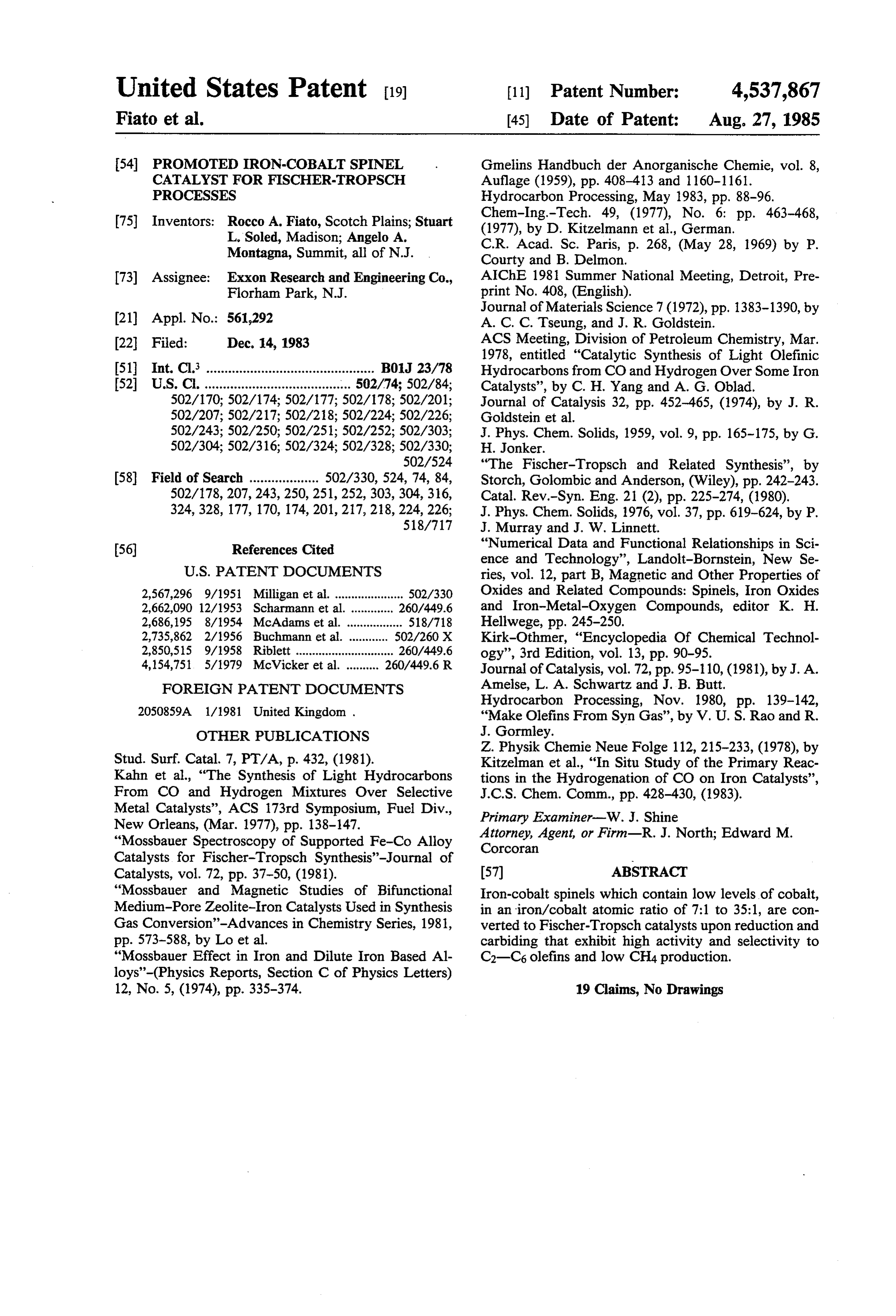
United States Patent (19) 11) Patent Number: 4,537,867 Fiato et al. (45) Date of Patent: Aug. 27, 1985 54 PROMOTED IRON-COBALT SPINEL Gmelins Handbuch der Anorganische Chemie, vol. 8, CATALYST FOR FISCHER-TROPSCH Auflage (1959), pp. 408-413 and 1160-1161. PROCESSES Hydrocarbon Processing, May 1983, pp. 88-96. 75 Inventors: Rocco A. Fiato, Scotch Plains; Stuart Chem-Ing-Tech. 49, (1977), No. 6: pp. 463-468, L. Soled, Madison; Angelo A. (1977), by D. Kitzelmann et al., German. Montagna, Summit, all of N.J. C.R. Acad. Sc. Paris, p. 268, (May 28, 1969) by P. Courty and B. Delmon.
73) Assignee: Exxon Research and Engineering Co., AIChE 1981 Summer National Meeting, Detroit, Pre Fiorham Park, N.J. print No. 408, (English).
Journal of Materials Science 7 (1972), pp. 1383-1390, by (21) Appl. No.: 561,292 A. C. C. Tseung, and J. R. Goldstein. (22 Filed: Dec. 14, 1983 ACS Meeting, Division of Petroleum Chemistry, Mar. 1978, entitled "Catalytic Synthesis of Light Olefinic 51 Int. Cl. .............................................. B01J 23/78 Hydrocarbons from CO and Hydrogen Over Some Iron 52 U.S. C. ..................................... ... 502/74; 502/84; Catalysts', by C. H. Yang and A. G. Oblad. 502/170; 502/174: 502/177; 502/178; 502/201; Journal of Catalysis 32, pp. 452-465, (1974), by J. R. 502/207; 502/217; 502/218; 502/224; 502/226; Goldstein et al.
502/243; 502/250; 502/251; 502/252; 502/303; J. Phys. Chem. Solids, 1959, vol. 9, pp. 165-175, by G. 502/304: 502/316; 502/.324; 502/.328; 502/330; H. Jonker.
502/524 "The Fischer-Tropsch and Related Synthesis', by 58 Field of Search ................... 502/330,524, 74, 84, Storch, Golombic and Anderson, (Wiley), pp. 242-243. 502/178, 207, 243, 250, 251, 252, 303, 304,316, Catal. Rev.-Syn. Eng. 21 (2), pp. 225-274, (1980). 324, 328, 177, 170, 174, 201, 217, 218, 224, 226; J. Phys. Chem. Solids, 1976, vol. 37, pp. 619-624, by P.
56) References Cited "Numerical Data and Functional Relationships in Sci ence and Technology', Landolt-Bornstein, New Se
2,567,296 9/1951 Milligan et al. ..................... 502/330 Oxides and Related Compounds: Spinels, Iron Oxides 2,662,090 12/1953 Scharmann et al. .. ... 260/449.6 and Iron-Metal-Oxygen Compounds, editor K. H. 2,686,195 8/1954 McAdams et al. ................. 518/718 Hellwege, pp. 245-250.
2,735,862 2/1956 Buchmann et al. ... 502/260 X Kirk-Othmer, “Encyclopedia Of Chemical Technol 2,850,515 9/1958 Riblett ............... ... 260/449.6 ogy', 3rd Edition, vol. 13, pp. 90-95. 4,154,751 5/1979 McVicker et al. .......... 260/449.6R Journal of Catalysis, vol. 72, pp. 95-110, (1981), by J. A. FOREIGN PATENT DOCUMENTS Amelse, L. A. Schwartz and J. B. Butt. Hydrocarbon Processing, Nov. 1980, pp. 139-142, 2050859A 1/1981 United Kingdom . "Make Olefins From Syn Gas', by V. U. S. Rao and R. OTHER PUBLICATIONS J. Gormley.
Stud. Surf. Catal. 7, PT/A, p. 432, (1981). Kitzelman et al., “In Situ Study of the Primary Reac Kahn et al., "The Synthesis of Light Hydrocarbons tions in the Hydrogenation of CO on Iron Catalysts', From CO and Hydrogen Mixtures Over Selective J.C.S. Chem. Comm., pp. 428-430, (1983). Metal Catalysts', ACS 173rd Symposium, Fuel Div., Primary Examiner-W. J. Shine New Orleans, (Mar. 1977), pp. 138-147. Attorney, Agent, or Firm-R. J. North; Edward M. "Mossbauer Spectroscopy of Supported Fe-Co Alloy Corcoran
Catalysts for Fischer-Tropsch Synthesis'-Journal of
Catalysts, vol. 72, pp. 37-50, (1981). 57 ABSTRACT "Mossbauer and Magnetic Studies of Bifunctional Iron-cobalt spinels which contain low levels of cobalt, Medium-Pore Zeolite-Iron Catalysts Used in Synthesis in an iron/cobalt atomic ratio of 7:1 to 35:1, are con Gas Conversion'-Advances in Chemistry Series, 1981, verted to Fischer-Tropsch catalysts upon reduction and pp. 573-588, by Lo et al. carbiding that exhibit high activity and selectivity to "Mossbauer Effect in Iron and Dilute Iron Based Al C2-C6 olefins and low CH4 production. loys'-(Physics Reports, Section C of Physics Letters) 12, No. 5, (1974), pp. 335-374. 19 Claims, No Drawings
Page 2
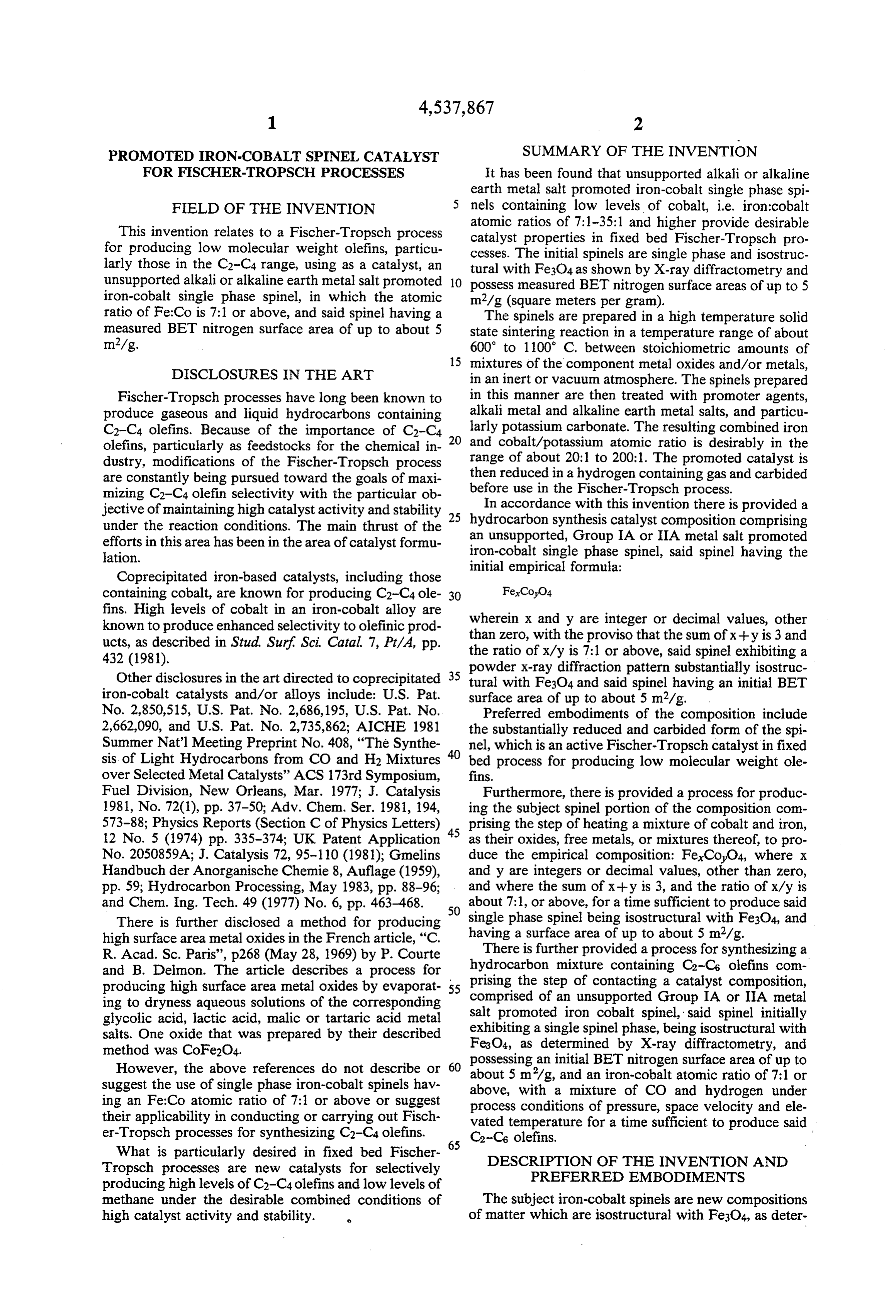
PROMOTED RON-COBALT SPINEL CATALYST SUMMARY OF THE INVENTION FOR FISCHER-TROPSCH PROCESSES It has been found that unsupported alkali or alkaline earth metal salt promoted iron-cobalt single phase spi
FIELD OF THE INVENTION nels containing low levels of cobalt, i.e. iron:cobalt This invention relates to a Fischer-Tropsch process catalyst ratios atomic of 7:1-35:1 and higher provide desirable properties in fixed bed Fischer-Tropsch pro for producing low molecular weight olefins, particu cesses. The initial spinels larly those in the C2-C4 range, using as a catalyst, an tural with Fe3O4 as shownare single phase and isostruc by X-ray diffractometry and unsupported alkali or alkaline earth metal salt promoted 10 possess measured BET nitrogen surface areas of up to 5 iron-cobalt single phase spinel, in which the atomic m2/g (square meters per gram).
ratio of Fe:Co is 7:1 or above, and said spinel having a The spinels are prepared in a high temperature solid measured BET nitrogen surface area of up to about 5 state sintering reaction in a temperature range of about m2/g. 600 to 1100° C. between stoichiometric amounts of 15 mixtures of the component metal oxides and/or metals,
DISCLOSURES IN THE ART in an inert or vacuum atmosphere. The spinels prepared Fischer-Tropsch processes have long been known to in this manner are then treated with promoter agents, produce gaseous and liquid hydrocarbons containing alkali metal and alkaline earth metal salts, and particu C2-C4 olefins. Because of the importance of C2-C4 larly potassium carbonate. The resulting combined iron olefins, particularly as feedstocks for the chemical in 20 and cobalt/potassium atomic ratio is desirably in the dustry, modifications of the Fischer-Tropsch process range of about 20:1 to 200:1. The promoted catalyst is are constantly being pursued toward the goals of maxi then reduced in a hydrogen containing gas and carbided mizing C2-C4 olefin selectivity with the particular ob before use in the Fischer-Tropsch process. In accordance with this invention there is provided a jective of maintaining high catalyst activity and stability 25 hydrocarbon under the reaction conditions. The main thrust of the synthesis catalyst composition comprising efforts in this area has been in the area of catalyst formu iron-cobalt singleGroup an unsupported, IA or IIA metal salt promoted phase spinel, said spinel having the lation.
Coprecipitated iron-based catalysts, including those initial empirical formula:
containing cobalt, are known for producing C2-C4 ole 30 FerCoO4 fins. High levels of cobalt in an iron-cobalt alloy are known to produce enhanced selectivity to olefinic prod than wherein X and y are integer or decimal values, other ucts, as described in Stud. Surf Sci Catal. 7, Pt/A, pp. the ratio Zero, with the proviso that the sum of x-y is 3 and 432 (1981). of x/y is 7:1 or above, said spinel exhibiting a
powder X-ray diffraction pattern substantially isostruc
Other disclosures in the art directed to coprecipitated tural with Fe3O4 and said spinel having an initial BET iron-cobalt catalysts and/or alloys include: U.S. Pat. surface area of up to about 5 m2/g.
No. 2,850,515, U.S. Pat. No. 2,686, 195, U.S. Pat. No. Preferred embodiments of the composition include 2,662,090, and U.S. Pat. No. 2,735,862; AICHE 1981 the substantially reduced and carbided form of the spi Summer Nat'l Meeting Preprint No. 408, “The Synthe nel, which is an active Fischer-Tropsch catalyst in fixed sis of Light Hydrocarbons from CO and H2 Mixtures bed process for producing low molecular weight ole over Selected Metal Catalysts' ACS 173rd Symposium, fins.
Fuel Division, New Orleans, Mar. 1977; J. Catalysis Furthermore, there is provided a process for produc 1981, No. 72C1), pp. 37–50; Adv. Chem. Ser. 1981, 194, ing the subject spinel portion of the composition com 573-88; Physics Reports (Section C of Physics Letters) 45 prising the step of heating a mixture of cobalt and iron, 12 No. 5 (1974) pp. 335-374; UK Patent Application as their oxides, free metals, or mixtures thereof, to pro No. 2050859A; J. Catalysis 72, 95-110 (1981); Gmelins duce the empirical composition: FeCoO4, where x Handbuch der Anorganische Chemie 8, Auflage (1959), and y are integers or decimal values, other than zero, pp. 59; Hydrocarbon Processing, May 1983, pp. 88–96; and where the sum of x-y is 3, and the ratio of x/y is and Chem. Ing. Tech. 49 (1977) No. 6, pp. 463-468. 50 about 7:1, or above, for a time sufficient to produce said There is further disclosed a method for producing single phase spinel being isostructural with Fe3O4, and high surface area metal oxides in the French article, "C. having a surface area of up to about 5 m2/g. There is further provided a process for synthesizing a
R. Acad. Sc. Paris', p.268 (May 28, 1969) by P. Courte hydrocarbon mixture containing C2-Cs olefins com and B. Delmon. The article describes a process for prising the step of contacting a catalyst composition, producing high surface area metal oxides by evaporat 55 ing to dryness aqueous solutions of the corresponding comprised of an unsupported Group IA or IIA metal glycolic acid, lactic acid, malic or tartaric acid metal salt promoted iron cobalt spinel, said spinel initially salts. One oxide that was prepared by their described exhibiting a single spinel phase, being isostructural with Fe3O4, as determined by X-ray diffractometry, and method was CoFe2O4. possessing an initial BET nitrogen surface area of up to However, the above references do not describe or 60 suggest the use of single phase iron-cobalt spinels hav above, with aand about 5 m/g, an iron-cobalt atomic ratio of 7:1 or mixture of CO and hydrogen under ing an Fe:Coatomic ratio of 7:1 or above or suggest process conditions of pressure, space velocity and ele their applicability in conducting or carrying out Fisch vated temperature for a time sufficient to produce said er-Tropsch processes for synthesizing C2-C4 olefins.
65 C2-C6 olefins.
What is particularly desired in fixed bed Fischer DESCRIPTION OF THE INVENTION AND Tropsch processes are new catalysts for selectively PREFERRED EMBODIMENTS producing high levels of C2-C4 olefins and low levels of methane under the desirable combined conditions of The subject iron-cobalt spinels are new compositions high catalyst activity and stability. O of matter which are isostructural with Fe3O4, as deter
Page 3
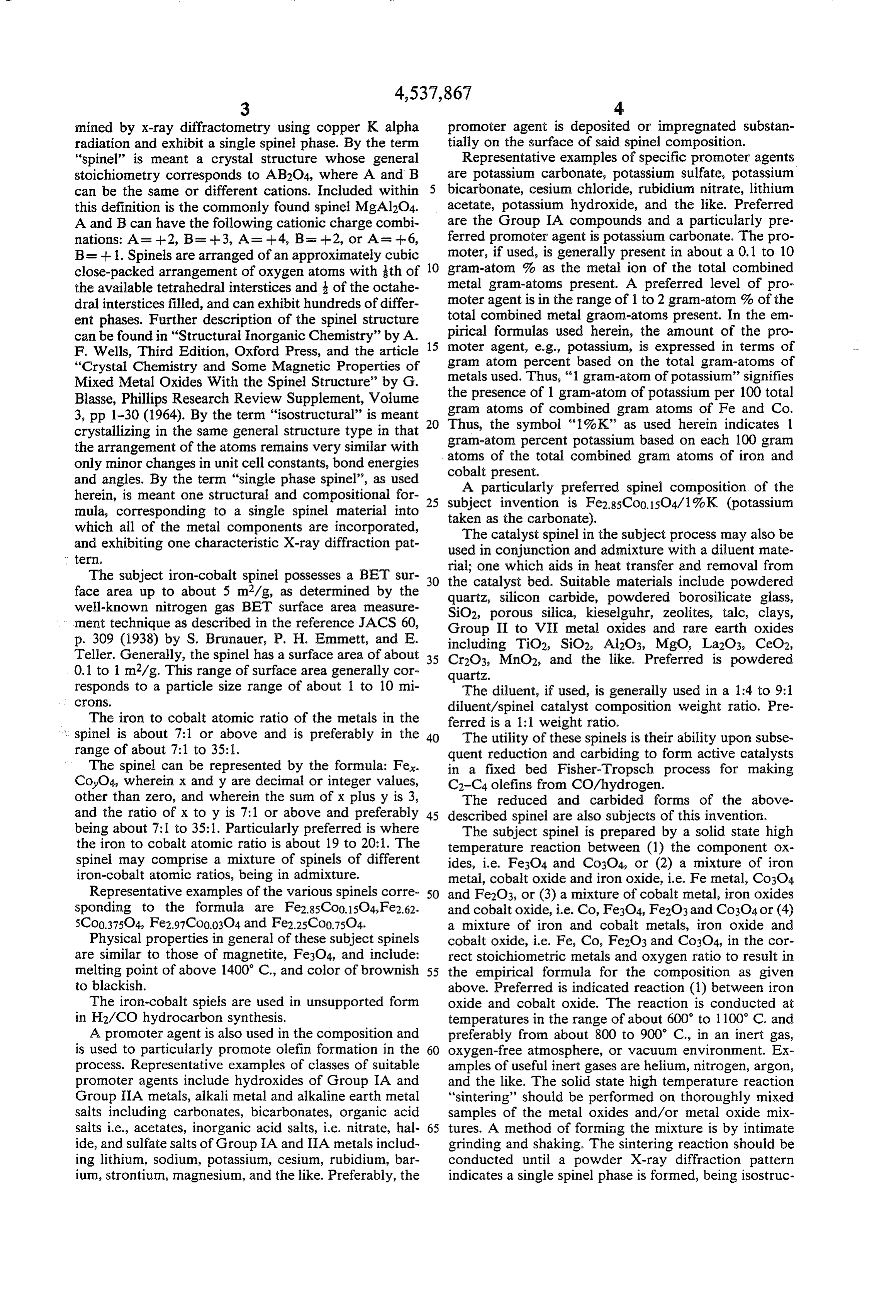
mined by x-ray diffractometry using copper K alpha promoter agent is deposited or impregnated substan radiation and exhibit a single spinel phase. By the term tially on the surface of said spinel composition. "spinel” is meant a crystal structure whose general Representative examples of specific promoter agents stoichiometry corresponds to AB2O4, where A and B are potassium carbonate, potassium sulfate, potassium can be the same or different cations. Included within bicarbonate, cesium chloride, rubidium nitrate, lithium this definition is the commonly found spinel MgAl2O4. acetate, potassium hydroxide, and the like. Preferred A and B can have the following cationic charge combi are the Group IA compounds and a particularly pre nations: A = --2, B = --3, A = +4, B= --2, or A = -- 6, ferred promoter agent is potassium carbonate. The pro B= -- 1. Spinels are arranged of an approximately cubic moter, if used, is generally present in about a 0.1 to 10 close-packed arrangement of oxygen atoms with th of 10 gram-atom 26 as the metal ion of the total combined the available tetrahedral interstices and of the octahe metal gram-atoms present. A preferred level of pro dral interstices filled, and can exhibit hundreds of differ moter agent is in the range of 1 to 2 gram-atom 9% of the ent phases. Further description of the spinel structure total combined metal graom-atoms present. In the em can be found in "Structural Inorganic Chemistry' by A. pirical formulas used herein, the amount of the pro F. Wells, Third Edition, Oxford Press, and the article 15 moter agent, e.g., potassium, is expressed in terms of “Crystal Chemistry and Some Magnetic Properties of gram atom percent based on the total gram-atoms of Mixed Metal Oxides With the Spinel Structure” by G. metals used. Thus, "1 gran-atom of potassium' signifies Blasse, Phillips Research Review Supplement, Volume the presence of 1 gram-atom of potassium per 100 total 3, pp. 1-30 (1964). By the term "isostructural' is meant Thus, atoms gram of combined gram atoms of Fe and Co.
the symbol '1%K' as used herein indicates 1 crystallizing in the same general structure type in that 20 gram-atom percent potassium based on each 100 gram the arrangement of the atoms remains very similar with only minor changes in unit cell constants, bond energies atoms of the total combined gram atoms of iron and and angles. By the term “single phase spinel', as used cobalt present.
A particularly preferred spinel composition of the herein, is meant one structural and compositional for 25 subject mula, corresponding to a single spinel material into taken as invention is Fe2.85Co0.15O4/1%K (potassium the carbonate).
which all of the metal components are incorporated, The catalyst spinel in the subject process may also be and exhibiting one characteristic X-ray diffraction pat used in conjunction and admixture with a diluent mate ten.
The subject iron-cobalt spinel possesses a BET sur 30 rial; one which aids in heat transfer and removal from face area up to about 5 m2/g, as determined by the the catalyst bed. Suitable materials include powdered quartz, silicon carbide, powdered borosilicate glass, well-known nitrogen gas BET surface area measure SiO2, porous silica, kieselguhr, zeolites, talc, clays, ment technique as described in the reference JACS 60, Group II to VII metal oxides and rare earth oxides p. 309 (1938) by S. Brunauer, P. H. Emmett, and E. including TiO2, SiO2, Al2O3, MgO, La2O3, CeO2, Teller. Generally, the spinel has a surface area of about 35 Cr2O3, MnO2, and the like. Preferred is powdered 0.1 to 1 m2/g. This range of surface area generally cor quartz.
responds to a particle size range of about 1 to 10 mi The diluent, if used, is generally used in a 1:4 to 9:1 COS. diluent/spinel catalyst composition weight ratio. Pre The iron to cobalt atomic ratio of the metals in the ferred is a 1:1 weight ratio. spinel is about 7:1 or above and is preferably in the 40 The utility of these spinels is their ability upon subse range of about 7:1 to 35:1. quent reduction and carbiding to form active catalysts The spinel can be represented by the formula: Fe in a fixed bed Fisher-Tropsch process for making CoyO4, wherein X and y are decimal or integer values, C2-C4 olefins from CO/hydrogen.
other than zero, and wherein the sum of x plus y is 3, The reduced and carbided forms of the above and the ratio of x to y is 7:1 or above and preferably 45 described spinel are also subjects of this invention. being about 7:1 to 35:1. Particularly preferred is where The subject spinel is prepared by a solid state high the iron to cobalt atomic ratio is about 19 to 20:1. The temperature reaction between (1) the component ox spinel may comprise a mixture of spinels of different ides, i.e. Fe3O4 and Co3O4, or (2) a mixture of iron iron-cobalt atomic ratios, being in admixture. metal, cobalt oxide and iron oxide, i.e. Fe metal, Co3O4 Representative examples of the various spinels corre 50 and Fe2O3, or (3) a mixture of cobalt metal, iron oxides sponding to the formula are Fe2.85Co0.15O4,Fe2.62 and cobalt oxide, i.e. Co, Fe3O4, Fe2O3 and Co3O4 or (4) 5Co0.375O4, Fe2.97Co0.03O4 and Fe2.25Co0.75O4. a mixture of iron and cobalt metals, iron oxide and Physical properties in general of these subject spinels cobalt oxide, i.e. Fe, Co, Fe2O3 and Co3O4, in the cor are similar to those of magnetite, Fe3O4, and include: rect stoichiometric metals and oxygen ratio to result in melting point of above 1400° C., and color of brownish 55 the empirical formula for the composition as given to blackish. above. Preferred is indicated reaction (1) between iron The iron-cobalt spiels are used in unsupported form oxide and cobalt oxide. The reaction is conducted at in H2/CO hydrocarbon synthesis. temperatures in the range of about 600 to 1100° C. and A promoter agent is also used in the composition and preferably from about 800 to 900 C., in an inert gas, is used to particularly promote olefin formation in the 60 oxygen-free atmosphere, or vacuum environment. Ex process. Representative examples of classes of suitable amples of useful inert gases are helium, nitrogen, argon, promoter agents include hydroxides of Group IA and and the like. The solid state high temperature reaction Group IIA metals, alkali metal and alkaline earth metal "sintering' should be performed on thoroughly mixed salts including carbonates, bicarbonates, organic acid samples of the metal oxides and/or metal oxide mix salts i.e., acetates, inorganic acid salts, i.e. nitrate, hal 65 tures. A method of forming the mixture is by intimate ide, and sulfate salts of Group IA and IIA metals includ grinding and shaking. The sintering reaction should be ing lithium, sodium, potassium, cesium, rubidium, bar conducted until a powder X-ray diffraction pattern ium, strontium, magnesium, and the like. Preferably, the indicates a single spinel phase is formed, being isostruc
Page 4
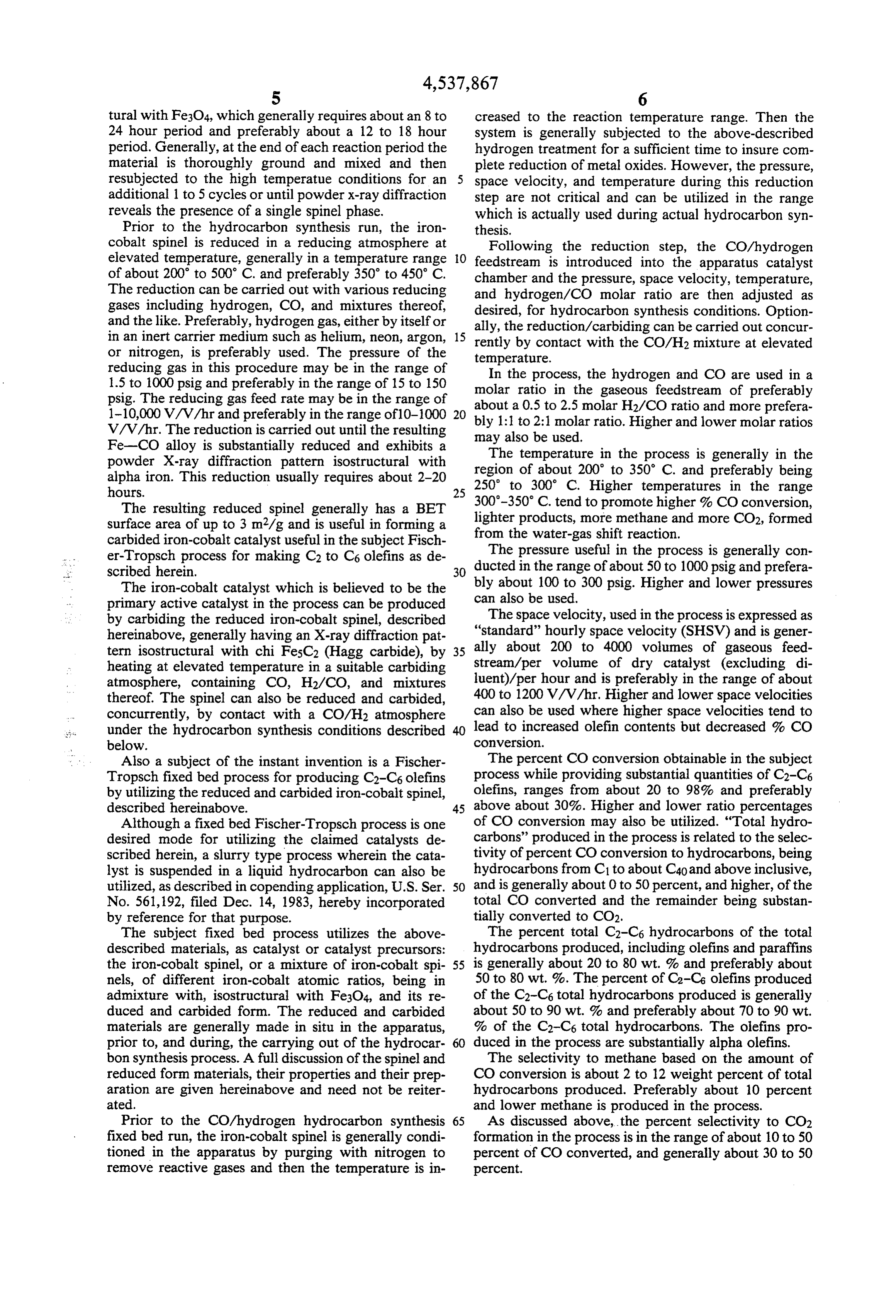
tural with Fe3O4, which generally requires about an 8 to creased to the reaction temperature range. Then the 24 hour period and preferably about a 12 to 18 hour system is generally subjected to the above-described period. Generally, at the end of each reaction period the hydrogen treatment for a sufficient time to insure com material is thoroughly ground and mixed and then plete reduction of metal oxides. However, the pressure, resubjected to the high temperatue conditions for an 5 space velocity, and temperature during this reduction additional 1 to 5 cycles or until powder x-ray diffraction step are not critical and can be utilized in the range reveals the presence of a single spinel phase. which is actually used during actual hydrocarbon syn Prior to the hydrocarbon synthesis run, the iron thesis.
cobalt spinel is reduced in a reducing atmosphere at Following the reduction step, the CO/hydrogen elevated temperature, generally in a temperature range 10 feedstream is introduced into the apparatus catalyst of about 200 to 500 C. and preferably 350 to 450° C. chamber and the pressure, space velocity, temperature, The reduction can be carried out with various reducing and hydrogen/CO molar ratio are then adjusted as gases including hydrogen, CO, and mixtures thereof, and the like. Preferably, hydrogen gas, either by itselfor desired, for hydrocarbon synthesis conditions. Option ally, the reduction/carbiding can be carried out concur in an inert carrier medium such as helium, neon, argon, 15 rently by contact with the CO/H2 mixture at elevated or nitrogen, is preferably used. The pressure of the temperature.
reducing gas in this procedure may be in the range of In the process, the hydrogen and CO are used in a 1.5 to 1000 psig and preferably in the range of 15 to 150 psig. The reducing gas feed rate may be in the range of molar about a ratio in the gaseous feedstream of preferably 0.5 to 2.5 molar H2/CO ratio and more prefera 1-10,000 V/V/hr and preferably in the range of 10-1000 20
V/V/hr. The reduction is carried out until the resulting bly 1:1 to 2:1 molar ratio. Higher and lower molar ratios Fe-CO alloy is substantially reduced and exhibits a may The also be used.
temperature in the process is generally in the powder X-ray diffraction pattern isostructural with region of about 200 to 350° C. and preferably being alpha iron. This reduction usually requires about 2-20 250 to 300° C. Higher temperatures in the range hours. 25
The resulting reduced spinel generally has a BET lighter products, more C. tend to promote higher % CO conversion, surface area of up to 3 m2/g and is useful in forming a from methane and more CO2, formed carbided iron-cobalt catalyst useful in the subject Fisch the water-gas shift reaction. er-Tropsch process for making C2 to C6 olefins as de The pressure useful in the process is generally con scribed herein. 30 ducted in the range of about 50 to 1000 psig and prefera The iron-cobalt catalyst which is believed to be the bly about 100 to 300 psig. Higher and lower pressures primary active catalyst in the process can be produced can also be used.
by carbiding the reduced iron-cobalt spinel, described The space velocity, used in the process is expressed as hereinabove, generally having an X-ray diffraction pat "standard' hourly space velocity (SHSV) and is gener ally about 200 to 4000 volumes of gaseous feed tern isostructural with chi FesC2 (Hagg carbide), by 35 stream/per heating at elevated temperature in a suitable carbiding volume of dry catalyst (excluding di atmosphere, containing CO, H2/CO, and mixtures luent)/per hour and is preferably in the range of about thereof. The spinel can also be reduced and carbided, 400 to 1200V/V/hr, Higher and lower space velocities concurrently, by contact with a CO/H2 atmosphere can also be used where higher space velocities tend to under the hydrocarbon synthesis conditions described 40 lead to increased olefin contents but decreased 9% CO below. conversion.
Also a subject of the instant invention is a Fischer The percent CO conversion obtainable in the subject Tropsch fixed bed process for producing C2-C6 olefins process while providing substantial quantities of C2-C6 by utilizing the reduced and carbided iron-cobalt spinel, olefins, ranges from about 20 to 98% and preferably described hereinabove. 45 above about 30%. Higher and lower ratio percentages Although a fixed bed Fischer-Tropsch process is one of CO conversion may also be utilized. "Total hydro desired mode for utilizing the claimed catalysts de carbons' produced in the process is related to the selec scribed herein, a slurry type process wherein the cata tivity of percent CO conversion to hydrocarbons, being lyst is suspended in a liquid hydrocarbon can also be hydrocarbons from C1 to about C40 and above inclusive, utilized, as described in copending application, U.S. Ser. 50 and is generally about 0 to 50 percent, and higher, of the No. 561,192, filed Dec. 14, 1983, hereby incorporated total CO converted and the remainder being substan by reference for that purpose. tially converted to CO2.
The subject fixed bed process utilizes the above The percent total C2-C6 hydrocarbons of the total described materials, as catalyst or catalyst precursors: hydrocarbons produced, including olefins and paraffins the iron-cobalt spinel, or a mixture of iron-cobalt spi- 55 is generally about 20 to 80 wt.% and preferably about nels, of different iron-cobalt atomic ratios, being in 50 to 80 wt.%. The percent of C2-Cs olefins produced admixture with, isostructural with Fe3O4, and its re of the C2-C6 total hydrocarbons produced is generally duced and carbided form. The reduced and carbided about 50 to 90 wt.% and preferably about 70 to 90 wt. materials are generally made in situ in the apparatus, % of the C2-C6 total hydrocarbons. The olefins pro prior to, and during, the carrying out of the hydrocar- 60 duced in the process are substantially alpha olefins. bon synthesis process. A full discussion of the spinel and The selectivity to methane based on the amount of reduced form materials, their properties and their prep CO conversion is about 2 to 12 weight percent of total aration are given hereinabove and need not be reiter hydrocarbons produced. Preferably about 10 percent ated. and lower methane is produced in the process. Prior to the CO/hydrogen hydrocarbon synthesis 65 As discussed above, the percent selectivity to CO2 fixed bed run, the iron-cobalt spinel is generally condi formation in the process is in the range of about 10 to 50 tioned in the apparatus by purging with nitrogen to percent of CO converted, and generally about 30 to 50 remove reactive gases and then the temperature is in percent.
Page 5
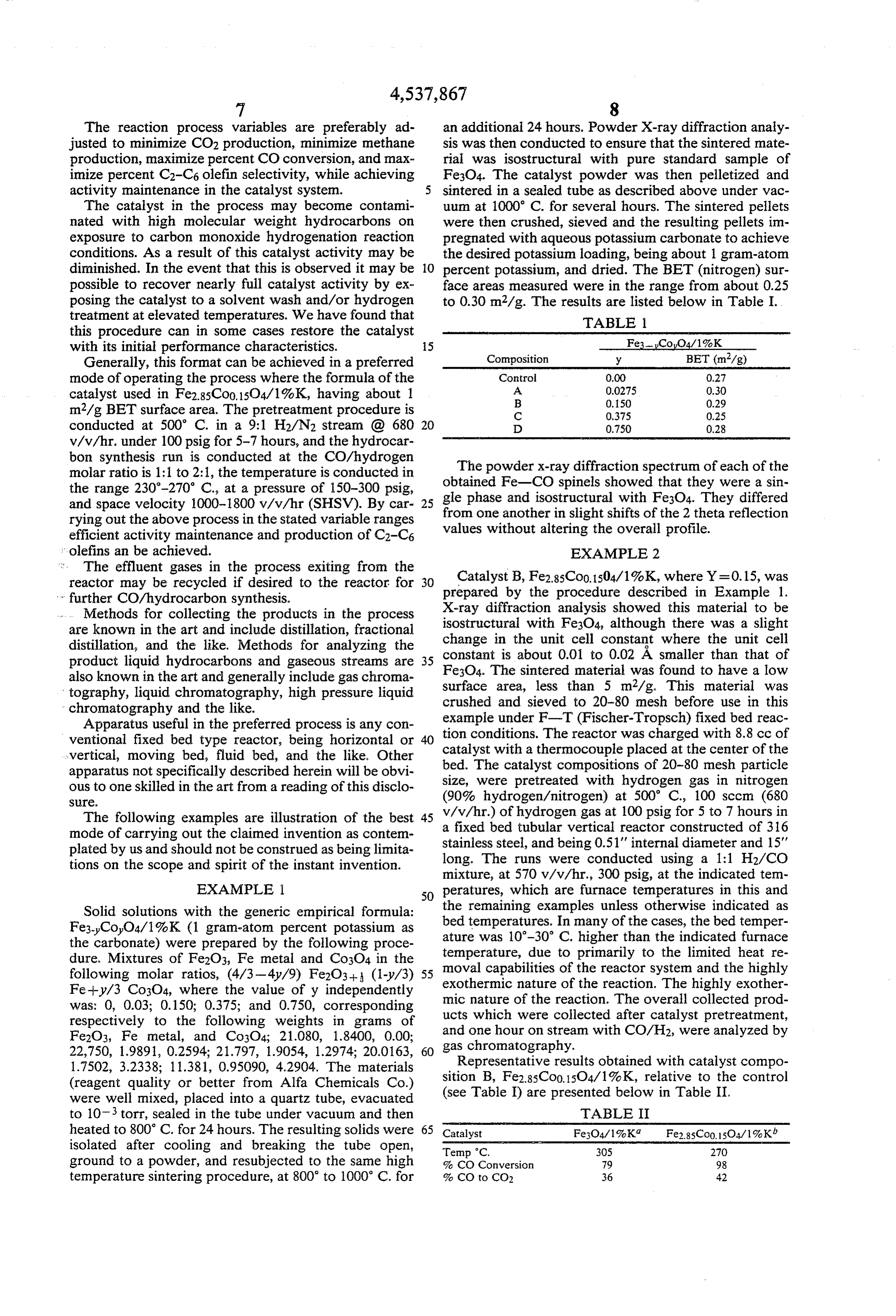
The reaction process variables are preferably ad an additional 24 hours. Powder X-ray diffraction analy justed to minimize CO2 production, minimize methane sis was then conducted to ensure that the sintered mate production, maximize percent CO conversion, and max rial was isostructural with pure standard sample of imize percent C2-C6 olefin selectivity, while achieving Fe3O4. The catalyst powder was then pelletized and activity maintenance in the catalyst system. 5 sintered in a sealed tube as described above under vac The catalyst in the process may become contami uum at 1000 C. for several hours. The sintered pellets nated with high molecular weight hydrocarbons on were then crushed, sieved and the resulting pellets im exposure to carbon monoxide hydrogenation reaction pregnated with aqueous potassium carbonate to achieve conditions. As a result of this catalyst activity may be the desired potassium loading, being about 1 gram-atom diminished. In the event that this is observed it may be 10 percent potassium, and dried. The BET (nitrogen) sur possible to recover nearly full catalyst activity by ex face areas measured were in the range from about 0.25 posing the catalyst to a solvent wash and/or hydrogen to 0.30 m2/g. The results are listed below in Table I. treatment at elevated temperatures. We have found that TABLE 1. this procedure can in some cases restore the catalyst Fe3-CoyO4/1%K with its initial performance characteristics. 15
Generally, this format can be achieved in a preferred mode of operating the process where the formula of the Control 0.00 0.27 catalyst used in Fe2.85Co0.15O4/1%K, having about 1 A. 0.0275 0.30
m2/g BET surface area. The pretreatment procedure is C 0.375 0.25 conducted at 500 C. in a 9:1 H2/N2 stream GD 680 D 0.750 0.28 v/v/hr. under 100 psig for 5-7 hours, and the hydrocar bon synthesis run is conducted at the CO/hydrogen The powder x-ray diffraction spectrum of each of the molar ratio is 1:1 to 2:1, the temperature is conducted in obtained Fe-CO spinels showed that they were a sin the range 230-270° C., at a pressure of 150-300 psig, gle phase and isostructural with Fe3O4. They differed and space velocity 1000-1800 v/v/hr (SHSV). By car from one another
in slight shifts of the 2 theta reflection rying out the above process in the stated variable ranges values without altering the overall profile. efficient activity maintenance and production of C2-C6 s' olefins an be achieved. EXAMPLE 2 : The effluent gases in the process exiting from the Catalyst B, Fe2.85Co0.1504/1%K, where Y=0.15, was reactor may be recycled if desired to the reactor for 30 prepared by the procedure described in Example 1. further CO/hydrocarbon synthesis.
Methods for collecting the products in the process X-ray diffraction analysis showed this material to be are known in the art and include distillation, fractional isostructural with Fe3O4, although there was a slight distillation, and the like. Methods for analyzing the change in the unit cell constant where the unit cell product liquid hydrocarbons and gaseous streams are 35 constant is about 0.01 to 0.02. A smaller than that of also known in the art and generally include gas chrona surface area,sintered
Fe3O4. The material was found to have a low less than 5 m2/g. This material was tography, liquid chromatography, high pressure liquid crushed and sieved to 20-80 mesh before use in this chromatography and the like. example under F-T (Fischer-Tropsch) fixed bed reac Apparatus useful in the preferred process is any con ventional fixed bed type reactor, being horizontal or tion conditions. The reactor was charged with 8.8 cc of vertical, moving bed, fluid bed, and the like. Other catalyst with a thermocouple placed at the center of the bed. The catalyst compositions of 20-80 mesh particle apparatus not specifically described herein will be obvi size, ous to one skilled in the art from a reading of this disclo (90% were pretreated with hydrogen gas in nitrogen hydrogen/nitrogen) at 500 C., 100 sccm (680
Sle.
The following examples are illustration of the best 45 v/v/hr.) of hydrogen gas at 100 psig for 5 to 7 hours in a fixed bed tubular vertical reactor constructed of 316 mode of carrying out the claimed invention as contem stainless steel, and being 0.51''' internal diameter and 15' plated by us and should not be construed as being limita long. The runs were conducted using a 1:1 H2/CO tions on the scope and spirit of the instant invention.
mixture, at 570 v/v/hr., 300 psig, at the indicated tem
EXAMPLE 1. 50 peratures, which are furnace temperatures in this and Solid solutions with the generic empirical formula: bed the remaining examples unless otherwise indicated as Fe3-yCoyO4/1%K (1 gram-atom percent potassium as temperatures. In many of the cases, the bed temper ature was 10-30 C. higher than the indicated furnace the carbonate) were prepared by the following proce temperature, dure. Mixtures of Fe2O3, Fe metal and Co3O4 in the due to primarily to the limited heat re following molar ratios, (4/3-4y/9) Fe2O3 (1-y/3) 55 moval capabilities of the reactor system and the highly Fe-y/3 Co3O4, where the value of y independently exothermic nature of the reaction. The highly exother was: 0, 0.03; 0.150; 0.375; and 0.750, corresponding mic nature of the reaction. The overall collected prod respectively to the following weights in grams of ucts which were collected after catalyst pretreatment, Fe2O3, Fe metal, and Co3O4; 21.080, 1.8400, 0.00; and one hour on stream with CO/H2, were analyzed by 22,750, 19891, 0.2594; 21.797, 1.9054, 1.2974; 20.0163, 60 gasRepresentative chromatography.
results obtained with catalyst compo 1.7502, 3.2338; 11.381, 0.95090, 4.2904. The materials sition B, Fe2.85Co0.15O4/1%K, relative to the control (reagent quality or better from Alfa Chemicals Co.)
were well mixed, placed into a quartz tube, evacuated (see Table I) are presented below in Table II. to 103 torr, sealed in the tube under vacuum and then TABLE II heated to 800° C. for 24 hours. The resulting solids were 65 Catalyst Fe3O4/1%Ka Fe2.85Co0.15O4/1%K isolated after cooling and breaking the tube open, Temp C. 305 270 ground to a powder, and resubjected to the same high % CO Conversion 79 98 temperature sintering procedure, at 800 to 1000° C. for % CO to CO2 36 42
Page 6
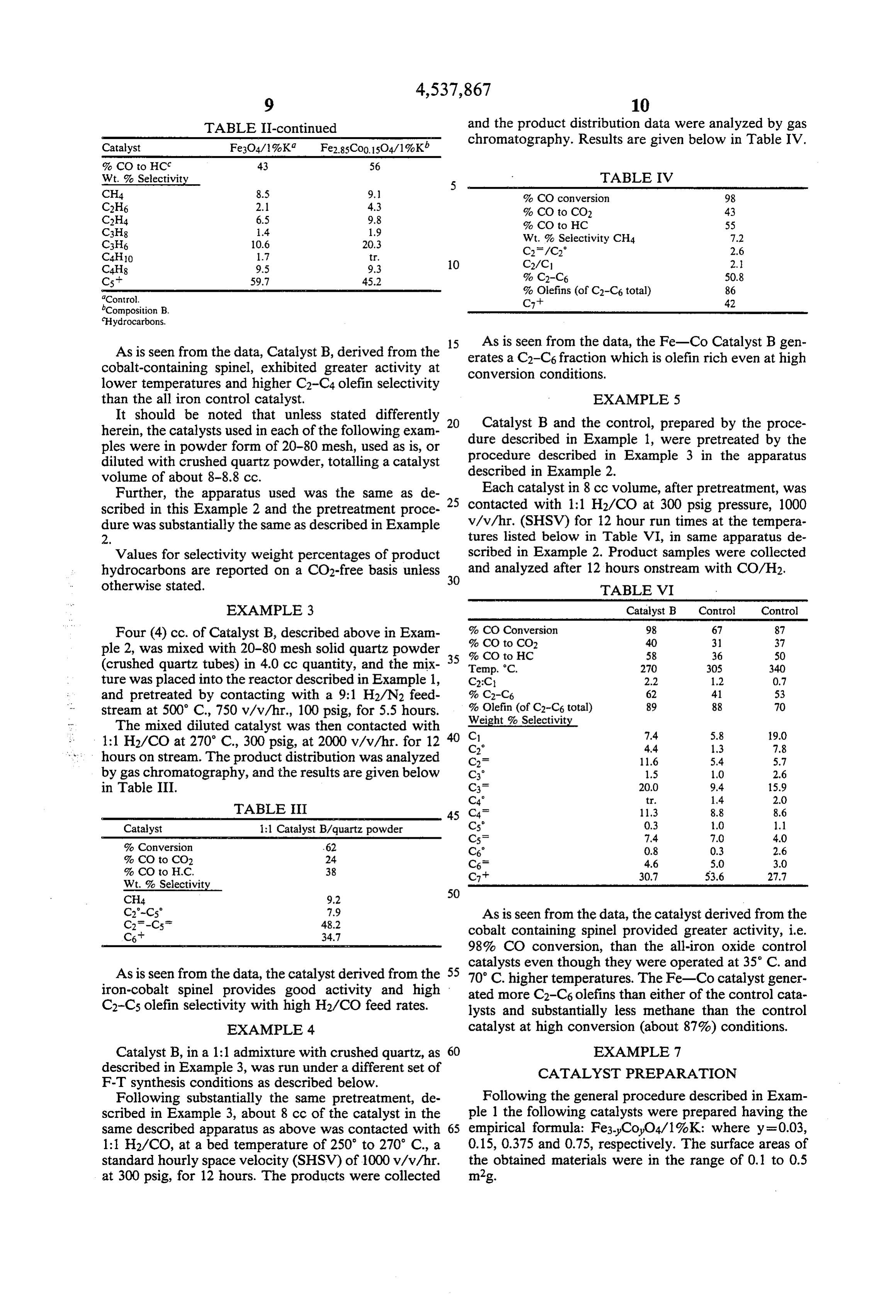
TABLE II-continued and the product distribution data were analyzed by gas Catalyst Fe3O4/1%K Fe2.85Co0.15O4/1%K chromatography. Results are given below in Table IV.
Wt. % Selectivity 5 TABLE IV CH4 8.5 9. % CO conversion 98 C2H6 2.1 4.3 % CO to CO2 43 C2H4 6.5 9.8 % CO to HC 55 C3H8 1.4 1.9 Wt. 9% Selectivity CH4 7.2
C4H10 1.7 t. C/C 2.6 C4H8 9.5 9.3 O C2/C 2. Cs+ 597 45.2 % C2-C6 50.8 Control.
Composition B. C+ 42 Hydrocarbons.
As is seen from the data, the Fe-Co Catalyst Bgen
As is seen from the data, Catalyst B, derived from the 15 erates a C2-C6 fraction which is olefin rich even at high cobalt-containing spinel, exhibited greater activity at conversion conditions.
lower temperatures and higher C2-C4 olefin selectivity than the all iron control catalyst. EXAMPLE 5
It should be noted that unless stated differently 20 Catalyst B and the control, prepared by the proce herein, the catalysts used in each of the following exam ples were in powder form of 20-80 mesh, used as is, or dure described in Example 1, were pretreated by the diluted with crushed quartz powder, totalling a catalyst procedure described in Example 3 in the apparatus volume of about 8-8.8 cc. described in Example 2.
Further, the apparatus used was the same as de 25 Each catalyst in 8 cc volume, after pretreatment, was scribed in this Example 2 and the pretreatment proce contacted with 1:1 H2/CO at 300 psig pressure, 1000 dure was substantially the same as described in Example v/v/hr. (SHSV) for 12 hour run times at the tempera 2 tures listed below in Table VI, in same apparatus de Values for selectivity weight percentages of product scribed in Example 2. Product samples were collected hydrocarbons are reported on a CO2-free basis unless and analyzed after 12 hours onstream with CO/H2.
otherwise stated. TABLE VI EXAMPLE 3 Catalyst B Control Control Four (4) cc. of Catalyst B, described above in Exam % CO Conversion 98 67 87 ple 2, was mixed with 20-80 mesh solid quartz powder 35 %% CO
(crushed quartz tubes) in 4.0 cc quantity, and the mix Temp. C. 270 305 340 ture was placed into the reactor described in Example 1, C2:C 2.2 1.2 0.7 and pretreated by contacting with a 9:1 H2/N2 feed % C2-C6 62 41 53 stream at 500 C., 750 v/v/hr., 100 psig, for 5.5 hours. % Olefin (of C2-C6 total) 89 88 70 The mixed diluted catalyst was then contacted with Weight % Selectivity
C 7.4 5.8 19.0 1:1 H2/CO at 270° C., 300 psig, at 2000 v/v/hr. for 12 C 4.4 13 7.8 hours on stream. The product distribution was analyzed c= 11.6 S4 5.7 by gas chromatography, and the results are given below C 15 10 2.6 in Table III. C= 20.0 9.4 5.9 C4 t. 1.4 2.0
TABLE III 45 C4- 11.3 8.8 8.6 Catalyst 1:l Catalyst B/quartz powder Cs 0.3 O 1.1 Cs- 7.4 7.0 4.0 % Conversion .62 C6 0.8 0.3 2.6 % CO to CO2 24 C6- 4.6 5.0 3.0 % CO to H.C. 38 C+ 30.7 53.6 27.7 Wt. % Selectivity
7.9 As is seen from the data, the catalyst derived from the
34.7 cobalt containing spinel provided greater activity, i.e.
98% CO conversion, than the all-iron oxide control catalysts even though they were operated at 35 C. and
As is seen from the data, the catalyst derived from the 55 70° C. higher temperatures. The Fe-Co catalyst gener iron-cobalt spinel provides good activity and high ated more C2-C6 olefins than either of the control cata C2-Cs olefin selectivity with high H2/CO feed rates. lysts and substantially less methane than the control EXAMPLE 4 catalyst at high conversion (about 87%) conditions.
Catalyst B, in a 1:1 admixture with crushed quartz, as 60 EXAMPLE 7 described in Example 3, was run under a different set of CATALYST PREPARATION
F-T synthesis conditions as described below.
Following substantially the same pretreatment, de Following the general procedure described in Exam scribed in Example 3, about 8 cc of the catalyst in the ple 1 the following catalysts were prepared having the same described apparatus as above was contacted with 65 empirical formula: Fe3CoO4/1%K: where y=0.03, 1:1 H2/CO, at a bed temperature of 250 to 270° C., a 0.15, 0.375 and 0.75, respectively. The surface areas of standard hourly space velocity (SHSV) of 1000 v/v/hr. the obtained materials were in the range of 0.1 to 0.5 at 300 psig, for 12 hours. The products were collected m?g.
Page 7
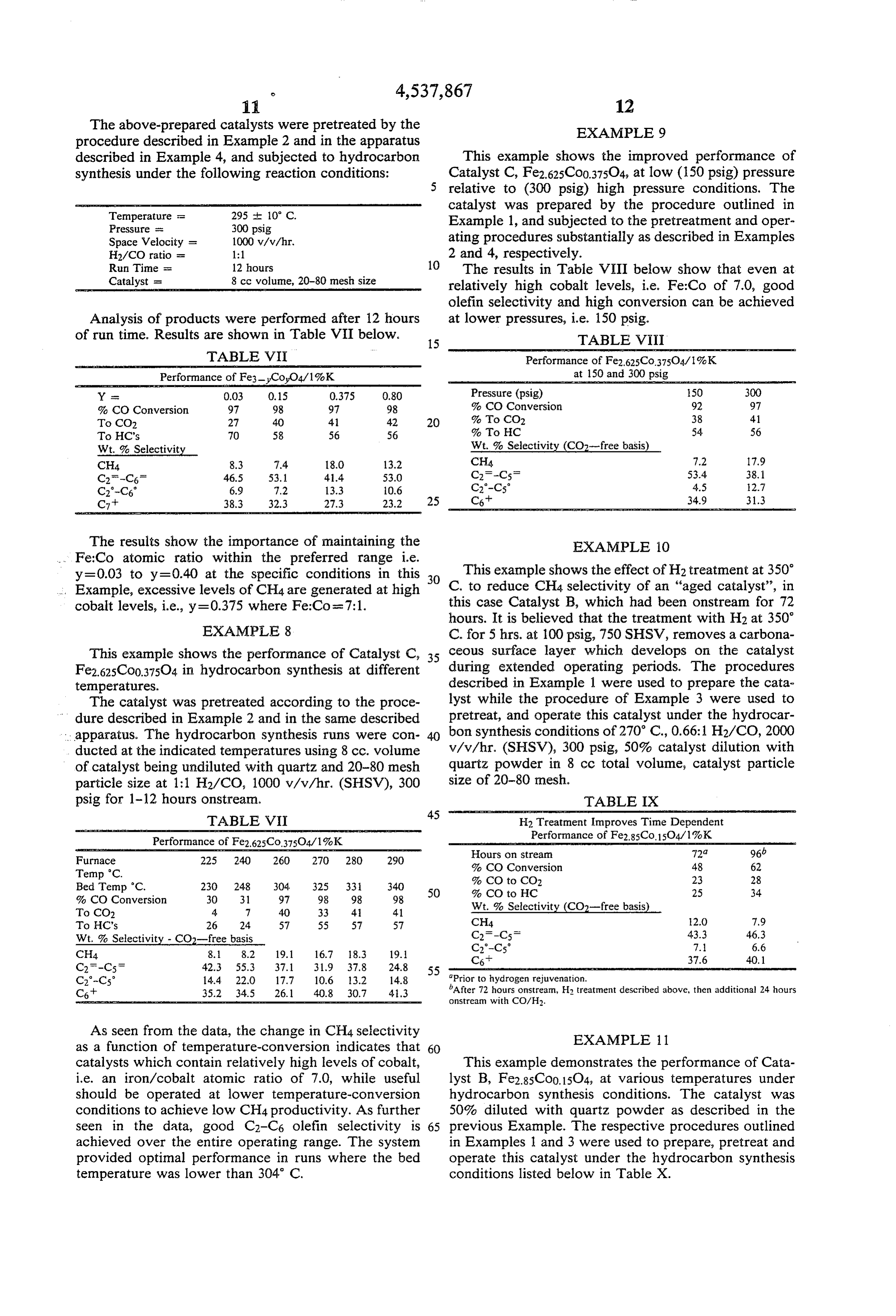
The above-prepared catalysts were pretreated by the EXAMPLE 9 procedure described in Example 2 and in the apparatus described in Example 4, and subjected to hydrocarbon This example shows the improved performance of synthesis under the following reaction conditions: Catalyst C, Fe2.625Co0.375O4, at low (150 psig) pressure relative to (300 psig) high pressure conditions. The
catalyst was prepared by the procedure outlined in
Pressure is 300 psig Example 1, and subjected to the pretreatment and oper Space Velocity = 1000 wv/hr, ating procedures substantially as described in Examples H2/CO ratio = 1:1 2 and 4, respectively.
Run Time = 12 hours 10 The results in Table VIII below show that even at Catalyst = 8 cc volume, 20-80 mesh size relatively high cobalt levels, i.e. Fe:Co of 7.0, good olefin selectivity and high conversion can be achieved
Analysis of products were performed after 12 hours at lower pressures, i.e. 150 psig, of run time. Results are shown in Table VII below. TABLE VIII
TABLE VII Performance of Fe2.625Co.375O4/1%K
Performance of Fe3-CoO4/1%K at 150 and 300 psig
Y- 0.03 0.15 0.375 0.80 Pressure (psig) 50 300 % CO Conversion 97 98 97 98 % CO Conversion 92 97 To CO2 27 40 41 42 20 % To CO2 38 41 To HC's 70 58 56 56 %. To HC 54 56 Wt. 9, Selectivit Wt. % Selectivity (CO2-free basis) CH4 8.3 7.4 18.0 13.2 CH4 7.2 7.9 C-C6- 46.5 53. 41.4 53.0 C-C5- 53.4 38.1 C2-C6 6.9 7.2 13.3 10.6 C2'-C5' 4.5 12.7 C+ 38.3 32.3 27.3 23.2 C6 34.9 31.3
The results show the importance of maintaining the EXAMPLE O
Fe:Co atomic ratio within the preferred range i.e.
y=0.03 to y = 0.40 at the specific conditions in this 30 This example shows the effect of H2 treatment at 350 . . Example, excessive levels of CH4 are generated at high C. to reduce CH4 selectivity of an “aged catalyst', in cobalt levels, i.e. y = 0.375 where Fe:Coat 7:1. this case Catalyst B, which had been onstream for 72 hours. It is believed that the treatment with H2 at 350
EXAMPLE 8 C. for 5 hrs. at 100 psig, 750 SHSV, removes a carbona
This example shows the performance of Catalyst C, 35 ceous surface layer which develops on the catalyst
Fe2.625Co0.375O4 in hydrocarbon synthesis at different during extended operating periods. The procedures temperatures. described in Example 1 were used to prepare the cata
The catalyst was pretreated according to the proce lyst while the procedure of Example 3 were used to dure described in Example 2 and in the same described pretreat, and operate this catalyst under the hydrocar apparatus. The hydrocarbon synthesis runs were con bon synthesis conditions of 270° C., 0.66:1 H2/CO, 2000 ducted at the indicated temperatures using 8 cc. volume v/v/hr. (SHSV), 300 psig, 50% catalyst dilution with of catalyst being undiluted with quartz and 20-80 mesh quartz powder in 8 cc total volume, catalyst particle particle size at 1:1 H2/CO, 1000 v/v/hr. (SHSV), 300 size of 20-80 mesh.
psig for 1-12 hours onstream. TABLE IX
H2 Treatment Improves Time Dependent
Performance of Fe2.625Co.375O4/1%K Performance of Fe2.85Co.15O4/1%K Furnace 225 240 260 270 280 290
Hours on stream 72a 96b
Temp C. % CO Conversion 48 62 Bed Temp C. 230 248 304 325 33 340 % CO to CO2 23 28 % CO Conversion 30 31 97 98 98 98 50 % CO to HC 25 34 To CO2 4. 7 40 33 4. 41 Wt. 26 Selectivity (CO2-free basis) To HC's 26 24 57 55 57 57 CH4 2.0 7.9 Wt. % Selectivity - CO2-free basis C-C5- 43.3 46.3 CH4 8. 8.2 19.1 16.7 8.3 19. C2-Cs' 7. 6.6 C6 37.6 40.1
C-C5- 42.3 55.3 37.1 31.9 37.8 24.8 55
C2-C5 14.4 22.0 17.7 10.6 3.2 14.8 Prior to hydrogen rejuvenation.
C6h 35.2 34.5 26.1 40.8 30.7 4.3 After 72 hours onstream, H treatment described above, then additional 24 hours onstream with CO/H2.
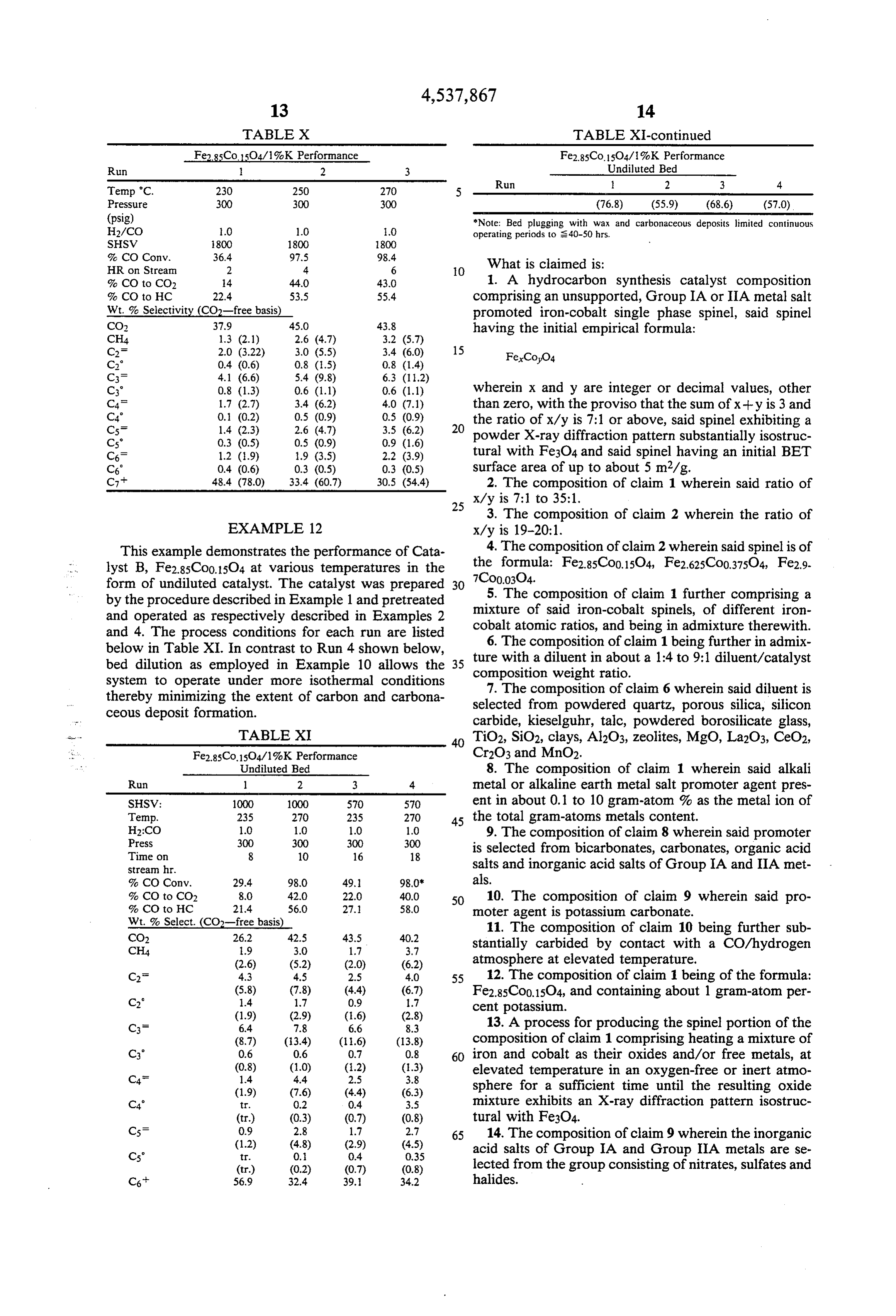
As seen from the data, the change in CH4 selectivity EXAMPLE 1. as a function of temperature-conversion indicates that 60 catalysts which contain relatively high levels of cobalt, This example demonstrates the performance of Cata i.e. an iron/cobalt atomic ratio of 7.0, while useful lyst B, Fe2.85Co0.15O4, at various temperatures under should be operated at lower temperature-conversion hydrocarbon synthesis conditions. The catalyst was conditions to achieve low CH4 productivity. As further 50% diluted with quartz powder as described in the seen in the data, good C2-C6 olefin selectivity is 65 previous Example. The respective procedures outlined achieved over the entire operating range. The system in Examples l and 3 were used to prepare, pretreat and provided optimal performance in runs where the bed operate this catalyst under the hydrocarbon synthesis temperature was lower than 304 C. conditions listed below in Table X.
Page 8
TABLE X TABLE XI-continued
Fe2.85Co. 504/1%K. Performance Fe2.85Co.15O4/1%K Performance Run 2 3 Undiluted Bed
Temp "C. 230 250 270 5
Pressure 300 300 300 (76.8) (55.9) (68.6) (57.0) (psig) Note: Bed plugging with wax and carbonaceous deposits limited continuous H2/CO .0 1.0 .0 operating periods to s40-50 hrs. SHSV 800 1800 800 % CO Conv. 36.4 97.5 98.4
HR on Stream 2 4. 6 O What is claimed is: % CO to CO2 i4 440 43.0 1. A hydrocarbon synthesis catalyst composition % CO to HC 22.4 53.5 55.4 comprising an unsupported, Group IA or IIA metal salt Wt. 7, Selectivity (CO3- free basis promoted iron-cobalt single phase spinel, said spinel CO2 37.9 45.0 43.8 having the initial empirical formula: CH4 1.3 (2.1) 2.6 (4.7) 3.2 (5.7)
CF 2.0 (3.22) 3.0 (5.5) 3.4 (6.0) 15 FexCoO4
C 0.4 (0.6) 0.8 (i.5) 0.8 (1.4) c= 4.1 (6.6) 5.4 (9.8) 6.3 (11.2)
C 0.8 (1.3) 0.6 (1.1) 0.6 (1.1) wherein X and y are integer or decimal values, other C4- 1.7 (2.7) 3.4 (6.2) 4.0 (7.1) than Zero, with the proviso that the sum of x-y is 3 and
the ratio of x/y is 7:1 or above, said spinel exhibiting a 20 powder X-ray diffraction pattern substantially isostruc
C5 0.3 (0.5) 0.5 (0.9) 0.9 (1.6)
C6 1.2 (.9) 1.9 (3.5) 2.2 (3.9) tural with Fe3O4 and said spinel having an initial BET C6 0.4 (0.6) 0.3 (0.5) 0.3 (0.5) surface area of up to about 5 m2/g. C+ 48.4 (78.0) 33.4 (60.7) 30.5 (54.4) 2. The composition of claim 1 wherein said ratio of
3. The composition of claim 2 wherein the ratio of
EXAMPLE 12 x/y is 19-20:1.
This example demonstrates the performance of Cata 4. The composition of claim 2 wherein said spinel is of
lyst B, Fe2.85Co0.15O4 at various temperatures in the 7Co0.03O4.
form of undiluted catalyst. The catalyst was prepared 30 5. The composition of claim 1 further comprising a by the procedure described in Example 1 and pretreated and operated as respectively described in Examples 2 mixture of said iron-cobalt spinels, of different iron and 4. The process conditions for each run are listed cobalt atomic ratios, and being in admixture therewith. 6. The composition of claim 1 being further in admix below in Table XI. In contrast to Run 4 shown below, ture with a diluent in about a 1:4 to 9:1 diluent/catalyst bed dilution as employed in Example 10 allows the 35 composition weight ratio.
system to operate under more isothermal conditions 7. The composition of claim 6 wherein said diluent is thereby minimizing the extent of carbon and carbona selected from powdered quartz, porous silica, silicon ceous deposit formation. carbide, kieselguhr, talc, powdered borosilicate glass, TABLE XI 40 TiO2, SiO2, clays, Al2O3, zeolites, MgO, La2O3, CeO2,
Fe2.85Co.15O4/1%K Performance Cr2O3 and MnO2.
- Undiluted Bed 8. The composition of claim 1 wherein said alkali Run 2 3 4. metal or alkaline earth metal salt promoter agent pres SHSV: 1000 1000 570 570 ent in about 0.1 to 10 gram-atom 9% as the metal ion of Temp. 235 270 235 270 45 the total gram-atoms metals content.
Press
9. The composition of claim 8 wherein said promoter
Time on 8 10 16 18 is selected from bicarbonates, carbonates, organic acid stream hr. salts and inorganic acid salts of Group IA and IIA met % CO Conv. 29.4 98.0 49, 98.0 als.
% CO to CO2 8.0 42.0 22.0 40.0 50 10. The composition of claim 9 wherein said pro % CO to HC 2.4 56.0 27. 58.0 moter agent is potassium carbonate. Wt. 5% Select. (CO2-free basis) 11. The composition of claim 10 being further sub CO2 26.2 42.5 43.5 40.2
CH4 .9 3.0 1.7 3.7 stantially carbided by contact with a CO/hydrogen (2.6) (5.2) (2.0) (6.2) atmosphere at elevated temperature.
CF 4.3 4.5 2.5 4.0 55 12. The composition of claim 1 being of the formula:
Fe2.85Co0.15O4, and containing about 1 gram-atom per
cent potassium.
c= 6.4 7.8 6.6 8.3 13. A process for producing the spinel portion of the (8.7) (13.4) (li.6) (13.8) composition of claim 1 comprising heating a mixture of C 0.6 0.6 0.7 0.8 60 iron and cobalt as their oxides and/or free metals, at
elevated temperature in an oxygen-free or inert atmo (1.9) (7.6) (4.4) (6.3) sphere for a sufficient time until the resulting oxide C4 t. 0.2 0.4 3.5 mixture exhibits an X-ray diffraction pattern isostruc (tr.) (0.3) (0.7) (0.8) tural with Fe3O4.
65 14. The composition of claim 9 wherein the inorganic
Cs' t. O. 0.4 0.35 acid salts of Group IA and Group IIA metals are se (tr.) (0.2) (0.7) (0.8) lected from the group consisting of nitrates, sulfates and 56.9 32.4 39. 34.2 halides.
Page 9
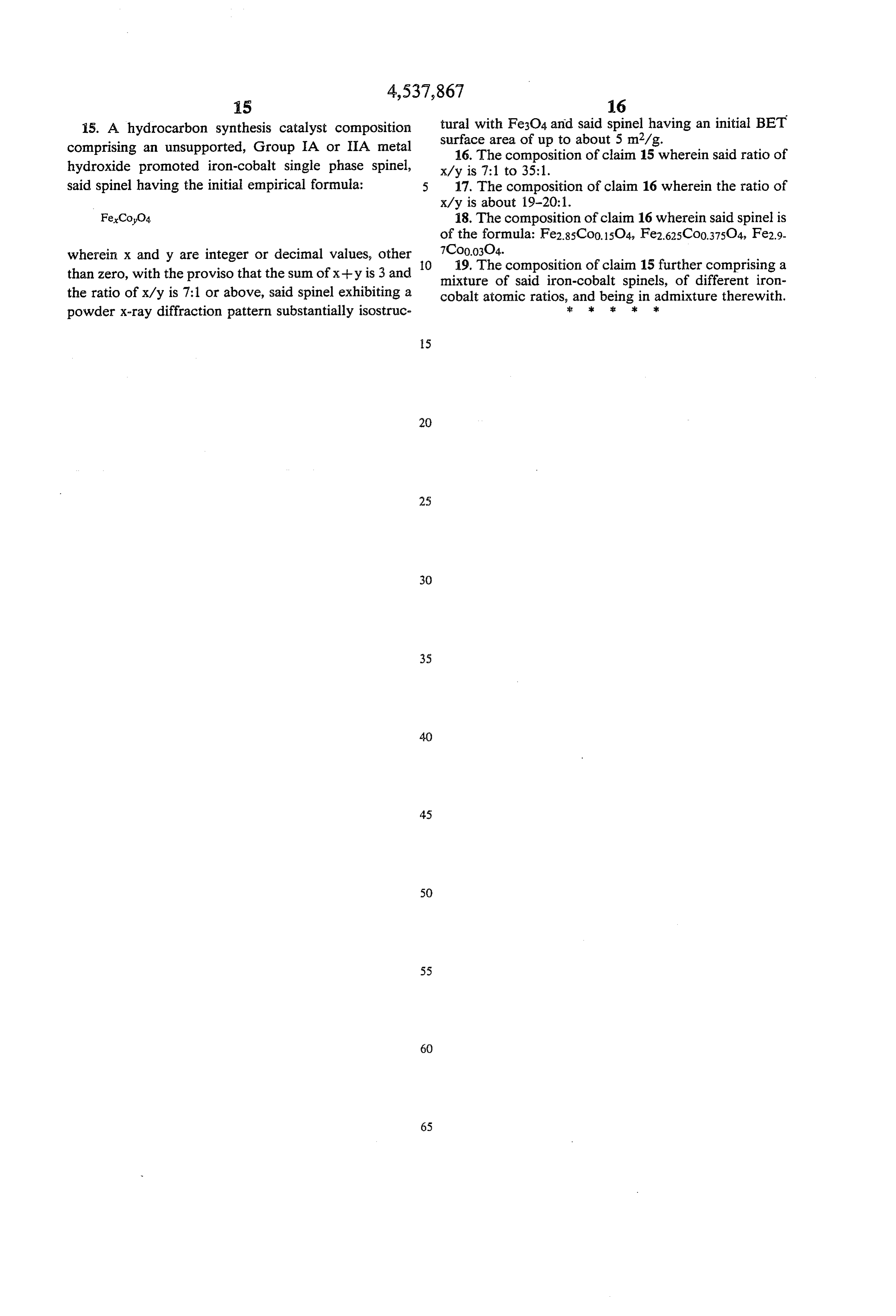
i5. A hydrocarbon synthesis catalyst composition tural with Fe3O4 and said spinel having an initial BET comprising an unsupported, Group IA or IIA metal surface area of up to about 5 m2/g. hydroxide promoted iron-cobalt single phase spinel, 16. The composition of claim 15 wherein said ratio of
said spinel having the initial empirical formula: 17. The composition of claim 16 wherein the ratio of
FeCoO4 18. The composition of claim 16 wherein said spinel is
wherein x and y are integer or decimal values, other 10 19. The composition of claim 15 further comprising a than zero, with the proviso that the sum of x-y is 3 and mixture of said iron-cobalt spinels, of different iron the ratio of x/y is 7:1 or above, said spinel exhibiting a cobalt atomic ratios, and being in admixture therewith. powder X-ray diffraction pattern substantially isostruc : *k s k s
Provenance
- Collection
- Cited prior art
- Original PDF
- patentimages.storage.googleapis.com →
- Filed
- 1983-12-14
- Pages
- 9
- Method
- pdftotext (the PDF's own text layer) + pdftoppm 300dpi page scans
- Source
- Google Patents bibliographic record
- Granted
- 1985-08-27
- Inventors
- Rocco A. Fiato; Stuart L. Soled; Angelo A. Montagna; Exxon Research and Engineering Co
- Transcribed from
- patentimages.storage.googleapis.com →