patent · US4394231
Cathode for the electrolytic production of hydrogen
19 July 1983
Page 1 — bibliographic record
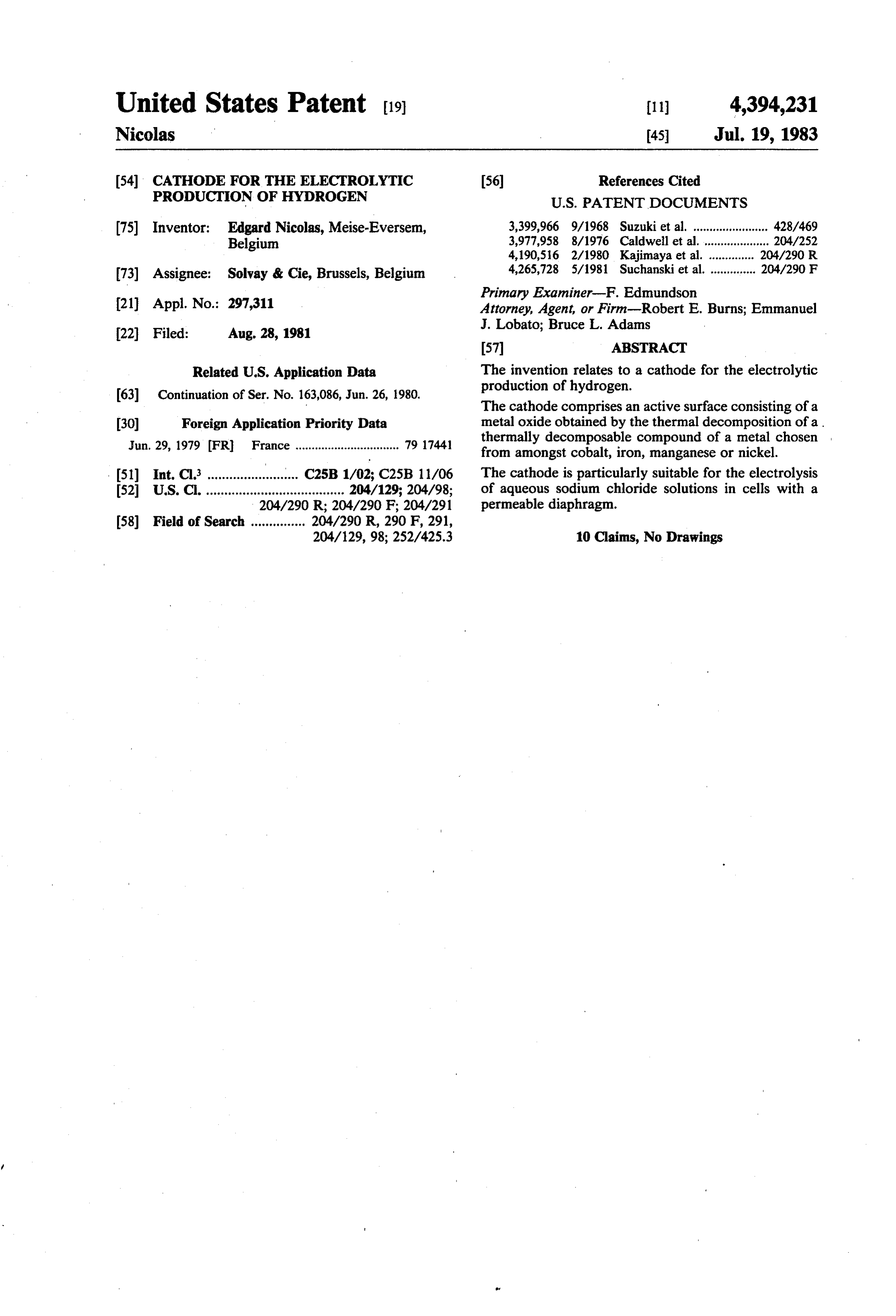
United States Patent (19) 11 4,394,231 Nicolas 45 Jul. 19, 1983 (54). CATHODE FOR THE ELECTROLYTIC 56) References Cited PRODUCTION OF HYDROGEN U.S. PATENT DOCUMENTS 75) Inventor: Edgard Nicolas, Meise-Eversem, 3,399,966 9/1968 Suzuki et al. ....................... 428/469 Belgium 3,977,958 8/1976 Caldwell et al..................... 204/252
73) Assignee: Solvay & Cie, Brussels, Belgium 4,265,728 5/1981 Suchanski et al. .............. 204/290 F Primary Examiner-F. Edmundson 21 Appl. No.: 297,311 Attorney, Agent, or Firm-Robert E. Burns; Emmanuel 22 Filed: Aug. 28, 1981 J. Lobato; Bruce L. Adams
Related U.S. Application Data The invention relates to a cathode for the electrolytic production of hydrogen.
The cathode comprises an active surface consisting of a 30 Foreign Application Priority Data metal oxide obtained by the thermal decomposition of a . Jun. 29, 1979 FR) France ................................ 79 1744 thermally decomposable compound of a metal chosen from amongst cobalt, iron, manganese or nickel.
51) Int. Cl.3 ......................... C25B 1/02; C25B 11/06 The cathode is particularly suitable for the electrolysis 52 U.S. C. ...................................... 204/129; 204/98; of aqueous sodium chloride solutions in cells with a 204/290 R; 204/290 F; 204/291 permeable diaphragm.
204/129,98; 252/425.3 10 Claims, No Drawings
Page 2
decomposition, in an inert or reducing atmosphere, of a
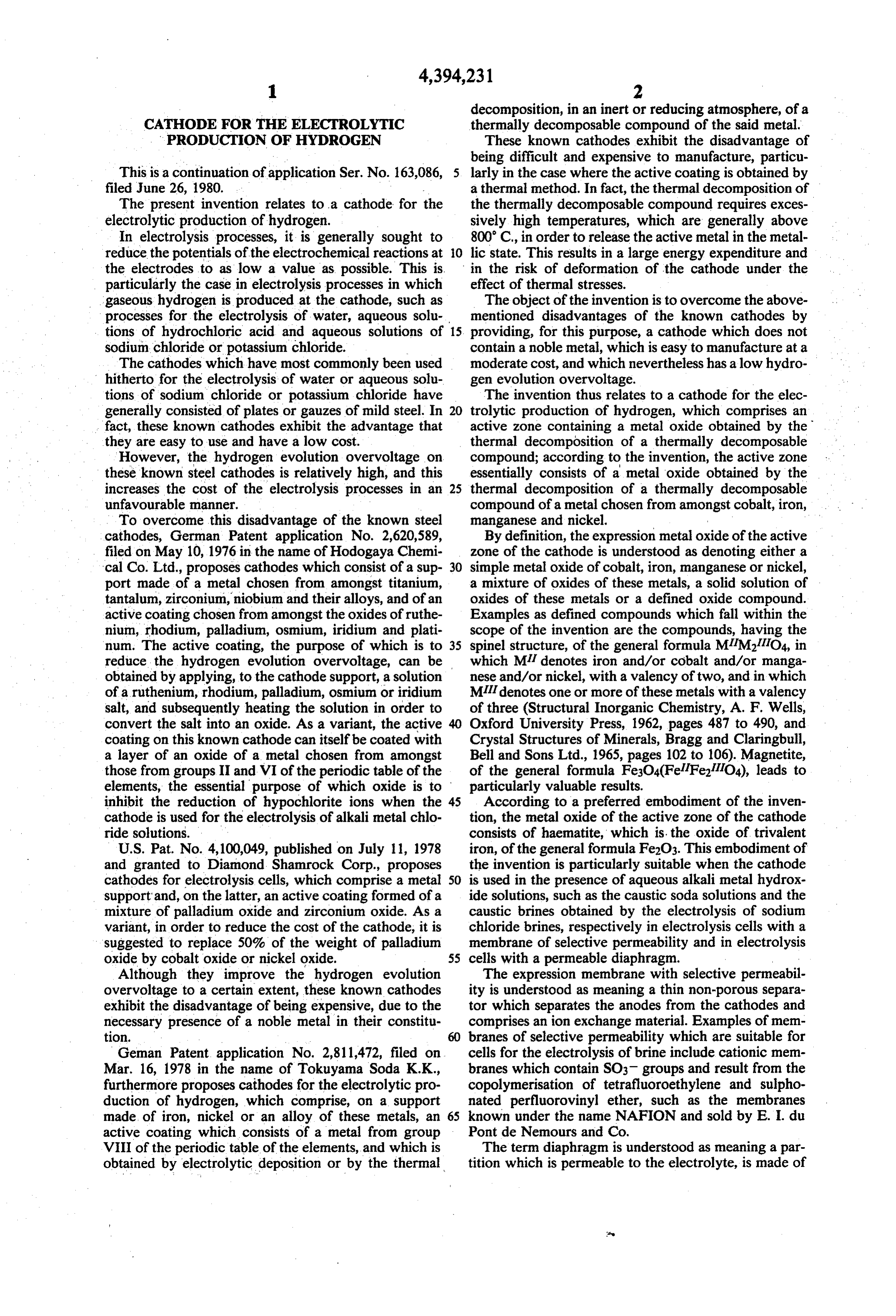
CATHODE FOR THEELECTROLYTIC thermally decomposable compound of the said metal. PRODUCTION OF HYDROGEN These known cathodes exhibit the disadvantage of being difficult and expensive to manufacture, particu
This is a continuation of application Ser. No. 163,086, 5 larly in the case where the active coating is obtained by filed June 26, 1980. a thermal method. In fact, the thermal decomposition of The present invention relates to a cathode for the the thermally decomposable compound requires exces electrolytic production of hydrogen. sively high temperatures, which are generally above In electrolysis processes, it is generally sought to 800 C., in order to release the active metal in the metal reduce the potentials of the electrochemical reactions at O lic state. This results in a large energy expenditure and the electrodes to as low a value as possible. This is. in the risk of deformation of the cathode under the particularly the case in electrolysis processes in which effect of thermal stresses.
gaseous hydrogen is produced at the cathode, such as The object of the invention is to overcome the above processes for the electrolysis of water, aqueous solu mentioned disadvantages of the known cathodes by tions of hydrochloric acid and aqueous solutions of 15 providing, for this purpose, a cathode which does not sodium chloride or potassium chloride. contain a noble metal, which is easy to manufacture at a The cathodes which have most commonly been used moderate cost, and which nevertheless has a low hydro hitherto for the electrolysis of water or aqueous solu gen evolution overvoltage.
tions of sodium chloride or potassium chloride have The invention thus relates to a cathode for the elec generally consisted of plates or gauzes of mild steel. In 20 trolytic production of hydrogen, which comprises an fact, these known cathodes exhibit the advantage that active zone containing a metal oxide obtained by the they are easy to use and have a low cost. thermal decomposition of a thermally decomposable However, the hydrogen evolution overvoltage on compound; according to the invention, the active zone these known steel cathodes is relatively high, and this essentially consists of a metal oxide obtained by the increases the cost of the electrolysis processes in an 25 thermal decomposition of a thermally decomposable unfavourable manner. compound of a metal chosen from amongst cobalt, iron, To overcome this disadvantage of the known steel manganese and nickel.
cathodes, German Patent application No. 2,620,589, By definition, the expression metal oxide of the active filed on May 10, 1976 in the name of Hodogaya Chemi zone of the cathode is understood as denoting either a cal Co. Ltd., proposes cathodes which consist of a sup 30 simple metal oxide of cobalt, iron, manganese or nickel, port made of a metal chosen from amongst titanium, a mixture of oxides of these metals, a solid solution of tantalum, zirconium, niobium and their alloys, and of an oxides of these metals or a defined oxide compound. active coating chosen from amongst the oxides of ruthe Examples as defined compounds which fall within the nium, rhodium, palladium, osmium, iridium and plati scope of the invention are the compounds, having the num. The active coating, the purpose of which is to 35 spinel structure, of the general formula MIM2O4, in reduce the hydrogen evolution overvoltage, can be which Mi denotes iron and/or cobalt and/or manga obtained by applying, to the cathode support, a solution nese and/or nickel, with a valency of two, and in which of a ruthenium, rhodium, palladium, osmium or iridium MII denotes one or more of these metals with a valency salt, and subsequently heating the solution in order to of three (Structural Inorganic Chemistry, A. F. Wells, convert the salt into an oxide. As a variant, the active 40 Oxford University Press, 1962, pages 487 to 490, and coating on this known cathode can itself be coated with Crystal Structures of Minerals, Bragg and Claringbull, a layer of an oxide of a metal chosen from amongst Bell and Sons Ltd., 1965, pages 102 to 106). Magnetite, those from groups II and VI of the periodic table of the of the general formula Fe3O4(FeFe2O4), leads to elements, the essential purpose of which oxide is to particularly valuable results.
inhibit the reduction of hypochlorite ions when the 45 According to a preferred embodiment of the inven cathode is used for the electrolysis of alkali metal chlo tion, the metal oxide of the active zone of the cathode ride solutions. consists of haematite, which is the oxide of trivalent U.S. Pat. No. 4,100,049, published on July 11, 1978 iron, of the general formula Fe2O3. This embodiment of and granted to Diamond Shamrock Corp., proposes the invention is particularly suitable when the cathode cathodes for electrolysis cells, which comprise a metal 50 is used in the presence of aqueous alkali metal hydrox support and, on the latter, an active coating formed of a ide solutions, such as the caustic soda solutions and the mixture of palladium oxide and zirconium oxide. As a caustic brines obtained by the electrolysis of sodium variant, in order to reduce the cost of the cathode, it is chloride brines, respectively in electrolysis cells with a suggested to replace 50% of the weight of palladium membrane of selective permeability and in electrolysis oxide by cobalt oxide or nickel oxide. 55 cells with a permeable diaphragm. Although they improve the hydrogen evolution The expression membrane with selective permeabil over voltage to a certain extent, these known cathodes ity is understood as meaning a thin non-porous separa exhibit the disadvantage of being expensive, due to the tor which separates the anodes from the cathodes and necessary presence of a noble metal in their constitu comprises an ion exchange material. Examples of mem tion. branes of selective permeability which are suitable for Geman Patent application No. 2,811,472, filed on cells for the electrolysis of brine include cationic mem Mar. 16, 1978 in the name of Tokuyama Soda K.K., branes which contain SO3 groups and result from the furthermore proposes cathodes for the electrolytic pro copolymerisation of tetrafluoroethylene and sulpho duction of hydrogen, which comprise, on a support nated perfluorovinyl ether, such as the membranes made of iron, nickel or an alloy of these metals, an 65 known under the name NAFION and sold by E. I. du active coating which consists of a metal from group Pont de Nemours and Co.
VIII of the periodic table of the elements, and which is The term diaphragm is understood as meaning a par obtained by electrolytic deposition or by the thermal tition which is permeable to the electrolyte, is made of
Page 3
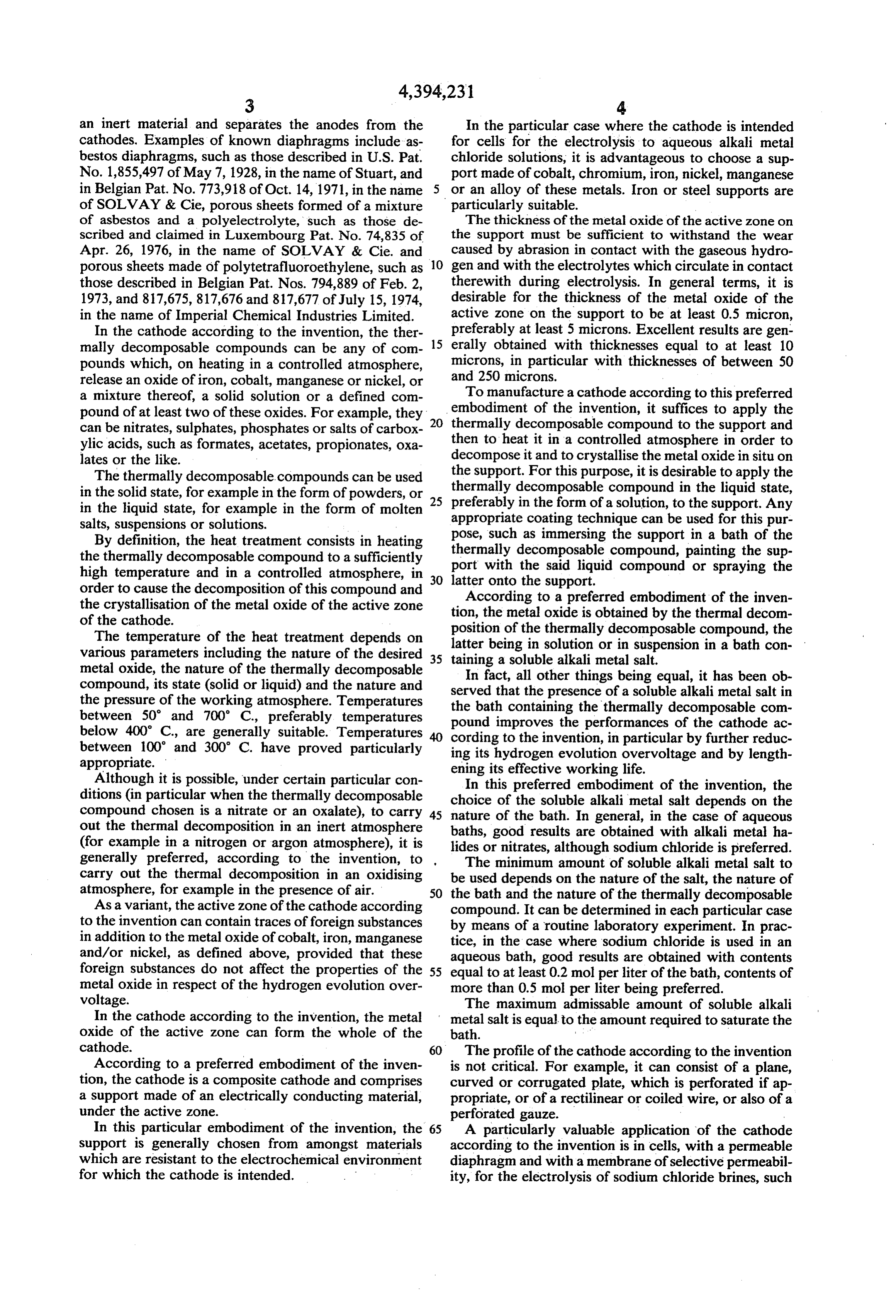
an inert material and separates the anodes from the In the particular case where the cathode is intended cathodes. Examples of known diaphragms include as for cells for the electrolysis to aqueous alkali metal bestos diaphragms, such as those described in U.S. Pat. chloride solutions, it is advantageous to choose a sup No. 1,855,497 of May 7, 1928, in the name of Stuart, and port made of cobalt, chromium, iron, nickel, manganese in Belgian Pat. No. 773,918 of Oct. 14, 1971, in the name or an alloy of these metals. Iron or steel supports are of SOLVAY & Cie, porous sheets formed of a mixture particularly suitable.
of asbestos and a polyelectrolyte, such as those de The thickness of the metal oxide of the active zone on scribed and claimed in Luxembourg Pat. No. 74,835 of the support must be sufficient to withstand the wear Apr. 26, 1976, in the name of SOLVAY & Cie. and caused by abrasion in contact with the gaseous hydro porous sheets made of polytetrafluoroethylene, such as 10 gen and with the electrolytes which circulate in contact those described in Belgian Pat. Nos. 794,889 of Feb. 2, therewith during electrolysis. In general terms, it is 1973, and 817,675, 817,676 and 817,677 of July 15, 1974, desirable for the thickness of the metal oxide of the in the name of Imperial Chemical Industries Limited. active zone on the support to be at least 0.5 micron, In the cathode according to the invention, the ther 15 preferably at least 5 microns. Excellent results are gen mally decomposable compounds can be any of com erally obtained with thicknesses equal to at least 10 pounds which, on heating in a controlled atmosphere, microns, in particular with thicknesses of between 50 release an oxide of iron, cobalt, manganese or nickel, or and 250 microns.
a mixture thereof, a solid solution or a defined com To manufacture a cathode according to this preferred pound of at least two of these oxides. For example, they 20 embodiment of the invention, it suffices to apply the can be nitrates, sulphates, phosphates or salts of carbox thermally decomposable compound to the support and then to heat it in a controlled atmosphere in order to ylic acids, such as formates, acetates, propionates, oxa decompose lates or the like. it and to crystallise the metal oxide in situ on The thermally decomposable compounds can be used thermally the support. For this purpose, it is desirable to apply the in the solid state, for example in the form of powders, or 25 preferably decomposable in the form of a compound in the liquid state, solution, to the support. Any in the liquid state, for example in the form of molten appropriate coating technique can be used for this pur salts, suspensions or solutions. pose, such as immersing the support in a bath of the By definition, the heat treatment consists in heating thermally decomposable compound, painting the sup the thermally decomposable compound to a sufficiently port with the said liquid compound or spraying the high temperature and in a controlled atmosphere, in 30 latter onto the support.
order to cause the decomposition of this compound and According to a preferred embodiment of the inven the crystallisation of the metal oxide of the active zone tion, the metal oxide is obtained by the thermal decom of the cathode. position of the thermally decomposable compound, the The temperature of the heat treatment depends on latter being in solution or in suspension in a bath con various parameters including the nature of the desired 35 taining a soluble alkali metal salt. metal oxide, the nature of the thermally decomposable In fact, all other things being equal, it has been ob compound, its state (solid or liquid) and the nature and served that the presence of a soluble alkali metal salt in the pressure of the working atmosphere. Temperatures the bath containing the thermally between 50 and 700° C., preferably temperatures pound improves the performancesdecomposable of the cathode com
below 400 C., are generally suitable. Temperatures cording to the invention, in particular by further reduc between 100 and 300 C. have proved particularly ing its hydrogen evolution overvoltage and by length appropriate. ening its effective working life. Although it is possible, under certain particular con In this preferred embodiment of the invention, the ditions (in particular when the thermally decomposable choice of the soluble alkali metal salt depends on the compound chosen is a nitrate or an oxalate), to carry 45 nature of out the thermal decomposition in an inert atmosphere baths, goodtheresultsbath. In general, in the case of aqueous are obtained with alkali metal ha (for example in a nitrogen or argon atmosphere), it is lides or nitrates, although generally preferred, according to the invention, to . The minimum amount ofsodium chloride is preferred. soluble alkali metal salt to carry out the thermal decomposition in an oxidising be used depends on the nature of the salt, the nature of atmosphere, for example in the presence of air. 50 the bath and the nature of the thermally decomposable As a variant, the active zone of the cathode according compound. It can be determined in each particular case to the invention can contain traces of foreign substances by means of a routine laboratory experiment. In prac in addition to the metal oxide of cobalt, iron, manganese tice, in the case where sodium chloride is used in an and/or nickel, as defined above, provided that these aqueous bath, good results are obtained with contents foreign substances do not affect the properties of the 55 equal to at least 0.2 mol per liter of the bath, contents of metal oxide in respect of the hydrogen evolution over more than 0.5 mol per liter being preferred. voltage. The maximum admissable amount of soluble alkali In the cathode according to the invention, the metal metal salt is equal to the amount required to saturate the oxide of the active zone can form the whole of the bath.
cathode. 60 The profile of the cathode according to the invention According to a preferred embodiment of the inven is not critical. For example, it can consist of a plane, tion, the cathode is a composite cathode and comprises curved or corrugated plate, which is perforated if ap a support made of an electrically conducting material, propriate, or of a rectilinear or coiled wire, or also of a under the active zone. perforated gauze.
In this particular embodiment of the invention, the 65 A particularly valuable application of the cathode support is generally chosen from amongst materials according to the invention is in cells, with a permeable which are resistant to the electrochemical environment diaphragm and with a membrane of selective permeabil for which the cathode is intended. - ity, for the electrolysis of sodium chloride brines, such
Page 4
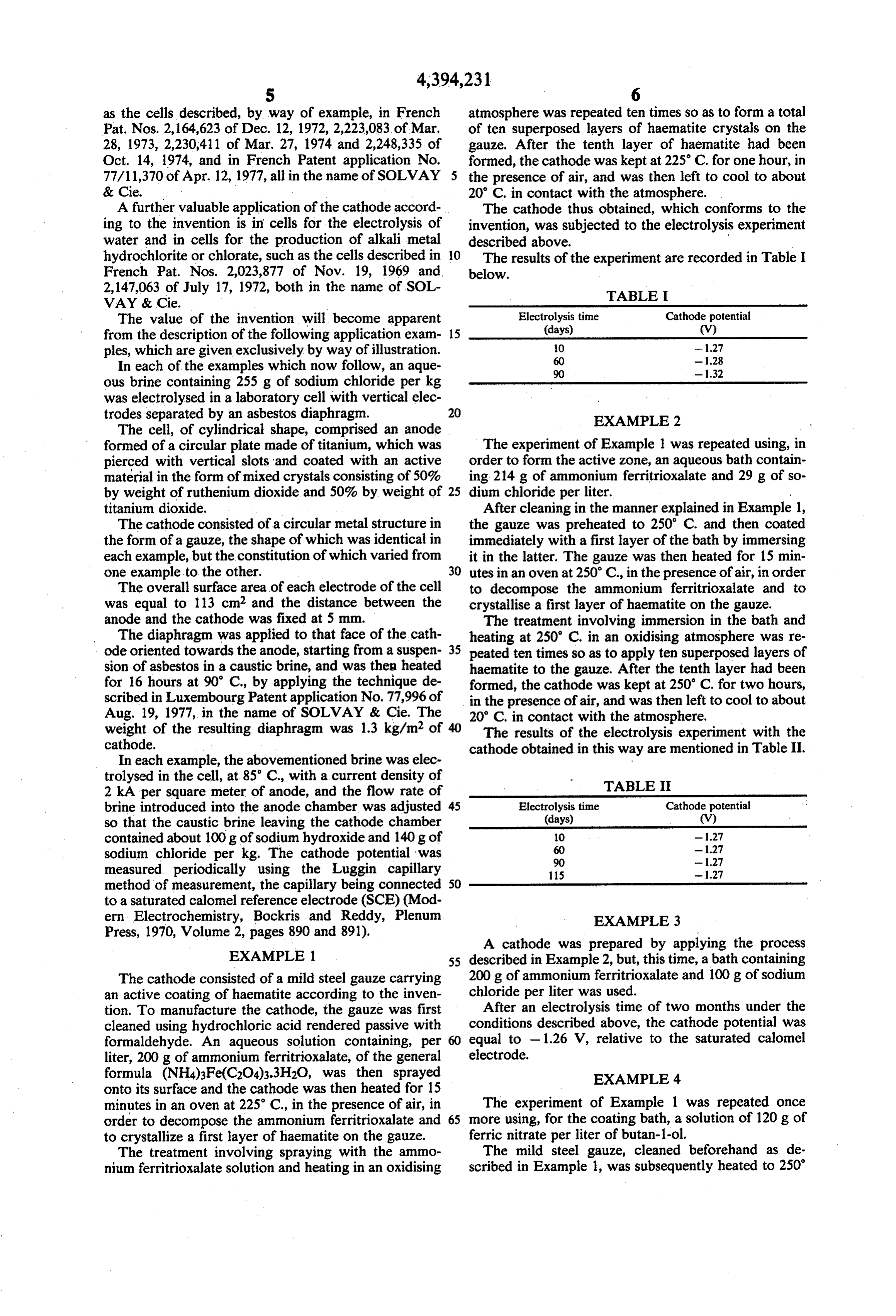
as the cells described, by way of example, in French atmosphere was repeated ten times so as to form a total Pat. Nos. 2,164,623 of Dec. 12, 1972, 2,223,083 of Mar. of ten superposed layers of haematite crystals on the 28, 1973, 2,230,411 of Mar. 27, 1974 and 2,248,335 of gauze. After the tenth layer of haematite had been Oct. 14, 1974, and in French Patent application No. formed, the cathode was kept at 225 C. for one hour, in 77/11,370 of Apr. 12, 1977, all in the name of SOLVAY 5 the presence of air, and was then left to cool to about & Cie. 20 C. in contact with the atmosphere. A further valuable application of the cathode accord The cathode thus obtained, which conforms to the ing to the invention is in cells for the electrolysis of invention, was subjected to the electrolysis experiment water and in cells for the production of alkali metal described above.
hydrochlorite or chlorate, such as the cells described in 10 The results of the experiment are recorded in Table I French Pat. Nos. 2,023,877 of Nov. 19, 1969 and below.
2,147,063 of July 17, 1972, both in the name of SOL TABLE I VAY & Cie.
The value of the invention will become apparent Electrolysis time Cathode potential from the description of the following application exam 15 (days) (V) ples, which are given exclusively by way of illustration. 60
In each of the examples which now follow, an aque 90 - 1.32 ous brine containing 255 g of sodium chloride per kg was electrolysed in a laboratory cell with vertical elec trodes separated by an asbestos diaphragm. 20
EXAMPLE 2
The cell, of cylindrical shape, comprised an anode formed of a circular plate made of titanium, which was The experiment of Example 1 was repeated using, in pierced with vertical slots and coated with an active order to form the active zone, an aqueous bath contain material in the form of mixed crystals consisting of 50% ing 214 g of ammonium ferritrioxalate and 29 g of so by weight of ruthenium dioxide and 50% by weight of 25 dium chloride per liter.
titanium dioxide. After cleaning in the manner explained in Example 1, The cathode consisted of a circular metal structure in the gauze was preheated to 250 C. and then coated the form of a gauze, the shape of which was identical in immediately with a first layer of the bath by immersing each example, but the constitution of which varied from it in the latter. The gauze was then heated for 15 min one example to the other. 30 utes in an oven at 250 C., in the presence of air, in order The overall surface area of each electrode of the cell to decompose the ammonium ferritrioxalate and to was equal to 113 cm2 and the distance between the crystallise a first layer of haematite on the gauze. anode and the cathode was fixed at 5 mm. The treatment involving immersion in the bath and The diaphragm was applied to that face of the cath heating at 250 C. in an oxidising atmosphere was re ode oriented towards the anode, starting from a suspen 35 peated ten times so as to apply ten superposed layers of sion of asbestos in a caustic brine, and was then heated haematite to the gauze. After the tenth layer had been for 16 hours at 90° C., by applying the technique de formed, the cathode was kept at 250 C. for two hours, scribed in Luxembourg Patent application No. 77,996 of in the presence of air, and was then left to cool to about Aug. 19, 1977, in the name of SOLVAY & Cie. The 20 C. in contact with the atmosphere.
weight of the resulting diaphragm was 1.3 kg/m2 of 40 The results of the electrolysis experiment with the cathode. cathode obtained in this way are mentioned in Table II. In each example, the abovementioned brine was elec trolysed in the cell, at 85°C., with a current density of TABLE II 2 kA per square meter of anode, and the flow rate of brine introduced into the anode chamber was adjusted 45 Electrolysis time Cathode potential so that the caustic brine leaving the cathode chamber (days) (V) contained about 100g of sodium hydroxide and 140 g of 10
sodium chloride per kg. The cathode potential was 90 - 1.27 measured periodically using the Luggin capillary 115 -1.27 method of measurement, the capillary being connected 50 to a saturated calomel reference electrode (SCE) (Mod ern Electrochemistry, Bockris and Reddy, Plenum EXAMPLE 3 Press, 1970, Volume 2, pages 890 and 891). A cathode was prepared by applying the process EXAMPLE 1. 55 described in Example 2, but, this time, a bath containing The cathode consisted of a mild steel gauze carrying 200 g of ammonium ferritrioxalate and 100 g of sodium an active coating of haematite according to the inven chloride per liter was used. tion. To manufacture the cathode, the gauze was first After an electrolysis time of two months under the cleaned using hydrochloric acid rendered passive with conditions described above, the cathode potential was formaldehyde. An aqueous solution containing, per equal to -1.26 V, relative to the saturated calomel liter, 200 g of ammonium ferritrioxalate, of the general electrode.
formula (NH4)3Fe(C2O4)3.3H2O, was then sprayed EXAMPLE 4 onto its surface and the cathode was then heated for 15 minutes in an oven at 225 C., in the presence of air, in The experiment of Example 1 was repeated once order to decompose the ammonium ferritrioxalate and 65 more using, for the coating bath, a solution of 120 g of to crystallize a first layer of haematite on the gauze. ferric nitrate per liter of butan-1-ol. The treatment involving spraying with the ammo The mild steel gauze, cleaned beforehand as de nium ferritrioxalate solution and heating in an oxidising scribed in Example 1, was subsequently heated to 250
Page 5
C. and then immersed in the coating bath in order to potential and, consequently, the energy efficiency of the form the layer of solution thereon. electrolysis cells.
The heat treatment was identical to that of Example I claim:
2, except that the heating time for each layer, in the 1. In a process for the production of hydrogen in an oven at 250 C., was ten minutes. Furthermore, after the electrolytic cell, wherein hydrogen is electrolytically tenth layer of iron oxide had been formed on the cath produced on the active zone of a cathode, the improve ode, the latter was heated for 16 hours at 350 C. and ment consisting in that the cathode active zone essen then cooled to about 20° C. in contact with the atmo tially consists of a metal oxide produced by the thermal sphere. decomposition of a thermally decomposable compound After an electrolysis time of one month under the 10 of a metal selected from the group consisting of cobalt, experimental conditions described above, the cathode iron, maganese and nickel, said metal oxide being pro had a potential equal to -1.28 V, relative to the satu duced in situ on a support made of an electrically con rated calomel electrode. ducting material selected from the group consisting of cobalt, chromium, iron, maganese, nickel and alloys of
In this experiment, an active zone formed of cobalt oxide 2. A process according to claim 1, in which the metal oxide was applied to the mild steel gauze. is obtained by the thermal decomposition of a thermally
To do this, after cleaning in the manner described in group consisting decomposable compound chosen from the Example 1, the mild steel gauze was immersed in an 20 salts of carboxylicofacids. nitrates, sulphates, phosphates and aqueous bath containing 291 g of cobalt nitrate hexahy 3. A process according to claim 1, in which the metal drate, of the general formula Co(NO3)2.6H2O, and 255 oxide is obtained by the thermal decomposition of said g of sodium nitrate per liter. thermally decomposable compound in an oxidizing The gauze impregnated with a first layer of the bath medium.
was then heated for 15 minutes in an oven at 250 C., in 25 4. A process according to claim 3, in which the metal the presence of air, so as to decompose the cobalt nitrate oxide is obtained by the thermal decomposition of said and to form a layer of cobalt oxide. thermally decomposable compound at a temperature The treatment involving immersion and heating at between 100' and 300 C.
250 C. was repeated five times so as to apply five super 5. A process according to any one of claims 1 to 4, in posed layers of cobalt oxide to the gauze. After the fifth 30 which the metal oxide is haematite. layer had been formed, the cathode was kept at 250 C. 6. A process according to any one of claims 1 to 4, in for one hour and then cooled in contact with the atmo which the metal oxide is obtained by the thermal de sphere. composition of the thermally decomposable compound, After an electrolysis time of 30 days under the condi the latter being in solution in a bath containing a soluble tions described above, the cathode potential was equal 35 alkali metal salt.
to - 1.31 V, relative to the saturated calomel electrode. 7. A process according to claim 6, in which the solu ble alkali metal salt is an alkali metal halide.
EXAMPLE 6 8. A process according to claim 7, in which the solu By way of comparison, a cathode of the prior art was ble alkali metal salt is sodium chloride. used; this cathode consisted of a mild steel gauze which contains9. A process according to claim 8, in which the bath was identical to that of Examples 1 to 3 and was only liter. at least 0.5 mol of soluble alkali metal salt per cleaned by treatment with hydrochloric acid rendered 10. In a process for the production of hydrogen, passive with formaldehyde, and was then mounted as wherein hydrogen is electrolytically produced on the such in the experimental electrolysis cell. 45 active zone of a cathode, the improvement in that the As from the start of electrolysis, the cathode potential cathode was -1.41 V, relative to the saturated calomel elec producedactive zone consists essentially of iron oxide by applied to a cathode support comprising a trode; after 70 days of experiments, the cathode poten mild steel gauze, a thermally decomposable compound tial was equal to -1.45 V, relative to the saturated of iron, heating said support with said compound calomel electrode. 50 thereon in an oxidizing atmosphere to convert said Comparison of the electrolysis results of Examples 1 compound into an oxide and repeating said applying to 3 (according to the invention) with those of Example and heating steps to form on said support an oxide coat 4 (prior art) immediately shows the advance made by ing having a thickness of at least 10 microns. the invention as regards the magnitude of the cathode 3: s s:
Provenance
- Collection
- Cited prior art
- Original PDF
- patentimages.storage.googleapis.com →
- Filed
- 1981-08-28
- Pages
- 5
- Method
- pdftotext (the PDF's own text layer) + pdftoppm 300dpi page scans
- Source
- Google Patents bibliographic record
- Granted
- 1983-07-19
- Inventors
- Edgard Nicolas; Solvay SA
- Transcribed from
- patentimages.storage.googleapis.com →